A Hierarchic Task-Based Programming
Model for Distributed Heterogeneous
Computing
Jorge Ejarque
1, Marc Dom´ınguez
1and Rosa M. Badia
1,2Abstract
Distributed computing platforms are evolving to heterogeneous ecosystems with Clusters, Grids and Clouds introducing in its computing nodes, processors with different core architectures, accelerators (i.e GPUs, FPGAs), as well as different memories and storage devices in order to achieve better performance with lower energy consumption. As a consequence of this heterogeneity, programming applications for these distributed heterogeneous platforms becomes a complex task. Additionally to the complexity of developing an application for distributed platforms, developers must also deal now with the complexity of the different computing devices inside the node. In this paper, we present a programming model that aims to facilitate the development and execution of applications in current and future distributed heterogeneous parallel architectures. This programming model is based on the hierarchical composition of the COMP Superscalar (COMPSs) and Omp Superscalar (OmpSs) programming models, that allow developers to implement infrastructure-agnostic applications. The underlying runtime enables applications to adapt to the infrastructure without the need of maintaining different versions of the code. Our programming model proposal has been evaluated on real platforms, in terms of heterogeneous resource usage, performance, and adaptation.
Keywords
Distributed Computing, Heterogeneous Computing, Task-based Parallel Programming Models
the development and execution of applications for future distributed heterogeneous architectures. This programming model is based on a hierarchical combination of the COMP Superscalar (COMPSs) (Badia et al. 2015) and the OMP Superscalar (OmpSs) (Duran et al. 2011) task-based programming models, where COMPSs deals with the distributed platform heterogeneity and OmpSs deals with the intra-node heterogeneity following the same programming paradigm. This approach facilitates application development, since developers do not require to learn several programming models and resource provider APIs, and the resultant application is infrastructure-agnostic. During the application execution, the programming model runtime detects the inherent application parallelism by analysing data dependencies between application tasks, and transparently manages their execution in the different computing devices. Apart from the basic execution management, the runtime is also capable of adapting the application execution to the underlying infrastructure by selecting the most appropriate available device for each type of tasks and deciding the number of resources to use according to the number of parallel tasks. All these features are provided without having to maintain different versions of the code. The rest of the paper is organized as follows: Section presents the related work; The programming model
1Barcelona Supercomputing Center (BSC), Spain
2Artificial Intelligence Research Institute - Spanish National Research Council (CSIC), Spain
Email: {jorge.ejarque, rosa.m.badia}@bsc.es
Introduction
In recent years, the computing ecosystem is becoming more and more heterogeneous. On the one hand, trends in computer architecture focus on providing different computingdevices(CPUs,GPUsandFPGAs)andmemories inasinglechiporcomputingnode,withtheaimofproviding better computing devices for different typesof algorithms andapplications.On theotherhand,distributedcomputing platforms such as Clusters, Grids and Clouds, which traditionally have been composed of homogeneous nodes, are starting to be built with heterogeneous nodes, which include processors with different core types, accelerators and memory capacities. This heterogeneity is required to achieve better computing performance with lower energy consumption. However, the development of applications formachines withpowerfulcomputingdevices requiresan extraordinary effortby developers.Learning how tobetter usethesecomputingresources is noteasy, sinceexecuting the same algorithm in one or another device can have different outcomes in terms of performance and energy consumption. Therefore, selecting the proper device for eachapplication partisakey factortoachieve anefficient applicationexecution.
Moreover, programming these heterogeneous platforms is not an easy task. For each accelerator, the developer has to add some specificc odet oe nablet heapplication execution in the computing device (e.g. manage transfers between device memories, spawn processes on these devices and collect the results). For that reason, in the framework of the TANGO project (Djemame et al. 2019), we propose a programming model to facilitate
expressed as futures or continuations, the level of look-ahead they support is limited in practice.
In any case, these solutions are just able to manage the heterogeneity inside a node. If the application requires to run in several nodes (e.g. big amount of data or large parallelism), the solutions mentioned before must be combined with other distributed computing frameworks that manage the processes’ spawning and data movements between the different computing nodes. Developers can program this by hand using the TCP/IP and threading libraries, but this option requires a lot of programming effort and parallel programming skills. One of these distributed computing frameworks is MPI (MPI Forum 2015). It provides an API for interchanging data messages between the different processes for Single Program Multiple Data (SPMD) applications. Another option are PGAS programming models such as GASPI (Alrutz et al. 2013) or UPC (El-Ghazawi and Smith 2006), which allow to create a global address space and use shared memory programs in different nodes. Both options are working quite well running SPMD applications in homogeneous clusters interconnected with a very fast network. However, in heterogeneous environments distributed across different locations they are not reaching good performance due to the long latency of the Wide Area Network.
Other approaches to distributed computing can be found in data analytic frameworks such as MapReduce (Dean and Ghemawat 2008), Spark (Zaharia et al. 2016), Graph-processing frameworks such as Pregel (Malewicz et al. 2010) or Deep learning frameworks such as TensorFlow (Abadi et al. 2016).
Workflow management systems are also an alternative for executing applications in distributed computing platforms. These tools provide an interface to describe and execute a workflow (Graphical or by means of a Workflow Description Language). This workflow description is mainly used to combine the execution of different binaries in a static way. Examples of these tools are Galaxy (Goecks et al. 2010), Taverna (Oinn et al. 2004), Kepler (Altintas et al. 2004) or Fireworks (Jain et al. 2015). Finally, we can also find task-based frameworks where users can implement workflows in a dynamic way such as Dask (Rocklin 2015), which provides a Python API to describe task-based workflow as programs and Parsl (Babuji et al. 2018) which from a Python interface enables the execution of workflows in distributed environments.
Finally, COMPSs (Badia et al. 2015) is the sibling of OmpSs for distributing computing. It applies the same concepts as OmpSs but instead of distributing tasks to the different devices of a node, it distributes tasks across computing nodes taking node heterogeneity into account.
In this paper, we propose to combine the COMPSs and OmpSs features to define a hierarchical programming model that enables the development of infrastructure-agnostic parallel applications. This proposal supports a single application code, which at execution is adapted by the runtime to the available underlying infrastructure. One relevant difference of this approach compared to others is that programming is simplified by the use of a single programming paradigm, which does not require the use of APIs to manage the interaction with different computing ispresentedinSection;Then,Section evaluatesaprototype
of this programming model; Finally, Section draws the conclusionsandpresentstheguidelinesforfuturework.
Related
Work
Asintroducedinpreviousparagraphs,computingnodesare incorporatingdifferenttypesofdevices inordertobemore efficientw henc omputingd ifferentt ypeso fapplications, either by accelerating the computation or by reducing the energyconsumed.However,thisbringsmorecomplexityto theapplicationdevelopment,sinceeachofthesedeviceshas its own programming language or API used tospawn the computationtothe different devices. Forinstance,FPGAs are traditionally programmed with the VHDL language; andfordeployingandrunningthecomputation,developers haveto use the tool chain provided by the FPGA vendor. A similar situation is given for General Purpose GPUs: NVIDIAofferstheCUDAframework(NVIDIACorp.2019) forprogrammingandrunningapplicationsintheirdevices, andothervendorsoffersimilarframeworkstodothesame.
Currentresearchis focusingonreducing thecomplexity of programming these heterogeneous nodes, as well as, providing portability between architectures allowing the reuseof code for similar devices. One example of this is OpenCL (Stone et al. 2010). It was developed with the intention of providing a common programming interface for heterogeneous devices (including not only GPUs, but also DSPs and FPGAs). With a syntax very similar to C, the same code can be used in several accelerators. However, similar to CUDA, it requires the programmer towrite specificc odef ord eviceh andling,w hichreduces programmability.OpenACC (OpenACC Consortium 2011) isanotherexample ofaprogramming standardfor parallel computing designed to simplify parallel programming of heterogeneousCPU/GPUsystems.Basedondirectives,the programmer can annotatethe code to indicate thoseparts thatshouldberunintheheterogeneousdevice.TheOpenMP standard(OpenMPArchitectureReviewBoard2018)tackles the programmability issuesfor heterogeneous devices ina similarwaytoOpenACC,however,it alsoconsiders many other aspects of parallelism which makes it a stronger option.Finally,OmpSs (Duranetal.2011)isatask-based programmingmodelproposedbyBSCwhichpromotesboth programmability and portability of codes. It hides to the programmer the architecture details, that are managed by theruntime instead of bythe developers.Forinstance,the parallelism of the architectures is inherently exploited by analyzing the data dependencies between tasks, and the allocation of memory in the device or data transfers are automaticallymanagedbytheruntime.
PGI (Group 2010) and HMPP (Dolbeau et al. 2007) programmingmodelsaretwootherapproachesquiterelated to OmpSs. PGI uses compiler technology to offloadthe executionofloopstotheaccelerators.HMPPalsoannotates as tasks functions to be offloadedt ot hea ccelerators.We thinkthatOmpSshashigherpotentialinthatitshiftspartof theintelligencethatHMPPandPGIdelegateinthecompiler tothe OmpSs runtime system. Although thesealternatives do support a fair amount of asynchronous computations
execute any implementation of the tasks according to the available resources. For instance, a part of an application can implement a feature programmed to run in a CPU. Moreover, a CUDA kernel which implements the same feature could be also available to run in a GPU. In this case, developers can define the CUDA kernel as a task which implements the CPU task behavior.
Also, in the case of coarse grain tasks, in addition to different implementations, developers can also add a
constraints directive to the tasks to specify the minimal resource requirements required to run this task type, a certain software, etc. The runtime takes these constraints into account when scheduling these tasks in resources which must fulfill them. For instance, for a coarse-grain task which is composed of a set of fine-grain tasks targeting accelerators we have to add a task constraint to indicate that it requires a given accelerator (i.e. a GPU, a FPGA, etc). Or in the case of coarse-grain tasks implementing a workflow of fine-grain tasks, the constraints directive can be also used to indicate the number of cores required to run the fine-grain tasks in parallel. An example of how an application is programmed is depicted in Section .
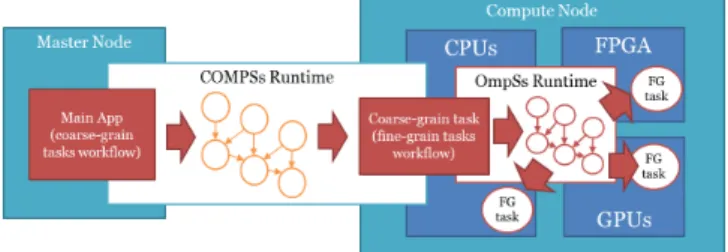
Figure 1. Application execution overview.
Figure 1 shows an overview of how applications are executed in the distributed environment. The main code of the application is linked to the platform-level runtime (COMPSs) which detects the data dependencies, builds a Direct-Acyclic-Graph (DAG) of the coarse-grain tasks. The COMPSs runtime also schedules dependency-free tasks taking into account data location and the coarse-grain constraints, deciding which tasks can run in parallel in each node and ensuring that the different tasks are not colliding in the use of resources. For instance, if there is a single GPU in a computing node, the runtime will not schedule two tasks requiring a GPU. Once the tasks have been assigned to a computing resource, the platform-level runtime will execute these tasks by initiating a node-level runtime (OmpSs) configured to use the assigned devices only. For each coarse-grain task, the node-level runtime builds a DAG of the fine grain tasks and schedules them in the resources assigned by the platform level scheduling.
The proposed programming model presents different advantages with respect to other approaches:
First, it provides a programming model which integrates distributed computing with heterogeneous systems, allowing developers to implement parallel applications in distributed heterogeneous environments without changing the program-ming model and paradigm. Programmers do not need to learn different programming model and APIs. They are only devices. In our proposal, the application execution is
transparentlydistributedbytheprogrammingmodelruntime to the different computing nodes of the platform and the heterogeneouscomputingdevicesavailableineachnode.
Programming
Model
StarSs is a family of task-based programming models where developers defines omep artso ft heapplication as tasks, indicating the direction of the data required by those tasks. Based on these annotations the programming model runtime analyzes data dependencies between the definedt asks,d etectingt hei nherentp arallelismand schedulingthetasks ontheavailable computingresources, managing the required data transfers and performing the tasks’ execution. Two frameworks currently compose the StarSs programming model family: COMP Superscalar (COMPSs), which provides the programming model and runtime implementation for distributed platforms such as Clusters,GridsandClouds,andOmpSuperscalar(OmpSs), which provides the programming model and runtime implementation for shared memory environments such as multicorearchitecturesandaccelerators(suchasGPUsand FPGAs).
The work presented in this paper proposes to combine COMPSs and OmpSs in a hierarchical way, where an applicationisrepresentedasaworkflowofcoarse-graintasks developedwithCOMPSs. Eachof thesecoarse-graintasks implementsaswellaworkflowofOmpSsfiner-graintasks. Atruntime,coarse-graintaskswillbemanagedbyCOMPSs runtime optimizing the execution in a platform level by distributingtasksinthe differentcompute nodesaccording tothe task requirements andthe clusterheterogeneity. On theotherhand,fine-graintaskswillbemanagedbyOmpSs which will optimize the execution of tasks at node level byschedulingtheminthedifferentdevicesavailableinthe assignednode.
To program an application with the proposed program-ming model, developers have to identify the parts of the code whichare candidates tobe coarse-graintasks. These are usually functions which are repeated several times in the code andwith enough computationto compensatethe overheadof spawningaremoteprocess(around 10ms).To indicatethatamethodisacoarse-graintask,developersjust needtoannotatethecodewithapreprocessordirectiveand alsoindicatethedirectionalityofthemethodparameters.The maincodeoftheapplicationcanbeimplementedasanormal sequentialC/C++code.Thesameprocedureisdoneforfine graintasks.Inthiscase,taskscanhavefinergranularitydue tothesharedmemoryenvironment.Inaddition,annotations for tasks that are accelerator kernels should also include atarget clause in the directive to differentiate them from regularCPUtasks.
In the case of the coarse-grain tasks, in addition to the normal task definition,t hep rogrammingmodel provides mechanisms to support different tasks’ versions andallocation of resources based on tasks’constraints, in ordertomakeapplicationcodesadaptabletotheunderlying infrastructure. By adding an implements clause in the directive, we are indicating that the task implements the same functionality as another task. So, the runtime can
i n t main ( i n t a r g c , c h a r a r g v ){ M a t r i x A , B , C ; i n t N = a t o i ( a r g v [ 1 ] ) ; i n t M = a t o i ( a r g v [ 2 ] ) ; c o m p s s o n ( ) ; / / Load M a t r i c e s M a t r i x A = M a t r i x : : i n i t ( N , M) ; M a t r i x B = M a t r i x : : i n i t ( N , M) ; M a t r i x C = M a t r i x : : i n i t ( N , M) ; / / C a l c u l a t e M a t r i x M u l t i p l i c a t i o n f o r( i n t i = 0 ; i<N ; i ++) { f o r( i n t j = 0 ; j<N ; j ++) { f o r( i n t k = 0 ; k<N ; k ++) { ( C . b l o c k [ i ] [ j ])−>m u l t i p l y B l o c k s (A . b l o c k [ i ] [ k ] , B . b l o c k [ k ] [ j ] ) ; } } } c o m p s s o f f ( ) ; }
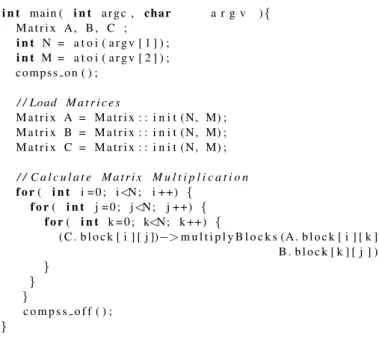
Figure 2. Matrix Multiplication main code. N is the number blocks and M is the number of elements per block
multiplication. The first level splits matrices into blocks and computes the matrix multiplication at the block level. Each block multiplication is defined as a coarse-grain task with two implementations one for CPUs and another for GPUs. The matrices’ blocks are also decomposed in smaller blocks, and the block multiplication task is is implemented as fine-grain tasks operating on sub-blocks. In the case of the GPU version, the fine-grain tasks are implemented by a CUDA kernel.
Figure 2 shows the main code of the benchmark application where a loop of the multiplyBlock coarse-grain task is implemented. As can be seen, nothing special must be included to call the coarse-grain tasks. They are called as regular functions.
Figure 3 depicts the two implementations of the block multiplication coarse-grain task. In that figure, we can see how developers define coarse-grain tasks with the#pragma compss task directive and the fine-grain tasks with the
#pragma omp task directive. We can also see in this figure how to include the implements clause to indicate that the Block::multiplyBlocks GPU task implements the same behavior as theBlock::multiplyBlockstask, and the#pragma compss constraintsdirective to define the task constraints for each implementation.
Regarding the fine-grain implementation, we can have different parallelization strategies depending on the com-puting device. In the CPU case, as they are executed in a shared-memory environment, a fine-grain level of tasks can be defined by annotating one of the inner loops of the block matrix multiplication. In the case of the figure, we have defined the second loop as a task, so each fine-grain task is in charge of computing a row of elements of the resultant block. In the GPU case, the big matrix blocks are decomposed in smaller blocks in order to fit in the GPU device memory and finer-grain tasks are defined as the multiplication of these small blocks. The fine-grain task in this case is the CUDA kernel defined by theMuldfunction which is annotated using requiredtodecidewhichpartsaretasks,thedirectionofits
data,anditsgranularitylevel.
Second,developersdonothavetodealwithdatatransfers, likeinMPI.Theprogrammingmodelruntimeanalyzesdata dependenciesatdistributedandnodelevels,andkeepstrack of the data locations during the execution. So, it tries to scheduletasksclosetotherequireddataandwhenthisisnot possible,it transparentlytransfers the datatothe available resource.
Third, we have extended the versioning and constraints capabilitiesof theseprogrammingmodelstomake applica-tionsadaptable.With theseextensions,developersare able todefinedifferentversionsoftasksfordifferentcomputing devices(CPU,GPUs,FPGA)orcombinationsofthem.So, the same application will be able to adapt its execution tothe different resource capabilities of the heterogeneous platformswithouthavingtomodifytheapplication.
Finally, intask-based programming models,the runtime has a deep knowledge of the application parallelism by analysing the generated task-dependency graph. For instance,it canbe aware of the parallel workload at each moment of the application execution using as estimation the equivalent load of the number of dependency-free tasks.Moreover,somedistributedcomputingplatformssuch as Clouds, or Slurm managed clusters allow users to dynamicallyrequestorreleaseresourcestotheirallocations. TheCOMPSsruntimeisabletocombinethistocapabilities in order to adapt the number of resources used by the applicationtoitsparallelworkload.
Evaluation
We have validated the proposed programming model with a prototype integration of the COMPSs and OmpSs programming model and we have deployed it in the MinoTauroclusterBarcelonaSupercomputingCenter(2019) at the Barcelona Supercomputing Center. MinoTauro is a heterogeneousclusterwhereeach nodecontains twoXeon processors with eight cores each and four NVIDIA K80 GPUs.Todemonstratethefeaturespresentedinthepaper,we haveimplementedtwo benchmark applications: thematrix multiplicationasanexampleforLinear-algebraapplications and the K-means clustering algorithm as an example of a Machine Learning application. With these applications, we have done three experiments. In the firstexperiment, we have executed the applications in different resource configurations,andwehavemeasuredtheexecutiontimeto seehow the programming model runtime is able todetect the available resources and select the appropriate tasks’ versionforeachconfiguration.Inthesecondexperiment,we evaluatethescalabilityoftheprototypeinbothapplications. Finally,withthethirdexperiment,weshowhowtheruntime adaptsthe used resources tothe application load. The rest of thesection is organizedas follows:First, we willshow howtheMatrixMultiplicationandK-meansapplicationsare implementedwiththeproposedmodelandafterthiswewill presenttheresultsoftheexperiments.
Application
Implementation
MatrixMultiplication The firsta pplicationu sedt ovalidate
#pragma compss c o n s t r a i n t s ( p r o c e s s o r s ={ p r o c e s s o r ( Type=CPU , C o m p u t i n g U n i t s = 6 )}) #pragma compss t a s k i n ( A , B ) v o i d B l o c k : : m u l t i p l y B l o c k s ( B l o c k A , B l o c k B ) { f o r (i n t i = 0 ; i<M; i ++) { # pragma omp t a s k i n (A . d a t a [ i ] [ 0 ;M] , \ B . d a t a [ 0 ;M] [ 0 ;M] ) o u t ( d a t a [ i ] [ 0 ;M] ) f o r (i n t j = 0 ; j<M; j ++) { f o r (i n t k = 0 ; k<M; k ++) { d a t a [ i ] [ j ] += A . d a t a [ i ] [ k ]∗B . d a t a [ k ] [ j ] ; } } } # pragma omp t a s k w a i t } #pragma compss c o n s t r a i n t s ( p r o c e s s o r s ={ p r o c e s s o r ( Type=GPU , C o m p u t i n g U n i t s = 1 )}) #pragma compss t a s k i n ( A , B ) i m p l e m e n t s ( B l o c k : : m u l t i p l y B l o c k s ) v o i d B l o c k : : m u l t i p l y B l o c k s G P U ( B l o c k A , B l o c k B){
i n t NB = M/ SB SIZE ; / / GPU sub−b l o c k s i z e f o r (i n t i = 0 ; i<NB ; i ++) { f o r (i n t j = 0 ; j<NB ; j ++) { f o r (i n t k = 0 ; k<NB ; k ++) { Muld (A . d a t a [ i∗NB+k ] , B . d a t a [ k∗NB+ j ] , d a t a [ i∗NB+ j ] , NB ) ; } } } # pragma omp t a s k w a i t } #pragma omp t a r g e t d e v i c e ( c u d a ) n d r a n g e ( 2 , 6 4 , 6 4 , 3 2 , 3 2 ) #pragma omp t a s k i n (A [ 0 : NB∗NB ] , B [ 0 : NB∗NB ] ) i n o u t ( C [ 0 : NB∗NB ] ) g l o b a l v o i d Muld (d o u b l e∗ A , d o u b l e∗ B , d o u b l e∗ C , i n t NB ) ;
cluster centroids, which has been implemented with two coarse-grain tasks: one that merges the distance calculation results of two fragments in order to reduce all results and another that updates the cluster. We have also defined as a coarse-grain task to load the different fragments in memory, to automatically parallelize the memory load and distribute the points in the different computing nodes.
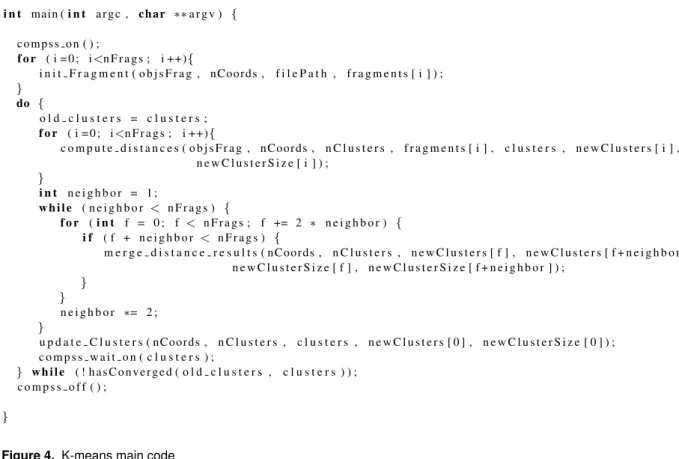
The main code for the K-means algorithm with our proposed programming model is shown in Figure 4. The code is composed by two main parts. The first consists of a loop which initializes the fragments by reading the points from a file. Then, there is a do-while loop which implements the K-means iterations. Each iteration consists of two loops: one for computing the distances of all the points of a fragment to all the clusters and one to merge the results. Finally, there is a call to update the clusters from the merged distance results.
Figure 5 shows the definition and implementation of the coarse-grain tasks. The compute distances task is parallelized with fine grain tasks. We have created two versions: compute distances and compute distances GPU, one for executing the task in 4 CPU cores and another which is ready to run in a GPU. The same figure also shows the implementation of both compute distances task versions, where we can see how to indicate that a code block is a fine-grain task, in the case of the compute distances
implementation. Also, we show how a CUDA kernel (cuda find nearest cluster) is defined as fine-grain tasks in the compute distances GPU implementation. The other tasks called from the main code are defined as simple sequential coarse-grain tasks.
Experiment 1: Execution in different resource
configurations
To validate the adaptability features of the programming model, we have executed the Matrix Multiplication in different resource configurations: using only CPUs, only GPUs or both, and we have measured the time to complete the matrix multiplication with different matrices’ sizes and resource configurations. This means that we have executed the application using only CPUs, assigning a different number of cores to each coarse-grain task to allow to run several fine grain tasks in parallel, different number of GPUs and different combinations of CPU and GPU together.
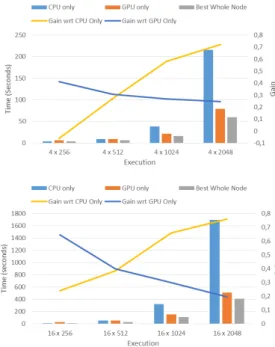
Figure 6 shows the measured execution times when running the matrix multiplication with different matrix sizes. The matrix size is indicated by the number of blocks and the size of the blocks. We have evaluated matrices with a range of 4×4 to 16×16 blocks and block sizes from 256×256 to 2048×2048 elements. For each configuration, we have plotted the best result achieved. We can see that the best configuration depends on the matrix size. For small number of blocks and sizes, the CPU only configuration is the one that is performing better. This is reasonable, since GPUs require an extra data and process management, and the speed up achieved with GPUs is not enough to overcome the overhead of the extra memory allocations and copies required. When increasing the matrix size (either by increasing the number of blocks or the block size, the version with both CPU and GPU is becoming the best option. So, the
Figure 3. Taskdefinitions
the#pragmaomptask toindicateitisataskand#pragma omptargettoindicateitshouldruninaCUDAdevice.
K-Means Following the same approach, we have also
implementedtheK-meansalgorithmwhichisawidelyused clusteringtechnique to group data inclusters, whereeach clusterisidentifiedbyacentroidpoint,whosedistancewith the rest of the points of the cluster is the minimum. K-meansisnormallyimplementedwithaniterativealgorithm starting with a random centroids’ set. The distance of all thepoints tothe different centroidsis calculatedandeach point is assigned to the closest centroid. According to these assignments, the new centroids are calculated. This is repeated until the difference of the centroids from one iterationtotheotheriscloseto0.
The parallelization of the K-means algorithm is based on the observation that each of the distance calculations betweenapointandagivenclusterisindependent,andthey canbecomputed inparallel.However, thesecomputations are too small for being distributed across nodes. For this reason, we group several points in fragments and the computation of all these fragments is defineda s coarse-graintaskswhileeachdistancecomputationcanbedefined as a fine-graint ask.O ncet hisp arallelr egionh asbeen finished, the distance results are used to recompute the
i n t main (i n t a r g c , c h a r ∗∗a r g v ) { c o m p s s o n ( ) ; f o r ( i = 0 ; i<n F r a g s ; i ++){ i n i t F r a g m e n t ( o b j s F r a g , n C o o r d s , f i l e P a t h , f r a g m e n t s [ i ] ) ; } do { o l d c l u s t e r s = c l u s t e r s ; f o r ( i = 0 ; i<n F r a g s ; i ++){ c o m p u t e d i s t a n c e s ( o b j s F r a g , n C o o r d s , n C l u s t e r s , f r a g m e n t s [ i ] , c l u s t e r s , n e w C l u s t e r s [ i ] , n e w C l u s t e r S i z e [ i ] ) ; } i n t n e i g h b o r = 1 ; w h i l e ( n e i g h b o r < n F r a g s ) { f o r (i n t f = 0 ; f < n F r a g s ; f += 2 ∗ n e i g h b o r ) { i f ( f + n e i g h b o r < n F r a g s ) { m e r g e d i s t a n c e r e s u l t s ( n C o o r d s , n C l u s t e r s , n e w C l u s t e r s [ f ] , n e w C l u s t e r s [ f + n e i g h b o r ] , n e w C l u s t e r S i z e [ f ] , n e w C l u s t e r S i z e [ f + n e i g h b o r ] ) ; } } n e i g h b o r ∗= 2 ; } u p d a t e C l u s t e r s ( n C o o r d s , n C l u s t e r s , c l u s t e r s , n e w C l u s t e r s [ 0 ] , n e w C l u s t e r S i z e [ 0 ] ) ; c o m p s s w a i t o n ( c l u s t e r s ) ; } w h i l e ( ! h a s C o n v e r g e d ( o l d c l u s t e r s , c l u s t e r s ) ) ; c o m p s s o f f ( ) ;
blocks to disk, and the OmpSs runtime initialization at the beginning of each coarse-grain task.
Experiment 3: Resource Adaptation
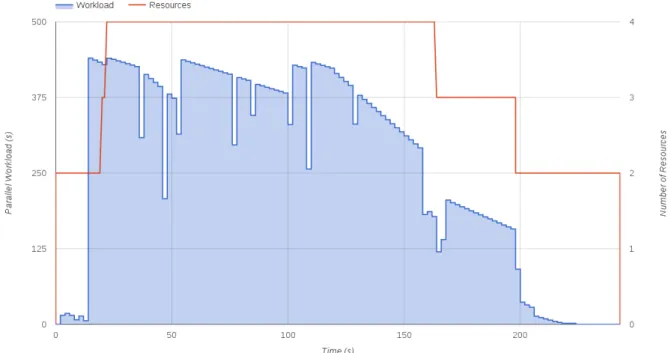
Finally, the third experiment is designed to demonstrate how the programming model runtime is able to detect the inherent parallelism of the application and adapt the number of resources used to the computing load. In this experiment, we have run the same K-means application but configuring the programming model runtime to partially manage the execution in an elastic way. In the runtime execution configuration, we have set the runtime to use two static computing nodes and we have activated the elasticity option to let the runtime decide how many nodes it will use depending on the number of parallel tasks in the application, the task duration and the time to get a new resource from the resource manager.
Figure 11 shows an image generated by the COMPSs runtime monitor, where we can see an estimation of the parallel workload (number of dependency-free tasks multiplied by its expected duration), represented with a blue shadow, and the number of resources used during the application execution, represented with a red line. We can see that the runtime starts with the initial resources (two nodes), and once the first set of tasks finishes, the runtime estimates the duration of executing the rest of the dependency-free tasks based on the duration of the previous executions. If this time is larger than the time to get a new resource in the resource manager, the runtime requests for a resource allocation to execute more tasks in parallel. In the actual execution shown in the figure, we can see that the runtime has decided to request two extra nodes, which are later discarded once the number of tasks decreases.
}
Figure4. K-meansmaincode
programmingmodelruntimeisabletoruntasksinallkind ofresourceswhichincreasestheparallelismandreducesthe executiontime.Inthebestcase,wehaveachievedagainof 75%withrespecttoCPU-onlycasesand65%withrespect toGPU-only when usingbothresources.In the worstcase (verysmallmatrices),wecouldhavea6%losswithrespect ofusingaCPU-onlyconfiguration.
Similar resultshavebeen observedwhen runningthe K-meansapplication.Figure7showstheexecutiontimewhen we run the K-means application to find5 0c lustersi n24 millionpointof50dimensions.Inthefigure,wecanseean importantaccelerationwhenusingtheGPUswithrespectto thecaseofusingtheCPUonly,butwecanhaveanextra10% ofimprovementwhenwecombinetheCPUandGPUs.
Experiment
2:
Scalability
We have also evaluated the scalability when running both applications (Matrix Multiplication and K-means) distributedondifferentcomputingnodes.
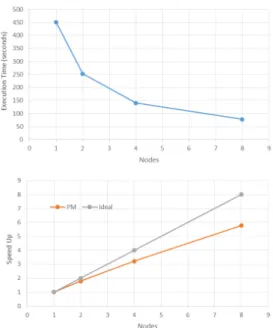
Figure 8 shows the execution time and speed-up of executingtheK-meansalgorithmtofind1024clustersin320 fragmentsof200Kpointof128dimensions.
Figure 9 shows the execution time and the efficiency whenincreasingtheproblemsizeinthesameproportionof thecomputingresources keepingthecomputationpernode constant. In this case, we can see the execution time has sufferasmallincrement.
Figure 10 shows the execution time and speed-up of executingthe matrix multiplicationfor matrices of 64×64 blocks of 1024×1024 elements each, using from 1 to 8 computingnodes.Weobserveareasonableperformance,and thedifferencefromtheidealspeed-upismainlycausedby theoverheadofthedatatransfers,theloadandwriteofthe
#pragma compss c o n s t r a i n t s ( p r o c e s s o r s ={p r o c e s s o r ( Type=CPU , C o m p u t i n g U n i t s = 4 )}) #pragma compss t a s k i n ( f r a g [ 0 ; n O b j s∗n C o o r d s ] , c l u s t e r s [ 0 ; n C l u s t e r s∗n C o o r d s ] ) o u t ( n e w C l u s t e r s [ 0 ; n C l u s t e r s∗n C o o r d s ] , n e w C l u s t e r s S i z e [ n C l u s t e r s ] ) v o i d c o m p u t e d i s t a n c e s (i n t nObjs , i n t n C o o r d s , i n t n C l u s t e r s , f l o a t ∗f r a g , f l o a t ∗c l u s t e r s , f l o a t ∗n e w C l u s t e r s , i n t ∗n e w C l u s t e r s S i z e ){ i n t s p l i t = g e t c o m p s s t a s k c u s ( ) ; i n t b l o c k = ( n O b j s / s p l i t ) + 1 ; i n t ∗i n d e x = new i n t[ n O b j s ] ; i n t k , i , j ; f o r ( i = 0 ; k<n O b j s ; k ++) { # pragma omp t a s k f i r s t p r i v a t e ( k ) i n ( f r a g [ 0 ; n C o o r d s∗n O b j s ] , c l u s t e r s [ 0 ; n u m C l u s t e r s∗n C o o r d s ] ) c o n c u r r e n t ( i n d e x [ 0 ; n O b j s ] ) i n d e x [ i ] = f i n d n e a r e s t c l u s t e r ( n C l u s t e r s , n C o o r d s , &f r a g [ i∗n C o o r d s ] , c l u s t e r s ) ; } # pragma omp t a s k w a i t i n ( i n d e x [ 0 ; n O b j s ] ) f o r ( i = 0 ; i<n O b j s ; i ++) { n e w C l u s t e r s S i z e [ i n d e x [ i ] ] + + ; f o r ( j = 0 ; j<n C o o r d s ; j ++){ i f ( n e w C l u s t e r s S i z e [ i n d e x [ i ] ] = = 1 ){ n e w C l u s t e r s [ i n d e x [ i ]∗n C o o r d s + j ] = 0 . 0 ; } n e w C l u s t e r s [ i n d e x [ i ]∗n C o o r d s + j ] += f r a g [ i∗n C o o r d s + j ] ; } } }
#pragma compss c o n s t r a i n t s ( p r o c e s s o r s ={p r o c e s s o r ( Type=GPU , C o m p u t i n g U n i t s = 1 )}) #pragma compss t a s k i n ( f r a g [ 0 ; n O b j s∗n C o o r d s ] , c l u s t e r s [ 0 ; n C l u s t e r s∗n C o o r d s ] ) o u t ( n e w C l u s t e r s [ 0 ; n C l u s t e r s∗n C o o r d s ] , n e w C l u s t e r s S i z e [ 0 ; n C l u s t e r s ] ) i m p l e m e n t s ( c o m p u t e d i s t a n c e s ) v o i d c o m p u t e d i s t a n c e s G P U (i n t nObjs , i n t n C o o r d s , i n t n C l u s t e r s , f l o a t ∗f r a g , f l o a t ∗c l u s t e r s , f l o a t ∗n e w C l u s t e r s , i n t ∗n e w C l u s t e r s S i z e ){ i n t ∗i n d e x = new i n t[ n O b j s ] ;
# pragma omp t a r g e t d e v i c e ( c u d a ) c o p y d e p s n d r a n g e ( 1 , nObjs , 6 4 )
# pragma omp t a s k i n ( f r a g [ 0 ; ( n O b j s∗n C o o r d s ) ] , c l u s t e r s [ 0 ; ( n C l u s t e r s∗n C o o r d s ) ] ) o u t ( i n d e x [ 0 ; ( n O b j s ) ] ) c u d a f i n d n e a r e s t c l u s t e r ( n C o o r d s , nObjs , n C l u s t e r s , f r a g , c l u s t e r s , i n d e x ) ; # pragma omp t a s k w a i t i n ( i n d e x [ 0 ; n O b j s ] ) f o r (i n t i = 0 ; i<n O b j s ; i ++) { n e w C l u s t e r s S i z e [ i n d e x [ i ] ] + + ; f o r (i n t j = 0 ; j<n C o o r d s ; j ++){ i f ( n e w C l u s t e r s S i z e [ i n d e x [ i ] ] = = 1 ){ n e w C l u s t e r s [ i n d e x [ i ]∗n C o o r d s + j ] = 0 . 0 ; } n e w C l u s t e r s [ i n d e x [ i ]∗n C o o r d s + j ] += f r a g [ i∗n C o o r d s + j ] ; } } } #pragma compss t a s k i n ( f i l e n a m e ) o u t ( f r a g [ 0 ; n O b j s∗n C o o r d s ] ) v o i d i n i t F r a g m e n t (i n t n C o o r d s , i n t nObjs , F i l e f i l e n a m e , f l o a t∗ f r a g ){ . . . } #pragma compss t a s k i n ( f r a g [ 0 ; n O b j s∗n C o o r d s ] , c l u s t e r s 2 [ 0 ; n C l u s t e r s∗n C o o r d s ] , n e w C l u s t e r s S i z e 2 [ 0 ; n C l u s t e r s ] ) i n o u t ( c l u s t e r s 1 [ 0 ; n C l u s t e r s∗n C o o r d s ] , n e w C l u s t e r s S i z e 1 [ 0 ; n C l u s t e r s ] ) v o i d m e r g e d i s t a n c e r e s u l t s (i n t n C o o r d s , i n t n C l u s t e r s , f l o a t∗ c l u s t e r s 1 , f l o a t∗ c l u s t e r s 2 , i n t∗ n e w C l u s t e r s S i z e 1 , i n t∗ n e w C l u s t e r s S i z e 2 ){ . . . } #pragma compss t a s k i n ( c l u s t e r s 2 [ 0 ; n C l u s t e r s∗n C o o r d s ] , n e w C l u s t e r s S i z e 2 [ 0 ; n C l u s t e r s ] ) i n o u t ( c l u s t e r s 1 [ 0 ; n C l u s t e r s∗n C o o r d s ] ) v o i d u p d a t e C l u s t e r s (i n t n C o o r d s , i n t n C l u s t e r s , f l o a t∗ c l u s t e r s 1 , f l o a t∗ c l u s t e r s 2 , i n t∗ n e w C l u s t e r s S i z e 2 ){ . . . }
parallel applications in a platform of distributed heteroge-neous resources. This proposal is based on two-levels of task-based programming models. The first level is in charge of
Figure5. K-meanstaskdefinition
Conclusion
and
Future
Work
Inthispaper,we havepresented aproposal fora program-ming model that aims to facilitate the implementation of
Figure 6. Matrix Multiplication benchmark with different
resource configurations Figure 8. K-means strong scaling.
Figure 9. K-means weak scaling (40 Fragments/Node).
doing the required data transfer, and exploit the maximum parallelism. Moreover, due to the versioning capabilities of the programming model, the runtime can select the implementation which fits better to the available resources selecting the one which provides better performance. So, the same application will be able to adapt to the different capabilities of the heterogeneous platform without having to modify the application.
The results obtained in the evaluation demonstrate that the runtime transparently adapts the application execution to the underlying infrastructure with reasonable performance
Figure7. K-meansbenchmarkexecutedwithdifferentresource configurations
definingcoarse-graintasksoftheapplicationwhichwillbe spawnedinthedifferentnodesofthedistributedcomputing environment. This coarse-grain level is managed by the COMPSs programming model and runtime. Each coarse-graintaskimplementsaworkflowoffinegraintaskswhich will be spawned on the different computing devices of a compute node. This fine-grainl eveli sm anagedb ythe OmpSs programming model which spawns the processes onthecomputingnodedevicesaccordingtotheconstraints providedbythecoarse-grainlevelruntimewhichcoordinates theoverallapplicationexecution.
Thebenefitofthisprogrammingmodelcombinationrelies on the easiness of programming, which avoids the need of changing the programming model paradigm or using differentAPIs,providingmeanstoimplementadistributed applicationwhichtakesprofitofthedifferentheterogeneous devices available in the computing nodes. Besides, the programming runtime transparently performs the required actionstoefficientlyexecutetheapplicationinthecomputing infrastructuresuch as: analyzedata dependencies between tasks,keeptrackofthe datalocationsduringtheexecution as well as schedule tasks close to data or transparently
Catalunya under contracts 1051 and 2014-SGR-1272.
References
Abadi M, Barham P, Chen J, Chen Z, Davis A, Dean J, Devin M, Ghemawat S, Irving G, Isard M et al. (2016) Tensorflow: a system for large-scale machine learning. In:OSDI, volume 16. pp. 265–283.
Alrutz T, Backhaus J, Brandes T, End V, Gerhold T, Geiger A, Gr¨unewald D, Heuveline V, J¨agersk¨upper J, Kn¨upfer A et al. (2013) Gaspi–a partitioned global address space programming interface. In:Facing the Multicore-Challenge III. Springer, pp. 135–136.
Altintas I, Berkley C, Jaeger E, Jones M, Ludascher B and Mock S (2004) Kepler: an extensible system for design and execution of scientific workflows. In:Scientific and Statistical Database Management, 2004. Proceedings. 16th International Conference on. IEEE, pp. 423–424.
Babuji Y, Chard K, Foster I, Katz DS, Wilde M, Woodard A and Wozniak J (2018) Parsl: Scalable parallel scripting in python. In:10th International Workshop on Science Gateways (IWSG 2018).
Badia RM, Conejero J, Diaz C, Ejarque J, Lezzi D, Lordan F, Ramon-Cortes C and Sirvent R (2015) Comp superscalar, an interoperable programming framework.SoftwareX3: 32–36. Barcelona Supercomputing Center (2019) Minotauro
Supercomputer. Available at https://www. bsc.es/innovation-and-services/
supercomputers-and-facilities/minotauro
(accessed 1 April 2019).
Dean J and Ghemawat S (2008) Mapreduce: simplified data processing on large clusters. Communications of the ACM
51(1): 107–113.
Djemame K, Kavanagh R, Kelefouras V, Aguil`a A, Ejarque J, Badia RM, Garc´ıa-P´erez D, Pezuela C, Deprez JC, Guedria L et al. (2019) Towards an energy-aware framework for application development and execution in heterogeneous parallel architectures. In: Hardware Accelerators in Data Centers. Springer, pp. 129–148.
Dolbeau R, Bihan S and Bodin F (2007) HMPP: A hybrid multi-core parallel programming environment. In:First Workshop on General Purpose Processing on Graphics Processing Units. Duran A, Ayguad´e E, Badia RM, Labarta J, Martinell L, Martorell
X and Planas J (2011) Ompss: a proposal for programming heterogeneous multi-core architectures. Parallel Processing Letters21(02): 173–193.
El-Ghazawi T and Smith L (2006) Upc: unified parallel c. In: Proceedings of the 2006 ACM/IEEE conference on Supercomputing. ACM, p. 27.
Goecks J, Nekrutenko A and Taylor J (2010) Galaxy: a com-prehensive approach for supporting accessible, reproducible, and transparent computational research in the life sciences.
Genome biology11(8): R86.
Group TP (2010)PGI Accelerator Programming Model for Fortran & C.
Intertwine Consortium (2018) Intertwine EU project homepage. Available at http://www.intertwine-project. eu/(accessed: 1 April 2019).
Figure 10. MatrixMultiplicationscalabilitywiththe ProgrammingModel
results.With thepresentedprogramming modeldevelopers do not need to maintain different codes as happens in alternativeapproaches.
However, during the prototype evaluation, we havealso detectedsomesourcesofoverhead.Forinstance,eachtime theruntimeexecutesacoarse-graintask,itstartsanOmpSs runtimewhichproducesaninitializationoverhead,specially when a task uses GPUs which requires a costly Host-GPUmemoryallocation.Thisoverheadwillbereduced by introducingthe solutionproposedinthe Intertwine project toachieve interoperability between different programming modelruntimes(IntertwineConsortium2018).Thissolution allowsCOMPSstokeepruntimespersistentlyloadedinthe computing nodes during the whole application execution reusingthesameruntimeforthedifferentcoarse-graintask executions.
In addition totheseperformanceimprovements, wewill extend the work performed in multi-objective scheduling for coarse-grain tasks in Clouds (Juarez et al. 2016) to support distributedheterogeneous environments. With this work, we aim at findingt heb estt asks chedulingtaking intoaccountdifferentfactorssuchasexecutiontime,energy consumptionorpowerlimitations.Finally,wewillalsostudy howtheprogrammingmodelcaninteractwiththecomputing infrastructureinordertohavemoreefficientexecutions,by requestingmoreresourcesinhighlyparallelregionsaswell asreleasingorpartiallypoweringoffthedeviceswhichare notcurrentlyusedbytheapplication.
Acknowledgment
ThisworkhasbeensupportedbytheEuropeanCommission throughtheHorizon2020ResearchandInnovationprogram under contract 687584 (TANGO project) by the Spanish GovernmentundercontractTIN2015-65316andgrant SEV-2015-0493(Severo OchoaProgram) andbyGeneralitat de
Figure 11. Resource adaptation managed by the Programming Model runtime.
Jain A, Ong SP, Chen W, Medasani B, Qu X, Kocher M, Brafman M, Petretto G, Rignanese GM, Hautier G et al. (2015) Fireworks: A dynamic workflow system designed for high-throughput applications. Concurrency and Computation: Practice and Experience27(17): 5037–5059.
Juarez F, Ejarque J and Badia RM (2016) Dynamic energy-aware scheduling for parallel task-based application in cloud computing.Future Generation Computer Systems.
Malewicz G, Austern MH, Bik AJ, Dehnert JC, Horn I, Leiser N and Czajkowski G (2010) Pregel: a system for large-scale graph processing. In:Proceedings of the 2010 ACM SIGMOD International Conference on Management of data. ACM, pp. 135–146.
MPI Forum (2015) Message Passing Interface Specification. Available at https://www.mpi-forum.org/docs/ mpi-3.1/mpi31-report.pdf(accessed 1 April 2019). NVIDIA Corp (2019) CUDA Toolkit. Available at https://
developer.nvidia.com/cuda-toolkit (accessed 1 April 2019).
Oinn T, Addis M, Ferris J, Marvin D, Senger M, Greenwood M, Carver T, Glover K, Pocock MR, Wipat A et al. (2004) Taverna: a tool for the composition and enactment of bioinformatics workflows.Bioinformatics20(17): 3045–3054.
OpenACC Consortium (2011) The openacc application program-ming interfaceversion 1.0. Available at http://www. openacc.org/specification(accessed 1 April 2019). OpenMP Architecture Review Board (2018) OpenMP Application Programming Interface Specification. Available athttp:// www.openmp.org/specifications/(accessed 1 April 2019).
Rocklin M (2015) Dask: Parallel computation with blocked algorithms and task scheduling. In:Proceedings of the 14th Python in Science Conference. Citeseer, pp. 130–136. Stone JE, Gohara D and Shi G (2010) Opencl: A parallel
programming standard for heterogeneous computing systems.
Computing in science & engineering12(3): 66–73.
Zaharia M, Xin RS, Wendell P, Das T, Armbrust M, Dave A, Meng X, Rosen J, Venkataraman S, Franklin MJ et al. (2016) Apache spark: a unified engine for big data processing.