Where Do Rewards Come From?
Satinder Singh
[email protected] Computer Science & Engineering University of Michigan, Ann Arbor
Richard L. Lewis
[email protected] Department of Psychology University of Michigan, Ann ArborAndrew G. Barto
[email protected] Department of Computer Science University of Massachusetts, AmherstAbstract
Reinforcement learning has achieved broad and successful ap-plication in cognitive science in part because of its general for-mulation of the adaptive control problem as the maximization of a scalar reward function. The computational reinforcement learning framework is motivated by correspondences to ani-mal reward processes, but it leaves the source and nature of the rewards unspecified. This paper advances a general computa-tional framework for reward that places it in an evolutionary context, formulating a notion of an optimal reward function given a fitness function and some distribution of environments. Novel results from computational experiments show how tra-ditional notions of extrinsically and intrinsically motivated be-haviors may emerge from such optimal reward functions. In the experiments these rewards are discovered through auto-mated search rather than crafted by hand. The precise form of the optimal reward functions need not bear a direct relationship to the fitness function, but may nonetheless confer significant advantages over rewards based only on fitness.
Introduction
In the computational reinforcement learning (RL) frame-work (Sutton & Barto, 1998), rewards—more specifically, re-ward functions—determine the problem the learning agent is trying to solve. Properties of the reward function influence how easy or hard the problem is, and how well an agent may do, but RL theory and algorithms are completely insensitive to the source of rewards (except requiring that their magni-tude be bounded). This is a strength of the framework be-cause of the generality it confers, capable of encompassing both homeostatic theories of motivation in which rewards are defined as drive reduction, as has been done in many motiva-tional systems for artificial agents (Savage, 2000), and non-homeostatic theories that can account, for example, for the behavioral effects of electrical brain stimulation and addic-tive drugs. But it is also a weakness because it defers key questions about the nature of reward functions.
Motivating the RL framework are the following correspon-dences to animal reward processes. Rewards in an RL system correspond toprimary rewards, i.e., rewards that in animals have been hard-wired by the evolutionary process due to their relevance to reproductive success. In RL, they are thought of as the output of a “critic” that evaluates the RL agent’s be-havior. Further, RL systems that form value functions, us-ing, for example, Temporal Difference (TD) algorithms, ef-fectively create conditionedor secondary reward processes whereby predictors of primary rewards act as rewards them-selves. The learned value function provides ongoing ations that are consistent with the more intermittent evalu-ations of the hard-wired critic. The result is that the local landscape of a value function gives direction to the system’s preferred behavior: decisions are made to cause transitions to
Agent Environment States Actions Rewards Critic Agent Internal Environment Rewards Critic External Environment Sensations States Decisions Actions "Organism"
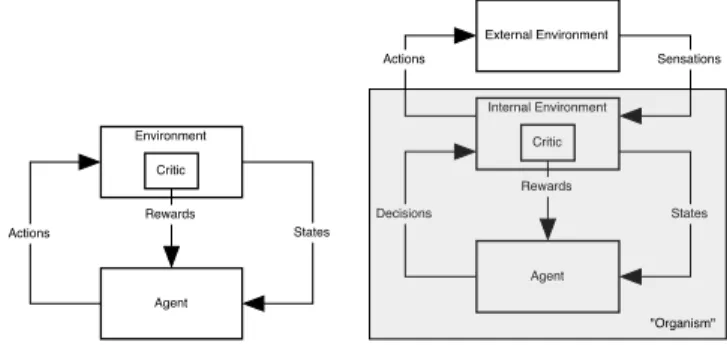
Figure 1: Agent-environment interactions in reinforcement learn-ing; adapted from Barto et al. (2004). See text for discussion.
higher-valued states. A close parallel can be drawn between the gradient of a value function andincentive motivation (Mc-Clure, Daw, & Montague, 2003).
In the usual view of an RL agent interacting with an ex-ternal environment (left panel of Figure 1), the primary re-ward comes from the external environment, being generated by a “critic” residing there. But as Sutton and Barto (1998) and Barto, Singh, and Chentanez (2004) point out, this is a seriously misleading view of RL if one wishes to relate this framework to animal reward systems.
In a less misleading view of this interaction (right panel of Figure 1), the RL agent’s environment is divided into ex-ternal and inex-ternal environments. For an animal, the inter-nal environment consists of the systems that are interinter-nal to the animal while still being parts of the learning system’s environment. This view makes it clear that reward signals are always generated within the animal, for example, by its dopamine system. Therefore, all rewards are internal, and the internal/external distinction is not a useful one, a point also emphasized by Oudeyer and Kaplan (2007). This is the viewpoint we adopt in this paper.
But what of a distinction between intrinsic and extrinsic reward? Psychologists distinguish betweenextrinsic motiva-tion, which means doing something because of some specific rewarding outcome, andintrinsic motivation, which refers to “doing something because it is inherently interesting or en-joyable” (Ryan & Deci, 2000). According to this view, in-trinsic motivation leads organisms to engage in exploration, play, and other behavior driven by curiosity in the absence of explicit reinforcement or reward.
Barto et al. (2004) used the term intrinsic rewardto re-fer to rewards that produce analogs of intrinsic motivation in RL agents, andextrinisic rewardto refer to rewards that de-fine a specific task as in standard RL applications. We use this terminology here, but the distinction between intrinsic
and extrinsic reward is difficult to make precise. Oudeyer and Kaplan (2007) provide a thoughtful typology. Space does not permit providing more detail, except to point out that a wide body of data shows that intrinsically motivated behavior does not occur because it had previously been paired with the sat-isfaction of a primary biological need in the animal’s own experience (Deci & Ryan, 1985). That is, intrinsic reward is not the same as secondary reward. It is likely that the evo-lutionary process gave exploration, play, discovery, etc., pos-itive hedonic valence because these behaviors contributed to reproductive success throughout evolution. Consequently, we regard intrinsic rewards in the RL framework as primary re-wards, hard-wired from the start of the agent’s life. Like any other primary rewards in RL, they come to be predicted by the value system. These predictions can support secondary rein-forcement so that predictors of intrinsically rewarding events can acquire rewarding qualities through learning just as pre-dictors of extrinsically rewarding events can.
In short, once one takes the perspective that all rewards are internal (Figure 1), it is clear that the RL framework nat-urally encompasses and provides computational clarity to a wide range of reward types and processes, and thus has the potential to be a source of great power in explaining behav-ior across a range of domains. But fully realizing this scien-tific promise requires a computational framework for reward itself—a principled framework with generative power. Our main purpose here is to specify and illustrate a candidate for such a framework with the following desired properties: Criteria for a Framework for Reward
1. The framework isformally well-defined and computation-ally realizable, providing clear answers to the questions of what makes a good reward and how one may be derived. 2. The framework makesminimal changes to the existing RL
framework, thereby maintaining its generality.
3. The frameworkabstracts away from specific mechanisms associated with RL agents, such as whether their learning mechanisms are model-based or model-free, whether they use options or other kinds of richer internal structure, etc. But it is in principle powerful enough to exploit such agent structure when present.
4. The framework does not commit to specific search pro-cessesfor finding good reward functions, but it does define and give structure to the search problem.
5. The frameworkderives rewards that capture both intrinsic and extrinsic motivational processes.
Taken together, these features of our framework distin-guish it from other efforts aimed at deriving or specify-ing the form of reward functions, e.g., Schmidhuber (1991); Singh, Barto, and Chentanez (2005); Ng, Harada, and Rus-sell (1999). While these computational approaches are all valuable explorations of reward formulations, they still in-corporate some notion of pre-defined extrinsic reward, and
are not concerned with explaining how their intrinsic rewards come about. Closer to our aims is early work by Ackley and Littman (1991) and recent work by Uchibe and Doya (2008). The former differs from our work in that it directly evolves secondary reward functions and lacks a theoretical frame-work. The latter proposes a specific mechanism—embodied evolution—for evolving primary reward but is still concerned with combining intrinsic and extrinsic rewards, depending on specialized RL algorithms for guaranteeing that the asymp-totic policy does not differ from the one implied by the ex-trinsic reward. The framework we propose here shares the goal of providing an evolutionary basis, but dispenses with pre-defined extrinsic rewards and seeks maximum generality in its theoretical formulation.
Optimal Rewards
Adopting an evolutionary perspective leads naturally to an ap-proach in which adaptive agents, and therefore their reward functions, are evaluated according to their expected fitness
given an explicit fitness function and some distribution of en-vironments of interest. The fitness function maps trajectories of agent-environment interactions to scalar fitness values, and may take any form (including functions that are similar in form to discounted sums of extrinsic rewards).
Definition More specifically we define the notion of opti-mal reward as follows. For a given RL agentA, there is a space,RA, of reward functions that map an agent’s state to
a scalar primary reward that drives reinforcement learning. The composition of the state can depend on the agent archi-tecture and its learning algorithm. There is a distribution over Markov decision process (MDP; Sutton and Barto (1998))1 environments in some set
E
in which we want our agents to perform well (in expectation). A specific reward functionrA∈RAand a sampled environmentE∈
E
producesh, thehistory of agentAadapting to environmentE using the re-ward functionrA. A given fitness functionFproduces a scalar
evaluationF(h)for all such historiesh. An optimal reward functionrA∗∈RA is the reward function that maximizes the
expected fitness over the distribution of environments. The formulation is very general because the constraints on
A,RA,F, and
E
are minimal. Ais constrained only to be anagent that uses a reward functionrA∈RAto drive its search
for behavior policies. F is constrained only to be a function that maps (finite or infinite) histories of agent-environment interactions to scalar fitness values. And
E
is constrained only to be a set of MDPs, though the Markov assumption can be easily relaxed. (We leave this to future work.)Regularies within and across enviroments The above formulation essentially defines a search problem—the search forr∗A. This search is for a primary reward function and is
1An MDP is a mathematical specification of agent-environment
interaction in which the environment can be in one of a number of states, at each time step the agent executes an action from a set of available actions, which stochastically changes the state of the envi-ronment to a next state, and a scalar reward is delivered to the agent.
to be contrasted with the search problem faced by an agent during its lifetime, that of learning a good value function, and hence a good secondary reward function, specific to its environment. Thus, our concrete hypothesis is (1) ther∗A de-rived from search will capture physical regularities across en-vironments in
E
as well as complex interactions betweenE
and specific structural properties of the agentA(note that the agentAis part of its environment and is constant across all environments inE
), and (2) the value functions learned by an agent during its lifetime will capture regularities present within its specific environment that are not necessarily shared across environments.Two Sets of Computational Experiments
We now describe a set of computational experiments in which we directly specify A, F, and
E
, and deriver∗A via search. These experiments are designed to serve three purposes. First, they will provide concrete and transparent illustrations of the basic framework above. Second, they will demonstrate theemergenceof interesting reward function properties that are not direct reflections of the fitness function—including features that might be intuitively recognizable as candidates for plausible intrinsic and extrinsic rewards in natural agents. Third, they will demonstrate theemergenceof interesting re-ward functions that capture regularities across environments, and similarly demonstrate that value function learning by the agent captures regularities within single environments.Basic form of each experiment
Both experiments use a simulated physical space shown by the 6×6 gridworld in Figure 3 (the arrows in that figure are explained below). It consists of four subspaces (of size 3×3). There are four movement actions, North, South, East and West, that if successful move the agent probabilistically in the direction implied, and if they fail leave the agent in place. The thick black lines in the figure represent barriers that the agent cannot cross, so that the agent has to navigate through gaps in the barriers to move to adjacent subspaces. The agent lives continually for its lifetime, i.e., the interaction is not di-vided into trials or episodes. Each experiment will introduce objects into the gridworld such as food, water, or boxes. The state includes the agent’s location in the grid as well as other features relevant to each experiment. These features and other experiment-specific aspects (e.g., the fitness functions used) are described in the appropriate sections below.
Our agents use the ε-greedy Q-learning (Watkins, 1989) algorithm to learn during their lifetimes. This algorithm has three types of parameters: 1)Q0, the initial Q-function (we
use small values chosen uniformly randomly from the range [−0.001,0.001]) that maps state-action pairs to their expected discounted sum of future rewards, 2)α, the learning rate, and
3) ε, the exploration parameter (at each time step the agent
executes a random action with probabilityεand the greedy
action with respect to the current Q-function with probability (1−ε)). At time stept, the current state is denotedst, the
cur-rent Q-function is denotedQt, the agent executes an actionat,
and the Q-learning update is as follows:
Qt+1(st,at) = (1−α)Qt(st,at) +α[rt+γmaxb(Qt(st+1,b)],
where rt is the reward specified by reward function rA for
the state st, andγ is a discount factor that makes
immedi-ate reward more valuable than limmedi-ater reward (we useγ=0.99 throughout). It is well known that the form of Q-learning used above will converge asymptotically to the optimal Q-function and hence the optimal policy (Watkins, 1989). Thus, our agent uses its experience to continually adapt its action selection policy to improve the discounted sum of rewards, as specified byrA, that it will obtain over its future (remaining
in its lifetime). Note that the reward function is distinct from the fitness functionF.
The psuedo-code below describes how we use simula-tion to estimate the mean cumulative fitness for a reward functionrAgivena particular setting of learning parameters
(α,ε).
set(α,ε)
fori=1toNdo
Sample an environmentEifrom
E
.InA, intialize Q-function
Generate a historyhiover lifetimeT forAandEi
Compute fitnessF(hi)
end for
return average of{F(h1), . . . ,F(hN)}
In the experiments we report below, we estimate the mean cumulative fitness of rAas the maximum estimate obtained
(using the pseudo-code above) over a coarse discretization of the space of feasible(α,ε)pairs.
Finding good reward functions for a given fitness function thus amounts to a large search problem.2
Hungry-Thirsty Domain: Emergent Extrinsic
Reward for Water
In this experiment, each sampled environment has two randomly-chosen special locations (from among the 4 cor-ners and held fixed throughout the lifetime of the agent): one where there is always food available, and one where there is always water available. In addition to the movement ac-tions, the agent has two special actions available: eat, which has no effect unless the agent is at the food location, where it causes the agent to consume food, and drink, which has no effect unless the the agent is at the water location, where it causes the agent to consume water. When the agent eats food, it becomes not-hungry for one time step, after which it be-come hungry again. When the agent drinks water, it bebe-comes not-thirsty for a random period of time (when not-thirsty, it becomes thirsty with probability 0.1 at each successive time step). Each time step the agent is not-hungry, its fitness is in-cremented by one. There isnofitness directly associated with
2In our experiments we conducted exhaustive searches over a
discretized parameter space because our focus is on demonstrating the generality of our framework and on the nature of the reward tions found. However, there is structure to the space of reward func-tions (as we illustrate through our experiments) that we will exploit in future work to gain computational efficiency.
0 20000 40000 60000 0 2000 4000 6000 8000
Mean Fitness Growth of 3,240 Rewards
Time Step in an Agent Lifetime
Mean Cumulative Fitness
Best reward
Best fitness−based reward
Best simple fitness based reward Other rewards 0 20000 40000 60000 0 10000 20000 30000 40000 50000 60000 70000
Mean Growth in Time Steps Not Thirsty
Time Step in an Agent Lifetime
Mean Cumulative Time Steps Not Thirsty
Best reward Best fitness−based reward Best simple fitness based reward Other rewards !0.4 !0.2 0.0 0.2 0.4 0 2000 4000 6000 8000
Max Fitness as a Function of Thirst Penalty
Thirst Penalty While Hungry (hnt ! ht)
Maximum Cumulative Fitness
! ! ! ! ! ! ! ! ! ! ! ! ! ! ! ! ! ! ! ! ! ! ! ! ! ! ! ! ! ! ! ! ! ! ! ! ! ! ! ! ! ! ! ! ! ! ! ! ! ! ! ! ! ! ! ! ! best possible with
thirst penalty
best possible without thirst penalty
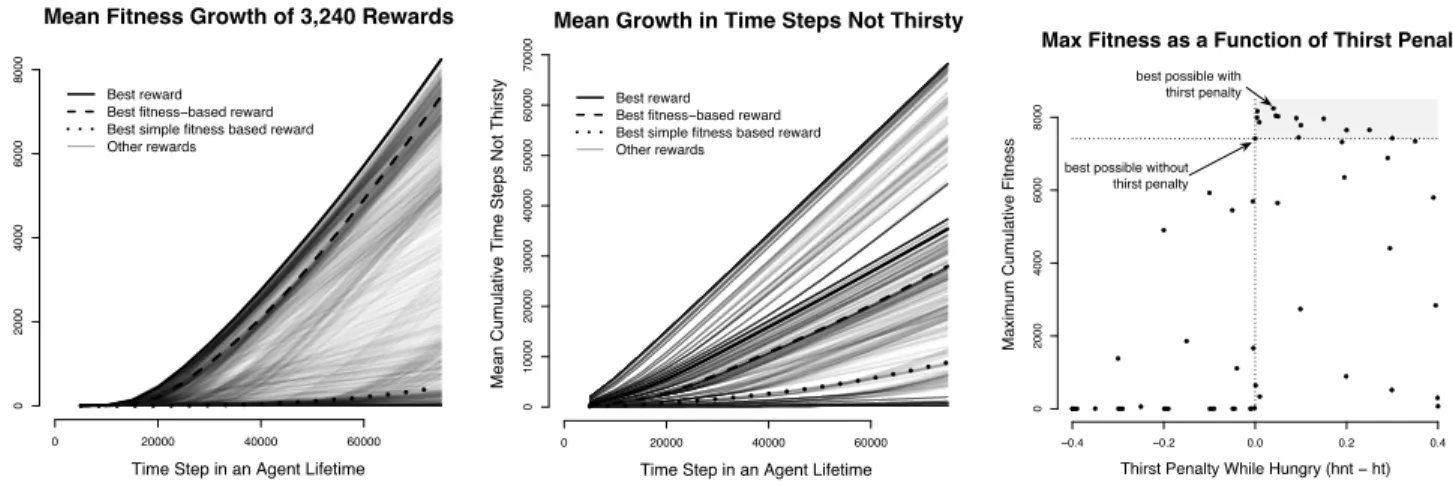
Figure 2:Results from Hungry-Thirsty Domain. See text for an explanation.
water at all. However being thirsty has a special effect: when the agent is thirsty, its eat action fails. Thus, the agent cannot just “hang out” at the food location and keep eating because at some point it will become thirsty and eating will fail. What is constant across environments is that there is food and there is water, that not-thirsty switches to thirsty with probability 0.1 on each step, and that being thirsty makes the agent incapable of eating. What varies across environments is the location of food and water. The state for use in Q-learning was four di-mensional: thexandycoordinates of the agent’s location and the binary thirst and hunger status features. We used only the hunger and thirst status features to define the space of reward functions. More specifically, the four combinations of hunger and thirst mapped to values chosen from a discretization of the range[−1.0,1.0]; there were 3,240 different such reward functions considered; we provide some examples below.
Figure 2 presents some of our results. In this experiment as well as in the next, we distinguish between three increasingly-general classes of reward functions: 1)simple fitness-based
reward functions that can assign positive reward to events that increment fitness (in this case being not-hungry) and zero to everything else, 2)fitness-basedreward functions that can choose two arbitrary reward values, one for events that in-crement fitness (in this case being not-hungry) and another for all other events, and 3) otherreward functions that are unconstrained (except by their range). The first interesting result (seen in the left panel) is that many reward functions outperform the fitness-based reward functions throughout the lifetime (of 75,000 time steps) in terms of mean cumulative fitness.3 The best simple fitness-based reward function does
very poorly.4The best reward function in our search space
as-signs a reward of−0.05 to the agent being hungry and thirsty, a larger but still negative reward of−0.01 to the agent being
3Here and in all subsequent comparisons of expected fitness
val-ues between reward types, the comparisons are highly statistically significant at thep<10−5level, using pairedttests appropriate to
the structure of our computational experiments.
4Presumably because it cannot take advantage of the added
ex-ploration provided by an optimistic initialization of Q-functions be-cause it cannot realize negative rewards.
hungry and not-thirsty, and positive rewards of 1.0 to being not-hungry and thirsty, and 0.5 to being hungry and not-thirsty. It is apparent that this reward function differentiates based on the thirst status of the agent.
Hungry & Thirsty F
W
drink
F
W Hungry & Not Thirsty
eat
*
* *
Figure 3:Policy for a single agent in Hungry-Thirsty Domain. See text for an explanation.
We illustrate this in the rightmost panel of Figure 2, which shows how fitness is sensitive to the magnitude of thepenalty
that the reward functions provide for being thirsty. We com-pute this penalty as the difference between the reward for (hungry, not-thirsty) and (hungry, thirsty). (We ignore the cases where the agent is not-hungry because they occur so infrequently). Each point in the graph plots the maximum mean cumulative fitness obtained over all reward functions with the same penalty. The vertical dotted axis separates pos-itive penalties from negative penalties, and the horizontal dot-ted axis is the performance of the best fitness-based reward function, which by definition has a penalty of exactly zero. Noteworthy is that all the reward functions that outperform the best fitness-based reward function have a positive thirst penalty. Indeed, the performance is quite sensitive to the thirst penalty and peaks at a value of 0.04, i.e., not just any penalty for thirst will work well—only a relatively narrow and peaked region of thirst penalty outperforms the best reward functions that are insensitive to thirst. Another view of this result is seen in the middle panel of Figure 2 that plots the mean growth in the number of time steps the agent is not-thirsty as a function of time for the different reward functions. The best reward function is somewhere in the middle of the range of curves;
clearly other reward functions can keep the agent not-thirsty far more often but do not achieve high cumulative fitness be-cause they make being not-thirsty so rewarding that they pre-vent the agent from eating often enough.
Turning next to what happens within each lifetime or en-vironment, the Q-learning performed by the agent produces a policy specific to the location of the food and water. This policy takes the agent back and forth between food and water, even though water does not directly contribute to cumulative fitness. This can be seen by inspecting Figure 3, which shows the policy learned by one of our agents (split into two panels: the right panel showing the actions when the agent is hungry and thirsty, and the left panel showing the policy when it is hungry and not-thirsty).5
Boxes Domain: Emergent Intrinsic Reward for
Exploration and Manipulation
In this experiment, each sampled environment has two boxes placed in randomly chosen special locations (from among the 4 corners and held fixed throughout the lifetime of the agent). In addition to the usual movement actions, the agent has two special actions: open, which opens a box if it is closed and the agent is at the location of the box and has no effect oth-erwise (when a closed box is opened it transitions first to a half-open state for one time step and then to an open state), andeat, which has no effect unless the agent is at a box loca-tion, the box at that location is half-open, and there happens to be food (prey) in that box, in which case the agent consumes that food. A closed box always has food. The food always escapes when the box is open. Thus to consume food, the agent has to find a closed box, open it, and eat immediately in the next time step when the box is half-open. When the agent consumes food it feels not-hungry for one time step and its fitness is incremented by one. An open box closes with prob-ability 0.1 at every time step. The state used for Q-learning was 6 dimensional: thexandycoordinates of the agent’s lo-cation, the agent’s hunger-status, the open/half-open/closed status of both boxes, as well the presence/absence of food in the square where the agent is located. We considered reward functions that map each possible combination of the status of the two boxes and hunger-status to values chosen from a dis-cretization of the range[−1.0,1.0](we searched over 54,000 rewards in this space).
Unchanging across environments is the presence of two boxes and the rules governing food. Changing across environments—but held fixed within a single environment— are the locations of the boxes.
In a different design from the first experiment, we ran this experiment under two conditions. In the first, called the con-stant condition, the food appears in closed boxes throughout
5We only show the policy in the two subspaces containing the
food and water because after learning the agent basically moves up and down the corridor connecting food with water and only departs it due to random exploration. Thus the agent gets very little experience in the other subspaces, and its policy there is mostly random. The policy off this corridor in the two right subspaces is mostly correct (the exceptions are the three locations marked with stars).
each agent’s lifetime of 10,000 steps. In the second, called thestep condition, each agent’s lifetime is 20,000 steps, and food appears only in thesecond half of the agent’s lifetime. Thus in the step condition, it is impossible to increase fitness above zero until after the 10,000thtime step. The step condi-tion simulates (in extreme form) a developmental process in which the agent is allowed to play in its environment for a pe-riod of time in the absence of any fitness-inducing events. (In this case, the fitness-inducing events are positive, but in gen-eral there could also be negative ones that risk physical harm.) Thus, a reward function that confers advantage through expo-sure to this first phase must reward events that have only a very distal relationship to fitness. Through the agent’s learn-ing processes, these rewards give rise to the agent’s intrinsic motivation. Notice that this should happen in both the step and constant conditions; we simply expect it to be more strik-ing in the step condition.
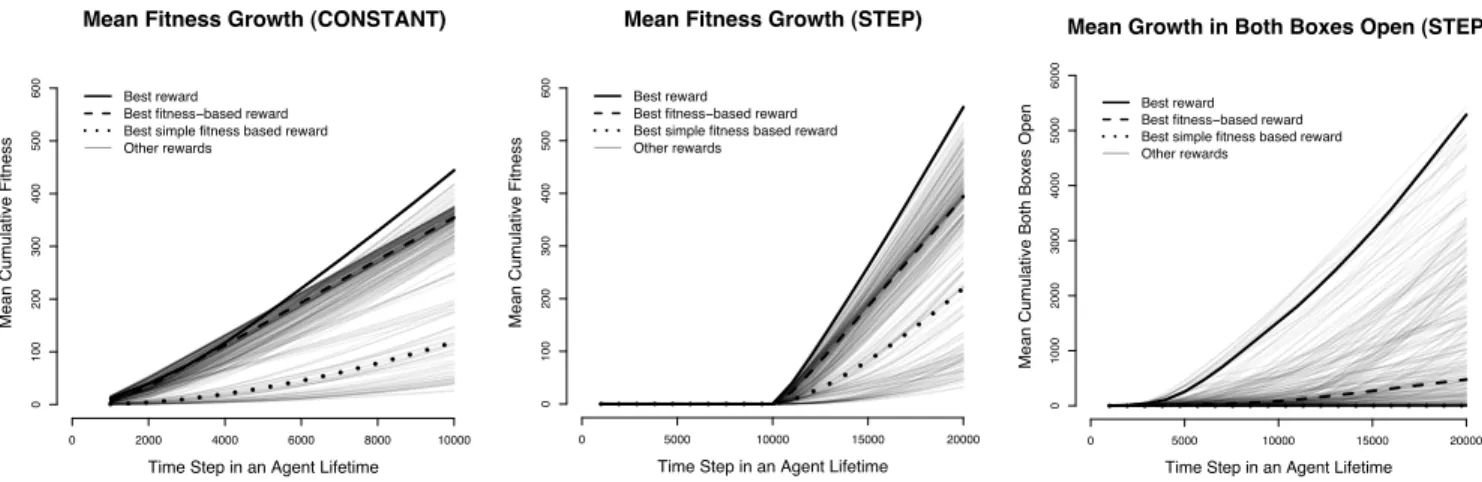
The left and middle panels of Figure 4 shows the mean cumulative fitness as a function of time under the two con-ditions. As expected, in the step condition, fitness remains zero under any reward function for the first 10,000 steps. The best reward function for the step condition is as follows: be-ing not-hungry has a positive reward of 0.5 when both boxes are open and 0.3 when one box is open, being hungry with one box half-open has a small negative reward of−0.01, and otherwise being hungry has a reward of −0.05. (Note that the agent will spend most of its time in this last situation.) Clearly, the best reward function in our reward space rewards opening boxes (by making their half-open state rewarding rel-ative to other states when the agent is hungry). This makes the agent learn to open boxes during the first half of the step con-dition so that when food appears in the second half, the agent is immediately ready to exploit that situation. This is reflected in the nearly constant slope from step 10,000 onwards of the mean cumulative fitness curve of the best reward function. In contrast, the curve for the best fitness-based reward function has an increasing slope because the agent has to learn from step 10,000 onwards that opening boxes leads to food. The policy learned under the best reward function makes the agent run back and forth between the two boxes, eating from both boxes, because this leads to higher fitness than staying at, and taking food from, only one box. This can be seen indirectly in the rightmost panel where the mean number of times both boxes are open is plotted as a function of time. It is clear that an agent learning with the overall best reward function keeps both boxes open far more often than one learning from the best fitness-based reward.
Discussion and Conclusions
We have outlined a general computational framework for re-ward that complements existing RL theory by placing it in an evolutionary context. This context clarifies and makes com-putationally precise the role of evolved reward functions: they convert distal pressures on fitness into proximal pressures on immediate behavior. We presented several computational
ex-0 2000 4000 6000 8000 10000 0 100 200 300 400 500 600
Mean Fitness Growth (CONSTANT)
Time Step in an Agent Lifetime
Mean Cumulative Fitness
Best reward Best fitness−based reward Best simple fitness based reward Other rewards 0 5000 10000 15000 20000 0 100 200 300 400 500 600
Mean Fitness Growth (STEP)
Time Step in an Agent Lifetime
Mean Cumulative Fitness
Best reward Best fitness−based reward Best simple fitness based reward Other rewards 0 5000 10000 15000 20000 0 1000 2000 3000 4000 5000 6000
Mean Growth in Both Boxes Open (STEP)
Time Step in an Agent Lifetime
Mean Cumulative Both Boxes Open
Best reward Best fitness−based reward Best simple fitness based reward Other rewards
Figure 4:Results from Boxes Domain. See text for an explanation.
periments that serve to draw out and provide empirical sup-port for two key properties of the framework.
First, multiple aspects of the domain may emerge to in-fluence a single reward function. The combination of these multiple aspects isimplicitin the form of the optimal reward function. Its precise properties are determined by the global goal of producing high fitness, but the relationship between the optimal reward function and fitness may be quite indi-rect. In the Hungry-Thirsty domain, two aspects of reward emerged, one related to food and hunger (directly related to fitness), and one related to thirst and water (not directly re-lated to fitness). Both aspects were combined in a single function that represented a delicate balance between the two (Figure 2). In the Boxes domain, the optimal reward func-tion related food and hunger (directly related to fitness), and curiosity and manipulation of boxes (not directly related to fitness). The latter aspect of the optimal reward produced dis-tinctplay and exploratorybehavior that would be thought of as intrinsically-motivated in the psychological sense. This was especially evident in the second condition of the Boxes experiment: during the first half of the agent’s lifetime, no fitness-producing activities are possible, but intrinsically re-warding activities are pursued that have fitness payoff later.
The second key property of the framework is that two kinds of adaptation are at work: the local adaptation of the RL agent within a given environment, and the global adaptation of the reward function to both a population of environments and the structure of the agent itself. The two kinds of adaptation are apparent in both experiments. In the Hungry-Thirsty domain, each agent benefits from the regularity across environments that drinking water ultimately helps it to achieve fitness—a regularity captured in the optimal (primary) reward function. Each agent also learns the specific locations of water and food sources in a given environment and good navigation patterns between them—regularities captured in the value functions learned by RL (Figure 3). Similarly, in the Boxes domain, each agent benefits from the regularity across environments that food is to be found in boxes, but also learns how to navi-gate to the specific locations of boxes in a given environment.
Acknowledgements Satinder Singh and Andrew Barto were supported by AFOSR grant FA9550-08-1-0418. Richard Lewis was supported by ONR grant N000140310087. Any opinions, findings, conclusions or recommendations expressed here are those of the authors and do not necessarily reflect the views of the sponsors.
References
Ackley, D. H., & Littman, M. (1991). Interactions between learning and evolution. Artificial Life II, SFI Studies in the Sciences of Complexity.
Barto, A. G., Singh, S., & Chentanez, N. (2004). Intrinsically moti-vated learning of hierarchical collections of skills. InProceedings of the international conference on developmental learning. Deci, E. L., & Ryan, R. M. (1985). Intrinsic motivation and
self-determination in human behavior. N.Y.: Plenum Press.
McClure, S. M., Daw, N. D., & Montague, P. R. (2003). A compu-tational substrate for incentive salience.Trends in Neurosciences, 26, 423-428.
Ng, A., Harada, D., & Russell, S. (1999). Policy invariance under reward transformations: Theory and application to reward shap-ing. InProceedings of the sixteenth international conference on machine learning.Morgan Kaufmann.
Oudeyer, P.-Y., & Kaplan, F. (2007). What is intrinsic motivation? A typology of computational approaches. Frontiers in Neuro-robotics.
Ryan, R. M., & Deci, E. L. (2000). Intrinsic and extrinsic moti-vations: Classic definitions and new directions. Contemporary Educational Psychology,25, 54-67.
Savage, T. (2000). Artificial motives: A review of motivation in artificial creatures.Connection Science,12, 211-277.
Schmidhuber, J. (1991). A possibility for implementing curios-ity and boredom in model-building neural controllers. InFrom animals to animats: Proceedings of the first international con-ference on simulation of adaptive behavior(p. 222-227). Cam-bridge, MA: MIT Press.
Singh, S., Barto, A. G., & Chentanez, N. (2005). Intrinsically mo-tivated reinforcement learning. InAdvances in neural informa-tion processing systems 17: Proceedings of the 2004 conference. Cambridge MA: MIT Press.
Sutton, R. S., & Barto, A. G. (1998). Reinforcement learning: An introduction. Cambridge, MA: MIT Press.
Uchibe, E., & Doya, K. (2008). Finding intrinsic rewards by em-bodied evolution and constrained reinforcement learning.Neural Networks,21(10), 1447-1455.
Watkins, C. J. C. H. (1989). Learning from delayed rewards. Un-published doctoral dissertation, Cambridge University, England. Wolfe, A. P., Tran, T., & Barto, A. G. (2008).Evolving reward and
initial value functions(Tech. Rep.). Amherst, MA: University of Massachusetts, Department of Computer Science.