REPORT OF THE
DEPARTMENT OF HEALTH
ANNUAL REPORT ON THE
STATUS OF VIRGINIA’S MEDICAL
CARE FACILITIES CERTIFICATE
OF PUBLIC NEED PROGRAM
TO THE GOVERNOR AND
THE GENERAL ASSEMBLY OF VIRGINIA
COMMONWEALTH OF VIRGINIA
RICHMOND
Table of Contents
Table of Contents ………ii
Executive Summary ... iii
Preface... 1
SUMMARY OF THE STATE HEALTH COMMISSIONER’S ACTIONS AND OTHER COPN PROGRAM ACTIVITY DURING FISCAL YEAR 2009... 1
Project Review...1 Decisions...1 Adjudication...3 Judicial Review ...4 Certificate Surrenders ...6 Significant Changes ...6
Competitive Nursing Home Review ...6
Timeliness of COPN Application Review... 7
Legislation... 7
Regulation ... 8
FIVE-YEAR SCHEDULE FOR ANNUAL PROJECT CATEGORY ANALYSIS ... 8
Overview ...8
PROJECT CATEGORY ANALYSES...10
Medical Rehabilitation ...11
Long-Term Care Hospital ...15
Nursing Homes and Nursing Home Beds ...18
Intermediate Care Facility for Mental Retardation ...22
Effectiveness of the COPN Application Review Procedures for FY 2009 Project Categories ...23
Other Data Relevant to the Efficient Operation of COPN Program... 24
Accessibility of Regulated Health Care Services by the Indigent ... 24
Relevance of COPN to Quality of Care Rendered by Regulated Facilities... 26
Equipment Registration ... 26 Appendix A... 27 Appendix B ... 28 Appendix C ... 31 Appendix D... 32 Appendix E ... 33 Appendix F... 34 Appendix G... 35 Appendix H... 38 Appendix I ... 40
Executive Summary
This annual report to the Governor and the General Assembly of Virginia on the status of Virginia’s Certificate of Public Need (COPN) program has been developed pursuant to § 32.1-102.12 of the Code of Virginia. The report is required to address the activities of the program in the previous fiscal year; review the appropriateness of continued regulation of at least three specific project categories; and to discuss the issues of access to care by the indigent, quality of care within the context of the program, and health care market reform. A copy of the enabling
Code section is reproduced at Appendix A. This report includes data for the most recent fiscal year (FY 2009).
Program activity for the period covered in this report includes the issuance of 58 decisions. The State Health Commissioner authorized 53 projects with a total expenditure of $1,690,635,271 and denied 5 projects with proposed capital expenditures of $32,314,568. Appendix D summarizes the authorization decisions. Additional program activities are described in the “Summary of the State Health Commissioner’s Actions” beginning on page 1.
The following project categories are analyzed in this report: medical rehabilitation services, long term care hospitals, nursing homes and intermediate care facilities for the developmentally challenged. The section on project analysis addresses the history of COPN regulation for these project categories, the nature of the specific services, the current state of the service in the Commonwealth and three potential options for the future of each of the categories with a recommended action. The Virginia Department of Health (VDH) recommends maintaining the current COPN review process for the review of nursing home project types and including
inpatient medical rehabilitation and long-term acute care hospitals in the request for applications process.
Applicants that have not demonstrated a historical commitment to charity care, consistent with other providers in their health service area, may have a “condition” to provide some level of indigent care placed upon any COPNs they are awarded. Compliance with the conditions to provide indigent care has improved considerably. Historically, many conditioned COPN holders have either not reported their compliance with conditions or have reported that they have been unable, for various reasons, to reach the required level of indigent care. Language for the “conditioning” of COPNs is now being augmented to include the second type of condition allowed in the Code, namely that the applicant facilitate access through the development and operation of primary health care services for special populations. The Code of Virginia has been changed to clarify the conditioning process and provide definition to the elements of a condition. These initiatives helped remove the barriers to compliance most often cited by facility managers as their reason for failing to satisfy indigent care conditions. Aggressive follow-up with non-reporting holders of conditioned COPNs has dramatically improved compliance.
During FY 2009 the application review process was completed as directed by the Code. There were no delays in receiving recommendations from regional health planning agencies that adversely affected timely decision-making.
Preface
This 2009 annual report to the Governor and the General Assembly of Virginia on the status of Virginia’s Certificate of Public Need (COPN) program has been developed pursuant to § 32.1-102.12 of the Code of Virginia. It includes data for the most recent fiscal year (2009). A copy of the enabling Code section is provided in Appendix A.
The COPN program is a regulatory program administered by the Virginia Department of Health (VDH). The program was established in 1973. The historical objectives of the program are: (i) promoting comprehensive health planning to meet the needs of the public; (ii) promoting the highest quality of care at the lowest possible cost; (iii) avoiding unnecessary duplication of medical care facilities; and (iv) providing an orderly procedure for resolving questions concerning the need to construct or modify medical care facilities. In essence, the program seeks to contain health care costs while ensuring financial and geographic access to quality health care for Virginia citizens at a reasonable cost. The current regulatory scope of the COPN program is shown in Appendix B.
The statute establishing Virginia’s COPN program is found in Article 1 of Chapter 5 of Title 32.1 of the Code (§ 32.1-102.1 et seq.). The State Health Commissioner (Commissioner)
authorizes capital projects regulated within the COPN program prior to implementation. The Commissioner must be satisfied that the proposed project meets public need criteria. The Code
specifies 8 factors (Appendix C) that must be considered in the determination of public need.
SUMMARY OF THE STATE HEALTH COMMISSIONER’S ACTIONS AND OTHER COPN PROGRAM ACTIVITY DURING FISCAL YEAR 2009
Project Review Decisions
During FY 2009, the Division of Certificate of Public Need (DCOPN), which assists the Commissioner in administering the COPN program, received 86 letters of intent to submit COPN requests and 67 applications for COPNs. There were ten applications withdrawn by applicants during the year. The balance of letters of intent and applications are those for which the
appropriate review cycles have crossed fiscal years. Letters of intent are required of all persons intending to become applicants for COPNs. These letters describe the proposed project in enough detail to enable DCOPN to batch the project in an appropriate review cycle and provide the applicant with the appropriate COPN application package for the proposed project. A letter of intent will lapse if a COPN application is not submitted within a year of the time the letter of intent was submitted.
Table 1 summarizes COPN review activity for FY 2009. Chart 1 puts this activity in historical context. The Commissioner issued 58 decisions on applications to establish new medical care facilities or modify existing medical care facilities in FY 2009. Fifty-three (91%) of these decisions were to approve or conditionally approve the request, for a total authorized capital expenditure of $1,690,635,271. Five (9%) requests were denied. These five denied projects had
proposed total capital expenditures of $32,314,568. Approved COPN decisions in FY 2009 are profiled in Appendix D.
Table 1. COPN Activity Summary
Fiscal Year Total Letters of Intent Received Total COPN Applications Received Applications
Withdrawn Approvals Denials
Appeals to Circuit Court Determined to be Not Reviewable 2009 86 67 10 53 5 5 0
The number of decisions does not equal the number of requests due to review cycles overlapping the fiscal year. Source: DCOPN
Chart 1
COPN Review Activity
0 50 100 150 200 250 1997 1999 2000 2001 2002 2003 2004 2005 2006 2007 2008 2009
Letters of Intent Requests Received Decisions
Source: DCOPN
In addition to assisting the Commissioner in the administration of the COPN program,
DCOPN provides written recommendations addressing the merits of approval or denial of COPN applications. The DCOPN provides advisory reports on all completed applications that are not subsequently withdrawn prior to the end of the review.
COPN reports and recommendations are also provided to the Commissioner by the regional health planning agencies. The regional health planning agencies are not-for-profit corporations that receive state funding to conduct regional health planning and to provide an independent recommendation to assist the Commissioner in the COPN decision process. The regional health planning agencies, when appropriately designated, conduct public hearings and make
recommendations to the Commissioner concerning the public’s need for proposed projects in their respective regions. In the absence of an appropriately designated regional health planning
agency, the DCOPN conducts the public hearing and solicits local input. The five health planning regions in Virginia are shown on the map in Appendix E.
Adjudication
If the DCOPN or one of the designated regional health planning agencies recommends denial of a COPN project, or if requested by any person seeking to demonstrate good cause, an informal fact-finding conference (IFFC) is held. The IFFC is the central feature of an informal adjudication process that serves as an administrative appeal prior to final decisions on projects by the
Commissioner. The adjudicatory process, held before the Commissioner’s Adjudication Officer, is a mechanism for providing full due process to applicants before a final agency decision is made. These conferences, conducted in accordance with the Administrative Process Act, are held to provide the applicant an opportunity to submit information and testimony in support of a project application. An IFFC is also held when two or more requests are competing to provide the same or similar services in the same jurisdiction and one or more of the requests are
recommended for denial. Another purpose for IFFCs is to permit persons opposed to a project, who have shown good cause, to voice their concerns. Following an IFFC, the Adjudication Officer reviews the entire agency record and prepares a recommended decision for the Commissioner’s consideration and, should it meet with her agreement, adoption.
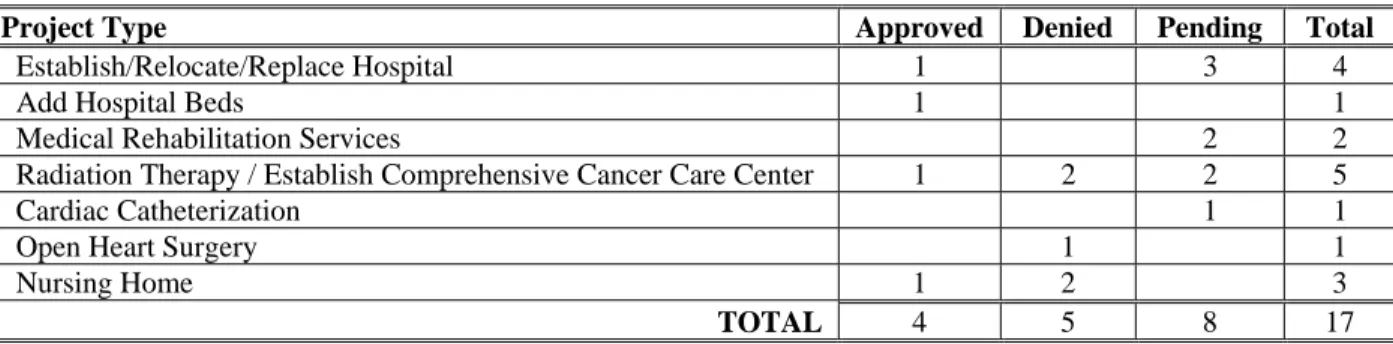
There were 18 COPN applications heard before a VDH Adjudication Officer at 12 individual IFFC’s in FY 2009. An additional four applications were exempted from participation in IFFC’s with competing applicants due to an agreed upon stipulation agreement and one application was withdrawn following the IFFC. Four of the COPN requests warranting an IFFC were approved in FY 2009. Five requests were denied after the IFFC. Eight projects heard at an IFFC in FY 2009 still have decisions pending and will be resolved in the Fall of 2009.
Table 2 illustrates the types of projects that were forwarded to an IFFC in FY 2009.
Table 2. Projects at IFFC in FY 2009
Project Type Approved Denied Pending Total
Establish/Relocate/Replace Hospital 1 3 4
Add Hospital Beds 1 1
Medical Rehabilitation Services 2 2
Radiation Therapy / Establish Comprehensive Cancer Care Center 1 2 2 5
Cardiac Catheterization 1 1
Open Heart Surgery 1 1
Nursing Home 1 2 3
TOTAL 4 5 8 17
Source: DCOPN
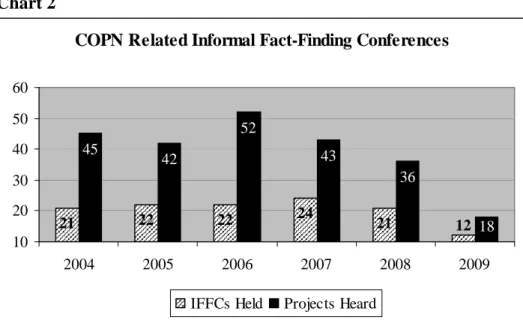
Chart 2 summarizes the number of IFFC’s held, as well as the number of underlying projects, from 2004 through 2009. The declining number of IFFC’s reflects the decline in the number of COPN applications over this time period.
Chart 2
COPN Related Informal Fact-Finding Conferences
21 22 22 24 21 12 45 42 52 43 36 18 10 20 30 40 50 60 2004 2005 2006 2007 2008 2009
IFFCs Held Projects Heard Source: DCOPN
Judicial Review
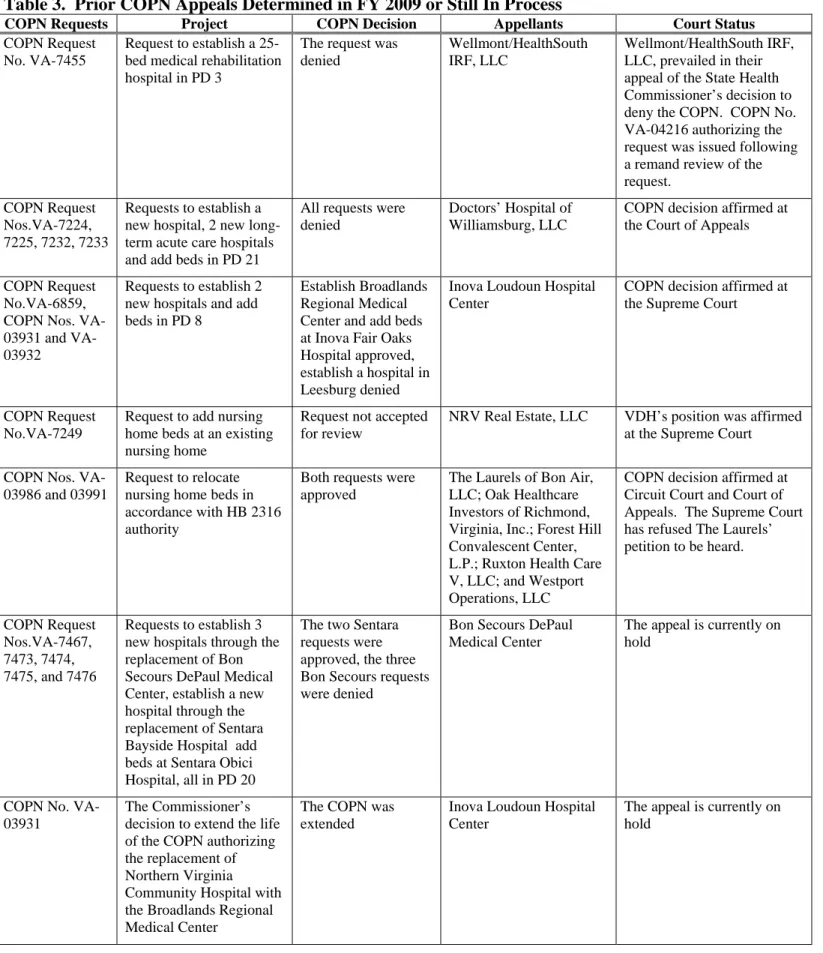
COPN decision challenges are not limited to administrative appeals. Once an applicant has exhausted his administrative remedies, he can take his claim to state court for judicial review. In three separate actions notice of appeal was filed for five decisions in FY 2009. All of the appeals were perfected with a filed appeal.
In November 2008 the State Health Commissioner approved a COPN for HCA to develop a new hospital in Goochland County and a competing request from Bon Secours St. Francis Medical Center to add inpatient beds. HCA appealed the Commissioner’s decision to authorize the addition of beds at Bon Secours St. Francis Medical Center.
HCA’s Reston Hospital appealed the decision to authorize a COPN request from Inova Health Care Services to add 43 acute care beds at Inova Fairfax Hospital and partially approve a
competing request from Reston Hospital to add 26 beds at that hospital.
In January 2008 a Request for Applications (RFA) was issued seeking applications to develop 30 new nursing home beds in Planning District 14. Four COPN applications were received in response to the RFA, one of which was subsequently withdrawn. Amelia Nursing and
Rehabilitation Center, an unsuccessful applicant for the additional nursing home beds in Planning District 14 authorized under the RFA, appealed the State Health Commissioner’s decision to authorize the addition of the 30 new nursing home beds to competing applicant Britthaven, Inc., and denying Amelia Nursing and Rehabilitation Center’s request.
Table 3. Prior COPN Appeals Determined in FY 2009 or Still In Process
COPN Requests Project COPN Decision Appellants Court Status
COPN Request No. VA-7455
Request to establish a 25-bed medical rehabilitation hospital in PD 3
The request was denied
Wellmont/HealthSouth IRF, LLC
Wellmont/HealthSouth IRF, LLC, prevailed in their appeal of the State Health Commissioner’s decision to deny the COPN. COPN No. VA-04216 authorizing the request was issued following a remand review of the request.
COPN Request Nos.VA-7224, 7225, 7232, 7233
Requests to establish a new hospital, 2 new long-term acute care hospitals and add beds in PD 21
All requests were denied
Doctors’ Hospital of Williamsburg, LLC
COPN decision affirmed at the Court of Appeals
COPN Request No.VA-6859, COPN Nos. 03931 and VA-03932
Requests to establish 2 new hospitals and add beds in PD 8
Establish Broadlands Regional Medical Center and add beds at Inova Fair Oaks Hospital approved, establish a hospital in Leesburg denied
Inova Loudoun Hospital Center
COPN decision affirmed at the Supreme Court
COPN Request No.VA-7249
Request to add nursing home beds at an existing nursing home
Request not accepted for review
NRV Real Estate, LLC VDH’s position was affirmed at the Supreme Court COPN Nos.
VA-03986 and 03991
Request to relocate nursing home beds in accordance with HB 2316 authority
Both requests were approved
The Laurels of Bon Air, LLC; Oak Healthcare Investors of Richmond, Virginia, Inc.; Forest Hill Convalescent Center, L.P.; Ruxton Health Care V, LLC; and Westport Operations, LLC
COPN decision affirmed at Circuit Court and Court of Appeals. The Supreme Court has refused The Laurels’ petition to be heard. COPN Request Nos.VA-7467, 7473, 7474, 7475, and 7476 Requests to establish 3 new hospitals through the replacement of Bon Secours DePaul Medical Center, establish a new hospital through the replacement of Sentara Bayside Hospital add beds at Sentara Obici Hospital, all in PD 20
The two Sentara requests were approved, the three Bon Secours requests were denied
Bon Secours DePaul Medical Center
The appeal is currently on hold
COPN No. VA-03931
The Commissioner’s decision to extend the life of the COPN authorizing the replacement of Northern Virginia Community Hospital with the Broadlands Regional Medical Center
The COPN was extended
Inova Loudoun Hospital Center
The appeal is currently on hold
Certificate Surrenders
Infrequently, an applicant awarded a COPN may have reasons to surrender it. A typical reason is the applicant’s inability to proceed with the project. In FY 2009 two certificates, COPN
numbers VA-03765, Lee Regional Medical Center, the introduction of cardiac catheterization issued in December 2003 and VA-03946, Memorial Hospital of Martinsville and Henry County, the addition of an MRI scanner issued in August 2005, were surrendered.
Significant Changes
A significant change results when there has been an alteration, modification, or adjustment to a reviewable project for which a COPN approval has been issued. To be considered a significant change, the alteration, modification, or adjustment must change the site, increase the authorized capital expenditure by 10% or more, change the service proposed to be offered, or extend the schedule for completion of the project beyond three years (36 months) from the date of certificate issuance or beyond the time period approved by the Commissioner at the date of certificate issuance.
The Commissioner received twenty-five requests for significant changes to nineteen different COPN projects in FY 2009. Fourteen requests were for extension of the schedule beyond the three-year generic time limit or the time authorized on the certificate. Seven requests were to increase the authorized capital cost by more than 10% but less than 20%, and one request, as provided by the 2007 legislative enactment of House Bill 2546, was to increase the capital cost to 130% of that authorized on the COPN. Three requests were to change the authorized site for the project. All twenty-five reviewed significant change requests were authorized.
Competitive Nursing Home Review
Beginning in 1988, a general prohibition on the issuance of COPNs that would increase the supply of nursing home beds in the Commonwealth, commonly known as the "nursing home bed moratorium," was imposed. Effective July 1, 1996 the moratorium was replaced with an
amended process governing COPN regulation of increases in nursing home bed supply (Code of Virginia §32.1-102.3:2). The new process requires the Commissioner to issue, at least annually in collaboration with Virginia's Department of Medical Assistance Services, a Request for
Applications (RFA) that will target geographic areas for consideration of increased bed supply and establish competitive review cycles for the submission of applications.
An RFA was issued for the addition of 120 Medicaid-certified nursing facility beds in Planning District 3 in May 2009. The RFA was authorized by House Bill 1498 of the 2008 session of the Virginia General Assembly. Two applicants presented requests to develop the 120 nursing facility beds as new nursing homes in the planning district. A decision on these requests is expected by February of 2010.
Timeliness of COPN Application Review
As a result of legislative changes in 1999 and 2000, all COPN recommendations by DCOPN must be completed by the 70th day of the review cycle, with the final decision due by the 190th day of the review cycle. Review cycles begin on the 10th day of each month. Only the applicant has the authority to extend the review schedule. In FY 2009 all COPN applications were
reviewed within the statutory or applicant extended time limit. A flow chart illustrating COPN timelines as a result of these and other bills can be found at Appendix F. The flow chart identifies the time periods within which VDH is to perform certain COPN functions.
The Code also specifies that the Commissioner has up to 70 days from the close of the record to render a decision unless the schedule is extended by the applicant. Failure to do so results in a deemed approval of the request. The average time to review a COPN request in FY 2009, from the start of the cycle to a decision being made, was 151 days. The average time for requests that were not heard at an IFFC was 112 days. Requests that needed to be heard at IFFC had an
average review time of 256 days. In FY 2009, all of the Commissioner’s decisions were rendered within the statutory or applicant extended time limit.
Legislation
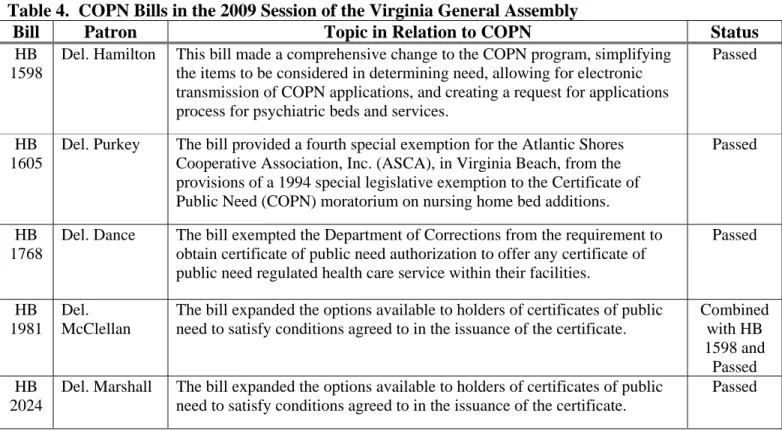
In the 2009 session of the General Assembly, there were six House bills and five Senate bills that addressed some aspect of the COPN program. There was no central theme to the types of bills considered during the session.
Table 4. COPN Bills in the 2009 Session of the Virginia General Assembly
Bill Patron Topic in Relation to COPN Status
HB 1598
Del. Hamilton This bill made a comprehensive change to the COPN program, simplifying the items to be considered in determining need, allowing for electronic transmission of COPN applications, and creating a request for applications process for psychiatric beds and services.
Passed
HB 1605
Del. Purkey The bill provided a fourth special exemption for the Atlantic Shores Cooperative Association, Inc. (ASCA), in Virginia Beach, from the provisions of a 1994 special legislative exemption to the Certificate of Public Need (COPN) moratorium on nursing home bed additions.
Passed
HB 1768
Del. Dance The bill exempted the Department of Corrections from the requirement to obtain certificate of public need authorization to offer any certificate of public need regulated health care service within their facilities.
Passed
HB 1981
Del. McClellan
The bill expanded the options available to holders of certificates of public need to satisfy conditions agreed to in the issuance of the certificate.
Combined with HB 1598 and Passed HB 2024
Del. Marshall The bill expanded the options available to holders of certificates of public need to satisfy conditions agreed to in the issuance of the certificate.
HB 2451
Del. Sickles The bill created a request for applications process for psychiatric beds and services. Combined with HB 1598 and Passed SB 1162
Sen. Watkins The bill expanded the options available to holders of certificates of public need to satisfy conditions agreed to in the issuance of the certificate.
Passed
SB 1263
Sen. Vogel Notwithstanding any other regulation or provision of a request for
applications the bill would have allowed the State Health Commissioner to issue a request for applications, accept applications and issue a certificate for 100 new nursing home beds in Planning District 8.
Failed to Report
SB 1334
Sen. Puckett This bill would have increased the maximum level for certificate of public need application fees.
Failed to Report SB
1411
Sen. Watkins The bill expanded the options available to holders of certificates of public need to satisfy conditions agreed to in the issuance of the certificate.
Passed
SB 1467
Sen. Reynolds This bill would have exempted the introduction of inpatient psychiatric services in critical access hospitals from the certificate of public need process.
Passed By Indefinitely
Source: Virginia Legislative Information System
Regulation
The State Medical Facilities Plan (SMFP) review and revision, with the assistance of an advisory committee consisting of industry representatives from the Virginia Health Care
Association, Virginia Hospital and Healthcare Association, the Medical Society of Virginia, the Virginia Association of Regional Health Planning Agencies, the Virginia Association of
Nonprofit Homes for the Aging, and other interested stakeholders, was completed. The revised SMFP became effective February 15, 2009.
House Bill 396, passed by the 2008 session of the Virginia General Assembly, requires the formation of a Task Force to meet at least every two years. The Task Force is to review, and where appropriate, update the SMFP at least every four years. The Task Force has been established and met three times in FY 2009. Several work groups were formed to address the technical issues of various specific issues including: the acute care bed need methodology, inpatient medical rehabilitation criteria, ways to address evolving technology, and radiation therapy criteria.
FIVE-YEAR SCHEDULE FOR ANNUAL PROJECT CATEGORY ANALYSIS Overview
For purposes of understanding the pattern of change in supply of many types of medical care facilities and services in Virginia since 1973, the year of the COPN program's inception, it is useful to understand that the program's 35 years can be segmented into three distinct periods. These periods can be characterized as regulatory, non-regulatory, and return to regulation. Those
periods are: 1) 1973 to 1986, a period of relatively consistent regulation; 2) 1986 to 1992, a period of dramatic deregulation; and 3) 1992 to the present, a period in which Virginia not only revived COPN regulation but also began, in 1996, a process of review and consideration of the scope of the new regulatory environment.
Between 1973 and the mid-1980s, there was an effort, with mixed results, to ground COPN decision-making in established plans and standards of community need, based on an assumption that controlling the supply of medical care facilities and equipment is a viable strategy for aiding in the containment of medical care costs. Increases in the supply of medical care facilities in Virginia during this period were, in most cases, gradual and tended to be in balance with population growth, aging of the population, and increases in the population's use of emerging technological advances in medical diagnosis and treatment.
Beginning around 1986 and through 1992, there was a period of "de facto" (1986 to mid-1989) and formal (mid-1989 to mid-1992) deregulation. Few proposed non-nursing home projects were denied during this period, followed by the actual deregulation of most non-nursing home project categories. There was a growth of most specialized diagnostic and treatment facilities and services that were deregulated.
On July 1, 1992, Virginia "re-regulated" in response to the perceived excesses of the preceding years of deregulation, however no process had been set up to evaluate whether there were actually any service capacity excesses. Re-regulation brought the scope of COPN regulation on non-nursing home facilities and services to a level similar to that in place prior to 1989.
Project review standards were updated and tightened and a more rigorous approach was taken to controlling growth in the supply of new medical care facilities and the proliferation of specialized services.
In recent years, VDH has taken an incremental approach to reviewing COPN regulation in response to legislative initiatives, by de-emphasizing regulation of replacement and smaller, non-clinically related expenditures, and focusing COPN regulation on new facilities development, new services development, and expansion of service capacity.
As a result of legislation passed during the 2000 session of the General Assembly, the Joint Commission on Health Care (JCHC) developed a plan for the phased deregulation of COPN in a manner that preserved the perceived positive aspects of the program. Due to the high cost of implementing the plan, it failed to gain General Assembly support in the 2001 session and was not enacted. The Act that required the development of the phased deregulation was repealed by the 2007 session of the General Assembly.
In accordance with section 32.1-102.12 of the Code, VDH has established a five-year schedule for analysis of all project categories within the current scope of COPN regulation that provides for analysis of at least three project categories per year. The five-year schedule is shown in Appendix G.
PROJECT CATEGORY ANALYSES
Section 32.1-102.12 of the Code provides guidance concerning the content of the project analysis. It requires the report to consider the appropriateness of continuing the certificate of public need program for each of the project categories. It also mandates that, in reviewing the project categories, the report addresses:
o The review time required during the past year for various project categories;
o The number of contested or opposed applications and the categories of these proposed projects;
o The number of applications upon which the regional health planning agencies have failed to act in accordance with the timelines of Section 32.1-102.B of the Code, and the number of deemed approvals from the Department because of their failure to comply with the timelines required by statute;
o The number of applications reviewed from health planning regions for which not regional health planning agency was appropriately designated; and
o Any other data determined by the Commissioner to be relevant to the efficient operations of the program.
Section 32.1-102.12 of the Code requires this report to consider at least three COPN project categories. For FY 2009, the project categories are:
Medical rehabilitation services, long term care hospitals, nursing homes and intermediate care facilities for the behaviorally challenged.
The following list is the specific project definitions for the categories considered in this report. • Establishment of a medical rehabilitation hospital
• Introduction by an existing medical care facility of any new medical rehabilitation service • Conversion of beds in an existing medical care facility to medical rehabilitation beds • Establishment of a long-term care hospital
• Establishment of a nursing home
• Establishment of an extended care facility
• Introduction by an existing medical care facility of any new nursing home service, such as intermediate care facility services, extended care facility services, or skilled nursing facility services, regardless of the type of medical care facility in which those services are provided
For each project type reviewed in this report three options are presented regarding the continued regulation of the service. While not exhaustive of the options available, the three actions represent a continuum of possibilities.
As the following discussions will note, the majority of COPN requests are approved. This does not imply that the COPN process is ineffective at limiting the number of new services or capital expenditures. Indications are that, for the most part, applicants are only submitting
requests for projects that meet the criteria for approval and that the number of speculative requests has declined.
Medical Rehabilitation
Medical rehabilitation services are provided for the restoration of normal form and function after injury or illness to individuals who are primarily physically disabled. The objective of these restorative services is self-sufficiency and a return to suitable gainful employment in the shortest possible time or both. Medical rehabilitation services do not include services provided to
individuals whose primary disability is psychiatric illness or substance abuse. However, medical rehabilitation services include mental health services needed by individuals whose disability is primarily physical in nature. The medical rehabilitation services subject to certificate of public need review are comprehensive inpatient medical rehabilitation services and specialized inpatient medical rehabilitation.
In January 2002, the Medicare payment mechanism for inpatient medical rehabilitation services provided in a designated inpatient rehabilitation facility (IRF) changed from a cost based system to a prospective payment system. Under prospective payment, facilities are reimbursed for care on a per patient discharge basis, with the rate set based on the severity of the conditions treated and adjusted for area wages. Payment for rehabilitation care is higher in rural areas, in facilities that treat low income patients and for teaching institutions.
To qualify for Medicare payment as an IRF, 60 percent of patients admitted to the facility must have one or more of the 13 qualifying conditions as their primary or secondary condition. The 60 percent factor, or rule, was decreased from 75 percent in 2007.
The Code of Virginia, at §32.1-102.1, (Appendix B) defines a project requiring COPN authorization, in part, as “The establishment of a medical care facility”, “The introduction into an existing medical care facility of any new … medical rehabilitation, … service which the facility has never provided or has not provided in the previous 12 months” and “The conversion of beds in an existing medical care facility to medical rehabilitation beds…” A medical care facility is defined, in part, as “Rehabilitation hospitals” and “Any facility licensed as a hospital.”
Table 5 below lists the inpatient medical rehabilitation programs that are units in a general hospital and the free standing medical rehabilitation hospitals in Virginia. There are 21 general acute care hospitals that offer inpatient medical rehabilitation services and 9 free standing medical rehabilitation hospitals in Virginia offering a total of 844 licensed inpatient medical rehabilitation beds. These facilities and beds are generally well distributed across the Commonwealth based on Planning Regions. The SMFP now considers medical rehabilitation services on a planning district basis instead of on the larger health planning region basis. There are seven planning districts without existing or authorized inpatient medical rehabilitation services (Planning Districts 4, 9, 13, 14, 17, 18, and 22).
Table 5. Rehabilitation Beds and Facilities Planning Region Planning District Licensed Beds
Augusta Health Care 1 6 8
Winchester Medical Center 1 7 30
University of Virginia Health System 1 10 39
UVA HealthSouth Rehabilitation Hospital 1 10 50
HealthSouth Rehabilitation Hospital of Fredericksburg 1 16 40
Health Planning Region I Total 167
HealthSouth Rehabilitation Hospital of Northern Virginia * ‡ 2 8 40
Inova Mt. Vernon Hospital 2 8 67
Virginia Hospital Center 2 8 20
Health Planning Region II Total 127
Lee Regional Medical Center † 3 1 10
Norton Community Hospital 3 1 11
Clinch Valley Medical Center 3 2 10
Wellmont HealthSouth Rehabilitation Hospital * ‡ 3 3 25
Carilion Roanoke Community Hospital ‡ 3 5 40
Lewis Gale Medical Center 3 5 35
Virginia Baptist Hospital 3 11 20
Danville Regional Medical Center 3 12 10
Health Planning Region III Total 161
Children's Hospital 4 15 16
HealthSouth Rehabilitation Hospital of Virginia 4 15 40
Henrico Doctors' Hospital-Parham 4 15 36
Johnston-Willis Medical Center 4 15 10
Sheltering Arms Hospital 4 15 40
Sheltering Arms Hospital - South 4 15 28
VCU Health System 4 15 46
HealthSouth Rehabilitation Hospital of Petersburg 4 19 40
Health Planning Region IV Total 256
Bon Secours - DePaul Medical Center 5 20 14
Bon Secours - Maryview Hospital 5 20 25
Children's Hospital of The King's Daughters 5 20 8
Sentara Norfolk General Hospital 5 20 22
Sentara Virginia Beach General Hospital ‡ 5 20 8
Riverside Rehabilitation Institute 5 21 50
Sentara Williamsburg Regional Medical Center ‡ 5 21 6
Health Planning Region V Total 133
State Total 844
* Facilities are not yet open
† Inpatient medical rehabilitation unit will close when the Wellmont/HealthSouth facility in Bristol opens
‡ Established or modified since 2004
In the five years since the last review of rehabilitation services (2004) there were six COPN decisions involving medical rehabilitation services. Five COPN requests, (two requests to establish rehabilitation units in existing hospitals and three requests to establish rehabilitation hospitals), were approved. One request to establish a rehabilitation hospital in northern Virginia was denied. Two requests to add bed capacity to existing rehabilitation units were withdrawn by the applicants and three requests (one to establish a 56-bed rehabilitation hospital in Planning District 15, one to add beds in an existing rehabilitation hospital in Planning District 15 and one to introduce inpatient rehabilitation services in an existing acute care hospital in Planning District 3) are still under review.
On the whole, occupancy of inpatient medical rehabilitation beds is declining in Virginia (Chart 3). Southwestern Virginia (HPR III) has shown very slight recent increases in occupancy of medical rehabilitation beds.
Chart 3
Average Inpatient Medical Rehabilitation Bed
Occupancy
20.0% 30.0% 40.0% 50.0% 60.0% 70.0% 80.0% 90.0% 1996 1997 1998 1999 2000 2001 2002 2003 2004 2005 2006 2007 HPR I HPR II HPR III HPR IV HPR V State Source: VHIThe decrease in occupancy is most likely due to a slight increase in available capacity in the face of a generally stable average daily census and average length of stay for patients receiving inpatient medical rehabilitation. Charts 4 and 5 summarize the average daily census, and average length of stay for inpatient rehabilitation across the State and in each of the Health Planning Regions.
Chart 4
Inpatient Rehabilitation Average Daily Census
0 100 200 300 400 500 600 1996 1997 1998 1999 2000 2001 2002 2003 2004 2005 2006 2007 P a ti e n ts State HPR I HPR II HPR III HPR IV HPR V Source: VHI Chart 5
Average Length of Stay
Inpatient Medical Rehabilitation
5.0
10.0
15.0
20.0
25.0
1996 1997 1998 1999 2000 2001 2002 2003 2004 2005 2006 2007
D
ays
HPR I
HPR II
HPR III
HPR IV
HPR V
State
Source: VHIAppropriateness of Continuing COPN for Medical Rehabilitation Services
The COPN experience concerning medical rehabilitation services supports a contention that the program is appropriate for these services. As mentioned earlier, the presence of a COPN program is thought to serve as a deterrent to speculative requests. It must be further presumed that absent the tempering effect of a COPN program these otherwise un-requested projects would be carried forth, resulting in, potentially, gross duplication of services. One of the goals of the COPN program is the promotion of comprehensive health planning to meet the needs of the public. Planning resulting in the decision to not pursue the development of a service represents the successful accomplishment of that goal. However, there are alternatives to consider.
Declining occupancy with constant average length of stay suggests that additional capacity should be added judiciously in response only to local specific needs.
Options:
No Change: Continue applying the COPN program to the establishment of new medical care facilities for medical rehabilitation and the addition of medical rehabilitation beds at existing programs as currently mandated. Ongoing efforts to review, and where appropriate, update the SMFP, will address necessary changes to the review criteria. All key stakeholders would likely support this option.
Minimal Change: In collaboration with the hospital industry, physicians, consumers and
advocates, VDH could produce a comprehensive assessment of the State's needs for the various facilities and service capacity subject to COPN regulation, and by way of a targeted RFA, publicize the locations where a demonstrated need for new or additional facilities/capacity exists as a means of stimulating interest in requesting authorization for development of the service. Most providers, except some providers seeking competitive advantage despite actual public need, would likely support this option.
Deregulation: Support efforts outside the comprehensive JCHC plan to deregulate medical rehabilitation services. It is doubtful key stakeholders would support this option.
RECOMMENDATION: Expand the Request for Applications (RFA) process to include the establishment of medical rehabilitation hospitals, the introduction of medical rehabilitation services, and the addition of medical rehabilitation beds based on a collaborative review with affected parties to determine the need for, and location of, such additional facilities and services. This would meet the planned need for new services in appropriate planning districts in a market competitive manner and improve access.
Long-Term Care Hospital
The Balanced Budget Act of 1997 (BBA) changed Medicare reimbursement for skilled nursing facilities (SNF) from a cost-based reimbursement to a prospective payment system based on resource utility groups. The result was an overall reduction in Medicare payments to SNF's such that they were reluctant to accept the more clinically complex patients. Many SNF's, in an effort to reduce costs in response to the BBA, managed their resources such that they were no
longer appropriate sites for the sickest, long-term acute patients. For example, many nursing homes made staffing changes such that they were not staffed to care for patients who were appropriate for long-term acute care hospitals (LTACHs). Prior to the LTACHs being present in the marketplace, general hospitals had been left as the sole provider of care for these patients.
LTACHs are specialty hospitals with an average Medicare inpatient length of stay of greater than 25 days and are established to provide extended medical care for clinically complex patients. LTACHs were excluded from the prospective payment system (PPS) and were reimbursed on a reasonable cost based system. In fiscal year 2003 the Centers for Medicare and Medicaid
Services established the Long-Term Care Hospital Prospective Payment System (LTACH PPS). The LTACH PPS pays LTACHs on a per discharge basis based on Long-Term Care Diagnostic Related Groups (LTC DRG). LTACH's must separately meet the Medicare Conditions of Participation for Hospitals, apart from any host hospital.
In 2007 the Medicare, Medicaid, and SCHIP Extension Act (MMSEA) established a three-year moratorium on new LTACHs and the addition of beds at existing LTACHs, subject to two basic categories of exceptions relevant to Virginia. First, MMSEA allowed the addition of beds at existing LTACHs if the facility had obtained a certificate of public need for the bed addition between April 1, 2005 and December 29, 2007. Second, if by December 29, 2007 the LTACH had; i) started its qualifying period for payment, ii) had a binding written agreement for
construction, renovation, lease or demolition and had expended at least 10% of the estimated cost of the project or $2,500,000, or iii) had obtained a certificate of public need authorizing the establishment of the LTACH, the LTACH would not be subject to the moratorium.
Table 6. Virginia Long Term Acute Care Hospitals
LTACH Within Freestanding Beds HPR PD
University of Virginia - HealthSouth, L.L.C. II * X 40 I 10 LTACH of Northern Virginia, LLC * Inova Mt Vernon 50 II 8 Central Virginia Hospital for Restoration and
Rehabilitation *
Centra Virginia Baptist 36 III 11
Kindred Hospitals East, LLC X 60 IV 15
Hospital for Extended Recovery Sentara Norfolk General 35 V 20
Lake Taylor Transitional Care Hospital X 104 V 20
Hampton Roads Specialty Hospital Riverside Rehabilitation Institute
25 V 21
* Hospital is not yet open Source: DCOPN
A medical care facility is defined in part, as it applies to the COPN program, as any facility licensed as a hospital. Virginia licenses LTACHs as general acute care hospitals. Four of Virginia’s seven LTACHs are established as separate hospitals within existing hospitals. The SMFP that became effective in 2009 now includes a specific set of criteria for the review of LTACHs.
There are currently seven non-State run LTACHs in the Commonwealth. Four of the seven are open and the remaining three are nearing completion.
As Chart 6 illustrates, LTACH aggregate occupancy in HPR V increased gradually through 2005, until 2006 when the Hampton Roads Specialty Hospital opened. The second year of operation of the Hampton Roads Specialty Hospital has shown a return to increasing occupancy of available LTACH beds in HPR V, indicating capacity may be matched to need. However, that conclusion may be premature as 2008 and 2009 figures are needed to provide an indication of performance following the start up phase of Hampton Roads Specialty Hospital. The only data available for the Kindred Hospital East in Planning District 15 is for 2007, the year the facility opened, and offers no insight yet to utilization.
Chart 6 LTACH Occupancy 45.0% 55.0% 65.0% 75.0% 85.0% 2002 2003 2004 2005 2006 2007 HPR V Source: VHI
Appropriateness of Continuing COPN for Long-Term Acute Care Hospitals
The COPN experience concerning LTACHs also supports a contention that the program is appropriate for these services. As mentioned earlier, the presence of a COPN program is thought to serve as a deterrent to speculative requests. It must be further presumed that absent the
tempering effect of a COPN program these otherwise un-requested projects would be carried forth, resulting in, potentially, gross duplication of services. The Federal rules for LTACHs and hospitals within existing hospitals also serve to control the growth in the number of these
facilities.
One of the goals of the COPN program is the promotion of comprehensive health planning to meet the needs of the public. All Health Planning Regions now have existing or authorized non-State run LTACHs. This may be sufficient to meet fairly limited demand for this service. All the authorized LTACHs should be allowed to operate through their start-up phases before additional capacity is introduced.
Options:
No Change: Continue applying the COPN program to the establishment of new long-term acute care hospitals as currently mandated. Ongoing efforts to review, and where appropriate, update the SMFP, will address necessary changes to the review criteria. This option would likely be supported by key stakeholders, except some hospitals that might look to the development of LTACHs as an alternative to keeping these patients in the general hospital.
Minimal Change: In collaboration with the hospital industry, physicians, consumers and
advocates, VDH could produce a comprehensive assessment of the State's needs for the various facilities and service capacity subject to COPN regulation and by way of a targeted RFA,
publicize the locations where a demonstrated need for new or additional facilities/capacity exists as a means of stimulating interest in requesting authorization for development of the service. All key stakeholders would likely support this option.
Deregulation: Support efforts outside the comprehensive JCHC plan to deregulate LTACHs. Existing LTACHs and other existing hospitals will likely oppose it.
RECOMMENDATION: Expand the Request for Applications (RFA) process to include the establishment of long-term acute care hospitals and the addition of long-term acute care beds based on a collaborative review with affected parties to determine the need for, and location of, such additional facilities and services. This would meet the planned need for new services in appropriate planning districts in a market competitive manner and improve access.
Nursing Homes and Nursing Home Beds
Currently, there are 317 nursing homes or hospital long-term care units with a total of 32,871 long-term care beds in Virginia. These nursing home beds are configured as shown in Table 7 below.
Table 7. Profile of Nursing Homes in Virginia
Number of Number of Facilities Beds Long Term Care Beds
Beds Not Certified for Either Medicaid or Medicare * 26 1,365
Non-Participating Facilities with no Certified Beds 14 999
Nursing Homes Certified Just for Medicaid 16 3,452
Nursing Homes Certified Just for Medicare 12 1,563
Nursing Homes Dually Certified for Medicaid and Medicare 233 25,492
Certified Long-Term Care Units in Hospitals 16 989
Total Subject to COPN 317 32,871
* Includes non-participating facilities and participating facilities with at least 1 non-participating bed Source: VDH
Nursing Home Utilization and Utilization Trends
Although the need for nursing home beds is often discussed with reference to the population age 65 and older, the actual need for nursing home beds is largely accounted for by the population age 80 and older. Division of COPN projections for nursing home bed need in 2007 found that 50% of occupied nursing home beds were used by persons age 85 and older, while another 19% were used by persons age 80-84. Only 21% of occupied nursing home beds were serving persons less than 75 years old.
During the current decade the number of elderly Virginians is expected to increase by age group as shown in Table 8. As shown, the number of elderly Virginians, especially those in the prime age groups for nursing home care, is expected to increase extremely rapidly during the present decade and substantially more rapidly than during the prior decade.
Table 8
2000 - 2010 1990 - 2000
Age Cohort % Change Persons Per Year % Change Persons Per Year
65+ 28% 22,200 19% 12,800
80+ 47% 9,100 40% 5,500
85+ 67% 5,800 46% 2,800
All Ages 12% 81,400 14% 89,100
Source: Virginia Employment Commission, DCOPN
This would seem to imply a large and growing demand for nursing home beds in Virginia. According to the most recent (2002) nursing home patient survey data reported by the Virginia regional health planning agencies and the DCOPN, about 13% of Virginians age 85 and above reside in a nursing home. This population group is expected to increase by approximately 5,800 persons per year in the current decade. The growth of this age group alone implies a need for about 750 additional nursing home beds in Virginia each year.
Every four years the Department of Health and the Regional Health Planning Agencies conduct a nursing home patient origin and utilization survey. These quadrennial nursing home patient origin surveys have found that over a number of years the age-specific use rates of Virginia nursing homes have been steadily declining. This is thought to be a result of general improvements in health, and other alternatives such as assisted living and in-home care.
Therefore, the growth in use of nursing home beds in Virginia has not kept pace with the growth of the prime nursing home population, especially persons age 80 and above. It seems likely that this well-established trend of declining age-specific use rates of nursing home beds will continue, although that cannot confidently be predicted.
Since 2004 the number of nursing home beds in Virginia subject to COPN decreased from 32,871 to 31,907, a net loss of 36 beds. However, during this five-year period, the prime nursing home population in Virginia was projected to have increased by about 19%.
With the minor decrease in nursing home beds and the far larger increase in the prime nursing home population, nursing home occupancy has shown a slight but steady increase over recent years in all Health Planning Regions except HPR III, Southwest Virginia, and HPR V, eastern
Virginia, where each showed slight decreases in occupancy. Statewide overall occupancy has remained fairly constant at 91.8% for Medicaid-certified nursing home beds (2003 to 2005). Possible reasons for this include the increased availability of alternative options for care and the generalized improved health of the elderly population. Neither HPR III nor V have added significantly more long-term care beds such that an increased supply would account for the decreased occupancy rate.
The negligible growth in usage of Virginia nursing homes in recent years, in spite of the large increase in the prime nursing home population of Virginia, is entirely consistent with the findings from the last several nursing home patient origin surveys that age-specific use rates of nursing homes are declining in Virginia. If these trends continue, the need for growth of Virginia's supply of nursing home beds can be kept to a modest level.
Nursing Home COPN Activity in the Last Five State Fiscal Years
Additions to the supply of nursing home beds in any planning district are controlled by the provisions of § 32.1-102.3:2 A of the Code of Virginia, which states:
Except for applications for continuing care retirement community nursing home bed projects filed by continuing care providers registered with the State Corporation Commission
pursuant to Chapter 49 (§ 38.2-4900 et seq.) of Title 38.2, which comply with the
requirements established in this section, the Commissioner of Health shall only approve, authorize or accept applications for the issuance of any certificate of public need pursuant to this article for any project which would result in an increase in the number of beds in a planning district in which nursing facility or extended care services are provided when such applications are filed in response to Requests For Applications (RFA).
The practical effect of this requirement is that applications to increase the supply of nursing home beds, except certain projects to relocate existing beds between planning districts and the addition of beds within continuing care retirement communities, may only be accepted for review when they are filed in response to a request for applications (RFA) issued by the Virginia State Board of Health based on a predetermined need for nursing home beds.
During the last five years, 2005 through 2009, the Virginia State Board of Health and the Virginia Department of Medical Assistance Services, acting jointly, have issued the following RFAs for development of additional nursing home beds, or have issued statements in lieu of an RFA that no planning district qualified for an RFA.
• January 2005: statement that no planning district qualified for an RFA based on the projected need for nursing home beds in 2007.
• October 2006: RFA, pursuant to House Bill 2639 (Chapter 838, Acts of the Assembly), to develop 60 additional Medicaid-certified nursing home beds in Planning District 12 (West Piedmont).
• January 2008: RFA to develop 30 additional nursing home beds in Planning District 14 (Piedmont).
• February 2009: RFA, pursuant to House Bill 1498 (Chapter 802, Acts of the Assembly), to develop 120 additional nursing home beds in Planning District 3 (Mount Rogers). Consequently, since the beginning of fiscal year 2005, four RFAs have been issued for the development of 210 additional nursing home beds in three planning districts. All beds authorized by these RFAs were applied for and, except for the PD 3 RFA, the review of which is still
pending, were issued COPNs authorizing their development. CCRC Nursing Home Projects
Projects to develop additional nursing home beds within continuing care retirement communities are exempt from the RFA process, but this exemption is strictly limited in the number of beds that may be approved at a particular CCRC in any one application. However, given the strict limitations that the RFA process imposes on non-CCRC development of nursing home beds, CCRC development of nursing home beds has become a moderately significant component of all development of additional nursing home beds in Virginia.
During fiscal years 2004 through 2009, the Commissioner of Health approved three projects to add 93 nursing home beds at CCRCs. This number, while quite small relative to the existing nursing home beds under the purview of the COPN program, is significant relative to the mere 210 additional nursing home beds authorized for development under RFAs issued during the past five fiscal years.
Other Nursing Home Projects
Although the number of COPN projects to increase the supply of nursing home beds is strictly limited by provisions of the Code of Virginia, the COPN program also deals with a considerably larger number of other nursing home projects that do not increase the supply of nursing home beds within a planning district. These projects are most often for the purpose of relocating existing nursing home beds from one place to another in the same planning district. Legislation allowing the relocation of certain long-term care beds between planning districts when specific criteria is met has added another dimension to the nursing home bed inventory issue.
These projects typically involve acquisition or downsizing of older nursing homes with low occupancy and in areas of little or no population growth, in order to combine the beds with an existing facility with high occupancy in a superior location or to create a new nursing home in a high-growth location. These projects almost always improve the geographical distribution of nursing home services and usually improve the physical environment and effectiveness of operation of the relocated nursing home beds. This is a little noticed benefit of the RFA process that, by limiting development of new capacity to well documented areas of need, the rebuilding, replacement, and relocation of outmoded facilities throughout the state has been encouraged. Allowing the relocation of beds between planning districts is a new enough development that the impact on the process is yet to be realized.
During the last five fiscal years, the Commissioner has approved 10 projects to relocate 495 nursing home beds within a planning district and 3 projects to relocate 145 beds between planning districts. All requests to relocate long-term care beds were authorized.
As use rates and occupancy levels of nursing homes have decreased, the likelihood that an elderly person in Virginia will require nursing home care has decreased markedly over the past 20 years. The population that has required nursing home care has changed considerably. Compared with nursing home residents over the last two decades, nursing home patients today are admitted to nursing facilities at a significantly older age, are more likely to be admitted from an acute care hospital, have shorter average lengths of stay in nursing homes, are likely to have more
debilitating and activity-limiting conditions, and are more likely to be Medicare patients. All of the factors tend to make caring for nursing homes patients more difficult and more costly. Options:
No Change: Continue applying the COPN program to the establishment of new nursing home facilities and the addition of nursing home beds using the RFA process as currently mandated. All key stakeholders would likely support this option.
Minimal Change:By linking regulatory processes and decisions to planning-based development policies and analyses, the RFA process has been key in accommodating and reflecting market circumstances and changes in Virginia. As now formulated, the RFA process works best in relatively stable markets. Given recent and projected trends, consideration could be given to improving the process by incorporating use-rate trend analyses in the methodology used to estimate likely future demand. All key stakeholders would likely support this option.
Deregulation: Support efforts outside the comprehensive JCHC plan to deregulate nursing home services. It is likely that existing nursing home providers will vigorously oppose it.
RECOMMENDATION: Continue to apply the COPN program, with the Request for Applications element, to nursing home services with the modification of the State Medical Facilities Plan, as needed.
Intermediate Care Facility for Mental Retardation
A medical care facility is defined in part, as it applies to the COPN program, as an intermediate care facility and as a mental retardation facility. Intermediate care facilities for mental retardation (ICF/MR) qualify as medical care facilities subject to COPN review. The 2004 session of the Virginia General Assembly passed a bill (SB 197) that specifically excluded
ICF/MRs of no more than twelve beds from the definition of a medical care facility. The result was that effective July 1, 2004 such facilities were no longer required to obtain COPN
authorization as long as they were to be located in an area in need of such services as determined by the Department of Behavioral Health and Developmental Services. Only ICF/MRs with more than 12 beds and those proposed for locations not specifically identified by the Department of Behavioral Health and Developmental Services as in need of ICF/MR services require COPN authorization.
ICF/MRs in Virginia range in size from 4 beds to 88 beds, with the average size being 11 beds, median of 8 beds. There are 33 non-State run ICF/MRs authorized and/or in operation in Virginia, with a total of 361 beds authorized.
Since July 1, 2004, there has only been one COPN request to establish an ICF/MR (with greater than 12 beds). The requested 24-bed ICF/MR was authorized.
The Department of Behavioral Health and Developmental Services included increasing “intensive community capacity,” which includes ICF/MRs, as an alternative to training centers and promote community integration in their 2008-2010 Strategic Plan.
The relaxing of the requirements for COPN for ICF/MRs is designed to increase the
availability of this resource in the home community of the residents and decrease dependence on the use of centralized State facilities. This is especially important as the baby boomer parent caregivers of persons needing highly intensive residential services such as ICF/MR grow too old to be able to continue to care for their special need adult children. The Department of Behavioral Health and Developmental Services’ efforts to redesign and replace state facilities includes efforts to increase the availability of ICF/MR beds as an alternative to centralized care at state training facilities.
Options:
No Change: Continue applying the COPN program to ICF/MRs as currently mandated. Current providers of ICF/MR services would probably be neutral to this option. There would probably be no opposition.
Minimal Change: In collaboration with the ICF/MR industry, physicians, consumers and advocates, VDH could produce a comprehensive assessment of the State's needs for ICF/MR services and by way of a targeted RFA publicize the locations where a demonstrated need for new ICF/MRs exist as a means of stimulating interest in requesting authorization for development of the service. This option has little utility as it is believed the providers wishing to develop ICF/MRs are doing so. Current providers of ICF/MR services would probably be neutral to this option. There would probably be no opposition.
Deregulation: Fully deregulate ICF/MR services from the requirement to obtain COPN authorization. It is expected there would be no resulting proliferation of providers. Current providers of ICF/MR services would probably be neutral to supportive of this option. There would probably be no opposition.
RECOMMENDATION: Support any effort to complete the deregulation of ICF/MR services.
Effectiveness of the COPN Application Review Procedures for FY 2009 Project Categories The statute defining the contents of this report requires an analysis of the effectiveness of the application review procedures used by the regional health planning agencies and VDH. An analysis of effectiveness must detail the review time required during the past year for various project categories. The statute also dictates that this report address the number of contested or opposed applications and the project categories of these contested or opposed projects. Information concerning all contested or opposed COPNs for FY 2009 can be found under the
statute requires the report to identify the number of projects automatically approved from the regional health planning agencies because of their failure to comply with the statutory timelines.
The application review process was completed in a timely manner as mandated by the Code. In FY 2009 there were three requests deemed recommended for approval by the Regional Health Planning Agency due to failure of the Eastern Virginia Health Systems agency to act in
accordance with statutory timelines. Two of the requests were reviewed during a temporary cessation in the operations of the Eastern Virginia Health Systems during the Fall of 2008 and the third was reviewed after the Eastern Virginia Health Systems suspended all operations at the end of the fiscal year. At no time did delays occur in receipt of a recommendation from a regional health planning agency such that there was an impact in DCOPN's ability to make a
recommendation or in the Commissioner's ability to make a decision.
On July 1, 2009 the Chairman of the Eastern Virginia Health Systems Agency notified the State Health Commissioner that the agency would suspend operations and would dissolve the corporation within 60 days. The reason stated for the termination of operations was a lack of funding from the Commonwealth of Virginia.
Other Data Relevant to the Efficient Operation of COPN Program
The final consideration in the analysis of project categories is that the Commissioner include any other data she determines to be relevant to the efficient operation of the COPN program. Nationally, the debate continues as to the usefulness of COPN, with no clear conclusions drawn. Like Virginia, other states are adjusting their certificate of public need programs. Thus far in the 2009-2010 sessions there were five bills dealing with COPN passed nationwide in state
legislatures other than Virginia’s. Washington passed bills that exempt certain hospice and hospital swing beds from certificate of need. West Virginia modified the review process, set standards for ambulatory surgery centers and modified the application fee schedule. Both Maryland and New Jersey passed legislation with a narrow, project specific focus.
Accessibility of Regulated Health Care Services by the Indigent
One of the 21 factors (8 as of March 25, 2009) considered in the COPN process is whether the indigent have access to health care services. Applicants that have not demonstrated a historical commitment to charity care, consistent with other providers in their health service area, may have a “condition” to provide some level of charity care placed upon any COPNs they are awarded.
Prior to 2002, most conditioned COPNs included a requirement to report compliance with the condition for three years. The language used for most conditions on COPNs since 2002 has dropped the three-year reporting requirement in favor of an annual reporting requirement over the life of the service.
Beginning in June 2002, the DCOPN began recommending that the certificate language for the “conditioning” of COPNs be augmented to include the second type of condition allowed in the
Code, namely that the applicant facilitate the development and operation of primary care for special populations. This added condition requirement allows an applicant a further opportunity for meeting the conditions placed on a COPN. Facilities not able to meet the conditioned requirement to provide service directly as charity care to the indigent can meet the obligation by supporting, including by direct monetary support, the development and operation of primary care through safety net providers such as the free clinics or community health centers. COPN holders opting to meet their condition obligation in this manner do so by making their contribution to the Virginia Association of Free Clinics, the Virginia Health Care Foundation, and/or the Virginia Primary Care Association, Inc., each of which has a memorandum of understanding with the Virginia Department of Health to distribute all such funds received.
The 2009 session of the Virginia General Assembly passed House Bill 1598 which, among other changes, codified the process by which the holder of a conditioned COPN could satisfy the condition. The codified process generally follows the process that had been in practice, such as allowing direct monetary donations to safety net providers when the direct provision of the conditioned service failed to achieve the required level of indigent care. The option of making direct payments to private nonprofit foundations that fund basic health insurance for indigents was added to the list of alternatives available to the holders of conditioned COPNs in satisfying their obligations.
In FY 2009, 31 of 53 COPNs issued were issued with a condition for the performance of a certain level of charity, indigent and/or primary care. This represents 58.5% of all COPNs issued in FY 2009. The table presented in Appendix H lists all COPNs issued in FY 2009 with a
condition that the applicant provide free or reduced cost care for the indigent and facilitate the development and operation of primary care for special populations.
Failure to comply with obligations accepted as conditions on the receipt of a COPN can have negative consequences for providers. There are provisions for fines, revocation of the COPN, and conditioning the issuance or renewal of a facility license for failure to meet the obligations of the condition. The Guidance Document already discussed was developed, at least in part, to help providers meet their agreed upon conditions when, for a host of legitimate reasons, they could not meet the condition through the provision of the conditioned service.
There are 182 active COPN authorized and conditioned projects, (i.e., those that are operational and have annual reporting requirements). This number is up from 128 in FY 2007 and 142 in FY 2008. The increase reflects the number of conditioned projects that have been completed less the number of projects that no longer are required to report. By the end of FY 2009, 173 active COPN projects (95.1%), reported compliance with conditions. The nine non-reporting facilities are being contacted with reminders and those failing to meet their conditioned obligation are being reminded of the options in the Guidance Document. It is expected that reporting for FY 2009 will again be 100%.
Attachment I is a list of organizations holding COPNs that were issued conditioned on the performance of a certain level of charity, indigent and/or primary care. The list also shows the number of conditioned COPN projects for which each organization has reported compliance and the number of COPN projects for which a report of compliance on the condition was due in FY