Understanding internally generated risks in projects
Richard B. Barber
*School of Aerospace Civil and Mechanical Engineering, University College, University of New South Wales, Canberra, ACT, 2600, Australia Received 2 November 2004; received in revised form 1 February 2005; accepted 17 May 2005
Abstract
This paper identifies a class of risk that is common, important and yet poorly managed in projects. Internally generated risks arise within a project management team or its host organisation, from their management systems, culture and decisions. Even when a project applies recognised risk management processes, and seems to be managing its risks well, research demonstrates that internally generated risks are a different matter altogether. This calls into question how such risks can be managed, and whether current risk management practices need to be changed.
Ó2005 Elsevier Ltd and IPMA. All rights reserved.
Keywords: Risk; Systems approach; Health checks; Maturity; Implementation
1. Introduction
When a project team has fewer staff than it needs to operate effectively, struggles to deal with bureaucratic financial constraints, or is not supported by higher man-agement, the project is likely to be less successful and may even fail. These are sources of risk to the project, but they cannot be blamed on the external world, nor on the nature of the task. They arise from how the pro-ject and its host organisation are set up and operate. They are internally generated risks (IGR).
2. Internally generated risks
In seeking to understand internally generated risks, we need first to know what we mean by the wordÔriskÕ. Definitions vary widely, but risk is most commonly de-fined in terms of uncertainty – such as ‘‘the chance of something happening that will have an impact on
objec-tives’’[8]. This is a narrow use of the word, useful when
we are concerned with theÔrisk of something happeningÕ. When we talk aboutÔthe greatest riskÕor we say that we have aÔsignificant riskÕ, we mean more than its probabil-ity – we are also considering the nature of the possible impact. Applying that broader meaning in the context of projects, the definition of risk used in this paper is:
A risk is a threat to project success, where the final impact upon project success is not certain.
Provided that there is some uncertainty in whether the threat will eventuate, some uncertainty in the nature of the possible impact on the project, or both, then a risk exists. Given this, we can define internally generated risks (IGR):
Internally generated risks are those risks that have their origin within the project organisation or its host, arising from their rules, policies, processes, structures, actions, decisions, behaviours or cultures.
For example, if a project task is assigned to a project manager who lacks appropriate experience or skills, the likelihood of project success will be reduced. The deci-sion to assign an inexperienced manager creates risk 0263-7863/$30.00 Ó2005 Elsevier Ltd and IPMA. All rights reserved.
doi:10.1016/j.ijproman.2005.05.006
* Present address: 20 Gardonia Place, Albany Creek, Queensland
4035, Australia. Tel.: +61 7 3325 4110; fax: +61 2 4959 9465. E-mail address:[email protected].
www.elsevier.com/locate/ijproman International Journal of Project Management 23 (2005) 584–590
PROJECT
MANAGEMENT
for the project and since that decision was taken within the host organisation, the risk is by definition an IGR. Some risks may appear to be internally generated but in fact are inherent to the nature of the project. For example, creating a breakthrough new technology car-ries a risk of failure simply because it is pushing the boundaries of what is possible. That risk would apply to any project team, in any organisation, that was trying to do the same work. It is inherent in the nature of the work and does not arise from the rules, policies, pro-cesses, structures, actions, decisions, behaviours or cul-tures of the project organisation or its host.
Fig. 1illustrates a total possible set of risks, including IGR[3]. A risk cannot be both externally generated and internally generated – they are mutually exclusive cate-gories. Similarly, a risk also cannot be both inherent and internally generated.
Internally generated risks may take many forms, but from the definition it seems likely that many will arise from or involve human behaviour. Even when the direct source of an IGR seems to lie in the operation of a pro-cess or from a structure, people are likely to be involved to some extent because it is people who design, own and operate structures and processes. If human behaviour is often involved, we might also expect that many IGRs will be difficult to quantify in terms of probability and impact. Human behaviour involves hidden factors such as mental models, beliefs and values that have to be in-ferred from behaviour. They can only ever be partially understood by outside observers. This means that pre-dicting human actions, decisions or other behaviour is problematic, making estimates of risk where humans are involved, subjective and unreliable[9].
3. The research
There is a large body of research into risk in projects, and a good deal of that research includes dealing with risks where human behaviour is involved. For example, McLucas[11]investigated projects that failed and found that many of the causes of failure were linked to human behaviour. Flyvberg et al.[13]discuss the same issues on
a larger scale, in his study of megaprojects. However, very little research is available that is focused specifically on how and why risks arise internally, how they are managed, and whether this is significant. Gilbreath [2] discusses such risks and their impacts, but does not ap-pear to base that discussion on empirical research. Con-row [9] spends time categorising and considering risk types, but does not identify those arising internally as a category in their own right.
A literature search indicates that there has been little research on internally generated risk as a specific cate-gory of risk. For this reason, the research hypotheses to be tested were designed as a first step in understand-ing IGRs. They were:
1. Hypothesis 1. Internally generated risks are common. 2. Hypothesis 2. Internally generated risks are
significant.
3. Hypothesis 3. Internally generated risks are poorly managed.
4. Hypothesis 4. The amount of internally generated risk in a project is related to how effective it is as a project organisation (its maturity).
Research was conducted on nine projects – three pro-jects in each of the three organisations in Australia and New Zealand. Each project was large enough to require three or more permanent staff and each had a schedule lasting more than 12 months. Five involved civil engi-neering construction, one was a technology enhance-ment project, two were internal systems improveenhance-ment projects and one was a software development project. Clearly nine projects of four types cannot be claimed to fully represent all possible projects. However, they are considered to be sufficiently diverse to be a reason-able basis for a general discussion about IGRs, and whether further research is warranted.
Risk data were gathered using group workshops and one-on-one confidential interviews, seeking to document the views of a range of project stakeholders on a range of issues related to a key question, which was: ‘‘What makes it hard for you to succeed in your role in your
pro-ject, or for the project to succeed as a whole?’’ This was
deliberately an open question, allowing a wide range of responses. The use of workshops and confidential interviews provided the opportunity for responses to arise in different ways, including the freedom to acknowledge issues that were too sensitive to discuss in the open forum.
The data gathered were examined in detail, every identified risk was cataloged, and an initial assessment of that risk carried out against the definition of IGR. Risks that were provisionally identified as IGRs were then mapped in detail using a risk mapping technique developed from the concept mapping work of Novak [15], McLucas [11] and Callison [12], and assessed The Total Set of
Risks to Success Inherent and Externally Generated Risks Internally Generated Risks
Fig. 1. Distinction between internally generated, inherent, and exter-nally generated risks.
against a further set of criteria. After this process, those risks confirmed as IGRs were assessed for their probability and impact, and treatment measures were identified and mapped. Each risk map and the under-standing it represented became part of the basis for the analysis that followed later.
A concern during the research was that much of the data gathered were subjective and could be biased by the project stakeholders, by the research method or by the researcherÕs own involvement. A number of steps were taken to protect the results against this possibility. One was to ensure that at every stage of the process of data gathering and analysis, project stakeholders had the final say. This meant that the content of the risk maps and the data developed for final analysis were in a large part outside the control of the researcher.
For example, one perceived risk was that the number of IGRs might be unintentionally inflated. To reduce this problem, each internally generated risk was assessed for its likelihood and impact and this was translated into an overall risk rating on a five point scale: very low, low, moderate, high and extreme. Those risks that fell into the bottom rating were rejected as ÔtrivialÕ risks, for the purpose of the analysis. Further, IGRs where exter-nal or inherent sources contributed 50% or more to the risk rating were also discarded.
The last of the hypotheses required that a project management maturity survey be conducted. The survey method involved a two-part questionnaire, filled in by project stakeholders. The first part was an overall matu-rity assessment against a five point scale, similar to the scales used by Morris[10]and by Checkland and Ireland [4]. The second part was a project performance assess-ment against the nine eleassess-ments of project manageassess-ment espoused by the PMI and by many other project man-agement organisations[5].
3.1. Hypothesis 1. Internally generated risks are common
If we assume that no project organisation is perfect in all of its rules, policies, processes, structures, actions, decisions, behaviours or cultures then every project organisation will have some risks arising internally. In fact most organisations are involved in a constant strug-gle to improve their rules, policies, processes, structures, actions, decisions, behaviours or cultures. That being so, we might expect to find that IGRs are common.
The control measures taken to ensure that unin-tended bias did not invalidate the analysis, unin-tended to limit the total number of IGRs. As well, the time avail-able for risk identification was limited. Given this, it can be assumed that not all IGRs were identified, and that the numbers shown inTable 1are conservative. Despite those restrictions, the smallest number of non-trivial IGR identified in any of the nine projects was 15, and the highest was 30.
The criterion for testing Hypothesis 1 was defined as:
Internally generated risks are common if the mean number of such risks in projects is 10 or greater per project.
Applying the null hypothesis and the t-distribution for small samples, the data from Table 1indicate that there is less than a 1% chance that the mean number of IGRs in projects are less than 10. That is, against the test criterion, we can conclude with some confidence that internally generated risks are common in projects. This confidence is boosted by the knowledge that the number of IGRs shown inTable 1are conservative.
3.2. Hypothesis 2. Internally generated risks are significant
Complex projects need all the help they can get and may fail if internal management systems and behaviour are less than optimised for the purpose. For example, any project can fail if insufficient resources are applied, if senior management does not play its part, or if com-peting priorities are allowed to get in the way [6]. It seems likely that IGRs can be powerful in their impact upon the likelihood of project success, even sometimes outweighing all other sources of risk.
Table 2shows the number of risks rated as high or ex-treme. High risks are defined as those that have at least a 10% chance of causing a 30% blowout in schedule, cost Table 1
Frequency of non-trivial internally generated risks identified by project
Project Number of non-trivial IGR
1 30 2 20 3 21 4 24 5 20 6 15 7 16 8 16 9 16 Table 2
Number of high or extreme IGR identified by project
Project Number of
non-trivial IGR
Number of
high or extreme IGR
1 30 19 (63%) 2 20 7 (35%) 3 21 18 (86%) 4 24 15 (62%) 5 20 19 (95%) 6 15 2 (13%) 7 16 8 (50%) 8 16 8 (50%) 9 16 9 (56%)
or performance. Extreme risks have at least a 10% chance of causing the total collapse of the project and or at least a 20% chance of a 30% blowout in schedule cost or performance. After applying these definitions, the test criterion for Hypothesis 2 was:
Internally generated risks are significant if the mean num-ber of IGRs rated high or extreme in projects is five or greater per project.
Using the data shown inTable 2, and applying the null hypothesis and thet-distribution for small samples, there is less than a 1% chance that the mean of the num-ber of high or extreme IGRs in projects is less than five. That is, against the test criterion, we can conclude with some confidence that internally generated risks are sig-nificant in projects.
3.3. Hypothesis 3. Internally generated risks are poorly managed
If project risk management is effective the majority of risks to success should be identified, understood and managed [1]. Here, ‘‘managed’’ does not mean that risks have been reduced to any specific level – only that deliberate management action has taken place to manage the risk. Even after management ac-tion, the level of any specific risk might remain high or extreme.
On the assumption that high and extreme risks al-ways require a management decision, only those IGRs rated as high or extreme have been included inTable 3. Removing lesser risks removes IGRs that may not have been treated simply because they were not important en-ough to warrant attention. This reduces the possibility of inflation of an assessment of the number of unman-aged risks. Each remaining internally generated risk was then reviewed to assess:
had it been identified by the project team prior to the research?
was it documented and reported in any recognised way prior to the research?
at the time of the research, had a management deci-sion been made on how to treat the risk and was that treatment being implemented?
The test criterion for Hypothesis 3 was:
Internally generated risks are poorly managed if the mean percentage of high or extreme IGR being treated or man-aged effectively in projects is less than 75%.
Using the data in Table 3, and applying the null hypothesis and the t-distribution for small samples, there is less than a 1% chance that the mean percentage of high or extreme IGRs being effectively managed is equal or greater than 75%. That is, against the test crite-rion, we can conclude with confidence that internally generated risks are poorly managed in projects.
3.4. Hypothesis 4. The amount of internally generated risk in a project is related to how effective it is as a project organisation (its maturity)
Project management maturity models are used as benchmarking tools and to focus improvement efforts [4]. Often, they assess project management capability or performance against the elements of project man-agement – for example, the nine knowledge areas de-scribed in the Guide to the PMBOK [5]. The results are then collated or mapped, to assign a score against a defined set of maturity levels[4]. Such models can be adapted in detail to match a particular type of project and context, or they can be broad and generic. It is dif-ficult for them to be both at once, and in practice this means that maturity models have to be used with caution.
According to Hypothesis 4, a highly mature project organisation generates relatively less risk for itself than does an organisation that is less mature. The implication is that an inverse correlation exists between project man-agement maturity and the level of internally generated risk. If this is true, is should be evident from the data.
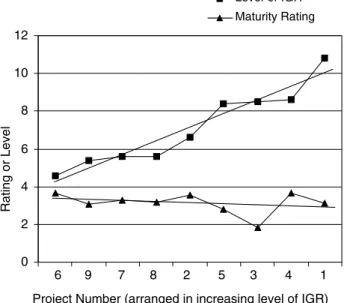
In order to provide a measure of the total internally generated project risk, each non-trivial IGR was as-signed a score of 1–5 according to its risk rating, then the scores were summed for each project. This provides a set of nine data points – as a relative measure of total IGR. The raw scores were scaled, for ease of comparison with maturity.
Maturity was assessed using a survey questionnaire of each projectÕs stakeholders in two parts. The first part was an assessment of maturity on a scale of 1–5, against a definition for each level. The second part assessed per-formance against each of the nine elements of the pro-ject management identified in the PMBOK (5). Both forms gave results for the maturity assessment in the Table 3
Identification, documentation and treatment of IGRs Project High or extreme IGR Previously identified Documented or reported Treated or managed 1 19 6 1 3 2 7 5 5 4 3 18 9 2 2 4 15 9 2 2 5 19 13 11 4 6 2 2 0 0 7 8 6 3 1 8 8 3 3 1 9 9 6 2 1 Total 105 59 29 18
range 1–5, where 5 represents a highly mature and effec-tive project management organisation. These results were then averaged, to provide a single maturity rating for each project. Both maturity and total IGR are shown inFig. 2.
To test for correlation, a non-parametric test using the rank correlation coefficient (Spearman rank) and thet-distribution for small samples was used, to exam-ine the null hypothesis that there is no correlation between the two sets of data. The rank correlation coef-ficient was calculated as 0.55, indicating a possible negative correlation. The significance of the correlation was assessed by calculating the ‘‘t’’ value. This indicated that the null hypothesis can be rejected at a 80% confi-dence level, but cannot be rejected at 90%. That is, there is some reason to believe that in projects there is a neg-ative correlation between total IGR and maturity. How-ever, confidence is not as high as we would like, and this should be taken as an indication only.
4. Interpretation of results
Although the nine projects are a small sample, the data indicate strongly that internally generated risks are common, significant and poorly managed. This should be of concern, since projects are pervasive in society today[13].
There are many reasons why IGRs may not be man-aged well. The first is that risks involving people tend to be sensitive to talk about and difficult to resolve. For example, if a manager is not good at his job or micro-manages subordinates, this will create risk to the organi-sationÕs success[7]. From experience, we also know that in such cases it is likely that people will simply put up
with the problems created, rather than face the sensitive task of seeking management action. It is even less likely that such risks will be openly documented in formal risk management systems. To do so, would be to cause af-front not only to the manager in question, but also to their manager – who is accountable to identify and re-solve such performance issues.
Risks can be sensitive for other reasons. If a project is under-resourced, staff are being overworked or an inter-nal process is ineffective then risks will be created. Although not directly about people, such sources of risk are often linked to a decision or policy that is ‘‘owned’’ by someone – the person who approved the project de-spite a lack of resources, the person who is demanding more work than is possible, or the owner of the ineffec-tive process or rule. These internally generated sources of risk may be known and discussed, but in many organ-isations they are unlikely to be documented in a risk register. To do so might be seen as insensitive or provoc-ative, or simply as politically inappropriate.
Internal risks are also often seen as afait accompli– such as when a project manager is told to ‘‘just do it’’ despite having inadequate resources to do the work properly. If there is no real possibility of the problem being resolved, then there is little incentive to document it as a risk. Reporting such risks may also be seen as being provocative or recalcitrant – as making a political point at the cost of the manager involved.
Finally, internally generated risks are often intangi-ble, and therefore not easily quantified. They do not lend themselves to being managed using risk processes that rely upon quantifying and classifying risks. Manag-ers may also feel uncomfortable trying to describe, as-sess and classify risks that are about human relationships, culture or behaviour. It may also be seen as a waste of time to bother documenting issues that are intangible or that are thought unlikely to be man-aged. Ultimately, these issues mean that internally gen-erated risks are less likely to be managed properly.
5. The implications for managers
The first implication for managers is that they should be concerning themselves more with the management of internally generated risks. This is reinforced by the re-search of McLucas, who showed that the lack of under-standing and hence lack of effective management of such risks is a common feature of avoidable disasters [11]. A plausible implication not tested here, is that poor man-agement of IGRs is a contributing factor to avoidable disasters in projects.
A second issue for managers is how to investigate and treat IGRs. For the research, a new risk mapping tech-nique was developed in order to be able to deal with the complexity of the risks involved. It was also possible to
0 2 4 6 8 10 12 Level of IGR Maturity Rating
Project Number (arranged in increasing level of IGR)
Rating or Level
6 9 7 8 2 5 3 4 1
Fig. 2. Project management maturity related to total internally generated risk.
conduct confidential interviews to gather data that otherwise may not have been forthcoming. A manager may have neither the necessary tools and skills, nor the opportunity, to investigate IGRs effectively.
The maturity survey results were not strongly conclu-sive, but did provide some support for the intuitively obvious link between how well an organisation is set up (its maturity) and the amount of internally generated risk it faces. If this inverse relationship is correct, work-ing to remove the sources of internally generated risk also means working to increase project management maturity. This is an exciting prospect, since it offers a way of using risk analysis to support the development of organisational capability, without the current reliance on benchmarking[14]. Since it is inherently context sen-sitive, the risk analysis of internally generated risks may be able to drive rapid organisational responses to changes in the environment.
6. Implications for risk management as a discipline
The research outcomes raise questions for profes-sional risk managers and for those who manage stan-dards such as AS/NZS 4360. The nine projects all had risk registers and reported their risks through formal systems. All had conducted some degree of risk assess-ment as part of their project manageassess-ment process. De-spite these measures being in place, the risk data are very clear – the projects were experiencing significant internally generated risk, but those risks were poorly managed. There were even cases where extreme risks had not been identified or were not being managed.
When attempting to draw lessons from this it is nec-essary to differentiate between project teams being inef-fective in applying the risk management standard and other possible explanations. Although not tested in this research, it seems unlikely that all nine projects were not capable of applying the standard risk management ap-proach. The alternative is that the standard approach may itself not be competent when dealing with typical internally generated risks. In turn, this would imply that those risk management standards should be re-examined from first principles in order to develop an approach that is capable of dealing with all risks, including inter-nally generated risks.
7. Further research
The results are based upon simple hypotheses, and indicate that further study is appropriate. Possible areas of interest include:
Confirmation of the results for a wider range of pro-ject types.
Identification of the underlying reasons as to why internally generated risks tend not to be identified or managed.
More complete testing of the relationship between project management maturity and the presence of internally generated risk in projects.
Testing whether AS/NZS 4360 compliant risk man-agement approaches can deal effectively with inter-nally generated risks.
Testing whether project failures and disasters can be linked to the presence of internally generated risks.
8. Conclusions
Both the arguments and the research data support a conclusion that internally generated risks are important in projects. Internally generated risks are common, sig-nificant and difficult to manage. Despite their impor-tance as a class of risk, the results imply that common process-driven risk management approaches are inade-quate to deal with internally generated risks. This may be because such risks are often complex and or sensitive, and hence can be difficult to document. They may also be difficult to quantify and to classify. The overall con-clusion is that internally generated risks are a key class of risk in their own right. They are important, and may require special attention in order for them to be managed effectively.
The level of internally generated risk seems to relate inversely to the level of project management maturity in the organisation. If this proposition is true, this pre-sents an opportunity to develop a new and exciting ap-proach to work on project management maturity. The identification, analysis and treatment of internally gen-erated risks would be used to drive organisational devel-opment[3].
The results of the research indicate that internally generated risks are a major challenge for project manag-ers and for risk professionals. The first step in meeting that challenge may prove to be the most difficult – to move outside the current way of thinking about the management of risk, to make it possible to develop a new and more capable risk management approach.
References
[1] Gray CF, Larson EW. Project management. The managerial process. Singapore: McGraw-Hill; 2000.
[2] Gilbreath RD. Winning at project management: what works, what fails and why. New York: Wiley; 1986.
[3] Barber RB. The dynamics of internally generated risks in organisations. In: Haslett T, Sarah R, editors. 9th ANZSYS conference proceedings, Sheraton Towers, Melbourne, Australia; 2003.
[4] Checkland DI, Ireland LR. Project management strategic design and implementation. New York: McGraw-Hill; 2002.
[5] Project Management Institute. A guide to the project manage-ment body of knowledge. North Carolina: PMI Publishing; 2000. [6] Barber RB, Burns M. A systems approach to risk management. In: Ledington P, Ledington J, editors. Proceedings of Australian and New Zealand systems conference 2002, Outrigger Resort, Mooloolaba, Australia; 2002.
[7] Jacques E. Requisite organisation. Arlington: Cason Hall & Co; 1998.
[8] Standards Australia. Risk management AS/NZS 4360. Strath-field: Standards Association of Australia; 2004.
[9] Conrow E. Effective risk management. Virginia: American Insti-tute of Aeronautics and Astronautics; 2003.
[10] Morris PWG. The management of projects. London: Thomas Telford; 1997.
[11] McLucas AC. Decision making: risk management, systems thinking and situation awareness. Canberra: Argos Press; 2003.
[12] Callison D. Concept mapping. School Library Media Activities Month 2001;17(10):30–2.
[13] Flyvbjerg B, Bruzelius N, Rothengatter W. Megaprojects and risk. Cambridge: University Press; 2003.
[14] Barber E. Benchmarking the management of projects: a review of current thinking. Int J Proj Manag 2004;22(4):301–7.
[15] Novak JD. Learning, creating and using knowledge: concept maps as facilitative tools in schools and corporations. Lon-don: Lawrence Erlbaum Associates; 1998.
![Fig. 1 illustrates a total possible set of risks, including IGR [3]. A risk cannot be both externally generated and internally generated – they are mutually exclusive cate-gories](https://thumb-us.123doks.com/thumbv2/123dok_us/9816722.2473991/2.892.93.396.109.266/illustrates-possible-including-externally-generated-internally-generated-exclusive.webp)