UNIVERSITY OF TARTU
Institute of Computer Science
Software Engineering Curriculum
Rain Oksvort
A Prototype for Learning
Privacy-Preserving Data Publishing
Master’s Thesis (30 ECTS)
Supervisor: Raimundas Matulevičius, PhD
A Prototype for Learning Privacy-Preserving Data
Publish-ing
Abstract: Our data gets collected every day by governments, different organi-zations and individuals for data mining. It is often not known who the receiving part of data is and whether data receiver can be trusted. Therefore it is necessary to anonymize data in a way what it would be not possible to identify persons from released data sets. This master thesis will discuss different threats to pri-vacy, discuss and compare different privacy-preserving methods to mitigate these threats. The thesis will give an overview of different possible implementations for these privacy-preserving methods. The other output of this thesis is educational purpose software that allows students to learn and practice privacy-preserving methods. The final part of this thesis is a validation of designed software.
Keywords: Privacy, data, publishing
CERCS:T120 Systems engineering, computer technology
Prototüüp privaatsust säilitava andmete avalikustamise
õp-pimiseks
Lühikokkuvõte:
Erinevad organisatsioonid, valitsusasutused, firmad ja üksikisikud koguvad and-meid, mida on võimalik hiljem uute teadmiste saamiseks andmekaeve meetoditega töödelda. Töötlejaks ei tarvitse olla andmte koguja. Sageli ei ole teada andmetööt-leja usaldusväärsus, mistõttu on oluline tagada, et avalikustatud andmetest po-leks enam võimalik tagantjärgi privaatseid isikuandmeid identifitseerida. Selpo-leks, et isikuid ei oleks enam võimalik identifitseerida, tuleb enne andmete töötlejate-le väljastamist rakendada privaatsust säilitavaid meetodeid. Käesotöötlejate-levas lõputöös kirjeldatakse erinevaid ohte privaatsusele, meetodeid nende ohtude ennetamiseks, võrreldakse neid meetodeid omavahel ja kirjeldatakse erinevaid viise, kuidas and-meid anonümiseerida. Lõputöö teiseks väljundiks on õpitarkvara, mis võimaldab tudengitel antud valdkonnaga tutvuda. Lõputöö viimases osas valideeritakse loo-dud tarkvara.
Võtmesõnad: Privaatsus, andmed, avalikustamine
Contents
1 Introduction 6
2 Privacy Assets, Threats and Mitigations 8
2.1 Related Work . . . 8
2.2 Privacy-Preserving Data Publishing Methods . . . 9
2.3 Record Linkage . . . 10 2.3.1 k-Anonymity . . . 11 2.3.2 (X, Y)-Anonymity . . . 12 2.3.3 MultiRelational k-Anonymity . . . 13 2.3.4 Comparison of Solutions . . . 14 2.4 Attribute Linkage . . . 15 2.4.1 l-Diversity . . . 16 2.4.2 t-Closeness . . . 17 2.4.3 Comparison of Solutions . . . 18 2.5 Table Linkage . . . 19 2.5.1 -Differential Privacy . . . 19 2.5.2 Distributional Privacy . . . 20 2.5.3 Comparison of Solutions . . . 20 3 Anonymization Operations 21 3.1 Generalization and Suppression . . . 21
3.2 Anatomization and Permutation . . . 22
3.3 Perturbation . . . 23
3.4 How Operations Help To Implement method . . . 24
3.4.1 k-Anonymity . . . 24 3.4.2 (X, Y)-Anonymity . . . 24 3.4.3 Multirelational k-Anonymity . . . 24 3.4.4 l-Diversity . . . 24 3.4.5 t-Closeness . . . 25 3.4.6 -Differential Privacy . . . 25 3.4.7 Distributional Privacy . . . 25 3.5 Comparison of Solutions . . . 25
4 Prototype For Learning Privacy-Preserving Data Publishing 27 4.1 Scope . . . 27
4.2 Overall Description . . . 28
4.2.1 Product Perspective . . . 28
4.2.2 User Characteristics . . . 28
4.3 Specific Requirements . . . 29 4.3.1 Mock-ups . . . 29 4.3.2 Functional Requirements . . . 34 4.3.3 Nonfunctional Requirements . . . 35 4.4 Back-end Description . . . 35 4.5 Front-end Description . . . 36 4.6 Process Diagram . . . 38 4.7 Summary . . . 38
5 Validation of the Prototype 39 5.1 Tasks . . . 39
5.1.1 Datasets . . . 39
5.1.2 Tasks . . . 39
5.2 Feedback Survey . . . 40
5.3 Background of the Students . . . 40
5.4 Treatment of the Students . . . 40
5.5 Results from University1 . . . 41
5.6 Results from University2 . . . 42
5.7 Comparison of Results . . . 42
5.8 Threats to Validity . . . 43
6 Conclusion 44 6.1 Limitations . . . 44
6.2 Answers to Research Questions . . . 44
6.3 Conclusion . . . 45
Definitions and Acronyms
PPDP - Privacy-Preserving Data Publishing.QID - Quasi-Identifier
CSV - Comma Separated File.
Import table- read table from CSV file into program memory.
Export table - write table from program memory to CSV file.
EMD - Earth Mover Distance
Open table- select table that is in program’s memory to for further processing.
Identifier column- column that is either primary key for table row (such as ’Id’) or that is part of table key (such as ’first name’ or ’last name’).
Attribute type - type of attribute (column) that is represented by that column. One of the following: Explicit_identifier, Quasi_identifier, Sensitive_attributes or Non-sensitive_attributes.
Attribute action - action to take to this attribute (column). One of the follow-ing: Keep as is, Remove or generalize.
TCP - Transmission Control Protocol.
Attribute- characteristic of data table. In other words column name. Examples: Id, Name, Age, Job, etc.
JSON- JavaScript Object Notation.
HTML - HyperText Markup Language.
1
Introduction
Data mining is often used to gain knowledge about our everyday life. Our data gets collected daily and then either sold or given to data miners. Digital informa-tion is collected by governments, organizainforma-tions and individuals. For example in California hospitals are even required to publish data by the law to publish demo-graphic data. Different parties collect and publish different data. Original data from data publisher’s database often contains personal information about people whose data was published. This will cause threats to our privacy because not all data miners are trustworthy. It may happen that data publisher does not even know if they can trust data recipients. This means that data recipient might be attacker. An attacker could find a victim from one record by some identifying attributes and then link the row in the first table with a row from the second table using attributes that are common for both tables. This can lead to loss of privacy due to record linkage as an attacker could misuse the data. This is a problem be-cause person’s private data could help an attacker to take advantage of victim. For example, an attacker could impersonate victim in order to get some prescription drug or even commit a crime so that guilt would fall on victim instead. Therefore it necessary to publish it in a way that preserves privacy. Privacy-preserving data publishing offers means to publish data in a way that is still useful for data miners but preserves privacy of individual whose data was published [FWCY10].
It is necessary to protect the people from potential consequences of privacy link-age. Privacy-preserving data publishing methods will preserve person’s privacy by making person not identifiable from published data. This can mean removing of identifying attributes such as first name and last name but in addition to that there different methods to generalize data in the way that makes it even harder to identify some specific person from a dataset. Such operations will improve pro-tection of privacy while still keeping data useful for data miners.
Since there are different methods for anonymizing data, it is hard to know which method is good for which situation. The aim of this master’s thesis is to compare the different methods to each other to find out which the strengths and weaknesses of each method. In the first part of this master’s thesis author gives an overview of different threats to privacy, and for each threat one or more solution and compar-ison of these solutions by highlighting their strong and weak points. The second part of this master’s thesis will be an educational program that lets users to try different privacy-preserving methods on different datasets to see and learn how they work. The third part of this thesis will be validation of this software.
The information is obtained by reading different articles on privacy-preserving data publishing [FWCY10].
The first chapter gives an overview of privacy-preserving data publishing and re-lated work. The second chapter describes different threats to privacy that can
occur when data is published in its original form and discusses and compares some privacy-preserving methods. The third chapter discusses and compares different anonymization operations, that can be used to make data to meet the requirements set by privacy-preserving methods. The fourth chapter specifies the educational purpose prototype application which is intended to help students to learn more about privacy-preserving data publishing. The fifth chapter validates the useful-ness of prototype using feedback that was received from students who used this program. In addition to that, this chapter also discusses possible threats to valid-ity.
This thesis will address the following research questions:
MRQ How to publish personal data in a way that preserves privacy?
RQ1 What are the risks of publishing personal data and what methods can be used to mitigate these risks?
RQ2 What anonymization operations implement privacy-preserving methods?
RQ3 What is the prototype for learning these privacy-preserving methods?
RQ4 What is usability of the prototype?
Research questions 1 and 2 are answered by doing systematic literature review and summarizing reviewed literature in the chapters 1 and 2. Research question 3 is answered by designing and implementing a prototype application for learning a privacy-preserving data publishing.
2
Privacy Assets, Threats and Mitigations
This chapter will answer to research question "What are the risks of publishing per-sonal data and what methods can be used to mitigate these risks". Since the data is collected by different parties every day and it is not possible to know whether or not data miner is trustworthy it is necessary to apply different anonymization operations on data before it is published. If data is not anonymized it can be used to perform different attacks. For example, AOL(America Online) query logs were published but removed after reidentification of a searcher [FWCY10]. Anonymiza-tion is a set of operaAnonymiza-tions on data that are designed to hide the identity of the data owner. In this chapter we are going to analyze different threats to privacy and anonymization methods [FWCY10].
2.1
Related Work
Different research works have been done in the field of privacy-preserving data publishing for years. In [Swe02] where are discussed the threat of publishing data, re-identification of the victim and a privacy-preserving method called k-anonymity. In [WF06] the authors show the weakness of k-Anonymity and propose (X, Y)-Anonymity as a solution. In [NCN07] authors extend the definition of k-Y)-Anonymity to work with relational data and define a new method called MultiRelational k-Anonymity. The authors also explain why k-Anonymity cannot be used on rela-tional data. In [MKGV07] the authors discuss different attacks on k-Anonymity and propose l-Diversity to mitigate these attacks. In [LLV07] the authors dis-cuss record linkage and attribute linkage, show the limitation of l-Diversity and proposes t-Closeness to overcome this limitation. Cynthia Dwork has published several papers about -Differential privacy. From these papers [Dwo06] was used for writing about-Differential privacy in this master’s thesis. In [Dwo06] is stated that risk to person’s privacy must not increase as a result of participating in data release which is the essence of -Differential privacy. In addition to that, there are several papers that discuss how these privacy-preserving methods could be implemented. Article [FWCY10] summarizes these papers and also other papers that I have not mentioned. Privacy-preserving Data Publishing: A Survey of Re-cent Developments was used as a starting point for writing this masters thesis and other papers were used to gain additional information. Papers that have been published in this field are mainly informative. They explain different attacks to privacy such as record linkage, attribute linkage or table linkage. Published work also proposes mitigation methods for such attacks such as k-Anonymity, (X, Y)-Anonymity, MultiRelational k-Y)-Anonymity, l-Diversity, t-Closeness, -Differential privacy and distributional privacy. Studies also propose algorithms for anonymiz-ing data released [FWCY10].
However by thesis author’s observation research papers do not compare differ-ent privacy-preserving methods by highlighting their strengths and weaknesses. Research papers mainly highlight weaknesses of previously known methods and after that focus on proposing an other method. In this master’s thesis author will compare privacy-preserving methods to each other to find out what are the weaknesses and strengths of different privacy-preserving methods. This research work will also compare the purposes of different privacy-preserving methods and the author of this thesis will write a prototype application that allows users to try different methods.
2.2
Privacy-Preserving Data Publishing Methods
Generally in PPDP (Privacy-Preserving Data Publishing), the table that is to be published is in the following form
T(Explicit_identif ier, Quasi_identif ier, Sensitive_attributes, N on−sensitive_attributes)
Where Explicit_identifier is a list of attributes that directly identify the person such as name, person code, address, social security number and so on. Quasi_identifier (QID) is a list of attributes whose combination could possibly identify the person such as sex, age, job, zip-code and so on. The combination of quasi-identifiers can either specify the unique record from a second table or small set of records. Sensitive_attributes are sensitive attributes that are specific to the person such as diseases or salary. Although there can be several attributes that can belong to sensitive attribute set, in this thesis we only cover privacy-preserving methods that are designed for tables that have only one sensitive attribute. Non-sensitive at-tributes are all other atat-tributes that do not fit into previous categories [FWCY10]. In this master’s thesis we discuss three different types of threats.
1. Record linkage attack which in other words is identity disclosure. After successful record linkage attack, attacker knows whether or not his victim is present in the data release.
2. Attribute linkage which means that value of some sensitive attribute is re-vealed about the victim.
3. Table linkage occurs when attacker will get to know whether or not victim is present in given table. The difference from record linkage is that in table linkage attacker does not need to find exact victim’s record.
Record linkage can often lead to attribute linkage [LLV07].
The following table will give an overview of threats to privacy and methods for each threat that can be used to mitigate the threats.
Table 1: Privacy models (adapted from [FWCY10])
Privacy Model Attack Model
Record Linkage Attribute Linkage Table Linkage k-Anonymity x (X, Y)-Anonymity x MultiR k-Anonymity x l-Diversity x x t-Closeness x -Differential Privacy x Distributional Privacy x
From table 1 it can be seen that most of the privacy-preserving methods protect against specific attack type. The only exception of methods discussed in this thesis is l-Diversity which protects against both record linkage and attribute linkage.
2.3
Record Linkage
Record linkage is an attack where attacker tries to map one or more records re-leased dataset to victim. To do this, attacker will try to match victims’ QID from released data. This could lead to exposure of data owner’s private data such as political or religious views for example [FWCY10].
The following tables are to demonstrate record linkage attack.
Table 2: Work (adapted from [FWCY10])
First name Last name Age Gender City Work
Juhan Olev 39 Male Elva Programmer
John Doe 35 Male Elva Analyst
Gebede Ahmed 37 Male Tartu Developer Beth Smith 41 Female Tartu Designer Laura Saar 44 Female Elva Painter
Table 3: Disability (adapted from [FWCY10])
Age Gender City Disability
39 Male Elva No
35 Male Elva Yes 37 Male Tartu No 41 Female Tartu Yes 44 Female Elva No
In the following two examples we have {First name, Last name} in role of ex-plicit_identifier, {Age, Gender, City} in role of Quasi_Identifier, and {Work}
from table 2 and {Disability} from table 3 in role of Sensitive_Attribute. Both tables 2 and 3 contain common attributesAge, Gender, City. These attributes individually do not specify any individuals, but when together they can either specify person uniquely or leave attacker with only few options to choose from.
Example 2.1. (Adapted from [FWCY10]). Suppose that attacker has access to table 2 and table 3. If both tables contain same people then attacker could join these tables together on Age, Gender and City. This way attacker can learn whether victim has disability or not.
It is also possible to use record linkage attack where only one table is available.
Example 2.2. (Adapted from [FWCY10]). Suppose that attacker knows victims Quasi_Identifier (QID). In that case, attacker can find out if the victim has a disability because knowing the combination of Age, Gender and City will uniquely define the row in tables 2 and 3.
The following chapters will discuss different methods to mitigate record linkage attacks what were shown in examples 2.1 and 2.2.
2.3.1 k-Anonymity
Suppose that data publisher wants to publish data to data miners. This will raise a question how to publish this data in a way that attacker would not be able to uniquely identify the victim from published data. One way of doing this is to take one or more quasi-identifiers and generalize them into groups so that data owner would not be identifiable inside that group. For example, if attribute job is part of QID then programmer, analyst and tester could be generalized to a software developer. Different ages of data owner could be generalized into 5-year intervals. For example, ages 21, 23 or 24 years could be generalized to 20-25 years. After such generalization exact values will be replaced with generalized valued. This will prevent record linkage trough QID. The idea described above is called k-anonymity. Next the author will give more formal definition [Swe02].
Definition 2.1. Let T be published table and k number of records. Table T is k-anonymous when record owner is not distinguishable from least k-1 other record owners. [Swe02]
In other words, k-anonymity means that groups size on QID is k or more. There-fore probability of linking victim trough QID is 1k or less. [FWCY10]
The number of attributes in QID can affect the value of k for which table satisfies k-Anonymity. For example, if we take QID = Age, Gender we can make a 2-anonymous table of table 3 by generalizing Age to intervals with a size of five.
Table 4: 2-anonymous disability (adapted from [FWCY10])
Age Gender City Disability [35-40) Male Elva No [35-40) Male Elva Yes [35-40) Male Tartu No [40-45) Female Tartu Yes [40-45) Female Tartu No
According to definition (2.1) table 4 is 2-anonymous because the smallest group on QID of indistinguishable records has a size of 2. If we would take QID to be {Age, Gender, City} then, however, our table would only be 1-anonymous because there is no other male whose age is in range 35 to 40 years and who lives in Tartu. From table 4 we cannot tell whether the male with a disability is Juhan or John. However, since the table is only 2-anonymous we can assume the name of record owner with 50% of probability. Hence the greater the k the less probability attacker has to successfully link records from different tables. Also the more elements we include in QID the better protection k-anonymity would provide. The downside of choosing more attributes in QID is that the data would become more distorted compared to choosing fewer attributes in QID [FWCY10].
The disadvantage of k-anonymity is that it causes data distortion. For example our 2-anonymous table above will not give us exact information about age, instead it gives us the age range. Such distortion might make information less valuable for data miners [Swe02].
2.3.2 (X, Y)-Anonymity
K-anonymity assumes that each individual appears only once in a data table. However when the same person appears more than one time in a data table, k-anonymity may not provide required k-anonymity.
Example 2.3. One person may have many different diseases. This could mean that hospital’s data set may contain more than one row for given person. If a person has 4 diseases then that person would have 4 rows in table and thus k-anonymity could give him k-anonymity of k4 instead of k.
To solve this problem (X, Y)-Anonymity was proposed by Wang and Fung in 2006 [WF06] where X and Y are disjoint sets of attributes.
Definition 2.2. Let X and Y be disjoint sets of attributes in table T. When each value from set X has to be linked to k or more values from Y then table T is (X, Y)-Anonymous.
This means that if X represents some QID and Y represents identifier (person) then (X, Y)-Anonymity would require that each QID group would represent at least k different persons. This would guarantee that QID groups would offer anonymity of k [WF06].
2.3.3 MultiRelational k-Anonymity
So far we have looked different methods to anonymize data that consists of a single table. In this section we are going to discuss method called multirelational k-Anonymity [NCN07].
In often cases data is kept in multiple relational tables instead of a single table. In relational tables, not all sensitive or identifying information is kept in each table separately. Instead there is one table that contains identifying information and other tables would refer to it. In this case k-anonymity may not be the best option. It may fail to ensure anonymity or cause too much distortion making data useless for data miners [NCN07]. The example below will illustrate multirelational database.
Table 5: Person (adapted from [NCN07])
Id First name Last name Age Gender City
1 Juhan Olev 39 Male Elva
2 John Doe 35 Male Elva
3 Gebede Ahmed 37 Male Tartu
4 Beth Smith 41 Female Tartu
5 Laura Saar 44 Female Elva
Table 6: Work (adapted from [NCN07])
Id Work 1 Programmer 2 Analyst 3 Developer 4 Designer 5 Painter
Table 7: Disability (adapted from [NCN07])
Id Disability 1 No 2 Yes 3 No 4 Yes 5 No
etc. Table 6 Work will not store any other identifying details other than Id that refers to Id column of Person table 5. Likewise the Disability table 7 only stores
Disability attribute and Id that refers to Person table 5. When data comes from multiple tables like these, it is necessary to guarantee that it would be difficult to link records between those tables. For such case multi-relational anonymity [NCN07] is proposed.
Definition 2.3. (Multirelational k-anonymity) Let PT be Person-specific table, T1, ..., Tn be a set of tables that linked to PT using identifier from PT,
T =P T on T1 on ... on Tn be join of all tables and o the owner of record in table
T. We say that table T is k-anonymous if for each record owner o there is at least
k−1record owners with same QID [FWCY10].
In example tables above PT is Person table, T1 is Work table andT2 is Disability
table. In this case table T would have columns {Id, First name, Last name, Age, Gender, City, Work, Disability }. Choosing QID would depend on to whom data is published [NCN07].
2.3.4 Comparison of Solutions
In this chapter, author will compare highlight strong and weak points of each privacy-preserving method discussed so far.
K-anonymity is designed for single data table where each row represents a dif-ferent person. In situations where the same person is present in multiple rows k-anonymity may not offer sufficient protection. In the case of relational database, anonymity might distort data too much or leak privacy. Another weakness of k-anonymity is that attacker can still successfully infer the value of sensitive attribute when the diversity of sensitive attribute in QID group is too small [FWCY10] [MKGV07].
(X, Y)-Anonymity is designed for situations where the same person is present in multiple rows. (X, Y)-Anonymity ensures that each QID group has at least k different values meaning that it would be more difficult to guess some specific attribute value for given QID group [FWCY10].
Multirelational k-anonymity is designed for relational databases. Compared to k-anonymity multirelational k-anonymity protects privacy in multirelational database sufficiently while still keeping it useful for data miners [FWCY10].
Table 8: Comparison table
Criteria k-Anonymity (X, Y)-Anonymity Multirelational k-Anonymity Purpose Single table where each
row represents a dis-tinct person.
Single table where one person can appear in multiple rows.
Multiple relational ta-bles.
Weakness Does not guarantee di-versity of sensitive at-tribute meaning that attribute linkage is still possible.
Does not guarantee suf-ficient privacy when person is present in multiple rows.
Does not offer sufficient privacy or renders ta-ble useless for datamin-ers when used on multi relational database. In practice, privacy does not depend much on QID size but rather on number of distinct values in QID group [XT06].
Does not offer sufficient privacy or renders ta-ble useless for datamin-ers when used on multi relational database. Does not guarantee di-versity of sensitive at-tribute.
Does not guarantee di-versity of sensitive at-tribute.
Does not guarantee suf-ficient privacy when person is present in multiple rows.
Strength Easier to understand and check than (X, Y)-Anonymity
Works wit tables where the same owner is present in multiple rows.
Does not over or under anonymize relational data.
Although in table 8 k-anonymity has more weaknesses than other privacy-preserving methods. (X, Y)-Anonymity and Multirelational k-Anonymity overcome these is-sues by adding additional requirements to k-Anonymity.
2.4
Attribute Linkage
Privacy-preserving methods that this master’s thesis covered in previous chapters work by hiding data owner in a number of other data owners with same QID. However this may not offer sufficient protection to privacy [FWCY10].
Example 2.4. For example when hospital releases a dataset of patient’s diseases. In some QID group there could be four people with HIV and one person with AIDS. In this case, even if attacker does not manage to exactly identify target’s record, he can guess with 80% of confidence that his target has HIV [FWCY10].
Such release is still k-anonymous but it still does not offer sufficient protection to privacy.
Attribute linkage is attack where attacker who knows QID of his target can infer sensitive attribute of target based on sensitive attributes in target’s QID group. The main idea of methods in the following chapters is to reduce the correlation between QID and sensitive attribute [FWCY10].
2.4.1 l-Diversity
L-diversity is proposed by Machanavajjhala [MKGV07] to prevent attribute linkage attack. L-diversity requires that each QID group has at least l different sensitive attribute values. This requirement also satisfies the requirement of k-anonymity where k = l. L-diversity differs from k-anonymity for that while k-anonymity re-quires a group to contain at least k individuals with same QID, l-diversity rere-quires a group to contain at least l different sensitive attributes [AY08] [FWCY10]. Next, the author of this will explain two instances of l-diversity called entropy l-diversity and recursive (c, l)-diversity.
L-diversity does not offer sufficient protection against probabilistic attack because some attributes appear more often than others. In probabilistic, the sensitive attribute is inferred because it appears more frequently than other sensitive at-tributes and therefore attacker can infer that his victim must also have that value for the sensitive attribute. To protect the record owner against such attacks there are stronger notations of l-diversity called entropy l-diversity [FWCY10].
Definition 2.4. Table T is entropy l-diverse when for each QID group
−X
s∈S
P(qid, s)·log(P(qid, s))≥log(l) (1)
Where s is sensitive attribute P(qid, s) is a probability that random person from that QID group has sensitive attribute s [FWCY10].
As a result of this condition, every QID block has to have at least l different sensitive attribute values.
Example 2.5. Let QID = {Age, Gender} in table 4 and P(qid, s) be proba-bility that sensitive attribute ’disaproba-bility’ has value of yes. Using formula 1 find entropy in first QID group −1
3log( 1 3)− 2 3log( 2
3) = log(1.9) and for second QID
group −1 2log( 1 2)− 1 2log( 1
2) = log(2). Therefore when QID={Age, Gender} table
Recursive (c,l)-diversity assures that most common attribute does not appear too frequently in data release and lease common attributes does not appear too rarely [FWCY10].
For the following two definitions author will first define some variables. Let S
sensitive attribute and s1, ...sn possible values of S in given QID group. Lets
sort counts of the occurrences of s1, ...sn in descending order and name the new
sequence r1, ..., rn where r1 is the most frequent element of S and rn be the least
frequent element of S. Let c be some constant chosen by data publisher [MKGV07] [FWCY10].
Definition 2.5. We say that QID block is recursive (c, l)-diverse when r1 < c·(rl+rl+1+...+rn)[MKGV07].
Definition 2.6. We say that table T is recursive (c, l)-diverse when every QID group is (c, l)-recursive [MKGV07].
Limitation of l-diversity is that it assumes that each sensitive attribute comes from uniform distribution. When data is skewed, l-diversity may cause data loss. [FWCY10]
Example 2.6. Suppose we have data of 1000 patients and sensitive attribute disease. Lets also suppose that only 5 patients have HIV and others have all flu for disease. To satisfy k-anonymity where k =l we need at lease one patient who has HIV in each QID group. This means that data loss is high [FWCY10].
2.4.2 t-Closeness
Similarly to previous example t-Closeness was proposed to prevent attribute link-age.
Example 2.7. suppose that in the dataset the value 90% of people have sensitive value a and 10% have sensitive value b. In such table there could be QID that still satisfies l-diversity requirement but where 50% of sensitive values are b. In that case person from that QID group could be inferred to have attribute b with 50% of confidence.
T-closeness was proposed to overcome skewness problem that was described in example 2.7. T-closeness requires that distribution of sensitive attribute in QID is similar to the distribution of that same attribute in the overall table. A table satisfies t-closeness when all QID groups satisfy t-closeness. T-closeness uses the Earth Mover Distance (EMD) to measure the closeness between two distributions of sensitive values. T-closeness requires that this distance is less than or equal to t. [LLV07] [FWCY10].
1. Specification of different protection levels is not flexible.
2. EMD function does not prevent attribute linkage on numerical attributes. 3. Enforcing t-closeness would reduce the data usefulness because it requires
the distribution to be same in all QID groups.
2.4.3 Comparison of Solutions
In this chapter author will compare methods for preventing attribute linkage.
L-diversitywas designed to overcome weaknesses of k-anonymity, however it will not offer sufficient protection to privacy when a distribution of values of a sen-sitive attribute in some QID group is different from the distribution of sensen-sitive attributes in the table. [LLV07].
To overcome this weakness of l-diversity t-closeness was proposed. There are several problems with t-closeness as it can reduce the usefulness of data or threaten privacy when the sensitive attribute is numerical [LLV07].
Table 9: Comparison table
Criteria l-diversity t-closeness
Purpose To prevent attribute linkage for which k-anonymity is not enough.
To prevent attribute linkage in cases where l-diversity does not offer enough protection.
Weakness Does not work when distribution of sensitive attribute is skewed. Knowing about global distribu-tion of sensitive attribute can help attacker to assume sensitive value for victim
Diversity requirement does not take into account diversity re-quirement [LLV07].
No good way defining protection level.
EMD function does not offer pro-tection when sensitive attribute is numerical.
Strict requirement for distribu-tions to be similar reduces use-fulness of data.
EMD function is difficult to com-pute.
Strength Does not reduce the data useful-ness.
Offers protection in cases where sensitive attribute does not come from uniform distribution.
Table 9 shows that l-Diversity and t-Closeness have both their strengths and weak-nesses. While t-Closeness offers stronger protection to privacy than l-Diversity, t-Closeness is more computationally more expensive than l-Diversity.
2.5
Table Linkage
Record linkage and attribute linkage attacks are based on assumption that victim’s record is already known to attacker. However, sometimes it is already enough when attacker know whether or not victim is present in released table. This can happen when the sensitive attribute in released data table is too specific. For example, suppose that a hospital released data table of patients who are mentally ill. In this case exact record does not matter to attacker anymore because no matter what exact disease hs victim has, attacker will know that his victim is mentally ill. In this case just knowing that fact that the victim is present in the data table can already be damaging. The following chapters will discuss some methods to mitigate record linkage attack [FWCY10].
Example 2.8. The following is adapted from [Man13] and illustrates where table linkage could be used. Suppose that employer has two candidates to choose from. Lets also suppose that there is a hospital that releases information about a disease that what will cost extra money for an employee when he hires a person with that disease. In that case employer might be interested in using that released data table to pick a candidate that would cost him less.
2.5.1 -Differential Privacy
In 2006 Dwork proposed another privacy-preserving method called -differential privacy, which says that threat to record owner’s privacy should not significantly increase as a result of being present in a data table. -Differential privacy model compares risk to record owner’s privacy before and after adding it to data table [FWCY10].
Definition 2.7. (-Differential privacy)Let F br randomized function, T1 and
T2 be two datasets that differ exactly one record and S ⊆ Range(F) a set of all
possible outputs of function F. A function F gives-differential privacy for all sets
T1 and T2 and allS ⊆Range(F) holds:
lnP(F(T1)) =S P(F(T1)) =S ≤. (2)
-Differential privacy guarantees to record owners that when they submit their sen-sitive information to the database, there is either very little or nothing new that attacker could learn from that data release about them. However, the downside of
-differential privacy is that does not protect against record linkage and attribute linkage attacks [FWCY10].
Achieving Differential Privacy Differential privacy is achieved by adding ran-dom noise to query answer. In other words answera =f(X) +b where f is query function, X is database and b are some random noise from distribution that is close to distribution on that sensitive attribute in database [Dwo06].
2.5.2 Distributional Privacy
Distributional privacy was proposed by Blum in 2008. It suggests that when records in data table origin from some distribution then that table should only reveal information about that specific distribution. Distributional privacy offers stronger protection to privacy than -differential privacy however it has high com-putational cost [FWCY10].
2.5.3 Comparison of Solutions
This chapter will compare-Differential privacy to Distributional privacy.
-Differential privacy is developed to estimate whether or not it is safe to add given person to data release. It does not protect against record or attribute linkage.
Distributional privacyfrom the other hand does not try to answer the question whether or not it is safe to add given person to data table but rather sets limitations on what table in general can and what it cannot publish.
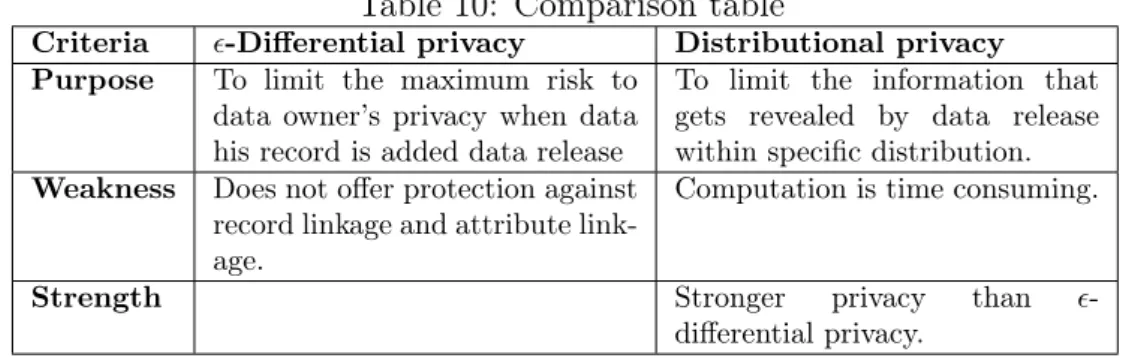
Table 10: Comparison table
Criteria -Differential privacy Distributional privacy Purpose To limit the maximum risk to
data owner’s privacy when data his record is added data release
To limit the information that gets revealed by data release within specific distribution. Weakness Does not offer protection against
record linkage and attribute link-age.
Computation is time consuming.
Strength Stronger privacy than
-differential privacy.
Table 10 offers side by side comparison of-Differential privacy and Distributional privacy.
3
Anonymization Operations
So far we have discussed what needs to be done in order to achieve required anonymity. In this chapter we are going to answer the research question "What anonymization operations implement privacy-preserving methods".
It often happens that original table does not satisfy required anonymity criteria. In this case data needs to be modified in a such way that privacy requirement would be satisfied and at the same time data would still be useful for data miners. Such operations that lead to privacy criteria fulfillment are called anonymization operations. There are many different anonymization operations but in this mas-ter’s thesis we are going to look at generalization, suppression, anatomization, permutation, and perturbation [FWCY10].
3.1
Generalization and Suppression
Generalization and suppression operations are used to hide details in QID. For example, we could generalize jobs such as tester, programmer and administrator under information technology and jobs such as a surgeon, family doctor and nurse could be generalized to medicine. If further generalization is needed information technology and medicine could be generalized toany job. Such generalizations can be represented using taxonomy trees. Likewise exact values such as weight or age, for example, could be generalized to intervals. However, since in generalization specific values will get replaced with more general values, data usefulness will de-crease. Another weakness of Generalization is that the more columns there are in QID, the more accuracy gets lost [FWCY10] [XT06].
Suppression works by replacing some values of QID with special value to indicate that this record was not meant to be published or record could be left out of release entirely [Pal14].
Figure 1 is the sample taxonomy tree that illustrates jobs generalization described in the previous paragraph. Below we are going to give an overview of some gener-alization schemes.
1. Full-domain generalization. This scheme requires that all values generalized to same level of taxonomy tree. For example, when programmer is general-ized to information technology then also surgeon needs to be generalgeneral-ized to medicine. Because of this requirement, this method has highest distortion [FWCY10].
2. Subtree generalization. For given non-leaf node either all or none of its child nodes are generalized. For example, if tester is generalized to information
Figure 1: Sample taxonomy tree of jobs (adapted from [FWCY10])
technology then programmer and developer should be also generalized. How-ever children of medicine can be left specific [Pal14].
3. Sibling generalization is similar to subtree generalization with the difference that it allows some nodes to be left un-generalized. For example if tester is generalized then programmer and developer can be left specific. When some value is generalized then all the other instances of this value must also be generalized [Pal14].
4. Cell generalization is a little bit more flexible than other generalization schemes. While the full-domain generalization, subtree generalization and sibling generalization require all the instances of given value to be general-ized, cell generalization allows some values to stay specific. For example, if in table T there are two records that have same values for sensitive attribute we can choose to generalize one record from programmer to information technology, but keep an other record as programmer [Pal14].
First three schemes are called global recoding while the fourth one is called local recoding [FWCY10].
3.2
Anatomization and Permutation
Anatomization is a method for anonymizing data release which overcomes the weaknesses that generalization has. It works releasing data in two separate tables. One table contains QID and an other table contains sensitive attribute. Both ta-bles have group id column which can be used to join these two tata-bles together.
The table that contains QID groups is called QIT and table that contains sensi-tive data is called ST. After applying an atomization technique to a data table, an attacker would randomly have to guess sensitive attribute for a specific row in QIT table. Since anatomization will keep sensitive attribute values unchanged, data would be more useful for data miners. Since it keeps data unchanged, the correlation between QID and the Sensitive attribute is also more accurate [XT06]. Permutation is similar to an atomization but it does not associate QID with the sensitive attribute in case it has a numerical value. This disassociation is achieved by shuffling values of the sensitive attribute within QID group [FWCY10].
3.3
Perturbation
Perturbation is known for its long history, simplicity and effectiveness. It works by replacing original data with synthetic data which has similar statistical properties. Attacker cannot gain sensitive information from perturbed data because it does not correspond to original data. The downside of perturbation is that the data is meaningless for humans and it is only useful for computing statistical properties such as minimum, maximum, average, mean and so on. As a result of this, data publisher could already just publish data mining results as well. Some perturba-tion methods will be discussed below [FWCY10].
Additive noise is perturbation method that works by adding some random value to original value so that statistical properties of the original table would not differ too much from original ones. The downside of additive noise is that it does always offer sufficient protection to sensitive attribute. For example, when there is high correlation between QID and sensitive attribute and noise is low, the sensitive at-tribute’s original value can be covered from perturbed data [FWCY10].
Data swapping is perturbation method that swaps sensitive attribute values with each other.
Rank swapping is similar to data swapping but first the sensitive attribute values will be divided into ranks and then the swapping is limited within one given rank. In other words value from one rank cannot be swapped with value from an other rank [FWCY10].
Synthetic data generation is an approach where a statistical model is built from original data and then data table is generated based on that model by using sam-pling. After that the synthetic data will be published instead of actual data. Condensation works like synthetic data generation, but it first divides data into groups and then generates synthetic data for each group such that statistical prop-erties of generated data would match the statistical propprop-erties of original data in that group [FWCY10].
3.4
How Operations Help To Implement method
3.4.1 k-AnonymityGeneralization of QID attributes to more general value enables to reach k-anonymity on QID size.
Suppression is not meant to be used alone, instead it should be used when after other methods do not offer sufficient protection (*).
Anatomizationdoes not modify original data but rather releases QID and ST in different tables. Later those two tables are joined using group_id. So if we take group size = k then we have k-anonymity.
Permutationcontributes to k-Anonymity the same way that anatomization does but it enhances privacy by swapping sensitive attribute values within each QID group.
Perturbationis not directly related to k-Anonymity as it generates new synthetic data instead of protecting data (*).
(*) The same applies for other privacy-preserving methods.
3.4.2 (X, Y)-Anonymity
Generalization is used to generalize specific data into QID groups.
Anatomization will lead to (X, Y) anonymity when we choose X to be QID and Y to be a sensitive attribute. In that case we would require that each element from X have at least k different matches from Y.
Permutationcontributes to (X, Y)-Anonymity the same way that anatomization does but it enhances privacy by swapping sensitive attribute values within each QID group.
3.4.3 Multirelational k-Anonymity
In Multirelational k-Anonymity tables from relational database are first joined together and after that Generalization, Suppression, Anatomization, Permutation and Perturbation work exactly the same way as the work with k-anonymity.
3.4.4 l-Diversity
Generalization of attributes in QID will lead to large enough QID group that can have at least l distinct sensitive attribute values.
Anatomization can be used to implement l-Diversity when we require that in each group in ST there would be at least l distinct values.
Permutation does not directly contribute to l-Diversity as l-Diversity sets re-quirement on diversity of sensitive attribute but shuffling of sensitive attribute values within same QID group would not change privacy in case of l-Diversity.
3.4.5 t-Closeness
In t-Closeness Generalization, Suppression, Anatomization, Permutation and Per-turbation work exactly the same way as the work with l-Diversity.
3.4.6 -Differential Privacy
Generalization of attributes increases protection to privacy making it more dif-ficult for attacker to learn whether or not victim is in data table.
Anatomization makes it more difficult to link victim with specific record.
Permutationhas the same effect as anatomization but enhances privacy protec-tion even more by swapping sensitive attribute values.
3.4.7 Distributional Privacy
Generalization methods that we have discussed so far do not offer any guarantee that table would not leak info about other distributions.
3.5
Comparison of Solutions
In this chapter author of the thesis will compare different anonymization oper-ation. In this master’s thesis author has discussed five different anonymization operations. They all have purpose of protecting record owner against attacker but they all work a little bit different.
Generalization changes some specific value in QID group to more general value thus hiding individual in large QID group. The problem, however, is that modify-ing values in QID will make data less useful for data miners.
Suppression is like generalization except that it completely hides some values. It may also use special values to indicate that something is left unpublished. For example, it could have minus one for weight value to indicate that it is not to be published. This can make data mining more difficult since such will affect statis-tical properties if they are not left out.
Anatomization from the other hand does not generalize or hide any value be-hind some special value. Instead, it publishes all the data as it is but divides the QID and sensitive attribute into two separate tables that both have group id in
common. This, however, does not offer sufficient protection to privacy.
Permutationis a version of anatomization which shuffles sensitive attribute val-ues within QID group, thus offering stronger protection for privacy than anato-mization.
Perturbation is data anonymization operation that publishes synthetic data in-stead of actual data. This will protect record owners because their actual data will not be published at all. Instead of that, a table that is entirely generated will be published. The negative side is that such data is uninteresting for humans.
Table 11: Comparison table
Criteria Generalization Suppression Anatomization Permutation Perturbation Purpose Hide
informa-tion in QID.
To indicate that some values are not released. Preserve data as it is. To overcome weaknesses of anatomization. To keep original data from being published. Weakness Will reduce the
usefulness of data.
The more at-tributes in QID, the greater information loss. Special value is useless for datamining and dataminers. Datamining software must be able to handle special values. Unmodified data in QIT and ST is danger to privacy.
Shuffling will remove corre-lation between QID and sensi-tive attribute.
Generating syn-thetic data might be difficult if data mining tasks are not known. Additive noise may not offer suf-ficient protection to privacy. Strength Is flexible due
to different generalization schemes. Offers strong protection for privacy Preserves orig-inal values of sensitive at-tribute will cause datamin-ing results to be more accurate. More accurate correlation between QID and sensitive attribute. Stronger protec-tion for privacy since correlation due to shuffling.
Has long history. Simple.
Effective.
Preserves statisti-cal information.
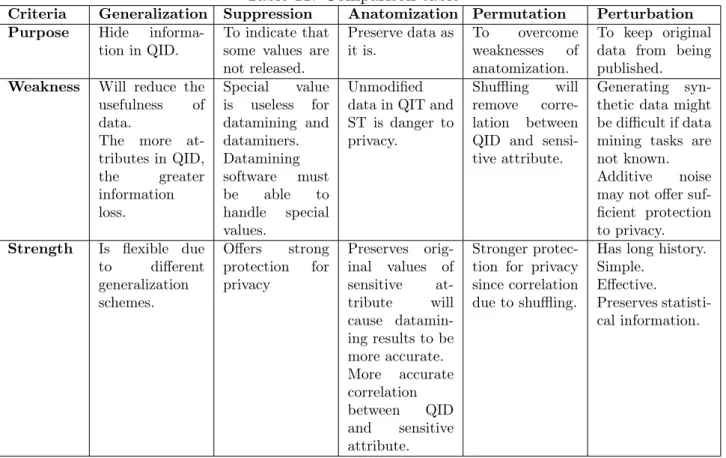
Table 11 offers side by side comparison of anonymization methods described in this chapter. The advantage of generalization, suppression and perturbation is that they keep data in a single table rather than splitting it into multiple tables. The advantage of anatomization and permutation is that they offer a stronger protection to privacy than generalization and suppression can offer. The advantage of perturbation is that it protects the record owner’s privacy but the disadvantage is that instead of actual data, synthetic data is published.
4
Prototype For Learning Privacy-Preserving Data
Publishing
This chapter will answer the research question "What is the prototype for learning these privacy-preserving methods". A prototype is an educational software with the purpose of helping students to better understand Privacy-Preserving Data Publishing. This program allows users to select data table(s) and then guides it’s users trough data anonymization process step-by-step. At each step, a user will be explained why this step is necessary and what needs to be done in order to complete this step. After going trough anonymization steps program will show the resulting table and statistics about it. Users can learn about PPDP by going trough steps of anonymization and comparing the results of anonymization operations. Prototype is a Spring boot [Gut02] web application with Thymeleaf [Fer11] front-end. In addition to Thymeleaf, also JavaScript [Eic95] frameworks such as jQuery [Res06], jQuery UI [Bak07], jQuery table sorter [Bac07], ChartJS [Dow13] and jQuery File Upload Plugin [Mor13] are used. JavaScript that is used by frontend is generated by TypeScript [Mic12] and icons used in this program are from icones.pro [Coz09]. The program has sample data sets to demonstrate different attacks and to allow students to experiment with different anonymization methods and parameters. A user can access content via web browser at localhost:8080.
4.1
Scope
The PPDP learning tool is designed to allow users to use different anonymiza-tion methods to anonymize data. This program allows users to practice data anonymization with different parameters and learn how data usefulness and pri-vacy change when anonymization parameters are changed. The primary purpose of this software is help users to understand how different anonymization methods work. This program is intended to let users to fill in required fields in each step while displaying them instructions and hints. This program is not intended to automatically go trough all steps for two reasons: firstly, students would think and learn more about anonymization methods if they are asked to enter param-eters themselves because then they would be actively engaged in process instead of passively observing it and secondly because automatically filling in required form fields often requires artificial intelligence which is not in scope of this master thesis. Distributional privacy is out of the scope of this program as it defines the required distribution of released table [FWCY10] but distribution theory is not part of this thesis. The program will support the following anonymization meth-ods: k-Anonymity, (X, Y)-Anonymity, MultiRelational k-Anonymity, l-Diversity, t-Closeness and -differential privacy.
4.2
Overall Description
This chapter will give a brief overview of the purpose of created prototype appli-cation, describes the main characteristics of users of this prototype and specifies assumptions and dependencies of this prototype application. The source code of prototype can be found in Appendix 8.
4.2.1 Product Perspective
The product is a program that is created with primary intention to help users to learn and understand how privacy-preserving methods work. PPDP study assis-tant uses back-end to read tables from the disk and data anonymization related operations are performed in front-end. PPDP study assistant goes trough differ-ent steps of anonymization process giving explanations and hints on each step. After anonymizing table it shows user anonymization result and statistics about anonymized table.
Figure 2: PPDP study assistant Use Cases
Figure 2 shows that there are 5 major use cases. The use case 3 can be divided into four subcategories. To see detailed use cases with Use Case Number, Use case Name, Use Case Description, Primary Actor, Precondition, Trigger and Normal Flow, see Appendix 6 Use cases.
4.2.2 User Characteristics
The main user of this program is a student who is learning PPDP. Student’s goal is to learn how different anonymization operations anonymize data and how com-bining them either increases or decreases anonymity. The author of this software
assumes that users of this program have already basic understanding about PPDP. Program author also assumes that users of this program are familiar how joining tables in relational database work.
4.2.3 Assumptions and Dependencies
Since this application is written in Java, it is required that Java version 8 or newer is installed. To run this web application it is required that TCP port 8080 is free at the time if starting the program. Since the user interface is designed in HTML, JavaScript and CSS it is required that user has browsers that support JavaScript.
4.3
Specific Requirements
This chapter will show the screenshots of the views of the program and explain what user is able to do in each view, define the functional and non-functional requirements.
4.3.1 Mock-ups
This chapter will show screenshots of different views in created prototype applica-tion and under each screenshot explain what user can do in that view.
Figure 3: Main view
The main view shown on figure 3 is shown to a user when he starts the program, with Import and Open buttons active. After a user has performed anonymization
operations he will also see the resulting table and statistical information about the anonymized table. Export to CSV button becomes active after opening a table. It can be used to export table to CSV file. On the right side user will see information about PPDP and instructions on how to use this program.
Figure 4: Open table view
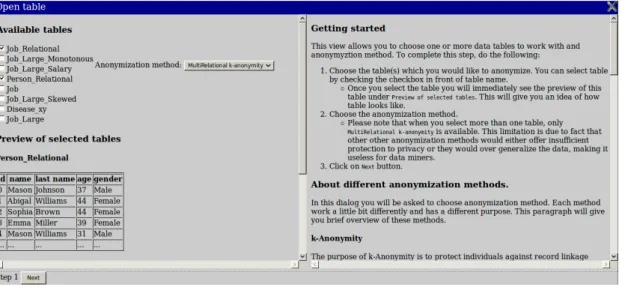
Open table view shown on figure 4 will be shown after a user clicks on ’Open’ button in the main view. On the left side user will see the list of tables under ’Available tables’ header. In this list, both built-in and imported tables will be shown. A user is able to select one or more tables by checking checkboxes in front of table names. Under ’Preview of selected table’ a short preview of each selected table is shown to help a user to know better what table(s) is he going to work with. From table preview user can already see what are the column names in selected table(s) and what kind of data is in selected table(s). This preview area will be updated every time when a user checks or unchecks tables. In addition to that user is also asked to specify anonymization method before he can continue. In case the user selects-Differential Privacy, he will be asked to enter a value forinto input that will become visible below anonymization method selection. On the right side user will see a step-by-step tutorial on how to complete this step and explanations on how different anonymization methods work and what they are for.
Figure 5: Join table view
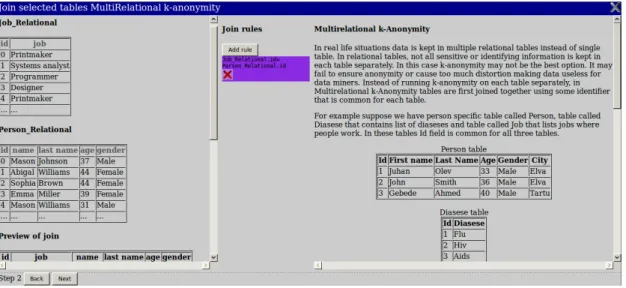
Join table view shown on figure 5 will be shown when a user has checked more than one table in open table view. When a user selects only one table, this view will be automatically skipped. This view allows a user to specify join rules in order to work with relational tables. On the left user will see the tables that he had previously checked in open table view. Below the header ’Preview of join’ user will see the preview of the join operation. When the user has not defined any rules yet a text ’No rules defined’ is shown. When a user clicks on ’Add rule’ button he will be asked click on some column in the first table and then corresponding column in the second table. In addition to that ’Add rule’ gets replaced with ’Ok’ button. When a user clicks ’Ok’ program creates new joining rule based on selected column names and updates preview of the join operation. In addition to that when a user clicks ’Ok’ the ’Ok’ button changes back into ’Add rule’ and created rule will also appear in the purple box under ’Add rule’ button. When it is possible to join tables using the rule that is defined by a user then a user will see the result of join operation below the header ’Preview of join’. If it is not possible to use that rule to join the tables together, a user will see notification which says ’Rules are defined but seem to be invalid. Please check your rules and remove any rules that incorrect. Hint: can you expect Job to be equal to disease instead of join result. If a user has defined a wrong rule, he can delete it by clicking delete button (which is red X icon) inside rule box. On the right side user will see explanation on MultiRelational k-Anonymity and joining columns and also a step-by-step tutorial on how to complete this step.
Figure 6: Attribute type specification view
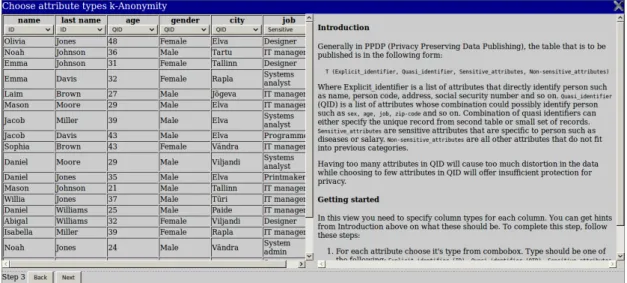
Attribute type view shown on figure 6 will be shown after user has opened a table. This view will allow user to specify attribute types for each attribute. Attribute types are required to compute statistics and also as input for attribute actions view. This view shows data table with attribute type selection below each attribute on the left side. On the right side information about attribute types and step-by-step instructions on how to complete this step is shown.
Figure 7: Attribute action specification view
Attribute action specification view shown on figure 7 allows user specify anonymiza-tion operaanonymiza-tions for each attribute that is part of QID or that is non-sensitive. On
the left side user will see the table that he is currently working on and specify what action should be taken for each attribute. On the right side user will see an explanation of possible actions and a step-by-step guide on how to complete this step.
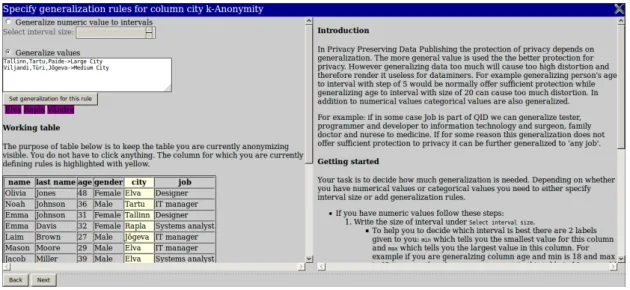
Figure 8: Generalization rules specification view
Generalization rules specification view shown on figure 8 allows user specify rules for generalization for given attribute. On the left side user will see two options: the first option is ’Generalize numeric value to intervals’ and second option is ’Generalize values’. The program will automatically choose the right option for user. When the first option is selected, user will be asked to enter the size of the interval. This means that all the values in this column are numbers and therefore it is best to generalize them into intervals. When the second option is selected user will be asked to generalize specific values to some more general value. This option is selected when the column contains values that are not numbers. User will be able to select values by clicking on purple boxes under ’Set generalization for this rule’. After that user will be asked to specify a more general value for selected values. For example on this screenshot ’Tallinn’ and ’Tartu’ are generalized to ’Large City’ This means that all occurrences of ’Tallinn’ and ’Tartu’ in city column will become ’Large City’ and therefore become indistinguishable from each other. Under the ’Working table’ header user will see the table on which he is currently working on and highlighting shows the column for which he is currently specifying generalization rules. The purpose of this table is to give user visual overview of the table and to allow him to see values in context. On the right side user will see an explanation about generalization and a step-by-step tutorial on how to complete this step.
Figure 9: Quiz
Quiz shown on figure 9 can be accessed by visiting clicking on "quiz" link on main page 3. On quiz page users can see 9 tasks with multiple choice questions below these tasks. Tasks are always in the same order but questions below tasks are randomized each time user visits quiz page. After answering all questions a user can click on submit button. If all questions are answered then a user will receive feedback for the quiz where user answer is highlighted with green if it was the correct answer and with red when it was a wrong answer. In case user selected a wrong answer, the right answer for that question is highlighted with green. After clicking Submit button user can see his score on top of the page. If he wishes to retake the test he can click on ’Try again’ or if he wants to download feedback to his computer he can click on ’Save results’.
4.3.2 Functional Requirements
This chapter specifies functional requirements of prototype application. Functional requirements specify what user must be able to do with the data tables in this pro-gram, how the program should interact with a user and what information should be displayed to a user. All functional requirements have the following fields: Re-quirement#, Requirement Type, Use case#, Description, Rationale, Created By, Fit Criterion, Dependencies, Supporting Materials, Supporting Materials, Priority and View id. Functional requirements in tabular form can be seen in appendix 4.
4.3.3 Nonfunctional Requirements
In this chapter author will specify nonfunctional requirements for given software. Nonfunctional requirements specify understandability of instructions and user in-terface and information it displays. These requirements also specify maximum waiting time. All nonfunctional requirements have the following fields: Require-ment#, Requirement Type, Use case#, Description, Rationale, Created By, Fit Criterion, Supporting Materials, Priority and View id. Nonfunctional requirements in the form of tables can be seen in appendix 5.
4.4
Back-end Description
In this chapter author will specify major concepts and components using a class diagram. This program consists of two parts: front-end and end. The back-end is used to allow front-back-end to have access to file system and to generate and grade quizzes. Everything else that is not related to file system is done in front-end part.
Figure 10: PPDP study assistant back-end class diagram
Figure 10 shows classes from back-end side that are used to manage .csv files. PPDPController is a class that exposes SchemaManager functionality to web and rest controllers. SchemaManager is used for listing and reading .csv files. It also handles uploaded .csv files by using SchemaReader to read uploaded a .csv file into memory and then adding it to schema list SchemaReader class is used to read .csv files from resources folder into memory. Uploaded .csv files are turned into InputStream and then read to memory using SchemaReader’s readSchema method.
Figure 11: PPDP study assistant back-end class diagram for quiz
Figure 11 shows classes from back-end side that handles quiz part. A Quiz class is used to compose and check quiz. A quiz is made of tasks. Each task has at least one multiple choice question. Every time quiz is composed a random question is chosen for each task from the list of questions that belong to that specific task. When a student submits a quiz, answers are sent as a list of Answer objects. Quiz class then gives Feedback for each Answer, sending client back the list of Feedback.
4.5
Front-end Description
Front-end part requests the list of available tables from back-end. Later, when user wants to use that specific table, it will send an other request to get the contents of selected table. Not downloading all the tables at once helps to reduce network traffic by not downloading tables that are not needed. Front-end guides users trough different steps and the performs anonymization operations based on user input. When user gets past the open table view, internet connection to back-end is no longer required because the anonymization of data and computing the statistics is done in front-end side.
Figure 12 shows classes in front-end side. Front-end starts from the Main class which initializes Application and dialogs. Application class is used to interact with back-end to get the list of available tables and to get the contents of a specific table by its name. It has also functionality processing received tables and extracting information from these. Frontend also has one class for each dialog that handles rendering of that specific dialog and actions that can be performed in that dialog. Anonymization class is used to anonymize data after the user has specified rules for anonymization. Statistics class is used to generate descriptive statistics for anonymized table.
4.6
Process Diagram
This chapter gives overview of anonymization process in PPDP study assistant.
Figure 13: PPDP study assistant process diagram
Figure 13 First user selects one or more table in open table view shown on figure 4. In case user selects two or more tables user will have to specify how to join tables in join table view shown on figure 5. In case user only selects one table in open table view or when he clicks next on join table view He will be shown he will be asked to specify attribute types for each attribute in attribute type specifica-tion view that is shown on figure 6. After that user is asked to specify attribute actions using attribute actions specification view shown on figure 7. For each col-umn for which generalization was specified, user is asked to specify generalization rules using generalization rules specification view. After that program performs anonymization operations using input received from user and displays the result.
4.7
Summary
In this chapter, we introduced the prototype for learning privacy-preserving data publishing. We defined the scope and the goal of our prototype application. We showed the screenshots of different views and explained what user can do in each view. We specified functional and nonfunctional requirements for that prototype. We created class diagrams for both back-end and front-end and explained how they work. We did process diagram and described the workflow of prototype.
5
Validation of the Prototype
In this chapter the author of the thesis will answer the question "What is usability of the prototype". Since the purpose of this software is to help students to learn and understand about PPDP the validation of this prototype will consist of two parts:
1) 9 different tasks that students have to solve, 2) Feedback questionnaire.
The aim of the tasks is to test if students can learn PPDP using this prototype tool and to test if they can use this tool independently. In addition to tasks, feedback survey was used to estimate usability.
5.1
Tasks
Before the students were given tasks to solve independently they were given a 30 minutes long introduction to PPDP with demonstration of this software which included solving of the first task. After completing each task, students had to answer questions based statistics that will be shown after anonymizing te table. These questions will test whether students understood instructions given by the prototype application. Since this tool teaches PPDP by guiding students trough different anonymization steps it is necessary to know whether or not students who use this will understand these instructions and if they are able to solve tasks independently with help of these instructions. In addition there are also questions that will test students understanding of PPDP in general, to see if this tool helped them to learn the main concepts and principles of PPDP.
5.1.1 Datasets
This prototype has built-in data sets for each privacy-preserving method. For some data sets there are smaller data set and larger data set of the same data. The purpose of different size data sets is to demonstrate that the same amount of generalization can offer sufficient protection to privacy on larger datasets while offering insufficient protection to smaller datasets. Detailed information about datasets can be seen in appendix 3.
5.1.2 Tasks
Tasks were made with purpose to help students to better understand PPDP. To complete the tasks students follow steps in each task. It was also required that students read explanations that given to them by this program on the right side.
After each task students had to answer the multiple choice questions at the end of the task. After finishing all tasks students had to submit quiz answers via the course web page. Tasks assumed that students used their knowledge from previ-ous tasks and therefore each next task may have given less information than the previous task. Students who could not figure out task were expected to memorize what they did in the previous task or read the instructions given by this program. If that did not help the were able to ask the practical class assistant. Tasks can be seen in appendix 1.
5.2
Feedback Survey
In addition to tasks the author of this thesis also used survey questions to get more feedback from students. Since the answers to tasks may not answer all the questions about the usability of this application, additional feedback was used to find out the following aspects:
1) Usefulness of this program in learning PPDP,
2) Usefulness of tasks and questions in learning PPDP,
3) Understandability of instructions, tasks, questions and statistics, 4) Understandability and learnability of program itself.
Feedback questions were presented as statements which students were able to agree or disagree. each question had five possible answers 1-4 where 1 means strongly disagree and 4 means strongly agree. The fifth option was "Don’t know" to indicate that student either did not know how to answer this question or did not want to answer it. Feedback questions can be seen in appendix 2.
5.3
Background of the Students
Students who used this software had all technical background. They were masters students of cybersecurity and software engineering. The majority of these students had finished their bachelor’s in computer science but some finished their bachelor’s in some non-technical field and then started to study either cyber security or software engineering masters.
5.4
Treatment of the Students
In University1 students received 30 minutes long lecture about privacy-preserving data publishing. After the lecture, the first task was solved together by guiding
![Table 1: Privacy models (adapted from [FWCY10])](https://thumb-us.123doks.com/thumbv2/123dok_us/9773378.2469070/10.892.183.712.169.357/table-privacy-models-adapted-from-fwcy.webp)
![Table 5: Person (adapted from [NCN07])](https://thumb-us.123doks.com/thumbv2/123dok_us/9773378.2469070/13.892.240.649.535.993/table-person-adapted-from-ncn.webp)
![Figure 1: Sample taxonomy tree of jobs (adapted from [FWCY10])](https://thumb-us.123doks.com/thumbv2/123dok_us/9773378.2469070/22.892.138.760.146.423/figure-sample-taxonomy-tree-jobs-adapted-fwcy.webp)