Efficient authenticated key agreement protocols
resistant to a denial-of-service attack
By Yuh-Min Tseng*
,†Malicious intruders may launch as many invalid requests as possible without establishing a server connection to bring server service to a standstill. This is called a denial-of-service (DoS) or distributed DoS (DDoS) attack. Until now, there has been no complete solution to resisting a DoS/DDoS attack. Therefore, it is an important network security issue to reduce the impact of a DoS/DDoS attack. A resource-exhaustion attack on a server is one kind of denial-of-service attack. In this article we address the resource-exhaustion problem in authentication and key agreement protocols. The resource-exhaustion attack consists of both the CPU-exhaustion attack and the storage-exhaustion attack. In 2001, Hirose and Matsuura proposed an authenticated key agreement protocol (AKAP) that was the first protocol simultaneously resistant to both the CPU-exhaustion attack and the storage-exhaustion attack. However, their protocol is time-consuming for legal users in order to withstand the DoS attack. Therefore, in this paper, we propose a slight modification to the Hirose–Matsuura protocol to reduce the computation cost. Both the Hirose–Matsuura and the modified protocols provide implicit key confirmation. Also, we propose another authenticated key agreement protocol with explicit key confirmation. The new protocol requires less computation cost. Because DoS/DDoS attacks come in a variety of forms, the proposed protocols cannot fully disallow a
DoS/DDoS attack. However, they reduce the effect of such an attack and thus make it more difficult for the attack to succeed. Copyright © 2005 John Wiley & Sons, Ltd.
Yuh-Min Tseng received the B.S. degree in Computer Science and Engineering from National Chiao Tung University, Taiwan, Republic of China, in 1988; and the M.S. degree in Computer and Information Engineering from National Taiwan University in 1990 and the Ph.D. degree in Applied Mathematics from National Chung-Hsing University in 1999. He is currently an Associate Professor in the Department of Math-ematics, National Changhua University of Education, Taiwan. He is a member of IEEE Communications Society and the Chinese Cryptology and Information Security Association (CCISA). His research interests include cryptography, communication security, network security, and mobile communications.
*Correspondence to: Yuh-Min Tseng, Information Security Laboratory, Department of Mathematics, National Changhua University of Educa-tion, Jin-De Campus, Chang-Hua 500, Taiwan
†E-mail: [email protected]
Contract/grant sponsor: National Science Council, Taiwan, R.O.C.; contract/grant number: NSC9 3-2213-E-018-011
1. Introduction
R
ecently, a loss of availability through denial-of-service (DoS) or distributed DoS (DDoS) attacks has become animportant network security issue.1,2 DoS/DDoS attacks can result in significant loss of profits for many enterprises and organizations. A server needs some resources to provide services for legiti-mate users. These resources include network con-Published online 28 February 2005 in Wiley InterScience (www.interscience.wiley.com). DOI: 10.1002/nem.561
nectivity between a user and a server, server’s memory space and CPU time. An intruder is able to consume the network bandwidth using a large number of request packets sent to a server over the Internet to prevent legitimate users from connect-ing to the server. Malicious intruders may also launch as many invalid requests as possible without establishing a server connection to bring the services provided by the server to a standstill. Until now, there has been no complete solution to resisting a DoS/DDoS attack. A resource-exhaus-tion attack on a server is a kind of denial-of-service attack. The resource-exhaustion attack consists of the CPU-exhaustion attack and the storage-exhaustion attack. In this paper, we address the resource-exhaustion problem in authentication and key agreement protocols.
L
oss of availability throughdenial-of-service attacks has become an important network security issue.
To achieve secure communication over an open network, two principals use a key agreement or a key distribution protocol to establish a session key to encrypt the communication data between them. In 1976, Diffie and Hellman3first proposed a secure key agreement protocol. However, their protocol does not allow two principals to authenticate each other. Their protocol therefore requires an authentication channel to exchange the public keys. Afterwards, many authenticated key agreement protocols were proposed to integrate authentication into key agree-ment protocols. According to technical categories of the authentication approach, these key agreement protocols may be classified into two categories: public-key-based key agreement protocols4–8 and password-based key agreement protocols.9,10 A public-key-based key agreement protocol adopts digital signature schemes11,12into a key agreement protocol to provide mutual authentication. A pass-word-based key agreement protocol allows both principals to share a secret password in advance to provide the authentication property. In this article, we address key agreement protocols based on public key systems.
In the past, several desired security goals and properties were considered for authenticated key
agreement protocols.13–15 An authenticated key agreement protocol (AKAP) should provide secu-rity goals and properties. In the following, first we describe two kinds of security goals. An authenti-cated key agreement protocol must achieve one of two security goals to withstand some attacks.
1. Implicit (Weak) key confirmation. This means that each principal shows to the other princi-pal who can compute the session key. 2. Explicit (Strong) key confirmation. This means
that a principal is assured that another prin-cipal has actually computed the session key. In addition, an authenticated key agreement pro-tocol must also have four security properties as follows:
1. Known-key security. Suppose that a session key established by two principals is dis-closed. The adversary must be unable to learn future session keys between them.
2. Forward secrecy. If both secret keys of two principals are disclosed, the adversary must be unable to derive any old session keys established by them.
3. Key-compromise impersonation. Assume that entities A and B are two principals. If A’s secret key is disclosed, obviously, an adver-sary that knows this secret key can imper-sonate A to other principals. However, it is desired that in some situation this disclosure does not allow the adversary to impersonate other principals to A.
4. Unknown key-share. When principal B believes the key is shared with some principal C πA, and Abelieves that the key is shared with B. This scenario cannot be permitted.
An authenticated key agreement protocol is designed to provide the mutual authentication function between two communication parties and establish a session key. This is one of the funda-mental protocols for many applications in Internet or network systems. Although authenticated key agreement protocols ensure that no malicious intruders can obtain the messages transmitted over an open channel, the previously proposed key agreement protocols4–6,8 are unable to with-stand the denial-of-service attack.
In 2001, Hirose and Matsuura proposed a key agreement protocol that was the first pro-tocol simultaneously resistant to both the
CPU-exhaustion attack and the storage-CPU-exhaustion attack. In this paper, first we propose a slight modification to the Hirose–Matsuura protocol to reduce the server computation cost. We then propose a new authenticated key agreement pro-tocol with explicit key confirmation, in which the computation cost can be further reduced. Our pro-posed protocols meet the security requirements for an authenticated key agreement protocol. Although the proposed protocols do not fully resist a DoS/DDoS attack, both protocols reduce the effect of such an attack and thus make it more difficult for the attack to succeed.
The remainder of this article is organized as follows. In the next section, some design principles and strategies for withstanding a DoS attack are presented. In Section 3, we briefly review the Hirose–Matsuura protocol. Section 4 gives our proposed protocols and security analysis. In Section 5, performance comparisons among our proposed protocols and the Hirose–Matsuura protocol are presented. Section 6 gives our conclusions.
A
vailability is defined as valid access fordata and services to an authorized user within a reasonable time.
2. Design Principles
Availability is defined as valid access for data and services to an authorized user within a rea-sonable time.16Malicious intruders may launch as many invalid requests as possible without estab-lishing server connection to bring the services pro-vided by the server to a standstill: thus, the server cannot provide services for authorized users. The resource-exhaustion attack consists of the CPU-exhaustion attack and the storage-CPU-exhaustion attack. Therefore, in the following we will describe strategies for preventing the CPU-exhaustion attack and the storage-exhaustion attack.
Let us first consider how to withstand the CPU-exhaustion attack. The fundamental design approach is that the client computation load should be higher than or equal to that of the server. We provide some design rules as follows.
1. In an authenticated key agreement protocol, several interactive steps occur between a client and a server. Initially, a client sends a request to the server. Malicious intruders may send random messages to the server. After receiving a request, the server should have no on-line modular exponentiation computations. That is, the pre-computation is independent of the client’s identity.
2. Malicious intruders may compute exponen-tiations to ensure that the server also com-putes some exponentiations to validate the received message. When the client increases the computation cost to carry out the attack in other steps, the increased computation cost to the server should be less than or equal to that of the client. The concept is that mali-cious intruders must carry a great computa-tion load to initiate the attack. This concept is called the pricing function.17
3. The fundamental design approach is that the computation cost to a client should be higher than or equal to that of the server. However, intentionally increasing the computation cost to a client is not permitted because it will affect legitimate clients at the same time.
In the following, let us consider the storage-exhaustion attack on an authenticated key agree-ment protocol. The server need not maintain the connection state before establishing a correct con-nection. Therefore, this connection is called the ‘stateless connection’.18 To achieve this goal, the server must combine the request message with some pre-computed values into an encrypted material and then send it to the client. This process is not recorded by the server. Afterwards, in the next step the client must re-send the encrypted material to the server.
According to the above design principles for preventing a DoS attack, two-pass authenticated key agreement protocols (such as, unified model4 and MQV6) are unable to withstand the DoS attack. That is because the client only sends a request message to the server and the server must compute the session key according to the request message. Meanwhile, the server must also validate the client. As a result, on-line computation of modular exponentiations is required.
3. Brief Review of the
Hirose–Matsuura Protocol
In this section, we briefly review the Hirose–Matsuura protocol.19In their system, there exist two large prime numbers pand q, where qis a factor of (p-1). Let gbe a generator with order qin GF(p). Let hbe a collision-free hash function.20 The system publishes p, q, g and h, which are shared among all users. Each user iwith the iden-tity information Iiselects a secret key xiin Zqand computes the corresponding public key yi = g-xi mod p. Assume that the user Ais the client and the user B is the server. Thus, A and B carry out the following procedure to generate the session key.
Step 0. The client A selects two random numbers a1, a2ŒZq, and computes uA= g-a1mod pand rA=ga2mod p. The server B also selects two random numbers b1, b2 Œ Zq, and computes uB = g-b1mod p and rB=gb2mod p.
Step 1. Asends uAand IAto B.
Step 2. Bcomputes eBand wBas follows. eB=h(rB, uB, uA)
sB=b2+eBb1+eB2SBmod q
Balso computes cB=EB(b1,rB), where EB(·) is a symmetric encryption function ofB and DB(·) is the corresponding decryp-tion funcdecryp-tion. And B keeps the master key K securely and uses h(K,t) as the secret key of EB(·), where t is changed every certain period of time.
Step 3. Bsends uB, eB, sB, cBand IBto A. Step 4. A computes rB¢ = gsB·uBeB·yBeB2
mod p, where rB¢ should be equal to rB if B is honest to compute uB, eB, sBand cB. Then, Achecks if eB=h(rB¢,uB,uA). If it holds, A computes the following:
Step 5. Asends uA, eA, sA, V, uB, eB, cB and IAto B. Meanwhile, A can compute the common key CK=uB-a1 mod p.
Step 6. Brecovers (b1,rB) =DB(cB) and checks if V
=h(rB,uA,uB) and eB = h(rB,uB,uA). If they do not hold,B terminates the execution. Otherwise,B computes rA¢ =gsA·uAeA·yAeA2 mod p and checks if eA = h(rA¢,uA,uB).
sA =a2+e aA 1+e xA2 A modq eA =h r u u(A, A, B)
V=h r u u(B¢, A, B)
Finally,B can get the common key CK=
uA-b1mod p.
4. Proposed Authenticated Key
Agreement Protocols
This section describes two authenticated key agreement protocols resistant to a DoS attack. The first is a slight modification of the Hirose– Matsuura protocol. As in the Hirose–Matsuura protocol, the improved protocol provides the implicit key confirmation property. The second protocol is a new authenticated key agreement protocol resistant to a DoS attack. It has the explicit key confirmation property and the computation cost can be further reduced.
—4.1. Improved Hirose–Matsuura
Protocol—
In the system, there are two large prime numbers pand q, where qis a factor of (p-1). Let gbe a generator with order qin GF(p). Let hbe a collision-free hash function. The system publishes p, q, g and h, which are shared among all users. Each user iwith the identity information Iiselects a secret key xiin Zqand computes the correspond-ing public key yi=gximod p. Assume that the user Ais the client and the user Bis the server, they own the secret/public key pairs (xA,yA) and (xB,yB), respectively. Thus, A and B carry out the follow-ing steps to generate the session key.
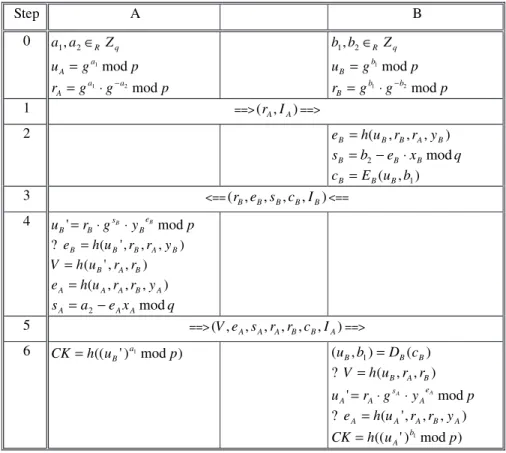
Step 0. The client A selects two random num-bers a1, a2 ŒZq, and computes uA = ga1 modp and rA=ga1·g-a2mod p. The server B also selects two random numbers b1, b2ŒZq, and computes uB=gb1modp and rB=gb1·g-b2mod p.
Step 1. Asends rAand IAto B.
Step 2. Bcomputes eBand sBas follows.
B also computes cB = EB(uB,b1), where EB(·) is a symmetric encryption function of B and DB(·) is the corresponding decryption function. And B keeps the master keyK securely and uses h(K,t) as
sB=b2-e xB B modq eB = (h u r r yB, , ,B A B)
the secret key of EB(·), where tis changed every certain period of time.
Step 3. Bsends rB, eB, sB, cBand IBto A.
Step 4. Acomputes uB¢ =rB·gsB·yBeBmod p. Then, Achecks if eB=h(uB¢,rB,rA,yB). If it holds, Acomputes the following:
Step 5. Asends V, eA, sA, rA, rB, cBand IAto B. Step 6. B recovers (uB,b1) =DB(cB) and checks if
V = h(uB,rA,rB). If it does not hold, B terminates the execution. Otherwise, B computes uA¢ = rA·gsA·yAeA mod p and checks if eA=h(uA¢,rA,rB,yA). Finally,B can get the session key CK=h((uA¢)b1mod p). Meanwhile, A can also compute the session key CK=h((uB¢)a1mod p).
sA =a2-e xA A mod q eA= (h u r r yA, , ,A B A)
V=h u r r( B¢, ,A B)
The improved authenticated key agreement pro-tocol (Improved-AKAP) is depicted in Figure 1. The improved protocol provides the implicit key confirmation using a signature scheme that is a variation of the Nyber–Ruppel signature scheme with message recovery.21 In Step 3, the message (rB,eB,sB) is regarded as a signature that is used to recover uB. By computing uB¢ =rB·gsB·yBeBmod pand then checking eB=h(uB¢,rB,rA,yA), Ais able to ensure that Breceived rAand knows uBand b1. Thus, Ais able to ensure that Bcan compute the session key CK.
Security analysis—Let us discuss the security properties described in Section 1 as follows.
1. Known-key security. If the session key CK is disclosed, an adversary is unable to obtain the value ga1b1 because it is protected by a hash function. Even though ga1b1is disclosed,
Step A B 0 a1,a2ŒR Zq p g u a A mod 1 = p g g r a a A mod 2 1◊ -= q R Z b b1, 2Œ p g u b B mod 1 = p g g r b b B mod 2 1◊ -= 1 ==>(rA,IA)==> 2 eB =h(uB,rB,rA,yB) q x e b sB = 2- B◊ Bmod ) , (u b1 E cB = B B 3 <==(rB,eB,sB,cB,IB)<== 4 u r gB y eB p B s B B'= ◊ ◊ mod ) , , , ' ( ? eB =huB rB rA yB ) , , ' (uB rA rB h V= ) , , , ( A A B A A hu r r y e = q x e a sA = 2- A Amod 5 ==>(V,eA,sA,rA,rB,cB,IA)==> 6 CK h((u ')a1modp) B = (uB,b1)=DB(cB) ) , , ( ? V=h uB rA rB p y g r u A eA A s A A'= ◊ ◊ mod ) , , , ' ( ? eA =huA rA rB yA ) mod ) ' ((u 1 p h CK b A =
the protocol may also withstand the known-key attack, this is because a1 and b1 are selected randomly in each session. Thus, knowing ga1b1is no value to deriving the new session keys in future sessions.
2. Forward secrecy. If both secret keys ofAand B are disclosed, the adversary is unable to compute a1 and b1 from sA or sB because neither sAnor sBinclude the values. Suppose that the adversary directly tries to find a1and b1from uA¢and uB¢, respectively. This is equiv-alent to solving the discrete logarithm problem.11That is, the adversary knows both secret keys ofAand B, but is unable to derive any old session keys established by the two principals.
3. Key-compromise impersonation. Suppose that the secret key of Bis disclosed. An adversary that knows this secret key tries to imperson-ate some entity A to B. Impersonating A requires computing the signature message (rA,eA,sA) using the secret key xAof A. In this case impersonating A to B is impossible. Therefore, the proposed protocol can with-stand the key-compromise impersonation attack.
4. Unknown key-share. Because this protocol pro-vides the implicit key confirmation property, it can withstand the unknown key-share attack.19
—4.2. New Authenticated Key
Agreement Protocol—
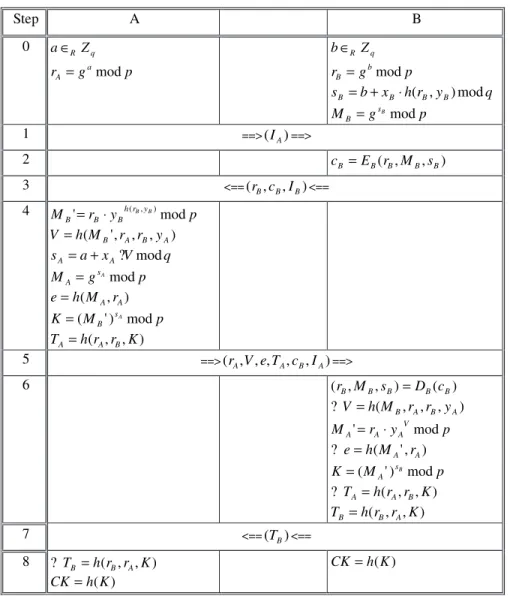
In this subsection, we propose a new authenti-cated key agreement protocol. The initialization is the same as that of the improved protocol. The new authenticated key agreement protocol (New-AKAP) is depicted in Figure 2. The detailed steps are presented as follows.
Step 0. The client Aselects a random number aŒZq, and computes rA=gamod p. The serverB also selects a random number, b ŒZq, and computes rB=gbmod p, sB
=
b +xB·h(rB,yB) mod qand MB= gsB mod p.
Step 1. Asends IAto B.
Step 2. Bcomputes cB=EB(rB,MB,sB), where EB(·) is a symmetric encryption function ofB
and DB(·) is the corresponding decryp-tion funcdecryp-tion. And B keeps the master key K securely and uses h(K,t) as the secret key of EB(·), where t is changed every certain period of time.
Step 3. Bsends rB, cBand IBto A.
Step 4. A computes MB¢ = rB·yBh(rB,yB) mod p. Then,Acomputes the following:
Step 5. Asends V, TA, rA, e, cBand IAto B. Step 6. Brecovers (rB,MB,sB) =DB(cB) and checks
if V=h(MB,rA,rB,yA). If it does not hold, B terminates the execution.B computes MA¢ = rA·yAV mod p and checks if e
=
h(MA¢,rA). If it does not hold,B terminates the execution. Otherwise, B computes K = (MA¢)sB mod p and checks if TA = h(rA,rB,K). Finally, B computes TB =
h(rB,rA,K). Step 7. Bsends TBto A.
Step 8. A checks TB = h(rB,rA,K). Then, A com-putes the session key CK =h(K).B also computes the session key CK=h(K). Note that both Aand Bmay obtain the session key CK since K = (MB¢)sA mod p = gsAsB mod p = (MA¢)sB mod p. Moreover, B checks the equation TA=h(rA,rB,K) in Step 7 and Achecks the equation TB = h(rB,rA,K) in Step 8, which may provide the security goal of explicit key confirmation.
Security analysis—In the following, we discuss our new protocol and how to hold the security properties described in Section 1.
1. Known-key security. If the session key CK is disclosed, an adversary is unable to obtain the value Kbecause it is protected by a hash function. Suppose that the adversary has obtained a value K1 established between A and B. Since K1=(MB¢1)sA1mod p=gsA1sB1mod p=(MA¢1)sB1mod p, we have
TA =h r r K( , , )A B K=(MB¢) modsA p e=h M r( A, A) MA =gsAmod p sA = +a x VA◊ modq V=h M r r y( B¢, A, ,B A)
Suppose that there is another value K2 estab-lished by Aand B. For the same reason, we have K2 = ga2b2+xAV2b2+a2xBh(rB2,yB)+xAxBV2h(rB2,yB) mod p. Suppose that the adversary knows K1, but is unable to compute sA or sB because this is equivalent to solving the discrete logarithm problem, and the adversary also obtains no
K g p g p g p s s a x V b x h r y a b x V b a x h r y x x V h r y A B A B B B A B B B A B B B 1 1 1 1 1 1 1 1 1 1 1 1 1 1 1 1 1 = = = + ( )( + ( )) + + ( )+ ( ) mod mod mod , , ,
information (such as, a1b1, xAxB, xAb1and xBa1) from K1. Certainly, the adversary does not find another session key K2from K1. There-fore, the proposed protocol can withstand the known-key attack.
2. Forward secrecy. If both secret keys of Aand B are disclosed, the adversary tries to find sAor sB and then computes K = (MB¢)sA mod p or K= (MA¢)sB mod p. However, to find sA or sB you must derive aand bfrom rAor rB, respec-tively. In this case, this will be equivalent to solving the discrete logarithm problem.
Step A B 0 aŒR Zq p g r a A = mod q R Z bŒ p g r b B = mod q y r h x b sB = + B◊ ( B, B)mod p g M sB B = mod 1 ==>(IA)==> 2 cB =EB(rB,MB,sB) 3 <==(rB,cB,IB)<== 4 M r y hrByB p B B B' mod ) , ( ◊ = ) , , , ' (MB rA rB yA h V= q V x a sA = + A? mod p g M sA A= mod ) , (MA rA h e= p M K sA B') mod ( = ) , , (r r K h TA= A B 5 ==>(rA,V,e,TA,cB,IA)==> 6 (rB,MB,sB)=DB(cB) ) , , , ( ?V =hMB rA rB yA p y r MA'= A◊ AVmod ) , ' ( ? e=h MA rA p M K sB A') mod ( = ) , , ( ? TA=h rA rB K ) , , (r r K h TB = B A 7 <==(TB)<== 8 ? TB =h(rB,rA,K) ) (K h CK= ) (K h CK=
Therefore, the proposed protocol provides forward secrecy.
3. Key-compromise impersonation. Suppose that the secret key of Bis disclosed. An adversary that knows this secret key tries to imperson-ate some entity A to B. Impersonating A requires computing sAthat must be computed using the secret key xA of A. In this case impersonating A to B is impossible. There-fore, the proposed protocol can withstand the key-compromise impersonation attack. 4. Unknown key-share. Because this protocol
pro-vides the explicit key confirmation property, it can withstand the unknown key-share attack.14
5. Discussion and Performance
Comparisons
In this section, we discuss the proposed proto-cols on how to resist the DoS attack. Performance comparisons between the proposed protocols and the Hirose–Matsuura protocol are presented.
First, the storage-exhaustion attack is consid-ered. In the improved protocol, the values (IA,rA,uB,b1) are the connection state. Since uBand b1 are encrypted and transmitted to the client A, then A forwards these values to B in Step 5. Thus, the values uBand b1need not be maintained by the server B. Therefore, this protocol can withstand the storage-exhaustion attack. By checking if V =
h(uB,rA,rB) in Step 6, B can confirm that rA and rB are used to compute the correct uB because of eB = h(uB,rB,rA,yB) and uB = rB·gsB·yAeB. The above technique is called the stateless connection for the server.
As for the new proposed protocol, we also adopt the same technique. The values sB and rB are the connection state. Because sB and rB are encrypted and transmitted to the client A, then Aforwards these to Bin Step 5, in this case the values sBand rB need not be kept by the server B. Therefore, the new protocol can withstand the storage-exhaustion attack. By checking if V=h(MB,rA,rB,yA) in Step 6, Bcan confirm that B has computed the correct MB.
In the following, let us consider the CPU-exhaustion attack, in which the server need not keep the connection state. The computation cost of modular exponentiations is considered as the
main factor because it is a time-consuming com-putation. Three kinds of requests to a server are analyzed. One is a valid request. Another is an invalid request with a last message, which is called a minor invalid request. The other is an invalid request without a final message. We call it a major invalid request, that is, the client sends the first message to the server to perform the CPU-exhaustion attack.
T
he computation cost of modularexponentiations is considered as the main factor because it is a time-consuming computation.
In our improved protocol, computing uB and rB in Step 0 requires two modular exponentiations and it is able to be pre-computed. That is, it can be computed off-line. When the client has computed a valid uB¢, they are able to compute the correct V in Step 4. Thus, the client sends the messages (V,eA,sA,rA,rB,cB,IA) to the server in Step 5. Therefore, when the client spends two modular exponentia-tions to compute the correct V, the checking for V = h(uB,rA,rB) to the server is valid. Then, the server must compute uA¢ = rA·gsA·yAeAmod pthat requires two modular exponentiations. If the client is a legal client, the server can compute the correct uA¢. Then, the checking for eA=h(uA¢,rA,rB,yA) is valid and the server must compute CK=h((uA¢)b1mod p) that requires one modular exponentiation. Finally, we summarize the above descriptions as follows. In a valid request, it requires five modular expo-nentiations to the server. In a major invalid request, a malicious client only sends (rA,IA) to the server, then two modular exponentiations are required to compute uBand rBto the server. For a minor invalid request, a malicious client computes the correct V and sends it to the server, four modular exponentiations are required. In addi-tion, considering the off-line pre-computaaddi-tion, the required modular exponentiations are three, two and zero for the valid request, the minor invalid request and the major invalid request, respectively. In our new protocol, when a client sends a request to the server, the server requires two modular exponentiations to compute rBand MBin Step 0. When the client has computed MB¢and the
correct V in Step 4. Thus, the client enables the server to check V=h(MB,rA,rB,yA) and compute MA¢ = rA·yAV mod p that requires one modular expo-nentiation. Meanwhile, a malicious client may compute MA=rA·yAV mod pfor passing the check of e=h(MA¢,rA) on the server. Thus, this enables the server to compute K = (MA¢)sB mod p, which requires one modular exponentiation. Finally, we also summarize the above descriptions as follows. In a valid request, it requires four modular expo-nentiations to the server. In a major invalid request, a malicious client only sends a request to the server, then two modular exponentiations are required to compute rBand MBto the server. For a minor invalid request, a malicious client computes the correct Vand e, and sends these values to the server, four modular exponentiations are required. Note that rB and MB in Step 0 can be computed off-line. Therefore, considering the off-line pre-computation, the required modular exponentia-tions are two, two and zero for the valid request, the minor invalid request and the major invalid request, respectively.
The number of modular exponentiations required by a server for three kinds of requests among the Hirose–Matsuura protocol and our proposed protocols is given in Table 1. Table 2 presents the number of on-line modular exponentiations required by a server and a client for three kinds of requests. Obviously, our pro-posed protocols have better performance than the
Hirose–Matsuura protocol for withstanding the CPU-exhaustion attack. Both the Hirose–Matsuura protocol and the improved protocol provide the property of implicit key confirmation with requir-ing three communication steps. Although the new proposed protocol requires four communication steps, this protocol provides explicit key confir-mation and the computation cost can be further reduced.
From Table 2, we know that the computation cost on the server side is less than or equal to that on the client side. If a client with limited resources wants to deny a powerful server, the attack cannot succeed. When a large number of clients simulta-neously launch thousands of requests at the target server, this attack actually is difficult to withstand. A notable example is the Yahoo and Amazon web sites attacked by a large number of compromised agent clients in February 2000. This attack crippled their services. The proposed protocols cannot fully disallow a DoS/DDoS attack, but they can reduce the effect of such an attack and thus make it more difficult to succeed. Our protocols increase the capability for resisting this attack. A server requires some resources to provide services for legitimate users including network connectivity between users and the server, server memory space and CPU time. DoS/DDoS attacks have many types: consumption of network bandwidth, exhaustion of server resources, and configuration information destruction. Here, we address only
Request\Protocol HM-AKAP Improved AKAP New AKAP
Valid request 6 5 4
Minor invalid request 5 4 4
Major invalid request 2 2 2
Communication steps 3 3 4
Key confirmation Weak Weak Strong
Table 1. The number of modular exponentiations required for a server for three kinds of requests, between the Hirose–Matsuura protocol and our proposed protocols
Request\Protocol HM-AKAP Improved AKAP New AKAP
Client Server Client Server Client Server
Valid request 4 4 3 3 3 2
Minor invalid request 3 3 2 2 2 2
Major invalid request 0 0 0 0 0 0
Table 2. The number of on-linemodular exponentiations required for a server and a client for three kinds of requests
the resource-exhaustion problem occurring in authentication and key agreement protocols. For defenses against DoS/DDoS attacks, many pre-vention and detection mechanisms must also be involved in the system, such as router filters.
6. Conclusions
We have proposed two authenticated key agree-ment protocols resistant to a denial-of-service attack. Although the proposed protocols cannot fully resist a DoS/DDos attack, both protocols reduce the effect of such an attack and thus make it more difficult to succeed. By reducing the com-putation cost on the server side relative to the client side and using the stateless connection tech-nique, both proposed protocols are able to simul-taneously resist both the CPU-exhaustion attack and the storage-exhaustion attack. One is an improved protocol on the Hirose–Matsuura key agreement protocol. The proposed protocol reduces the computation cost compared with the Hirose–Matsuura protocol. The other new proto-col provides explicit key confirmation and further reduces the computation cost. Our proposed pro-tocols are efficient in resisting the CPU-exhaustion attack. Several design principles resistant to a DoS attack were also presented for designing an authenticated key agreement protocol or authenti-cation protocol. These design principles increase the system’s capability to resist DoS attacks.
References
1. Needham RM. Denial of services: An example. Com-munications of ACM1994; 37(11):42–46.
2. Leiwo J, Aura T, Nikander P. Towards network denial of service resistant protocols. Proceedings of the Sixteenth Annual Working Conference on Informa-tion Security, IFIP Series, Vol.175, Beijing, China, 2000.
3. Diffie W, Hellman ME. New directions in cryptog-raphy. IEEE Transactions on Information Theory1976; IT-22(6):644–654.
4. Ankney R, Johnson D, Matyas M. The Unified Model. Contribution to ANSI X9F1, 1995.
5. Lee WB, Chang CC. Integrating authentication in public key distribution system. Information Process-ing Letters1996; 57:49–52.
6. Menezes AJ, Qu M, Vanstone SA. Some key agree-ment protocols providing implicit authentication. 2nd Workshop Selected Areas in Cryptography, 1995.
7. Tseng YM. Multi-party key agreement protocols with cheater identification. Applied Mathematics and Computation2003; 145(2–3):551–559.
8. Tseng YM. On the security of an efficient two-pass key agreement protocol. Computer Standards and Interfaces2004; 26(4):371–374.
9. Jablon DP. Extended password key exchange proto-cols. WETICE Workshop on Enterprise Security 1997; 248–255.
10. Kwon T, Song J. Secure agreement scheme for gxyvia
password authentication. Electronics Letters 1999;
35(11):892–893.
11. ElGamal T. A public key cryptosystem and signature scheme based on discrete logarithm. IEEE Transac-tions on Information Theory 1985; 31(4):469–472. 12. NIST. Digital signature standard (DSS), FIPS PUB
XX, 1993.
13. Blake-Wilson S, Johnson D, Menezes A. Key agree-ment protocols and their security analysis. Proceed-ings of the Sixth IMA International Conference on Cryptography and Coding, Lecture Notes in Computer Science 1355, 1997; 30–45.
14. Blake-Wilson S, Menezes A. Authenticated Diffie–Hellman key agreement protocols. Proceed-ings of the 5th Annual Workshop on Selected Areas in
Cryptography (SAC ’98), Lecture Notes in Computer
Science 1556, 1999; 339–361.
15. Diffie W, Van Oorschot PC, Wiener MJ. Authentica-tion and authenticated key exchanges. Designs, Codes and Cryptography1992; 2:107–125.
16. ITSEC. Information Technology Security Evaluation Cri-teria.Version 1.2, COM(92) 298 final, Brussels, 1992. 17. Dwork C, Naor M. Pricing via processing or com-bating junk mail. Advances in Cryptology—Crypto’92, Lecture Notes in Computer Science 740, Springer-Verlag, 1993; 139–147.
18. Aura T, Nikander P. Stateless connections. Informa-tion and CommunicaInforma-tions Security (ICICS’97), Lecture Notes in Computer Science 1334, 1997; 87–97. 19. Hirose S, Matsuura K. Key agreement protocols
resistant to a denial-of-service attack. IEICE
Trans-actions on Information and Systems 2001; E-84
-D(4):477–484.
20. Dobbertin H. The status of MD5 after a recent attack. CryptoBytes1996; 2(2):1–6.
21. Nyberg K, Rueppel RA. Message recovery for sig-nature schemes based on the discrete logarithm.
Designs Codes and Cryptography 1996; 7(1–2):
61–81.
If you wish to order reprints for this or any other articles in the International Journal of Network Management, please see the Special Reprint instructions inside the front cover.