Microfinance: accountability from
the grassroots
Rob Dixon, John Ritchie and Juliana Siwale
Durham Business School, Durham University, Durham City, UK
AbstractPurpose– The purpose of this research is to use an accountability framework to explain the emerging tensions in accountability and how an intended bottom-up approach became progressively supplanted. This paper is set within an emerging Zambian microfinance organisation moving into crisis.
Design/methodology/approach– A series of semi-structured interviews were conducted with key local microfinance specialists, managers and accountants, clients and past and current loan officers. Live observation of the client-loan officer interface and internal meetings provided triangulation on accountability relationships in the midst of crisis. Data were analysed using NVIVO, a qualitative computer software package.
Findings– The findings show that tensions between vertical and horizontal accountability in practice can be directly translated into heightened pressure and stresses on both the non-governmental organisation (NGO) and its loan officers, which constrain overall accountabilities to other stakeholders and disguise other potential dysfunctions.
Research limitations/implications– This study focussed on accountability at the grassroots in microfinance NGOs with a social mission. It reveals potential for further personal, community and socially constituted accounting research within microfinance in particular.
Originality/value– The paper adds to the literature on NGO accountability. It will be of value to researchers and practitioners seeking to gain a better understanding of not-for-profit organisations whose goals are not primarily wealth creation. It also gives details on under-researched areas in accounting, namely NGOs and poverty reduction, and practices in Sub-Saharan Africa.
KeywordsFinance, Non-governmental organizations, Poverty, Zambia
Paper typeResearch paper
Introduction
Official sources (Commission for Africa Report, 2005; Kaldor, 2003; Kovachet al.2003;
Lewis and Madon, 2004; Zadek, 2003) now frequently argue “good governance” of aid and development organisations, including NGOs necessitates them becoming more transparently accountable and demonstrably accounted for. This implies that more accountability is better and will lead to required goals and outcomes being legitimately pursued through policies whose implementation has been independently monitored. This presumes that only more officially sanctioned accountability running from the centre to the periphery of organisations can assure proper grassroots “service delivery”. Others question such top-down approaches in both principle and practice (Ebrahim, 2003, 2005; Hillhorst, 2003; Naidoo, 2003). They contend that such approaches fail to comprehend, are too distant from, and may not even reach into the
The current issue and full text archive of this journal is available at www.emeraldinsight.com/0951-3574.htm
The authors have benefited from insightful comments made by Sue Richardson on the first draft. They are also grateful to two anonymous referees of this journal for their extremely thoughtful and detailed comments that have improved the paper. The Commonwealth Scholarships funded the research.
Accountability
from the
grassroots
405
Received January 2005 Revised October 2005 Accepted November 2005Accounting, Auditing & Accountability Journal Vol. 19 No. 3, 2006 pp. 405-427
qEmerald Group Publishing Limited 0951-3574 DOI 10.1108/09513570610670352
grassroots where aid and development are needed most. Instead they call for other forms of intermediation with those at the periphery of aid and development organisations and, in contrast to what is officially called for, seek less top-down and more bottom-up accountability involving grassroots groups.
Microfinance has been defined as the provision of financial services such as deposits, loans, payment services, money transfers and insurance to low-income, poor and excluded people enabling them to raise their income and living standards (Rhyne, 2001). It consists of lending and recycling very small amounts of money for short periods of time. Microfinance or microcredit has therefore been associated with helping empower the poor to account properly and independently for their small businesses and thus manage their livelihoods better. On the other hand, poverty alleviation has been a long term goal of governments and key international institutions such as the World Bank and United Nations seeking more effective ways of reaching the poor. The importance of microfinance as a targeted strategy for poverty alleviation lies in its ability to reach the grassroots with financial services based more on a “bottom-up” as opposed to “top-down” approach. Within the “bottom-up” approach, non-governmental organisations (NGOs)[1] have been a “favoured” institutional form for delivering these services.
As an innovative form of financial intermediation with the poor (ADB, 2000; Nissanke, 2002), microfinance is in effect “double tasked” to achieve specified developmental ends and goals through particular means such as group lending methodologies (Donaghue, 2004; Zeller, 2001), through which the poor can borrow money and mutually assure their own progressive empowerment towards independent survival and self-management (CGAP, 2000). With Bangladesh and South East Asia as early proving grounds it was hoped that microfinance would overcome the limitations inherent in more orthodox development programmes by being a more “joined up” initiative which was also accountable to the poor themselves. As it has diffused outside its original proving grounds, and been officially confirmed in the 2005 United Nations “International Year of Microfinance”, questions are still raised about what forms microfinance should take, and how well it can transfer and translate elsewhere. Accountability of NGOs is therefore an issue because of their increased importance, rapid growth in numbers, and high development profile as against their actual performance on the ground (Choudhury and Ahmed, 2002; Edwards and Hulme, 1996; Vakil, 1997; Zadek, 2003).
The paper is an attempt to understand and interpret the nature of NGO accountability and its unique emerging relationships when compared with other public sector organisations. The paper does this by looking at NGOs (at an individual level) involved in microfinance in a developing country, founded with objectives of alleviating poverty by providing credit and related financial services to the poor. The paper is concerned to understand why microfinance in Sub-Saharan Africa and, in particular, Zambia has not evolved as expected. In doing this the paper adopts a “bottom-up” (rather than “top-down”) approach to understanding accountability and focuses on the loan officers[2] who mediate the relationship between clients and the organization. An accountability framework is then used to inform the discussion of the case study. The paper is primarily focussed on NGOs in microfinance which are so reliant upon outside donor funding that their resulting dependence plays a central role in shaping their accountability. It calls for a more critical perspective on NGO accountability, particularly where microfinance NGOs are concerned.
AAAJ
19,3
NGO accountability
It has long been recognised that accountability can be a contradictory and tricky concept (Choudhury and Ahmed, 2002; Demirag, 2004; Kearns, 1994; Patton, 1992; Sinclair, 1995). Accountability is concerned with giving explanations through a “credible story of what happened, and a calculation and balancing of competing obligations, including moral ones” (Boland and Schultze, 1996, p. 62). Grayet al.(1996, cited in Unerman and O’Dwyer, 2004, p. 6) view accountability as “the duty to provide an account (by no means necessarily a financial account) or reckoning of those actions for which one is held responsible”. Others have seen accountability as a relationship involving the “giving and demanding of reasons for conduct” (Roberts and Scapens, 1985, p. 447; Robinson, 2003, p. 172). This perspective may particularly hold true in an organisational context based on the principal-agent model (Laughlin, 1996; Power, 1991), which assumes that some individual or organisation (the principal) has certain “rights” to make demands over the conduct of another (the agent), as well as seeking reasons for actions taken (Goddard, 2004). It is this aspect of accountability which has been a focus in the accounting literature (Jacobs and Walker, 2004). Roberts (1996), on the other hand, stresses the social aspects of accountability and argues that it also involves varied social practices which seek to remind each other of their reciprocal dependence. In this sense it is a relational concept, which does not stand alone, but is reflective of relationships among organizational actors embedded in a social and institutional environment (Ebrahim, 2005). Accountability is thus, not only a formal order, but also a moral order; a system of reciprocal rights and obligations.
While these definitions of accountability are useful, discussions of accountability in the not-for-profit sector (NGOs) are problematic (Connolly and Hyndman, 2004). In particular, NGO accountability, often defined as “the means by which individuals and organisations report to a recognised authority, or authorities, and are held responsible for their actions” (Edwards and Hulme, 1996, p. 8), is equated narrowly with the use of accounting procedures (for example, the collection of receipts, or compilation of annual reports) deemed to demonstrate and thereby enforce, the responsible use of the funds provided. This view may not fully reflect the openly relational and socially constructed nature of the concept in NGOs (Kaldor, 2003). Patton (1992) therefore suggests that not-for-profit accountability typically suffers from imprecise meaning while Ebrahim (2003) and Najam (1996) argue that conceptual definitions tend to become too complicated and even ambiguous, in an attempt to comply with the “New Public Management” (NPM) accountability model. Edwards and Hulme (1996) and Kaldor (2003) likewise highlight the problem of multiple accountabilities. This view is supported by discussions of accountability of NGOs focussing on “stewardship”, the “proper” use of financial resources (Ebrahim, 2005; Lewis and Madon, 2004) – and not on accountability as enabling the organisation to meet and stay true to the needs of clients, as well as itself. Critics have observed that while many NGOs may claim accountability to the poor (unless they are actually membership organisations of the poor), in practice they may find themselves acting as intermediaries more accountable to the outside donors who provide them with funds. Lewis and Madon (2004) further argue that accountability in NGOs can be unbalanced and may result in goal displacement and unplanned growth.
Other writers (Biggs and Naeme, 1996; Demirag, 2004; Ebrahim, 2003; Edwards and Hulme, 1996; Hilhorst, 2003; Najam, 1996) have argued that the “NPM” literature on
Accountability
from the
grassroots
accountability based on the “principal”-“agent” model does not adequately address those organisations which deal with multiple and sometimes competing accountability demands. As such this literature may be of limited value to such organisations as NGOs whose missions may not include/prioritize profit-making. This is not to argue that NGO accountability cannot be informed by the private sector, but it questions whether NGOs can conform to its norms without them changing their character as a result. Despite this ongoing debate, NGO accountability (especially among “development” NGOs) remains neglected in research and practice (Choudhury and Ahmed, 2002), and is under-researched in the accounting literature (Collier, 2005). This paper seeks to contribute to this limited literature by embracing a broader understanding of accountability based on a concept that extends beyond formal explanation to embrace the actual giving of accounts (Munro and Mouritsen, 1996). In order to examine broader aspects of accountability it is necessary to investigate different organisational settings (Roberts and Scapens, 1985) – such as microfinance NGOs – that are more relational in character. The fourfold typology developed by Ritchie and Richardson (2000) provides an opportunity to locate diverse forms of NGO accountability models.
Comparative accountability framework
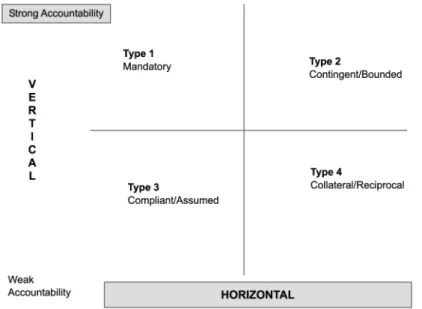
There are two main alternative models of vertical and horizontal accountability within the literature on NGO accountability (Lewis and Madon, 2004). The fourfold typology of Ritchie and Richardson (see Figure 1) identified how specific types of accountability differ and configure in a variety of ways.
This typology distinguishes vertical/hierarchical “rule” from horizontal “relational” based accountabilities while also recognising that certain hybrid forms may combine
Figure 1. Ideal-typical forms of accountability
AAAJ
19,3
408
both. Accounting information plays a central role in formal, hierarchical accountability (Types 1 and 2), representing the “principal” and “agent” relationship respectively. Others observe that much of the formal accounting literature traditionally focuses upon Types 1 and 2 denoting the more familiar and most narrow forms of accountability (Hilhorst, 2003; Jacobs and Walker, 2004) incorporating explicit standards of performance and procedures imposed and enforced either by an outside stakeholder, or in accordance with its own internal rules (Kearns, 1994, p. 188). Accountability here is primarily in terms of “rule-bound responses by organisations
and individuals who report to recognized authorities . . .in order to ensure that the
resources they receive are used properly” (Lewis and Madon, 2004, p. 120).
Type 3 and 4, along the horizontal dimension, draw upon the idea that organisations are socially constructed entities (Hilhorst, 2003; Lewis and Madon, 2004). Ritchie and Richardson (2004) designate Types 3 and 4 as the most personal and socially diffuse accountabilities respectively, and ones which accommodate broader constituted definitions of accountability. Others see Type 3 as “an almost everyday occurrence”, that ordinarily appears“ taken for granted”, and “more like accepted custom and practice” making it relatively unquestioned and routine (Garfinkel, 1967, cited in Ritchie and Richardson, 2004, p. 5; Hillhorst, 2003; Sinclair, 1995). Type 3 lacks formal rules and wider relational commitment and is based on “spoken” or unrecorded accountability. On the other hand, Type 4 is based upon the strength of mutual ties, relies upon wider situated relationships, and arises through diffused social networks whose governing norms may bring public honour and shame into accountability processes. These address standards of accountability that are implicit, arising from shifting societal values and beliefs, and are loosely defined and therefore negotiated, between different stakeholders (Biggs and Neame, 1996; Kearns, 1994).
Research methods
This project was not initially conceived as a study of accountability. The researcher entered the field to study microfinance in action by focusing on loan officers as its key practitioners. By observing loan officers in action it originally sought to show how loan officers and others made sense of situations and their everyday practices (Miles and Huberman, 1994, Morse and Richards, 2002). However, as field work progressed, accountability emerged as a key issue in the work of the loan officer and the process of microfinance. Consequently, this research adopted an interpretive methodology (Russell, 1996) in an iterative fashion (Miles and Huberman, 1994; Scapens, 1990; Yin,
1993 Hoque et al., 2004), where the researcher conducts both a reflective analysis
(Bryman, 2001; Holland, 1999) with an initial problem focus and then observes what other issues duly emerge. This helps the researcher build up interpretations from the direct experience, perceptions, and beliefs of participants. In addition the research resonates with microfinance by simultaneously focusing on both grassroots and hierarchical relationships.
The field study was based on intensive qualitative research conducted in Zambia during 2003 and 2004, complemented by the researcher’s “indigenous knowledge”, and extensive prior local field experience. However, being a Zambian researcher did not guarantee open access at both corporate and branch level, as even the introductory letter to the branch managers from the Head office expressly requested that, while they should facilitate the research programme, “normal” operations must not be disrupted.
Accountability
from the
grassroots
One loan officer thus informed the researcher that “Our ‘real’ offices are out there in the field with clients. The ones at the branch are not real”. Such statements carried important methodological implications. First, negotiation for access became on-going (Glesne and Peshkin, cited in Harrington, 2003, p. 599; Lee, 1993), especially with loan officers and clients. Second, the researcher could not conduct interviews with loan officers for longer than 45 minutes, because they felt obliged to be in the field as their “real” offices. The researcher as a result spent more time with loan officers in the field in order to capture the “oral” character of microfinance, and feel and observe the processes as they happened, before making extensive field notes later.
Prior to the field study, the researcher had assumed that loan officers would be free to talk to a “native,” given that previous research had been dominated by donor funded consultants from developed countries, but this assumption proved incorrect. The fieldwork revealed that loan officers lack space for engaging the “politics” of MFIs and, even where space was created, significant negotiation was needed for them to open up, as some initially feared the researcher might “spy” on their activities on behalf of management. There was suspicion of who is listening over my shoulder” or “am I safe with you?” and consequently, individual interviews were delayed in order to build relationships and trust.
During the course of the field study the role of the researcher changed. In the first stage, being perceived as an “outsider” to the business of microfinance and an “intruder”, the researcher adopted a role as observer (Junker, 1960, cited in Collier, 2001, p. 471). In the second stage, the researcher became more of a participant observer (Burgess, 1984), better accepted by the organisation (in particular by staff at branch level), and thus more able to conduct interviews and attend branch meetings. In the third stage, the researcher became more “accepted” as such. In all, 36 formal interviews were conducted[3], tape recorded and subsequently transcribed[4], each lasting between 45 minutes to one-and-half hours. Transcribing the interviews gives a researcher more “feel” for the data thus emerging (O’Dwyer, 2004). These interviews were semi-structured using open questions to elicit participants” interpretations of everyday actions (Goddard, 2004; Maykut and Morehouse, 1994), and opinions of lending practices and social settings (Janestick, 2002). It is important to realise that while an interview guide was used it was not allowed to constrain (Patton, 1990) the researcher from being open to any new or stand-alone themes that emerged. Accountability was thus an emerging theme and not initially the subject of the questions first posed. In addition, parallel interviews with selected actors external to, but familiar with, the organisation and locality were conducted to assure validity and reliability.
During the second and third stages of the research, access to internal meetings was “granted” by the manager of one branch on condition that the researcher did not take notes during the meetings nor tape record discussions. A total of 12 morning meetings
of loan officers and their immediate supervisor were then observed in situ. These
meetings provided an opportunity to capture the “live” accounts made by loan officers to their supervisors, the use of power on those being held to account, and the actors’ reactions (verbal and non-verbal), which could not otherwise have been accessed through interviews alone. In addition, these meetings provided a valuable source of data that was less subjectively influenced than one-to-one interviews (Collier, 2005).
In order to capture a grassroots view of loan officers in the field, the researcher attended ten client group meetings where observations were made and notes taken
AAAJ
19,3
later. These provided important insights into what clients and loan officers were doing during the meetings and gave the researcher first hand local knowledge of “real time” practice and processes. These visits were not made by appointment in order to minimize the bias in the data that would occur if loan officers took the researcher to their favoured client groups and communities. The researcher avoided drawing up an explicit plan of visits in order to observe the “live” loan officer/client interaction in their natural settings. In some cases, however, this proved difficult as loan officers would quickly brief group leaders before meetings began. But, after some mutual sensitivity (Fineman, 1998), the presence of the researcher was increasingly ignored as discussions became more “heated” over delayed loan repayments. Field notes were written up soon after the meetings. Additional data were collected by observably “being around” (Rahman and Goddard, 1998, p. 187).
The research strategy incorporated its own “quality checking”. Data were analysed using NVIVO, a qualitative data analysis computer software package for working with textual data. The researcher used NVIVO (through coding, tree nodes and modeller) to “pull down” (from data) key patterns and thematic areas, and search for interrelationships. NVIVO is a tool to assist analysis which does not “do the thinking” for the researcher (O’Dwyer, 2004) and cannot develop theories from the data. As a computer program it was not a substitute for the “analyst core role” of searching for meanings behind any given data set. In the next section, we describe the particular experience of an NGO in Zambia as it moved from being a successful start-up to a failing organisation.
Local context – Zambia
Microfinance in Zambia is relatively young and has operated without a distinct legal and regulatory framework until recently[5]. The sector emerged in the 1990s (AMIZ, 2002; Musona and Coetzee, 2002) through NGOs whose primary orientation was more social than commercial (AMIZ, 2002, p. 7). Most MFIs began as unregulated credit NGOs, operating on a non-profit basis (Meagher and Mwiinga, 1999). The sector is largely external donor- driven and may therefore lack local “ownership” and legitimacy. Outreach remains low in relation to the potential client “market”, and the scope of the services offered is likewise limited, mostly to microcredit with little saving mobilisation. One estimate of all the active MFIs in Zambia is 60,000 active clients out of 2 million Zambians that may need access to microfinance (AMIZ, 2004). Most MFIs are now faced with challenges of “good governance” and can struggle to maintain high repayment rates. In terms of accountability, Zambian MFIs were formally answerable to their boards and to donors, though the latter line of accountability counted most. Accountability[6] is in this sense perceived as “reactive” and a “weapon” – which becomes important for management and donors should problems arise. These local issues form the background to the case study of a microfinance institution-CETZAM Opportunity Microfinance Limited (hereafter referred to as CETZAM) – that moved from a founding “success” story to a failing case where its own survival was in question.
The CETZAM case study
CETZAM, funded by the British Department for International Development (DFID), is one of Zambia’s best known microfinance institutions. According to its chief executive
Accountability
from the
grassroots
officer (CEO) it was founded in 1995 as an NGO with an expressly strong vision” to meet a social agenda driven by Christian principles to “transform the lives of the poor” by “providing opportunities to create employment and generate income through credit and training services”. This approach originally reflected the specific concerns of its founder members. It therefore began by taking a “missionary perspective” and sought to use the Christian biblical framework to shape a threefold (economic, social and spiritual) transformational development. Initially, loans were disbursed on “mercy” to help poor people through what Dichter (1999) calls the “culture of compassion”. Within this religious framework, one senior manager emphasized that loan officers (field workers) are considered to be “servants” of the clients they are “called” to serve, as part of “God’s work” and not as career practitioners. Its first loans were disbursed in July 1998 and through its group-based lending methodology[7] it originally targeted the poorest of the economically active population, especially women (CETZAM brochure, 2003). DFID agreed to provide £2.29 million in financial support for a five year period starting February 1998 (Copestake, 2002).
To qualify for a loan a borrower needs no physical collateral but must belong to a self-selected “joint-liability” credit group, as is the accepted practice with most group lending methodologies elsewhere. Each group member was liable for the debts of others; if one does not repay, the others must pay instead, or else all lose access to future loans (Van Bastelaer, 1999; Matin, 2000). This approach works through relations among people who share a common neighbourhood and high social integration (Dichter, 1999). In addition, the group selects a leader who acts as an intermediary between it and CETZAM’s loan officers. Fundamental to this group methodology is the requirement that all members account to each other for their use of money and repayment of loans.
CETZAM represents an institution that, by current standards, enjoyed great success shortly after it was founded. The first six years reveal an impressive start before it turned into a failing case. CETZAM originally claimed great success (in terms of client outreach), recording repayment rates of 98 per cent and over (Copestake, 2002; Copestakeet al., 2001), with low percentages of portfolio at risk (PAR)[8] and portfolio in arrears. This initial “success story” led to a massive client outreach drive (see Figure 2) partly driven by outside donors as well as itself, for together they envisaged the conversion of CETZAM into a registered bank with a network of at least 20
branches serving 50,000 clients by 2005 (Chestonet al., 2000). CETZAM expanded its
outreach to about 9,390 active clients and five branches by 2000. This, according to
Copestake et al.(2001) exceeded all original grant targets. As Figure 2 shows, the
numbers of borrowers started small, rose quickly, approaching 16,135 by 2002, but then fell dramatically to 5,382 by the end of 2003. From December 2002 to December 2003 the number of loans disbursed went down from 3,259 to 585, and in monetary terms, from $467,000 to $89,000, respectively.
By the end of 2001 CETZAM opened 12 branches (most not eventually sustainable), employed 85 loan officers who operated under the “pressures of expansion” (Cheston
et al., 2000), and had a large numbers of clients, a feature which was emphasized more than the quality of loans made (Personal field notes, 2004). The average number of clients per loan officer stood at 375 clients against an expected standard load of 350. According to its loan officers the message from head office had been “disburse to the poor, disburse to the poor”:
AAAJ
19,3
Management is to blame for having put us under pressure to form groups within a short period of time and impress donors. We were fighting to have groups and picked anyone in order to meet expected targets of clients. But the end result was disastrous and we paid dearly as most loans were written off. And that is why even our donors threatened to withdraw (interview with loan officer).
With branches in 12 towns located in three broad provinces, CETZAM was widely spread and risked losing central control. One local microfinance specialist asserted that by expanding organically and by opening new offices while knowing that its existing ones had not yet reached capacity, CETZAM was already seriously unbalanced. In addition there was a lack of timely and accurate information. This made the programme potentially vulnerable to staff fraud. This became “public” when, in June 2003, it was decided to write off thousands of clients as “bad debts” and loan officers then became focused on “pressures of collecting overdue loans”. CETZAM then reduced its number of branches from 12 to seven and loan officers from 85 to 28, and the client load per loan officer fell to 192 from 233 in December 2002. By the end of 2003, PAR at 30 days and over stood at 30 per cent, while the percentage of portfolio in arrears was 22 per cent, signifying substantial “delinquent” loans. In part the high arrears rate may be associated with the widespread poor credit “culture”, mismanagement, and rapid growth of the institution when the screening, evaluation, and monitoring of loans was weakened by the freer availability of funds along with assumed “high” levels of trust amongst stakeholders. Notwithstanding the success achieved over those six years of its operation, CETZAM was considered to be so failing that donors attempted to forestall its further complete collapse. The institution bore symptoms of crisis as its new chief executive officer (the third in seven years) commented:
It is a pity you have come at such a time when the organisation is going through a very rough patch. CETZAM is being restructured and things are not good and work is hectic as we try to
Figure 2.
Number of borrowing clients from July 1998-December 2003
Accountability
from the
grassroots
put the organisation back on its feet as in the last three years, it has experienced cases of financial mismanagement, declining client membership, low loan repayment rates and rising percentages of PAR.
This comment was revealing as it implied that the crisis at CETZAM may have began much earlier than 2002 but was probably not brought to “surface” because of an increase in the number of borrowers (see Figure 2) and oversight regarding internal and external accountability.
The emerging crisis
These events at CETZAM were “public” knowledge by end of 2003. There was a perception among field staff, clients and the wider public that CETZAM had “lost direction”. Issues of accountability were implied but other factors such as organisational dynamics, the context, and wider cultural factors also played a part:
CETZAM’s rate of expansion was too fast. They went on opening branches all over the place. There was too much luxury, accompanied by uncontrolled expenditures on luxurious buildings, trips and vehicles. In addition, there was fraud within the organisation and staff at head office was spending recklessly and giving each other loans. This gave an impression of an organisation with a lot of money to spend anyhow, but this did not please donors who demanded change and accountability (Journalist from the local media, 27 November 2003).
. . .there were very big financial scandals where loan officers started creating fictitious client
groups and would then disburse loans to them, when effectively they were paying themselves. As a result, millions of Kwachas were written off as bad debt. Management realised when it was too late and some consultants were called in from the UK to investigate the cause (former loan officer, 28 May 2004).
I must say that at the beginning CETZAM had a vision to help the poor but as time went by they mishandled the whole thing. Loan officers started getting money from people and not accounting for it. My experience with CETZAM is that there is no transparency in the way money is handled. At one time actually, the loan officer we had was even taken to police because he used to take money from us and not submit at the office and we did not know that this is what was happening. The other thing was that, he had fake groups and we thought they were genuine groups – but all he would do is form a group and then would collect money from a genuine registered bank group and later lend this money to his own (private) clients not know to the MFI. So the loan officer would form his own bank. i.e. making himself a lender within the MFI (former client, 21 May 2004).
On the other hand, CETZAM staff adopted a “name and blame” culture for the problems the institution had gone through. For example, a loan officer who had been with the institution for four years and “survived” the restructuring wondered in disbelief about researcher’s apparent ignorance and asked:
L/O: Are you not aware that CETZAM nearly closed?
JNS: No. What happened?
L/O: The problem started from the top. There were no internal controls, wrong figures were being given to donors, and audits were only being done when fraud was reported. Top people would get huge sums of money as loan advances, make unnecessary trips and enjoy themselves. It was like “manna from heaven” in the way resources were being used. Ultimately, the situation deteriorated to the point where no one knew what was going on. On
AAAJ
19,3
the other hand, some loan officers started “cutting corners” in order to meet targets and qualify for the bonus. It was a mess and a number of people have been fired and now they’re just a few of us left. Management’s view is that loan officers are to blame and donors have responded by changing top management but we have not dealt with the image that was destroyed at the client level.
Another loan officer added:
You see, the Zambian culture is different from say that of Uganda. In Zambia, clients have no fear of defaulting. Clients tend to have an “I don’t care attitude” towards the loans disbursed to them. Most of them still think that an NGO like us are a Charity and therefore they need not pay back. In addition clients have also seen the weaknesses of CETZAM’s credit policy and have taken advantage. They know we cannot take them to court for failing to pay back their loans.
Management on the other hand exonerated itself. The extract below typified their view:
The mess has been created by loan officers because they are the service deliverers and relate directly with clients. And once in the field, it is difficult to supervise them and so there has been a lot of cheating with figures as well as on clients’ group performances.
However, an external consultant attached to CETZAM during the crisis and subsequent restructuring expressed a different view:
All stakeholders had a role to play. Management was not focused and cut itself off from the grassroots while loan officers mishandled clients. In addition, the people [clients] we are dealing with are generally individualistic, and not keen to promote self-help activities and mutual accountability. And so the social bonds amongst themselves are not strong and yet this is the main ingredient to the methodology of group lending.
Many of the problems cited apparently emerged without detection despite the formal accounting and evaluation reports made to donors. With hindsight, it is likely that due to relationships based on funding, CETZAM could have been encouraged to conceal certain problems in the relationships and the programme. The varied extracts above also reveal that the institution [in practice] left loan officers to determine and shape the nature of “accounts” with clients and with their supervisors. The underlying issues that led to the crisis had much to do with the lack of appropriate oversight and failure to institute or maintain appropriate accountability mechanisms.
Response to crisis
Top management was replaced at the insistence of funding partners who called for greater accountability as a condition for further funding. CETZAM underwent a restructuring that saw the number of branches reduced to seven from 12. The number of loan officers was reduced to 28 from 85 and the remaining loan officers and staff (including those at head office) were retrained in the basics of the group-lending methodology with a view to improve common understanding. One branch manager claimed that the training emphasised the need to follow loan procedures to the letter, to ensure clients received full orientation and improved customer care:
The re-training was meant to prepare us for a “fresh” start where there will be no room for default and no partial payment. In short, zero tolerance for arrears. We also have to ensure we now do a proper scrutiny of clients to get rid of “ghost” clients and loan officers have to make meetings with clients interesting and stick to the methodology.
Accountability
from the
grassroots
Loan officers had to follow a standardized training manual for clients where previously they only had broad outlines of what they were expected to teach their groups:
Right now group meetings with clients are interesting compared to the past. We now have a tool kit and therefore there is some uniformity in what is taught.
In addition, the management information systems department was reorganised to improve the processing of “field” information from the branches. It was later headed by an external consultant (on contract) from Opportunity International Network (UK) in a move interpreted by locals as signifying a lack of confidence and mistrust.
The common emphasis was to be on the “quality” of loans, with zero tolerance for arrears and portfolio at risk not exceeding five per cent. Loan officers would be more accountable for the performance of the clients’ groups, “poor portfolio” and their performance was closely monitored. Loan officers were also expected to carry out intensive supervision and monitoring of groups. In addition, management demanded that loan officers submit written reports to branch managers daily, detailing what they had done, and what groups they had visited. Branch accountants were expected to prepare an analysis of loan arrears that would then be discussed with loan officers at morning meetings before they went back into the field. The “accountability language” from management to loan officers was considered tough and threatening”. According to one branch manager these changes were taking place because:
There was no formal reporting from loan officers to the branch managers as was being demanded now. Previously loan officers relied on verbal reports and only submitted written reports to the branch manager weekly. But things have now changed in view of the near collapse.
The daily reports became an important mechanism for communicating and coordinating the “accounts” between the loan officers and the branch managers and then to management but not with client groups. However, certain accounts staff and loan officers in particular resented the new practice as burdensome and intrusive:
If branch managers do read the end of day reports that we submit, why do we still have meetings in the morning going through the same stuff? What purpose are the reports serving?
. . .this kind of reporting is exhausting. It seems they don’t trust us. As for me, I will just be
filling them – it’s too much!
An accountant at one branch also claimed:
The newly introduced daily reports are being questioned and we are wondering whose idea it is. What is their value? Are we doing it to please the boss or donors? It is just another burden! Loan officers resent the idea as it shows mistrust and in fact this could just be eating into loan officer’s time as they have to be back to the office accounting for their day’s activities.
On the other hand, loan officers spoke of the “inroads” that being made accountable this way exerted into their “real” time with clients and other work:
As loan officers we have no time to sell the organisation’s product, visit client’ businesses, form new groups or give proper orientation. It seems that marketing is secondary and what is cardinal is that you have groups and are collecting money and meeting targets.
AAAJ
19,3
Some further complained that those now requiring more accountability did not themselves have enough “working knowledge” of what was involved in the field. Accountability was thus perceived in the negative – in terms of mistrust and increased paperwork. At issue here was the change in accountability exerted by management and the resultant consequences. The extracts above suggest that changed accountability had become a “problem” for loan officers, who had to first deal with their own previous outlook and expectations as well as adapt their activities towards meeting additional hierarchical demands. As the morning meetings revealed, the “audit” procedure was considered stressful as every loan officer became acutely aware that his or her conduct and performance was under constant hierarchical scrutiny (Hilhorst, 2003). The lack of trust between management and loan officers thus resulted in more formalized reporting. Most loan officers indicated that they were now “speaking” more upwards to management, than downwards to clients; that their daily activities were driven by meeting targets and “paperwork” in order to demonstrate greater transparency and due performance. Power (1994), however notes that surveillance and “audit” of this kind may reduce commitment and loyalty of individuals to their organisations and may damage trust rather than support it, thereby obstructing the expected” better practice.
Discussion
The preceding discussion prompts further questions about these developments. Why did loan officers (in particular) find these accountability changes so problematic? How did the changes affect the way loan officers performed and related to management and grassroots groups? The typology developed in Figure 1 can be applied to these different actors.
The actors in Figure 3 were identified through preliminary data analysis using NVIVO to derive the different accountability relationships and perspectives. For CETZAM, accountability to donors in terms of reporting on funds and activities was fairly strong because of their resource dependence position. More accountability was therefore generally perceived as “externally” driven just to satisfy donors. Hoque and Hopper (1997) and Uddin and Hopper (2001) make similar observations. During the study, loan officers and other branch staff claimed that the extensive accountability now demanded of them owed much to pressure from donors (in Type 1) – seen as a condition for further funding in response to the alleged mismanagement of funds and poor performance.
Several other studies claim that research has previously focused more on how NGOs account to and interact with patrons (the donors) who make substantial financial contributions than how they deal with their clients (Ebrahim, 2005, 2003; Najam, 1996; Khan, 2003). Given these asymmetries in resources, donors have demanded more formal compliance from CETZAM. In response, internal management (Type 2) then acted more like donors’ “own agents”, and thus imposed tighter controls and accountability mechanisms, especially on loan officers. Accountability within Type 2 is rule based and loan officers accounted upwardly to management through branch managers. Internal management ensured performance and financial reports were prepared once loan officers provided more timely information from the field. The immediate response to the emerging crisis was to prioritise vertical accountability, while horizontal accountabilities (at group level) were sidelined. Accountability
Accountability
from the
grassroots
relationships between loan officers, branch managers and top management also changed amid increased tension, suspicion and heightened formal accountability pressures. The appropriate balance between rules and relations was therefore problematic. Management needed to have more trusting relationships with loan officers for added Type 2 accountability to work. However, as management exerted more control and audit”, loan officers found the experience frustrating:
. . .about 80% or more of a loan officer’s work is self-supervisory. You go out to look for
clients, develop a list of clients to get loans, make recommendations to the branch manager and again supervise the loan repayments. As a loan officer you know what suits the clients and yourself.
A loan officer with four years of experience confirmed:
As you are aware by now, when we [loan officers] leave the office, we can go wherever we want or even sleep at home. Although of course results will show that I am not working. I am emphasizing the aspect of independence in this job. I am my own manager! I do not need to be policed.
The nature of the loan officer’s work in the field, as others confirm (i.e. Ahmad, 2002; Goetz, 2001), is largely based on autonomy and trust, and less on visibility and obligatory accountability. Loan officers in CETZAM felt there was little space for them to openly admit their fears, vulnerability and doubt when dealing with superiors, thereby creating pressures to be highly selective and partial reporting what they did. As Willmott (1996) argues: Figure 3. CETZAM’s accountability matrix
AAAJ
19,3
418
Systems of accountability can be rendered counter-productive by their unintended consequences. Their introduction by the principal [in this case management] may, for example, signal to the agent [the loan officer] a lack of confidence and trust and thereby weaken any (moral) obligation to go beyond mere compliance with a request from the principal. . .When the principal (inadvertently) sends wrong signals that indicate distrust of the agent, the agent may be more inclined to fiddle receipts, provide misleading documentation, etc. and feel morally justified in doing so.
Willmott’s views were echoed in the words of a frustrated loan officer “It seems they don’t trust us. As for me I will just be filling them in. It is too much!” Any such (unnecessary) pressure on loan officers was likely to redirect accountability more towards “audit” than “learn and share” (Roberts, 1996).
Loan officers as implementers and mediators were therefore “caught up in the middle”, having to satisfy different and contradictory demands from their superiors (Type 2 – compliance accountability) and clients (Type 4 – reciprocal accountability). In this typology loan officers were the link between clients and the institution who mediated the relationship between vertical (formal) and horizontal (informal) accountabilities and inevitably combined Types 2 and 4 to varying degrees. As previously described, microfinance is a “bottom-up” development strategy aimed at reducing poverty with the participation of the poor or the community. This makes Types 3 (i.e. representing the community) and 4 (i.e. representing clients) accountability pertinent for understanding accountability relationships at the grassroots and their role in the overall accountability of CETZAM. The criteria of Types 3 and 4 accountability are implicit, and subject to change with shifts in societal values, beliefs, and public sentiments (Chew and Greer, 1997; Choudhury and Ahmed, 2002). Within CETZAM’s trust bank methodology client groups are formed on the basis of socialised relationships and members expect reciprocity and hold each other accountable on that basis (Type 4). This reflects the original intention of microfinance to favour what Roberts (1996) terms “socialised accountability” because of its solidaristic character (Gariyo, 1996; Kaldor, 2003). However, this conflicted with increasingly formal, hierarchical accountability (Type 2) later. In practice, loan officers need to build social relationships to be able to manage and supervise client groups’ performance and meet loan repayment targets. This entails establishing accountability within groups and at the grassroots. However, actualising such accountability in practice was problematic, particularly as most clients’ literacy levels were very limited, and many wanted to relate to loan officers more through another Type of accountability that was informal, unspoken, and/or unrecorded with few formal rules. The dilemma for loan officers (worried about saving their jobs and maintaining relations with clients) was that in practice clients (who did not feel directly accountable to them) decided what and what not to tell them. There was no contract bearing explicitly agreed accountability expectations and, in addition, clients were not incorporated into the organisational hierarchy, so that the same power and rules could not be strictly exerted on them. There therefore existed something of a “gap” that made accountability relationships between loan officers and clients ambiguous.
Loan officers under pressure to satisfy Type 2 accountability demands were therefore adopting roles originally meant to be carried out by clients (such as client screening, debt collecting, group record keeping) and taking ownership of these responsibilities, as if they themselves were “debt” collectors for the groups (contrary to
Accountability
from the
grassroots
what was stipulated in the lending methodology). For instance, in one case, a loan officer spent more than two hours (instead of one) trying to make sense of the group’s record keeping and counting of money, while clients went on disputing each others’ “accounts”. The loan officer, angry and frustrated remarked:
If your Trust Bank is in problems and confusion, it means that I also get affected because I start doing what you should be doing on your own. This affects my work, as I cannot meet all the groups planned for the day. I am doing this because the office will want a report from me [not the clients] about your performance.
So, while standards (under Types 3 and 4) were more implicit and imprecise, they were also sufficiently powerful to explain why the solely formal, vertical, and “rational” ways of accountability can become problematic for microfinance NGOs, which by design have originally prioritised “relational” over “rule”-based accountabilities (Karim, 1996). This in practice raised a problem (particularly for loan officers expected to work through types 2, 3 and 4) of combining and satisfying vertical and horizontal demands simultaneously, and brought other tensions for those held to account. These problems can constrain organizational accountabilities to wider stakeholders and may also disguise the effectiveness of [even] hierarchical accountability.
For CETZAM, mixed accountability relationships (combining Types 2, 3 and 4 in Figure 3) were initially embedded in the Christian belief that; “everybody is ultimately accountable to God” for their deeds. Accountability was originally perceived as a matter of conscience (Hillhorst, 2003; Sinclair, 1995) towards God. This resonates with the work of Rahman and Goddard (1998), who found similar beliefs in Malaysian Islamic organisations. Actors in CETZAM had a “strong” belief in moral accountability where “high trust” (in a less trusting Zambian society) dominated the initial stages. Informal “accounts” were thus rarely openly questioned in their actual accountability relationships. Horizontal relational accountabilities were to some extent taken for granted but, as two branch managers and loan officer reveal, this also created space for fraud and mistrust between loan officers and clients and amongst clients themselves:
. . .for the loan officer there in the field the situation is so open that if I don’t have morals, I can
manipulate certain things and find my self in fraud. It all depend on the loan officer out there to tell the truth to the clients about the entire lending methodology, including how the money is supposed to move. Instead, I can collect the money myself and never deposit it! These people [clients] believe everything that we tell them and that is where the problem is. So a loan officer can get away with it. It just depends on the loan officer’s integrity (loan officer – branch 1, June 2004).
It is a tempting job especially where loan officers are “forced” to collect money from defaulters wherever they meet them. The problem comes in when a loan officer collects the money and then decides to use that money for personal things with a view of replacing it later and fails to. This has been the case in the past. The challenge is that of maintaining one’s integrity for them to avoid embezzling client’s money. You see, clients do not hesitate to give money to the loan officers wherever they meet them because clients expect loan officers to be trustworthy persons and so at times client don’t even ask for a receipt from the loan officer confirming whether money was deposited or not (manager – branch 3, July 2004). The people we are dealing with are not enlightened most of them. So if you don’t have a loan officer who is trustworthy, it is easy for them to manipulate clients. Clients have been
AAAJ
19,3
swindled! You see – clients look at the loan officer as a role model and everything that comes from a loan officer is taken to be gospel truth. There is some form of “blind trust” on the part of clients. So you need people that are trust worthy as money out there is highly exposed. Microfinance deals with highly liquid assets and so loan officers have to be honest. This money becomes highly exposed – calling for truthfulness on the part of loan officers. If we are going to have a loan officer reporting numbers that are not there, then we have a problem. Loan officers have the capacity to go out there and manipulate things. So everything is centres on the loan officer and everything goes back to the loan officer (manager – branch 2, June 2004).
The emerging crisis thus exposed CETZAM’s assumed accountabilities (as in Figure 3) and heightened pressure and stress on loan officers once they came under increased surveillance while “accounting” for daily individual activities. When it was last observed the situation at CETZAM showed that many key actors (management, supervisors, loan officers and clients) were less trusting of each other, despite the “strong” Christian belief that originally shaped CETZAM’s social mission. If accountability remained narrowly focused upward along with increased oversight any further growth would be constrained. It may have prevented large scale fraud but not necessarily in ways that were beneficial to the microfinance process because the loan officers who were supposed to enable such growth had become more like “fixers” at the expense of other required – especially long term – intermediation with clients.
Conclusion
Many official aid and development agendas now demand that NGOs have “good governance” involving greater transparency and accountability. This paper has shown that such intentions can be difficult to realise if accountability is not well matched to the task, organisation, and context in which NGOs operate. The CETZAM case shows how microfinance institutions in particular may find it difficult to accommodate multiple stakeholder requirements based upon different power bases and resources. Unless they can resolve such problems their poor clients may become progressively sidelined and overlooked, and the organisational character of such institutions may change as a result. As microfinance continues to evolve in contexts like Africa its accountabilities need to develop accordingly, especially if they are to become an integral part of everyday working practice, and not just another external imposition upon those concerned. This study suggests that the existing microfinance literature may not sufficiently recognise how a dysfunctional group lending methodology (where clients do not suitably trust each other) may eventually so disable horizontal accountability that vertical accountability over-dominates instead. As a result there is a risk of increasing mission/goal displacement (Lewis and Madon, 2004, p. 121) and other potentially counter-productive actions (Desai and Howes, 1996; Zadek, 2003), which threaten to arrest further development.
The CETZAM case suggests that, even when they began very promisingly, some NGOs may find further development difficult, and they may lapse into unanticipated crises which put their survival – and also potential benefit to the poor – in question, unless they organise and manage that development better. Furthermore, if they resort back to top-down, vertical accountability alone they may then face other unintended consequences which could change their entire organisational character. CETZAM here needed to manage its emerging crisis whilst still engaging and supporting its intended
Accountability
from the
grassroots
client groups for the future. Instead, how its accountability was reconfigured duly restricted its choices of how to take the organisation forward, and instead made its immediate short-term survival an overriding priority.
The current debate over NGO accountability needs to recognise how diverse NGOs are and how customized their accountability needs to be. This study opens up potential for further personal, community and socially constituted accounting research and contributes to the limited literature on NGO accountability. Accountability in practice is often more problematic than originally anticipated, particularly in little researched contexts like Sub-Saharan Africa which are already struggling to deal with acute poverty. The importance of such research is made more evident in the Commission for Africa Report (2005) which has called for strengthening governance and accountability at all levels of society. Accountability is an issue in Africa now and the future as microfinance is likely to become more significant as an inclusive tool for reducing poverty levels. Future research is encouraged to explore how accountability relationships would be reconfigured as not-for-profit NGOs are converted to for-profit, regulated microfinance institutions. How best these institutions might be managed and held accountable should be a priority for microfinance in developing countries, and in particular, Sub-Saharan Africa.
Notes
1. The definition of NGOs is not commonly agreed upon. However, in this paper, we adopt Vakil’s (1997, p. 2060) definition of NGOs as “self-governing, private, not-for-profit organisations that are geared to improving the quality of life for disadvantaged people”. Microfinance NGOs fit in this category.
2. Loan officers are employees of MFIs actively involved in the lending process by way of implementing the policies, mediating the transactions and interacting with clients. They are the major link between microfinance institutions and clients and possess the most experience with respect to implementation or real work of microfinance. Other titles such as: field staff, credit officers or fieldworkers are used to refer to such MFI employees. The paper adopts the term loan officers as used by CETZAM.
3. For clients not fluent in English, the researcher used a local dialect – Bemba. The services of a teacher in this local language were sought over words that the researcher was not sure of. The researcher, however, is fluent with the local language.
4. Two interviewees declined to be tape recorded. Notes were taken throughout and expanded immediately after the interviews. Four senior managers, four branch managers, three external experts, two branch accountants, 19 loan officers, three former loan officers and two clients made up the 36 recorded interviews.
5. The Bank of Zambia has finalised the regulatory framework that would allow some MFIs to mobilise savings, but more importantly, establish governance rules (that have been non-existent hitherto) and formal accountability channels with the central bank (April 2005). 6. In Zambia the term accountability” has different meanings and connotations to different groups of people and it is a term that is at all levels in a diluted, diffused and fuzzy state.” The researcher did not find a direct equivalent Bemba (local dialect) word for accountability. 7. CETZAM primarily uses a group lending methodology after the Grameen Bank model. However, within that it has Trust Banks and Solidarity groups. Membership in Trust Banks is between 20 and 40, comprising people with similar economic needs. Solidarity groups have five to seven members. Trust Bank members meet weekly, Solidarity fortnightly (CETZAM brochure). The data in this paper are mainly based on Trust Bank loans.
AAAJ
19,3
8. Portfolio at risk is a measure of loan quality that considers not just missed repayments of delinquent clients, but the remaining outstanding balance of loans, which are at risk of not being repaid. The determination of when a loan is at risk is based on the age of the arrears and can vary among MFIs. A cut-off” of 30 days was considered as the norm.
References
Ahmad, M.M. (2002), “Who cares? The personal and professional problems of NGO fieldworkers in Bangladesh”,Development in Practice, Vol. 12 No. 2, pp. 177-91.
Asian Development Bank (2000),Finance for the Poor: Microfinance Development Strategy, ADB, Manila.
Association of Microfinance Institutions of Zambia (AMIZ) (2002), A Synopsis on the
Microfinance Industry in Zambia, AMIZ, Lusaka.
Association of Microfinance Institutions of Zambia (AMIZ) (2004),Microfinance Statistics Report, AMIZ, Lusaka, December.
Biggs, S. and Neame, A. (1996), “Negotiating room for manoeuvre: reflections concerning NGO autonomy and accountability within the new policy agenda”, in Edwards, M. and Hulme, D. (Eds),Non-Governmental Organizations – Performance and Accountability, Beyond the
Magic Bullet, Earthscan Publications, London, pp. 31-40.
Boland, J.R. and Schultze, U. (1996), “Narrating accountability: cognition and the production of the accountable self” in Munro, R. and Mouritsen, J. (Eds),Accountability: Power, Ethos
and The Technologies of Managing, International Thomson Business Press, London.
Bryman, A. (2001),Social Research Methods, Oxford University Press, Oxford.
Burgess, R.G. (1984),In the Field: An Introduction to Field Research, Allen and Unwin, London. Cheston, S., Reed, L., Salib, S., Voorhies, R. and Copestake, J. (2000), “Measuring transformation: assessing and improving the impact of microcredit, Part II – Implementing impact assessments and monitoring systems: a practitioner perspective from Zambia”, paper presented at the Microcredit Summit Campaign, Washington DC, available at: www. microcreditsummit.org/papers/impactpaper2H.htm
Chew, A. and Greer, S. (1997), “Contrasting worldviews on accounting: accountability and Aboriginal culture”,Accounting, Auditing & Accountability, Vol. 10 No. 3, pp. 276-98. Choudhury, E. and Ahmed, S. (2002), “The shifting meaning of governance: public accountability
of third sector organizations in an emergent global regime”,International Journal of Public
Administration, Vol. 25 No. 4, pp. 561-88.
Collier, P.M. (2001), “The power of accounting: a field study of local financial management in a police force”,Management Accounting Research, Vol. 12, pp. 465-86.
Collier, P.M. (2005), “Governance and the quasi-public organization: a case study of social housing”,Critical Perspectives on Accounting, Vol. 16, pp. 929-49.
Commission for Africa Report (2005), “Commission for Africa Report”, available at: http://213. 225.140.43/english/report/introduction.html#report
Connolly, C. and Hyndman, N. (2004), “Performance reporting: a comparative study of British and Irish charities”,The British Accounting Review, Vol. 36 No. 2, pp. 127-54.
Consultative Group to Assist the Poorest (CGAP) (2000), “Consultative group to assist the poorest”, available at: www.cgap.org
Copestake, J.G. (2002), “Inequality and the polarizing impact of microcredit: evidence from Zambia’s copperbelt”,Journal of International Development, Vol. 14 No. 6, pp. 743-55.
Accountability
from the
grassroots
Copestake, J.G., Gosnell, H., Musona, D., Musumbu, G. and Mtlotshwa, W. (2001), “Impact monitoring and assessment of microfinance services provided by CETZAM on the Zambian copperbelt”, 1999-2001”, University of Bath and M&N Associates Limited, available at: www.bath.ac.uk/cds/micro-Zambia.htm
Demirag, I. (2004), “Towards better governance and accountability: exploring the relationships between the public, private and the community”,Journal Corporate Citizenship, Vol. 15, Autumn, pp. 19-26.
Desai, V. and Howes, M. (1996), “Accountability and participation: a case study from Bombay”, in Edwards, M. and Hulme, D. (Eds), Beyond the Magic Bullet: NGO Performance and
Accountability in the Post Cold War World, Earthscan, London.
Dichter, T.M. (1999),Non-governmental Organizations in Microfinance: Past, Present and Future
– An Essay, Case studies in Microfinance, World Bank, Washington, DC, available at:
http://wbln0018.worldbank.org/html/FinancialSectorWeb.nsf/(attachmentweb)/NGOs_ Tom_Final/$FILE/ngoS_Tom_Final.pdf
Donaghue, K. (2004), “Microfinance in the Asian Pacific”, Asian-Pacific Economic Literature, Vol. 18 No. 1, pp. 41-61.
Ebrahim, A. (2003), “Accountability in practice: mechanisms for NGOs”, World Development, Vol. 31 No. 5, pp. 813-29.
Ebrahim, A. (2005), “Accountability myopia: losing sight of organizational learning”,Nonprofit
and Voluntary Sector Quarterly, Vol. 34 No. 1, pp. 56-87.
Edwards, M. and Hulme, D. (Eds) (1996),Non-governmental Organizations – Performance and
Accountability: Beyond the Magic Bullet, Earthscan, London.
Fineman, S. (1998), “The social construction of environmental control”,Organization Studies, Vol. 19 No. 6, pp. 953-74.
Gariyo, Z. (1996), “NGOs in East Africa: a view from below”, in Edwards, M. and Hulme, D. (Eds),
Non-governmental Organisations – Performance and Accountability: Beyond the Magic
Bullet, Earthscan, London.
Goddard, A. (2004), “Budgetary practices and accountability habitus: a grounded theory”,
Accounting, Auditing and Accountability Journal, Vol. 17 No. 4, pp. 543-77.
Goetz, A. (2001), Women Development Workers: Implementing Rural Credit Programmes in
Bangladesh, Sage Publications, New Delhi.
Harrington, B. (2003), “The social psychology of access in ethnographic research”,Journal of
Contemporary Ethnography, Vol. 32 No. 5, pp. 592-625.
Hillhorst, D. (2003), The Real World of NGOs: Discourses, Diversity and Development, ZED, London.
Holland, R. (1999), “Reflexivity”,Human Relations, Vol. 52 No. 4, pp. 463-84.
Hoque, Z. and Hopper, T. (1997), “Political and industrial relations turbulence, competition and budgeting in the nationalised jute mills of Bangladesh”, Accounting and Business
Research, Vol. 27 No. 2, pp. 125-43.
Hoque, Z., Arends, S. and Alexander, R. (2004), “Policing the police: a case study of the rise of new public management within an Australian police service”, Accounting, Auditing &
Accountability Journal, Vol. 17 No. 1, pp. 59-84.
Jacobs, K. and Walker, S.P. (2004), “Accounting and accountability in an Iona community”,
Accounting, Auditing & Accountability Journal, Vol. 17 No. 3, pp. 361-81.
Janestick, V.J. (2002), “The choreographer of qualitative research design”, in Denzin, N.K. and Lincoln, Y.S. (Eds), The Landscape of Qualitative Research: Theories and Issues, Sage Publications, Beverly Hills, CA.
AAAJ
19,3
Kaldor, M. (2003), “Civil society and accountability”,Journal of Human Development, Vol. 4 No. 1, pp. 5-27.
Karim, M. (1996), “NGOs in Bangladesh: issues of legitimacy and accountability”, in Edwards, M. and Hulme, D. (Eds),Beyond the Magic Bullet: NGO Performance and Accountability in the
Post Cold War World, Earthscan, London.
Kearns, K.P. (1994), “The strategic management of accountability in nonprofit organizations: an analytical framework”,Public Administration Review, Vol. 54 No. 2, pp. 185-92.
Khan, M.M. (2003), “Accountability of NGOs in Bangladesh: a critical review”, Public
Management Review, Vol. 5 No. 2, pp. 267-78.
Kovach, H., Neligan, C. and Burall, S. (2003),The Global Accountability Report 1, 2003: Power
without Accountability?, One World Trust, London.
Laughlin, R. (1996), “Principals and higher principals: accounting for accountability in the caring professions”, in Munro, R. and Mouritsen, J. (Eds),Accountability: Power, Ethos and the
Technologies of Managing, International Thomson Business Press, London.
Lee, R. (1993),Doing Research on Sensitive Topics, Sage Publications, London.
Lewis, D. and Madon, S. (2004), “Information systems and nongovernmental development organizations: advocacy, organizational learning, and accountability”,The Information Society, Vol. 20, pp. 117-26.
Matin, I. (2000), “Rapid credit deepening and the joint liability credit contract: a study of Grameen Bank borrowers in Madhupur”, PhD dissertation, University of Sussex, Brighton.
Maykut, R. and Morehouse, R. (1994), Beginning Qualitative Research: A Philosophical and
Practical Guide, The Falmer Press, London.
Meagher, P. and Mwiinga, D. (1999),Zambian Laws and Regulations Affecting Microfinance:
Review and Recommendations for Reform, IRIS Centre, University of Maryland, Baltimore,
MD.
Miles, M.B. and Huberman, A.M. (1994), Qualitative Data Analysis: A Sourcebook of New
Methods, Sage, Beverly Hills, CA.
Morse, M. and Richards, L. (2002),READ ME FIRST for User’s Guide to Qualitative Methods, Sage Publications, Thousand Oaks, CA.
Munro, R. and Mouritsen, J. (1996), Accountability: Power, Ethos and the Technologies of
Managing, International Thomson Business Press, London.
Musona, D. and Coetzee, G. (2002),Dropouts among Selected Zambian Microfinance Institutions:
Causes and Potential Impact on Product Design, Microsave-Africa, Nairobi.
Naidoo, K. (2003), “Who guards the guardians? The accountability and governance of NGOs Workshop, 3 April 2003, UN Headquarters, New York”, available at: www.civicus.org/ new/media/NGOAccountability.doc (accessed 6 December 2004).
Najam, A. (1996), “NGO accountability: a conceptual framework”,Development Policy Review, Vol. 14, pp. 339-53.
Nissanke, M. (2002), “Donor’s support for microcredit as social enterprise: a critical reappraisal”, WIDER discussion paper, No. 2002/127, United Nations University.
O’Dwyer, B. (2004), “Qualitative data analysis: illuminating a process for transforming a messy but attractive nuisance”, in Humphrey, C. and Lee, B. (Eds),The Real Life Guide to
Accounting Research: A Behind-the-Scenes View of Using Qualitative Research Methods,
Elsevier, Oxford.
Accountability
from the
grassroots
Patton, J.M. (1992), “Accountability and governmental financial reporting”, Financial
Accountability and Management, Vol. 8 No. 3, pp. 165-80.
Patton, M.Q. (1990),Qualitative Evaluation and Research Methods, Sage, Beverly Hills, CA. Power, M. (1991), “Auditing and environmental expertise: between protest and professionalism”,
Accounting, Auditing and Accountability, Vol. 4 No. 3, pp. 30-42.
Power, M. (1994),The Audit Explosion, Demos, London.
Rahman, A.A. and Goddard, A. (1998), “An interpretive inquiry of accounting practices in religious organisations”, Financial Accountability and Management, Vol. 14 No. 3, pp. 183-201.
Rhyne, E. (2001),Mainstreaming Microfinance: How Lending to the poor Began, Grew, and Came
of Age in Bolivia, Kumarian Press, Bloomfield, CT.
Ritchie, J. and Richardson, S. (2000), “Smaller business governance: exploring accountability and enterprise from the margins”,Management Accounting Research, Vol. 11, pp. 451-74. Ritchie, J. and Richardson, S. (2004), “Making accounting accountable: is East Asia changing?”
paper presented at the 4th Asia Pacific Interdisciplinary Research in Accounting Conference, Singapore.
Roberts, J. (1996), “From discipline to dialogue: individualizing and socializing forms of accountability”, in Munro, R. and Mouritsen, J. (Eds),Accountability: Power, Ethos and the
Technologies of Managing, International Thomson Business Press, London.
Roberts, J. and Scapens, R. (1985), “Accounting systems and systems of accountability – understanding accounting practices in their organizational contexts”, Accounting,
Organizations and Society, Vol. 10 No. 4, pp. 443-56.
Robinson, P. (2003), “Government accountability and performance measurement”, Critical
Perspectives on Accountability, Vol. 14, pp. 171-86.
Russell, J. (1996),An Approach to Organizational Ethnographic Research: Strategy, Methods and
Processes, Discussion Paper Series in Accounting and Management Science, University of
Southampton, Southampton, March pp. 96-122.
Scapens, R.W. (1990), “Researching management accounting practice: the role of case study”,The
British Accounting Review, Vol. 22 No. 3, pp. 259-81.
Sinclair, A. (1995), “The chameleon of accountability: forms and discourses”, Accounting
Organizations and Society, Vol. 20 Nos 2/3, pp. 219-37.
Uddin, S. and Hopper, T. (2001), “A Bangladesh soap opera: privatization, accounting, and regimes of control in a less developed country”,Accounting, Organizations and Society, Vol. 26 Nos 7/8, pp. 643-72.
Unerman, J. and O’Dwyer, B. (2004), “A case for NGO accountability in the risk society“, paper presented at the Inter-disciplinary CSR Research Conference, University of Nottingham, Nottingham.
Vakil, A.C. (1997), “Confronting the classification problem: towards a taxonomy of NGOs”,World
Development, Vol. 25 No. 12, pp. 2057-70.
Van Bastelaer, T. (1999),Does Social Capital Facilitate the Poor’s Access to Credit? A Review of the
Microeconomic Literature, Social Capital Initiative Working Paper No. 8, IRIS and World
Bank, Washington, DC.
Willmott, H. (1996), “Thinking accountability: accounting for the disciplined production of self”, in Munro, R. and Mouritsen, J. (Eds),Accountability: Power, Ethos and The Technologies of
Managing, International Thomson Business Press, London.