VILJAMI NIKKARI
NEW LAYOUT FOR DISTRIBUTION
CENTER
LOGISTICS
2020
Title of publication
New Layout for Distribution Center
79 Pages 7 pages of appendices Commissioned by
F9 Distribution Oy Supervisor
Katri Kesti, Lecturer, MScEng Abstract
This thesis is commissioned by F9 Distribution Oy. Aim of the thesis is to design warehouse layout for the distribution center of the company that is capable to store as many goods as possible without reducing speed of processes in production. Safe working environment is also important factor in new layout-design. Thesis offers several ways to expand warehouse layout for the company in the future.
New layout-designs were created based on data of types of locations and their fill rate, number of different product codes current and upcoming and their measure-ments, analysis on safety of working environment and suitability of different ware-housing systems for company’s warehouse operations. Furthermore, information about layout planning and warehouse optimization was acquired from various sources. Lean method was used to point out waste in current layout and created lay-out options.
AutoCAD drawing software was used to simulate various layout solutions to find out suitable solutions for the company. Project was completed within time range.
Result of the project were expanded warehouse layouts, which utilize automated solutions on warehousing of the company in the future. This included but not limited to changes as more vertical lift systems and specified racking for huge televisions. Keywords
1INTRODUCTION ... 5
1.1 Company presentation ... 5
1.2 Outline of the research topic ... 6
1.3 Research question ... 7
1.3.1Sub-questions 8 2CONTENT OF THE RESEARCH ... 8
2.1 Research approach ... 9
2.2 Data collection ... 9
2.3 Research methods ... 10
3WAREHOUSING ... 12
3.1 Difference between warehouse and distribution center ... 12
3.2 Applications of warehouses ... 12
3.2.1Public and government warehouses ... 13
3.2.2Private warehouses ... 13 3.2.3Bonded warehouses ... 13 3.2.4Smart warehouses ... 13 3.2.5Consolidated warehouses ... 14 3.2.6Cooperative warehouses ... 14 3.2.7Distribution center ... 14 4IMPORTANCE OF LAYOUT ... 15 4.1 Layout-design ... 15
4.2 Use of Lean model in layout-design ... 17
4.3 Warehouse operations ... 20 4.3.1Receiving 20 4.3.2Picking 20 4.3.3Dispatching 22 4.3.4Material handling ... 23 4.3.5Safety 23 4.4 Essence of layout ... 24 4.4.1Racking solutions ... 25 4.4.2Automated solutions ... 27 4.4.3Material flow 30 5WAREHOUSING IN DISTRIBUTION CENTER OF F9 ... 32
5.1 Areas out of modification process in layout ... 33
5.2 Current situation in the F9 warehouse ... 34
5.6 Safety ... 41
5.7 Utilizing Lean model ... 41
6USE OF AUTOMATED GUIDED VEHICLES ... 44
7LAYOUT PLANS ... 46 7.1 First option ... 46 7.2 Second option ... 50 7.3 Third option ... 52 7.4 Fourth option ... 55 7.5 Fifth option ... 58
8JUSTIFICATION FOR PRESENTED SOLUTIONS ... 60
8.1 Summary ... 60
8.2 Speed of processes aspect ... 61
8.3 Quality aspect ... 62
8.4 Safety aspect ... 62
8.5 Evaluating with Lean method ... 63
9CONCLUSION ... 65
10REFERENCES ... 68 APPENDIX
Figure 2 F9, AutoCAD layout with descriptions ... 7
Figure 3 Factors in layout-design ... 16
Figure 4 Regular racking ... 25
Figure 5 Metal point boltless shelving ... 25
Figure 6 Mobile racking ... 26
Figure 7 Flow rack ... 26
Figure 8 Vertical lift system ... 27
Figure 9 Automated stacking crane ... 28
Figure 10 Automated miniload ... 28
Figure 11 Different types of conveyors ... 29
Figure 12 Automated reach truck ... 29
Figure 13 Different flow types ... 31
Figure 14 F9, AutoCAD layout with operations ... 33
Figure 15 First layout option ... 48
Figure 16 Second layout option ... 50
Figure 17 Third layout option ... 53
Figure 18 Fourth layout option ... 55
Figure 19 Fifth layout option ... 58
Figure 20 Driving routes ... 63
Figure 21 Evaluating with Lean method ... 65
1
INTRODUCTION
Topic for the thesis is commissioned by F9 Distribution Oy, which gave author project on planning new layout for warehouse with enlargement. Existing layout should be enhanced to layout that is still suitable for warehouse operations of the company and is capable to store greater amount of goods per square meter. Layout plans in existing area and enlargement area should follow this principle and also keep versatile essence of the warehouse for the future. Finding right warehousing solutions required research on warehousing capacity, type of goods and number of goods. Also, the kind of oper-ations performed in the warehouse and the space required affects warehouse solution selection.
1.1 Company presentation
F9 is Finnish electronics wholesaler which has operations also in Baltic countries. F9 was founded in the year 2010 and its headquarters are located in Hatanpää, Tampere, Finland. Important vendors for the company are for example Samsung, Lenovo, Dell and Whirlpool. F9 is employer for 150 employees and made turnover of 375 million euros last year (F9 Distribution Oy, 2020). Distribution centers are located in Tampere Finland and Kaunas Lithuania, on top of these two locations F9 has offices in Helsinki and Oulu at Finland, Tallinn at Estonia and Riga at Latvia. Company has been in con-tinuous growth and distribution operations are mainly operated from Finnish distribu-tion center, which creates need for expanding of the layout.
1.2 Outline of the research topic
Thesis aims at creating layout for near future that has highest warehousing capacity with least effect on speed of the production, safe working environment is also present in planning new layout. Working tasks are only considered on general level, for exam-ple where their imexam-plementation would be reasonable, how to avoid long driving dis-tances and how much space they require in the warehouse.
Other operations of the warehouse are researched on level that layout planning re-quires, therefore in layout planning specific details of different working tasks and op-erations aren’t considered. Furthermore, quality is one value to consider in layout plan-ning, for example use of automated solutions on reducing damages and wastage in the warehouse. Research on layout solutions reducing congestion and hassle in the ware-house. Moreover, specific products require specific warehousing systems, for example big televisions can’t be stored in regular racking and some home appliances couldn’t be stored efficiently in mass storage since their low stack ability. Research on safe working environment aims to find out how layout solutions take effect on safety of the warehouse and how their effect can be minimized, for example with traffic mirrors and driving routes.
From the layout figure below, state of layout can be seen before starting this thesis. Enlargement area is marked in the figure as well as area that isn’t currently in use of the company. In layout planning area that isn’t in use and office space are excluded, as well as yard areas of the company.
Figure 2. F9, Autocad layout (Heinonen, Director, 2019) with descriptions
1.3 Research question
To achieve goal of the project answers for main question must be found. “How to create near future layout that can store as much goods as possible and has positive or neutral effect on speed and quality of processes and safety of working environment?”
1.3.1 Sub-questions
Several sub-questions need to be considered in order to achieve goal of the main ques-tion.
How does future of the warehouse look like? – This requires research on which kind of goods are decreasing in number and which are increasing.
How automation can be applied in the future? – Research on suitability of au-tomated solutions for warehouse of F9 must be done.
How safety of the warehouse can be improved? – Requires research on what kind of accidents have happened in the past and how they could be prevented in the future. Also, research on common accidents in warehouses.
How layout takes effect on quality and speed of processes? – Research on cur-rent state of production must be completed. This includes data about speed of processes, damages and wastage happened in warehouse operations and pick-ing failures.
2
CONTENT OF THE RESEARCH
Research on topic started by creating framework for layout planning. F9 wants to in-vest on automated warehouse solutions, however automation should support manual work done in the warehouse instead of being main operator in the production. Manual work gives flexibility to warehouse operations and therefore can create more value to the customer (Heinonen, Director, 2019). This commission gave author framework on how research should be approached and what kind of research methods to utilize in the research. Moreover, to be able to gain wanted outcome from the research data on operations and state of the warehouse should be collected.
2.1 Research approach
Research on topic started on autumn 2019 when F9 gave author project on planning new future layout for the warehouse. New layout solutions have been under construc-tion frequently since author is warehouse foreman at F9 and works there every busi-ness day. This creates good foundation for the research since research environment could be visited whenever needed. Person in charge of internal logistics was inter-viewed at the beginning of the project to define problems and challenges of current layout, which gave clear objective for the project and helped on creating research ques-tion and sub-quesques-tions. Interviews were made time to time to various persons that were working in the warehouse and had influence on its operations when project proceeded. Author himself has also faced problems and challenges linked to current layout while managing daily production.
After commission of new layout-design data on state of production and warehouse was collected. This data was updated time to time to keep research valid. After acquir-ing and studyacquir-ing data research strategy was created. This gave framework for author on which kind of sources should be applied in the research. Also, it clarified essence of research methods.
Framework of the project, interviews of persons within internal logistics and various sources helped author to create suitable layout plans for the warehouse of F9. Big part of research and data collection was completed at the very beginning of the project. However, minor research on specific topics was made whenever needed. Also, new findings about challenges of current layout and possibilities on how to solve them faced author time to time in everyday work.
2.2 Data collection
There are many kinds of metrics available from warehouse operations. For example, picking speed and accuracy, fill rate, days on hand and supply chain cycle time (Kusrini, Novendri, & Noor Helia, 2017). Because this report handles layout planning metrics like picking speed and accuracy aren’t considered that much as fill rate for example.
Data researched from F9 warehouse operations was following.
Number and type of locations, boxes in racking, boxes in vertical lift systems, regular racking in buffer and on floor level, group-location, mass storage. Data on products, which kind of products have increased in number and which
have decreased, also their measurements and type.
o Data about future and demand forecast, which kind of products F9
ex-pects to be stored in the warehouse and is there any closures on some products nor vendors.
Fill rate of locations
Inventory turnover rate of top seller products, how often whole stock is sold within a year, furthermore how often they are reordered.
Quality of warehouse operations. What kind of products suffer damages and how often, what kind of products suffer on picking failures?
Time and workload on different warehouse operations. This data is especially useful on research how Kardex vertical lift systems enhance picking and ma-terial handling speed.
Safety of the working environment, what kind of accidents have happened and how often. Could they be prevented with layout solutions?
2.3 Research methods
This chapter includes research methods that were needed to plan most suitable layout solutions for F9.
1. Analysis on current state of the warehouse
Author has worked at current location of F9 for over three years now and has been participating on planning of layout modifications before. This has made author to analyze layout frequently. Time to time after starting this project au-thor has identified some problems in current layout, for example congestion in Kardex area and lack of space in dispatch/reception area. Author has also done regular work of warehouseman on daily basis which has given deeper knowledge on which matters should be improved in the layout.
2. Interview of colleagues, subordinates and supervisors
Interviewing colleagues (Akonniemi, Eskola, & Lindlöf, 2019) has given great points about how layout could be improved, because of their expertise on lead-ing and managlead-ing work done in the warehouse author had qualified partners to discuss with how layout should be improved. Subordinates gave author more specific details on what they think that could be better, since they are experts on their field and gave author good points about different warehouse opera-tions, for example material handling where huge televisions are problem. In-terviewing supervisors (Heinonen & Pihlaja-Sillanpää, Directors.Layout planning, 2019) gave framework for author’s project, since they desired that manual work would be more present than automation in the future distribution center of F9. Supervisors have also great expertise on internal logistics and therefore were reasonable contact when author was finalizing layout options. 3. Analyzing collected data
There were a lot of internal data to be analyzed to get proper picture about current state of the operations in distribution center. This data was acquired from reports of warehouse operations. Topics of analyzed data are presented above on chapter 2.2. This data gave clarification to author on current state of warehouse operations and gave author idea on how layout solutions could im-prove speed of these processes while increasing storage space as well.
4. Theory
While project proceeded author applied many sources of information from the internet. For example, other thesis works bachelor and master, articles and websites of operators related to internal logistics. Various sources of infor-mation helped author on planning new layout solutions for F9. Inforinfor-mation was really useful on how automation could enhance internal logistics, how different warehouse operations should be taken under account and what kind of ware-housing systems are available at the market. Furthermore, sources of infor-mation were important to complete proper research and provide professional like layout solutions for the company.
3
WAREHOUSING
Warehousing means storing goods in building in specific location. Warehousing is done from small households to enormous companies, spaces vary from small lockers to huge warehouse buildings. Warehousing is important for keeping delivery times reasonable from manufacturer to retail store and all the way to end-customer (Dictionary.com, 2020).
3.1 Difference between warehouse and distribution center
Definition of warehouse is “a structure or room for the storage of merchandise or com-modities” (Merriam Webster, 2020). Definition for distribution center is “facility that is usually smaller than firm’s main warehouse and is used for receipt, temporary stor-age, and redistribution of goods according to the customer orders as they are received” (Business dictionary, 2020). Difference between warehouse and distribution center is that warehouse focuses more on storing products where distribution center temporarily stores products and fulfils orders of customers (Khanzode & Shah). In case of F9, distribution center acts as main warehouse as well, however vendors warehouses act as buffer warehouses which enable F9 to keep stock balances at right level at distribu-tion center.
3.2 Applications of warehouses
There are several ways how warehouses are utilized in the modern world. Nowadays warehouses usually storage products from different companies. Because of globaliza-tion role of warehouses is essential in internaglobaliza-tional trade. Warehouses enable faster speed of supply chain for companies doing business around the globe (Bouchard, 2015).
3.2.1 Public and government warehouses
Public warehouses are managed by the government or local operator (HDC, 2020) and they offer storage services for individuals and private sector. These warehouses are great option for small and medium sized enterprises (SMEs) to handle their operations at the beginning of their entrepreneurial journey. Public warehouses are usually man-ually operated and rarely have automated solutions in use. Government warehouses are used for warehousing needs of governmental organizations (EasyShip, 2020).
3.2.2 Private warehouses
Private warehouse refers to warehouse owned by distributor, large retailer, wholesaler or manufacturer. It’s possible for SMEs to buy warehouse hotel services from these big operators. These are great option for long-term warehousing, however price is usu-ally higher than in warehouses of public sector (Let Danske Fragtmænd, 2020).
3.2.3 Bonded warehouses
Bonded warehouses relate to globalization, since they are offering services for com-panies to store imported goods before customs. This is popular for comcom-panies in inter-national trade, because they can save time and have possibility to postpone paying duties until buyer is found for the products. These warehouses are popular in eCom-merce (Wakestone Logistics, 2020).
3.2.4 Smart warehouses
These warehouses apply latest innovations of fourth industrial revolution (Marr, 2018) which means use of autonomous systems and vehicles as well as robots. Operations in these warehouses are mostly controlled by artificial intelligence under human surveil-lance. Benefits of artificial intelligence are lack of human errors and faster lead times. Warehouses of Alibaba are good examples of smart warehouses (Kharpal, 2018).
3.2.5 Consolidated warehouses
Consolidated warehouses consolidate shipments from different dispatchers as one shipment and send it to end-customer. They are called as terminals as well. Consoli-dation reduces cost of the shipping, since multiple parcel shipments can be consoli-dated on pallet. Using these services enable savings on shipping fees for companies that are doing business to business sales (EasyShip, 2020).
3.2.6 Cooperative warehouses
These warehouses are popular in alliances. They enable lower warehousing costs to each party of the alliance. These kinds of warehouses are popular for example in agri-cultural industry (EasyShip, 2020).
3.2.7 Distribution center
Warehouse of distribution center is built for temporary need of warehousing. It should be near to its customers to enable fast delivery. Distribution centers usually handle specific sorts of goods, for example electronics or food. Competitive edge of distribu-tion center is their delivery speed, which is suggested to be one business day (EasyShip, 2020).
4
IMPORTANCE OF LAYOUT
Layout-design creates foundation for evaluating speed of processes, quality of pro-cesses and safety of working environment in warehouse. Therefore, excellent layout planning allows company to save capital and space in warehouse operations. When looking to more specified actors that proper layout planning can improve one can find values as ease of access, higher picking rates per hour and increased storage capacity. Furthermore, space layout planning aims to use vertical and horizontal space in the warehouse as good as possible by taking stored products under consideration and cre-ating them storage space which enable high fill rates. Layout planning also saves space for future changes, so that warehouse wouldn’t reach its storage capacity that fast. In case of productivity, layout planning aims to cut useless driving done in the warehouse, therefore distances between main locations should be as small as possible. Savings can be acquired by taking space and productivity under consideration, since long driving distances and too little storage space mean more working hours which will lead to increased labor expenses for the company. Layout planning requires a lot of time, ex-pertise and knowledge on current state of the warehouse of the company. Each ware-house requires individual layout, since their operations, stored products and building aren’t similar (Yu Zhang, 2017).
4.1 Layout-design
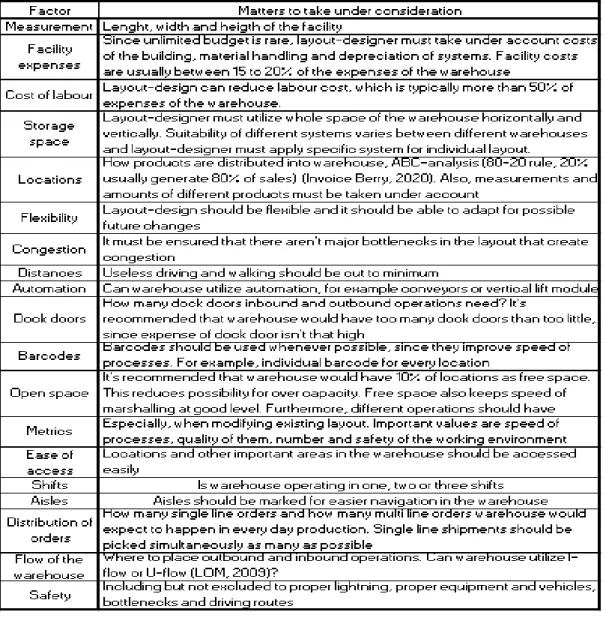
There are many specific factors taking effect on layout-design of the warehouse. When planning new or modifying existing layout, layout-designer must identify needs of the warehouse to create suitable solutions for it, because of the fact that warehouses aren’t identical. They can vary in measurements of the building, shape of the building, types of goods stored, daily operating hours, number of employees, number of vehicles for example and many other factors. Factors taking account on layout-design are shown in the excel table below.
4.2 Use of Lean model in layout-design
Goal of lean model is to minimize waste in processes and in end-product. This means eliminating actions and resources used to create product and perform processes that don’t add value to end-product and customer and aren’t necessary in production. There are seven types of waste in Lean model which refer to defect product, inventory, over-production, movement, waiting, over-processing and unused talent. Wastes are de-scribed in the table at the end of this chapter.
Lean method was originally invented in Japan in factory plant of Toyota back in year 1930, when it was called Toyota Production System (TPS). Worldwide distribution of Lean model had started when Henry Ford and Fredrick Taylor visited Toyota’s factory and adapted their way of running a factory. Definition for lean contains five principles, accurate value for every product, evaluating value stream for every product, reduce interruptions, customer retrieves value from manufacturer and reaching for perfection (R. Sundar, 2014).
Proper layout-design can decrease waste in processes, such as need for driving an empty forklift. Moreover, if high demand products are stored at certain area close to each other it reduces driving distances of reach truck drivers, since they are mostly lifting products and putting down products at high demand area. However, this requires that incoming pallets area is close to area that contains high demand products. Further-more, pickers experience less driving with empty forklift since products aren’t distrib-uted all over the warehouse. These actions decrease waste of movement in the ware-house. In case of reducing picking failures with layout design, locations should be clearly separated, and they must only contain one product code per location. Ware-houses that utilizes this kind of locations experience less waste of over-processing since products are easier to handle separately. If warehouse has waste of excess in-ventory it would be eventually forced to use locations containing multiple product codes.
Storage space could be enhanced with new layout solutions, such as flow racking, mo-bile racking or warehouse automation fill rate could be increased when compared to regular racking, therefore smaller storage space could storage bigger amount of goods.
These actions as well tackle waste of excess inventory. However, warehouse shouldn’t have too much free capacity, since over capacity creates possibility for acquiring too much inventory or at least creates expenses because of unused storage space. Reason for excess inventory in manufacturer’s warehouses is commonly explained by waste of overproduction.
Waiting time and congestion could be decreased by distribution of different products that aren’t usually picked for same shipments, therefore pickers which are majority operators in aisles of warehouses point to different locations instead of going to same area shipment after shipment. By smart distributing products within warehouse waste of waiting will be reduced. However, when planning new layout, one has to remember to keep it simple, avoid overengineering and waste of unused talent of employees which have or will have role in operations of the layout. Complex layouts should be avoided since they have negative effects on speed of processes (A. Reis*, 2017).
Table 1. Types of waste in Lean model
Defect Stands for product isn’t good for its purpose, product must be fixed or thrown away, either way waste is created.
Inventory Having too much inventory decreases available working space in the facility, binds capital, increases risk of wastage of the products and damages to the products and improves lead times. Furthermore, it doesn’t enable efficient use of space, therefore having overcapacity creates waste.
Overproduction Overproduction reserves resources of the facility and output of the overproduction will eventually lead on having too much in-ventory. Overproduction is determined as doing tasks that don’t create value for the company. To reduce waste, products should be created by Just In Time (JIT) philosophy instead of Just In Case (JIC) philosophy.
Movement Refers to unnecessary movement of employees, vehicles, equip-ment and machinery. Moveequip-ment requires resources from the pro-duction and therefore unnecessary movement decreases effi-ciency of the production, which makes it as waste in processes. Waiting Concerns every object that moves in the facility from employees
to machinery. If their productive movement is stopped because of lumpy material flow nor bottleneck in the process waste is created, since operators couldn’t utilize their time in the process. Over-processing For the end-product or service extra resources must not be used,
included but not limited to unnecessary steps in the process or parts in the product. Moreover, product nor service should con-tain only necessary elements and elements that don’t add value of the product nor service should be considered as waste. Talent Unused talent of employees creates waste as well, since usually
employees performing work can give great development ideas for development of their own department. Working environment where employees have strict roles disables possibilities for inno-vations and therefore creates invisible waste.
4.3 Warehouse operations
Warehouse layout has effect on every operation implemented in the warehouse. With right layout solutions done in the warehouse quality, safety and speed of the processes can be improved. Main warehouse operations described in sub-chapters of this section.
4.3.1 Receiving
The beginning of internal supply chain. Usually, products arrive to warehouse by trucks, vessels or trains. After truck, vessel or train has parked for unloading, possible seal will be removed, and receiver checks that condition of products is good. If prod-ucts are in good condition and shipment is identified for the warehouse unloading pro-cess can start. In the unloading propro-cess employee checks pallets and parcels for poten-tial damages. Counting of products arrived can be done in unloading process or after it. If products have damages or shortages in balances markings will be done to the bill of lading. Markings to bill of lading will lead to claim for replacement product or compensation towards courier or dispatcher.
After unloading and inspection receiving employee will add products to balances of the warehouse and move them to incoming products area, where they will be distrib-uted to right locations in the warehouse (Khanzode & Shah).
4.3.2 Picking
In picking process employee travels to specific location with truck or by walking and picks product from there to fulfil customer’s order. Multiple order lines mean multiple locations for picker to pick. Picking as a concept is clear and easy to understand, on top of above picking process usually contains reading EAN-code or UPC-code (Nationwide Barcode, 2011) and possible serial number. However, when company is trying to improve picking speed of employees this concept isn’t that simple anymore. Type of building, picking equipment, driving distances, type of picking locations are one of many factors having effect on picking speeds. On average picking in warehouse performs 55% of operational costs. Picking can be divided into five categories.
Zone picking, refers to picking process where orders that have multiple order lines are picked from different zones in the warehouse. After zone picking goods will be taken to dispatch or packing station from different zones for con-solidation of the shipment. Concon-solidation enables smaller shipping fees, since only one pallet or parcel is shipped instead of multiple pallets or parcels. Zone picking is popular in large warehouses with large number of employees. Discrete picking, in this picking mode employee picks order one line at the
time from different zones of the warehouse. Discrete picking is popular in warehouses that don’t have that many employees, since they can’t apply zone picking.
Multi-order picking means picking multiple orders on same picking trip. Pick-ing similar small orders from locations close each other enable higher pickPick-ing speed. For this picking method picking volume must be large. This kind of picking method is utilized in eCommerce distribution centers for example, be-cause of predictability of orders and their similar trend.
Cluster picking is similar to multi-order picking. However, this picking mode involves big pallet shipments. In this picking mode pickers fulfil several pallet shipments in the same picking trip. Pallets could be fulfilled at specific location or few pallets could be on truck while picking. This kind of picking mode is good if big shipments have products from locations close to each other. Wave picking, in wave picking pickers pick products from specific areas of the
warehouse and pass those products to next picker who fulfills orders even more and so on to next picker. This kind of picking method requires huge demand.
Picking processes in warehouse are either automated or manual done by employees with or without forklift. Essence of picking of the warehouse depends on type of prod-ucts, which creates framework on which kind of equipment will be used, company’s investment level on warehouse operations which on its best enables high level auto-mated picking (Khanzode & Shah).
4.3.3 Dispatching
At dispatch area employees are moving ready pallets and units that contain several parcels, for example trolleys to courier trucks. For pallet to be ready dispatch workers must consolidate each parcel of the shipment to pallet or pallets and pack them properly. Packing includes filming of the pallet. When handling with extremely ex-pensive products or special products pallets could require visual protection, for exam-ple plywood cover or black film to be used. Products that aren’t stabile on the pallet require straps to be used to attach them strictly on the pallet. Before moving pallet to carrier truck dispatch worker must attach necessary documents, in domestic shipments this means package card and packing list. Shipments to outside borders of European Union usually require more documentation, for example physical bill of lading and country of origin certificate which proves manufacturing country of the product (Habazin;Glasnović;& Bajor, 2017).
4.3.3.1 Dispatching of small items
Some of the picked goods can’t be shipped on their own boxes, because of vulnerabil-ity of the packaging. For example, when multipack of small items is opened, and one vulnerable product is picked for delivery it must be packed. Some products may also have retail packaging and therefore should be packed, since retailers don’t appreciate package cards and packing lists attached to retail packages.
If packing to cardboard boxes packer at packing station chooses as small box as pos-sible for the product or products and places them and filling into the box. In case of large amount of small nor fragile items packer could place products straightly to ship-ment unit, in this case shipship-ment should have plywood or cardboard cover. After this package card and packing list are attached to the box and it will be moved to shipment unit or package cage waiting for pickup. Products could be moved to packing station with conveyors, forklifts or roller tracks. It’s recommended that small products would be in picking unit, for example plastic box. This ensures that products of the order won’t mix up with another order or get lost (Habazin;Glasnović;& Bajor, 2017).
4.3.4 Material handling
Warehouses and other facilities should try to follow lean principle, which aims to cut every unproductive move implemented in the production (Lean Australia, 2020). In this case relocating of products in the warehouse. However, material handling is re-quired in warehouses at first when moving pallets to picking and buffer locations from incoming products area. Products must be stored in buffer locations, since square me-ters of warehouses are limited. Furthermore, products from buffer locations must be moved to picking location when stock balance on picking level goes to zero. If ware-house has high fill rate, goods from picking locations must be moved frequently to make room for products from buffer locations. Because of every product code couldn’t have floor level picking location low demand goods must be sometimes lifted back to buffer location (Lean material handling, 2018).
4.3.5 Safety
Safe working environment should be important element in every warehouse. Safety of the warehouse should be monitored all the time and employees and management should be active when they find safety risks in warehouse operations and eliminate them as soon as possible. Typical accidents reported in warehouses are slipping or falling, forklift accidents, objects falling from racking, collapsing of racking and back pain due to heavy lifting.
Slipping could be prevented by investing on floor that isn’t slippery, also employees must have safety shoes that have patterns that increase balance on slippery surfaces. For falling, warehouse picking locations should be designed in a way that eliminates need for climbing. Reducing number of accidents on driving a forklift, include deter-mining speed limits on areas that have congestion, pointing out driving routes, proper training for employees on how to operate forklift and to drive very slow in areas that have limited line of sight.
To prevent objects falling from racking, reach truck drivers must complete lifts and put downs slowly and ensure on lifts that products are stationary and placed correctly on racking, also objects have to be attached to the pallet with film or straps or their combination to ensure they won’t fall from the racking. Objects that are very long or especially heavy create their own challenges as well. When handling long objects reach truck driver must use longer forks to ensure that pallet won’t fall from reach truck in lifting or landing. As well when handling big objects with clamps forklift driver must ensure that forklifts has enough capacity for the lifted load and that prod-ucts are clamped from the right position to avoid falling of the load and damaging of the products.
Collapsing of racking or collapsing of stacked products are most dangerous accidents in warehouses. In case of stacked products, warehouse employees must ensure that stacks are in line with each other and that products in stacks are strictly attached to each other with film. For collapsing of racking the condition of racking should be monitored on daily basis and faulty parts of the racking should be replaced immedi-ately. Furthermore, if collision with racking occurs employees must to inform super-visor in the warehouse who is responsible to arrange fix immediately. To avoid instant collapsing of racking employees should be trained properly on how to operate forklift and driving speeds near racking should be reduced, moreover impact protectors must be installed to protect foundation of the racking. Sprains and strains most occur with the back for employees working in the warehouse, employees must be educated on right lifting techniques, it should be ensured that employees lift by using legs and don’t complete lifting only using their back muscles. Also, in case of heavy lifting forklift must be used, if this isn’t possible employees should be educated on asking for help to lifting in case of heavy objects (Hoda Davarzani, 2015).
4.4 Essence of layout
As described above there are many factors to take under account in layout planning. Furthermore, company’s choices on are operations handled mainly manually or with automation have effect on essence of the layout. Below are presented most popular warehousing methods for manual warehouses and some untailored automated systems.
4.4.1 Racking solutions
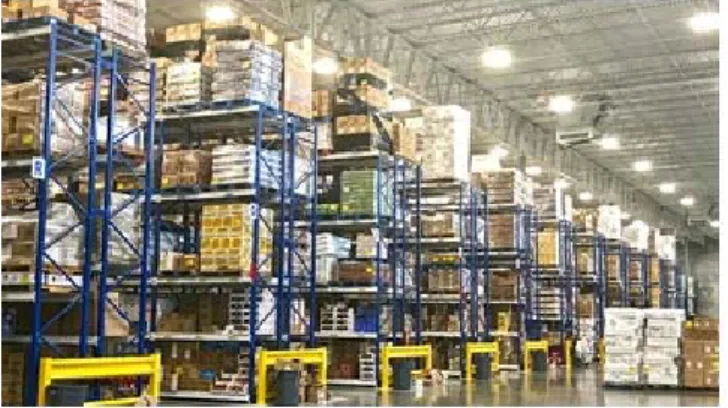
Regular racking, this kind of racking is very popular in warehouses. Usually, wide beams can carry four standard EUR-pallets (120cm * 80cm) or three FIN-pallets (120cm * 100cm). However, racking could be modified to specific need of the company. Regular racking is reasonable choice for up to twelve meters in height, which is maximum lift height for biggest reach trucks. Typical height used in warehouses is six meters (Close, 2018). Furthermore, human errors may occur more in higher lifting heights than twelve meters. Benefit of regular racking is that it can be modified and extended as much as needed. Disadvantages of this kind of racking are lowest filling rate and vulnerability to collisions, which can lead to serious damages inside a warehouse.
Figure 4. Regular racking (Close, 2018)
Metal point boltless shelving is space saving solution for smaller and lighter warehousing needs, since height of the beams is smaller than in regular rack-ing. This kind of racking is popular in small warehouses and offices. Disad-vantage of this kind of racking is that it couldn’t be operated with forklifts in case of heavy products (Lifttrucksupplyinc, 2020).
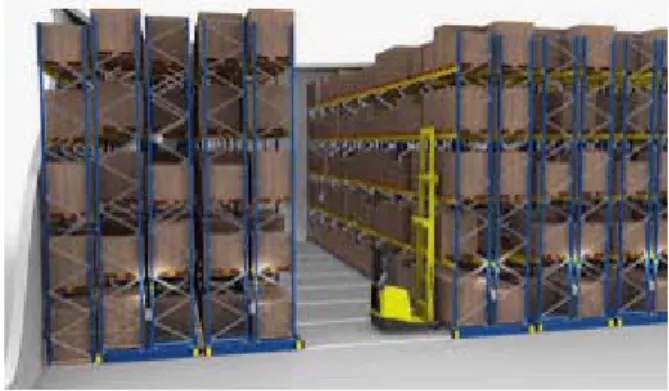
Mobile racking is similar to regular racking, however racking lines can be moved next to each other and be separated at the point where products are waiting to be picked or moved. Mobile racking has its limitations in length but is very good for manufacturer’s warehouse for example where a lot of similar resources or products are stored. If warehouse contains various product codes mobile racking should include low demand products to avoid moving of it fre-quently, otherwise increased storage space couldn’t be justified since speed of warehouse processes will be reduced (SSI-Schaefer, 2020).
Figure 6. Mobile racking (Jungheinrich, 2015)
Flow racks can be utilized when stock balance on same product is high enough. In this case they offer great filling rates for the stored products. They also re-duce work of reach truck drivers, since pallet movement is done by the system in the flow rack. Disadvantages of the flow rack are that pallets could get stuck in the system in case of broken pallet, system also requires maintenance for brakes and wheels time to time. In flow racks pallets or parcels are inserted from one end and taken from the other end. Flow racks therefore follow first in first out (FIFO) principle, which is commonly used with products that have expiration dates. Flow rack may also be modified as drive-in drive-thru racking with only opening at one end, which creates it as last in first out (LIFO) racking (Lifttrucksupplyinc, 2020).
4.4.2 Automated solutions
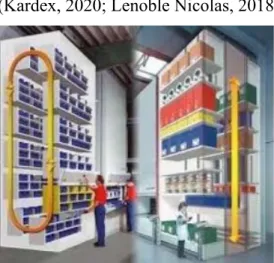
Vertical lift system is useful solution when warehousing small goods. System has multiple trays where goods in boxes can be placed. System moves tray that has picking lines to opening where it’s accessible to picker. After picking tray is taken back to the machine and new tray will be moved to the opening. Ver-tical lift systems are great solution for small item storing, since free space be-tween boxes is minimized in these systems. Disadvantage of the vertical lift system is that it is very slow used individually and without software integra-tion. To get most out of vertical lift system it should be integrated with ware-house software to make it serve trays automatically to picker and loader of the system, also there should be two system pairs facing each other to ensure that they are functioning faster than their operator. Vertical lift systems can be up to thirty meters in height, enabling safer warehousing in high buildings (Kardex, 2020; Lenoble Nicolas, 2018).
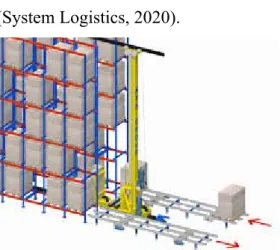
Automated stacking crane is machine that is operating on rails between ing. Automated stacking crane can move pallets to racking and out from rack-ing. Benefits of automated stacking crane are that it eliminates human errors, it moves pallets faster than human operated reach truck to racks and from racks and it can lift up safely up to forty meters. Disadvantage of this system as well as any automated system is that when it gets stuck or malfunctions products it isn’t possible to receive products from the system before fixing of the problem (System Logistics, 2020).
Figure 9. Automated stacking crane (ATS Group, 2020)
Automated miniload is automated system picking plastic boxes from specific miniload racking. Several cranes operate in different aisles and pick up parcels from racking and move them to conveyor which leads to employee who will pick up product and forward it to right destination. Miniload system is highly adjustable for specific needs of the company. Miniloads are usually used by big operators in their warehouses or distribution centers. As well as in case of vertical lift system miniload has strict limitations for measurements of the stored product and it couldn’t be modified that easily as non-automatic ware-housing systems (Qian Wang, 2011).
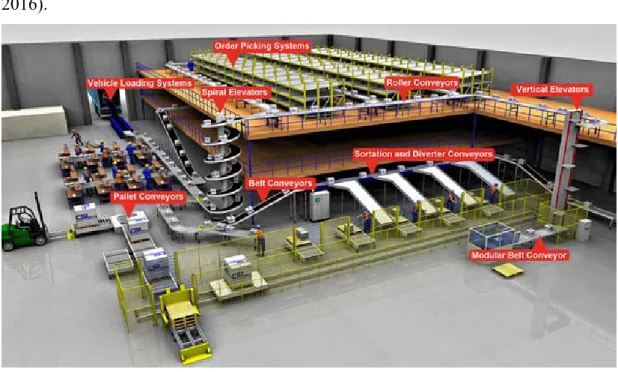
Conveyors are used to move products in warehouses from location A to loca-tion B. Use of conveyors require space but if they are placed on localoca-tions in the warehouse that don’t block operations, they reduce time used in processes, since they reduce movement in the warehouse. There are many kinds of con-veyors available at the market as presented in figure below (Abhijit Gaikwad, 2016).
Figure 11. Different types of conveyors (Conveyor Systems LTD, 2020)
Automated guided vehicles (AGVs) can be found from warehouses of big op-erators. AGVs are most suitable for repetitive task in warehouses, for example moving pallets to racking and from racking or moving goods from location A to location B in the warehouse. AGVs release resources from material handling to other operations. They also increase safety, speed and accuracy of the pro-cesses in the warehouse. Breakthrough of AGVs is held by their high acquisi-tion cost and maintenance costs (Benevides, 2019).
4.4.3 Material flow
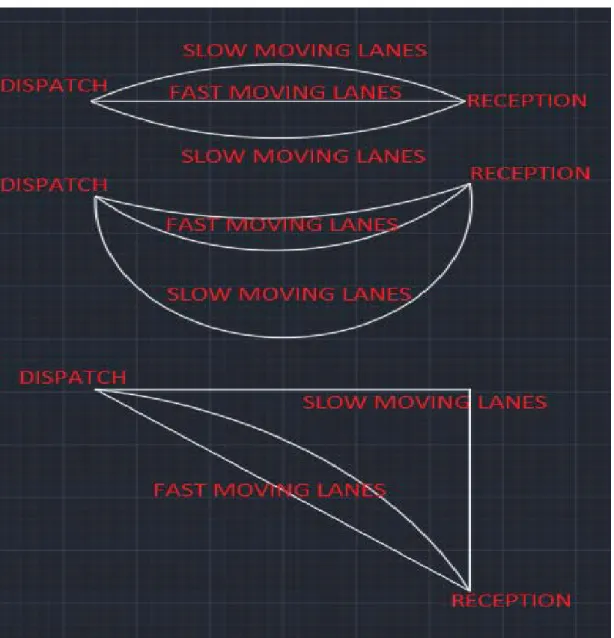
There are two popular material flow types for warehouses, throughflow, L-flow and U-flow. In throughflow model products in the warehouse travel from the one end of the building to another. In the beginning of the throughflow goods are received and in the end of it goods are dispatched. Product demand determines either it’s going fast lane or slow lane in the warehouse, as described in the picture in the end of this chapter. Throughflow model requires separate space for inbound and outbound operations. Af-ter reception products are moved to locations all around the warehouse where picker picks them when they are ordered and moves them to dispatch area for dispatching. It’s recommended that high demand products are going fast lanes and low demand products are going slow lanes to avoid time spent on driving in the warehouse. Throughflow model’s disadvantages are high driving distances, however it makes working in the warehouse clearer since inbound and outbound operations are clearly apart. Throughflow model is great flow type for warehouses that receive products in large transportation units for example vessels or trains and dispatch them forward in smaller units such as delivery trucks.
In L-flow model reception is for example located in top left corner of the warehouse and dispatch is located in bottom right corner of the warehouse. From reception prod-ucts are moved by reach truck drivers to picking and buffer locations where pickers pick the products whenever order for them is made. It’s recommended that high de-mand products are closer to dispatch than low dede-mand products. In L-flow model prod-ucts long driving distances are required as well since dispatch and reception are sepa-rated in the opposite ends of the warehouse. L-flow is popular flow type in warehouses that receive products in big transportation units for example trains and dispatch them in smaller transportation units like delivery trucks.
U-flow model is used when reception and dispatch area are located next to each other. Products are moved from the reception to back of the warehouse, high demand prod-ucts will go to very beginning of the warehouse locations and low demand prodprod-ucts to very end of the warehouse locations. U-flow model doesn’t separate inbound and out-bound operations that much as throughflow model does, however it offers smaller
driving distances, especially for high demand products. Moreover, U-flow warehouse offers easier management, since departments are close to each other.
To gain optimized warehouse for company operations company has to analyze its warehouse operations and find out do they need to ship products in different kind of transportation unit than one that products arrive. Furthermore, if warehouse is attached to plant this usually means L-flow or throughflow model to be used. Occasionally, these flow types couldn’t be implemented in every warehouse, for example if company rents facility that has been used for other actions than warehousing and doesn’t offer different space for dispatch and reception operations, this disable use of U-flow, L-flow and throughL-flow models (Hoda Davarzani, 2015).
4.4.3.1 Distances
Longer driving distances mean longer time for performing operations in the ware-house. To reduce time spent on driving with forklifts high demand products should be placed closer to dispatch area as described above. Further optimization could be done by placing products closer to reach truck drivers who will move products to picking and buffer locations. This however means usually more driving for employees in re-ception, however this effect could be reduced with use of AGVs since they are great for performing simple movement of goods inside warehouses (José Antonio Larco, 2016).
5
WAREHOUSING IN DISTRIBUTION CENTER OF F9
F9 is distributor for 65 vendors. Warehouse of F9 is currently located in 12 000 square meters building (F9 Distribution Oy, 2020) and area in use of the company is 9400 square meters. Enlargement is going to increase this area to 10 000 square meters. Size of the enlargement isn’t that big when compared to existing area, however more ware-housing space always helps operations and with modifications existing space can be enhanced.
A lot of vendors mean large number of product codes to be stored. Precise number of different physical product codes was 21 304 on February 17th 2020 (Product codes report, 2020), on top of this number are virtual products, but they are outlined from this project since they don’t require regular storage space. Number of vendors and products is continuously rising, which justifies need for modification and enlargement. Below figure on how warehousing is done in the distribution center of F9.
Figure 4. F9, Autocad layout (Heinonen, Director, 2019) with operations
5.1 Areas out of modification process in layout
According to the figure three in chapter 3.3, there are few areas that should be left outside modification of layout of warehouse of F9, since their locations couldn’t be changed in current layout.
Dispatch and reception should remain in same place, since there isn’t any other possible location for docking doors in current layout. Yard area is too small for movement of trucks in other locations.
Inbound operations should be left on current places, since the solid location of reception.
Warehousing of home appliances should stay close at docking door for incom-ing containers, since mass storage is most flexible way to warehouse these products in six and half meters high area.
Packing station should remain on same place, since its close location to dis-patch area and Kardex vertical lift systems which include most of the small items stored in the warehouse. Enlargement of preinstallation has also been started already which locks packing station to its current place.
Current Kardex vertical lift systems should left at current place. All though, they could be moved in the warehouse it’s expensive and has long-term effect on daily production. Furthermore, it’s expected that warehouse will get more automated systems in the future and advantage from current storage space can be taken best with automated systems.
Preinstallation, investments have already been done for enlargement of the space of preinstallation. Moreover, most suitable location for preinstallation was on top of support when F9 started distribution operations in its current location. Also, utilization of preinstallation space in other operations in distri-bution center doesn’t make sense since space has low accessibility for forklifts.
5.2 Current situation in the F9 warehouse
Time range for implementation of layout enlargement isn’t clear (Heinonen, Director, 2019), therefore it’s hard to determine distribution of different products in the future warehouse. Currently warehouse needs more storage space for televisions, which is taken under account in layout plans. Smaller part of warehouse will be kept mainly as mass storage which can be used for temporary warehousing space for all sorts of prod-ucts. Defining top seller products and using ABC-analysis isn’t reasonable since ware-house software doesn’t get information about demand of the products. In electronics wholesale business A products vary frequently, therefore it isn’t reasonable to point specific locations for specific products, since situation would change within few months.
Quality of the warehouse operations was already at good level before starting this project. In the point of view of layout planning quality could be increased by investing more on warehouse automation, since this has reduced wastage and picking failures in the past already, since most of picking failures and wastage happens with small items. When looking at damaged products in internal operations, it can be seen that most of the accidents happen with large products, either when handling them in the mass stor-age with counter balance forklift or when big televisions fall while moving them with low-level order pickers (Quality report, 2020). AVGs could be utilized for keeping storage space free and they could also prevent damages in warehouse operations, for example handling mass storage or moving television pallets.
Speed of processes in point of view of layout planning include use of ABC-analysis. Currently products are distributed to warehouse of F9 whenever where is location that is close to measurements of the pallet or plastic box containing products. If ABC-analysis could be included into warehouse software it would enable reach truck drivers to place A products closer to dispatch which would reduce driving distances of pickers, especially ones that are picking heavy shipments that have only few order lines. From data about daily production it can be seen that automated solutions have improved speed of processes, which justifies use of them also from this point of view. After vertical lift systems were assembled to warehouse of F9 picking speed of small items was increased by 25 %. When reflecting to chapter 4.2 about Lean it can be found out that use of automation has enabled ease access for almost every small item in the ware-house, therefore unnecessary working task of moving products before being able to pick right product has been erased. Automation has reduced wastage in the small items, since picking area is well organized and has good lighting. Moreover, driving distances are reduced since picker moves only small distances from vertical lift system group to another. Sometimes automated solutions have created congestion in their area, how-ever they have reduced congestion greater in the aisles of the warehouse.
From production data it can be seen how long driving distances take effect on picking speeds. Picking of speed of white goods and huge televisions increased by 50 % when picking of multiple shipments on same picking trip started (DBM - F9 Distribution Oy, 2017-2020). Furthermore, material handling would be faster if warehouse would have enough free storage space, because currently in worst case scenario reach truck drivers have to make several moves to create free picking location for pallet that is dropped from the buffer location. Dispatch and reception operations could be enhanced if company invest on AGVs which could be used in these processes also for moving of the goods (Production data, 2018-2020).
5.3 Matters of development in current layout
There are few topical development matters in current layout. Since main focus in this project is to solve storage space obstacles, development solutions focus more on in-creasing storage space than inin-creasing speed of processes. All though, speed of pro-cesses and safety of working environment are also taken under account in planning of new layout solutions. Topical challenges of current layout are following.
Warehousing of televisions and info displays bigger than 55”. In current layout warehouse experiences time to time situation where there aren’t enough buffer locations for 65” televisions and info displays. Moreover, warehousing of 70” – 98” televisions and info displays is also challenging, since there aren’t proper buffer locations for these products.
Lack of picking locations. Frequently warehouse meets situation where there aren’t enough floor level picking locations for pallets. This often creates situa-tion where reach truck drivers must move products from larger picking loca-tions to smaller ones to be able to drop pallet from buffer location to picking location on floor level. Obviously, movement of products in warehouse from one location to another is typical, but if this could be reduced it would speed up processes and enable smoother production.
5.4 Long-term layout development suggestions
As can be seen from the figure building has dispatch/reception area at the other end that isn’t currently in use. When company’s operations require whole building, this area should be used for use of reception, so that dispatch and reception departments wouldn’t overlap each other, it would also allow through flow of products in the warehouse which would reduce time used on picking. This would speed up processes, since bigger batches can be handled when plac-ing products to locations than when pickplac-ing them from locations. Moreover, It would move high demand products closer to dispatch and low demand closer to reception which would be ideal situation, since high demand products are picked most and don’t require that much racking space whether low demand products which require more racking space and material handling. Current combination of U-flow and one way throughflow will meet its limits when ma-terial flow increases because reception and dispatch share same docking doors, working stations and some machinery and equipment.
Current mass storage area is placed on highest part of the building, which is 25 meters high. Currently this area is used to 6,5 meters in height. To be able to take full advantage from this area there should be installed automated stacking crane for pallet handling all the way to top of the storage space. Other kinds of automated systems should be operating in lower side of the building, which has height of twelve and ten meters. This is because when handling singular prod-ucts like in vertical lift systems or miniload speed of automation is able to stay in reasonable level when lift height isn’t that high.
ABC-analysis would be useful tool on controlling areas of stored products in the layout. If demand of the products could be utilized to warehousing soft-ware, specific places for products depending on their demand could be pointed out to reach truck drivers. This would reduce driving distances in the ware-house, since locations in the end of the warehouse wouldn’t be visited that of-ten. However, this would require change on placing products in the layout. Furthermore, different picking methods and measurements of products set lim-itations for use of ABC-analysis. Rough version how ABC-analysis could be implemented to current layout found as appendix one.
Stock control, if possible, some products could have lower stock balances. Dis-tribution center has experienced situations where it has had huge amount of specific product codes which demand hasn’t been that high. These products have required much storage space and therefore have caused expenses for the company. Sometimes these products have been dispatched back to the manu-facturer which has caused unnecessary work for the warehouse. Forecasting of demand and matching stock balances to it can sometimes be challenging, but if over stocking could be prevented it would create more free storage space and enable smoother production.
5.5 Locations
In below table current number of different locations in warehouse of F9 is described. As seen from the table warehouse of F9 has specific locations for small items and white goods as well as for many different sized pallets, data acquired 17th of February (Empty locations report, 2020; Locations report, 2020; Plastic box report, 2020).
Table 2. Warehouse locations
Type Measurements Amount Fill rate
Plastic box locations in vertical lift systems 80cm*60cm*23cm 60cm*40cm*23cm 40cm*30cm*15cm 30cm*20cm*15cm 6800 (148) 13 600 (6751) 27 200 (1044) 54 400 (1667) Possible locations/ (actual usage) 58,7%
Number of buffer lo-cations in racking Height Width 3m*0,9m 2,5m*0,9m 2,35m*0,9m 2,3m*0,9m 2,25m*0,9m 2,2m*0,9m 2,15m*0,9m 2,05m*0,9m 2m*0,9m 1,95m*0,9m 1,9m*0,9m 1,8m*0,9m 1,55m*0,9m 1,5m*0,9m 1,4m*0,9m 1,3m*0,9m 1,25m*0,9m 1,05m*0,9m 0,95m*0,9m 0,75m*0,9m 0,7m*0,9m 60 362 95 134 104 60 775 633 108 60 231 206 171 89 207 251 102 642 342 117 931 = 5680 Fill rate of locations couldn’t be determined, since pallet report doesn’t understand wider pallets than EUR-pallets. Therefore precise fill rate couldn’t be calculated. Number of regular picking locations Height Width 2,5m*0,9m 2,45m*0,9m 2,25m*0,9m 2,15m*0,9m 1,9m*0,9m 1,37m*0,9m 1,3m*0,9m 1,28m*0,9m 1,25m*0,9m 234 33 148 188 98 46 142 142 58 Fill rate of locations couldn’t be determined, since pallet report doesn’t understand wider
1,2m*0,9m 1,1m*0,9m 0,9m*0,9m 0,87m*0,9m 0,85m*0,9m 0,7m*0,9m 0,68m*0,9m 0,64*0,9m 0,61m*0,9m 0,56m*0,9m 0,43m*0,9m 0,41m*0,9m 0,33m*0,9m 45 58 58 58 58 163 58 58 58 58 83 84 191 = 2121 Large tv locations = 290 pallets than EUR-pallets. Therefore precise fill rate couldn’t be calculated. Number of group-lo-cations, red plastic boxes for medium-sized shipment units (6 plastic boxes/loca-tion)
60cm*40cm*30cm 118
= 708 locations for red plastic boxes
94,4%
Number of mass stor-age locations
Length Width
4m*1,53m 105 47,6%
5.6 Safety
According to accounting of accidents working environment of F9’s warehouse is at excellent state (Accidents, 2020). Accidents refer mostly to misuse of equipment and aren’t caused by essence of the layout. When referring to safety chapter 4.3.5 layout-design related risks are colliding forklifts, damages to racking and handling of large products. In case of colliding forklifts specific driving routes would reduce risk in the warehouse as well as traffic mirrors assembled in the racking. Damages to racking could be prevented also with driving routes since they reduce congestions which will move traffic closer to foundation of the racking. Furthermore, automated solutions will decrease need for human operated forklifts which will decrease change on operator colliding with the racking. In case of large products white goods and large televisions will have bigger handling, which will ease handling of these goods and therefore de-crease risk on accidents. Moreover, use of AGVs would minimize these risks.
5.7 Utilizing Lean model
Every warehouse has its pros and cons, this chapter utilizes Lean model of chapter 4.2 and points out wastes in warehouse of F9 in point of view of layout-design. Defect products are presented in warehouse of F9 time to time, damages are caused by exter-nal and interexter-nal transportation. In interexter-nal transportation defects happen when products are mishandled with vehicles or products aren’t packed properly for internal transpor-tation. Layout-design could prevent these defect products by enabling enough space for material handling and by specific driving routes which would reduce number of sudden encounters of vehicles. In case of sudden encounters operators must slow speed of their vehicle which makes poorly packed product move from pallet to the floor damaging the product and making it defect especially in cases of fragile product. Fur-thermore, traffic mirrors would enhance visibility in warehouse and reduce sudden encounters of vehicles.
Time to time manufacturers tend to push their products to distribution center, this is caused by them trying to reach their accounting period goals nor overproduction which can be seen as greater discounts for greater batches. Also, demand of products varies which can be seen in warehouse as having too much or too little inventory on some products. Currently, situation at F9 warehouse is at good level, free storage space is available in mass storage, vertical lift systems and in racking locations. However, there have been times in the past when warehouse had too much inventory. Waste was vis-ible in mass storage area and in locations for televisions, which were both full and some of the products had to be stored in aisles and handling areas. To reduce waste of having too much inventory warehouse must have enough storage space for specific products and consider even outsourcing of warehousing in case of exceeding storage capacity greatly.
In case of overproduction in warehouse of F9 amount of orders are considered instead of manufactured product, since distribution center of F9 has only small level opera-tions in manufacturing area. Having too much orders leads to heavy workload for the employees working in production and creates waste, such as congestion caused by high number of moving products, vehicles and employees. Layout-design can tackle this waste by reserving enough space for each operation even for the peak days in produc-tion. When daily order lines are rising, layout-design has to adapt to serve greater amount of orders on daily basis or even expand when limitations of current space are encountered.
Most visible waste in warehouse of F9 is movement, since reception and dispatch operations are located to same area, therefore in worst cases reception employees move products to most distant corner of the warehouse and after that employees working in dispatch operations pick the same product from that distant corner. Unnecessary move-ment could be tackled by handling greater batches at once and by placing high demand products closer to dispatch and reception area. In the future another area with docking doors should be utilized for dispatch or reception operations.
Waste of waiting is present in warehouse of F9 time to time. In most cases waste of waiting occurs when two employees are having order lines only from same vertical lift system group, therefore one of them has to wait for another one to pick up products from the vertical lift system group. Waiting could be reduced by investing more on
vertical lift systems or other automation which would reduce possibility on having two employees that have order lines from same vertical lift system group. Waiting also occurs in aisles and in dispatch and reception area. Waiting could be reduced by cre-ating specific driving routes for specific forklifts and by use of AGVs for simple move-ment of goods.
Over-processing in case of distribution center of F9 is present in form of moving goods that have already dropped down from buffer location to picking location. This is required because high picking locations (higher than 2 meters) are often full. Moving products from picking locations is considered as over-processing since products are already at picking level. Layout-design could reduce this kind of waste by ensuring enough high picking locations. Other way to reduce over-processing is that in case of low demand products reach truck drivers won’t drop whole pallet from the buffer to picking location. All though, this creates need for moving half of the pallet from buffer location to smaller one. However, it would be reasonable since movements in buffer locations wouldn’t occur that much than movements in picking locations. Moreover, layout-design can reduce waste of over-processing by determining areas for different products by applying ABC-analysis, therefore reach truck drivers would have better understanding in which cases whole pallet should be dropped from the buffer location and in which cases only part of the pallet.
In case of layout-design waste could be created as well by ignoring potential talent of employees, by doing this some great innovations may never occur. Author has inter-viewed his supervisors, colleagues and subordinates during the project and has tried to utilize their expertise in layout-design to avoid waste of unused talent. However, since potential implementation of this project is in the future, suitability of the presented layout suggestions must be evaluated again before implementation and talent of em-ployees should be utilized again since essence of warehouse of F9 will most likely be different in the future.
6
USE OF AUTOMATED GUIDED VEHICLES
This topic isn’t directly linked to creating more storage space with warehousing sys-tems and different layout solutions. However, use of AGVs can greatly help on keep-ing storage space available in the warehouse, increase accuracy and safety of the work-ing environment. AGVs could do simple movement of goods in the warehouse and release resources to more difficult operations which require human operator. Further-more, AGVs would easily increase productivity in silent hours of warehouse when number of employees isn’t that high. Unfortunately, work of AGVs must be monitored so they can’t operate when warehouse is closed, however if AGVs would also operate at night this could be implemented by one employee monitoring them. Another con in this solution is that currently AGVs currently require high procurement investments. Rocla (Rocla, 2020) is chosen for the company offering solutions, since Rocla was only manufacturer on Finnish market with proper selection available in the internet in AGVs. Below are some suitable solutions for F9 distribution center from Rocla.
Automated reach truck from Rocla could be useful on driving incoming pallets from their area to buffer and picking locations. According to specifications of reach truck shown in the second appendix (Rocla, 2020), it would be suitable for warehousing operations in distribution center of F9. Automated reach truck should only handle standard EUR and FIN pallets, since there isn’t standard way on warehousing long special pallets. Time to time there is a hassle in in-coming pallets area, especially when many delivery trucks arrive at same time. Furthermore, distribution center aims to operate with accurate number of em-ployees when comparing to workload of production on daily basis, this is ena-bled by use of rental workforce. All though, there are days when number of employees doesn’t match with workload of production and reach truck drivers must be used in picking and packing. Automated reach truck could balance these kinds of situations.
AWT narrow aisle, which has similar functionality to above reach truck. Ben-efits of this solution is that it only requires aisle width of minimum of 1,75 meters and has lift height up to twelve meters (Rocla, 2020). Possible down-side in this solution is that to get its full advantage new racking with narrow aisles should be built up. Specifications and picture can be found as third ap-pendix.
Rocla also offers automated counterbalance truck, which could be utilized on clamping objects as well (Rocla, 2020). This kind of solution isn’t suitable for distribution center of F9 without modifications, but if clamps with length of 1,3 meters and maximum width of 1,5 meters would be attached to truck it could be utilized in handling of mass storage. Manual version of this truck is already in use in distribution center of F9. This kind of AGV would prevent damages, increase safety and speed up picking process, since it could drop home appliances beforehand for the picker to ground level. It could also help on unloading containers, since it could stack ready sets of home appliances to their mass storage location. Picture and specifications of the AGV found as appendix four.
For only floor to floor operations Rocla offers AGV called ATX. It could be utilized on order picking and moving of pallets from location to another (Rocla, 2020). This kind of AGV could help on moving on pallets and trolleys from department to another. However, since there aren’t any stabile picking stations for shipment units this kind of solution wouldn’t have that many applications in the distribution center. Appendix five provides specifications and picture of ATX.
If F9 would invest on AGVs processes in production should be thought through. Cleaning in the warehouse should stay on excellent level to enable clear passage for AGVs, since they can’t pick up cardboard and film trash from the aisles. Driv-ing routes should be changed to reduce number of manual trucks and AGV inter-actions in the aisles to ensure safe working environment. Gladly, AGVs are capa-ble to detect human traffic and therefore avoid it, however too many interactions increase possibility for human error. Furthermore, operating areas for AGVs should be determined.