i
DEVELOPMENT
OF
ENERGY-BALANCED
NODE
DEPLOYMENT
STRATEGIES
TO
REDUCE
ENERGY
HOLE
PROBLEM
IN
WIRELESS
SENSOR
NETWORKS
By
HADI
ASHARIOUN
Thesis submitted in fulfillment of the requirements
for the degree of Doctor of Philosophy
ii DEDICATION
This thesis is dedicated to my mother Ozra, father Mohammad and wife Leili for their patience and the encouragement they provided during the entire period of the study and also is dedicated to my newborn daughter Helia.
i
ACKNOWLEDGEMENT
First of all, thank the almighty God, for generously supporting me through all my life. I would like to express my deep and sincere gratitude to my supervisor, Assoc. Prof. Dr. Wan Tat Chee for his guidance, expert advice, understanding and patience.
I wish to express my deepest thanks to my dear parents and wife Leili for the love, affection and support they have provided me with on every step of my life, specially this important part of my education. Without blessing, goodwill, advice and moral encouragement it would have been impossible for me to complete my study. I would like to remember my father-in-law Majid Taghizadeh who passed away in October 2010. May Almighty God continue to grant him soul perfect eternal peace, Amen.
Special thanks to my committee members, Prof. Dr. Mohd. Asri Mohd. Nawi, Prof. Dr. Sabira Khatun, Dr. Mohammed M. Kadhum and Assc. Prof. Dr. Widad bt. Ismail. All the knowledge that I have learned from them broadens my horizons and will guide me throughout my career pathway. I would like to express my gratitude to all the member of NAv6 for the exceptionally friendly working environment.
Last but not least, I would like to use this opportunity to sincerely thank people and my friends who have helped me, in any way, during my thesis work
Thank you! Hadi Asharioun,
ii
TABLE OF CONTENTS
Page
ACKNOWLEDGEMENT ... i
TABLE OF CONTENTS ... ii
LIST OF TABLES ... vii
LIST OF FIGURES ... viii
LIST OF ABBREVIATIONS ... xi
LIST OF PUBLICATION ... xiii
ABSTRAK ... xiv
ABSTRACT ... xvi
CHAPTER ONE: INTRODUCTION ... 1
1.1 Introduction ... 1
1.2 Research Problem ... 3
1.3 Contribution of Thesis ... 5
1.4 Research Objectives ... 6
1.5 Research Scope and Limitations ... 6
1.6 Organization of the Thesis ... 7
CHAPTER TWO: LITERATURE REVIEW ... 8
iii
2.2 Application in WSN ... 9
2.3 Characteristics Issues in Wireless Sensor Networks... 10
2.4 Network Topology ... 14
2.5 Routing in Wireless Sensor Networks ... 15
2.5.1 Node Deployment ... 16 2.5.2 Energy Consumption ... 16 2.5.3 Node Heterogeneity... 17 2.5.4 Fault Tolerance ... 17 2.5.5 Scalability ... 18 2.5.6 Network Dynamics ... 18 2.5.7 Connectivity ... 18 2.5.8 Coverage... 19 2.5.9 Data Aggregation ... 19 2.5.10 Quality of Service... 19
2.6 The Energy Hole Problem ... 20
2.7 Dynamic Methods ... 22
2.7.1 Dynamic Election in Clustering Scheme ... 22
2.7.2 Using Sink Mobility to Reduce Energy Holes Problem ... 25
iv
2.9 Using Heterogeneous Nodes ... 31
2.9.1 Energy Provisioning ... 32
2.9.2 Relay Nodes Approach... 34
2.10 Multi-Level Transmission Range... 37
2.11 Critical Review ... 50
2.12 Summary ... 51
CHAPTER THREE: METHODOLOGY ... 53
3.1 Introduction ... 53
3.2 Research Flow ... 53
3.3 Design and Development ... 56
3.3.1 Optimum Node Deployment Strategy (ONDS) ... 57
3.3.2 Exponential Node Deployment Strategy (ENDS) ... 59
3.3.3 Energy-Balanced Provisioning Strategy (EBPS) ... 60
3.3.4 Two Level Transmission Range (TLTR) ... 62
3.4 Evaluations and Simulations ... 64
3.4.1 Simulations ... 65
3.5 Summary ... 70
CHAPTER FOUR: MATHEMATICAL MODELING OF THE PROPOSED SOLUTIONS FOR MITIGATING ENERGY HOLE PROBLEM ... 71
v
4.1 Introduction ... 71
4.2 Design Assumption ... 71
4.3 Related Mathematical Background ... 73
4.3.1 Number of Nodes ... 73
4.3.2 Energy Considerations in the Coronas ... 74
4.4 Non-Uniform Node Deployment Strategies ... 76
4.4.1 Optimum Node Deployment Strategy (ONDS) ... 76
4.4.2 Exponential Node Deployment Strategy (ENDS) ... 86
4.5 Energy Provisioning Strategy ... 88
4.5.1 Calculation the Ratio of Energy Increment ... 88
4.5.2 Energy-Balanced Provisioning Strategy (EBPS) ... 92
4.6 Two-Level Transmission Range (TLTR) ... 94
4.6.1 Average Energy Consumption in Unlimited Transmission Range94 4.6.2 Calculate Two-Level Transmission Range Ratio... 96
4.6.3 Setup Procedure for Two Level Transmission Range (TLTR) .. 102
4.7 Summary ... 105
CHAPTER FIVE: SIMULATION AND EVALUATION ... 106
5.1 Introduction ... 106
vi
5.3 Evaluation of Exponential Node Deployment Strategy (ENDS) ... 110
5.4 Evaluation of Energy-Balanced Provisioning Strategy (EBPS) ... 114
5.5 Evaluation of Two Level Transmission Range Method (TLTR) ... 118
5.6 Consideration of Combined ENDS and TLTR ... 122
5.7 Comparison of Proposed Strategies ... 123
5.8 Summary ... 126
CHAPTER SIX: CONCLUSION ... 128
6.1 Introduction ... 128
6.2 Optimum Node Deployment Strategy (ONDS) ... 128
6.3 Exponential Node Deployment Strategy (ENDS) ... 129
6.4 Energy-Balanced Provisioning Strategy (EBPS) ... 129
6.5 Two Level Transmission Range (TLTR) ... 130
6.6 Future Works ... 131
REFERENCES ... 133
vii LIST OF TABLES
Page
Table 2-1 Related works. Summary of non-uniform node deployment ... 31
Table 2-2 Summary of the related works that use heterogeneous nodes ... 37
Table 2-3 Summary related works of multi level transmision range ... 49
Table 3-1 Details of research framework ... 55
Table 3-2 Development stages of the proposed optimum node deployment ... 58
Table 3-3 Simulation Setup Parameters ... 67
Table 3-4 Matlab Variables Description ... 68
Table 4-1 Number of nodes requrement in each corona ... 85
Table 4-2 Best ratio of direct sending packets ... 102
Table 5-1 Node deployment under uniform and ONDS deployment strategies ... 107
Table 5-2 Node deployment using uniform and ONDS ... 109
Table 5-3 The number of nodes needed in coronas ... 112
Table 5-4 Lifetime ratio by doubling the energy ... 116
Table 5-5 Compression between EBPS and normal energy distribution in terms of lifetime ... 117
Table 5-6 Simulation parameters for using TLTR ... 119
Table 5-7 Sending direct to sink and sending multi-hop ... 119
viii LIST OF FIGURES
Page
Figure 2-1 A sensor network topology (Liu, 2012) ... 8
Figure 2-2 Some of common applications in wireless sensor networks ... 10
Figure 2-3 Classification of various issues in a WSN ... 11
Figure 2-4 A many-to-one network consisting of five coronas ... 15
Figure 2-5 Methods used to reduce the energy holes problem ... 21
Figure 2-6 Clustering with dynamic cluster head election (Heinzelman et al., 2002) ... 24
Figure 2-7 distribution of load among nodes by sink mobility (Luo & Hubaux, 2005) ... 26
Figure 2-8 q-switch routing (Xiaobing et al., 2008) ... 29
Figure 2-9 Transmission protocols ... 38
Figure 2-10 A general chain network composed of n sensor nodes (Charilaos et al., 2006) ... 42
Figure 2-11 Mapping the network onto a linear model. ... 44
Figure 2-12 Azad and Kamruzzaman methods (Azad & Kamruzzaman, 2011)46 Figure 3-1 Overall operational framework of the research stages ... 54
Figure 3-2 The new proposed strategies ... 56
Figure 3-3 ONDS development stages... 57
ix
Figure 3-5 EBPS development stages ... 61
Figure 3-6 TLTR development stages ... 63
Figure 3-7 Evaluation steps... 65
Figure 4-1 Backward induction steps ... 80
Figure 4-2 Number of Nodes in each corona using ONDS ... 85
Figure 4-3 A circular area in which the radius is 𝑅𝑎𝑟𝑒𝑎 and the width of the corona is 𝑅. ... 97
Figure 4-4 Operational procedure of TLTR capable sensor ... 104
Figure 5-1 Lifetime comparison between uniform nodes ... 107
Figure 5-2 L ifetime comparison between uniform node deployment and ONDS strategies where total network energy ... 109
Figure 5-3 ENDS and q-switch comparison in terms of the number of nodes required in each corona. ... 111
Figure 5-4 Critical corona for different values of x ... 113
Figure 5-5 Ratio energy increment requirement of nodes in each corona to balance the energy throughout the network ... 115
Figure 5-6 Lifetime comparison between EBPS and Ferng node deployment strategy ... 118
Figure 5-7 Comparison between TLTR and normal multi-hop methods in terms of network lifetime ... 120
x
Figure 5-9 Comparison between ENDS and ENDS+TLTR in terms of network lifetime ... 122 Figure 5-10 Comparison of the node deployment strategies ... 126
xi
LIST OF ABBREVIATIONS
AVHS Asynchronous Variable Hop Size
BECR Biased Energy Consumption Rate
EBPS Energy-Balanced Provisioning Strategy
BS Base Station
CH Cluster Head
ECR Energy Consumption Ratio
ENDS Exponential Node Deployment Strategy EPND Energy Proportional Node Distribution
ESPDA Energy-efficient and Secure Pattern-based Data Aggregation
FHS Fixed Hop Size
H-AVHS Heuristic- Asynchronous Variable Hop Size HEED Hybrid Energy-Efficient Distribution
H-SVHS Heuristic- Synchronous Variable Hop Size LEACH Low-Energy Adaptive Clustering Hierarchy
xii
MANET Mobile Ad Hoc Network
TLTR Two-Level Transmission Range
NLM Network Lifetime Maximization
NP Nondeterministic Polynomial
ONDS Optimum Node Deployment Strategy
QoS Quality of Service
RN Relay Node
SAPC Secure Aggregation Protocol for Cluster-based
SN Sensor Node
SVHS Synchronous Variable Hop Size
xiii LIST OF PUBLICATION
Asharioun, H., Asadollahi, H., Wan, T.-C., & Gharaei, N. (2014). A Survey on Analytical Modeling and Mitigation Techniques for the Energy Hole Problem in Corona-Based Wireless Sensor Network. Wireless Personal Communications, 1-27. doi: http://dx.doi.org/10.1007/s11277-014-2122-3
Asharioun, H., Asadollahi, H., Wan, T.-C., & Ismail, A. S., (2014). An Investigation into the Effect of Each Corona on Using Balanced-Energy Scheme in Corona-Based Wireless Sensor Networks. INFORMATION, 17(2).
Asharioun, H., & Wan, T.-C., (2012). A Multi Transmission Range Scheme to maximizing lifetime in the Corona-Based Wireless Sensor Networks. International Journal of Digital Content Technology and its Applications, 8(2). Asharioun, H., & Wan, T.-C., (2014). Energy Provisioning and Nodes Deployment
Strategy for Maximizing Lifetime in Corona-Based Wireless Sensor Network. PLOS ONE. under review.
Asharioun, H., Asadollahi, H., Ismail, A. S., & Ramadass, S. (2012). Lifetime Comparison on Location Base Routing in Wireless Sensor Networks. International Journal of Information and Education Technology, 2(2).
Asharioun, H., Asadollahi, H., Ramadass, S., & Osman, A. B. (2012). Greedy routing life time consideration on Location base routing in wireless sensor Networks. International Proceedings of Computer Science & Information Technology, 27(1).
Asadollahi, H., Asharioun, H., Ismail, A. S., & Ramadass, S. (2012). On the life time in compass routing on Delaunay triangulation in wireless sensor Networks. International Journal of Innovation, Management and Technology, 3(5).
xiv
PEMBANGUNAN STRATEGI PENEMPATAN NOD TENAGA SEIMBANG UNTUK MENGURANGKAN MASALAH LUBANG
TENAGA DALAM RANGKAIAN SENSOR TANPA WAYAR
ABSTRAK
Rangkaian sensor tanpa wayar (WSNs) banyak-ke-satu (berasaskan korona), mempunyai banyak aplikasi yang berpotensi termasuk pemantauan alam sekitar, pemantauan kesihatan bioperubatan, dan pengumpulan data. Dalam rangkaian banyak-ke-satu, nod sensor terletak di sekitar sinki untuk menyampaikan data, menggunakan lebih banyak tenaga dan mempunyai jangka hayat lebih pendek berbanding dengan mereka di lokasi yang jauh. Ini menyebabkan wujudnya lubang tenaga dalam rangkaian, yang merendahkan prestasi keseluruhan dan kecekapan rangkaian disebabkan oleh tenaga yang tidak seimbang antara nod sensor menyebabkan jangka hayat rangkaian merosot dengan ketara. Apabila wujudnya lubang tenaga, WSN tidak akan berfungsi seperti yang dikehendaki walaupun kebanyakan sensor masih mempunyai tenaga kerana data sensor aktif tidak dapat mencapai singki. Dalam tesis ini, pergerakan nod tidak seragam yang berbeza dan strategi peruntukan tenaga beserta skim liputan transmisi dicadangkan untuk mengurangkan masalah lubang tenaga. Strategi ini melibatkan bilangan optimum sensor yang diperlukan dalam setiap korona bagi mengimbangi penggunaan tenaga dan untuk memenuhi liputan dan keperluan sambungan dalam rangkaian. Strategi ini mempertimbangkan penggunaan konsep pengedaran nod heuristik dan mengimbangi tenaga antara korona terdalam dan korona terdalam kedua menggunakan sensor dengan dua lapisan transmisi liputan. Mengikut hasil kajian yang
xv
diperoleh dari simulasi dan penilaian, hasil kajian mengesahkan bahawa semua cadangan penyelesaian yang dibentangkan di dalam tesis ini dapat membantu meningkatkan hayat dan mengurangkan kos operasi rangkaian.
xvi
DEVELOPMENT OF ENERGY-BALANCED NODE DEPLOYMENT STRATEGIES TO REDUCE ENERGY HOLE PROBLEM
IN WIRELESS SENSOR NETWORKS
ABSTRACT
Many-to-one corona-based Wireless Sensor Networks (WSNs) have many potential applications, including environmental monitoring, biomedical health monitoring, and data gathering. In a many-to-one network, sensor nodes located around the sink to relay data, consume more energy and die earlier compared to those in remote locations. This causes energy holes in the network, which degrade the overall performance and efficiency of the network as unbalanced energy among sensor nodes grounds the network lifetime to decline significantly. When an energy hole appears, a WSN will not function as required even though most of the sensors still have energy because the data of active sensors will not reach the sink. In this thesis, different non-uniform node deployments and energy provisioning strategies in addition to a transmission range scheme are proposed to mitigate energy holes problem. These strategies concerns the optimal number of sensors required in each corona in order to balance the energy consumption and to meet the coverage and connectivity requirements in the network. These strategies consider utilizing a heuristic node distribution concept and balancing the energy between innermost corona and second innermost corona using the sensors with two level transmission range. According to the results gained from simulations and evaluations, the results confirmed that all solutions presented in this thesis would help improve the lifetime and reduce the cost of the network operation.
1
1
CHAPTER ONE:
INTRODUCTION1.1 Introduction
Wireless Sensor Network (WSN) consists of several sensors located within the field mainly aiming at sensing a phenomenon, within either uniformly the whole field or certain places like the target tracking applications. The sensed data are sent from sensor nodes to a sink for further processing.
A sensor network is formed of many inexpensive sensor nodes that are small-sized low-power devices equipped with radio, microprocessor, power supply, memory, and actuator. Unlike traditional networks, WSNs are designed specifically for the application and environment within which they are to be used. However, they suffer from limited communication range, bandwidth, processing and memory resources. Thus, the application and its algorithms depend on the environment to be observed (Yick, Mukherjee, & Ghosal, 2008).
Network lifetime is one of the most significant issues in the WSN, which depends on active nodes and connectivity. When the energy of a node within a WSN is depleted, it dies and is disconnected from the sensor network. As a result, the application of the network is no longer fully operational. Therefore, energy must be conserved in an efficient way to ensure the network operation. Batteries are the main power supply for sensors and, however, because sensors often are deployed in unattended areas, the batteries cannot be replaced easily. Moreover, rechargeable batteries cannot be used in some environments. Consequently, networking protocols
2
should consider energy-efficient techniques to prolong the network lifetime (Dietrich & Dressler, 2009).
Extending the lifetime of networks is one of the most critical challenges in designing WSNs. Network lifetime depends on several factors such as the energy model, network protocols and architecture, channel characteristics, data collection method, and how lifetime is defined (Chen & Zhao, 2005).
Unbalanced energy among sensor nodes causes the network lifetime to decline significantly. When the many-to-one architecture is used, sensors located around the sink relay the data from other sensors and thus have heavier traffic loads. These sensors consume more energy than other ones and their energy is depleted more quickly, resulting in energy holes (Xiaobing, Guihai, & Das, 2008) and hot spot areas (Perillo, Cheng, & Heinzelman, 2005). When an energy hole appears, data cannot be sent from other sensors to the sink even though most of the sensors still have energy. This means that the network lifetime ends prematurely, and a considerable amount of energy is wasted. Lian, Naik, and Agnew (2006) reported that as much as 90% of the available energy is unused due to the hot spot and energy holes in networks where sensor nodes are uniformly distributed.
Node or sink mobility, non-uniform sensor distribution, adjustable transmission range, and dynamic energy balancing are among the approaches that used to solve or mitigate the energy hole problem (Ferng, Hadiputro, & Kurniawan, 2011; Xiaobing et al., 2008). In the mobility strategy, the mobile sink node moves in order to reduce the energy hole (Marta & Cardei, 2008; Wu & Chen, 2007). In a non-uniform distribution strategy, sensors are located in the areas with energy holes to ensure the
3
connectivity of the network. Perillo, Cheng, and Heinzelman (2004) showed that transmission power control could affect the network lifetime. The strategy of adjusting transmission power is used to balance energy and reduce energy holes (Cardei, Wu, Lu, & Pervaiz, 2005; Olariu & Stojmenovic, 2006; M. Perillo et al., 2004; Song et al., 2009). In addition, many dynamic algorithms have been proposed to balance energy consumption in the network; including Low-energy Adaptive Clustering Hierarchy (LEACH) (Heinzelman, Chandrakasan, & Balakrishnan, 2002), MLEACH (Fan & Song, 2007), Hybrid, Energy-Efficient, Distributed Clustering (HEED) (Ossama Younis, 2004), and Unequal Cluster-based Routing (UCR) (Chen, Li, Ye, & Wu, 2009).
1.2 Research Problem
In a corona-based WSN where sensor nodes are distributed in a circular area and a sink node is located at the center of the area, the energy holes problem is the most important factor that it decreases the network lifetime. Reducing the energy holes leads to improvement on the lifetime of sensor networks.
Xiaobing et al. (2008) propose a sub-balanced energy depletion method to reduce energy hole problem. In their work, the sub-balanced energy depletion is reached in the network when nodes in all coronas, except the outermost one, exhaust their energy simultaneously. However the work does not consider the coverage and connectivity limitation. Ferng et al. (2011) improved the sub-balanced energy depletion technique and also investigate the coverage and connectivity. They proposed three new strategies of non-uniform node distribution for mitigating the
4
energy holes problem, but they used heterogeneous nodes with different transmission and sensing ranges in the outermost corona. Also, two of their strategies were designed to deploy nodes manually in specified geometry positions.
Now, how to improve the sub-balanced technique using homogeneous node along while maintaining coverage and connectivity?
Using appropriate non-uniform node deployment strategy help mitigating the energy hole problem but it may increase the number of nodes of inner coronas which consequently increases the cost of network. Strategy III of Ferng et al. (2011) tries to reduce the number of nodes but it deploys sensing nodes manually in specified geometry positions. Hence, this thesis considers enhancing the previously proposed non-uniform deployment method in order to reduce the number of nodes in corona-based networks.
Another way to reduce energy hole problem is the energy provisioning in each corona such that the energy depletion of each corona is balanced. It is believed that having fore knowledge on the required initial energy for balancing the lifetime in each corona would help in reducing the energy holes. It is based on relation between initial energy in each corona and the network lifetime of the network. Moez et al, (2007) investigate the relationship between the network lifetime and the network density. Ammari and Das (2008) propose a sensor deployment strategy based on energy heterogeneity with a goal that all the sensors deplete their energy at the same time. To the best of my knowledge, there is no any formula to calculate requirement initial energy for balancing the lifetime in each corona that would extend the lifetime of the network. This research considers formulating the relation between initial
5 energy in each corona and the network lifetime.
Energy-balanced transmission range strategies are a type of energy-balanced strategy such that controlling the transmission range helps in reducing the energy holes problem. Many research works attempted to find a solution for the energy-balanced transmission strategies in WSNs (Charilaos et al., 2006, Jarry et al., 2006 Azad and Kamruzzaman, 2011, Thanigaivelu and Murugan, 2012). These strategies are not practical because they require many different transmission ranges (Xiaobing et al., 2008). Here, the problem is how to find a practical energy balanced transmission rang technique using only few transmission ranges to mitigate energy hole problem?
The research work presented in this thesis concerns on reduction of energy holes by proposing new node deployments and new energy-balanced transmission scheme.
1.3 Contribution of Thesis
Wireless sensors networking is a promising technology for a wide range of useful applications in many areas including civilian and military areas. The lifetime of WSN is one of the most important parameters that define the network reliability. In many-to-one networks, such as corona-based wireless sensor networks, the energy hole problem has a major negative effect on the network lifetime. In this research, several strategies has been proposed to reduce energy hole problem in aiming to prolonging the network lifetime.
6 1.4 Research Objectives
The main goal of this research is to mitigating energy hole in corona-based WSNs. Therefore, the research objectives are listed down below:
To design efficient non-uniform node deployment strategies to mitigate the energy hole problem.
To improve network lifetime using a balanced energy mechanism based on an energy provisioning formula and a dynamic transmission range technique.
To test and verify the proposed approaches.
1.5 Research Scope and Limitations
The research presented in this thesis focuses on corona-based WSN where the width of each corona is R and the transmission range is R too. However, in two level transmission range scheme, the transmission range 𝑅 and 2𝑅 are assumed for each node. The sensing range and transmission range are the same and the process of data gathering is divided into rounds. In each round, sensor nodes complete data reception and transmission to the next hop node using multi-hop routing. All the nodes generate data at the same rate. The research methodology focuses on the use of theoretical and mathematical modelling to formulate the proposed solutions. Other research scopes are as follow:
All nodes have a finite initial energy.
Transmission range and width of each corona are the same The sink/cluster-head has no energy limitation.
7
The area is an environment with path loss exponent n=4 Communication environment is contention-and error-free.
Coverage and connectivity requirement on the network is assumed. Nodes are deployed randomly in each corona.
1.6 Organization of the Thesis
This Thesis is organized in six chapters as follow:
Chapter 2 covers the literature review and presents a taxonomy and general classification of mitigating energy hole problem schemes and discusses the most current and related works in this regard.
Chapter 3 presents the proposed framework and explains the methodologies that used in this research.
Chapter 4 presents the innovative non-uniform node deployment and energy provisioning strategies in addition to the two-level transmission range scheme.
Chapter 5 presents the performance evaluation of the proposed methods comparing to some of the existing approaches.
Chapter 6 concludes the research findings and provides suggestions for possible future research.
8
2
CHAPTER TWO:
LITERATURE REVIEW2.1 Introduction
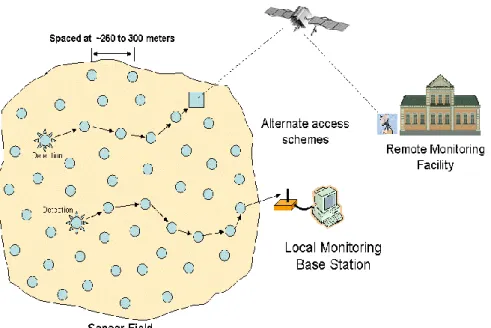
A Wireless Sensor Network (WSN) comprises of several low-power sensors, functioning in an environment which is sometimes unattended. These sensors are able to communicate both among each other and in a straight line to an external Base Station (BS). Sensor nodes are tiny and have limited processing and computing resources, and they frequently equipped with exceptional batteries that have a restricted power capacity. Thus, energy productivity is a very significant issue in scheming the topology. Figure 2-1 shows a wireless sensor network.
9
This chapter provides the background and some related research on challenges in wireless sensor network, such as routing, network lifetime, and the taxonomy of the energy hole problem, that defines the general framework of this research. It also reviews methods for determining the optimal corona size in corona-based WSNs. In addition, this chapter present a detailed evaluation of the existing methods used to reduce energy holes. Gaps in the existing methods are highlighted. The two methods to reduce energy holes that are most relevant to this research (i.e., transmission range control and non-uniform node deployment of nodes) are described in details.
2.2 Application in WSN
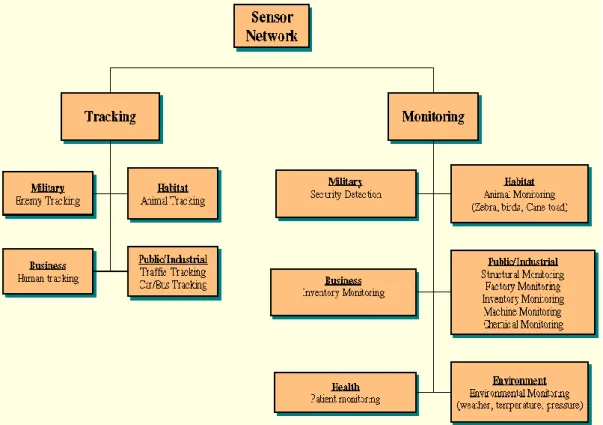
Figure 2-2 shows some kind of applications that in WSNs are designed for. The WSN can be used in tracking application such that animal tracking, object tracking, and traffic tracking, human tracking and so on. Also, WSN can be used in monitoring such as security detection, inventory monitoring, patient monitoring, environmental monitoring, industrial monitoring and so on (Holger Karl, 2005).
10
Figure 2-2 Some of common applications in wireless sensor networks
2.3 Characteristics Issues in Wireless Sensor Networks
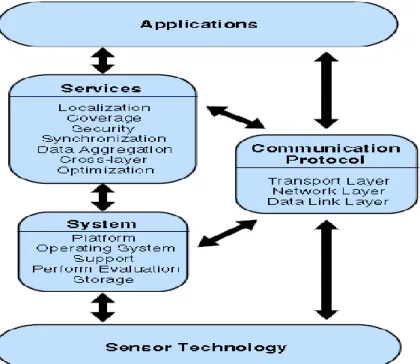
The applications might be generally categorized into three groups as indicated in Figure 2-3.
1. System.
2. Communication protocols. 3. Services
11
Figure 2-3 Classification of various issues in a WSN
Each sensor node is a separate system. To support various applications on a sensor system, it is required to improve new platforms, storage schemes and operating systems. Communication protocols are considered as the second group which make the communication between the application and sensors possible. The third group is the services which are established to improve the application and to enhance network efficiency and system performance (Yick et al., 2008).
It is noteworthy to mention that sensor nodes can self-organize themselves. Sensor nodes are capable of organizing themselves into a network and consequently can manage and control themselves effectively.
Since sensor nodes are restricted in power, storage, and processing capacity, new communication protocols and management services are required to overcome these limitations (Yick et al., 2008).
12
Five standard protocol layers exist in the communication protocol for packet switching namely, application layer, transport layer, network layer, data-link layer, and physical layer. Functions including coverage, localization storage, security, synchronization, compression and data aggregation are found as sensor network services (Yick et al., 2008). Implementation of protocols at various layers in the protocol stack might be considerably effective on end-to-end delay, energy consumption, and system efficiency. It is important to improve communication and reduce energy consumption. Traditional networking protocols are not effective in a WSN as they are not designed for such necessities. Therefore, several new energy-efficient protocols were proposed for the entire layers of the protocol stack. Cross-layer optimization is employed by these protocols to support communications among the protocol layers. More precisely, the information of protocol state at a specific layer is common across all the layers in order to meet the specific requirements of the wireless sensor network (Holger Karl, 2005).
Since sensor nodes function on restricted battery power, the usage of energy is a very significant concern in a WSN. There has been important research works that rotates around harvesting and reducing the energy. Once a sensor node is out of energy, it will expire and consequently disconnect from the network which may affect the performance of the application considerably. The lifetime of sensor network is based on the connectivity of the network and number of active nodes. Thus energy must be consumed efficiently so that it can make the best use of the network lifetime.
Energy harvesting includes nodes reloading its energy from a source of energy. Possible energy sources comprise solar cells (Raghunathan, Kansai, Hse, Friedman,
13
& Srivastava, 2005), acoustic noise, mobile supplier, and fuel cells (Rahimi, Shah, Sukhatme, & Heideman, 2003). Regarding the production of energy from the environment, the existing developed technique is solar cell which produces energy from light. In addition, the usage of a mobile energy supplier is also effective for instance a robot to reload energy. The robots would be liable in charging themselves by means of energy and then carrying energy to the nodes (Y. Chen & Zhao, 2005).
Energy maintenance in a WSN gets the most out of network lifetime. It is directed through effective intelligent sensor placement and consistent wireless communication to achieve sufficient coverage, efficient storage management, and security by data compression and aggregation.
The objective of the above approaches is to fulfil the energy limitation as well as providing quality of service (QoS) for the application. In order to have a reliable communication, services including congestion control, acknowledgements, active buffer monitoring and packet-loss recovery are required to support delivery of packet. Communication strength is based on the sensor nodes placement. Sparse sensor placement might cause higher energy usage and long-range transmission while placement of dense sensor might give rise to less energy consumption and short-range transmission. Coverage is associated with sensor placement. The number of sensors in the network as well as their placement specifies the amount of network coverage (Yick et al., 2008).
14 2.4 Network Topology
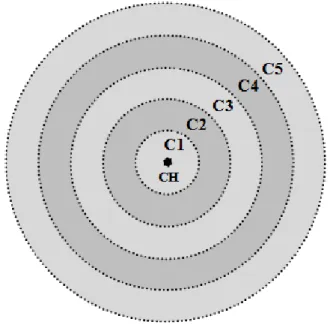
Wireless Sensor Networks (WSNs) consist of several sensors located within the field. WSNs are designed to sense a phenomenon, either uniformly throughout the whole field or at specific locations (as in target tracking applications) (Ilyas, Mahgoub, & Kelly, 2005). Sensor nodes relay sensed data to the sink or cluster head (CH) which does some further processing based on the application purpose. Consequently, the nodes located near the sink relay more data than those farther from the sink. This WSN architecture is called “many-to-one network”, and it can be analysed based on the corona-based model (see Figure 2-4) where the area is divided into rings (coronas) with respect to sink node location. In such systems, scenarios in whichthenodeslocatedwithinthenetwork’sinnercoronassimultaneouslyrunout of energy while those situated within the outermost coronas still have energy are common (Xiaobing et al., 2008).
15
Figure 2-4 A many-to-one network consisting of five coronas
2.5 Routing in Wireless Sensor Networks
One of the leading design objectives of WSNs is to implement data communication while attempting to extend the network lifetime. The following list includes some considerations that should be taken into account when designing routing protocols for WSN, which differs from traditional routing protocols (Datta & Gopinath, 2013).
1. There is not universal Addressing (the ID maintenance overhead is high). Therefore, traditional IP-based protocols might not be functional to WSNs. 2. Nearly all sensor networks applications need the transferring of sensed
data from several sources to a specific BS.
3. Sensor nodes are strongly limited in regards to processing, energy, and storage capacities. Therefore, they require cautious resources management. 4. For most of the WSN applications scenarios, sensor nodes are usually
16 immobile after placement.
5. Sensor networks are considered to be application-specific.
6. Collected data by several sensors in WSNs is normally dependent on common phenomena; as a result, it is highly probable that this data has particular redundancy (aggregation is significant).
7. The lifetime ofnetwork is a critical issue in WSNs routing design.
The routing protocols design in WSNs is affected by several challenging issues as follows:
2.5.1 Node Deployment
Node deployment in WSNs could be considered as application-dependent and might be either randomized or deterministic (manual). In manual node deployment, the sensors are located by hand and data is routed through predetermined paths. On the other hand, in random deployment, the sensor nodes are distributed accidentally, making an ad hoc routing arrangement. If the subsequent scattering of nodes is not constant, optimal clustering will be essential to cover connectivity and support operation of energy-efficient network. Inter sensor communication happens typically in the interior of short transmission ranges because of bandwidth and energy limitations. Thus, it is most probable that a route will comprise multiple wireless hops (Sengupta, Das, Nasir, & Panigrahi, 2013).
2.5.2 Energy Consumption
17
transmitting information and computations in a wireless environment. Each node, in a multi-hop WSN, plays a double role as data router and data sender. Therefore, forms of energy-conserving for computation and communication are crucial. Lifetime of sensor node indicates a strong reliance on lifetime of battery (Pantazis, Nikolidakis, & Vergados, 2013).
2.5.3 Node Heterogeneity
All sensor nodes,in many applications, were supposed to be homogeneous (V. Mhatre & C. Rosenberg, 2004). Nevertheless, a sensor node, based on the application, might have a different capability or role. The presence of a set of heterogeneous sensors gives rise to several technical issues associated with data routing. For instance, some applications might need a diverse combination of sensors for checking humidity of the surrounding environment temperature, pressure, and discovering motion through acoustic signatures, and taking video or image tracking of objects in motion (Noori & Ardakani, 2012).
2.5.4 Fault Tolerance
Several sensor nodes might be blocked or fail because of lack of power, physical damage, or lack of environmental interference. Sensor nodes failure should not cause an effect the general task undertaken by the WSN. If many sensor nodes fail, routing protocols and medium access control should be able to form paths for transferring collected data to Base Stations (BSs) (Geeta, Nalini, & Biradar, 2013).
18 2.5.5 Scalability
The number of nodes in a network, which are deployed in the sensing zone, might be hundreds or even thousands. Any routing scheme should be capable of coping with such large amount of sensor nodes. Furthermore, routing protocols of sensor network must be accessible enough to response to procedures in the environment. While waiting for an event to occur, most sensors might stay in the sleep state (Bechkit, Challal, Bouabdallah, & Tarokh, 2013).
2.5.6 Network Dynamics
In lots of WSN applications, sensor nodes are expected to be fixed. Nevertheless, in numerous applications both sensor nodes and the base station might be mobile. Thus, routing messages to (or from) mobile nodes in dynamic changeable topology is a major issue.
2.5.7 Connectivity
Sensor networks with high node density, nodes are precluded from being entirely remote from each other. Hence, sensors must be connected to each other. However, this might not stop the network topology from being adjustable and the size of the network from shrinking because of nodes failure. Furthermore, according to Shakkottai et al. (2003), connectivity is dependent on the possible random scattering of nodes.
19 2.5.8 Coverage
All nodesin a WSN take a particular view of the environment. This certain view of the sensor towards the environment is restricted in both accuracy and range. In other words, it can just cover a restricted range of the environment. Therefore, coverage is could be a crucial design factor in WSNs (Nayyar & Sharma, 2014).
2.5.9 Data Aggregation
As sensors might generate many redundant and duplicate data, analogous data from nodes could be aggregated to decrease the amount of sending packets. Data aggregation is considered to be the mixture of data from several nodes based on some particular aggregation function (Sinha & Lobiyal, 2013).
2.5.10 Quality of Service
For some kind of applications, data must be distributed within a definite period of time after sense data. Thus, restricted latency for data distribution is an additional condition in time-limited applications. On the other hand, in many applications, energy conservation, which is directly associated with lifetime of network, is regarded relatively more significant than the quality of data sent. Once energy is finished, the network might be in need of reducing the quality of results so that it can decrease energy consumption in the nodes and therefore increase the whole network lifetime. Therefore, routing protocols with energy-attentive are needed in order to take this requirement (Feng et al., 2013).
20 2.6 The Energy Hole Problem
In the multi-hop transmission (also called many-to-one) architecture, energy consumption of the nodes is imbalances among the sensors. The sensor nodes that are closer to the sink (or CH) dissipate more energy than those that are more distant. Thus, they die earlier and create energy holes, or hot spots (M. Perillo et al., 2005). Alternatively, if multi-hops are not used and all sensors transmit data directly to the sink, the nodes deployed farthest from the sink die much faster than those deployed closer to the sink due to long transmission distance. When energy holes occur, they partition the network into islands, which in turn considerably reduces the network lifetime, and thus, the network cannot perform the task completely. Therefore, methods to reduce the energy hole problem are needed (Watfa, Al-Hassanieh, & Salmen, 2013). Currently, several techniques used to overcome this problem using a mobile sink, transmission range control, and a non-uniform node deployment strategy.
Removing energy holes increases the network lifetime; which can be done using energy-efficient designs for the network layers. The following five layers constitute WSN protocols: physical, data link, network, transport, and application. Coverage, localization, synchronization, data aggregation, data compression, security and storage are important issue in designing these protocols. Designing and implementing efficient algorithms for these protocols could increase the total network lifetime. Increasing the lifetime of networks is one of the most critical challenges in designing a WSN. Network lifetime depends on many factors such as the energy model, protocols and architecture of the network, channel characteristics, data collection method, and how lifetime is defined (Chen & Zhao, 2005).
21
Figure 2-5 summarizes some of the methods used to reduce the energy holes problem. In corona-based WSNs, energy holes appear in the inner coronas (the close rings to sink). One technique for increasing the network lifetime is to reduce the occurrence (or limit the development) of energy holes. Most of these techniques can be modeled using a corona-based model, which is a static model. Dynamic methods, non-uniform node deployment, heterogeneous nodes, and transmission range control are techniques that can be modeled using the corona-based model. However, WSNs that use clustering methods usually cannot be analyzed using a corona-based model because in clustering techniques, CHs rotate among the sensor nodes dynamically.
Figure 2-5 Methods used to reduce the energy holes problem Avoiding the energy holes schemes Dynamic Methods Dynamic Election in Clustering Scheme Sink Mobility Non-Uniform Node Deployment Hetrogeneius Nodes Provisioning the Energy Relay Nodes Multi-Level Transmission Range
22
Energy hole problem can be mitigated by optimizing the parameters that contribute to the energy hole problem and affect the network lifetime. These parameters include the number of coronas, the width of each corona, the node distribution strategy, the node transmission range, and the network area. The following sections of this chapter review the techniques that can be used to reduce the energy hole problem.
2.7 Dynamic Methods
As Figure 2-5 shows there are two different kind of dynamic methods to reduce energy holes problems including dynamic election in clustering scheme and using sink mobility. Dynamic election scheme is used in the cluster network for balancing the energy while the mobile sink is usually used in the corona-based WSN (Zhu et al., 2014). These methods are described in the following subsections.
2.7.1 Dynamic Election in Clustering Scheme
One way to save energy and prolong the network lifetime is to use multi-hop transmissions to transmit data from the sensor nodes to the sink. For large-scale sensor networks, however, the clustering method is more appropriate (Bandyopadhyay & Coyle, 2004). In this method, each sensor node forwards data to its Cluster Head (CH); after aggregation, the CH sends data to the sink. Transmission from the sensors to the CH or from the CH to the sink can be done directly and multi-hop transmissions can be used as well. When choosing a method to transmit data, distance between the source and the destination or restrictions on range must be
23 considered (Abbasi & Younis, 2007).
There are several objectives for using clusters in WSNs, such as network connectivity, load balancing, and fault tolerance. When the clustering method is used, a CH is chosen from among the deployed sensors (Heinzelman et al., 2002; Lindsey, Raghavendra, & Sivalingam, 2002). To balance energy, the CH role can be rotated among the sensor nodes within the cluster (G. Gupta & Younis, 2003; Heinzelman et al., 2002). Thus, dynamic clustering methods can be used to address energy efficiency issues (Abbasi & Younis, 2007). In dynamic clustering, sensor nodes are able to organize themselves into local clusters in which a node plays the role of CH. Nodes that are not the CH sends data towards the CH. Nodes that are CHs receive the data from other cluster members and then transmit the data to the base station. Thus, nodes act as CHs consumes more energy than other nodes. After consuming all of its energy, the CH can no longer operate, which means that all of the surrounding nodes lose their communication capability. To overcome this problem, the positions of CHs with a high level of energy should be randomized in to avoid running out of energy.
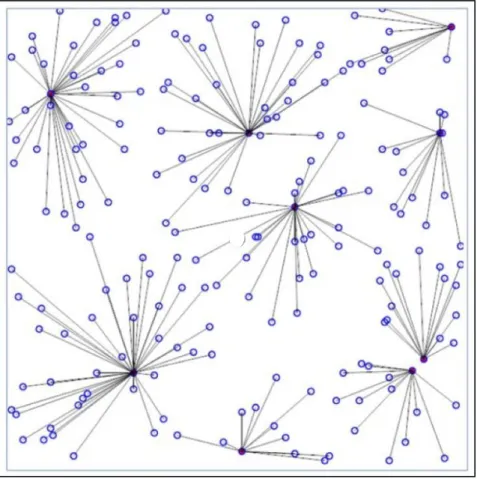
In the LEACH protocol (Heinzelman et al., 2002), once in a while nodes designated as CHs will become regular nodes and other nodes will become CHs in order to balance the depletion of energy (see Figure 2-6). This technique can increase the network lifetime, and it has been also used in scenarios where only one-hop communication exists from each head to sink within a small square area. In the HEED protocol (Younis & Fahmy, 2004), the multi-hop mode of transmission is used. To lower the communication cost in a rectangular network, the node degree and remaining energy factors were used to select the CHs. Bekara,
Laurent-24
Maknavicius, and Bekara (2007) proposed Secure Aggregation Protocol for Cluster-based wireless sensor network (SAPC). By utilizing SAPC, the head nodes are recognized as the aggregators and the other heads’ results will not be once more aggregated by those relay nodes that are close to base station. Energy-efficient and Secure Pattern-based Data Aggregation (ESPDA) (Akham et al., 2006) is another type of cluster-based protocol. It first employs a sleep-active coordination protocol to avoid redundancy in the process of data transmission during intra-cluster communication. It then applies pattern codes as an alternative to the sensed data for data aggregation.
Figure 2-6 Clustering with dynamic cluster head election (Heinzelman et al., 2002)