University of Bradford eThesis
This thesis is hosted in Bradford Scholars – The University of Bradford Open Access
repository. Visit the repository for full metadata or to contact the repository team
© University of Bradford. This work is licenced for reuse under a
Creative Commons
Licence
.
Design and Analysis of Energy-Efficient
Media Access Control Protocols in
Wireless Sensor Networks
Ibrahim A. M. Ammar
BSc, MSc
PhD
Design and Analysis of
Energy-Efficient Media Access Control
Protocols in Wireless Sensor Networks
Design and Analysis of MAC Layer
Protocols Using Low Duty Cycle
Technique to Improve Energy Efficient
and Enhance Communication
Performance in Wireless Sensor
Networks
Ibrahim Ammer Musbah Ammar
A thesis Submitted for the degree of Doctor of
Philosophy
School of Electrical Engineering and Computer
Science
ii
A
BSTRACTIBRAHIM A.AMMAR
DESIGN AND ANALYSIS OF ENERGY-EFFICIENT MEDIA ACCESS CONTROL
PROTOCOLS IN WIRELESS SENSOR NETWORKS
DESIGN AND ANALYSIS OF MACLAYER PROTOCOLS USING LOW DUTY CYCLE
TECHNIQUE TO IMPROVE ENERGY EFFICIENT AND ENHANCE COMMUNICATION
PERFORMANCE IN WIRELESS SENSOR NETWORKS
Keywords: Energy-efficiency, clustering, medium access control, synchronisation, schedules, sensor networks.
Wireless sensor network (WSN) technology has gained significant importance due to its potential support for a wide range of applications. Most of the WSN applications consist of a large numbers of distributed nodes that work together to achieve common objects. Running a large number of nodes requires an efficient mechanism to bring them all together in order to form a multi-hop wireless network that can accomplish some specific tasks. Even with recent developments made in WSN technology, numbers of important challenges still stand as vulnerabilities for WSNs, including energy waste sources, synchronisation leaks, low network capacity and self-configuration difficulties. However, energy efficiency remains the priority challenging problem due to the scarce energy resources available in sensor nodes. These concerns are managed by medium access control (MAC) layer protocols. MAC protocols designed specifically for WSN have an additional responsibility of managing radio activity to conserve energy in addition to the traditional functions.
iii
This thesis presents advanced research work carried out in the context of saving energy whilst achieving the desired network performance. Firstly the thesis contributes by proposing Overlapped Schedules for MAC layer, in which the schedules of the neighbour clusters are overlapped by introducing a small shift time between them, aiming to compensate the synchronisation errors. Secondly, this thesis proposed a modified architecture derived from S-MAC protocol which significantly supports higher traffic levels whilst achieving better energy efficiency. This is achieved by applying a parallel transmission concept on the communicating nodes. As a result, the overall efficiency of the channel contention mechanism increases and leads to higher throughput with lower energy consumption. Finally, this thesis proposed the use of the Adaptive scheme on Border Nodes to increase the power efficiency of the system under light traffic load conditions. The scheme focuses on saving energy by forcing the network border nodes to go off when not needed. These three contributions minimise the contention window period whilst maximising the capacity of the available channel, which as a result increase network performance in terms of energy efficiency, throughput and latency. The proposed system is shown to be backwards compatible and able to satisfy both traditional and advanced applications.
The new MAC protocol has been implemented and evaluated using NS-2 simulator, under different traffic loads and varying duty cycle values. Results have shown that the proposed solutions are able to
iv
significantly enhance the performance of WSNs by improving the energy
efficiency, increasing the system throughput and reducing the
v
A
CKNOWLEDGEMENTSI owe my gratitude to many people who have made my goals achievable. My deepest gratitude is to my supervisor, Professor. Irfan Awan, who I have been fortunate enough to have as my supervisor. Professor Awan has always supported my ideas, inspired me to tackle challenges and encouraged me to achieve my objectives. His patience and support have helped me to overcome many obstacles and problems during my study and have enabled this work to be completed.
Furthermore, I want to express my profound gratitude to my parents, wife and the rest of my family for supporting me constantly, in every situation, and at any expense. Special thanks always go to my mother and father for their endless love and support.
I would like to acknowledge the support from my friends and colleagues at the School of Electrical and Computer Science, University of Bradford. All of the staff have made me feel at home and have constantly helped me with technical difficulties and have enhanced my knowledge and communication skills.
vi Table of Content
ABSTRACT ... ii
ACKNOWLEDGEMENTS ... v
LIST OF AUTHOR’S PUBLICATIONS ... Error! Bookmark not defined. LIST OF FIGURES ... xi
LIST OF TABLES ... xv
LIST OF ABBREVIATIONS ...xvi
Chapter 1. ... 1
INTRODUCTION ... 1
1.1 Introduction ... 1
1.2 Motivation ... 4
1.3 Aims and Objective ... 6
1.4 Original Contributions ... 9
1.5 Thesis Organization ... 11
Chapter 2. ... 13
BACKGROUND AND LITERATURE REVIEW ... 13
2.1 Background ... 13
2.1.1 Ad-hoc Network ... 13
2.1.2 Wireless Sensor Networks WSN ... 14
2.1.2.1 Characteristics of Wireless Sensor Network ... 15
2.1.2.2 The Differences between WSNs and Ad-hoc Networks:... 16
2.1.2.3 Challenges of Quality of Service in WSNs: ... 17
2.1.2.4 Types of WSNs ... 18
vii
2.1.2.4.2 Time-Driven Sensor Networks. ... 18
2.1.2.4.3 Query-Driven Sensor Networks. ... 19
2.1.3 Medium Access Control (MAC) Layer ... 19
2.1.3.1 Functions of MAC Protocols... 20
2.1.3.2 MAC Layer in Wireless Sensor Network. ... 21
2.1.3.3 MAC Layer Protocols for Wireless Sensor Networks. ... 21
2.2 Related Work ... 24
2.2.1 WSNs MAC Protocols ... 24
2.2.2 S-MAC Protocol Case Study ... 30
2.2.3 S-MAC Protocol Delay Analysis ... 34
2.2.4 MAC Protocols for Ad-Hoc Networks ... 39
2.2.5 Multiple Concurrent Transmission ... 42
Chapter 3. ... 46 SIMULATION METHODOLOGY ... 46 3.1 Introduction ... 46 3.2 Computer Simulation... 47 3.2.1 NS-2 Simulator ... 48 3.2.1.1 Why NS-2 ... 49 3.2.1.2 Complexity of NS-2 ... 50
3.3 Software and Computer Resources ... 50
3.4 Simulation Setup ... 51
3.4.1 Simulated Network Topologies ... 52
3.4.2 Used Routing Protocol ... 55
3.4.3 Constant-Bit-Rate Traffic Service ... 56
3.4.4 Used Energy-Model ... 57
3.4.5 Node Radio Parameters ... 58
3.5 Identifying the Performance Metrics ... 58
3.5.1 Mean End-to-End Delay ... 59
3.5.2 Average Energy Consumption ... 59
3.5.3 Throughput ... 60
viii
3.5.5 Communication Overhead ... 62
Chapter 4. ... 63
OVERLAPPED SCHEDULES MACALGORITHM ... 63
4.1 Introduction ... 63
4.2 OLS-MAC Design ... 64
4.2.1 Algorithm Overview ... 64
4.2.2 Algorithm Assumptions... 66
4.2.3 Definitions and Notations ... 67
4.2.4 The OLS-MAC Core Components: ... 67
4.2.5 The OLS-MAC Architecture ... 69
4.3 Clustering and Schedules ... 71
4.3.1 OLS-MAC Clustering Shape ... 71
4.3.2 Cluster Membership ... 73
4.3.3 Schedules Updates ... 74
4.3.4 Duty Cycle Concept ... 75
4.3.5 Data Transmission ... 75
4.4 OLS-MAC Features ... 76
4.4.1 Scalability ... 76
4.4.2 Overlapped Schedules ... 78
4.4.3 Synchronisation Error ... 79
4.4.4 Handling Clock Drift ... 80
4.5 OLS-MAC Delay Analysis: ... 81
4.6 OLS-MAC Optimised Model Parameterisation ... 85
4.6.1 Cluster Radius ... 86
4.6.2 Schedules Overlap Ratio ... 87
4.6.2.1 Connectivity Failure ... 88
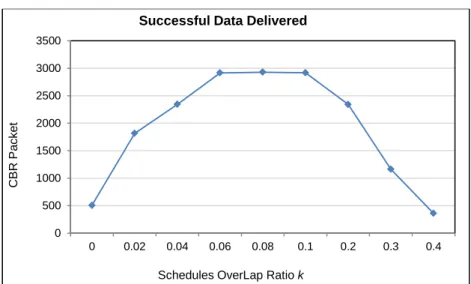
4.6.2.2 Successful Data Delivery ... 89
4.6.2.3 Energy Consumption ... 90
4.7 Simulation Numerical Experiments ... 91
4.8 OLS-MAC Performance Metrics ... 92
ix
4.8.2 System Throughput: ... 95
4.8.3 Packet Loss Rate ... 98
4.8.4 End-to-End Delay ... 101
4.8.5 Communication Overhead ... 103
Chapter 5. ... 106
PARALLEL TRANSMISSION FOR WSN ... 106
5.1 Introduction ... 106
5.1.1 Concurrent Communications and WSNs ... 107
5.2 Problem Statement ... 108
5.2.1 Transmission Scenario ... 109
5.2.2 Reception Scenario ... 110
5.3 System Model ... 111
5.4 Parallel Communication Concept ... 111
5.5 Why S-MAC Protocol ... 113
5.6 Parallel Communication Applied to S-MAC Protocol ... 115
5.6.1 Duty Cycle: ... 115
5.6.2 Data Period: ... 116
5.6.3 NAV Timers ... 119
5.7 PS-MAC Algorithm features ... 121
5.7.1 Sleeping Enhancement: ... 121
5.7.2 Parallelism the Border Nodes Transmission ... 122
5.8 Performance Evaluation ... 124
5.8.1 Simulation Scenario ... 124
5.8.2 Number of Flows ... 125
5.8.3 Varying Traffic Pattern ... 125
5.9 Performance Results and Discussion ... 126
5.9.1 System Throughput ... 126
5.9.2 Power Consumption ... 128
5.9.3 Packet Loss Ratio ... 131
x
Chapter 6. ... 134
ADAPTIVE BORDER NODES ALGORITHM ... 134
6.1 Introduction ... 134
6.2 Problem formulation ... 136
6.3 Birth of Border Nodes ... 136
6.4 Death of border nodes ... 138
6.5 Adaptive Border Nodes Algorithm (ABN) ... 139
6.5.1 Algorithm Overview ... 139
6.5.2 Algorithm Description ... 140
6.6 ABN Cycle Time Structure ... 143
6.7 Border Nodes Synchronisation ... 144
6.8 Analysing a Schedule Energy Consumption ... 145
6.9 Simulation Setup ... 146
6.10 Simulation Results ... 147
6.10.1Schedules Rate ... 147
6.10.2Other Performance Metrics ... 153
Chapter 7. ... 157
CONCLUSION AND FUTURE WORK ... 157
7.1 Conclusion ... 157
7.2 Futurework ... 161
xi
L
IST OFF
IGURESFigure 2-1: Ad-hoc network. ...13
Figure 2-2: Virtual Clustering Scheme for Wireless Sensor Network. ...32
Figure 2-3: S- MAC Duty Cycle Structure Details. ...33
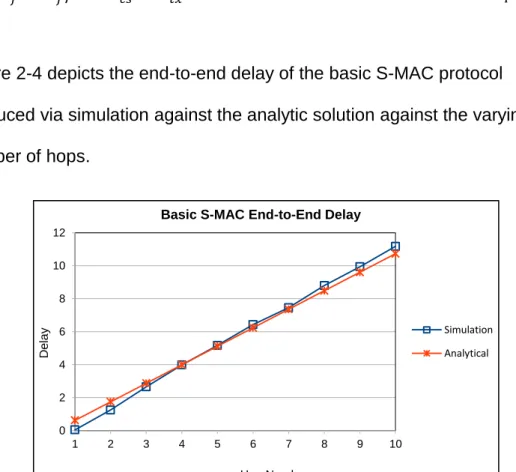
Figure 2-4: Basic S-MAC protocol End-to-End delay with respect to number of hops. ...36
Figure 2-5: The Adaptive S-MAC protocol End-to-End delay with respect to the number of hops. ...39
Figure 2-6: Hidden terminal problem: Node b is hidden from node a. ...40
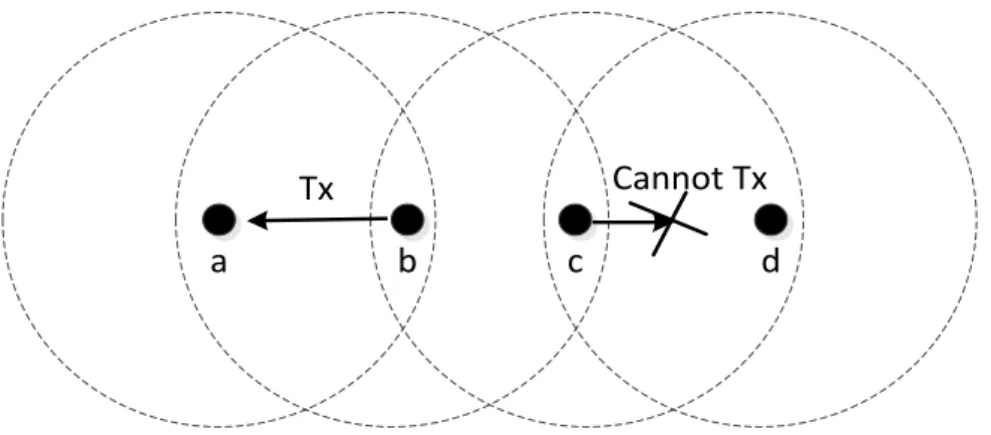
Figure 2-7: Exposed terminal problem. Node c is blocked unnecessarily by node a’s transmission. ...41
Figure 3-1: NS-2 Simulation architecture with proposed approaches added. ...48
Figure 3-2: Simplified User's View of NS-2 ...49
Figure 3-3: Link the NS-2 used scripts. ...51
Figure 3-4: m-hop tandem network with one source and one sink. ...53
Figure 3-5: Simulated grid topology in n x m dimensions with multiple sinks. ...54
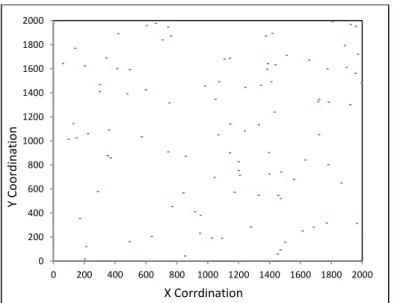
Figure 3-6: Random topology of 100 nodes deployed in 2000m x 2000m. ...55
Figure 4-1: Water-follow diagram for energy efficiency requirements. ...65
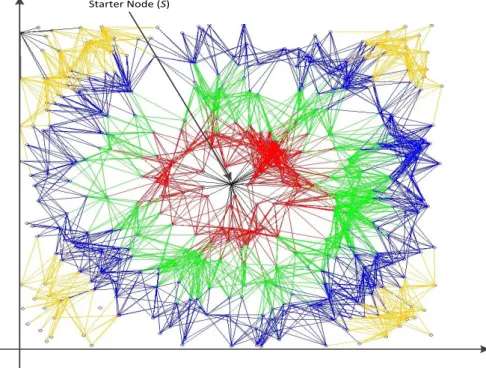
Figure 4-2: Creating the first cluster by starter node (S). ...70
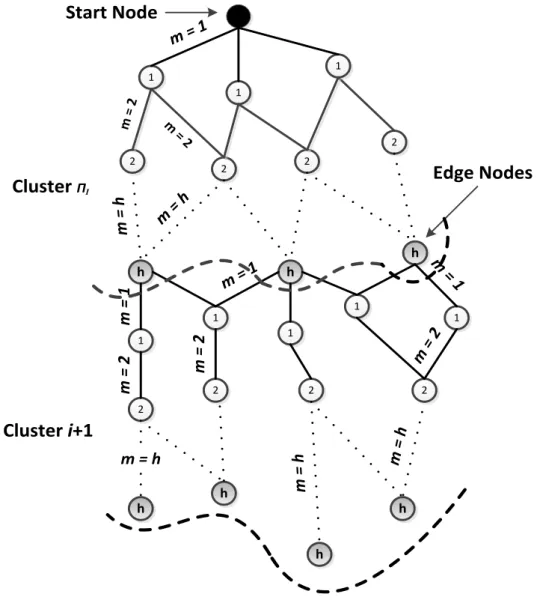
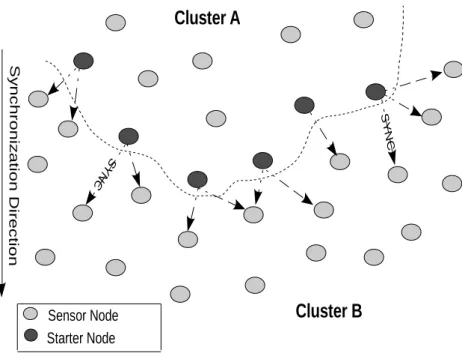
Figure 4-3: Clustering process in OLS-MAC algorithm, portioning the network into clusters based on the overlapping schedules. ...71
Figure 4-4: The OLS-MAC network shape with starter node (S) in the middle. ...72
Figure 4-5: OLS-MAC clustering shape with different starter node (S) allocation. ...73
Figure 4-6: Periodic listen/sleep Frame format. ...75
Figure 4-7: CSMA Channel Access Mechanism. ...76
Figure 4-8: Clustering through edge nodes makes the OLS-MAC algorithm more scalable to dens and distributed nodes in the deployment area...77
xii
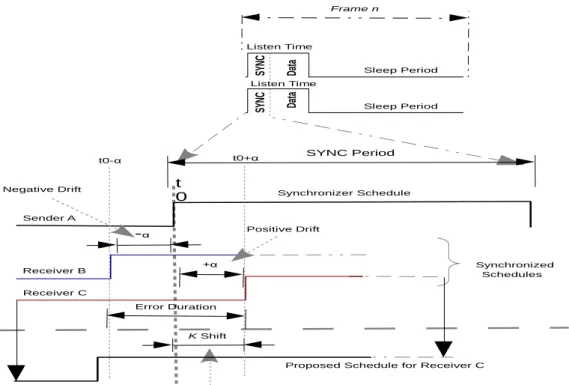
Figure 4-10: Illustrates the effects of the clock drift in both positive and negative directions
on schedules. Explain how k shift can compensate the clock drift. ...81
Figure 4-11: OLS-MAC algorithm End-to-End delay with respect to the number of hops. ...85
Figure 4-12: OLS-MAC algorithm end-to-end delay against varying number of hops. ...87
Figure 4-13: Number of sending attempt against schedules overlap ratio. ...89
Figure 4-14: The amount of Data delivered with repect to varying 𝒌 valus. ...90
Figure 4-15: Total energy consumption normalised to the amount of data delivered. ...91
Figure 4-16: Aggregate energy consumptions of the network V.S varied duty cycle. ...94
Figure 4-17: Aggregate energy consumptions of the network V.S inter-arrival time. ...95
Figure 4-18: Network overall throughput V.S. duty cycle. ...96
Figure 4-19: Network overall throughput V.S. offered load. ...96
Figure 4-20: End-to-end delay with respect to a varying number of hops at light traffic. ...98
Figure 4-21: Network packet loss ratio V.S. offered load ...99
Figure 4-22: DSR and NOAH protocols end-to-end delay comparsion. ...100
Figure 4-23: Average system delay V.S. duty cycle. ...101
Figure 4-24: Average system delay V.S. offered load. ...102
Figure 4-25: Impact of number of hops on the end-to-end delay...103
Figure 4-26: Total number of SYNC packet sent during the simulation time. ...104
Figure 5-1: Four nodes in the range of each other. ...108
Figure 5-2: A’s transmission to B blocks the surrounding nodes. ...109
Figure 5-3: A’s receptions from B block C reception. ...110
Figure 5-4: Nodes A and B can transmit Simultaneous to nodes B and D respectively. ...112
Figure 5-5: Nodes A and C can receive Simultaneous from B and D respectively. ...112
Figure 5-6: S-MAC sensor network before modifying the communication architecture...114
xiii
Figure 5-8: Procedures of scheduling two pairs communication agreement in the PS-MAC
algorithm during the listening period...118
Figure 5-9: Applying parallel transmission on border nodes. ...123
Figure 5-10: Total data delivered of symmetric topology V.S offered load. ...127
Figure 5-11: Average total gained throughput V.S arrival rate. ...128
Figure 5-12: Normalised total energy consumption to throughput for symmetric topology V.S offered load. ...129
Figure 5-13: Average energy consumption per successful data delivered with respect to the arrival rate. ...129
Figure 5-14: Average energy consumptions at all nodes in the network V.S arrival rate. ....131
Figure 5-15: Packet loss ratio against arrival rate. ...132
Figure 5-16: Average delay of successful delivered data V.S arrival rate. ...133
Figure 6-1: Primary and secondary listening period time line. ...138
Figure 6-2: Border nodes link different clusters. ...140
Figure 6-3: Adaptive secondary listen period for border nodes. ...142
Figure 6-4: Details SYNC and DATA periods. ...143
Figure 6-5: Hierarchy of resynchronisation periods for ABN algorithm...145
Figure 6-6: Detailed listen period structure. ...145
Figure 6-7: Average number of schedules adopted by nodes V.S transmission range. ...148
Figure 6-8: nodes with multiple schedules. ...149
Figure 6-9: Simulation of 25 nodes deployed in grid fashion. ...149
Figure 6-10: Average energy consumption for all nodes V.S offerd load. ...151
Figure 6-11: Energy consumption at different duty cycle values. ...151
Figure 6-12: the remaining energy for each node of the 25 nodes grid scenario. ...152
Figure 6-13: Average ABN-SMAC delay against offered load. ...153
Figure 6-14: Average ABN-SMAC delay against duty cycle. ...154
xiv
Figure 6-16: Average total throughput of ABN-SMAC V.S duty cycle. ...155 Figure 6-17: Packet loss ratio of ABN-SMAC V.S varied duty cycle. ...155 Figure 6-18: Packet loss ratio of ABN-SMAC V.S offered load. ...156
xv
L
IST OFT
ABLESTable 2-1: Performance ...29
Table 3-1: Radio power consumption for each radio mode. ...58
Table 4-1: Simulation parameters for 𝒉 & 𝒌 optimaisation. ...86
Table 4-2: OLS-MAC Simulation parameters. ...92
Table 5-1: Node possible states under PS-MAC algorithm. ...121
xvi
L
IST OFA
BBREVIATIONSABN-SMAC Adaptive Border Nodes for SMAC protocol
ACK Acknowledgment
AWK programming language used for data extraction
B-MAC Berkeley Medium Access Control
CBR Constant Bit Rate
CS Carrier Sense
CSMA Carrier Sense Multiple Access
CSMA/CA Carrier Sense Multiple Access with Collision Avoidance
Ctrl_Sync Synchronisation Control Packet
CTS Clear to Send
CTS_NAV Clear to Send Network Allocation Vector Timer
CW Contention Window
DATA Data Packet
DATA-CW Data Contention Window
DCF Distributed Coordination Function
DIFS Distributed Inter Frame Space
DSMAC Dynamic sensor Medium Access Control
DSR Dynamic Source Routing
Dur_Sync Duration for Sending Synchronisation packet
EMAC Routing-Enhanced Medium Access Control
IEEE802.11 the Institute of Electrical and Electronics Engineering
xvii
LPL Low power Listening
MAC Medium Access Control
MACA Multiple access collision avoidance
MACA-P Medium Access via Collision Avoidance with Enhanced
Parallelism
MACAW Medium Access with Collision Avoidance for Wireless
LAN Local Area Network
MANET mobile ad hoc network
NAV Network Allocation Vector Timer
NOAH No Ad-Hoc Routing
NS-2 Network Simulator 2
OLS-MAC Overlapped Schedule for Medium Access Control Layer
OTCL Object Oriented Extension of Tool Command Language
P-MAC Parallel Medium Access Control
QoS Quality of Service
RTS Request to Send
RTS_NAV Network Allocation Vector Timer for RTS packet
SIFS Short Inter Frame Space
S-MAC Sensor Medium Access Control Layer Protocol
SUA Schedule Unifying Algorithm
SYNC Synchronisation
SYNC-CW Contention Window for SYNC packet
xviii
SyncRTS Synchronisation Packet attached RTS Packet
TCL Tool Command Language
TDMA Time Division Multiple Access
TEEM Traffic aware Energy Efficient MAC
T-MAC Timeout Medium Access Control
UDP User Datagram protocol
1
Chapter 1.
I
NTRODUCTION1.1
Introduction
Wireless sensor network (WSN) technology has gained significant importance due to its potential support for a wide range of applications including military operations, industrial manufacturing, surveillance, targeting systems, health needs and monitoring disaster areas amongst many other applications [1 , 2]. Depending on the application services, WSN usually consists of large numbers of distributed nodes that work together to achieve some specific targets. Generally, a node is like a microelectronic device [3] composed of many modules with limited resources, in terms of embedded processor, sensing devices, memory, low-power radio and battery. Running a large number of nodes requires an efficient mechanism to bring them all together in order to form a multi-hop wireless network that can accomplish a common task. Typically, most of the WSNs are formed by random deployment of the sensor nodes without human intervention, where the battery might not be feasible to be replaced once it exhausts. Thus, this type of sensor networks is strongly dependent of the battery lifetime of the sensor nodes. WSNs are expected to last for long periods, typically years, without needing to replace batteries of the nodes. Therefore WSNs must be highly energy efficient in order to prolong the network life time. There are various
2
mechanisms designed specifically to consider the limited source attributes of WSNs [4 , 5 , 6 , 7 , 8 , 9 , 10 , 11 , 12 , 13 , 14 , 15 , 16 , 17 , 18 , 19 , 20 , 21 , 22 , 23 , 24 , 25 , 26 , 27 , 28 , 29 , 30 , 31 , 32 , 33]. Among them, the techniques that make nodes operate with extremely low duty cycles is considered an effective solution for when the traffic load is light [34]. Putting nodes into periodic listen/sleep can significantly reduce the power waste caused by idle listening, which is identified as one of the main sources for energy waste [24]. Power consumption during idle listening has been defined as having the same order as a receiving mode. In addition to idle listening there are a number of various issues which have been addressed as other sources for energy expenditure [24] including, collisions, processing overhead and overhearing.
These concerns and other operations like synchronisation and clustering in WSNs are handled by medium access control (MAC) layer protocols. MAC protocols are designed specifically for wireless sensor networks and have an additional responsibility of managing radio activity to conserve energy, whilst traditional MAC protocols mainly focus on balancing throughput, delay, and fairness maters [35]. Designing an energy efficient protocol relies on a duty cycle mechanism and requires precise synchronisation algorithm which can schedule a group of nodes to cooperate in communicating together in a scheduled manner (duty cycle). Forcing neighbour nodes to be active on an agreed specific time can make traffic travel more feasible even when nodes are operating with a low duty cycle.
3
The work of a MAC layer in WSN can generally be divided into two major categories, contention based MAC protocols (Carrier Sense Multiple Access CSMA) and time division multiple access (TDMA) MAC protocols [36]. The later approaches require a very tight synchronisation mechanism in order to assign time slots to each node. Furthermore, dividing the time into slots according to the number of nodes that are sharing the same medium is not practicable to large number of nodes.
All the proposed schemes in this thesis are built on the contention based style (CSMA). The architecture of the CSMA class is more appropriate for WSNs in terms of the concern of energy efficiency. Nodes can enter the sleep state in order to save energy and can only wake up when there is information ready to be sent. The virtual clustering scheme introduced by [4] is another feature that is supported by the contention based algorithms where nodes are grouped in a flat manner without coordination or control by any cluster heads. Nodes are communicating with each other in the form of peer-to-peer style within the cycle periods.
This thesis investigates into the energy efficiency issues in the context of power consumption being the primary concern along with the other network performance metrics including total throughput, communication delay, packet loss and communication processing overhead.
4
1.2
Motivation
Over the time, WSNs technology has expanded to serve more advanced applications which consequentially require reconfiguring the sensor networks design with the aim of increasing the network performance to satisfy new challenges posed by advanced applications. The rapid growth of WSNs technology contributes to a new class of applications which are enabled by large scale of networks [37]. Even with recent development in WSN technology, numbers of important challenges still stand as vulnerabilities for WSNs including energy waste sources, synchronisation leak and self-configuration difficulties. In this thesis, such issues are motivation for research in the context of saving energy whilst achieving the desired performance.
The research presented in this thesis is inspired by the following issues:
1) The lack of time accuracy can significantly reduce the network’s lifetime. The functionality of any protocol based on a clustering concept depends mainly on the accuracy of the clustering process, which is affected greatly by the synchronisation leaks. Several factors cause synchronisation errors, among them being the clock drift that accommodated over the time at each hop. A number of techniques [6 , 10 , 12 , 20 , 21 , 27 , 30 , 38 , 39] have been proposed for WSN synchronisation but do not focus on the precision of synchronisation period. This thesis aims to make
5
further advances by achieving more accuracy and precision in time synchronisation through controlling the network topology, self-configuration and estimating the clock errors between the nodes and correcting the nodes’ clock to the estimated value. The observation from the literatures shows that synchronisation and clustering can have a great influence on the network functionality, which in turn reflects on the overall network performance and in particular, energy efficiency.
2) Despite the fact that contention based MAC protocols are more appropriate for WSNs, it suffers from high contention in accessing the channel in a dense deployed area of networks, where many nearby nodes share a common final destination. In contention based protocols, the number of contending transmission attempts in the system will have a significant impact on the throughput capacity of the network. Since all the nodes of the same cluster are within the carrier sense range of each other, only one transmission process can proceed at a time under the CSMA/CA scheme adopted by the contention based algorithms. Some other features observed in contention-based communication styles which motivate concurrent transmissions are:
Short-range communications, which, among a large number ofnodes, encourage applying the concurrent transmissions concept in such a network with the aim of increasing the system throughput capacity and reduce the positional delay.
6
Due to the communications nature between nodes as peer-to-peermode in CSMA, the use of parallel transmissions will become more desired for many reasons, such as supporting multiple sources, destinations transmission and establishing different paths for routing.
3) The last fundamental factor that emerges as a challenge in research is related to those nodes which during the clustering process follow multiple schedules and become border nodes. Although these border nodes are exploited to be used as bridge between the adjacent clusters, it is not a desired feature because it means that they die faster than normal nodes and can cause holes in the network which can result in a desynchronised network.
1.3
Aims and Objective
The research efforts presented in this thesis concentrates on improving the system performance of WSNs to fulfil the requirements of the applications which expand every day. The purpose of the proposed and developed schemes in this thesis are to build a sensor networks that can take into account the synchronisation errors, self-configuration, system capacity and multiple schedules nodes during the design stage, in order to improve the network performance in terms of network functionality by means of energy efficiency, throughput capacity, system delay, cluster size and
7
network stability. The intermediate objectives of this thesis and the steps to achieve the research aims are outlined below:
1) Using the duty cycle concept where sensors alternate between sleeping and awaking periods in order to save energy over the idle listening time.
2) Since S-MAC protocol is designed for low traffic rates, it is expected that its throughput capacity can be enhanced through applying a parallel transmission mechanism. Combining parallel transmissions and S-MAC protocols can significantly improve the system performance, since nodes under S-MAC protocol are by default synchronised
3) Controlling the synchronisation time for each cluster in order to make clusters related instead can minimise the communication latency between the clusters. According to this assumption, nodes of adjacent clusters don’t need to wait for a long time to meet each other since their active periods are overlapped.
4) Introducing a small shift time between the schedules of the adjacent clusters can be used to avoid the possible synchronisation errors i.e. clock drift, which accumulated at each hop over the time.
5) The clustering mechanism used in this thesis is based on the virtual clustering concept that was introduced by [24]. The purpose behind this type of clustering is making the proposed algorithms scalable to a
8
large number of distrusted sensor nodes, where nodes can contact any node and join any cluster in its reception range.
6) Denying the excitement of the boundary nodes which expend relatively more energy due to adopting to multiple schedules can prolong the network life time. Two techniques are used to recompense the work of a border node: overlapped schedules and adaptive border node approaches. In the former technique, nodes are mostly overlapped and require border nodes. In the second approach, nodes that have adopted multiple schedules just follow the schedule needed to pass traffic and ignore the other schedules.
7) Controlling the cluster size through identifying the number of hops per cluster can achieve some degree of load balancing and correct the synchronisation errors accumulated over hops.
1.4
Scope of the Work
The clustering and communication mechanism used in the OLS-MAC scheme take in consideration the natural of the traffic direction in WSNs which is mostly toward the sink nodes, thus if traffic direction changed for any reason there will be more delay added which is caused from missing frames between clusters. Also, mobility has not assumed within this thesis, therefore the proposed schemes cannot cope with the issues accompany with nodes movements.
9
1.5
Original Contributions
In response to the motivations listed in Section 1.2, this thesis makes the following contributions.
Overlapped Schedules MAC: Designed and implemented a new MAC algorithm called OLS-MAC (Chapter 4) which prolongs WSNs lifetime and enhances its performance using a combination of techniques: 1) duty cycle. The basic idea is to make sensors alternate between sleeping and awaking periods. During the sleeping period, there is no energy consumption due to communication. 2) However, the OLS-MAC algorithm has to ensure the awaking period of sensors sufficiently overlaps in order to allow nodes to communicate with each other. The schedules of neighbouring clusters are not exactly the same but sufficiently overlap to allow communication between these clusters. 3) OLS-MAC divides sensor nodes into clusters. This construction is initiated by a starter node that can be the sink, for instance. All nodes in the same cluster follow the same schedule for the awaking period. Basically, OLS-MAC algorithm is designed with three main input parameters: the starter point, the number of hops per cluster and the overlap ratio between clusters. These parameters are used for achieving the desired clustering objective, including correlated clusters, controlled cluster sizes and overlapped cluster schedules.
10
Parallel S-MAC (PS-MAC): The challenges in achieving both low duty cycling and high throughput inspired the proposed design of an energy efficient MAC layer protocol called PS-MAC (Chapter 5). PS-MAC enhanced the sensor network through applying parallel transmission mechanisms on the communicating neighbour nodes. PS-MAC implements parallelism on S-MAC nodes by enhancing the communication architecture of CSMA used in S-MAC protocol in two scenarios. In the first assumption, PS-MAC suggests that neighbouring nodes are able to transmit to other nodes even though they are in the transmission range of each other, providing that their destinations are not in the same transmission range. Secondly, PS-MAC assumes that nodes can receive from other nodes, even though they are in the transmission range of each other, as long as their sources are not in the same transmission range. Most of the applications that WSNs are proposed to serve require deploying a large number of nodes. Thus, total network throughput has significantly improved by applying multiple concurrent transmission schemes.
Adaptive Border Nodes for S-MAC Protocol (ABN-SMAC): the leak in the border nodes design results in a dysfunctional network at very early stage. ABN-MAC algorithm extends the life time of the border nodes of the S-MAC network without affecting the achieved S-S-MAC protocol performance. Border nodes consume more power compared to the normal nodes due to adopting multiple schedules. Since border nodes’ functions cannot be
11
ignored in a large distributed system, ABN-SMAC forces nodes with multiple schedules to be adaptive to the traffic contention in the area of these nodes. Border nodes that have no data to pass from a cluster to another don’t need to wake up during all of its adopted schedules, instead each node chooses a schedule and sets it as its primary schedule while considering the other schedules as secondary schedules and follows them only when there is traffic and they need to travel through these schedules.
1.6
Thesis Organization
This thesis is organized in 7 chapters as below:
Chapter 2 includes the background necessary for generalunderstanding in the area of Ad-hoc networking and advanced understanding in WSNs and its MAC sub-layer protocols. The is followed by a detailed survey of the related work in the area of Ad-hoc and WSN MAC layer protocols.
Chapter 3 describes the simulation methodology used to design, implement and test the mechanisms proposed in this thesis.
Chapter 4 presents the algorithm designed for the MAC layer called Overlapped Schedules MAC (OLS-MAC), describing the main three input parameters used with OLS-MAC including the synchronisation start point, the clusters’ radii and the schedules’ overlap ratio. Experimental results have demonstrated significant performance gains in both energy efficiency and system throughput. Additionally, this12
chapter shows how the different values of the input parameters should be selected to achieve the desired results.
Chapter 5 depicts the design of the parallel transmission approach for MAC layer protocol (PT-MAC) in detail. The necessary modifications on the CSMA scheme to support parallel transmission concepts have been included in this chapter followed by results analysis and discussion.
Chapter 6 discusses the implementation details and results for the adaptive border nodes algorithm (ABN) designed particularly for the virtual clustering schemes. Furthermore, the explanation of the mechanism used by the border nodes for when and when not to follow the secondary schedule is also covered in this chapter.
Chapter 7 summarises the results provided herein and proposes potential ideas for future research in the context of energy efficiency, along with a conclusion of the thesis work.13
Chapter 2.
BACKGROUND AND LITERATURE REVIEW
2.1
Background
2.1.1
Ad-hoc Network
An ad hoc network is a group of wireless nodes that create a multi-hop network without the use of any network infrastructure or centralised administration.
Figure
2-1: Ad-hoc network.Figure 2-1 shows an example of this type of computer networks [40], in which devices communicate in peer-to-peer style. Every node acts as a router for the on-going traffic between the nodes. In fact, each individual
14
node forwards packets to and from each other. Therefore, nodes are free to move in a random way and organize themselves arbitrarily. The network topology may change rapidly and unpredictably.
2.1.2
Wireless Sensor Networks WSN
Wireless sensor network (WSN) is a branch of Ad-hoc networks which contains on a large numbers of distributed nodes that are able to configure themselves in the form of a multi-hop wireless network. The size of WSNs varies according to its application requirements. All nodes within a WSN corporate with each other to collect and pass the data to a common destination (sink node or a base station).
Essentially, nodes in WSN are classified mainly into normal sensor nodes (sources or intermediate nodes) and sink or base station nodes (nodes with high specifications). Both types of nodes represent the network architectures [41].
The sensor nodes perform different jobs including event sensing, collecting, forwarding and data processing. Thus sensor nodes typically compose of a power unit, a processing unit, a sensing unit, and a communication unit. The processing unit is responsible for collecting and processing signals captured from sensor nodes and transmit them through the network towards the base station [1]. The sensing unit is responsible for producing a measurable response to a change in a physical condition, such
15
as temperature or pressure. The wireless communication unit provides a medium to transfer the sensed data from the observer sensor nodes to the network sinks. Usually sensor nodes are tiny devices and can be as small as coins.
WSNs have great potential for many different applications [1 , 2 , 42 , 43], for instance military operations, monitoring, tracking, measuring temperature, speed, industry applications, home applications and health applications. The WSNs applications can be used for classifying the types of WSNs. Before looking into WSNs types, the following section explains the characteristics of WSNs and its differences compared to Ad-hoc networks.
2.1.2.1 Characteristics of Wireless Sensor Network
WSNs are different to the conventional networks in various respects and have their own characteristics [2 , 41]. These characteristics, in fact, are emerging as challenges needing to be taken in consideration when designing a WSN:
Nodes are densely deployed.
Sensor network topology changes very frequently.
Sensor nodes are limited in power, computation, capacity and memory.
Sensor nodes may not have global identification.16
Data redundancy.
Different types of traffic.These characteristics have been studied thoroughly in order to improve the WSNs performance. The main concern of WSNs is the limitation of the energy which is the most distinct factor in WSNs due to the power source being scarce. The above characteristics are analysed with respect to energy efficiency as the primary concern whilst the other parameters such as throughput, delay, utilisation etc. are considered as secondary objectives to WSNs.
2.1.2.2 The Differences between WSNs and Ad-hoc Networks:
WSNs are in many aspects quite similar to Ad-Hoc Networks [44 , 45 , 46], however, they possess certain distinct characteristics as summarised below:
Number of nodes in WSN is higher than Ad Hoc network.
WSN nodes are densely deployed in most of its applications.
Wireless sensor nodes are prone to failure compared to other networks due to the type of application they serve.
WSNs topology changes frequently due to the joining/leaving of nodes.
Broadcast communication paradigm.
Sensor nodes are usually limited in their power, processing and memory capabilities.
17
WSN Possibly suffers from the absence of unique global identification per node.
2.1.2.3 Challenges of Quality of Service in WSNs:
The most important design criterion for any type of network is to guarantee a minimum level of quality of service, [43 , 44 , 47 , 48]. Many concerns of resources affecting the QoS provisioning in WSNs include:
Resource Constraints: energy, bandwidth, memory, buffer size, processing capability and transmission power.
Unbalanced Traffic: nodes close to the BS have more traffic than the other nodes, QoS metrics should be defined for unbalanced traffic.
Data Redundancy: data sensed by sensor nodes is expected to be correlated. Data aggregation mechanisms decreased the data redundancy but also introduced the latency which complicates the QoS issue in WSN. Also, the same region nodes are expected to collect the same data.
Network Dynamics: QoS mechanisms should be capable enough to handle such changes in the network topology.
Energy Balance: energy load distributed among the nodes to prolong network lifetime is another QoS metric.
Scalability: the used QoS metrics should be able to scale up to a large number of sensor nodes.
18 2.1.2.4 Types of WSNs
The method followed for event reporting in WSNs is connected to the application desired from the sensor network. Thus some of the categorisation policies used for classifying the WSNs into different types include the network application and the type of data inquiry [45]. This section attempts to identify the major WSNs types according to their event packets generation:
2.1.2.4.1 Event-Driven Sensor Networks.
In the event-driven sensor networks type [2 , 49], nodes report data to the observer only when a certain event occurs. This kind of sensor network is widely used in monitoring applications, for example, in fire-monitoring networks; nodes are alerted to a central station as soon as the temperature rises to a certain threshold. This type of sensor networks is an attractive option for a large class of applications due to its ability in saving energy, since message transmissions are happening less frequently (until a certain event occurs). In this type of sensor networks, nodes can go to sleep and wakeup to send data to the sink whenever a random event occurs.
2.1.2.4.2 Time-Driven Sensor Networks.
Time-driven sensor networks, also known as continuous monitoring sensor network [2 , 49], are suitable for applications that require sensor nodes to sense and report their observations periodically to the sink.
19
Packets in this network are sampled and transmitted continuously at regular time intervals. Thus, sensor nodes can periodically switch their radio on to transmit the data of interest at constant periodic time intervals. In this case, periodic property is the main reason behind Scheduling-based MAC schemes, which are naturally energy efficient. The main objective of scheduling-based protocols is to reduce energy waste caused by idle listening.
2.1.2.4.3 Query-Driven Sensor Networks.
In this type of WSNs, the sink nodes broadcast a query for gathering data from certain nodes or a certain region. The nodes that received the query, reply with the required data by broadcasting it to the neighbours. The queries are generated by the sink node on demand and are sent to sensor nodes inquiring the occurrence of certain events [50]. The query-driven type is quite similar to the event-driven type, aside from the fact that data in the former type is pulled by the sink while in the later type data is pushed to the sink [51]. Because queries are sent on demand, this type of WSNs (query-driven) is naturally energy efficient.
2.1.3
Medium Access Control (MAC) Layer
The medium access control (MAC) layer is a sub-layer in the data link layer and works with the physical layer to provide fair communication medium access. This layer has to manage the communication channels
20
available for the contending nodes. The MAC layer adopts the necessary procedures to organize data transfer between two or more nodes from the network. Part of the responsibility of the MAC layer is performing error correction that may occur in the physical layer [48].
Activities that the MAC layer performs include framing, physical addressing, flow and error controls, and resolving conflicts among different nodes for channel access [52]. Another role that the MAC layer may play is affecting how reliably and efficiently data can be transmitted between nodes along the routing path. Because of these roles the MAC layer clearly affects the quality of service of the overall network performance. Thus, MAC protocols should be capable of addressing MAC layer issues in order to provide a high quality of service [46]. The functions that should be addressed by MAC layer are as follows [52];
2.1.3.1 Functions of MAC Protocols.
Framing: Assembling data into frames for transmission by appending a header field containing addressing information, and the disassembling of a received frame in order to extract addressing.
Medium Access: Controlling which devices participate in communication at given times to prevent collision.
Reliability: Ensuring successful transmission between devices and allowing retransmissions when necessary.
21
Error Control: Controlling the amount of errors present in frames delivered to upper layers by using certain methods for error detection or correction.
2.1.3.2 MAC Layer in Wireless Sensor Network.
Media Access Control in WSN works to enable the successful operation of the network and provide the best performance at the lowest rate of energy consumption. This is particularly important due to the fact that nodes in WSN are battery powered and are assumed to be unattended due to their deployment in remote areas. Generally it is impractical to replace the exhausted battery, therefore one of the fundamental tasks of the MAC layer in sensor networks is to provide significant energy saving opportunities to extend the sensor network lifetime [52]. For instance the MAC layer has the role of clustering and synchronising the sensor network. In WSN, the MAC layer considers the energy efficiency as the primary objective, whilst leaving the other performance metrics as secondary objectives.
2.1.3.3 MAC Layer Protocols for Wireless Sensor Networks.
In general, the proposed MAC protocols for Ad Hoc wireless networks do not work efficiently with sensor networks due to a number of reasons such as the limitation of resources being available a sensor node, the multi-hop operations of a sensor network, and the different application specific requirements. In order to prolong the network lifetime, the energy
22
consumption among sensor nodes should be reduced to an acceptable level without degrading the network performance. Because of these new requirements, a new generation of MAC layer protocols have recently been developed for wireless sensor networks [41]. Researchers from both hardware and software perspectives show that most of the energy portion is consumed primarily at communication unit (transmissions, receiving, listening) [24]. To achieve the required energy efficiency, nodes have to be scheduled to set their transceivers to an active state when needed and turn them off when they are in the idle mode. The most common approach used for this purpose is setting the sensor node hardware in switching between high (active) and low (sleep) power states. Putting the node radio to sleep mode when it is not needed can dramatically increase a sensor node’s lifetime. This is particularly true when the idle mode consumption rate has the same order of magnitude as the receiving rate [24].
Over the years, the MAC protocols for WSNs that have been proposed can be roughly divided into two types: contention based and contention free protocols. In the contention-free protocols, time slots are pre-allocated on the basis of time, code or frequency to individual nodes. In actual fact, the energy conservation in this type of sensor protocols is achieved naturally because they are collision free. But at the same contention free protocols suffer from such time slots being wasted due to the need for coordinating the medium access between the nodes regularly. The second type is contention-based protocols in which nodes share a common
23
channel for communicating to each other. Protocols that share the same channel face high collision rate and the nodes are more likely to be idle listening.
In both types contention based and contention free schemes reducing the energy consumption is the primary concern whiles the other metrics such as throughput, delay and packet loss are left as secondary objectives. We are interested in the second class type (contention-based scheme) as our developed algorithms are based on this.
In the literature, there are different ideas that have been applied to WSNs aimed around energy efficiency purposes. The most common approach used for energy efficiency is the concept of duty cycling (putting nodes into listen/sleep states). Duty cycle techniques are used to avoid idle listening problems which are defined by [24] as the dominating power waste part in the sensor nodes. The main sources of energy waste that have been addressed by the S-MAC protocol authors [24] are:
Collision: when packets are corrupted due to interference.
Overhearing: when a node picks up packets that are destined to other nodes.
Idle listening: when nodes are listening to receive possible traffic that has not been sent yet.
Overhead: Refers to sending and receiving packets that are considered to be useless data.
24
These issues emerge as designing challenges for developing MAC protocols for wireless sensor network.
2.2
Related Work
2.2.1
WSNs MAC Protocols
There has been a wide variety of research on the design and implementation of MAC protocols that are explicitly proposed for serving WSNs applications. Prolonging the network lifetime to a great extent is a common objective of these protocols, since sensor nodes are usually limited in power supply. WSN protocols can be classified into contention-based and contention-free schemes [9] according to the underplaying mechanism used for regulating medium access. Existing contention-based protocols are categorized into synchronized and asynchronised approaches. Both approaches work on the basis of the duty cycle mechanism in which each node puts its radio to active and sleep states periodically.
Asynchronous schemes such as B-MAC [53], WiseMAC [54], and X-MAC [33] rely on low power listening (LPL). LPL is a technique in which nodes periodically check the wireless channel for possible incoming packets. If there is no message, the node switches off its radio until the next checking time, otherwise, a message is received [9]. When a sensor node has packets to send, the node will hold the data packets until the receiver enters the active mode.
25
Nodes under the synchronised scheme specify and coordinate their schedules (listen/sleep periods) by periodically exchanging SYNC packets for synchronisation, and communicate in the agreed common active periods. The well-known proposed protocol that belongs to the synchronised-based class is Sensor-MAC (S-MAC) which was developed by Ye et al [24]. The S-MAC protocol authors use the contention-based approach to avoid idle listening by adopting the periodic listen and sleep concept. S-MAC studies the characteristics of Ad-hoc wireless sensor networks in terms of energy efficiency and also identify the main sources of energy wastage, Collision, idle listening, overhearing and control packet overhead. The S-MAC protocol introduces a new concept for clustering in which no cluster head is used for coordinating or managing the clusters nodes.
A detailed overview of the S-MAC protocol is given in section 2.2.2.
This section reviews the works that are closely related to the S-MAC protocol. It mainly focuses on the schemes that adopt the virtual clustering concept, contention-based access mechanisms and the duty cycle technique.
In literature, there is extensive research which has been carried out on duty-cycled MAC protocols [4 , 5 , 11 , 19 , 31 , 55 , 56 , 57 , 58 , 59 , 60], for example [5], [57] and [31] try to improve the system performance through analysis and the development of mechanisms for controlling the duty
26
cycle to adapt to an estimated value. Other works concentrate on converting the network schedules of different clusters to a single schedule [16 , 23 , 29 , 60]. The aim behind merging the network clusters to a single cluster is to eliminate the border nodes which are produced by virtual clustering (nodes that follow two or more schedules to work as a bridge between clusters).
There are a number of schemes that have improved based on the main features of the S-MAC protocol, for instance virtual clustering and duty cycles which are described as follows:
Dam et al. [5] developed T-MAC, a contention-based Medium Access Control protocol for wireless sensor Networks based on improving the Duty Cycle of S-MAC. T-MAC introduced an adaptive duty cycle instead of having a fixed duty cycle as in S-MAC by letting the listen interval time end when there is no event with a predefined threshold time. Because of this, T-MAC achieves a better throughput than S-MAC when the traffic is varied. T-MAC reduces idle listening by transmitting all of its messages in bursts of variable length, and sleeping between each of the bursts. However, this sleeping introduces what is called an early sleep problem which can cause schedules to be missed.
In [57] authors propose a MAC protocol with a dynamic duty cycle called DSMAC. The significant idea of this protocol is to improve the duty cycle of S-MAC by adopting variable sleep intervals while the listening period is kept constant, aiming to improve the latency according to the traffic changes.
27
Additional information is added to the SYNC messages to reveal the new duty cycle of a node. At the start time, all nodes have the same duty cycle, then the duty cycle of a receiver node that has noticed its average latency increasing shortens its sleep interval by half (doubling the duty cycle value), while the listening period remains constant. In turn, the sender node which has received the new sleep announcement checks if its power level is above a certain threshold value and still has data destined to the receiver, the sender also doubles its duty cycle to match with the receiver duty cycle.
TEEM [31] is also based on the periodic listen/sleep technique as used in the S-MAC protocol in order to save energy. TEEM does not adopt fixed duty cycles, instead it makes the duty cycle adaptive according to the traffic information. In TEEM, the listen period is designed to consist of Syncdata
and Syncnodata. The first part of the listen period is proposed to handle data
while the other part has no data. However, both parts are used for synchronisation. Each node listens in the first Syncdata part of its listen
period whether someone has data to transfer or not. If there is no data in the
Syncdata part, it will send its own SYNC packet in the Syncnodata part. The
TEEM protocol combines the SYNC and RTS packets into one packet called
SyncRTS to reduce control packet overhead. Whenever a node wants to
communicate with another node, it sends out the SyncRTS packet in its
Syncdata part. Only the destination node that is addressed in the SyncRTS
packet starts communicating with the source, while the other nodes synchronise themselves with the SyncRTS packet and enter sleep mode.
28
Nodes in TEEM sleep more than that in S-MAC and T-MAC protocols, thus the TEEM protocol saves more energy but suffers higher delay.
One of the main features of the S-MAC protocol is, what are known as, the border nodes. These nodes are adopted to multiple sleep schedules and have to stay awake longer in order to relay packets between the clusters of different sleep schedules. Because of this, border nodes die earlier compared to normal nodes. This can cause network holes, which result in a disconnected network. There is a lot of work [16 , 23 , 25 , 60 , 61] focusing on converting the network of multiple clusters into a single cluster with the aim of eliminating the border nodes in order to increase the life span of a wireless sensor network.
The authors in [16] made the nodes of isolated virtual clusters follow one schedule to form a single cluster by letting the nodes adopt the most common schedule among the merged clusters, for instance the schedule that has the highest number of neighbours. The merging process is started when the connectivity is established between two or more isolated virtual clusters. By the end of the merging process, all the nodes are supposed to share exactly the same number active periods (same schedule). The assumption of this algorithm is not realistic due to the synchronisation errors associated with large clusters. Also, as the cluster sizes increase, the probability of collisions between nodes increases, where all nodes share the active time. Finally, the functionality of the network will pause during the merging time.
29
Other algorithm that are also based on enhancing the S-MAC protocol to a global schedule is given in [60]. Authors propose the Schedule Unifying Algorithm (SUA) to improve the S-MAC protocol by excluding the border nodes for the entire network in order to extend the overall network lifetime. SUA starts by defining the border nodes, then chooses the schedule with the highest synchroniser ID in the schedule table as the target schedule and allows the nodes which follow schedules other than the target schedule to convert to the target schedule. The membership of a border node that moves to another virtual cluster may change due to the merging process. Therefore, SUA suggests that, before moving to the target schedule, the border nodes should send the information of the target schedule and inform the target neighbours about the adoption of the target schedule by the current border node. The process of adopting the target schedule is repeated for all border nodes. Once all the border nodes convert to a single schedule, the entire network will follow the same schedule creating a global unified algorithm.
The table Table 2-1 below gives comparison of the related work in terms of Latency, Energy Efficiency and total communication overhead.
Table
2-1: Performance comparsion of related MAC protocols.Protocol Latency Energy Efficiency Com. Overhead
S-MAC High Low High
T-MAC Moderate Moderate High
30
TEEM Low High Moderate
Global S-MAC Moderate High High
SUA Moderate Moderate High
2.2.2
S-MAC Protocol Worked Example
The architecture of S-MAC protocol is built on three main components including virtual clustering, periodic listen/sleep (duty cycle), and data communication. The description of each of them is detailed hereafter.
I. Virtual Clustering Process: The S-MAC protocol assumes that at the network initialization stage, each node first listens for broadcasted SYNC messages from neighbours for a limited time, called the synchronisation period. During this time, if a node receives a schedule (SYNC massage from a neighbour), it will configure its schedule time according to the received one, and then start broadcasting this schedule as its own schedule to its neighbours. On the other hand, if a node does not receive a scheduled message from its neighbours during the synchronisation period, it creates a schedule for itself arbitrarily, and announces it by broadcasting it as a SYNC message to its neighbours. If the node created its own schedule and announces this schedule, it later receives a schedule message from any of its neighbours; in this case there are two approaches for this node to take:
31
a) The node will check its neighbours availability - if no other neighbour is available, it adopts the new schedule and starts following it after it discards its current schedule. This will lead the node to join the existing schedule instead of creating a new one.
b) If the node has one or more neighbours available. It has to follow both its own and the neighbour schedules by waking up at the active time for both schedules. Since these nodes wake up more frequently, they consume more energy due to the fact that they are used as a bridge for the communications between clusters. Nodes that follow multiple schedules are called border nodes because they are located in the borders between clusters.
The overall shape of the whole network after completing the virtual clustering process is depicted in Figure 2-2.
II. Periodic Cycling: Idle listening time is defined as the most power
consuming source in ad hoc sensor networks as addressed by [24]. The S-MAC protocol puts nodes into periodic listen and sleep states to avoid idle listening. The basic concept of this scheme is to let nodes go to sleep the majority of the time and wake up at certain times for short periods to sense and report events that could happen.
32 Cluster 1 Cluster 5 Cluster 6 Cluster 4 Cluster 2 Cluster 3
- Nodes have same schedule form an cluster, so they will wake up and sleep together
- Each cluster has its own schedule Border nodes
(sharing multiple schedules)
Wireless Sensor Network Portioned to Six Clusters
By S-MAC Protocol
Wireless Sensor Node
Figure
2-2: Virtual Clustering Scheme for Wireless Sensor Network.In S-MAC, a frame is represented as a complete cycle time of listen and sleep intervals as described in detail in Figure 2-3. The listen interval is divided into two parts. The first one is proposed for broadcasting and receiving the SYNC packets, which is used for carrying the schedule to neighbours to keep them synchronised. The SYNC period is a short time interval designed to handle one SYNC packet. SYNC packets are broadcasted without any agreement between nodes using RTS and CTS handshaking mechanism. The second part used for data communications. This part is further divided into sub-parts, the first one for sending the RTS
33
packet and the second sub-part is for receiving the CTS packet. S-MAC assumes data transmissions start after a successful exchange of RTS and CTS messages. Data transmission extends to the sleeping duration as well, if required.
Active Period
Sleep Period In this period all nodes of the same cluster
are ON and start establishing communication if necessary
SYNC
Exchange RTS & CTS
Starting DATA Transmission
Only nodes have to send or receive data remain active during this period
Cycle Time Duty Cycle
Listen Listen
Listen Sleep Sleep Sleep
Time
Figure
2-3: S- MAC Duty Cycle Structure Details.III. Data Communication Phase: The S-MAC protocol inherits the
majority of the functions of IEEE 82.11 DCF [62]. In addition to this, there are some modifications that have been made by S-MAC to the communication part, for instance solving the overhearing problem. Simply by letting nodes that overhear RTS or CTS packets which is not the designated to go to sleep for the time needed for data and ACK packets duration which included in the duration filed of RTS/CTS packets. S-MAC also reduces the communication overhead by transmitting the data as bursts, where messages are divided into fragments, and sending them using only one RTS and CTS reserve as the medium for all of the fragments. For collision avoidance, S-MAC is
34
similar to IEEE802.11; it uses both physical and virtual carrier sensing.
2.2.3
S-MAC Protocol Delay Analysis
There are several delay components in the WSN model. The most commonly used components are: Transmission delay, which is a function of the packet’s length over the transmission rate; queuing delay, which can be defined as the time that each job spends in the queue waiting to be processed; propagation delay is determined by the distance between the source and destination nodes; back-off delays are caused by collision or another transmission that has taken place; processing delay is the time needed by the node for processing before it is sent again; carrier sense delay is the time consumed by the virtual and physical carrier sense; In addition, there is sleep delay which is caused by the sleeping of the receiver, so the sender waits until the wake up of the receiver.
In [24] there are several assumptions that have been made to make the analysis of S-MAC latency more feasible. In particular, the traffic was assumed to be very light and the packet size is fixed, as a result, the transmission delay is also fixed. In addition the distance between two communicating nodes is very small. According to these assumptions, both the propagation delay and the queuing delay were assumed to be zero. This means that only the carrier sense delay, was assumed to be random and