
for Process Control in
A Dual-Mode Adaptive MAC Protocol
for Process Control in
Industrial Wireless Sensor Networks
Doctoral Dissertation for the Degree
Philosophiae Doctor (PhD)
at
the Faculty of Engineering and Science, Specialisation in
Information and Communication Technology
University of Agder
Faculty of Engineering and Science
2017
ISBN: 978-82-7117-843-7 c
A. Ajith Kumar S., 2017 Printed by Wittusen & Jensen Oslo
This thesis is a result of a PhD project undertaken as a collaborative effort be-tween the department of computing and the department of electrical engineer-ing at Bergen University College, Norway. The PhD position is registered at the Faculty of Engineering and Science, University of Agder, Norway. The PhD project was funded via the ICT Engineering research programme at Bergen University College.
The research undertaken in this thesis concentrates on the domain of In-dustrial Wireless Sensor Networks. In the course of the PhD project, several papers have been published in peer-reviewed workshops and conference pro-ceedings presenting the research contributions that have been achieved.
The thesis is organised into two main parts. The first part contains an overview of the work done, summarising the results obtained and putting them into the context of related work. The second part consist of a collection of already published papers.
An integral part of a doctoral dissertation is the acknowledgement of the fact that it is a collective process. A process that is influenced by multiple people in separate phases in diverse ways. Here, I would like to acknowledge their part by thanking them for their time, effort and support. Firstly, I would like to thank my supervisors Lars Michael Kristensen, Knut Øvsthus, and Rune Werner Fensli for their invaluable support and guidance throughout the doctoral study. I am particularly thankful to the diverse guidance obtained from them due to their diverse backgrounds. Each of them brought out their own strengths, resulting in an overall development. I appreciate the freedom I had throughout my dissertation in terms of the research path taken, and work environment. Support was always there for any aspirations and plan I had. Whenever I needed any hardware or other equipments, they were readily available. Their door has always been open for me. Our discussions have always been interesting with constant support, realization of boundaries, and separate perspectives.
I also would like to thank Bergen University College for the position pro-vided, and the University of Agder for the registration as a doctoral student. I am thankful to the staff at the department of electrical engineering and the department of computing for their support. In particular, I would like to men-tion Per Eilif Thorvaldsen for his support. He always made sure I was doing well and had everything I needed. Also, Carsten Helgesen from the comput-ing department, I always felt like I was a part of both the departments equally. All my administrative requirements were smoothly taken care of by them. I would like to extend special thanks to Emil Cimpan, who has helped me un-derstand the requirements that led to the idea of the central protocol in this thesis. Also, to Farzan Jouleh for the hardware support.
During my doctoral study, I had one project linked directly to my the-sis with a fellow student at the time and now a PhD, Kent Inge Fagerland Simonsen. I am grateful to him for the work done together, the support pro-vided on site and online, distantly at times. I would also thank my fellow PhD students Florian Mantz and Xiaoliang Wang who convinced me this is a position I would like to take also for the work environment apart from the research interest in itself. This included a trip to Fløyen when I was in Bergen
czak, and Erik Eikland who together with Florian Mantz, Xiaoliang Wang, and Kent Inge Fagerland Simonsen formed a fun group in the PhD room in the old building. The old building since has been a benchmark to compare with all facilities provided in the new building, and the time we had previ-ously. I would like to thank them for making me feel welcome in a new city and helping me integrate into it. The mentions in the PhD room are incom-plete without the newly appointed PhD students who I have spent the time since the old PhD students had completed, particularly, Fernando Macias and Rui Wang. Also, Roberto who has been visiting Bergen University College last two summers.
The year of 2014, has been special in terms of the work done and also about the Forsker Grandprix that I took part in. This has helped me train in skills that would otherwise not be a direct part of the doctoral study. I had the opportunity to get into the competition and obtain guidance in presenta-tion skills. This gave me a unique experience in putting forward my work in simple terms. I would like to thank Silje Vik Pedersen, Marthe Berg-Olsen, my supervisors and all the staff part of the Forsker Grandprix for this op-portunity and the training provided. It has been an experience of a lifetime. I would also like to thank my dear friends; Linnea, Nils, Silje, Elizabeth, Gjermund, my department head Per Eilif Thorvaldsen, my supervisors Lars Michael Kristensen and Knut Øvsthus for their presence and support.
The doctoral study in the new city of Bergen would have been hard if not for the support of the people in my personal life. My Eindhoven gang as I would like to say have always been including and supportive throughout the period. Initially, I had many trips to Eindhoven to cope with stay change alone for the first time through my life. I had not felt for quite a while that I had moved from Eindhoven. It is still my most visited destination and my go to place for any help I need, professionally or even personally. Among them, I would like to thank Amit and Abhinav for going through my work, my reports, reviewing, and helping me with my writing. I am grateful to Menzi for all the printout support whenever needed, including this thesis. The visit to Eindhoven would not be as much fun and fulfilling if not for the rest of the gang who I am forever thankful for. The idea of a PhD would not be
Also, it has been an experience to create a social life apart from the work life in Bergen. The void of the Eindhoven gang after I moved here has been filled by my salsa gang, in the Norwegian side. I would like to extend special thanks to Nhat Børnes for welcoming me into the salsa environment upon which my entire social circle in Bergen outside work is built upon. Apart, from being a friend he has been a guide to me in more than one ways. Their family including Nhat, Ingrid and My-Li have helped me integrate into the society here along with private Norwegian tuitions. I have been exposed to Norwegian culture and traditions through many friends in the circle, and particularly Iril. I am thankful to Iril for her effort on my Norwegian language and providing me an understanding of the local culture along with exposure to the food, also for the summary in Norwegian. I am also thankful to my gaming gang, Phoung, Erik, Shashi and Cathrine, who have instilled a new kind of gaming craze in me and make the weekends fun. I thank Linnea for all the good times, and Alejandro for taking me to all the good parties. Also, special mention of Daniel Schmidt for his immense interest in providing free salsa lessons in Fantoft which led me into this salsa circle.
Final part is dedicated to all my friends and family. In particular I am deeply grateful to my parents who have forever been supportive, guiding and understanding. I would not have come this far even, if not for them.
Wireless Sensor Networks (WSNs) consist of sensors and actuators operating together to provide monitoring and control services. These services are used in versatile applications ranging from environmental monitoring to industrial automation applications. Industrial Wireless Sensor Network (IWSN) is a sub domain of the WSN domain, focussing the industrial monitoring and automation applications. The IWSN domain differs from the generic WSN domains in terms of its requirements. General IWSN requirements include: energy efficiency and quality of service, and strict requirements are imposed on the quality of service expected by IWSN applications. Quality of service in particular relates to reliability, robustness, and predictability.
Medium Access Control (MAC) protocols in an IWSN solution are re-sponsible for managing radio communications, the main consumer of power in every IWSN element. With proper measures, MAC protocols can provide energy efficient solutions along with required quality of service for process control applications. The first goal of the thesis was to assess the possibility of creating a MAC protocol exploiting properties of the application domain, the process control domain. This resulted in the creation of the Dual-Mode Adaptive Medium Access Control Protocol (DMAMAC) which constitutes the main contribution of this thesis. The DMAMAC protocol is energy effi-cient, while preserving real-time requirements, and is robust to packet failure. This has been guaranteed by the thorough evaluation of the protocol via sim-ulation, verification, and implementation with deployment testing.
In parallel, we also investigated the possibility of using an alternative de-velopment approach for MAC protocols. Specifically, we have proposed a development approach based on MAC protocol model in CPN tools. The development approach consists of automatic code generation for the MiXiM simulation tool and the TinyOS platform.. We used the related GinMAC pro-tocol as a running example for the development approach. The generated code for MiXiM simulation platform and the TinyOS implementation plat-form are evaluated via simulation and deployment respectively. This results in a faster design to implementation time, and closely related protocol arti-facts, improving on the traditional approach.
Wireless Sensor Network (WSN) består av sensorer og aktuatorer som op-ererer sammen for å gi overvåknings og kontrolltjenester. Disse tjenestene er brukt i allsidige applikasjoner med et spenn fra miljøovervåkning til in-dustrielle overvåknings og automasjons applikasjoner. Industrial Wireless Sensor Network (IWSN) er et subdomene av WSN domene, med et fokus på overvåkning og automasjonsapplikasjonene. IWSN domene skiller seg fra de generiske WSN domene i form av sine krav. Generelt omfatter IWSN sine krav: energieffektivitet, kvaliteten på tjenesten som blir forventet av IWSN applikasjonene. Kvaliteten på tjenestene relateres spesielt til pålitelighet, ro-busthet og forutsigbarhet av de foreslåtte løsningene.
Medium Acess Control (MAC) protokoller i en IWSN løsning er ansvarlig for å administrere radiokommunikasjon som er den viktigste hovedforbruk-eren av kraft i hvert av IWSN elementene. Med en riktig styring kan MAC protokoller gi energieffektive løsninger sammen med ønsket effekt av kvalitet for tjenesten av prosesskontrollapplikasjonen. Det første med denne opp-gaven var å vurdere muligheten for å skape en MAC protokoll til å utnytte egenskapene til prosesskontroll domenet. Dette resulterte i en etablering av Dual Mode Adaptive Medium Acess Controll (DMAMAC), som er utgjør hovedbidraget til denne avhandlingen. DMAMAC protokollen er energief-fektiv, samtidig som den bevarer sanntidskravet samtidig som den er robust mot pakkefeil. Dette har blitt garantert via en grundig evaluering av pro-tokollen gjennom simulering, verifisering og gjennomføring testing.
Parallelt har vi også undersøkt muligheten fir bruken av en alternativ utviklet tilnærming for MAC protokollen. NtilnÊrmingrmere bestemt har vi foreslått en utviklet tilnærming basert på MAC - protokollens modell i CPN verktøyet. Denne utviklede tilnærmingen består av automatiske kode-genereringer for MiXiM simuleringsvertøyet og TinyOS plattformen. Vi brukte den relaterte GinMAC protokollen som en løpede eksempel for den utviklede tilnærmingen. Den genererte koden for MiXiM simuleringsplat-tformen og TinyOS gjennomføringsplatsimuleringsplat-tformen evalueres via en simulering og en henholdsvis distribusjon. Dette resulterte i en raskere design til imple-menteringstiden, en nærmere gjenstands protokoll og gav en bedring på den tradisjonelle tilnæmingen.
I Overview
1
1 Introduction 3
1.1 Industrial Wireless Sensor Networks . . . 4
1.1.1 Applications of IWSN . . . 5
1.1.2 IWSN Requirements . . . 6
1.1.3 Industrial Standards . . . 7
1.2 Process Control Application . . . 9
1.3 Functions . . . 11
1.4 Research Questions . . . 12
1.5 Goals and Contributions . . . 13
1.6 Outline . . . 15
2 The DMAMAC Protocol 19 2.1 MAC Protocols for Process Control . . . 20
2.2 The DMAMAC Protocol . . . 21
2.3 DMAMAC-Hybrid and DMAMAC-TDMA . . . 24
2.4 Related Work and Perspectives . . . 27
3 Protocol Evaluation 31 3.1 Simulation . . . 32
3.1.1 OMNeT++ MiXiM Simulator . . . 32
3.1.2 MiXiM model . . . 33
3.1.3 Experiment Setup and Performance Analysis . . . 34
3.2 Verification . . . 35
3.2.1 Uppaal Tool . . . 37
3.2.5 Validation using Sequence Diagrams . . . 42
3.3 Contributions and Perspectives . . . 42
4 Implementation and Deployment 45 4.1 Background on TinyOS . . . 45
4.2 DMAMAC Implementation Goals . . . 46
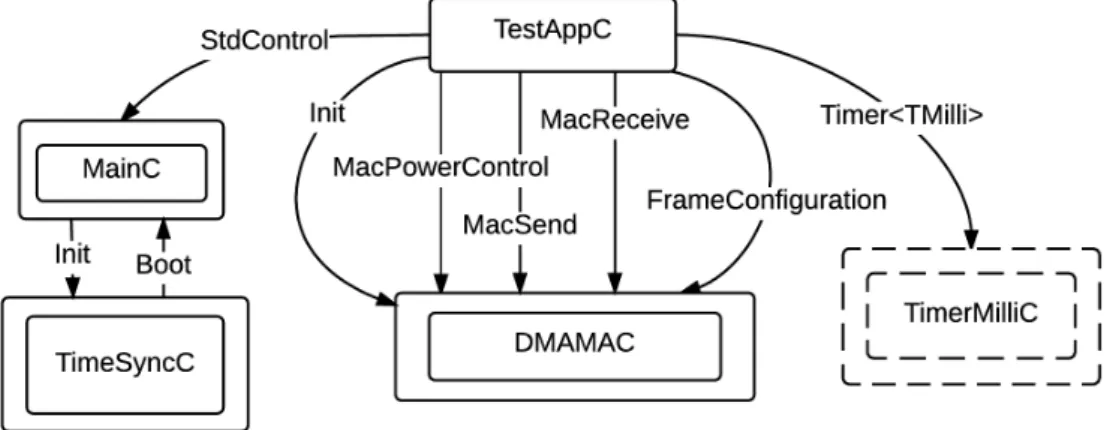
4.3 The DMAMAC nesC Implementation . . . 47
4.3.1 Time Synchronization . . . 49
4.4 Deployment Setup . . . 51
4.5 Deployment Analysis . . . 52
4.6 Contributions and Perspectives . . . 54
5 Towards A Model Based Approach for MAC Protocol Develop-ment 57 5.1 Background on MDSE . . . 58
5.2 An MDSE Approach for MAC Protocols . . . 61
5.2.1 PetriCode . . . 62
5.3 GinMAC CPN model . . . 64
5.4 Platform Specific Models . . . 66
5.4.1 MiXiM . . . 66
5.4.2 TinyOS . . . 67
5.5 Contributions and Perspectives . . . 69
6 Conclusion and Future Work 71 6.1 Summary of Contributions . . . 71
6.2 Re-visiting Research Questions . . . 74
6.3 Beyond IWSN Process Control . . . 74
7 Towards a Dual-mode Adaptive MAC Protocol (DMA-MAC) for Feedback-based Networked Control Systems 87 8 Simulation-based Evaluation of DMAMAC: A Dual-mode
Adap-tive MAC Protocol for Process Control 95
9 Model-based Specification and Validation of the Dual-Mode
Adap-tive MAC Protocol 107
10 Implementation and Deployment Evaluation of the DMAMAC Protocol for Wireless Sensor Actuator Networks 139 11 Towards a Model-Based Development Approach for Wireless
Sensor-Actuator Network Protocols 149
12 Model-based Development for MAC Protocols in Industrial
Introduction
A Wireless Sensor Network (WSN) is a network comprised of sensor devices operating to monitor an environment of interest. The devices have three main responsibilities: sensing, processing of the obtained data; and communica-tion with other devices. In some cases, the main processing of data happens at a sink node, which is a designated node in the network. A sink node is typ-ically a computationally powerful wire-powered device in a WSN. A typical sensor device consists of a micro-controller, a sensor, and a radio transceiver. Application requirements for the WSN domain require these devices to be physically portable to assist in the calibration process, which is a part of the system setup. The portability requirement requires the devices to be small, and to be able to operate on batteries. The small size and battery-based oper-ation results in limited energy and computing power. Initially, such devices were extensively used in military applications [1]. With the advancement in technology and extensive research in the domain of WSN, new opportunities and application domains have opened up [2, 3]. One of emerging domains of research is the Wireless Sensor Actuator Networks (WSAN) domain. A WSAN generally employs sensors and actuators to perform monitoring and control in an environment, across diverse operating elements. Actuators are devices responsible for controlling a physical quantity such as temperature, pressure, and flow. WSAN assists in building smart environments that em-ploy automatic control systems for many application domains including smart homes, transportation, industrial automation, and healthcare.
In this thesis, we focus on industrial applications and Industrial Wire-less Sensor Networks (IWSN) [4, 5, 6] which constitutes a sub-domain of
Figure 1.1.1: Wireless Sensor Actuators Networks
WSAN. IWSN applications have a set of requirements specific to the indus-trial setting [6, 7, 8]. Traditionally, indusindus-trial control automation applications have used wired communication. Major industrial players are now invest-ing in research activities for IWSN, includinvest-ing the creation of standard solu-tions for process control automation applicasolu-tions, such as wirelessHART [9], ISA100.11a [10]. Lowering the cost while addressing the original require-ments for quality of service is one of the main challenges when moving from wired to wireless networks.
1.1 Industrial Wireless Sensor Networks
An IWSN typically consists of sensors, actuators, a sink/network manager, and a management console to control the network as shown in Fig. 1.1.1. The sensor nodes are responsible for data collection and relay of packets to-wards the sink (network manager). The actuators obtain the processed data from the sink via multi-hop communication and routing. Alternatively, the sensors may also communicate (information) directly to the actuators as il-lustrated by the dashed arrows in Fig. 1.1.1. The network manager is also responsible for scheduling and managing the network, and the management console is used to control the network manager. A typical sensor/actuator node for the industrial domain implements four important functions of IWSN
[7]: Routing, Medium Access Control (MAC), Transport, andSecurity. Mul-tiple standards have been developed to provide solutions for IWSN applica-tions. The most important ones are: Zigbee [11], ISA100.11a [10], WIA-PA [12], and wirelessHART [9]. Below we provide a broad classification of in-dustrial applications, requirements specific to use in the inin-dustrial domain, and current standardization efforts to provide efficient IWSN solutions.
1.1.1 Applications of IWSN
WSNs are applied in a wide range of industrial applications and is not only replacing existing wired solutions, but also creating new and effective solu-tions. Industrial applications include operation in harsh environments such as having high temperature apparatus close to the sensor devices and actuators. Eliminating the requirement of manual intervention and reducing the size and cost of the devices is a main focus points of emerging wireless solutions.
Monitoring systems Initially, WSNs were used in military applications for monitoring purposes, and later expanded to additional applications ar-eas. These new applications involve two types [8]: environmental mon-itoring and condition monmon-itoring. Environment monmon-itoring includes monitoring of physical quantities in a given environment and collecting this information over a period of time. Condition monitoring includes monitoring of equipments in the industrial setup for noise and vibration. An application example for condition monitoring on a smart grid can be found in [13] which is concerned with monitoring of components crit-ical for operation of a smart grid. The monitoring process looks for failures or erroneous behaviours. An example of remote monitoring in the oil and gas industry can be found in [14] for pipeline monitoring.
Safety systems While working in harsh industrial environments, safety is an important concern. Fire detection [15] systems, methane gas leak detection systems [16] are examples of WSN applications. These sys-tems continuously monitor a given environment for events that threaten safety and when an event occurs, authorities are notified for further han-dling. Another gas leak detection example involving hazardous gases can be found in [17]. Depending on the seriousness of the threat, the
requirements for the safety system applications vary. Real-time require-ments, including low-delay, high-reliability, and robustness constitute a general set of requirements for these systems.
Control systems An important part of process automation applications are control systems. Control systems can be broadly classified [10] into:
open loop and closed loop systems. The open loop system consists of a human in the loop that manages and controls the process. Theclosed loop is a completely automated system, which could have a human as a supervisory controller. Process control systems generally have strict real-time requirements typically in the order of milliseconds for delay. They also have high reliability requirements which is essential to keep the process being controlled stable and operational. The set of require-ments imposed by the control systems in general pose a challenge to the wireless solutions. A wireless temperature control network is presented in [18], and [19] discusses a water pump control system.
In this thesis, we focus specifically on applications of IWSN in control systems [20].
1.1.2 IWSN Requirements
The IWSN domain is a subset of the WSAN domain and has requirements specific to the industrial domain [6, 7, 8]. Below we discuss the requirements, specifically focussing on the control system applications.
Energy efficiency IWSN devices are generally battery powered, and due to their limited size, the battery capacity is also limited. Energy consump-tion can be viewed in two dimensions as menconsump-tioned in [7]: low energy consumption and efficient energy consumption. Low energy consump-tion solutions focus on keeping the energy consumption at every single node low. Efficient energy consumption solutions focus on balancing the energy consumption throughout the network to extend the network lifetime.
Quality of Service (QoS) Every application defines a set of performance met-rics based on its requirements. These metmet-rics are used to assess if the
proposed solutions meet the application requirements. For example, real-time process control in industrial applications has strict require-ments on delay (low), reliability (low packet loss), dependability, ro-bustness, and predictability. A protocol solution attempts to obtain an optimal trade-off between energy efficiency and providing the required QoS.
Wireless channel conditions are dynamic and vary with time. This is par-ticularly true given the influx of multiple types of wireless services used in an environment in general and also within the particular application domain. For example, WiFi, mobile services and other electromagnetic noise creates interference with the operation of the IWSN. Thus, protocols need to employ techniques to be robust under potentially deteriorating channel conditions. Predictability allows the application users to create definitive models for the operation of IWSN solution and is one of the important IWSN application requirements [21, 22].
1.1.3 Industrial Standards
The IEEE 802.15.4 [23] is an IEEE standard to support low-power, low-data rate radio applications with a short coverage area. It was developed as a stan-dard by the Personal Area Network (PAN) working group. This stanstan-dard has been widely used for WSN solutions proposed by industrial working groups such as WirelessHART [9] and ISA100.11a [10]. It mainly specifies the MAC and the physical layer. IEEE 802.15.4 uses Carrier Sense Multiple Access (CSMA) with Collision Avoidance (CA) and Guaranteed Time Slots (GTS). The 802.15.4 PHY (Physical layer) is embedded into transceivers such as the CC2420 [24]. Later, given the industrial requirements of predictability, reliability, and real-time aspects, the IETF working group on Wireless Per-sonal Area Networks (WPAN) proposed a new version called IEEE 802.15.4e [25, 26]. The new standard aims at addressing co-existence issues using Time Slotted Frequency Hopping (TSFH). Additionally, other features for e.g., dedicated and shared slots, multi-channels, were proposed [26, 27] to improve the MAC performance.
WirelessHART [9] is the wireless standard developed by the HART Com-munication Foundation (HCF) for process automation applications. The
net-work architecture proposed by HCF consists of multiple components includ-ing: field device, adapter, handheld device, gateway, network manager, and
security manager. Thefield deviceis a field instrument, either a sensor or an actuator device. Ahandheld device is a portable device to collect data, con-figure, and diagnose field devices. The gateway connects the plant automa-tion network to the network manager, and the security manager. The architec-ture relies on centralized control with a dedicated device called thenetwork managerfor control and management. The security manager is responsible for the security in the network. The physical layer in wirelessHART is based on 802.15.4 PHY, but the MAC in WirelessHART is significantly different and is based on the Time Synchronization Mesh Protocol (TSMP). TSMP is a Time Division Multiple Access (TDMA) protocol developed by Dust Networks [28]. It uses TDMA and applicable features from IEEE 802.15.4 MAC. TDMA is reliable in comparison to random access techniques, and reliability is one of the important requirements in process automation ap-plications. To overcome radio frequency interference [29, 30], the standard employs channel blacklisting, where poor frequency channels among the 16 available channels are blacklisted based on observed performance.
The International Society of Automation (ISA) [31] set out to develop its own standard for wireless networks in process automation, similar to the standardization process by HCF. The standard created is ISA100.11a [10]. ISA is based on the IEEE 802.15.4 standard similar to wirelessHART and shares some common features in the MAC layer, like employing TDMA techniques. In addition, it also uses the CSMA-CA techniques similar to the base IEEE 802.15.4 MAC. CSMA-CA is used to obtain higher utilization. ISA100.11a also uses channel hopping techniques to address interference is-sues. ISA100.11a supports the IPv6 standard, enabling support for the new domain referred to as Internet of Things (IoT) [32]. The ISA100.11a standard uses a wired backbone network along with a gateway, system manager (net-work) and security manager similar to wirelessHART to manage the network. It also has support for integrating legacy protocols into the ISA solution, e.g., wired HART and interoperability with networks based on wirelessHART.
It is important to note that all these standards constitute more of a frame-work than a complete solution. The frameframe-works provide flexibility for devel-opers to include their own software by modifying an existing framework to
Figure 1.2.1: An example process control scenario
match specific requirements. As an example, existing MAC protocols in the framework can be extended to include additional features addressing appli-cation specific requirements. For a more detailed comparison between differ-ent wireless standards, including wirelessHART and ISA100.11a, we refer to [33].
1.2 Process Control Application
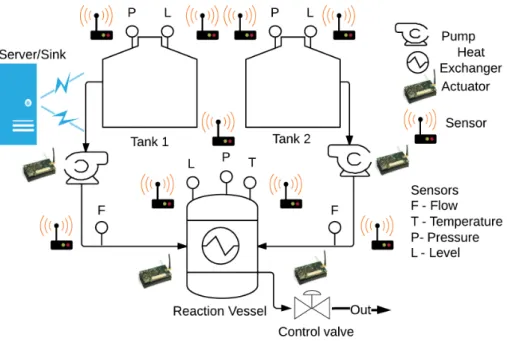
In this thesis, we focus on the use of IWSN for the process control applica-tions. An example of a representative process control system is shown in Fig. 1.2.1. This is similar to the example process control system used in the case study for the GinMAC protocol [34]. It shows a chemical process plant with sensors and actuators installed to control the chemical process. The example includes two storage tanks (Tank 1 and 2) to store chemicals to be mixed, in the reaction vessel. The actuators control the flow of chemicals from the stor-age tanks to the reaction vessel based on the actuation commands from the sink/network manager. The sink makes control decisions based on the sen-sor readings it obtains and the requirements of the process being controlled. Multiple types of sensor units are used in the scenario including: flow, tem-perature, pressure, and level sensors. Three types of actuators are used: pump
0 5 10 15 20 25 30 35 40 45 50 0 5 10 15 20 25 30 35 T e m p e r a t u r e Time
Response Upper bound Lower bound Target Value
Transient Steady
Switch
Figure 1.2.2: Chart representing of process control variables
controller (for flow/level), heat exchanger (for temperature), and a control valve (for pressure/level). With the assistance of these sensors, actuators, and the underlyingprocess model, the sink performs monitoring and control. Process models are models representing the process in operation and the con-trol procedure. In other words, the process models provide the decision logic used by the sink to process the incoming sensor data. The processed data is then relayed to the actuators as actuation commands for required operation.
A typical process control operation could result in a graph similar to the one shown in Fig. 1.2.2. It shows a measured physical quantity, e.g., temper-ature monitored and controlled over time. Process control normally consists of the two states steadyand transient and the process control alternates be-tween these two operational states. The transient state is a state in which there is rapid change in a measured physical quantity (temperature) as indi-cated in the first section of the graph. An IWSN solution has to communicate large amounts of data in the transient state in order to control the process without disruptions. Thesteady state in contrast to the transient state has a small rate of change. The measured value (in this case temperature) generally lies within a bounded interval for the steady state as shown in the second part of the graph. This allows for the IWSN to reduce the data traffic towards the sink from the sensors.
1.3 Functions
An IWSN solution for process control applications is made up of a suite of protocols that provide the different functions required. The suite of proto-cols implement four important functions:Transport, Routing, Medium Access Control (MAC)andSecurity. These in addition to an application layer make up a complete solution for a given industrial application. Below we discuss Transport, Routing, MAC and security functions.
Transport. In the context of this thesis, reliability is an important requiment for the design of industrial solutions. Reliability here refers to the re-liable delivery of data from source to destination, thus reducing packet loss at the same time as addressing real-time delay requirements. Packet loss can be caused either by congestion or interference that exists in wireless chan-nels. Transport protocols are generally responsible for reliable communica-tion in an IWSN in conjunccommunica-tion with the MAC protocols. Transport protocols achieve this goal by congestion control/avoidance and implementing features to reduce interference effects. The application requirements can further spec-ify the reliability requirements at a finer granularity based on the goals it needs to achieve as described in [7]. Example transport protocols applicable in the IWSN domain include the Asymmetric and Reliable Transport Mech-anism (ART) [35], the real-Time and reliable transport protocol (RT2) [36], and the Reliable Bursty Convergecast (RBC) [37] protocol.
Routing. In a typical multi-hop network, multiple paths exists between a given source and destination. The routing layer in an IWSN solution is re-sponsible for efficiently routing data within the network by finding the best path suitable for the application requirements. Important design requirements for routing protocols include: fault tolerance, energy efficiency, load bal-ancing, service differentiation, and Expected Transmission count(ETX) [7]. Apart from the general design requirements, the planned topology of the network imposes additional requirements to the design. Example protocols applicable in the domain are: the Multipath Multi-SPEED protocol (MM-SPEED) [38], the Threshold Sensitive Energy Efficient Sensor Network pro-tocol (TEEN) [39], and the Routing Propro-tocol over Low-power and Lossy
Networks (RPL) [40].
Medium Access Control (MAC). MAC protocols are mainly responsible for controlling the medium access in the network. Thus, it is directly respon-sible for controlling the radio, which is the largest consumer of energy in a sensor-actuator device [41, 42]. The MAC protocol decides the required schedule for the network operation based on the application requirements. Two important types of approaches used in MAC protocols are Time Divi-sion Multiple Access (TDMA) and Carrier Sense Multiple Access (CSMA). Protocols implementing the TDMA approach divide the available time be-tween the nodes in the network. Nodes operating as part of a CSMA-based protocol first sense the channel whenever they have data to be sent. If the channel is found to be clear with no communication in the vicinity, the nodes go ahead with data communication. Some protocols use both TDMA and CSMA concepts to realise a hybrid operation [43]. This allows the protocol designers to exploit the advantages of the two approaches. Some example MAC protocols that could be applicable in the IWSN domain are the Gin-MAC protocol [44], QoS aware Gin-MAC [45], Power Efficient and Delay Aware MAC for Sensor Networks (PEDAMACS) [46], and Emergency Response MAC (ER-MAC) [47].
Security. Wireless networks are inherently susceptible to security attacks due to the lack of physical connections. Additionally, given the substan-tial difference in the requirements of the IWSN applications from traditional wired networks, the security techniques applied to wired networks are not directly applicable [48]. Given the limited capability of the devices included in the network, developing a lightweight but strong security procedure is a challenge in itself. The wireless standards wirelessHART and ISA100.11a use dedicated devices as security managers.
1.4 Research Questions
Given our focus on specific industrial requirements, and the fact that MAC protocols control most of the energy expenditure, including its ability to
af-fect other requirements (e.g. delay), we further narrow our focus on MAC protocols for the IWSN domain. The research questions that this thesis ad-dresses are listed below:
• Can MAC protocols for wireless process control be made energy effi-cient by exploiting intrinsic properties of the process control domain? • What guarantees can be provided with respect to real-time operation
and reliability?
• How can model-driven engineering techniques be used for MAC proto-col development?
1.5 Goals and Contributions
The main contribution of the thesis is the proposed Dual-Mode Adaptive Medium Access Control Protocol (DMAMAC). The DMAMAC protocol is proposed for process control application with real-time requirements. The proposed protocol is then thoroughly analyzed and refined to arrive at ro-bust, energy efficient protocol with two variants (Hybrid and TDMA). The analysis process included validation, verification, simulation and deployment test. Prior to the protocol proposal, to get an idea about the state-of-the-art in the domain, we investigated state of the art as a first step towards answering the research questions. This investigation resulted in identifying the MAC protocols applicable to the domain of research, the process control domain in particular. Further, we studied the identified protocols thoroughly to be able to extend them in order to exploit the domain properties to result in design that performs better than the existing solutions. We identified the GinMAC protocol [44] as a base and proposed the DMAMAC protocol. In parallel, we also studied state-of-the-art model-driven techniques for the design of communication protocols. We used one of the existing tools, the PetriCode tool [49], and proposed a design and development approach on model-driven principles.
We proposed an initial version of the DMAMAC protocol in the article "Towards a dual mode adaptive MAC protocol (DMA-MAC) for feedback-based networked control systems" [50]. The paper mainly discussed the
DMAMAC-Hybrid variant. Additionally, we evaluated the energy consump-tion of the DMAMAC protocol against the related GinMAC [44] protocol analytically, and showed that it provides substantial reduction in energy con-sumption for target configurations.
The DMAMAC protocol was then evaluated via simulation and was pre-sented in the article [51]. Based on the initial simulation evaluation, a fully-TDMA version was derived from the DMAMAC protocol to obtain a DMA-MAC variant with improved reliability and predictability. Both variants of the DMAMAC-protocol were compared for several metrics including energy ef-ficiency, network lifetime, and switch failure probability (notification packet failure).
The contribution of the article "Model-based Specification and Validation of the DMAMAC Protocol" [52] is to describe the validation and verification of the DMAMAC protocol via model checking. We describe the modeling for both DMAMAC protocol variants using the Uppaal tool [53]. Models created are validated and verified using queries. The queries include: configuration-specific, configuration-independent and real-time queries.
The DMAMAC protocol is implemented and evaluated via deployment in the article "Implementation and Deployment Evaluation of the DMAMAC Protocol for Wireless Sensor Actuator Networks" [54]. We, mainly focus on the goals drawn out for the implementation evaluation of the DMAMAC protocol. The DMAMAC protocol nesC implementation code is deployed using a hardware platform (Zolertia), and evaluated in a realistic industrial application scenario.
The contribution of the article "Towards a model-based development ap-proach for wireless sensor-actuator network protocols" [55] is to present an initial idea of a Model-Driven Software Engineering (MDSE) [56] approach for MAC protocols. We present the MDSE approach based software code generation architecture. The entire process uses: a modeling tool, PetriCode for code generation based on platform specific code templates (simulation and deployment). An extended version is presented in "Model-based De-velopment for MAC Protocols in Industrial Wireless Sensor Networks" [57]. The simulation platform source code generated is simulated in the MiXiM platform and analyzed for performance. The implemented code for deploy-ment is deployed using a hardware platform and evaluated for link quality.
We use the GinMAC protocol as a running example to present the MDSE approach.
1.6 Outline
This thesis is divided into two main parts: Part I provides an introduction and overview of the dissertation, and Part II is comprised of a collection of articles [50, 51, 52, 54, 55, 57] that make up the dissertation. Part I in addition to the current chapter, is divided into the following:
Chapter 2 provides an introduction to the DMAMAC protocol and the ar-ticles concentrating on the design of DMAMAC. We discuss the work related to the DMAMAC protocol, followed by a detailed overview of the features of the DMAMAC protocol. We also discuss the two vari-ants of the DMAMAC protocol, Hybrid and DMAMAC-TDMA along with their differences and applications.
Chapter 3 discusses the evaluation of the DMAMAC protocol. The per-formance evaluation of the DMAMAC protocol is done via a network simulator platform focussing on energy efficiency and network lifetime. The verification of the design of the DMAMAC protocol is discussed as a second part of the evaluation.
Chapter 4 discusses the prototype implementation and deployment of the DMAMAC protocol. In addition to providing an overview of the im-plementation article, we add the details related to the imim-plementation setup missing in the article itself.
Chapter 5 In the chapters 2, 3, and 4, a traditional design and development methodology is followed. In chapter 5, we provide an overview of the alternative development methodology that we have suggested. The al-ternative development methodology provides a model-based approach for design and development of MAC protocols. As a running example, the GinMAC protocol is used.
Chapter 6 We discuss conclusions and possible future directions in the last chapter. Additionally, a summary of the overview part, and applicability
of the DMAMAC protocol beyond the IWSN domain is discussed. In addition to summarising the contribution of each article, we also put the limitation of the work into perspective.
Part II is comprised of the following published/submitted articles:
[50] A. Ajith Kumar S., Knut Øvsthus, and Lars Michael Kristensen, "To-wards a Dual Mode Adaptive MAC protocol (DMA-MAC) for Feedback-based Networked Control Systems", in Proceedings of the 2nd Interna-tional Workshop on Communications and Sensor Networks, Procedia Computer Science, 34, 505 –510, 2014.
[51] A. Ajith Kumar S., Lars M. Kristensen, and Knut Øvsthus, "Simulation-based evaluation of DMAMAC: A Dual-Mode Adaptive MAC protocol for process control", in Proceedings of the 8th International Conference on Simulation Tools and Techniques, pages 218 –227, 2015.
[52] A. Ajith Kumar S., Andreas Prinz, and Lars M. Kristensen, "Model-based verification of the DMAMAC protocol for real-time process con-trol", in Proceedings of the 9th International Workshop on Verification and Evaluation of Computer and Communication Systems, 1431:81 –96, 2015.
[54] A. Ajith Kumar S., Knut Øvsthus, and Lars M. Kristensen, "Implemen-tation and Deployment Evaluation of the DMAMAC Protocol for Wire-less Sensor Actuator Networks", in Proceedings of the 7th International Conference on Ambient Systems, Networks and Technologies, Proce-dia Computer Science, 83, 329 –336, 2016.
[55] A. Ajith Kumar S. and K. I. F. Simonsen, Towards a model-based de-velopment approach for wireless sensor-actuator network protocols, in Proceedings of the 4th ACM SIGBED International Workshop on De-sign, Modeling, and Evaluation of Cyber Physical Systems, pp. 35 –39, ACM, 2014.
[57] A. Ajith Kumar S. and K. I. F. Simonsen, Model-based Development for MAC Protocols in Industrial Wireless Sensor Networks, in Proceedings of the International Workshop on Petri Nets and Software Engineering (Accepted), 2016.
The reader of this thesis is assumed to have knowledge about communi-cation systems and the use of wireless technologies in general. The artifacts for simulation code and verification models (+code) can be found in [58].
The DMAMAC Protocol
This chapter is based on the article article "Towards a dual mode adaptive MAC protocol (DMA-MAC) for feedback-based networked control systems" [50]. The article mainly provides an initial specification of the Dual-Mode Adaptive MAC (DMAMAC) protocol, along with underlying assumptions. The article gives an introduction to the process control application for which the DMAMAC protocol was proposed. Further, it proposes the dual-mode mechanism in the DMAMAC protocol, a detailed description of each slot and its function in the two types of superframes (steady and transient). Also, an introduction to the idea of the alert message mechanism to facilitate the mode-switch. The article mainly discussed the DMAMAC-Hybrid variant. Additionally, we evaluated the energy consumption of the DMAMAC proto-col against the related GinMAC [44] protoproto-col analytically, and showed that it provides a substantial reduction in energy consumption for target configura-tions.
The DMAMAC protocol was first proposed in [50] targeted at process control applications. After simulation analysis of the initial version, an im-proved variant was proposed and analyzed in [51]. The two variants use Time Division Multiple Access(TDMA) and Carrier Sense Multiple Access (CSMA) methods for channel access. The two variants are called DMAMAC-Hybrid (TDMA+CSMA) and DMAMAC-TDMA Protocol. In addition to providing an overview of the DMAMAC protocol along with its variants, we also discuss the differences between the two, their pros and cons. It should be mentioned that the DMAMAC protocol can be used within the framework of the industrial standard solutions presented in 1.1.3.
Figure 2.1.1: A generic GinMAC superframe
2.1 MAC Protocols for Process Control
The GinMAC protocol [44] was proposed for the GINGSENG [59] project aimed at performance monitoring and control in Industrial Wireless Sensor Networks (IWSN). The design of the GinMAC protocol aims at satisfying real-time requirements of industrial applications. GinMAC is a TDMA-based protocol with features that include: offline dimensioning, exclusive TDMA, anddelay conformed reliability control. Offline dimensioningmeans that the scheduling of the superframe for the network using the GinMAC protocol is calculated offline prior-deployment. Exclusive TDMA means that the slots used by the nodes are exclusive and cannot be re-used by other nodes. Gin-MAC also assumes data transmission of maximum packet length and associ-ated acknowledgement within the same slot. The GinMAC authors propose pre-deployment assessment of the channel conditions in the deployment en-vironment. Based on results obtained from the conducted experiments, and delay requirements of the application, delay conformed reliability control is employed to decide the number of re-transmissions slots.
A typical GinMAC superframe is shown in Fig. 2.1.1. Apart from the essential sensor and actuator data slots, the GinMAC superframe incorpo-rates re-transmission for both types of data slots, sleep slots, and a configura-tion command slot. The configuraconfigura-tion command slot is used for transmitting management information by the sink, such as time synchronization messages. The network topology for the GinMAC protocol is a tree topology as shown in Fig. 2.1.2. GinMAC protocol is an important background and related work, which will be used extensively in the rest of the thesis.
Figure 2.1.2: The network topology for GinMAC
Figure 2.2.1: An example node topology for the DMAMAC protocol
2.2 The DMAMAC Protocol
The DMAMAC protocol is designed for a tree topology network similar to GinMAC. The network consists of sensors, actuators, and a sink. Both the sensors and the actuators are equipped with wireless communication capable transceivers. The sensors measure a given physical quantity (e.g., tempera-ture) over a certain geographical area. The actuators act on incoming com-mands influencing a certain physical quantity, e.g., influencing temperature by heating up or cooling down. The sink is a computationally powerful wire powered device, it performs data processing on the sensed data and commu-nicates processed data to the actuators. The sensors and actuators are battery powered, and have relatively lower computational power.
The network is organized into levels, where each level is associated with a rankRnwhere n=1,2,3..as shown in the Fig. 2.2.1. The only difference between the topology presented previously in Fig. 2.1.2 is the indication of levels associated with a rank required by the DMAMAC protocol. R1 and R2 in the case of Fig. 2.2.1. The rank is used in the alert message mechanism of the DMAMAC-Hybrid variant of the protocol. The DMAMAC protocol serves the dual-states of the process control via two separate operating modes in the protocol. The transient state of the process control is served by the transient mode in the DMAMAC protocol, and the steady state is served by the steady mode of the protocol.
Transient Superframe The transient superframe is designed for the tran-sient mode of the DMAMAC protocol, and is based on the GinMAC [44] protocol superframe. The design of the transient superframe was first pro-posed in [50] and has remained unchanged. This is unlike the structure of the steady superframe. The main goal of the transient superframe is to support a high data rate in order to support the transient state of the process control. Additionally, it provides reliability measures by providing additional slots. When the packets fail due to poor channel conditions, they are sent again in the additional slots. The structure of the transient superframe is shown in Fig. 2.2.2. The number of re-transmission slots is a configurable parameter in the DMAMAC protocol design, and can be set based on application require-ments. For an industrial environment with high packet loss, the application could benefit from providing more than one re-transmission slot. Also, this can be configured separately for sensor data and actuator data. The transient superframe is the same for both variants of DMAMAC (hybrid and TDMA). The length of a transient superframe is denoted asNt.
Steady Superframe The steady superframe is designed for the steady mode of the DMAMAC protocol. The steady mode is designed to support the steady state of a process control application which has low-data rate require-ments. This allows for incorporating a larger number of sleep slots than in the transient superframe. The steady superframe is designed such that its length (denoted asNs) is a multiple of Nt, i.e, Ns=n×Nt where n≥1 is a configurable parameter that can be set based on application requirements.
Figure 2.2.2: Transient mode superframe [50]
Essentially, the higher the value of n, the larger is the energy savings in the steady state. The energy saving is also dependent on the occurrence of the steady superframe during the operation. Also,Ns being a multiple ofNt al-lows seamless synchronization for nodes between the operating modes. For example, if a node misses a notification packet with mode switch command (steady to transient), it still will receive all the forthcoming notification pack-ets and can switch to the transient mode at the beginning of the next transient part (in the steady superframe).
The steady mode superframe was first proposed in [50] and further mod-ified in [51] based on performance analysis results. The first modification included moving the notification slot from the beginning of the second Nt
part of the steady superframe to the end, and also including it for each Nt
parts that follows. Moving the notification to the end, after the alert slots, ensured quick state change after an alert is received. In [54], we restored the notification slot to the beginning of each Nt slot to improve robustness against packet failures. This is explained in detail in [54]. Thus, the final ver-sion of the steady superframe shown in Fig. 2.2.3 includes two notification slots in eachNt part as opposed to one in the initial version. Additionally, the steady superframe has two configurable parameters. One is the number of re-transmission slots per transmission slots; the other is the number of alerts slots.
Alert messages An important part of the dual-mode DMAMAC protocol is the mode switch procedure. The switch between the transient and steady
Figure 2.2.3: Steady mode superframe
modes are facilitated by different actors (sink or sensors) depending on the nature of the switch. The switch from transient to steady is facilitated by the sink based on an assessment of the process control state. This could be auto-matic statistical analysis or manual setting based on deployment experience. This switch is less critical compared to the switch from steady to transient. The switch from steady to transient is initiated by the nodes and implemented network-wide by the sink. This is a critical switch since the transient state re-quires transient mode support from the protocol in order to accommodate a high data-rate. This switch is decided based on a threshold interval set by the sink. When the measured physical quantity breaches the aforementioned threshold, the sensor nodes notify the sink of this breach via alert messages. The alert messages are sent in the alert slot (see Fig. 2.2.3). The schedul-ing of the alert slots is the main difference between the two variants of the DMAMAC protocol (hybrid and TDMA) and is discussed in the following section.
2.3 DMAMAC-Hybrid and DMAMAC-TDMA
The first proposed variant of the DMAMAC protocol was the DMAMAC-Hybrid protocol. The term hybrid comes from the fact that it combines CSMA and TDMA within the steady superframe. The transient superframe uses entirely TDMA and the steady superframe uses CSMA for the alert mes-sage slots. The use of CSMA for alert mesmes-sage slots results in a scalable
Figure 2.3.1: Alert message mechanism in the DMAMAC protocol, DMAMAC-Hybrid (a) and DMAMAC-TDMA (b)
steady superframe and energy conservation. The slot distribution is based on the rank in the tree topology as discussed in [52]. Each rank has two spe-cific slots assigned: one for reception (RX) and one for transmission (TX). The alert mechanism for DMAMAC-Hybrid is shown in Fig. 2.3.1(a). The slot identification withRnindicates slot per rank for the DMAMAC-Hybrid variant and re-transmission slots (if any) follow the main transmission slot. The actual alert sending mechanism was modified in [51] from the initial ver-sion proposed in [50] based on the simulation performance analysis done in [51]. Initially, we chose to send two alert messages in the same alert slot. Duplication was used to prevent loss of alert messages due to collision.
Further, we tried alternative configurations which proved to perform better based on simulation analysis, resulting in the change to initially proposed model. In the final version of the protocol, a node performs the following steps when an alert has to be sent and the node is in the alert transmission slot. Firstly, a random delay is chosen by the respective sensor node, and it waits for this duration in its alert slot. At the end of the delay, the node performs carrier sense to check if there is any other alert transmission taking place in the vicinity. In the absence of other alert transmissions, the sensor node transmits its alert message to its parent in the tree topology.
The DMAMAC-TDMA has a simpler alert message approach than the hybrid version. The alert mechanism for DMAMAC-TDMA is shown in Fig. 2.3.1(b). As the name suggests, each sensor node has its own alert message
transmission slot. It forwards its alert message to its parent, which in turn forwards it towards the sink. Note that only one alert message is required to make the switch, and thus the parent nodes only send one alert message, which could be either an alert to be forwarded or their own alert message. No separate alert message forward slots are used. The slot identification with node identifier(n,n−1....)is for the DMAMAC-TDMA variant with subse-quent re-transmission slots as shown in the Fig. 2.3.1(b).
As a configurable parameter, the re-transmission slots could be used for alert messages too, to make the protocol more robust in poor channel con-ditions. This is true for both DMAMAC-Hybrid (per-level re-transmission slots) and DMAMAC-TDMA (per node re-transmission slots). The alert message slots are shown in Fig. 2.3.1 for both DMAMAC-Hybrid (left) and DMAMAC-Hybrid (right) with optional re-transmission slots. The number of re-transmission slots (black) may vary depending on the requirements.
The two variants of the DMAMAC protocol have their own advantages and disadvantages in the following aspects:
Energy efficiency In certain cases the DMAMAC-TDMA protocol could consume more energy than the hybrid variant. This is specifically true due to alert messaging. As an example, consider a case where a large number of nodes exist in the network and each parent node has three child nodes. The parent node has to have a separate receive slot for each child node. In the case of hybrid, the parent would only have one alert receive slot, but the same node in the TDMA variant would have three alert receive slots. This means that the energy consumption for its alert slot is three times that of the hybrid variant alert slot.
Packet failure DMAMAC-Hybrid may suffer from packet collisions in its CSMA part for alert messaging. This affects the performance of the critical switch from steady to transient. DMAMAC-TDMA has an ad-vantage over the hybrid variant in this case, but could still be affected by packet failure due to poor channel conditions (which affects both variants equally).
Switch delay The relatively low number of alert slots in the hybrid variant facilitates low-switch delay compared to the TDMA variant. This could
be used as an advantage while designing smaller superframes facilitat-ing low-delay.
Predictability The TDMA variant has a higher level of predictability due to the use of entirely TDMA. The hybrid variant suffers from the non-determinism introduced in its alert message slots and due to collision. As discussed above, both variants of the DMAMAC protocol can be use-ful depending on application requirements. Thus, it is up to the application designer to use the appropriate variant based on the application requirements. Additionally, the configurable parameters provide flexibility to adapt the per-formance of the protocol to the application requirements. In the end, the choice of the protocol to be used depends on the type of trade off that the application can have, essentially, the trade-off between energy efficiency and predictability.
2.4 Related Work and Perspectives
The Breath [60] protocol suite was proposed as a complete protocol stack with routing, MAC, and radio controlling mechanisms included. Breath is also aimed at industrial control applications using WSN similar to the DMA-MAC protocol. The main focus of the Breath protocol stack at the DMA-MAC layer is to have a CSMA/CA based solution with clustering techniques. The key assumption underlying the protocol is that the application has a high amount of randomly occurring events. The protocol aims to adapt to these random events while being energy efficient at the same time. In contrast, we on the other hand focus on applications that require predictability, energy efficiency along with satisfaction of real-time requirements.
The Priority enhanced Medium Access Control (PriorityMAC) [61] is a protocol designed for IWSN. The focus of the protocol is to facilitate critical traffic by separating data into different traffic classes. The main classes are: critical, secondary and low priority. It successfully achieves low-latency for the critical priority traffic (critical) by higher bandwidth allocation. The au-thors have analyzed the performance of the protocol via simulation in MAT-LAB and further implemented the protocol on TinyOS and deployed it on a
testbed for further analysis. With respect to the DMAMAC protocol, the fo-cus of PriorityMAC is entirely different. The fofo-cus of the PriorityMAC pro-tocol is to classify data into different traffic classes, with critical data being assigned higher priority to provide reliable service. It could be possible that these two protocols could co-exist, i.e., the DMAMAC protocol data could benefit from priority classifications and usage of PriorityMAC features.
Z-MAC [43] is a hybrid protocol using both CSMA and TDMA. Z-MAC is a distributed protocol (for slot selection) and also a dual mode protocol sim-ilar to the DMAMAC protocol with two modes of operation: low-contention level and high contention level. Contention here refers to contention for chan-nel resources, i.e., number of nodes competing for using the chanchan-nel at a given time. The nodes running on Z-MAC list their two-hop neighbors and locally perform scheduling in a distributed manner such that no two nodes select the same slot. CSMA is used for low-contention level duration and TDMA for high contention level to obtain high bandwidth utilization. The scheduling in Z-MAC is dynamic, whereas in the DMAMAC protocol, we use offline scheduling, where the node slots are calculated pre-deployment similar to the GinMAC protocol. The offline scheduling in combination with TDMA increases the predictability of the DMAMAC protocol opera-tion, which is an important requirement of IWSN.
The GinMAC [44] protocol, used as a basis for the DMAMAC protocol is also used for monitoring and control. The DMAMAC protocol is energy ef-ficient compared to the GinMAC protocol for process control scenarios with dominant steady state as presented in the analytical evaluation in [51]. Also, the longer the length of the steady superframe the more is the energy savings. This chapter mainly provided an overview to the DMAMAC protocol de-sign based on details and excerpts from [50] and [51]. Apart from these, the steady superframe modification made in [54] is also mentioned, which led to the final version of the steady superframe. Below, we place the article [50] in perspective based on the current standing of the DMAMAC protocol.
The DMAMAC protocol is aimed at a section of process control applica-tions, where the steady state dominates the time of execution duration. Thus, the protocol is assumed to operate in steady mode for most of the execu-tion duraexecu-tion, consuming lesser energy relative to the GinMAC protocol. For configurations with higher transient state occurrence in the process control
operation, users can benefit from using the GinMAC protocol. The DMA-MAC protocol has an increased operation and implementation complexity compared to the GinMAC protocol. We would like to also stress on the fact that, the DMAMAC protocol has been successfully improved since its first proposal in [50].
Protocol Evaluation
The DMAMAC protocol was thoroughly simulated and also verified to ob-tain higher confidence on the specification of the DMAMAC protocol. In this chapter, we discuss the simulation and verification of the DMAMAC proto-col, based on articles [51] and [52].
The contribution of the article [51] is mainly the simulation evaluation of the DMAMAC protocol. Multiple simulation runs for different configura-tions provided better insight into the performance of the protocol. In partic-ular, the alert message mechanism of the protocol (DMAMAC-Hybrid) was improved for better performance. Also, a fully-TDMA version was carved off the DMAMAC protocol to obtain a DMAMAC variant with improved reliability and predictability of the protocol. Both variants of the DMAMAC-protocol were compared for several metrics including energy efficiency, net-work lifetime based on first node death, and switch failure probability. The simulation modeling and analysis was done on the MiXiM simulator based on the OMNeT++ platform. Both variants have their own advantages and disadvantages and are applicable in different settings as explained in Chapter 2.
The contribution of the article "Model-based Specification and Validation of the DMAMAC Protocol" [52] was to describe the verification of the DMA-MAC protocol via model checking. The article describes the modeling of both DMAMAC protocol variants Hybrid and TDMA using timed automata and the Uppaal tool [53]. The modeling approach and the models are dis-cussed in detail along with initial validation using Message Sequence Charts (MSC). The representative network topology used for exhaustive
verifica-tion queries is discussed along with the configuraverifica-tions used for verificaverifica-tion and validation. Models created are validated also via queries and thoroughly verified using queries independent of configurations, configuration-specific queries, and real-time queries. The real-time queries had separate versions of the models created. The performance of the queries along with the system configuration used are listed for getting a better idea of the analysis. Fur-ther, the sequence diagrams from the Uppaal model simulation were used to validate the sequence diagrams from the simulation evaluation [51] and implementation evaluation of the DMAMAC protocol [54].
3.1 Simulation
Plethora of tools have been proposed over the years to perform wireless net-work simulation [62, 63]. In the recent years, many of the proposed netnet-work simulators have focussed particularly on Wireless Sensor Networks and Body Area Networks. OMNeT++ [64] is one of these simulator frameworks which performs better [65, 66] compared to other popular wireless simulators like ns-2 [67]. The OMNeT++ simulator has advantages over ns-2 in terms of customization and GUI features. OMNeT++ has also certain performance ad-vantages [65] over ns-2. In this thesis, we used the MiXiM simulator based on the OMNeT++ platform to evaluate the performance of the DMAMAC protocol.
3.1.1 OMNeT++ MiXiM Simulator
OMNeT++ [64] is an open source simulation framework, that supports con-struction of simulators. The framework is modular and component based, where multiple submodules can be combined together to obtain a required solution, e.g. a network node with multiple protocols. The modularity al-lows modellers to replace existing modules with their own and analyze them for performance. The modularity also allows for re-use of existing modules and components. OMNeT++ is a discrete event simulator, thus the simula-tion procedure goes through a set of events occurring during the simulasimula-tion timeline. Definition of a network over an OMNeT++ framework includes multiple types of files: Network Descriptor files (NED), INI or
configura-tion files, the C++ files, message files, and XML files. The C++ files mainly describe the protocol modules under consideration. The NED files describe the physical characteristics of the nodes and the network, along with the C++ modules used by them. The XML files are for specifying configuration of the channel conditions, the topology and other configurational requirements. The message files are used to specify the packet types, and includes a detailed description of each field in the packets.
Over the years multiple network simulators have been built based on the OMNeT++ framework which now includes multiple C++ libraries supporting network simulations. MiXiM [68] and Castalia [69] are two network simula-tors used for WSN and Body Area Networks (BAN) respectively. OMNeT++ provides support for programming protocols spanning multiple layers to con-struct a virtual WSN with multiple nodes and simulate it over varying param-eters. The modular architecture along with existing C++ libraries provided, lets users build their own protocols for performance analysis and testing.
In this thesis, we mainly refer to the MiXiM platform based on OM-NeT++. MiXiM is a mixed simulator made with the combination of multiple simulation frameworks developed for mobile and wireless networks. It pro-vides a rich C++ library with protocol models, and infrastructure required for a full network simulation. The MiXiM paltform consists of an Integrated De-velopment Environment (IDE). The Eclipse-based simulation IDE provides a platform for development, simulation, debugging and analysis via a Graphi-cal User Interface. The simulation support also provides support for running multiple simulations as batches, collecting required data, and analyzing this data via additional tools.
3.1.2 MiXiM model
The DMAMAC protocol model in MiXiM is created based on the specifica-tion of the protocol from [50]. A MiXiM node model is made up of multiple layers of protocol, each responsible for separate functions. MiXiM uses a modular approach, each of these layers constitute a simple module. Addition-ally, network descriptor (NED) files are used to describe a compound module made up of multiple simple modules. The compound modules can also be used to create a network based on the simple modules. The simple modules
Figure 3.1.1: MiXiM DMAMAC model [51]
in this case include application, network, and radio modules connected to the DMAMAC protocol module.
The simulation architecture as shown in Fig. 3.1.1 is made of simple mod-ules consisting of C++ files, network description with NED files, XML files for some user based input, packet types as message files, and input parame-ters file. Separate MAC modules are created for the nodes and the sink along with their own network descriptor files (NED files). Also, separate MAC modules are created for DMAMAC-Hybrid and DMAMAC-TDMA. Multi-ple configuration files are created, two of which are used to specify the super-frame structure with one file for each supersuper-frame. The main packet types are: generic MAC packet, sink MAC packet, and alert packets. The configuration for execution is specified in the input parameters file. The configuration pa-rameters also include the time duration for execution and the position of each node in the network. For application and radio layer modules, the existing modules from MiXiM were used.
3.1.3 Experiment Setup and Performance Analysis
The simulation setup consisted of 25 nodes at three levels in the tree topology excluding the sink. The nodes were comprised of 19 sensors and 6 actua-tors. We compared the DMAMAC-Hybrid and DMAMAC-TDMA with the GinMAC protocol. The comparison was done based on two important met-rics: energy consumption and network lifetime in terms of first node death. The DMAMAC-TDMA protocol outperforms the other two protocols in most configurations. Also, we analyzed the state-switch failure possibilities in the DMAMAC-Hybrid variant, induced due to its alert message mechanism. The
Figure 3.1.2: Energy consumption comparison in MiXiM [51]
DMAMAC-Hybrid variant performs decently in terms of the switch failure conditions.
The comparisons are mostly presented graphically, with additional tables for getting better insight. Among the results, we present the comparison of the two DMAMAC variants (TDMA and Hybrid) with GinMAC in Fig. 3.1.2 (a) and Fig. 3.1.3 (b). The GinMAC is presented as a black line as a bench-mark and the DMAMAC variants with separate colours. Multiple configura-tions are used, mainly varying the ratio of transient and steady superframes in the execution, and varying the length of steady superframes. The "P-10-2x", is to be read such that 10 is the ratio of transient superframes in the entire execution (as 10% of the execution time) and 2x as steady superframe being twice the length of the transient superframe. All configurations were simu-lated using 100 repetitions each with varying execution sequences. Further, we briefly discussed the protocol performance for metrics including packet transmission delay, reliability and scalability.
3.2 Verification
The DMAMAC protocol is designed for process control applications with strict real-time requirements. The design of the DMAMAC protocol could benefit from formal verification to ensure behavioural correctness and
con-Figure 3.1.3: Node lifetime comparison in MiXiM [51]
formity to requirements. Existing formal verification tools like Uppaal [53], Prism [70] provide model-checking or model-based verification facilities based on exhaustive verification of a given input model. These verification tools consist of a verification engine equipped with query language that facilitate the verification process. The verification engine also provides counter ex-amples to pin point faults in the design when a given query is not satisfied. In this thesis, we used timed automata and the Uppaal tool [53] to perform model-based verification of the DMAMAC protocol.
Uppaal has been previously used for verification of communication proto-cols [71, 72, 73]. The modeling and verification of the Lightweight Medium Access Control (LMAC) protocol is the most closely related work to the ver-ification article [52]. The focus of the LMAC protocol modeling is to verify the slot selection and the collision detection module. For the DMAMAC pro-tocol slot selection is done offline and no collision detection is included, also, the main focus is to verify the dual mode operation with switching. It requires a different model to represent the DMAMAC protocol than the ones used in the LMAC protocol verification article.
For the model-based verification of the DMAMAC protocol, we designed a generic MAC protocol model with DMAMAC protocol specific extensions. This extensibility feature of the designed Uppaal model is discussed later in this chapter. This generic design allows the re-use of the Uppaal model to obtain other Uppaal models of MAC protocols. The Uppaal model of the

![Figure 3.2.5: Data transmission sequence diagram in Uppaal [52]](https://thumb-us.123doks.com/thumbv2/123dok_us/1774565.2752564/57.892.236.668.153.482/figure-data-transmission-sequence-diagram-in-uppaal.webp)
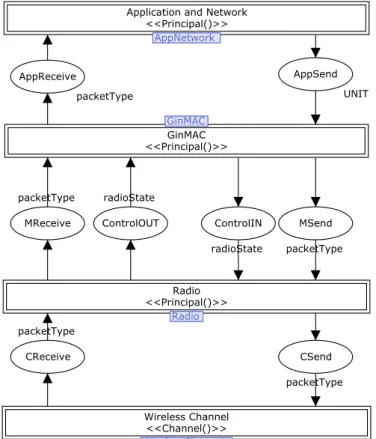
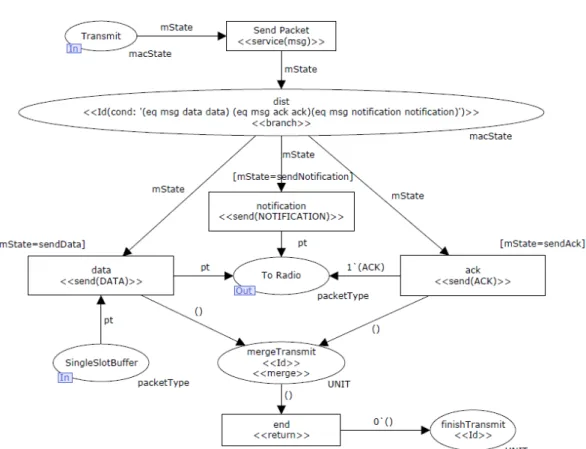

![Figure 5.4.4: The PSM and implementation-deployment flow for GinMAC in MiXiM [57]](https://thumb-us.123doks.com/thumbv2/123dok_us/1774565.2752564/82.892.168.783.810.1027/figure-psm-implementation-deployment-flow-ginmac-mixim.webp)
