Cornell University Law School
Scholarship@Cornell Law: A Digital Repository
Cornell Law Faculty Publications
Faculty Scholarship
2-17-2010
Reframing Financial Regulation
Charles K. Whitehead
Cornell Law School, [email protected]
Follow this and additional works at:
http://scholarship.law.cornell.edu/facpub
Part of the
Law and Economics Commons
, and the
Securities Law Commons
This Article is brought to you for free and open access by the Faculty Scholarship at Scholarship@Cornell Law: A Digital Repository. It has been accepted for inclusion in Cornell Law Faculty Publications by an authorized administrator of Scholarship@Cornell Law: A Digital Repository. For more information, please [email protected].
Recommended Citation
Whitehead, Charles K., "Reframing Financial Regulation" (2010).Cornell Law Faculty Publications.Paper 42. http://scholarship.law.cornell.edu/facpub/42
Electronic copy available at: http://ssrn.com/abstract=1447424 1
REFRAMING FINANCIAL REGULATION
CHARLES K. WHITEHEAD∗
INTRODUCTION ... 2
I. FINANCIAL INTERMEDIATION ... 8
A. Intermediation Benefits ... 8
B. Intermediation Costs ... 10
C. Regulation of Financial Intermediaries... 14
II. CHANGING MARKETS AND REGULATION ... 16
A. Changing Financial Markets ... 16
B. Financial Markets – Evolution and Regulation ... 21
1. Bank and Non-Bank Runs ... 21
2. Regulatory Capital and Shadow Banking ... 25
3. Outsourcing Risk Management ... 28
4. AIG Financial Products ... 30
III. ASSESSING FINANCIAL REGULATION ... 36
CONCLUSION ... 44
APPENDIX A–GOVERNMENT-DIRECTED INSURANCE ... 45
A. Banks ... 45
B. Insurance Companies ... 45
C. Securities Firms ... 46
D. Thrifts ... 46
E. Pension Funds ... 46
APPENDIX B–SELECTED REGULATIONS ... 47
A. Portfolio Regulation ... 47
1. Commercial Banks ... 47
2. Life Insurance Companies ... 47
B. Investment Companies ... 48
C. Capital Instruments ... 48
1. Commercial Banks ... 48
2. Life Insurance Companies ... 48
∗
Associate Professor of Law, Cornell University Law School. I appreciate the thoughtful comments and contributions of Steven Davidoff, Tamar Frankel, Jeff Gordon, Michael Meurer, Curtis Milhaupt, Alex Raskolnikov, Fred Tung, and David Walker, and participants in conferences and presentations sponsored by the Association of American Law Schools, Section on Securities Regulation, the Institute for Monetary and Financial Stability at Goethe University Frankfurt, McGeorge School of Law, USC Gould School of Law, and Washington & Lee School of Law, as well as the valuable research assistance provided by Alysia Fancher, John Siemann, and Lauren Turner. Any errors or omissions are the author’s alone.
Electronic copy available at: http://ssrn.com/abstract=1447424
2 BOSTON UNIVERSITY LAW REVIEW [Vol. 90:1
3. Investment Companies ... 49
C. Net Worth, Capital, or Surplus ... 49
1. Commercial Banks ... 49
2. Life Insurance Companies ... 50
3. Investment Companies ... 50
4. Securities Firms ... 50
Financial regulation today is largely framed by traditional business categories. The financial markets, however, have begun to bypass those categories, principally over the last thirty years. Chief among the changes has been convergence in the products and services offered by traditional intermediaries and new market entrants, as well as a shift in capital-raising and risk-bearing from traditional intermediation to the capital markets. The result has been the reintroduction of old problems addressed by (but now beyond the reach of) current regulation, and the rise of new problems that reflect change in how capital and financial risk can now be managed and transferred.
In this Article, I begin to assess the current U.S. approach to financial regulation, in light of recent changes in the financial system, and offer a tentative way to address gaps in proposals for regulatory reform. Regulators must focus on the principal problems that financial regulation is intended to address – relating to financial stability and risk-taking – without regard to fixed categories, intermediaries, business models, or functions. Doing so, however, requires a prospective assessment of the markets, a different approach from the reactive process that characterizes much of financial regulation today.
INTRODUCTION
Financial regulation is often reactive. New regulation seals up leaks in the financial system – usually following a crisis, a shift in the markets, or other
change that threatens financial stability.1 The decision in 1933 to separate
commercial and investment banking, for example, followed a transformative period of growth in the stock market and the broad dispersion of stock
ownership.2 Congress also began to divide the regulation of financial
1 See Erik F. Gerding, The Next Epidemic: Bubbles and the Growth and Decay of
Securities Regulation, 38 CONN. L. REV. 393, 418-24 (2006) (describing tendency of reactive regulation to follow financial crises); Jerry W. Markham, Banking Regulation: Its History and Future, 4 N.C.BANKING INST. 221, 221 (2000) (describing bank regulation as “a set of accumulated responses to a long history of financial crises, scandals, happenstance, personalities and compromises”); Heidi Mandanis Schooner, Regulating Risk Not Function, 66 U. CIN. L. REV. 441, 480-81 (1998) (“[O]ur regulatory structure has generally been reactive to market events, thus focusing on existing products and activities.”).
2 See Banking Act of 1933 (Glass-Steagall Act), Pub. L. No. 73-65, §§ 16, 20, 21, 32, 73 Stat. 184-85, 188-89, 194. The barrier between banking and investment banking was
Electronic copy available at: http://ssrn.com/abstract=1447424
2010] REFRAMING FINANCIAL REGULATION 3
intermediaries into categories – as banks, thrifts, securities firms, insurance companies, and pension and investment advisors – largely based on the
functions, products, and services they provided at the time.3 Relying on
categories to frame U.S. financial regulation generally worked well over the next seventy-five years, with only minimal disruption until the credit slowdown in 2007.4
Intermediation, however, has continued to evolve, particularly beginning in the 1970s with the start of rapid change in the financial markets.5 Chief among
the changes has been convergence in the products and services offered by traditional intermediaries and new market entrants, spurring new competition, as well as a shift in capital-raising and risk-bearing from traditional intermediation to lower-cost alternatives, in many cases through the capital markets.
largely repealed by the Financial Services Modernization Act of 1999, also known as the Gramm-Leach-Bliley Act, Pub. L. No. 106-102, 113 Stat. 1338 (codified at 15 U.S.C. §§ 6801-6809, 6821-6827 (2006)).
3 See infra notes 65-68 and accompanying text. The principal functions of financial intermediation are described infra at notes 21-51 and accompanying text. Types of financial intermediaries are described in Robert Charles Clark, The Federal Income Taxation of Financial Intermediaries, 84 YALE L.J. 1603, 1605-08 & nn.1-21 (1975) (classifying financial intermediaries as “first order financial intermediaries” that rely on capital from individual households and “second order financial intermediaries” that receive funds directly form other financial entities), and Howell E. Jackson, Regulation in a Multisectored Financial Services Industry: An Exploration Essay, 77 WASH.U.L.Q. 319, 322-31 (1999) (presenting financial relations along a spectrum between privately negotiated arrangements and contingent-return intermediaries).
4 The savings and loan crisis of the 1980s and 1990s was a costly disruption, but confined to a specific sector of the financial system. See Gary Gorton, Slapped in the Face by the Invisible Hand: Banking and the Panic of 2007 2-3, 38 (May 9, 2009) (unpublished working paper), available at http://papers.ssrn.com/sol3/papers.cfm?abstract_id=1401882. Likewise, the 22.6% drop in the Dow Jones index on October 19, 1987 (known as “Black Monday”) – which exceeded the 12.8% decline at the start of the Great Depression – was largely limited to the stock market, and was touched off by program trading that caused the rapid sell-off of shares as stock prices tumbled. See Lewis D. Solomon & Howard B. Dicker, The Crash of 1987: A Legal and Public Policy Analysis, 57 FORDHAM L.REV. 191, 191, 222-28 (1988).
5 See infra notes 69-76 and accompanying text (illustrating the relaxation of the divide between investment and commercial banking that occurred in the 1970s due to increased competition, changes in regulations, and new products and other innovations); see also Ronald J. Gilson & Charles K. Whitehead, Deconstructing Equity: Public Ownership, Agency Costs, and Complete Capital Markets, 108 COLUM.L. REV. 231, 244-47 (2008); Merton H. Miller, Financial Innovation: The Last Twenty Years and the Next, 21 J.FIN.& QUANTITATIVE ANALYSIS 459, 459-60 (1986) (describing “revolutionary” changes in financial institutions and instruments in the prior twenty years); Peter Tufano, Financial Innovation, in 1AHANDBOOK OF THE ECONOMICS OF FINANCE 307, 311-12 (George M. Constantinides et al. eds., 2003) (discussing the “tremendous innovation” in financial products during the 1980s).
4 BOSTON UNIVERSITY LAW REVIEW [Vol. 90:1 Banks, for example, began to face new competition from money market
funds (“MMFs”)6 and finance companies that began to offer similar products
and services, but at competitive prices, drawing away substantial numbers of
depositors and borrowers from the banking industry.7 Growing competition
and changes in regulation also prompted bank lenders to begin to transfer loan-related risk to third parties. Initially, banks sold all or portions of entire loans to other banks and investors, but over time, they also began to transfer only the credit risk of those loans, separating the banks’ role as working capital providers from their traditional function as credit risk managers.8 Increasingly,
banks relied on new instruments – like credit default swaps (“CDSs”)9 – to
outsource risk management to less-regulated entities, including hedge funds,10
6 MMFs are mutual funds whose portfolios are limited to short-term, highly liquid, and relatively low-risk debt instruments. See infra note 103 and accompanying text.
7 See infra note 73 and accompanying text.
8 See Charles K. Whitehead, The Evolution of Debt: Covenants, the Credit Market, and Corporate Governance, 34 J.CORP.L.641,657-59(2009) (“[U]sing a credit default swap, a bank can buy or sell all or a portion of a borrower’s credit risk without transferring the loan or bond itself, enabling it to more efficiently manage and diversify exposure and expanding the universe of prospective investors beyond those with significant amounts of capital to lend.”).
9 A CDS is a type of derivative that permits a counterparty to a swap contract to buy or sell all or a portion of the credit risk tied to a loan or bond. The CDS customer pays the “writer” of the swap a periodic fee in exchange for a contingent payment in the event of a credit default. If a credit event occurs, typically involving default by the borrower, the CDS writer must pay the counterparty an amount sufficient to make it whole or purchase the referenced loan or bond at par. See William K. Sjostrom, Jr., The AIG Bailout, 66 WASH.& LEE L. REV. 943, 947-52 (2009). For more information on derivatives and CDSs, see generally MORTON GLANTZ, MANAGING BANK RISK: AN INTRODUCTION TO BROAD-BASE
CREDIT ENGINEERING 531-49 (2003), and Blythe Masters & Kelly Bryson, Credit Derivatives and Loan Portfolio Management, in HANDBOOK OF CREDIT DERIVATIVES 43, 43-85 (Jack Clark Francis et al. eds., 1999). CDSs are, in substance, economically similar to term insurance policies written against the credit downgrade of the referenced borrower. See Stephen J. Lubben, Credit Derivatives & the Future of Chapter 11, 81 AM.BANKR.L.J. 405, 423-24 (2007); Frank Partnoy & David A. Skeel, Jr., The Promise and Perils of Credit Derivatives, 75 U.CIN.L.REV. 1019, 1050 (2007).
10 There is no standard definition of “hedge fund,” although a distinctive feature is an organizational structure that helps align shareholder and manager interests and the payment to managers of significant performance-related fees that aim to maximize the fund’s risk-adjusted returns. Those returns often rely on substantial borrowings, derivatives, and complex investment strategies. See infra note 170 and accompanying text; see also TECHNICAL COMM. OF THE INT’L ORG. SEC. COMM’NS, HEDGE FUNDS OVERSIGHT: CONSULTATION REPORT 6-9 (Mar. 2009), http://www.iosco.org/library/pubdocs/pdf/ IOSCOPD288.pdf [hereinafter IOSCO, HEDGE FUNDS]. Hedge funds and their advisors are subject to minimal regulation – often defined by reference to the federal securities laws from which they are exempt. See Steven M. Davidoff, Black Market Capital, 2008 COLUM.BUS. L. REV. 172, 201-16; Troy A. Paredes, On the Decision to Regulate Hedge Funds: The SEC’s Regulatory Philosophy, Style, and Mission, 2006 U.ILL.L.REV. 975, 979-83. In
2010] REFRAMING FINANCIAL REGULATION 5 which could then invest in and manage the credit risk of a bank’s loan portfolio
without extending loans themselves.11 Although hedge funds grew by 260%
between 1999 and 2004 to become a one trillion dollar business, they were largely exempt from regulation under the federal securities and investment
advisory laws.12 In effect, through new capital markets products, banks and
other intermediaries could transfer a core function of traditional intermediation from an industry subject to close, prudential supervision to one largely beyond regulatory oversight. Fueled by similar changes, the financial system transformed – from primarily relying on traditional intermediaries to becoming increasingly flexible as new instruments, new participants, and new markets began to manage and transfer capital and financial risk.
In this Article, I begin to assess the U.S. approach to financial regulation in light of recent changes in the financial system and offer a tentative way to address gaps in current proposals for regulatory reform. Today, the principal financial regulations (and associated cost) that apply to a particular entity largely depend upon whether the entity is a bank, insurance company, or securities firm – definitions that, in many cases, were formed according to
business models that existed in the 1930s.13 The financial markets, however,
are well on the way to bypassing those categories. The result has been the reemergence of old problems addressed by (but now beyond the reach of) current regulation, and the introduction of new problems that reflect change in how capital and financial risk can now be managed and transferred.
Capital regulation, for example, helps contain the financial risks borne by
banks, securities firms, and insurance companies.14 Bank requirements have
historically been more costly, reflecting the relative ability of securities firms and insurance companies to bear risk. Banks, however, were not disadvantaged so long as they only competed with other banks. Problems arose when banks and securities firms began to compete directly by offering similar products and services, such as loan securitization. In order to remain competitive, banks were forced to move risky assets off their balance sheets – in many instances to special purpose vehicles (“SPVs”) that financed the purchase with commercial paper. Funding longer-term assets with short-term addition, the hedge fund industry, traditionally under the oversight of the Securities and Exchange Commission (the “SEC”), has largely fallen outside the scope of systemic risk regulation, which has principally been a function of the Federal Reserve and the Treasury Department. See John C. Coffee, Jr. & Hillary A. Sale, Redesigning the SEC: Does the Treasury Have a Better Idea?, 95 VA.L.REV. 707, 775-79 (2007); Paredes, supra, at 1000.
11 See infra notes 29-32, 125-34 and accompanying text.
12 See Registration Under the Advisers Act of Certain Hedge Fund Advisers, Investment Advisers Act Release No. IA-2333, 69 Fed. Reg. 72,054, 72,055-56 (Dec. 10, 2004); Paredes, supra note 10, at 999-1001.
13 As Jamie Dimon, the Chairman and CEO of J.P. Morgan Chase, has noted, “A lot of the rules and regulations [we have] are closer to the Civil War than they are to today.” Paul Tharp, Ben Sees Treasury as the Bank Cure, N.Y.POST, July 9, 2008, at 31.
6 BOSTON UNIVERSITY LAW REVIEW [Vol. 90:1 credit created many of the same problems that bank regulation has historically addressed. SPVs, however, fell outside direct regulatory oversight, resulting in an increase in the risks borne by the financial system without a corresponding increase in protections.15
Regulators, I argue, must begin to focus on the principal issues that regulation is intended to address – relating to market stability and risk-taking – without regard to fixed categories, intermediaries, business models, or functions. Stated differently, the financial markets have become more flexible, and so must the regulatory response. Yet, many proposals for reform continue to lag behind the market. For example, a centerpiece of the Obama Administration’s reforms is a proposal to create a “systemic risk” regulator that focuses, among others, on private equity and hedge funds that are “too big” or
“too interconnected” to fail.16 That focus may help address some of the
specific problems that sparked the current financial crisis. It fails, however, to address new problems prompted by change in the markets. Recall the ability of intermediaries, like banks and insurers, to outsource risk management to
less-regulated entities, like hedge funds.17 That change reflects a shift away
from traditional categories, as new participants – regardless of size or interconnectedness – take on functions historically managed by, and regulated within, banks and insurers. Financial risk may increasingly be bought and sold among capital markets participants, some of whom are not subject to the same levels of regulation as traditional intermediaries. What this suggests is that regulators must begin to address whether there are now market-based risks – beyond any single intermediary – that raise the same systemic concerns that
underlie bank and insurance regulation,18 a prospective look that differs from
the reactive process that has characterized much of financial regulation to date.19
15 See infra notes 115-24 and accompanying text.
16 See U.S.DEP’T OF TREASURY,FINANCIAL REGULATORY REFORM,ANEW FOUNDATION: REBUILDING FINANCIAL SUPERVISION AND REGULATION 20-27, 37-38 (2009) [hereinafter TREASURY, FINANCIAL REGULATORY REFORM], available at http://www.financialstability.gov/docs/regs/FinalReport_web.pdf; see also CONG. OVERSIGHT PANEL, SPECIAL REPORT ON REGULATORY REFORM: MODERNIZING THE
AMERICAN FINANCIAL REGULATORY SYSTEM: RECOMMENDATIONS FOR IMPROVING
OVERSIGHT, PROTECTING CONSUMERS, AND ENSURING STABILITY 22-24, 29 (2009) [hereinafter COP, SPECIAL REPORT], available at http://cop.senate.gov/documents/cop-012909-report-regulatoryreform.pdf; THE GROUP OF THIRTY, FINANCIAL REFORM: A FRAMEWORK FOR FINANCIAL STABILITY 8-10 (2009), available at http://www.group30.org/ pubs/recommendations.pdf.
17 See supra notes 8-11 and accompanying text.
18 One such concern, involving financial risk management, is described infra at notes 177-81 and accompanying text.
19 As Eddie George, the former Governor of the Bank of England, commented, “[T]here are many ways of skinning this particular cat . . . . In any event no structure can be set in
2010] REFRAMING FINANCIAL REGULATION 7 Let me note two caveats. First, it is difficult at this early stage to detail how a new regulatory structure should look. My goal in this Article is to begin to set the stage for a new approach to financial regulation, focusing on trends in the financial markets that have moved beyond existing regulation, and incorporating those trends into a tentative approach that is not limited by fixed categories. Specific proposals for reform will need to be weighed on a case-by-case basis. To be effective, however, they must include consideration of the new trends and problems in the financial system illustrated in this Article.
Second, my focus here is on the effect of changes in the financial markets on U.S. regulation. Not surprisingly, similar changes have occurred outside the United States, suggesting a transnational dimension in reframing financial regulation.20 Differences in regulation can result in shifts in business and
risk-bearing among regulatory regimes. Consequently, similar regulation needs to be considered irrespective of the jurisdiction in which a business is located – a vital step in the process, but requiring an analysis that is beyond the scope of this Article.
In the next Part, I describe the role of financial intermediaries in allocating and transferring capital and in managing risk-bearing. Intermediation itself creates risk, and so, in addition, I describe the role of financial regulation in filling gaps that imperfect markets are unable to effectively police. In Part II, I illustrate how change in the financial markets has affected capital-raising and risk-bearing, blurring the divide between traditional business models. The result has been a growing mismatch between regulation and intermediation. In Part III, I consider the evolving role of financial regulation and the need for new regulation to reflect change and convergence in the marketplace. I propose a supra-functional approach to financial regulation that takes into account the transfer of like functions across the financial markets, but considers them within the institutions (including the markets) where those
stone – the markets continue to evolve and so too must the regulatory structure.” Edward George, Some Thoughts on Financial Regulation, 36 BANK ENG.Q.BULL. 213, 215 (1996).
20 Non-U.S. banking crises rose in the 1970s in line with changes in financial intermediation. One study found that globally there were few banking crises between 1945 and 1971. See Michael Bordo et al., Is the Crisis Problem Growing More Severe?, 16 ECON.POL’Y 53, 57-58, 65 (2001). Between 1970 and 2007, however, forty-two systemic banking crises occurred in thirty-seven countries, even before the start of the current credit downturn. See Luc Laeven & Fabian Valencia, Systemic Banking Crises: A New Database 3 (IMF Working Paper No. WP/08/224, Nov. 2008), available at http://www.imf.org/ external/pubs/ft/wp/2008/wp08224.pdf. A number of factors contributed to the rise. Significant among them was growing competition among intermediaries as non-banks began to engage in banking activities, and the absence of a regulatory framework to manage the greater risk – in essence, the change in business model – assumed by banks in response. See The Banking Crises of the 1980s and Early 1990s: Summary and Implications, in 1 FED. DEPOSIT INSUR.CORP.,AN EXAMINATION OF THE BANKING CRISES OF THE 1980S AND EARLY
1990S 3, 5, 35-38 (1997), available at http://www.fdic.gov/bank/historical/ history/3_85.pdf.
8 BOSTON UNIVERSITY LAW REVIEW [Vol. 90:1 functions now appear, and then apply it to a current proposal to regulate derivatives transactions.
I. FINANCIAL INTERMEDIATION
A. Intermediation Benefits
Financial intermediation helps bridge the gap between suppliers and consumers of capital, many of whom are located at a distance. In a frictionless world, the financial markets would allocate the kinds and amounts of capital that businesses require, without the assistance (or cost) of an intermediary.21
Transaction costs, however, create a role for financial intermediaries, which collect capital from diverse, often small, investors and transfer it to end-users
at lower cost than investors could do themselves.22 By accumulating
small-denomination deposits, for example, banks can economically extend larger-denomination loans, effectively lowering the costs which a depositor would incur if she tried to make the loans directly. In addition, banks act as “delegated monitors,” leveraging long-term relationships to lend capital based on information that is unavailable to depositors or only available at higher cost. The discipline that comes with monitoring may, in turn, improve a borrower’s financial condition and increase the value of the bank’s investment.23
Intermediaries also transmit information to capital suppliers. Data about a firm’s business and prospects are increasingly reflected in its stock price, permitting a decentralized market to direct capital where it can be used most productively. Firms, as well, rely on changes in stock price to determine
which projects to pursue and how to fund them.24 More recently, with
increased trading in private credit instruments, the feedback provided by changes in credit pricing – with the cost of a new loan increasingly driven by pricing in the secondary market – has begun to provide the same kind of information as the public equity markets.25
21 See Franco Modigliani & Merton H. Miller, The Cost of Capital, Corporation Finance, and the Theory of Investment, 3 AM.ECON.REV. 261, 261-71 (1958).
22 See Robert C. Merton, Operation and Regulation in Financial Intermediation: A Functional Perspective, in OPERATION AND REGULATION OF FINANCIAL MARKETS 17, 21-27 (Peter Englund ed., 1993).
23 See Fischer Black, Bank Funds Management in an Efficient Market, 2 J.FIN.ECON. 323, 323-24 (1975); Douglas W. Diamond, Financial Intermediation and Delegated Monitoring, 51 REV.ECON.STUD. 393, 393-95 (1984); Eugene F. Fama, What’s Different About Banks?, 15 J.MONETARY ECON.29,35-39(1985);Richard J. Herring & Anthony M. Santomero, What Is Optimal Financial Regulation? 13 (Wharton Fin. Inst. Ctr., Working Paper No. 00-34, May 1999), available at http://fic.wharton.upenn.edu/fic/papers/ 00/0034.pdf.
24 See Jeffrey N. Gordon, The Rise of Independent Directors in the United States, 1950-2005: Of Shareholder Value and Stock Market Prices, 59 STAN.L.REV. 1465, 1561-63 (2007).
2010] REFRAMING FINANCIAL REGULATION 9 In addition, intermediaries help smooth the transfer of capital. Retail suppliers typically prefer to access their money quickly, favoring short-term investments, like bank deposits, that can be turned into cash on demand. By contrast, borrowers require a source of longer-term capital; term loan
maturities, for example, average sixty-nine months.26 What has made banks
special is their ability to balance these two competing needs – managing a loan portfolio against the obligation to make depositors whole, using loan proceeds to repay depositors, and smoothing any shortfall with liquid reserves. A key to the juggling act is the bank’s ability to realize on its investments gradually, without being forced – by sudden and widespread withdrawals – to liquidate assets quickly and at fire sale prices.27
Risk management is also an important function of intermediation. Insurance policies, for example, provide customers with a means to transfer the financial risk of future loss to insurers. The insurers, in turn, cap some portion of that risk through deductibles, limits, and other policy features, and then manage or
disperse the remaining risk across a large pool of policyholders.28 More
recently, intermediaries have begun to take a more active role in managing and transferring financial risk from originators prepared to pay to transfer risk, to
others (including intermediaries) prepared to manage that risk.29 A bank, for
example, has traditionally managed the risks of its loan portfolio more effectively than its depositors could. The principal risk, that a borrower will default on its loan, is addressed through portfolio diversification, as well as relationships that help the bank to monitor and enforce loan covenants. As portfolio risk management improved, bank lenders sought to transfer risk to firms that were better able to manage it, starting with loan syndication and then
moving to lower-cost alternatives, such as loan trading and derivatives.30
Today, lenders can separate their role as working capital providers from their traditional job as risk managers, in the process introducing a new category of market participants – increasingly, hedge funds – who are willing to invest in
26 See Philip E. Strahan, Borrower Risk and the Price and Nonprice Terms of Bank Loans tbl.1 (Fed. Reserve Bank of N.Y., Staff Report No. 90, Oct. 1999), available at http://www.newyorkfed.org/research/staff_reports/sr90.pdf.
27 See Herring & Santomero, supra note 23, at 13-14.
28 See Jackson, supra note 3, at 330-31. Today, insurers are also able to hedge risk by issuing securities whose value is tied to losses on outstanding policies or by swapping some portion of that risk with others in order to diversify their aggregate exposure. See Ernst Rauch, Effects of Climate Change on the Insurance Industry, 26A STAN.ENVT’L.L.J. 239, 249 (2007); Robert J. Rhee, Terrorism Risk in a Post-9/11 Economy: The Convergence of Capital Markets, Insurance, and Government Action, 37 ARIZ.ST.L.J. 435, 500-05 (2005).
29 See Franklin Allen & Douglas Gale, Financial Markets, Intermediaries, and
Intertemporal Smoothing, 105 J. POL. ECON. 523, 525-26 (1997) (explaining how
intertemporal hedging can be used to limit the impact of nondiversifiable risks). 30 Whitehead, supra note 8, at 655-58.
10 BOSTON UNIVERSITY LAW REVIEW [Vol. 90:1
the credit of a referenced borrower without extending loans themselves.31 The
result has been substantial growth in the private credit market.32
B. Intermediation Costs
Intermediation also creates risk. By their nature, financial intermediaries are more likely than other businesses to expose customers to fraud, self-dealing,
and other misconduct.33 Retail consumers, for example, often find the task of
evaluating financial assets or services to be formidable. In many cases, such as pension funds, this is because the benefits are unlikely to accrue until far in the future. If performance fails to be as promised, it may be difficult to determine how much of the shortfall was caused by a change in market conditions and
how much was due to incompetence or dishonesty.34 Consequently, a principal
31 See infra notes 126-27 and accompanying text; see also Robert C. Merton, Financial Innovation and Economic Performance, J. APPLIED CORP. FIN., Winter 1992, at 12, 12 (observing that working capital, used to finance firm projects, can be separated from risk capital that bears those projects’ risks).
32 See Franklin Allen & Anthony M. Santomero, The Theory of Financial
Intermediation, 21 J. BANKING & FIN. 1461, 1466-74, 1482 (1996); Whitehead, supra note 8, at 657 n.115. By 2008, for example, an estimated sixty-two trillion dollars in notional amount of CDSs were traded. See Gretchen Morgenson, First Comes the Swap. Then It’s the Knives, N.Y.TIMES, June 1, 2008, at BU. This was up from $632 billion in 2001. See David Mengle, Credit Derivatives: An Overview, ECON. REV., 4th Q. 2007, at 1, 7, http://www.frbatlanta.org/filelegacydocs/erq407_mengle.pdf.
33 See Robert Charles Clark, The Soundness of Financial Intermediaries, 86 YALE L.J. 1, 12-13 (1976). Financial holdings are particularly susceptible to self-dealing compared to less liquid assets, providing one basis for a higher standard of conduct for the directors and officers of financial intermediaries. See, e.g., Gerdes v. Reynolds, 28 N.Y.S.2d 622, 653 (Sup. Ct. 1941) (finding former directors of an investment firm liable for breach of fiduciary duty for selling control to a purchaser notwithstanding red flags that indicated the purchaser would liquidate and misappropriate the firm’s holdings). Regulators also use licensing to screen directors, managers, and employees. The failure, for example, of an insurer or its agent to satisfy applicable standards of conduct can result in the revocation of its license by the state insurance commissioner. See 7 ERIC MILL HOLMES,APPLEMAN ON INSURANCE §§ 49.7, 49.9 (2d ed. 2009); see also, e.g., N.Y.INS.LAW §§ 1102, 1104, 2601 (McKinney 2006) (vesting power in the Superintendent to suspend or revoke an insurance provider’s license for misconduct). Customer suitability requirements serve a similar function for securities firms. See Lewis D. Lowenfels & Alan R. Bromberg, Suitability in Securities Transactions, 54 BUS.LAW. 1557, 1557 (1999). The Basel (Basle) Committee on Banking Supervision (a global forum of senior bank regulators) also lists the vetting of directors and senior managers to assess personal integrity as a best practice. See BASLE COMM. ON
BANKING SUPERVISION, CORE PRINCIPLES FOR EFFECTIVE BANKING SUPERVISION 17-18 (1997), available at http://www.bis.org/publ/bcbs30a.pdf.
34 Products may also be too complex for investors to determine the cause of loss. Notwithstanding substantial public outcry, prosecutors have had difficulty in deciding whether losses from mortgage and other instruments tied to the 2007 credit crisis were the result of criminal misbehavior or simply bad business judgment. See Andrew J. Ceresney et
2010] REFRAMING FINANCIAL REGULATION 11 aim of financial regulation is to protect investors who may not, on their own, be able to protect themselves – including through standards of conduct and increased disclosure to customers. Mutual funds, for example, are subject to special regulations that restrict potential conflicts of interest,35 partly the reason
for the substantial decline in fraud that had permeated the mutual fund industry.36
In addition, financial intermediaries must address the standard agency cost rivalry that arises between shareholders and creditors. A shareholder’s liability is capped at the amount she invested, whereas her return, tied to the intermediary’s profits, is potentially unlimited. The intermediary’s principal liabilities are comprised of the products it sells – for example, deposits by banks and policies by insurance companies. Repayment amounts are fixed at a pre-agreed rate or formula so long as the intermediary does not default. The result is a split in incentives, with shareholders preferring a riskier investment strategy in order to maximize the potential for profits, and creditors interested in simply receiving their pre-agreed return.37
Intermediaries, of course, manage risk in the ordinary course.38 Managing
credit risk, for example, lies at the heart of a bank’s function as an
intermediary between suppliers and consumers of capital.39 Risk management
also helps to reduce the earnings volatility many banks face as they have moved away from traditional lending revenues to less reliable, fee-based
al., Regulatory Investigations and the Credit Crisis: The Search for Villains, 46 AM.CRIM. L.REV. 225, 227-28 (2009).
35 Section 17(a) of the Investment Company Act of 1940 prohibits affiliates from buying or selling securities to or from a mutual fund or borrowing money from the fund, 15 U.S.C. § 80a-17(a) (2006), and section 17(d) prohibits mutual funds from acting jointly with affiliates in transacting business with a third party in contravention of SEC rules, id. § 80a-17(d). The SEC subsequently issued Rule 17d-1, 17 C.F.R. § 270.17d-1 (2009), which has been expansively construed to limit a mutual fund’s transactions with affiliates, absent an SEC exemption, see Joseph W. Bartlett & Stephen P. Dowd, Section 17 of the Investment Company Act – An Example of Regulation by Exemption, 8 DEL.J.CORP.L. 449, 452-58, 472-75 (1984), without regard to whether or not the mutual fund profits, see, e.g., In re Imperial Fin. Serv., Inc., 42 S.E.C. 717, 727 (1965).
36 See Harold Marsh, Jr., Are Directors Trustees?: Conflicts of Interest and Corporate Morality, 22BUS.LAW.35,73(1966).
37 See Michael Jensen & William Meckling, Theory of the Firm: Managerial Behavior, Agency Costs and Capital Structure, 3 J.FIN.ECON. 305, 334-39 (1976); Whitehead, supra note 8, at 641-42.
38 See supra notes 28-32 and accompanying text.
39 See supra notes 22-23 and accompanying text; see also Bert Scholtens & Dick van Wensveen, A Critique on the Theory of Financial Intermediation, 24 J.BANKING &FIN. 1243, 1247-48 (2000) (asserting that managing risk has always been “the bread and butter of financial intermediaries”).
12 BOSTON UNIVERSITY LAW REVIEW [Vol. 90:1
earnings tied to new products and services.40 Customers (as creditors),
nevertheless, may worry that managers will favor shareholder over customer interests,41 absent a government guarantee of the customers’ money42 or limit
on management discretion.43 Managers could invest in riskier assets, for
example, in an effort to enhance total returns, but resulting in a greater likelihood of default to depositors or policyholders.44
How, then, to minimize the risk of loss to creditors? An intermediary’s customers could, in theory, amend their contracts to reflect the risks of their investment. Insurance premiums, for example, could be reduced to reflect the likelihood that an insurer will be unable to pay its policyholders. Most customers, however, face an informational barrier – not having sufficient information on which to assess the risk of nonpayment and the reduction in premium. In addition, simply reducing a premium is unlikely to make up for the losses a customer would suffer in the event an insurer defaults.45
Customers could also rely on covenants and monitoring to control an
intermediary’s risks directly.46 The sheer number of customers, however,
makes it prohibitive to negotiate covenants with each of them or coordinate
40 See Robert DeYoung & Karin P. Roland, Product Mix and Earnings Volatility at Commercial Banks: Evidence from a Degree of Leverage Model, J.FIN.INTERMEDIATION, Jan. 2001, at 54, 81-82. Intermediaries also benefit from risk management in the same way as other firms. Firms with convex tax schedules, for example, have been found to hedge more, suggesting that hedging may reduce pre-tax earnings variability and enhance post-tax value. See Deana R. Nance, Clifford W. Smith, Jr. & Charles W. Smithson, On the Determinants of Corporate Hedging, 48 J. FIN. 267, 280 (1993); Clifford W. Smith & René Stulz, The Determinants of Firms’ Hedging Policies, 20 J. FIN. & QUANTITATIVE ANALYSIS
391, 392 (1985). In addition, hedging can reduce the risk premium that firms must pay employees whose wealth is substantially invested in their employer (through stock awards, options, and bonuses). See Lisa K. Meulbroek, The Efficiency of Equity-Linked Compensation: Understanding the Full Cost of Awarding Executive Stock Options, FIN. MGMT., Summer 2001, at 5, 35; Smith & Stulz, supra, at 399-402. An intermediary’s managers can also benefit from hedging to the extent it reduces profit variability and, in their superiors’ eyes, evidences stronger management performance. See Peter M. DeMarzo & Darrell Duffie, Corporate Incentives for Hedging and Hedge Accounting, 8 REV.FIN. STUD. 743, 746 (1995). Finally, an intermediary’s expertise in risk management can provide an additional source of revenue for services it provides to institutional customers. See Allen & Santomero, supra note 32, at 1465.
41 See Allen N. Berger et al., The Role of Capital in Financial Institutions, 19 J.BANKING &FIN. 393, 398-99 (1995).
42 A brief description of government guarantees appears infra at notes 52-54 and accompanying text and in Appendix A.
43 Regulatory restrictions on management discretion are described infra at notes 58-64 and accompanying text, and in Appendix B.
44 See Mark J. Flannery, Debt Maturity and the Deadweight Cost of Leverage: Optimally Financing Banking Firms, 84 AM.ECON.REV. 320, 325-26 (1994).
45 See Merton, supra note 22, at 43. 46 See Whitehead, supra note 8, at 641-42.
2010] REFRAMING FINANCIAL REGULATION 13 their enforcement. Monitoring, as well, is costly or difficult to undertake. Banks, for example, conceal borrower information from the public, rather than risk its release to competitors. Most depositors, therefore, have only limited data on which to assess the assets in which a bank has invested and, in turn, the credit quality of the bank itself. The problem is compounded in the case of insurance companies. Insurance policies typically have long maturities. Consequently, information obtained today is less likely to be meaningful when a policy becomes due. Even if that information is available, banks, insurers, and other intermediaries can quickly change their risk levels, reflecting the relative liquidity, compared to most businesses, of the assets they hold.47
Intermediation risk could also be hedged away by transferring some portion of the risk to others.48 A depositor, for example, could short her bank’s stock –
selling stock she does not own but can borrow from a custodian, with a view to later buying back the stock in order to repay what she borrowed. In the interim, she would profit if the stock price declined (by selling high and buying back low), potentially offsetting any losses on her deposit if the bank made poor portfolio choices.49 For the strategy to be effective, however, she would
need to be as capable of assessing the bank’s portfolio risk as the bank’s own managers – a complex process based on information she probably would not have.
The combined effect of customer uncertainty and informational gaps contributes substantially to systemic risk – broadly defined, the risk that the default or failure of one intermediary will impact the viability of others, damaging their ability to collect and allocate capital and harming the wider
economy.50 With banks, for example, the feature that makes them special – the
ability to finance illiquid, longer-term loans with liquid, short-term deposits – may trigger a run if one or more of them is rumored to be unstable. Investors then face a collective action problem. If none of them withdraws, the bank may continue to go about business as usual. Panicked depositors, however, without the ability to gauge a bank’s health, may rush to withdraw money from a stable bank rather than risk being last in line if it fails. The subsequent liquidity shock – as the bank is forced to sell assets, quickly and at depressed prices, in order to repay depositors – may cause the rumor of failure to become a self-fulfilling prophecy. Concerns over the health of one bank may, in turn,
47 See Clark, supra note 33, at 14-18.
48 See Franklin Allen & Douglas Gale, Systemic Risk and Regulation, in THE RISKS OF FINANCIAL INSTITUTIONS 341, 346-56 (Mark Carey & René M. Stulz eds., 2006).
49 See Frank H. Easterbrook, Derivative Securities and Corporate Governance, 69 U. CHI.L.REV. 733, 736-37 (2002).
50 There is a substantial amount of scholarship on the causes and effects of systemic risk. I will not repeat that literature here, but simply highlight some key aspects that financial regulation is intended to address. For a catalogue of approaches to defining “systemic risk,” see Steven L. Schwarcz, Systemic Risk, 97 GEO.L.J. 193, 196-204 (2008), and Paredes, supra note 10, at 983.
14 BOSTON UNIVERSITY LAW REVIEW [Vol. 90:1 be projected on to others, with the customers’ inability to differentiate among banks setting off a cascade of failures across the industry.51
C. Regulation of Financial Intermediaries
Market remedies – like covenants, monitoring, and hedging – are of only
limited effect in minimizing the likelihood of customer runs.52 In response,
government-directed insurance helps address customer concerns over cash and assets held by intermediaries. Up to specified levels, customers can be assured of being made whole irrespective of the intermediary’s financial health or the reason for a default. For banks, for example, Federal Deposit Insurance Corporation (“FDIC”) insurance protects depositors against losses up to
$250,000.53 Customers of insurance companies, securities firms, thrifts, and
pension funds also benefit from government-directed insurance programs.54
Insurance, however, creates a risk of moral hazard. An intermediary may
51 See Douglas W. Diamond & Philip H. Dybvig, Bank Runs, Deposit Insurance, and Liquidity, 91 J.POL.ECON. 401, 401-04 (1983); Herring & Santomero, supra note 23, at 8-9, 14-17, 18-19. Customers could single out individual firms by relying on less costly means, such as reputation, to bridge the information gap. A good reputation, however, takes time to establish and, in any event, may not be reliable if the benefits of default are sufficiently high. See William W. Bratton, Jr., Corporate Debt Relationships: Legal Theory in a Time of Restructuring, 1989 DUKE L.J. 92, 139-42 (remarking on “the limited force of reputation”).
52 There is a substantial amount of scholarship on financial regulation that I do not repeat here. A comprehensive overview of approaches to U.S. financial regulation appears in Jackson, supra note 3, at 339-63.
53 Banks can also access Federal Reserve funds to cover shortfalls in liquidity temporarily in the event of substantial withdrawals. See Mark E. Van Der Weide & Satish M. Kini, Subordinated Debt: A Capital Markets Approach to Bank Regulation, 41 B.C.L. REV. 195, 204-05 (2000). More recently, in light of the credit crisis, the nation’s largest securities firms (including Goldman Sachs and Morgan Stanley) elected to become bank holding companies subject to federal bank regulation. Among other benefits, those firms can now access funding that has historically been made available by the Federal Reserve to banks. See Patrice Hill, Treasury to Try to Keep Owners in Their Homes; Goldman, Morgan Cleared to Acquire Banks, WASH.TIMES, Sept. 22, 2008, at A1.
54 Brief descriptions of the FDIC and other government-directed insurance providers appear in Appendix A. The importance of government insurance was powerfully illustrated following a run on MMFs in fall 2008. See infra notes 101-05 and accompanying text. The Treasury Department responded to widespread customer redemptions by creating a temporary program to guarantee MMF account balances – economically, not unlike bank insurance – which quickly broke the run. See Joe Adler, Bailout Bill’s FDIC Hike Temporary – For Now; Many View Increase in Coverage as Likely to Be Made Permanent, AM.BANKER, Oct. 2, 2008, at 1; Steven Sloan, Money Market Funds Get Third Boost from Fed, AM.BANKER, Oct. 22, 2008, at 4. The guarantee, which protected balances as of September 19, 2008, expired on September 19, 2009. See Press Release, U.S. Dep’t of Treasury, Treasury Announces Expiration of Guarantee Program for Money Market Funds (Sept. 29, 2009), http://www.ustreas.gov/press/releases/tg293.htm.
2010] REFRAMING FINANCIAL REGULATION 15 assume more risk if insurance or other protection minimizes any resulting loss.55
Perhaps more significantly, intermediaries are likely to assume greater risk than is socially optimal. For example, the costs of a bank run, resulting from the bank’s decision to assume a risky loan portfolio, can be substantial. In addition to harming the bank, its shareholders, and its customers, other banks may also experience a decline in business, or even a run, as concerns over financial instability spread across the market. Borrowers, as a result, may not be able to obtain funding at the same cost, restricting their ability to invest in new, value-enhancing projects and causing a slowdown in the general
economy.56 The costs of incurring risk, consequently, extend well beyond
those who make the decision to do so – a negative externality that is unlikely to be fully considered (or priced) by a bank’s managers, shareholders, or
customers when deciding what risk levels are optimal.57
Financial regulation, therefore, restricts the amounts and types of
risk-bearing that an intermediary can assume,58 directly through requirements that
circumscribe the riskiness of an intermediary’s portfolio assets59 and its capital
structure,60 and indirectly through rules regarding the intermediary’s net worth,
capital, or surplus that effectively cap its risk-taking activities.61 Those
55 See Diamond & Dybvig, supra note 51, at 417; Richard S. Grossman, Deposit Insurance, Regulation, and Moral Hazard in the Thrift Industry: Evidence from the 1930’s, 82 AM.ECON.REV. 800, 802-03 (1992); Patricia A. McCoy, The Moral Hazard Implications of Deposit Insurance: Theory and Evidence, in 5 CURRENT DEVELOPMENTS IN MONETARY AND FINANCIAL LAW 417, 423-25 (Int’l Monetary Fund Legal Dep’t ed., 2008); Franklin Allen & Douglas Gale, Capital Adequacy Regulation: In Search of a Rationale 4-6 (Wharton Fin. Inst. Ctr., Working Paper No. 03-07, Sept. 2002), available at http://fic.wharton.penn.edu/ic/papers/03/0307.pdf.
56 For a description of the economic impact of a systemic shock, see Ben S. Bernanke, Nonmonetary Effects of the Financial Crisis in the Propagation of the Great Depression, 73 AM. ECON. REV. 257, 264-65 (1983); Charles W. Calomiris, Is Deposit Insurance Necessary? A Historical Perspective, 50 J.ECON.HIST. 283, 284 (1990).
57 See infra notes 151-54 and accompanying text (describing one particular example, the AIG failure).
58 See Clark, supra note 33, at 15-18, 23-24; Jackson, supra note 3, at 352-59; Jonathan R. Macey & Geoffrey P. Miller, Bank Failures, Risk Monitoring, and the Market for Bank Control, 88 COLUM.L.REV. 1153, 1155, 1165 (1988). Financial regulation can also further social objectives by channeling funds to preferred projects or limiting concentrations of economic power. See Herring & Santomero, supra note 23, at 10-11. Those motivations, while important to an assessment of financial regulation, are beyond the scope of this Article.
59 See infra Appendix B for examples of regulations governing a financial intermediary’s investment portfolio.
60 See infra Appendix B for examples of limitations on the types, amounts, and valuation of equity and debt instruments that can be issued by financial intermediaries.
61 See Charles K. Whitehead, What’s Your Sign? – International Norms, Signals, and Compliance, 27 MICH.J.INT’L L. 695, 720-25 (2006) (citing the Basel Accord of 1988 as an
16 BOSTON UNIVERSITY LAW REVIEW [Vol. 90:1 regulations also lower systemic risk by reducing the likelihood of disruption in
the intermediation process itself.62 Insurance companies, for example, are
required to meet minimum capital standards in order to protect policyholders against insolvency, but also to safeguard against the systemic consequences of
default by a large insurer.63 Together, these regulations moderate the amount
of risk that an intermediary can incur by restricting both the asset and liability sides of its balance sheet.64
In the next Part, I illustrate how the financial markets have changed over the last thirty years, in particular with respect to the introduction of new instruments, new participants, and new markets to manage and transfer capital. Those developments have enhanced the efficiency of our financial markets, but have also created new risks. I then turn to the impact of those changes on the role of financial regulation.
II. CHANGING MARKETS AND REGULATION
A. Changing Financial Markets
Our present system of financial regulation was born of the Great Depression – during the 1930s, for banks, securities firms, and thrifts, and during the 1940s, for investment advisors and mutual funds. Federal regulation divided intermediaries into separate categories, based on the businesses they conducted at the time, largely in order to address perceived abuses leading up to the economic collapse of the late 1920s.65 The Glass-Steagall Act,66 for example,
example of indirect regulation of financial intermediaries’ risk-taking activities). Examples of regulations covering net worth, capital (including risk-based capital), and surplus are included infra in Appendix B. A discussion of differences in regulatory capital requirements among financial intermediaries is also set out infra at notes 107-09 and accompanying text.
62 See Herring & Santomero, supra note 23, at 13-14, 17-18 (discussing justifications for capital requirements and other protections to prevent systemic failure in the banking industry).
63 See Robert W. Klein, The Insurance Industry and Its Regulation: An Overview, in THE FUTURE OF INSURANCE REGULATION IN THE UNITED STATES 13,38-40 (Martin F. Grace & Robert W. Klein eds., 2008); see also Brady Dennis, AIG Warned of ‘Catastrophic’ Failure; Company Told U.S. Its Collapse Would Cause Worldwide ‘Chain Reaction,’ WASH.POST, Mar. 10, 2009, at D1.
64 See Clark, supra note 33, at 47.
65 Allen & Gale, supra note 55, at 3; see also Gary Gorton, Bank Regulation When “Banks” and “Banking” Are Not the Same, 10OXFORD REV.ECON.POL’Y 106, 107 (1994) (describing historical definition of banks); Roberta S. Karmel, Regulatory Implications of Individual Management of Pension Fund: The Challenge to Financial Regulators Posed by Social Security Privatization, 64 BROOK. L. REV. 1043, 1056-58 (1998) (describing definitional distinctions that control regulatory oversight); Heidi Mandanis Schooner & Michael Taylor, United Kingdom and United States Responses to the Regulatory Challenges
2010] REFRAMING FINANCIAL REGULATION 17 created a clear regulatory divide between commercial and investment
banking.67 Twenty years later, the Bank Holding Company Act extended that
separation by walling off banks from the underwriting of insurance products.68
Those differences began to blur in the 1970s, in part due to increasing
competition,69 new products and other innovation,70 and changes in financial
regulation.71 For banks, as an example, the introduction of new regulatory
capital requirements made it more expensive to continue the lending business as they had before, causing them to expand into new business lines such as the
development of structured finance and other, new instruments.72 New
technologies and new competitors, like MMFs and finance companies, also made the banks’ traditional business model less profitable.73
of Modern Financial Markets, 38 TEX.INT’L L.J. 317, 328-29 (2003) (observing that U.S. regulation is largely tied to business model rather than function).
66 Banking Act of 1933 (Glass-Steagall Act), Pub. L. No. 73-65, 48 Stat. 162 (codified as amended in scattered sections of 12 U.S.C.).
67 See James R. Smoot, Bank Operating Subsidiaries: Free at Last or More of Same?, 46 DEPAUL L.REV. 651, 655-56 (1997).
68 Bank Holding Company Act of 1956, Pub. L. No. 84-511, 70 Stat. 133 (codified as amended at 12 U.S.C. §§ 1841-1850 (2006)).
69 See LOWELL L.BRYAN,BREAKING UP THE BANK:RETHINKING AN INDUSTRY UNDER SIEGE 22-28 (1988); KERRY COOPER &DONALD R.FRASER,BANKING DEREGULATION AND THE NEW COMPETITION IN FINANCIAL SERVICES 2-17 (1984); Franklin Allen & Anthony M. Santomero, What Do Financial Intermediaries Do?, 25 J. BANKING &FIN. 271, 274-82 (2001); Michael C. Keeley, Deposit Insurance, Risk, and Market Power in Banking, 80 AM. ECON.REV. 1183, 1184-86 (1990); Alan E. Sorcher & Satish M. Kini, Does the Term “Bank Broker-Dealer” Still Have Meaning?, 6 N.C.BANKING INST. 227, 232-34 (2002).
70 See Allen N. Berger, Anil K. Kashyap & Joseph M. Scalise, The Transformation of the U.S. Banking Industry: What a Long, Strange Trip It’s Been, 1995 BROOKINGS PAPERS ON
ECON.ACTIVITY 55,68-70.
71 See COOPER &FRASER, supra note 69, at 195-217; ROBERT E.LITAN,WHAT SHOULD BANKS DO? 33-59 (1987); Berger, Kashyap & Scalise, supra note 70, at 127.
72 See Smoot, supra note 67, at 654-60; Whitehead, supra note 61, at 721-25.
73 Finance companies lend to business and retail borrowers, relying on MMFs for funding through the sale to them of short-term commercial paper. See Jane W. D’Arista & Tom Schlesinger, The Parallel Banking System 3-4, 7-14 (Econ. Pol’y Inst., Briefing Paper No. 37, 1993), available at http://epi.3cdn.net/60831aa1353ed4610d_nbm6i6tar.pdf. MMFs, in turn, offer investors the convenience of a bank account, including checking services, toll-free telephone numbers, record-keeping, and wire transfers, but with nominally higher returns than bank deposits. See FRANKLIN R. EDWARDS, THE NEW FINANCE: REGULATION &FINANCIAL STABILITY 73-74 (1996). Unlike bank deposits, MMF accounts are normally not protected by federal government insurance, see id., although the Treasury Department created a temporary program to guarantee MMF account balances following the run on MMFs in fall 2008, see supra note 54. Investors instead rely on regulations that limit portfolio assets to high quality securities and, in the past, the implicit assurance that an MMF’s managers would prevent the fund’s assets from falling below par, one dollar per share. See infra notes 101-02 and accompanying text. Together, MMFs and finance
18 BOSTON UNIVERSITY LAW REVIEW [Vol. 90:1 In addition, the end of Bretton Woods and the start of the OPEC oil embargo in 1973 subjected peacetime businesses to new exchange rate and energy cost volatility. Business managers began to search for cost-effective means to manage their risk.74 Financial market participants saw an opportunity to profit
from the creation and trading of new financial instruments that responded to
the new demands.75 In many cases, they adopted technologies similar to those
used by (but no longer limited to) insurers and banks – namely, the pooling and transferring of financial risk from corporate counterparties to those who,
through diversification or otherwise, could manage that risk at lower cost.76
The result was the introduction of new products and services, often replicating those of traditional intermediaries, but offered by new participants or through the capital markets.
Take, for example, the chief operating officer (“COO”) of a manufacturer (“Seller”) who intends to increase her sales to an existing, large customer (“Buyer”). More sales will result in a substantial boost in profits, but, at the same time, will increase Seller’s exposure to the risk that Buyer will fail to make its payments when due. In the 1970s, before the recent changes in the financial markets, the COO could have considered the following in order to offset that risk:
• As a preliminary matter, she might have simply decided to self-insure
against the increased risk of default (a bad debt reserve) – setting aside capital against that possibility, which could be less expensive than market insurance, but might not protect Seller against unexpected loss.
• Alternatively, the COO could ask Buyer to arrange with its bank to
post a letter of credit in Seller’s favor, in effect substituting the bank’s creditworthiness for Buyer’s as an independent assurance that payment would be made.
• The COO could also sell its accounts receivable to a factor, which
typically would purchase them at a discount, taking on the risk of
companies began to mirror the traditional balance struck by banks, resulting in a substantial shift in liquid household assets from the banking sector to the capital markets. See EDWARDS,supra, at 73-74; D’Arista & Schlesinger, supra, at 3-4, 7-14.
74 See Gilson & Whitehead, supra note 5, at 244-45.
75 See FRANKLIN ALLEN & DOUGLAS GALE, FINANCIAL INNOVATIONAND RISK SHARING 38 (1994); Allen & Santomero, supra note 32, at 1479-80; Gilson & Whitehead, supra note 5, at 245-47; James C. Van Horne, Of Financial Innovations and Excesses, 40 J. FIN. 621, 621-22 (1985).
76 See Allen & Santomero, supra note 32, at 1479-80; Van Horne, supra note 75, at 621-22.
2010] REFRAMING FINANCIAL REGULATION 19 Buyer’s default, but benefiting from any gain if Buyer paid more than the discounted price.77
• Finally, the COO could buy a commercial credit insurance policy that
would be payable upon Buyer’s default. The insurer, as part of the underwriting process, would actively monitor Buyer’s credit quality and adjust the amount of coverage depending on changes in Buyer’s financial position.78
Today, faced with the same problem, the COO would have available to her an even greater menu of new products and strategies from which to select79:
• In addition to the traditional options, she could decide, in the first
instance, to securitize the Buyer receivables – transferring them to a trust or other entity and then selling interests in the pool to the public. As with factoring, interest holders would take on both the risks and benefits of Buyer’s credit quality.80
• Alternatively, the COO could decide to short sell Buyer’s stock,81 with
any profit potentially offsetting a portion of the losses Seller incurs if Buyer’s credit declines. Changes in stock price, however, might not completely correlate with Seller’s losses, resulting in a mismatch (referred to as “basis risk”) between the hedge and Seller’s exposure.
• The COO could also enter into a CDS with a hedge fund or other
counterparty, with the value of the CDS tied to an outstanding Buyer loan or bond. Seller could economically short Buyer’s credit risk by structuring the swap so that its value increased in the event Buyer defaulted on a referenced obligation. Payments received under the CDS could offset any losses that Seller incurred, subject again to basis
77 See James J. White, Death and Resurrection of Secured Credit, 12 AM.BANKR.INST. L.REV. 139, 153 (2004).
78 See AON Trade Credit, Inc. v. Quintec, S.A., 981 So. 2d 475, 478 (Fla. Dist. Ct. App. 2008) (describing of a commercial credit insurance policy); Roberto Ceniceros, Credit Crunch Fuels Rush for Coverage; Trade Credit Insurers See Rise in Demand as Bankruptcies Grow, BUS.INS., Apr. 13, 2009, at 1, 1, 20.
79 For a detailed discussion of new capital markets instruments that permit the transfer of traditional insurance risk to investors, see J. David Cummins & Mary A. Weiss, Convergence of Insurance and Financial Markets: Hybrid and Securitized Risk-Transfer Solutions, 76 J.RISK &INS. 493, 515-27 (2009).
80 See White, supra note 77, at 153-55.
81 The process of short selling is summarized supra at notes 48-49 and accompanying text.
20 BOSTON UNIVERSITY LAW REVIEW [Vol. 90:1 risk in the event of a mismatch between the CDS and the amounts owed by Buyer to Seller.82
• Finally, Seller could issue credit-linked notes (“CLNs”) in the capital
markets whose value at maturity is tied to Buyer’s credit. If that credit declines, then an amount less than par would be paid to the CLN investors. In return for that risk, investors would receive a coupon that was somewhat higher than the market standard. Economically, the CLNs would be equivalent to the sale by Seller of ordinary fixed-rate notes against its purchase from the note holders of a CDS whose value is referenced to Buyer.83
These examples illustrate two significant trends in the financial markets. First, they highlight a move from regulated (e.g., banks and insurance companies) to less-regulated intermediaries (e.g., securities firms and hedge funds), as well as from traditional products and services (e.g., letters of credit and insurance), to lower-cost alternatives, in many cases through the capital markets (e.g., securitization and CDSs). Consequently, traditional intermediaries have experienced a decline in market share – with banks, most notably, losing ground to less-regulated businesses, and the securities markets
becoming a lower-cost source of capital and risk-bearing.84 Second, they
illustrate that market participants – irrespective of category – can achieve similar results today using a variety of products and services, many of which
did not exist thirty years ago.85 Thus, Seller could manage his exposure to
Buyer through one or more of a bank, insurance company, securities firm, or hedge fund, with economically similar outcomes in each case.
How do these changes affect financial regulation? Today, each intermediary and product – framed by traditional categories – is subject to different regulations and regulators, depending on the category in which it falls. The result has been a patchwork of laws, even as similar problems have sprung up across the financial markets. Many of the new risks also fail to fit neatly into a traditional category, creating a gap between financial regulation and today’s markets. I discuss those concerns below.
82 See supra note 9 and accompanying text.
83 See Jonathan Batten & Warren Hogan, A Perspective on Credit Derivatives, 11 INT’L REV.FIN.ANALYSIS 251, 255-57 (2002).
84 See Allen & Santomero, supra note 32, at 1466-74; Herring & Santomero, supra note 23, at 27-41.
85 See Gorton, supra note 65, at 116-18; Jonathan R. Macey, Derivative Instruments: Lessons for the Regulatory State, 21 J.CORP.L. 69, 78 (1995); Merton, supra note 22, at 33-41.
2010] REFRAMING FINANCIAL REGULATION 21 B. Financial Markets – Evolution and Regulation
Beginning in the 1950s, financial regulation began to evolve in response to changes in the financial markets, in particular as concerns arose that traditional
intermediaries had become less competitive.86 Regulators, for example, began
to loosen their interpretations of the Glass-Steagall Act and the Banking Holding Company Act, largely in response to the banks’ growing interest in
offering new products and services.87 Additional regulatory changes reflected
new market participants and products, in some cases spurred by pressure from
banks wishing to stay competitive,88 and in others, prompted by the desire to
accommodate new financial practices.89
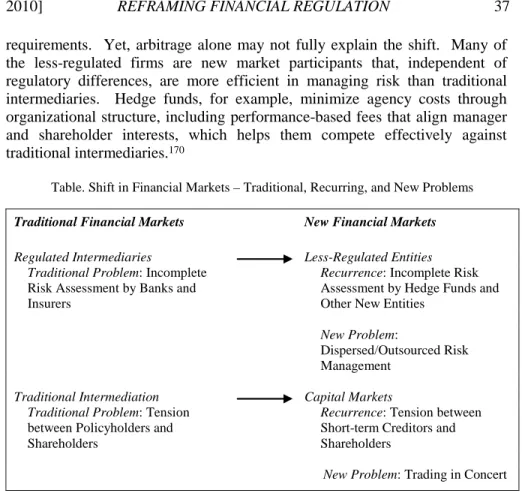
Traditional categories, nevertheless, continue to frame how intermediaries are regulated, even though the convergence in products and services has resulted in similar problems appearing across the financial markets. The resulting problems are illustrated below. The first example, regarding bank runs by investors in non-banks, illustrates how issues addressed by existing regulation have begun to appear in new settings that fall outside the traditional categories. The second example, on the impact of capital requirements on banking competitiveness, outlines the emergence of new problems affecting traditional intermediaries, in many cases prompted by existing regulation. The third example describes the outsourcing of risk management by traditional intermediaries, evidencing the rise of new, unregulated risks among new market participants. I end with a discussion of AIG Financial Products (“AIGFP”), which provides an extreme example of the divide that has grown between the financial markets and financial regulation.
1. Bank and Non-Bank Runs
Within the standard framing, banks rely on short-term credit (deposits) to invest in a portfolio of longer-term assets (loans), capitalizing on special relationships to invest in private borrowers. Bank runs occur when there has been a loss of customer confidence; depositors, facing a collective action problem, rush to withdraw money because they believe, whether well-founded or not, that the bank has become unstable and wish to avoid being last-in-line
to collect their money.90 Banks, in turn, face a liquidity problem, since
86 See Allen & Santomero, supra note 32, at 1464-74; Herring & Santomero, supra note 23, at 29-35.
87 See Thomas G. Fischer et al., The Securities Activities of Commercial Banks: A Legal and Economic Analysis, 51 TENN.L.REV. 467, 474-502 (1984); Sorcher & Kini, supra note 69, at 233-34.
88 See Coffee & Sale, supra note 10, at 737-38, 749.
89 See Donald C. Langevoort, Statutory Obsolescence and the Judicial Process: The Revisionist Role of the Courts in Federal Banking Regulation, 85 MICH.L.REV. 672, 728-33 (1987).
90 See Douglas W. Diamond & Philip H. Dybvig, Banking Theory, Deposit Insurance, and Bank Regulation, 59 J.BUS. 55, 63-64 (1986). Although uncommon today, the United