Boom in Mobile Data Creates Backhaul Urgency
In their bid to improve their profitability and maintain their competitiveness, many mobile operators are rolling out new services meant to generate revenue and increase usage. Supporting these new offerings requires a corresponding increase in the capacity of the backhaul network. Unfortunately, the average revenue per user (ARPU) from new services does not offset the rising capital and operating expense (CAPEX/OPEX) of meeting increased capacity requirements. Consequently, operators need to evolve their mobile backhaul networks to reduce costs without impacting customer satisfaction. This paper will identify the challenges mobile operators face in the current environment; outline the steps they can take to evolve the backhaul network to support greater capacity at lower cost; and examine the role of a trusted partner in helping implement a mobile backhaul solution that meets their specific business imperatives.
Table of Contents
1 Introduction
2 The Backhaul Burdens
3 Transforming the Backhaul Network
3 Optimizing the Total Cost of Ownership (TCO)
6 Minimizing Commercial and Technical Risks
7 Transitioning from PMO to FMO
8 Managing Operations Efficiently and Reducing OPEX
8 Partnering for Change
9 IP Transformation Centers
9 Mobile Evolution Transport Architecture (META)
10 Conclusion
Introduction
Mobile operators face no shortage of challenges in today’s market environment. They need to deliver increasingly sophisticated services and applications that are always available and reasonably priced. They need to juggle diverse traffic types, keep track of complicated service-level agreements (SLAs) and speed time to market—all while reducing capital and operating expense (CAPEX/OPEX) and generating new revenues.
Unfortunately, even as their subscriber base grows, many mobile operators are finding that they cannot meet increasing traffic demands cost-effectively. Simply put, in a climate where data services are far outpacing voice in terms of that demand, the average revenue per user (ARPU) from new services is not enough to offset the requirements for capacity and the associated CAPEX/OPEX.
A big part of the problem is the backhaul infrastructure—that part of the network that includes the cellular base station at the edge, the base station controller, and the Layer 1-3 transport, aggregation, and switching elements in the access and metro networks. This infrastructure, which typically consists of leased lines or TDM microwave, is difficult to scale. Yankee Group estimates backhaul costs account for approximately 30% of network-related OPEX, while Heavy Reading notes that mobile carriers are increasing their spend on
backhaul by 15% to 25% annually to meet demand for a high-quality HSDPA or EV-DO end-user experience.
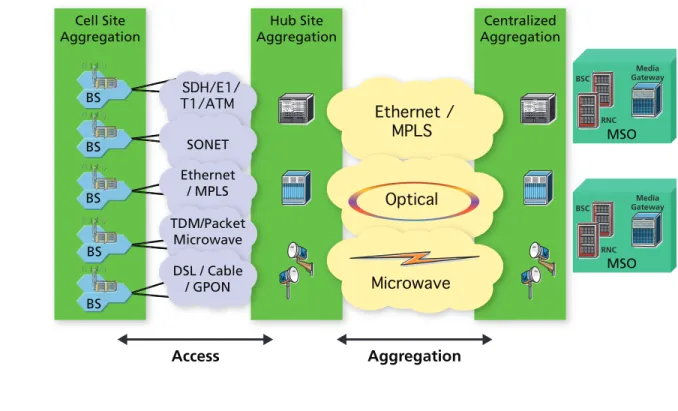
Faced with these realities, mobile operators are rethinking their approach to the backhaul network—migrating from a mix of legacy transports and multiple leased lines to packet-based technologies, so as to support an order of magnitude more capacity at much lower cost.
Figure 1 Media Gateway BSC RNC Media Gateway BSC RNC Cell Site Aggregation Centralized Aggregation Hub Site Aggregation BS BS BS BS BS MSO MSO Ethernet / MPLS Optical Microwave SDH/E1/ T1/ATM SONET Ethernet / MPLS TDM/Packet Microwave DSL / Cable / GPON Access Aggregation
However, evolving the mobile backhaul network is a complex undertaking which requires a comprehensive and well-planned approach. For this reason, mobile operators should engage a trusted partner for help in implementing the solution. A partner that combines extensive experience in mobile and fixed networks with established expertise in IT is best equipped to meet the challenges such a project poses—minimizing risk while helping operators realize optimal results and the greatest business value.
The Backhaul Burdens
Today, the backhaul network is under an increasing amount of stress. The main contributing factor is the emergence of ever-more sophisticated, data-centric services that have a much greater impact on the network than the voice services it was originally intended to handle. These include:
• Web browsing, requiring 9.6 to 240 kb/s • Media streaming, requiring 128 to 384 kb/s • Real-time multimedia, requiring 1 to 3 Mb/s
Further, these high-bandwidth and fast-response applications facilitated by new devices such as the smart phones are changing communication patterns, and the reliable delivery of these services impose technology shifts:
• Radio access speeds are on the rise as networks move from 2G to 3G and then to 4G • New services comprise a mix of bursty traffic, each type of which requires different quality
of service (QoS) handling
• High peak data rates require dynamic allocation of bandwidth
The backhaul network is therefore highly impacted and current estimates show that data traffic will require over 3 times the bandwidth of voice on a 3G network by 2011, and total backhaul bandwidth (2G+3G) will double by 2012 and triple by 2017. (Source: Bell Labs Business Modeling analysis and forecast 2008)
Figure 2 (T b /y e a r)
Traffic on Service Provider 1 Network
Average iPhone 10% 20% 40% 30% P e rc e n t su b sc ri b e rs m o b il e T V o r v id e o Source: MMetrics 900,000 600,000 300,000 – 2 0 0 2 2 0 0 3 2 0 0 4 2 0 0 5 2 0 0 6 2 0 0 7 2 0 0 8 e s t. 2 0 0 9 e s t 2 0 1 0 e s t 2 0 1 1 e s t 2 0 1 2 e s t Voice Data Applications
Not surprisingly, this is leading to increased levels of operational complexity. In handling a wide array of traffic types—from unlimited voice bundles and VPNs to mobile Web services and mobile TV—operators are also dealing with numerous, detailed SLAs. At the same time, they have to manage a variety of multi-vendor network elements to ensure their
interoperability, even as they work to leverage investments in legacy technologies like TDM and ATM.
While Pyramid Research forecasts mobile data will grow 15% worldwide from 2009 to 2013, the per user revenues that new services are supposed to generate are not keeping up with per-user traffic demands. Mobile operators are thus seeking to reduce the cost per bit
transported—by migrating the backhaul network to a packet-based network.1
Doing so offers the following specific advantages:
• Better bandwidth efficiency through statistical multiplexing; bandwidth not used by one source can be dynamically allocated to others
• Optimized traffic grooming, so that there are no idle channels
• Reduced expenses; at equivalent capacity, leased Ethernet costs less than leased T1/E1 circuits
Transforming the Backhaul Network
However, in evolving the backhaul network without disrupting day-to-day operations, mobile operators have to consider a number of key issues. These include multi-vendor
interoperability, network reliability, and scalability. Ensuring a successful transformation involves the following important considerations:
• Optimizing the total cost of ownership (TCO) of the backhaul network
• Securing investment to address the rise in traffic and the future evolution of technology • Minimizing commercial and technical risk
• Securing migration from present mode of operation (PMO) to future mode of operation (FMO)
• Setting up backhaul operations efficiently in order to reduce OPEX
The following section details how mobile operators can address these considerations.
Optimizing the Total Cost of Ownership (TCO)
As mobile operators seek to reduce the price per transported bit, they face several key questions: How can they cost-effectively support a mix of TDM, ATM and Ethernet interfaces? Where to deploy new backhauling technologies? How to architect the ideal transport network? How to minimize end-user impact during migration? What kind of savings can they expect when they migrate to IP/ Ethernet? And what is the cost of operating the new backhaul network?
1Emerging Markets Remain Dynamic Amid Projected 1% Growth Rate for Global Telecom Market in 2009, Pyramid Find, Cambridge,
Mass., USA, Jan. 8, 2009.
Finding clear answers to these questions is the key to optimizing costs. Mobile operators should thus follow these steps:
• Assess the existing backhaul network through audit and traffic analysis; identify existing and future bottlenecks and evolution roadblocks
• Develop business scenarios in terms of subscriber forecast, growth in the number of cell sites, geographic distribution (urban/metro/rural), cell traffic evolution (data vs. voice, delay-sensitive vs. non-delay-sensitive)
• Analyze network evolution alternatives and their impact on operations; for example: – Leased-line solution: Incrementally add leased-line capacity to accommodate growth – Hybrid solution: Keep leased lines for 2G/3G voice and deploy Ethernet for data – Full IP/Ethernet backhaul solution: Use Ethernet and pseudo-wire (PWE) to converge
voice and data on an Ethernet connection
• Develop network modeling and TCO analysis to quantify cost-effectiveness of evolution scenarios, including a sensitivity analysis
The following table summarizes the main parameters used in this model.
Table 1
Main Assumptions
E1 rental fee (urban areas) 300 €/month
E1 rental fee (rural areas) 600 €/month
Traffic per Base Station (urban areas) 10 Mbps Traffic per Base Station (rural areas) 5 Mbps Traffic increase per base station 20% CAGR Number of urban base stations 3000 Number of rural base stations 8000
From Leased lines to Packet Microwave –
Recent modeling for a
European Tier 1 provider shows that an operator can achieve ~ 50%
TCO reduction over 5 years by migration from leased lines (PMO) to
Packet Microwave (FMO), with a payback period of 2 years.
Figure 3
The following charts show the net savings, as well as the sensitivity analysis.
Figure 4
FMO versus PMO
-400 -200 0 200 400 600 800 1000
Year 1 Year 2 Year 3 Year 4 Year 5
M E u ro s PMO Expenses FMO Expenses Net Savings
PMO – Leased Lines
FMO – Packet Microwave
MSC MSC Urban Zones Rural Zones BSC/RNC BSC/RNC E1 E1 SDH/ATM/TDM lub/ATM E1 lub/ATM Base Station Aggregation Site 2 Aggregation Site 3 Aggregation Site 2 Aggregation Site 1 Leased GE Service Router Service Access Router Voice Switch Data Switch Voice Switch Data Switch Scope Scope Base Station Base Station E1 E1 E1
Figure 5
Additionally, mobile operators should produce a detailed backhaul design for specific markets, in which the number, type, size and location of nodes are determined; the equipment
deployed for geographical areas is defined; and bandwidth, reliability and scalability requirements are taken into account.
Minimizing Commercial and Technical Risks
Evolving the mobile backhaul network is an inherently risky undertaking. Multi-vendor, multi-technology interoperability; QoS and reliability; and synchronization requirements are just some of the challenges:
How can operators guarantee user experience with QoS and reliability? Engineering a RAN transport network to avoid congestion is prohibitively expensive. However, operators can implement packet aggregation and advanced end-to-end QoS design to support different traffic classes (defined by 3PPP in the case of UMTS, as shown in the figure below). For example, for an end-to-end GPON-MPLS backhaul, a layer 2 forwarding model is used for access; it needs to be mapped into the MPLS design, whether layer 2 or layer 3 VPNs.
NPV (MEuros)
0 200 400 600 800 1000 1200 1400 1600
E1 rental fee (urban areas) Euros /month
Traffic per Base Station (urban areas) Mbps
Traffic increase per base station
WACC
CAPEX MW
E1 rental price erosion
GigE rental fee Euros /month
CAPEX MW price erosion 200 7 10% 10% 450 15 40% 20% +20% 10% 2500 8% -20% 5% 10000 3%
The four UMTS traffic classes Transfer Delay requirement Transfer Delay variation Low bit Error rate Guaranteed
bit rate Application Examples
Conversational Stringent Stringent No Yes VoIP, video-conferencing, audio-conferencing Fixed resource allocation (like CBR in ATM)
Streaming Constrained Stringent No Yes Broadcast services (audio, video), news, sports Tolerance to a certain amount of delay variation (like VBR in ATM)
Interactive No No Yes No Web browsing, chat, games, m-commerce Services requiring assured response times (scheduling priority)
Background No No Yes No E-mail, SMS, database download Best effort services (lowest priority)
Equipment synchronization also needs to be addressed. Traditionally, 2G base stations were synchronized using the clock reference provided by the BSC/RNC over the E1 connections linking the two network elements. The clock reference was maintained as the E1 circuit was transported over a TDM network. Migrating towards IP/Ethernet networks that do not transport the clock reference transparently requires strict QoS implementation rules to keep delay and jitter to be within ITU-T recommendations, and to ensure recovery of the clock reference. The most secured way to mitigate these risks is to pre-integrate the end-to-end solution in a lab environment. Typical lab validation programs include both functional and non-functional tests:
• Interoperability, including, for example, performance and functionality tests for different DSLAM/CPE combinations
• Solution level testing, including, for example, end-to-end connectivity and solution management across vendors
• Synchronization, including clock stability against ITU-T recommendations and behavior under various conditions, such as traffic overload or network outage
• QoS, including confirmation of the QoS mechanism and end-to-end performance of high-priority traffic in the presence of varying levels of lower high-priority traffic
• Scalability, including end-to-end performance as a function of traffic levels and verification that hundreds of base stations can be connected to the BSC/RNC site
• Availability and resilience, including failure mode testing and fault recovery • Negative testing to check impact of impairments
• Operation, administration and maintenance (OAM), including alarm generation/reporting under fault conditions and testing of operations methods of procedure
• Quality of experience (QoE), including connection setup and retainability, speech quality, video quality and page loading
Transitioning from PMO to FMO
Moving from present mode of operation to future mode of operation requires efficient management to ensure delivery against key business requirements, with a focus on the creation and implementation of the following:
• Reusable industrialized migration processes that deliver successful migrations at a consistent level of quality in accordance with schedules
• Consistent migration management control to ensure maximum continuity / minimum risk, with a constant reporting channel to ensure visibility into progress and involvement in decisions
• End-to-end migration timeline measured against defined quality benchmarks aligned with the principal elements of the process. For example:
– Pre-migration management (including planning for transition of traffic, preparation of sites, facilities upgrade, infrastructure rollout, and roll-back strategy)
– Migration readiness (including validation that pre-migration tasks have been completed, risks managed and sites prepared)
– Migration execution (including logical movement or update of data, fault monitoring and reporting)
– Post-migration management (including stability monitoring and smooth hand-over to the operator’s business as usual management)
The figure below shows an example of the main steps involved in a 3G backhaul network.
Figure 6
Mobile backhaul transformation projects usually span multiple regions and can be broken down into several delivery projects. To maximize backhaul efficiency, this may sometimes include a base station re-parenting, as well as the relocation of some BSC/RNC equipment.
Managing Operations Efficiently and Reducing OPEX
Because backhaul migration is such a large undertaking, the help of a trusted partner is often required. The partner can then take on the Prime Integrator role and the responsibilities of deploying, operating and maintaining the network on an ongoing basis, freeing mobile operators to concentrate on the delivery of in-demand services.
Specifically, mobile operators can turn to a trusted partner to handle the following: • Backhaul operations setup and readiness
• Implementation of operation and maintenance business processes in line with the Enhanced Telecommunications Operations Map (eTOM) model
• Setup of operations and management teams, operational training, database population and operation readiness tests
• NOC operations, including backhaul network monitoring, performance management, provisioning and technical support
Furthermore, mobile operators can transfer all backhaul-related end-to-end processes (including network engineering, network operations and maintenance) to a partner able to maximize process efficiency and operate with greater agility. This allows the operator to: • Control the delay for the creation of an end-to-end transmission link
MTSO Aggregation Access Aggregation IP / MPLS and Optical Backbone Intranet/ CorporateVPNs Evolving 2G, 3G RAN Backhaul TDM N*T1/E1 ATM IMA Ethernet NEW IP RAN Backhaul Service Router Service Router SGSN GGSN MSC/MGW BSC RNC RNC OC-3/STM-1, OC-12/STM-4 Ethernet
QuickTime™ and adecompressor are needed to see this picture.
Multi-Service ATM Multi-Service ATM IMS PSTN
Sample Evolution to IP/MPLS backhaul Encapsulation of ATM interfaces in PW for transport over DSL/GPON
Addition of Ethernet interfaces into multiservice ATM switches
Addition of Service routers with Ethernet for HSPA
Addition of ATM & CE interfaces to Service routers & converge
• Increase the speed of production • Reduce the cost of operations
Partnering for Change
The transformation of the backhaul network is a challenging undertaking for many mobile operators. As they consider the potential approaches, they should view their decision-making in the context of the following questions:
• Are there skilled resources available to design the next-generation network ? • Can the inter-operability of multi-vendor network elements be ensured end to end? • Are there enough experienced staff in place to embark on large migration projects and to
manage the potential business disruptions?
• Are there sufficient personnel resources to operate the new network while current operations still need to be maintained ?
Many mobile operators may not be able to answer “yes” to all of these questions. In such cases, enlisting a trusted partner to act as a one-stop shop could be the best option.
IP Transformation Centers
In order to fully support service providers in their transformation programs, Alcatel-Lucent has invested in a network of integration facilities across the world, known as IP
Transformation Centers (IPTCs). Currently, regional IPTCs are located in New Jersey, Antwerp, and Singapore, hosting more than 50 technologies.
Figure 7
In the IPTCs’ Hosted Integration Lab, service providers have one-stop access to a live test environment in which to replicate their own (multi-vendor) network, and to configure, pre-integrate and test end-to-end solutions encompassing terminals, network infrastructure, service application platforms and OSS/BSS.
Americas
Murray Hill, NJ
Europe, Middle East & Africa
Antwerp, Belgium
Asia and Pacific
In addition to state-of-the-art lab facilities, Alcatel-Lucent leverages industry standard architectures such as the Mobile Evolution Transport Architecture.
Mobile Evolution Transport Architecture (META)
META is an end-to-end architecture – from cell site to core – designed to help service providers make a profitable transition to a more cost-effective mobile transport network infrastructure. META provides industry leading integrated end-to-end management across multiple technology domains – wireless and wireline - to dramatically simplify operations and reduce operating expenditures (OPEX).
Figure 8
Alcatel-Lucent helps operators in mitigating potential risks in areas such as end-to-end network design, end-to-end integration, process reengineering and migration.
Conclusion
The major challenge for mobile operators is architecting and deploying a high-performance backhaul solution capable of reducing the cost per transmitted bit. One strategy to minimize risks is to select a partner with:
• Business and economic modeling tools in order to optimize Total Cost of Ownership (TCO) • Expertise in multi-technology (wireline/wireless), multi-vendor design
• Advanced Ethernet / IP technology R&D across multiple platforms to ensure equipment interoperability
•Proven ability to test and validate end-to-end solutions
• Experience and capability in infrastructure migrations (end-to-end methods and procedures, roll-back strategy, migration tools)
• Proven capability in operations set-up and network monitoring
By selecting a trusted partner to implement their backhaul solution, mobile operators put themselves in a better position to address their pressing business imperatives: offering new services in response to subscriber demand, speeding time to market, generating revenue and reducing operating expenses.
C O R E IP/MPLS and Optical Core
Network and Service Management
TDM/Ethernet
TDM/Ethernet
TDM/Ethernet Optical, Microwave or IP/MPLS Backhaul
* S U P P O RT O F M U LT I - G E N E R AT I O N A L W I R E L E S S N E T W O R K S U S I N G A N Y B T S / N O D E B ( C D M A B T S , G S M / G P R S B T S , U M T S , W I M A X , E V D O / H S PA , B S R F E M T O , LT E ) 7 7 1 0 / 7 7 5 0 S R , 7 6 7 0 R S P, 1 8 5 0 T S S , 1 6 6 X , M D R 8 0 0 0 O R 9 6 0 0 L S Y 7 7 5 0 S R , 1 8 5 0 T S S , 1 6 X X A C C E S S A G G R E G A T I O N IMS Internet BSC/RNC SGSN aGW PDSN/GGSN MSC/MGW PSTN Optical BTS/Node B* 1850 TSS-5 IP/MPLS 7705 SAR BTS/Node B* TDM/Ethernet Microwave 9500 MPR BTS/Node B* DSL/GPON BTS/Node B* Cellsite Aggregator ISAM 5 End-to-End Services and Network Integration 6 7750 SR 1850 TSS 1850 TSS 73xx ISAM 9500 MPR 7705 SAR
Industry Leading IP/MPLS and Optical Core
(increases network availability and capacity)
Flexible Transport & Aggregation
(2G / 3G / 4G traffic optimization)
Service Aware Management
(enhances end-user experience)
Network Transformation Expertise
About the Authors
Thierry Lebugle Solution Manager Alcatel-Lucent Services
Thierry has over 12 years of experience in the telecommunications business, specializing in the delivery of design, optimization and consultancy services. He previously managed the Consulting & Engineering Service Line within Alcatel Mobile Group before joining the Network & System Integration Division to develop Alcatel-Lucent mobile backhaul services Anne Henrotte
Business Consultant Alcatel-Lucent Services
Anne has over 15 years of experience in the telecommunications business gained through system engineering, large offers preparation and business development.
www.alcatel-lucent.com
Alcatel, Lucent, Alcatel-Lucent and Alcatel-Lucent logo are trademarks of Alcatel-Lucent. All other trademarks are the property of their respective owners. The information presented is subject to change without notice. Alcatel-Lucent assumes no responsibility for inaccuracies contained herein. © 2009 Alcatel-Lucent. All rights reserved.