A Joint Standard of AASHTO, ITE, and NEMA
NTCIP 1201:2005
v02.32
National Transportation
Communications for ITS Protocol
Global Object (GO) Definitions –
version 02
October 2005
A major revision of NTCIP 1201 v01.10,
which included NTCIP 1201 Amendment 1 v07
This Adobe® PDF copy of an NTCIP standard is available at no-cost for a limited time through support from the U.S. DOT / Federal Highway Administration, whose assistance is gratefully acknowledged.
Published by
American Association of State Highway and Transportation Officials (AASHTO)
444 North Capitol Street, N.W., Suite 249 Washington, D.C. 20001
Institute of Transportation Engineers (ITE)
1099 14th Street, N.W., Suite 300 West Washington, D.C. 20005-3438
National Electrical Manufacturers Association (NEMA)
1300 North 17th Street, Suite 1752 Rosslyn, Virginia 22209-3806
Do Not Copy Without Written Permission © 2005 AASHTO / ITE / NEMA Version 01 © 2001 by the National Electrical Manufacturers Association (NEMA). Version 02 2005 by the American Association of State Highway and Transportation Officials (AASHTO), the Institute of Transportation Engineers (ITE), and the National Electrical Manufacturers Association (NEMA). All intellectual property rights, including, but not limited to, the rights of reproduction, translation, and display are reserved under the laws of the United States of America, the Universal Copyright Convention, the Berne Convention, and the International and Pan American Copyright Conventions. Except as licensed or permitted, you may not copy these materials without prior written permission from AASHTO, ITE, or NEMA. Use of these materials does not give you any rights of ownership or claim of copyright in or to these materials.
Visit www.ntcip.org for other copyright information, for instructions to request reprints of excerpts, and to request reproduction that is not granted below.
PDF File License Agreement
To the extent that these materials are distributed by AASHTO / ITE / NEMA in the form of an Adobe® Portable Document Format (PDF) electronic data file (the “PDF File”), AASHTO / ITE / NEMA authorizes each registered PDF File user to view, download, copy, or print the PDF File available from the
authorized Web site, subject to the terms and conditions of this license agreement:
(a) you may download one copy of each PDF File for personal, noncommercial, and intraorganizational use only;
(b) ownership of the PDF File is not transferred to you; you are licensed to use the PDF File;
(c) you may make one more electronic copy of the PDF File, such as to a second hard drive or burn to a CD;
(d) you agree not to copy, distribute, or transfer the PDF File from that media to any other electronic media or device;
(e) you may print one paper copy of the PDF File;
(f) you may make one paper reproduction of the printed copy;
(g) any permitted copies of the PDF File must retain the copyright notice, and any other proprietary notices contained in the file;
(h) the PDF File license does not include (1) resale of the PDF File or copies, (2) republishing the content in compendiums or anthologies, (3) publishing excerpts in commercial publications or works for hire, (4) editing or modification of the PDF File except those portions as permitted, (5) posting on network servers or distribution by electronic mail or from electronic storage devices, and (6) translation to other languages or conversion to other electronic formats;
(i) other use of the PDF File and printed copy requires express, prior written consent.
Data Dictionary and MIB Distribution Permission
To the extent that these materials are distributed by AASHTO / ITE / NEMA in the form of a Data Dictionary (“DD”) or Management Information Base (“MIB”), AASHTO / ITE / NEMA extend the following permission:
You may make or distribute unlimited copies, including derivative works, of the DD or MIB, including copies for commercial distribution, provided that:
(i) each copy you make or distribute contains the citation “Derived from NTCIP 0000 [insert the document number]. Used by permission of AASHTO / ITE / NEMA.”;
© 2005 AASHTO / ITE / NEMA Do Not Copy Without Written Permission
(ii) the copies or derivative works are not made part of the standards publications or works offered by other standards developing organizations or publishers or as works-for-hire not associated with commercial hardware or software products intended for field implementation;
(iii) use of the DD or MIB is restricted in that the syntax fields may be modified only to reflect a more restrictive subrange or enumerated values;
(iv) the description field may be modified but only to the extent that: (a) only those bit values or enumerated values that are supported are listed; and (b) the more restrictive subrange is expressed. These materials are delivered “AS IS” without any warranties as to their use or performance.
AASHTO / ITE / NEMA and their suppliers do not warrant the performance or results you may obtain by using these materials. AASHTO / ITE / NEMA and their suppliers make no warranties, express or implied, as to noninfringement of third party rights, merchantability, or fitness for any particular purpose. In no event will AASHTO / ITE / NEMA or their suppliers be liable to you or any third party for any claim or for any consequential, incidental or special damages, including any lost profits or lost savings, arising from your reproduction or use of these materials, even if an AASHTO / ITE / NEMA representative has been advised of the possibility of such damages.
Some states or jurisdictions do not allow the exclusion or limitation of incidental, consequential or special damages, or the exclusion of implied warranties, so the above limitations may not apply to you.
Use of these materials does not constitute an endorsement or affiliation by or between AASHTO, ITE, or NEMA and you, your company, or your products and services.
If you are unwilling to accept the foregoing restrictions, you should immediately return these materials.
PRL and RTM Distribution Permission
To the extent that these materials are distributed by AASHTO / ITE / NEMA in the form of a Profile Requirements List (“PRL”) or a Requirements Traceability Matrix (“RTM”), AASHTO / ITE / NEMA extend the following permission:
(i) you may make and/or distribute unlimited copies, including derivative works of the PRL (then known as a Profile Implementation Conformance Statement (“PICS”)) or the RTM, provided that each copy you make and/or distribute contains the citation “Based on NTCIP 0000 [insert the document number] PRL or RTM. Used by permission. Original text © AASHTO / ITE / NEMA.”;
(ii) you may not modify the PRL or the RTM except for the Project Requirements column, which is the only column that may be modified to show a product’s implementation or the project-specific
requirements; and
(iii) if the PRL or RTM excerpt is made from an unapproved draft, add to the citation “PRL (or RTM) excerpted from a draft document containing preliminary information that is subject to change.” This limited permission does not include reuse in works offered by other standards developing organizations or publishers, and does not include reuse in works-for-hire, compendiums, or electronic storage devices that are not associated with commercial hardware or software products intended for field installation.
A PICS is a Profile Requirements List which is completed to indicate the features that are supported in an implementation. Visit www.ntcip.org for information on electronic copies of the MIBs, PRLs, and RTMs.
Do Not Copy Without Written Permission © 2005 AASHTO / ITE / NEMA Requirements Form (“TRF”), AASHTO / ITE / NEMA extend the following permission:
(i) you may make or distribute unlimited electronic or hard copies, including derivative works of the TRF, provided that each copy you make or distribute contains the citation “Based on NTCIP 0000 [insert the document number] TRF. Used by permission. Original text © AASHTO / ITE / NEMA.”;
(ii) you may not modify the logical flow of any test procedure, without clearly noting and marking any such modification; and
(iii) if the TRF excerpt is made from an unapproved draft, add to the citation “TRF excerpted from a draft document containing preliminary information that is subject to change.”
Content and Liability Disclaimer
The information in this publication was considered technically sound by the consensus of persons engaged in the development and approval of the document at the time it was developed. Consensus does not necessarily mean that there is unanimous agreement among every person participating in the development of this document.
AASHTO, ITE, and NEMA standards and guideline publications, of which the document contained herein is one, are developed through a voluntary consensus standards development process. This process brings together volunteers or seeks out the views of persons who have an interest in the topic covered by this publication. While AASHTO, ITE, and NEMA administer the process and establish rules to promote fairness in the development of consensus, they do not write the document and they do not independently test, evaluate, or verify the accuracy or completeness of any information or the soundness of any
judgments contained in their standards and guideline publications.
AASHTO, ITE, and NEMA disclaim liability for any personal injury, property, or other damages of any nature whatsoever, whether special, indirect, consequential, or compensatory, directly or indirectly resulting from the publication, use of, application, or reliance on this document. AASHTO, ITE, and NEMA disclaim and make no guaranty or warranty, express or implied, as to the accuracy or completeness of any information published herein, and disclaims and makes no warranty that the information in this document will fulfill any of your particular purposes or needs. AASHTO, ITE, and NEMA do not undertake to guarantee the performance of any individual manufacturer or seller’s products or services by virtue of this standard or guide.
In publishing and making this document available, AASHTO, ITE, and NEMA are not undertaking to render professional or other services for or on behalf of any person or entity, nor are AASHTO, ITE, and NEMA undertaking to perform any duty owed by any person or entity to someone else. Anyone using this document should rely on his or her own independent judgment or, as appropriate, seek the advice of a competent professional in determining the exercise of reasonable care in any given circumstances. Information and other standards on the topic covered by this publication may be available from other sources, which the user may wish to consult for additional views or information not covered by this publication.
AASHTO, ITE, and NEMA have no power, nor do they undertake to police or enforce compliance with the contents of this document. AASHTO, ITE, and NEMA do not certify, test, or inspect products, designs, or installations for safety or health purposes. Any certification or other statement of compliance with any health or safety–related information in this document shall not be attributable to AASHTO, ITE, or NEMA and is solely the responsibility of the certifier or maker of the statement.
© 2005 AASHTO / ITE / NEMA Do Not Copy Without Written Permission
Trademark Notice
NTCIP is a trademark of AASHTO / ITE / NEMA. All other marks mentioned in this document are the trademarks of their respective owners.
Do Not Copy Without Written Permission © 2005 AASHTO / ITE / NEMA < This page is intentionally left blank. >
© 2005 AASHTO / ITE / NEMA Do Not Copy Without Written Permission
ACKNOWLEDGEMENTS
This publication was prepared by the NTCIP Global Object Working Group, which is a subdivision of the Joint Committee on the NTCIP. The Joint Committee is organized under a Memorandum of
Understanding among the American Association of State Highway and Transportation Officials (AASHTO), the Institute of Transportation Engineers (ITE), and the National Electrical Manufacturers Association (NEMA). The Joint Committee on the NTCIP consists of six representatives from each of the standards organizations, and provides guidance for NTCIP development.
At the time that this document was prepared, the following individuals were members of the NTCIP Global Object Working Group:
• Bob De Roche • Curtis Herrick • Paul Hing • Bud Kent • Larry Lindley
• Joerg “Nu” Rosenbohm • Ken Vaughn (Chair)
Other individuals providing input to the document, include: • Moon Chueng • Blake Christie • Mike Forbis • Craig Gardner • Robert Martindale • Gary Meredith • Jeris White
In addition to the many volunteer efforts, recognition is also given to those organizations who supported the efforts of the working groups by providing comments and funding for the standard, including:
• U.S. Department of Transportation, Federal Highway Administration • Econolite Control Products, Inc.
• G. C. Herrick & Associates, Inc. • Iteris, Inc.
• Ministry of Ontario • Mitretek
• PB Farradyne, a Division of PBQD, Inc. • Peek Transportation Systems
• Robert De Roche Consulting, Inc. • Siemens ITS
• Trevilon
• Washington State Department of Transportation
Do Not Copy Without Written Permission © 2005 AASHTO / ITE / NEMA
FOREWORD
This document uses only metric units.
The purpose of this publication is to identify and define the common object definitions that may be supported by devices that are NTCIP-compliant.
This document is an NTCIP Device Data Dictionary standard. Device Data Dictionary standards provide definitions of data elements for use within NTCIP systems. A Joint NTCIP data dictionary standards publication is equivalent to these document types at the standards organizations:
AASHTO – Standard Specification ITE – Software Standard
NEMA – Standard
For more information about NTCIP standards, visit the NTCIP Web site at http://www.ntcip.org.
User Comment Instructions
The term “User Comment” includes any type of written inquiry, comment, question, or proposed revision, from an individual person or organization, about any part of this standard publication’s content. A “Request for Interpretation” of this standard publication is also classified as a User Comment. User Comments are solicited at any time. In preparation of this NTCIP standards publication, input of users and other interested parties was sought and evaluated.
All User Comments will be referred to the committee responsible for developing and/or maintaining this standards publication. The committee chairperson, or their designee, may contact the submitter for clarification of the User Comment. When the committee chairperson or designee reports the committee’s consensus opinion related to the User Comment, that opinion will be forwarded to the submitter. The committee chairperson may report that action on the User Comment may be deferred to a future committee meeting and/or a future revision of the standards publication. Previous User Comments and their disposition may be available for reference and information at www.ntcip.org.
A User Comment should be submitted to this address: NTCIP Coordinator
National Electrical Manufacturers Association 1300 North 17th Street, Suite 1752
Rosslyn, Virginia 22209-3801 fax: (703) 841-3331 e-mail: [email protected]
A User Comment should be submitted in the following form:
Standard Publication number and version: Page:
Paragraph or Clause: Comment:
© 2005 AASHTO / ITE / NEMA Do Not Copy Without Written Permission
Approvals
This document was separately balloted and approved by AASHTO, ITE, and NEMA after
recommendation by the Joint Committee on the NTCIP. Each organization has approved this standard as the following standard type, as of the date:
AASHTO – Standard Specification; October 2004 ITE – Software Standard; March 2005
NEMA – Standard; November 2004
History
From 1996 to 1999, this document was referenced as NEMA TS 3.4. However, to provide an organized numbering scheme for the NTCIP documents, this document is now referenced as NTCIP 1201. The technical specifications of NTCIP 1201 are identical to the former reference, except as noted in the development history below:
NEMA TS 3.4-1996 v96.01.7, April 7, 1997. October 1996 – Version 1.5 approved by NEMA. April 1997 – Version 1.7 published by NEMA with editorial corrections. October 1996 – Accepted as a Recommended Standard by the Joint Committee on the NTCIP. Approved by AASHTO in 1997 and approved by ITE in December 1997.
NEMA TS 3.4 Amendment 1 v98.01.07. October 1998 – Version 98.01.05 accepted as a
Recommended Amendment by the Joint Committee on the NTCIP, and edited v01.07 referred for balloting and approval by NTCIP Standards Bulletin B0032 in May 1999. Approved by AASHTO in October 1999, approved by ITE in January 2001, and approved by NEMA in December 1999. Amendment 1 clarified ambiguities discovered during real-world implementations of this standard. NTCIP 1201:1996 [assigned version 01.08]. August 1999 – Assigned NTCIP 1201 document number in NTCIP Standards Bulletin B0038. August 2000 – Joint NTCIP Standards Publication cover used over TS 3.4 contents.
NTCIP 1201:1996 v01.10, December 2001. January 2002 – Formatted for printing: incorporated Amendment 1 v07 into text; updated title page date and version number; modified and
reorganized front matter to conform to NTCIP 8002. Most references to TS 3 standard designations were changed to equivalent NTCIP standard numbers.
NTCIP 1201 v02. Developed to reflect additional lessons learned, to incorporate better documentation (in the Annex) of some of the logic required to implement the standards, and to add new features requested by the ITS community.
NTCIP 1201 v02.14. September 2001 – Accepted by the NTCIP Joint Committee as a User Comment Draft. February 2002 – NTCIP Standards Bulletin B0071 distributed NTCIP 1201 v02.16 for review and comment.
NTCIP 1201 v02.24. October 2002 – Accepted by the NTCIP Joint Committee as a
Recommended Standard. April 2004 – NTCIP Standards Bulletin B0092 referred NTCIP 1201 v02.26 for balloting. Approved by AASHTO in October 2004, approved by ITE in March 2005, and approved by NEMA in November 2004.
Do Not Copy Without Written Permission © 2005 AASHTO / ITE / NEMA NTCIP 1201 v02.31. February 2005 – Disposed of ballot period comments on backward
compatibility, object deprecation, and others. In clause 1.3 Terms, added Deprecated and Obsolete definitions.
Specific changes made from NTCIP 1201 v01.10 (1996) to v02.31 include:
1. Added Unified Modeling Language (UML) diagrams to explain interrelationships between objects. 2. Adjusted the ISO Tree Structure diagram to conform to this updated document.
3. Modified the DESCRIPTION field of the object definitions to conform with ISO 14817. 4. Changed MIB name to reflect new version.
5. Added Default Value statements to several Configuration and Control object definitions. This was not necessary for Status-type object definitions.
6. Added wording to the moduleVersion object definition to clarify the value content of this object. 7. Added an object definition that allows to identify on which Information Profile MIB an implementation
is based.
8. Added additional clarifications to the DESCRIPTION field of the dbCreateTransation object definition. 9. Deprecated the dbErrorType, the dbErrorID, the dbTransactionID, and the dbMakeID object
definitions.
10. Expanded on the possible parameter values for the globalDaylightSavings object definition. 11. Added a timeBaseScheduleTable-status object definition to identify which schedule is currently
selected by the schedule.
12. Added additional clarifying wording to the DESCRIPTION field of several objects within the dayPlanTable, especially the dayPlanActionNumberID object definition.
13. Deprecated the globalLocalTimeDifferential object definition. 14. Added the standardTimeZone and localTime object definitions.
15. Added clarifying wording to several object definitions within the Report node tables.
16. Changed the sequence of the three tables within the Report node to show the logical sequence of populating and querying those tables.
17. Added another value (andedWithValue) to the eventConfigMode object definition and clarified the wording explaining the various possible values.
18. Added another value (error) to the eventConfigStatus object definition. 19. Modified the SYNTAX of the maxEventLogSize object.
20. Deprecated the hdlcGroupAddress object definition.
21. Moved the object definitions previously defined under the Security node to NTCIP 1103.
22. Moved the object definitions for the Auxiliary I/O objects previously defined in NTCIP 1203 to a node under the Global object definitions. Some clarifications were added to those object definitions. Additionally, an object definition (auxIO-lastCommandedState) was added.
23. Deleted Section 3 (Group Definitions) and Section 4 (Conformance Statements) because
conformance to definitions within this document should be made within the referencing Information Profiles such as NTCIP 1202 (ASC) or NTCIP 1203 (DMS).
24. Added Annex A to provide a Concept of Operations explaining the interrelationships between objects to achieve a particular function.
25. Added Annex B to show all deprecated object definitions. 26. Added Annex C to show UML class diagrams.
27. NOTE on dbVerifyStatus. To align NTCIP 1201 v02 with other NTCIP and several Internet
standards, the object definitions in NTCIP 1201 v01.10 that had enumerated values starting with a value of (0) have been changed in NTCIP 1201 v02 to start with a value of (1). This change affected clause 2.3.6, dbVerifyStatus. The changed definition in NTCIP 1201 v02 makes this object incompatible with NTCIP 1201:1996 v01.10.
NTCIP 1201:2005 v02.32. October 2005 – Edited document for publication with modified and reorganized front matter.
© 2005 AASHTO / ITE / NEMA Do Not Copy Without Written Permission
Compatibility of Versions
All NTCIP Standards Publications have a major and minor version number for configuration management. The version number syntax is "v00.00a," with the major version number before the period, and the minor version number and edition letter (if any) after the period.
Anyone using this document should seek information about the version number that is of interest to them in any given circumstance. The MIB, the PRL, and the PICS should all reference the version number of the standards publication that was the source of the excerpted material.
Compliant systems based on later, or higher, version numbers MAY NOT be compatible with compliant systems based on earlier, or lower, version numbers. Anyone using this document should also consult NTCIP 8004 for specific guidelines on compatibility.
Do Not Copy Without Written Permission © 2005 AASHTO / ITE / NEMA
INTRODUCTION
This publication defines data elements for use with various transportation devices. The data is defined using the Simple Network Management Protocol (SNMP) object-type format as defined in RFC 1212 and the NTCIP format defined in NTCIP 8004. This data would typically be exchanged using one of the NTCIP 1103 recognized Application Layers (e.g., SNMP).
This standard defines requirements that are applicable to all NTCIP environments and it also contains optional and conditional clauses that are applicable to specific environments for which they are intended. The following keywords apply to this document: AASHTO, ITE, NEMA, NTCIP, global, data, data
dictionary, object.
In 1992, the NEMA 3-TS Transportation Management Systems and Associated Control Devices Section began the effort to develop the NTCIP. Under the guidance of the Federal Highway Administration’s NTCIP Steering Group, the NEMA effort was expanded to include the development of communications standards for all transportation field devices that could be used in an ITS network.
In September 1996, an agreement was executed among AASHTO, ITE, and NEMA to jointly develop, approve, and maintain the NTCIP standards. In late 1998, the Global Object Working Group was tasked with updating the Global Object Definitions standard. The first meeting of the GO WG was held in January 1999.
© 2005 AASHTO / ITE / NEMA Do Not Copy Without Written Permission CONTENTS Page FOREWORD... ii INTRODUCTION... vi Section 1 GENERAL... 1 1.1 Scope... 1 1.2 References ... 1 1.2.1 Normative References... 1 1.2.2 Other References ... 2 1.3 Terms... 2
1.4 Abbreviations and Acronyms... 3
1.5 Object Tree ... 4
1.6 Controller Class Diagram ... 6
Section 2 OBJECT DEFINITIONS... 7
2.1 NTCIP Objects... 7
2.2 Global Configuration Node ... 8
2.2.1 Global Set ID Parameter ... 8
2.2.2 Maximum Modules Parameter ... 8
2.2.3 Module Table... 9
2.2.3.1 Module Number Parameter ... 9
2.2.3.2 Module Device Node Parameter ... 9
2.2.3.3 Module Make Parameter ... 10
2.2.3.4 Module Model Parameter ... 10
2.2.3.5 Module Version Parameter... 10
2.2.3.6 Module Type Parameter ... 11
2.2.4 Base Standards Parameter ... 11
2.3 Global Database Management Node ... 12
2.3.1 Database Creation Transaction ... 12
2.3.2 Database Error Type Parameter ... 16
2.3.3 Database Error ID Parameter... 16
2.3.4 Database Transaction ID Parameter... 16
2.3.5 Database Make ID Parameter... 17
2.3.6 Database Verify Status Parameter... 17
2.3.7 Database Verify Error Parameter ... 17
2.4 Global Time Management Node ... 18
2.4.1 Global Time Parameter ... 18
Do Not Copy Without Written Permission © 2005 AASHTO / ITE / NEMA
2.4.3 TimeBase Event Scheduler Node ... 19
2.4.3.1 Maximum Number of Time Base Schedule Entries Parameter... 20
2.4.3.2 Time Base Schedule Table... 20
2.4.3.3 Schedule Status Parameter... 23
2.4.4 Day Plan Parameters ... 23
2.4.4.1 Maximum Number of Day Plans- Parameter... 23
2.4.4.2 Maximum Number of Day Plan Events - Parameter... 24
2.4.4.3 Day Plan Table ... 24
2.4.4.4 Day Plan Status Parameter ... 27
2.4.5 Global Local Time Differential Parameter ... 27
2.4.6 Standard Time Zone Parameter... 27
2.4.7 Local Time Parameter ... 28
2.5 Report Parameter Node ... 28
2.5.1 Maximum Event Classes Parameter ... 28
2.5.2 Event Class Table ... 29
2.5.2.1 Event Class Number Parameter ... 29
2.5.2.2 Event Class Limit Parameter ... 29
2.5.2.3 Event Class Clear Time Parameter ... 30
2.5.2.4 Event Class Description Parameter... 30
2.5.2.5 Event Class Number of Rows in Event Log Table Parameter... 30
2.5.2.6 Class Event Log Counter Parameter ... 31
2.5.3 Maximum Event Log Configurations Parameter ... 31
2.5.4 Event Log Configuration Table... 31
2.5.4.1 Event Log Configuration ID Parameter... 32
2.5.4.2 Event Log Configuration Class Parameter ... 32
2.5.4.3 Event Log Configuration Mode Parameter ... 33
2.5.4.4 Event Log Configuration Compare Value Parameter ... 34
2.5.4.5 Event Log Configuration Compare Value 2 Parameter ... 34
2.5.4.6 Event Log Configuration Compare Object Identifier Parameter ... 35
2.5.4.7 Event Log Configuration Log Object Identifier Parameter... 35
2.5.4.8 Event Log Configuration Action Parameter ... 36
2.5.4.9 Event Log Configuration Status Parameter ... 36
2.5.5 Maximum Event Log Size Parameter... 37
2.5.6 Event Log Table ... 37
2.5.6.1 Event Log Class Parameter... 37
2.5.6.2 Event Log Number Parameter ... 38
2.5.6.3 Event Log ID Parameter ... 38
2.5.6.4 Event Log Time Parameter ... 38
2.5.6.5 Event Log Value Parameter... 39
2.5.7 Total Event Log Counter Parameter... 39
© 2005 AASHTO / ITE / NEMA Do Not Copy Without Written Permission
2.6.1 Maximum HDLC Group Address Parameter... 40
2.6.2 HDLC Group Address Table ... 40
2.6.2.1 HDLC Group Address Index Parameter ... 41
2.6.2.2 HDLC Group Address Parameter ... 41
2.6.2.3 HDLC Group Address Number Parameter ... 41
2.7 Security Node ... 41
2.7.1 Community Name Administrator Parameter ... 42
2.7.2 Maximum Community Names Parameter ... 42
2.7.3 Community Names Table... 42
2.7.3.1 Community Name Index Parameter ... 43
2.7.3.2 User Community Name Parameter... 43
2.7.3.3 User Community Name Mask Parameter... 44
2.8 Auxiliary I/O Objects ... 44
2.8.1 Maximum Number of Digital Auxiliary IOs Parameter... 44
2.8.2 Maximum Number of Analog Auxiliary IOs Parameter... 44
2.8.3 Auxiliary IO Table Parameter ... 45
2.8.3.1 Auxiliary Port Type Parameter... 45
2.8.3.2 Auxiliary Port Number Parameter ... 46
2.8.3.3 Auxiliary Description Parameter ... 46
2.8.3.4 Auxiliary Resolution Parameter ... 46
2.8.3.5 Auxiliary Value Parameter ... 47
2.8.3.6 Auxiliary Port Direction Parameter... 47
2.8.3.7 Auxiliary Port Last Commanded State Parameter... 47
Section 3 CONFORMANCE ... 48
Annex A CONCEPT OF OPERATIONS (NORMATIVE)... 49
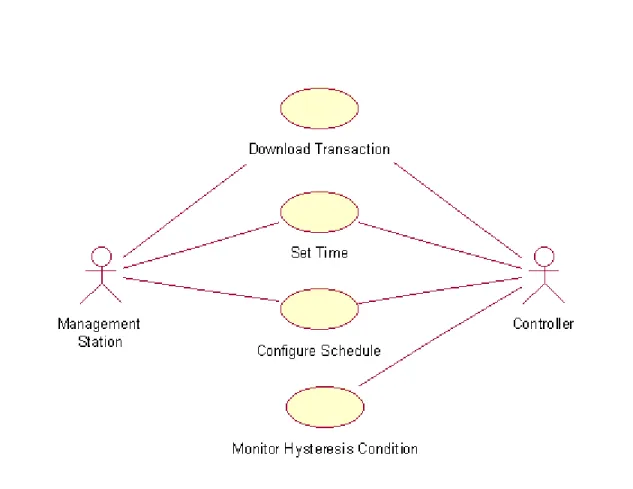
A.1 Download Transaction Use Case... 49
A.2 Set Time ... 52
A.3 Configure Scheduler... 54
A.4 Monitor Hysteresis Condition ... 54
Annex B DOCUMENTATION OF REVISIONS (INFORMATIVE) ... 56
B.1 Transaction Mode... 56
B.2 Local Time ... 56
B.3 HDLC Group Address ... 56
Annex C CLASS DIAGRAMS (INFORMATIVE) ... 57
C.1 Configuration Information ... 57
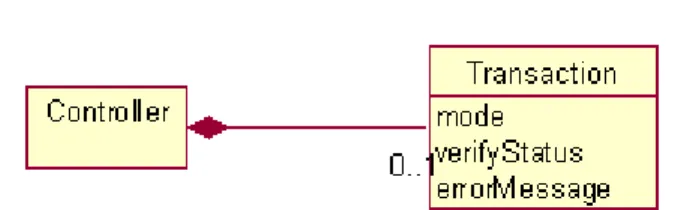
C.2 Transaction Information... 58
C.3 Time Information... 58
Do Not Copy Without Written Permission © 2005 AASHTO / ITE / NEMA
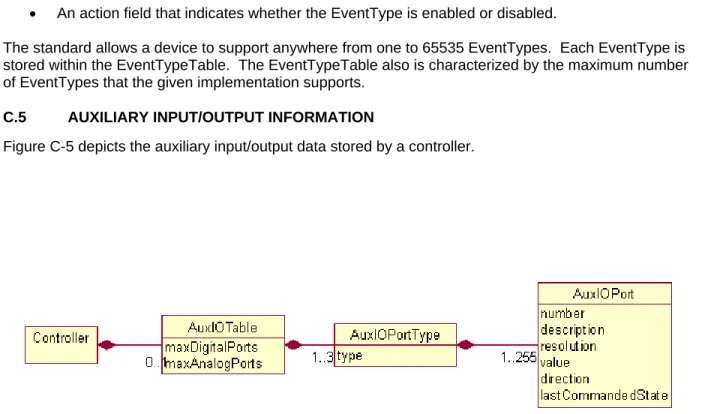
C.5 Auxiliary Input/Output Information ... 61
Annex D SUMMARY OF CHANGES (INFORMATIVE) ... 62
D.1 Updated ISO Tree ... 62
D.2 Updates to Conform with NTCIP 8004 ... 62
D.3 Updated Name of the MIB ... 62
D.4 Added Default Value Statements ... 62
D.6 Enhanced Module Version Definition ... 63
D.7 Added an Object to Identify Supported Standards... 63
D.8 Corrected the Database Transaction Feature... 63
D.9 Added Support for Additional Daylight Saving Modes ... 63
D.10 Added a Schedule Status Object ... 63
D.11 Clarified Definitions of Day Plan Objects... 64
D.12 Corrected Problems with the Local Time Logic... 64
D.13 Clarified Definitions Related to the Event Log... 64
D.14 Reordered Clauses for the Event Log ... 64
D.15 Added Support for Another Mode to the Event Log ... 64
D.16 Added Error Value to the Event Configuration Status... 64
D.17 Corrected Syntax of Event Log Size Object ... 65
D.18 Replaced the Group Address Object ... 65
D.19 Added Generic Auxiliary I/O Objects... 65
D.20 Removed Conformance Statements ... 65
D.21 Added a Concept of Operations ... 65
D.22 Prepared Communication Objects to be Moved to 1103 ... 66
D.23 Added Annex C to Document Deprecated Objects... 66
© 2005 AASHTO / ITE / NEMA Do Not Copy Without Written Permission
Section 1
GENERAL
1.1 SCOPE
The messaging between Transportation Management Center and field devices is accomplished by using the NTCIP Application Layer services to convey requests to access or modify values stored in a given device; these values are referred to as objects. The purpose of this publication is to identify and define these objects definitions that may be supported by multiple device types (e.g. actuated signal controllers and variable message signs). The grouping of objects for a given device type is performed in the device-type-specific object definition standard.
1.2 REFERENCES
For approved revisions, contact:
NTCIP Coordinator
National Electrical Manufacturers Association
1300 North 17th Street, Suite 1752 Rosslyn, VA 22209-3806
fax: (703) 841-3331 e-mail: [email protected]
For draft revisions, which are under discussion by the relevant NTCIP Working Group, and recommended revisions of the NTCIP Joint Committee, visit http://www.ntcip.org.
The following standards (normative references) contain provisions which, through reference in this text, constitute provisions of this Standard. Other documents and standards (other references) are referenced in these documents, which might provide a complete understanding of the entire protocol and the
relations between all parts of the protocol. At the time of publication, the editions indicated were valid. All standards are subject to revision, and parties to agreements based on this standard are encouraged to investigate the possibility of applying the most recent editions of the standard listed below.
1.2.1 Normative References
National Electrical Manufacturers Association
1300 North 17th Street, Suite 1752 Rosslyn, VA 22209 NTCIP 1103 Transportation Management Protocols
NTCIP 8004 Structure and Identification of Management Information
ANSI
11 West 42nd Street, 13th Floor New York, NY 10036
ISO/IEC 8824-1:1998 Information Technology—Abstract Syntax Notation One (ASN.1): Specification of Basic Notation
Obtain Request for Comment (RFC) electronic documents from several repositories on the World Wide Web, or by “anonymous” File Transfer Protocol (FTP) with several hosts. Browse or FTP to:
Do Not Copy Without Written Permission © 2005 AASHTO / ITE / NEMA http://www.rfc-editor.org/
http://www.rfc-editor.org/repositories.html
for FTP sites, read ftp://ftp.isi.edu/in-notes/rfc-retrieval.txt
1.2.2 Other References
National Electrical Manufacturers Association
1300 North 17th Street, Suite 1752 Rosslyn, VA 22209
TS 2-2003 Traffic Controller Assemblies with NTCIP Requirements NTCIP 1102 Octet Encoding Rules
NTCIP 1104 Naming Conventions
NTCIP 9001 NTCIP Guide
ANSI
11 West 42nd Street, 13th Floor New York, NY 10036
(212) 642-4900
ISO/IEC 8825-1:1998 Information Technology—ASN.1 Encoding Rules: Specification of Basic Encoding Rules (BER), Canonical Encoding Rules (CER) and Distinguished Encoding Rules (DER).
Obtain Request for Comment (RFC) electronic documents from several repositories on the World Wide Web, or by “anonymous” File Transfer Protocol (FTP) with several hosts. Browse or FTP to:
http://www.rfc-editor.org/
http://www.rfc-editor.org/repositories.html
for FTP sites, read ftp://ftp.isi.edu/in-notes/rfc-retrieval.txt
IAB STD 15 RFC 1157 A Simple Network Management Protocol (SNMP). M. Schoffstall; M. Feder; J. Davin; J. Case; 05/10/1990
IAB STD 16 RFC 1155 Structure and Identification of Management Information for TCP/IP-based Internets. K. McCloghrie; M. Rose; 05/10/1990
RFC 1212 Concise MIB Definitions. K. McCloghrie; M. Rose; 03/26/1991 IAB STD 17 RFC 1213 Management Information Base for Network Management of
TCP/IP-based Internets: MIB-II. K. McCloghrie; M. Rose; CP/IP-base
1.3 TERMS
For the purposes of this standard, the following terms, definitions, acronyms, and abbreviations apply. Terms not defined in this clause are in accordance with their definitions in the NTCIP 8004. Electrical and electronic terms not defined in this clause are used in accordance with their definitions in IEEE Std 100-2000. English words not defined in this clause or in IEEE Std 100-2000 are used in accordance with their definitions in Webster’s New Collegiate Dictionary.
© 2005 AASHTO / ITE / NEMA Do Not Copy Without Written Permission
class An abstraction of any kind of object that may be described; equivalent to a ISO 14817 Object Class.
component A central system, field device, etc. that supports NTCIP.
conformance level Each of the defined Profiles have one or more layers specifying the protocols that must be implemented in a device to correspond to a particular level of NTCIP support.
data value The value of a data element.
database object Any object identified as a ‘database object’ by the relevant device-specific standard. For example, in NTCIP 1202 (version 2), objects that are identified as ‘P’ or ‘P2’ are database objects.
deprecated The 'deprecated' value in the STATUS field of an 'OBJECT-TYPE' macro indicates that the subject object was included in a previous version of the standard but no longer represents the preferred design. An implementer implementing this version of the standard is not required to implement a deprecated object, but may wish to support it to foster interoperability with older implementations. The STATUS of a deprecated object will likely change to obsolete in some future version of the standard.
Feature A capability of an component
obsolete The 'obsolete' value in the STATUS field of an 'OBJECT-TYPE' macro indicates that the subject object was included in a previous version of the standard but no longer in significant use within the industry. While an implementer is allowed to implement an obsolete object, the benefits of doing so may be minimal due to the limited use of the object.
Profile Refers to a set of protocols, each of which operates independently on one of the seven (7) OSI Layers, if this layer is utilized. Different protocols are utilized at the same layer within different profiles.
Static Database A parameter that does not change other than by a user command.
Object For example, the controllerTimeZone object is a static database object since it only changes value through some sort of user command, however, globalTime is not a static database object since it is constantly incrementing.
1.4 ABBREVIATIONS AND ACRONYMS
The abbreviations and acronyms used in this Standard Publication are defined as follows:
ASC Actuated Signal Controller
CRC Cyclic Redundancy Check, polynominal algorithm performed on a specified range of data resulting in a 16 or 32 bit value.
MIB Management Information Base, a collection of objects defined using Abstract Syntax Notation One (ASN.1) that can be accessed via a network management protocol.
Do Not Copy Without Written Permission © 2005 AASHTO / ITE / NEMA
NVT-ASCII Network Virtual Terminal, American Standard Code for Information Interchange as defined in RFC 854
PMPP Point-to-MultiPoint Protocol, a transporation specific subnetwork layer protocol that enables communication between multiple devices on the same communications line/channel.
STMP Simple Transportation Management Protocol, part of the Transportation Management Protocols of the NTCIP effort (see NTCIP 1103). STMP provides a simple and bandwidth efficient mechanism to communicate with field devices.
1.5 OBJECT TREE
© 2005 AASHTO / ITE / NEMA Do Not Copy Without Written Permission transportation (4) globalTimeManagement (3) globalDbManagement (2) globalConfiguration (1) global (6) devices (2) profilesPMPP (3) profiles (3) protocols (1) auxIO (6) globalReport (4) auxIOTable-numDigitalPorts (1) eventLogTable (4) maxEventLogSize (3) eventLogConfigTable (2) maxEventLogConfigs (1) eventClassTable (6) maxEventClasses (5) controller-localTime (6) controller-standardTimeZone (5) globalLocalTimeDiffere ntial (4) - deprecated timebase (3) globalDaylightSaving (2) globalTime (1) dbVerifyError (7) dbVerifyStatus (6) dbMakeID (5) -deprecated dbTransactionID (4) -deprecated dbErrorID (3) -deprecated globalModuleTable (3) dbErrorType (2) -deprecated globalMaxModules (2) dbCreateTransaction (1) globalSetIDParameter (1)
Node {global 5} is defined in NTCIP 1103 as the 'security' node.
auxIOTable (3) auxIOTable-numAnalogPorts (2) hdlcGroupAddress Table (2) maxGroupAddresses (1) Figure 1-1 ISO Tree Structure
Do Not Copy Without Written Permission © 2005 AASHTO / ITE / NEMA
1.6 CONTROLLER CLASS DIAGRAM
The following figure depicts the components of data stored within a controller in Unified Modeling Language (UML) notation.
Figure 1-2
Controller Class Diagram
The diagram indicates that a Controller may or may not contain the following major components: • A module table
• A transaction service • A day plan table
• A timebase schedule table • An event class table • An event type table • An event table
• An auxiliary input/output table
The details of each class are defined through the Management Information Base provided in Section 2. More detailed class diagrams for each feature are provided in Annex C.
© 2005 AASHTO / ITE / NEMA Copy Per MIB Distribution Notice
Section 2
OBJECT DEFINITIONS
This section defines those objects which are expected to be used by different device types such as actuated signal controllers, variable message signs, ramp meter controllers. The objects are defined in OBJECT-TYPE macro defined in RFC 1212 per the rules defined in NTCIP 8004. The text provided from Clause 2.1 through the end of the section (except the clause headings) constitutes the standard
NTCIP1201-2004 MIB.
In order to convert these object definitions into data concepts, e.g. for the exchange in center-to-center communications, the rules defined in NTCIP 8005 shall apply.
All of the objects defined in this document reside under the "global" node of the global naming tree. To aid in object management, the "global" node has been subdivided into logical categories, each defined by a node under the "global" node. The individual objects are then located under the appropriate node. Nodes should not be confused with conformance requirements, which are defined in device specific object standards. Conformance requirements are based on logical groupings of objects that provide specific features that may be desired in a device. While the conformance requirements will frequently correspond to the nodal structure, a conformance group may contain objects that are not lexigraphically ordered. For example, a schedule conformance group may contain both "global" and "asc" specific objects.
NOTE—This version of the standard uses the NTCIP 8004 version v01.36+ conventions. It specifies all (non-deprecated/non-obsolete) objects to have a STATUS of "mandatory" according to the conventions stated in NTCIP 8004; it is the responsibility of any document referring to this standard to specify exactly which objects should be supported under what conditions through a Protocol Requirements List (PRL). Documents referring to the 1201:1996 v01.10 version of this standard shall use the STATUS settings as defined in the published (and amended) 1201:1996 v01.10 version.
Text preceded by a double hyphen in the MIB definitions represent normative text for this standard. The class diagrams contained within this standard are supplemental normative requirements to the text.
2.1 NTCIP OBJECTS
--NTCIP OBJECTS
NTCIP1201-2004 DEFINITIONS ::= BEGIN -- NTCIP 8004 Header
-- <DataConceptType>Entity Type -- <DescriptiveName>Controller -- <DescriptiveNameContext>ITS
-- <Definition>A microprocessor, typically located in the field, that controls and/or monitors a wayside
-- device of interest to an ITS management system.
--For the purpose of this section, the following OBJECT IDENTIFIERS are used: IMPORTS
OBJECT-TYPE
Copy Per MIB Distribution Notice © 2005 AASHTO / ITE / NEMA DisplayString
FROM RFC1213-MIB
devices, protocols, profiles, global
FROM NTCIP8004-A-2004
Opaque, Counter, Gauge, null
FROM RFC1155-SMI;
-- global OBJECT IDENTIFIER ::= { devices 6 }
2.2 GLOBAL CONFIGURATION NODE
globalConfiguration OBJECT IDENTIFIER ::= { global 1 }
--This node is an identifier used to group all objects for support of configuration functions
-- that are common to most device types.
2.2.1 Global Set ID Parameter
globalSetIDParameter OBJECT-TYPE
SYNTAX INTEGER (0..65535)
ACCESS read-only STATUS mandatory DESCRIPTION
"<Definition>Specifies a relatively unique ID (e.g., this could be a counter, a check-sum, etc.) for current values stored in all user-changeable static database objects of the particular device-type currently implemented in the device. This value shall be calculated on the change of any static database object. The value reported by this object shall not change unless there has been a change in the static data since the last request; however a genErr shall be returned if the unique ID value has not yet been updated. A management station will be able to detect any change in the
static database objects by monitoring this value after it has established a baseline. Often this ID is calculated using a CRC algorithm.
<DescriptiveName>Controller.databaseID:number <DataConceptType>Data Element"
::= { globalConfiguration 1}
2.2.2 Maximum Modules Parameter
globalMaxModules OBJECT-TYPE
SYNTAX INTEGER (1..255)
ACCESS read-only STATUS mandatory DESCRIPTION
"<Definition>The number of rows that are listed in the globalModuleTable.
<DescriptiveName>ModuleTable.maxModules:quantity <DataConceptType>Data Element
<Unit>module"
© 2005 AASHTO / ITE / NEMA Copy Per MIB Distribution Notice
2.2.3 Module Table
globalModuleTable OBJECT-TYPE
SYNTAX SEQUENCE OF ModuleTableEntry
ACCESS not-accessible STATUS mandatory DESCRIPTION
"<Definition>A table containing information regarding manufacturer of software and hardware and the associated module models and version numbers as well as an indicator if the module is hardware or software related. The number of rows in this table shall equal the value of the globalMaxModules object.
<DescriptiveName>ModuleTable <DataConceptType>Entity Type <TableType> static" ::= { globalConfiguration 3 } moduleTableEntry OBJECT-TYPE SYNTAX ModuleTableEntry ACCESS not-accessible STATUS mandatory DESCRIPTION
"<Definition>This object defines an entry in the module table. <DescriptiveName>Module <DataConceptType>Entity Type" INDEX { moduleNumber } ::= { globalModuleTable 1 } ModuleTableEntry ::= SEQUENCE { moduleNumber INTEGER,
moduleDeviceNode OBJECT IDENTIFIER,
moduleMake OCTET STRING,
moduleModel OCTET STRING,
moduleVersion OCTET STRING,
moduleType INTEGER }
2.2.3.1 Module Number Parameter
moduleNumber OBJECT-TYPE
SYNTAX INTEGER (1..255)
ACCESS read-only STATUS mandatory DESCRIPTION
"<Definition>This object contains the row number (1..255) within this table for the associated module.
<DescriptiveName>Module.number:identifier <DataConceptType>Data Element"
::= { moduleTableEntry 1 }
2.2.3.2 Module Device Node Parameter
moduleDeviceNode OBJECT-TYPE
SYNTAX OBJECT IDENTIFIER
Copy Per MIB Distribution Notice © 2005 AASHTO / ITE / NEMA STATUS mandatory
DESCRIPTION
"<Definition>This object contains the device node number of the device-type, e.g., an ASC signal controller would have an OID of 1.3.6.1.4.1.1206.4.2.1.
<DescriptiveName>Module.deviceNode:identifier <DataConceptType>Data Element"
::= { moduleTableEntry 2 }
2.2.3.3 Module Make Parameter
moduleMake OBJECT-TYPE
SYNTAX OCTET STRING
ACCESS read-only STATUS mandatory DESCRIPTION
"<Definition>This object specifies the manufacturer of the associated module. A null-string shall be transmitted if this object has no entry.
<DescriptiveName>Module.make:text <DataConceptType>Data Element" ::= { moduleTableEntry 3 }
2.2.3.4 Module Model Parameter
moduleModel OBJECT-TYPE
SYNTAX OCTET STRING
ACCESS read-only STATUS mandatory DESCRIPTION
"<Definition>This object specifies the model number (hardware) or firmware reference (software) of the associated module. A null-string shall be transmitted if this object has no entry.
<DescriptiveName>Module.model:text <DataConceptType>Data Element" ::= { moduleTableEntry 4 }
2.2.3.5 Module Version Parameter
moduleVersion OBJECT-TYPE
SYNTAX OCTET STRING
ACCESS read-only STATUS mandatory DESCRIPTION
"<Definition>This object specifies the version of the associated module. If the moduleType has a value of software, the value of this object shall include the date on which the software was
released as a string in the form of YYYYMMDD, it shall be followed by a space, a hyphen, another space, the lower-case letter ‘v’, followed by a version or configuration number. Preceding zeros shall be required for the date. For example, version 7.03.02 of the software released on July 5, 2002 would be presented as 20020705 – v7.03.02
© 2005 AASHTO / ITE / NEMA Copy Per MIB Distribution Notice
<DescriptiveName>Module.version:text <DataConceptType>Data Element"
::= { moduleTableEntry 5 }
2.2.3.6 Module Type Parameter
moduleType OBJECT-TYPE SYNTAX INTEGER { other (1), hardware (2), software (3) } ACCESS read-only STATUS mandatory DESCRIPTION
"<Definition>This object specifies if the associated module is a hardware or software module.
<DescriptiveName>Module.type:code <DataConceptType>Data Element" ::= { moduleTableEntry 6 }
2.2.4 Base Standards Parameter
controllerBaseStandards OBJECT-TYPE
SYNTAX OCTET STRING (SIZE (0..256))
ACCESS read-only STATUS mandatory DESCRIPTION
"<Definition>An ASCII string that shall identify all of the
standard document numbers that define or reference MIBs upon which the device is based. Where applicable, profiles shall be
referenced rather than the base standards. The string shall be constructed as follows: The acronym of the standards development organization (or other body) that developed and approved the
standard; a space; the standards document number; a colon; and the documents version number as designated by the standards
development organization (or other body). Separate entries in the list of standards shall be separated by a carriage return (0x0d) and line feed (0x0a).
In the case of NTCIP documents prior to formal approval, the version number shall be the version number in the form of lower case ‘v’ followed by the major version followed by a period followed by the minor revision. In the case of approved NTCIP standards, the version number shall be the four digit year of publication followed by a space and the version string indicated above. In the case of amended NTCIP standards, it shall consist of the four digit year of publication of the published standard
followed by the upper case letter ‘A’, followed by the amendment number.
For example, a message sign may have the following value for this object:
NTCIP 1201:v02.19 NTCIP 1203:1997A1 NTCIP 2101:2001 v01.19 NTCIP 2103:v01.13
Copy Per MIB Distribution Notice © 2005 AASHTO / ITE / NEMA NTCIP 2201:v01.14 NTCIP 2301:2001 v01.08 <DescriptiveName>Controller.baseStandards:text <DataConceptType>Data Element" ::= { globalConfiguration 4 }
2.3 GLOBAL DATABASE MANAGEMENT NODE
globalDBManagement OBJECT IDENTIFIER ::= { global 2 }
-- This node is an identifier used to group those objects used to manage a transaction.
-- A transaction is a SET of one or more database parameters that have interrelationships with other
-- database parameters, as such a SET for any one of these objects must be validated against a set of
-- consistency checks and may potentially require the setting of a large number of objects
-- simultaneously. Thus, the mode described by these objects allow for such a large database download. -- Any device standard that allows this feature shall define which objects are
-- database parameters versus status or control objects.
2.3.1 Database Creation Transaction
dbCreateTransaction OBJECT-TYPE
SYNTAX INTEGER { normal (1),
transaction (2), verify (3), done (6) } ACCESS read-write STATUS mandatory DESCRIPTION
"<Definition>This object provides transaction control for device configuration. The transaction mode changes the behavior of the agent to force buffering of database objects until all related database objects have been modified. In the normal mode, SET operations to any database object shall either be stored in a device’s database immediately with no regard to whether other changes will be made or be rejected (as defined in the device-specific Information Profile). In the transaction mode, SET
operations to any database object shall be buffered until a verify state performs a consistency check. When the consistency check completes, the device automatically transitions to the done state where a normal or transaction command may be issued.
A database object is a user provided piece of setup information (or it may be defined in an information profile) that is necessary for the proper operation of a device. It is static in nature in that the agent would never change it without direction from the management station. For example, a parameter that defines a
default mode of operation would be a database object. A parameter that indicates the current state of the device would not be a database object.
© 2005 AASHTO / ITE / NEMA Copy Per MIB Distribution Notice
The states and commands are defined as:
NORMAL: SET operations behave as normal SETs and shall have an immediate effect on the value of any database objects used by the device if none of the objects contained in the operation require the use of the transaction mode (as defined in the device-specific Information Profile). A SET operation containing any database object that requires the use of transaction mode shall result in a genErr. This is the default state of this object.
The only command that may be written to dbCreateTransaction while in this state is TRANSACTION. Any other values written to this object in this state shall result in an error response of
‘badValue’.
TRANSACTION: A SET operation of one or more database objects that use the same community name as used in the request for the
TRANSACTION state are buffered by the agent device for later consistency checks and a normal response is returned. A SET operation of one or more database objects using different community names shall result in a genErr with the index set to zero. A SET operation without a community name field (e.g., an STMP operation) shall be buffered by the agent device for later consistency checks and a normal response is returned. Standard SYNTAX checking shall take place at the time of the SET operation. A transaction may consist of multiple SET operations over multiple frames.
A SET operation for one or more non-database objects shall be processed as normal even if it uses another community name, except for this (i.e., the dbCreateTransaction) object.
A SET operation containing both database and non-database objects shall be processed in full according to these two rules. Thus, if it contains the same community name as used in the request for the TRANSACTION state, the non-database objects shall be stored
immediately while the database objects shall be buffered. If it uses a different community name, the entire request will be rejected and a genErr with an index of zero shall be returned. GET operations on any object shall return the values of the data stored in the controller and shall ignore any values contained in the buffer.
Any valid community name may read this (dbCreateTransaction) object when in this state, but only the community name used to command the object to the transaction mode and the administrator community name can set this object. A set from any other community name shall result in a genErr with an index of zero. The only commands that can be written to dbCreateTransaction while in this state are VERIFY and NORMAL. A VERIFY command will change the state to VERIFY. If a NORMAL command is received, all buffered data is discarded and the state is returned to NORMAL. Any other values written to this object when in this state shall result in an error response of ‘badValue’.
VERIFY: Specific database objects are checked for consistency. When consistency checks are complete the device will automatically advance to the DONE state.
Copy Per MIB Distribution Notice © 2005 AASHTO / ITE / NEMA The state of dbCreateTransaction cannot be changed when in the
VERIFY state. Any values written to this object in this state shall result in an error response of ‘badValue’.
The consistency check analyzes certain critical objects 'in context' and treats them as an interrelated whole rather than separate non-related data items. The consistency check rules are not defined in this standard. They are device and implementation specific. Where applicable, the consistency check rules are defined in application specific object definition standards. A specific implementation may add additional checks beyond those defined in the standards.
A SET operation containing any database objects while in the VERIFY state shall result in a genErr with the index set to zero.
DONE: This state is entered automatically once consistency checks have completed in the VERIFY mode. The value of dbVerifyStatus and dbVerifyError indicate whether the consistency check found any errors.
A SET operation containing any database objects while in the DONE state shall result in a genErr with the index set to zero.
Any valid community name may read this (dbCreateTransaction) object when in this state, but only the community name used to command the object to the transaction mode and the administrator community name can set this object. A set from any other community name shall result in a genErr with an index of zero. The only commands that can be written to dbCreateTransaction while in this state are NORMAL and TRANSACTION. Any other values written to this object in this state shall result in an error response of ‘badValue’.
If a NORMAL command is issued and dbVerifyStatus indicates doneWithNoError, the buffered data is transferred to the device memory and the state is returned to NORMAL. If a NORMAL command is issued and dbVerifyStatus indicates something other than
doneWithNoError then the buffered data is discarded and the state is returned to NORMAL.
If a TRANSACTION command is issued, regardless of dbVerifyStatus, no action takes place (the buffered data is not changed) and the TRANSACTION state is re-entered.
© 2005 AASHTO / ITE / NEMA Copy Per MIB Distribution Notice
COMMANDED STATE (9)
transaction verify normal done normal transaction (1) normal (2) normal (2) normal (2) transaction transaction (2) verify (3) normal (4) transaction (2) verify (7) verify (2) verify(2) verify (2) verify (2)
CURRENT STATE
done (8) transaction (5) done(2) normal (6) done (2)
Operational procedures and error responses:
(1) Once a copy of all database objects is placed in a buffer the state is changed to transaction and error response indicates noError. If the operation fails, the state remains the same and error response indicates genErr. (2) No action takes place, the state remains the same, but response indicates badValue.
(3) The state is changed to verify, a consistency check is started, and response indicates noError. Once the
consistency check is completed, the state automatically changes to done.
(4). The buffered copy of all database objects is discarded, the state is changed to normal, and response indicates noError.
(5) The buffered copy of all database objects is not changed or reloaded, the state is changed to transaction, and response indicates noError.
(6) If dbVerifyStatus indicates doneWithNoError, then the copy of all database objects is transferred to memory, the state is changed to normal and response indicates noError. If dbVerifyStatus indicates doneWithError then the buffered data is discarded, the state is changed to NORMAL, and response indicates noError.
(7) The state will automatically change to done when the consistency check completes.
(8) dbVerifyStatus and dbVerifyError are only valid in this state.
(9) All SET operations on this (dbCreateTransaction) parameter shall be made using a protocol that uses a community name, or equivalent field (e.g., SNMP).
<DescriptiveName>Transaction.mode:code <DataConceptType>Data Element"
DEFVAL {normal} ::= { globalDBManagement 1 }
Copy Per MIB Distribution Notice © 2005 AASHTO / ITE / NEMA
2.3.2 Database Error Type Parameter
-- This object has been deprecated. See Clause B.1 for more information.
dbErrorType OBJECT-TYPE
SYNTAX INTEGER { tooBig (1),
noSuchName (2), badValue (3), readOnly (4), genError (5), updateError (6), noError (7)} ACCESS read-only STATUS deprecated DESCRIPTION
"This object returns the current error status of the transaction. The value of this
object is only valid when the dbCreateTransaction object is in the Done or Error state."
::= { globalDBManagement 2 }
2.3.3 Database Error ID Parameter
-- This object has been deprecated. See Clause B.1 for more information.
dbErrorID OBJECT-TYPE
SYNTAX OBJECT IDENTIFIER
ACCESS read-only STATUS deprecated DESCRIPTION
"This object contains the object identifier of the first object in the
transaction buffer that caused an error while dbCreateTransaction object was in the Verifying or Updating state. The value of this object is only valid when the dbCreateTransaction object is in the Error state. It is undefined when the dbCreateTransaction object is in other states."
::= { globalDBManagement 3 }
2.3.4 Database Transaction ID Parameter
-- This object has been deprecated. See Clause B.1 for more information.
dbTransactionID OBJECT-TYPE
SYNTAX INTEGER (0..255)
ACCESS read-write
STATUS deprecated
DESCRIPTION
"This object contains the transaction ID value that is to be contained in all SET operation writes while the dbCreateTransaction object is not in the Normal state. During transaction operations every SET command shall begin with a write to this object with the current value of this object. If a SET
operation is performed without writing to this object, or with a value that does not match the current value, then an error response of ‘genError’ shall be returned. This mechanism is used to determine that the same management station that started the transaction is performing the SET operations that are being buffered or modifying the state of dbCreateTransaction."
© 2005 AASHTO / ITE / NEMA Copy Per MIB Distribution Notice
2.3.5 Database Make ID Parameter
-- This object has been deprecated. See Clause B.1 for more information.
dbMakeID OBJECT-TYPE
SYNTAX INTEGER (0..255)
ACCESS read-only STATUS deprecated DESCRIPTION
"This object is used to create unique transaction ID’s for management stations to use when starting transactions using the dbCreateTransaction object. This object will be incremented by one every time it is read, so that different values will be returned for each read. Management stations wishing to start a transaction should first read the dbCreateTransaction object to verify that it is in the Normal state. If so then the management shall GET dbMakeID to
obtain a transaction ID to use, then SET dbCreateTransaction to startCmd and dbTransactionID to the value just received. If the response to the SET
operation is ‘noError’ then the management station has started a transaction. If the response to the SET operation is ‘genError’ then the management station should read the dbCreateTransaction and dbTransactionID objects to ensure that the error was not due to a communications retry. If the dbCreateTransaction is in the Transaction state, and the dbTransactionID is the same value
returned by the read of this object, then the management station is the owner of the transaction. If the dbTransactionID does not match the value
originally returned by this object, then the management station is not the owner of the transaction and must wait until the dbCreateTransaction object returns to the Normal state before attempting to start the transaction." ::= { globalDBManagement 5 }
2.3.6 Database Verify Status Parameter
dbVerifyStatus OBJECT-TYPE
SYNTAX INTEGER { notDone (1),
doneWithError (2),
doneWithNoError (3) }
ACCESS read-only STATUS mandatory DESCRIPTION
"<Definition>This object indicates the current status of verify (consistency checking) processing. The value of this object is only meaningful when the dbCreateTransaction object is in the Verify or Done state.
<DescriptiveName>Transaction.verifyStatus:code <DataConceptType>Data Element"
::= { globalDBManagement 6 }
2.3.7 Database Verify Error Parameter
dbVerifyError OBJECT-TYPE
SYNTAX OCTET STRING (SIZE (0..255))
ACCESS read-only STATUS mandatory DESCRIPTION
"<Definition>This object contains a textual description of or a reference to an error that was found by the verify (consistency checking) processing. The value of this object is only meaningful when the dbCreateTransaction object is in the Done state and the dbVerifyStatus object is in the doneWithError state.
Copy Per MIB Distribution Notice © 2005 AASHTO / ITE / NEMA <DescriptiveName>Transaction.errorMessage:text
<DataConceptType>Data Element" ::= { globalDBManagement 7 }
2.4 GLOBAL TIME MANAGEMENT NODE
globalTimeManagement OBJECT IDENTIFIER ::= { global 3 }
-- This node is an identifier used to organize all objects for support of time-related
-- functions that are common to most device types.
2.4.1 Global Time Parameter
globalTime OBJECT-TYPE SYNTAX Counter ACCESS read-write STATUS mandatory DESCRIPTION
"<Definition>The number of seconds since the epoch of 00:00:00 (midnight) January 1, 1970 UTC (a.k.a. Zulu or GMT).
<DescriptiveName>Controller.globalTime:quantity <DataConceptType>Data Element
<Unit>second"
DEFVAL { 0 }
::= { globalTimeManagement 1}
2.4.2 Global Daylight Savings Parameter
globalDaylightSaving OBJECT-TYPE
SYNTAX INTEGER { other (1),
disableDST (2), enableUSDST (3), enableEuropeDST (4), enableAustraliaDST (5), enableTasmaniaDST (6), enableEgyptDST (7), enableNamibiaDST (8), enableIraqDST (9), enableMangoliaDST (10), enableIranDST (11), enableFijiDST (12), enableNewZealandDST (13), enableTongaDST (14), enableCubaDST (15), enableBrazilDST (16), enableChileDST (17), enableFalklandsDST (18), enableParaguayDST (19) } ACCESS read-write STATUS mandatory DESCRIPTION
"<Definition>This object specifies if the Daylight Savings Time (DST) is enabled, disabled or some other form of daylight savings time is active.
© 2005 AASHTO / ITE / NEMA Copy Per MIB Distribution Notice
other - DST adjustments by a mechanism not defined within this standard.
disableDST - DST clock adjustments shall NOT occur.
enableUSDST - DST shall begin the first Sunday in April and shall end the last Sunday of October. All changes of time occur at 2:00 AM.
enableEuropeDST - DST shall start the last Sunday of March at 2:00
AM and ends the last Sunday of October at 3:00 AM.
enableAustraliaDST - DST shall start the last Sunday in October at 2:00 AM and ends the last Sunday in March at 2:00 AM.
enableTasmaniaDST - DST shall start the first Sunday in October at 2:00 AM and ends the last Sunday in March at 3:00 AM.
enableEgyptDST – DST shall start the last Friday in April and end the last Thursday in September.
enableNamibiaDST – DST shall start the first Sunday in September and end the first Sunday in April.
enableIraqDST – DST shall start on April 1 and end on October 1. enableMongoliaDST – DST shall start the last Sunday in March and end
the last Sunday in September.
enableIranDST – DST shall start the first day of Farvardin and end the first day of Mehr
enableFijiDST – DST shall start the first Sunday in November and end the last Sunday in February.
enableNewZealandDST – DST shall start the first Sunday in October and
end the first Sunday on or after March 5th.
enableTongaDST – DST shall start the first Saturday in October and
end the first Saturday on or after April 15th.
enableCubaDST – DST shall start April 1st and end last Sunday in
October.
enableBrazilDST – DST shall start the first Sunday in October and end the last Sunday in February.
enableChileDST – DST shall start the first Sunday on or after October
9th and end the first Sunday on or after March 9th.
enableFalklandsDST – DST shall start the first Sunday on or after
September 8th and end the first Sunday on or after April 8th.
enableParaguayDST – DST shall start the first Sunday in October and end the last Saturday in February.
<DescriptiveName>Controller.daylightSavingsMode:code <DataConceptType>Data Element"
REFERENCE
"NEMA TS 2 Clause 3.8.2; http://fatty.law.cornell.edu/uscode/15/260a.html; http://www.timing.se/Daylight.htm; http://www.dstc.qut.edu.au/DST/marg/daylight.html#cutoffs; http://www.dstc.qut.edu.au/DST/marg/daylight.html#cutoffs; http://webexhibits.org/daylightsaving/g.html " DEFVAL { disableDST } ::= { globalTimeManagement 2 }
2.4.3 TimeBase Event Scheduler Node
timebase OBJECT IDENTIFIER ::= { globalTimeManagement 3 }
-- This node is an identifier used to organize the main objects for event scheduling.
-- Device type-specific objects (tables) pointed to are defined within the appropriate MIB.