Is your Data Modeling Workflow Agile or Fragile?
Karen Lopez, InfoAdvisors
June 2015
www.datamodel.com
[email protected]
@datachick
This white paper is sponsored by Embarcadero Technologies ER/Studio is a registered trademark of Embarcadero Technologies
InfoAdvisors 1
Is your Data Modeling
Workflow Agile or Fragile?
Introduction
Many data modelers are finding out that their traditional data modeling processes aren’t a good fit for modern software development methods such as Agile or Scrum. Yet these approaches have become the de facto standard used by developers in enterprise organizations. Because we data professionals struggle to deliver value to these software projects, it’s common for our products and services to be excluded from project work. Until we data professionals can tailor our approaches to meet the needs of software projects, we will continue to be left out of mission-critical projects.
The good news is that we can participate in these projects with some changes to our data modeling workflows. In this paper, we will describe the key components of a modern data modeling process.
Agile Overview
Agile approaches were developed in response to long, process-heavy, centrally-managed, death-march projects. A group of developers, exhausted and frustrated by not being able to develop software the way they wanted to, created The Manifesto for Agile Software Development (agilemanifesto.org). This manifesto has twelve principles, in summary: continuous delivery of valuable software
welcome changing requirements, even late in development delivering working software frequently
team working together daily throughout the project trusting the team to get the job done
face-to-face conversation as the best way to get work done working software as the primary measure of progress maintaining a constant pace indefinitely
focusing on technical excellence and good design simplicity
use of self-organizing teams
reflection, tuning and adjustments performed regularly
Modern data modelers
need to adapt processes to
work on modern
development projects.
Data modelers have access
to a wealth of data value in
the enterprise. They can
bring that value to
enterprise-class agile
projects.
Leveraging data modeling
and engineering tools is the
perfect fit for agile values
and principles.
Data Modeling in an Agile
IT Environment
Is your Data Modeling Workflow Agile or Fragile?
InfoAdvisors 2
We recommend that you take a few minutes to read the full manifesto, even memorize it, as your agile team members will use these principles daily in making process and workflow decisions.
Scrum
Scrum (www.scrumalliance.org and scrum.org) is a type of agile method developed for teams with loosely defined requirements that change in the midst of software development, often several times for the same requirement set. Scrum, pulling from a rugby analogy, uses terms like sprints, daily stand ups (scrums), backlogs, parking lots, product owners and scrum masters.
Scrum has five values as a basis for its approach:
Focus: dividing work into small efforts that can be accomplished in a relatively short period of time
Courage: an emphasis on cross-functional team efforts
Openness: regular open discussions about what’s working, what isn’t
Commitment: due to empowerment, teams are motivated to take on challenges Respect: an emphasis on team respect
We also recommend you study the approaches, methods and terminology from Scrum development methods since they appear to be the most commonly used on enterprise projects.
There are other agile approaches such as XP, Kanban, Lean and more. This paper will use terminology from Scrum for simplicity purposes.
Fragile Development
Fragile development is the use of tools, methods, standards or deliverables that does not support the values and principles of agile development. There are some data management methods that may never be part of agile software development, but that’s okay. Agile software projects will carry on whether or not they are part of the software process.
Data modelers who insist on forcing a traditional, process-heavy,
massive deliverable base approach to agile projects will be seen as
violating the values of agile development. That does not mean,
however, that data modeling cannot be useful to agile projects.
It can, and so can agile data modelers.
Agile Challenges for the Data Modeler
The agile movement has accomplished some great things in the IT world. There's a renewed focus on testing during development. Software is delivered more often and bugs are found much earlier in the process than older methods. Teams feel more empowered and users get the opportunity for hands-on work with application slices in weeks, not months. But along with these things, the traditional data modeler can find themselves scrambling to fit in.
InfoAdvisors 3
It's All About the Software
One of the most difficult challenges for a data modeler is found in the core mission and value
statements for agile: it’s a software development approach. This means that the methods and values are focused primarily on the development process, with the assumption that infrastructure, integration with other systems, reference data, data life cycle, data sovereignty, etc. are all dealt with externally. What team members want from data modelers is a database, specifically one designed and ready with reference data and test data at the start of each sprint so that they can begin coding.
Another key aspect as a software process is that agile teammates value working code over all else. For an agile data modeler, working code is a functional database. If you are a logical-only data modeler, you can provide value by sharing your logical models, but you will not be a member of the agile team. Agile data modelers deliver code (full database scripts, alter scripts, reference data scripts and more) to the team. We also deliver beautiful data models for use in helping teammates understand the database. However, it's the code that is the primary measure of progress on an agile team.
No Specialists Allowed
One of the extensions to agile methods requires that all team members be able to perform any job on the project – in other words, everyone is a generalist. This means that there are no specialists in security, data modeling, databases or networking. This, again, is due to the fact that agile is primarily a software development approach. In reality, on enterprise projects, specialists are needed on the project. But it's likely that due to all the other challenges listed here, data modelers are the least likely to be invited to the party.
Documentation
is a Dirty Word
Agile approaches call for "just enough" documentation. Many people who last saw a data model as part of a college homework assignment understand data models as something created as part of a checklist of documentation for software they developed. They produced it after they built some tables for their software. At most, they see data models as something that is reverse engineered from a database. They do not understand that data models are the record of all discussions, security needs, privacy needs, business requirements and design decisions made for a project or multiple projects.
This disconnect is the leading cause for agile teams to see data
models as process-heavy documentation, not a living artifact for
using model-driven engineering methods.
Stories as a Requirement
Most sprint planning provides the loosely defined requirements, as stories, at the start of each sprint. These stories were created by working with the product owner and a team member acting as a business analyst. This means that modelers have no time to ask follow up questions, to clarify vague
requirements such as "each transaction must charge sales tax" or "we add a customer if they don't exist yet in the system".
Is your Data Modeling Workflow Agile or Fragile?
InfoAdvisors 4
Sprint Planning
Sprints are 2-3 week efforts to deliver a working piece of the system. Often sprint planning calls for work to be done in order based on priorities for the system being delivered first. In a point of sale system, planning may call for Sell a Retail Item to be the first sprint. For a developer, that involves recording data about a customer, item, price, promotion and sales tax. To a data modeler, that's weeks, if not months, of work to build all those entities and attributes. The scope of the story is very large for the database, but relatively small for the code that is just recording the fact that this customer bought this item at this price.
Sprint Timing
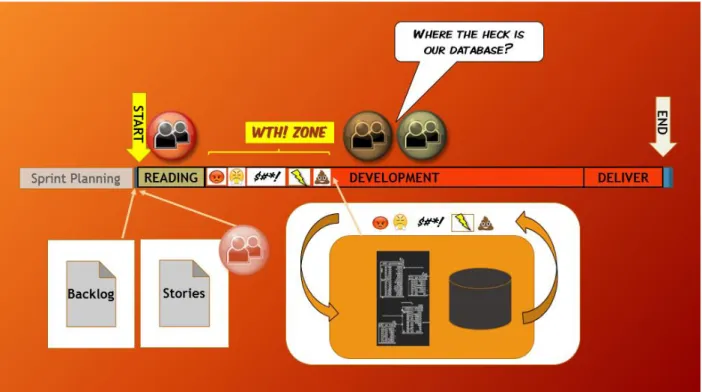
A typical sprint (or set of sprints) has sprint planning deliver the stories and backlog items at the beginning of each sprint to the entire team, including data modelers. That leaves the data modeler scrambling to understand the requirements at the same time the developers are waiting for the
database. Teammates are left waiting for a functional database to start their coding activities while the data modeler is trying to understand the requirements and model dozens of entities and then build a physical model. As seen in Figure 1 - Typical Fragile Sprint, everyone gets frustrated with this process. Repeat it enough times and it becomes clear that the data modeler will be perceived as not being agile enough to be part of the team.
InfoAdvisors 5
Using an Agile, Not Fragile, Data Modeling Workflow
With all these challenges, how can a data modeler ensure his or her data modeling methods deliver value to agile teams? First, data modelers must understand the values and process embraced by agile teams and adjust accordingly. Second, data modelers must reflect those values while educating teams on the challenges we face in adjusting a single tightly integrated database design into a software process that focuses on dividing work into process-driven efforts. Finally, we must prepare our data modeling environments to support rapid and continuous delivery of database code.
The Right Sprint Workflow for Agile Data Modelers
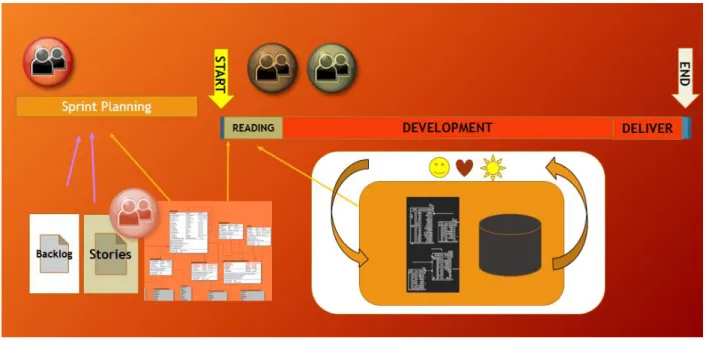
The first thing that data modelers need to accomplish is to become part of the sprint planning process, due to the challenges mentioned above. As seen in Figure 2 - Data Models & Sprint Planning, data modeling for requirements has been moved to the sprint planning phase so that data modelers can be part of the development of stories and have access to the product owner to ensure critical data requirements are understood and ready for database design. By moving data modeling to the planning phase, modelers will deliver higher quality data models and therefore higher quality database designs, at the right time for the team.
Figure 2 - Data Models & Sprint Planning
But not all sprint planning happens just before a sprint starts. It's common for teams to do sprint planning two or three sprints ahead of when a sprint starts. So instead of the data model being prepared just before the start, it's part of sprint planning several weeks (two to three sprints) ahead of when developers need a functioning database. This approach is the most ideal situation for the team.
Hands On with Databases
As mentioned above, agile approaches are focused on software delivery. For data professionals, this means databases. However, many data modelers have let their database skills fall behind current RDBMS (and other DBMSs) versions.
Is your Data Modeling Workflow Agile or Fragile?
InfoAdvisors 6
It's critical that an agile data modeler be able to engineer a
database, even one with only a first cut design, on a regular basis.
This means having database client tools and drivers, having permissions for the right databases, and being ready to connect to them.
Data modelers likely won't need to develop database queries that will be deployed with the system, but they should have tools and skills to look at data in the database as well as forward and reverse engineer database objects.
Understand Changes to the Data Model…and Database
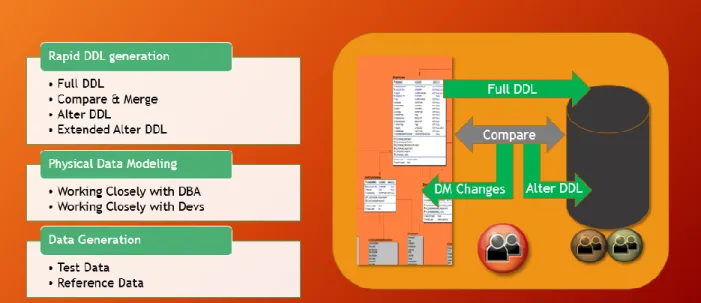
Iterative development means that changes to the models and databases will happen weekly or even more often. Data modelers will need to master their tool features to do fast database forward engineering, reverse engineering and compare and merge tasks.
While agile embraces change, an accidental or unplanned change can set the team back by days or weeks. The key to planned change is comparing versions of models and databases to understand the exact nature of each iteration of the database design. We do this level of change management via Model-Driven Database Design as seen in Figure 3 - Model-Driven Database Design.
Figure 3 - Model-Driven Database Design
This concept is so important that we recommend data modelers get formal training on the compare features of their tool, then practice performing these tasks before joining an agile team.
InfoAdvisors 7
Agile Data Model Documentation
While agile methods discourage the production of mounds of hand-written documentation, providing "just the right amount" of documentation does include publishing data models, metadata and data model diagrams where all team members can access them.
Providing searchable, commentable, browser-based access to all of
these is the ultimate in agile documentation. This gives team
members "self-service data models" and frees up data modelers to
do core data modeling activities.
Tasks & Issue Management Tracking
While agile teams embrace process-light methods, they do make use of control mechanisms around changes, versioning and collaborative development. This often includes issue or bug management systems that allow team members to check in, check out and describe changes. They may also use a change control process such as tying every change in code to a specific task or issue (bug).
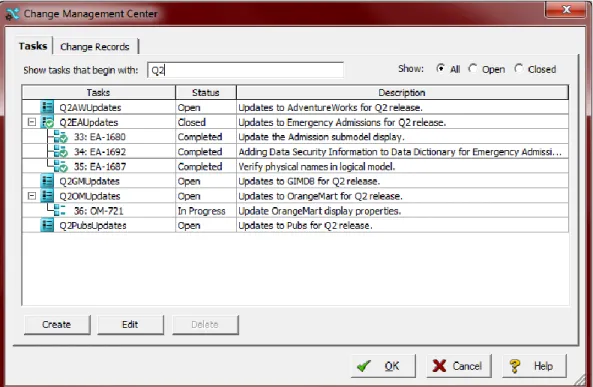
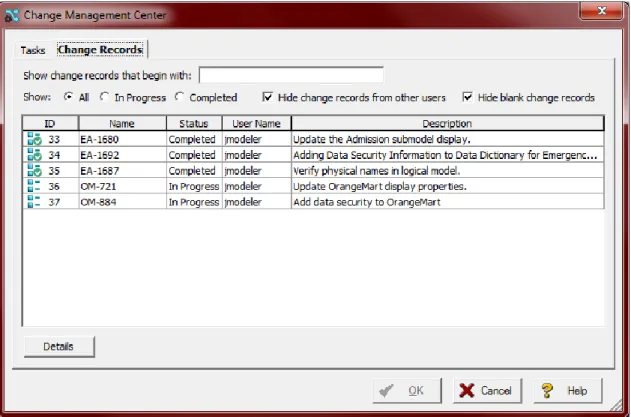
Data modelers must use a data modeling tool repository to manage change control, with compare features to ensure we understand the exact nature of changes, down to the finest granularity possible. We also need a way to tie these changes to tasks and external issue management items. One way to do that is right inside our data modeling tools, as seen in Figure 4 - ER/Studio Tasks and Figure 5 - ER/Studio Change Records.
Is your Data Modeling Workflow Agile or Fragile?
InfoAdvisors 8
Figure 5 - ER/Studio Change Records
Having this level of change management allows multiple people to work on models, while having the context of why and how something changed in the data models.
Ten Tips for Agile Data Modelers
If you'd like to be a valued member of an agile team you should follow these tips to ensure you are ready for modern software development approaches.
1. Stop using the word Documentation; say data models. 2. Get agile and Scrumtraining. Get certified even. 3. Prepareyour Agile Data Modeling environment.
4. Learn, practice and test your Data Model iterationsprocesses and standards. 5. Learn to automateas much as possible.
6. Get data models and DDL tasks moved sprints ahead. At least 2 sprints ahead. 7. Don’t get pushed into sprinting a marathon.
8. Don’t back off from Agile teams, even if they are hostile to data modeling…or modelers. 9. Don’t be a roadblock. Get ahead of the sprints.
InfoAdvisors 9
About the Author
Karen López is Senior Project Manager and Architect at InfoAdvisors. She has more than twenty years of experience in helping organizations implement large, multi-project programs.
InfoAdvisors is a Toronto-based data management consulting firm. We specialize in the practical application of data management. Our philosophy is based on assessing the cost, benefit, and risk of any technique to meet the specific needs of our client organizations.
We want you to love your data. Find us at datamodel.com
About Embarcadero Technologies
Embarcadero Technologies, Inc. is a leading provider of award-winning tools for application developers and database professionals so they can design systems right, build them faster and run them better, regardless of their platform or programming language. ER/Studio is the company’s flagship data
architecture solution that combines business-driven data modeling and collaboration in a multi-platform environment.
Ninety of the Fortune 100 and an active community of more than three million users worldwide rely on Embarcadero products to increase productivity, reduce costs, simplify change management and compliance, and accelerate innovation. Founded in 1993, Embarcadero is headquartered in San Francisco, with offices located around the world. To learn more, please visit