CHAPTER 33
EXPLOSIVES AND FIREWORKS
SECTION 3301 GENERAL
3301.1 Scope.The provisions of this chapter shall govern the possession, manufacture, storage, handling, sale and use of explosives, explosive materials, fireworks and small arms ammunition.
Exceptions:
1. The Armed Forces of the United States, Coast Guard or National Guard.
2. Explosives in forms prescribed by the official United States Pharmacopoeia.
3. The possession, storage and use of small arms ammunition when packaged in accordance with DOTn packaging requirements.
4. The possession, storage, and use of not more than 15 pounds (6.81 kg) of commercially manufactured sporting black powder, 20 pounds (9 kg) of smoke-less powder and any amount of small arms primers for hand loading of small arms ammunition for per-sonal consumption.
5. The use of explosive materials by federal, state and local regulatory, law enforcement and fire agencies acting in their official capacities.
6. Special industrial explosive devices which in the aggregate contain less than 50 pounds (23 kg) of explosive materials.
7. The possession, storage and use of blank indus-trial-power load cartridges when packaged in accor-dance with DOTn packaging regulations.
8. Transportation in accordance with DOTn 49 CFR Parts 100-178.
9. Items preempted by federal regulations.
10. The storage, handling, or use of explosives or blast-ing agents pursuant to the provisions of Title 45.1 of the Code of Virginia.
11. The display of small arms primers in Group M when in the original manufacturer’s packaging.
12. The possession, storage and use of not more than 50 pounds (23 kg) of commercially manufactured sporting black powder, 100 pounds (45 kg) of smokeless powder, and small arms primers for hand loading of small arms ammunition for personal con-sumption in Group R-3 or R-5, or 200 pounds (91 kg) of smokeless powder when stored in the manu-facturer’s original containers in detached Group U structures at least 10 feet (3048 mm) from inhabited buildings and are accessory to Group R-3 or R-5.
3301.1.1 Explosive material standard.In addition to the requirements of this chapter, NFPA 495 shall govern the
manufacture, transportation, storage, sale, handling and use of explosive materials.
3301.1.2 Explosive material terminals.In addition to the requirements of this chapter, the operation of explosive material terminals shall conform to the provisions of NFPA 498.
3301.1.3 Fireworks.The possession, manufacture, storage, sale, handling and use of fireworks are prohibited.
Exceptions:
1. Storage and handling of fireworks as allowed in Section 3304.
2. Manufacture, assembly and testing of fireworks as allowed in Section 3305.
3. The use of fireworks for display as allowed in Sec-tion 3308.
4. The possession, storage, sale, handling and use of permissible fireworks where allowed by applica-ble local or state laws, ordinances and regulations provided such fireworks comply with CPSC 16 CFR, Parts 1500, 1507, and DOTn 49 CFR, Parts 100-178, for consumer fireworks.
5. The sale or use of materials or equipment when such materials or equipment is used or to be used by any person for signaling or other emergency use in the operation of any boat, railroad train or other vehicle for the transportation of persons or property.
3301.1.4 Rocketry.The storage, handling and use of model and high-power rockets shall comply with the requirements of NFPA 1122, NFPA 1125, and NFPA 1127.
3301.1.5 Ammonium nitrate.The storage and handling of ammonium nitrate shall comply with the requirements of NFPA 490 and Chapter 40.
Exception:Storage of ammonium nitrate in magazines with blasting agents shall comply with the requirements of NFPA 495.
3301.2 Permit required.Permits shall be required as set forth in Section 107.2 and regulated in accordance with this section. The manufacture, storage, possession, sale and use of fire-works or explosives shall not take place without first applying for and obtaining a permit.
3301.2.1 Residential uses.No person shall keep or store, nor shall any permit be issued to keep, possess or store, any fireworks or explosives at any place of habitation, or within 100 feet (30 480 mm) thereof.
Exception:Storage of smokeless propellant, black pow-der, and small arms primers for personal use and not for resale in accordance with Section 3306.
3301.2.2 Sale and retail display. Except for the Armed Forces of the United States, Coast Guard, National Guard, federal, state and local regulatory, law enforcement and fire agencies acting in their official capacities, explosives shall not be sold, given, delivered or transferred to any person or company not in possession of a valid permit. The holder of a permit to sell explosives shall make a record of all transac-tions involving explosives in conformance with Section 3303.2 and include the signature of any receiver of the explosives. No person shall construct a retail display nor offer for sale explosives, explosive materials, or fireworks upon highways, sidewalks, public property, or in assembly or educational occupancies.
3301.2.3 Permit restrictions.The fire official is authorized to limit the quantity of explosives, explosive materials, or fireworks permitted at a given location. No person, possess-ing a permit for storage of explosives at any place, shall keep or store an amount greater than authorized in such permit. Only the kind of explosive specified in such a permit shall be kept or stored.
3301.2.3.1 Permit applicants.The fire official shall not issue a permit to manufacture, store, handle, use or sell explosives or blasting agents to any individual applicant who is not certified by the SFMO as a blaster in accor-dance with Section 3301.4.1, or who is not in the posses-sion of a background clearance card or to designated persons representing an applicant that is not an individ-ual and who is not in possession of a background clear-ance card issued in accordclear-ance with Section 3301.2.3.1.1. The SFMO shall process all applications for a background clearance card for compliance with Section 27-97.2 of the Code of Virginia and will be the sole provider of background clearance cards.
3301.2.3.1.1 Background clearance card.A back-ground clearance card may be issued upon comple-tion of the following requirements:
1. Any firm or company manufacturing, storing, using or selling explosives in the Common-wealth shall provide the name of a designated person or persons who will be a representative of the company and be responsible for (i) ensur-ing compliance with state law and regulations relating to blasting agents and explosives and (ii) applying for permits from the fire official. 2. Using a form provided by the SFMO, all
indi-vidual applicants and all designated persons representing an applicant that is not an individ-ual, shall submit to a background investigation, to include a national criminal history record check, for a permit to manufacture, store, han-dle, use or sell explosives, and for any applicant for certification as a blaster.
3. Each such applicant shall submit fingerprints and provide personal descriptive information to the SFMO to be forwarded through the Central Criminal Records Exchange to the Federal Bureau of Investigation for the purpose of
obtaining a national criminal history record check regarding such applicant.
3301.2.3.1.2 Issuance of a background clearance card.The issuance of a background clearance card shall be denied if the applicant or designated person representing an applicant has been convicted of any felony, whether such conviction occurred under the laws of the Commonwealth, or any other state, the District of Columbia, the United States or any terri-tory thereof, unless his civil rights have been restored by the Governor or other appropriate authority.
3301.2.3.1.3 Fee for background clearance card.
The fee for obtaining or renewing a background clear-ance card from the SFMO shall be $150 plus any addi-t i o n a l f e e s c h a rg e d b y o addi-t h e r a g e n c i e s f o r fingerprinting and for obtaining a national criminal history record check through the Central Criminal Records Exchange to the Federal Bureau of Investiga-tion.
3301.2.3.1.4 Revocation of a background clear-ance card.After issuance of a background clearance card, subsequent conviction of a felony will be grounds for immediate revocation of a background clearance card, whether such conviction occurred under the laws of the Commonwealth, or any other state, the District of Columbia, the United States or any territory thereof. The card shall be returned to the SFMO immediately. An individual may reapply for his background clearance card if his civil rights have been restored by the Governor or other appropriate authority.
3301.2.4 Financial responsibility. Before a permit is issued, as required by Section 3301.2, the applicant shall file with the jurisdiction a corporate surety bond in the principal sum of $500,000 or a public liability insurance policy for the same amount, for the purpose of the payment of all damages to persons or property which arise from, or are caused by, the conduct of any act authorized by the permit upon which any judicial judgment results. The legal department of the jurisdiction may specify a greater amount when conditions at the location of use indicate a greater amount is required. Government entities shall be exempt from this bond require-ment.
3301.2.4.1 Blasting.Before approval to do blasting is issued, the applicant for approval shall file a bond or sub-mit a certificate of insurance in such form, amount and coverage as determined by the legal department of the jurisdiction to be adequate in each case to indemnify the jurisdiction against any and all damages arising from permitted blasting but in no case shall the value of the coverage be less than $500,000.
Exception:Filing a bond or submitting a certificate of liability insurance is not required for blasting on real estate parcels of five or more acres conforming to the definition of “real estate devoted to agricultural use” or “real estate devoted to horticultural use” in Section 58.1-3230 of the Code of Virginia and con-ducted by the owner of such real estate.
3301.2.4.2 Fireworks display.The permit holder shall furnish a bond or certificate of insurance in an amount deemed adequate by the legal department of the jurisdic-tion for the payment of all potential damages to a person or persons or to property by reason of the permitted dis-play, and arising from any acts of the permit holder, the agent, employees or subcontractors.
3301.3 Prohibited explosives.Permits shall not be issued or renewed for possession, manufacture, storage, handling, sale or use of the following materials and such materials currently in storage or use shall be disposed of in an approved manner.
1. Liquid nitroglycerin.
2. Dynamite containing more than 60 percent liquid explosive ingredient.
3. Dynamite having an unsatisfactory absorbent or one that permits leakage of a liquid explosive ingredient under any conditions liable to exist during storage. 4. Nitrocellulose in a dry and uncompressed condition in
a quantity greater than 10 pounds (4.54 kg) of net weight in one package.
5. Fulminate of mercury in a dry condition and fulminate of all other metals in any condition except as a compo-nent of manufactured articles not hereinafter forbid-den.
6. Explosive compositions that ignite spontaneously or undergo marked decomposition, rendering the prod-ucts of their use more hazardous, when subjected for 48 consecutive hours or less to a temperature of 167°F (75°C).
7. New explosive materials until approved by DOTn, except that permits are allowed to be issued to educa-tional, governmental or industrial laboratories for instructional or research purposes.
8. Explosive materials condemned by DOTn.
9. Explosive materials containing an ammonium salt and a chlorate.
10. Explosives not packed or marked as required by DOTn 49 CFR, Parts 100-178.
Exception:Gelatin dynamite.
3301.4 Qualifications.Persons in charge of magazines, blast-ing, fireworks display, or pyrotechnic special effect operations shall not be under the influence of alcohol or drugs which impair sensory or motor skills, shall be at least 21 years of age and possess knowledge of all safety precautions related to the storage, handling or use of explosives, explosive materials or fireworks.
3301.4.1 Certification of blasters. Certificates as a restricted or unrestricted blaster will be issued upon proof of successful completion of an examination approved by the SFMO and a background investigation for compliance with Section 27-97.2 of the Code of Virginia. The applicant for certification shall submit proof to the SFMO of the follow-ing experience:
1. For certification as a restricted blaster, at least one year under direct supervision by a certified
unre-stricted blaster, certified reunre-stricted blaster or other person(s) approved by the SFMO.
2. For certification as an unrestricted blaster, at least one year under direct supervision by a certified unre-stricted blaster or other person(s) approved by the SFMO.
The SFMO shall process all certification applicants for compliance with Section 27-97.2 of the Code of Virginia and will be the sole provider of blaster certifications.
Exception:The owner of real estate parcels of five or more acres conforming to the definition of “real estate devoted to agricultural use” or “real estate devoted to horticultural use” in Section 58.1-3230 of the Code of Virginia when blasting on such real estate.
3301.4.2 Certification issuance.The issuance of a certifi-cation as a blaster shall be denied if the applicant has been convicted of any felony, whether such conviction occurred under the laws of the Commonwealth, or any other state, the District of Columbia, the United States or any territory thereof, unless his civil rights have been restored by the Governor or other appropriate authority.
3301.4.3 Fee for certification. The fee for obtaining or renewing a blaster certificate from the SFMO shall be $150 plus any additional fees charged by other agencies for fin-gerprinting and for obtaining a national criminal history record check through the Central Criminal Records Exchange to the Federal Bureau of Investigation.
3301.4.4 Revocation of a blaster certification.After issu-ance of a blaster certification, subsequent conviction of a felony will be grounds for immediate revocation of a blaster certification, whether such conviction occurred under the laws of the Commonwealth, or any other state, the District of Columbia, the United States or any territory thereof. The certification shall be returned to the SFMO immediately. An individual may subsequently reapply for his blaster certifi-cation if his civil rights have been restored by the Governor or other appropriate authority.
3301.4.5 Expiration and renewal of a blaster certifica-tion.A certificate for an unrestricted or restricted blaster shall be valid for three years from the date of issuance. A background clearance card shall be valid for three years from the date of issuance. Renewal of the unrestricted blaster certificate will be issued upon proof of at least 16 hours of continued training or education in the use of explo-sives within three consecutive years and a background investigation for compliance with Section 27-97.2 of the Code of Virginia. Renewal of the restricted blaster certifi-cate will be issued upon proof of at least eight hours of con-tinued training or education in the use of explosives within three consecutive years and a background investigation for compliance with Section 27-97.2 of the Code of Virginia. The continued training or education required for renewal of a blaster certificate shall be obtained during the three years immediately prior to the certificate’s published expiration date. Failure to renew a blaster certificate in accordance with this section shall cause an individual to obtain another blaster certificate upon compliance with Section 3301.4.1 to continue engaging in the unsupervised use of explosives.
3301.5 Supervision. The fire code official is authorized to require operations permitted under the provisions of Section 3301.2 to be supervised at any time by the fire code official in order to determine compliance with all safety and fire regula-tions.
3301.6 Notification.Whenever a new explosive material stor-age or manufacturing site is established, including a temporary job site, the local law enforcement agency, fire department, and local emergency planning committee shall be notified 48 hours in advance, not including Saturdays, Sundays and holidays, of the type, quantity and location of explosive materials at the site.
3301.7 Seizure.The fire official is authorized to remove or cause to be removed or disposed of in an approved manner, at the expense of the owner, fireworks offered or exposed for sale, stored, possessed or used in violation of this chapter.
3301.8 Establishment of quantity of explosives and dis-tances.The quantity of explosives and distances shall be in accordance with Sections 3301.8.1 and 3301.8.1.1.
3301.8.1 Quantity of explosives. The quantity-distance (Q-D) tables in Sections 3304.5 and 3305.3 shall be used to provide the minimum separation distances from potential explosion sites as set forth in Tables 3301.8.1(1) through 3301.8.1(3). The classification and the weight of the explo-sives are primary characteristics governing the use of these tables. The net explosive weight shall be determined in accordance with Sections 3301.8.1.1 through 3301.8.1.4.
3301.8.1.1 Mass-detonating explosives.The total net explosive weight of Division 1.1, 1.2 or 1.5 explosives shall be used. See Table 3304.5.2(1) or Table 3305.3 as appropriate.
Exception:When the TNT equivalence of the explo-sive material has been determined, the equivalence is allowed to be used to establish the net explosive weight.
TABLE 3301.8.1(1)
APPLICATION OF SEPARATION DISTANCE (Q-D) TABLES—DIVISION 1.1, 1.2 AND 1.5 EXPLOSIVESa,b,c
ITEM MAGAZINE Q-D OPERATING BUILDING Q-D INHABITED BUILDING Q-D PUBLIC TRAFFIC ROUTE Q-D Magazine Table 3304.5.2(1) IMD Table 3305.3 ILD or IPD Table 3304.5.2(1) IBD Table 3304.5.2(1) PTR Operating Building Table 3304.5.2(1) ILD or IPD Table 3305.3 ILD or IPD Table 3304.5.2(1) IBD Table 3304.5.2(1) PTR Inhabited Building Table 3304.5.2(1) IBD Table 3304.5.2(1) IBD NA NA NA NA Public Traffic Route Table 3304.5.2(1) PTR Table 3304.5.2(1) PTR NA NA NA NA
For SI: 1 foot = 304.8 mm.
a. The minimum separation distance (Do) shall be 60 feet. Where a building or magazine containing explosives is barricaded, the minimum distance shall be 30 feet.
b. Linear interpolation between tabular values in the referenced Q-D tables shall not be allowed. Nonlinear interpolation of the values shall be allowed subject to an approved technical opinion and report prepared in accordance with Section 104.7.2.
c. For definitions of Quantity-Distance abbreviations IBD, ILD, IMD, IPD and PTR, see Section 3302.1.
TABLE 3301.8.1(2)
APPLICATION OF SEPARATION DISTANCE (Q-D) TABLES—DIVISION 1.3 EXPLOSIVESa,b,c
ITEM MAGAZINE Q-D OPERATING BUILDING Q-D INHABITED BUILDING Q-D PUBLIC TRAFFIC ROUTE Q-D Magazine Table 3304.5.2(2) IMD Table 3304.5.2(2) ILD or IPD Table 3304.5.2(2) IBD Table 3304.5.2(2) PTR Operating Building Table 3304.5.2(2) ILD or IPD Table 3304.5.2(2) ILD or IPD Table 3304.5.2(2) IBD Table 3304.5.2(2) PTR Inhabited Building Table 3304.5.2(2) IBD Table 3304.5.2(2) IBD NA NA NA NA Public Traffic Route Table 3304.5.2(2) PTR Table 3304.5.2(2) PTR NA NA NA NA
For SI: 1 foot = 304.8 mm.
a. The minimum separation distance (Do) shall be a minimum of 50 feet.
b. Linear interpolation between tabular values in the referenced Q-D table shall be allowed.
3301.8.1.2 Nonmass-detonating explosives (exclud-ing Division 1.4).Nonmass-detonating explosives shall be as follows:
1. Division 1.3 propellants. The total weight of the propellants alone shall be the net explosive weight. The net weight of propellant shall be used. See Table 3304.5.2(2).
2. Combinations of bulk metal powder and pyrotech-nic compositions. The sum of the net weights of metal powders and pyrotechnic compositions in the containers shall be the net explosive weight. See Table 3304.5.2(2).
3301.8.1.3 Combinations of mass-detonating and nonmass-detonating explosives (excluding Division 1.4).Combination of mass-detonating and nonmass-det-onating explosives shall be as follows:
1. When Division 1.1 and 1.2 explosives are located in the same site, determine the distance for the total quantity considered first as 1.1 and then as 1.2. The required distance is the greater of the two. When the Division 1.1 requirements are controlling and the TNT equivalence of the 1.2 is known, the TNT equivalent weight of the 1.2 items shall be allowed to be added to the total explosive weight of Divi-sion 1.1 items to determine the net explosive weight for Division 1.1 distance determination. See Table 3304.5.2(2) or Table 3305.3 as appro-priate.
2. When Division 1.1 and 1.3 explosives are located in the same site, determine the distances for the total quantity considered first as 1.1 and then as 1.3. The required distance is the greater of the two. When the Division 1.1 requirements are control-ling and the TNT equivalence of the 1.3 is known, the TNT equivalent weight of the 1.3 items shall be allowed to be added to the total explosive weight of Division 1.1 items to determine the net explo-sive weight for Division 1.1 distance
determina-tion. See Table 3304.5.2(1), 3304.5.2(2) or 3305.3, as appropriate.
3. When Division 1.1, 1.2 and 1.3 explosives are located in the same site, determine the distances for the total quantity considered first as 1.1, next as 1.2 and finally as 1.3. The required distance is the greatest of the three. As allowed by paragraphs 1 and 2 above, TNT equivalent weights for 1.2 and 1.3 items are allowed to be used to determine the net weight of explosives for Division 1.1 distance determination. Table 3304.5.2(1) or 3305.3 shall be used when TNT equivalency is used to establish the net explosive weight.
4. For composite pyrotechnic items Division 1.1 and Division 1.3, the sum of the net weights of the pyrotechnic composition and the explosives involved shall be used. See Tables 3304.5.2(1) and 3304.5.2(2).
3301.8.1.4 Moderate fire — no blast hazards.Division 1.4 explosives. The total weight of the explosive material alone is the net weight. The net weight of the explosive material shall be used.
SECTION 3302 DEFINITIONS
3302.1 Definitions.The following words and terms shall, for the purposes of this chapter and as used elsewhere in this code, have the meanings shown herein.
AMMONIUM NITRATE. A chemical compound
repre-sented by the formula NH4NO3.
BACKGROUND CLEARANCE CARD.An identification
card issued to an individual that is not a certified blaster and is representing himself or acting as a representative of a company, corporation, firm or other entity, solely for the purpose of sub-mitting an application to the fire official for a permit to manu-facture, use, handle, store, or sell explosive materials. TABLE 3301.8.1(3)
APPLICATION OF SEPARATION DISTANCE (Q-D) TABLES—DIVISION 1.4 EXPLOSIVESa,b,c
ITEM MAGAZINE Q-D OPERATING BUILDING Q-D INHABITED BUILDING Q-D PUBLIC TRAFFIC ROUTE Q-D Magazine Table 3304.5.2(3) IMD Table 3304.5.2(3) ILD or IPD Table 3304.5.2(3) IBD Table 3304.5.2(3) PTR Operating Building Table 3304.5.2(3) ILD or IPD Table 3304.5.2(3) ILD or IPD Table 3304.5.2(3) IBD Table 3304.5.2(3) PTR Inhabited Building Table 3304.5.2(3) IBD Table 3304.5.2(3) IBD NA NA NA NA Public Traffic Route Table 3304.5.2(3) PTR Table 3304.5.2(3) PTR NA NA NA NA
For SI: 1 foot = 304.8 mm.
a. The minimum separation distance (Do) shall be a minimum of 50 feet.
b. Linear interpolation between tabular values in the referenced Q-D table shall not be allowed. c. For definitions of Quantity-Distance abbreviations IBD, ILD, IMD, IPD and PTR, see Section 3302.1.
BARRICADE.A structure that consists of a combination of walls, floor and roof, which is designed to withstand the rapid release of energy in an explosion and which is fully confined, partially vented or fully vented; or other effective method of shielding from explosive materials by a natural or artificial bar-rier.
Artificial barricade.An artificial mound or revetment a minimum thickness of 3 feet (914 mm).
Natural barricade.Natural features of the ground, such as hills, or timber of sufficient density that the surrounding exposures that require protection cannot be seen from the magazine or building containing explosives when the trees are bare of leaves.
BARRICADED.The effective screening of a building con-taining explosive materials from the magazine or other build-ing, railway, or highway by a natural or an artificial barrier. A straight line from the top of any sidewall of the building con-taining explosive materials to the eave line of any magazine or other building or to a point 12 feet (3658 mm) above the center of a railway or highway shall pass through such barrier.
BLAST AREA. The area including the blast site and the immediate adjacent area within the influence of flying rock, missiles and concussion.
BLAST SITE.The area in which explosive materials are being or have been loaded and which includes all holes loaded or to be loaded for the same blast and a distance of 50 feet (15 240 mm) in all directions.
BLASTER.A person qualified in accordance with Section 3301.4 to be in charge of and responsible for the loading and firing of a blast.
BLASTER, RESTRICTED.Any person engaging in the use of explosives or blasting agents utilizing five pounds (2.25 kg) or less per blasting operation and using instantaneous detona-tors.
BLASTER, UNRESTRICTED.Any person engaging in the use of explosives or blasting agents without limit to the amount of explosives or blasting agents or type of detonator.
BLASTING AGENT.A material or mixture consisting of fuel and oxidizer, intended for blasting provided that the finished product, as mixed for use or shipment, cannot be detonated by means of a No. 8 test detonator when unconfined. Blasting agents are labeled and placarded as Class 1.5 material by US DOTn.
BULLET RESISTANT.Constructed so as to resist penetration of a bullet of 150-grain M2 ball ammunition having a nominal muzzle velocity of 2,700 feet per second (fps) (824 mps) when fired from a 30-caliber rifle at a distance of 100 feet (30 480 mm), measured perpendicular to the target.
DETONATING CORD.A flexible cord containing a center core of high explosive used to initiate other explosives.
DETONATION.An exothermic reaction characterized by the presence of a shock wave in the material which establishes and maintains the reaction. The reaction zone progresses through the material at a rate greater than the velocity of sound. The
principal heating mechanism is one of shock compression. Detonations have an explosive effect.
DETONATOR.A device containing any initiating or primary explosive that is used for initiating detonation. A detonator shall not contain more than 154.32 grains (10 grams) of total explosives by weight, excluding ignition or delay charges. The term includes, but is not limited to, electric blasting caps of instantaneous and delay types, blasting caps for use with safety fuses, detonating cord delay connectors, and noninstantaneous and delay blasting caps which use detonating cord, shock tube or any other replacement for electric leg wires. All types of det-onators in strengths through No. 8 cap should be rated at 1.5 pounds (0.68 kg) of explosives per 1,000 caps. For strengths higher than No. 8 cap, consult the manufacturer.
DISCHARGE SITE. The immediate area surrounding the fireworks mortars used for an outdoor fireworks display.
DISPLAY SITE.The immediate area where a fireworks dis-play is conducted. The disdis-play area includes the discharge site, the fallout area, and the required separation distance from the mortars to spectator viewing areas. The display area does not include spectator viewing areas or vehicle parking areas.
EXPLOSIVE.A chemical compound, mixture or device, the primary or common purpose of which is to function by explo-sion. The term includes, but is not limited to, dynamite, black powder, pellet powder, initiating explosives, detonators, safety fuses, squibs, detonating cord, igniter cord, igniters and display fireworks, 1.3G (Class B, Special).
The term “explosive” includes any material determined to be within the scope of USC Title 18: Chapter 40 and also includes any material classified as an explosive other than consumer fireworks, 1.4G (Class C, Common) by the hazardous materi-als regulations of DOTn 49 CFR.
High explosive. Explosive material, such as dynamite, which can be caused to detonate by means of a No. 8 test blasting cap when unconfined.
Low explosive.Explosive material that will burn or defla-grate when ignited. It is characterized by a rate of reaction that is less than the speed of sound. Examples of low explo-sives include, but are not limited to, black powder, safety fuse, igniters, igniter cord, fuse lighters, fireworks, 1.3G (Class B special) and propellants, 1.3C.
Mass-detonating explosives. Division 1.1, 1.2 and 1.5 explosives alone or in combination, or loaded into various types of ammunition or containers, most of which can be expected to explode virtually instantaneously when a small portion is subjected to fire, severe concussion, impact, the impulse of an initiating agent, or the effect of a considerable discharge of energy from without. Materials that react in this manner represent a mass explosion hazard. Such an explosive will normally cause severe structural damage to adjacent objects. Explosive propagation could occur imme-diately to other items of ammunition and explosives stored sufficiently close to and not adequately protected from the initially exploding pile with a time interval short enough so that two or more quantities must be considered as one for quantity-distance purposes.
UN/DOTn Class 1 explosives.The former classification sys-tem used by DOTn included the terms “high” and “low” explo-sives as defined herein. The following terms further define explosives under the current system applied by DOTn for all explosive materials defined as hazard Class 1 materials. Com-patibility group letters are used in concert with the Division to specify further limitations on each division noted (i.e., the let-ter G identifies the malet-terial as a pyrotechnic substance or arti-cle containing a pyrotechnic substance and similar materials).
Division 1.1.Explosives that have a mass explosion haz-ard. A mass explosion is one which affects almost the entire load instantaneously.
Division 1.2.Explosives that have a projection hazard but not a mass explosion hazard.
Division 1.3. Explosives that have a fire hazard and either a minor blast hazard or a minor projection hazard or both, but not a mass explosion hazard.
Division 1.4. Explosives that pose a minor explosion hazard. The explosive effects are largely confined to the package and no projection of fragments of appreciable size or range is to be expected. An external fire must not cause virtually instantaneous explosion of almost the entire contents of the package.
Division 1.5.Very insensitive explosives. This division is comprised of substances that have a mass explosion hazard but which are so insensitive that there is very little probability of initiation or of transition from burning to detonation under normal conditions of transport.
Division 1.6.Extremely insensitive articles which do not have a mass explosion hazard. This division is comprised of articles that contain only extremely insensitive deto-nating substances and which demonstrate a negligible probability of accidental initiation or propagation.
EXPLOSIVE MATERIAL. The term “explosive” material means explosives, blasting agents, and detonators.
FALLOUT AREA.The area over which aerial shells are fired. The shells burst over the area, and unsafe debris and malfunc-tioning aerial shells fall into this area. The fallout area is the location where a typical aerial shell dud falls to the ground depending on the wind and the angle of mortar placement.
FIREWORKS.Any firecracker, torpedo, skyrocket, or other substance or object, of whatever form or construction, that con-tains any explosive or inflammable compound or substance, and is intended, or commonly known, as fireworks and which explodes, rises into the air or travels laterally, or fires projec-tiles into the air. Fireworks shall not include automobile flares, paper caps containing not more than an average of 0.25 grain (16 mg) of explosive content per cap or toy pistols, toy canes, toy guns or other devices utilizing such caps and items com-monly known as party poppers, pop rocks and snap-n-pops. Fireworks may be further delineated and referred to as:
Fireworks, 1.4G.(Formerly known as Class C, Common Fireworks.) Small fireworks devices containing restricted amounts of pyrotechnic composition designed primarily to produce visible or audible effects by combustion. Such 1.4G fireworks that comply with the construction, chemical
com-position and labeling regulations of the DOTn for Fireworks, UN 0336, and the U.S. Consumer Product Safety Commis-sion as set forth in CPSC 16 CFR: Parts 1500 and 1507, are not explosive materials for the purpose of this code.
Fireworks, 1.3G. (Formerly Class B, Special Fireworks.) Large fireworks devices, which are explosive materials, intended for use in fireworks displays and designed to pro-duce audible or visible effects by combustion, deflagration or detonation. Such 1.3G fireworks include, but are not limited to, firecrackers containing more than 130 milligrams (2 grains) of explosive composition, aerial shells containing more than 40 grams of pyrotechnic composition, and other display pieces that exceed the limits for classification as 1.4G fireworks. Such 1.3G fireworks, are also described as Fire-works, UN0335 by the DOTn.
FIREWORKS DISPLAY.A presentation of fireworks for a public or private gathering.
HIGHWAY.A public street, public alley or public road.
INHABITED BUILDING.A building regularly occupied in whole or in part as a habitation for people, or any place of reli-gious worship, schoolhouse, railroad station, store or other structure where people are accustomed to assemble, except any building or structure occupied in connection with the manufac-ture, transportation, storage or use of explosive materials.
MAGAZINE.A building, structure or container, other than an operating building, approved for storage of explosive materials.
Indoor.A portable structure, such as a box, bin or other con-tainer, constructed as required for Type 2, 4 or 5 magazines in accordance with NFPA 495, NFPA 1124 or DOTy 27 CFR Part 55 so as to be fire resistant and theft resistant.
Type 1.A permanent structure, such as a building or igloo, that is bullet resistant, fire resistant, theft resistant, weather resistant and ventilated in accordance with the requirements of NFPA 495, NFPA 1124, or DOTy 27 CFR Part 55.
Type 2. A portable or mobile structure, such as a box, skid-magazine, trailer or semitrailer, constructed in accor-dance with the requirements of NFPA 495, NFPA 1124 or DOTy 27 CFR, Part 55 that is fire resistant, theft resistant, weather resistant and ventilated. If used outdoors, a Type 2 magazine is also bullet resistant.
Type 3.A fire-resistant, theft-resistant and weather-resis-tant “day box” or portable structure constructed in accor-dance with NFPA 495, NFPA 1124, or DOTy 27 CFR Part 55 used for the temporary storage of explosive materials.
Type 4.A permanent, portable or mobile structure such as a building, igloo, box, semitrailer or other mobile container that is fire resistant, theft resistant and weather resistant and constructed in accordance with NFPA 495, NFPA 1124, or DOTy 27 CFR, Part 55.
Type 5.A permanent, portable or mobile structure such as a building, igloo, box, bin, tank, semitrailer, bulk trailer, tank trailer, bulk truck, tank truck or other mobile container that is theft resistant, which is constructed in accordance with NFPA 495, NFPA 1124, or DOTy 27 CFR, Part 55.
MORTAR.A tube from which fireworks shells are fired into the air.
NET EXPLOSIVE WEIGHT (net weight).The weight of explosive material expressed in pounds. The net explosive weight is the aggregate amount of explosive material contained within buildings, magazines, structures or portions thereof, used to establish quantity-distance relationships.
OPERATING BUILDING.A building occupied in conjunc-tion with the manufacture, transportaconjunc-tion, or use of explosive materials. Operating buildings are separated from one another with the use of intraplant or intraline distances.
OPERATING LINE. A group of buildings, facilities or workstations so arranged as to permit performance of the steps in the manufacture of an explosive or in the loading, assembly, modification and maintenance of ammunition or devices con-taining explosive materials.
PERMISSIBLE FIREWORKS. Any sparklers, fountains, Pharaoh’s serpents, caps for pistols, or pinwheels commonly known as whirligigs or spinning jennies.
PLOSOPHORIC MATERIAL.Two or more unmixed, com-mercially manufactured, prepackaged chemical substances including oxidizers, flammable liquids or solids, or similar substances that are not independently classified as explosives but which, when mixed or combined, form an explosive that is intended for blasting.
PROXIMATE AUDIENCE.An audience closer to pyrotech-nic devices than allowed by NFPA 1123.
PUBLIC TRAFFIC ROUTE (PTR).Any public street, road, highway, navigable stream or passenger railroad that is used for through traffic by the general public.
PYROTECHNIC COMPOSITION.A chemical mixture that produces visible light displays or sounds through a self-propa-gating, heat-releasing chemical reaction which is initiated by ignition.
PYROTECHNIC SPECIAL EFFECT.A visible or audible effect for entertainment created through the use of pyrotechnic materials and devices.
PYROTECHNIC SPECIAL-EFFECT MATERIAL. A
chemical mixture used in the entertainment industry, to pro-duce visible or audible effects by combustion, deflagration or detonation. Such a chemical mixture predominantly consists of solids capable of producing a controlled, self-sustaining and self-contained exothermic chemical reaction that results in heat, gas sound, light or a combination of these effects. The chemical reaction functions without external oxygen.
QUANTITY-DISTANCE (Q-D). The quantity of explosive material and separation distance relationships providing pro-tection. These relationships are based on levels of risk consid-ered acceptable for the stipulated exposures and are tabulated in the appropriate Q-D tables. The separation distances speci-fied afford less than absolute safety:
Minimum separation distance (Do).The minimum sepa-ration distance between adjacent buildings occupied in con-junction with the manufacture, transportation, storage or
use of explosive materials where one of the buildings con-tains explosive materials and the other building does not.
Intraline distance (ILD) or Intraplant distance (IPD).
The distance to be maintained between any two operating buildings on an explosives manufacturing site when at least one contains or is designed to contain explosives, or the dis-tance between a magazine and an operating building.
Inhabited building distance (IBD).The minimum separa-tion distance between an operating building or magazine containing explosive materials and an inhabited building or site boundary.
Intermagazine distance (IMD).The minimum separation distance between magazines.
RAILWAY.A steam, electric or other railroad or railway that carriers passengers for hire.
READY BOX.A weather-resistant container with a self-closing or automatic-closing cover that protects fireworks shells from burning debris. Tarpaulins shall not be considered as ready boxes.
SMALL ARMS AMMUNITION.A shotgun, rifle or pistol car-tridge and any carcar-tridge for propellant-actuated devices. This defi-nition does not include military ammudefi-nition containing bursting charges or incendiary, trace, spotting or pyrotechnic projectiles.
SMALL ARMS PRIMERS.Small percussion-sensitive explo-sive charges, encased in a cap, used to ignite propellant powder.
SMOKELESS PROPELLANTS. Solid propellants, com-monly referred to as smokeless powders or any propellant clas-sified by DOTn as a smokeless propellant in accordance with “NA3178, Smokeless Powder for Small Arms,” used in small arms ammunition, firearms, cannons, rockets, propellant-actu-ated devices and similar articles.
SPECIAL INDUSTRIAL EXPLOSIVE DEVICE. An
explosive power pack containing an explosive charge in the form of a cartridge or construction device. The term includes but is not limited to explosive rivets, explosive bolts, explosive charges for driving pins or studs, cartridges for explosive-actu-ated power tools and charges of explosives used in automotive air bag inflators, jet tapping of open hearth furnaces and jet per-foration of oil well casings.
THEFT RESISTANT.Construction designed to deter illegal entry into facilities for the storage of explosive materials.
SECTION 3303
RECORD KEEPING AND REPORTING
3303.1 General.Records of the receipt, handling, use or dis-posal of explosive materials, and reports of any accidents, thefts, or unauthorized activities involving explosive materials shall conform to the requirements of this section.
3303.2 Transaction record.The permittee shall maintain a record of all transactions involving receipt, removal, use or dis-posal of explosive materials. Such a record shall be maintained for a period of five years, and shall be furnished to the fire code official for inspection upon request.
Exception: Where only Division 1.4G (consumer fire-works) are handled, records need only be maintained for a period of three years.
3303.3 Loss, theft or unauthorized removal.The loss, theft or unauthorized removal of explosive materials from a maga-zine or permitted facility shall be reported to the fire code offi-cial, local law enforcement authorities, and the U.S. Department of Treasury, Bureau of Alcohol, Tobacco and Fire-arms within 24 hours.
Exception: Loss of Division 1.4G (consumer fireworks) need not be reported to the Bureau of Alcohol, Tobacco and Firearms.
3303.4 Accidents.Accidents involving the use of explosives, explosive materials and fireworks, which result in injuries or property damage, shall be reported to the fire code official immediately.
3303.5 Misfires.The pyrotechnic display operator or blaster in charge shall keep a record of all aerial shells that fail to fire or charges that fail to detonate.
3303.6 Hazard communication.Manufacturers of explosive materials and fireworks shall maintain records of chemicals, chemical compounds and mixtures required by DOL 29 CFR, Part 1910.1200, and Section 407.
3303.7 Safety rules.Current safety rules covering the opera-tion of magazines, as described in Secopera-tion 3304.7, shall be posted on the interior of the magazine in a visible location.
SECTION 3304 EXPLOSIVE MATERIALS STORAGE AND HANDLING
3304.1 General.Storage of explosives and explosive materi-als, small arms ammunition, small arms primers, propel-lant-actuated cartridges and smokeless propellants in magazines, shall comply with the provisions of this section.
3304.2 Magazine required.Explosives and explosive materi-als, and Division 1.3G fireworks shall be stored in magazines constructed, located, operated and maintained in accordance
with the provisions of Section 3304 and NFPA 495 or NFPA 1124.
Exceptions:
1. Storage of fireworks at display sites in accordance with Section 3308.5 and NFPA 1123 or NFPA 1126. 2. Portable or mobile magazines not exceeding 120
square feet (11 m2) in area shall not be required to comply with the requirements of the International Building Code.
3304.3 Magazines.The storage of explosives and explosive materials in magazines shall comply with Table 3304.3.
3304.3.1 High explosives.Explosive materials classified as Division 1.1 or 1.2 or formerly classified as Class A by the U.S. Department of Transportation shall be stored in Type 1, 2 or 3 magazines.
Exceptions:
1. Black powder shall be stored in a Type 1, 2, 3 or 4 magazine.
2. Cap-sensitive explosive material that is demon-strated not to be bullet sensitive, shall be stored in a Type 1, 2, 3, 4 or 5 magazine.
3304.3.2 Low explosives.Explosive materials that are not cap sensitive shall be stored in a Type 1, 2, 3, 4 or 5 maga-zine.
3304.3.3 Detonating cord.For quantity and distance pur-poses, detonating cord of 50 grains per foot shall be calcu-lated as equivalent to 8 pounds (4 kg) of high explosives per 1,000 feet (305 m). Heavier or lighter core loads shall be rated proportionally.
3304.4 Prohibited storage. Detonators shall be stored in a separate magazine for blasting supplies and shall not be stored in a magazine with other explosive materials.
TABLE 3304.3
STORAGE AMOUNTS AND MAGAZINE REQUIREMENTS FOR EXPLOSIVES, EXPLOSIVE MATERIALS AND FIREWORKS, 1.3G MAXIMUM ALLOWABLE QUANTITY PER CONTROL AREA
NEW UN/ DOTn DIVISION OLD DOTn CLASS ATF/OSHA CLASS INDOORa(pounds) OUTDOOR (pounds)
MAGAZINE TYPE REQUIRED
Unprotected Cabinet Sprinklers
Sprinklers & cabinet 1 2 3 4 5 1.1b A High 0 0 1 2 1 X X X — — 1.2 A High 0 0 1 2 1 X X X — — 1.2 B Low 0 0 1 2 1 X X X X — 1.3 B Low 0 0 5 10 1 X X X X — 1.4 B Low 0 0 50 100 1 X X X X — 1.5 C Low 0 0 1 2 1 X X X X — 1.5 Blasting Agent Blasting Agent 0 0 1 2 1 X X X X X 1.6 N/A N/A 0 0 1 2 1 X X X X X
For SI: 1 pound = 0.454 kg, 1 pound per gallon = 0.12 kg per liter, 1 ounce = 28.35 g.
a. A factor of 10 pounds per gallon shall be used for converting pounds (solid) to gallons (liquid) in accordance with Section 2703.1.2. b. Black powder shall be stored in a Type 1, 2, 3 or 4 magazine as provided for in Section 3304.3.1.
3304.5 Location.The use of magazines for storage of explo-sives and explosive materials shall comply with Sections 3304.5.1 through 3304.5.3.3.
3304.5.1 Indoor magazines.The use of indoor magazines for storage of explosives and explosive materials shall com-ply with the requirements of this section.
3304.5.1.1 Use.The use of indoor magazines for storage of explosives and explosive materials shall be limited to occupancies of Group F, H, M or S, and research and development laboratories.
3304.5.1.2 Construction.Indoor magazines shall com-ply with the following construction requirements:
1. Construction shall be fire resistant and theft resis-tant.
2. Exterior shall be painted red.
3. Base shall be fitted with wheels, casters or rollers to facilitate removal from the building in an emer-gency.
4. Lid or door shall be marked with conspicuous white lettering not less than 3 inches (76 mm) high and minimum1/2inch (12.7 mm) stroke, reading EXPLOSIVES — KEEP FIRE AWAY.
5. The least horizontal dimension shall not exceed the clear width of the entrance door.
3304.5.1.3 Quantity limit.Not more than 50 pounds (23 kg) of explosives or explosive materials shall be stored within an indoor magazine.
Exception:Day boxes used for the storage of in-pro-cess material in accordance with Section 3305.6.4.1.
3304.5.1.4 Prohibited use.Indoor magazines shall not be used within buildings containing Group R occupan-cies.
3304.5.1.5 Location.Indoor magazines shall be located within 10 feet (3048 mm) of an entrance and only on floors at or having ramp access to the exterior grade level.
3304.5.1.6 Number.Not more than two indoor maga-zines shall be located in the same building. Where two such magazines are located in the same building, one magazine shall be used solely for the storage of not more than 5,000 detonators.
3304.5.1.7 Separation distance.When two magazines are located in the same building, they shall be separated by a distance of not less than 10 feet (3048 mm).
3304.5.2 Outdoor magazines. All outdoor magazines other than Type 3 shall be located so as to comply with Table 3304.5.2(2) or Table 3304.5.2(3) as set forth in Tables 3301.8.1(1) through 3301.8.1(3). Where a magazine or group of magazines, as described in Section 3304.5.2.2, contains different classes of explosive materials, and Divi-sion 1.1 materials are present, the required separations for the magazine or magazine group as a whole shall comply with Table 3304.5.2(2).
3304.5.2.1 Separation. Where two or more storage magazines are located on the same property, each maga-zine shall comply with the minimum distances specified from inhabited buildings, public transportation routes and operating buildings. Magazines shall be separated from each other by not less than the intermagazine dis-tances (IMD) shown for the separation of magazines.
3304.5.2.2 Grouped magazines. Where two or more magazines are separated from each other by less than the intermagazine distances (IMD), such magazines as a group shall be considered as one magazine and the total quantity of explosive materials stored in the group shall be treated as if stored in a single magazine. The location of the group of magazines shall comply with the intermagazine distances (IMD) specified from other magazines or magazine groups, inhabited buildings (IBD), public transportation routes (PTR) and operating buildings (ILD or IPD) as required.
3304.5.3 Special requirements for Type 3 magazines.
Type 3 magazines shall comply with Sections 3304.5.3.1 through 3304.5.3.3.
3304.5.3.1 Location. Wherever practicable, Type 3 magazines shall be located away from neighboring inhabited buildings, railways, highways, and other mag-azines in accordance with Table 3304.5.2(2) or 3304.5.2(3) as applicable.
3304.5.3.2 Supervision. Type 3 magazines shall be attended when explosive materials are stored within. Explosive materials shall be removed to appropriate stor-age magazines for unattended storstor-age at the end of the work day.
3304.5.3.3 Use.Not more than two Type 3 magazines shall be located at the same blasting site. Where two Type 3 magazines are located at the same blasting site, one magazine shall used solely for the storage of detonators.
3304.6 Construction. Magazines shall be constructed in accordance with Sections 3304.6.1 through 3304.6.5.2.
3304.6.1 Drainage.The ground around a magazine shall be graded so that water drains away from the magazine.
3304.6.2 Heating.Magazines requiring heat shall be heated as prescribed in NFPA 495 by either hot water radiant heat-ing within the magazine or by indirect warm air heatheat-ing.
3304.6.3 Lighting. When lighting is necessary within a magazine, electric safety flashlights or electric safety lan-terns shall be used, except as provided in NFPA 495.
3304.6.4 Nonsparking materials. In other than Type 5 magazines, there shall be no exposed ferrous metal on the interior of a magazine containing packages of explosives.
3304.6.5 Signs and placards.Property upon which Type 1 magazines and outdoor magazines of Types 2, 4 and 5 are located shall be posted with signs stating: EXPLOSIVES — KEEP OFF. These signs shall be of contrasting colors with a minimum letter height of 3 inches (76 mm) with a minimum brush stroke of 0.5 inch (12.7 mm). The signs shall be located to minimize the possibility of a bullet shot at the sign hitting the magazine.
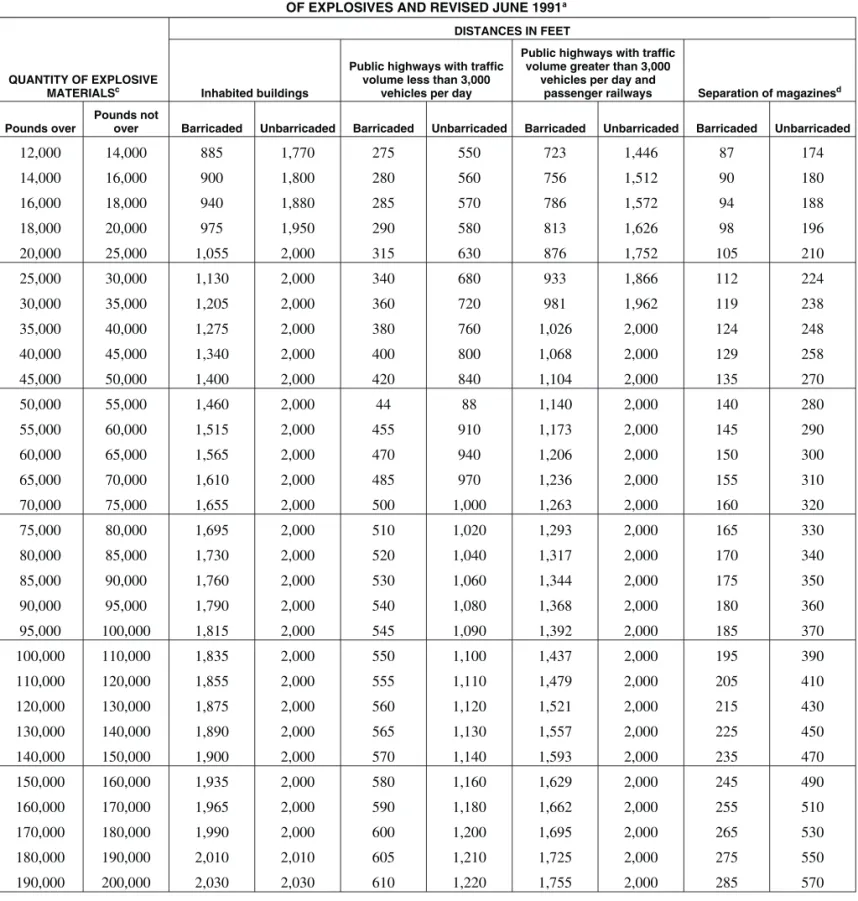
TABLE 3304.5.2(1)
AMERICAN TABLE OF DISTANCES FOR STORAGE OF EXPLOSIVES AS APPROVED BY THE INSTITUTE OF MAKERS OF EXPLOSIVES AND REVISED JUNE 1991a
QUANTITY OF EXPLOSIVE MATERIALSc
DISTANCES IN FEET
Inhabited buildings
Public highways with traffic volume less than 3,000
vehicles per day
Public highways with traffic volume greater than 3,000
vehicles per day and
passenger railways Separation of magazinesd
Pounds over
Pounds not
over Barricaded Unbarricaded Barricaded Unbarricaded Barricaded Unbarricaded Barricaded Unbarricaded
0 5 70 140 30 60 51 102 6 12 5 10 90 180 35 70 64 128 8 16 10 20 110 220 45 90 81 162 10 20 20 30 125 250 50 100 93 186 11 22 30 40 140 280 55 110 103 206 12 24 40 50 150 300 60 120 110 220 14 28 50 75 170 340 70 140 127 254 15 30 75 100 190 380 75 150 139 278 16 32 100 125 200 400 80 160 150 300 18 36 125 150 215 430 85 170 159 318 19 38 150 200 235 470 95 190 175 350 21 42 200 250 255 510 105 210 189 378 23 46 250 300 270 540 110 220 201 402 24 48 300 400 295 590 120 240 221 442 27 54 400 500 320 640 130 260 238 476 29 58 500 600 340 680 135 270 253 506 31 62 600 700 355 710 145 290 266 532 32 64 700 800 375 750 150 300 278 556 33 66 800 900 390 780 155 310 289 578 35 70 900 1,000 400 800 160 320 300 600 36 72 1,000 1,200 425 850 165 330 318 636 39 78 1,200 1,400 450 900 170 340 336 672 41 82 1,400 1,600 470 940 175 350 351 702 43 86 1,600 1,800 490 980 180 360 366 732 44 88 1,800 2,000 505 1,010 185 370 378 756 45 90 2,000 2,500 545 1,090 190 380 408 816 49 98 2,500 3,000 580 1,160 195 390 432 864 52 104 3,000 4,000 635 1,270 210 420 474 948 58 116 4,000 5,000 685 1,370 225 450 513 1,026 61 122 5,000 6,000 730 1,460 235 470 546 1,092 65 130 6,000 7,000 770 1,540 245 490 573 1,146 68 136 7,000 8,000 800 1,600 250 500 600 1,200 72 144 8,000 9,000 835 1,670 255 510 624 1,248 75 150 9,000 10,000 865 1,730 260 520 645 1,290 78 156 10,000 12,000 875 1,750 270 540 687 1,374 82 164 (continued)
TABLE 3304.5.2(1)–continued
AMERICAN TABLE OF DISTANCES FOR STORAGE OF EXPLOSIVES AS APPROVED BY THE INSTITUTE OF MAKERS OF EXPLOSIVES AND REVISED JUNE 1991a
QUANTITY OF EXPLOSIVE MATERIALSc
DISTANCES IN FEET
Inhabited buildings
Public highways with traffic volume less than 3,000
vehicles per day
Public highways with traffic volume greater than 3,000
vehicles per day and
passenger railways Separation of magazinesd
Pounds over
Pounds not
over Barricaded Unbarricaded Barricaded Unbarricaded Barricaded Unbarricaded Barricaded Unbarricaded
12,000 14,000 885 1,770 275 550 723 1,446 87 174 14,000 16,000 900 1,800 280 560 756 1,512 90 180 16,000 18,000 940 1,880 285 570 786 1,572 94 188 18,000 20,000 975 1,950 290 580 813 1,626 98 196 20,000 25,000 1,055 2,000 315 630 876 1,752 105 210 25,000 30,000 1,130 2,000 340 680 933 1,866 112 224 30,000 35,000 1,205 2,000 360 720 981 1,962 119 238 35,000 40,000 1,275 2,000 380 760 1,026 2,000 124 248 40,000 45,000 1,340 2,000 400 800 1,068 2,000 129 258 45,000 50,000 1,400 2,000 420 840 1,104 2,000 135 270 50,000 55,000 1,460 2,000 44 88 1,140 2,000 140 280 55,000 60,000 1,515 2,000 455 910 1,173 2,000 145 290 60,000 65,000 1,565 2,000 470 940 1,206 2,000 150 300 65,000 70,000 1,610 2,000 485 970 1,236 2,000 155 310 70,000 75,000 1,655 2,000 500 1,000 1,263 2,000 160 320 75,000 80,000 1,695 2,000 510 1,020 1,293 2,000 165 330 80,000 85,000 1,730 2,000 520 1,040 1,317 2,000 170 340 85,000 90,000 1,760 2,000 530 1,060 1,344 2,000 175 350 90,000 95,000 1,790 2,000 540 1,080 1,368 2,000 180 360 95,000 100,000 1,815 2,000 545 1,090 1,392 2,000 185 370 100,000 110,000 1,835 2,000 550 1,100 1,437 2,000 195 390 110,000 120,000 1,855 2,000 555 1,110 1,479 2,000 205 410 120,000 130,000 1,875 2,000 560 1,120 1,521 2,000 215 430 130,000 140,000 1,890 2,000 565 1,130 1,557 2,000 225 450 140,000 150,000 1,900 2,000 570 1,140 1,593 2,000 235 470 150,000 160,000 1,935 2,000 580 1,160 1,629 2,000 245 490 160,000 170,000 1,965 2,000 590 1,180 1,662 2,000 255 510 170,000 180,000 1,990 2,000 600 1,200 1,695 2,000 265 530 180,000 190,000 2,010 2,010 605 1,210 1,725 2,000 275 550 190,000 200,000 2,030 2,030 610 1,220 1,755 2,000 285 570 (continued)
TABLE 3304.5.2(1)–continued
AMERICAN TABLE OF DISTANCES FOR STORAGE OF EXPLOSIVES AS APPROVED BY THE INSTITUTE OF MAKERS OF EXPLOSIVES AND REVISED JUNE 1991a
QUANTITY OF EXPLOSIVE MATERIALSc
DISTANCES IN FEET
Inhabited buildings
Public highways with traffic volume less than 3,000
vehicles per day
Public highways with traffic volume greater than 3,000
vehicles per day and
passenger railways Separation of magazinesd
Pounds over
Pounds not
over Barricaded Unbarricaded Barricaded Unbarricaded Barricaded Unbarricaded Barricaded Unbarricaded
200,000 210,000 2,055 2,055 620 1,240 1,782 2,000 295 590
210,000 230,000 2,100 2,100 635 1,270 1,836 2,000 315 630
230,000 250,000 2,155 2,155 650 1,300 1,890 2,000 335 670
250,000 275,000 2,215 2,215 670 1,340 1,950 2,000 360 720
275,000 300,000b 2,275 2,275 690 1,380 2,000 2,000 385 770
For SI: 1 foot = 304.8 mm, 1 pound = 0.454 kg.
a. This table applies only to the manufacture and permanent storage of commercial explosive materials. It is not applicable to transportation of explosives or any han-dling or temporary storage necessary or incident thereto. It is not intended to apply to bombs, projectiles or other heavily encased explosives.
b. Storage in excess of 300,000 pounds of explosive materials in one magazine is not allowed.
c. Where a manufacturing building on an explosive materials plant site is designed to contain explosive materials, such building shall be located with respect to its proximity to inhabited buildings, public highways and passenger railways based on the maximum quantity of explosive materials permitted to be in the building at one time.
d. Where two or more storage magazines are located on the same property, each magazine shall comply with the minimum distances specified from inhabited build-ings, railways and highways, and, in addition, they should be separated from each other by not less than the distances shown for separation of magazines, except that the quantity of explosives in detonator magazines shall govern in regard to the spacing of said detonator magazines from magazines containing other explosive materials. Where any two or more magazines are separated from each other by less than the specified separation of magazines distances, then two or more such magazines, as a group, shall be considered as one magazine, and the total quantity of explosive materials stored in such group shall be treated as if stored in a single magazine located on the site of any magazine in the group and shall comply with the minimum distances specified from other magazines, inhabited buildings, rail-ways and highrail-ways.
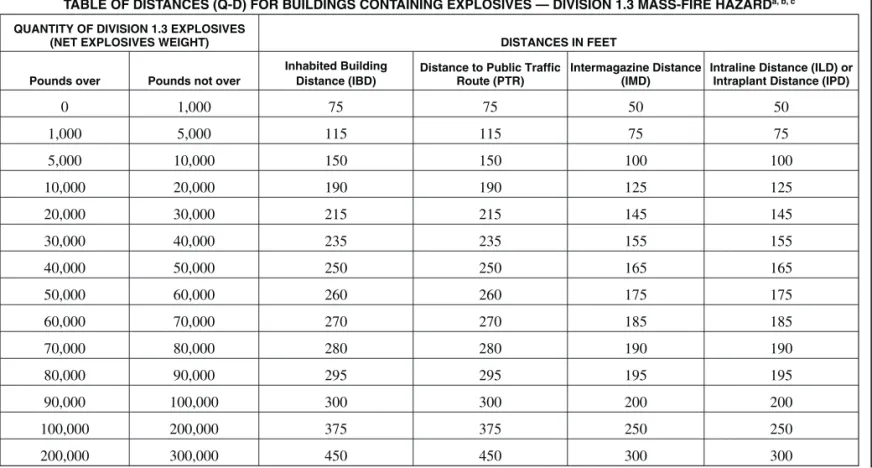
TABLE 3304.5.2(2)
TABLE OF DISTANCES (Q-D) FOR BUILDINGS CONTAINING EXPLOSIVES — DIVISION 1.3 MASS-FIRE HAZARDa, b, c QUANTITY OF DIVISION 1.3 EXPLOSIVES
(NET EXPLOSIVES WEIGHT) DISTANCES IN FEET
Pounds over Pounds not over
Inhabited Building Distance (IBD)
Distance to Public Traffic Route (PTR)
Intermagazine Distance (IMD)
Intraline Distance (ILD) or Intraplant Distance (IPD)
0 1,000 75 75 50 50 1,000 5,000 115 115 75 75 5,000 10,000 150 150 100 100 10,000 20,000 190 190 125 125 20,000 30,000 215 215 145 145 30,000 40,000 235 235 155 155 40,000 50,000 250 250 165 165 50,000 60,000 260 260 175 175 60,000 70,000 270 270 185 185 70,000 80,000 280 280 190 190 80,000 90,000 295 295 195 195 90,000 100,000 300 300 200 200 100,000 200,000 375 375 250 250 200,000 300,000 450 450 300 300
For SI: 1 foot = 304.8 mm, 1 pound = 0.454 kg.
a. Black powder, when stored in magazines, is defined as low explosive by the Bureau of Alcohol, Tobacco and Firearms (BATF).
b. For quantities less than 1,000 pounds, the required distances are those specified for 1,000 pounds. The use of lesser distances is allowed when supported by approved test data and/or analysis.
3304.6.5.1 Access road signs.At the entrance to explo-sive material manufacturing and storage sites, all access roads shall be posted with the following warning sign or other approved sign:
DANGER!
NEVER FIGHT EXPLOSIVE FIRES. EXPLOSIVES ARE STORED ON THIS SITE
CALL _______.
The sign shall be weather resistant with a reflective surface and have lettering at least 2 inches (51 mm) high.
3304.6.5.2 Placards.Type 5 magazines containing Divi-sion 1.5 blasting agents shall be prominently placarded as required during transportation by DOTn 49 CFR, Part 172 and DOTy 27 CFR, Part 55.
3304.7 Operation.Magazines shall be operated in accordance with Sections 3304.7.1 through 3304.7.9.
3304.7.1 Security.Magazines shall be kept locked in the manner prescribed in NFPA 495 at all times except during placement or removal of explosives or inspection.
3304.7.2 Open flames and lights. Smoking, matches, flame-producing devices, open flames, firearms and fire-arms cartridges shall not be allowed inside of or within 50 feet (15 240 mm) of magazines.
3304.7.3 Brush.The area located around a magazine shall be kept clear of brush, dried grass, leaves, trash, debris, and similar combustible materials for a distance of 25 feet (7620 mm).
3304.7.4 Combustible storage. Combustible materials shall not be stored within 50 feet (15 240 mm) of magazines.
3304.7.5 Unpacking and repacking explosive materials.
Containers of explosive materials, except fiberboard con-tainers, and packages of damaged or deteriorated explosive materials or fireworks shall not be unpacked or repacked inside or within 50 feet (15 240 mm) of a magazine or in close proximity to other explosive materials.
3304.7.5.1 Storage of opened packages. Packages of explosive materials that have been opened shall be closed before being placed in a magazine.
3304.7.5.2 Nonsparking tools.Tools used for the open-ing and closopen-ing of packages of explosive materials, other than metal slitters for opening paper, plastic or fiber-board containers, shall be made of nonsparking materi-als.
3304.7.5.3 Disposal of packaging. Empty containers and paper and fiber packaging materials that previously contained explosive materials shall be disposed of or reused in a approved manner.
3304.7.6 Tools and equipment. Metal tools, other than nonferrous transfer conveyors and ferrous metal conveyor stands protected by a coat of paint, shall not be stored in a magazine containing explosive materials or detonators.
3304.7.7 Contents.Magazines shall be used exclusively for the storage of explosive materials, blasting materials and blasting accessories.
3304.7.8 Compatibility.Corresponding grades and brands of explosive materials shall be stored together and in such a manner that the grade and brand marks are visible. Stocks shall be stored so as to be easily counted and checked. Pack-ages of explosive materials shall be stacked in a stable man-ner not exceeding 8 feet (2438 mm) in height.
3304.7.9 Stock rotation. When explosive material is removed from a magazine for use, the oldest usable stocks shall be removed first.
3304.8 Maintenance.Maintenance of magazines shall comply with Sections 3304.8.1 through 3304.8.3.
3304.8.1 Housekeeping.Magazine floors shall be regularly swept and be kept clean, dry and free of grit, paper, empty packages and rubbish. Brooms and other cleaning utensils shall not have any spark-producing metal parts. Sweepings from magazine floors shall be disposed of in accordance with the manufacturers’ approved instructions.
TABLE 3304.5.2(3)
TABLE OF DISTANCES (Q-D) FOR BUILDINGS CONTAINING EXPLOSIVES —DIVISION 1.4c QUANTITY OF DIVISION 1.4 EXPLOSIVES (NET
EXPLOSIVES WEIGHT) DISTANCES IN FEET
Pounds over Pounds not over
Inhabited Building Distance (IBD)
Distance to Public Traffic Route (PTR)
Intermagazine Distancea, b(IMD)
Intraline Distance (ILD) or Intraplant Distancea(IPD)
50 Not Limited 100 100 50 50
For SI: 1 foot = 304.8 mm, 1 pound = 0.454 kg.
a. A separation distance of 100 feet is required for buildings of other than Type I or Type II construction as defined in theInternational Building Code.
b. For earth-covered magazines, no specified separation is required.
1. Earth cover material used for magazines shall be relatively cohesive. Solid or wet clay and similar types of soil are too cohesive and shall not be used. Soil shall be free from unsanitary organic matter, trash, debris and stones heavier than 10 pounds or larger than 6 inches in diameter. Compaction and surface prep-aration shall be provided, as necessary, to maintain structural integrity and avoid erosion. Where cohesive material cannot be used, as in sandy soil, the earth cover over magazines shall be finished with a suitable material to ensure structural integrity.
2. The earth fill or earth cover between earth-covered magazines shall be either solid or sloped, in accordance with the requirements of other construction fea-tures, but a minimum of 2 feet of earth cover shall be maintained over the top of each magazines. To reduce erosion and facilitate maintenance operations, the cover shall have a slope of 2 horizontal to 1 vertical.
c. Restricted to articles, including articles packaged for shipment, that are not regulated as an explosive under Bureau of Alcohol, Tobacco and Firearms regulations, or unpacked articles used in process operations that do not propagate a detonation or deflagration between articles.
3304.8.2 Repairs. Explosive materials shall be removed from the magazine before making repairs to the interior of a magazine. Explosive materials shall be removed from the magazine before making repairs to the exterior of the maga-zine where there is a possibility of causing a fire. Explosive materials removed from a magazine under repair shall either be placed in another magazine or placed a safe distance from the magazine, where they shall be properly guarded and protected until repairs have been completed. Upon com-pletion of repairs, the explosive materials shall be promptly returned to the magazine. Floors shall be cleaned before and after repairs.
3304.8.3 Floors.Magazine floors stained with liquid shall be dealt with according to instructions obtained from the manufacturer of the explosive material stored in the maga-zine.
3304.9 Inspection.Magazines containing explosive materials shall be opened and inspected at maximum seven-day inter-vals. The inspection shall determine whether there has been an unauthorized or attempted entry into a magazine or an unau-thorized removal of a magazine or its contents.
3304.10 Disposal of explosive materials.Explosive materials shall be disposed of in accordance with Sections 3304.10.1 through 3304.10.7.
3304.10.1 Notification.The fire code official shall be noti-fied immediately when deteriorated or leaking explosive materials are determined to be dangerous or unstable and in need of disposal.
3304.10.2 Deteriorated materials. When an explosive material has deteriorated to an extent that it is in an unstable or dangerous condition, or when a liquid has leaked from an explosive material, the person in possession of such mate-rial shall immediately contact the matemate-rial’s manufacturer to obtain disposal and handling instructions.
3304.10.3 Qualified person. The work of destroying explosive materials shall be directed by persons experi-enced in the destruction of explosive materials.
3304.10.4 Storage of misfires. Explosive materials and fireworks recovered from blasting or display misfires shall be placed in a magazine until an experienced person has determined the proper method for disposal.
3304.10.5 Disposal sites. Sites for the destruction of explosive materials and fireworks shall be approved and located at the maximum practicable safe distance from inhabited buildings, public highways, operating buildings, and all other exposures to ensure keeping air blast and ground vibration to a minimum. The location of disposal sites shall be no closer to magazines, inhabited buildings, railways, highways and other rights-of-way than is allowed by Tables 3304.5.2(1), 3304.5.2(2) and 3304.5.2(3). When possible, barricades shall be utilized between the destruction site and inhabited buildings. Areas where explosives are detonated or burned shall be posted with adequate warning signs.
3304.10.6 Reuse of site.Unless an approved burning site has been thoroughly saturated with water and has passed a safety inspection, 48 hours shall elapse between the
com-pletion of a burn and the placement of scrap explosive materials for a subsequent burn.
3304.10.7 Personnel safeguards.Once an explosive burn operation has been started, personnel shall relocate to a safe location where adequate protection from air blast and flying debris is provided. Personnel shall not return to the burn area until the person in charge has inspected the burn site and determined that it is safe for personnel to return.
SECTION 3305
MANUFACTURE, ASSEMBLY AND TESTING OF EXPLOSIVES, EXPLOSIVE MATERIALS
AND FIREWORKS
3305.1 General.The manufacture, assembly and testing of explosives, ammunition, blasting agents and fireworks shall comply with the requirements of this section, Title 59.1 of the Code of Virginia, and NFPA 495 or NFPA 1124.
Exceptions:
1. The hand loading of small arms ammunition prepared for personal use and not offered for resale.
2. The mixing and loading of blasting agents at blasting sites in accordance with NFPA 495.
3. The use of binary explosives or plosophoric materials in blasting or pyrotechnic special effects applications in accordance with NFPA 495 or NFPA 1126.
3305.1.1 Permits.Permits for the manufacture, assembly and testing of explosives, ammunition, blasting agents and fireworks shall be required as set forth in Section 107.2 and regulated in accordance with this section. A permit to manu-facture any explosive material in any quantity shall be pro-hibited unless such manufacture is authorized by a federal license and conducted in accordance with recognized safety practices.
3305.2 Emergency planning and preparedness.Emergency plans, emergency drills, employee training and hazard commu-nication shall conform to the provisions of this section and Sec-tions 404, 405, 406 and 407.
3305.2.1 Hazardous Materials Management Plans and Inventory Statements required. Detailed Hazardous Materials Management Plans (HMMP) and Hazardous Materials Inventory Statements (HMIS) complying with the requirements of Section 407 shall be prepared and submit-ted to the local emergency planning committee, the fire code official, and the local fire department.
3305.2.2 Maintenance of plans.A copy of the required HMMP and HMIS shall be maintained on site and furnished to the fire code official on request.
3305.2.3 Employee training.Workers who handle explo-sives or explosive charges or dispose of exploexplo-sives shall be trained in the hazards of the materials and processes in which they are to be engaged and with the safety rules gov-erning such materials and processes.
3305.2.4 Emergency procedures. Approved emergency procedures shall be formulated for each plant which will include personal instruction in any emergency that may be