A Phase Model for E-Commerce Business Models
and its Application to Security Assessment
Manfred Hauswirth, Mehdi Jazayeri
TU Vienna, Distributed Systems Group,
m.hauswirth, m.jazayeri
@infosys.tuwien.ac.at
Markus Schneider
GMD, Institute for Secure Telecooperation
[email protected]
Copyright 2001 IEEE. Published in the Proceedings of the Hawai’i International Conference On System Sciences, January 3-6, 2001, Maui, Hawaii.Abstract
New e-commerce business models attempt to exploit in-formation technology to overcome the limitations of tradi-tional business models and to lower costs by improving the efficiency of business processes. A basic requirement for their success is security mechanisms against theft or other fraud. The overall security assessment of business models is complicated, however, since the simple customer-vendor model is often augmented by a large number of roles and in-teractions. This paper presents a simple approach to under-standing e-commerce business models by phases in business processes and roles and interactions in each phase. We use our model to categorize several typical new business mod-els and then analyze the specific security requirements of these business models and highlight potential threat scenar-ios and describe their solutions. The contribution of the pa-per is in the decomposition approach for e-commerce busi-ness models and its application to the systematic assessment of their security requirements.
1. Introduction
The Internet has become the most relevant platform for commerce. As in any business the main goal of doing e-business is to make profit under the assumption that every involved party respects the rules that are defined by the legal framework. This assumption is clearly too idealistic since e-commerce suffers from the same possible threats, such as theft or fraud, as non-electronic business. The new business models, however, can only be successful if their technical design and implementation are done in a secure way to pre-vent such threats.
Early e-commerce systems typically were electronic re-implementations of simple traditional business models with a small number of involved roles. These systems used customized security solutions and mainly considered secu-rity issues between two communication partners (2-party security). Current e-commerce business models are far more complex and evolving because they are based on the
This work was supported in part by the European Commission under contract IST-1999-10288, project OPELIX (Open Personalized Electronic Information Commerce System).
business cooperation among several partners. The sim-ple customer-vendor model has been augmented by a large number of intermediaries and suppliers which increases complexity due to the higher number of roles and inter-actions. Unfortunately, 2-party security cannot easily be generalized to n interacting parties (n-party security), since more and new security threats are possible (for example, by collusions among parties). Additionally, upcoming do-mains such as i-commerce (trading of intangible goods) yield new security problems.
Secure and trustworthy commercial relationships require a better understanding of the risks and how they can be addressed technically. To thwart successful attacks poten-tial security holes of the business models must be analyzed carefully in all respects. Such analysis provides the basis for determining the appropriate security methods. At the moment security analysis of business models is done ad hoc and depends heavily on intuition and experience. A system-atic and general approach to discover all possible problems and scenarios has not been defined so far.
This paper presents a phase model for e-commerce sys-tems which is applied in a systematic approach to assess the security of e-commerce business models and discusses techniques to overcome possible threats. Section 2 presents the phase model which characterizes the involved business roles and the exchanged artifacts and breaks down the busi-ness process into phases. With this model actual busibusi-ness models can be defined by the sequence in which the phases occur and by mapping the phases onto the roles that inter-act. We then classify currently relevant business models in terms of our model. As a prerequisite for the security analysis of business models Section 3 describes the security threats to be considered. Section 4 then maps the security threats onto our phase model (and thus actual business mod-els), analyzes possible threats for each phase and presents security mechanisms to overcome them. Finally, Section 5 completes the paper with our conclusions.
2. Modeling the business process
In this section we define a general model for e-commerce business models according to [16] which defines a business model for e-commerce as
flows, including a description of the various business actors and their roles;
– a description of the potential benefits for the various business actors; and
– a description of the sources of revenues.
First we will describe the involved business actors (roles) and the exchanged artifacts. Then we will define and de-scribe the phases any business model may involve includ-ing the possible services, information flows, benefits for the business actors and sources of revenues. Finally we map these phases onto currently relevant business models and describe them in terms of our model. The definition of busi-ness models in terms of phases simplifies the investigation of security threats (see Section 4) and facilitates the cover-age of possible business models even those not currently in use.
2.1. Business roles and artifacts
Every possible business model can be modeled with three business roles: customers, providers, and interme-diaries. A customer requests services or products from providers or intermediaries, expects the delivery of the re-quested product or service, and possibly has to pay for it. A provider generates and offers products or services to customers and intermediaries, delivers them according to the negotiated business terms, and may require payment for them. An intermediary offers services to customers, providers, and intermediaries and possibly offers products to customers or other intermediaries. A concrete business model can involve any number of any of these roles but at least must consist of a customer and a provider.
The services and products an intermediary offers can be manifold. It can provide search and retrieval services, ad-vertise products or services, group, or aggregate informa-tion products, or provide negotiainforma-tion or payment services. The underlying idea is that customers, providers, or inter-mediaries can delegate certain functionalities to specialized intermediaries so that they do not have to address certain issues themselves.
In the trading (business) process these actors produce, use, exchange and modify the following main artifacts [7]: Request: defines a service or product a party is interested in; sent from a customer or intermediary to a provider or intermediary
Offer: defines a service or product of a provider or in-termediary (including legal terms and prices); sent from a provider or intermediary to a customer or intermediary Order: if a party is satisfied with an offer (possibly after a negotiation phase) an order is placed with the offering party; sent from a customer or intermediary to a provider or inter-mediary
Product: goods (service, information, material goods) which are traded in a business model; sent from a provider or intermediary to a customer or intermediary
A detailed description of the above terminology and a business and domain model for information commerce are
given in [7]. Additional optional artifacts will be described together with the models in which they are required. 2.2. Business process phases
A typical business model consists of a combination (of a subset) of the following phases:
Advertising: A party publishes descriptions of the avail-able products to enavail-able other parties to discover products of their interest and browse through available offers. Offers may be legally binding or not. Typical implementations in-clude publishing on web servers (passive), mail/push dis-tribution (active), or active searching and matching (robots, mobile agents).
Negotiation: Once a product of interest is found, negoti-ating the business terms and possibly the properties of the product can start. Independently of the concrete negotia-tion process this phase must end with an agreement between the involved parties to continue with the succeeding phases. If no agreement can be reached at all the business process aborts. However, negotiation and advertising can trigger each other mutually: If a party disagrees with an offer it can request new offers or the party issuing the original offer can send new offers.
Ordering: After an agreement on the product and the busi-ness terms has been reached, a party may order the product. If the agreement is legally binding, we call it a contract. Payment: If a product requires payment, then monetary values must be exchanged. We consider payment from a high-level point of view due to the arbitrary ways it can be done: It may involve credit card interactions, a bonus point system, micro-payments, or real money transfers, and heav-ily depends on the applied payment model such as rates, pay-per-use, or flat fees. Since these models involve very different concerns we address the conceptual superset and assume that the applied payment system secures payment transaction in a feasible way.
Delivery: In this phase the involved product is delivered to the requesting parties. Security in this phase heavily de-pends on whether products are tangible or intangible. Secu-rity for tangible goods is provided by non-electronic means whereas for intangible goods additional security issues ap-ply. For example, intangible goods such as programs or documents may be duplicated and sold without the consent of the copyright holder or the product could be tampered with. These scenarios require special consideration. The security problems of intangible goods and an approach to address them are presented in [8].
The possible business models are derived from the above phases by mapping them onto the roles that interact in a certain phase and the sequence in which the phases occur (see Section 2.4).
2.3. The incremental business phases model
In the following we consider an incremental business process in which the provider gradually delegates phases (i.e., functionality) to the intermediary. If a phase is skipped
then the security concerns defined for that phase do not ap-ply; if a phase is performed by the provider instead of the in-termediary (as in our incremental model) then the involved security issues were discussed in a previous step; and if the initiative in a phase is reversed, then the security issues can easily be derived.
Depending on the applied business model the sequence of phases may differ from the sequence in the incremen-tal model as discussed below. For example, payment may follow the delivery phase or a product might be delivered to a party without prior advertising, negotiation, and order-ing, on the basis of a party’s profile and payment is per-formed after the party accepts the product. In principle any sequence of the presented phases is possible. Also the num-ber of intermediaries involved may differ: One intermediary may be used for all phases or a dedicated intermediary may be used for each phase. For example, one intermediary may be in charge of all phases except for payment which could be done via the services of a credit card company. Our in-cremental model simplifies the assessment and presentation of security concerns but does not exclude other models as the ones above or violate the general applicability.
In the simplest case all interactions occur directly be-tween the customer and the provider. We call this the direct
model. At the moment this model is used frequently. It
involves 2-party security issues only which are well investi-gated and standard solutions exist for all phases. However, it is likely to diminish in importance, because it requires the full set of functionalities for all phases at the customer and the provider which may yield “heavy” applications and may necessitate considerable installation efforts on the customer side. The provider is in full control of the whole process but at the cost of having to provide all required functional-ity. The sources of revenue are clear since only the provider and no intermediaries are involved.
The current trend in e-commerce goes towards the separation-of-concerns paradigm in which specialized in-termediaries gradually take over part of the functionality (phases). The benefit for the provider in these models is that it can delegate parts of the process and need not implement it and pays the intermediary for the service(s) it provides. The customer may also benefit because the models may al-low the customer to compare prices and products, combine them, or simply order them at a single location.
In the first model—the A model—shown in Figure 1 (UML sequence diagram) the intermediary takes over the advertising phase from the provider. To be able to do ad-vertising for a provider the intermediary needs marketing information from the provider such as a description of the provider or individual products or a product catalog. We summarize this class of artifacts under the term catalog. Advertising can then be done by putting the catalog on the intermediary’s web server or sending its data to cus-tomers and other intermediaries or entering into into search engines. The A model is applied frequently in current e-commerce applications and corresponds to (process)
por-tals [14] such as Amazon.com and/or associated partner programs such as Amazon.com’s [1].
deliver product Provider Intermediary
Customer
advertize product * negotiate business terms
order product pay product
Figure 1. The A model
In the AN model the intermediary provides negotiation service in addition to advertising. For the negotiation ser-vice the provider must supply the intermediary with an addi-tional artifact—the pricing and discount model. This model should enable the intermediary to negotiate with the cus-tomer in a meaningful way on behalf of the provider. De-pending on the complexity of this model, negotiation can reach from simple discounts for ordering a higher number of products up to sophisticated models based on customer history, customer classification, etc. This heavily depends on the amount of information a provider wants to disclose to the intermediary.
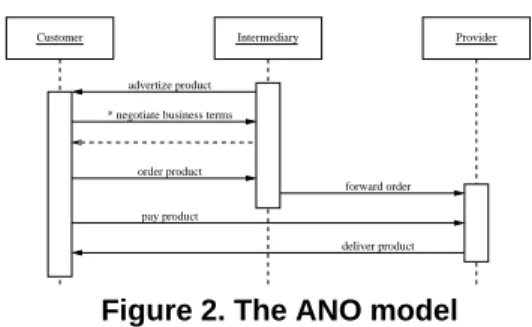
Figure 2 shows the ANO model in which the interme-diary also does order processing on behalf of the provider additionally to advertisement and negotiation.
Customer
pay product
Provider Intermediary
advertize product * negotiate business terms
order product
forward order
deliver product
Figure 2. The ANO model
In this model the intermediary additionally requires an
order specification artifact from the provider where the
provider defines the attributes and requirements for a syn-tactically and semantically correct order. So the intermedi-ary can request all required information from the customer to create and send a correct order that the provider will ac-cept. The intermediary may forward orders immediately to the provider or collect orders and send them to the provider in one message (maybe once a day).
The ANO model and the following ones additionally al-low the intermediary to provide higher-level services to the customer. The intermediary may offer combined or syndi-cated products which the customer may order. This (com-bined) order may be split by the intermediary into sub-orders for several providers (including itself) to accomplish the overall order. In this case several providers may interact with the customer in the payment and delivery phases (if these phases are not covered by the intermediary).
In the ANOP model the intermediary also provides a pay-ment service on behalf of the provider additionally to ad-vertisement, negotiation, ordering. The intermediary takes care of customers’ payment requests and forwards them to
payment service providers in much the same way as de-scribed above for orders. The intermediary may also act as a payment gateway which frees customers and providers of supporting many different payment mechanisms and ad-ditionally allows them to use best applicable payment ser-vices. For example, the customers may pay the interme-diary using a micro-payment protocol and the intermedi-ary accomplishes payment with its providers via a macro-payment protocol after having accumulated a large number of customer payments to keep transaction costs low.
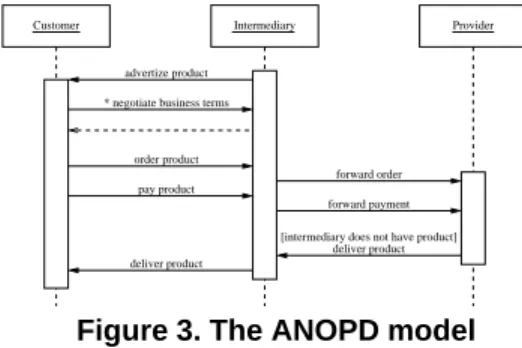
Finally, Figure 3 shows the ANOPD model in which the intermediary also takes over the delivery and thus is the single interaction partner of the customer on behalf of the provider. This is a degenerate case of the direct model.
Customer
[intermediary does not have product] Provider Intermediary
advertize product * negotiate business terms
order product forward order forward payment deliver product deliver product pay product
Figure 3. The ANOPD model
Typical delivery mechanisms are: download, email, or push. Physical shipment is outside the scope of our model because we are concerned with intangible (information) products. The intermediary may also act as a delivery gate-way. For example, the intermediary may provide a uniform delivery service for its customers via WWW download and have multiple different delivery channels for its providers. A problem in this model is that the intermediary has a phys-ical copy of the product which it may exploit to produce unlicensed copies and sell them. This is a general prob-lem of intangible goods and will be discussed in Section 4. The ANOPD model also allows the intermediary to act in a new role. It can combine products of several providers autonomously and create, offer, and sell combined prod-ucts. Thus the intermediary becomes a kind of provider it-self (value-adding reseller, content syndicator). However, it is unclear where to exactly draw the line between an in-termediary and a provider in this case.
As stated at beginning of this section phases in the incre-mental model may be left out. As an example, we will also evaluate the security of the ANOD model in Section 4. This practically highly relevant model is similar to the ANOPD model but payment is done directly between the customer and the provider. Such a configuration is applicable if, for example, the provider does not have enough network band-width to distribute its products to a high number of con-sumers and for this purpose uses a feasible intermediary but does not want to hand over payment to the intermediary. 2.4. Mapping of business models
In the previous section we have already identified some correspondences of our model with well-known
e-commerce models and architectures. The e-shop model and
portal (for one provider) correspond to the direct model. A (process) portal [14] and the associated partner model, e.g.,
[1], can be mapped onto the A model. Several others, such as (process) vortex, dynamically trading processes, third-party marketplace, (value-adding) reseller, or virtual com-munities, require special consideration since no simple 1:1 mapping can be defined for them.
The (process) vortex architecture [14] is similar to a por-tal. The difference is that in a vortex marketplace the inter-actions between customers and providers occur through a third-party (the intermediary). A vortex would correspond to the AN model and the subsequent models (depending on the service level of the vortex). The dynamically trading
processes model [14] extends the vortex model. In this
model neither business processes nor the set of possible in-teractions are predefined. Instead a unique process can be dynamically constructed on a per customer basis. Dynami-cally trading processes have the same mapping as the vortex since they only add higher flexibility to the vortex model but do not extend it otherwise.
A third-party marketplace architecture can be mapped onto all our models other than the direct model and de-notes a wide range of architectures. Depending on the ser-vices that an intermediary provides it defines a more ad-vanced marketplace. The (value-adding) reseller and
(con-tent) syndicator models correspond to our ANOPD model
whereas the concept of virtual communities is orthogonal to our models and simply depends on whether such a service is provided by the intermediary or producer.
3. Security threats and solutions
Before the design of a secure system the business model has to be analyzed to identify what has to be protected against which potential attacker and which parts need not be secured because the parties trust each other. The re-sult is the trust model which is the basis for any further steps. To enable an analysis, we have to consider the ca-pabilities, skills, and time the attacker is assumed to have. Then critical points have to be determined, the values for all involved parties and the possibilities for dishonest parties to achieve advantages illegally must be identified. Other problems with dishonest parties to be regarded concern the infliction of losses to other parties, e.g., denial of service. In such cases, the advantages are indirect: causing prob-lems for a competitor can have positive influence on the attacker’s own business. Another aspect to be considered in a trust model are potential collusions of involved parties. Even if security concepts resist attacks that were performed by individual attackers they can become dramatically inse-cure if attackers exploit their common power. In reality, the strength and restrictiveness of the trust model to be chosen is not only driven by security aspects. Because security can often be expensive, the expenditure for security has to be compared with expected losses.
Security methods can be classified into those providing prevention of attacks (e.g., encryption of information) and
those for detection of attacks (e.g., verification of signature forgery). Furthermore, consequences for attackers have to be defined clearly. This must be accomplished by laws and regulations within a legal framework since technical secu-rity is not sufficient for a secure business environment. Ad-ditionally, an arbitrator is needed who has the authority to impose these consequences based on the evaluation of some evidence provided by the detection mechanisms. A party
which is in conflict with party can convince an
arbitra-tor of ’s fault only if it can present an evidence which
can be only created by party . Presenting information
that can also be created by other parties, e.g., , is
insuffi-cient for this purpose. Therefore, the technical design must include special mechanisms whenever a business interac-tion requires convincing means to prevent malicious parties from infringing the business or legal rules. Additionally, trusted third parties (TTP) such as certification authorities or time stamping authorities, are frequently necessary in se-curity concepts.
Actions of malicious parties are categorized under the summarizing terms privacy infringement and fraud. Privacy infringement: This category denotes actions by which malicious parties intend to find out information about other parties. Such attacks can hardly be detected by the victims. Considering a business relation we have to distin-guish if the privacy infringement is performed by a party which is involved in the business relation or which does not participate in the business relation. Inside a business relation the involved partners in general have to reveal in-formation to each other to a certain degree. For example, a customer may have to provide name and address, the knowl-edge of a customer’s buying preferences can be exploited for identifiable customer profiles for data mining and direct marketing purposes. Studies have shown that users want to reveal as little personal information as possible because they fear loss of privacy and potential misuse [6, 17].
Two approaches exist for avoiding misuse of personal data such as collecting, processing or passing it to other parties: regulation by legal framework, e.g., [4], and tech-nologies which constrain or fully avoid unauthorized insight into personal data. Solely relying on a legal framework is an insufficient protection since this is equivalent to trusting that other parties will follow the rules. Furthermore, in an international context the legal framework is still very het-erogeneous. Technologies that hide personal data from in-teracting business partners are not developed to an extent to be used in real trading scenarios. Technologies which pro-vide anonymity exist and can be used to surf the Internet or to hide all identifiable information from the communication partner in emails, e.g., [5, 13, 15], but cannot be used in business relations that are based on contracts.
Beside this intra-business protection also protection against parties not participating in the business relationship must be considered, e.g., a wiretapper who is interested in what a specific person buys or how often a vendor sells a specific product. This problem can be easily solved by en-crypting messages. Several encryption methods and ways for exchanging cryptographic keys can be used here [9].
Fraud: In this classification fraud covers different inten-tions of malicious parties that can either be inside or out-side the business relationship. It comprises masquerading of parties, manipulation of messages, repudiation of bind-ing agreements, and theft of goods. Secure systems must be able to detect such attacks immediately and they should provide the victim with enough evidence to identify the ma-licious party undoubtedly to convince an arbitrator.
In masquerading attacks, malicious parties claim to have some other party’s identity. Examples are sending messages with forged sender address, or using services and charging it to some other party’s account. The solution to this well-known problem is authentication, where we have to distin-guish between data origin authentication and entity authen-tication. Data origin authentication provides the receiver of a message with the identity of the party which originated the message. However, this does not prevent an attack in which a malicious party copies an authenticated message and re-sends it later claiming the identity of the originator. This security hole can be fixed by applying entity authentication which guarantees both the identity of the communication partner and that he/she really sent the received message. Authentication methods can also be classified according to whether they provide the receiver with an evidence to con-vince a third party or not.
Manipulation of messages is another security problem in business relationships that has to be prevented. E.g., an at-tacker who is not involved in the business relationship could increase the prices in offers on their way to a customer to dissuade him/her. The motivation to manipulate messages can be for profit or simply wanting to be detrimental to oth-ers. To prevent manipulation methods for verifying the in-tegrity of exchanged messages are applied. Again we can distinguish two cases: Is it sufficient to detect manipulation at all or should the detection also provide an evidence to convince a third party of the integrity and validity of a doc-ument? In the second case this additionally means that the originator of a valid document cannot claim that the docu-ment was changed at a later time. This already touches the problem of repudiation of binding agreements. In business relations agreements are often binding. E.g., a party should not be able to claim not having placed a certain order if it actually did, or it should not be possible that a party falsely claims having received an order from another party. In both cases, the ordering party would repudiate what the receiver claims. A conflict in which a party repudiates having agreed to some business details requires evidence that can be used to convince a third party or to identify the dishonest party. A solution to this problem are unforgeable digital signatures as first sketched in [3]. A digital signature of a message is a number which depends on a secret key that is only known to the signer, and on the content of the message that is signed. The validity of the signature can be verified easily by every-one using the signer’s public key and without knowing the secret.
Whenever commercial goods are traded the possibility of theft must be considered. This problem is well-known in the tangible world and measures are taken to avoid it. In the
area of i-commerce dealing with intangible goods the situa-tion is different and much more complicated. Digital goods can be copied easily at nearly no costs and without loss of quality. An original and its copies are identical and cannot be distinguished. Illegal copying and redistribution of intan-gible goods is hard to detect because in contrast to theft in the tangible world the original is still available to its rightful owner afterwards. Two approaches exist to cope with this piracy problem: preventive methods using tamper-resistant hardware and repressive methods based on fingerprinting the intangible goods.
The approach based on special tamper-resistant hard-ware modules has shown its limitations because of practical and effectiveness reasons. Although fingerprinting cannot make copying data technically impossible, it can prevent malicious parties from redistributing information goods. The goal of fingerprinting is to embed invisibly some formation into each copy to make it unique [10]. This in-formation can be used later to identify the buyer of a copy. If an illegal copy is found the seller can trace the copy back to the buyer who has redistributed the copy. Fingerprints in information goods have to fulfill several requirements: They should not harm the functionality or representation of the data they are embedded in, buyers or a certain number of colluding buyers must not be able to locate the marks, marks must not be deleted by processing and compression, and must not be corrupted by embedding new fingerprints.
If it is sufficient for a seller to know which buyer has redistributed an illegal copy the seller can fingerprint each sold copy on his/her own. But if he/she also wants an evi-dence for a third party to prove that an illegal copy was re-distributed by a specific buyer, then the seller is not allowed to know the fingerprinted copy at the time of selling it. If the seller has the fingerprinted copy he/she could illegally distribute it after having sold it to an honest buyer and then claim that this buyer has redistributed it. On the other hand, he/she must be able to identify the buyer if he/she finds a copy one day at an unexpected party. These properties are provided by asymmetric fingerprinting as described in [11, 12]. Unfortunately, the case in which a malicious buyer redistributes an asymmetrically fingerprinted copy cannot be distinguished from the case in which some other party steals an asymmetrically fingerprinted copy from an honest buyer.
The methods described above are basic technical means to avoid privacy infringement and fraud. Beside these tech-nical means organizational means are also necessary [2].
4. A security view on business processes
In this section we show security problems in complex business processes involving three parties and describe
pos-sible solutions. The well-known direct model of two
inter-acting parties will not be discussed. In the discussion of the considered models—A, AN, ANO, ANOP, and ANOD— we assume as little trust as possible and that all communi-cation is encrypted by default to prevent wiretapping. We also address the issue of non-repudiation, which is required
to obtain binding messages, wherever reasonable. 4.1. The A model
In this model the intermediary only performs
advertis-ing on behalf of the provider . If ’s marketing efforts
are successful, the costumer starts to negotiate with .
Therefore, has to provide its catalog at ’s disposal
before can start marketing. has a validity period
start-ing at time and ending at which have to be
commu-nicated to . For reasons of authentication, integrity
verifi-cation, and conflict resolution by third parties, creates a
digital signature ! that depends on , , , and , and passes the signature to . After positive
ver-ification of the signature, creates"#$ % ! and
replies it to . This signature is a confirmation that really
received and is informed about the validity period. The signature also depends on so that no other party&
provid-ing the same products can claim havprovid-ing a confirmation of .
If distributes different catalogs and to
differ-ent intermediaries and , and should be prevented
from exchanging the catalog. Therefore, ’s signature
de-pends on the receiver . Both parties, and , should
store the received signatures because they can be used as evidences in case of malicious actions by some party. The evidences can be verified by a third party (e.g., an arbitra-tor) to identify a dishonest party. E.g., since has stored # ' (%)!, cannot advertise expired offers.
Having received ’s catalog, can start with the
mar-keting activities. In general, and can cooperate in two
ways: (1) pays a constant amount of money to for its
advertising service, or (2) pays a commission to for
each sale resulting from ’s advertising activities. In the
first case, and have a contract that guarantees a fixed
income. The second case is more attractive for since it
motivates to do good advertising and needs not check
if or how is doing its job.
Whenever gives any advertising information to it
should be digitally signed. This is necessary for several rea-sons: (1) it can be used for an integrity check; (2) it can be used as proof if does not work properly; and (3) it can be
used for the authentication of and for the assignment of
the commission.
The third point is essential in this model. The identity of has to be forwarded by to while negotiating or
ordering. Then, knows which intermediary deserves the
commission. Therefore, the information referencing as
the intermediary has to be protected against modification by a malicious party& that could replace the reference to
by a reference to itself: A digital signatures of could be
deleted and replaced by a new signature of another parties. The strategies to avoid this attack depend on the power of the assumed adversary. In case the adversary is an external party that tries to replace ’s signature by its own signature,
it suffices to encrypt the communication between and .
In the case that the adversary has the power of ’s Internet
service provider, the situation is more complicated. Here
reached properly. If does not receive ’s confirmation,
it may become distrustful. In reality, there are several ex-amples in which the information for the identification of the intermediary is transmitted without protection.
The low protection level in real business relationships may be due to further weak assumptions which are inherent in the A model: In the A model must trust . Since does
not see any order or contract negotiated between and ,
does not know if really buys and how much it pays. Thus has to trust that is honest and provides with proper
sales information. Of course, could ask for a signed
and unique purchase confirmation which indicates the price and also holds a signed and unique receipt from . But
it is questionable if such a scheme would work in practice because gains no benefit from its additional work. Even
if such a scheme was introduced, could collude with
to achieve a win-win situation by offering goods at a lower price if did not inform about the purchase.
So far we have only described the potential for any kind of fraud in the A model. The second issue to consider is privacy infringement. As long as gets no information if
and are doing business with each other there are no data
concerning that can be collected, processed, or used by
for other purposes. Even if receives information
specify-ing how much money spends while doing business with it does not know which products is buying.
In summary the A model has some advantages in the area of privacy protection: While providers get insight into the personal data of costumers, no other parties can learn about the costumers’ interests or collect personal data of the customer. The A model is based on a trusted relation between the intermediary and the provider. The interme-diary should not cooperate with the provider if it does not trust the provider. Thus, it is questionable if the A model should be applied for ad-hoc business cooperations. On the other hand, introducing security instead of trust would have a negative impact on potential privacy infringements. 4.2. The AN model and the ANO model
In these models the intermediary performs advertising
and negotiation. In the AN model the ordering is done by
, whereas in the ANO model, is also responsible for
for-warding the order as a signed contract to . In both models provides with a pricing and discount model*,+.- , in
ad-dition to the catalogue , to enable negotiation by . Both,
and*/+- , and their validity periods have to be signed
by similarly to the signing described in the A model to
avoid the attacks described above. The same applies to the advertising phase: All advertising messages should be digi-tally signed by . If is interested in some product, it can
start to negotiate about the final price or other negotiable properties. All messages that are exchanged in the nego-tiation phase before the final contract should be protected against modification and also be checked if they are created and sent by the claiming party. If both negotiating partners finally agree and intends to purchase they finish the
ne-gotiation with a binding contract. Therefore, and sign
the contract which includes all the relevant business param-eters such as description of the good, price, identity of both
and , date, constraints for delivery, and more. This will
be done by filling in and signing an order form provided by
. In the AN model, the contract is sent to by , while in
the ANO model it is forwarded by . The contract and the
signature can be verified by and additionally it can check
whether followed the rules. If not, can can prove ’s
fault by showing ’s confirmation signature on the*,+.- and ’s signature on the contract. If did act properly it can
nul-lify any false accusation through ’s signature on the
*/+-and the contract signed by and .
In the ANO model, after having forwarded the signed contract, requires to send the commission. All contracts
have to be uniquely identifiable (e.g., by a unique number) because copies of the same contract will not be accepted by
. This prevents an intermediary from sending a contract
twice. Upon receipt of the commission, must send a
con-firmation of having received it for each specific contract to
. This confirmation protects against multiple
commis-sion claims. If a malicious requests the commission
mul-tiple times and refuses to send the payment confirmation
can prove the money transaction via a trustworthy payment authority. Thus can be forced to send the payment
con-firmation. As long as has no evidence that proves the
payment of the commission it will lose a conflict with and
has to pay. Since has a proof for every good sold as
a result of ’s activities, this model also works even if
does not trust . There is also no obvious possibility for a
collusion between and .
In the AN model, after has sent the signed contract to , waits for the commission from . Having received it, has to confirm the receipt of each payment as in the ANO
model. In AN model, it is still possible that changes its
mind after having signed the contract—of which holds a
copy—and does not send the signed contract as an order to
. In this case, would wait a certain time for the
commis-sion, and then would inquire about the commission. At
this stage, cannot know if did not send the contract or if tries to cheat or simply failed to send the commission to . In all cases can show a copy of the contract to , and as
long as has no confirmation from for the payment of the
commission for that specific contract, would have to pay.
In the case that changed its mind and did not send the
contract to , can use the copy of the contract provided
by and deliver the goods which has confirmed in the
contract. This model also works if does not trust . But
in case of not receiving the commission in time, he does not know whose fault— ’s or ’s—it was. The delivery and
payment in both models are handled between and as
in the well-known direct model and thus require no further discussion.
Regarding privacy aspects, the properties of the AN and the ANO model are equivalent. In both models gains
con-siderable insight into the costumers’ personal data, their in-terests and activities. knows all products is interested
in and how much it is willing to pay for them. This knowl-edge not only derives from the interaction with during
marketing, negotiation, and contracting: Since has access
to the*/+- it can categorize customers probably enriched
with further properties that can be critical from a privacy protection point of view. Since can act as an
intermedi-ary for several providers 0 111(32 it can aggregate and
concentrate lots of personal data.
Summarizing the properties of the AN and the ANO models, we see that there is a larger potential for privacy infringement but a much more balanced trust model for the business process. The AN and ANO models can be applied even if there is no trust between and . However, since
has the possibility to change its mind after signing a binding contract which implies some further workflow for conflict resolution, the ANO model seems to be preferable. 4.3. The ANOP model
The ANOP model is similar to the ANO model. The dif-ference is that is also involved in the payment process. sends the payment to after ordering. Thus, can
di-rectly withhold the commission it is entitled to. The rest of the money is forwarded to together with the order and
the signed contract. Having received this artifacts can
deliver the ordered good(s) to . To enable proper
cooper-ation in the ANOP model, the same prerequisites as in the ANO model have to be fulfilled (e.g., provision of and
*/+- ). The security requirements for the early phases in this
model are clear by the discussion of the previous models. Let us suppose now that has received the signed
or-der from and replied the confirmation to it. Since
receives the money directly from in the ANOP model,
there is no necessity for to collect evidences in order to
proof its claim for the commission resulting from its activi-ties. Upon the receipt of the payment, has to confirm the
receipt to with a digital signature referencing undeniably
the payment to the unique order. Thus, gets an
undeni-able proof that it paid for a certain order if some conflict arises later. Of course, a dishonest& could try to cheat by
claiming the money transfer without actually having done it and accuse of not having sent the confirmation. Similarly,
a dishonest& could refuse to send the confirmation to
af-ter receipt of the money. All these problems can be solved easily with the help of the involved payment authorities that have registered all money transactions.
After deducting the commission, forwards the rest of
the payment to with an undeniable reference to the
con-cerned order. The unique order containing ’s address and
the description of the ordered good(s) which is also signed by can be send in parallel to the payment or before. Thus, knows where the ordered good(s) have to be delivered to.
In any case, the receipt of the undeniable order and the re-ceipt of the payment have to be confirmed undeniably to
by . Thus cannot claim later having received different
data. Since both and hold evidences, i.e., signed
confir-mations, about the exchanged messages all responsibilities for intentional or unintentional faults can be assigned eas-ily. Other problems concerning payment and confirmation can be solved with the help of payment authorities. After
has verified all data it has received from it can deliver
the ordered goods to . In case complains that it did
not receive the goods, the dishonest party can be identified (e.g., &
did not forward the money and order, or
&
received
the money but did not deliver the goods) because this party does not have the necessary evidences.
From the privacy point of view the ANOP model is com-parable with the ANO model. Here also gains
consider-able insight into ’s personal data. can learn the same
things about as in the ANO model. Like in the ANO
model, the ANOP model is based on a balanced trust model. The ANOP model can be applied even if there is no mu-tual trust between and . One advantage of the ANOP
model over the ANO model is that potential doubtful in-termediaries can be convinced easier to participate in such business cooperations. They obtain money directly from the costumer and do not have to wait for their commission from the provider. Conversely there is no risk for the producer, since it can keep the good(s) until receiving the money. The ANOP model seems to be attractive if cannot fulfill some
requirements concerning payment, e.g., accepts only one
or a few payment systems while offers a variety of
pay-ment systems.
4.4. The ANOD model
In the ANOD model performs the delivery of the
or-dered good after the reception of the order while
trans-fers the payment to . Therefore, has to provide with
the good(s). Let us assume that the earlier phases are se-cured as in the ANO model and both and hold a signed
copy of the order. In the ANOD model knows exactly
how much was sold resulting from its activities and also has undeniable proofs by the orders that are signed by the costumers. Thus there is no possibility for a dishonest &
to claim that it sold less products via ’s activities.
There-fore, non-repudiably forwards each received order to
and waits for a confirmation. (Later, we will also need the forwarding of the order and the confirmation of receipt for copyright protection. There these non-repudiable messages are used for informing about the identity of legal buyers.)
Thereby, knows which costumer ordered which product
at what price via which intermediary. Meanwhile, can
send the payment to accompanied with its order. Upon
receipt of the payment sends a confirmation of receipt to . If a dishonest& refuses to send its payment can
en-force the payment by using the copy of the order with & ’s
signature. Problems related to dishonest claims concerning payment and the confirmation can be solved via trustworthy payment authorities.
Further security aspects concerning the provision of goods to and delivery depend on the kind of goods. In
this context we classify them as tangible or intangible. In the case of tangible goods, has to provide each piece to physically. After the receipt of the order can deliver
the good(s) itself or via a delivery service. In both cases,
confirms the receipt of the good(s) and replies the confirma-tion to so that later cannot claim that did not deliver.
For the sake of simplicity assume that the delivery service is trustworthy. If refuses to pay and claims that did not
deliver the good(s) asks to show ’s confirmation of
delivery. If is dishonest and provides with ’s
con-firmation of delivery can force to pay. If cannot show ’s confirmation can force to deliver.
In the case of intangible goods they can be delivered electronically. We assume that holds one copy of each
intangible information product in its database which it uses to create the copies of the products to be delivered. If de-livery is done electronically a dishonest & can receive the
good(s) without replying a confirmation and claim that it never received the good(s)s from . In this situation it is not
possible for to decide who— or —cheats. A malicious
&
could refuse to pay. In this case, would ask to send
the good(s) or to send the same copy again as before. Even if delivered the good(s) before it requires no costs for to
send the same copy twice which is in contrast to the case of tangible good(s). If such a conflict arises the delivery could be done under the observation of or any other trustworthy
party. Thus can be forced to pay.
A serious problem with intangible goods stems from piracy and copyright infringement. Since digital goods can be copied at no costs without loss of quality, illegal copies are very attractive for pirates. Since the ANOD model com-prises three parties— , , and —that trade with
digi-tal goods, and since two parties— and —can deal with
illegal copies, a special special protection mechanism is needed. This mechanism should help to identify the party
which has distributed illegal copies of ’s good(s).
Further-more, the identifying information must also be sufficient to convince third parties of the identity of the malicious party. Therefore the marked copy which is distributed legally has to be unknown to the distributor. If not the distributor could give a copy to some other party and accuse the legal receiver having redistributed it. The mechanism to overcome these problems is offered by the double application of asymmetric fingerprinting.
The concept of asymmetric fingerprinting of digital good(s) was already presented in the previous section. In the following we restrict our discussion to those kind of in-tangible goods to which asymmetric fingerprinting can be applied, e.g., multimedia content. In a first step, while
provides its product to , the product is marked by
asym-metric fingerprinting. If redistributes this product legally
to upon ’s order, the copy which is delivered gets a
sec-ond asymmetric fingerprint. Both asymmetric fingerprints do not interfere with each another. Furthermore, informs that ordered a copy of a specific good by forwarding ’s order, and confirms the receipt of this information as
described above.
If finds a copy of a digital good at some& it can check
by the information provided by if
&
is a legal buyer of the
good. If & is not known as a legal buyer can analyze
the copy and prove to third parties that it stems from ’s
copy. Here the first asymmetric fingerprint in the copy is exploited. But even if some illegal copy turns up which can
be traced back to it is not clear at this time which party
is malicious. There are two possibilities: (1) is malicious,
because he has redistributed an illegal copy to & . This
im-plies that has not informed that
&
is a legal buyer. Or
(2) has delivered a legal copy to a malicious which has
redistributed an illegal copy to & .
If acted honestly it has informed about the identity of
the legal buyer . Now, can analyze the copy found by
and prove to third parties that it stems from ’s copy.
Fur-thermore, has ’s confirmation that informed it about
to be a legal buyer. This proves that is honest.
Addition-ally, can verify itself if it knows to be a legal buyer.
In this case, will be accused for redistribution of
ille-gal copies. Here the second asymmetric fingerprint in the copy is exploited. If cannot prove to third parties that the
found copy once belonged to a certain customer who was announced to by to be a legal buyer, will be accused.
Concerning privacy problems, the ANOD model shows the same properties as the previously considered ANO and ANOP model.
To summarize the ANOD model we see that it is also based on a more balanced trust model. Like in the ANO and the ANOP case, the ANOD model can also be applied if there is no mutual trust between and . Since the
in-termediary has access to the digital goods, this model re-quires special mechanisms to cope with copyright protec-tion problems. Here it also has to be considered that the costs for copyright protection and possibly necessary con-flict resolution must be in relation to the value of the traded goods. This implies that the value of the traded goods has an impact on the applicability of the ANOD model. Be-sides , gains considerable insight into ’s personal data.
The ANOD model is attractive when a special delivery ar-rangement is required that can not be provided by , e.g.,
delivery of large data packages when only has access to
limited network bandwidth. 4.5. Comparison of the models
The previous discussion shows that models with better privacy protection have more potential for fraud (A model) and vice versa (AN, ANO, ANOP, and ANOD models). The A model can only be applied if the intermediary trusts the provider. In contrast the AN, ANO, ANOP, and ANOD model do not require mutual trust between intermediary and provider. This distinction may considerably influence the decision whether two parties start a business coopera-tion without knowing each other. In the ANOP and ANOD models, the intermediary offers special functionalities (pay-ment, delivery) to the provider. These models are attractive if the provider cannot fulfill special requirements related to these functionalities. The A, AN, ANO, and ANOP model are applicable to tangible and intangible goods, whereas in the ANOD model precautions for securing intangible goods are required. The value of the traded intangible goods has an impact on the applicability of the ANOD model.
5. Conclusions
The success of business models in e-commerce de-pends on how well they support secure business interactions among the business actors. Due to the complexity of the new models, which involve a higher number of roles and interactions, security must be based on a systematic analy-sis that clearly exposes the possible threats and supports an overall security assessment of the intended model before it is deployed. On the basis of such analysis, it is possible to apply, combine, or augment standard security mechanisms to achieve the required level of security.
In this paper we have presented a systematic approach for the assessment of business model security. As the ba-sis for a security analyba-sis we have broken down the busi-ness process into 5 phases: advertising, negotiation, order-ing, payment, and delivery. We have presented a 3-party model (customer, intermediary, provider) for modeling in-teractions in e-commerce business models, described their possible roles in the phases, and the exchanged artifacts. We then mapped this generally applicable unified model onto the common e-business models and concepts.
We analyzed the security concerns of each phase with respect to mappings of the phases onto the different parties in our model. This analysis facilitates overall security as-sessment of specific business models. The 5-phases/3-party model allows a designer to classify a business model and assess its security. We have analyzed business processes on a conceptual level, discussed their security problems, and have provided conceptual proposals for addressing the se-curity issues if technically possible.
As a main result of our security analysis we have demon-strated the impact of assigning different phases to different parties on the security level that is objectively achievable. The level of security that can be achieved depends on the party that performs a certain phase. For example, different security levels are possible depending on whether negotia-tion is done by the intermediary or the provider. As a result, depending on which party performs a given phase, different security mechanisms must be applied.
In some models, correct operation depends on trust and cannot be secured in an objective way, i.e., some parties must always be honest for the model to work. For example, the A model—portal, associated partners—can only work correctly if the intermediary is trustworthy (but no mech-anism exists to enforce this). In several other models we have analyzed, objective security is possible. This distinc-tion may heavily influence the choice of possible business partners since it defines whether a business party can poten-tially defraud another party or such fraud may be prevented by security mechanisms.
If a 2-party business model is extended to an n-party model then the security issues cannot be addressed by solely applying standard security mechanisms such as authentica-tion, signatures, or secure payment methods. Instead the overall security of the n-party model heavily depends on the assignment of phases among the partners. Additional security issues emerge depending on a concrete assignment
even as the security issues of a 2-party model must still be addressed adequately.
Our results show that many intrinsic security issues ex-ist in common e-business models which are addressed only to a limited extent in current e-business sites. Assessment of these problems and the application of adequate solutions may determine the success of e-business sites in the long run. Such assessment may be made systematically on the basis of our phase model.
References
[1] Amazon.com Associates Program, Amazon.com, 2000, http://www.amazon.com/exec/obidos/subst/associates/join/ associates.html/ref=as gw sf/104-2151277-1127609 [2] R. Anderson: Why Cryptosystems Fail, Comm. of the ACM,
Vol. 37, No. 11, 1994
[3] W. Diffie, M. Hellman: New Directions in Cryptography, IEEE Trans. Inf. Th., Vol. 22, No. 6, 1976
[4] Directive 95/46/EC of the European Parliament and of the Council of 24 October 1995 on the Protection of Individu-als with the Regard to the Processing of Personal Data and on the Free Movement of such Data, Official Journal of the European Communities, No. L281, 1995
[5] D. Goldschlag, M. Reed, P. Syverson: Hiding Routing In-formation, Proc. Information Hiding, Springer, LNCS 1174, 1996
[6] D. Hoffman, T. Novak, M. Peralta: Building Consumer Trust Online, Comm.of the ACM, Vol. 42, No. 4, 1999
[7] M. Jazayeri, I. Podnar: A Business and Domain Model for Information Commerce, To appear in Proc. HICSS, 2001, Maui, Hawaii
[8] D. Konstantas, J.-H. Morin: Trading digital intangible goods: the rules of the game, Proc. HICSS, 2000, Maui, Hawaii
[9] A. Menezes, P. van Oorschot, S. Vanstone: Handbook of Ap-plied Cryptography, CRC Press, 1997
[10] F. Petitcolas, R. Anderson, M. Kuhn: Information Hiding -A Survey, Proc. of the IEEE, Vol. 87, No. 7, 1997
[11] B. Pfitzmann, M. Schunter: Asymmetric Fingerprinting, Eu-rocrypt ’96, LNCS 1070, Springer, 1996
[12] B. Pfitzmann, M. Waidner: Asymmetric Fingerprinting for Larger Collusions, Proceedings, 4th ACM Conf. on Com-puter and Communications Security, Zurich, 1997
[13] M. Reed, P. Syverson, D. Goldschlag: Anonymous Connec-tions and Onion Routing, IEEE Journal on Selected Areas in Communications – Special Issue on Copyright and Privacy Protection, 16(4), 1998
[14] A.P. Sheth, W.v.d. Aalst, I.B. Arpinar: Processes Driving the Networked Economy, IEEE Concurrency, Vol.7, No.3, 1999 [15] P. Syverson, M. Reed, D. Goldschlag: Private Web
Brows-ing, Journal of Computer Security, Vol. 5, No. 3, 1997 [16] P. Timmers: Business Models for Electronic Commerce, EM
– Electronic Markets, Vol.8, No.2, 1998
[17] H. Wang, M. Lee, C. Wang: Consumer Privacy Concerns about Internet Marketing, Comm. of the ACM, Vol. 41, No. 3, 1998