Proving That Non-Blocking Algorithms Don’t Block
Alexey Gotsman
University of CambridgeByron Cook
Microsoft ResearchMatthew Parkinson
University of CambridgeViktor Vafeiadis
Microsoft ResearchAbstract
A concurrent data-structure implementation is considered non-blockingif it meets one of three following liveness criteria: wait-freedom,lock-freedom, orobstruction-freedom. Developers of non-blocking algorithms aim to meet these criteria. However, to date their proofs for non-trivial algorithms have been only manual pencil-and-paper semi-formal proofs. This paper proposes the first fully automatic tool that allows developers to ensure that their algo-rithms are indeed non-blocking. Our tool uses rely-guarantee rea-soning while overcoming the technical challenge of sound reason-ing in the presence of interdependent liveness properties.
Categories and Subject Descriptors D.2.4 [Software Engineer-ing]: Software/Program Verification; F.3.1 [Logics and Meanings of Programs]: Specifying and Verifying and Reasoning about Pro-grams
General Terms Languages, Theory, Verification
Keywords Formal Verification, Concurrent Programming, Live-ness, Termination
1.
Introduction
Non-blocking synchronisationis a style of multithreaded program-ming that avoids the blocking inherent to lock-based mutual ex-clusion. Instead, alternative synchronisation techniques are used, which aim to provide certain progress guarantees even if some threads are delayed for arbitrarily long. These techniques are pri-marily employed by concurrent implementations of data structures, such as stacks, queues, linked lists, and hash tables (see, for ex-ample, thejava.util.concurrent library). Non-blocking data structures are generally much more complex than their lock-based counterparts, but can provide better performance in the presence of high contention between threads [38].
An algorithm implementing operations on a concurrent data structure is considerednon-blockingif it meets one of three com-monly accepted liveness criteria that ensure termination of the op-erations under various conditions:
Wait-freedom [15]:Every running thread is guaranteed to com-plete its operation, regardless of the execution speeds of the other threads. Wait-freedom ensures the absence of livelock and starvation.
Permission to make digital or hard copies of all or part of this work for personal or classroom use is granted without fee provided that copies are not made or distributed for profit or commercial advantage and that copies bear this notice and the full citation on the first page. To copy otherwise, to republish, to post on servers or to redistribute to lists, requires prior specific permission and/or a fee.
POPL’09, January 18–24, 2009, Savannah, Georgia, USA. Copyright c2009 ACM 978-1-60558-379-2/09/01. . . $5.00
Lock-freedom [23]:From any point in a program’s execution, some thread is guaranteed to complete its operation. Lock-freedom ensures the absence of livelock, but not starvation. Obstruction-freedom [16]:Every thread is guaranteed to
com-plete its operation provided it eventually executes in isolation. In other words, if at some point in a program’s execution we suspend all threads except one, then this thread’s operation will terminate.
The design of a non-blocking algorithm largely depends on which of the above three criteria it satisfies. Thus, algorithm developers aim to meet one of these criteria and correspondingly classify the algorithms as wait-free, lock-free, or obstruction-free (e.g., [14, 16, 25]). To date, proofs of the liveness properties for non-trivial cases have been only manual pencil-and-paper semi-formal proofs. This paper proposes the first fully automatic tool that allows developers to ensure that their algorithms are indeed non-blocking.
Reasoning about concurrent programs is difficult because of the need to consider all possible interactions between concurrently exe-cuting threads. This is especially true for non-blocking algorithms, in which threads interact in subtle ways through dynamically-allocated data structures. To combat this difficulty, we based our tool on rely-guarantee reasoning [18, 29], which considers every thread in isolation under some assumptions on its environment and thus avoids reasoning about thread interactions directly. Much of rely-guarantee’s power comes from cyclic proof rules for safety; straightforward generalisations of such proof rules to liveness prop-erties are unsound [1]. Unfortunately, in our application, we have to deal with interdependencies among liveness properties of threads in the program: validity of liveness properties of a thread can depend on liveness properties of another thread and vice versa. We resolve this apparent circularity by showing that (at least for all of the al-gorithms that we have examined) proofs can found that layer non-circular liveness reasoning on top of weak non-circular reasoning about safety. We propose a method for performing such proofs by repeat-edly strengthening threads’ guarantees using non-circular reason-ing until they imply the required liveness property (Section 2). We develop a logic that allows us to easily express these layered proofs for heap-manipulating programs (Sections 3 and 4) and prove it sound with respect to an interleaving semantics (Section 6).
In addition, we have found that the rely and guarantee condi-tions needed for proving algorithms non-blocking can be of a re-stricted form: they need only require that certain events do not hap-pen infinitely often. This allows us to automate proving the liveness properties by a procedure that systematically searches for proofs in our logic with relies and guarantees of this form (Section 5).
Using our tool, we have automatically proved a number of the published algorithms to be formally non-blocking, including chal-lenging examples such as the HSY stack [14] and Michael’s linked list algorithm [25]. Proofs for some of the verified algorithms re-quire complex termination arguments and supporting safety prop-erties that are best constructed by automatic tools.
2.
Informal development
We start by informally describing our method for verifying liveness properties and surveying the main results of the paper.
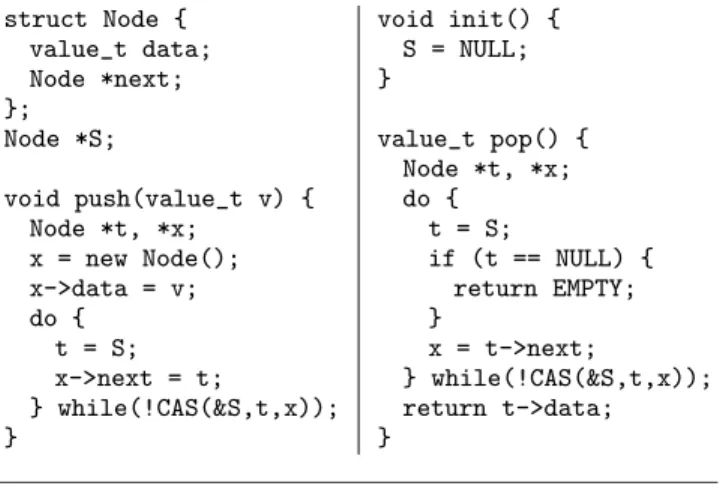
Example. Figure 1 contains a simple non-blocking implemen-tation of a concurrent stack due to Treiber [33], written in a C-like language. A client using the implementation can call several pushorpopoperations concurrently. To ensure the correctness of the algorithm, we assume that it is executed in the presence of a garbage collector (see [17, Section 10.6] for justification). We also assume that single word reads and writes are executed atomically. The stack is stored as a linked list, and is updated by compare-and-swap (CAS) instructions. CAS takes three arguments: a memory address, an expected value and a new value. It atomically reads the memory address and updates it with the new value when the ad-dress contains the expected value; otherwise, it does nothing. In C syntax this might be written as follows:
int CAS(WORD *addr, WORD v1, WORD v2) { atomic {
if (*addr == v1) { *addr = v2; return 1; } else { return 0; }
} }
In most architectures an efficient CAS (or an equivalent operation) is provided natively by the processor.
The operations on the stack are implemented as follows. The functioninitinitialises the data structure. Thepushoperation (i) allocates a new nodex; (ii) reads the current value of the top-of-the-stack pointerS; (iii) makes thenextfield of the newly created node point to the read value ofS; and (iv) atomically updates the top-of-the-stack pointer with the new valuex. If the pointer has changed between (ii) and (iv) and has not been restored to its initial value, the CAS fails and the operation is restarted. Thepopoperation is implemented in a similar way.
Liveness properties of non-blocking algorithms. Notice that a push or pop operation of Treiber’s stack may not terminate if other threads are continually modifying S: in this case the CAS instruction may always fail, which will cause the operation to restart continually. Thus, the algorithm is not wait-free. However, it is lock-free: ifpushandpopoperations execute concurrently, some operation will always terminate.
We note that an additional requirement in the definitions of the liveness properties given in Section 1 is that the properties have to be satisfied under any scheduler, including an unfair one that suspends some threads and never resumes them again: in this case the remaining threads still have to satisfy the liveness properties. The properties form a hierarchy [10]: if an algorithm is wait-free, it is also lock-free, and if it is lock-free, it is also obstruction-free. Note also that even the weakest property, obstruction-freedom, prevents the use of spinlocks, because if a thread has acquired a lock and is then suspended, another thread may loop forever trying to acquire that lock.
We first describe our approach for verifying lock-freedom. Reducing lock-freedom to termination. We show that the check-ing of lock-freedom can be reduced to the checkcheck-ing of termina-tion in the spirit of [36]. Consider a non-blocking data structure with operationsop1, . . . ,opn. Letopbe the command that non-deterministically executes one of the operations on the data struc-ture with arbitrary parameters:
op=
if(nondet())op1;else if(nondet())op2;. . . else opn; (2.1) struct Node { value_t data; Node *next; }; Node *S; void push(value_t v) { Node *t, *x; x = new Node(); x->data = v; do { t = S; x->next = t; } while(!CAS(&S,t,x)); } void init() { S = NULL; } value_t pop() { Node *t, *x; do { t = S; if (t == NULL) { return EMPTY; } x = t->next; } while(!CAS(&S,t,x)); return t->data; }
Figure 1. Treiber’s non-blocking stack
We denote non-deterministic choice withnondet(). The definition of lock-freedom of the data structure requires that for allmin any (infinite) execution of the data structure’s most general clientC(m) defined below, some operation returns infinitely often:
C(m) = m
i=1while(true){op}
We now show that this is the case if and only if for allk the following programC(k)terminates:
C(k) = k i=1op
(2.2)
The proof in the “only if” direction is by contrapositive: a non-terminating execution ofC(k)can be straightforwardly mapped to an execution ofC(k)violating lock-freedom in which thewhile loops make at most one iteration executing the same operations with the same parameters as inC(k). For the “if” direction note that any infinite execution ofC(m) violating lock-freedom has only finitely many (say,k) operations started: those that complete successfully, those that are suspended by the scheduler and never resumed again, and those that do not terminate. Such an execution can then be mapped to a non-terminating execution ofC(k), in which the operations are completed, suspended or non-terminating as above.
Thus, to check lock-freedom of an algorithm, we have to check the termination of an arbitrary number of its operations running in parallel.
Rely-guarantee reasoning and interference specifications. We prove termination of the programC(k)using rely-guarantee rea-soning [18, 29]. Rely-guarantee avoids direct rearea-soning about all possible thread interactions in a concurrent program by specifying a relation (theguaranteecondition) for every thread restricting how it can change the program state. For any given thread, the union of the guarantee conditions of all the other threads in the program (its relycondition) restricts how those threads can interfere with it, and hence, allows reasoning about this thread in isolation.
The logic we develop in this paper uses a variant of rely-guarantee reasoning proposed in RGSep [35]—a logic for reason-ing about safety properties of concurrent heap-manipulatreason-ing pro-grams, which combines rely-guarantee reasoning with separation logic. RGSep partitions the program heap into several thread-local parts (each of which can only be accessed by a given thread) and the shared part (which can be accessed by all threads). The partition-ing is defined by proofs in the logic: an assertion in the code of a thread restricts its local state and the shared state. Additionally, the
partitioning is dynamic, meaning that we can use ownership trans-fer to move some part of the local state into the shared state and vice versa. Rely and guarantee conditions are then specified with sets of actions, which are relationson the shared state determin-ing how the threads change it. This is in contrast with the original rely-guarantee method, in which rely and guarantee conditions are relationson the whole program state. Thus, while reasoning about a thread, we do not have to consider local states of other threads.
For example, using RGSep we can prove memory safety (no invalid pointer dereferences) and data structure consistency (the linked list is well-formed) of Treiber’s stack [34]. The proof con-siders the linked list with the head pointed to by the variableSto be in the shared state. When apushoperation allocates a new nodex, it is initially in its local state. The node is transferred to the shared state once it is linked into the list with a successful CAS instruction. The proof specifies interference between threads in the shared state with three actions,Push,Pop, andId, with the following informal meaning:Pushcorresponds to pushing an element onto the stack (a successful CAS inpush);Popto removing an element from the stack (a successful CAS inpop); andIdrepresents the identity ac-tion that does not change the shared state (a failed CAS and all the other commands in the code of the threads).
Proving lock-freedom. Using the splitting of the heap into local and shared parts and the interference specification for Treiber’s stack described above, we can establish its lock-freedom as follows. As we showed above, it is sufficient to prove termination of a fixed but arbitrary number of threads each executing a singlepushor popoperation with an arbitrary parameter. The informal proof of this (formalised in Section 4) is as follows:
I.No thread executesPushorPopactions infinitely often. This is because aPushorPopaction corresponds to a success-ful CAS, and once a CAS succeeds, the correspondingwhile loop terminates.
II.Thewhileloop in an operation terminates if no other thread executesPushorPopactions infinitely often.
This is because the operation does not terminate only when its CAS always fails, which requires the environment to execute PushorPopactions infinitely often.
Hence, every thread terminates.
The above proof uses rely-guarantee reasoning: it consists of proving severalthread-localjudgements, each of which establishes a property of a thread under an assumption about the interfer-ence from the environment. Properties of a parallel composition of threads are then derived from the thread-local judgements. This is done by first establishing the guarantee provided by Statement I and then using it to prove termination of the operations. This pattern— establishing initial guarantees and then deriving new guarantees from them—is typical for proofs of lock-freedom. We now con-sider a more complicated example in which the proof consists of more steps of this form.
Hendler, Shavit, and Yerushalmi [14] have presented an im-proved version of Treiber’s stack that performs better in the case of higher contention between threads. Figure 2 shows an adapted and abridged version of their algorithm. The implementation combines two algorithms: Treiber’s stack and a so-called elimination scheme (partially elided). Apushor apopoperation first tries to modify the stack as in Treiber’s algorithm, by doing a CAS to change the shared top-of-the-stack pointer. If the CAS is successful then the operation terminates. If the CAS fails (because of interference from another thread), the operation backs off to the elimination scheme. If this scheme fails, the whole operation is restarted.
The elimination scheme works on data structures that are sepa-rate from the list implementing the stack. The idea behind it is that
two contendingpushandpopoperations can eliminate each other without modifying the stack ifpopreturns the value thatpushis trying to insert. An operation determines the existence of another operation it could eliminate itself with by selecting a random slot posin thecollisionarray, and atomically reading that slot and overwriting it with its thread identifierMYID. The identifier of an-other thread read from the array can be subsequently used to per-form elimination. The corresponding code does not affect the lock-freedom of the algorithm and is therefore elided in Figure 2. The algorithm implements the atomic read-and-write operation on the collisionarray in a lock-free fashion using CAS1. This illus-trates a common pattern, when one lock-free data structure is used inside another.
An RGSep safety proof of the HSY stack would consider the data structures of the elimination scheme shared and describe in-terference on the shared state using the actions introduced for Treiber’s stack and two additional actions:Xchg (which denotes the effect of the successful operation on thecollisionarray de-scribed above) andOthers(which includes all the operations on the other data structures of the elimination scheme). Given this in-terference specification, the informal proof of lock-freedom of the algorithm is as follows: in a parallel composition of several threads each executing onepushorpopoperation,
I.No thread executesPushorPopactions infinitely often. II. pushandpopdo not execute theXchgaction infinitely often if
no other thread executesPushorPopactions infinitely often. This is because a thread can only execute Xchg infinitely often if its outerwhileloop does not terminate. This can only happen if some other thread executesPushorPopinfinitely often.
III.push andpop terminate if no other thread executesPush, Pop, orXchgactions infinitely often.
This is because in this case both inner and outerwhileloops eventually terminate.
From Statements I and II, we get that no thread executesPush, Pop, orXchgactions infinitely often. Hence, by Statement III every thread terminates.
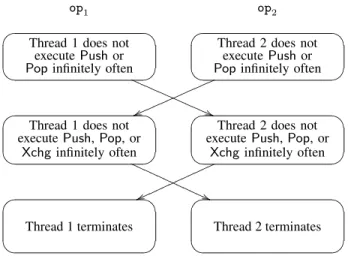
The above proof is done in a layered style, i.e., starting from the weak guarantee provided by Statement I and strengthening it using already established guarantees until it implies termination. This is informally illustrated in Figure 3 for the case of two operations (op1 andop2) running in parallel. The validity of the property of Thread 1 in the middle layer depends on the validity of the counterpart property of Thread 2 and vice versa. However, it is unsound to remove the upper layer of Figure 3 and justify the guarantee in the middle layer by circular reasoning, i.e., by observing that a thread satisfies the guarantee if the other thread does.
We have found that the proof method described above was applicable in all of the examples of lock-free algorithms that we have considered. In the next two sections we develop a logic for formalising proofs following the method.
Automating lock-freedom proofs. The above informal proofs of lock-freedom use guarantee conditions of a restricted form that specifies two sets of actions: those that a thread can execute and those that it cannot execute infinitely often. We have found that guarantee conditions of this form were sufficient to prove lock-freedom for all the examples we considered. This observation al-lows us to automate proving lock-freedom of an algorithm by sys-tematically searching for termination proofs for a program
consist-1Such an operation could be implemented with an atomic exchange
instruc-tion. The reason for implementing it with CAS is that in some architectures the atomic exchange instruction is either not available or slow.
struct Node { value_t data; Node *next; }; Node *S; int collision[SIZE]; void push(value_t v) { Node *t, *x; x = new Node(); x->data = v; while (1) { t = S; x->next = t; if (CAS(&S,t,x)) { return; } // Elimination scheme // ...
int pos = GetPosition(); // 0 ≤ pos ≤ SIZE-1 int hisId = collision[pos];
while (!CAS(&collision[pos],hisId,MYID)) { hisId = collision[pos]; } // ... } } value_t pop() { Node *t, *x; while (1) { t = S; if (t == NULL) { return EMPTY; } x = t->next; if (CAS(&S,t,x)) { return t->data; } // Elimination scheme // ...
int pos = GetPosition(); // 0 ≤ pos ≤ SIZE-1 int hisId = collision[pos];
while (!CAS(&collision[pos],hisId,MYID)) { hisId = collision[pos]; } // ... } }
Figure 2. The HSY non-blocking stack
op1 op2
?> =<
89 :;
Thread 1 does not executePushor Popinfinitely often
( ( Q Q Q Q Q Q Q Q Q Q Q Q ?> =< 89 :;
Thread 2 does not executePushor Popinfinitely often
v v mmmmmmmm mmmm ?> =< 89 :;
Thread 1 does not executePush,Pop, or
Xchginfinitely often ( ( P P P P P P P P P P P P ?> =< 89 :;
Thread 2 does not executePush,Pop, or
Xchginfinitely often v v nnnnnnnn nnnn ?> =< 89 Thread 1 terminates :; ?> =< 89 Thread 2 terminates :;
Figure 3. An informal proof argument where an arrow from state-mentAto statementB means thatAis used as a rely condition while establishing the guaranteeB.
ing of an arbitrary number of the algorithm’s operations running in parallel: we search for proofs that follow the pattern described above and use rely and guarantee conditions of the restricted form. Our proof search procedure performs a forward search, construct-ing proof graphs like the one in Figure 3 top-down. It is able to con-struct proofs that the programsC(k)terminate for allkat once, because our guarantee conditions are such that if several threads satisfy a guarantee, then so does their parallel composition. We now informally describe the procedure using the HSY stack as the run-ning example (the details are provided in Section 5).
Consider a program consisting of an arbitrary number of the al-gorithm’s operations running in parallel. First, using existing tools for verifying safety properties of non-blocking algorithms [6], we can infer a splitting of the program state into local and shared parts and a set of actions describing how the operations change the shared state ({Push,Pop,Xchg,Others,Id}for the HSY stack). The set defines the initial guarantee provided by every operation in the program that ensures that the operation changes the shared state only according to one of the actions. Note that if several opera-tions satisfy this guarantee, then so does their parallel composition. Hence, while checking a property of an operation in the program, we can rely on its environment satisfying the guarantee. The guar-antee, however, is too weak to establish termination of the oper-ations. We therefore try to strengthen it by considering every ac-tion in turn and attempting to prove that no operaac-tion executes the action infinitely often in an environment satisfying the guarantee. In our running example, we will be able to establish that the op-erations do not execute the actionsPushandPopinfinitely often (but notXchgandOthers). Again, if several operations satisfy the guarantee strengthened in this way, then so does their parallel com-position. Hence, we can check properties of the operations in the program assuming that their environment satisfies the guarantee. An attempt to prove their termination in this way fails again, and we have to strengthen the guarantee one more time. Namely, we try to prove that the operations do not execute the remaining ac-tionsXchgandOthersinfinitely often. In this case, the available guarantee is strong enough to prove that theXchgaction is not exe-cuted infinitely often. Finally, the strengthened guarantee allows us to establish termination of the operations.
Proving obstruction-freedom and wait-freedom. Obstruction-freedom of an operation ensures its termination in an environ-ment that eventually stops executing. Therefore, when proving obstruction-freedom, infinite behaviours of the environment are ir-relevant and the necessary environment guarantee can always be
Values ={. . . ,−1,0,1, . . .} Locs ={1,2, . . .}
Vars ={x, y, . . . ,&x,&y, . . .} Stores = Vars→Values Heaps = LocsfinValues Σ = Stores×Heaps
Figure 4. Program statesΣ
represented by a safety property. For example, the operations of Treiber’s stack guarantee that they modify the shared state accord-ing to one of the actionsPush,Pop, andId. To prove obstruction-freedom of apushorpopoperation2, it is thus sufficient to prove its termination in an environment that executes only finitely many such actions. This is true because, as in the proof of lock-freedom, in such an environment the CAS in the code of the operation will eventually succeed. In general, we can automatically check obstruction-freedom by checking termination of every operation in the environment satisfying the safety guarantee inferred by the safety verification tool and the additional assumption that it exe-cutes only finitely many actions. We describe this in more detail in Section 5.
To the best of our knowledge, loops in all practical wait-free non-blocking algorithms have constant upper bounds on the num-ber of their iterations. For example, Simpson’s algorithm [32] con-sists of straight-line code only, and the number of loop iterations in the wait-freefindoperation of a non-blocking linked list [37] is bounded by the number of distinct keys that can be stored in the list. For this reason, termination of operations in wait-free algorithms can be justified by considering only safety properties guaranteed by operations’ environment. The automatic check for wait-freedom is similar to the one for obstruction-freedom (see Section 5).
3.
Specifying liveness properties
Our logic for reasoning about liveness properties is a Hoare-style logic, which combines ideas from rely-guarantee reasoning and separation logic. It generalises a recent logic for reasoning about safety properties of non-blocking algorithms, RGSep [35]. As any Hoare logic, ours consists of two formal systems: an assertion language and a proof system for Hoare triples. In this section, we describe the assertion language, define the form of judgements in our logic, and show how to specify wait-freedom, lock-freedom, and obstruction-freedom in it. The next section presents the logic’s proof system.
Programming language. We consider heap-manipulating pro-grams written in the following simple programming language. CommandsCare given by the grammar
C::=C1;C2|if(e)C1elseC2|while(e)C|x = new()
|x = e|x = *e1|*e1 = e2|deletee|atomicC where e ranges over arithmetic expressions, including non-deterministic choice nondet(). The command atomic C exe-cutes C in one indivisible step. Programs consist of initialisa-tion code followed by a top-level parallel composiinitialisa-tion of threads:
C0; (C1. . .Cn).
To avoid side conditions in our proof rules, we treat each pro-gram variablexas a memory cell at the constant address&x. Thus, any use ofxin the code is just a shorthand for*(&x). Similarly, we interpret field expressionsx->nextas*(x+offset of next). In our examples, we also use other pieces of C syntax.
Assertion language. Letp,qandrbe separation logic assertions:
p, q, r::=emp|e1→e2|p∗q|false|p⇒q| ∃x.p|. . .
2This example is used here for illustrative purposes only:
obstruction-freedom of Treiber’s stack follows from its lock-obstruction-freedom.
Separation logic assertions denote sets of program statesΣ repre-sented by store-heap pairs (Figure 4). A store is a function from variables to values; a heap is a finite partial function from locations to values. We omit the standard formal semantics for most of the as-sertions [30]. Informally,empdescribes the states where the heap is empty;e1 →e2 describes the states where the heap contains a single allocated location at the addresse1with contentse2;p∗q de-scribes the states where the heap is the union of two disjoint heaps, one satisfyingpand the other satisfyingq. The formal semantics of the assertionp∗qis defined using a partial operation·onΣsuch that for all(t1, h1),(t2, h2)∈Σ
(t1, h1)·(t2, h2) = (t1, h1h2)
ift1=t2andh1h2is defined, and(t1, h1)·(t2, h2)is undefined otherwise. Then
u∈[[p∗q]]⇔ ∃u1, u2. u=u1·u2∧u1∈[[p]]∧u2∈[[q]] As we argued in Section 2, while reasoning about concurrent heap-manipulating programs it is useful to partition the program state into thread-local and shared parts. Therefore, assertions in our logic denote sets of pairs of states fromΣ. The two components represent the statelocalto the thread in whose code the assertion is located and thesharedstate. We use the assertion language of RGSep [35], which describes the local and shared components with separation logic assertions and is defined by following grammar:
P, Q::=p|p |P∗Q|true|false|P∨Q|P∧Q| ∃x.P
An assertionpdenotes the local-shared state pairs with the local state satisfying p; p the pairs with the shared state satisfying
pand the local state satisfying emp;P ∗Q the pairs in which the local state can be divided into two substates such that one of them together with the shared state satisfiesP and the other together with the shared state satisfiesQ. The formal semantics ofP∗Qis defined using a partial operationonΣ2such that for all(l1, s1),(l2, s2)∈Σ2
(l1, s1)(l2, s2) = (l1·l2, s1)
ifs1=s2andl1·l2is defined, and(l1, s1)(l2, s2)is undefined otherwise. Thus,
σ∈[[P∗Q]]⇔ ∃σ1, σ2. σ=σ1 σ2∧σ1∈[[P]]∧σ2∈[[Q]] Note that by abuse of notation we denote the connectives inter-preted by·andwith the same symbol∗. It should be always clear from the structure of the assertion which of the two connectives is being used. We denote global states fromΣwith small Latin let-ters (u,l,s), and local-shared state pairs fromΣ2with small Greek letters (σ).
Judgements. The judgements in our logic include rely and guar-antee conditions determining how a command or its environment change the shared state. These represent languages of finite and infinite words over the alphabetΣ2 of relations on shared states and are denoted with capital calligraphic letters (R,G, . . .). A word in any of the languages describes the sequences of changes to the shared state. Thus, relies and guarantees can define liveness proper-ties. This generalises the RGSep logic, in which rely and guarantee conditions define safety properties and are therefore represented with relations on the shared state. Our proof system has two kinds of judgements:
• R,G {P}C {Q}: if the initial state satisfies P and the environment changes the shared state according to R, then the program is safe (i.e., it does not dereference any invalid pointers), changes the shared state according toG, and the final state (if the program terminates) satisfiesQ.
•R,(G1,G2) {P}C1C2{Q}: if the initial state satisfiesP and the environment changes the shared state according toR, then the programC1C2 is safe,C1 changes the shared state according toG1,C2changes the shared state according toG2, and the final state (if both threads terminate) satisfiesQ. Dis-tinguishing the guarantee of each thread is crucial for liveness proofs done according to the method described in Section 2. The informal definition of judgements’ validity given above as-sumes a semantics of programs that distinguishes between the lo-cal and the shared state. We sketch how such a semantics can be defined later in this section. In Section 6 we give formal definitions of the semantics and the notion of validity, and relate them to the standard ones, which consider the program state as a whole. Specifying rely and guarantee conditions. As noted above, a rely or a guarantee condition defines sequences of atomic changes to the shared state. We describe each such change with the aid of actions[35] of the formpq, wherepandqare separation logic assertions. Informally, this action changes the part of the shared state that satisfiespinto one that satisfiesq, while leaving the rest of the shared state unchanged. Formally, its meaning is a binary relation on shared states:
[[pq]] ={(s1·s0, s2·s0)|s1∈p∧s2∈q} It relates some initial states1 satisfying the precondition pto a final states2satisfying the postconditionq. In addition, there may be some disjoint states0that is not affected by the action.
For example, we can define the three actions used in the proof of lock-freedom of Treiber’s stack mentioned in Section 2 as follows: &S→y &S→x∗x→Node(v, y) (Push) &S→x∗x→Node(v, y) &S→y∗x→Node(v, y) (Pop)
emp emp (Id)
Herex→Node(v, y)is a shortcut forx→v∗(x+ 1)→y. Recall that the algorithm is assumed to be executed in the presence of a garbage collector. Hence, the node removed from the list byPop stays in the shared state as garbage.
In our examples, we syntactically define rely and guarantee con-ditions using linear temporal logic (LTL) with actions as atomic propositions. LetFalseandTrue be the actions denoting the re-lations∅andΣ2 respectively. We denote temporal operators “al-ways”, “eventually”, and “next” with,, and, respectively. Their semantics on infinite words is standard [22]. The semantics on finite words is defined as follows [20]: form≥0
δ1. . . δm|=Ψ ⇔ ∀i.1≤i≤m⇒δi. . . δm|= Ψ
δ1. . . δm|=Ψ ⇔ ∃i.1≤i≤m ∧ δi. . . δm|= Ψ
δ1. . . δm|=Ψ ⇔ m≥2⇒δ2. . . δm|= Ψ
Note that hereis theweaknext operator: it is true if there is no next state to interpret its argument over. For example, R, whereR ⊆ Σ2, denotes the language of words in which every letter is fromR(including the empty word),¬Rdenotes words which contain only finitely many letters fromR(including all finite words), andFalsedenotes exactly all finite words. We specify termination of a command by requiring that it satisfy the guarantee False, i.e., we interpret termination as the absence of infinite computations. This is adequate for programs in the language intro-duced above, since they cannot deadlock.
The semantics of triples in our logic makes no assumptions about the scheduler. In particular, it can be unfair with respect to the command in the triple: the guarantee condition includes words corresponding to the command being suspended and never executed again. For this reason, all rely and guarantee conditions in this paper are prefix-closed, i.e., for any word belonging to a rely
or a guarantee all its prefixes also belong to it. Additionally, we require that relies and guarantees represent nonempty languages. Splitting states into local and shared parts. We now informally describe thesplit-statesemantics of programs that splits the pro-gram state into local and shared parts (formalised in Section 6).
We partition all the atomic commands in the program into those that access only local state of the thread they are executed by and those that can additionally access the shared state. By convention, the only commands of the latter kind are atomic blocks. For example, in the operations of Treiber’s stack, all the commands except for CASes access only the local state. Further, we annotate eachatomic block with an action p q determining how it treats the shared state, writtenatomicpq C. These annotations are a part of proofs in our logic. For the logic to be sound, all the judgements used in a proof of a program have to agree on the treatment of the shared state. We therefore require that the same annotation be used for any fixedatomicblock throughout the proof.
In the split-state semantics the command atomicpq C cutes as follows: it combines the local state of the thread it is exe-cuted by and the part of the shared state satisfyingp, and runsCon this combination. It then splits the single resulting state into local and shared parts, determining the shared part as the one that satis-fiesq. The new shared state is thus this part together with the part of the shared state untouched byC. For the splittings to be defined uniquely (and for our logic to be sound), we require thatpandqin all annotations be precise assertions [28]. An assertionris precise if for any stateuthere exists at most one substatesatr(u) satisfy-ingr:u=satr(u)·restr(u)for somerestr(u). The assertions in all the actions used in this paper are precise.
LetCASA(addr,v1,v2)be defined as follows: if (nondet())
atomicA {
assume(*addr == v1); *addr = v2; return 1; }
else
atomicId { assume (*addr != v1); return 0; } where theassumecommand acts as a filter on the state space of programs—eis assumed to evaluate to 1 after assume(e)is ex-ecuted. The above definition of CAS is semantically equivalent to the definition in Section 2, but allows different action anno-tations for the successful and the failure cases. We annotate the CAS commands in thepushandpopoperations of Treiber’s stack asCASPush(&S,t,x)andCASPop(&S,t,x), respectively. Similarly, we annotate the CAS in the inner loop of the HSY stack as CASXchg(&collision[pos],hisId,MYID).
Specifying wait-freedom, lock-freedom, and obstruction-freedom. A non-blocking data structure is given by an initialisation routine initand operationsop1, . . . ,opnon the data structure. We require that the initialisation routine satisfy the triple
Id,True emp init Inv
for some data structure invariant Invrestricting only the shared state: the routine creates an instance of the data structure in the shared state when run in isolation (i.e., in the environment that does not change the shared state). For Treiber’s stack an invariant maintained by all the operations on the data structure is thatS points to the head of a linked list. We can express this in our assertion language using an inductive predicate assertionlseg(x, y) of separation logic that represents the least predicate satisfying
lseg(x, y)⇔(x=y∧emp)
Thus,lseg(x,NULL)represents all of the states in which the heap has the shape of a (possibly empty) linked list starting from location
xand ending withNULL. The invariant can then be expressed as Inv =∃x.&S→x∗lseg(x,NULL)∗true (3.1) In our logic, we can express the liveness properties of non-blocking algorithms we introduced before as follows. Wait-freedom of an operationopiis captured by the triple
R,False {Inv}opi{true} (3.2) which ensures termination of the operation under the interfer-ence from the environment allowed by the rely condition R. Obstruction-freedom of an operationopican be expressed as
R ∧False,False {Inv}opi{true} (3.3) Here Rdescribes the allowed interference from the operation’s environment, and the conjunctFalseensures that eventually all the threads in the environment will be suspended. As we showed in Section 2, lock-freedom can be reduced to proving termination of several operations run in isolation, which is ensured by the validity of the triples
Id,False {Inv}C(k){true} (3.4) for allk, where the programC(k)is defined by (2.2).
Note that obstruction-freedom and wait-freedom are directly compositional properties and can thus be specified for every op-eration separately. The specification of lock-freedom considers all operations at once, however, as we show in the next section, we can still reason about lock-freedom in a compositional way.
4.
Compositional proof system for liveness and
heaps
To reason about judgements of the form introduced in the previ-ous section we need(i)a method for proving thread-local triples (i.e., those giving a specification to a single thread) and(ii)a proof system for combining thread-local triples into triples about paral-lel compositions. We describe an automatic method for proving thread-local triples in Section 5 (the THREADLOCAL procedure and Figure 7). In this section, we present the second component—a compositional proof system for reasoning about liveness properties of heap-manipulating programs, shown in Figure 5. We explain the proof rules by example of formalising the informal proofs of lock-freedom from Section 2. In Section 5 we show how to construct such proofs automatically, and in Section 6 we prove the proof rules sound with respect to an interleaving semantics.
We first introduce two operations on languages used by the rules. LetL(A)denote the language of all finite and infinite words over an alphabetA. We denote the concatenation of a finite word
α ∈ L(A)and a word (either finite or infinite)β ∈ L(A)with
αβ. The safety closure CL(G)of a language G ⊆ L(A) is the smallest language defining a safety property that contains G [2]. In the setting of this paper, where all the languages considered are prefix-closed,CL(G)can be defined as the set of wordsαsuch that every prefix ofαis inG:
CL(G) ={α∈ L(A)| ∀β, γ. α=βγ ⇒ β∈ G}
For two words α, β ∈ L(A), we denote the set of their fair interleavings withαβ(we omit the standard definition [4]). We lift this to languagesG1,G2⊆ L(A)as follows:
G1G2=
{αβ|α∈ G1∧β∈ G2} 4.1 Proving lock-freedom of Treiber’s non-blocking stack We start by proving termination of any two operations with arbi-trary parameters (which we denote withopi1andopi2) running in
RCL(G2),G1 {P1}C1{Q1} RCL(G1),G2 {P2}C2{Q2} R,(G1,G2) {P1∗P2}C1C2{Q1∗Q2} PAR-C R, G {P}C{Q} P⇒P R⊆ R G ⊆G Q⇒Q R, G {P}C{Q} CONSEQ R,(G1,G2) {P1∗P2}C1C2{true} RG2,G1 {P1}C1{Q1} RG1,G2 {P2}C2{Q2} R,(G 1,G2) {P1∗P2}C1C2{Q1∗Q2} P AR-NC R,(G1,G2) {P}C1C2{Q} R,G1G2 {P}C1C2{Q} PAR-MERGE R, G {P}C{Q} R, G {P}C{Q} R∩ R, G∩G {P∧P}C{Q∧Q} CONJ
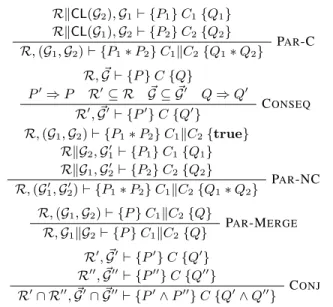
Figure 5. Proof rules for reasoning about liveness properties of heap-manipulating programs.G denotes eitherG or(G1,G2) de-pending on whether the triple distinguishes between the guarantees provided by the different threads. In the latter case operations on (G1,G2)are done componentwise.
parallel and consider the general case later. To prove this, we have to derive the triple
Id,False {Inv}opi1opi2{true} (4.1) for the data structure invariantInvdefined by (3.1).
Statement I. Formally, the statement says that every thread has to satisfy the guarantee
G=(Push∨Pop∨Id)∧ ¬(Push∨Pop) where the actionsPush,Pop, andIdare defined in Section 3. The first conjunct specifies the actions that the thread can execute, and the second ensures that it cannot execute the actionsPushandPop infinitely often. In order to establish this guarantee, we do not have to make any liveness assumptions on the behaviour of other threads; just knowing the actions they can execute (Push,Pop, andId) is enough. We therefore use the rule PAR-C to establish G. It is a circular rely guarantee rule [1] adapted for reasoning about heaps. It allows two threads to establish their guarantees simultaneously, while relying on the safety closure of the other thread’s guarantee that is being established. Note that without the safety closure the circular rules like this are unsound for liveness properties [1]. Note also that pre- and postconditions of threads in the premises of the rule are∗-conjoined in the conclusion: according to the semantics of the assertion language, this takes the disjoint composition of the local states of the threads and enforces that the threads have the same view of the shared state. It is this feature of our proof rules that allows us to reason modularly in the presence of heap.
Applying PAR-C withG1=G2=GandR=CL(G), we get: CL(G)CL(G),G {Inv}opi1{true}
CL(G)CL(G),G {Inv}opi2{true} CL(G),(G,G) {Inv∗Inv}opi1opi2{true∗true}
(4.2)
Taking the safety closure ofGremoves the second conjunct repre-senting the liveness part ofG:
Additionally,CL(G)CL(G) = CL(G), so that the premises sim-plify to triples
CL(G),G {Inv}opj{true}, j∈ {i1, i2} (4.3) which ensure that the thread does not executePushandPopactions infinitely often, provided the environment executes only actions Push, Pop, and Id. We show how to discharge such triples in Section 5. Their proof would formalise the informal justification of Statement I given in Section 2 and would use the annotations at atomicblocks introduced in Section 3 to determine the splitting of states into local and shared parts.
SinceInvrestricts only the shared state,Inv∗Inv⇔Inv, hence, the conclusion of (4.2) is equivalent to
CL(G),(G,G) {Inv}opi1opi2{true} (4.4) SinceG ⊆CL(G), we can then apply a variation on the rule of con-sequence of Hoare logic, CONSEQ, which allows us to strengthen the rely condition toG:
G,(G,G) {Inv}opi1opi2{true} (4.5) Statement II. Termination is captured by the guaranteeFalse, which says that eventually the program does not execute any tran-sitions. To prove this guarantee, we use the non-circular rely-guarantee rule PAR-NC, which allows the first thread to replace its guarantee with a new one based on the already established guarantee of the other thread, and vice versa. Note that the first premise need only establish the postconditiontrue, since the post-conditionQ1 ∗Q2 of the conclusion is implied by the other two premises. Applying PAR-NC withR = G1 = G2 = G and
G
1=G2 =False, we get:
G,(G,G) {Inv}opi1opi2{true}
GG,False {Inv}opi1{true}
GG,False {Inv}opi2{true}
G,(False,False) {Inv}opi1opi2{true} (4.6)
We have already derived the first premise. SinceGG=G, we need to discharge the following thread-local triples (again postponed to Section 5):
G,False {Inv}opj{true}, j∈ {i1, i2} (4.7) We no longer need to distinguish between the guarantees of the two threads in the conclusion of (4.6). Hence, we use the rule PAR -MERGE, which merges the guarantees provided by the threads into a single guarantee provided by their parallel composition:
G,(False,False) {Inv}opi1opi2{true}
G,(False)(False) {Inv}opi1opi2{true} The conclusion is equivalent to
G,False {Inv}opi1opi2{true} (4.8) from which (4.1) follows by CONSEQ. This proves termination of the two operations.
Arbitrary number of operations. We can generalise our proof to an arbitrary number of operations as follows. First, note that applying PAR-MERGEon (4.4), we get:
CL(G),G {Inv}opi1opi2{true} (4.9) Hence, the proof for two operations establishes (4.9) and (4.8) given (4.3) and (4.7), i.e., it shows that the parallel composition opi1opi2preserves the properties (4.3) and (4.7) of its constituent operations. Note that this derivation is independent of the particular definitions ofopi1andopi2satisfying (4.3) and (4.7).
This allows us to prove by induction onkthat CL(G),G {Inv}opi1. . .opik{true}
G,False {Inv}opi1. . .opik{true} (4.10) is derivable in our proof system for any k ≥ 1. For k = 1 the triples are established by (4.3) and (4.7). For the induction step, we just repeat the previous derivation withopi1replaced by opi1. . .opikandopi2replaced byopi(k+1).
Applying CONSEQto (4.10), we get (3.4), which entails lock-freedom of Treiber’s stack.
Note that instead of doing induction on the number of threads, we could have formulated our proof rules forkthreads. To simplify the presentation, we chose the minimalistic proof system. 4.2 Proving lock-freedom of the HSY non-blocking stack The actionXchgused in the informal proof of lock-freedom of the HSY stack (Section 2) can be formally defined as follows:
0≤i≤SIZE−1∧collision[i]→ collision[i]→ (Xchg) The abridged data structure invariant is:
Inv=∃x.∗&SSIZE−→1 x∗lseg(x,NULL)∗true i=0 collision[i]→ ∗. . .
(We elided some of the data structures of the elimination scheme.) We now formalise the informal proof from Section 2 for two operationsopi1andopi2running in parallel.
Statement I. The statement requires us to establish the guarantee
G=(Push∨Pop∨Xchg∨Others∨Id)∧ ¬(Push∨Pop) whereOthersdescribes the interference caused by the elimination scheme (elided). As before, we can do this using PAR-C. Given the thread-local triples (4.3) with the newly definedopi1,opi2,G, and Inv, we can again derive (4.5) and (4.9), where
CL(G) =(Push∨Pop∨Xchg∨Others∨Id) Statement II. Now, provided that a thread satisfies the guarantee
G, we have to prove that the other thread satisfies the guarantee
G=(Push∨Pop∨Xchg∨Others∨Id)∧ ¬Xchg To this end, we use the non-circular rely-guarantee rule PAR-NC:
G,(G,G) {Inv}opi1opi2{true} GG,G {Inv}op i1{true} GG,G {Inv}op i2{true} G,(G,G) {Inv}op i1opi2{true} We thus have to establish the following thread-local triples:
G,G {Inv}
opj{true}, j∈ {i1, i2} (4.11) We can now use the conjunction rule, CONJ, to combine the guar-anteesGandGinto a single guaranteeG:
G,(G,G) {Inv}opi1opi2{true} G,(G,G) {Inv}op i1opi2{true} G,(G,G) {Inv}op i1opi2{true} (4.12) where
G=G ∧ G=(Push∨Pop∨Xchg∨Others∨Id)
∧ ¬(Push∨Pop∨Xchg) This combines Statements I and II. Applying CONSEQ, we get:
procedureLOCKFREE(init,op)
(Inv, G1) :=SAFETYGUARANTEE(init,op) G2:=∅
do
G:=G1∧ ¬G2
ifTHREADLOCAL(G,False {Inv}op{true}) return“Lock-free”
G0 2:=G2
for eachA∈(G1\G02)do
ifTHREADLOCAL(G,¬A {Inv}op{true})
G2:=G2∪ {A} whileG02=G2
return“Don’t know”
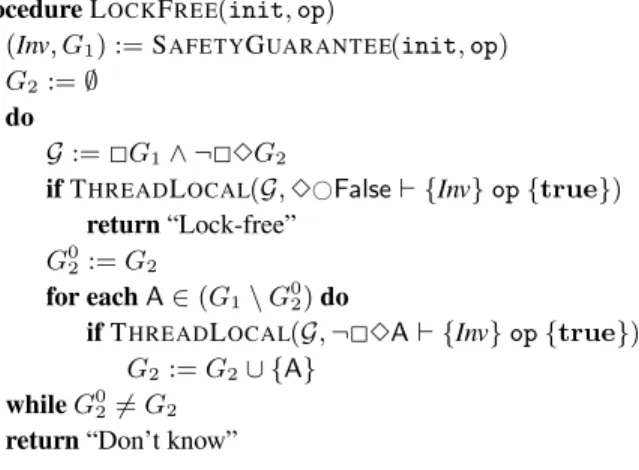
Figure 6. Proof search procedure for lock-freedom
Thus, we have strengthened the guaranteeGof Statement I to the guaranteeG.
Statement III. Finally, we can formalise Statement III by apply-ing the rule PAR-NC to establish termination:
G,(G,G) {Inv}op i1opi2{true} GG,False {Inv}op i1{true} GG,False {Inv}op i2{true}
G,(False,False) {Inv}op
i1opi2{true} provided we can establish the thread-local triples
G,False {Inv}
opj{true}, j∈ {i1, i2} (4.13) By PAR-MERGEwe then get:
G,False {Inv}op
i1opi2{true} (4.14) which proves the termination of the two operations.
Arbitrary number of operations. From the conclusion of (4.12), by PAR-MERGEwe get:
G,G {Inv}opi1opi2{true} (4.15) Thus, the above derivation establishes (4.9), (4.15), and (4.14) given (4.3), (4.11), and (4.13). As before, this allows us to prove by induction onk that the following triples are derivable in our logic for anyk≥1:
CL(G),G {Inv}opi1. . .opik{true}
G,G {Inv}op
i1. . .opik{true}
G,False {Inv}op
i1. . .opik{true} The last one implies lock-freedom of the HSY stack.
5.
Automation
In this section we describe our automatic prover for liveness prop-erties of non-blocking concurrent algorithms. Our tool’s input is a liveness property to be proved and a program in a C-like lan-guage consisting of the code of operationsop1, . . . ,opnof a non-blocking algorithm, together with a piece of initialisation code init. We remind the reader that we denote withopthe command, defined by (2.1), that non-deterministically executes one of the op-erationsopion the data structure. We first describe how our tool handles lock-freedom.
Proving lock-freedom via proof search. Recall that to prove lock-freedom, we have to prove termination of the programC(k)
defined by (2.2) for an arbitraryk. All rely and guarantee condi-tions used in the examples of such proofs in Section 4 had a re-stricted formA1∧ ¬A2, whereA1andA2are sets (disjunc-tions) of actions andA2 ⊆A1. HereA1is the set of all actions that a thread can perform, whereasA2is the set of actions that the thread performs only finitely often. In fact, for all the non-blocking algorithms we have studied, it was sufficient to consider rely and guarantee conditions of this form to prove lock-freedom.
We prove termination of C(k) by searching for proofs of triple (3.4) in our proof system in the style of those presented in Section 4 with relies and guarantees of the formA1∧ ¬A2. There are several ways in which one can organise such a proof search. The strategy we use here is to perform forward search as explained informally in Section 2.
Figure 6 contains our procedure LOCKFREEfor proving lock-freedom. It is parameterised with two auxiliary procedures, whose implementation is described later:
• SAFETYGUARANTEE(init,op) computes supporting safety properties for our liveness proofs, namely, a data structure in-variantInvsuch that
Id,Trueemp init Inv (5.1) and an initial safety guarantee provided by every operation, which is defined by a set of actionsG1 ={A1, . . . ,An}such that
G1,G1 {Inv}op{Inv} (5.2)
• THREADLOCAL(R,G {Inv}op{true})attempts to prove the thread-local tripleR,G {Inv}op{true}valid. The no-tion of validity of thread-local triples used by THREADLOCAL
corresponds to the informal explanation given in Section 3 and is formalised in Section 6.
LOCKFREE first calls SAFETYGUARANTEEto compute the data structure invariantInvand the safety guaranteeG1. In our proofs of liveness properties, rely and guarantee conditions are then represented using LTL formulae with actions inG1as atomic propositions. A side-effect of SAFETYGUARANTEEis that it an-notatesatomicblocks inopwith actions fromG1as explained in Section 3. These annotations are used by the subsequent calls to THREADLOCAL, which ensures that all thread-local reasoning in the proof of lock-freedom uses the same splitting of the program state into local and shared parts.
Having computed the safety guarantee, we enter into a loop, where on every iteration we first attempt to prove termination of opusing the available guarantee. If this succeeds, we have proved lock-freedom. Otherwise, we try to strengthen the guaranteeG1∧
¬G2by considering each action inG1\G2and trying to prove that it is executed only finitely often using the current guarantee as a rely condition. If we succeed, we update the guarantee by adding the action to the set of finitely executed actionsG2. If we cannot prove that any action fromG1\G2is executed only finitely often, we give up the search and exit the loop.
This procedure scales because in practice the set of actionsG1 computed by SAFETYGUARANTEEis small. This is due to the fact that actionspqare local in the sense thatpandqdescribe only the parts of the shared state modified by atomic blocks.
It is possible to show that a successful run of LOCKFREE con-structs proofs of triples (3.4) for allk. We can construct the proofs for any number of threads uniformly because the guaranteesGused in them are such that GG = G. The construction follows the method of Section 4. The only difference is that the proofs con-structed by LOCKFREEfirst apply the rule PAR-C to triples (5.2) withG1 =G2 =G1. SinceCL(G1) =G1, this establishes the initial safety guaranteeG1, which is then strengthened using
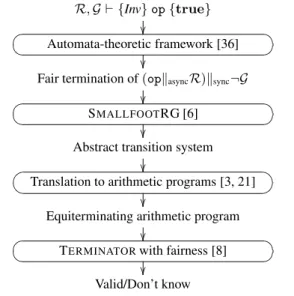
R,G {Inv}op{true} /. -, () Automata-theoretic framework [36] *+
Fair termination of(opasyncR)sync¬G
/. -, () SMALLFOOTRG [6] *+
Abstract transition system
76 54
01 Translation to arithmetic programs [3, 21] 23
Equiterminating arithmetic program
/. -,
() TERMINATORwith fairness [8] *+
Valid/Don’t know
Figure 7. The high-level structure of the THREADLOCAL proce-dure for discharging thread-local triples
the rule PAR-NC. In the proofs of Section 4, these two steps were performed with one application of the rule PAR-C.
We now describe the two auxiliary procedures used by LOCK -FREE—SAFETYGUARANTEEand THREADLOCAL.
TheSAFETYGUARANTEEprocedure. We implement the proce-dure using the SMALLFOOTRG tool for verifying safety properties of non-blocking algorithms [6]. SMALLFOOTRG computes a data structure invariant and an interference specification by performing abstract interpretation of the code ofinitandopover an abstract domain constructed from RGSep formulae. This abstract interpre-tation is thread-modular, i.e., it repeatedly analyses separate threads without enumerating interleavings using an algorithm similar to the one described in [12]. For the invariant and interference specifica-tions computed by SMALLFOOTRG to be strong enough for use in liveness proofs, its abstract domain has to be modified to keep track of the lengths of linked lists as described in [21].
RGSep judgements can be expressed in our logic by triples with rely and guarantee conditions of the formA, whereAis a set of actions. SMALLFOOTRG proves the validity of RGSep judgements that, when translated to our logic in this way, yield (5.1) and (5.2). TheTHREADLOCALprocedure. We prove a thread-local triple
R,G {Inv}op{true}using a combination of several existing methods and tools, as shown in Figure 7. For technical reasons, in this procedure we assume thatRand G consist of only infi-nite words andophas only infinite computations. This can always be ensured by padding the finite words inRandGwith a special dummy action and inserting an infinite loop at the end ofop exe-cuting the action. To prove the tripleR,G {Inv}op{true}:
•We first representRand¬G as B¨uchi automata, whose tran-sitions are labelled with actions from the setG1computed by SAFETYGUARANTEEand apply the automata-theoretic frame-work for program verification [36]. This reduces proving the triple to proving that the program(opasyncR)sync¬G termi-nates when run from states satisfying the preconditionInv un-der the fairness assumptions extracted from the accepting con-ditions of the automata forRand¬G. HereopasyncRis the asynchronous parallel composition interleaving the executions of op and the automaton R in all possible ways. The pro-gram(opasyncR)sync¬G is the synchronous parallel
compo-sition ofopasyncRand the automaton¬Gsynchronising on ac-tions ofop. Intuitively, fair infinite executions of the program (opasyncR)sync¬G correspond to the executions ofopin an environment satisfying the relyRthat violate the guaranteeG. Its fair termination implies that there are no such executions.
• To check fair termination of (opasyncR)sync¬G, we analyse it with the abstract interpreter of SMALLFOOTRG [6], which produces an abstract transition system over-approximating the program’s behaviour. The interpreter uses the annotations at atomic blocks computed by SAFETYGUARANTEEto choose the splitting of the heap into local and shared parts.
• Using the techniques of [3, 21], from this transition system we then extract an arithmetic program (i.e., a program with-out the heap with only integer variables), whose fair termina-tion implies fair terminatermina-tion of(opasyncR)sync¬G. The arith-metic program makes explicit the implicit aritharith-metic infor-mation present in the heap-manipulating program that can be used by termination provers to construct ranking functions. For example, it contains integer variables tracking the lengths of linked lists in the original program.
• Finally, we run a termination prover (TERMINATORwith fair-ness [8]) to prove fair termination of the arithmetic program. We note that proofs of thread-local statements may be more complicated then the ones in the examples of Section 2, which were based on control-flow arguments. For example, for Michael’s non-blocking linked list algorithm [25] they involve reasoning about lengths of parts of the shared data structure. Furthermore, the proofs may rely on complex supporting safety properties that en-sures that the data structure is well-formed. Automatic tool support is indispensable in constructing such proofs.
Proving obstruction-freedom and wait-freedom. As we showed in Section 2, proving obstruction-freedom or wait-freedom of an operation in a non-blocking algorithm usually requires only safety guarantees provided by the operation’s environment. In our tool, we use the guaranteeG1inferred by SAFETYGUARANTEE. Namely, we prove obstruction-freedom of an operationopiby establishing triple (3.3) withR=G1via a call to
THREADLOCAL(G1∧False,False {Inv}opi{true}) We can prove wait-freedom of an operationopi by establishing triple (3.2) withR=G1via a call to
THREADLOCAL(G1,False {Inv}opi{true}) Experiments. Using our tool, we have proved a number of non-blocking algorithms lock-free and have found counterexamples demonstrating that they are not wait-free. The examples we anal-ysed include a DCAS-based stack, Treiber’s stack [33], the HSY stack [14], a non-blocking queue due to Michael and Scott [26] and its optimised version due to Doherty et al. [9], a restricted double-compare single-swap operation (RDCSS) [13], and Michael’s non-blocking linked list [25]. In all cases except Michael’s algorithm the tool found a proof of lock-freedom in less then 10 minutes. Verification of Michael’s algorithm takes approximately 8 hours, which is due to the unoptimised arithmetic program generator and the inefficient version of the termination prover that we currently use.
We have also tested our tool by proving the obstruction-freedom of the above lock-free algorithms. (Obstruction-free algorithms that are not lock-free typically traverse arrays, handling which is be-yond the scope of the shape analysis that we use.) Additionally, we have checked that the deletion operation of a linked list algorithm by Vechev and Yahav [37, Figure 2] is not obstruction-free (as ob-served by the authors), even though it does not use locks.