RFM70
V1.0
Low Power High Performance 2.4 GHz GFSK Transceiver Module
Features
2400-2483.5 MHz ISM band operation
Support 1 and 2 Mbps air data rate
Programmable output power (-40dBm to 5dBm)
Low power consumption
Variable payload length from 1 to 32bytes
Automatic packet processing
6 data pipes for 1:6 star networks
1.9V to 3.6V power supply
4-pin SPI interface with maximum 8 MHz clock rate
DIP-8pin and SMD-8pin Package
Applications
Wireless PC peripherals
Wireless mice and keyboards
Wireless gamepads
Wireless audio
VOIP and wireless headsets
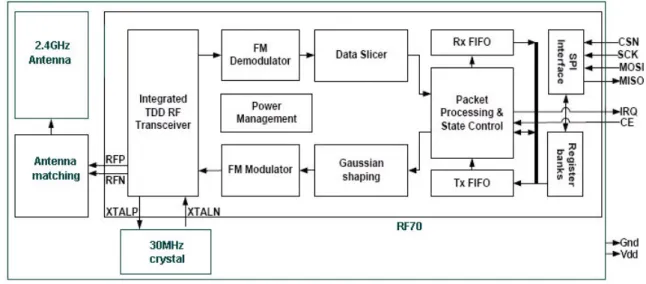
Block Diagram
Remote controls
Consumer electronics
Home automation
Toys
Personal health and entertainment
RFM70
V1.0
Table of Contents
1 General Description ... 3 2 Abbreviations ... 4 3 Pin Information ... 5 4 State Control ... 64.1 State Control Diagram ... 6
4.2 Power Down Mode... 7
4.3 Standby-I Mode ... 7 4.4 Standby-II Mode... 7 4.5 TX Mode ... 7 4.6 RX Mode ... 8 5 Packet Processing ... 8 5.1 Packet Format ... 8 5.1.1 Preamble... 9 5.1.2 Address... 9 5.1.3 Packet Control ... 9 5.1.4 Payload ... 10 5.1.5 CRC... 10 5.2 Packet Handling ... 10
6 Data and Control Interface ... 11
6.1 TX/RX FIFO ... 11 6.2 Interrupt ... 11 6.3 SPI Interface ... 12 6.3.1 SPI Command ... 12 6.3.2 SPI Timing ... 13 7 Register Map ... 15 7.1 Register Bank 0 ... 15 7.2 Register Bank 1 ... 20 8 Electrical Specifications ... 21
9 Typical Application Schematic ... 22
10 Package Information... 23
11 Order Information ... 25
RFM70
V1.0
1
General Description
RFM70 is a GFSK transceiver module operating in the world wide ISM frequency band at 2400 - 2483.5 MHz. Burst mode transmission and up to 2Mbps air data rate make them suitable for applications requiring ultra low power consumption.The embedded packet processing engines enable their full operation with a very simple MCU as a radio system.Auto re-transmission and auto acknowledge give reliable link without any MCU interference.
RFM70 operates in TDD mode, either as a transmitter or as a receiver.
The RF channel frequency determines the center of the channel used by RFM70. The frequency is set by the RF_CH register in register bank 0 according to the following formula: F0= 2400 + RF_CH (MHz). The
resolution of the RF channel frequency is 1MHz.
A transmitter and a receiver must be programmed with the same RF channel frequency to be able to communicate with each other.
The output power of RFM70 is set by the RF_PWR bits in the RF_SETUP register. Demodulation is done with embedded data slicer and bit recovery logic. The air data rate can be programmed to 1Mbps or 2Mbps by RF_DR register. A transmitter and a receiver must be programmed with the same setting. In the following chapters, all registers are in register bank 0 except with explicit claim.
RFM70
V1.0
2
Abbreviations
ACK Acknowledgement
ARC Auto Retransmission Count
ARD Auto Retransmission Delay
CD Carrier Detection
CE Chip Enable
CRC Cyclic Redundancy Check
CSN Chip Select Not
DPL Dynamic Payload Length
FIFO First-In-First-Out
GFSK Gaussian Frequency Shift Keying
GHz Gigahertz
LNA Low Noise Amplifier
IRQ Interrupt Request
ISM Industrial-Scientific-Medical
LSB Least Significant Bit
MAX_RT Maximum Retransmit
Mbps Megabit per second
MCU Microcontroller Unit
MHz Megahertz
MISO Master In Slave Out
MOSI Master Out Slave In
MSB Most Significant Bit
PA Power Amplifier
PID Packet Identity Bits
PLD Payload
PRX Primary RX
PTX Primary TX
PWD_DWN Power Down
PWD_UP Power Up
RF_CH Radio Frequency Channel
RSSI Received Signal Strength Indicator
RX Receive
RX_DR Receive Data Ready
SCK SPI Clock
SPI Serial Peripheral Interface
TDD Time Division Duplex
TX Transmit
RFM70
V1.0
3
Pin Information
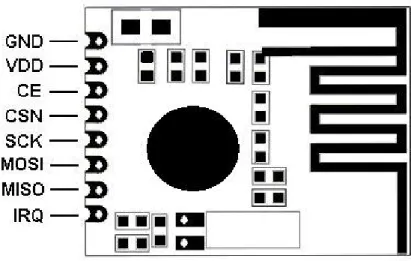
Figure 2 RFM70 pin assignments (top view)
Name Pin Function Description
GND Ground Ground (0 V)
VDD Power Power Supply (1.9 V to 3.6 V DC)
CE Digital Input Chip Enable Activates RX or TX mode
CSN Digital Input SPI Chip Select, Active low
SCK Digital Input SPI Clock
MOSI Digital Input SPI Slave Data Input
MISO Digital Output SPI Slave Data Output with tri-state option IRQ Digital Output Maskable interrupt pin, Active low
RFM70
V1.0
4
State Control
4.1 State
Control
Diagram
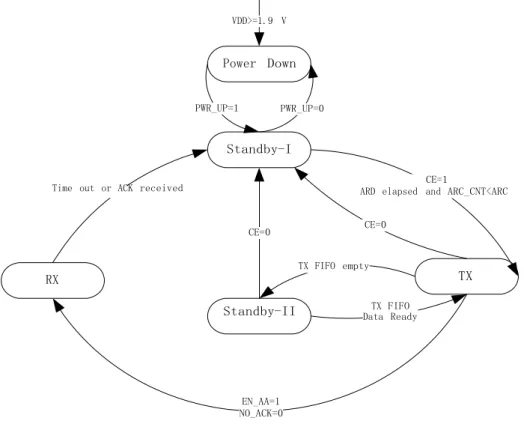
Pin signal: VDD, CE
SPI register: PWR_UP, PRIM_RX,
EN_AA, NO_ACK, ARC, ARD
System information: Time out, ACK received, ARD elapsed, ARC_CNT, TX FIFO empty, ACK packet transmitted, Packet received
RFM70 has built-in state machines that control the state transition between different modes.
When auto acknowledge feature is disabled, state transition will be fully controlled by MCU.
VDD>=1.9 V
Power Down
PWR_UP=1 PWR_UP=0
Standby-I
Time out or ACK received ARD elapsed and ARC_CNT<ARC CE=1
CE=0 CE=0
TX FIFO empty
RX TX
Standby-II Data Ready TX FIFO
EN_AA=1 NO_ACK=0
RFM70
V1.0
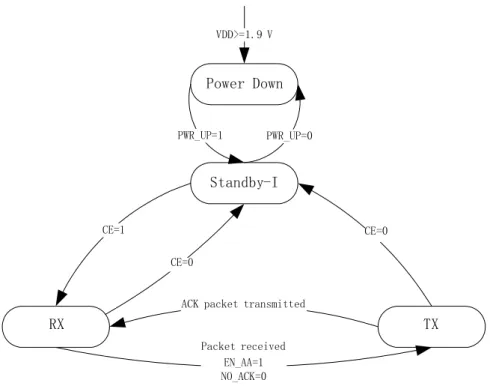
VDD>=1.9 V Power Down PWR_UP=1 PWR_UP=0 Standby-I CE=1 CE=0 CE=0ACK packet transmitted
RX TX
Packet received EN_AA=1 NO_ACK=0
Figure 4 PRX (PRIM_RX=1) state control diagram
4.2 Power
Down
Mode
In power down mode RFM70 is in sleep mode with minimal current consumption. SPI interface is still active in this mode, and all register values are available by SPI. Power down mode is entered by setting the PWR_UP bit in the CONFIG register to low.
4.3 Standby-I
Mode
By setting the PWR_UP bit in the CONFIG register to 1 and de-asserting CE to 0, the device enters standby-I mode. Standby-I mode is used to minimize average current consumption while maintaining short start-up time. In this mode, part of the crystal oscillator is active. This is also the mode which the RFM70 returns to from TX or RX mode when CE is set low.
4.4 Standby-II
Mode
In standby-II mode more clock buffers are active than in standby-I mode and much more current is used. Standby-II occurs when CE is held high on a PTX device with empty TX FIFO. If a new packet is uploaded to the TX FIFO in this mode, the device will automatically enter TX mode and the packet is transmitted.
4.5 TX
Mode
PTX device (PRIM_RX=0)
The TX mode is an active mode where the PTX device transmits a packet. To enter this mode from power down mode, the PTX device must have the PWR_UP bit set high, PRIM_RX bit set low, a payload in the TX FIFO, and a high pulse on the CE for more than 10µs.
RFM70
V1.0
The PTX device stays in TX mode until itfinishes transmitting the current packet. If CE = 0 it returns to standby-I mode. If CE = 1, the next action is determined by the status of the TX FIFO. If the TX FIFO is not empty the PTX device remains in TX mode, transmitting the next packet. If the TX FIFO is empty the PTX device goes into standby-II mode.
If the auto retransmit is enabled (EN_AA=1) and auto acknowledge is required (NO_ACK=0), the PTX device will enter TX mode from standby-I mode when ARD elapsed and number of retried is less than ARC.
PRX device (PRIM_RX=1)
The PRX device will enter TX mode from RX mode only when EN_AA=1 and NO_ACK=0 in received packet to transmit acknowledge packet with pending payload in TX FIFO.
4.6 RX
Mode
PRX device (PRIM_RX=1)
The RX mode is an active mode where the RFM70 radio is configured to be a receiver. To enter this mode from standby-I mode, the PRX device must have the PWR_UP bit set high, PRIM_RX bit set high and the CE pin
5
Packet Processing
set high. Or PRX device can enter this mode from TX mode after transmitting an acknowledge packet when EN_AA=1 and NO_ACK=0 in received packet.
In this mode the receiver demodulates the signals from the RF channel, constantly presenting the demodulated data to the packet processing engine. The packet processing engine continuously searches for a valid packet. If a valid packet is found (by a matching address and a valid CRC) the payload of the packet is presented in a vacant slot in the RX FIFO. If the RX FIFO is full, the received packet is discarded.
The PRX device remains in RX mode until the MCU configures it to standby-I mode or power down mode.
In RX mode a carrier detection (CD) signal is available. The CD is set to high when a RF signal is detected inside the receiving frequency channel. The internal CD signal is filtered before presented to CD register. The RF signal must be present for at least 128 µs before the CD is set high.
PTX device (PRIM_RX=0)
The PTX device will enter RX mode from TX mode only when EN_AA=1 and NO_ACK=0 to receive acknowledge packet.
5.1 Packet
Format
The packet format has a preamble, address, packet control, payload and CRC field.
Preamble 1 byte
Address 3~5 byte
Packet Control 9/0 bit Payload 0~32 byte
CRC 2/1 byte
Figure 5 Packet Format
RFM70
V1.0
5.1.1 Preamble
The preamble is a bit sequence used to detect 0 and 1 levels in the receiver. The preamble is one byte long and is either 01010101 or 10101010. If the first bit in the address is 1 the preamble is automatically set to 10101010 and if the first bit is 0 the preamble is automatically set to 01010101. This is done to ensure there are enough transitions in the preamble to stabilize the receiver.
5.1.2 Address
This is the address for the receiver. An address ensures that the packet is detected by the target receiver. The address field can be configured to be 3, 4, or 5 bytes long by the AW register. The PRX device can open up to six data pipes to support up to six PTX devices with unique addresses. All six PTX device addresses are searched simultaneously. In PRX side, the data pipes are enabled with the bits in the EN_RXADDR register. By default only data pipe 0 and 1 are enabled.
Each data pipe address is configured in the RX_ADDR_PX registers.
Each pipe can have up to 5 bytes configurable address. Data pipe 0 has a unique 5 byte address. Data pipes 1-5 share the 4 most significant address bytes. The LSB byte must be unique for all 6 pipes.
To ensure that the ACK packet from the PRX is transmitted to the correct PTX, the PRX takes the data pipe address where it received the packet and uses it as the TX address when transmitting the ACK packet.
On the PRX the RX_ADDR_Pn, defined as the pipe address, must be unique. On the PTX the TX_ADDR must be the same as the RX_ADDR_P0 on the PTX, and as the pipe address for the designated pipe on the PRX.
No other data pipe can receive data until a complete packet is received by a data pipe that has detected its address. When multiple PTX devices are transmitting to a PRX, the ARD can be used to skew the auto retransmission so that they only block each other once.
5.1.3 Packet Control
When Dynamic Payload Length function is enabled, the packet control field contains a 6 bit payload length field, a 2 bit PID (Packet Identity) field and, a 1 bit NO_ACK flag.
Payload length
The payload length field is only used if the Dynamic Payload Length function is enabled.
PID
The 2 bit PID field is used to detect whether the received packet is new or retransmitted. PID prevents the PRX device from presenting the same payload more than once to the MCU. The PID field is incremented at the TX side for each new packet received through the SPI. The PID and CRC fields are used by the PRX device to determine whether a packet is old or new. When several data packets are lost on the link, the PID fields may become equal to the last received PID. If a packet has the same PID as the previous packet, RFM70 compares the CRC sums from both packets. If the CRC sums are also equal, the last received packet is considered a copy of the previously received packet and discarded.
NO_ACK
The NO_ACK flag is only used when the auto acknowledgement feature is used. Setting the flag high, tells the receiver that the packet is not to be auto acknowledged.
The PTX can set the NO_ACK flag bit in the Packet Control Field with the command: W_TX_PAYLOAD_NOACK.However, the function must first be enabled in the
FEATURE register by setting the
RFM70
V1.0
the PTX goes directly to standby-I mode aftertransmitting the packet and the PRX does not transmit an ACK packet when it receives the packet.
5.1.4 Payload
The payload is the user defined content of the packet. It can be 0 to 32 bytes wide, and it is transmitted on-air as it is uploaded (unmodified) to the device.
The RFM70 provides two alternatives for handling payload lengths, static and dynamic payload length. The static payload length of each of six data pipes can be individually set. The default alternative is static payload length. With static payload length all packets between a transmitter and a receiver have the same length. Static payload length is set by the RX_PW_Px registers. The payload length on the transmitter side is set by the number of bytes clocked into the TX_FIFO and must equal the value in the RX_PW_Px register on the receiver side. Each pipe has its own payload length.
Dynamic Payload Length (DPL) is an alternative to static payload length. DPL enables the transmitter to send packets with variable payload length to the receiver. This means for a system with different payload lengths it is not necessary to scale the packet length to the longest payload.
With DPL feature the RFM70 can decode the payload length of the received packet automatically instead of using the RX_PW_Px registers. The MCU can read the length of the received payload by using the command: R_RX_PL_WID.
In order to enable DPL the EN_DPL bit in the FEATURE register must be set. In RX mode the DYNPD register has to be set. A PTX that transmits to a PRX with DPL enabled must have the DPL_P0 bit in DYNPD set.
5.1.5 CRC
The CRC is the error detection mechanism in the packet. The number of bytes in the CRC is set by the CRCO bit in the CONFIG register. It may be either 1 or 2 bytes and is calculated over the address, Packet Control Field, and Payload.
The polynomial for 1 byte CRC is X8 + X2 + X + 1. Initial value is 0xFF.
The polynomial for 2 byte CRC is X16 + X12 + X5 + 1. Initial value is 0xFFFF.
No packet is accepted by receiver side if the CRC fails.
5.2 Packet
Handling
RFM70 uses burst mode for payload transmission and receive.
The transmitter fetches payload from TX FIFO, automatically assembles it into packet and transmits the packet in a very short burst period with 1Mbps or 2Mbps air data rate. After transmission, if the PTX packet has the NO_ACK flag set, RFM70 sets TX_DS and gives an active low interrupt IRQ to MCU. If the PTX is ACK packet, the PTX needs receive ACK from the PRX and then asserts the TX_DS IRQ.
The receiver automatically validates and disassembles received packet, if there is a valid packet within the new payload, it will write the payload into RX FIFO, set RX_DR and give an active low interrupt IRQ to MCU. When auto acknowledge is enabled
(EN_AA=1), the PTX device will
automatically wait for acknowledge packet after transmission, and re-transmit original packet with the delay of ARD until an acknowledge packet is received or the number of re-transmission exceeds a threshold ARC. If the later one happens, RFM70 will set MAX_RT and give an active low interrupt
RFM70
V1.0
IRQ to MCU. Two packet loss counters(ARC_CNT and PLOS_CNT) are incremented each time a packet is lost. The ARC_CNT counts the number of retransmissions for the current transaction. The PLOS_CNT counts the total number of retransmissions since the last channel change. ARC_CNT is reset by initiating a new transaction. PLOS_CNT is reset by writing to the RF_CH register. It is possible to use the information in the OBSERVE_TX register to make an overall assessment of the channel quality.
The PTX device will retransmit if its RX FIFO is full but received ACK frame has payload. As an alternative for PTX device to auto retransmit it is possible to manually set the RFM70 to retransmit a packet a number of times. This is done by the REUSE_TX_PL command.
When auto acknowledge is enabled, the PRX device will automatically check the NO_ACK field in received packet, and if NO_ACK=0, it will automatically send an acknowledge packet to PTX device. If EN_ACK_PAY is set, and the acknowledge packet can also include pending payload in TX FIFO.
6
Data and Control Interface
6.1 TX/RX
FIFO
The data FIFOs are used to store payload that is to be transmitted (TX FIFO) or payload that is received and ready to be clocked out (RX FIFO). The FIFO is accessible in both PTX mode and PRX mode.
There are three levels 32 bytes FIFO for both TX and RX, supporting both acknowledge mode or no acknowledge mode with up to six pipes.
TX three levels, 32 byte FIFO
RX three levels, 32 byte FIFO
Both FIFOs have a controller and are
accessible through the SPI by using dedicated SPI commands. A TX FIFO in PRX can store payload for ACK packets to three different PTX devices. If the TX FIFO contains more than one payload to a pipe, payloads are handled using the first in first out principle. The TX FIFO in a PRX is blocked if all pending payloads are addressed to pipes where the link to the PTX is lost. In this case, the MCU can flush the TX FIFO by using the FLUSH_TX command.
The RX FIFO in PRX may contain payload from up to three different PTX devices.
.
A TX FIFO in PTX can have up to three payloads stored.
The TX FIFO can be written to by three commands, W_TX_PAYLOAD and W_TX_PAYLOAD_NO_ACK in PTX mode and W_ACK_PAYLOAD in PRX mode. All three commands give access to the TX_PLD register.
The RX FIFO can be read by the command R_RX_PAYLOAD in both PTX and PRX mode. This command gives access to the RX_PLD register.
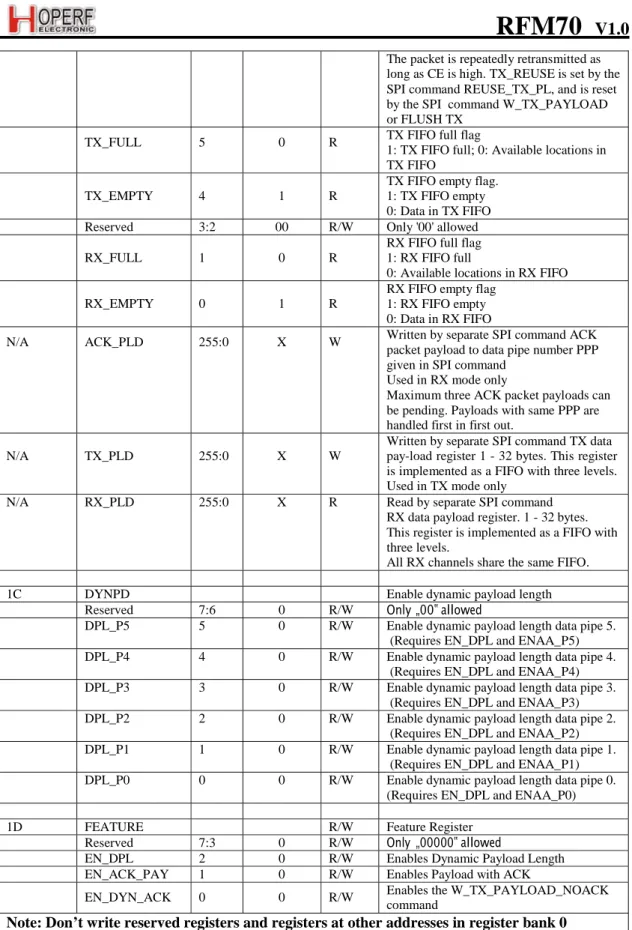
The payload in TX FIFO in a PTX is NOT removed if the MAX_RT IRQ is asserted. In the FIFO_STATUS register it is possible to read if the TX and RX FIFO are full or empty. The TX_REUSE bit is also available in the FIFO_STATUS register. TX_REUSE is set by the SPI command REUSE_TX_PL, and is reset by the SPI command: W_TX_PAYLOAD or FLUSH TX.
6.2 Interrupt
In RFM70 there is an active low interrupt (IRQ) pin, which is activated when TX_DS IRQ, RX_DR IRQ or MAX_RT IRQ are set high by the state machine in the STATUS register. The IRQ pin resets when MCU writes
'1' to the IRQ source bit in the STATUS register. The IRQ mask in the CONFIG
RFM70
V1.0
register is used to select the IRQ sources thatare allowed to assert the IRQ pin. By setting one of the MASK bits high, the corresponding IRQ source is disabled. By default all IRQ sources are enabled.
The 3 bit pipe information in the STATUS register is updated during the IRQ pin high to low transition. If the STATUS register is read during an IRQ pin high to low transition, the pipe information is unreliable.
6.3 SPI
Interface
6.3.1 SPI Command
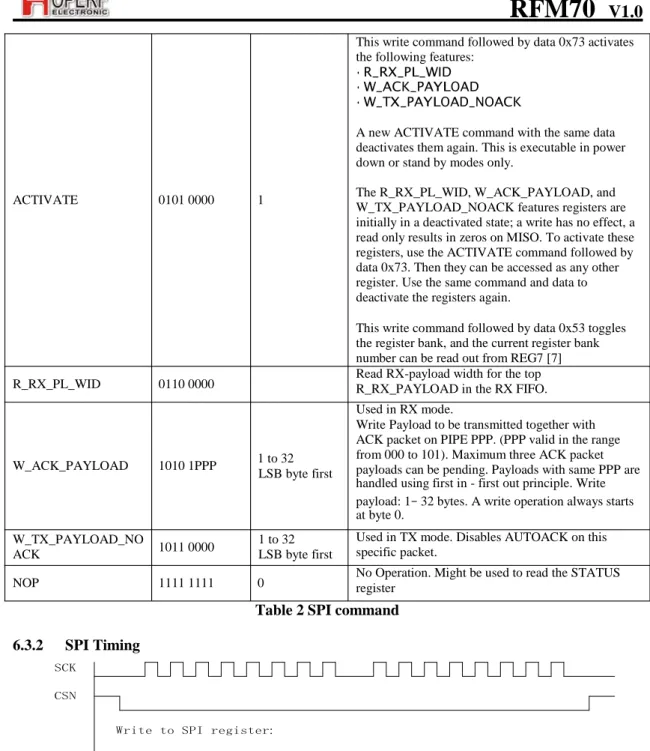
The SPI commands are shown in Table 2. Every new command must be started by a high
to low transition on CSN.
In parallel to the SPI command word applied on the MOSI pin, the STATUS register is shifted serially out on the MISO pin.
The serial shifting SPI commands is in the following format:
<Command word: MSB bit to LSB bit (one byte)>
<Data bytes: LSB byte to MSB byte, MSB bit in each byte first> for all registers at bank 0 and register 9 to register 14 at bank 1
<Data bytes: MSB byte to LSB byte, MSB bit in each byte first> for register 0 to register 8 at bank 1 Command name Command word (binary) # Data bytes Operation
R_REGISTER 000A AAAA 1 to 5
LSB byte first
W_REGISTER 001A AAAA 1 to 5
LSB byte first
R_RX_PAYLOAD 0110 0001 1 to 32 LSB byte first
W_TX_PAYLOAD 1010 0000 1 to 32 LSB byte first
Read command and status registers. AAAAA = 5 bit Register Map Address
Write command and status registers. AAAAA = 5 bit Register Map Address
Executable in power down or standby modes only. Read RX-payload: 1 – 32 bytes. A read operation always starts at byte 0. Payload is deleted from FIFO after it is read. Used in RX mode.
Write TX-payload: 1 – 32 bytes. A write operation always starts at byte 0 used in TX payload.
FLUSH_TX 1110 0001 0 Flush TX FIFO, used in TX mode
Flush RX FIFO, used in RX mode
FLUSH_RX 1110 0010 0
REUSE_TX_PL 1110 0011 0
Should not be executed during transmission of acknowledge, that is, acknowledge package will not be completed.
Used for a PTX device
Reuse last transmitted payload. Packets are repeatedly retransmitted as long as CE is high.
TX payload reuse is active until
W_TX_PAYLOAD or FLUSH TX is executed. TX payload reuse must not be activated or deactivated during package transmission
RFM70
V1.0
This write command followed by data 0x73 activates the following features:
• R_RX_PL_WID • W_ACK_PAYLOAD • W_TX_PAYLOAD_NOACK ACTIVATE 0101 0000 1 R_RX_PL_WID 0110 0000 W_ACK_PAYLOAD 1010 1PPP 1 to 32 LSB byte first
A new ACTIVATE command with the same data deactivates them again. This is executable in power down or stand by modes only.
The R_RX_PL_WID, W_ACK_PAYLOAD, and W_TX_PAYLOAD_NOACK features registers are initially in a deactivated state; a write has no effect, a read only results in zeros on MISO. To activate these registers, use the ACTIVATE command followed by data 0x73. Then they can be accessed as any other register. Use the same command and data to deactivate the registers again.
This write command followed by data 0x53 toggles the register bank, and the current register bank number can be read out from REG7 [7] Read RX-payload width for the top R_RX_PAYLOAD in the RX FIFO. Used in RX mode.
Write Payload to be transmitted together with ACK packet on PIPE PPP. (PPP valid in the range from 000 to 101). Maximum three ACK packet payloads can be pending. Payloads with same PPP are handled using first in - first out principle. Write payload: 1– 32 bytes. A write operation always starts at byte 0.
W_TX_PAYLOAD_NO
ACK 1011 0000
1 to 32 LSB byte first
Used in TX mode. Disables AUTOACK on this specific packet.
No Operation. Might be used to read the STATUS
NOP 1111 1111 0 register
Table 2 SPI command 6.3.2 SPI Timing
SCK
CSN
MOSI
Write to SPI register:
x C7 C6 C5 C4 C3 C2 C1 C0 x D7 D6 D5 D4 D3 D2 D1 D0 x
MISO HI-Z S7 S6 S5 S4 S3 S2 S1 S0 0 0 0 0 0 0 0 0 Hi-Z
Read from SPI register:
MOSI x C7 C6 C5 C4 C3 C2 C1 C0 x
MISO x S7 S6 S5 S4 S3 S2 S1 S0 D7 D6 D5 D4 D3 D2 D1 D0 x
RFM70
V1.0
Cn: SPI command bitSn: STATUS register bit
Dn: Data Bit (LSB byte to MSB byte, MSB bit in each byte first)
Note: The SPI timing is for bank 0 and register 9 to 14 at bank 1. For register 0 to 8 at bank 1, the byte order is inversed that the MSB byte is R/W before LSB byte.
Figure 7 SPI NOP timing diagram
Symbol Parameters Min Max Units
Tdc Data to SCK Setup 10 ns Tdh SCK to Data Hold 2 ns Tcsd CSN to Data Valid 38 ns Tcd SCK to Data Valid 55 ns Tcl SCK Low Time 40 ns Tch SCK High Time 40 ns Fsck SCK Frequency 0 8 MHz
Tr,Tf SCK Rise and Fall 100 ns
Tcc CSN to SCK Setup 2 ns
Tcch SCK to CSN Hold 2 ns
Tcwh CSN Inactive time 50 ns
Tcdz CSN to Output High Z 38 ns
RFM70
V1.0
7
Register Map
There are two register banks, which can be toggled by SPI command “ACTIVATE” followed with 0x53 byte, and bank status can be read from Bank0_REG7 [7].
7.1 Register
Bank
0
Address
(Hex) Mnemonic Bit
Reset
Value Type Description
00 CONFIG Configuration Register
Reserved 7 0 R/W Only '0' allowed
MASK_RX_DR 6 0 R/W Mask interrupt caused by RX_DR
1: Interrupt not reflected on the IRQ pin 0: Reflect RX_DR as active low interrupt on the IRQ pin
MASK_TX_DS 5 0 R/W Mask interrupt caused by TX_DS
1: Interrupt not reflected on the IRQ pin 0: Reflect TX_DS as active low interrupt on the IRQ pin
MASK_MAX_RT 4 0 R/W Mask interrupt caused by MAX_RT
1: Interrupt not reflected on the IRQ pin 0: Reflect MAX_RT as active low interrupt on the IRQ pin
EN_CRC 3 1 R/W Enable CRC. Forced high if one of the bits
in the EN_AA is high
CRCO 2 0 R/W CRC encoding scheme
'0' - 1 byte '1' - 2 bytes
PWR_UP 1 0 R/W 1: POWER UP, 0:POWER DOWN
PRIM_RX 0 0 R/W RX/TX control,
1: PRX, 0: PTX
01 EN_AA Enable „Auto Acknowledgment‟ Function
Reserved 7:6 00 R/W Only '00' allowed
ENAA_P5 5 1 R/W Enable auto acknowledgement data pipe 5
ENAA_P4 4 1 R/W Enable auto acknowledgement data pipe 4
ENAA_P3 3 1 R/W Enable auto acknowledgement data pipe 3
ENAA_P2 2 1 R/W Enable auto acknowledgement data pipe 2
ENAA_P1 1 1 R/W Enable auto acknowledgement data pipe 1
ENAA_P0 0 1 R/W Enable auto acknowledgement data pipe 0
02 EN_RXADDR Enabled RX Addresses
Reserved 7:6 00 R/W Only '00' allowed
ERX_P5 5 0 R/W Enable data pipe 5.
ERX_P4 4 0 R/W Enable data pipe 4.
ERX_P3 3 0 R/W Enable data pipe 3.
ERX_P2 2 0 R/W Enable data pipe 2.
ERX_P1 1 1 R/W Enable data pipe 1.
RFM70
V1.0
03 SETUP_AW Setup of Address Widths
(common for all data pipes)
Reserved 7:2 000000 R/W Only '000000' allowed
AW 1:0 11 R/W RX/TX Address field width
'00' - Illegal '01' - 3 bytes '10' - 4 bytes '11' - 5 bytes
LSB bytes are used if address width is below 5 bytes
04 SETUP_RETR Setup of Automatic Retransmission
ARD 7:4 0000 R/W Auto Retransmission Delay
„0000‟ – Wait 250 us „0001‟ – Wait 500 us „0010‟ – Wait 750 us
……..
„1111‟ – Wait 4000 us
(Delay defined from end of transmission to start of next transmission)
ARC 3:0 0011 R/W
Auto Retransmission Count „0000‟ –Re-Transmit disabled „0001‟ – Up to 1 Re-Transmission on fail of AA …… „1111‟ – Up to 15 Re-Transmission on fail of AA 05 RF_CH RF Channel
Reserved 7 0 R/W Only '0' allowed
RF_CH 6:0 0000010 R/W Sets the frequency channel
06 RF_SETUP RF Setup Register
Reserved 7 0 R/W Reserved
6 0 R/W Reserved
5 1 R/W Reserved
4 1 Reserved
RF_DR 3 1 R/W Air Data Rate
„0‟ – 1Mbps „1‟ – 2Mbps RF_PWR[1:0] 2:1
11 R/W
Set RF output power in TX mode RF_PWR[1:0] '00' – -10 dBm '01' – -5 dBm '10' – 0 dBm '11' – 5 dBm LNA_HCURR 0 1 R/W
Setup LNA gain 0:Low gain(20dB down) 1:High gain
07 STATUS
Status Register (In parallel to the SPI command word applied on the MOSI pin, the STATUS register is shifted serially out on the MISO pin)
RBANK 7 0 R
Register bank selection states. Switch register bank is done by SPI command “ACTIVATE” followed by 0x53 0: Register bank 0
RFM70
V1.0
1: Register bank 1
RX_DR 6 0 R/W Data Ready RX FIFO interrupt
Asserted when new data arrives RX FIFO Write 1 to clear bit.
TX_DS 5 0 R/W Data Sent TX FIFO interrupt
Asserted when packet transmitted on TX. If AUTO_ACK is activated, this bit is set high only when ACK is received.
Write 1 to clear bit.
MAX_RT 4 0 R/W
Maximum number of TX retransmits interrupt
Write 1 to clear bit. If MAX_RT is asserted it must be cleared to enable further communication.
RX_P_NO 3:1 111 R Data pipe number for the payload available for reading from RX_FIFO
000-101: Data Pipe Number 110: Not used
111: RX FIFO Empty
TX_FULL 0 0 R TX FIFO full flag.
1: TX FIFO full
0: Available locations in TX FIFO
08 OBSERVE_TX Transmit observe register
PLOS_CNT 7:4 0000 R Count lost packets. The counter is overflow protected to 15, and discontinues at max until reset. The counter is reset by writing to RF_CH.
ARC_CNT 3:0 0000 R
Count retransmitted packets. The counter is reset when transmission of a new packet starts. 09 CD Reserved 7:1 000000 R CD 0 0 R Carrier Detect 0A RX_ADDR_P0 39:0 0xE7E7E 7E7E7
R/W Receive address data pipe 0. 5 Bytes maximum length. (LSB byte is written first. Write the number of bytes defined by SETUP_AW)
0B RX_ADDR_P1 39:0 0xC2C2C
2C2C2
R/W Receive address data pipe 1. 5 Bytes maximum length. (LSB byte is written first. Write the number of bytes defined by SETUP_AW)
0C RX_ADDR_P2 7:0 0xC3 R/W Receive address data pipe 2. Only LSB
MSB bytes is equal to RX_ADDR_P1[39:8]
0D RX_ADDR_P3 7:0 0xC4 R/W Receive address data pipe 3. Only LSB
MSB bytes is equal to RX_ADDR_P1[39:8]
0E RX_ADDR_P4 7:0 0xC5 R/W Receive address data pipe 4. Only LSB.
MSB bytes is equal to RX_ADDR_P1[39:8]
0F RX_ADDR_P5 7:0 0xC6 R/W Receive address data pipe 5. Only LSB.
MSB bytes is equal to RX_ADDR_P1[39:8]
10
TX_ADDR 39:0 0xE7E7E
7E7E7
R/W
Transmit address. Used for a PTX device only.
(LSB byte is written first)
Set RX_ADDR_P0 equal to this address to handle automatic acknowledge if this is a PTX device
RFM70
V1.0
11 RX_PW_P0
Reserved 7:6 00 R/W Only '00' allowed
RX_PW_P0 5:0 000000 R/W
Number of bytes in RX payload in data pipe 0 (1 to 32 bytes). 0: not used 1 = 1 byte … 32 = 32 bytes 12 RX_PW_P1
Reserved 7:6 00 R/W Only '00' allowed
RX_PW_P1 5:0
000000 R/W
Number of bytes in RX payload in data pipe 1 (1 to 32 bytes). 0: not used 1 = 1 byte … 32 = 32 bytes 13 RX_PW_P2
Reserved 7:6 00 R/W Only '00' allowed
RX_PW_P2
5:0 000000 R/W
Number of bytes in RX payload in data pipe 2 (1 to 32 bytes). 0: not used 1 = 1 byte … 32 = 32 bytes 14 RX_PW_P3
Reserved 7:6 00 R/W Only '00' allowed
RX_PW_P3
5:0 000000
R/W
Number of bytes in RX payload in data pipe 3 (1 to 32 bytes). 0: not used 1 = 1 byte … 32 = 32 bytes 15 RX_PW_P4
Reserved 7:6 00 R/W Only '00' allowed
RX_PW_P4 5:0 000000 R/W
Number of bytes in RX payload in data pipe 4 (1 to 32 bytes). 0: not used 1 = 1 byte … 32 = 32 bytes 16 RX_PW_P5
Reserved 7:6 00 R/W Only '00' allowed
RX_PW_P5
5:0
000000
R/W
Number of bytes in RX payload in data pipe 5 (1 to 32 bytes).
0: not used 1 = 1 byte
… 32 = 32 bytes
17 FIFO_STATUS FIFO Status Register
Reserved 7 0 R/W Only '0' allowed
TX_REUSE 6 0
R Reuse last transmitted data packet if set high.
RFM70
V1.0
The packet is repeatedly retransmitted as long as CE is high. TX_REUSE is set by the SPI command REUSE_TX_PL, and is reset by the SPI command W_TX_PAYLOAD or FLUSH TX
TX_FULL 5 0 R TX FIFO full flag
1: TX FIFO full; 0: Available locations in TX FIFO
TX_EMPTY 4 1 R
TX FIFO empty flag. 1: TX FIFO empty 0: Data in TX FIFO
Reserved 3:2 00 R/W Only '00' allowed
RX_FULL 1 0 R
RX FIFO full flag 1: RX FIFO full
0: Available locations in RX FIFO
RX_EMPTY 0 1 R
RX FIFO empty flag 1: RX FIFO empty 0: Data in RX FIFO
N/A ACK_PLD 255:0 X W Written by separate SPI command ACK
packet payload to data pipe number PPP given in SPI command
Used in RX mode only
Maximum three ACK packet payloads can be pending. Payloads with same PPP are handled first in first out.
N/A TX_PLD 255:0 X W
Written by separate SPI command TX data pay-load register 1 - 32 bytes. This register is implemented as a FIFO with three levels. Used in TX mode only
N/A RX_PLD 255:0 X R Read by separate SPI command
RX data payload register. 1 - 32 bytes. This register is implemented as a FIFO with three levels.
All RX channels share the same FIFO.
1C DYNPD Enable dynamic payload length
Reserved 7:6 0 R/W Only „00‟ allowed
DPL_P5 5 0 R/W Enable dynamic payload length data pipe 5.
(Requires EN_DPL and ENAA_P5)
DPL_P4 4 0 R/W Enable dynamic payload length data pipe 4.
(Requires EN_DPL and ENAA_P4)
DPL_P3 3 0 R/W Enable dynamic payload length data pipe 3.
(Requires EN_DPL and ENAA_P3)
DPL_P2 2 0 R/W Enable dynamic payload length data pipe 2.
(Requires EN_DPL and ENAA_P2)
DPL_P1 1 0 R/W Enable dynamic payload length data pipe 1.
(Requires EN_DPL and ENAA_P1)
DPL_P0 0 0 R/W Enable dynamic payload length data pipe 0.
(Requires EN_DPL and ENAA_P0)
1D FEATURE R/W Feature Register
Reserved 7:3 0 R/W Only „00000‟ allowed
EN_DPL 2 0 R/W Enables Dynamic Payload Length
EN_ACK_PAY 1 0 R/W Enables Payload with ACK
EN_DYN_ACK 0 0 R/W Enables the W_TX_PAYLOAD_NOACK
command
Note: Don’t write reserved registers and registers at other addresses in register bank 0
RFM70
V1.0
7.2 Register
Bank
1
Address
(Hex) Mnemonic Bit
Reset
Value Type Description
00 31:0 0 W Must write with 0x404B01E2
01 31:0 0 W Must write with 0xC04B0000
02 31:0 0 W Must write with 0xD0FC8C02
0x
03 31:0 03001200 W Must write with 0x99003941
Must write with 0xD99E860B(High Power)
04 31:0 0 W For single carrier mode:0xD99E8621
RF output power in TX mode: 0:Low power(-30dB down)
20 1 W 1:High power
Must write with 0x24067FA6(Disable
05 31:0 0 W RSSI)
RSSI Threshold for CD detect
RSSI_TH 29:26 W 0: -97 dBm, 2 dB/step, 15: -67 dBm RSSI measurement: 0:Enable RSSI_EN 18 0 W 1:Disable 06 31:0 0 W Reserved 07 31:0 0 W Reserved
Register bank selection states. Switch register bank is done by SPI command “ACTIVATE” followed by 0x53 0: Register bank 0
RBANK 7 R 1: Register bank 1
BEKEN Chip ID:
08 Chip ID 31:0 0 R 0x00000063(RFM70)
09 0 Reserved
0A 0 Reserved
0B 0 Reserved
0C 31:0 0 Please initialize with 0x00731200
0D NEW_FEATURE 31:0 0 Please initialize with 0x0080B436
0E RAMP 87:0 NA W Ramp curve
Please write with
0xFFFFFEF7CF208104082041
Note: Don’t write reserved registers and no definition registers in register bank 1 Table 5 Register Bank 1
RFM70
V1.0
8
Electrical Specifications
Name Parameter (Condition) Min Typi
cal
Max Unit Comm
ent
Operating Condition
VDD Voltage 1.9 3.0 3.6 V
TEMP Temperature -40 +27 +85 ºC
Digital input Pin
VIH High level 0.7VDD 5.25 V
VIL Low level VSS 0.3VDD V
Digital output Pin
VOH High level (IOH=-0.25mA) VDD- 0.3
VDD V
VOL Low level(IOL=0.25mA) 0 0.3 V
Normal condition
IVDD Power Down current 3 uA
IVDD Standby-I current 50 uA
IVDD Standby-II current 400 uA
Normal RF condition
FOP Operating frequency 2400 2527 MHz
FXTAL Crystal frequency 16 MHz
RFSK Air data rate 1 2 Mbps
Transmitter
PRF Output power -40 0 5 dBm
PBW Modulation 20 dB bandwidth(2Mbps) 2.5 MHz
PBW Modulation 20 dB bandwidth (1Mbps) 1.3 MHz
PRF1 Out of band emission 2 MHz -20 dBm
PRF2 Out of band emission 4 MHz -40 dBm
IVDD Current at -40 dBm output power 11 mA
IVDD Current at -30 dBm output power 11 mA
IVDD Current at -25 dBm output power 12 mA
IVDD Current at -10 dBm output power 13 mA
IVDD Current at -5 dBm output power 15 mA
IVDD Current at 0 dBm output power 17 mA
IVDD Current at 5 dBm output power 23 mA
Receiver
IVDD Current (2Mbps) 18 mA
IVDD Current (1Mbps) 17 mA
Max Input 1 E-3 BER 10 dBm
RXSENS 1 E-3 BER sensitivity (2Mbps) -85 dBm
RXSENS 1 E-3 BER sensitivity (1Mbps) -88 dBm
C/ICO Co-channel C/I (2Mbps) 4 dB
C/I1ST ACS C/I 2MHz (2Mbps) -5 dB
C/I2ND ACS C/I 4MHz (2Mbps) -20 dB
C/I3RD ACS C/I 6MHz (2Mbps) -25 dB
C/ICO Co-channel C/I (1Mbps) 4 dB
C/I1ST ACS C/I 1MHz (1Mbps) 4 dB
C/I2ND ACS C/I 2MHz (1Mbps) -18 dB
C/I3RD ACS C/I 3MHz (1Mbps) -19 dB
RFM70
V1.0
9
Typical Application Schematic
RFM70
V1.0
10
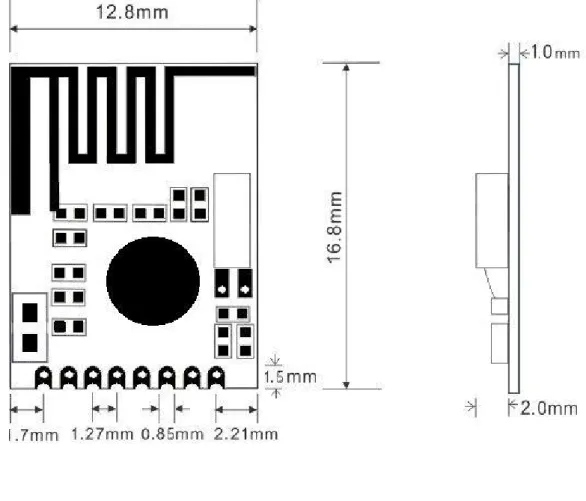
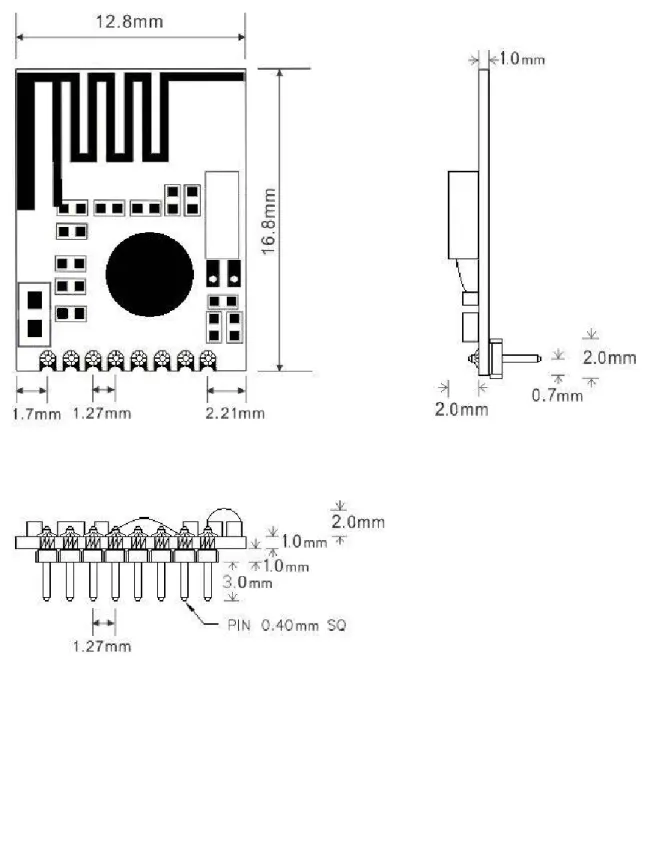
Package Information
RFM70
V1.0
RFM70
V1.0
11
Order Information
Part number Package
RFM70-S SMD
RFM70-D DIP
RFM70
V1.0
12
Contact Information
HOPE MICROELECTRONICS CO.,LTD
4/F, Block B3, East Industrial Area, Huaqiaocheng, Shenzhen, Guangdong, China Tel: 86-755-86096602 Fax: 86-755-86096587 Email: [email protected] Website: http://www.hoperf.com http://www.hoperf.cn http://hoperf.en.alibaba.com
This document may contain preliminary information and is subject to change by Hope Microelectronics without notice. Hope Microelectronics assumes no responsibility or liability for any use of the information contained herein. Nothing in this document shall operate as an express or implied license or indemnity under the intellectual property rights of Hope Microelectronics or third parties. The products described in this document are not intended for use in implantation or other direct life support applications where malfunction may result in the direct physical harm or injury to persons. NO WARRANTIES OF ANY KIND, INCLUDING, BUT NOT LIMITED TO, THE IMPLIED WARRANTIES OF MECHANTABILITY OR FITNESS FOR A ARTICULAR PURPOSE, ARE OFFERED IN THIS DOCUMENT.