Durham Research Online
Deposited in DRO: 02 February 2017
Version of attached le: Published Version
Peer-review status of attached le: Peer-reviewed
Citation for published item:
Asutay, M. and Harningtyas, A.F. (2015) 'Developing Maqasid al-Shari'ah index to evaluate social performance of Islamic banks : a conceptual and empirical attempt.', International journal of Islamic economics and nance studies., 1 (1). pp. 5-64.
Further information on publisher's website: http://ijisef.org/index.php/IJISEF/article/view/20 Publisher's copyright statement:
This work is licensed under a Creative Commons Attribution-NonCommercial-ShareAlike 4.0 International License.
Additional information:
Use policy
The full-text may be used and/or reproduced, and given to third parties in any format or medium, without prior permission or charge, for personal research or study, educational, or not-for-prot purposes provided that:
• a full bibliographic reference is made to the original source
• alinkis made to the metadata record in DRO
• the full-text is not changed in any way
The full-text must not be sold in any format or medium without the formal permission of the copyright holders. Please consult thefull DRO policyfor further details.
Durham University Library, Stockton Road, Durham DH1 3LY, United Kingdom Tel : +44 (0)191 334 3042 | Fax : +44 (0)191 334 2971
Developing
Maqasid al-Shari’ah
Index to Evaluate Social
Performance of Islamic Banks: A Conceptual and Empirical
Attempt
Mehmet ASUTAY1
Astrid Fionna HARNINGTYAS2
Abstract
The rise of Islamic banking and finance is now a reality with Shari 'ah compliant financial operations existing in many different parts of the world. However, its development has recently been subjected to criticism in relation to the aspirational objectives of Islamic moral economy, which constitutes the moral foundations of Islamic finance. The aspirational objectives are general expressed with maqasid al-Shari'ah, which is defined as 'human well-being'.
The aim of this research, hence, is to evaluate the social performance of Islamic banks according to maqasid al-Shari'ah upon the realization of Islamic Moral Economy aspirations. AbdelMajid Najjar's concept of maqasid al-Shari 'ah with eight orientations or articulations is adopted to construct an evaluation framework aligned with the objective of rendering a critical improvement of current empirical studies.
In operationalizing the developed framework, this study conducts empirical investigations by taking 13 banks from 6 countries for 5-year period (2008-2012) as a sample. In doing so, the annual reports of the sampled banks for the period are subjected to content analysis to generate the necessary data in applying to the formulated framework.
Empirical evidence indicates that there is lack of achievement in maqasid al-Shari 'ah performance of Islamic bank and finance. Nevertheless, the overall industry concentrates mainly on self, faith and rights and stakeholding rather than wealth orientation, despite the fewer contributions in social entity, intellect, posterity and ecology. Additionally, the empirical results find that there are different orientations across the banks and countries. Finally, the industry orientation is estimated in this research, which is located to be somewhere between faith and rights and stakeholding. Keywords:Maqasid al-Shari 'ah, Islamic Banking and Finance, Evaluation, Performance
1 Professor, Durham University Business School, Durham University, UK [email protected]
2 Specialist, Macroprudential Policy Department, Bank Indonesia
Introduction
Islamic banking and finance (IBF) emerged in mid-1970s in the form of Islamic commercial banking as a value oriented banking proposal shaped by the norms, values, and principles of Islamic ethics and also by Islamic legal norms. In referring to the nature of IBF, AAOIFI (2007: 27) describes it as: ‘Islamic banks were developed on a foundation that does not permit the separation between temporal and religious matters. That foundation requires compliance with Shari'a as a basis for all aspects of life. This covers not only religious worship but also business transactions, which should comply with Shari'a precepts’.
Thus, financial and religious dimensions together constructs the nature of IBF with the objective of producing an ethical financial system, as attempted by the axiomatic approach of Islamic Moral Economy (IME), which reflects the maqasid al-Shari 'ah or the objectives of Islamic principles with ultimate goal to promote human wellbeing (Asutay, 2012). In this contextualisation, "the foundational axioms demonstrate, as a system, that Islamic Moral Economy refers to economic and sustainable development, social justice and social investing oriented principles" (Asutay, 2012: 96).
Over the last forty years, IBF has shown important progress and is now considered as part of global financial system. Despite such success, the recent debate on IBF performance is also concerned with the observed converge of IBF towards existing neo-classical system by gradually moving away from its value proposition, as the orientation has been diverged in becoming a financial option at the expense of IME aspirations (Asutay, 2012). One of the reasons for such development is attributed to mimicking of conventional finance practices and products in fulfilling 'form' or legal requirements only, while neglecting the 'substance' or social function as identified in the maqasid
al-Shari'ah framework (Ahmed, 2011). Since the aspirations of IME concern for
multidimensional aspects, social as well as economic; the divergence is mainly attributed to social and developmentalist failures.
It is therefore essential to evaluate the performance of Islamic banks in relation to IME's foundational framework, as the latter provides the rationale for the emergence of IBF. This will help to locate how the IBF institutions are directed in fulfilling the multidimensional development instead of ‘financialisation of the economy’; and meet both ‘form’ (fiqh rulings or Islamic principles) as well as ‘substance’ (social and moral filters) (Asutay, 2012: 98-99).
The existing body of knowledge reveals that there is an increasing awareness about the development of IBF performance measurements. From the evaluation frameworks presented in this literature review, this study aims to develop a comprehensive framework that address the multidimensional aspects to capture the aspirations of IME in IBF practices through an empirical research framework.
The rationale of this research stems form the fact that the unique features of the industry should be treated differently in performance evaluation apart from the conventional system in order to measure its achievement in realizing the IME aspirations. In addition, the performance of IBFs should not be limited with financial performance but also they should be subjected to social evaluation as articulated by maqasid al-Shari’ah within the IME frame. Since the ontological framework of IME requires IBF to fulfill the ethical and social orientations, this study aims at developing a comprehensive evaluation framework for the social and economics/developmentalist performance of IBF institutions that addresses the foundations and aspirations of IME. In addition, this research conducts an empirical study within the formulated framework in measuring maqasid al-Shari 'ah performance of sampled Islamic banks from various countries.
In the recent years, a couple of frameworks to assess the fulfillment of
maqasid al- Sharï'ah have appeared in the literature. In building on these
efforts, this research proposes a framework conceptualized through the articulation of maqasid al-Shari 'ah and adopted from the available body of knowledge. Eventually, the evaluation of Islamic banks performance across the regions within five-year time period is conducted to provide evidence for the achievement of the industry in overall.
In fulfilling these aims the following objectives are developed:
(i) Exploring maqasid al-Shari 'ah to develop an evaluation framework of Islamic bank's performance;
(ii) Using annual reports of sampled Islamic banks to gather data through content
analysis to be used in the established maqasid framework;
(iii) Developing an index from the gathered data to chart the performance of each maqasid consequences for each bank, industry and the country;
(iv) Calculating the consequence vectors to provide an ultimate understanding of the maqasid performance of the industry.
The following research questions are to be addressed in this research in line with aims and objectives:
(i) What is the framework that represents the aspiration of IME to evaluate the performance of IBF industry?
(ii) How is the maqasid performance of Islamic banks in relation to the suggested framework?
(iii) What is the maqasid orientation of the industry?
As for the organization of the paper, after providing the overall articulation of the current context, presenting the aims and objectives of the study whilst addressing the research questions in this section, a literature survey on IBF institutions’ social performance is provided in Section 2. Section 3 discusses the construction of evaluation framework to measure the
maqasid performance of Islamic banks, including presenting data set and
methodological approach. After analyzing the collated data, the empirical results per each bank, countries and industry are presented in Section 4. Finally, Section 5 provides conclusion whilst explaining the study limitations and recommendations for future research.
1. Islamic Moral Economy Foundations of Islamic Finance
The concept of IME was initiated to propose a new economic system, apart from capitalism and socialism, for solving the underdevelopment of Muslim world after regained the independence from colonial powers (Asutay, 2012). This proposed system is constructed on the ontology and epistemology of Islam, namely Quran and Sunnah, which aimed at putting generating a human wellbeing centred developmentalist objectives.
IBF as an operational form of this system was initiated to play an important role in realizing the Islamic concept of development and maqasid
al-Shari'ah (the objectives of Islam). However, with the recent growth in IBF
sector, it is claimed that the direction has diverged from the origin or the aspiration of IME (Ahmed, 2011; Asutay, 2012). IBF as the institutional forms of IME, has achieved remarkable financial performance and impressive growth in assets and the number of institutions; but has failed to serve the social and developmental needs of Muslim world, as aimed at by IME (Asutay, 2012); and therefore ‘social failure’ of IBF is a source of debate in various circles.
1.1. Maqasid Al-Shari'ah Paradigm
Maqasid al-Shari'ah or the objectives of Shari'ah is interpreted as 'human
Ghazali, 1937; cited in Chapra, 2008a: 5-6): “The very objective of the
Shari'ah is to promote the well-being of the people, which lies in safeguarding
their faith (din), their self (nafs), their intellect ('aql), their posterity (nasi),
and their wealth (mal”.
Chapra (2008a) asserts that these five objectives are primary, while there are others important corollaries can be derived from Islamic ontology and epistemology. The impact and importance in short-run may be different, thus, in long run they are all important, as “They are all interdependent and play the role of supporting each other” (Chapra, 2008a: 71). Chapra (2008a) sets up an order based on importance for all primary objectives to be: the human self, faith, intellect, posterity and wealth.
In searching for the articulation of maqasid al-Shari'ah, Bedoui (2012: 8) provides a borader and more effective articulation of maqasid al-Shariah
concept according to Abdel Majid Najjar within 4 objectives and 8 corollaries as depicted in Table 1.
Table 1: Najjar's Concept of Maqasid al-Shariah
(i) Safeguarding the value of human life
(a) Faith
(b) Human rights
(ii) Safeguarding the human self (a) Self
(b) Intellect
(iii) Safeguarding the society (a) Posterity
(b) Social entity
(iv) Safeguarding the physical environment
(a) Wealth
(b) Environment (Ecology) It is noted that the accomplishment of both primary and corollary objectives are important, therefore Bedoui (2012) uses all corollaries to represent objective pillars and visualises in eight axes within the spider graph, who also (2012: 15) assumes that all the objectives should be balanced and therefore they should all have the same weight.
1.2. Social and Moral Identities of IBF
As an embodiment of Islamic economic system, Asutay (2012) classifies 4 characteristics of Islamic values and norms as filters that should be represented by IBF:
(i) IBF is derived from ontology of Islam; therefore, the Industry prohibits the practices of riba (interest-based transactions), gharar (gambling), speculation transactions, and production of products that violates Islamic norms, which
are believed to be the financialisation of the economy and the sources of financial crises (Askari etal., 2012; El-Gamal, 2006; Chapra, 2008b).
(ii) The risk-sharing model in profit and loss sharing (PLS) contracts, namely mudharabah and musharakah, is proposed. Two-tier mudharabah was initially conceptualised as the ideal model of IBF, as it is considered promoting the social and economic objectives while reflecting maqasid al-Shariah as to bring social justice for human centric development (Askari et al., 2012; Ahmed, 2011; El- Gamal, 2006; Ayub, 2007; Kettel, 2009; Dusuki, 2007). This is expected to lead to a ‘participatory society’ in the sense emancipation and empowerment of individuals are achieved with developing ‘ihsan’ in the society as a social capital.
(iii) IBF proposes an embedded financing proposition, in the sense of financing being embedded in real economy as it concentrates on asset-backed transactions while promoting stability and productivity. On the contrary, as the conventional finance is not merely backed by assets or links to real economy, it triggers 'excessive and imprudent lending' which may result in financial crises (Chapra, 2008b: 1).
(iv) The embeddedness relates to financing being determined also by non-economic factors including religions (Islam), reciprocity, distribution, altruism, for example;
(v) IBF focuses on the society, a broader scope than 'market segmented' approach. In consequence, the society concerns such as poverty alleviation and environmental problems will also be covered as objectives in the system.
Thus, being ethical and socially oriented is not an option for IBF, but rather it is essentialised within the ontological framework of IME.
1.3. Social Failure of IBF
The experience of IBF indicates that it has moved away from the aspirational position identified by IME. Therefore, Asutay (2012: 101-106) evaluates the social failures of IBF based on some areas adopted from IME framework. Thus, the following is considered to be outcomes and sources of the observed social failure:
Due to the fact that the institutions operate within the conventional economic and monetary system, it is affected and there is no appropriate benchmark for the some financial transaction thus riba element remains.
As the dominancy of industry's main instruments has involved from two-tier mudharabah to murabahah syndrome (mark-up sale) and later,
tawarruq syndrome (synthetic loan); it sends a message that IBF is trying to replicate the conventional products to serve the market, instead of the society (Ahmed, 2011) and the real economy, far from the expectation as Islamic economic manifestation (Asutay and Aksak, 2011).
IBF has not successfully promoted socio-economic development, while focused only to economic growth. Asutay (2012) illustrates that in term of economic development: lack of long term financing and specific concentration on real estate sector instead of agriculture, industry and manufacturing, clarifies that the industry only focus to the growth but not to the development.
An important reason as to why moral or social expectations have not been incorporated in the operation of the IBs is due to the way Islamic law or
Shari’ah treated by the Shari’ah scholars involved in the IB industry. Their
narrow approach to Shari’ah is very much based on only fulfilling the ‘form’ by negating the ‘substance’ of Islam or Islamic moral economy. However, ‘substance’ is the main soul of IB operations and it is the source of main distinction (which makes IB ‘Islamic’). The rationalistic legal reading of
Shari’ah by the Shari’ah scholars have resulted in ignoring the moral
dimension or the substance, as they claim that Islamic methodological approach is based on ‘intention’ and therefore as long as the intention is correct the rest does not matter. On the contrary, Islamic practice as well as knowledge suggests that ‘intention’ has to be complemented by ‘consequence’ and consequence can only be measured by substance. In other words, ‘iman’ is essential, but iman without good deeds (amal al saleh) is not enough. Islamic methodology of tawhid suggests complementarity in the sense that ‘intention’ has to go together with ‘consequences’; and therefore IB industry should also consider ‘coinseqiences’ of their financing, which can be possible with the articulation of maqasid al-shari’ah.
Lastly, while IME requires more improved model of corporate governance rather than the stakeholder model to internalise the Islamic values and principles, the perceptions of the IBF institutions to the concept remain low and the ideal concept has not been captured by AAOIFI and IF SB. 1.4. Rationale for Social Performance Measurement
As defined in the previous sections, social objectives play important role in internalising Islamic values in IBF practices, which define IBF. Despite the performance failure in this orientation, there is a need to develop performance measurement framework that considers the aspects other than economic and
financial goals. The current practices to assess the performance of IBF is not really distinguished from the conventional, as it is only focus on the financial measures (Mohammed et al., 2008), while the ontological reasoning, as articulated through Islamic moral economy and, hence, by maqasid
al-shari’ah, suggests and also rationalises social performance of Islamic financial
institutions.
To identify 'Islamic' in IBF performance measurements, Hasan (2004) states that social responsibilities should be included in the framework. Some further studies propose the framework by conceptualising the maqasid
al-Shariah, such as the one conducted by Mohammed et al. (2008), which
performs ratios calculations including the distinct identities of IBF (e.g. zakah
obligation and investment in real sector). Nevertheless, the study deals with transparency problem so that some ratios cannot be computed. Furthermore, the framework does not cover some responsibilities to perform GCG and environmental issues.
In operationalising maqasid al-Shari'ah framework, Bedoui (2012) proposes some visualisation of the objectives in Shari'ah. The model allows the calculation of global performance and identifies the orientation focus. However, the study does not identify the indicators therefore we need to construct the evaluation framework.
In addition to maqasid al-Shari 'ah framework, Haniffa and Hudaib (2007) explore the ethical identity disclosures that are presented in Islamic banks annual reports. In another study, Hameed et al. (2004) proposes Islamicity Disclosure Index, which combines the Shari'ah compliance, GCG and social/environmental indicators alongside some financial ratios calculation. Nevertheless, in Haniffa and Hudaib's study is more qualitative while there is no financial instrument included in the framework. The other study completes the prior by providing analysis of the social and environmental issues and provides deeper analysis of GCG compliance indicators according to the regulations.
2. Modelling Maqasid Evaluation Framework 2.1. Research Strategy
The empirical nature of this study aims at assessing the financial and especially social performance of Islamic banks through the disclosure in annual reports. Therefore this researcher attempts to employ mixed methods data analysis since the qualitative and quantitative data are being collected (Creswell and Clark, 2007) throughout content analysis and financial ratios calculation.
The content analysis, which according to Krippendorff (1980) and Weber (1988), "a method of codifying the text (or content) of a piece of writing into various groups (or categories) depending on selected criteria" (cited in Haniffa and Hudaib, 2007: 103), is essential in this study to analyse the annual reports. This method is employed to collect the disclosed information in relations to the dimensions and aspects in this study. Thus, content analysis in the form of qualitative method is performed alongside with analysing some financial indicators and implement the multiple attribute decision- making method to generate the overall performance result.
2.2. Research Approach
Recently, a number of research approaches content analysis in relation to gauging the maqasid al-Shari 'ah compliancy nature of Islamic banks within the form of social performance. In this evaluatory research on IBF performance, the frameworks of some of these studies are consulted in an attempt to construct the proposed framework. The frameworks of those studies are discussed below:
2.2.1.Constructing Maqasid al-Shari'ah Index
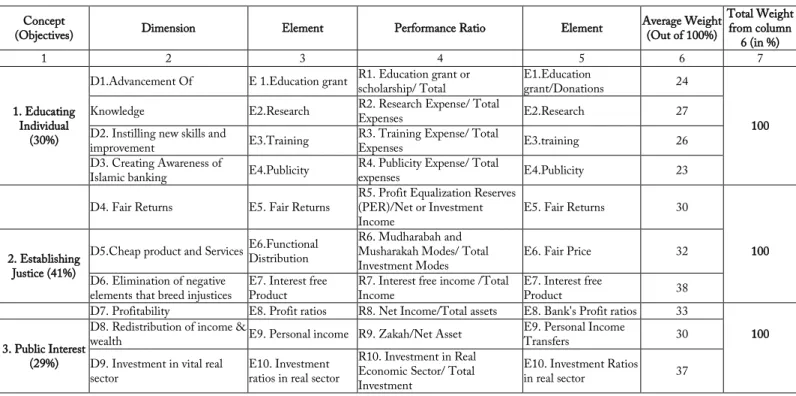
Mohammed et al.'s (2008) study is conducted based on Abu Zaharah's concept of maqasid al-Shari'ah. They use Sekaran's method to convert the objectives into performance measurements, in which the objectives are translated into several dimensions and later be measured by elements through collecting disclosed data. Their maqasid index dimensions and are disclosed in Table 2.
Mohammed et al. (2008: 8) construct the weights and ratios based on results of interviews and questionnaires distributed to Shari'ah experts from Middle East and Malaysia. In their study, seven out of ten ratios from first and third objectives are performed to assess six Islamic Banks throughout 6-year period: 2000-2005. The three ratios within second objectives could not be implemented in their study, however, the study conducted by Antonio et al. (2012), as an extension of Muhammad et al.'s (2008) improves by performing R6 ratio (the utilisation of PLS contract) while examining four Indonesian and Jordan Islamic banks throughout 3-year period (2008-2010).
Table 2: Maqasid al-Shari'ah Index
Concept
(Objectives) Dimension Element Performance Ratio Element
Average Weight (Out of 100%) Total Weight from column 6 (in %) 1 2 3 4 5 6 7
D1.Advancement Of E 1.Education grant R1. Education grant or
scholarship/ Total E1.Education grant/Donations 24 1. Educating Individual (30%)
Knowledge E2.Research R2. Research Expense/ Total
Expenses E2.Research 27
100 D2. Instilling new skills and
improvement E3.Training
R3. Training Expense/ Total
Expenses E3.training 26
D3. Creating Awareness of
Islamic banking E4.Publicity
R4. Publicity Expense/ Total
expenses E4.Publicity 23
D4. Fair Returns E5. Fair Returns
R5. Profit Equalization Reserves (PER)/Net or Investment Income
E5. Fair Returns 30
2. Establishing Justice (41%)
D5.Cheap product and Services E6.Functional
Distribution
R6. Mudharabah and Musharakah Modes/ Total Investment Modes
E6. Fair Price 32 100
D6. Elimination of negative elements that breed injustices
E7. Interest free Product
R7. Interest free income /Total Income
E7. Interest free
Product 38
D7. Profitability E8. Profit ratios R8. Net Income/Total assets E8. Bank's Profit ratios 33
3. Public Interest (29%)
D8. Redistribution of income &
wealth E9. Personal income R9. Zakah/Net Asset
E9. Personal Income
Transfers 30 100
D9. Investment in vital real sector
E10. Investment ratios in real sector
R10. Investment in Real Economic Sector/ Total Investment
E10. Investment Ratios
in real sector 37
In order to perform analysis, the Simple Additive Weighting method (according to Yoon and Hwang, 1995) is implemented to calculate the total score from three attributes (objectives) and 10 intra-attribute values (ratios). Since the method requires the attributes to be independent to each other (Yoon and Hwang, 1995), this matter is considered when assigning the performance indicators for each element in the evaluation framework within this research study.
2.2.2. Shari'ah-Based Ethical Performance
Bedoui (2012) proposes a visual graph based on maqasid al-Shari'ah
performance, measured from geometric and mathematical approaches. Since this study implements Najjar's model, instead of using 4 axes for the primary maqasid (objectives), it uses 8 axes to represent consequences derived from the primary objectives. The reason is that the realization of the primary objectives is not accomplished without the corollaries (Bedoui, 2012: 5).
The performance of all the consequences is visualised in a spider-graph. If the institution maintains balanced performance and within the ideal (perfect) condition, Bedoui (2012) illustrates that the result will reach to the outer range of the web as in the bold line as in Figure 1.
Figure 1. Visualisation of Najjar's Maqasid al-Shariah Concept
1. Faith
5. Posterity
Furthermore, to measure the general performance for the balanced-orientation institution, Bedoui (2012: 6) also proposes a formula based on the law of sinus as below (where refers to the performance of each objectives):
7 1 8 1 1 2 sin( ) 8 2 pi pi p p
Balanced Orienttation Maqasid Performance 8
Nevertheless, in the case when the institution concentrates more to one objective rather than any other objectives, Bedoui (2012: 6) proposes the following formula: 7 1 8 1 1 2 sin( ) 8 2 wpi pi p p
Unbalanced Orienttation Maqasid Performance 8
Since this institution does not give equal proportion to focus on all corollaries, Bedoui introduces V indicator as the attributed weight given by the institution for each objectives.
Bedoui (2012) explains that the prioritisation of all the objectives is important to calculate the general performance. However, the prioritisation and the orientation of each institution may differ. In order to calculate the general performance for all samples, this study assumes the ideal condition of the balanced-orientation where the banks should put the objectives altogether as all maqasid are interrelated (Chapra, 2008a). This study analyses the individual bank performance, alongside the country and the overall industry performance. To harmonise the differentiation across the countries and the industry, therefore, this study implements the balanced maqasid- performance and applies one evaluation framework. Moreover, to define the prioritisation, this research implements the prioritisation order according to Najjar's model. As regards to this research, however, it does not employ empirical study nor determines the specific details of elements to be evaluated within the Najjar's model.
3.2.3. Islamicity Disclosure Index
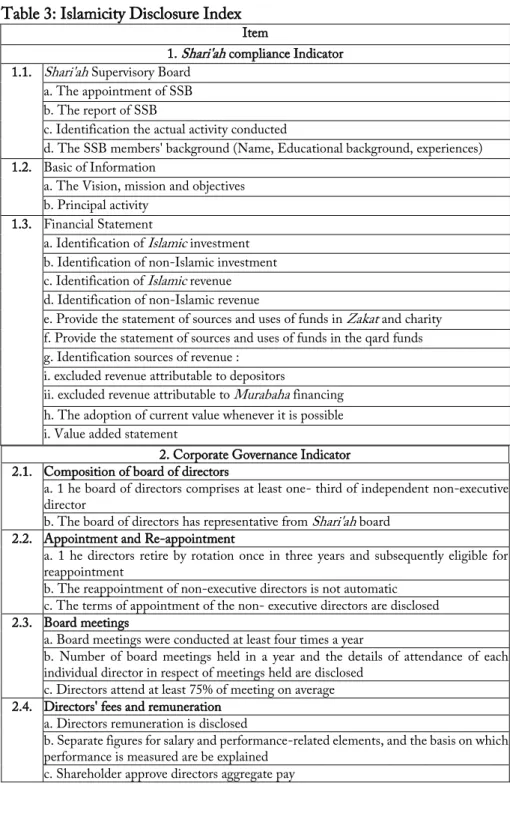
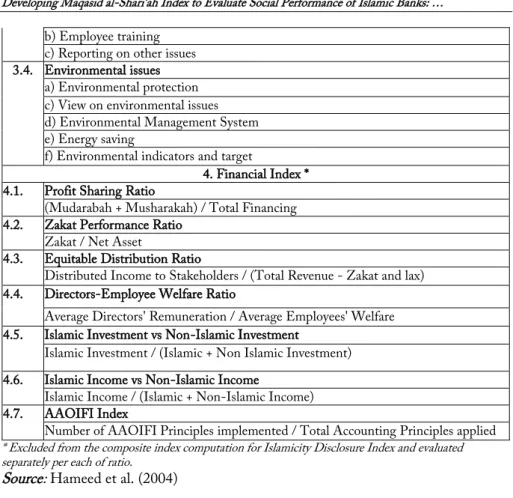
Islamicity Disclosure Index (Hameed et al., 2004) contributes in this research's framework from the GCG, social and environmental compliancy dimensions. The assessment for three indicators is qualitative and uses the content analysis as provided in Table 3.2. Later, they attribute the weights accordingly to calculate the overall disclosure index (50%, 30% and 20%). In addition, they also perform financial ratio analyses apart from the disclosure index to form Islamic Quantitative Index. Some of the ratios are also covered in this study as included in Mohammed et al. (2008), namely the proportion
Developing Maqasid al-Shari’ah Index to Evaluate Social Performance of Islamic Banks: …
2. Corporate Governance Indicator 2.1. Composition of board of directors
a. 1 he board of directors comprises at least one- third of independent non-executive director
b. The board of directors has representative from Shari'ah board 2.2. Appointment and Re-appointment
a. 1 he directors retire by rotation once in three years and subsequently eligible for reappointment
b. The reappointment of non-executive directors is not automatic c. The terms of appointment of the non- executive directors are disclosed 2.3. Board meetings
a. Board meetings were conducted at least four times a year
b. Number of board meetings held in a year and the details of attendance of each individual director in respect of meetings held are disclosed
c. Directors attend at least 75% of meeting on average 2.4. Directors' fees and remuneration
a. Directors remuneration is disclosed
b. Separate figures for salary and performance-related elements, and the basis on which performance is measured are be explained
c. Shareholder approve directors aggregate pay
Table 3: Islamicity Disclosure Index
Item
1. Shari'ah compliance Indicator 1.1. Shari'ah Supervisory Board
a. The appointment of SSB b. The report of SSB
c. Identification the actual activity conducted
d. The SSB members' background (Name, Educational background, experiences) 1.2. Basic of Information
a. The Vision, mission and objectives b. Principal activity
1.3. Financial Statement
a. Identification of Islamic investment b. Identification of non-Islamic investment c. Identification of Islamic revenue d. Identification of non-Islamic revenue
e. Provide the statement of sources and uses of funds in Zakat and charity f. Provide the statement of sources and uses of funds in the qard funds g. Identification sources of revenue :
i. excluded revenue attributable to depositors
ii. excluded revenue attributable to Murabaha financing h. The adoption of current value whenever it is possible i. Value added statement
2.5. Nomination committee
a. The company has nomination committee
b. The committee should exclusively consists of non-executive directors which majority are independent
2.6. Remuneration Committee
a. There is a Remuneration Committee
b. Remuneration consisting wholly or mainly of non-executive directors
c. Membership of the remuneration committee should appear in the directors' report 2.7. Audit Committee
a. There is an audit committee
b. T he Audit Committee consists of at least three non-executive directors, whom majority are independent
c. Audit committee include someone with expertise in accounting
d. Audit committee recommends the external auditor at the annual shareholders meeting
e. At least, once a year the committee met with the external auditors without executive board members present, to review financial statement
f. Details of the activities of audit committees, the number of audit meetings held in a year and details of attendance of each individual director in respect of meetings are disclosed
g. Audit committee members attend at least 75% of meetings on average 2.8. Shari'ah Supervisory Board
a. Include someone with expertise in accounting
b. SSB meets with audit committee and/or external auditor to review financial statement
c. Details of the activities of SSB, the number of board meetings held in a year and details of attendance of each individual member in respect of meetings are disclosed d. SSB committee members attend at least 75% of meetings on average
e. SSB is independent body 2.9. Others
a. Directors, senior management are qualified persons in terms of educational background, working experience etc
b. Chairman and CEO are different persons c. There is a Risk Management Committee d. English disclosure exists
e. There is a statement on Corporate Governance
f. The maintenance of an effective system of internal controls is disclosed g. There is director's report
3. Social & Environmental Indicator 3.1. Policy and objective
a) Mission statement/statement of environmental policy b) Mission statement/statement of social policy c) Environmental target and objective
d) Social target and objective 3.2. Community issues
a) Consumer care
b) Community involvement 3.3. Employees issues
b) Employee training c) Reporting on other issues 3.4. Environmental issues
a) Environmental protection c) View on environmental issues d) Environmental Management System e) Energy saving
f) Environmental indicators and target
4. Financial Index * 4.1. Profit Sharing Ratio
(Mudarabah + Musharakah) / Total Financing 4.2. Zakat Performance Ratio
Zakat / Net Asset
4.3. Equitable Distribution Ratio
Distributed Income to Stakeholders / (Total Revenue - Zakat and lax) 4.4. Directors-Employee Welfare Ratio
Average Directors' Remuneration / Average Employees' Welfare 4.5. Islamic Investment vs Non-Islamic Investment
Islamic Investment / (Islamic + Non Islamic Investment) 4.6. Islamic Income vs Non-Islamic Income
Islamic Income / (Islamic + Non-Islamic Income) 4.7. AAOIFI Index
Number of AAOIFI Principles implemented / Total Accounting Principles applied
* Excluded from the composite index computation for Islamicity Disclosure Index and evaluated separately per each of ratio.
Source: Hameed et al. (2004)
2.2.4. Ethical Identity Index
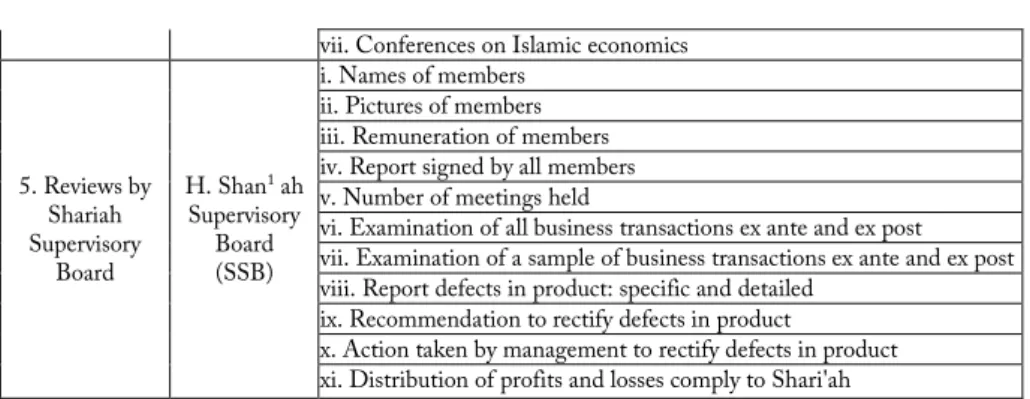
In defining the Ethical Identity Index (EII), Haniffa and Hudaib (2007) present the framework as in Table 4, which identifies the dimensions and elements in their study. It should be noted that Haniffa and Hudaib (2007: 103) assess 7 Islamic Banks across the Arabian Gulf region for the period of 2002-2004.
Table 4: Dimensions and Elements of Ethical Identity Index
Theme Dimension Instrument
1. Underlying Philosophy and Values A. Vision and Mission Statement
i. Commitments in operating within Shari'ah principles/ideals ii. Commitments in providing returns within Shari'ah principles iii. Focus on maximising shareholders returns
iv. Current directions in serving the needs of Muslim community v. Future directions in serving the needs of Muslim community vi. Commitments to engage only in permissible investment activities vii. Commitments to engage only in permissible financing activities viii. Commitments to fulfil contracts via 'contract (uqud) statement' ix. Appreciation to shareholders and customers
B. BOD and Top
i. Names of Board Members ii. Positions of Board Members
Management iii. Pictures of Board Members iv. Profile of Board Members v. Shareholdings of Board Members
vi. Multiple-directorships exist among Board Members vii. Membership of Audit Committees
viii. Board Composition: Executive vs Non-Executive ix.Role Duality: CEO is Chairman of Board x. Names of Management Team
xi. Positions of Management Team xii. Pictures of Management Team xiii. Profile of Management Team
2 & 3. interest-tree and Islamically Acceptable Deals C. Product
i. No involvement in non-permissible activities ii. Involvement in non-permissible activities-% of Profit iii. Reason for involvement in non-permissible activities iv. Handling of non-permissible activities
v. Introduced new product
vi. Approval ex ante by SSB for new product vii. Basis of Shari'ah concept in approving new product viii. Glossary/definition of products
ix. Investment activities-general x. Financing projects-general 4. Developmental and Social Goals 4. Developmental and Social Goals D. Zakah, charity and benevolent loans
i. Bank liable for zakah ii. Amount paid for zakah iii. Sources of zakah iv. Use/beneficiaries of zakah
v. Balance of zakah not distributed-amount vi. Reasons for balance of zakah
vii. SSB attestation that sources and uses of zakah according to Shari'ah viii. SSB attestation that zakah has been computed according to Shari'ah ix. Zakah to be paid by individuals-amount
x. Sources of charity (saddaqa) xi. Uses of charity (saddaqa) xii. Sources of qard al-hassan xiii. Uses of qard al-hassan
xiv. Policy for providing qard al-hassan xv. Policy on non-payment of qard al-hassan
E. Employees
i. Employess appreciation ii. Number of employees iii. Equal opportunities policy iv. Employees welfare v. Training: Shari'a awareness vi. Training: Other
vii. Training: Student/recruitment scheme viii. Training: Monetary
ix. Reward for employees F. Debtors
i. Debt policy
ii. Amount of debts written off iii. Type of lending activities-general iv. Type of lending activities-detailed
G. Community
i. Women branch
ii. Creating job opportunities
iii. Support for org. that provide benefits to society iv. Participation in govt. social activities
v. Sponsor community activities vi. Commitment to social role
vii. Conferences on Islamic economics 5. Reviews by Shariah Supervisory Board H. Shan1 ah Supervisory Board (SSB) i. Names of members ii. Pictures of members iii. Remuneration of members iv. Report signed by all members v. Number of meetings held
vi. Examination of all business transactions ex ante and ex post vii. Examination of a sample of business transactions ex ante and ex post viii. Report defects in product: specific and detailed
ix. Recommendation to rectify defects in product
x. Action taken by management to rectify defects in product xi. Distribution of profits and losses comply to Shari'ah
Source: Haniffa and Hudaib (2007)
Methodologically, the scoring approach is 'dichotomous' (Haniffa and Cooke, 2000:14), which one score is given for the instrument if disclosed and no score if it is not; otherwise, no penalty given when the instrument is not relevant. To eliminate bias, "the entire annual report is read before any decision is made" (Cooke, 1996 cited in Haniffa and Hudaib, 2007: 103). Furthermore, in their attempt, all the instruments are treated equally by assigning the same weight as Haniffa and Hudaib (2007: 103) explain that the scoring is 'additive and equally weighted'. Those aforementioned methods will be implemented in this study.
2.2.5. CAMEL Ratios
In addition to the aforementioned studies, the framework in this study also covers the evaluation of financial performance to assess wealth-consequence.
This study uses Jaffar and Manarvi's (2011) as a reference by performing CAMEL ratios calculation as depicted in Table 5. Jaffar and Manarvi (2011) use these ratios in assessing the performance of Islamic banks in comparison to conventional banks. However, instead of constructing the overall index, they only evaluate the performance within the ratios and parameters.
Table 5: CAMEL Ratios
Parameters Ratios
Capital Adequacy Debt to Equity
Capital to Risk Assets
Asset Quality Non performing loan
Loan loss average Management Quality Operating expense
Cost per money lent
Earning Ability Return on asset
Return on equity
Liquidity Loan to asset
Deposit to asset Source: Jaffar and Manarvi (2011)
Nevertheless, not all the financial ratios performed by Jaffar and Manarvi (2012) are calculated in this study. Several ratios are selected by considering their impact to the global performance score.
3.3. Framework Construction in Assessing Islamic Banks Performance: Model Selection
In constructing the evaluation framework, firstly, Najjar's model of maqasid
al- Shari 'ah is implemented with 4 objectives and 8 corollaries. The
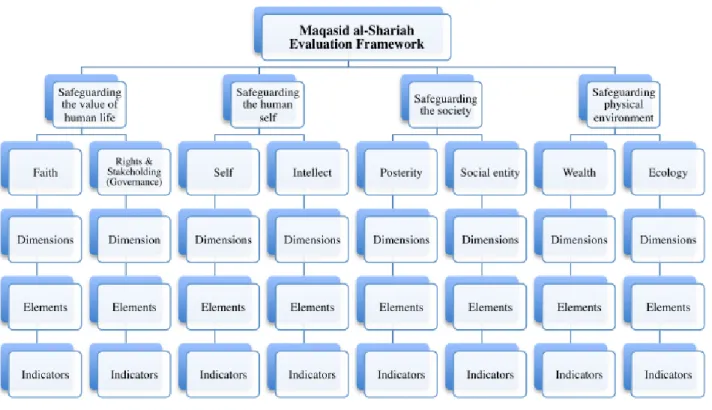
dimensions, elements and indicators are distributed to each relevant corollary according to the critical assessment of the aforementioned frameworks. Not all indicators from the references are implemented since only relevant indicators are used and assigned by referring to the consequences. In addition, the concept of dimensions, elements and indicators are adopted from Mohammed et aVs (2008) approach to measure general objectives by deriving it into some specific indicators. Thus, the overall evaluation framework is depicted in Figure 2.
The assignment of dimensions to the secondary maqasid is defined according to the literature review. Bedoui (2012) provides an example in the study to evaluate the framework within some primary objectives and criteria as well as to assign some weights. In addition, Chapra (2008) renders some specific examples to determine the correlation amongst the objectives and other corollaries. These help to construct the framework used in this study.
For the second corollary, instead of human rights we use rights and
stakeholding to measure how good institutions in fulfilling their
responsibilities to their stakeholders throughout the good corporate governance practices.
The following sections, hence, detail the chosen dimensions and their corollaries.
2.3.1. Safeguarding the Value of Human Life
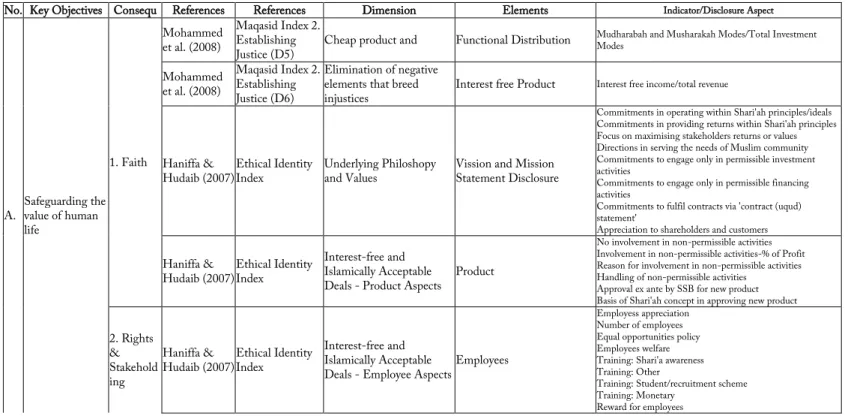
In constructing the first objective, each consequence is distributed to some dimensions, elements and indicators or disclosure aspect according to the concepts introduced by Mohammed et al. (2008), Haniffa and Hudaib (2007), Hameed et al. (2004) as can be seen in Table 6.
In faith, the first two dimensions and indicators are taken from
Mohammed et al. (2008), which are quantitative data to measure the use of PLS contract and the percentage of halal income as truly representatives of Islamic principles. The others are qualitative disclosures to measure the commitment of the institution to implement Shari'ah principles; their contribution to treat the employee as a way to develop human wellbeing; fulfillment of the internal stakeholder (BOD and Committees) and independent party (SSB) responsibilities, and other GCG practices.
In order to simplify the evaluation, especially for rights and
stakeholding, not all indicators from Haniffa and Hudaib's (2007) and
Hameed et al.'s (2004) studies are adopted since some indicators are irrelevant. For some indicators that are relatively similar, Hameed et al.'s (2004: 15-16) framework is utilised, since there are more regulatory aspects in relation to GCG rather than only disclosure, as according to the Code of Best Practice for Corporate Governance in Islamic and Malaysian Code on Corporate Governance.
Table 6: Index for Safeguarding the Value of Human Life Framework
No. Key Objectives Consequ References References Dimension Elements Indicator/Disclosure Aspect
A. Safeguarding the value of human life 1. Faith Mohammed et al. (2008) Maqasid Index 2. Establishing Justice (D5)
Cheap product and Functional Distribution Mudharabah and Musharakah Modes/Total Investment Modes
Mohammed et al. (2008) Maqasid Index 2. Establishing Justice (D6) Elimination of negative elements that breed injustices
Interest free Product Interest free income/total revenue
Haniffa & Hudaib (2007) Ethical Identity Index Underlying Philoshopy and Values
Vission and Mission Statement Disclosure
Commitments in operating within Shari'ah principles/ideals Commitments in providing returns within Shari'ah principles Focus on maximising stakeholders returns or values Directions in serving the needs of Muslim community Commitments to engage only in permissible investment activities
Commitments to engage only in permissible financing activities
Commitments to fulfil contracts via 'contract (uqud) statement'
Appreciation to shareholders and customers
Haniffa & Hudaib (2007) Ethical Identity Index Interest-free and Islamically Acceptable Deals - Product Aspects
Product
No involvement in non-permissible activities Involvement in non-permissible activities-% of Profit Reason for involvement in non-permissible activities Handling of non-permissible activities
Approval ex ante by SSB for new product Basis of Shari'ah concept in approving new product
2. Rights & Stakehold ing Haniffa & Hudaib (2007) Ethical Identity Index Interest-free and Islamically Acceptable Deals - Employee Aspects
Employees
Employess appreciation Number of employees Equal opportunities policy Employees welfare Training: Shari'a awareness Training: Other
Training: Student/recruitment scheme Training: Monetary
Hameed et al. (2004)
Islamicity Disclosure Index
Corporate Governance Indicator (Fairness and Transparency) - BOD aspects
BOD (Composition, Appointment and Re-appointment, Board meetings, and Director's fees
The board of directors comprises at least one- third of independent non-executive director
The board of directors has representative from Shari'ah board The directors retire by rotation once in three years and subsequently eligible for re- appointment
The reappointment of non-executive directors is not automatic
The terms of appointment of the non- executive directors are disclosed
Board meetings were conducted at least four times a year Number of board meetings held in a year and the details of attendance of each individual director in respect of meetings held are disclosed
Directors attend at least 75% of meeting on average Directors remuneration is disclosed
j. Separate figures for salaiy and performance-related elements, and the basis on which performance is measured are be explained k. Shareholder approve directors aggregate pay
Corporate Governance Indicator (Fairness and Transparency) - Committees aspects
Nomination, Remuneration and Audit Committees
The company has nomination committee
The committee should exclusively consists of non-executive directors which majority are independent
There is a Remuneration Committee
Remuneration consisting wholly or mainly of non-executive directors
Membership of the remuneration committee should appear in the directors' report
There is an audit committee
The Audit Committee consists of at least three non-executive directors, whom majority are independent
Audit committee include someone with expertise in accounting
Audit committee recommends the external auditor at the annual shareholders meeting
j. At least, once a year the committee met with the external auditors without executive board members present, to review financial statement
k. Details of the activities of audit committees, the number of audit meetings held in a year and details of attendance of each individual director in respect of meetings are disclosed l. Audit committee members attend at least 75% of meetings on average
Corporate Governance Indicator (Fairness and Transparency) - SSB aspects
SSB
Include someone with expertise in accounting
SSB meets with audit committee and/ or external auditor to review financial statement
Details of the activities of SSB, the number of board meetings held in a year and details of attendance of each individual member in respect of meetings are disclosed
SSB committee members attend at least 75% of meetings on average
SSB is independent body
Corporate Governance Indicator (Fairness and Transparency) - Other aspects
Others
Directors, senior management are qualified persons in terms of
Chairman and CEO are different persons There is a Risk Management Committee English disclosure exists
There is statement on Corporate Governance
The maintenance of an effective system of internal controls is disclosed
3.3.2. Safeguarding the Human Self and Society
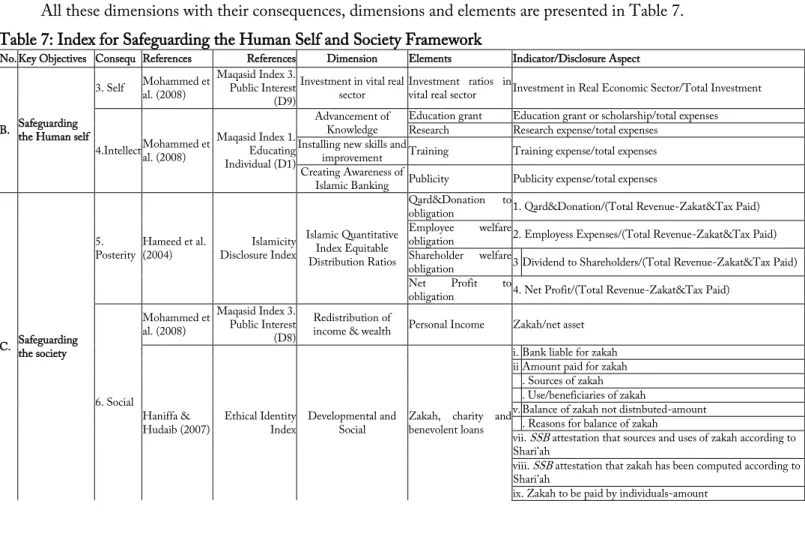
On the second key objective, safeguarding the human self, there are 2 consequences (self and intellect) adopted from Mohammed et al.'s (2008) study. Self-consequence addresses one indicator to measure the bank contribution in the economic empowerment of the real sector. According to Aizenman et al. (2011), financing to financial sector (includes insurance and real estate) should be excluded to perform the calculation. The intellect-consequence covers 4 indicators to measure the fund allocation for educating individuals.
Meanwhile, the third objective (safeguarding the society) consists of 2 consequences. In posterity, we adopt 4 indicators of Islamic Quantitative Index (Hameed et al., 2004) to measure how good the institution fulfil the needs of their stakeholders in order to eliminate the irritants factor, e.g. fear and conflicts (Chapra, 2008a).
For the other consequence, social entity, we utilise the frameworks developed by Mohammed et al., (2008) Haniffa and Hudaib (2007) and Hameed et al. (2004) to evaluate the bank's social contribution from zakat,
charity and qardh hasan (loans with special terms for the poor) contribution. In assessing zakat, although Mohammed et al. (2004) and Antonio et al.
(2012) use net income as the denominator, this study proposes net asset method, according to AAOIFI (2007) in Financial Accounting Standard
All these dimensions with their consequences, dimensions and elements are presented in Table 7. Table 7: Index for Safeguarding the Human Self and Society Framework
No. Key Objectives Consequ References References Dimension Elements Indicator/Disclosure Aspect
B. Safeguarding the Human self
3. Self Mohammed et al. (2008)
Maqasid Index 3. Public Interest (D9)
Investment in vital real sector
Investment ratios in
vital real sector Investment in Real Economic Sector/Total Investment
4.Intellect Mohammed et al. (2008) Maqasid Index 1. Educating Individual (D1) Advancement of Knowledge
Education grant Education grant or scholarship/total expenses Research Research expense/total expenses
Installing new skills and
improvement Training Training expense/total expenses Creating Awareness of
Islamic Banking Publicity Publicity expense/total expenses
C. Safeguarding the society 5. Posterity Hameed et al. (2004) Islamicity Disclosure Index Islamic Quantitative Index Equitable Distribution Ratios Qard&Donation to
obligation 1. Qard&Donation/(Total Revenue-Zakat&Tax Paid) Employee welfare
obligation 2. Employess Expenses/(Total Revenue-Zakat&Tax Paid) Shareholder welfare
obligation 3 Dividend to Shareholders/(Total Revenue-Zakat&Tax Paid) Net Profit to
obligation 4. Net Profit/(Total Revenue-Zakat&Tax Paid)
6. Social Mohammed et al. (2008) Maqasid Index 3. Public Interest (D8) Redistribution of
income & wealth Personal Income Zakah/net asset
Haniffa & Hudaib (2007) Ethical Identity Index Developmental and Social
Zakah, charity and benevolent loans
i. Bank liable for zakah ii Amount paid for zakah . Sources of zakah . Use/beneficiaries of zakah
v. Balance of zakah not distnbuted-amount . Reasons for balance of zakah
vii. SSB attestation that sources and uses of zakah according to Shari'ah
viii. SSB attestation that zakah has been computed according to Shari'ah
No. Key Objectives Consequ References References Dimension Elements Indicator/Disclosure Aspect x Sources of charity (saddaqa) . Uses of charity (saddaqa) i. Sources of qard al-hassan ii. Uses of qard al-hassan
xiv.Policy for providing qard al-hassan xv.Policy on non-payment of qard al-hassan
U. Community ii
Creating job opportunities Support for org. that provide benefits to society . Participation in govt. social activities . Sponsor community activities Commitment to social role . Conferences on Islamic economics
Hameed et al. (2004)
Islamicity
Disclosure Index Social Indicators
Policy Objectives and Environmental Issues
a.Mission statement/statement of social policy b.Social target and objective
c.Consumer Care d.Community involvement
2.2.3. Safeguarding the Physical Environment
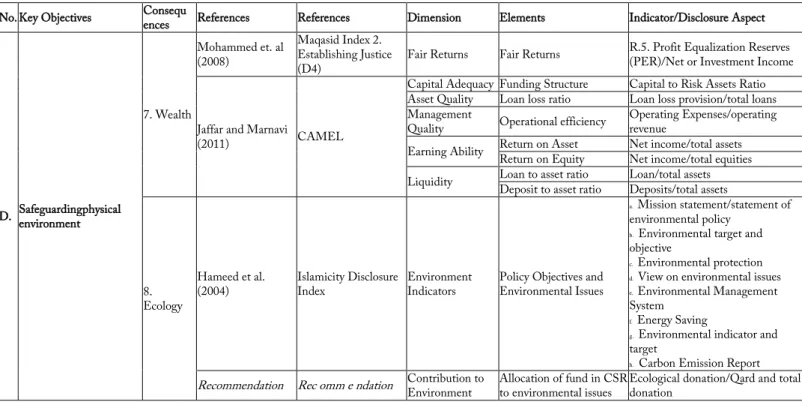
The last objective, safeguarding physical environment, covers 2 consequences: wealth and ecology. This dimension with their consequences, dimensions and elements are presented in Table 8.
Table 8: Index for Safeguarding the Physical Environment
No. Key Objectives Consequ
ences References References Dimension Elements Indicator/Disclosure Aspect
D. Safeguardingphysical environment 7. Wealth Mohammed et. al (2008) Maqasid Index 2. Establishing Justice (D4)
Fair Returns Fair Returns R.5. Profit Equalization Reserves
(PER)/Net or Investment Income
Jaffar and Marnavi
(2011) CAMEL
Capital Adequacy Funding Structure Capital to Risk Assets Ratio
Asset Quality Loan loss ratio Loan loss provision/total loans
Management
Quality Operational efficiency
Operating Expenses/operating revenue
Earning Ability Return on Asset Net income/total assets
Return on Equity Net income/total equities
Liquidity Loan to asset ratio Loan/total assets
Deposit to asset ratio Deposits/total assets
8. Ecology Hameed et al. (2004) Islamicity Disclosure Index Environment Indicators
Policy Objectives and Environmental Issues
a.Mission statement/statement of
environmental policy
b.Environmental target and
objective
c.Environmental protection
d.View on environmental issues
e.Environmental Management
System
f.Energy Saving
g.Environmental indicator and
target
h. Carbon Emission Report
Wealth consequence adopts CAMEL analysis as performed by Jaffar and Marnavi (2011). Furthermore, this consequence also covers PER ratio.
In accordance with the contradictions of PER implementation in Islamic banks in return smoothing, Antonio et al. (2012: 18) mentions PER as "one form of injustice because the savers rights to receive profits have been cancelled or postponed". The higher ratio means the higher degree of fairness in profit distribution. Mohammed et al. (2008) and Antonio et al. (2012) include this ratio in their frameworks; however, none performed the calculation due to the data availability.
Ecology adopts Hameed et al.'s (2004) framework. To improve the
indicator for this objective, this study recommends assessing the commitment in environmental issues by calculating the donation for the environment over the total donation.
In sum, a total of 25 dimensions, 32 elements and 112 indicators within the framework will be evaluated.
2.3. Constructing the Data Set
This study utilizes the information disclosure in annual reports of Islamic banks over 5 years period: 2008 - 2012. The sample selection is determined by the annual reports availability in banks' websites and with preference of well-established bank in each country. 13 Islamic banks from 6 countries are chosen, which is motivated by the fact to eliminate the different legal regimes determination. In other words, different regions are considered to be included in the sample. The sampled banks and the respective countries are depicted in Table 9.Two Islamic banks from each country are selected, except for Malaysia considering its large market share.
Table 9: Sample Selection
No. Country Islamic Bank 1 Malaysia
Bank Islam Malaysia Berhad RHB Islamic Bank Berhad Hong Leong Islamic Bank 2 Indonesia Bank Muamalat Indonesia
Bank Syariah Mandiri 3 Pakistan Meezan Bank
Bank Al Falah
4 Turkey alBaraka Turk
Bank Asya 5 Qatar Qatar Islamic Bank
Qatar International Islamic Bank 6 UK Islamic Bank of Britain
2.4. Estimation Method
In operationalising the research and hence conducting the estimations, the following procedure followed:
Firstly, the arithmetic mean of each indicator is calculated. For the quantitative ratios, the average of 5-year period is calculated. Furthermore, to quantify the qualitative disclosure indicators, the scoring approach is derived from Haniffa and Hudaib's (2007) study. One score is given for the disclosure of the required information and zero is given when there is no disclosure. Otherwise, no penalty is given if the indicator is irrelevant.
Considering the relations between the dimensions, elements and indicators, we use the Simple Additive Weighting (SAW) concept from the Multiple Attribute Decision Making (MADM) method (Yoon and Hwang, 1995: 32) to get the dimension score, as explained below:
1 ( ) ( ), 1,..., n i i j j ij j V A V w v x i m
V(Ai) in this study refers to the dimension score, while wj and vj ( xi j) are
the weight and value function of elements attribute, respectively. Nevertheless, we assume that the weights are equally proportioned.
According to Bedoui's simulation (2012), the weights for the dimensions are defined since each dimension is interrelated with others. Therefore, weights were assigned to define the correlation amongst the dimensions according to the literatures, which are depicted in Table 10. The results are the scores for each consequence.
Table 10: Weight Allocation of the Dimensions
No . Key Objectives Consequenc es Dimension 1. Faith 2. Human rights 3. Self 4. Intellect 5.Posterity 6.Social
entity 7.Wealth 8.Ecology
A.
Safeguardin g the value of human life
1. Faith
Cheap product and services (% of PLS Financing Mode)
30% 30% 40%
Elimination of negative elements that breed injustices
30% 30% 40% Underlying Philoshopy and Values 50% 30% 20% Interest-free and Islamically Acceptable Deals - Product Aspects 100% 2. Rights & Stakeholdin g Interest-free and Islamically Acceptable Deals -Employee Aspects 50% 50% Corporate Governance 100%
Indicator (Fairness and Transparency) - BOD aspects Corporate Governance Indicator (Fairness and Transparency) - Committees aspects 100% Corporate Governance Indicator (Fairness and Transparency) - SSB aspects 100% Corporate Governance Indicator (Fairness and Transparency) - Other aspects 100% B. Safeguardin g the Human self
3. Self Investment in vital
real sector 50% 50%
4. Intellect
Advancement of
Knowledge 50% 50%
Installing new skills
and improvement 50% 50% Creating Awareness of Islamic Banking 50% 50% C. Safeguardin g the society 5. Posterity Islamic Quantitative Index - Equitable Distribution Ratios 12.5% 12.5% 25% 25% 12.5% 12.5% 6. Social entity Redistribution of
income & wealth 15% 10% 10% 10% 10% 25% 15% 5% Developmental and Social Goals 15% 10% 10% 10% 10% 25% 15% 5% Social/Environmen t Indicator (Social Objectives) 15% 15% 15% 55% D. Safeguardin g physical environment 7. Wealth Fair Returns 100% Capital Adequacy 100% Asset Quality 100% Management Quality 100% Earning Ability 100% Liquidity 100% 8. Ecology Social/Environmen t Indicator (Environmental Objectives) 30% 70% Contribution to Environment 30% 70%
In the estimation and scoring, if the perfect score is attributed for each indicator, all of the consequence will be 100%. Nevertheless, the overall performance score will be 282.84%. The overall performance scored 75% does not mean it performs 75 from 100 points, but it rather measures the achievement compared to the others. The higher score is literally the better performance. However, achieving the perfect score is unlikely, as the framework constitutes the financial ratios, which could be translated into several interpretations. Rather than implementing a scoring performance for
financial matter, this study takes the ratio as it is and does not assign a scoring approach by implementing some benchmarks.
Bedoui (2012) sets the scoring performance to evaluate the bank achievement in each consequence. Nevertheless, since there is no benchmark to measure the appropriate financial performance, we use the original data instead and then evaluate the performance for each consequence.
Finally, we perform the calculation of general maqasid performance by using Bedoui's formula. The general performance for 8 corollaries is calculated with equally balanced formula. In addition, to analyse the overall industry orientation, we use the sum vector as suggested by Bedoui (2012).
3. Measuring Maqasid Performance of Islamic Banks: Empirical Evidence In this chapter, the evaluation results for each bank as well as industry and country level results are presented. In doing so, the performance results are interpreted according to the rank of the bank and in comparison to other banks within the country, followed by the industry performance. Eventually the overall industry performance from all six countries is discussed and the industry orientation is estimated.
3.1. Bank-Level Findings
As can be seen from the results presented in Table 11, Indonesian IBs have the best performance, which is followed by Malaysian Bank (BIMB) in the third position. The full-fledge IBs from the UK (IBB and EIIB) and QSC remain on the bottom list.
Table 11: Overall Maqasid Performance for Individual Islamic Bank
Bank Rank Islamic Banks Country Maqasid
Performance
1 Bank Syariah Mandiri (BSM) Indonesia 59.41%
2 Bank Muamalat Indonesia (BMI) Indonesia 54.27% 3 Bank Islam Malaysia Berhad (BIMB) Malaysia 50.21%
4 Meezan Bank Pakistan 49.72%
5 Qatar Islamic Bank (QIB) Qatar 37.33%
6 Hong Leong Islamic Bank (HLIB) Malaysia 32.77%
7 Al Baraka Turk Turkey 29.58%
8 Bank Asya Turkey 29.11%
9 RHB Islamic Bank Malaysia 24.45%
10 Bank Al Falah Pakistan 22.19%
11 Islamic Bank of Britain (IBB) United Kingdom 14.45% 12 Qatar International Islamic Bank (QSC) Qatar 12.92% 13 European Islamic Investment Bank (EIIB) United Kingdom 7.01%
Table 12: Overall Maqasid Performance per Country
Country Rank Country Maqasid Performance
1 Indonesia 56.83% 2 Pakistan 34.67% 3 Malaysia 33.53% 4 Turkey 29.34% 5 Qatar 23.82% 6 United Kingdom 11.44%
For the country performance, as can be seen in Table 12, Indonesia scored the best maqasidal-Shari'ah performance result with 56.83%, followed, in order, by Pakistan, Malaysia, Turkey, Qatar and United Kingdom. Nevertheless, these scores indicate lack of accomplishment if compared with the perfect score of 282.84%.
3.2. Maqasid Al-Shari'ah Performance of Islamic Banks: Country Level
Analysis
As depicted by Table 13, Bank Syariah Mandiri (Indonesia) achieves the highest score in 5 objectives (namely faith, rights & stakeholding, self, intellect
and social entity). While Qatar Islamic Bank predominantly attains highest
performance in posterity, Pakistani Bank (Meezan Bank) is superior to other Islamic banks in ecology disclosure.
Table 13: Maqasid al-Shari'ah Performance
Maqasid al-Sharia
INDONESIA PAKISTAN MALAYSIA TURKEY QATAR UNITED
KINGDOM 1 2 1 2 1 2 3 1 2 1 2 1 2 Bank Syariah Mandiri Bank Muamalat Meezan Bank Bank Al Falah BIMB Hong Leong Islamic Bank RHB Islamic Bank Al Baraka Turk Bank
Asya QIB QSC IBB EIIB
1. Faith 72.92% 72.49% 68.98% 39.92% 64.22% 45.34% 46.53% 29.90% 29.97% 52.72% 35.63% 57.72% 36.77% 2. Rights & Stakeholding 64.91% 61.36% 47.14% 36.88% 59.00% 52.84% 60.37% 45.22% 45.93% 44.03% 24.89% 35.63% 51.23% 3. Self 76.08% 74.19% 70.75% 65.22% 65.78% 59.31% 38.53% 65.81% 66.19% 58.41% 38.54% 35.50% 3.54% 4. Intellect 22.67% 21.99% 20.12% 11.50% 20.41% 14.14% 11.42% 16.76% 18.03% 21.07% 10.23% 6.68% 5.06% 5. Posterity 22.44% 24.42% 18.45% 10.02% 19.04% 11.59% 5.33% 9.45% 8.65% 28.32% 20.40% -9.80% -14.48% 6. Social entity 42.91% 41.08% 40.66% 27.32% 39.22% 33.16% 18.27% 33.47% 33.38% 38.08% 19.65% 12.88% 3.21% 7. Wealth 42.10% 41.18% 40.73% 38.99% 39.12% 32.00% 40.68% 41.07% 40.15% 34.10% 31.34% 69.24% 78.20% 8. Ecology 18.52% 13.07% 29.86% 2.46% 24.39% 16.68% 5.05% 15.31% 11.97% 16.84% 2.82% -1.36% -2.00% Maqasid Performance 59.41% 54.27% 49.72% 22.19% 50.21% 32.77% 24.45% 29.58% 29.11% 37.33% 12.92% 14.45% 7.01% Country Score 56.83% 34.67% 33.53% 29.34% 23.82% 11.44%
3.2.1. The Maqasid Performance of Indonesian IBs3
The analysis of the maqasid performance of IBs and countries are presented according to rank order (countries performance, followed by banks performance rank).
According to Figure 3, Bank Syariah Mandiri or BSM shows high performance in first three important objectives, while gaining the lowest performance in ecology.
Nevertheless, for the ecology disclosure, BSM reaches the second highest performance after Meezan Bank. The bank's overall performance is the best overall score in comparison to other sampled banks.
Figure 3: Bank Syariah Mandiri Maqasid Performance
According to the Table 14, in the first consequence, faith, BSM earns high score in implementing PLS financing mode; disclosing the non-halal
income (e.g. late instalment penalty and interest) and committing in Shah 'ah
principles.
From the overall performance in rights and stakeholding, BSM recognises their stakeholder's rights and maintain their interest by fulfilling their obligations in disclosing some GCG practices.
3 Due to limited space and length, this paper only provides detailed analysis of Indonesian Islamic banks so
that the methodology can be understood; for the rest of the sampled countries general results are presented.
1. Faith
Table 14: Maqasid al-Shari'ah Performance Performance of Bank Syariah Mandiri
No. Key
Objectives Consequences No. Dimension 2012 2011 2010 2009 2008
Average per Dimension A. Safeguarding the value of human life 1. Faith
1 Cheap product and
services 23.71% 27.50% 36.84% 41.06% 42.01% 34.22%
2
Elimination of negative elements that breed
injustices 99.97% 99.95% 99.95% 99.92% 99.91% 99.94% 3 Underlying Philoshopy and Values 75.00% 75.00% 75.00% 62.50% 62.50% 70.00% 4 Interest-free and Islamically Acceptable Deals - Product Aspects
83.33% 83.33% 83.33% 83.33% 83.33% 83.33% 2. Rights & Stakeholding 5 Interest-free and Islamically Acceptable Deals - Employee Aspects 100.00% 100.00% 66.67% 66.67% 66.67% 80.00% 6 Corporate Governance Indicator (Fairness and Transparency) - BOD
aspects
72.73% 72.73% 72.73% 63.64% 63.64% 69.09%
7
Corporate Governance Indicator (Fairness and
Transparency) - Committees aspects
83.33% 75.00% 83.33% 83.33% 83.33% 81.67%
8
Corporate Governance Indicator (Fairness and Transparency) - SSB
aspects
40.00% 40.00% 40.00% 20.00% 20.00% 32.00%
9
Corporate Governance Indicator (Fairness and Transparency) - Other aspects 85.71% 100.00% 100.00% 100.00% 100.00% 97.14% B. Safeguarding the Human self
3. Self 10 Investment in vital real
sector 100.00% 100.00% 100.00% 100.00% 100.00% 100.00%
4. Intellect
11 Advancement of
Knowledge 0.27% 0.38% 0.11% 0.06% 0.08% 0.18%
12 Installing new skills and
improvement 1.76% 2.44% 2.43% 3.68% 2.39% 2.54% 13 Creating Awareness of Islamic Banking 3.85% 4.68% 5.33% 4.05% 3.95% 4.37% C. Safeguarding the society 5. Posterity 14 Islamic Quantitative Index - Equitable Distribution Ratios 8.24% 6.88% 8.34% 7.18% 6.30% 7.39% 6. Social entity 15 Redistribution of income & wealth 0.67% 0.62% 0.72% 0.99% 0.00% 0.60% 16 Developmental and Social
Goals 85.71% 85.71% 80.95% 80.95% 76.19% 81.90% 17 Social Indicators 100.00% 100.00% 100.00% 100.00% 100.00% 100.00% D. Safeguarding physical environment 7. Wealth 18 Fair Returns 95.36% 81.04% 75.18% 74.82% 64.59% 78.20% 19 Capital Adequacy 13,82% 14.57% 10.60% 12.39% 12.66% 12.56% 20 Asset Quality 2.82% 2.42% 3.52% 4.84% 5.66% 3.85% 21 Management Quality 73.00% 76.44% 74.97% 73.76% 78.71% 75.38% 22 Earning Ability 13.65% 13.10% 32.90% 23.22% 24.02% 21.38% 23 Liquidity 45.68% 46.12% 46.58% 45.91% 45.03% 45.87% 8. Ecology 24 Environment Indicators 37.50% 25.00% 50.00% 50.00% 12.50% 35.00% 25 Contribution to Environment 3.14% 0.42% 0.27% 0.01% 0.00% 0.77%