FULL-LENGTH ARTICLE
A hybrid filtering approach for storage
optimization in main-memory cloud database
Ghada M. Afify
a,*, Ali El Bastawissy
b, Osman M. Hegazy
a aDepartment of Information System, Faculty of Computers and Information, Cairo University, Egypt
bFaculty of Computer Science, MSA University, Cairo, Egypt
Received 24 December 2014; revised 16 June 2015; accepted 30 June 2015 Available online 21 August 2015
KEYWORDS Cloud computing; Cloud storage; Main-memory database; Hot/cold data; Cold data management
Abstract Enterprises and cloud service providers face dramatic increase in the amount of data stored in private and public clouds. Thus, data storage costs are growing hastily because they use only one single high-performance storage tier for storing all cloud data. There’s considerable potential to reduce cloud costs by classifying data into active (hot) and inactive (cold). In the main-memory databases research, recent works focus on approaches to identify hot/cold data. Most of these approaches track tuple accesses to identify hot/cold tuples. In contrast, we introduce a novel Hybrid Filtering Approach (HFA) that tracks both tuples and columns accesses in main-memory databases. Our objective is to enhance the performance in terms of three dimensions: storage space, query elapsed time and CPU time. In order to validate the effectiveness of our approach, we realized its concrete implementation on Hekaton, a SQL’s server memory-optimized engine using the well-known TPC-H benchmark. Experimental results show that the proposed HFA outperforms Hekaton approach in respect of all performance dimensions. In specific, HFA reduces the storage space by average of 44–96%, reduces the query elapsed time by average of 25–93% and reduces the CPU time by average of 31–97% compared to the traditional database approach.
Ó2015 Production and hosting by Elsevier B.V. on behalf of Faculty of Computers and Information,
1. Introduction
Main-memory database (MMDB) is a database management system that primarily relies on main-memory for computer data storage. It is contrasted with database management sys-tems which employ a disk storage mechanism. Main-memory databases are faster than disk-based databases since the inter-nal optimization algorithms are simpler and execute fewer CPU instructions. Accessing data in memory eliminates seek * Corresponding author.
Peer review under responsibility of Faculty of Computers and Information, Cairo University.
Production and hosting by Elsevier
Cairo University
Egyptian Informatics Journal
www.elsevier.com/locate/eijwww.sciencedirect.com
http://dx.doi.org/10.1016/j.eij.2015.06.007
1110-8665Ó2015 Production and hosting by Elsevier B.V. on behalf of Faculty of Computers and Information, Cairo University.
Cairo University. This is an open access article under the CC BY-NC-ND license (http://creativecommons. org/licenses/by-nc-nd/4.0/).
time when querying the data, which provides faster and more predictable performance than disk[1].
Recent evolution in main-memory sizes has prompted huge increases in the prevalence of database systems that keep the entire database in memory. Nonetheless, main-memory is still a scarce resource and expensive compared to disk[2]. A major goal of recent research works is to improve main-memory stor-age optimization. The more free memory the larger systems to be stored in the database, which improves the performance and the cost efficiency. The objective is to separate the data into active (hot) and inactive (cold) data. The hot data will remain in main-memory and the cold ones will be moved to a cheaper cold store[3]. The main difference in the existing techniques is the level of granularity in which the data is accessed and classified as hot or cold; which in some databases is at the tuple-level and in others at page-level.
In the same context, cloud storage becomes more expensive because charges of ‘‘GB transferred”over the network vary with the amount of data transferred each month, conceivably with amazing and capricious variations. Moreover, extra hid-den fees, such as connecting fees, maintenance charges, and data access charges can add up quickly[4]. Therefore, the con-cept of multi-temperature cloud storage (hot, cold) was devel-oped to improve the economics of storing the enormous amounts of data. Frequently accessed (hot) data is available on fast, high performance storage, while inactive (cold) data is archived onto lower cost storage[5].
To the best of the author’s knowledge, this is the first initia-tive to propose a Hybrid Filtering Approach (HFA) that hor-izontally filters the database by hot tuples and then, vertically filters the database by defining hot attributes, in the aspect of storage optimization (reducing storage space) in main-memory cloud database. Moreover, we prove its efficiency compared to the traditional approach using standard benchmark.
The contributions of this paper can be summarized as follow:
1. Comprehensive analysis of existing main-memory data-bases that focus on hot/cold data management.
2. Introduce the proposed approach and explain it through a detailed case study.
3. Evaluate the effectiveness of the proposed approach using a standard benchmark.
The remaining of this paper is organized as follow. Section 2 surveys the recent related work. Section 3 introduces the proposed hybrid filtering approach. Section 4 presents a detailed case study to illustrate the workflow of the proposed approach. Section 5 reports the experimental evaluation of the proposed approach. Finally, Section 6 concludes the paper.
2. Related work
Recent development in hardware has led to rapidly dropping market prices of main-memory in the past years. This develop-ment made it economically feasible to use the main-memory as the primary data store of DBMS, which is the main character-istic of a main-memory DBMS. Recent research works focus on main-memory DBMS storage.
Commercial systems include Oracle’s Times Ten[6], IBM’s solidDB [7], and VoltDB [8]. On the other hand, research
systems are HYRISE [9], H-Store [10], HyPer [11] and MonetDB [12]. These systems are suitable for the databases that are smaller than the amount of the physical available memory. If memory is exceeded, then it will lead to perfor-mance problems. This problem of capacity limitation of main-memory DBMS has been addressed by a number of recent works.
SAP HANA[13]is a columnar in-memory DBMS suitable for both OLTP and Online Analytical Processing (OLAP) workloads. It offers an approach to handle data aging [14]. Hot data refers to columns that are loaded into main-memory and can be accessed by the DBMS. Cold data is not loaded into main memory but is stored in the disk-based persistence layer. It uses the Least Recently Used (LRU) technique to distinguish between hot and cold data.
Oracle Database 12c In-Memory Option [15]is based on dual-format data store, suitable for use by response-time crit-ical OLTP applications as well as analytcrit-ical applications for real-time decision-making. Oracle in-memory column store uses LRU technique to identify hot/cold data.
HyPer is a main-memory hybrid OLTP and OLAP system [11]. It has a compacting-based approach used to handle hot and cold data[16]. In this approach, the authors use the capa-bilities of modern server systems to track data accesses. The data stored in a columnar layout is partitioned horizontally and each partition is categorized by its access frequency. Data in the (rarely accessed) frozen category is still kept in memory but compressed and stored in huge pages to better uti-lize main memory. HyPer performs hot/cold data classification at the Virtual Machine (VM) page level.
In[17], authors proposed a simple and low-overhead tech-nique that enables main-memory database to efficiently migrate cold data to secondary storage by relying on the Operating System (OS)’s virtual memory paging mechanism. Hot pages are pinned in memory while, cold pages are moved out by the OS to cold storage.
In[18], the authors implemented hot and cold separation in the main-memory database H-Store. The authors call this approach ‘‘Anti-Caching” to underline that hot data is no longer cached in main-memory but cold data is evicted to sec-ondary storage. To trace accesses to tuples, tuples are stored in a LRU chain per table.
A comparable approach is presented in Hekaton [19], a SQL server’s memory-optimized OTLP engine that manages hot and cold tuples. In Hekaton, the primary copy of the data-base is entirely stored in main-memory. Hot tuples remain in main-memory while cold ones are moved to cold secondary storage[20].
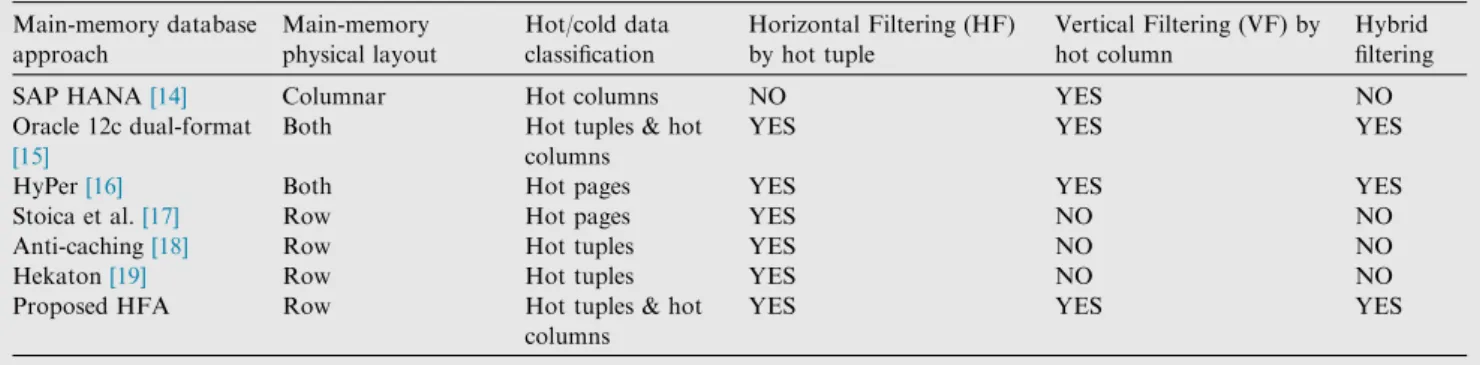
Table 1summarizes the comparison between hot/cold data management approaches in main-memory databases. We observe that SAP HANA [14]vertically filters the data in a columnar layout, which is a different context than the row lay-out employed in our HFA approach. Oracle 12c dual-format [15]stores the primary copy of the data on disk, and then uses the concept of hybrid filtering in its approach. However, it applies HF and VF on disk, and then moves these hot data into in-memory columnar store. In contrast, we apply hybrid filtering approach on data resident in main-memory. HyPer [16,17] perform cold/hot data classification at the VM page level, which is different from our scope. It is proved by [18] that it is best to make the classification at the same level of granularity that the data is accessed, which is at the
tuple-level. Compared to Anti-Caching[18], it uses the LRU technique to horizontally filter the database, while our approach uses the ‘‘datetime” key filtering method. Finally, Hekaton [19] is the work closest to our approach as it uses the same horizontal filtering methodology by hot tuples which is using the application pattern ‘‘datetime”key to split the data [21]. Therefore, we chose to build on their work and extend their architecture in order to implement our HFA.
Our novel Hybrid Filtering Approach (HFA) is based on a row store main-memory database. Our primary copy of data is entirely stored in main-memory. First, HFA horizontally fil-ters the data by hot tuples. Then, it vertically filfil-ters the data by hot columns.
3. Proposed hybrid filtering approach
Our proposed approach is composed of two phases as shown in Fig. 1. In the first phase, the offline analysis, we classify the hot and cold attributes. Hot attributes will remain in main memory and cold ones will be moved to a cheaper secondary storage. In the second phase, the online analysis, the system interacts with users. The user enters a query and receives a response to his query. In this paper, we focus on the offline analysis phase. Comprehensive details on the online analysis phase and query profiling process will be addressed in a sepa-rate publication.
Table 1 Hot/cold data management approaches in main-memory databases.
Main-memory database approach Main-memory physical layout Hot/cold data classification Horizontal Filtering (HF) by hot tuple Vertical Filtering (VF) by hot column Hybrid filtering
SAP HANA[14] Columnar Hot columns NO YES NO
Oracle 12c dual-format [15]
Both Hot tuples & hot columns
YES YES YES
HyPer[16] Both Hot pages YES YES YES
Stoica et al.[17] Row Hot pages YES NO NO
Anti-caching[18] Row Hot tuples YES NO NO
Hekaton[19] Row Hot tuples YES NO NO
Proposed HFA Row Hot tuples & hot
columns
YES YES YES
3.1. Phase1: offline analysis
The offline phase is composed of three modules. Periodically, we run the offline analysis to define the hot and cold attributes in the log files and update the hot/cold attributes list. The duration is predefined by the system administration according to one of two factors either by time (i.e. number of months) or by database workload (i.e. number of queries).
3.1.1. Horizontal filtering
Similar to recent research work, the primary copy of database resides in main-memory and is horizontally filtered at tuple-level of granularity to hot and cold tuples. The hot tuples will remain in main-memory and the cold ones will be migrated to a cold secondary storage. In HFA, we use a horizontal filtering approach that depends mainly on the application business logic. Thus, we use the filtering pattern ‘‘datetime”key to split the data to hot/cold tuples[21].
3.1.2. Frequent attributes identification
In this module, we developed a novel technique to identify the hot/cold attributes. We analyze the queries stored in the log files to compute the frequency of occurrence for each attribute. The hot (most frequent) attributes are identified as the attri-butes that appear more than or equal to a pre-specified thresh-old. The results are stored to hot-attributes list. On the other hand, the hot attribute will be cold if its frequency is less than
the pre-specified threshold. Cold attributes will be stored to cold-attributes list.
3.1.3. Vertical filtering
Vertical filtering of a table T splits it into two or more tables (sub-tables), each of which contains a subset of the attributes in T. Since many queries access only a small subset of the attri-butes in a table, vertical filtering can reduce the amount of data that needs to be scanned to answer the query. According to the hot-attributes list, the database in main-memory is vertically filtered at attribute-level of granularity to hot and cold attri-butes. The hot attributes will remain in main-memory, while the cold ones will be migrated to a cold secondary storage.
Table 2 Items table in main-memory.
Item_ID Brand Description Price Cost Size UPC Weight Taxable
11 Nabisco Cookies 2.25 1 20218 124,576 23.5 1 12 Morries Cigarettes 5 3 777 235,467 78 0 13 Kraft Cheese 6 4 6102 365,421 0.11 0 14 Kellog Cereal 1 0.5 999 875,465 15 1 15 Quaker Oatmeal 2.5 1 333 654,123 1.3 0 16 Nabisco Crackers 4 2 444 412,678 2.4 0 17 Brand Spagetti 0.99 0.5 222 127,896 3.4 0 18 Monte Candy 0.5 0.1 222 345,346 6.3 1 19 Hershy Candy 3.99 2 4135 112,367 50.2 0 20 Kleenex Tissues 2.99 1 2163 224,643 32 0
Table 3 (a) Hot tuples in main-memory (b) Cold tuples on disk.
Item_ID Brand Description Price Cost Size UPC Weight Taxable
(a) 11 Nabisco Cookies 2.25 1 20218 124,576 23.5 1 12 Morries Cigarettes 5 3 777 235,467 78 0 13 Kraft Cheese 6 4 6102 365,421 0.11 0 14 Kellog Cereal 1 0.5 999 875,465 15 1 15 Quaker Oatmeal 2.5 1 333 654,123 1.3 0 (b) 16 Nabisco Crackers 4 2 444 412,678 2.4 0 17 Brand Spagetti 0.99 0.5 222 127,896 3.4 0 18 Monte Candy 0.5 0.1 222 345,346 6.3 1 19 Hershy Candy 3.99 2 4135 112,367 50.2 0 20 Kleenex Tissues 2.99 1 2163 224,643 32 0
Table 4 Query log file.
Q_ID Table name Attributes
101 Items Item_ID, Brand, Description, Price
101 Customers Name, Phone
102 Customers Name, Phone
102 Items Item_ID, Brand, Description, Price
102 Employee Name, Phone
103 Items Item_ID, Brand, Description
103 Customers Name
104 Items Item_ID, Brand, Price, Cost
Algorithm 1: Query Execution Input: User QueryQ Output: Query ResultR 1.Begin
2.ifall attributes inQare cold attributesthen 3. Return a view ofRfrom cold storage 4. Increment attributes counters
5.else ifall attributes inQare hot attributesthen 6. Return a view ofRfrom hot storage 7.else
8. Return a view ofRfrom both hot and 9. cold storage
10.end if
11.foreach attribute in Q 12.ifcounter >= thresholdthen
13. Change cold attribute into hot attribute 14. Update hot and cold attributes lists 15.else
16. Change hot attribute into cold attribute 17. Update hot and cold attributes lists 18.end if
19.end for
20. ReturnRto User 21.End
3.2. Phase 2: online analysis
The online phase is composed of three modules.
1.Query parsing: This module receives the user query and
parses it to identify the requested tables and attributes.
2.Query storage:This module stores the user query into the
Log files.
3.Query execution: This module executes the query and
returns the results to the user. The algorithm of the query execution is demonstrated using pseudo code in Algorithm 1.
4. Case study
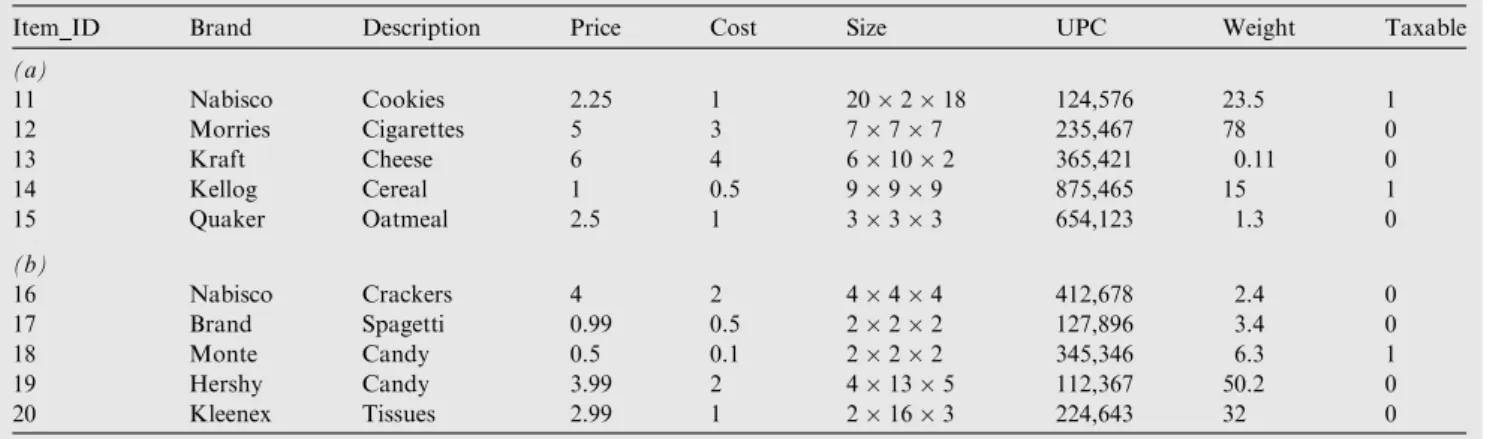
In this section, a detailed case study is presented in order to demonstrate the proposed HFA workflow.Table 2shows the Items table which consists of 9 attributes.
4.1. Phase1: offline analysis
1.Horizontal filtering: Items table is horizontally filtered to
hot tuples (remain in main-memory) and cold tuples (moved to disk) as shown inTable 3.
2.Frequent attributes identification: Identify hot/cold
attri-butes in the database, which involves two main steps.
Step 1:Scan the query log file shown inTable 4in order to
find the most frequent attributes in Items table.
Step 2:Employ a pre-specified attribute frequency
thresh-old (h) = 3 on the attribute-frequency table shown in Table 5. Thus, the hot-attributes list = [Item_ID, Brand, Description, Price] and the cold-attributes list = [Cost, Weight, Shape, Taxable, Size, UPC].
3.Vertical filtering: Hot tuples fromTable 3(a) are
verti-cally filtered by the hot-attributes list. Consequently, the data set for Items table in main-memory will have only hot attributes of hot tuples as shown inTable 6.
4.2. Phase 2: online analysis
Receive the user query and parse it to identify the requested tables and attributes.
Query 105:
SelectCost, Weight, Taxable
FromItems;
After parsing the query, it is noticed that it fits the first case as all query attributes are cold attributes (Cost, Weight, and Taxable) (Lines 2-4 in pseudo code). We increment these attri-butes’ counters, and then return a view of the query attributes from cold storage (disk) using the following T-SQL code sample.
First, we create a view called V1 CREATE VIEW V1
AS SELECT Cost, Weight, Taxable FROM dbo.Cold_Table;
GO
Second, we run the view to verify its contents SELECT * FROM V1;
GO
These attributes’ frequencies will be incremented such as (Cost = 3, Weight = 1, Taxable = 1). The Cost attribute fre-quency is equal to the threshold (Lines 11–14) then it’ll be added to hot-attributes list. Thus, the updated hot-attributes list = [Item_ID, Brand, Description, Price, Cost] and Cold-attributes list = [Weight, Shape, Taxable, Size, UPC]. Finally, the query is stored to the Log files.
5. Experimental evaluation of HFA approach
In order to systematically validate the effectiveness of our HFA approach, we have implemented it and the Hekaton Table 5 Attributes-frequency for Items table.
Attribute Frequency Item_ID 4 Brand 4 Description 3 Cost 2 Price 3 Weight 0 Shape 0 Taxable 0 Size 0 UPC 0
approach. In this section, we present details of the experiment setup, the workload, the experiment scenario, and finally the performance study is reported.
5.1. Experiment setup
Experiments run using the following resources:
Hardware platform:IntelÒCoreTMi7 CPU (@ 2.60 GHZ)
with 12 GB of RAM running on 64-bit Windows 8.1.
Software tools:Microsoft Server 2014 Enterprise Edition as
a software tool to build our in-memory database and tables and run the queries. In addition, we use client statistics tool to monitor and compare the performance of our queries. 5.2. Workload
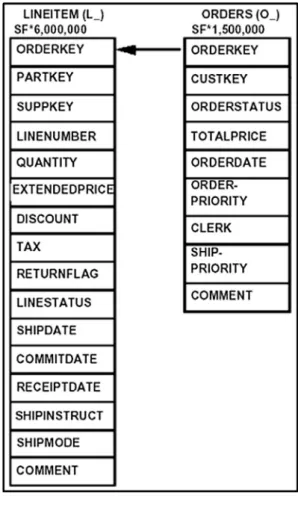
For all experiments, we use the well-known TPC-H[22] bench-mark, which has been used in reputable research works [11,13,15]. The workload consists of two tables LINEITEM and ORDERS. We populated the tables with data by the offi-cial TPC-H toolkit, with scale factor SF = 1. LINEITEM table has 6,001,215 rows and the ORDERS table has 1,500,000 rows. Fig. 2 shows the tables schema. The LINEITEM table consists of 16 columns and the ORDERS table consists of 9 columns.
5.3. Experiment scenario
We base all experiments on a variant of the following query:
Selecthotcol1, hotcol2. . .
Fromtable
Wherehotcoloperatorx;
The value ofxis any valid value according to the data type
ofhotcol. The objective of the predicate in thewhereclause is
to identify and retrieve the hot rows (e.g. OrderDate). The
select clause vertically filters the table by the hot columns.
The HFA workflow can be summarized as follow:
We create two memory-optimized tables (ORDERS and LINEITEM) and store them entirely in the main-memory.
We horizontally filter both tables by hot rows using differ-ent cases of hot rows: 25%, 50% and 75% of the original table.
We vertically filter each horizontal table by hot columns using four different cases of hot columns. For ORDERS table: 2, 4, 6 and 8 hot columns. For LINEITEM table: 3, 7, 11 and 15 hot columns.
5.4. Performance study
In this section, we experimentally evaluate the effectiveness of our HFA compared to Hekaton in terms of three performance dimensions: storage space, query elapsed time and CPU time. We have used different cases of hot rows 25–75% using step of 25 employing different cases of hot columns. In ORDERS table: HFA-2, HFA-4, HFA-6 and HFA-8 while in LINEITEM table: HFA-3, HFA-7, HFA-11 and HFA-15. 5.4.1. Storage space dimension
In this experiment, we investigate the storage space require-ments of the proposed HFA compared to Hekaton in main-memory database. As shown in Fig. 3, results show that the storage space of all approaches increase with increasing num-ber of hot rows. It is obvious that our HFA outperforms Hekaton in all cases of vertical filtering.
It can be noted that in Fig. 3(a), the best storage require-ment for Hekaton is worse than the worst storage requirerequire-ment for the proposed HFA approach using HFA-2 and HFA-4 hot columns. In Fig. 3(b), the best storage value for Hekaton is worse than the worst storage requirement for the proposed HFA approach using HFA-3 and HFA-7 hot columns.
As shown inFig. 4(a), results show that our HFA outper-forms Hekaton. The HFA approach has storage improvement on average 44–96% and Hekaton approach on average 25–
Figure 2 Tables schema.
Table 6 Vertical filtering of hot tuples in main-memory.
Item_ID Brand Description Price
11 Nabisco Cookies 2.25
12 Morries Cigarettes 5
13 Kraft Cheese 6
14 Kellog Cereal 1
76% compared to the original ORDERS table. In Fig. 4(b), the HFA approach has storage improvement on average 47– 94% and Hekaton approach on average 25–75% compared to the original LINEITEM table.
5.4.2. Query elapsed time dimension
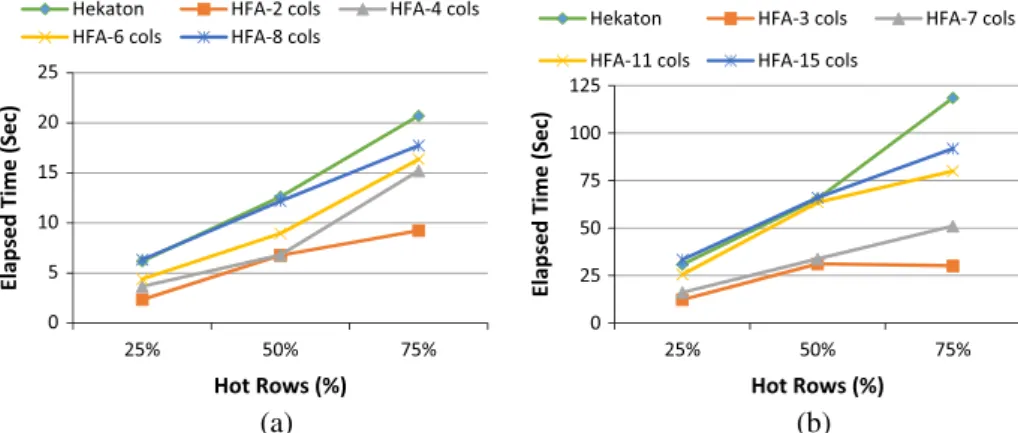
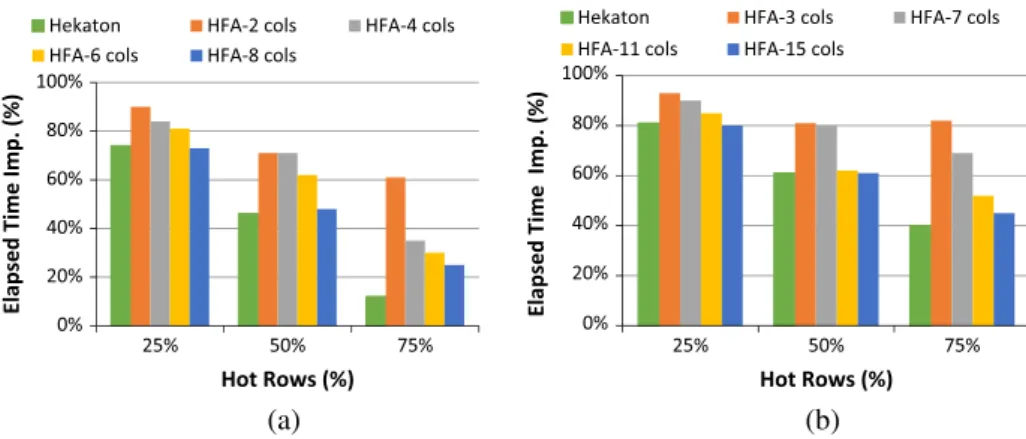
In this experiment, we investigate the query elapsed time of the proposed HFA compared to Hekaton in main-memory data-base. As shown inFig. 5, results show that the query elapsed time of all approaches increase with increasing number of hot rows. It is obvious that our HFA outperforms Hekaton in all cases of vertical filtering except in the case of HFA-8 hot columns in the case of hot rows less than 50%.
FromFig. 5(a), it can be noted that the best elapsed time value for Hekaton is worse than the best value for our pro-posed HFA approach using HFA-2, HFA-4 and HFA-6. In Fig. 5(b), the best elapsed time value for Hekaton is worse than the best value for our proposed HFA approach using HFA-3, HFA-7 and HFA-11 hot columns.
As shown inFig. 6(a), results show that our HFA outper-forms Hekaton. The HFA approach has elapsed time improve-ment on average 25–90% and Hekaton approach on average 12–74% compared to the original ORDERS table. InFig. 6 (b), the HFA approach has elapsed time improvement on aver-age 45–93% and Hekaton approach on averaver-age 40–81% com-pared to the original LINEITEM table.
(a)
(b)
0 50 100 150 200 250 300 Storage Space (MB) Hot Rows (%)Hekaton HFA-2 cols HFA-4 cols HFA-6 cols HFA-8 cols
0 250 500 750 1000 Storage Space (MB) Hot Rows (%)
Hekaton HFA-3 cols HFA-7 cols HFA-11 cols HFA-15 cols
25% 50% 75% 25% 50% 75%
Figure 3 Storage space requirements (a) for ORDERS table (b) for LINEITEM table.
(a) (b)
0 5 10 15 20 25Elapsed Time (Sec)
Hot Rows (%)
Hekaton HFA-2 cols HFA-4 cols HFA-6 cols HFA-8 cols
0 25 50 75 100 125 25% 50% 75% 25% 50% 75%
Elapsed Time (Sec)
Hot Rows (%)
Hekaton HFA-3 cols HFA-7 cols HFA-11 cols HFA-15 cols
Figure 5 Query elapsed time (a) for ORDERS table (b) for LINEITEM table.
(a)
(b)
0% 20% 40% 60% 80% 100% 120%Storage Space Imp. (%)
Hot Rows (%) Hekaton HFA-2 cols HFA-4 cols HFA-6 cols HFA-8 cols
0% 20% 40% 60% 80% 100%
Storage Space Imp. (%)
Hot Rows (%) Hekaton HFA-3 cols HFA-7 cols HFA-11 cols HFA-15 cols
25% 50% 75% 25% 50% 75%
5.4.3. CPU time dimension
In this experiment, we investigate the CPU time of the pro-posed HFA compared to Hekaton in main-memory database. As shown in Fig. 7, results show that the CPU time of all approaches increase with increasing number of hot rows. It is obvious that our HFA outperforms Hekaton in all cases of vertical filtering except in the case of HFA-15 hot columns in the case of hot rows less than 50%.
From Fig. 7(a), it can be noted that the best CPU time value for Hekaton is worse than the best value for our pro-posed HFA approach using HFA-2, HFA-4 and HFA-6. In
Fig. 7(b), the best CPU time value for Hekaton is worse than the best value for our proposed HFA approach using HFA-3, HFA-7 and HFA-11 hot columns.
As shown in Fig. 8(a), results show that our HFA out-performs Hekaton. The HFA approach has CPU time improvement on average 31–97% and Hekaton approach on average 12–62% compared to the original ORDERS table. In Fig. 8(b), the HFA approach has CPU time improvement on average 60–96% and Hekaton approach on average 41–83% compared to the original LINEITEM table. (a) (b) 0 0.5 1 1.5 2 2.5
CPU Time (Sec)
Hot Rows (%)
Hekaton HFA-2 cols HFA-4 cols HFA-6 cols HFA-8 cols
0 2.5 5 7.5 10 12.5 25% 50% 75% 25% 50% 75%
CPU Time (Sec)
Hot Rows (%)
Hekaton HFA-3 cols HFA-7 cols HFA-11 cols HFA-15 cols
Figure 7 CPU time (a) for ORDERS table (b) for LINEITEM table.
(a) (b) 0% 20% 40% 60% 80% 100% 120% CPU Time Imp. (%) Hot Rows (%) Hekaton HFA-2 cols HFA-4 cols HFA-6 cols HFA-8 cols
0% 20% 40% 60% 80% 100% 120% 25% 50% 75% 25% 50% 75% CPU Time Imp. (%) Hot Rows (%)
Hekaton HFA-3 cols HFA-7 cols HFA-11 cols HFA-15 cols
Figure 8 CPU time improvements (a) for ORDERS table (b) for LINEITEM table.
(a) (b) 0% 20% 40% 60% 80% 100%
Elapsed Time Imp. (%)
Hot Rows (%)
Hekaton HFA-2 cols HFA-4 cols HFA-6 cols HFA-8 cols
0% 20% 40% 60% 80% 100% 25% 50% 75% 25% 50% 75%
Elapsed Time Imp. (%)
Hot Rows (%)
Hekaton HFA-3 cols HFA-7 cols HFA-11 cols HFA-15 cols
6. Conclusion
Due to the budgetary challenges of storing vast amounts of data in the cloud, identifying hot/cold storage is emerging as a significant trend. To contribute to this research, we investi-gated the optimization of the storage space requirements with the aim of reducing the cost in main-memory cloud databases. We conducted a comprehensive analysis of existing main-memory databases that focus on hot/cold data management. We proposed a novel Hybrid Filtering Approach (HFA) that filters the tables in the main-memory both horizontally by rows and then vertically by columns. We demonstrated its workflow through a detailed case study. We evaluated the effectiveness of HFA using the standard TPC-H benchmark.
Experimental evaluation proved that the proposed HFA approach is superior to Hekaton in terms of all performance metrics in main-memory row store database. The proposed HFA reduces the storage space by average of 44–96%, reduces the query elapsed time by average of 25–93% and reduces the CPU time by average of 31–97% compared to the traditional database approach.
References
[1] Gupta M, Verma V, Verma M. In-memory database systems-a paradigm shift. arXiv preprint arXiv, vol. 6, no. 6; December 2013. [2]Arora I, Gupta A. Improving performance of cloud based transactional applications using in-memory data grid. Int J Comput Appl 2014;107(13).
[3] Boissier M. Optimizing main memory utilization of columnar in-memory databases using data eviction. VLDB PhD Workshop; 2014.
[4] Mark P. Buffington J, Keane M. Cloud storage: the next Frontier for tape. White paper of Enterprise Strategy Group, April 2013. [5] Song Y. Storing big data—the rise of the storage cloud. Advanced
Micro Devices, Inc., AMD; December 2012.
[6]Lahiri T, Neimat M, Folkman S. Oracle times ten: an in-memory database for enterprise applications. IEEE Data Eng Bull 2013;36(2):6–13.
[7]Lindstroem J, Raatikka V, Ruuth J, Soini P, Vakkila K. IBM solidDB: in-memory database optimized for extreme speed and availability. IEEE Data Eng Bull 2013;36(2):14–20.
[8]Stonebraker M, Weisberg A. The VoltDB main memory DBMS. IEEE Data Eng Bull 2013;36(2):21–7.
[9]Grund M, Kruger J, Plattner H, Zeier A, Cudre-Mauroux P, Madden S. HYRISE – a main memory hybrid storage engine. Proc VLDB Endow 2012;4(2):105–16.
[10]Kallman R, Kimura H, Natkins J, Pavlo A, Rasin A, Zdonik S, et al. H-Store: a high-performance, distributed main memory transaction processing system. Proc VLDB Endow 2008;1(2):1496–9. [11] Kemper A, Neumann T. HyPer: A hybrid OLTP&OLAP main
memory database system based on virtual memory snapshots. 27th International Conference on Data Engineering (ICDE), IEEE; 2011. p. 195–206.
[12]Boncz P, Zukowski M, Nes N. MonetDB/X100: hyper-pipelining query execution. CIDR 2005;5:225–37.
[13]Fa¨rber F, Cha SK, Primsch J, Bornho¨vd C, Sigg S, Lehner W. SAP HANA database – data management for modern business applications. ACM Sigmod Record 2011;40(4):45–51.
[14] Archer S. Data-aging strategies for SAP NetWeaver BW focusing on BW’s new NLS offering for Sybase IQ. SAP BW Product Management; 2013.
[15] Colgan M, Kamp J, Lee S. Oracle database in-memory. Oracle White Paper; 2014.
[16]Funke F, Kemper A, Neumann T. Compacting transactional data in Hybrid OLTP & OLAP databases. Proc VLDB Endow 2012;5(11):1424–35.
[17] Stoica R, Ailamaki A. Enabling efficient OS paging for main-memory OLTP databases. In: Proceedings of the ninth interna-tional workshop on data management on new hardware, ACM; 2013.
[18]DeBrabant J, Pavlo A, Tu S, Stonebraker M, Zdonik S. Anti-caching: a new approach to database management system architecture. Proc VLDB Endow 2013;6(14):1942–53.
[19] Diaconu C, Freedman C, Ismert E, Larson P-A, Mittal P, Stonecipher R, et al. Hekaton: SQL server’s memory-optimized OLTP engine. In: Proceedings of the international conference on management of data, SIGMOD, ACM; 2013. p. 1243–54. [20] Delaney K. SQL server in-memory OLTP internals overview for
CTP2. SQL Server Technical Article; 2013.
[21] Weiner M, Levin A. In-memory OLTP – common workload patterns and migration considerations. SQL Server Technical Article; 2014.
[22] TPC BENCHMARKTMH Standard Specification Revision 2.17.1. Transaction processing performance council; 2014. Information available at <http://www.tpc.org/tpch/>.