Middlesex University Research Repository
An open access repository of
Middlesex University research
http://eprints.mdx.ac.uk
Sargisson, Caroline Jane (2019) Developing recruitment and retention processes for Nursing Programmes in Higher Education. DProf thesis, Middlesex University.
Final accepted version (with author’s formatting)
This version is available at:http://eprints.mdx.ac.uk/27967/
Copyright:
Middlesex University Research Repository makes the University’s research available electronically. Copyright and moral rights to this work are retained by the author and/or other copyright owners unless otherwise stated. The work is supplied on the understanding that any use for commercial gain is strictly forbidden. A copy may be downloaded for personal, non-commercial, research or study without prior permission and without charge.
Works, including theses and research projects, may not be reproduced in any format or medium, or extensive quotations taken from them, or their content changed in any way, without first obtaining permission in writing from the copyright holder(s). They may not be sold or exploited commercially in any format or medium without the prior written permission of the copyright holder(s).
Full bibliographic details must be given when referring to, or quoting from full items including the author’s name, the title of the work, publication details where relevant (place, publisher, date), pag-ination, and for theses or dissertations the awarding institution, the degree type awarded, and the date of the award.
If you believe that any material held in the repository infringes copyright law, please contact the Repository Team at Middlesex University via the following email address:
The item will be removed from the repository while any claim is being investigated.
Doctorate in Professional Studies
Developing Recruitment and Retention Processes for
Nursing Programmes in Higher Education
A project submitted to Middlesex University in partial fulfillment
of the requirements for the degree of Doctorate of Professional
Studies
School of Health and Education
Caroline Sargisson
9540646
DPS: 5360
i Acknowledgements
I would like to thank both my supervisors, Dr Barbara Workman, who supported and inspired me at the start of this doctoral journey. Dr Mehmet Dikerdem, for his encouragement and guidance at the end. He helped me to believe I could complete this project and so I did.
Professor Kay Caldwell has supported, inspired and guided me as both my consultant and manager. I thank her for all that she did and will miss working with her but wish her a long and happy retirement. I could not have completed this mammoth task without the unfailing support, back up and love from my partner, Tadhg, and I owe him more than I can say. Thank you.
I dedicate this completed work to my parents, Michael and Rosemary Sargisson, and also thank them so much for all their love and support and the pride they continue to show in my academic achievements.
A special mention has to go to my beloved nephew and niece, Edward and Florence who make the world a better place. They have both inspired me in different ways to carry on and finish this work. I suspect they don’t know just how much this has meant to me when I was struggling to complete this work, but maybe they do now.
ii Contents
Acknowledgements ... i
List of tables and charts ... viii
Abstract ... x
Glossary of Abbreviations ... xi
Chapter One: ... 12
Introduction ... 12
1:1 Current Role ... 13
1:2 Recruitment and Selection ... 13
1:3 The Recruitment Role ... 15
1:4 The London Problem ... 16
1: 5 Methodological approach ... 17
1:6 The relevance of this project ... 17
Conclusion ... 18
Chapter Two: Terms of reference, objectives, review of knowledge and information ... 19
Introduction ... 19
2:2 Why this project? ... 21
2:3 The current challenges of nursing recruitment ... 22
2:4 Aims of the Project ... 24
2:5 Professional Terms of Reference ... 24
2:6 Literature Review: the search process. ... 25
2:7 Key areas of interest ... 26
2:8 Recruitment and Selection ... 26
2:9 The London Position ... 30
2:10 The bigger picture ... 31
2:11 Partnership Working ... 32
iii
2:13 Transition from Further Education to Higher Education ... 33
2:14 The Successful Student ... 35
2:15 Early Preparation ... 36
2:16 Pre-admission preparation ... 37
2:17 The students who stay ... 37
2:18 Building Resilience ... 38 Conclusion ... 40 Chapter 3: Methodology ... 41 Introduction ... 41 3.1 Research Questions: ... 42 3:2 Project Overview ... 43
3.3 Framing the Problem ... 44
3.3 Student attrition, retention and achievement. ... 45
3.5 Predictors of attrition ... 47
3:7 Further education colleges ... 51
3:8 Student expectation ... 52
3:9 Resilience in nursing students ... 53
3.5 Why mixed methods? ... 55
3:11 Mixed methods research and the role of the researcher ... 56
3:12 Positionality ... 57
3:13 Starting the research ... 58
3:14 Insider researcher ... 59
3:15 Ontology and Epistemology ... 61
3:17 Data Collection ... 62
3:18 Mixed methods analysis... 64
3:19 Triangulation of methods... 66
3:20 Ensuring rigour ... 67
iv
3:22 Ethical approval... 68
Conclusion ... 70
Chapter 4: Project Activity ... 71
Introduction ... 71
4:1 Problem solving ... 71
4:2 Gathering data and evidence ... 72
4:3 The development of the project ... 73
4:4 Academic staff and Doctoral Candidate ... 74
4:5 Student Selection ... 75
4:6 Student selection processes ... 75
4:7 The challenge of attrition ... 76
4:8 Attrition and success ... 77
4:9 Classifying attrition ... 78
4:10 The start of the project. Pre-induction days ... 79
4:11 Pre-induction day process ... 81
4:12 One Thing ... 82
4:13 Student Voices ... 83
4:14 The Emerging Themes ... 85
4:15 Survey of September 2013 first year student nurses. ... 85
4:16 Survey of FE college tutors. ... 88
4:17 Working with the FE tutors ... 91
4:18 September 2012 profiling ... 94
4:19 Entry qualifications as a predictor of success ... 95
4:20 Hopes and Fears: ... 97
4:21 The contribution of the third year student nurses ... 98
4:22 The specific task for the students ... 99
Conclusion ... 102
v
Introduction ... 103
5:1 The Starting Point ... 104
5:2 Telling the story ... 106
5:3 Academic achievement equals success ... 107
5:4 The Completion and attrition rates for the three fields of nursing and midwifery from 2010 to 2013 ... 108
5:5 Definitions of attrition ... 108
5:6 Cohort completion rates for nursing and midwifery ... 109
5:7 Attrition levels as an indicator of success ... 111
5:8 September 2012 scoping exercise ... 112
5:9 September 2012, nursing cohort numbers ... 113
5:10 September 2012 attrition ... 113
5:11 Age of the students. September 2012 cohort ... 114
5:12 Age as a predictor of success ... 116
5:13 Entry qualifications and exit award ... 117
5:14 Reasons for attrition / leaving ... 118
5:15 Attrition in year one ... 119
5:16 Why did they leave? ... 119
5:17 Personal Circumstances ... 120
5:18 Academic Failure ... 121
5:19 Findings ... 123
5:20 Wrong Career Choice ... 123
5:21 Financial Reasons ... 127
5:22 Conduct / DBS Failure ... 128
5:23 Attrition: Other Reasons ... 128
5:24 Summary of findings ... 129
5:25 What helps them to stay? ... 130
vi
5:27 Student Voices ... 134
5:28 Pre-Induction day findings ... 135
5:29 Year three student nurse group exercise... 136
5:30 Further Education college liaison work... 138
5:31 Further Education staff liaison day ... 138
5:32 Interactive discussion with FE tutors ... 139
5:33 Responses to direct questions ... 139
5:34 Session review ... 143
5:35 Partnership working ... 143
5:36 Summary of findings ... 144
Conclusion ... 145
Chapter Six: Conclusions and Recommendations ... 147
Recommendation One: Attrition and Retention ... 149
Recommendation Two: Buddy support ... 152
Recommendation Three: Development of pre-induction information and activities ... 155
Recommendation Four: Partnership working with FE Colleges ... 158
Summary of Project Recommendations ... 159
Chapter 7: Reflexive account of personal learning and professional journey ... 164
Introduction ... 164
Reflective Practice ... 164
Where it began for me ... 165
The Doctoral Struggle ... 165
Conclusion ... 168
Bibliography and Reference List ... 169
List of Appendices ... 185
APPENDIX ONE ... 186
APPENDIX THREE ... 194
vii
APPENDIX FIVE ... 203
APPENDIX SIX ... 205
APPENDIX SEVEN... 208
viii List of tables and charts
Table Number Content Page number
Table 1 Application rates for September 2016 entry 4 Table 2:1 Comparison of applications received and rejections.
2014 – 16 cohorts
10 Table 2:2 Drop in applications by age group since 2013 11 Table 2:3 Application numbers for September 2016 cohort 17 Table 2:4 Pie chart of entry qualifications: September 2013 adult
nursing field
27 Table 3:1 Comparative data showing attrition and pass rates for
nursing programmes from 2008 to 2011
34 Table 3:2 Applicants / acceptances for entry to nursing courses at
HEIs in the UK (2010 – 2014). UCAS data
36 Table 3:3 Age brackets of nursing cohorts; September 2015 entry 37 Table 3:4 Table of information and data collected 50 Table 4:1 Top ten applications to the nursing programme by college
and year (2014 – 2018)
78 Table 4:2 Pass / fail rates for nursing programme identified by
college
79 Table 4:3 Hopes and fears identified by students; September 2017 85 Table 5:1 Table of information and data collected 92 Table 5:2 Time line for project activity and analysis 93 Table 5:3 Cohort completion rates. September 2010 – 2013 cohorts 97 Table 5:4 Comparison of cohort attrition. September 2010 – 2013
cohorts
98 Table 5:5 Starter / finisher numbers September 2012 cohort 101 Table 5:6 Comparison of ages; September 2012 nursing cohort and
students in England
102 Table 5:7 Attrition rates compared with ages 104 Table 5:8 Attrition from September 2012 programme by field and
year
106 Table 5:9 Reasons given for attrition in year one; September 2012
cohort
108 Table 5.10 Number of students failing academically per field.
September 2012 cohort
109 Table 5.11 Profiles of students who failed more than module:
September 2012 cohort
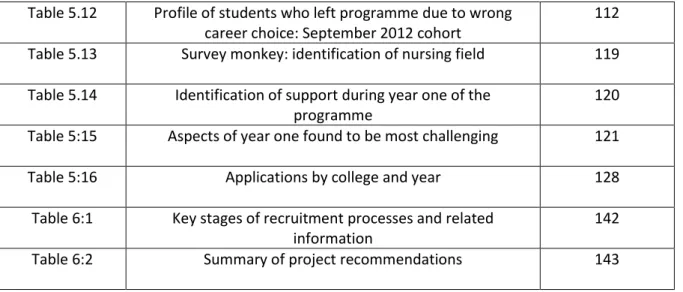
ix Table 5.12 Profile of students who left programme due to wrong
career choice: September 2012 cohort
112 Table 5.13 Survey monkey: identification of nursing field 119 Table 5.14 Identification of support during year one of the
programme
120 Table 5:15 Aspects of year one found to be most challenging 121 Table 5:16 Applications by college and year 128
Table 6:1 Key stages of recruitment processes and related information
142 Table 6:2 Summary of project recommendations 143
x Caroline Jane Sargisson
Abstract
Developing Recruitment and Retention Processes for Nursing Programmes in Higher
Education
The ability in Higher Education to attract competent student nurses and midwives and ensure they complete and pass their degree programme are constrained by the decrease in contracted numbers and the value for money pressures of the health commissioners. The nursing and midwifery contract is currently worth around £14 million annually to Middlesex University. As the current Head of Recruitment, my professional role is focused on ensuring I meet agreed institutional targets and recruit high calibre students who will successfully stay and graduate.
My Research Project Report explores and identifies both the levels of attrition from the nursing programme as well as the reasons for interruption and non-continuation. My findings are considered along with the identification of structures, relations and good practices of support that enables students to remain and progress. The recommendations from this project will impact on the delivery of a package of bespoke bridging activities to assist the transfer of students to their chosen nursing programme at this university. The findings will also inform and shape the support provided during the crucial first year.
Deploying a mixed methods approach, this Research Project Report shows how students from FE college and schools may be better prepared for both application processes and their study on nursing programmes by the use of a package of interactive and informative activities. This earlier and more targeted preparation as well as increased support during year one, will assist the students with their socialisation to both the university and the nursing profession.
xi Glossary of Abbreviations
APL Assessment of Prior Learning
CINAHL Cumulative Index to Nursing and Allied Health Literature DBS Disclosure and Barring Service
DipHE Diploma in Higher Education ERC Education Research Complete FE Further Education
HE Higher Education
HEE Health Education England
HEFCE Health education Funding Council for England HEI Higher Education Institution
LETB Local Education Training Board MHR Mental Health Research
MISIS Middlesex Integrated Student Information System NHSL NHS London
NIP Nursing for Initial Practice NMC Nursing and Midwifery Council
NTS Nurse Training System: database of all students on nursing and midwifery programmes at the university. Used to manage placement allocation and monitor attendance hours
OH Occupational Health
UCAS University and Colleges Admissions Services PHC Primary Health Care
12 Chapter One:
Introduction
The context for this project has emerged from my work as a nurse academic but primarily from my role as the Head of Recruitment for professional programmes. The role is large and complex as I am responsible for operationalising our recruitment and selection procedures and ensuring we recruit the required number of nurses and midwives each year.
This project is set against a background of significant change in pre-registration nurse education and wider healthcare provision in the UK. There has been a persistent decline in the number of applications received by universities for nursing programmes and an increase in the number of nurses retiring or leaving the profession. Figures from the Universities and College Admissions Service, (UCAS), released in 2018, report a decline of around 32% in applications received, a drop of 5,000 application compared with 2017, (UCAS, 2018).
The Royal College of Nursing carried out a survey in 2013 of workloads, pressures and decreasing staff levels across the NHS in the UK and discovered that there had been a decline in the number of student nurse training places from approximately 24,800 across the UK in 2010 / 11 to 21,380 in 2012/13, (RCN, 2013), and this has ultimately led to a further shortage of trained nurses in clinical practice. There has been increased focus on attrition from nursing programmes and a recent survey completed by the Nursing Standard in collaboration with the research charity, the Health Foundation, revealed that one in four nursing students in the UK ends up dropping out of their course. They identified that out of 16,544 students who started nursing courses in the UK in 2014, 4027 left their course early; an average attrition rate of 24%, ( https://rcni.com/nursing-standard/features/nursing-student-attrition-why-it-happens-and-how-to-stop-it-137071).
These developments mean that universities are under increased pressure to ensure that they attract and recruit the candidates who not only stay and complete the programme but will also become the qualified nurses of the future.
Using a mixed methods approach, this project will consider how applicants from further education colleges for nursing programmes may be better prepared for their studies. The work will explore the notion that earlier interventions through partnership working with the colleges will increase successful applications and reduce attrition from the programme.
13 1:1 Current Role
My current role as Head of Recruitment, (Professional Programmes), is focused on the recruitment of high calibre nursing & midwifery students for the BSc and PgDip programmes for the University. I remain a registered nurse and whilst I am no longer in clinical practice I continue to apply the relevant professional skills and knowledge as well as ensuring our recruitment and selection processes are evidence based, up to date and student focused. I also recognise the need for early engagement by the students with the University to assist with their preparation for studying on a higher education, professional programme and therefore, beginning the process of identifying themselves as one of ‘our’ students.
The changing nature and responsibilities of my role has led to the increased use of informatics to assist with decision making and monitoring of recruitment figures. This has furthered my interest in understanding the decisions made by students as well as developing my ability to find out more about our students; where do they come from, why are some of them successful and why do some of them not succeed.
This project will also consider whether is it possible to decrease the levels of attrition through better preparation for the demands of studying on professional programmes, when should that work begin and what should be included.
1:2 Recruitment and Selection
The Willis Commission, (2012), completed an independent inquiry into nurse education and identified the need for a graduate nursing work force who were well educated and able to take the lead in delivering excellent healthcare. Universities are tasked with selecting candidates for nursing programmes who demonstrate academic ability, caring and competence and motivation to pursue their chosen career.
All admissions tutors across all University programmes are searching for the gold standard of recruitment and selection processes to identify and select the most suitable candidates. For non-professional programmes it may be the application of the UCAS tariff, the combination of subjects studied to gain entry or the relevant work experience gained. For professional programmes such as nursing or midwifery, there are further processes included and the use of these and their relevance will be explained in more detail in later chapters.
Any or all of these approaches are applied to help find the potential students that will complete and pass their programmes without causing any problems to their academic colleagues or clinical mentors
14 and then achieve a high classification in their degree. The temptation can be to add more and more processes and checks for the candidate to complete or to make the entry tariff higher. The assumption is that the more academic the candidate, the more likely they are to succeed and the better the nurse or midwife they will be once they have completed and qualified. Some Universities will only shortlist candidates if they have clinical experience in a hospital setting; they may only be required to have two week’s experience but this is often difficult to acquire as they will need to find a place and have DBS clearance and busy clinical staff often do not have the time to spend with a volunteer who is not there for long.
As providers of nurse education we have a responsibility to our partnership trusts to ensure that quality assurance standards are met and we are seeking and recruiting high calibre recruits for our programmes. Successful recruitment to nursing and midwifery programmes is more complex and lengthy than the ‘normal’ processes required for other University programmes and students require help and support with these to ensure that they are fully informed of what is required. It is not simply a question of submitting a UCAS form and being made an offer. The Nursing and Midwifery Council set out clear expectations in regard to literacy and numeracy standards, assessing potential in caring and compassion as well as stating that all candidates must have a face to face interview, (NMC, 2010). All our short-listed candidates are invited for maths & English testing and, if successful, they then proceed to interview with a member of the academic staff, a clinician from our partnership Trusts and a service user. The use of these ‘extra’ processes does ensure we have the opportunity to engage with our successful candidates and begin to build a relationship before they start on the programme, but it adds to the stress for the candidates as they are required to complete these processes for all their five UCAS choices. The recruitment of nurses and midwives in London is fiercely competitive as all nine HEIs are seeking to attract the best candidates.
UCAS reported in 2010 that nursing was the most popular of all the undergraduate courses and they had received a total of 194,000 applications, seven applications for every one place, (UCAS 2013). In London, the nursing and midwifery programmes remain popular with applicants and often over-subscribed but programmes still end up with shortfalls due to a lack of suitable candidates. There were 7,353 applications received for our 449 nursing and midwifery places in the 2015 / 2016 cycle. Whilst this is a high number of applications it is still a struggle to fill the places without at least one of our nursing programmes entering into Clearing as they have not fully recruited. The table below shows the applications received and how many offers are required to fill the contracted places. There remains a discrepancy between the calibre of applicants for the different programmes: BSc mental health nursing received 1044 applications for 49 places but had only filled 30 places by July 2016 so
15 had to go into Clearing. However, the BSc midwifery programme received 1192 applications for 59 places and was full and closed by May 2016.
Application Rates for September 2016 entry Table: 1
Programme Qualification Commissions Total Applications Received
Offers made Offers accepted
Starter numbers
Adult Nursing BSc 176 2788 359 233 186
Adult Nursing PgDip 30 580 67 37 32
Mental Health Nursing BSc 49 1044 98 65 62
Mental Health Nursing PgDip 45 501 73 55 44
Children's Nursing BSc 70 982 141 91 71
Midwifery, Long BSc 59 1192 168 116 70
Midwifery, short BSc 20 205 37 29 21
European Adult Nursing BSc inc in BSc Ad 61 10 3 3
449 7353 953 629 489
Data retrieved from university reporting systems
In my working life as a nursing academic and Head of Recruitment, I am required to regularly deal with students and candidates who have either failed to achieve entry to the programme or been unsuccessful during their training, either in theory and practice, or both. This causes distress and upset at a personal level for the student as it can mean that they had to confront the reality that they were not going to be a nurse and often they have been working towards this for many years. On a wider scale, this is the loss of another potential nurse to the health service. Because of the uniqueness of recruitment role I currently hold, I have developed my own expertise through the development of analytical and critical review skills and I use these to provide me with the specific evidence to feed into and update our recruitment and selection policies and procedures. This approach will be explored in more detail in the following chapters and the significance to the work of this project analysed further.
1:3 The Recruitment Role
From my own personal perspective, the recruitment role can be isolating at times, as there is no network of staff in similar roles in London to meet up with and discuss common ground despite the fact we are all dealing with the same challenges. The HEIs are all competing to attract the best students and we are all using different approaches to ensure we fill our places but we are also recruiting from the same pot of applicants and there is fierce competition amongst us to attract and secure the best candidates. We are reluctant to share what works and what does not and we do not have a forum to facilitate this.
16 There is no agreed Pan-London approach to attracting, recruiting and retaining student nurses and there are no discussions with colleagues from the other London Universities sharing best practice or even more importantly, speaking up when there are problems such as predicted under recruitment or high levels of attrition. However, I have come to realise that sharing the findings from this project may be a way that the London HEIs may start to consider some common ground and work more closely in addressing some of the key issues we all face. It is planned that the findings from the completed project may be shared in some way across London so we may consider shared ways to help with the preparation of our students and increase the number who will stay and work in our London Trusts, once qualified.
1:4 The London Problem
Recruiting student nurses and midwives in London is particularly challenging with the added issues of longer journeys to placements, often on public transport and increased housing and living costs. Universities have to be very clear about what it is that they are offering to make them more attractive to potential applicants; not just at the application stage but also when candidates are choosing between several offers. A high level of preparation for the programme and support throughout, both academic and clinical, are key aspects that may be attractive to future students as they select their University. Students and their families also use information such as UniStats and the National Student Survey to help them make their decision when choosing a programme or university. Completion rates and levels of attrition as well as student feedback contribute to these results so increased completion and decreased attrition will improve the standing of the programme and the University.
Health Education England have recognised the specific problems facing qualified nurses in London as more than 30% of newly qualified nurses leave the capital within five years and this is on top of a vacancy rate of 17% ( https://www.rcn.org.uk/news-and-events/news/london-safe-staffing-review-of-2015). A focused response to this has been launched in 2017: the Capital Nurse programme has been created and developed by Caroline Alexander, NHS England’s chief nurse for London and Health Education England’s Dean of healthcare for north, central and east London, Dr. Chris Caldwell. It has been established to ensure that all newly qualified nurses in London will be guaranteed a job when they qualify to improve recruitment and retention across London and there are also plans to work with other organisations to reduce costs associated with housing and transport. This is a positive and supportive step that goes some way in recognising the problems faced and it also demonstrates collaborative working amongst competing Trusts who are again looking to recruit from the one pool of applicants.
17 1: 5 Methodological approach
The work undertaken for this project recognises the importance of understanding meanings, contexts and processes related to the transition of students from FE to HE. The research methods will incorporate both qualitative and quantitative approaches and use a mixed methods approach to compare the findings to produce the final outcomes and recommendations.
1:6 The relevance of this project
The work undertaken for this project will look at not just the reasons for students leaving the programme but also recognise what support and preparation helps them to stay and complete and qualify as a nurse. The review of literature as well as my own data gathering will focus on identifying if there are any clear predictors of either. Castles, (2004), stated that academic staff are constantly surprised not just by the misfortunes suffered by their students but also by their determination to stay and complete their studies. This is a significant insight because it shows that most students do want to complete and qualify and it may be that with increased and targeted support or a better understanding of the challenges the students face, may help increase the numbers who achieve this. The clear and ongoing remit for me in my recruitment role is to attract and recruit the best candidates for the professional programmes; but unlike my colleagues working as admission tutors in other areas, I also have to ensure that my candidates have the required skills and attributes to ensure that they will not just be academically able but also be safe and competent nurses at the end of three years and employable by our partnership Trusts.
The completed project will produce recommendations carried out and one of these outcomes is primarily looking at how we can better prepare our students for the rigours of a professional programme. This has come from looking at specific reasons for attrition in year one and related these to the student profiles to see if we can identify those students who may require more support and how we could provide this. However, it is also hoped that this work will also show our future students that we are keen to support and work with them at the earliest opportunity.
There has been considerable work already completed in the field of attrition from nursing programmes, which considers how we may predict student success or failure. This project does call upon the outcomes from this body of work to support the findings of this project. However, this work is not just about looking at who succeeds and who does not but how we may best support the successful transition into university study on a professional programme. This work is not looking for ways to exclude future students from applying to study but encouraging them to consider nursing as a career.
18 Conclusion
The importance of this project to my area of practice, is that it identifies and considers those factors that may assist students in their transition to studying on a higher education, professional programme and suggests a tailored approach to a programme of activities to address these challenges.
The work considers a more joined up and smooth transition for students from further education to higher education and by starting this preparation prior to the students joining the course, it is envisaged that this may reduce attrition and improve the individual student experience. This project will identify and describe specific approaches for the university to implement to support the applicants through the recruitment and selection processes as well as during their transition and first year of study.
19 Chapter Two: Terms of reference, objectives, review of knowledge and information
Introduction
This chapter will focus on providing the context and evidence to support the project work as well as the professional terms of reference. The literature selected will be critically analysed and discussed and different viewpoints compared and contrasted to show how they have contributed to the development of the project.
The work completed for this project relates specifically to my current role as Head of Recruitment for Professional Programmes and draws on my previous experience gained in nursing, academia and the recruitment of student nurses.
My interest and involvement in recruitment and selection developed further after I stood down as a Programme Leader for the Diploma in adult nursing. I was in this role for eight years and during that time had completed my MSc (Nursing). I had over 450 students a year from two intakes in March and September and I had overall responsibility for the day to day operational management of their diploma programme as well as monitoring progression, academic achievement and attendance. I have been involved in student nurse selection both as a ward sister and a nurse academic for around 20 years. My commitment and involvement increased as a Programme Leader at Middlesex University School of Health and Education, now part of the Faculty of Professional and Social Sciences, when I was regularly required to deal with students who were referred to me with many and varied challenges that affected their progression on the programme. These issues involved behaving unprofessionally in clinical practice, not submitting work or failing to engage with the programme. Dealing with these varied situations led me to consider if there were any identifiable factors at the point of selection that may have enabled earlier intervention and focused support to assist these students. These are still the questions that are asked of me today when students are struggling with the academic demands of the programme or not coping in clinical practice; is there any way to either identify the students who will struggle or those who will succeed? These questions have underpinned some of the work I have undertaken since taking on the role of Head of Recruitment. I know I need to be able to clearly demonstrate that our recruitment and selection processes are fit for purpose and that the students we select are ready to take on the challenge of studying and completing a higher education, professional programme.
The academic positioning and contributions of this project are in its closer and more detailed identification of the reasons why students stay and progress in the Nursing and Midwifery
20 programmes in a post-1992 university in London. This is the particular context which I addressed bringing out the mechanisms and good practices which identified support structures contributing to retention and graduation. The findings from this project recommend that the focus of analysis should shift from `attrition’ to the characteristics and practices of the students who stay and complete. These students are able to provide better and richer insights into how they successfully navigate the challenges of a professional programme. The information, insights and knowledge gained contributes to the preparatory induction materials for prospective students, along with the focused support provided during the transition to university and throughout the first year.
The mixed methods approach I have used has enabled me to reflect upon and include all aspects of the roles that I have to deliver in meeting recruitment targets, their induction into the programmes and enabling the successful completion of the programmes for the cohorts concerned. However, these units of investigation which roughly mirror my professional practice at the University also required me to apply my specific knowledge and experience from both my academic and nursing disciplinary backgrounds. This means that my professional practice is located at the intersection of Nursing Studies, practice-based learning pedagogies and HE management / administration. In short, my work has been avowedly transdisciplinary.
This project is based on the unique professional role I hold within the university, and allows the work to sit within the wider area of HE recruitment to university and ensuring successful transition to all programmes. The specific knowledge I have applied also includes professional knowledge gained about of attrition, retention and bridging. Consequently, my materials and the findings are applicable to nursing programmes, other programmes with a professional practice component and to university programmes in general.
2:1 The purpose of this project
The purpose of undertaking this particular doctoral study was to review current practice in recruitment and selection and then develop and produce approaches that would have a clear impact on the preparation of nursing candidates for their study on a professional programme. Nursing has been a graduate only profession since 2013; prior to this date nurses could either study for a diploma or degree and both qualifications would enable registration as a nurse. The degree programme is validated by both the university and the Nursing and Midwifery Council and managed in partnership with local Trusts who provide and supervise the clinical placements.
The nursing degree is intense and demanding for the students as they spend 50% of their time, (2,300 hours over three years), in clinical practice, working shifts in a variety of health care settings and are
21 often faced with difficult and demanding situations. The students are also required to gain their academic credits to achieve their degree so they also have assignments to complete and submit. 2:2 Why this project?
This project is reflective of some of the challenges I encounter in my recruitment role but also builds upon the interest I developed from my time as a programme leader. I have a genuine interest in the recruitment of students who will stay and complete their programme but also wanted to explore and implement other ways of improving their chances of doing this.
My original plan was to consider changing the approach we currently used for the screening of the applicants for their suitability during the selection stages; but adopting this strategy could lead to the loss of potential students as we are likely to be rejecting high numbers of applicants at an early stage in the process.
An easy way to screen or reject students at the shortlisting stage is to use fixed criteria such as health care work experience or only accepting those with specific A level subjects or grades. However, a review of the number of applications received by the nursing programmes at this university in 2015 and 2016 shows that there are already high levels of rejection across all the stages of the process. It should be noted that the candidates rejected by us may gain a place at another University so they are not lost to the profession. The table below shows the overall number of students ‘lost’ during the recruitment processes from shortlisting to testing / interviews or not achieving their offer conditions. The quandary for me in my role is how I decrease the high level of wastage at this stage without diluting the agreed processes. There is little point in increasing the numbers who are accepted if they are then unable to stay and complete the programme.
Table: 2:1
Comparison of applications received and rejections September 2014 - 16 Overall Number of
Applications Received
Overall Number Rejected Percentage
September 2014 Applications for Nursing and Midwifery
7,290
5,333
73%
September 2015 Applications for Nursing and Midwifery
22
September 2016 Applications for Nursing and Midwifery
7,113
4,209
59%
Source: University Reporting Systems (MISIS)
Nursing programmes attract and welcome applications from a diverse pool of applicants and my commitment to widening participation means that I look for ways to encourage and support candidates throughout the process rather than deter them. However, evidence accessed through literature searches and researching the approaches taken by other Universities shows that the majority of processes may appear to focus on ways of de-selecting or identifying ways of screening out candidates rather than supporting and encouraging through the application process.
2:3 The current challenges of nursing recruitment
It is well reported that nursing programmes are over-subscribed and it is often implied that universities are turning potential nurses away. However, UCAS have reported that applications to study nursing have fallen again in 2018; this is in part being attributed to the loss of the bursary. They report a fall of 13% in applications for this year and a drop of 700 fewer nurses starting their training in 2017, (https://www.ucas.com/file/147216/download?token=wuwe_zbe).
The table below shows the drop in applications since 2013 cycle by age group. The number of applications from 19 – 34 year olds fell by 22% last year and the same can be seen for the applicants aged over 35 years.
23 Table: 2:2
Source: UCAS 2017 cycle applicant figures – June deadline
However, the Government have stated that they have increased the number of places available to prospective students by 25% by removing the bursary and therefore, places available on nursing programmes are no longer restricted by NHS funding, (https://www.gov.uk/government/publications /nhs-bursary-reform/nhs-bursary-reform). What this means in practice is that universities previously could only recruit to the agreed number of places allocated to them by local commissioning bodies and any over or under recruitment could lead to financial penalties. The removal of the bursary places the funding of nursing programmes with the same student finance arrangements as other students; i.e. they are required to borrow money to cover the cost of university tuition and living costs and will only have to start to re-pay this loan once they are employed and earning over £25,000 per year., and will be required to pay back around £ 15.00 per month. (http://media.slc.co.uk/sfe/1819/sfe_terms_ and_conditions_guide_1819_o.pdf). Newly qualified nurses in London currently start on a salary of £24,963 p.a.
24 2:4 Aims of the Project
My overall aim for this project was:
“To consider how the development of recruitment and retention processes for professional programmes in Higher Education could contribute to the successful transition of students from FE to HE as well as their ability to stay and succeed”.
My objectives were as follows:
Review reasons for attrition in year one to identify possible predictors at selection stage Review current processes and the student experience of transition from FE to HE Critically review relevant and recent literature to identify good practice
Disseminate and embed the learning from the objectives above to contribute to an improvement in both acceptance rates and attrition rates.
2:5 Professional Terms of Reference
The Nursing and Midwifery Council (NMC) is the professional body in the UK for nurses and midwives and sets the standards for the recruitment of student nurses and midwives. They categorize the specific requirements under three main headings and selection processes must demonstrate that these are being met:
Academic criteria Good health Good character
(NMC, 2010)
We are also tasked by Health Education England to ensure that we apply a values based approach throughout our recruitment and selection policies and procedures. The NHS Constitution for England which sets out the rights for patients, public and staff was revisited in 2015 by the government and one area of focus was a clearer identification of the principles and values of the NHS.
The NHS values are:
Working together for patients Respect and dignity
25 Compassion Improving lives Everyone counts ( https://www.gov.uk/government/publications/the-nhs-constitution-for-england/the-nhs-constitution-for-england).
The challenge is to ensure we identify and select those students who not only have the skills and potential to succeed but also have the values and behaviours that align with the NHS Constitution. We also need to identify those candidates who may require extra support and not dissuade or reject those with potential and these complex recruitment challenges will be explored in more depth in later chapters.
2:6 Literature Review: the search process.
I started my literature review by accessing the following databases: CINAHL (Cumulative Index to Nursing and Allied Health Literature Medline
ERC (Education Research Complete)
These are the databases I am the most familiar with and they offer a breadth of literature concerning nursing, recruitment and attrition. Nursing literature can sometimes be limited to the art of science of nursing so I needed to ensure I included a database, (ERC), that covered the broader educational literature.
I commenced my search by using general terms to ensure I did not exclude any literature that may be relevant to the project... These were:
Nursing recruitment Attrition
Retention of students
My initial literature review showed me that the individual themes of my work were well covered by supporting evidence but only in the broadest sense and mainly related to attrition and retention.
26 I limited the time period to the previous ten years, 2007 – 2017, but many articles were discarded as they were reporting on programmes that no longer existed such as the diploma in nursing and their associated challenges. Nursing has been through a major change since the introduction of degree only programmes in 2013 and one of these changes was the increase in entry requirements as well as increased focus on the need to assess compassion and caring through a values based approach to recruitment. I was aware of the need for the supporting evidence for this work to acknowledge the recent history of the profession but mainly to provide the background to the current picture. A major area of evidence for this project comes from the data arising from individual students and programmes within my own university. Access to the university reporting systems meant I am able to find statistical data relating to attrition from nursing programmes and comparing this information with key documents exploring the specific challenges of recruiting and retaining nurses in London. 2:7 Key areas of interest
There is a great deal of related literature that considers the key areas of recruitment, retention and attrition. Several authors have also focused upon the ability to predict success through the application of various interview techniques as well as identifying the required values and behaviours of nursing students.
I was not challenged by a scarcity of supporting literature but I was in danger of being side tracked or lacking focus because there was so much evidence available. I ensured that I only researched the identified themes for this work and discarded research that was dated or not specifically relevant. As this is a professional Doctorate and concerned with the review of admissions and retention procedures there was a need to include other sources of evidence such as relevant policies as well as data from both within the university and external sources. The inclusion of this material ensures that the project and the findings is current and relevant.
2:8 Recruitment and Selection
The literature search for this project also focused on reviewing and assessing the varying approaches to nursing recruitment of the partner institutions, where possible. All admissions tutors across all programmes are searching for the gold standard of selection processes but are reluctanct to share their successful strategies as we are all competing in an ever-decreasing field.
The aim of all admissions procedures for any university programme is to identify and attract the students that will complete and pass their programme without causing any problems to their academic colleagues or clinical mentors and achieve a high classification in their degree. The Swartz
27 Review, (DfES 2004a:7), an independent review of the admissions in Higher Education, commissioned by the Government of the day, states that ‘the ability to complete the course must be an essential criterion for admission to any programme of study’.
One of the key drivers that identified the need to assess the care and compassion of future nursing students at the recruitment stage was the Francis Report, (2013). This was published following the failings at Mid Staffordshire Hospital NHS Foundation Trust and one of their main recommendations was an increased focus in nurse training on the essential components of delivering compassionate care. This priority led to further scrutiny of recruitment processes and the need to evidence the assessment of ‘appropriate values, attitudes and behaviours’ for both applicants to nurse training and qualified nurses.
Also, a further key report that is central to this work was the Willis Commission on Nursing Education, published in 2012, also in response to the Mid Staffordshire Enquiry. One of the findings identified that high quality recruitment campaigns should be focused on attracting potential nurses from a wide range of applicants, these should include graduates of other professions, health care assistants and mature people as well as school leavers.
These two reports have helped to form both my approach to the development of our recruitment and selection processes and provided the starting point for this project. They also suggest that our ideal student is the one all HEIs are looking to recruit. This student may be defined as one who is academically able, has identifiable caring and compassion skills, and will stay, complete and succeed on their professional programmes and gain a position with a partnership Trust as a qualified nurse or midwife. However, it must be acknowledged that students may not present themselves with these characteristics or maintain them throughout their studies due to changes in circumstances or dealing with the challenges of the programme. It is therefore important that academic staff and clinical staff establish supportive strategies to support and encourage student development. I recognised that this input needs to commence before the student starts on the programme so they can start to learn about what the challenges are likely to be and what is available to assist them to successfully progress. The temptation can be to add more and more processes and checks for the candidate to complete or to make the entry tariff high as the assumption is that the more academic the candidate, the more likely they are to succeed and the better the nurse they will be at the end. A review of entry requirements on UCAS, (www.ucas.com), of nursing programmes in London, completed by me for my recruitment role, showed the variation in approaches used by our close competitors; for example, universities will only shortlist candidates if they have clinical experience in a hospital setting. The
28 candidates may only be required to have two weeks experience but this is often difficult to acquire due to the sheer number of requests received by Trusts as well as ensuring compliance with governance procedures such as DBS clearance.
The recruitment of nurses and midwives in London is fiercely competitive as all nine HEIs who offer nursing programmes are seeking to attract and recruit the best candidates, often from the same pot. This means that each HEI needs to be seen to be responsive and supportive as well as showcasing what they can offer. Successful recruitment to nursing and midwifery programmes is more complex and lengthy than the ‘normal’ processes required for other University programmes, and students require help and support with these to ensure that they are fully informed of what is required throughout. It is not simply a question of submitting a UCAS form and being made an offer. The Nursing and Midwifery Council set out clear expectations in regards to literacy and numeracy standards, assessing potential in caring and compassion as well as stating that all candidates must have a face to face interview, (NMC, 2010). All our short-listed candidates are invited for maths and English testing and, if successful, they then proceed to interview with a member of the academic staff, a clinician from our partnership Trusts and a service user. The use of these ‘extra’ processes does ensure we have the opportunity to engage with our successful candidates and begin to build a relationship as well as screening out those who are not suitable, but it adds to the stress for the candidates as they are required to complete these processes for all their applications.
The nursing and midwifery programmes remain popular with applicants and over-subscribed throughout London. There were 7,353 applications received for our 449 nursing and midwifery places in the 2015 / 2016 cycle. Whilst this is a high number of applications it is still a struggle to fill the places without at least one nursing programme entering Clearing1, to fill empty places, so one of the drivers
for this project was to consider how the conversion rate from application to offer may be improved by a closer and more supportive relationship with our candidates. Analysis of the numbers at each of the stages of the selection processes has identified the key areas where candidates are lost and this has provided valuable data and structure to the project.
The table below shows the applications received and how many offers are required to fill the agreed places for each programme. There has always been a marked variance between the calibre and characteristics of applicants for the different programmes: for example, BSc mental health nursing received 1044 applications for 49 places but had only filled 30 places by July 2016, so had to go into
1Clearing is available to anyone who has made a UCAS application but does not hold any offers. Clearing matches
universities that need students to students that need a university. It takes place in August each year and starts on the day that the A level results are published.
29 Clearing. BSc midwifery received 1192 applications for 59 places and was full and closed by May 2016. These differences will be explored and analysed in more detail in later chapters as will the significance for this project. However, this table shows the volume of applications required to meet the agreed contracted numbers for each programme and how this may limit what we can offer to an individual student to help them prepare for the processes.
Table 2:3
Application Numbers for September 2016 Cohort
Programme Qualification **Commissions Total Applications received from UCAS for each programme
Offers made after tests and interview Offers accepted by the candidates Starter numbers at the beginning of the course Adult Nursing BSc 176 2788 359 233 189
Adult Nursing PgDip (shortened two year programme) 30 580 67 37 30 Mental Health Nursing BSc 49 1044 98 65 63 Mental Health Nursing PgDip (shortened two year programme) 45 501 73 55 44 Children's Nursing BSc 70 982 141 91 71 Midwifery, long BSc 59 1192 168 116 72 Midwifery, short BSc 20 205 37 29 21 European Adult Nursing BSc inc in BSc Ad 61 10 3 3 449 7353 953 629 471
** Nursing and midwifery programme numbers were previously set by local commissioning bodies not by the University
Data sourced from University systems; uploaded from UCA
This table is included as it shows the numbers of applications required to achieve the commissioned targets. Recruiting to targets may be considered to be something of a black art as the final reporting day is four weeks after the start of the programme when all university processes have been completed. These can include occupational health and DBS clearance as well as verification of final results or submission of references so even if would appear that targets have been met or even exceeded by day one of the programme, it may well be a different situation four weeks later.
30 The challenge of ensuring that the required numbers are achieved is one that requires a clear understanding of the implications of not doing so. Under recruitment to programmes will lead to a loss of income to the university that may affect the resources available as well as the potential loss of future trained nurses. Over recruitment is not desirable either as extra placements and mentors will need to be identified and too many students may mean that their overall experience is poor.
2:9 The London Position
Universities in England have invested considerably over recent years in targeted marketing and improved facilities to attract suitable candidates; this was in some part due to the Labour government’s (1997-2010), target of increasing participation in higher education to 50% by 2010. However, there has been more focus recently on the nursing and midwifery programmes by the universities, Trust partners and Health Education England (HEE), not just on recruitment numbers but also on the retention of students and their achievement rates. This has led to a closer scrutiny of the suitability of the candidates available for nursing and their preparation for study and likelihood of success and completion. We are tasked with selecting the candidates who will become the next generation of nurses for our partnership Trusts.
There have been increasing concerns, both locally and nationally, about the drop in the number of newly qualified nurses and the need for Trusts to recruit elsewhere and the costs associated with this as well as the increase in the use of agency staff. Trusts are unable to recruit the required numbers of suitably qualified permanent staff and have to rely on filling gaps with agency staff. In September 2015, Trusts were set individual expenditure ceilings for agency nursing staff but a report by the King’s Fund in March 2015, (http://www.kingsfund.org.uk/blog/2016/03/nhs-agency-staff-spend), stated that more than twenty Trusts had exceeded the cap for more than 100 shifts a week. It is estimated that London Trusts spend £14million a month on temporary and agency nursing staff as they simply do not have enough trained nurses to cover the shifts. It is an ongoing problem as many nurses prefer the flexibility that agency work offers them as they can choose where and when they work and Trusts struggle to replicate this degree of flexibility. Reliance on agency staff also means less capacity in a clinical area for the allocation of student nurses who require consistent support and mentorship from the same nurse(s). Clinical areas are audited by the University and the number of students to be allocated is agreed based on the number of trained, qualified mentors available.
The lack of suitable mentors available in a clinical area to support and teach students has a direct impact on the numbers that universities may recruit to the programmes. We can only allocate students to clinical areas where there are adequate numbers of staff to mentor, support and assess
31 the students. This is not simply a safety measure but experienced mentors are required to ensure that students are supported and guided in their learning to enable them to progress safely and acquire their professional and clinical knowledge.
2:10 The bigger picture
There is currently an international shortage of nurses as the projections for 21st century populations
show an ageing population and the birth rates decreasing, (Kukkonen et al, 2016). The average age of nurses is 41 – 45 years in the EU, (WHO, 2015), and by 2020 there will be an estimated shortage of 1,000,000 health professionals across the EU, (European Commission, 2012). The impact of BREXIT on the recruitment of both trained nurses and applicants to nursing programmes remains unclear but is likely to result in reduced numbers for both. There are also concerns that EU nationals currently working in the NHS will no longer be able to work unimpeded once the freedom of movement policy changes and many staff are expected to return to their own countries.
In 2014, there was a national shortfall of 5.9% (around 50,000 full time equivalents), between the number of staff required and the number in post; particularly in nursing, midwifery and health visiting, (National Audit Office, 2016). In recent years, Trusts have been going overseas to recruit qualified nurses and midwives in Ireland, Spain, Portugal and the Philippines but the market is tightening and the nursing shortage continues to grow. The financial cost of recruiting from abroad is high with some estimates claiming it costs £12,000 to recruit one nurse but there are also the moral and ethical issues of enticing nurses away from poorer countries who can ill afford to lose them.
In 2015, the nursing vacancy rate in London was 17%; an increase of 3% since 2014 and nine London NHS employers report vacancy rates of 20% or more. One solution is to train more nurses but this is not a quick fix as it takes three years to train a nurse and they will then require a period of preceptorship of three to six months, however a survey by HEE showed that more than 30% of newly qualified nurses had stopped working in the capital within five years.
The RCN published the London Safe Staffing Review in January 2016, ( https://www.rcn.org.uk/news-and-events/news/london-safe-staffing-review-of-2015). In this they reported that there were 10,000 nursing vacancies across the capital; twice those for the rest of the country, yet there were only 20,000 training places available across England. It was also reported that 57,000 applicants applied to train as a nurse in 2014 and 37,000 were turned away.
Nurses in London experience higher living and travel costs and there is a lack of affordable housing. The RCN report, Caring for the Capital, published in June 2015, noted that the average house is twice the price of the rest of the UK and childminding costs are 30% higher than elsewhere in the UK. They
32 also identified that shortage of staff means that nurses are getting less access to training and support and a growing number are taking time off due to stress, (RCN, 2015).
The Government spending review of 2015 announced that proposals to end free University education for student nurses and midwives in England would allow Universities to provide up to 10,000 extra course places by 2020 as they would no longer be constrained by funding, (https://www.gov.uk/ government/collections/nhs-bursary-reform-and-nurse-education)
However, concerns were raised by nurse educators and Trusts about the availability of the extra placements and mentors required to support this increase. There is little point increasing the numbers of students in training if there are too few mentors to support them in clinical practice; students who be paying for their training are likely to be less accepting of being placed in a clinical area that does not meet their expectations or their professional requirements.
2:11 Partnership Working
The change to the funding arrangements has opened up the market for providers of nursing and midwifery education and the implications for this change to us as a university is that we need to work more closely with our partnership Trusts in ensuring that we are able to attract the best possible candidates. The relationship between student and university will shift from one where we ‘owned’ our students for three years because their training was funded by the NHS to one where they are the purchaser and consumer. There is no room for complacency as we do not know at this stage whether we continue to receive the same number of applications for our courses. If the numbers applying to study do decrease, then we need to work harder and better with the candidates who do apply to increase the numbers who then convert to becoming students.
Partnership Trusts provide the clinical placements that make up 50% of the course, (2,300 hours), and work closely with the University throughout all the recruitment and validation processes.
2:12 Applicant Profile
The recruitment, selection and retention of high calibre nursing and midwifery students is crucial in ensuring the future NHS workforce and this is set against a drop in candidates from traditional backgrounds as well as an increase of more mature students with ‘vocational’ qualifications such as BTEC, Access, HND and NVQ. In 2009, 59% of candidates accepted onto nursing courses were aged under 25 years and 17% were over 35 years; compared with the acceptances in 2015 when 61% were under 25 and 14% over 35 years, (www.health.org.uk). This shift may be explained by the move from diploma and degree entry to all degree training so higher level qualifications are required.
33 The number of people holding a BTEC qualification and gaining a place at University has almost doubled since 2008, to 85,000 in 2014, ( https://www.ucas.com/corporate/data-and-analysis/ucas-undergraduate-releases/ucas-undergraduate-analysis-reports/ucas-undergraduate-end-cycle
reports). Figures for acceptances from candidates with Access qualifications show that 23,305 students gained a place at University and this figure has only shown a slight increase since 2008 when 19,225 students gained a place, (QAA, 2016). These figures show that the introduction of the graduate only profession has need meant that students are applying with a wider gate of A level equivalent qualifications. These are candidates who are more mature, in the case of Access students, and may have returned to study after working or they may be have been encouraged to study for vocational qualifications such as BTEC rather than the more traditional A levels.
2:13 Transition from Further Education to Higher Education
Successful transition from studying at FE level to HE level has been acknowledged as challenging especially for learners from qualification backgrounds other than the traditional academic route and has been the subject of several studies, (e.g., Haggis & Pouget, 2002; Knox 2005; Laing, Robertson & Johnston, 2005). The relevance of the findings from this work to my project is that they all identify the need to commence the transition period and preparation as early as possible. The transition may be a stressful one but universities have a moral obligation to offer their students as much assistance as possible and to focus on helping them to complete rather than just counting the numbers who initially enrol on a programme, (Leese, 2010, Briggs et al, 2012). This research also highlighted the need for support on both sides of the ‘transition bridge’ from universities and HE colleges. This resonated with me as it supports the work I had commenced with our partnership colleges to identify positive adjustment activities for the future students. This approach will be explored in more detail in later chapters.
The students with non-traditional qualifications remain under-represented in universities; statistics from the Higher Education Statistics Agency state that less than one in ten young people enter university from NVQ, Access, ONC or Foundation degree routes, (HESA, 2011) and a study by the Linking London Lifelong Learning Network, (2010), suggested that increasing the linkage and bridging between FE and HE are fundamental to the development of a more socially inclusive education system. The report recommends the development of these activities as they have been shown to have a significant impact on retention and progression, especially among vocational entrants. (Clark, 2010). This area will be explored in more depth in later chapters in relation to the scoping I completed of a whole cohort. Following on from this article I felt it important to explore our student’s journeys and
34 whether this not only impacted on their ability to stay and complete but also their final degree classification.
Several studies show it may be especially difficult for candidates from non-traditional learning backgrounds where students may be older or have returned to study to gain the required qualifications after a period of employment, (Bamber & Tett, 2000, Crombie et el, 2013, Hinsliff et al., 2011). However, these students have often been working in a caring role for many years and have gained useful transferrable skills, not just in the area of healthcare but also they have gained key work based skills such as being part of a team, dealing with public and managing their own time. These are often skills that are gained by experience of the world of work and develop with maturity and insight. Pryjmachuk et al, (2007), identified the need for nurse educators to ensure that they selected and retained those students who were capable of handling the changing role of the nurse and the constant expansion of nursing, knowledge, skills and abilities. However, it can be seen that this is no easy task for recruiters as they encounter applicants with a wide breadth of entry qualifications and experience and there remains no way of using these entry characteristics to successfully predict their future success.
The Government supports the inclusion of applicants to University from either a widening participation background, or application to University with qualifications other than A Levels; one in ten young people enter University from NVQ, Access, ONC or Foundation routes, (HESA, 2011). I am aware from my involvement with short listing for our programmes each year that we have a high level of candidates who apply with these qualifications and therefore it is right that I should focus on how we may develop these candidates and this work should start at the pre-application stage. Pryjmachuk et al, (2009), recommended that HE institutions should have a robust pre-admission strategy that included providing informative material; O’Donnell, (2010), also recommended a pre-university study programme which included a cultural component and Urwin, et al, (2010) suggested that Universities need to be pro-active in securing lasting relationships with pre-nursing candidates but at the pre-entry stage not at selection. A recent study by Linking London Lifelong Learning Network also recommended the development of linking and bridgin