University of Huddersfield Repository Knowles, Robert G
Further education students and the internet : a case study Original Citation
Knowles, Robert G (2004) Further education students and the internet : a case study. Doctoral thesis, University Of Huddersfield.
This version is available at http://eprints.hud.ac.uk/10115/
The University Repository is a digital collection of the research output of the University, available on Open Access. Copyright and Moral Rights for the items on this site are retained by the individual author and/or other copyright owners. Users may access full items free of charge; copies of full text items generally can be reproduced, displayed or performed and given to third parties in any format or medium for personal research or study, educational or not-for-profit purposes without prior permission or charge, provided:
• The authors, title and full bibliographic details is credited in any copy;
• A hyperlink and/or URL is included for the original metadata page; and
• The content is not changed in any way.
For more information, including our policy and submission procedure, please contact the Repository Team at: [email protected].
Further Education students and the Internet: A case Study.
Robert G. Knowles
A thesis submitted in partial fulfilment of the requirements for the degree of Doctor of Education at the University ofHuddersfield
Dedication
I would like to thank that all the tutors who contribute to the Huddersfield University Ed.D. course, in particular Dr. Matthew Pearson for his support and suggestions.
I would also like to thank the principal, staff and students at Snow Hill College for making it possible for this study to be done.
Contents
Abstract 1
List of abbreviations 111
List of figures and tables IV
Chapter Title Page
1 Introduction 1
2 Review of related research 14
3 Methodology 28
4 Analysis of data- from college servers and
questionnaire 74
5 Analysis of data - interviews 142
6 Discussion of findings and implications for the college 197 and summary
Appendices 1. Questionnaire 227
2.Analysis of self assessed IT skill levels 231
3. Analysis of computer use at home and at college 234
4.1nterview schedule 1 243
5.1nterview schedule 2 244
Abstract
This research is a case study of the way students at a Further Education College are making use of computer technology, in particular their use of the Internet, both at home and at college. The research used a multi-method approach that involved the collection of data by use of questionnaire and interviews. The questionnaire was completed by two hundred students drawn from a range of courses offered at the college. The students invited to complete the questionnaire represented both full time and part time students. From the students who completed the questionnaire twenty were invited to take part in individual interviews.
From the data collected the researcher has been able to establish a link between a student's cultural background and their use of computers and the Internet. The researcher has been able to gather data to support the theory that for students from some cultural backgrounds there is a likelihood that they will use Infonnation Technology for certain tasks more than students with a different cultural background. As a means of identifying groups of students who could be described as having the same cultural background the data gathered was analysed by comparing students by gender, ethnic group and religion. This research has shown that the use of computers and the Internet has become part of everyday life and as such part of our society's culture. However the research has shown that different cultural groups within our society are using the Internet in different ways and for different purposes.
The data showed that male students had a more positive attitude towards computers than female students; it was also found that male students made more use of email at college than female students.
The researcher has found two significant differences regarding students' use of the Internet, namely that males use the Internet more than females for entertainment and that students from a Pakistani ethnic origin use the Internet more than white students for private use. Students from Pakistani ethnic origins were also found to use email at home more than students from other ethnic backgrounds.
Part of the questionnaire was used as a student self-assessment of Infonnation Technology (IT) skills and the training they had received. Analysis of this section of data showed that whilst the amount of training of students in the use of IT is independent of gender, religion and ethnicity the level of skills claimed was not. Male students claimed a higher level of IT skills than female students and the level of skill in IT claimed by Christians is significantly less than that claimed by both Muslims and those of no religion.
The questionnaire results led the researcher to believe that students from different cultural backgrounds were using computers and the Internet differently. The interviews were used to probe the implications of these differences with students from particular ethnic groups. The results showed that, at the college where the study took place there were Muslim Pakistani females students who were using the Internet as their main means of social interaction, when not at college. For these students this level of social interaction would not have been available to them they did not have access to the Internet. These students were making extensive use of chat rooms on the
Internet. They prearranged to talk on line to people they knew, and they did this on a regular basis. This is in contrast to female students from other cultural groups who did not use chat rooms to the same extent, and when they did it was to talk to people they did not know.
The research also found that some computer use was independent of a student's cultural background. One such area related to students having difficulties or problems when using the Internet. From the students interviewed the researcher believes that for many of the students the instruction they are receiving, particularly with reference to using the Internet, is inadequate to meet their needs.
In addition to the lack of IT training, some students saw the monitoring of computer use as problematic. Parental monitoring students' use of computers at home was mainly done by having the home computer located in a family room. Few of the students said that content monitoring software was being used on these machines. All students accepted this monitoring within the home environment but many were unhappy with the monitoring arrangements that the college had put in place.
This research project has shown that it is not sufficient for future education researchers to investigate computer use in terms of type of use alone, as has been the case in many previous studies. This research has shown that how students choose to use computers needs to be interpreted in terms of their gender and cultural background.
List of Abbreviations CD-ROM FE FLC GNVQ HE ICT IP IT NIMIS NUD*IST PC URL VLE WWW
Compact disc - read only memory
Further Education
Flexible Learning Centre
General National Vocational Qualification
Higher Education
Infonnation Communication Technology
Internet Protocol
Infonnation Technology
Network Interactive Media in Schools
Non-Numeric Unstructured Data - Indexing Searching Theorizing
Personal Computer
Unifonn Resource Locator - the address of a file or document on the WWW
Virtual Leaming Environment
World Wide Web
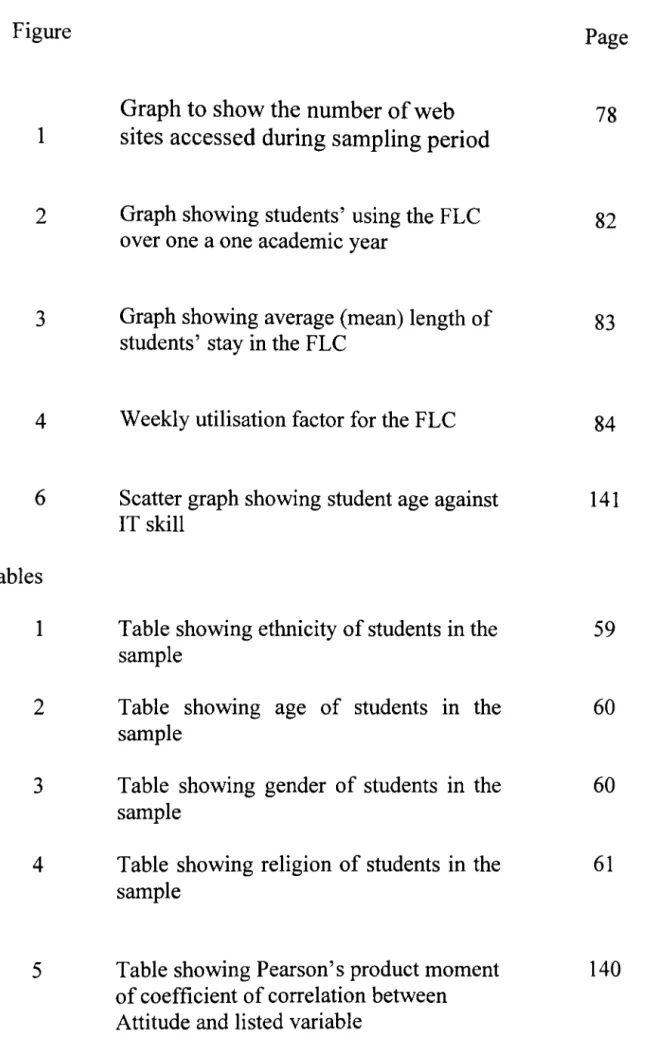
List of Figures and tables Figure 1 2 3 4
6
Tables1
2 3 4 5Graph to show the number of web
sites accessed during sampling period
Graph showing students' using the FLC over one a one academic year
Graph showing average (mean) length of students' stay in the FLC
Weekly utilisation factor for the FLC
Scatter graph showing student age against IT skill
Table showing ethnicity of students in the sample
Table showing age of students In the sample
Table showing gender of students in the sample
Table showing religion of students in the sample
Table showing Pearson's product moment of coefficient of correlation between
Attitude and listed variable
Page
78
82
83 84 141 5960
60
61
140
Chapter 1
Introduction
The aim of this study was to construct a picture of how students at a Further Education
(FE) college were using computer technology both in and out of college. This chapter explains why this was chosen as the topic to be studied and why the implications of the results of the study should be of interest to this and similar colleges.
The focus of this research was the use of IT, in particular the Internet, in an FE college. The research was based at a college that will be referred to as Snow Hill College.
Snow Hill College
Snow Hill College is a large Further Education College in the north east of England. The
college has a wide range of courses on offer covering the full spectrum of post 16 education. The local population, from which the college attracts its students, is
multicultural. Although most ethnic and religious groups to be found in England are represented within the college, the predominant ethnic groups are White and Pakistani.
Snow Hill College has 17,562 students, 14,120 part time and 3,442 full time. Of the full
time students 68% are white, 15% are Pakistani, 3% are Afro-Caribbean and the remaining 14% being from minority ethnic groups. Of the part time students 81 % are white, 4.3% are Pakistani, 2% are Afro-Caribbean. The remaining 12.7% being from
minority ethnic groups. The college does not keep data on students' religious beliefs, but
in the course of the study it became apparent that the predominant religious groups were
Christian and Muslim. The students range from 16 years of age to 85 years of age, with 20% in the 16 to 19 age group.
This study was concerned with how students from different cultural backgrounds make
use of the computer facilities available to them. The research raises questions of equality of opportunity regarding both the accessibility of computer facilities for students and use
the college assumes. The college chosen for the study is about to embark on an expansion of the use of Information Technology (IT) into the curriculum in the form of a Virtual Learning Environment (VLE). The VLE is a computer-based program that will enable staff and students to access and share course material. It will also enable the college to deliver some parts of the curriculum via the Internet. As this VLE is introduced and expanded to cover more courses the teaching staff will need a clear understanding of how different groups of students are prepared to interact with this aspect of the curriculum. It is hoped that this research will be useful to those staff at the college who are involved
with this latest initiative. In order to understand the relevance of the research some
understanding of the current developments in IT at the college and neighbouring colleges
is required.
Locally some colleges have been working in partnership to produce Web based learning
materials. Recent projects in the region have drawn staff from nineteen FE and Sixth Form Colleges to work in curriculum based areas, to produce on-line learning materials.
exerCIses and on-line assessment. Other colleges are encouragmg teaching staff to
develop similar course materials for use on a college Intranet. Some are trying to do both.
Page (1996) stated that Further Education (FE) is an area of education that is under researched and reported hostility toward the researcher in FE. The lack of research based in FE colleges was also noted by Robson (1999). Since incorporation FE colleges have
gone through a period of major and rapid change, Scott and Hyland (2001, p123) suggest that because of this fundamental change in the organisation of FE such colleges are not
necessarily under-researched but under-valued. More specifically Kimbell (1996) reported a general lack of research into technology as a teaching aid. Information Technology (IT) is one of the fastest changing areas in education and Further Education
in particular. It is important that lecturers and curriculum managers in FE understand how their students use this technology. The age range of students in FE colleges is wide and as many FE colleges are in the process of increasing the accessibility of the Internet for
students how the different age groups react to the use of computers in college is important. Selwyn and Moss (1996) said that adult IT learners remain an under
researched aspect of computer education.
There are aspects of computer use in education that are unique to FE either because of the
age of the students, the type of courses on offer or the social setting of the college.
Research findings based on schools may not be applicable in a FE college for a variety of
reasons. Students in FE have fewer timetabled constraints than school pupils, and
therefore greater opportunity to use the IT facilities that are available. The age range of
students in a FE college sets it apart from both schools and Sixth Form colleges. Different age groups could be expected to react differently to new technologies. There have been
studies that have focused on particular age groups. Before the introduction of the Internet to schools and colleges Selwyn and Moss (1996) surveyed adult learners' attitudes and
use of IT and found these students were motivated by either work requirements or personal interest, but they did not find any gender-based differences. Other researchers, looking at different age groups, report gender difference being significant in a range of IT
applications (see Barrett and Lally 1999, Leathwood 1999, Clegg and Trayhum 2000, Passig and Levin 2000). This research will consider the question of gender differences in use of the Internet, and if these differences, if any, are common to all ethnic groups.
Students' use of IT in Higher Education (HE) has been the subject of many research
projects (see for example Lauder et al 1998, Collis 1998, McIntyre and Wolf 1998, Smeaton and Keogh 1999). While interesting these research projects are not directly applicable to the FE setting. The students in these studies were, as to be expected in HE,
on more advanced courses than students in FE, one would therefore expect them to be more independent in their learning styles. FE can be seen as sitting between the two
worlds of school and HE, and as such presents a different educational society from them.
It follows therefore that there is scope for research to be done on the use of IT within the
Justification for the research.
Most teachers would probably agree with Means' statement that:
'The primary motivation for using technology in education is the belief that they will support superior forms of learning' (Means et aI, 1993, pI).
We could therefore expect to find that research into the use of technology in the schools and colleges to be concerned with investigating aspects of the learning experience that are affected by the technology.
Of prime importance is the students' attitude towards the technology. In the mid-1980s
there was encouragement, from the schools' inspectorate, for schools to be aware of
pupils' attitudes.
'It is important, therefore, that schools seek to promote positive attitudes through the attention they give to content and method'
(HMI, 1985 paragraph 104, pI6).
In schools and colleges that are multicultural, teachers need to be aware of possible
differences in attitude that are attributable to cultural difference. How students or pupils react to and make use of learning materials can be influenced by their personal
background and previous experiences, both in and out of the school or college setting.
•
"Many teachers will have to face the ways in which ethnic minority children's participation and performance in school in
influenced by family, neighbourhood and cultural factors." (Hitchcock and Hughes 1995 p245)
Martinez cited Chisholm's research (1994) which indicated that access to a computer outside the school was strongly related to student's proficiency with information technology. Chisholm (1998) reported on how integrating technology into education affects a multicultural classroom. Working in the USA Chisholm highlighted the
inequality of opportunity faced by different ethnic minority groups in American schools. He found that some ethnic groups were less likely to have access to computing facilities
outside school (Chisholm 1998). Students who do have access to computers outside school can be expected to be more familiar with their use than those that do not.
Flexible Learning Centre
Colleges can help to redress this inequality of opportunity by making computers available
for students to use outside normal class time. Snow Hill College does this. The room
where these computers are is referred to as the Flexible Learning Centre (FLC).
The FLC is an open access room with fifty-four computers available from 0900 hours to
including Microsoft Office and some subject specific packages. There are also scanning
facilities and a small CD-ROM library that students can use. The computers are connected to the college Intranet and the Internet. The room is staffed at all times, when it is open. The learning support staff based in the FLC offer basic instruction and help to students in response to student requests.
For many students the FE College is a stepping-stone to Higher Education. As such the
FE College has a role to play in transforming the student from a 'School pupil' into a 'College student'. There is a growing expectation at universities that students will be computer literate, and this should include the ability to use IT as a resource for
independent study (see Somekh 1998 p27). It follows therefore that IT should be both part of the college curriculum and a method of study or aid to learning available to all
students. At Snow Hill College it is one of the aims of the FLC to promote opportunities
for individual study.
Snow Hill College has a clear policy statement regarding equal opportunities for all
ethnic and religious groups. The researcher is aware that practice does not always
necessarily follow policy. If differences in behaviour are found between ethnic or
religious groups then further investigation will be required. The researcher was seeking to
identify the cause of these differences and to find out if they were because of student choice or if they were present because of the practices or policies imposed on the student
by the college.
The aims of the research project
The research project began by investigating in broad terms which students were making use of the college's IT facilities. Differences in the type and length of time of use between ethnic, religious and gender groups were looked at.
There are many factors that could contribute to affecting how, or if, a student chooses to make use of the IT facilities on offer. This research aimed to identify the key characteristics or influences on student behaviour in this respect. This research project set out to investigate the following questions:
-• Who is making use of the Internet facilities in the college?
• Are there any identifiable differences In IT use between different cultural groups?
• If any differences are found are they due to cultural influences or by factors introduced by the college?
• How are students using the Internet and what contribution do they think it is making to their studies?
When asking questions such as these a researcher needs to be aware that some words and concepts may not be interpreted or understood in the way intended:
'One of the important preoccupations of philosophers is the
clarification of the meaning of terms' (Barrow and Wood 1988 p8)
This was a view also held by Wilson (1972) in respect to educational research, who criticised work in this field because of inadequately defined terms. With this in mind the key terms used in the research are now discussed.
The Internet
The term the Internet is used to encompass the World Wide Web (WWW), e-mail and
chat rooms. The Internet is actually a system of connections between many computers. These connections enable computers to share files and so share or transmit information.
A similar system that operates within a closed computer network, not readily accessible to the general public is called an Intranet. Many schools, colleges and other companies
that have their own Intranet have connected their Intranet to the Internet via an outside
service, usually referred to as an Internet provider. It was not important for the purposes of this research that students were able to distinguish between an Intranet and an Internet.
The researcher decided that it was more important to consider what web pages students
were accessing rather than were these pages were being stored.
A software programme called a Firewall can monitor the connection between an Intranet and the Internet, or between a single computer and the Internet. This software can be
tailored to meet the needs of the institution and so access to sites or information deemed by the institution to be unsuitable can be blocked.
Culture
Marsh (1996 p20) begins a definition of culture by stating it is 'the intellectual aspects of a civilisation.' This is the anthropologist's view of culture as the customs and interests of society. He continues that sociologists prefer a broader definition, which includes the
'values, customs and acceptable modes of behaviour.' Other researchers (Chen, Mashadi, Aug and Harkinder 1999 p219) have been less concerned with actions being acceptable
by society but rather have considered all 'patterns of action by individuals or groups as
contributing to their culture. '
The word culture can be used to describe different aspect of society and does not always mean the same to everyone. According to Hoggart (cited in Entwhistle 1978 p 122) unless
the majority of a class or group are involved in a particular activity then it is
inappropriate to include such activities in accounts of their culture. Other writers on educational research have been interested in behaviour being observed and recorded and
less preoccupied with the number of people involved in activities that are grouped under
culture is taken to be the activities engaged in by the students who took part in the study,
and the value system and acceptable modes of behaviour (Marsh 1996) that influences these activities.
MCLoughlin (1999) states that culture and learning are so closely interwoven that they should be considered at the same time.
'An appreciation of the role of culture in education is essential
as it leads researchers and teachers to a deeper and more valid understanding of the nature of learning.' (Chen Mashadi, Aug and Harkrider 1999 p 219)
The definitions of the term culture, referred to above, are not necessarily in disagreement,
but are merely looking at a concept from a different viewpoint. How an individual uses their computer or how a group of students use the computers in a college fits these
definitions and can therefore be described as part of the individual's or students' culture. The number of students using computers and the extent to which they are using them
could be seen as a measure of how much the technology has become part of their culture.
There is sometimes a distinction made between high culture, such as classical music or
Shakespeare, and popular culture, such as watching the television or a football match. Such a distinction may lead to the conclusion that only aspects of high culture, which
tend to be more intellectually demanding, are worthy of serious study. This is not true.
Evetts (1973 p43) regarded popular culture as being just as worthy of study, usmg
rigorous analytical methods, as high culture. Using a computer has become an activity undertaken on a regular basis by people in our society both at home and at work and can therefore be regarded as part of popular culture.
Racism
A useful starting point is Foster's definition of racism citied by Gillbom (1998). Foster defines racism as practices which restrict the chances of success of individuals from a
particular racial or ethnic group. These practices, according to Foster, are based on beliefs that regard particular ethnic or religious groups as 'morally, culturally or intellectually inferior.' This definition of racism, according to Gillbom needs to be widened to cover
'unintentional or institutional racism.' In a school or college setting an example of this could be insisting all students wear a particular style of clothing, which for some could be
against their racial culture or religion and is therefore discriminatory against that group.
'The vast majority of people in education are not overtly racist but will probably not realise they are racist by default' (James
and Griffiths 1984 p 160).
As a multicultural college Show Hill is trying to operate an equal opportunity policy for
all students. However, the behaviour or actions of students from different cultural
aware that cultural differences do impact on student behaviour. This affects how students
study, how they learn and how they spend their time when not in class. If cultural differences affect how a student relates to particular aspects of a course then teaching
staff may need to reconsider course delivery.
This research project looked at the social interaction between students and the Internet in an FE setting. The researcher investigated if gender, ethnic origin and religious group had any influence on students' use of the Internet. The primary aim of this research was to
investigate if a student's culture influenced how they used computers and the Internet and to use the data collected to judge if this could have an impact on their studies.
Chapter 2
Review of related research
Information Communication Technology (lCT) is changing the basic or key skills that are needed in order to fully participate in our evolving society, and this includes education or the 'learning society' (Edwards and Usher 1999 p262).
The Internet is also growing in importance within our society. The Internet is seen by some as the latest major technological change that is of such importance that it will affect how we live (Rosenberg 2001). Still in the early stages of permeating into people's lives it is too early to predict what the full impact of this technology will be. Eddings (1994) forecast that the Internet would continue to grow and develop, and one can not help to notice that increasingly it is becoming part of our culture and society. Many firms have their own Web page - schools and colleges increasingly have a presence on the Internet. Radio presenters encourage listeners to contact the radio station using e-mail, and this form of communication is becoming more common.
IT changes quickly and computer use in education, like computer use elsewhere, has gone through a process of evolution. Within this process of evolution the computers, that are available in colleges and homes, have become comparatively cheaper, and therefore more readily available. The hardware has become more sophisticated and the software that can be used on these machines has improved, both have become more reliable. Research in the educational use of computers has mirrored this evolution. As the computers and the software have become more complicated in terms
of both what they can do and how they performs these tasks, the uses made of these machines has also become more complicated.
When computers began to be introduced into the classroom, educational IT research concentrated on how using the computer would help the learning process. There is a body of research relating to the use of computers to support learning (see for examples Suppes 1965, Tsai and Phol 1980, Skues 1983, Ainsworth, Bibby and Wood, 1997, Kumari 1998, French, Ransom, and Bett 1999, Nicol and Anderson 2000, Robson 2000, Weaver 2000). These studies all point to the benefits of using IT in its many forms to enhance students' learning experiences.
This research into IT in education may have led some people to expect IT to have a large impact on our schools and colleges. Generally speaking this has not been the case, and research turned to investigate why this was not happening. Bell (1993 cited in Forsyth 1998 p24) was able to identify what he felt were some of the reasons for this lack of impact. Other researchers such as Selwyn (1999a) investigated further the lack of impact of IT on the curriculum. He asked the question 'Why the computer is
not dominating schools?' He considered the impact of both policy and practice with
respect to computers in the classroom. His findings highlight the difficulty faced by those who try to incorporate more IT into the curriculum:
'The very ordered individualistic environment of the computer does not easily mesh with the everyday mechanics of education' (Selwyn 1999a p 85)
Before educators can maximise the impact of IT on the curriculum, they need to understand why there has been an apparent lack of effect to date. Davis (1992) wrote about the enormous potential to improve teaching and learning that could be gained by the increased use of computers in education. It is generally agreed that IT in education has yet to reach its full potential (French, Ransom and Bett 1999), but even as an under used resource or aid it is still an important tool in educational settings. Paine (2000 p 18) argued that this new technology is not a panacea for schools and colleges, but is a 'fundamental tool that will deliver the efficiencies and opportunities required'. Bell (1993) lists reasons for the failure of IT to have an impact on schools and these include non co-ordinated vision by managers in the school and senior managers are not taking a strategic management of change approach with respect to introducing computers to the curriculum. Another reason given by Bell is that there is little or no evidence of what works.
Educational researchers have for sometime been interested in the role of IT in teaching and learning and within this body of research some themes can be identified. Researchers were initially interested in whether IT had the potential to enhance learning and then latter why this potential was not being fulfilled. There is still a research interest in looking at how IT can enrich the learning experience, but much is focused in schools rather than in FE. One example of such research can be seen in a recent European funded project. In order to investigate further the possible benefits of leT in the classroom this project (NIMIS: Network Interactive Media in Schools) supported classroom based research. One aspect of this project was to fund a classroom of the future. This involved equipping a year one elementary classroom in a school in Leeds with a range of modem equipment, including networked computers
-connected to the Internet. The results of this research (Cooper and Brna 2002) show that ICT, when well planned and integrated into the classroom, does have benefits. It was shown that the children experienced better relationships in the classroom, improved motivation and that this led to longer lasting engagement with activities and learning.
Central to the NIMIS project was the intension to carefully plan and manage the IT activities within the classroom. This does have a point that FE colleges can take note of. In FE, Walker and Greaves (1999) found that all the research they reviewed pointed to a lack of clear policy for ICT. They cite poor management of resources for IT linked to lack of vision regarding its position in the curriculum. Herson, Sosabowski and Lloyd (1999 p269) investigated the use of Intranets in HE and FE organisations and found that they tended to serve administrative rather than academic roles. This may be an over simplified picture of what is happening. IT is repeatedly referred to as a fast moving world of change and it is easy to find examples of IT being used for teaching and learning. Kumari (1998) reported on Web based lessons designed by teachers from a variety of curriculum disciplines, as early examples of good practice in trying to incorporate this resource into teaching and learning.
Here again the pattern of education research has mirrored IT advances. As the Internet has grown in significance, researchers have been increasingly interested in the educational implications. Studies looking at use of the Internet, as opposed to other aspects of computer aided learning, have addressed the following issues:
1. Distance learning
McKinnon (1995), Collis (1999) and Albert and Thomas (2000) reported on how students used the Internet and its positive motivational effects. Passerini and Granger (2000) considered the design models to be used when developing distance learning courses. Other similar studies have been done (see for example Asserini and Granger 2000)
2. Use of the Internet in HE
Sloane (1997), Arthur and Lewis (1998) Montelpare and Paul (2000) are some examples of investigations into Internet use in HE
3. Attitude studies
The studies of Mikropoulos, Chalkidis, Katsikis, and Emvalotis (1998) and Downes (1999) produce some insight into students' attitude towards some aspects of IT in the curriculum. Students' ability to interact with the Internet formed the basis of Robertson's study (1998)
4. Content of the WWW
Bos (2000) and Yates (2000) discussed methods, which can be used, for evaluation the content of the WWW from an educational view.
All of these studies have a common element. They considered the use of the Internet and education in a classroom (under the control of a teacher) or at the student's home (private and unobserved) for a specific learning task. These studies did not investigate students using the Internet in a public open access area or the social impact on the
student of being encouraged to work in this way. Students' behaviour, social groupings, attitudes and activities undertaken in an open access area can be very different from that observed in a classroom. These differences in student culture are worthy of further investigation. This is a theme that this current research project investigated. Questions regarding the social and emotional needs of learners who are to use IT as part of their course (FEU 1987), or as an enhancement of their learning, have not been fully addressed by practitioners in education, in this country. This issue can be seen as an emerging theme in educational research that researchers have begun to address, but there is scope for further study.
For the researcher interested in both computing and the impact of computers on students' culture, the findings and implications of previous research on both must be considered.
Researchers have begun to consider the cultural implications connected with the use of IT and the Internet (see Paul 1995 and 2000) but there is still much to be done. Given the fast changing nature of IT, it is likely that researchers will need to revisit the cultural implications of IT in education as new developments are introduced. Kress (2000) argues that changes in both social and economic circumstances require educators to rethink the curriculum, but he did not address the question of whether these changes are common to all ethnic groups.
Regarding research based on a particular culture, Hitchcock and Hughes (1995) draw our attention to some of the research carried out regarding native North American Indians' participation and performance in schools. They cite three examples of
research, which showed culture to be a contributing factor in education (Wax and Wax 1971, Philips 1972, and Brice-Heath 1982).
Wax and Wax (1971) found that white teachers saw school failure was 'located in the child's culture'. Philips' (1972) account of how North American Indians' participation in classroom activities was affected by their cultural background. He found that teachers' opinion of pupils was affected by the behaviour of the pupils. In some instances this behaviour was part of the accepted code of conduct of the pupil's home culture. Both of these studies found the teachers' lack of understanding regarding the students' culture affected how the teacher viewed a particular student.
Brice-Heath (1982 p245) contrasted the types of questions black Americans were asked at home with the type of question they were asked at school. Responses which students gave to teachers' questions were viewed, by teachers, as either inappropriate in content of in the way they were given. Teachers were labelling students as uncooperative or disrespectful when in reality the student was answering in a way that was consistent with the student's home culture. This research found that social and cultural contexts undoubtedly playa crucial part in influencing and affecting learning.
Schools playa major part in shaping the culture of society (see Byram 1993). It is at school where children have early contact with cultural influences that are not controlled by their parents. Byram argues that the importance of the role schools play in defining and maintaining a national cultural identity is recognised by the government. Government control of the curriculum, and therefore of the cultural values it supports, has long been the norm in many other countries, Byram believes
the introduction of the national curriculum into the British education system was to protect aspects of British culture rather than Educational standards.
'The haste with which the British government has sought to catch up is the consequence of the threat to nationhood, implicit in the development of a super national European community.' (Bryam 1993 p175)
Drury and Chathain (2002) are of the opinion that the classroom plays an important part in reinforcing gender differences in children which show in their behaviour, attitudes and achievements. They believe that this is such an important factor in respect to the children's development that all teachers should be trained to be self critical with regard to the gender balance in their classroom.
Part of the difference between students' culturally based behaviour can be attributed to gender differences. Harris (1992) was able to identify some gender differences in the use of IT. Boys were found to use computers on more occasions than girls, but the over all time use was similar for boys and girls. What they used the computer for was also different. Boys tended to use computers for games and amusement, while girls used them for word processing. Some of these differences may be due to what Marsh (1996) calls 'cultural conditioning'. Cultural rules, Marsh explains, regarding gender appropriate tasks or behaviour can vary enormously from one culture to another. The culture controlling these gender activities may be based in ethnic origin, religion or a combination of the two. For younger children, access to a home computer is probably dependant on the willingness of the parents to buy a machine for them to use.
Schofield (1995 p175) found that parents of boys were more likely to purchase a computer for them to use than the parents of girls.
It is not just what students study that contributes to their education. Factors such as how the information in front of them is presented, or how students are required to work, all help to play a part in how successful the learning experience is for the student. Students preferred learning styles are part of an individual student's culture, and the two are interrelated. Working in the United States of America, Park (2000) was able to identify differences in preferred learning styles between Asian and white American students. Recognising the difference in students due to cultural needs, Wild and Henderson (1997) outlined some possible strategies for developing culturally appropriate instructional models for use on the World Wide Web (WWW). DeVoogd (1998) has looked at how teachers can adapt to using IT in a multicultural classroom.
This research project included a survey of home computer ownership. The researcher investigated access to a home machine and compared the level of access to these machines between male and female students. This is an area that has been little researched for FE. The research however, did not just consider gender differences but also sought to investigate if there was a difference in level of access to home computers experienced by students from different ethnic and religious groups.
Connections between race and culture have been investigated and it has been shown that the distribution and definition of gender roles is 'a major activity of all cultures' (Munns, Rejan and Bromley 1995 p485). However, studies into computer use in education have tended to neglect cultural differences of students from different ethnic
backgrounds. Considering ethnic background, according to Corwin (1965 pI76), may lead to a more efficient explanation of differences in behaviour between groups rather than social class. Ethnicity is easier to define than social class and if we are becoming a classless society, explanations of behaviour patterns based on ethnicity may be more relevant.
Questions relating to how gender and ethnic origin relate to use of the Internet and if there is a measurable difference between students of different ethnic origin and their use of the Internet are currently unanswered. It was an aim of this research to gather data relating to these questions with a view to providing a better understanding of students' behaviour in relation to computers and the Internet.
If cultural differences mean that particular groups do not feel comfortable using computers and the Internet, then they are in danger of being disadvantaged within the learning environment. The Internet was initially a western innovation,
, At present much of the knowledge available online, and the software to access it, is produced by western white middle class men and reflects their interests and priorities' (Leathwood 1999 p 11 )
This is significant from the point of view of the socio-cultural paradigm (Robson 2000), which views both knowledge and learning and understanding as culturally based. Culture and education are interwoven and inseparable (McLoughlin 1999 p232). As a means of mass communication and dissemination of information it may
be suspected that the Internet would remove cultural obstacles. This however is appears not to be the case. Joo (1999) is of the opinion that the Internet actually adds to these cultural obstacles.
From initial observations at the college selected for this case study it seems that some ethnic groups are the predominant users of the IT drop-in facilities. It would also appear that female students from some ethnic groups are reluctant to use these facilities because of the social implications that may follow from their actions. If these observations are true, then the college needs to be aware of what is happening in the drop-in centres and take appropriate remedial action. One value of the study will be to help the college identify disadvantaged students, as far as IT entitlement or social inclusion (Passey 2000) is concerned, and so plan a course of action.
According to Marsh (1996) factors such as children's social background should not interfere with educational opportunity and educational achievements. In practice however, the type of education received or the end qualifications gained are closely linked to social background. Corson (1998) was concerned with girls from immigrant cultures in so far as how they were treated within our education system and society. He found that they were marginalised first because they were members of a different culture and then because they were females within that culture. Corson (1998) believes that students in this category are also disadvantaged because of gender and culture bias found in the material that is used in classrooms, such as textbooks. Corson (1998) reported that there had been few studies done in schools that had put together gender and culture and this was an area that should be addressed.
An example of this new theme in education research linking IT in education and
cultural or social issues in education can be found in the work of Kerawalla and Cook
(2002). They report that their work can be seen as an extension of earlier research that
looked at how computers were being used at home. They concluded that home
computers being used for educational purposes would remain a rarity unless the level
of support for such use increased. Why this should be was a question Kerawalla and
Cook (2002) tried to answer. They found that many parents said that home computers
were bought to help their children with their school work but that was not how the
computer was actually used in the home. Kerawalla and Cook (2002) discussed the
influence cultural setting has on the activities children engage in. They explained that
the cultural setting of the school or classroom is very different to that at home; hence
the activities children do at school and home are different. This difference extends to
how children use computers.
The importance of the researcher considering home computers and what students are
using them for was highlighted by MCNicol, Nakivivell and Ghelani (2002 p393).
They found that:
'there are approximately seven times as many computers in
homes as there are in schools'
These researchers also investigated what children were using these home computers
for. They found a high proportion of the home machines were being used for playing
games, but not exclusively. Many of the parents they interviewed claimed that their
children were using the computer to help with homework. Within their report they
also identify a disadvantaged group of low income families who did not have access to the Internet at home, because of the costs involved.
Kerawalla and Cook (2002) also considered where the computer was in the home and found 44% were in a central family room and 47% were placed so that the privacy of the user was protected. However, they found that the location of the computer did not affect the type of use. The positioning of the home computer for those that were centrally placed was justified in terms of fairness of use for all family members. For others security of an expensive item was a prime consideration.
Having investigated where home computers were located, Kerawalla and Cook (2002) then looked at how children used computers. They found that 57% of the school children surveyed reported that they preferred working with a partner or group.
'Most school use is collaborative and naturally linked to the support of an adult (the teacher) most home use is solitary' (Kerawalla and Cook (2002 p767)
Kerawalla and Cook's research was based in primary school and their findings cannot be assumed to be valid for other section of the education system. This research sought to investigate comparable questions, but within the setting of an FE college.
Clegg and Trayhurn (2000) suggest that it is time for computing research to move on and become more focused:
'Future research needs to look more closely at who is doing computing and what they are doing.' (Clegg and Trayhurn 2000 p87)
With this in mind this research project focused on students at an FE college and how they were using the Internet. Whilst this was the focus of the research, it was not the sole purpose of the research. The research did therefore consider related topics and activities as were necessary to give a detailed picture.
Chapter 3
Methodology
The practitioner who has decided to do a research project needs to consider the arguments
for and against a particular approach. In making this decision the researcher must consider different approaches and adopt the most suitable. This decision will include
consideration of the time available for the study, the practicalities of adopting a particular approach and the suitability of a research method in respect of the nature of the topic being studied.
If the researcher views knowledge in the context of the research as hard, objective and
measurable and favours research methods that reflect this view, namely scientific methods, the researcher may be described as a positivist. A researcher who is described as anti-positivist would view knowledge as 'personal, subjective and unique' (Cohen and
Manion 1994 p6) and would adopt the methods of the social sciences as opposed to those of the natural scientist. These epistemological differences, i.e. how knowledge is viewed,
give rise to two different types of research method, which can be called quantitative
Quantitative methods
Quantitative methods are sometimes referred to as scientific research methods. According
to Ebel (1969 P 1129) there is no one scientific method, but the methods of science can be considered jointly as a framework or approach for the researcher. Here the meaning of method is that used by Cohen and Manion (1994 p38), and covers the
'Range of approaches used in educational research to gather data which are to be used as a basis for inference and
interpretation for explanation and prediction'
The science approach to research is based on three assumptions (Cohen and Manion 1994
pI3), determinism, empiricism and parsimony.
The determinist view of the research questions being considered within this research
would be, does the college spending money on providing Internet access cause students to use it? Clearly if the college did not provide the access then the students would not be
able to use it. There will be other factors that 'cause' the students to use the Internet.
These may include instructions or work set by their tutor, or they may choose to work this way by their own volition. From these questions the researcher should find it
relatively easy to formulate some simple hypothesis that could be tested. The scientific
researcher works with a hypothesis and its complement the null hypothesis.
Engelhart (1972 p12) describes scientific research as being characterised by 'hypotheses deduced from theory' proceeding to 'empirical testing' leading to generalizations or laws. He refers to this as the hypothetico-deductive model.
The researcher has been teaching at Snow Hill College for a number of years and in this time has witnessed the introduction of IT at the college. In this time the researcher has
been interested in a number of patterns of student behaviour that seem to be developing. From these observations the research has identified a number of lines of enquiry that could be followed. To fit the epistemology of the scientific method this initial observation could have been expressed in the form of a hypothesis which could then be
tested. These hypotheses could be expressed as
• Internet access within the college is used predominantly by the 16
-19 age group
• Students use the Internet for recreation more than they use it for
study.
• Students from different ethnic backgrounds use computers and the
At this stage the researcher is led by two factors, first is the chosen aspect of the research topic of interest to either the researcher or anyone else, and secondly what is possible within the chosen methodology.
After formulation of the research question we move to the second assumption, empiricism. The researcher takes the view that data to prove or disprove the hypothesis
can be collected. As the research progressed it was found that data relating to some of the above hypotheses could be collected, but some could not. The data collected would have
to have covered a large number of Internet access points available to staff and students, the time these groups of people spend on the Internet and what was being accessed and why.
The aim of the scientific researcher is to explain events in the simplest way possible, the principal of parsimony. Part of the researcher's explanation will be the acceptance or rejection of their hypothesis. The acceptance or rejection of the hypothesis is a matter of
statistical technique. The researcher has to make a decision regarding the rejection of a hypothesis, referred to as the level of confidence. How sure does the researcher want to
be that what they say is really true? It is usual for the researcher in social science to use a
ninety-five percent level of confidence, meaning that statistically the results reported
could have happened by chance in five out of a hundred performances of the experiment
or research. Said another way, this means the research data can be interpreted as
happening not by chance 95% of the time.
The scientific researcher has to be able to justify his conclusions not only with reference to the statistical tests used, but also taking into account possible errors. The researcher
has to account for both random errors and systematic errors (see Mouly 1978 p 137-141).
Random errors can be estimated and reduced by increasing sample size. Systematic errors can be both serious and difficult to detect. A common source of these errors is poor sample selection. A researcher who thinks his data is affected by systematic errors can
not reduce their effect by increasing the sample size; neither can they be estimated by
statistical theory.
The quality of data that the researcher can collect is governed by the quality of the
measurement tool he/she uses to collect the data.
'Success in research and science depends on the availability of
instruments and techniques of sufficient precision to measure
the phenomenon under study' (Mouly 1978 p 73)
Instruments here can refer to a gauge, a rule, a test or a questionnaire. For the researcher
operating in the field of education or social science Mouly (1978 p 74) argued that:
many of the measurements with which social research is
As part of the research or experimental design the researcher had to decide on how to
view the students' use of the Internet. Was it to be compared with traditional teaching methods by perhaps setting up an experiment to monitor the progress of one group using the Internet over a second group restricted to traditional methods?
These questions sit well with the positivist model
'Eliciting responses to predetermined questions, recording measurements, describing phenomenon and performing experiments' (Cohen et al 1994 p38)
and may they tell the researcher what is happening. Being able to prove or disprove a statement that students in group A are more likely to behave in a particular way than
group B will provide useful information for the researcher. The researcher also believes
that a positivist approach to this aspect of the research project is the most appropriate. However this approach would not tell the researcher why group A behaves differently to
group B.
The researcher's initial perception of what was happening in the college was that students
were using the Internet to further their studies. They were also using it for recreation. The researcher's aim was to find out which students were using it, and what they were using it
for. The setting up of a controlled experiment may enable us to compare this teaching aid
with alternatives and make recommendations for future use, but an experiment of this
type would distort what is happening and how students are choosing to use the technology. Researchers who use a scientific approach sometimes try to simplify their
experiment in order to limit the variables being studied, but this can then lead the research results to be viewed as 'banal and trivial' (Cohen and Manion 1994)
It was possible to extract data relating to current usage from the 'fire-wall'. This is the software that monitors and regulates Internet access from within the college. It can be used to produce a history of Internet access for any computer in college. It can also be used to produce a list of the most popular sites accessed from within the college.
Using this data may be viewed by some to constitute covert observation (Hitchcock and Hughes 1995 p48), however all staff and students have already been informed that
Internet access is regulated in this way. The current data is presently only viewed by the college IT manager; the researcher's first task was agree a procedure with him so that the researcher can gain access to the data. To be sure an ethical approach to the research is
maintained, the researcher will remind all staff of the college policy and there are notices
informing students of this policy that come on screen prior to Internet connections being
made.
Incorporating this data into the study would be beneficial:
'Using existing data has some advantages over data collected
credibility because it is independent of the teacher's research activities' (Altrichter et aI, 1993, p83)
It would have been possible for the researcher to proceed with this project taking the positivist approach of the scientist. Knowledge gained would be genuine in so far as it
was obtained by 'means of observation and experiment' (Cohen et al 1994 p9). The research would also meet the scientist criteria for good research, as it would be repeatable
(Cohen et al 1994 p 19). The researcher may even have been able to make some generalisations regarding use of the Internet in college; the external validity will of course be limited unless the research is extended to include some other colleges at the
same level of development. Using one college would be too small a sample for the scientific researcher to make generalisations. There are other colleges that would fit the
requirements but it may not be practical to incorporate them into a study of this size. Time and cost would be severely limiting factors.
There is also the criticism that research which uses a scientific methodology cannot paint
a full picture. The researcher would be able to say on a certain day a particular student accessed the following Web pages, but he would not necessarily be able to say why. This
is where, in the study of human behaviour, positivism is less successful (Cohen et al 1994
p12) than some other research perspectives. There is a human behaviour element to this
research, namely how the student chooses to interact with the available technology.
Positivism is sometimes criticised for 'contributing to the dehumanisation of the individual' (Cohen and Manion 1994 p23) and over looking this human dimension. One
of the dangers of statistical research is that it reduces both the subject and the data to
numbers. Sometimes this means the contribution non-numeric data could contribute to the researcher's understanding of what is happening is lost. Positivists, according to
Hitchcock and Hughs (1995), make the assumption that human behaviour is predictable, and that it can be observed and measured. The more complex the activity being observed becomes the harder it is to predict and measure what the subject will do.
The problem facing the scientific researcher here is that he is interested in aspects of the social behaviour of students, which can not be fully described by quantitative data.
' ... a lot of questions about teaching, though undoubtedly
empirical to some degree, just don't lend themselves to empirical research.' (Barrow and Woods 1988 p 181)
Reasoning in various forms is one of the tools by which the scientist seeks to advance knowledge (see Mouly 1978 pp8 - 10). Deductive reasoning perfected by Aristotle was
the first step in developing the systematic advancement of knowledge. The progress of
science was hampered by this one-track approach until Francis Bacon advocated the concept of inductive reasoning. Inductive reasoning enabled science to move forward but
in some ways it was just as restrictive as Aristotle's deductive reasoning. The modern
scientist will probably use what is termed 'Inductive-Deductive reasoning' (see Mouly
1978 pI 0). This entails the researcher, first using inductive reasoning, to move from
and the implications in order to check their validity. In this way the scientist builds into his research a self-checking mechanism. By this mechanism scientific knowledge is advanced with an assurance of what is discovered is true.
Qualitative methods.
Qualitative approaches to research are those that employ descriptive techniques rather than a reliance on numerical data or quantitative methods. Hitchcock and Hughes (1995 p25) believe that 'school-based research' offers a unique opportunity to the researcher who plans incorporate qualitative methods into their research. Because of the complex nature of education generalisations that come from rigidly controlled quantitative
methods, research based on scientific paradigms cast little light on problems that are interesting to teachers. Kerlinger (1969 P 1130) discusses the dilemma faced by researchers. His hypothesis is that the more interesting a problem then the more complex
it is, problems that are reduced to quantitative, measurable and manipulable constructs
tend to have less general interest. If this is the case then the approach of the qualitative researcher should produce findings that can be of interest to a wider audience.
The context of the research is a contributing factor when deciding on a methodology to
employ. The qualitative researcher can be hampered in his quest for the truth if he is
known within the institution. Interviewees may be more truthful with someone they know, they may also reveal to someone they do not expect to see again a slightly
different truth. As with all data the researcher has to have some way of checking its
validity. Internal validity is an essential feature of all good research, as part of the
research design the researcher should consider triangulation as a means of checking internal validity. Observations and interviews can easily be used as a crosscheck, e.g. is what the student says he does the same as the researcher sees him do?
Cohen and Manion (1994 p 193) listed a number of common criticisms of action
research, a particular type of qualitative method:
, [it] lacks scientific rigour ... situational and specific ... its
sample is restricted and unrepresentative ... little or no control over independent variables and its findings are not generalisable ... restricted to environment research is carried
out in.'
These criticisms can be directed at all types of qualitative research methods. However
lack of scientific rigour is not considered by all as a justification for rejecting this mode
of research.
"Although lacking in rigor of true scientific research, it is a
means of providing a preferable alternative to the more subjective, impressionistic approach to problem solving in the
It is often acceptable to perform a research project that may not be as scientifically rigorous as it could be, if the end result is a solution to a problem that the practitioner can make use of (see Mouly 1969 p 115). Here rigour is used to describe the control the researcher has over the research activity. The control of variables within a social setting
such as a school or college is sometimes impossible or too disruptive. There is also the concept of scientific research being repeatable, and that by repeating the research the results are confirmed. Social research is unlikely to be repeatable in the scientific sense,
as the researcher cannot claim to be able to control the social environment to this extent.
Within this research paradigm the results obtained are often seen to be of less importance than the process.
'If emphasis is placed on participant action research as an action technique, the degree of precision of the research
findings is not particularly important as long as the action is being steered towards desirable channels.' (Chein et al 1998
p60)
The criticism that qualitative research is specific to the situation it was carried out in is
not completely valid. The researcher may only be interested in the solution to his problem
within that setting and so will not be concerned with a wider application. Altrichter (1993
p202) argues that the solutions cannot be successfully applied to other situations but they
can be of use to other practitioners as a starting point for their research.
For the researcher who does want their work to be useful to others the limitation placed on the research process by restricting it to one location can be a serious drawback. This
can be a criticism of all data collection activities, 'data can only represent events selectively' (Altrichter 1993 p70). Whatever the data collection technique used the data gained can only be a representation of part of what was happening at a particular time.
With this in mind part of the research design must take into account sample selection.
'An inherent weakness in this type of work is that conclusions are drawn either from experience with a single group or from experience with several groups differing in numerous uncontrolled ways. Despite this weakness empirical action
research may lead to a gradual development of generally valid principals.' (Chein et al 1998 p60)
Just as important as sample selection is what the researcher does with the data they collect. It is more than likely than the researcher will collect more data than