INTELLIGENT TUTORING SYSTEMS:
THE PRACTICAL IMPLEMENTATION
OF CONSTRAINT-BASED MODELLING
A thesis
submitted in partial fulfilment of the requirements for the degree
of
Doctor of Philosophy in Computer Science in the University of Canterbury by Brent. 1. Martin University of Canterbury
2002
Acknowledgements
Thank you to my supervisor Dr Tanja Mitrovic, for her invaluable guidance during my research and for making this period of study so enjoyable. Thanks also to my associate supervisor Professor Ian Witten from Waikato University, who taught me how to write and provided valuable feedback on this thesis. I am also grateful to the other members of the Intelligent Computer Tutoring Group--especially Pramudi, Mike, Kurt, Amali and Konstantin-for the many fruitful discussions on research in progress. Thank you also to Jane Mackenzie for her help with the Language Builder tutor, and the Canterbury University COSC programmers for keeping the machines well oiled. I also appreciate the staff (especially Ray Bygate) and year seven students at Akaroa Area School for their enthusiastic evaluation ofthe Language Builder ITS.
Finally, I thank my wife Suky and son Hugh for enduring the inevitable financial constraints, for supporting me during this time, and for taking an active interest in my research.
This research was supported by a University of Canterbury Doctoral Scholarship.
Abstract
An Intelligent Tutoring System (ITS) differs from other educational systems because it uses knowledge to guide the pedagogical process. It attempts to optimise the student's mastery of domain knowledge by controlling the introduction of new problems, concepts and instruction/feedback. Central to this process is the student model, which provides information about what the student knows. The state of the art in student modelling is model tracing, which compares student actions against an "ideal" procedure.
Constraint-based modelling is a new domain and student modelling method that describes only pedagogically informative states, rather than following the procedure the student used to arrive at their answer. Ohlsson introduced the idea, which is based on learning from performance errors, but did not provide details of how it should be implemented. Even his definition of constraints is very broad. SQL-Tutor is an existing ITS that uses a constraint-based model. The representation of constraints within this system is as loose as Ohlsson's description. The constraints in SQL-Tutor are LISP code fragments, where domain structural knowledge is incorporated into the constraints via ad hoc functions.
In this thesis we present a more specific representation for constraints that obviates the need for complex user-defined functions. Constraints (and their associated taxonomies and domain-specific functions) are specified as pattern matches. This new approach has two advantages: the constraints are simpler to author, and they can be used to generate solutions on demand. We have used the new representation to create algorithms for solving problems and correcting student mistakes, and for generating novel problems to present to the student. We present the details of these algorithms and the results of both laboratory and classroom evaluations. The solution generation algorithm is demonstrated in laboratory testing to
be practical, and the problem generation algorithm, together with a new problem selection method, exhibits improved learning performance in the classroom.
We also present the design and implementation of an authoring system for constraint-based tutors and demonstrate its efficacy in authoring tutors for two domains. One of these, a tutor for English language skills, was evaluated in an elementary school classroom. This evaluation was a success. The students enjoyed using the tutor, found the interface easy to use, and felt that they had learned a lot. An analysis of their mastery of the constraints suggested that they did indeed learn the underlying principles in the course of the session. The authoring tool enabled us to develop this system quickly using a spelling resource book as the source of both the domain taxonomy from which to produce the problems (i.e. a vocabulary of words to use) and the principles for the constraints. The authoring tool provided all other functions. This evaluation therefore showed that our authoring tool allows the rapid creation of an effective ITS.
Table of Contents
1 INTRODUCTION ... 1
1.1 INTELLIGENT TUTORING SySTEMS ... 2
1.2 THE DOMAIN AND STUDENT MODELS ... 4
1.3 CONSTRAINT BASED MODELLING ... 5
1.4 LIMITATIONS OF CBM ... 6
1.5 THESIS CONTRIBUTIONS AND OUTLINE ... 7
2 BACKGROUND ... 11
2.1 INTELLIGENT TUTORING SYSTEMS ... 11
2.1.1 Architecture ... 13
2.1.2 Domain model and expert module ... 13
2.1.3 The S(udent model ... 14
2.1.4 Pedagogical module ... 18
2.1.5 Communication Module ... ... 18
2.2 THE STATE OF THE ART: COGNITIVE TUTORS ... 18
2.2.1 ACT theory: rules of the mind ... 19
2.2.2 ACT-R and learning ... 20
2.2.3 Cognitive tutors ... 21
2.2.4 Example: LISP TUTOR ... : ... 23
2.2.5 Summary ... ... 25
2.3 MOTIVATION FOR CHANGE ... 25
2.4 CONSTRAINT-BASED MODELLING ... 28
2.4.1 Learningfrom performance errors ... 28
2.4.2 CBMin ITS ... ... 30
2.4.3 Comparison with Cognitive tutors ... 31
2.4.4 Applicability of CB M ... 35
2.4.5 Example of a constraint-based system: SQL-Tutor ... 36
3 ADDRESSING LIMITATIONS OF CBM ... 43
3.1 FEEDBACK CAN BE MISLEADING ... 43
3.2 LIMITED PROBLEM SET ... 47
3.3 BUILDING AN ITS IS HARD ... 49
3.4 SUMMARY ... 50
4 CONSTRAINT REPRESENTATION ... 51
4.1 CONSTRAINT REPRESENTATION ... 52
4.1.2 TEST ... ... 54
4.1.3 TEST_SyMBOL ... ... 55
4.1.4 Removing domain-specific functions: macros ... 56
4.1.5 Limitations of the representation ... 59
4.2 THE CONSTRAINT EVALUATOR ... 60
4.3 SUMMARY ... 64
5 PROBLEM SOLVING USING CONSTRAINTS ... 65
5.1 MOTiVATION ... 65
5.2 THE APPROACH ... : ... 68
5.3 PROBLEM SOLVING WITH CONSTRAINTS ... 69
5.4 CORRECTING AN ERRONEOUS SOLUTION ... 70
5.5 EXAMPLES OF SOLUTION CORRECTION ... 71
5.6 DISCUSSION ... 77
5.7 THE PROBLEM-SOLVING ALGORITHM ... 78
5.7.1 Algorithm overview ... ... 78
5.7.2 Collecting corrections ... 79
5.7.3 Fixing errors ... ... 80
5.7.4 Putting it all together ... 85
5.8 ROBUSTNESS TESTING ... 86
5.8.1 Testing robustness ... 87
5.9 CONCLUSIONS ... 91
6 PROBLEM GENERATION ... 95
6.1 MOTiVATION ... 97
6.2 IDENTIFYING THE TARGET CONSTRAINT ... 97
6.2.1 Motivation ... ... 98
6.2.2 Increasing the knowledge depth ... ... 98
6.2.3 Manually adding the concept hierarchy ... 99
6.2.4 Inducing the student model using machine learning ... 103
6.2.5 Evaluation ... ... 105
6.2.6 Selecting the target constraints ... 107
6.3 BUILDING A NEW IDEAL SOLUTION ... 108
6.4 CONTROLLING PROBLEM DIFFiCULTy ... 110
6.5 CONVERTING TO NATURAL LANGUAGE ... 114
6.6 PROBLEM GENERATION EXAMPLE ... 115
6.7 THE PROBLEM GENERATION ALGORITHM ... 116
6.8 EVALUATION ... 120
6.8.1 Testing of hypotheses 6.1 and 6.2 ... 121
6.8.2 Classroom evaluation ofhypotheses 6.3 and 6.4 ... 123
6.8.3 Pre- and post-test performance ... 126
6.8.4 Problem difJiculty ... 126
6.8.5 Learning speed ... 128
6.9 DISCUSSION ... 135
7 AN AUTHORING SYSTEM FOR CBM TUTORS ... 141
7.1.1 REDEEM: adding instructional planning to CAI.. ... 142
7.1.2 Demonstr8: programming by demonstration ... 143
7.1.3 Teaching by simulation: RIDES ... 146
7.1.4 Support for authol'ing the domain model.. .... ... 148
7.2 WETAS: A WEB-ENABLED CBMTUTOR AUTHORING SYSTEM ... 149
7.2.1 Scope ... 150
7.2.2 Implementation of WET AS ... ... 153
7.2.3 Building an ITS using WETAS ... 157
7.2.4 Example domain 1: SQL-Tutor ... 164
7.2.5 Example domain 2: Language Builder ITS (LBITS) ... 166
7.2.6 Evaluation. ... ... : ... 168
7.2.7 Conclusions ... 172
7.2.8 Further work ... ... 172
7.2.9 Other domain paradigms ... 173
7.3 PROSPECTIVE AUTHORINGTOOLS ... 174 7.3.1 Constraint learner ... 174 7.3.2 Constraint editor ... ... 185 8 CONCLUSIONS ... 187 8.1 NEW REPRESENTATION ... 187 8.2 SOLUTION GENERATION ... 188 8.3 PROBLEM GENERATION ... 189 8.4 AUTHORING ... 191 8.5 CONCLUDING REMARKS ... : ... 191
APPENDIX A. SQL-TUTOR EVALUATION TESTS ... 195
APPENDIX B. LANGUAGE BUILDER SURVEY QUESTIONS ... 199
APPENDIX C. PUBLICATIONS ... 201
APPENDIX D. EXAMPLE CONSTRAINTS FOR SECTION 5.5 ... 205
List of Tables
Table 1. Results for the training set ... 89
Table 2. Results for the first test set (same population) ... 90
Table 3. Results for three students ... 106
Table 4. Test score results ... 126
Table 5. Aborted problems ... 127
Table 6. Attempts per problem ... 128
Table 7. Learning rates for individual students ... 131
Table 8. Learning rates for individual students: new constraint set.. ... 133
Table 9. Constraints mastered per problem ... 134
Table 10. Summary data for the LBITS evaluation ... 169
List of Figures
Figure 1. Architecture of an ITS ... 13
Figure 2. Perturbation model ... 17
Figure 3. SQL-Tutor interface (web-enabled version) ... 37
Figure 4. Solution Space ... 69
Figure 5. Solution generation algorithm ... 79
Figure 6. Tidying constraint ... 83
Figure 7. Constraints con-ected per log ... 92
Figure 8. Concept hierarchy for "all tables present" ... 100
Figure 9. Problem generation algorithm ... 120
Figure 10. Learning curves, cut-off= 40 problems ... 130
Figure 11. Learning curves, cut-off= 5 problems ... 130
Figure 12. Examples of individual learning curves ... 131
Figure 13. Error rates excluding constraints that are always true ... 132
Figure 14. Learning Curves using the new evaluator for both groups ... 134
Figure 15. Constraints mastered per problem ... 135
Figure 16. Problems available by difficulty ... 137
Figure 17. WET AS architecture ... 151
Figure 18. WETAS interface (SQL domain} ... 154
Figure 19. WETAS input files ... 155
Figure 20. DOMAINS.CL ... 159
Figure 21. Example problem from LBITS/LAST-TWO-LETTERS.PROBANS ... 160
Figure 22. Screen appearance ofLewis diagram question ... 161
Figure 23. Example of a Lewis diagram problem ... 161
Figure 24. Examples of syntactic constraints ... 162
Figure 25. Examples of semantic constraints ... 163
Figure 26. WETAS running the Language Builder (LBITS) domain ... 166
Figure 27. En-or rate for raw constraint data ... 170
Figure 28. En-or rate for revised constraint set ... 171
1 Introduction
Intelligent Tutoring Systems (ITS) differ from classic computer-aided instruction (CAI) in the way they adapt to users' individual needs. This is accomplished by modelling what the student does or does not understand. The basis of this student model is a domain model, which is a detailed description of the subject being taught. A common element of an ITS is its provision of a scaffolded environment for the student to practise the skill they are trying to learn. The domain and student models may be used to provide detailed feedback on student answers, select new problems, and indicate to the user their current strengths and weaknesses. They are an effective way to teach students, and gains in the order of 1 to 2 standard deviations in performance are possible when compared with classroom teaching alone (Bloom 1984; Anderson, Corbett, Koedinger and Pelletier 1995). Teaching by ITS promises to be more efficient than one-on-one tutoring, although not necessarily as effective. Unfortunately, building them is hard and this imposes a major bottleneck in their use (Murray 1997).
Constraint-Based Modelling (CBM) (Ohlsson 1994) is an effective approach that simplifies the building of domain models. However, CBM is still a young approach that lacks detail. In this thesis we investigate how to build effective ITSs using CBM. We present a representation for CBM that is easy to use and facilitates automatic problem solving. We then demonstrate how it can be used to decrease the effort required to build an ITS by automatically providing detailed, student-specific feedback, and by generating new problems according to students' needs. The remainder of this chapter introduces ITS and CBM, describes our thesis, and outlines the structure of the remainder of this document.
Intelligent tutoring systems
In the early 1970s, Intelligent Tutoring Systems began to evolve from simple computer-aided instruction (CAI). In simple CAI the interface is static with respect to each user. Information is presented in a lecture (or "storyboard") fashion, grouped into topics to form some sort of curriculum. The student navigates their way through the curriculum according to their needs, however each student is presented with exactly the same information and choices. They may also be asked questions either on request or automatically, to test their understanding so far. Feedback on their answers is usually restricted to an indication of whether their answer was right or wrong, and what the correct answer was. If any further feedback is required, such as comments on individual incorrect answers, it must be hand crafted for each question.
The problem with such systems is two-fold. First, the information they present does not target their audience. Although the student may select parts of the curriculum they are interested in, this is performed at a very high level, and the actual content of each topic is unvarying. The system may therefore present information that the student is already familiar with, requiring them to wade through it in search of the parts that are of use. Worse, it may make assumptions about what the student knows, even though they have not covered the required part of the curriculum. The student will then need to hunt for the relevant concepts in the rest of the material.
This problem extends to the setting of exercises. On conclusion of a topic, a simple CAI often poses some questions so the student can see how well they have understood the material. However, the system may make invalid assumptions about what the student knows at this point, and hence set problems that they are unable to solve. Also, if the student has understood most of the content but is struggling with a particular aspect, the system is unaware of this and may not set any/enough exercises in the problem area.
Second, the feedback on problems is of limited use. People learn by applying the relevant skills, and so problem solving is an important part of learning. However, the usefulness of performing exercises is dependant on how much can be learned from mistakes made (Ohlsson 1996). To be helpful, the system needs to tell the student why the answer was wrong. In simple CAI, this is difficult, because the system has no
understanding of the domain: it simply presents information and problems that have been stored by a teacher. Any additional feedback is developed from scratch for each problem.
Early CAI adopted an approach called "linear programming", where the topic was presented in very small steps, such that questions posed have at least a 95% chance of being answered correctly (Last 1979). CAI has since evolved into ITS (and other methods) via a series of improvements, which have deepened the level of adaptivity. Some examples are (O'Shea and Self 1983):
• Branching, e.g. (Ayscough 1977) - the program adapts its response depending on the answer given. For example, it might present corrective feedback for a given error, or engage in a dialogue;
• Generative (Palmer and Oldehoeft 1975) - generate new problems of appropriate difficulty for the student, according to their current performance;
CD Simulation, e.g. (McKenzie 1977) - the student interacts with a "virtual
laboratory" ; • Games
• Dialogue systems (Carbone111970) - an extension of branching CAI where the student interacts with the system in a natural language
Intelligent Tutoring Systems (ITS) have evolved from these early attempts. They are an example of adaptive educational systems. Adaptivity is an important extension of CA!. Instead of presenting static information, adaptive systems use domain knowledge to actively decide what to show the student next. Techniques such as active hypermedia (Brusilovsky 2000; Murray, Piemonte, Khan, Shen and Condit 2000) combine and format content for presentation, depending on what the student has so far seen and understood. Intelligent coaches (Lajoie and Lesgold 1992) tailor the interface of online "coaches" so that the help they provide is useful without being extraneous. Practice-based systems select problem tasks based on the students' current understanding. Some systems combine aspects of all three approaches. A key attribute of ITS is that the adaptive aspects of the system are separated from the course content. In other words delivery of the course material is supported by features that facilitate adaptivity, such as a domain and student model, teaching strategy, etc.
1.2 The domain and student models
The benefits of ITS over standard CAI are a result of their adaptivity, which in turn is derived from their deep modelling. ITSs contain two main models: a domain model and a student model.
The domain model represents the subject being taught in such a way that the system can use it for reasoning. There are many possible representations, including semantic networks, production rules and constraints. What representation is adopted depends partly on how it will be used. It supports other functions such as information selection and representation, problem selection, and feedback generation.
Whereas the domain model is common to all users of the system, the student model varies between students, or groups of them. It is a representation of their beliefs. This may take many forms, including general measures such as level of competence, rate of acquisition, attentiveness and motivation. Commonly, it includes detailed information such as which parts of the curriculum the student has visited, what problems they have solved and not solved, and, ideally, which concepts they have grasped or failed to grasp. The student model provides the ITS with adaptability. Given the system's current state plus the information from the student model, decisions will be made about how next to proceed. Because the student model is included, behaviour will be unique to that student.
The student model is usually related in some sense to the domain model. One common approach is to use an overlay: the student model is a kind of "window" to the domain model, providing a unique view of the underlying domain concepts coloured by the student's beliefs. As a simple example, it may specify that each individual knowledge unit has been learned or not learned. When talking about the student model, it is therefore not usually possible to separate it from the domain model, or, conversely, the representation of the domain model usually characterises much of the student model.
1
Constraint based modelling
CBM is a method that arose from experiments in learning from performance errors (Ohlsson 1996). Ohlsson proposes that we often make mistakes when performing a task, even when we have been taught the correct way to do it. He asserts that this is because the declarative knowledge we have learned has not been internalised in our procedural knowledge, and so the number of decisions we must make while performing the procedure is sufficiently large that we make mistakes. By practicing the task however, and catching ourselves (or being caught by a mentor) making mistakes, we modify our procedure to incorporate the appropriate rule that we have violated. Over time we internalise all of the declarative knowledge about the task, and so the number of mistakes we make is reduced.
Some domain model methods such as model-tracing (Anderson, Corbett, Koedinger and Pelletier 1995) check whether or not the student is performing correctly by comparing the student's procedure directly with one or more "correct" ones. In CBM, we are not interested in what the student has done, but in what state
they are currently in. As long as the student never reaches a state that is known to be wrong, they are free to perform whatever actions they please. The domain model is therefore a collection of state descriptions of the form:
"If
<relevance condition> is true, then <satisfaction condition> had better also be true, otherwise something has gone wrong. "In other words, if the student solution falls into the state defined by the relevance condition, it must also be in the state defined by the satisfaction condition.
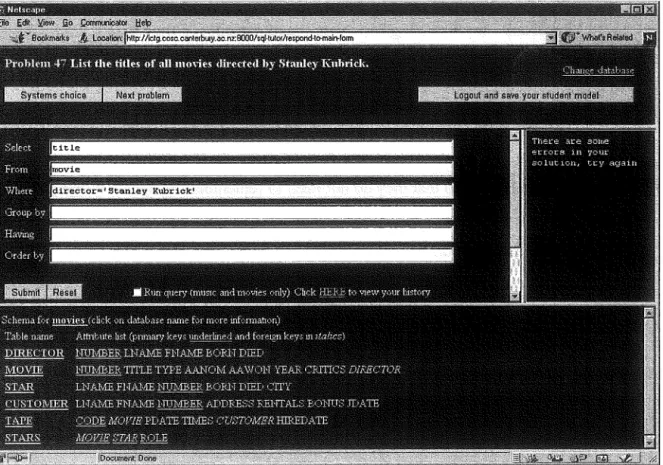
SQL-Tutor (Mitrovic 1998) is an example of an ITS that uses CBM. The domain model consists of over 500 constraints. A simple overlay student model is used, which records the number of times each constraint has been satisfied or violated. Although we have built a new tutor using the methods described in this thesis (see Section 7.2.5), we used SQL-Tutor as the basis of much of this research. This is chiefly because it already contains a model for a rich and complex domain, the SQL database language. This enabled us to test our ideas thoroughly without needing to build a new
domain model of similar complexity from scratch, which is difficult and time-consuming; instead we modified the existing domain model to fit our new approach. Further, it provided us with a full working system on which we could test individual ideas. Finally, SQL-Tutor had already been subjected to four evaluations between 1998 and 2000, providing a wealth of student performance information that could be used as input for our testing.
1.4 Limitations of CBM
In his definition of CBM, Ohlsson does not include implementation. In particular, the domain model is limited purely to describing how to critique a student solution. Even the student model representation is left for further research. SQL-Tutor, for example, uses a very simplistic student model that does not include any form of curriculum. CBM is also not concerned with how problems are produced or selected, and provides detail of only one type of feedback: declarative messages that are attached to each constraint.
Many ITSs contain a problem solver, whose function is to determine the correct solution to a given problem state, or, at the very least, the next best action to take. Because a constraint-based model contains all the required information to determine whether or not a solution is in a valid state, we propose that this is sufficient to solve the problem. Further, we contend that because CBM always considers the student solution's state, it is capable of correcting any student solution. We argue that this is useful because it allows the system to show the student how to eliminate their mistakes without misleading them by introducing unnecessary changes.
CBM's modular nature allows information relating to different domain concepts to be mixed together at will, subject to satisfying the constraints. This provides an opportunity for automatic experimentation within the domain: SQL-Tutor could potentially try patching different SQL constructs together to produce novel SQL statements. Since the answers to problems in this domain are SQL statements, we can use this technique to craft new problems.
The basis of our work was therefore to produce a representation for CBM that allows it to be used for problem solving, and to exploit this capability by adding
algorithms for solving student problems and for generating new exerCIses dynamically.
1.5 Thesis contributions and outline
Constraint-based modelling is a promising approach with a plausible psychological foundation. However, experiences with SQL-Tutor suggest that while such models are fairly easy to build, on their own they are of fairly limited utility. This thesis explores the practicalities of building ITSs using CBM. It proposes a representation for constraints, and a set of algorithms that extend the capabilities of CBM to problem solving and problem generation. It proposes and experimentally evaluates the following four hypotheses:
• Hypothesis 1: It is possible to build a constraint-based domain model that contains sufficient information to solve problems and correct student solutions, by adopting a constraint representation that makes all of the logic in each constraint reversible;
• Hypothesis 2: Using the representation defined in hypothesis 1, it is possible to develop an algorithm for solving problems and correcting student answers, which does not need further domain information to achieve this;
• Hypothesis 3: CBM can also be used to generate new problems that fit the student's current beliefs, and this is superior to selecting one from a pre-defined list;
• Hypothesis 4: Because the new representation is domain-independent, it may form the basis of an ITS authoring tool that supports the development of new CBM tutors.
For hypothesis 1 to be true for a given domain, the constraint representation must be sufficiently expressive that it can describe the entire model without relying on external functions, yet simple enough that all operations it performs (such as testing for a valid value of a term) can be reversed, i.e. given that term t is valid, we can say
why it is so. ITS domains come in many different types, such as procedural, declarative and open-ended. Whether hypothesis 1 is true for all domains (and if not, what characterises the domains for which it is true) remains an open question. In this thesis we explore two domains: the SQL database query language, and English vocabulary and spelling. We develop a representation that is suitable for both these domains.
Similarly, the algorithm we develop to demonstrate hypothesis 2 works quite well for the SQL domain but is not guaranteed to work for all others. Also, the behaviour of the algorithm relies heavily on the completeness and correctness of the domain model. In Chapter 5 we demonstrate that the algorithm performs satisfactorily in the SQL domain but is not flawless, because of problems with the constraint set. Instead of trying to prove hypothesis 2 for all domains, we set ourselves the practical target of showing that hypothesis 2 is feasible in that solution generation can be performed acceptably in a complex domain such as SQL, despite errors in the domain model.
For hypothesis 3 we discuss the possibility of generating problems on the fly in Chapter 6, but we do not demonstrate that it works. Again, we are at the mercy of the constraint set, which makes the approach risky. Instead, we propose a more practical solution: we use problem generation to create a large problem set offline, which increases the chance that the system will choose a suitable problem in a given situation. In doing so, we develop a novel method of determining problem difficulty based on the constraints, which is needed to create appropriate problems on the fly. This new difficulty measure turns out to provide a more accurate means of problem selection.
We have built an ITS authoring tool that uses our new representation. The domain model is entirely represented in data files using the new constraint language, with no added code for external functions. We therefore satisfy hypothesis 4 for the representation chosen. Again, it remains an open question whether there are types of domains for which this would not be possible.
An outline of the thesis structure follows. In Chapter 2, we briefly describe the fundamentals of ITS, and give details on the current state of the art, Cognitive tutors. We then introduce constraint-based modelling, and discuss how it compares to
Cognitive tutors, and show why CBM is a worthwhile approach to research. We also describe SQL-Tutor, an example of CB M applied to a complex domain.
Chapter 3 describes the limitations of CBM as implemented thus far and gives the motivation for our work. In Chapter 4 we introduce a new representation for constraints that we have developed, which is designed to be easy to use and readily reasoned about by the system. This representation forms the basis of the work in the next three chapters. Chapter 5 discusses the idea of solving problems (and correcting student answers) directly from constraints, and details the algorithm we have developed. This algorithm makes it possible for the system to return (as feedback) a corrected version of a student's incorrect answer. We also give the results of a laboratory evaluation of this approach. In Chapter 6 we extend the approach to generating novel SQL statements, and describe how this is used to build new problems for the student to solve, based on their current student model. We present the results of both a laboratory test and a six-week classroom evaluation. We also describe a method for inducing high-level student models using machine learning, which we developed while trying to determine the best way to select target constraints for problem selection.
The purpose of our research is to facilitate the authoring of new CBM tutors. In Chapter 7 we describe an authoring system we have implemented for building text-based CBM tutors. We have reimplemented a tutor (SQL-Tutor) using this system, and built a new system for teaching English language skills. Both are described. We also discuss an algorithm for building new CBM domain models based on the MARVIN machine learning system. Finally, we summarise the results of our research and reiterate fruitful areas for future work. This thesis makes the following contributions to research in ITS:
et We develop a representation for constraints that is simple and transparent, and
show that it is sufficiently expressive for two domains-English vocabulary and SQL-the latter being structurally complex;
• We present an algorithm for correcting student solutions that uses only the constraints to guide it, and allows constraint-based tutors to show the student
hints about what they should have done. We demonstrate its feasibility in a complex domain (SQL);
• We develop an algorithm for generating new problems from the constraint set and demonstrate its efficacy in the SQL domain. We also introduce a method for determining the difficulty of each problem with respect to an individual student, and demonstrate via a classroom evaluation that a system using both problem generation and the new difficulty measure outperforms one that uses neither;
• We implement a constraint-based authoring system that uses the new representation and demonstrate its effectiveness in the domains of SQL and English vocabulary. We show through a classroom evaluation how the latter is an effective tutoring system, despite being built in a very short time by someone who was not an expert in teaching that domain;
• Through all the above, we increase the practicability of implementing constraint-based tutors, and thus make a significant contribution to the field of ITS.
In the course of this research, we have prepared and presented 11 publications, which are listed in Appendix C.
2 Background
2.1 Intelligent tutoring systems
Computers have been used in education since the sixties (O'Shea and Self 1983). The first Computer Aided Instruction (CAI) systems presented material to the student in a static "storyboard" fashion, where every student received the same material, although they may have had some control over how they navigated through the curriculum. At appropriate ( again, static) intervals, the system posed questions for the student to answer. The earliest CAI systems (so-called "linear" systems) assumed that the student's answer would nearly always be correct, and that the system needs modification if this is not true (O'Shea and Self 1983). Later systems included "branching", where the response to a student's answer differed according to what their response was. However, because these CAI systems lacked any knowledge of the domain being taught, specific feedback was difficult, because it had to be hand-crafted for each problem. As a consequence, the system's response was often limited to indications of right/wrong or presentation of the correct answer, and so the problems posed usually required only yes/no, multi-choice or a short (e.g. numeric) answers.
CAI systems can achieve modest gains in learning perfonnance over classroom learning (Kulik, Kulik and Cohen 1980), however this falls short of individual one-on-one (human) tutoring, which may improve students' learning performance by up to two standard deviations (Bloom 1984). This prompted researchers to investigate ways that computer-based teaching environments could more closely approximate human
tutors. Many approaches have been tried, some very anthropomorphic, such as animated agents (Johnson, Rickel and Lester 2000) and natural language dialogue systems (Petrie-Brown 1989). The latter allows computers to emulate classic tutoring behaviour such as Socratic dialogues.
Intelligent Tutoring Systems (ITS) may mean any system that uses advanced techniques such as those described to improve teaching/learning performance. However, in more recent times ITS has come to mean teaching systems that "care" (Self 1999). Self describes "care" as meaning that ITSs are sensitive to what the student knows, what they misunderstand, and what they want to do. In other words, ITS attempts to tailor the system to the individual using it.
Even under this more restrictive definition of ITS there remain many different possible approaches. Cognitive Tutors (Anderson, Corbett, Koedinger and Pelletier 1995) provide a problem-solving environment with rich feedback. Collaborative learning systems (Dillenbourg and Self 1992; Soller, Goodman, Linton and Gaimari 1998) try to facilitate positive interaction between students by promoting interaction, encouraging participation, supporting collaborative skill practice and promoting group processing, rather than directly tutoring each individual knowledge in the domain being learned. Computer coaches such as SHERLOCK (Lajoie and Lesgold 1992) present the system as both an environment in which the student can practise tasks, and as a more advanced peer who can lead the student through impasses and thus enable them to work on problems that would otherwise be out of reach. Simulation tutors (Alexe and Gescei 1996; Satava 1996; Yacef and Alem 1996; Forbus 1997; Munro, Johnson, Pizzini, Surmon, Towne and Wogulis 1997; Rickel and Johnson 1997) provide an environment in which the student can experiment in the chosen domain with computer direction. Some tutors fall into more than one of these categories: for example, SHERLOCK is both a simulation tutor and a coach.
In this thesis we are primarily interested in systems like the Cognitive Tutors, which support learning by problem solving. The student is given a problem in the chosen domain, which they attempt to answer. The main roles of the system are to set the problem, and to provide rich help and feedback as the student progresses. Lajoie (Lajoie 1993) identifies four types of cognitive tools that can be identified by the functions they served: those that (1) support cognitive processes such as memory and
Student Modeller Domain Model Pedagogical Module
Figure 1. Architecture of an ITS
Communication Module
metacognitive processes, (2) share the cognitive load by providing support for low-level skills, (3) allow learners to engage in activities that would otherwise be beyond their reach, and (4) allow learners to generate and test hypotheses in the context of problem solving. The ITSs we are concerned with cover at least the last three of these. However, they most strongly fit category 3. By providing rich and detailed feedback during problem solving, they allow the student to tackle problems that they would be unable to solve on their own. In this context they are like an individual human tutor coaching a student through a difficult problem by teaching them the knowledge and skills they currently lack to complete the exercise.
2.1.1 Architecture
Many different architectures exist for intelligent tutoring systems. However, most share a common set of functional units as shown in Figure 1 (Beck, Stem and Haugsjaa 1996). Each of these is now described.
2.1.2 Domain model and expert module
The domain model contains a representation of the information to be taught. It
provides input into the expert module, and ultimately is used to produce detailed feedback, guide problem selection/generation, and as a basis for the student model.
The domain model may take many forms, depending on the knowledge representation used, the domain it represents, and the granularity of the information
being represented. In page-based systems such as adaptive hypertext (Brusilovsky 2000) or adaptive storybook systems such as those produced by the REDEEM authoring system (Ainsworth, Grimshaw and Underwood 1999), domain knowledge is stored at the page level, and provides basic information about the content of the page, which aids in problem selection and course sequencing. In Cognitive tutors, the domain model consists of low-level production rules that completely describe the expected student behaviour down to "atomic" thought components (Anderson and Lebiere 1998). Simulation-based systems, e.g. RIDES (Munro, Johnson, Pizzini, Surmon, Towne and Wogulis 1997), use the domain model to describe how each component of the simulation should behave (i.e. what actions are possible with this object, and what the consequences of each action should be), and how components are interrelated. Constraint-based systems describe the possible (and pedagogically interesting) valid states that an answer may occupy.
The expert model uses the domain knowledge to advise other parts of the system.
It may indicate the relative difficulty of curriculum sections or problems, such that the pedagogical module can select the next task. In Cognitive tutors it identifies whether or not the student's current solution is on track and, if not, what has gone wrong. It
may also be able to run the domain model to solve the problem from a given state. In constraint-based systems it evaluates the student solution against the constraints to determine what concepts have been misapplied.
2.1.3 The Student model
The student model contains information specific to each individual student (or, possibly, populations of students), which is used to tailor the system's response to individual needs. The student model does not actually do anything by itself. Rather, it provides input to the pedagogical module.
Because student modelling is so central to ITS, it is also a controversial area. Initially, the goal was for the student model to model the student's mental state as completely as possible. Modellers therefore tried to represent many different mental constructs and attributes, such as learned facts and omissions in knowledge, mal-formed knowledge, relevant real-world experiences, attentiveness, tiredness, and so on. The task quickly became impossible and pessimism set in. Then, in 1988 Self
published the paper "Bypassing the intractable problem of student modelling", which sought to find a solution to the impasse (Self 1990). Self proposed four "rules" of student modelling, which sought to overcome the pessimism and silence some of ITSs detractors. They are:
1. Avoid guessing. Have the student supply information such as the current goal, if it is needed by the system, rather than trying to infer what they are doing. This decreases the requirements of the system, and reduces the likelihood of making decisions about actions based on incorrect assumptions;
2. Don't diagnose what you can't treat. There is no point III modelling information that will never be used by the pedagogical module. Rather than trying to model everything you can about the student, decide what pedagogical actions you wish to take, and build the student model to support it;
3. Empathise with the student's beliefs. Don't label them as bugs if they disagree with the system, but rather strive to converge the system and the user beliefs. This means, for example, being mindful that the student might be correctly solving the problem, but in a different way to the system. Strive for sufficient flexibility that the system can accept, and adapt to, different problem-solving approaches;
4. Don't feign omniscience. Assume the role of "fallible collaborator". That is, allow the model to be overridden by the student, rather than taking complete control and refusing to relinquish it.
Following Selfs paper, there has been much more research into student modelling, with many different systems being devised. However, most of these fall into three main approaches (Holt, Dubs, Jones and Greer 1994): overlay models, perturbation models, and other methods. Each is now described.
Overlay models
These assume that the domain model contains all of the concepts the student must learn, and that the student knows a subset of this information. The task of teaching is therefore seen as filling in the holes in the student's knowledge until they have learned sufficient of the model to achieve mastery. For a production mle domain
model this means that all rules have been applied with sufficiently few errors that they can be said to be learned. In an adaptive hypertext system all of the curriculum has been either covered, or is considered learned (because more comprehensive material has been covered), with enough problems on each page answered correctly. In a simulation the student may have successfully applied all the procedures they are required to learn (such as resuscitating the simulated drowning victim). A variation on overlay models is the differential model, which assumes that different parts of the domain have different importance, and so models the difference between student knowledge and the expected student knowledge rather than the entire domain. The expected subset may vary over time, thus "forgiving" some gaps in the student's knowledge early on but remediating them later, as the expected model changes to require them. WEST (Burton and Brown 1978), a gaming system for teaching arithmetic, is an example of such a differential model.
Whilst many different systems fall into the general category of overlay systems, they may vary greatly in their specific implementations, particularly how they judge which parts of the domain are learned and which are not. The simplest method is to consider a knowledge element learned after it has been successfully applied n times. Some Cognitive Tutors (Anderson, Corbett, Koedinger and Pelletier 1995) use a complex Bayesian formula to calculate the probability that each production rule has been learned. It takes into account several a priori probabilities: that the student already knew the production, that they will learn it at a given opportunity to apply it; that they will correctly guess how to use it, and that they will accidentally misuse it, even if they know it. Then, after each step, they calculate and update the probability that the student actually knows the rule, given their observed performance. This information can then be used to predict performance, and thus help select new problems. Mayo and Mitrovic (Mayo and Mitrovic 2000) use a similar method for a constraint-based student model. The Cardiac Resuscitation simulation system, or Cardiac Tutor (Eliot and Woolf 1995), estimates the desirability that the system end up in a given simulation state (e.g. patient fibrillating) given the student's behaviour so far, and the probability that the student's behaviour will lead it to this state. This information is used to adjust parameters of the simulation such that the desired state is more likely to be reached. Many other schemes exist.
Perturbation models
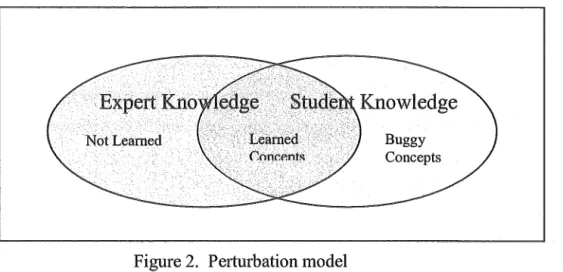
Whereas an overlay model assumes that the student's knowledge is a subset of that of an expert, a perturbation model recognises that the student may harbour misconceptions, or "buggy knowledge", which must also be represented. Figure 2 illustrates the notion of a perturbation model.
Figure 2. Perturbation model
Buggy Concepts
Building a perturbation model usually requires that the underlying domain model contain information about the mistakes students are likely to make, or "bug libraries" (Burton 1982) so that they can be identified in individual students' behaviour. For example, model-tracing tutors often include incorrect productions, which represent commonly made mistakes.
Other approaches
Researchers have recently begun to use machine learning to try to induce student models. ADVISOR (Beck and Woolf 2000) uses a functional approximator to predict the time taken to solve the next problem and the probability that the student will answer it correctly, based on the complexity of the problem, the student's proficiency, and the number of hints they have received for this problem. In Section 6.2 we use a variation of the rule induction algorithm PRISM (Cendrowska 1988) to infer a high-level student model from the low-high-level constraint information (Martin 1999). Gilmore and Self (Gilmore and Self 1988) similarly use an ID3 type classification system to learn the concepts the student has and hasn't learned.
2.1.4 Pedagogical module
This module decides what to present to the student next. It uses information from the student, domain and expert models to arrive at each decision. In effect, this module models the "teaching style" to be applied. For example, it may favour examples over the presentation of static text. It may make both 10w~level decisions, such as the level of difficulty of practice exercises, and high~level ones, such as when the student should move to the next topic of the curriculum. There are many different forms, depending on the teaching style being modelled, and the kind of information available: adaptive hypertext systems may only control page presentation, while the pedagogical module of a Cognitive tutor may determine problem difficulty, level of feedback, and when to declare that a portion of the curriculum is learned.
2.1.5 Communication Module
Also known as the interface module, it interacts with the learner, displaying information and accepting input from the student.
In this research, we are primarily interested in the domain and student models. With the exception of the authoring system in Chapter 7, which is a complete system built around CBM, we have intended the methods we have developed to be independent of interface or pedagogy.
2.2 The state of the art: Cognitive Tutors
Cognitive tutors (Anderson, Corbett, Koedinger and Pelletier 1995) model the domain to be learned as a runnable model (such as a set of production rules), that map out all the valid ways a student may solve the problem. Based on Anderson's ACT~R theory or "rules of the mind" (Anderson 1993; Anderson and Lebiere 1998), they were initially proposed partially as a means of validating Anderson's theories. Since then they have become successful tutors in their own right, the most celebrated being the Algebra Tutor, which has been shown to provide gains of 1 SD (over non-tutor users) in the subject of secondary school algebra (Koedinger, Anderson, Hadley and Mark
ACT theory: rules of the mind
The central tenet of Anderson's theory is that the processes of thought can be modelled using declarative and procedural knowledge. Whereas others have argued over which of these (if either) are a better representation of the mind, e.g. (Winograd 1975), Anderson contends that both are necessary. To be able to perform a task, a person needs the required procedural knowledge. However, before they can learn this they first need the underlying declarative knowledge. Learning then becomes a two-step process: first the student must acquire the appropriate declarative knowledge, and then they must develop this into the required procedural knowledge. Although humans can perform tasks where they have forgotten the declarative knowledge that led to their acquisition of the skill, Anderson asserts that they must have had that knowledge at some point.
Anderson produced a formal representation for declarative knowledge usmg chunks (Miller 1956) and procedural knowledge (production rules) to describe a person's knowledge state. This representation, plus the rules for their use and creation, forms the ACT theory. Since its inception in 1976, the ACT theory has been modified heavily, giving rise to several major versions: ACTE, ACT*, and several versions of ACT-R, of which the current is ACT-R 5.0. During this time Anderson has refined the definitions for chunks and procedural rules by restricting what can be represented in a single chunk or rule, and the way in which they can be generated. For example, a production rule may only produce one of the following six combinations of effects: no change, goal elaboration (current goal modification, no change to the goal stack), side effect (new goal on stack, no modification to current goal), return result (modify current goal, push new goal on stack), pop unchanged (pop completed goal without modification), and pop changed (modify current goal and pop off the stack). He believes his latest representation models the atomic components of thought. This is backed by empirical evidence: given an appropriate latency for the firing of each production rule and the retrieval of each chunk, simulations of tasks using Anderson's model display behaviour where the time taken to perform a task correlates closely with human performance on a wide variety of tasks.
2.2.2 ACT-R and learning
Any theory that describes the structures of thought must also be able to describe how they got there. ACT-R contains theories of learning for both declarative and procedural knowledge. As stated previously, production rules can only make modifications to goals. Since productions are also the only means of performing a mental action, goal chunks must be used to store new declarative knowledge. In ACT-R 4.0 when a novel problem is solved, a goal chunk is stored that essentially represents the solution to the solved problem (such as "the answer to 6+4 is 10"). If a person later solves a problem that is similar to an existing one, the two may be merged to form a more general declarative chunk. Thus declarative knowledge may be obtained from performing some procedure and remembering the result. For example, some children learn their addition tables by using counting to add numbers and remembering the answer. Note that this learning process is not deterministic: having noted that 6 plus 4 is 1 0, the child may subsequently fail to remember this fact and again resort to counting. However, the more times the child encounters the problem 6+4, the more likely they are to remember the answer. This is born out by experiment.
ACT-R 4.0 also describes the learning of procedures. As a person performs some procedure, they may at intervals seek to understand what they have done, so as to be able to repeat the task. ACT-R represents this via a dependency goal, which specifies the relationship between two (encountered) goals and the constraints upon when this dependency is valid. Consider the following point in a multi-column addition problem, which a child is being shown how to perform:
23 +34
7
At this stage the student is aware that 3
+
4 = 7. They have an initial state where nonumbers have been filled in, followed by the next state where "7" has been written. They also have a declarative chunk that corresponds to the two numbers in the
column, namely "7 is the sum of 3
+
4", They now create the dependency goal (in pseudocode) :Initial goal is ADD-COLUMN with values 3 and 4, and an answer of NIL
Modified goal is ADD-COLUMN with values 3 and 4, and an answer of 7 Constraint is FACT34: ADDITION-FACT 3 + 4 = 7
ACT-R now pops this dependency goal and creates a procedural rule from it. Since the values "3" and "4" appear in the initial and modified goals, plus the dependency, ACT-R assumes that such repetition is not coincidence, but that it indicates that such terms can be variablised, so the following rule can be induced:
IF
Initial goal is ADD-COLUMN with values NI and N2, and answer NIL
AND
There exists ADDITION-FACT NI + N2 = SUM THEN
Modify goal to ADD-COLUMN with values NI and N2, and answer SUM.
ACT-R 4.0 also provides a theory for the learning of the sub symbol parameters, i.e. how fast each piece of declarative knowledge can be retrieved and the speed and utility of performing the production rules. Together these four aspects of learning (creating declarative chunks, merging/generalising chunks, dependency goals for procedural learning, and retrieval speed and utility) constitute a robust theory of learning based on ACT-R's definitions of the atomic components of thought, which are well corroborated in practise.
2.2.3 Cognitive tutors
Cognitive tutors were initially developed in part to validate the (then) ACT* theory of mind. An early goal was that the tutors should possess a plausible model of what the student was trying to learn:
"The core commitment at every stage of the work and in all applications is that instruction should be designed with reference to a cognitive model of the competence that the student is being asked to learn. This means that the system possesses a computational model capable of solving the problems that are given to students in the ways students are expected to solve the problems."
Thus, from the outset Cognitive tutors have followed (versions of) the ACT-R theory of learning as described above, which continues to this day. Recall that learning in ACT-R is described as the acquisition of declarative knowledge chunks, followed by the compilation of procedural rules that apply declarative knowledge to tasks being mastered. Anderson believes that the acquisition of declarative knowledge is relatively straightforward and unproblematic compared with the subsequent refinement into procedural knowledge. Hence, Cognitive tutors focus on the acquisition of production rules and represent their domain models in this manner, supported by declarative knowledge chunks, which are assumed to already be learned. Initial work on Cognitive tutors was intended to support the ACT theory of skill-acquisition by showing that learning could be achieved by getting students to behave like the production-rule model. This required from the outset that the domain model be a complete model of the task being performed, specified using production rules. Tutoring is achieved using a method known as model tracing. As the student works at the problem, the system traces her progress along valid paths in the model. If she makes a recognisable off-path action she is given an error message indicating what she has done wrong, or perhaps an indication of what she should do. If the action is identified as being off-path but cannot be recognised, she may only be told that it is incorrect, but not why. Because of the combinatorial infeasibility of tracking the student's state relative to the correct path throughout the entire domain space, early Cognitive tutors forced the student to stay on a correct path. Later tutors relaxed this requirement somewhat, however this was done in an ad hoc way. For example, later versions of the LISP tutor (Anderson, Farrell and Sauers 1984) allowed delayed feedback, which dropped the necessity for the student to stay on a recognised path. Instead, if the student produced a program that could not be recognised, it was run against a set of test cases and accepted if it returned the correct results. This has the disadvantages that specific feedback may not be given for an incorrect solution, and that the student might "get lucky", producing an incorrect program that happens to work for the test cases.
Analogous to the model tracing technique for critiquing the student's action is the student modelling method of knowledge tracing. A Bayesian procedure is used to
estimate the probability that a production rule has been learned after each attempt. Formulas 1 and 2 give the probability that a production is in a learned state after a correct answer and an error, respectively.
(L
le) _
p(L
II _I)* (1-
p(S))
p 11-1 11 - P(L
)* (1-
(s))+ (u )*
(G)
11-1 P P 11-1 P (1)(L
lE) -
p(L
II _I)*
p(s)
p 11-1 11 - P(L
)*
(s)+ (u
)*
(1- (G))
11-1 P P 11-1 P (2)p(LII
_I) is the probability that the rule was already learned,
p(s)
is the probability ofa slip, p(UII_1) is the probability that the production was not previously known, and
p(G)
is the probability that the student guessed.This information is used to decide when the skills of a section of curriculum have been satisfactorily learned. Anderson et al. found that these skill probabilities could be used to accurately predict post-test performance (Corbett and Anderson 1992).
2.2.4 Example: LISP TUTOR
The LISP tutor (Anderson, Farrell and Sauers 1984) was an early attempt at a Cognitive tutor. The student is given a description of a small program to encode in LISP, which she then writes with the system's help. Interaction is similar to using a (very comprehensive) language-sensitive editor. As the user builds their solution, the system inserts tags that describe the general form of the program, for example (user input in bold):
(defun fact (n)
(cond «equalp) <ACTION» <RECURSIVE-CASE»)
The standard LISP tutor does not allow the student to stray at all from the model of desired performance. In the above example, the student needs to test for zero, for which there is a dedicated function. The tutor immediately interrupts the student and makes them use the ZEROP function, rather than the more general EQUALP. In fact, the use ofEQUALP is valid, however this would lead to a solution that is off the path
specified in the LISP tutor, because the authors have deemed it undesirable. Note that this is a design decision, rather than a characteristic of the modelling method. Further, the LISP tutor will interrupt the student at key points, even if no recognisable mistake has been made, if they perform actions that are not expected. In the previous example, this student is writing a recursive function. Anderson et al. determined that students tend to find the terminating case easy to write, but struggle with the recursive case. Therefore, if they perform any unexpected actions after writing the terminating case, the system asks them a question about the recursive case, even though they may be performing some valid action. If they fail to answer the question correctly, the system digresses with some exercises to help them understand the nature of the recursion they are trying to build. Again, this is an issue with the model being used, but it highlights how deficiencies in the model may lead to overly prescriptive behaviour.
In order to follow the student correctly, the LISP tutor needs to constantly know their intent. In many cases this is obvious, but in others (such as declaring one of several variables) further clarification is needed. The LISP tutor pops up a menu whenever something needs to be disambiguated. Once they have finished the exercise, they are presented with a standard LISP environment in which they can test their code.
The LISP tutor performs very well. In an initial mini-course at eMU, students using it solved a series of exercises in 30% less time than those in a standard LISP environment, and performed one standard deviation better on their final test. As a result, a full year course was devised using the LISP tutor, which" continues to this day. However, later evaluations failed to conclusively prove that the style of teaching used (notably comprehensive, immediate help) improved performance per se. Anderson et al. concluded that the main reason for improved performance in post-tests previously was probably because the LISP tutor enabled students to cover more exercises in the same amount of time, which subsequently gave them an advantage. However, this in itself is considered a worthwhile outcome, since enabling students to achieve their learning in less time gives them more time to learn additional material, or to do other things.
Summary
Cognitive tutors are some of the most successful to date. The PAT tutor for high school mathematics has produced gains as high as 100% for areas targeted by the system (Koedinger, Anderson, Hadley and Mark 1997). The model-tracing technique, on which they are based, is derived from a comprehensive theory ofleaming, ACT-R, and the results obtained with it strongly support that theory.
2.3 Motivation for change
Since Cognitive tutors are so effective and the technology for building them is well understood, it may seem unnecessary to explore other options. However, they harbour several outstanding issues. In particular, the following may be attributed directly to the Cognitive tutoring method, rather than to the wider field of ITS in general (Anderson, Corbett, Koedinger and Pelletier 1995): Cognitive tutors are hard to build, they may be too restrictive, and they may not suit all domains. These three issues are all related.
With respect to difficulty in building tutors, Anderson estimates the typical time to author a system is around 10 hours per production (Koedinger, Anderson, Hadley and Mark 1997), although this figure is not backed up by empirical data, and seems overly large. For example, Koedinger authored the 25 productions for Kermit in just a few days (See section 2.4.3). Complex domains may run into hundreds, perhaps thousands, of productions. Using the 10 hours estimate, a very simple tutor for teaching subtraction with carry requires at least six production rules (Blessing 1997), so would require more than a week's effort, and a domain such as SQL might take years just to author the production rules. Such effort would be a serious barrier to building tutors for very complex domains, yet this is where the need is arguably greatest.
Some domains are highly suited to a procedural approach. In arithmetic for example, there tend to be a few well-defined procedures for performing tasks such as addition, subtraction, and division. In others such as programming, this is not the case. Commenting on tutoring systems for programming in general, (Deek and McHugh 1998) note that:
"Intelligent systems present the student with a simple problem containing a clear definition, specifications and constraints. The student is then led into finding the
'ideal solution '. "
A consequence, they claim, is that students become dependent upon being led to the solution, and fail to develop the skills to determine the solution for themselves. Part of the reason for this is that often only a single solution path is encoded in the production rules. In the LISP tutor for example, the student is guided very closely along a particular path. For example, alternative means of testing a condition may be discounted by the tutor. Allowing greater flexibility in programming language tutors is difficult because they often contain a high level of redundancy. For example, in SQL there are three completely different problem-solving strategies for retrieving data from multiple tables. The following three queries all perform the exact same function (retrieve the name of the director of "Of mice and men"), but use different strategies:
SELECT lname, fname FROM movie, director
WHERE director = director.number and title 'Of mice and men' SELECT lname, fname
FROM movie join director on movie.director director.number WHERE title = 'Of mice and men'
SELECT lname, fname FROM director
WHERE number
=
(select director from movie where title
=
'Of mice and men')There is no obvious "ideal" solution to the above problem, although there may be criteria with which one could judge merit (e.g. efficiency). Further, there are many subtle details that could be modified arguably without affecting the quality of the solution, such as whether or not to qualify names (e.g. "director.lname"), and whether or not to use table aliases to shorten name qualifications. While such alternatives could be represented using the production rule approach, it would be a substantial undertaking. Even successful Cognitive tutors such as the LISP tutor are sometimes criticised for being too restrictive because they inevitably exclude valid solutions (Anderson, Corbett, Koedinger and Pelletier 1995; Deek and McHugh 1998), although it is arguable whether or not this affects learning. Since Cognitive Tutors
have been shown to be capable of producing dramatic learning outcomes (Koedinger, Anderson, Hadley and Mark 1997), this might even be a positive feature.
More importantly, in SQL the solution is structured into six clauses representing different aspects of the problem: what to select (SELECT), where from (FROM), any restrictions (WHERE), grouping (GROUP-BY), sorting (ORDER-BY) and group restrictions (HA VING). There is no right or wrong way to approach writing an SQL query. For example, some students may choose to focus on the "what" part of the problem first, and then fill in the restrictions, whereas others may first attend to the restrictions, or even sorting. Again, it is possible to encode all variations as separate paths through the production rule model, but this would make the mode large and unwieldy. Worse, the actual paths represented are of no importance to us. The production rule model is simply too low-level an abstraction for this type of domain. Similarly in data (entity-relationship) modelling, it is equally valid to define all entities and then their relationships, or define each pair of entities and their relationships simultaneously. Thus it appears that there are domains for which Cognitive tutoring is likely to be an unwieldy (or possibly unworkable) tool for modelling.
What happens when there is no "right" answer to a problem at all? For example, imagine a tutor for musical improvisation, where the student's input is via an instrument such as a keyboard and the "problem" is an accompaniment that the s