Succeeding with Your
Master’s Dissertation
Succeeding with
Your Master’s
Dissertation
A step-by-step handbook
Open University Press McGraw-Hill Education McGraw-Hill House Shoppenhangers Road Maidenhead Berkshire England SL6 2QL email: [email protected] world wide web: www.openup.co.uk
and Two Penn Plaza, New York, NY 10121-2289, USA First published 2008
Copyright © John Biggam 2008
All rights reserved. Except for the quotation of short passages for the purposes of criticism and review, no part of this publication may be reproduced, stored in a retrieval system, or transmitted, in any form or by any means, electronic, mechanical, photocopying, recording or otherwise, without the prior written permission of the publisher or a licence from the Copyright Licensing Agency Limited. Details of such licences (for reprographic reproduction) may be obtained from the Copyright Licensing Agency Ltd of Saffron House, 6–10 Kirby Street, London, EC1N 8TS.
A catalogue record of this book is available from the British Library ISBN-10: 0 335 22719 8 (pb) 0 335 22720 1 (hb)
ISBN-13: 978 335 22719 8 (pb) 978 0 335 22720 4 (hb) Library of Congress Cataloguing-in-Publication Data
CIP data applied for
Typeset by RefineCatch Limited, Bungay, Suffolk Printed in the UK by Bell and Bain Ltd, Glasgow
Fictitious names of companies, products, people, characters and/or data that may be used herein (in case studies or in examples) are not intended to represent any real individual, company, product or event.
This book is dedicated to:–
Three people, now deceased, all of whom left school in the days when it was unusual, if not exceptional, for those labelled ‘working class’ to continue with formal education beyond the age of 14: my father, Alexander, who did not have any formal qualifications; my mother, Margaret, who knew the value of them; and my father-in-law, William Macfarlane, who did not need any.
My wife, Kay, and my son, Jason.
The late Phil O’Donnell, of Motherwell F.C. and Celtic F.C. A gentleman and a role model to all students, regardless of field of study. Non scholae sed vitae discimus.
Contents
1
Introduction
1
A Master’s dissertation: what is it? 1
So, what skills do you need to succeed? 4
Watch your words! 10
How to use this book 12
Summary of key points 13
2
Preparing for your dissertation
15
Putting together your research proposal 15 Research focus and overall research aim 15 Research objectives and keywords 20
Research methods 22
Setting a timescale 23
Producing a dissertation template 25
Supervisor meetings 27
Summary of key points 29
3
The dissertation Introduction
31
The general structure of the Introduction 31
Background 32
Research focus (revisited) 37
Overall research aim and individual research objectives 39
Value of your research 44
A further suggestion 46
Summary of key points 48
4
The Literature Review
50
Focus on your research objectives 50
Referencing 54
Description vs critical evaluation 64 Learning theory and your dissertation 70 Structuring your Literature Review 73
Summary of key points 78
5
Research methods
79
What’s it all about? 79
Research strategy 82
Introduction 82
Quantitative vs qualitative research 86
Sampling techniques 88
Positivism and phenomenology 92
Justifying your research strategy 95 The question of reliability (and validity) 99
Data collection 101
Preparation, preparation, preparation 101
What and why? 104
Framework for data analysis 113
Limitations and potential problems 121
Summary of key points 127
6
Writing up your findings
129
The general approach 129
The process of description, analysis and synthesis: an example 132
Summary of key points 137
7
Concluding your dissertation
138
What’s in a Conclusion? 138
Research objectives: summary of findings and conclusions 140
Recommendations 147
Contribution to knowledge 151
Self-reflection 156
Summary of key points 160
8
Finally: Writing the abstract
162
What is an abstract? 162
How to write an abstract 163
Abstract template 167
Summary of key points 169
9
Practical issues
171
Presenting your work and preparing for a viva 171 Presenting your work: common mistakes 171
Preparing for a viva 176
The marking scheme 179
Good grammar 183
A word of warning: plagiarism 190
What counts as plagiarism? 191
What if you are accused of plagiarism? 197
10 Summary of good practice to adopt and bad practice to avoid
199
Forewarned is forearmed 199
Dissertation writing: summary of good practice to adopt
and bad practice to avoid 200
Practical issues: summary of good practice to adopt and bad
practice to avoid 202
Appendix A Sample Introduction 205
Appendix B Sample chapter outline 213
Appendix C Sample Literature Review Introduction 215
Appendix D Sample Literature Review Conclusion 217
Appendix E Sample Research Methods 219
Appendix F Sample Questionnaire 241
Appendix G Sample marking sheet 247
Appendix H Sample completed marking sheet 249
Appendix I Comprehensive set of useful verbs 251
Appendix J List of research objective keywords 255
References 256
Index 263
1
Introduction
A
Master’s
dissertation: what is it? • So, what skills do you need to
succeed? • Watch your words! • How to use this book
A
Master’s
dissertation: what is it?
A professor was approached by one of her students, who enquired: ‘Is it all right to put bullet points in an essay?’ Another student queried: ‘When you say you want journal articles, how many?’ This tutor was disappointed that her students required their assessment criteria to be explained in such minutiae (Wojtas 2006: 2). What may appear trivial to a dissertation supervisor can be a source of concern to you, the student. A Master’s dissertation involves the production of a substantial piece of work, normally consisting of about 15,000 words, and it is likely that this is the first time you have encountered such a work, in such depth; therefore, it is important that you understand fully what is required of a Master’s student and, equally, how to get through the dissertation journey, from grasping an overview of the main phases of writing a dissertation (submitting your dissertation proposal, writing your research objectives, writing the Literature Review, etc.) to the finer points of completing the content of each phase. This book provides detailed guidance on how to complete your dissertation, thus meeting the needs of students eager for practical assistance in this commonplace, but challenging, mode of assessment.
Dissertations have always been a problematic area for students. Students registered for a taught Master’s programme not only have to cope with their core subject areas, but they are also required, largely through independent study, and within tight time constraints, to complete a substantial dissertation project. Students registered for a Master’s by research, although they have no
taught element to contend with, often find the dissertation process equally stressful. For many Master’s students, their venture into the world of the dis-sertation becomes nothing short of a guessing-game, where the tasks to be completed are difficult to comprehend, and where the final mark awarded for their efforts is even trickier to fathom. Students are aware that they have to write an Introduction, but they are not really sure how to go about it; they sort of know that they have to complete something called a Literature Review, but they are at a loss where to start or what it ought to contain, or what will get them good marks; the section on Research Methods (necessary if students are implementing their own practical research work to complement their Litera-ture Review) seems so abstract to them, and concepts such as ‘positivism’ and ‘phenomenology’, so revered by their tutors, do not help matters; and so on.
There are many different types of Master’s dissertations: some focusing on a review of literature relevant to your topic of study; others also requiring the implementation of practical research; some involving a presentation of the dissertation findings; others, still, obliging you to attend an oral examination. At the heart of each of these dissertations is the study of a particular subject, usually selected by you, the student.
How does a Master’s qualification differ from an undergraduate qualification? The traditional view of a graduate degree qualification – such as a Bachelor of Arts (B.A.) in Business Studies – is that it is evidence that the holder of the degree has attained a level of general knowledge related to the subject area(s) named in the award (Hart 2006). For instance, a B.A. in History indicates that the holder has a general knowledge, at university level, of History, or specific aspects of history; similarly, a B.A. in Hospitality Management indicates that the holder has a general knowledge of hospitality management. A Master’s
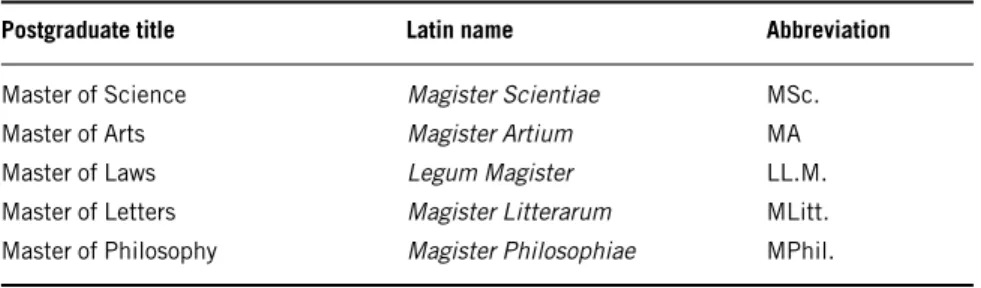
qualification, by contrast, signifies that the holder has gone beyond the acqui-sition of general knowledge and has advanced specialized knowledge of a sub-ject. Master’s programmes come in various guises, with the more traditional and well-known Master’s titles shown in Table 1.1.
Table 1.1 shows the more common type of Master’s titles – MSc., MA, MLitt., and MPhil. – but they by no means exhaust the list of Master’s titles found in university programmes. For example, Newcastle University in the UK offers a Master of Music (MMus.), while the University of Sydney in
Table 1.1 Traditional Master’s programmes
Postgraduate title Latin name Abbreviation
Master of Science Magister Scientiae MSc.
Master of Arts Magister Artium MA
Master of Laws Legum Magister LL.M.
Master of Letters Magister Litterarum MLitt. Master of Philosophy Magister Philosophiae MPhil. 2 SUCCEEDING WITH YOUR MASTER’S DISSERTATION
Australia lists a Master of Design Science (MDESSC.) within its postgraduate portfolio, and the University of Nevada in the USA advertises a Master of Education (M.Ed.). The form of the title abbreviation is left to individual institutions, with some institutions italicizing the title abbreviation (e.g.
MDESSC.), some placing a full stop after the abbreviation of Magister (e.g. M.Ed.), while others ignore full stops and italics altogether (e.g. MEd, MSc, MPhil, etc.).
Confusingly, an MSc. does not necessarily indicate that the topics studied are science-based, as many business schools within universities now offer MSc. programmes (e.g. MSc. in International Business). Equally confusing is the fact that not all Master’s programmes are postgraduate programmes, where a related degree is the usual entrance qualification. For instance, the MA is traditionally viewed as an undergraduate degree in the UK, yet when offered in the USA it is normally offered as a postgraduate qualification. It is worth noting that uni-versities in the UK and the USA sometimes use different terminology to refer to postgraduate programmes – UK universities stick to the term ‘postgraduate’ while universities in the USA commonly use the term ‘graduate’. For example, the University of Chicago publicize their LL.M. as a graduate degree while the University of Cambridge present their LL.M. as a postgraduate degree, but both qualifications are advanced law degrees requiring a degree qualification for entry.
A critical element of any Master’s programme, whether it is an advanced undergraduate degree (such as an MA in the UK) or a postgraduate programme proper (such as an MSc.), is the requirement to complete a dissertation. So, what is a dissertation? The Concise Oxford Dictionary (1998: 391) defines a dissertation as ‘a detailed discourse on a subject, esp. one submitted in partial fulfilment of the requirements of a degree or diploma’. In effect, it appears to be a very long essay. In the context of a typical Master’s programme, it is a focused ‘essay’, typically about 10,000–15,000 words in length (the MPhil. dissertation, often referred to as a thesis, is different in that the word length is easily in the range 30,000–50,000). A dissertation is more than an extended essay, though: it is an independent piece of work (by you, the student) to be completed in such a way as to satisfy the examiner(s) that you are a competent researcher with advanced knowledge on a specific topic, normally chosen by you, which relates to your Master’s programme.
A Master’s dissertation, as with Master’s titles and programmes, can come in many shapes and sizes, varying from university to university, and even within different departments in the same university. The types of Master’s disserta-tions available to you can include the straightforward Literature Review; or a work-based report, in which you explore a particular problem in an organiza-tion where you have worked, making practical recommendaorganiza-tions based on your findings; or a laboratory-based dissertation, where you carry out experi-ments and then report on your results; or a dissertation which encompasses both a Literature Review and the collection and analysis of your own primary research data, providing you with the opportunity to compare theory (from
your Literature Review) with practice (from your collected primary data, e.g. from interviews or questionnaires).
Your university should provide you with a Master’s Handbook containing clear guidance on aspects of your dissertation. The Handbook will normally clarify the maximum length of your dissertation, dissertation format (line spacing, text type and size, style of referencing, page numbering, dissertation structure, etc.), expected minimum content for each major section of your dis-sertation (e.g. main areas to be covered in your chapter on Research Methods), the department’s marking scheme, and details of your role and responsibilities. Successful completion of a Master’s dissertation, however, is more than adhering merely to university dissertation requirements and guidelines: you need competence in specific dissertation-related skills and a certain street savvy about the rules of the game.
So, what skills do you need to succeed?
Basically, to pass your Master’s dissertation you need to show that you are a
competent researcher. On the face of it, this is quite a difficult task, mainly because this is probably the first time that you have attempted an independent piece of research work of this magnitude. A competent researcher is someone who can, in the context of a Master’s dissertation, exhibit proficiency in tack-ling the various phases normally found in the Dissertation Life Cycle (DLC), illustrated in Figure 1.1.
To complete the DLC successfully you require to show proficiency in skills specific to each stage of the cycle, i.e. you need to be able to do the following:
• Put forward a credible research proposal (Stage 1 of the DLC).
• Evaluate literature, from a variety of sources, pertinent to your research objectives (Stage 2).
• Cite sources – books, journals, web sources, conference proceedings, etc. – using a standard acceptable to the academic community, e.g. Harvard style of referencing, or American Psychological Association (APA) citation style, etc. (Stage 2).
• Identify (and justify) how you will collect (and analyse) your own research data (Stage 3).
• Carry out your own empirical research (Stage 4). • Discuss and analyse your findings (Stage 5). • Wrap up your research work (Stage 6).
Be aware that the DLC is rarely a straightforward linear process, where the journey from Stage 1 to Stage 7 is smooth and untroubled. More often than not, you will find yourself revisiting previous stages, usually as a result of
discussions and advice from your supervisor or perhaps because you have found additional material that enhances aspects of your dissertation. The DLC is an iterative process, so get used to the idea that you will be looking over your shoulder to review and improve earlier parts of your dissertation. Also, there are other elements to a dissertation that are not listed as main phases of the DLC, but which nonetheless will be included in your final submission, such as an Abstract (sometimes referred to as the Synopsis), an Introduction, and a section listing your References (all of which are discussed in detail later).
As stated earlier, there are different types of Master’s dissertations and they all involve research of one kind or another. You may be asked to carry out a review of literature pertinent to your research objectives. Or in addition to a review of literature you may be required to collect your own research data, to compare
Figure 1.1 Dissertation Life Cycle (DLC)
what you found out in your literature review against your own practical research findings (this is the more traditional dissertation). Alternatively, your dissertation may be framed in the form of a work-based report. Regardless of the type of dissertation that you are being asked to complete, the DLC still holds.
As well as skills pertinent to particular stages of the DLC – producing a credible research proposal, critically evaluating relevant literature, etc. – you will also require generic skills, i.e. skills that are useful regardless of the stage of the DLC in which you find yourself:
Generic skills
• Time-management skills. You need to be able to manage your time effect-ively. You do this by adopting two types of time-management perspectives: macro-management and micro-management. Macro-management requires that you manage your time in terms of the bigger dissertation picture, guessing intelligently how long you think it will take you to complete each chapter in your dissertation, dovetailing nicely into the required submission date. Pivotal to the macro-management of your time is the need to work backwards from your dissertation submission date to generate an effective time framework. Micro-management occurs when you work out the time it will take you to do the sub-sections that go to make up a particular chapter. For example, as a result of a macro approach to managing your time, you might decide that it will take you three weeks to write the introductory chapter to your dissertation and that, switching to micro mode, this chapter will have three parts to it and that you intend allocating one week to each part. Remember to allow time for the binding or presentation of your disser-tation in accordance with your university’s regulations. Apportioning time slots, in both macro and micro management mode, will give you a sense of awareness about what lies ahead and with that insight comes a sense of control over your dissertation.
• Linked to time-management skills are organization skills. You will have to organize a variety of dissertation-related activities: meetings with your supervisor, the overall structure of your dissertation, sub-sections within each chapter, your ideas and arguments, visits to the library, internet-based activities, reading material, cited sources, meetings with research subjects (e.g. people you might want to interview), and so on.
• Self-discipline skills. Keeping to your own timetable of activities will not prove easy. You will have other demands on your time, some predictable (e.g. parties, holidays, other assessments, part-time work, family commit-ments, etc.), others unpredictable (illness, relationship problems, family issues, etc.). Supervisors are realistic and accept that most students stray from their dissertation work from time to time, but the key to avoid 6 SUCCEEDING WITH YOUR MASTER’S DISSERTATION
complete derailment is self-discipline, and that requires focus and an inner strength to keep going when things are getting on top of you. Time-management and sound organization will help you achieve a disciplined approach to your dissertation.
• Communication skills, both verbal and written. Communicating your ideas, arguments, rationale for choices, whether at meetings with your supervisor or in your submitted work, requires clarity of thought and expression. If you cannot say or write what you mean, then your work will be hindered. Sloppy grammar in written work is a particular concern highlighted by many supervisors. When communicating, in whatever form, keep it simple, keep it clear and keep it relevant. Cluttered waffle helps no one!
• Effective communication also requires good listening skills. It is important that you learn to listen to your supervisor when he gives you advice – he is not doing so for the good of his health. When your supervisor suggests that perhaps you should alter an aspect of your work in some way, he is telling you politely that it is deficient in some respect and that corrective action can be achieved by taking on board his counsel. In effect, he is telling you how to gain marks and avoid losing marks. He is marking your dissertation, so it makes sense that you heed his advice.
• Presentational skills. You may be required to present your work to examiners, in which case you ought to be aware of how to produce a skilful presentation, including use of technologies, voice projection, structure of content, audi-ence engagement, etc. Presenting your work periodically to friends (and your supervisor) will provide you with invaluable experience in appreciating what works and what does not.
• Social skills. Getting on well with people – your supervisor, fellow students, research subjects, departmental secretary, etc. – will ease your dissertation journey.
• Technical skills. Internet searching skills, library skills, email and word processing skills are all essential aspects of dissertation work.
• Independent learner skills. This is the main difference between under-graduate degree work and Master’s level work: the shift from directed learn-ing to independent learning. Most dissertation handbooks highlight the importance of this requirement by including a separate section in the handbook on your responsibilities, emphasizing that it is your responsibility to identify a research topic, to put forward a research proposal, to plan and implement your dissertation activities and to be proactive in contacting your supervisor (i.e. to produce an independent piece of research). If you are a final-year undergraduate student considering applying to ‘do’ a Master’s programme, then you need to appreciate that Master’s work is very different from undergraduate work. Essentially, the difference is that at undergraduate level the learning primarily takes place through the lecturer (in the form of lectures, seminars, tutorials, laboratories, etc.) whereas at
Master’s level the learning is mainly student-centred, i.e. there is a major shift of responsibility from the tutor to you, the student. This is no more evident than in the Master’s dissertation, where the responsibility for selecting the research topic and writing the actual dissertation lies with the student; your supervisor acts as a guide, albeit an important one. Taking responsibility for your own work can be quite liberating, but it requires the development of new skills and confidence in your own abilities. By covering the Master’s dissertation process in detail, from start to finish, this book provides the practical skills necessary to allow you to approach each stage of your dissertation with confidence.
Dissertation work can be a lonely process, so it is no bad thing to mitigate any sense of isolation by sharing your ideas about your work with your fellow students. This can be done more formally and constructively through some-thing called learner circles (Biggam 2007a). This is where a group of students – a learner circle – get together, e.g. over coffee, to discuss their work-in-progress at regular intervals. They can also formally present their work to one other, using modern technology such as a data projector to display PowerPoint pre-sentations, in which case they would need to borrow the data projector from their department and book a university room, all of which show initiative and engender a sense of togetherness. Learner circles are normally led by a super-visor, in effect, enacting group supervision, but they can be set up by students themselves, without the participation of supervisors. Akister et al. (2006) pro-duced evidenced-based research showing that students who were supervised in groups were more positive when undertaking their dissertation and had a higher completion rate than students dependent on the more traditional one-to-one supervision model.
Finally, in addition to the aforementioned skills – specific and generic – there are certain personal qualities that are necessary prerequisites for the completion of a successful dissertation: self-motivation, self-confidence, and self-centredness. A lack of motivation, i.e. personal drivers (for example, in pursuit of a particu-lar career path or intention to register for a higher degree), will reduce greatly the chances of you completing your dissertation. A Master’s dissertation is the type of assessment that demands your time, concentration and enthusiasm over a lengthy period. A serious lack of genuine interest on your part will cause you to view every task as a tiresome activity, with the first real difficulty encountered probably resulting in the abandonment of your dissertation. On the other hand, if your motivation is strong, and you adopt a positive out-look, you can face every stage with enthusiastic curiosity, making the whole experience enjoyable and, ultimately, fruitful.
Have confidence in your own abilities. Occasional self-doubt is natural – everyone, staff and students, suffers from bouts of self-doubt. It is a natural human condition. In a Master’s dissertation you are required to judge the work
of other researchers (for example, within your review of literature) and to do so calls for a level of self-confidence to express your views on what these people are saying. One tutor recalls his student lamenting, ‘Who am I to criticize this author when I am just a student and he has such an international reputation?’ Your views are as valid as anyone else’s (providing, of course, you back them up with supporting evidence!). You are on a Master’s programme because the admission’s tutor has confidence that you will complete your studies. Your supervisor is giving you the benefit of his time and expertise because he has confidence that you will produce a solid piece of research, providing that you follow his advice. Nothing pleases a supervisor more than when his students pass, and with flying colours at that! Others have faith in your abilities, so have faith in yourself.
There will be occasions during your dissertation journey when others – friends, family members, boyfriends/girlfriends, partners, spouses, etc. – will make demands upon your time. On such occasions you need to remind your-self that your priority is your dissertation – if you respond to every request for help from those around you then you will have difficulty in concentrating on your work. Self-centredness is a quality that will serve you well during your dissertation. From the outset, inform those close to you that you are serious about completing your dissertation, that it is a priority for you, and that you will require understanding and patience from others as you devote your time and energies to give of your best. A book worth reading on how to make the best of your dissertation time is Roberts (2007), Getting the Most out of the Research Experience.
Figure 1.2 summarizes the combined skills – specific and generic – and personal qualities that you need to complete a winning dissertation.
What of the rules of the game? Although this is your first time attempt-ing a Master’s dissertation, your supervisor has probably seen hundreds of dissertation students pass through his door. Through experience, he has learned how to assess the type of dissertation student he is supervising. With each meeting, email communication, telephone conversation, work-in-progress submitted, he will form an accumulative picture of your abilities. The rules of the game refer to not only the university’s formal rules and regu-lations in terms of your submitted dissertation (word count, page format, style of referencing, etc.) but also to the informal, unwritten processes and behaviour that constitute your dissertation journey, such as how you conduct yourself at meetings with your supervisor, the impression you give when you email your tutor, the quality of your work-in-progress, and so on. For example, if at meetings with your supervisor you ask no questions or spend your time complaining that you cannot find any material on your chosen subject area (a common student complaint!), then you are ignoring the informal rules of the game: if you want to be viewed as a ‘good’ student, then behave like one (ask questions, discuss enthusiastically the work that you have researched, show initiative, etc.).
Watch your words!
Your dissertation handbook will stipulate the maximum number of words that your submitted dissertation must not succeed, for example it might state that ‘The word limit for your dissertation must not exceed 15,000 words’. Or your dissertation guidelines may include a word limit with a leeway of +/− 10 per cent, meaning that you can be 10 per cent over the recommended word limit or 10 per cent under the recommended word limit, without suffering any penalty.
It is important that you adhere to the stated dissertation word-length for your Master’s dissertation, for a number of reasons. The first, and obvious reason, is that you may lose marks for ignoring your institution’s guidelines. If your dissertation was to be written in no more than, say, 10,000 words, and you write 14,000 words then you may be penalized before your marker actually starts to read your dissertation! The actual penalty incurred depends on your institution’s rules and regulations, but it is not uncommon to lose 5–10 per cent of your overall marks. On the other hand, your institution may ignore your transgression, provided the extra words add value to your disserta-tion. One tutor in a university was known to stop reading (and marking!) a dissertation after the allocated words had been reached! Incidentally, if you
Figure 1.2 Skills and qualities needed to succeed
have exceeded the recommended number of words but your institution’s handbook makes no mention of a possible penalty for such a breach, then you may be in a position to argue that you should not be penalized because the lack of a stated penalty implied to you that none would be given or that the recommended word-length was not to be taken too seriously.
When you start your dissertation you will have no idea whether or not you will exceed your allocated dissertation word-length. It is only when you are knee-deep in the write-up that you will begin to get an inkling of how quickly you might be eating up your available words. For instance, suppose that you have just finished writing your Literature Review and that it took you 8,000 words to do so. However, from sample dissertations borrowed from the university library, you noticed that the number of words used for that particular section was typically in the region of 3,500. As a result of this comparison, you might reasonably conclude that you are in danger of exceeding your overall word-length. This issue reflects how well you have
micro-managed your activities: the tasks that you have to do (e.g. write your dissertation Introduction, Literature Review, Research Methods chapter, col-lect data, etc.), the time you expect each of these tasks to take (e.g. one week for the Introduction, six weeks to write the Literature Review, etc.), as well as the number of words that you anticipate each dissertation chapter/section to use up (e.g. 800 words for the Introduction, 3,500 words for the Literature Review, etc.).
Another reason why exceeding the recommended word-length may be unwise is that you may be guilty of padding. Sticking to an expected word-length is evidence that you can say something in a given number of words. If you go over the word-length, then you may be indicating an inability to write succinctly. Padding occurs when you include irrelevant material in your dis-sertation, just for the sake of ‘beefing up’ your dissertation. It is easy to spot and, at best, will not gain you extra marks: more often than not, it will lose you marks, because it is an unnecessary distraction, interfering with the focus and substance of your dissertation. It is a great temptation to include material that you have read, even if it is not really relevant, just because you have gone to the trouble of finding and reading it! Have the courage to reject what is not essential to your dissertation’s research objectives.
What do you do if you suspect that you are going over the recommended dissertation word-length? First of all, remove any padding, i.e. excise unneces-sary material. If you still consider that you need extra words to play with, then ask permission to exceed the word-length. Write to your supervisor, giving the following information:
1 your request to exceed the recommended word-length;
2 the (new) word-length that you need to complete your dissertation; 3 the reason(s) for needing the extra words.
Point three above is important. It is insufficient to write, for example, that you
need an extra 3,000 words over and above the recommended limit because that is how many words it has taken you, or will take you, to complete your dissertation. It is likely that your supervisor will write back to you, advising that you are in the same boat as other students and that you need to reduce your word-length accordingly. On the other hand, if you were to explain, for example, that your data collection was extensive and that to do it justice you require the extra words to capture the richness of your empirical work – then you would be better placed to secure permission to exceed the word-length without penalty. You need to think about the position of your supervisor when you make a request to go over the word-length: if he allows one student,
without good reason, to exceed the word-length, then he must make the same opportunity available to all his students, which makes the idea of a word-length meaningless. Hence the need for a valid reason to go beyond the declared word-limit.
Finally, it is good practice when you have finished your dissertation to include the word-count near the start of your dissertation, somewhere between the cover page and your introductory chapter (check your Disserta-tion Handbook for guidance). All word-processing software has a facility for a word-count. Remember to exclude appendices from your word-count, as they are not normally included.
How to use this book
Writing a Master’s dissertation is not easy: if it were, then it would not be worth doing. Consequently, there are so many areas where you can fall down. Fortunately, there are things that you can do to minimize the chances of mediocrity – or worse, failure – and improve the opportunities to secure impressive marks. This book takes you patiently through the stages of a disser-tation – the Disserdisser-tation Life Cycle – explaining how to gain (and lose!) marks at each stage of the marking scheme, as well as exploring a worrying feature in many dissertations: plagiarism (Biggam 2007b). The topics to be covered include: submitting your research proposal; writing the introductory chapter to your dissertation; clarifying your research objectives; how to reference and review literature; describing and justifying your research methods; devel-oping a framework for analysing your empirical research; producing a solid conclusion to your work; writing a competent abstract; presenting your work; and the importance of good grammar. Throughout, detailed sample answers, together with relevant practical examples, will be used to illustrate good and bad practice. As you approach each stage of your dissertation, use this book for comprehensive guidance on good and bad practice.
A common mistake by students
In each chapter, common mistakes made by students with regard to disserta-tion writing will be highlighted. For instance, if it is necessary to warn you about bad practice related to referencing literature, then this study will go on to indicate errors that are commonly made by students when they try and reference works that they have read. For example, a common mistake by stu-dents is not to take the advice of their dissertation supervisor, although one student, after listening attentively to his tutor explaining the technique of writing a Literature Review, and ending his advice with the words ‘blah blah blah’, took his tutor’s advice too literally. When he submitted his Literature Review it contained only the words ‘blah blah blah’!
To get a good start on your dissertation it is necessary to be well prepared for what lies ahead, otherwise ‘a great deal of time can be wasted and goodwill dissipated by inadequate preparation’ (Bell 1993: 1). To prepare properly you will need to appreciate the phases that your work will go through, from outlin-ing your research objectives to concludoutlin-ing your dissertation, and know how to address each of these phases. This book will take you through each phase in detail. By the end of this book you should understand the parts that go to make up a dissertation, what makes a good dissertation and, just as import-antly, why students often fail to secure easy marks. Writing a dissertation need not be a guessing-game. Writing a dissertation that will achieve pass marks or – even better – excellent marks is as much a technique as it is an art. The aim of this book is to lay bare the techniques that you need to undertake a disserta-tion, in effect, to equip you with the knowledge and skills to produce a highly competent piece of work. There is truth in the old adage knowledge is power; in your case, knowledge equates to marks.
Summary of key points
• An undergraduate degree is evidence that the holder has a general know-ledge of the named subject area; a Master’s degree is normally a postgradu-ate qualification, indicating that the holder has advanced knowledge of the named subject area.
• Master’s programmes come in many guises (taught Master’s, Master’s by
research, with a variety of titles – M.Litt., MSc., MPhil., MMus., etc. – and different assessment requirements).
• The Master’s dissertation is a long research-based essay, typically 10,000– 15,000 words in length. There are a variety of types of Master’s dissertations (work-based dissertations, laboratory-based dissertations, literature review-based dissertation, literature review and empirically-review-based dissertations, etc.).
• The Dissertation Life Cycle (DLC) highlights the conventional stages of the dissertation journey: produce a research proposal, write a Literature Review, design appropriate research methods, implement empirical research, ana-lyse the findings, conclude the research, and submit the completed work. • To complete a Master’s dissertation, you require a combination of generic skills (time-management, organizational, self-discipline, communication, listening, presentational, social, technical, independent learner skills) and personal qualities (self-motivation, self-confidence, and self-centredness), as well as skills specific to dissertation-writing (submitting a realistic research proposal, writing a Literature Review, proper citing of sources, etc.).
• Take cognizance of the maximum word-length for your dissertation. If you anticipate exceeding the word-limit, then request permission from your supervisor, giving your reason(s).