1.1 BACKGROUND
No one can avoid sickness, getting old, and death. When people get sick, they are likely to spend money for medical expenses and treatment. Some may lose the ability to work, and in the worse case they may lose their life. Humans face a variety of risks such as property loss from fire or storms and personal losses from disability or premature death. As these perils are unavoidable and people cannot predict the future, they need to seek a guarantee of stability in their lives. The best answer is insurance which helps people safeguard themselves against unfortunate situations or catastrophe. Insurance also provides people with the advantage of sharing the losses and the substitution of certainty for uncertainty.
Moreover, humans cannot live alone in the universe. People not only work for their life stability, they are also concerned with the wellness of their loved ones, such as children, parents, spouses or relatives. As a result, life insurance plays an important role in a person’s life. When premature death unfortunately takes place among the insured, life insurance can indemnify his/her financial loss (Huebner & Black, 1969, p. 3).
In Thailand, the life insurance business has grown over the years. Although the economy at present has slowed down throughout the world, life insurance has
continued growing. According to the Thai Life Assurance Association (
สมาคมประกัน
ชีวิตไทย
, 2550), the total premiums in the first quarter of 2009 were 58,325.3 million baht, higher than the premiums in the same period last year. Besides, the total of first year premiums in January 2009 was 3,189.1 million baht, with about 83% being ordinary life insurance. In addition, 177,010 ordinary life insurance policies were sold to individuals, accounting for 90% of the total amount of life insurance policies sold in January 2009 (The Thai Life Assurance Association [TLAA], 2009). These figures reflect that more individuals are paying attention to life insurance, causing theThe more people become involved with life insurance, the more they are confronted with insurance contracts and agreements. They may face
misunderstandings about the content in the agreements, which may result from unclear explanations by the insurer, the ignorance of the insured, or difficult wording in the agreement. Such misunderstandings can lead to serious disputes between the insured and the insurer or many other unexpected situations.
The Foundation for Consumers (
มูลนิธิเพื่อผูบริโภค
, 2552) revealed that there have been 1,114 cases of life insurance complaints since January 2008. One of the major reasons for the complaints is that people misunderstand the conditions of life insurance policies.The content and conditions in an insurance policy are based on at least three types of laws: the Civil and Commercial Code, the Life Insurance Act, and the
Revenue Code (
โกศล
อนุสิม
, 2551). Most of the insured fail to read their policy because the formal language and jargon seems difficult to understand. Furthermore, many insurance agents neglect to explain the conditions and the exceptions in the policy to the insured. As a result, the insured do not receive benefits because they break the rules intentionally or unintentionally. Such situations often lead to disputes between the insurers and the insured.For example, one insured person’s beneficiary sued an insurance company for the insured’s death claim payment. The insurance company refused to pay this sum to the beneficiary because the insured intentionally concealed that she had heart disease and high blood pressure when applying for insurance, as she was afraid that the company would not agree to insure her due to her pre-existing health problems. Thus, this policy was voided and not effective. The Supreme Court agreed that the company did not have to pay the money to the beneficiary because the insured violated the
contract (
ศาลฎีกา
,
2549).Insurers must detail the conditions and the regulations of the policy for the insured. On the other hand, the insured need to study the life insurance policy in order to be aware of his/her rights. Understanding the coverage the insured has purchased is significant; serious misunderstandings can be avoided if the insurance buyers read and
understand the policy admonitions, which always appear in bold faced type on the outside of the policy (Allen & Simon, 1961, pp. 3-4).
As studying the conditions and the regulations of an ordinary life insurance policy can prevent serious disputes between the insurers and the insured, the results of this study can be used as guidelines toward better communication in the future
between the insurer and the insured.
1.2 STATEMENT OF THE PROBLEM
This study was conducted to answer the following question:
Do the insured have knowledge ofthe conditions and regulations of ordinary life insurance policies?
1.3 OBJECTIVE OF THE STUDY
To investigate whether the insured have knowledge ofthe conditions and the regulations of ordinary life insurance policies in four categories:
1) Insurance contract 2) Premium payment 3) Grace period
4) Rights in relation to surrender value
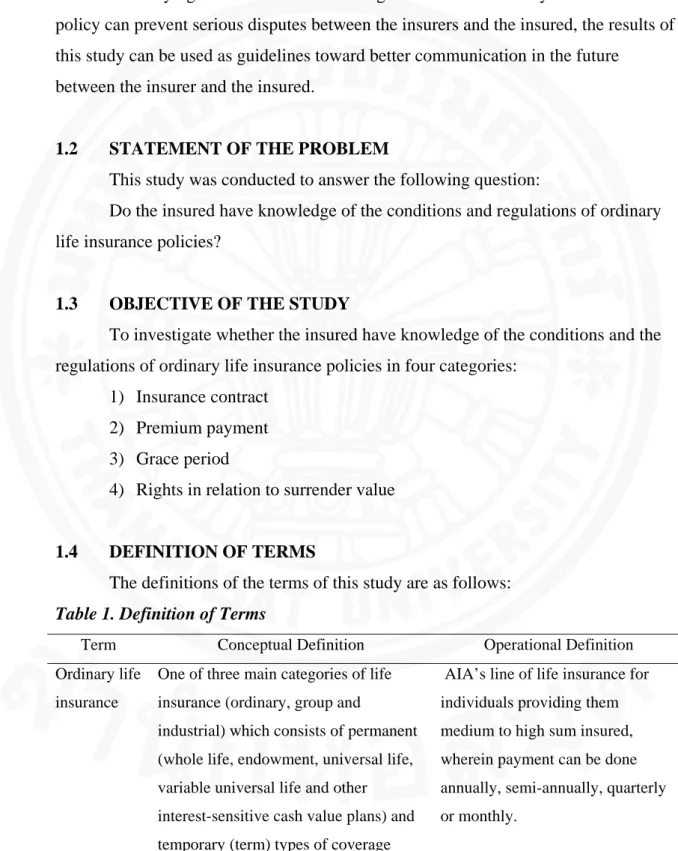
1.4 DEFINITION OF TERMS
The definitions of the terms of this study are as follows: Table 1. Definition of Terms
Term Conceptual Definition Operational Definition
Ordinary life insurance
One of three main categories of life insurance (ordinary, group and
industrial) which consists of permanent (whole life, endowment, universal life, variable universal life and other interest-sensitive cash value plans) and temporary (term) types of coverage
AIA’s line of life insurance for individuals providing them medium to high sum insured, wherein payment can be done annually, semi-annually, quarterly or monthly.
Table 1 (continued)
Term Conceptual Definition Operational Definition
Conditions An arrangement that must exist before something else can happen
The terms and restrictions in an ordinary life insurance policy of AIA
Regulations An official rule or the act of controlling The rules in practice of the ordinary life insurance policy of AIA
The insured The person, group of people or organization who is insured in a particular agreement
A person who owns an ordinary life insurance policy of AIA
Knowledge Understanding information about a subject, which has been obtained by experience or study and which is either in a person's mind or possessed by people generally
Understanding the conditions and the regulations of an ordinary life insurance policy
1.5 SCOPE OF THE STUDY
This study was limited to investigating the insured’s knowledge of the conditions and regulations of ordinary life insurance policies.
The researcher was interested in ordinary life insurance policies because such kinds of policies account for the largest number of life insurance policies sold to individuals in Thailand. One hundred persons insured by American International Assurance Company Limited (AIA) in Nakhon Pathom and Bangkok were selected as the subjects.
1.6 SIGNIFICANCE OF THE STUDY
The results from this study will be useful to the insured, insurance agents, insurance companies and government agencies in the following ways.
First, the questions from the questionnaire may help some of the insured to become aware of the conditions and regulations of their own policies. This may lead them to read the policy or find out more information from other sources, such as their agents or the internet.
Second, the results will be useful for agents in promoting their customers’ knowledge of life insurance, and to encourage them to read their own policy.
Third, the results will be useful for insurance companies and government agencies in designing more effective ways to promote insurance knowledge for their present and future customers. If most people gain more knowledge and read their policies as a habit, they will be aware of their rights in the policy and have a more positive view towards life insurance.
1.7 ORGANIZATION OF THE STUDY
The study in this paper is divided into five chapters. The first chapter consists of the background, the statement of the problem, objective of the study, the definition of terms, as well as the scope, significance, and organization of the study. The second chapter is a review of the related literature. The third chapter consists of the subjects, materials, procedures, and data analysis. The fourth chapter shows the results of the study. Finally, the last chapter includes the summary and findings of the study, as well as the discussion, conclusion, and recommendations for further research.