Multicast
1+1
protection: the case for simple
network coding
Mirzad Mohandespour
Dept. of Electrical and Computer Eng.Iowa State University Ames, IA 50011 Email: [email protected]
Ahmed E. Kamal
Dept. of Electrical and Computer Eng. Iowa State University
Ames, IA 50011 Email: [email protected]
Abstract—We discuss how the idea of unicast 1+1protection can be efficiently extended to protect multicast connections in optical backbone networks. Particularly, we show how to achieve instantaneous failure recovery and cost efficiency by allowing intermediate nodes to merge their incoming flows by a simple network code, i.e., logical OR operation. Under simple network coding, the problem of minimum cost multicast 1+1 protection is formulated as a 2-connectivity problem. In order to solve this problem, an optimal ILP and three efficient heuristic algorithms are proposed. Simulation results on real-world networks show that the average cost of our best heuristic algorithm is only 2.6% higher compared to the optimal ILP solution.
I. INTRODUCTION
Multicast is a one-to-many traffic model in which a source node transmits the same information to a set of destination nodes. Such traffic model is used in backbone networks for provisioning high data rate applications such as Internet TV (IPTV) [1][2], distribution of financial information [3], and data dissemination in cloud and grid computing [4]. Many such applications demand highly available always-on connections. Underlying backbone networks, on the other hand, are subject to service disruption because of link and component failures. Moreover, even a single link failure can disrupt the connection to multiple destination nodes in the multicast traffic model. Therefore efficient multicast protection techniques that satisfy availability requirements are needed.
While multicast protection has been the subject of extensive studies, most of proposed techniques are tuned for non-instantaneous recovery, i.e., when a certain amount of delay in recovery is acceptable. In this paper we focus on the problem of multicast protection with instantaneous failure recovery.
Dedicated 1+1protection has been commonly used in
op-tical networks to provide instantaneous failure recovery against single failures for unicast connections. A pair of disjoint primary and backup routes are used to deliver two copies of each data unit from source to destination simultaneously. Failure of one route therefore causes no service disruption. If a multicast connection was provisioned as a set of independent unicast connections, the same technique could be directly applied to each connection. However, clearly that does not provide a cost efficient solution. When a tree is used to provision a multicast connection, a natural generalization of
the idea of1+1protection is to have a pair of disjoint primary
and backup trees connecting source to all destinations. While the cost efficiency is improved here, the required connectivity could be higher. If the network is 2-connected, one can always find a pair of disjoint paths between the source and each destination node but not necessarily a pair of disjoint trees.
The idea of1+1protection has been used in [5] to design
a cost-efficient multicast protection technique against single link failures. A minimum cost disjoint path pair, Optimal Path
Pair (OPP), is found from source to each destination. In order
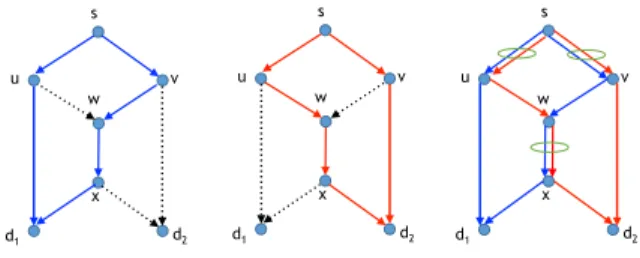
to reduce the cost, path pairs to different destinations are allowed to share bandwidth on common links. Figure 1 shows
an example of how OPP works. A multicast connection is
given with source node s and destination nodes d1 and d2
on a Butterfly network. Assuming that one unit of capacity is s u v w x d1 d2 s u v w x d1 d2 s u v w x d1 d2
Fig. 1. Unicast1+1protection vs.OPP
reserved on each link of each path to each destination, the total
reserved capacity without sharing is6 + 6 = 12in unicast1+1
protection. In the case ofOPP, total reserved capacity would
be reduced to12−3 = 9because of sharing on links(s, u),
(s, v), and(w, x). However the capacity improvement byOPP
has a negative effect on the recovery delay.
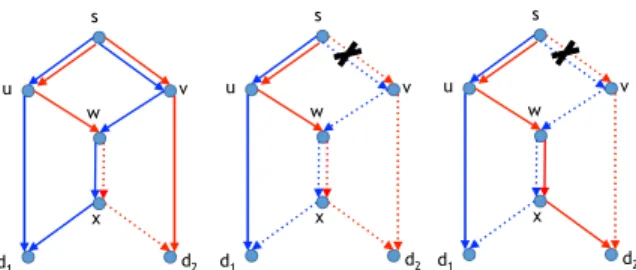
Even though OPP finds two disjoint paths per destination
node, because of the link sharing it cannot send two disjoint
flows to all destination nodes. In Figure 1, node wcan only
forward one of the incoming flows from nodesuandvbecause
only one unit of capacity is reserved on link(w, x). Figure 2
shows this situation. Suppose nodewchooses to forward flow
from v to the downstream node x, then destination node d1
will receive two disjoint flows but that is not the case for node d2.
Given a failure on link(s, v), noded1will still receive data
13 s u v w x d1 d2 s u v w x d1 d2 s u v w x d1 d2
Fig. 2. Required switching at intermediate node w
disrupted. It is only after node wrealizes that incoming flow
from node v has failed and switches to incoming from node
u that the flow to node d2 could be restored through path
(s−u−w−x−d2) (Figure 2). The recovery delay in this
case is due toOPPnot delivering two disjoint copies of each
data unit to each destination. The same situation could happen for multiple intermediate nodes in a general multicast network.
In this paper we propose a solution to the multicast 1+1
protection problem that offers both cost-efficiency of sharing
and instantaneous recovery of unicast1+1protection. In order
to eliminate the recovery delay due to the sharing, our solution introduces the idea of merging flows at intermediate nodes which can be implemented using simple logical OR operation.
The problem of minimum cost multicast1+1protection is then
formulated as an ILP. The optimal results obtained by solving the ILP model are compared with two efficient heuristic
algorithms for multicast1+1 protection.
The rest of the paper is organized as follows: Section II
explains the main idea behind multicast 1+1protection by an
example. Section III reviews the related work in the fields of multicast protection in networks and connectivity problems in graph theory. Section IV presents the assumptions and problem statement. In Section V, we present optimal formulation of the problem. Section VI describes the heuristic algorithms. Simulation results for optimal and heuristic algorithms are presented in Section VII. Finally Section VIII concludes the paper.
II. THE IDEA
As discussed earlier, the recovery delay in OPP is due to
the fact that the failure will have to be detected, intermediate
nodes (such as w in Figure 2) are signaled, and switches
will have to be reconfigured. All of this can take tens of milliseconds. This delay can be avoided if the intermediate node merges the incoming flows into one outgoing flow by a simple logical OR operation. As Figure 3 shows, under
normal operation node w would OR equal data units fromu
andv (α+α=α). This results in a single data unit which is
forwarded to nodex. In case of a single failure on an upstream
link, e.g., (s, u) or (s, v), node w receives an empty packet
(equally a zero data unit) on one link and αon the other. The
OR operation would still produce α. Therefore the outgoing
flow on (w, x) will not be affected by any upstream single
link failure. Both destinations, as a result, will at least receive
one copy of α under any single link failure. This example
shows how merging flows at intermediate node w, makes it
possible to have the benefits of sharing (cost efficiency) and dedicated protection (instantaneous recovery) at the same time. In general, merging happens whenever an intermediate node has multiple incoming flows (belonging to the same multicast connection) that share an outgoing link.
Solution: Network coding
s u v w x d1 d2 𝝰 𝝰 𝝰 𝝰 𝝰 𝝰 𝝰 𝝰 𝝰+𝝰 15 s u v w x d1 d2 𝝰 0 0 0 𝝰 𝝰 𝝰 𝝰 𝝰+0 s u v w x d1 d2 0 𝝰 𝝰 𝝰 𝝰 𝝰 0 0 0+𝝰
Fig. 3. Multicast1+1protection using merging flows
III. RELATED WORK
In [5] and [6] two different classifications of general mul-ticast protection techniques are given. Here we focus on multicast protection techniques that offer instantaneous failure recovery. Due to the recovery requirement, such techniques are mainly categorized as dedicated protection techniques. There-fore in the case of multiple sessions, there is no inter-session backup sharing and each session is protected independently.
As mentioned before one idea is to find a primary tree and protect it with a disjoint secondary tree. Normally a Steiner Minimal Tree heuristic such as MPH (Minimum Path Heuristic) [7] is used to find the primary tree. In [8] a dual-tree approach was proposed. A primary dual-tree is protected by secondary (node or link) disjoint tree that connects all the leaf nodes. More recently in [9] authors propose a novel Steiner tree heuristic called Steiner Node Heuristic (SNH). SNH incrementally adds non-destination nodes to the set of destinations and finds a new Steiner tree using MPH. The algorithm proceeds to the next step only if adding a new terminal reduces the cost. Therefore, by construction SNH is proved to be at least as good as MPH. SNH is then used to find a pair of disjoint trees.
The other idea is to use a ring subgraph to provision and protect a multicast connection. In [10] a collapsed-ring, i.e., a ring on which data is transmitted in both directions is proposed. The authors specifically describe their method as
a multicast1+1protection.
In the context of network coding,Robust Network Coding
[11] provides instantaneous failure recovery for multicast. Static linear codes are designed such that a feasible multicast rate can be protected against any failure pattern for which the rate remains feasible. In [12] a review of optical multicast protection using network coding is presented. Implement-ing robust network codImplement-ing in optical backbone networks is challenging. The main problem is implementation of linear network coding functions at the optical layer. In [13] optical-electrical-optical (OEO) conversion is assumed at network nodes in order to implement linear network coding functions.
Robust network coding is then used to protect against single link failures. Authors propose a minimum cost network coding subgraph formulation and a multi-objective formulation to account for the cost of OEO ports.
An all-optical implementation of robust network coding is presented in [14]. Instead of OEO converters which require terminating of optical signal, all-optical implementation of linear network coding is discussed including optical switching, buffering, and logical operations. The problem of unit rate
multicast protection against k link failures is then addressed
using robust network coding. A heuristic algorithm, Robust
Coded Multicast (RCM), for the general case of k failures
and an ILP formulation for the special case of single failures is proposed. We make the observation that in the case of unit rate multicast, one simple network code, i.e., OR operation is sufficient thereby simplifying both the algorithm and the implementation.
IV. ASSUMPTIONS AND PROBLEM STATEMENT
The backbone network is modeled as directed graph
G(V, E) where V is the set of nodes and E is the set of
directed edges. A physical bidirectional link between a pair
of nodesuandv is modeled as two edges:(u, v)and(v, u).
One wavelength channel is defined as the unit capacity. We
assume that each link carries W wavelength channels in each
direction. Failure of a link causes all those channels to fail. This is modeled by removal of both directed edges. The cost of
reserving one unit of capacity on edge(u, v)is defined ascuv
which could be different for each edges depending on physical link properties such as physical length. A multicast request is
represented as M(s, D = {d1, ..., dk}) where s ∈ V is the
source node and there are k distinct destination nodes such
that∀i, di∈V ands /∈D. We assume unit multicast rate, i.e.,
multicast demand can be delivered over a single wavelength-channel in an optical network. This assumption is justified by the high bandwidth offered by a single optical channel. More-over we assume static traffic model and no traffic grooming. We further assume that network nodes are capable of merging incoming flows by simple logical OR operation. Finally, the
single link failure multicast1+1protection problem is defined
as follows:
Problem. GivenG(V, E)where nodes are capable of merging incoming flows and a unit rate multicast connectionM(s, D=
{d1, ..., dk}), find the minimum cost (link cost) subgraphH⊆
Gthat provides instantaneous single link failure recovery.
In the following we describe necessary and sufficient
con-ditions for subgraph H.
Lemma 1. Subgraph H ⊆ G provides instantaneous single
link failure recovery iff it includes 2 link-disjoint paths from
s to eachdi.
Proof: (Sufficient condition) AssumeH includes 2
link-disjoint paths from sto every di which are denoted by p1s,di
and p2
s,di. A single link failure could at most hit one of
the two paths for each destination. For a specific destination
di, suppose p1s,di is failed and p
2
s,di is not. The data unit
traveling onp2
s,diwould possibly be merged with other flows at
intermediate nodes. Since any such merging operation would be a logical OR operation whose other operands are either zero or the same data unit (from other intact flows), the data
unit traveling onp2s,d
i will not be affected by the failure and
will be delivered todi. In the same way any destination node
will receive at least one copy of each data unit in the event of any single link failure.
(Necessary condition) Assume subgraph H provides unit
rate multicast connectionM(s, D={d1, ..., dk})with
instan-taneous recovery for any single link failure. If H does not
include (at least) two link disjoint paths from s to (at least)
one destinationdi, then min-cut betweens anddi is at most
1. This means there is a single link whose failure disconnects
s from di which contradicts the assumption of single failure
protection.
It is also worth noting that the necessary condition applies to any approach that provides single link failure protection even if it does not support instantaneous recovery. Finding minimum
cost subgraphH that provides bi-connectivity between source
and each destination node is known to be NP-hard [14]. V. OPTIMAL FORMULATION
Based on the necessary and sufficient conditions presented
in Section IV, the problem of minimum cost multicast 1+1
protection is equivalent to finding a minimum cost subgraph that provides bi-connectivity between the source and each destination. Such subgraph can be optimally found using the following ILP formulation.
M inimize: X (u,v)∈E cuvxuv (1) X (u,v)∈E fuvdi − X (w,u)∈E fwudi = +2 u=s −2 u=di 0 o.w. ∀u∈V, ∀di∈D (2) xuv≥fuvdi ∀(u, v)∈E,∀di∈D (3) fdi uv, xuv∈ {0,1} ∀(u, v)∈E,∀di∈D (4)
Binary variable xuv is equal to one if edge (u, v)is used in
the solution. Binary variable fdi
uv represents the flow from s
todi on edge (u, v). Equation 1 presents the total cost of the
solution to be minimized. Equation 2 is flow conservation at the source, destination nodes, and other intermediate nodes.
Equation 3 makes sure thatxuv = 1if edge (u, v)is used by
any flow. Equation 4 defines the binary variables.
The ILP basically sends 2 units of flow from s to each
destination di. Since flow variables are defined as binary, 2
units of flow would be carried by 2 edge-disjoint paths.
VI. HEURISTIC ALGORITHMS
The problem of minimum cost1+1protection for multicast
is NP-hard. Obtaining the minimum cost by solving ILP formulation may not be practical for the real scenarios of
dynamically changing multi-session multicast traffic. There-fore it is necessary to propose heuristic algorithms capable of providing fast yet efficient online solutions.
The core problem is 2-connectivity from source to all destinations. The 1-connectivity problem is the famous Steiner tree problem for which there is a well-known heuristic, i.e.,
Minimum Path Heuristic (MPH) [7]. The idea is to find the
closest destination to the source, connect it by shortest path, set the cost of edges on the path to zero, then find next closest destination, and continue until all destinations are covered. The very same idea can be extended to build a 2-connected subgraph: substituting the notion of shortest path with shortest disjoint path-pair which can be found by Suurballe’s algorithm [15] (Algrithm 1). We call this Minimum Path-Pair Heuristic (MPPH).
WhileMPPHmaintains 2-connectivity at each step, another
method is to start from a 1-connected subgraph (Steiner tree) and augment it to a 2-connected one. In [14] authors have proposed an algorithm based on a similar idea. First a Steiner tree is found, then the connectivity to destinations is augmented one at a time. This is done by removing the edges of the path from source to each destination on the Steiner tree and then finding a second shortest path to that destination. We propose an algorithm that augments a
Steiner tree found by MPH to a 2-connected subgraph using
MPPH. Hence calledMPH+MPPH(Algorithm 2). The cost of
Steiner edges returned byMPH are set to zero so thatMPPH
has incentive to use Steiner tree edges. In the simulation resutls we also use a more involved version of this algorithm
called MPH+MPPH(all) which basically runs |D| instances
of MPPH. In each instance one destination node is fixed as
the first destination in MPPH algorithm.
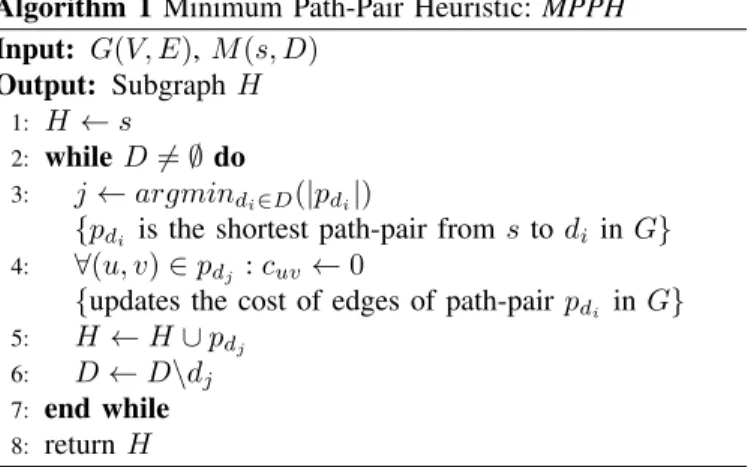
Algorithm 1 Minimum Path-Pair Heuristic: MPPH
Input: G(V, E),M(s, D)
Output: Subgraph H
1: H ←s
2: whileD6=∅ do
3: j←argmindi∈D(|pdi|)
{pdi is the shortest path-pair fromstodi inG}
4: ∀(u, v)∈pdj :cuv←0
{updates the cost of edges of path-pair pdi inG}
5: H ←H∪pdj
6: D←D\dj
7: end while
8: returnH
Time complexity of MPH [7] is |D|.O(S) where |D| is
number of destinations and O(S) is the time complexity of
shortest path algorithm. Time complexity of MPPH depends
on finding a shortest path-pair (step 3) which has the same time complexity as shortest path algorithm. In each iteration
of MPPH we need to find the destination with minimum
shortest path-pair among the remaining destinations. Therefore
the time complexity of MPPH is |D|2.O(S). Time
compexl-ity of MPH+MPPH hence is the same as MPPH. Finally
Algorithm 2 MPH+MPPH
Input: G(V, E),M(s, D)
Output: SubgraphH
1: T ←M P H(G(V, E), M(s, D))
2: ∀(u, v)∈T:cuv ←0
{updates the cost of edges ofT inG}
3: H ←M P P H(G(V, E), M(s, D))
4: returnH
MPH+MPPH(all)would have time complexity of|D|3.O(S).
In our implementation O(S) = O(|V|2) however a more
efficient implementation can achieve O(|E|+|V|log|V|)for
Dijkstra’s shortest path algorithm.
VII. SIMULATION RESULTS
The original Pan-European network COST239 (11 nodes, 26 links) [16] and a modified version are used in the simulations.
In the modified version, evey link(u, v)in original network is
replaced by a new nodewuv and two new links(u, wuv)and
(wuv, v). Therefore it has 11+26=37 nodes and 2*26=52 links.
We refer to it as COST239+. For COST239 two cost functions are used: 1- unit link cost where links have equal unit cost, 2-physical distance cost where distance between cities is used as the link cost (in km). In the case of COST239+, we only consider physical distance and the new nodes are assumed to be halfway between original nodes.
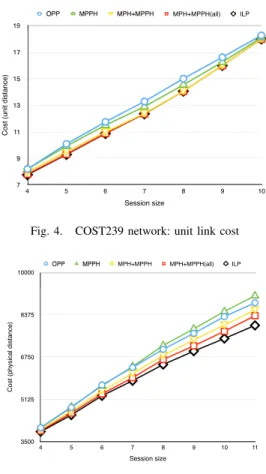
In each case the costs reported by ILP and heuristics (OPP,
MPPH,MPH+MPPH, andMPH+MPPH(all)) are compared. Our results cover the complete range of session size which is 2 to 11 for COST239 and 2 to 37 for COST239+. In each case 100 random multicast sessions are generated and the average cost for each session size is calculated. The same random sessions are applied as input to ILP and heuristic algorithms. Figure 4 shows the results for COST239 with unit distance cost. While all heuristics perform well compared to ILP,
MPH+MPPH and MPH+MPPH(all) are almost the same as optimal. Figure 5 shows the results for COST239 with
physical distance as the link cost. Here again MPH+MPPH
and MPH+MPPH(all) peform better than OPP and MPPH. In Figure 6 the results on COST239+ network are presented.
Again we observe that MPH+MPPH and MPH+MPPH(all)
perform very close to optimal. For the sake of readability, in each figure we have only shown a subset of session sizes for which the optimal vs. heuristic difference is more visible. In Table I we summarize the average and worst case performance (over all session sizes) of our best heuristics and
OPPcompared to optimal.
TABLE I
AVERAGE/WORST CASE PERCENTAGE OF EXTRA COST(VS.OPTIMAL) Network OPP MPH+MPPH MPH+MPPH(all) COST239(unit) 4.4/8.6 0.6/2.6 0.1/0.7 COST239(phys) 8.3/11.3 5.0/7.4 2.6/4.7 COST239+(phys) 5.5/7.7 2.6/4.4 1.6/2.4
Session size OPP MPPH MPH+MPPH MPH+MPPH(all) ILP 2 3.71 3.71 3.71 3.71 3.71 0.00 0.00 0.00 0.00 3 6.09 6.13 5.89 5.82 5.79 5.18 5.87 1.73 0.52 4 8.18 8.18 7.95 7.8 7.75 5.55 5.55 2.58 0.65 5 10.08 9.91 9.5 9.31 9.28 8.62 6.79 2.37 0.32 6 11.74 11.49 10.97 10.88 10.86 8.10 5.80 1.01 0.18 7 13.28 12.89 12.38 12.36 12.35 7.53 4.37 0.24 0.08 8 15.01 14.54 14.06 14.06 14.06 6.76 3.41 0.00 0.00 9 16.62 16.26 16 16 16 3.88 1.63 0.00 0.00 10 18.27 18.11 18 18 18 1.50 0.61 0.00 0.00 11 20 20 20 20 20 0.00 0.00 0.00 0.00 122.98 121.22 118.46 117.94 117.8 4.40 2.90 0.56 0.12 8.62 6.79 2.58 0.65
Session size OPP MPPH MPH+MPPH MPH+MPPH(all) ILP
2 1841.75 1841.75 1841.75 1841.75 1841.75 0.00 0.00 0.00 0.00 3 2960.6 2953.75 2927 2892.05 2876.1 2.94 2.70 1.77 0.55 4 4035.35 4042.5 3976.65 3922.75 3886.45 3.83 4.02 2.32 0.93 5 4812.1 4835.65 4674.05 4601.05 4525.85 6.32 6.85 3.27 1.66 6 5675.2 5644.6 5454.95 5335.8 5261.4 7.86 7.28 3.68 1.41 7 6349.2 6383.75 6115.3 5954 5838.75 8.74 9.33 4.74 1.97 8 7045.3 7191.4 6812.6 6652.05 6460.7 9.05 11.31 5.45 2.96 9 7658.4 7830.5 7401.4 7177.5 6973.9 9.82 12.28 6.13 2.92 10 8299.45 8496.15 7974.85 7735.85 7457.55 11.29 13.93 6.94 3.73 11 8827.5 9098.8 8547.1 8333.4 7961.9 10.87 14.28 7.35 4.67 57504.85 58318.85 55725.65 54446.2 53084.35 8.33 9.86 4.98 2.57 11.29 14.28 7.35 4.67
Cost (physical distance)
3500 5125 6750 8375 10000 Session size 4 5 6 7 8 9 10 11
OPP MPPH MPH+MPPH MPH+MPPH(all) ILP
Cost (unit distance)
7 9 11 13 15 17 19 Session size 4 5 6 7 8 9 10
OPP MPPH MPH+MPPH MPH+MPPH(all) ILP
1
Fig. 4. COST239 network: unit link cost
Session size OPP MPPH MPH+MPPH MPH+MPPH(all) ILP
2 3.71 3.71 3.71 3.71 3.71 0.00 0.00 0.00 0.00 3 6.09 6.13 5.89 5.82 5.79 5.18 5.87 1.73 0.52 4 8.18 8.18 7.95 7.8 7.75 5.55 5.55 2.58 0.65 5 10.08 9.91 9.5 9.31 9.28 8.62 6.79 2.37 0.32 6 11.74 11.49 10.97 10.88 10.86 8.10 5.80 1.01 0.18 7 13.28 12.89 12.38 12.36 12.35 7.53 4.37 0.24 0.08 8 15.01 14.54 14.06 14.06 14.06 6.76 3.41 0.00 0.00 9 16.62 16.26 16 16 16 3.88 1.63 0.00 0.00 10 18.27 18.11 18 18 18 1.50 0.61 0.00 0.00 11 20 20 20 20 20 0.00 0.00 0.00 0.00 122.98 121.22 118.46 117.94 117.8 4.40 2.90 0.56 0.12 8.62 6.79 2.58 0.65 Session size OPP MPPH MPH+MPPH MPH+MPPH(all) ILP
2 1841.75 1841.75 1841.75 1841.75 1841.75 0.00 0.00 0.00 0.00 3 2960.6 2953.75 2927 2892.05 2876.1 2.94 2.70 1.77 0.55 4 4035.35 4042.5 3976.65 3922.75 3886.45 3.83 4.02 2.32 0.93 5 4812.1 4835.65 4674.05 4601.05 4525.85 6.32 6.85 3.27 1.66 6 5675.2 5644.6 5454.95 5335.8 5261.4 7.86 7.28 3.68 1.41 7 6349.2 6383.75 6115.3 5954 5838.75 8.74 9.33 4.74 1.97 8 7045.3 7191.4 6812.6 6652.05 6460.7 9.05 11.31 5.45 2.96 9 7658.4 7830.5 7401.4 7177.5 6973.9 9.82 12.28 6.13 2.92 10 8299.45 8496.15 7974.85 7735.85 7457.55 11.29 13.93 6.94 3.73 11 8827.5 9098.8 8547.1 8333.4 7961.9 10.87 14.28 7.35 4.67 57504.85 58318.85 55725.65 54446.2 53084.35 8.33 9.86 4.98 2.57 11.29 14.28 7.35 4.67
Cost (physical distance)
3500 5125 6750 8375 10000 Session size 4 5 6 7 8 9 10 11
OPP MPPH MPH+MPPH MPH+MPPH(all) ILP
Cost (unit distance)
7 9 11 13 15 17 19 Session size 4 5 6 7 8 9 10
OPP MPPH MPH+MPPH MPH+MPPH(all) ILP
1 Fig. 5. COST239 network: physical distance as link cost
VIII. CONCLUSION
The idea of 1+1 protection is extended to multicast
pro-tection using simple network coding. The 1+1 protection
sends, simultaneously, two copies of each data unit to ev-ery destination, and simple network coding (OR operation) guarantees that upon any single link failure, at least one data copy is received by all destinations. No rerouting or switch reconfiguration is required and destination nodes would not experience any service disruption under any single link/node failure. The necessary and sufficient condition for the existence
of 1+1protection solution under merging flows is simply
2-connectivity from source to each destination. This allows us to easily formulate the problem as a network flow problem which
can be solved to find minimum cost subgraph supporting1+1
protection. An optimal ILP formulation of the problem and three heuristic algorithms are proposed as offline and online solutions. The simulation results on two sample networks show impressive performance by our top two heuristics as compared to the optimal: on average, our best heuristic increases the cost by no more than 2.6% and in the worst case, the gap between our best heuristic and optimal is only 4.7%. Future work would include implementation of OR operation, other failure models and traffic models, e.g., dynamic multi-session multicast.
REFERENCES
[1] M. Cha, G. Choudhury, J. Yates, A. Shaikh, and S. Moon, “Case study: Resilient backbone design for iptv services,” in Workshop on IPTV
Cost (physical distance)
10000 12250 14500 16750 19000 Session size 15 16 17 18 19 20 21 22 23 24 25 26 27 28 29 30 31 32 33 34 OPP MPPH MPH+MPPH MPH+MPPH(all) ILP
2 Fig. 6. COST239+ network: physical distance as link cost
Services over World Wide Web, 2006.
[2] Y. Xiao, X. Du, J. Zhang, F. Hu, and S. Guizani, “Internet protocol television (iptv): the killer application for the next-generation internet,”
Communications Magazine, IEEE, vol. 45, no. 11, pp. 126–134, 2007. [3] N. Maxemchuk, D. Shur,et al., “An internet multicast system for the stock market,”ACM transactions on computer systems, vol. 19, no. 3, pp. 384–412, 2001.
[4] K. Chen, C. Hu, X. Zhang, K. Zheng, Y. Chen, and A. V. Vasilakos, “Survey on routing in data centers: insights and future directions,”
Network, IEEE, vol. 25, no. 4, pp. 6–10, 2011.
[5] N. Singhal, L. Sahasrabuddhe, and B. Mukherjee, “Provisioning of survivable multicast sessions against single link failures in optical wdm mesh networks,” Journal of lightwave technology, vol. 21, no. 11, p. 2587, 2003.
[6] W. Zhong and F. Zhang, “An overview of p-cycle based optical multicast protection approaches in mesh wdm networks,”Optical Switching and Networking, vol. 8, no. 4, pp. 259–274, 2011.
[7] H. Takahashi and A. Matsuyama, “An approximate solution for the steiner problem in graphs,” Math. Japonica, vol. 24, no. 6, pp. 573– 577, 1980.
[8] A. Fei, J. Cui, M. Gerla, and D. Cavendish, “A dual-tree scheme for fault-tolerant multicast,” in Communications, 2001. ICC 2001. IEEE International Conference on, vol. 3, pp. 690–694, IEEE, 2001. [9] C. Constantinou and G. Ellinas, “A novel multicast routing algorithm
and its application for protection against single-link and single-link/node failure scenarios in optical wdm mesh networks,” Optics Express, vol. 19, no. 26, pp. B471–B477, 2011.
[10] T. Rahman and G. Ellinas, “Protection of multicast sessions in wdm mesh optical networks,” in Optical Fiber Communication Conference, 2005. Technical Digest. OFC/NFOEC, vol. 2, pp. 3–pp, IEEE, 2005. [11] R. Koetter and M. M´edard, “An algebraic approach to network coding,”
Networking, IEEE/ACM Transactions on, vol. 11, no. 5, pp. 782–795, 2003.
[12] A. E. Kamal and M. Mohandespour, “Network coding-based protection,”
Optical Switching and Networking, 2013.
[13] M. Kim, M. M´edard, and U.-M. O’Reilly, “Network coding and its implications on optical networking,” in Optical Fiber Communication Conference, Optical Society of America, 2009.
[14] E. Manley, J. Deogun, L. Xu, and D. Alexander, “All-optical network coding,”Optical Communications and Networking, IEEE/OSA Journal of, vol. 2, no. 4, pp. 175–191, 2010.
[15] J. W. Suurballe and R. E. Tarjan, “A quick method for finding shortest pairs of disjoint paths,”Networks, vol. 14, no. 2, pp. 325–336, 1984. [16] P. Batchelor,Ultra high capacity optical transmission networks: Final
report of action COST 239. Faculty of Electrical Engineering and Computing, 1999.