Women Returning to Work Across the Life Course: Who Does It, Why, and What Do They Return To?
A Dissertation
SUBMITTED TO THE FACULTY OF UNIVERSITY OF MINNESOTA
BY
Anne Elizabeth Kaduk
IN PARTIAL FULFILLMENT OF THE REQUIREMENTS FOR THE DEGREE OF
DOCTOR OF PHILOSOPHY
Phyllis Moen, Advisor
ii
Acknowledgements
I would like to acknowledge the guidance and support of my advisor, Professor Phyllis Moen for her thoughtful feedback, guidance, and support as I moved through this process. I would also like to thank Professor Erin L. Kelly for her guidance and support throughout my time in graduate school. I additionally acknowledge and thank my other committee members, Professors J. Michael Oakes and Andrew Van de Ven for their thoughtful participation in the dissertation process and for teaching courses that shaped my outlook on social science research. Moreover, I wish to acknowledge the support of the Minnesota Population Center, particularly my fellowship mentors Colleen
Manchester and Joe Ritter, for bringing a variety of disciplinary perspectives to this work. I also wish to acknowledge the University of Minnesota Interdisciplinary Doctoral Fellowship and the Bilinski Educational Foundation Fellowship for University of
Minnesota Sociology for their financial support. Finally, I would like to acknowledge my family, friends, and colleagues who contributed in a variety of ways to the successful completion of this dissertation.
iii
Dedication
This dissertation is dedicated to the family, friends, and colleagues who have made it possible.
iv
Abstract
Using data on over 10,000 person-spells of non-employment lasting 2 months or longer in the NLSY79, my dissertation examines how women’s reasons for job exit, motherhood status, and education affect 1) the probability and timing of their return to work, 2) whether they change occupation and industry of employment between the jobs they left and the jobs they return to, and 3) whether and how women change work hours and wages between the jobs they left and the jobs they return to.
Women’s exits have been studied widely, yet little is known about who returns to work. But, returning to work likely has important consequences for the well-being of women and their families. As would be expected given the high overall labor force participation rates of women in the 1980s to 2010s, nearly all women who spend two months or more not employed eventually return to work, although the timing of their reentry and the duration of their exit from employment vary greatly. Women who leave for family reasons tend to postpone re-employment for around a year longer than women who leave for other reasons; this difference is largest for women who have a bachelor’s degree. In addition, most women (51-76%, depending on classification scheme) who leave jobs and are observed returning to work change both occupation and industry upon returning to work, although change is less likely when leaving a job in
occupations/industries with greater training and/or licensing requirements.
On average, women who leave jobs and are observed returning to work do not experience a change in hourly wage, while they tend to return to jobs with about two fewer weekly work hours. Women who leave for family reasons and/or have children
v
while away from employment tend to return to fewer work hours. Wages upon return are also predicted to be lower when women have children while away from employment.
Results for changes in occupation/industry and job conditions upon return to work largely reflect a story of accumulated advantage, where women with more education (and thus likely more material resources) tend to return to jobs with higher wages, greater work hours, higher occupation/industry median income, and greater occupation/industry percent with a bachelor’s degree, controlling for the characteristics of the jobs they left. Even so, women who take time away from work for family care or other reasons still miss out on retirement contributions, including social security, during the time when they are not employed, which can erode their financial security at older ages. Thus there are potentially negative impacts on the financial well-being of women who leave and return to work, even if they are able to return to similarly paid jobs after taking time away from employment.
vi Table of Contents List of Tables ... ix List of Figures ... xi Chapter 1 – Introduction ... 1 Introduction ... 1 Research Questions ... 6
Chapter 2 – Who Returns to Work? ... 8
Introduction ... 8
Women’s Labor Force Participation ... 11
Leaving Work ... 13
Family Reasons... 13
Job Loss ... 15
Other Reasons ... 16
Relationship between Employment and Motherhood ... 17
Employment Trajectories ... 18
Returning to Work ... 21
Off the “Career” Track ... 22
Education and Employment ... 24
Impact of Children on Employment Varies By Education ... 25
Research Questions ... 27
Data & Methods ... 28
Data ... 28 Variables ... 30 Analytic Strategy ... 36 Results ... 37 Descriptive Results ... 37 Return to Work ... 47
Education, Fertility, and Economic Conditions... 55
vii
Chapter 3 – Occupation & Industry Changes ... 64
Introduction ... 64
Labor Market Inequality by Occupation and Industry ... 65
Gender Composition of Occupations and Industries ... 66
Changes in Occupation and Industry ... 69
Research Questions ... 70
Data & Methods ... 72
Data ... 72
Variables ... 73
Analytic Strategy ... 84
Results ... 84
Sample Description... 84
Changes in Occupation and Industry ... 90
Where is the Change? ... 111
Consequences of Change ... 120
Discussion ... 129
Chapter 4 – Changes in Job Conditions ... 131
Introduction ... 131
Traditional Career Path ... 133
Career Consequences ... 135
Research Questions ... 136
Data & Methods ... 138
Data ... 138
Variables ... 139
Analytic Strategy ... 141
Results ... 141
Sample Description... 141
How Do Wages and Work Hours Change? ... 147
What is Related to Change in Wages and Work Hours? ... 149
viii
Data Appendix ... 176
Reason for Leaving Last Job ... 177
Comparison of Analytic Samples Across Chapters ... 179
ix
List of Tables
Table 1: NLSY79 Response Options for Reason Leaving Last Job by Year and Recoding
... 32
Table 2: Number of Non-Employment Spells Per Women ... 39
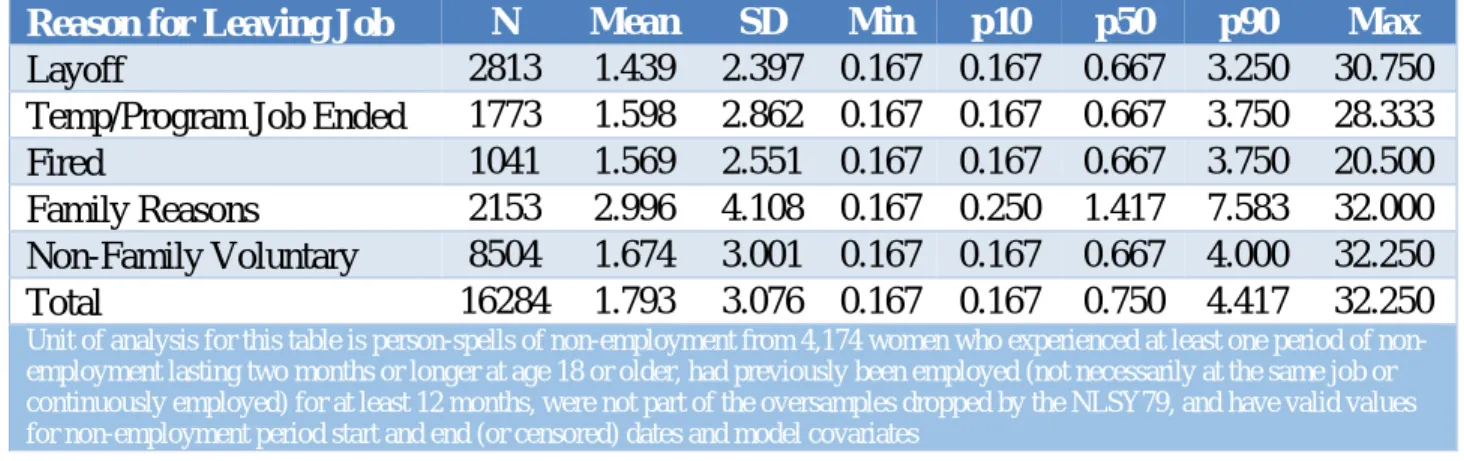
Table 3: Summary of Years Not Employed by Reason for Leaving Last Job ... 40
Table 4: Description of Women in the Analytic Sample ... 43
Table 5: Description of Person-Spells Used in Event History Models ... 44
Table 6: Number of Person-Spells by Family Characteristics, Education, and Race/Ethnicity ... 46
Table 7: Proportion of Non-Employment Spells Ended Within Various Timeframes by Reason for Exit ... 48
Table 8: Proportion of Non-Employment Spells Censored (vs Ended in Re-Employment) Within Various Timeframes by Reason for Exit ... 48
Table 9: Cox Proportional Hazard Models of Returning to Work ... 52
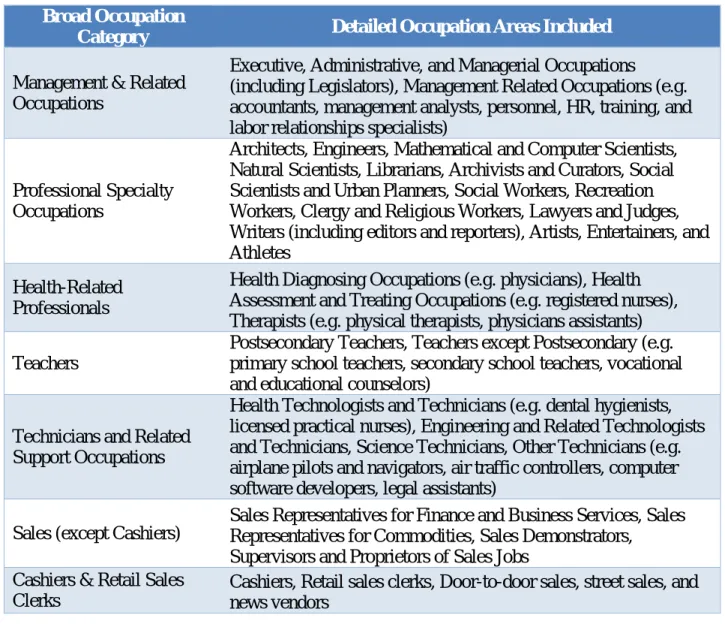
Table 10: Classification of Occupations into Broad Category Groupings Based on the U.S. Census Occupation Classification System ... 76
Table 11: Classification of Industries into Broad Category Groupings Based on the U.S. Census Occupation Classification System ... 79
Table 12: Description of Analysis Sample for Occupation & Industry Changes ... 86
Table 13: P-values for t-tests of Difference in Proportion of Women in Detailed Occupation/Industry Change Categories between Reason for Leaving Last Job Categories Among Person-Spells Where Women Are Observed Returning to Work ... 95
Table 14: P-values for t-tests of Difference in Proportion of Women in Broad Occupation/Industry Change Categories between Reason for Leaving Last Job Categories Among Person-Spells Where Women Are Observed Returning to Work ... 96
Table 15: P-values for t-tests of Difference in Proportion of Women in Detailed Occupation/Industry Change Categories between Education at Start of Non-Employment Spell Categories Among Person-Spells Where Women Are Observed Returning to Work ... 97
Table 16: P-values for t-tests of Difference in Proportion of Women in Broad Occupation/Industry Change Categories between Education at Start of Non-Employment Spell Categories Among Person-Spells Where Women Are Observed Returning to Work ... 98
Table 17: Logistic Regression Models of No Change in Occupation and/or Industry Between Start and End of Non-Employment Spell Among Person-Spells Where Women Are Observed Returning to Work ... 107
Table 18: Most Common Detailed Occupations and Industries with No Change in Detailed Occupation/Industry between Start and End of Non-Employment Spell Among Person-Spells Where Women Are Observed Returning to Work ... 112
Table 19: Most Common Detailed Occupations among Women Who Changed Detailed Industry but Not Detailed Occupation between Start and End of Non-Employment Spell ... 113
x
Table 20: Most Common Detailed Industries among Women Who Changed Detailed Occupation but Not Detailed Industry between Start and End of Non-Employment Spell
... 114
Table 21: Percent of Person-Spells in Most Common Detailed Occupation / Industry Change Categories Among Person-Spells With Change in Both Detailed Occupation and Detailed Industry Classification ... 115
Table 22: Percent of Person-Spells in Most Common Broad Occupation / Industry Change Categories Among Person-Spells with Change in Both Broad Occupation and Broad Industry Classification ... 117
Table 23: Linear Regression of Change in Characteristics of Occupation/Industry at Start and End of Non-Employment Spell Among Person-Spells Where Women Are Observed Returning to Work ... 125
Table 24: Description of Person-spells of Non-Employment in Analysis Sample for Job Condition Changes ... 142
Table 25: Usual Weekly Work Hours and Change by Various Characteristics ... 151
Table 26: Hourly Wage and Change by Various Characteristics ... 154
Table 27: Linear Regression Models of Change in Work Hours and Hourly Wage ... 160
Table 28: Multinomial Logistic Regression Model of Categorical Work Hours Upon Return to Work ... 165
Table 29: NLSY79 Text for Question about the Reason Respondents Left Each Job ... 178
xi
List of Figures
Figure 1: Graph of Survival in Non-Employment By Reason for Leaving Last Job ... 41
Figure 2: Predicted Hazard of Returning to Work by Education ... 56
Figure 3: Predicted Hazard of Returning to Work by Age of Youngest Child ... 57
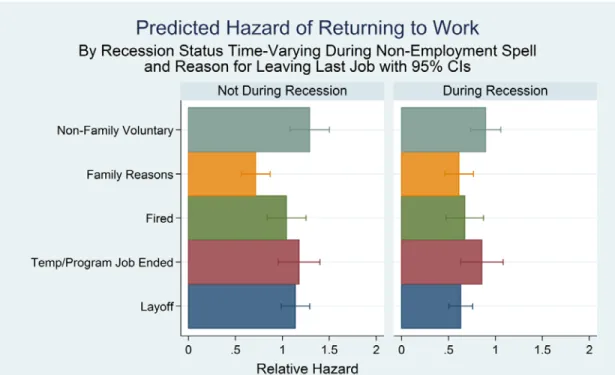
Figure 4: Predicted Hazard of Returning to Work by Economic Climate ... 58
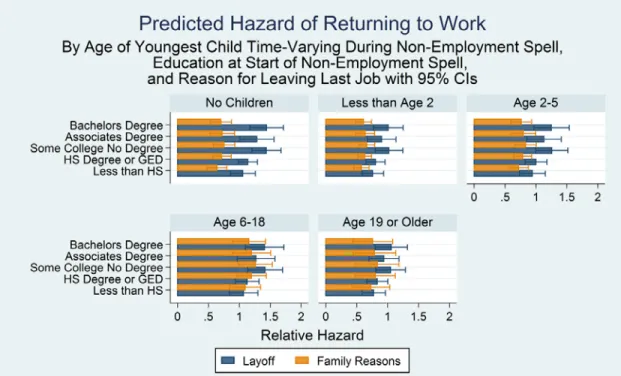
Figure 5: Predicted Hazard of Returning to Work by Age of Youngest Child, Education, and Reason for Leaving Last Job (comparing Layoffs and Family Reasons) ... 60
Figure 6: Predicted Hazard of Returning to Work by Age of Youngest Child, Education, and Reason for Leaving Last Job (comparing Family Reasons and Non-Family Voluntary Reasons) ... 60
Figure 7: Percent of Person-Spells with Change in Detailed Occupation and Industry Among Person-Spells Where Women Are Observed Returning to Work ... 90
Figure 8: Percent of Person-Spells with Change in Broad Occupation and Industry Among Person-Spells Where Women Are Observed Returning to Work ... 91
Figure 9: Percent of Person-Spells with Change in Detailed Occupation & Industry by Reason for Leaving Last Job Among Person-Spells Where Women Are Observed Returning to Work ... 93
Figure 10: Percent of Person-Spells with Change in Broad Occupation & Industry by Reason for Leaving Last Job Among Person-Spells Where Women Are Observed Returning to Work ... 94
Figure 11: Mean Years of Non-Employment By Change in Detailed Occupation and Industry Among Person-Spells Where Women Are Observed Returning to Work ... 99
Figure 12: Mean Years of Non-Employment By Change in Broad Occupation and Industry Among Person-Spells Where Women Are Observed Returning to Work ... 100
Figure 13: Percent of Person-Spells with Change in Detailed Occupation & Industry by Education at Start of Non-Employment Spell Among Person-Spells Where Women Are Observed Returning to Work ... 101
Figure 14: Percent of Person-Spells with Change in Broad Occupation & Industry by Education at Start of Non-Employment Spell Among Person-Spells Where Women Are Observed Returning to Work ... 102
Figure 15: Percent of Person-Spells with Change in Detailed Occupation & Industry by Family Life Stage Among Person-Spells Where Women Are Observed Returning to Work ... 103
Figure 16: Percent of Person-Spells with Change in Broad Occupation & Industry by Family Life Stage Among Person-Spells Where Women Are Observed Returning to Work ... 104
Figure 17: Kernel Density of Change in Weekly Work Hours by Hours Worked at Job Prior to Non-Employment Spell ... 148
Figure 18: Kernel Density of Change in Hourly Wage by Hourly Wage Decile at Job Prior to Non-Employment Spell ... 148
1
Chapter 1 – Introduction
Introduction
Women have left the labor force for a variety of reasons and at a variety of life stages1 in recent history; some have returned to work after their exits, and others have not. One large body of research considers married, professional women who leave the labor force to care for their young children (e.g. Percheski 2008; Stone 2007); some of those women return to work after their children are in school or have left the house, but it is often difficult for them to attain jobs similar to the ones they left (e.g. Hewlett 2007; Lovejoy and Stone 2012). Other research considers women who experience job loss; some quickly return to work, while others leave the labor force entirely (Moore,
Meiksins, and Root 2013; Swaim and Podgursky 1994). In both of these literatures, the emphasis is largely on leaving work, with far fewer studies on returning to work after a labor force exit. However, such transitions back to paid employment may become increasingly important for women’s well-being given increased life expectancies and the increasing individualization of risk in U.S. labor market (e.g. declining job security, defined contribution pension plans instead of defined benefit) (Hacker 2006; Moen 2016).
Each of these types of labor force exit are freely chosen by employees in some situations and beyond their control in others – often the result of a structural mismatch between existing job conditions and women employees’ needs at a given life stage. While the broad social contract of work has changed since the early 20th century, the expectation
1 Life stage is a combination of people’s age and their positioning in their family and work career life courses. All of these are interrelated, so the phrase life stage refers to the combination of these influences.
2 that ideal workers are those who can continuously work full-time, year round, without career breaks, and be available for long hours or overtime as needed has not (Moen and Roehling 2005; Williams 2000). Williams (2000) argues that this omnipresent ideal worker expectation marginalizes women’s participation in the paid labor force, even if they frame their decision to leave their job (or to keep working in a marginalized “mommy track”) so they can care for children as a choice. Moen and Roehling (2005) argue that there is a mismatch between the career mystique (the myth that hard work, long hours, and continuous employment pay off) and contemporary reality, in that the career mystique for full-time (male) workers has always been supported by the feminine mystique of a full-time (female) homemaker. Yet, most workers do not have those supports today, either because both spouses work for pay or because they are in households with only one adult (Jacobs and Gerson 2004). This structural mismatch between ideal worker expectations and the realities of contemporary family life, combined with a lack of supports at work or at home, pushes some women out of the labor force to care for children or other family members.
The structural mismatch encompassing job loss also relates to the changing social contract of work, in that the model of stable, lifetime employment at the same company with opportunities for advancement that many white men experienced in the mid-20th century has given way to a new economy characterized by a rising number of contingent workers and the increasing prevalence of layoffs (Rubin 1996; Smith 1997). These changes in the social contract of work contrast with realities that all adults work for pay in most American families in recent years and families depend on both incomes, so job loss and job insecurity are particularly problematic in this “new economy” (Sweet and
3 Meiksins 2013). Several prominent scholars agree that these changes in the labor market since the 1970s have not generally been for the benefit of employees; rather, they have tended to reflect the interests of the business elite and/or shareholders by shifting market and other risks formerly absorbed by companies onto employees, in the context of various macroeconomic changes (Kalleberg 2011; Williams 2010). Kalleberg (2011) describes an ideological transition from “we’re all in this together” to “you’re on your own,” in addition to union decline, labor market deregulation, and changes in capital markets that reward managers for short-term profits. Williams (2010) highlights the impact of the sharp shift to the right in American politics (crystallizing during the presidency of Ronald Reagan) that deified corporations while demonizing government, which led to the dismantling of New Deal era financial regulations and the recent financial crisis.
Returning to work after time out of the labor force for any of these reasons can be important for the well-being of people and their families, but the timing and prevalence of such reemployment is likely to vary by their reason for exit, gender, age, and life stage, among other characteristics. Like much social science research, I rely on the answers respondents give to a set of survey questions. Whether those respondents left the labor force voluntarily, were (perhaps unknowingly) pushed out by a structural mismatch or were forced out by their employer (via layoffs, early retirement incentives, or job conditions that made it impossible to continue) can only be determined by what the respondent reports on the survey, and respondents may ascribe different reasons for their labor force exits and entries than their material circumstances would suggest to a
4 understand some of these reasons and how they vary across the life course. The dataset I use has the particular advantage of capturing women’s reason for leaving jobs within a year or two of their job exit, as opposed to retrospective life history interviews where there is more time for respondents to reevaluate their reasons.
My dissertation examines how women’s reasons for labor force exit affect the probability and timing of their return to work, whether they change occupations or industries when returning to work, and changes in their job conditions between the job they left and the job they return to. This makes an original contribution because while there have been many studies of women’s exits, little is known about who returns or the consequences of taking time out of the workforce. To do so, I draw on data from the National Longitudinal Survey of Youth, 1979 cohort (NLSY79). By comparing these aspects of labor force participation at varying points in women’s life course, I contribute to important new knowledge about work and employment in the U.S.
I consider the impact of a variety of reasons for labor force exit, including family reasons (e.g. caring for children and caring for adult relatives) and job loss (e.g. losing one’s job because the company closed, through layoffs, or getting fired). Labor force exits are freely chosen by employees in some situations but are beyond their control in others. Even “voluntary” exits are often the result of a structural mismatch between existing job conditions and employees’ needs at a given life stage. The small amount of existing research on returning to work after labor force exits to care for family members mainly discusses the difficulty of doing so and the career penalties associated with it (largely for married, professional women), while existing research on reemployment after job loss tends to focus on wage penalties. My research examines a variety of reasons for
5 exits and a broad range of consequences following reemployment, including changes in industry and job quality upon reemployment. Moreover, I focus on the experiences of the majority of American women in the middle; existing research on returning to work (particularly after exits for family reasons) often focuses on either the very top or the bottom of the income and education distributions. Neither has previous research examined differences in women returning to work (especially after job loss) by demographic characteristics, family demands, and previous employment history.
Beyond whether they return to the labor force, examining the types of jobs women attain upon return and the differences in characteristics of their new jobs compared to the jobs they left will provide insight into broad labor force inequalities, including gender inequality. This analysis also provides a window into social change in the United States, including effects of the decline in job security and the increasing expectation as well as need for women’s employment since the 1970s. Such knowledge will provide essential insights into the pathways that reduce or perpetuate inequality in wages and occupational level. Overall, my dissertation illuminates inequalities in the costs and benefits of labor force exits and entries for a variety of reasons in the U.S. It reflects the costs and benefits to women if they use labor force exits as a way to meet non-work needs in the absence of policy supports or are forced into a labor force exit because of involuntary job loss, as well as the costs and benefits to women who freely choose not to work for a period of time. This research provides relevant information on the existing state of reemployment in the U.S. so that future policy changes by
6
Research Questions
The section above outlines a problem of women’s labor force participation – particularly surrounding women’s return to employment after leaving it for a variety of reasons. Women leave jobs for the same reasons men do – looking for a job with better pay, through layoffs, being fired – but they also tend to leave employment around the birth of children or for other family reasons. An overarching question, then, is whether and how women’s return to work is different when women leave for family reasons as compared to involuntary job loss such as layoffs. More specifically, I address several related research questions, each of which will be the focus of one of the three analysis chapters of my dissertation. While these are the broad focus of each chapter, each chapter also contains more detailed research questions to drive the analysis.
(1) How do women’s reasons for employment exit affect their probability of employment reentry and the length of their labor force exit?
(2) When women reenter employment, do they shift occupation or industry of employment? Where do they come from and where do they go? How does that vary by reason for and duration of exit?
(3) How are job conditions different before and after returning from an employment exit?
One possible answer is that women’s reasons for leaving employment are not related to their probability of re-entering employment, the duration of their exit, or changes in job conditions. Recent research on nonstandard employment histories and being asked to interview for a job shows that part-time work or unemployment are not significantly associated with call-back rates for women, but they are for men (Pedulla 2016), so this is not implausible. Alternatively, women’s reasons for leaving employment could be unrelated to their probability of re-entering employment, the duration of their exit, or
7 changes in job conditions because the real differentiating factor is whether or not women have young children while they are away from employment. Existing research provides substantial evidence of a wage penalty among mothers related to taking time away from employment (e.g. Budig and England 2001; England et al. 2016). A third potential answer is that women’s return to employment is not related to either the reasons they left their jobs or having children, but is perhaps explained by other factors such as their educational attainment or macroeconomic conditions.
A key part of this study will be to compare whether and how these relationships are different for women of varying educational attainment. I draw on a gendered life course approach (Elder, Johnson, and Crosnoe 2003; Moen 2001; Moen and Flood 2013; Shanahan and Macmillan 2008) and the NLSY79 to examine employment exits,
reentries, and related job conditions across the life course for a cohort of women in the United States who came of age during a time when women’s opportunities in the labor market were greatly expanding.
8
Chapter 2 – Who Returns to Work?
Introduction
A successful manager at a large consulting firm decided not to return to work after the birth of her first child, in part because she knew she would be unable to use flexibility policies at the company she worked for without significant negative career impact. She later found another job in a completely different industry that allowed her to have more time with her family. An MBA graduate saw the inability of her co-workers at a consumer products company to use flexibility policies at that company without losing out on opportunities for career advancement; this was a major part of her decision to leave that industry before she had any children. On the other end of the income scale, research describes low income mothers planning their use of welfare benefits as a backup to cover expenses during times when they needed to exit the labor force to care for children or for their own health (Collins and Mayer 2010).
The situations described above are not uncommon. Much research has
documented and debated the changes in work time for families over the past fifty years (see Jacobs and Gerson 2004) along with the “opt out” phenomenon of women leaving the workforce to care for children (see Moe and Shandy 2009). Jacobs and Gerson (2004) argue that paid work hours in the U.S. have increased from 1970 to 2000 when
considered from the perspective of families, with much of the increase in work hours due to dramatic increases in women’s labor force participation. Bianchi and Wight (2010) update this trend through 2005 with similar findings. Women’s labor force participation has increased over the 20th century, but the increase has leveled out in more recent years
9 (Cohn, Livingston, and Wang 2014). This chapter addresses a relatively understudied aspect of women’s labor force participation: whether and after how long women return to the employment after an earlier exit from it. In recent history, women and men have left for a variety of reasons and at a variety of life stages; some return to work after their exits, and others do not (or have yet to) return.
One body of research considers married, professional women who leave the labor force to care for their young children (e.g. Percheski 2008; Stone 2007); some of those women return to work after their children are in school or have left the house, but it is often difficult for them to attain jobs similar to the ones they left (e.g. Hewlett 2007; Lovejoy and Stone 2012). Other research considers women who experience job loss; some quickly return to work, while others leave the labor force entirely (Moore et al. 2013; Swaim and Podgursky 1994). In both of these literatures, the emphasis is largely on leaving work, with far fewer studies on returning to work after a labor force exit. Several scholars (e.g. Aisenbrey and Fasang 2014; Damaske 2011; Damaske and Frech 2016) describe a substantial group of women whose labor force attachment is more fluid and includes one or more labor force exits and reentries, but such situations have largely been studied as trajectories or overall patterns, rather than examining the predictors of timing and duration of specific employment exits. Another line of research considers the effects of leaving work around the birth of a child on the motherhood wage penalty or other career consequences of mothers (e.g. Budig 2003; Byker 2015; Hynes and Clarkberg 2005), but these analyses do not generally consider the impacts of women’s reasons for leaving a job and often (but not always) focus on the birth of women’s first child,
10 neglecting women who leave employment for a longer period after the birth of a second child.
This chapter examines how women’s reasons for employment exits lasting two months or more affect the probability and timing of their return to work. While there have been a variety of studies of women’s exits, little is known about who returns or the
consequences of taking time out of the workforce for a broad population of women (including lower wage and/or lower status workers that are often excluded from studies of workplace flexibility). Some research suggests that women, particularly those in low-wage jobs, use periods of non-employment with or without financial assistance from “welfare” programs like Temporary Assistance for Needy Families (TANF), as a way to meet their family care needs without support from U.S. public or organizational policy (e.g. Collins and Mayer 2010). I draw on data from the National Longitudinal Study of Youth 1979 Cohort (NLSY79) and consider the impact of five reasons for job exit, including family reasons (e.g. caring for children and caring for adult relatives), layoffs, the end of a temporary or program job, getting fired, and non-family voluntary reasons, on the timing and duration of women’s time away from employment. Job exits are freely chosen by employees in some situations but are beyond their control in others. Even “voluntary” exits are often the result of a structural mismatch between existing job conditions and employees’ needs at a given life stage. The small amount of existing research on returning to work after employment exits to care for family members mainly discusses the difficulty of doing so and the career penalties associated with it (largely for married, professional women), while existing research on reemployment after job loss tends to focus on wage penalties. By specifically examining the predictors of women’s
11 job reentry timing, rather than broad trajectories or only focusing on exists directly
related to childbirth, this chapter contributes to a better understanding of women’s employment transitions.
Women’s Labor Force Participation
The proportion of women working for pay in the United States has increased since the 1960s (Bianchi and Wight 2010; Jacobs and Gerson 2004). The proportion of mothers with children under age 18 who do not work outside the home has declined a similar amount in the same timeframe (Cohn et al. 2014). Yet the expectation that ideal workers are those who can work full-time, year round, and be available for overtime as needed has not changed (Moen and Roehling 2005; Williams 2000). Williams (2000) argues that this omnipresent ideal worker expectation marginalizes women’s participation in the paid labor force, even if they frame their decision to leave their job (or to keep working in a marginalized “mommy track”) so they can care for children as a choice. Moen and Roehling (2005) argue that there is a mismatch between the career mystique (the myth that hard work, long hours, and continuous employment pay off) and
contemporary reality, in that the career mystique for full-time (male) workers has always been supported by the feminine mystique of a full-time (female) homemaker, yet most workers do not have those supports today, either because both spouses work for pay or because they are in households with only one adult (Moen and Roehling 2005). When viewed this way, it is not surprising that contemporary adults, especially parents, experience conflicts between their work and non-work lives.
Work-family policies at the national, local and company levels are largely designed with the goals of decreasing the sense of conflict workers experience between
12 their work and non-work responsibilities and keeping women employed who would otherwise leave the labor force, thus increasing women’s labor force participation (Gornick and Meyers 2003; Grunow and Aisenbrey 2016). Policies supporting women’s employment (and the employment of people with family care responsibilities more generally) are important for gender equity, single parents needing to support families, and to maintain families’ standard of living (at least among families with two potentially working adults), given stagnant real wages since the 1970s (Kalleberg 2011). Such policies include those allowing for flexible work arrangements (e.g. telecommuting, flexible scheduling, and compressed workweeks requested by employees), short-term (sick days) and extended (family leave) time off, and career flexibility (ability to leave and re-enter the workforce) (National Advisory Commission on Workplace Flexibility 2010). Of these, career flexibility is by far the least studied and the least available through formal programs (Aumann and Galinsky 2012), although most others are nowhere near universally available in the U.S. either (Matos and Galinsky 2012). This chapter addresses the idea of career flexibility by examining women’s periods of non-employment and return to work, although not all periods of non-non-employment are voluntary or can reasonably be thought of in the positive sense that career flexibility language is usually used to describe. Specifically, this chapter examines how women’s reasons for leaving jobs affect the length of their time away from employment and the timing of their return to employment, particularly examining variation by education and family life stage. Later chapters examine the employment consequences of such exits, in terms of changes in occupation, industry, and job conditions.
13
Leaving Work
Family ReasonsWhen available family leave is insufficient or the demands of one’s job are too much when caregiving responsibilities are added on, some women leave the labor force altogether (Damaske 2011). This is likely to be a particularly large component of the population in the U.S., since the options for meaningful part-time work or other “pulled back” forms of work are more limited as compared to some countries in Europe. In many cases, this is not the employment strategy either member of a couple would prefer– many couples begin with expectations of an egalitarian marriage, and it is only under conditions of constraint (e.g. “ideal worker” expectations and a lack of supportive work-family policies) that the woman pulls back in her career (e.g. Gerson 2010; Pedulla and Thébaud 2015). Some women and couples do prefer that the mother to stay home with children (Jacobs and Gerson 2016), although such preferences are developed in an environment of constrained choices. A key contribution of this chapter is the ability to consider how women characterize their reason for leaving jobs, rather than assuming exits for family reasons around childbirth (which is likely the case for many, but certainly not all, women).
The idea of leaving work to care for children has been the subject of a significant amount of scholarly and popular attention (Stone 2007), although much of this attention has focused on fairly privileged, married, mostly white women whose husbands earn enough money that they can leave the labor force to care for their children and maintain the family’s standard of living (e.g. Hewlett 2007; Stone 2007). However, such women are relatively rare in population level trends (Cohn et al. 2014; Landivar 2014; Percheski
14 2008). But women also leave jobs for the same reasons men do, including layoffs, being fired, and non-family voluntary reasons (and some men leave for family reasons, too). At those transition points, some people leave the labor force rather than searching for a new job. Some are older workers who leave the labor force through retirement after job loss (Chan and Stevens 2001), but some are younger workers who are not able to find a new job or who, in the context of their family responsibilities, leave the labor force to meet those family responsibilities (see Damaske 2011; Swaim and Podgursky 1994). Even among women with significant family demands, sometimes it is the work conditions in their job that push them out of the labor force. For example, overwork (working 50 or more hours/week) tends to push women out of male-dominated occupations across a variety of cohorts, shown with a national sample of noncontingent workers aged 18-64 in 1996-2004 (Cha 2013). Hewlett (2007) also describes work conditions such as being passed over for promotion or doing only work that is not meaningful as factors that push women out of the labor force. Such factors can heighten women’s sense that their family needs them at home. While Hewlett (2007) studied highly qualified workers, her findings about job conditions pushing women out of the labor are also echoed in qualitative work on more economically diverse samples (Damaske 2011).
Many studies of mothers’ employment focus on the time surrounding the birth of their first child (e.g. Barrow 1999; Evertsson 2013), although some also compare with second births (e.g. Hynes and Clarkberg 2005). However, an additional child adds substantially more care demands to a household, and there may be additional financial pressure to stay home as opposed to paying most or all of one’s wages in higher costs for two children in daycare, regardless of the potentially better long-term labor market
15 outcomes from doing so. A contribution of this study is the ability to examine a longer timeframe past first births, which is more likely to include a second (or third) birth.
Job Loss
While many women leave jobs and tell interviewers that it is for family reasons, other women are fired or laid off and choose to remain out of the labor force, perhaps because they decided it was the right time to have a child (or because they were fired for being pregnant, which was more common in the 1980s when many of the women in the NLSY79 were having children). One advantage of this chapter and the NLSY79 dataset is the information on why women left each job, collected within a year or two of the event in nearly all instances. Thus it is possible to examine the impact of reason for leaving jobs in combination with the timing of having a child (if it occurs while not employed) on returning to work.
Most of the literature related to involuntary job loss examines job displacement: a similar concept, but not exactly the same. Job displacement is different than other forms of job loss in that it systematically affects large groups of workers through factory closings, mass layoffs, or insufficient work (Maroto and Serafini 2012). Research on job displacement has grown since the 1980s, but much of it has been done by economists, with less focus by sociologists (Brand 2006). Much of the research focuses on job displacement, rather than the broader category of job loss, because it is more
straightforward to identify the effects of job displacement as compared to job loss. This is because individual worker characteristics and/or actions are much more likely to lead to being fired or discharged, as compared to more general layoffs that are perhaps less tied to individual worker performance. Job displacement has been shown to have a variety of negative consequences for workers, including greater psychological distress (e.g.
16 Mandemakers and Monden 2013), lower social participation for workers displaced during prime earning years (Brand and Burgard 2008), a substantial period of non-employment (Fallick 1996; e.g. Farber 2003), increased probability of part-time employment
subsequent to job loss (e.g. Farber 2003), and substantial earnings losses upon re-employment (e.g. Farber 2011; Stevens 1997).
While most workers look for a new job following job displacement, some do not, and at least in the late 1980s women were more likely to leave the labor force after job displacement than men (Swaim and Podgursky 1994). Using more recent data on science and engineering workers from the 1994-2008, Moore, Meiksins, and Root (2013) find that when married women workers are displaced for a non-academic science or engineering job, they are more likely to exit the workforce than men (regardless of
marital status) or unmarried women (Moore et al. 2013). While it considers only a limited range of occupations, their paper provides evidence of gender differences in
re-employment and in who returns to work after job loss or other worker displacements. Fallick (1996) also reports that displaced workers were similar to the overall labor force in terms of demographic characteristics, with the exception that men were more likely to be displaced than women. I have not found research on fertility and job loss among women.
Other Reasons
Women also leave jobs for a variety of other reasons, including escaping a toxic work environment, to advance their career through education or simply taking the time to find a new job that is a better fit for their needs. Sometimes women’s priorities change after spending time away from employment, particularly if they have children during that time. Damaske (2011) discusses the variety of reasons women gave for employment
17 transitions, often framed in terms of what is best for their family, since it is less socially acceptable for women to say that they want to go back to work because the like their job or that they want to eschew paid employment and care for children at home because they do not like their job. If women leave a job for non-family voluntary reasons, such as to look for a better job, we would expect that they would be more likely to return to work quickly and potentially to better job conditions and/or a better paid occupation. Women who were fired from their last job are likely to return to work more slowly. If they were fired for poor work ethic or being a bad employee, then that would likely make it harder to return to work quickly. Additionally, in the 1980s when many women in the NLSY79 were having children, pregnancy discrimination was illegal, but still prevalent, and women who were fired because they were pregnant and then have an infant to care for may also return to work more slowly, unless they particularly need the income.
Relationship between Employment and Motherhood
A substantial body of research examines the relationship between women’s employment and the number of children they have, if any. One commonly proposed reason for low fertility rates in developed countries is women’s experience of conflict between work and family roles; however, research provides little support for the idea of women in the U.S. who have difficulty managing their work and family roles going on to have fewer children (Liu and Hynes 2012). Instead, women who have difficulty with conflict between work and family tend to have the children they want to, sometimes at the expense of continued labor force participation (Liu and Hynes 2012). Other research (Budig 2003) finds that the presence of preschool children increases the hazard that full-time working women will leave the labor force, while the presence of older children is
18 associated with a greater hazard of full-time employment. However, there is evidence of considerable heterogeneity in women’s employment patterns around the birth of their children: Hynes and Clarkberg (2005) find evidence of six different ideal types of employment patterns around the birth of women’s first child: continuously employed, continuously out, hiatus at birth, exit at birth, declining employment, and low intermittent employment. Although fewer women in the sample had experienced a second birth, they found a similar pattern at that time as well (Hynes and Clarkberg 2005). Byker (2015) uses the Survey of Income and Program Participation (SIPP) to show that labor force participation is lower for women after a second birth as compared to a first birth, with similar trends in the 1980s, 1990s, and 2000s.
Employment Trajectories
Another important way to study women’s employment is by examining patterns of employment and non-employment across women’s lives, generally accomplished either through analysis of relatively small samples of qualitative interviews or though group-based trajectory analysis. Such analyses can provide important insight into broad patterns of employment, but lack the specificity about particular periods of
non-employment that are studied in this chapter or contemporaneous measures of reasons women leave and reenter employment. For example, Damaske’s use of detailed life history interviews in a qualitative research project allows her to capture information about women’s labor force participation throughout their 20s and 30s (prime career and childrearing years) along with the reasons women give for their decisions retrospectively (Damaske 2011). She finds three main categories of women’s work trajectories: steady, pulled-back, and interrupted (Damaske 2011). These categories better capture the
19 experiences of women today, compared to earlier work using either the working/not working dichotomy captured in many surveys or the three category life course divisions of employed, intermittently employed, and not employed.
An earlier qualitative research project using life history interviews (Gerson 1985) talks about four groups of women – those who expected to work for pay and did so, those who expected to work for pay and ended up staying at home to care for children, those who expected to stay and home and did so, and those who expected to stay at home but either disliked the work of childrearing or whose families needed their income. Women’s early life attitudes and expectations towards work generally influenced both what
pathway they took and how satisfied women were with their work and childcare responsibilities (Gerson 1985), although the external constraints on women’s
opportunities were different in the 1960s and 1970s than for the later cohort of women studied by Damaske (2011).
Group-based trajectory analysis allows similar clustering of women’s employment patterns into trajectories for much larger samples using survey data,
although the results can be quite sensitive to the particular model used (see Warren et al. 2015). García-Manglano (2015) uses this method to analyze data on the careers of women aged 14-24 in 1968 from the National Longitudinal Study of Young Women (NLS-YW) and finds four ideal-types of employment trajectories among these early Baby Boom women: consistently detached (21%), increasingly attached (27%), increasingly detached (13%), and consistently attached (40%). The variety of the trajectories found by García-Manglano (2015) illustrates the heterogeneity of women’s labor force attachment
20 in this cohort – some women remained consistently employed for most of their adult lives, while others increased or decreased their labor force attachment.
For this cohort of women slightly older than those considered in this chapter, family events (e.g. having many children or having children at a younger age) were strongly associated with loose labor force attachment in their 20s (García-Manglano 2015). At older ages, external constraints (e.g. subjective feelings of discrimination, dealing with poor health of oneself or a family member, and husband’s unsupportive views about women’s work) were more strongly related to dropping out of the labor force in midlife, while divorce is correlated with higher employment at midlife
(García-Manglano 2015). Women’s own views about work and childcare were also related to their employment patterns, in that women who at a younger age intended to work for pay when older tended to do so throughout their lives, while those who were dissatisfied with work and satisfied with childcare were more likely to have consistent detachment from the labor force (García-Manglano 2015). Note that this is a similar cohort of women as studied by Gerson (1985). While García-Manglano (2015) studied a slightly older cohort of women than used in this chapter, notably because of more detailed information
available on women’s attitudes towards childcare and their work plans and expectations are available in the older dataset, he also reproduced the trajectory analysis with the same cohort studied in this chapter, finding substantially similar employment trajectories to those described above. However, García-Manglano’s (2015) paper cannot be fully reproduced with the NLSY79 dataset, given the lack of essential covariates.
Damaske and Frech (2016) similarly use group-based developmental trajectory analysis to examine women’s work pathways in the NLSY79 dataset, comparing the
21 larger scale quantitative analysis to the pathways identified using qualitative methods by Damaske (2011). They find a majority of women on a stable, full-time work pathway, with a smaller portion on a stable, full-time work pathway with work hours often
considered “overwork.” Fewer than ten percent of the women in their analysis followed a pathway of consistent non-participation in paid work (Damaske and Frech 2016).
Damaske and Frech (2016) frame their results talking about women’s ability to work full-time across the life course as an accrued advantage, which is supported by their analysis. Due to the requirements of the trajectory analysis method, both García-Manglano (2015) and Damaske and Frech (2016) limit their analysis to one snapshot of work hours for each year considered in the analysis. This is a trade-off necessary to examine broad patterns over time, but it collapses the wealth of more detailed data available in these longitudinal datasets; the analysis in this chapter is thus an important complement to their analyses.
Returning to Work
Trajectories are an important way to understand the varying employment pathways women experience, but they do not tell us about the specific conditions of employment transitions and potential timelines for returning to work. People leave the labor force for a variety of reasons, including caring for children or other family members. But children grow up, enter school, and (usually) become independent, and other family members in need of care usually get well or pass away, so such reasons for labor force exit are usually not permanent. In other cases, financial need develops for the individual or the family that necessitates their return to work; for people who left jobs for family reasons, this could include spousal job loss, divorce, and alimony or government
22 benefits discontinued. Financial need may be a stronger driver of returning to work when people left jobs due to layoffs, workplace closure, or being fired, as compared to family reasons. And for some people, a desire for social interaction or simply a desire to return to work drives their return.
Each of these potential reasons is tied to life course principles – historical timing, timing of events in a person’s life (life stage), agency, and linked lives. Historical timing affects both gendered labor force opportunities and the availability of jobs (due to economic conditions). Life stage matters because of the presence or absence of children or others in need of care (also related to linked lives), as well as one’s age and number of years remaining before retirement (which can limit or expand the range of
available/desirable jobs). Agency and cycles of control apply in that returning to work may be a way of reestablishing control over one’s life, and linked lives apply in that one’s availability and desire to return to work are influenced by those around them. Many of these reasons for returning to work are likely to be influenced by time out of the labor force, prior labor force experience, and life stage, so all of these are examined in this chapter. Gender, birth cohort, and historical timing likely also matter, but are impossible to separate in the current analysis because the data used consists of women from a particular birth cohort – a trade-off necessary for the depth of information available.
Off the “Career” Track
Existing research on returning to work after labor force exits to care for family members mainly discusses the difficulty of doing so and the career penalties associated with it. Hewlett (2007) finds that 93 percent of highly qualified professional women in her study who voluntarily left their careers for a period of time planned to return, but only 74 percent regained employment; Hewlett does not state the reference period for
23 returning to employment, but the average time out of the labor force was 2.2 years and results are from a survey of highly qualified professional women ages 28-55. 40 percent of those who exited returned to full-time, mainstream jobs, and most of those who returned to employment encountered significant barriers in their job search (Hewlett 2007). Using administrative data on U.S. managers from a large, multinational financial services organization in 1990-1995, Judiesch and Lyness (1999) find that even leaves of absence (up to 18 months) were associated with significantly fewer subsequent
promotions and salary increases, regardless of reason for leave or gender of the manager. Using a sample of U.S. women in the NLSY79 who worked at least one month of the 7 months prior to birth of a child, Aisenbrey, Evertsson, and Grunow (2009) find that more than half of those mothers are back in the labor force (at the same or a similar job) within 3 months after childbirth, and 75 percent of these mothers are back at work within 6 months of their child’s birth. Conversely, Aisenbrey and colleagues (2009) show that even among their sample of mothers firmly attached to the labor market before their child’s birth, 25 percent are not working 6 months after the birth of their first child. While that is evidence of a trend among women firmly attached to the labor force, this chapter contributes to the literature by considering a broader group and focusing labor force reentry for all women, not just new mothers.
Research on involuntary job loss tends to focus only on the unemployed who are actively looking for work and wage penalties upon re-employment, rather than
considering people who left the labor force for a period of time. Using the 2006-2012 CPS Displaced Workers Supplements covering workers displaced from 2003-2012, Maroto and Serafini (2012) find that mothers and wives, but not always single women,
24 are consistently unemployed longer after job displacement and experience lower earnings upon reemployment as compared to fathers and husbands. Mazerolle and Singh (2004) find that human capital did not affect reemployment, economic need and social networks positively affected reemployment, while discrimination negatively affected
reemployment. Overall, I have found very little research about the characteristics of people who return to employment after job displacement, especially differences by life stage; Maroto and Serafini (2012) also comment on this gap. Existing research tends to focus more on the effects of job displacement on well-being, rather than considering variations in the reemployment consequences of job displacement by family life stage, with the exception of research on the plight of older displaced workers who are more likely to be pushed into early retirement (e.g. Chan and Stevens 2001).
Education and Employment
The literature review thus far has largely described all women, rather than
examining differences by educational attainment. It is well-established that education has labor force consequences for both men and women, although sometimes in opposing directions. Women and men with more education are more likely to be in the labor force, with much larger differences by education for women than men (Juhn and Potter 2006). Among both men and women, more highly educated workers tend to earn more than workers with less education, although the composition-adjusted differences among women become much larger after the 1980s, reflecting women’s increased employment and educational opportunities (Autor, Katz, and Kearney 2008). And while overall U.S. labor force participation rates for mothers of children under a year old are lower than those with older children or no children, women with more education, particularly a
25 college degree, have much greater labor force participation rate, in that 60-70% of
college educated mothers of children under a year old were in the labor force between 1994 and 2005 compared to around 30 percent of those with less than a high school diploma (Cohany and Sok 2007). Even so, there is a small (in terms of population-level trends) group of highly educated women who do leave the labor force (Percheski 2008). And women with husbands who work 60 or more hours per week are also more likely to leave the labor force, particularly among professional workers who are likely to be highly educated (Cha 2010).
Impact of Children on Employment Varies By Education
Women with more education tend to delay having children until older ages, which allows them to be more established in a career before making the transition to
motherhood (Martin 2000). Women who wait until their 30s to bear children, particularly those who are college-educated, also face less of a motherhood wage penalty than those who bear children earlier (Amuedo-Dorantes and Kimmel 2005). As discussed above, a variety of research has examined women’s labor force participation around the birth of their children (e.g. Budig 2003; Byker 2015; Hynes and Clarkberg 2005); some of this has also considered, or at least controlled for, women’s education. Budig’s (2003)
analysis of the NLSY79 when women were ages 30-37 finds that women with more years of education have a higher hazard of returning to full-time employment as compared to remaining non-employed, even controlling for a wide variety of characteristics including pregnancy and presence of children. However, Budig finds no effect of education on exiting full- or part-time employment, again controlling for pregnancy, presence of children, and a variety of other characteristics. In addition to the shorter follow-up period, Budig’s (2003) analysis differs from the analysis in this chapter in that it does not
26 consider specific non-employment spells. Rather, it considers all women who were in a particular status (e.g. part-time or full-time employment) at the same time and calculates the hazard of transition to a different status (e.g. non-employment).
Several studies examine women’s employment specifically in the time around first birth. Using the NLS-YW, McLauglin (1982) finds that almost all women with births in the late 1960s and early 1970s in the U.S. leave employment for a few months surrounding the birth of their first child. There is an education gradient, with almost all women with more than a high school degree employed fifteen months before the birth of their first child, compared to about half of those with less than a high school degree, and about 40 percent of women with more than a high school degree having returned to employment a year after their first birth, compared to around 25 percent of those with less than a high school degree; women with a high school degree fall between these limits (McLaughlin 1982). Byker (2015) finds a similar pattern when comparing the labor force participation of women with less than a bachelor’s degree to those with a bachelor’s or higher degree at their first birth in the 1980s, 1990s, and 2000s, using the short panels of the Survey of Income and Program Participation (SIPP). However, the low point of labor force participation around first birth in these later years is around 55 percent for women with less than a bachelor’s degree, and higher for others (Byker 2015). This is not
surprising given the overall increase in mothers’ labor force participation since the 1960s (e.g. Cohn et al. 2014). And using the NLSY79, Desai and Waite (1991) find that women with less than twelve years of school are less likely than those with 12 years of school to return to work within 3 months of the birth of their first child, while women with more than 12 years of schooling are more likely to return to work within 3-11 months of the
27 birth of their first child than those with only 12 years of schooling. The results of these studies provide reason to expect different lengths of non-employment spells by
educational attainment in this study, although the effect of educational attainment may vary by reason for exit.
Research Questions
While there is a wealth of research on women’s employment, no existing studies directly address the question of job exits and returns for a representative sample of women of women in the U.S., comparing the impact of a variety of reasons for job exit and including returning to employment after extended exits (including exits of two months to 15 years or longer away from employment). It is important to examine women’s employment transitions in the U.S. in such a way to better understand the consequences of them, including the costs and benefits to women if they use non-employment as a way to meet non-work needs in the absence of policy supports. This chapter uses detailed employment histories from the NLSY79 to examine women’s employment in the context of specific employment transitions. Specifically, I ask:
(1) How do women’s reasons for job exit affect their hazard of job reentry and the length of their time not employed?
(2) How are these relationships different for women with varying levels of education and varying family life stage?
The analysis also considers a variety of other relevant factors, such as economic climate and prior labor force attachment.
In the case of voluntary exits, the reason women give as to why they left their job indicates whether they exited voluntarily or not and what their immediate need that required leaving work was. As noted above, even “voluntary” job exits are often the
28 result of a structural mismatch between existing job conditions and employees’ needs at a given life stage. This is particularly the case for women with young children who lack access to paid sick leave and paid family leave, which is true for most women in the United States, especially in the 1980s and 1990s when this cohort was most likely to have young children. A key comparison is between women who left their jobs via job
displacement, or involuntary job loss not likely to be due to their human capital, and those who left for family reasons, in terms of both time away from employment, and later, career consequences of time away from employment.
Data & Methods
DataI use data from the 1979-2012 waves of the National Longitudinal Survey of Youth, 1979 cohort, which contains information from a nationally representative sample of people born between 1957 and 1964 in the U.S.; respondents were aged 14-22 when first interviewed in 1979, and aged 47 to 56 during the 2012 round of interviews.
Respondents were interviewed annually from 1979 to 1994, then biannually from 1996 to 2012. The original data collection also included a supplemental oversample of civilian, Hispanic or Latino, black, and economically disadvantaged non-black/non-Hispanic respondents and a separate sample of military members meeting the same age criteria, but most of the military sample were not followed after the 1984 interviews and the
oversample of economically disadvantaged, non-black/non-Hispanic sample were not followed after the 1990 interviews. This analysis does not include respondents from these two subsamples that were subsequently dropped, since it would result in a large amount of censoring. In addition, I am particularly interested in longer periods of
non-29 employment and following the full length of women’s careers to the extent possible. The NLSY79 dataset contains information on 6,283 women; 1,342 were excluded from the analytic sample for this chapter due to being in one of the dropped subsamples (military and economically disadvantaged non-black/non-Hispanic oversamples). Another 632 women were excluded because they did not have a period of non-employment lasting 2 months or longer (13 percent of women otherwise eligible for the sample). 135 women meeting these other criteria were excluded due to missing data on covariates. Thus, the analytic sample for this chapter includes 16,284 non-employment spells lasting two months or longer from 4,174 women in the NLSY79 sample.
The NLSY79 data are well suited to answer questions about returning to work because they contain detailed employment histories over thirty years in length for women who remain in the sample through the 2012 data collection (the most recent data
available). These data also ask reason for leaving within one to two years of the date women left a job, which allows much less time for redefining one’s reasons in the light of changes in personal situation than retrospective life history interviews would. Given that the NLSY79 is designed as a labor force survey, it also includes extensive relevant, time-varying independent variables and controls, including educational attainment, marital status, and parental status. I use the detailed employment histories, contained in summary variables called the employer history roster, to create a dataset with information on sequential periods of non-employment for each respondent. The employer history roster contains sequential (by job start date) information on all employers a respondent has worked at with start and end dates, work hours, wages, and various other job conditions.
30 It should be noted that while this chapter uses the language of jobs for simplicity, the NLSY79 only captures periods of employment with the same employer; it does not explicitly record shifts in roles and responsibilities at the same employer as a separate job (although that information would be captured somewhat if job conditions changed), nor does it include periods of time spend on paid (vacation, sick and/or family) leave while attached to an employer or other within job gaps (such as time on layoff when the
respondent returns to the same employer). I use the information on job start and end dates (rounded to calendar months), accounting for periods when respondents held multiple jobs concurrently, to calculate a series of periods of calendar months when respondents were not employed. As an example, a period of non-employment lasting one month in my dataset means that a respondent left a job sometime in a calendar month, was not
concurrently employed at any other jobs, and if they were observed starting another job, it was in the next calendar month or later.
Variables Reason Left Job
The focal independent variable for this chapter is the reason women left their most recent job. Response categories vary over time in the NLSY79, generally becoming more detailed in later survey years (see Data Appendix for more information). The NLSY79 includes a variety of reasons for leaving last job, which I recode into five categories for simplicity and consistency across survey years, similar to the
categorization used by Looze (2014). The categories are: family reasons (e.g. pregnancy, caring for children, and caring for other family members), layoffs, the end of a temporary or program job, getting fired, and non-family voluntary reasons. Looze (2014) included the response option “end of temporary or program job” with layoffs, which makes sense
31 for her purpose of examining the impact of each type of job changes on the motherhood wage penalty; but, for my purposes of examining career pathways, it is important to separate those jobs that likely had a defined end date when they were begun from those that did not. The detailed response options available in the NLSY79 and how I collapse them for analysis here are shown in Table 1. Following the work of other scholars (Fuller 2008; Keith and McWilliams 1995; Keith and Mcwilliams 1997; Keith and McWilliams 1999; Looze 2014), I include “quit for other reasons” and “other (specify)” responses as non-family voluntary job separations. For a few, very small, categories such as going to prison or ill health, this is less than ideal, but those categories are so small that the only alternative would be to drop them from the analysis, which is likely to introduce a different type of bias. In addition, there are likely to be people whose “other reasons” included those reasons before they were captured as specific categories, and it is more consistent across survey years to include them in the analysis even where there is information that could be used to separate them out.
32 Table 1: NLSY79 Response Options for Reason Leaving Last Job by Year and Recoding
NLSY79 Response Category Frequency Percent Recoded Category Used in Analysis
First Year Category Available
Layoff, job eliminated 2,308 14.17% layoffs 1979*
Company, office or workplace closed 505 3.10% layoffs 1984
End of temporary or seasonal job 1,287 7.90% temp/program job ended 1984
Discharged or fired 1,041 6.39% fired 1979
Government program ended 465 2.86% temp/program job ended 1979*
Quit for pregnancy, childbirth or
adoption of a child 2,025 12.44% family reasons 1979*
Quit to look for another job 381 2.34% non-family voluntary 1990
Quit to take another job 238 1.46% non-family voluntary 1979^/1990
Quit for other reasons 6,763 41.53% non-family voluntary 1979*
Quit because Rs ill health, disability, or
medical problem 294 1.81% non-family voluntary 1979^/2002
Moved to another geographic area 232 1.42% non-family voluntary 2002 Quit to spend time with or take care of
children, spouse, parents, or other family members
128 0.79% family reasons 2002
Quit because didn't like job, boss,
coworkers, pay or benefits 210 1.29% non-family voluntary 2002
Quit to attend school or training /
because interfered with school 83 0.51% non-family voluntary 1979^/2002 Went to jail, prison, had legal problem 12 0.07% non-family voluntary 2002
Transportation problems 33 0.20% non-family voluntary 2002
Retired 38 0.23% non-family voluntary 2002
33
NLSY79 Response Category Frequency Percent Recoded Category Used in Analysis
First Year Category Available Job assigned through a temp agency or
a contract firm became permanent 5 0.03% non-family voluntary 2002 Dissatisfied with job matching service 10 0.06% non-family voluntary 2002 Project completed or job ended 21 0.13% temp/program job ended 2002
Business failed or bankruptcy 12 0.07% non-family voluntary 2010
Sold business to another person or firm 18 0.11% non-family voluntary 2010
Business temporarily inactive 49 0.30% non-family voluntary 2010
Closed business down or dissolved
partnership 112 0.69% non-family voluntary 2010
Total 16,284
* = category changed in wording over the years; ^=category existed in 1979 but skipped many years; table includes only person-spells included in analysis