M A S T E R ' S T H E S I S
Internal Branding
Development of Brand Values and
Organizational Commitment
Stephen Roast
Nadihezda Silva-Rojas
Luleå University of Technology D Master thesis
Industrial Organization
Department of Business Administration and Social Sciences Division of Industrial marketing and e-commerce
ACKNOWLEDGEMENTS
To write our Masters Thesis has been an extremely demanding and challenging task of hard work and co-operation. We would like to thank our supervisor Manucher Farhang for all his assistance, as well as expressing our gratitude to Moa Welinder at Peab AB and Elisa Saarinen at Svenska Handelsbanken AB for taking the time to support our study and participate in the interviews to share valuable information in our research area. We would also like to thank our families for understanding the time and effort that writing this thesis has taken.
Luleå, February 2007
ABSTRACT
Internal branding is considered to be a relatively new approach which assists companies to focus on the organizational vision and values, by collectively conveying and committing to one coherent brand message, so as to enhance the corporate brand identity to all stakeholders. The purpose of this study is to provide a better understanding of the development of internal branding in organizations. Therefore the following four research questions were applied to this study: How can the alignment of brand values be described? How can the attaining of consistent brand values be described? How can organizational brand commitment be described? How can the sustaining of organizational brand commitment be described? A literature review was conducted based on the four research questions, which resulted in a conceptual framework that supported the data collection. A qualitative, multiple-case study methodology was applied for this investigation, with the primary data collected from two focused telephone interviews. The two interviews in this study were conducted with a member of the Human Resource Department at the Swedish company Peab AB and the Head of Communications of Svenska Handelsbanken AB. The findings indicate that the alignment of brand values is important to the development of internal branding, core brand values are the fundamental aspects in internal branding for attaining consistent brand values, effective internal communication of the core brand values is vital for employee belief and commitment and a strong organizational culture assists individual employees to remain loyal and committed to the brand.
SAMMANFATTNING
Intern uppbyggnad av varumärket är ansett att vara en relativt ny infallsvinkel vilket hjälper företag att fokusera på organisatoriska visioner och värden, genom att kollektivt förmedla och satsa på en sammanhängande budskap om varumärket, för att förbättra företagets varumärkesidentitet för alla inblandade. Syftet med denna studie är att tillgodose en bättre förståelse för intern varumärkesutveckling i organisationer. Således användes följande fyra forskningsfrågor till denna studie: Hur kan inriktningen av värdegrunden av varumärket beskrivas? Hur kan konsistent varumärkesvärde beskrivas? Hur kan organisatoriskt åtagande gentemot varumärket beskrivas? Hur kan upprätthållandet av åtagandet gentemot varumärket beskrivas? En litteraturöversikt utfördes, baserad på de fyra forskningsfrågor vilket resulterade i en teoretisk referensram som assisterade vid datainsamlingen. En kvalitativ, flerfalls studie inom metodologi användes vid undersökningen tillsammans med primär data från två strukturerade telefonintervjuer. Intervjuerna utfördes med en anställd vid Human Resource avdelning i det svenska företaget Peab och kommunikationsansvarig vid Svenska Handelsbanken AB. Resultaten indikerar att inriktningen av värdegrunden av varumärket är viktig för utvecklingen av det interna uppbyggandet av varumärket. Vidare att kärnan av varumärkets värdegrund är den fundamentala aspekten i intern uppbyggning av varumärket för att uppnå konsistent värdegrund av varumärket. Även effektiv intern kommunikation gällande kärnan av varumärkets värdegrund är väsentlig för anställdas tro och engagemang och en stark organisatorisk kultur assisterar enskilda anställda att förbli lojala och engagerade mot varumärket.
TABLE OF CONTENTS
1 INTRODUCTION ... 1
1.1 Background ... 1
1.2 Problem Discussion... 3
1.3 Purpose and Research Questions... 5
1.4 Demarcations... 5
1.5 Outline of the Thesis ... 6
2 LITERATURE REVIEW... 7
2.1 Alignment of Brand Values... 7
2.2 Attaining Consistent Brand Values ... 11
2.3 Organizational Brand Commitment ... 17
2.4 Sustaining Organizational Brand Commitment ... 22
2.5 Conceptual Framework ... 27
2.5.1 Conceptualization – Alignment of brand values ... 27
2.5.2 Conceptualization – Attaining consistent brand values ... 28
2.5.3 Conceptualization – Organizational brand commitment... 29
2.5.4 Conceptualization – Sustaining organizational brand commitment... 30
3 METHODOLOGY... 32
3.1 Research Purpose ... 32
3.2 Research Approach ... 32
3.3 Research Strategy ... 33
3.4 Data Collection Method ... 33
3.5 Sample Selection ... 34 3.6 Data Analysis ... 34 3.7 Quality Standards ... 35 3.7.1 Validity... 35 3.7.2 Reliability ... 36 4 EMPIRICAL DATA ... 37
4.1 Case 1: Peab AB... 37
4.1.1 Alignment of brand values ... 37
4.1.2 Attaining consistent brand values ... 39
4.1.3 Organizational brand commitment... 40
4.1.4 Sustaining organizational brand commitment... 43
4.2 Case 2: Svenska Handelsbanken AB ... 44
4.2.1 Alignment of brand values ... 45
4.2.2 Attaining consistent brand values ... 46
4.2.3 Organizational brand commitment... 48
5 DATA ANALYSIS ... 54
5.1 Within-Case Analysis... 54
5.1.1 Within case analysis of Peab AB ... 54
5.1.2 Within case analysis of Svenka Handelsbanken AB... 61
5.2 Cross-Case Analysis... 68
5.2.1 Alignment of brand values ... 68
5.2.2 Attaining consistent brand values ... 70
5.2.3 Organizational brand commitment... 72
5.2.4 Sustaining organizational brand commitment... 75
6 FINDINGS AND IMPLICATIONS ... 77
6.1 Research Question 1: How can the alignment of brand values be described? ... 77
6.2 Research Question 2: How can the attaining of consistent brand values be described?... 78
6.3 Research Question 3: How can organizational brand commitment be described? .. 80
6.4 Research Question 4: How can the sustaining of organizational brand commitment be described? ... 82
6.5 Implications... 83
6.5.1 Implications for practitioners ... 83
6.5.2 Implications for further research ... 84
REFERENCE LIST ... 86
APPENDICES APPENDIX A: INTERVIEW GUIDE LIST OF FIGURES FIGURE 1.1 Outline of the thesis ... 6
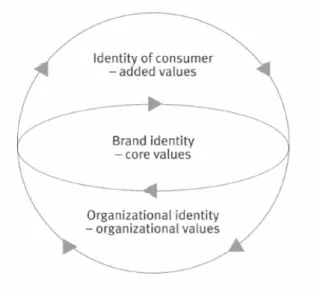
FIGURE 2.1 There is a continuous interaction between value and identity at three levels... 7
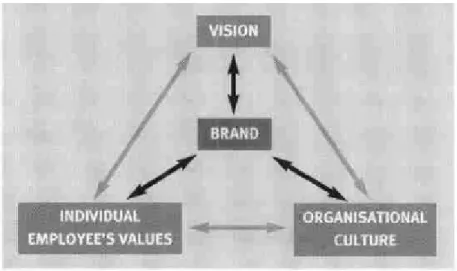
FIGURE 2.2 Interaction sources contribute to brand values. ... 9
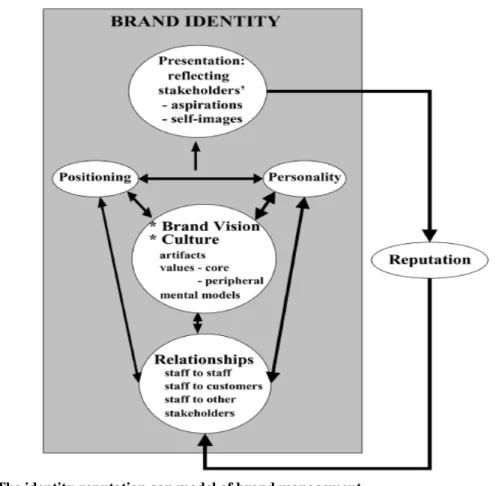
FIGURE 2.3 The identity-reputation gap model of brand management... 11
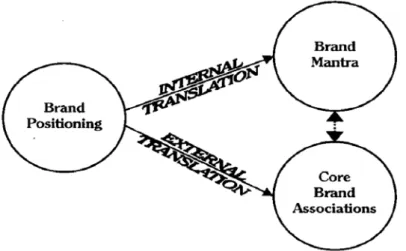
FIGURE 2.4 Brand mantras ... 15
FIGURE 2.5 The relationships between internal brand resources and brand performance .... 16
FIGURE 2.6 A holistic model for internal brand management ... 18
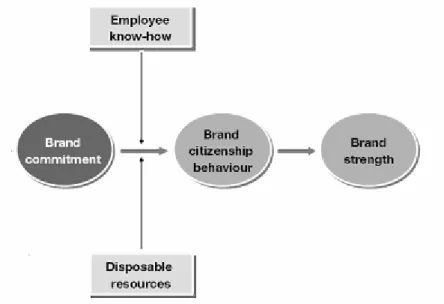
FIGURE 2.7 A holistic model for internal brand management ... 23
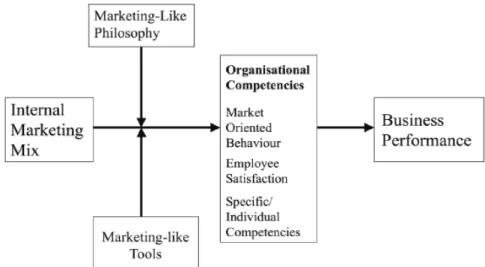
FIGURE 2.8 Conceptual model of internal marketing ... 26
FIGURE 2.9 Illustration of the emerged conceptual framework ... 31
LIST OF TABLES TABLE 5.1 Alignment of brand values ... 68
TABLE 5.2 Attaining consistent brand values... 70
TABLE 5.3 Organizational brand commitment ... 72
1
INTRODUCTION
In this first chapter, the background will present the concept of corporate brands and corporate branding. A problem discussion will then follow describing the organizational development of internal branding. Finally, the purpose and the research questions of this investigation will be identified.
1.1
Background
Brands are recognized to provide quality to customers, distinction within a market and to gain financial rewards to an organization, and can be characterized as products, corporations, persons and places. The impact of brands can not be overvalued, since organizations need to constantly attain customers so as to exist and compete in the marketplace, with brands being deemed to be as valuable to a company as the human and financial resources. Brands require a continual development and fostering, in order to meet customer expectations, and as customers are becoming more refined and markets more intricate, the positioning of the brand is of utmost importance, in assisting to differentiate the brand from its many competitors (Andriopoulos and Gotsi, 2000; Uggla, 2006; Melewar and Bains, 2002; Davis, 2002; Hatch and Schultz, 2003).
Harris and de Chernatony (2001) expose that brands are multidimensional creations that must coordinate a company’s operational and emotional values with customer activities and psychological needs. As mentioned by Simões and Dibb (2001), brands identify with the customer in both a psychologically and physically manner, with the acknowledgement that consumers currently purchase brands and not products. Morsing (2006) highlights that branding concentrates on generating an additional emotional value to the customer, which fundamentally creates imaginative and visual associations to increase the appeal of products or services. Organizations, as contended by Hatch and Schultz (2003), have changed marketing importance from product brands to corporate branding due to the progress of globalization. Morsing (2006) adds that many companies are transformed into brands due to the increased stakeholder pressure of today’s business environment, as a company’s ethics are becoming an extremely scrutinized aspect of corporate branding.
Morsing (2006) explains how corporate branding has been developed from a marketing framework, with the intentions of engaging the interests of the brand in a complimentary fashion. According to Kay (2006), corporate branding must be appreciated as a method of communicating to an audience in a logical manner, in which mental and emotional representations in many forms can be employed to provide customers with the meaning of the brand. A corporate brand is explained by Balmer and Greyser (2006) to entail a high degree of emotional ownership, as close association and loyalty are recognized as important elements of corporate branding. Corporate brands vary from product brands, as Uggla (2006) notes that corporate brands have a greater strategic focus and approach, plus the involvement of internal and external stakeholders. Corporate branding, as highlighted by Kay (2006) has been recognized as the means in which a company communicates its identity.
Corporate brand identity is a process that creates uniqueness, as well as representing what an organization stands for, as Melewar and Baines (2002) mention that this is of extreme importance to employees, customers and investors. Simões and Dibb (2001) describe how a
strong brand identity is essential in order to convey a consistent image for the internal and external environments surrounding the organization, with corporate branding entailing an influential role. Harris and Chernatony (2001) express how a holistic approach towards corporate branding is needed in order for the entire company to perform in unison with the desired brand identity. Moreover, Knox and Bickerton (2003) argue therefore that to be able to attain successful corporate branding today, organizations must be aware of and understand both organization and customer focus. Kay (2006) affirms that corporate branding activities can be aimed at shareholders, employees and other stakeholders, with a distinct focus on the operational and visible actions which represent the values of the organization. As described by Knox and Bickerton (2003), in the past few years the perception of corporate branding has switched to focusing on the qualities of the organization and its individuals, so as to project an enhanced impression of the company towards customers, in order to be able to cope with the demands of the modern day business activities.
Even though the intricate task of developing a strong corporate brand has been made more difficult due to the greater intensity of intangibility and responsibility, the value of creating a reputable corporate brand is regarded by Simões and Dibb (2001) to be an excellent opportunity, especially for service brands, to enhance recognition. Hatch and Schultz (2003) expose that organizations must take into consideration the past and the future, in order for the brand to relate to all stakeholders through both their heritage and the planned visions of what is to be expected. Strong corporate brands are recognized by Simões and Dibb (2001) to be a valuable asset to organizations, as increasing competition indicates that customer perceptions are becoming more and more important. Kay (2006) states that successful corporate brands enjoy having a significant impact, which strategically entails attracting more loyal and less price-sensitive customers in today’s fierce competitive markets. Effective corporate brands, as described by Brønn, Engell and Martinsen (2006), should possess a distinct perspective of its values, especially when interacting with customers, so as to “make a difference” in a competitive environment.
Balmer and Gray (2003), furthermore Simões and Dibb (2001) affirm that corporate brands have many benefits to appreciate, such as communicating brand values, differentiation from competitors and increased admiration and loyalty to the company. According to Morsing (2006), corporate branding focuses on a single central locus of control to manipulate corporate visions, values, actions and morals that all employees are asked to perform by. She also notes that this means corporate branding involves communicating with one voice to all stakeholders and media through consistent and coherent actions. Research has shown, according to Melewar and Karaosmanoglu (2006) that organizations can develop a stronger reputation and enhanced recognition if employees are always proficient in representing company values to external stakeholders. A fundamental problem regarding corporate brand management is consequently highlighted by Kay (2006) and Morsing (2006) to be how the values associated to the brand correspond to the personal values and beliefs of employees, which must be align with the brand’s value and promises, as they are responsible for the daily communications to customers. Vallaster (2004) indicates how internal branding is a relative new phenomenon that is starting to attract a lot of attention, and that it is a key feature for organizations to develop strong corporate brands, by coordinating organizational culture with internal operations.
1.2
Problem Discussion
Organizations need to adopt a systematic internal branding approach in order for employees to become customer conscious, as well as to perform in align with brand values. In light of this discovery, employees have now become the focus of brand management, as they interact on behalf of the company to external stakeholders and can differentiate the organization in an increasingly competitive working environment. Therefore, the importance of educating and training personnel on the brand message and integrating these values into working operations is growing in many organizations today. However, this is renowned to be an extremely intricate task, as an organization must expose a consistent fit of all business activities connected to the corporation with their brand meaning (King and Grace, 2005; Aurand, Gorchels and Bishop, 2005; Kay, 2006).
Brønn, Engell and Martinsen (2006) expose that consistency and likeness of employee values is a major influence which affects the daily routines of a company, as well as corporate communication. The employees’ attitudes and expressions are critically observed by stakeholders, as these should constantly be aligned with the corporate brand and its values, thus Melewar and Karaosmanoglu (2006), as well as Kiriakidou and Millward (2000) contend that employee beliefs and actions may at times disagree with the external generated image. Leberecht (2004) notes that there are many researchers which state that an important aspect of internal brand management is to align personnel behaviour with brand values, and he continues to mention that by applying this internal approach, management can guide employees to a greater overall image of the brand vision. By directly linking organizational culture with strategic vision, Hatch and Schultz (2003) dispute that the corporate brand has a greater opportunity to succeed. Organizational culture, which includes the vision and the strategies of the company are highlighted by Gotsi and Wilson (2001) to have a major impact of how employees create an image of the company. By simultaneously linking strategic vision, organizational culture and corporate images, Hatch and Schultz (2003) argue that an organization has a far better chance of differentiating brand values and competing in a market. Uggla (2006) states that corporate brands posses a few essential core values which describe the brand and that these values are central to the organization, in addition to having a big role in its core philosophy. Kay (2006) comments that the core values of an organization must always be associated to help and maintain the brand’s identity. To have too many core values, as proposed by Uggla (2006), may generate confusion involving a company’s values and norms. Effective brand management, according to King and Grace (2005), therefore relies on employees recognizing the correct behaviour or service when communicating to customers, as these actions should be associated with the brand’s core values. Gotsi and Wilson (2001) reveal that studies have shown that a corporate reputation is influenced by the performance of the entire organization, and they further note that it is the responsibility of management and the employees to look after and develop their corporate image. Employees are, according to Hatch and Schultz (2003), the vital link in building relationships with all organizational stakeholders, as they are required to convey the genuine significance of the brand.
Vallaster (2004) declares that in order for employees to transmit the brand’s values in all communications, they must understand and acknowledge what the brand represents. In order to develop a strong corporate brand with a reputable corporate identity, Brønn, Engell and Martinsen (2006) highlight that projecting the brands story to others needs the staff to recognize the knowing, being and performance of the corporate brand. Employees must develop a collective understanding of the brand, as Vallaster (2004) mentions that a
consistency in branding activities, for example corporate design, corporate communication and corporate behaviour need to be harmonized, with the intention of the company to create a strong corporate brand identity. So as corporate branding switches from aesthetic promises to moral promises, Morsing (2006) states that employees are required to believe in and possess personal morals in which the organization promotes to all stakeholders. According to Harris and de Chernatony (2001), the responsibility of employees is shifting to a role than can be deemed to be viewed as a brand’s “ambassadors”, as employees are the pivotal communicating link to a corporate brand’s internal and external environments. Balmer and Greyser (2006), furthermore King and Grace (2005) declare that every individual within the organization must be seen to be corporate marketers.
Wilson (2001) claims that internal communication operations must be ongoing and continuous if they are deemed to be effective, furthermore he mentions that they should be connected to recruitment procedures, training, performance measurements, motivation and rewards. By the recruitment of personnel that have similar values and morals of the brand, Morsing (2006) declares that this enables the organization to minimize the risks of noise and lack of commitment by employees, so as to present a strong, consistent corporate communication of the brand. However, King and Grace (2005) and Gotsi and Wilson (2001) also note that this entails the constant support of brand management, including all levels of the organization in the process of motivating and preparing all employees to fully understand the practice, as well as operational and communicational activities chosen by the organization. Involving the entire organization in corporate branding is highlighted by Hatch and Schultz (2003) to help to attract and motivate all employees.
By including the motivation of employees, Melewar and Karaosmanoglu (2006) maintain that a respectable corporate identity can be accomplished. Ewing and Caruana (1999) describe how successful internal branding plays a significant part in assisting employee attitudes in regards to work assignments, organizational commitment, work contributions, job motivation and job satisfaction. Gotsi and Wilson (2001) also mention that management must communicate a distinct message of defining brand values and corporate identity internally, so as to support personnel identification with corporate identity and increase commitment, motivation and reliable employee behaviour in conveying the brand’s core values and company goals. Emotional commitment is deemed by Vallaster and de Chernatony (2006) to contain the strongest and most encouraging association to the workforce’s behaviour. Organizational culture, as described by Balmer and Greyser (2006), refers to how employees identify themselves with the organization through values, beliefs and assumptions of the company’s historical roots and traditions.
Morsing (2006) reveals that a strong organizational culture is required so as to be able to constantly motivate and commit employees to collectively perform to branding operations. Firms which create a successful corporate brand, as illustrated by King and Grace (2005), develop an organizational culture that encourages all levels of the organization to be committed to branding operations, as the message of corporate strategy and performance must be consistent to employees, so as to positively interact with external stakeholders. Leberecht (2004) proclaims that employees must completely understand the values of the brand and internalize these to the degree that they are aligned, as well as committed to performing these values. King and Grace (2005) assert that by committing and motivating employees to always signify the corporate brand’s values and promise to all audiences, leads to a greater recognition to customer satisfaction.
Internalizing the brand enhances the organization to achieve a strong reputation, and Simões and Dibb (2001) define this process as; “Internalising the brand involves explaining and selling the brand to employees. It involves sharing with employees the research and strategy behind the presented brand. It involves creative communication of the brand to employees. It involves training employees in brand-strengthening behaviours. It involves rewarding and celebrating employees whose actions support the brand. Most of all, internalising the brand involves involving employees in the care and nurturing of the brand”. Leberecht (2004) states that internal branding, “encompasses the firm’s values, systems, policies and behaviours towards the objectives of attracting, motivating, aligning and retaining the firm’s current and potential employees”.
In light of the aforementioned problem discussion, we have chosen to investigate this area of research due to the fact that internal branding is recognized by many researchers to be a fairly new phenomenon that has become important for corporate brands to be recognized and operate in increasingly competitive markets. Many authors have also stated that there is relative little empirical evidence surrounding the concept of internal branding and its developments. In order to study the concept of internal branding the following purpose and research questions has been applied.
1.3
Purpose and Research Questions
The purpose of this study is to provide a better understanding of the development of internal branding in organizations.
In order to attain our stated purpose, the following research questions will be addressed: 1. How can the alignment of brand values be described?
2. How can the attaining of consistent brand values be described? 3. How can organizational brand commitment be described?
4. How can the sustaining of organizational brand commitment be described?
1.4
Demarcations
The ideal situation would be to research the development of internal branding from many different perspectives. However, in our study we are only focusing on brand values and organizational commitment from a corporate perspective. This enabled us to attain a better understanding and a more focused analyse in our time-restricted study of a large, complex research area.
1.5
Outline of the Thesis
The study consists of six chapters and we will briefly explain the contents of each chapter. Chapter one begins with the background, which is followed by the problem discussion that presents the research area and the research questions. Chapter two describes the literature and the theory which is associated to our research questions and thereafter a conceptual framework is selected to support us in our study. Chapter three illustrates the methodology and how the data was obtained for our thesis. In chapter four, the collected empirical data is presented, which is then analyzed in comparison to the conceptual framework in chapter five. Finally, chapter six highlights the findings and implications assessed in our research. The outline of the thesis is shown in figure 1.1 below:
FIGURE 1.1 Outline of the thesis CHAPTER 1 Introduction CHAPTER 2 Literature Review CHAPTER 3 Methodology CHAPTER 4 Empirical Data CHAPTER 6 Findings and Implications CHAPTER 5 Data Analysis
2
LITERATURE REVIEW
The purpose of this chapter is to review the relevant literature and establish a theoretical outline. Firstly, the presentation of brand value alignment, the attaining of consistent brand values, organizational brand commitment and the sustaining of organizational brand commitment are described, in order to establish how these factors influence the development of internal branding in organizations. At the end of this chapter a conceptual framework is presented relating to the literature reviewed.
The basis for selecting the following literature to help investigate our research area and to construct a conceptual framework for our study is that we consider them to be current theories which also provide us with different perspectives surrounding each of our four research questions. Thus, this presented us with an overall general view of each research question that enabled us to select the most relevant theories, or parts of theories, which we considered to best suit our investigation.
2.1
Alignment of Brand Values
Urde (2003) highlights that the acknowledging, application and functioning of the value credentials of the corporate brand are often matters that can be neglected, forgotten or unclear. He continues to mention that the expressions associated with the combination of values employed to generate the identity of the corporate brand can create uncertainty. Due to these circumstances Urde states that there are no evident connections to creating and sustaining the corporate brand, as values are difficult to relate to. Urde asserts that the supporting of corporate brand values in the brand building process is a recognized dilemma, and presents three perspectives to how values can be examined: values that are related to the organization, values that summarize the brand and values that are experienced by customers (see figure 2.1).
FIGURE 2.1 There is a continuous interaction between value and identity at three levels Source: Urde (2003), p 1020.
Values that are related to the organization
Urde (2003) declares that organizational and corporate values can be explained in several ways, and are used to help express how a company operates. He illustrates that values can be interpreted as the rules of the company, the religion of the company, provides a company with a cohesive mission and vision, accepted intrinsic principles, exclusive core practices, storytelling and an element of intellectual assets. These internal values are maintained by Urde to describe what the company represents, and are an essential source for core values which generate the distinctiveness of an organization.
Values that sum up the brand
The heart and the fundamental nature of the brand has in the view of Urde (2003) been a discussed area in corporate branding over the years and can also be construed in various terms. He adds that defining and describing the core of the brand helps to enhance identity, by revealing the innermost values that cements the brand’s essence. Furthermore, Urde discloses that values can be viewed as the most important part of the brand, which help to clarify the brand’s spirit, as the communicative element of the brand’s soul and the brand’s code or desire can be described in only a few words. Urde states that the function of core brand values is to proficiently assist corporate brand development, thus this implies that core brand values have an instrumental role in employee performance and communication.
Values as experienced by the customer
Urde (2003) verifies that corporate brands possess value as they are entailed to provide added value to the customer, however, customer added value is rather hard to illustrate and are noted by several authors in different theories to contain either emotional and/or functional appreciations, competitive advantage, brand development and a willing sacrifice. Customer associations to the brand are, according to Urde, symbolic and extremely strongly connected to the core values of the brand and the organization, implying that added values represent the image and identity of the corporate brand, in other words the interactions of internal and external communication.
As exposed by Urde (2003), first and foremost each of the three explanations can significantly be acknowledged on its own, so as to obtain a greater understanding of clarifying which are the organizational, the core and the added values, as well as the identities of the organization, the brand and the customer. Urde indicates that when all these factors are combined they help to demonstrate the value base of the corporate brand, in addition to the value development process.
de Chernatony (2002) clarifies that the brand’s values may be evaluated alongside the values of the vision, individual employees and organizational culture to ensure that management can understand and recognize the required activities and practices that help to create a more consistent brand. Figure 2.2 on the next page illustrates the interaction sources which contribute to brand values according to de Chernatony.
FIGURE 2.2 Interaction sources contribute to brand values. Source: de Chernatory (2002), p. 32.
de Chernatony (2002) notes that this approach to strengthen the brand performance is to evaluate the consistency of the providers to brand values. According to de Chernatony, these can be assessed and observed by firstly considering the values of senior management that are transmitted into the brand vision, and then there are the values of individual employees that must be aligned with these generated brand values in their working environment of providing the brand’s promise to customers. Additionally, de Chernatony points out that the brand vision values may not be so different between rival companies and highlights that managers must be able to differentiate between category values which are essential for competing in the given industry and distinctive brand values which encourage the purchase of a service or product. It is here that de Chernatony explains that all these elements are rarely completely aligned with the brand at once.
de Chernatony (2002) then comments on the importance of organizational culture, as this consists of all the values held by every division within an organization, and then finally the values stated in documents and experienced by stakeholders. By creating their own organizational culture, Abbott, White and Charles (2005) maintain that companies are capable of attracting internal and external stakeholders with equivalent qualities, features and values. They add that it is also positive to observe that organizations which mainly focus on standard and end result values are more likely to experience negative behaviour in the work arena, as although these values are important for a company, Abbott et al. claim that to operate in an environment where diligence surpasses moral integrity is not very encouraging.
Yaniv and Farkas (2005) confirm that to increase employee identification to the corporate brand, as well as maintaining their backing, corporate brand values must mirror organizational values and culture. They further note that if there appears to be a difference in these perceptions, employees will begin to develop mistrust towards the organization in which they work for, thus harming their identification with the corporate brand. Consequently, Yaniv and Farkas propose that this dissatisfaction felt by the employee will then be conveyed to the customer, paving the way for customers to question the value of the corporate brand, which helps to create a greater corporate brand and organizational value difference that will affect customer loyalty issues. Yaniv and Farkas highlight that the theory of Person-Organization Fit (POF) is regarded to assist treating the contrast between the employee’s individual values and the value’s of the corporation, from an employee’s perspective.
According to Yaniv and Farkas (2005), the greater the POF an employee has, the more likely it is that job satisfaction and commitment to the company and its objectives will be achieved through performance. Thus, as mentioned by Yaniv and Farkas, a high POF implies that if the personal values, as well as the brand and the organizational values are coherent, this provides a source of contentment and accomplishment to the employee. Yaniv and Farkas continue to argue that by feeling this fulfilment an employee will have no qualms in the communicating and the transferring of the brand promise to customers, as they appreciate these given principles themselves, plus the fact that the organization and the brand appear to project the same beliefs. Moreover, Yaniv and Farkas proclaim that if the difference of corporate values and corporate brand values are small, in other words, if the actual and desired image of the organization does seem to be true, this will also assist an employee in to communicating and transferring the brand’s promise to the customer, as no deceit is felt by the employee, thus enhancing employee and customer relations.
Yaniv and Farkas (2005) validate that there have been many studies surrounding the POF theory and there will be many more in the future, due to the fact that the POF is acknowledged to be an effective assessment and measurement of mission direction for an organization. They also highlight that one study has shown that this theory can be investigated from four viewpoints: the degree to which individual knowledge, skills and abilities match work requirements, the degree of contrast between employee needs and organizational structures, the match between personal values and organizational values and culture and employee personality and apparent organizational image. However, Yaniv and Farkas state that a majority of researchers are in agreement with that the POF influences personnel behaviour and performance, which in turn influences customer perceptions of the corporate brand and the organization.
Personal values are indicated by Yaniv and Farkas (2005) to be of a social nature which assists the individual to become accustomed to an environment, and this includes the values, goals, personality and attitude of a person. While organizational values are described by Yaniv and Farkas to present the motives for employee behaviour, in addition to organizational operations. Yaniv and Farkas acknowledge that this involves organizational culture, climate, values, goals and norms. Organizational values are therefore illustrated by Yaniv and Farkas to be manipulated by the majority, as these group principles shape the basis for organizational culture and the more employees that comply to these implications, the greater the influence organizational culture has. They add that personal and organizational values interact and influence with each other, allowing POF to assess how employee values may modify when becoming part of the workforce, as well as evaluating the degree to which the employee will familiarize himself/herself to organizational norms and values. Thus, Yaniv and Farkas affirm that a strong association between POF observations and organizational identification inferred that an employee is more prepared to offer a additional support to the brand and the company in his/her performance.
Yaniv and Farkas (2005) also reveal that a previous study from 1996 observed the congruence between direct (subjective) and indirect (objective) appraises of POF. Direct measurements are highlighted by Yaniv and Farkas to be better applied to obtain a perceived fit, as a strong match between personal and organizational values always implies that an individual will be more satisfied with and committed to an organization despite whether this is actually true. Whereas indirect measurements are described by Yaniv and Farkas to be more adept in acquiring an actual fit, as the compatibility of personal and organizational values must be
evaluated together in order to obtain a conclusion, which focuses upon “process” effects, such as communication and teamwork. Additionally, Yaniv and Farkas emphasize upon two articles from 2001 and 2002 that underlined a strong connection between values alignment and organizational efficiency and between values alignment and economic success. Yaniv and Farkas mention that from the conclusions of the articles it had revealed that organizations that possess a strong adaptive cultures supported by shared values had a far greater performance level than other organizations, plus they illustrated superior rates of growth, better job creation rates and a greater returns in stocks prices.
2.2
Attaining Consistent Brand Values
Harris and de Chernatony (2001) propose that a manager’s task is to first characterize brand values and then to make certain that employees’ values and performance correspond with them. Corporate brand management, as verified by Harris and de Chernatony, must adopt a manner which appreciates the entire workforce to behave as a unit in appliance with the generated brand identity. They clarify that corporate identity is reflected in an organization’s values and goals so as to create distinction in the marketplace. According to Harris and de Chernatorny, brand identity is formed upon six elements: vision and culture, positioning, personality, relationships to all stakeholders and stakeholders’ reflections, which all help to fashion an organization’s reputation. Figure 2.3 illustrates de Chernatorny’s identity-reputation gap model of brand management.
FIGURE 2.3 The identity-reputation gap model of brand management Source: Harris and de Chernatorny (2001), p. 443.
Vision and culture
Vision and culture are noted by Harris and de Chernatorny (2001) to be the hub of the brand’s identity. They illustrate that vision focuses upon the brand’s core purpose, with organizational core values and principles leading the way. Every corporate brand, as revealed by Harris and de Chernatorny, distinguishes the organization to its audience by their core values, so they proclaim that the consistency and the character of these core values are an important feature to successful corporate brands. Therefore, Harris and de Chernatorny mention that it is these core values that are to be prominently communicated by management to employees, so as to provide working roles, guide behaviour and to motivate. Organizational culture is deemed by Harris and de Chernatorny to include employees’ values and assumptions, which also shapes employee behaviour, so managers must recognize the need to align organizational culture with core values in order to encourage a consistent brand performance. For an organizational culture to be considered to be a competitive advantage for the organization, Harris and de Chernatorny state that central core brand values can not be altered, while other core brand values must be adaptable.
Positioning
Harris and de Chernatorny (2001) highlight that the association between the brand’s vision and core values, as well as the brand’s positioning then needs to be addressed. The brand’s positioning should be founded upon the brand’s core values, as they explain that these must represent the brand and distinguish the brand from competition, prompting an indication of the brand’s performance qualities.
Personality
As described by Harris and de Chernatorny (2001), emotional features of the brand are developed through the brand’s core values to create personality. These characteristics are affirmed by Harris and de Chernatorny to be supported and emphasized in the employee/customer relationship. To assist the brand’s positioning, Harris and de Chernatorny explain that managers must make sure that the brand’s personality is constantly communicated to employees and external stakeholders.
Relationships
The values featured and developed in the brand’s personality, are then according to Harris and de Chernatorny (2001) consistently applied to create a customer/brand association. The interactions of employees are therefore noted by Harris and de Chernatorny to be fundamental in cementing the relationship of the brand with its customers. Harris and de Chernatorny further mention that managers must assist and support employees to acquire suitable behaviour at all times to different stakeholders, which stem from the brand’s core values. Presentation
The next element pointed out by Harris and de Chernatorny (2001), entails creating presentation methods to enhance the brand’s identity to an audience. Here they mention that both marketing activities and employee interactions affect the way a consumer relates
themselves to the brand, so managers must appreciate the desired image in reflection to advertising and employee behaviour.
Reputation
Effective internal brand management should conclude in a complimentary brand reputation, as Harris and de Chernatorny (2001) declare that the brand’s value is evaluated by customers on both past and present performances over time. According to Harris and de Chernatorny, the identity-reputation gap model of brand management assists managers to reduce the gaps between a company’s identity and reputation, consequently managers must develop employees that can effectively, internally and externally, build the brand.
Ind (2003) states that the employing of an ideology helps an organization to identify their objectives, which in turn presents an overall belief for employees to connect to the organization. A distinct ideology presents a focus for employees and is declared by Ind to permit employees to systematically deliver a customer-orientated product or service in a content and liberated manner. He goes on to mention that for an organization to be strictly values-led, the vision must be delivered with conviction and consistency and that there are three aspects that must be encompassed. Ind highlights that an organization’s ideology should be clearly and honestly described, communicated and practised in an appropriate way and it must convey business benefits.
Clearly and Truthfully Defined
In order to develop an authentic commitment towards an organization, Ind (2003) asserts that this necessitates both transparency and reality, as it must be a genuine and logical way for an organization to attain its business goals. Applying the values that need to be integrated into and associated with the organization is explained by Ind to require total faith and commitment for an organization to be successful.
According to Ind (2003), employees should be able to trust the organization, so the ideology must be reliable and visionary in order for the whole organization to strive to accomplish goals. Passion, and to be motivated to feel passionate are not emotions that can be artificially attained, so Ind claims that by creating a strong organizational culture should assist stimulation, involvement and commitment. The ethical element of an ideology must also be considered, as Ind affirms that this entails an organization operating within the view of customer and shareholder belief. Furthermore, he continues to mention that courage is needed so as to create uniqueness and differentiation from competitors, which leads to developing a real loyalty and fondness with customers.
Communication and Experience
Ind (2003) illustrates that organizations can not believe that by just communicating an ideology to its employees will immediately entail that it will become a focus in their working environment. Employees are busy people that also have their own values and judgements, and Ind states that management can not simply enforce certain beliefs on individuals for the sake of the business. Managers, as declared by Ind, must validate the values to be applied, while also appreciating the freedom and possibilities to put them into action, therefore the employee must understand their right to select their own value structures.
Consequently, Ind (2003) highlights that the organizational culture should be encouraging and favourable in endorsing an ideology, however, Ind also states that individuals should appreciate and understand these matters, as well as being allowed to decide about the given ideology for themselves. Creating the working environment is generally considered by Ind to be the hardest element of this process, and the following are highlighted as requirements: wholehearted commitment of management, willingness to empower people, willingness to take risks on people, accepting the need to share ideas and results, and integrating the ideology into all facets of the organization, in particular recruitment policy, training, appraisals and rewards. In the view of Ind, the ideology must be employed and appreciated by the entire organization, which entails the need to apply these values beyond simply communication and to implement them into the day-to-day tasks of employees so as to motivate and encourage self-discovery and behavioural change, instead of demanding it. Business Benefits
By focusing on employees, Ind (2003) notes that an organization demonstrates the relationships between extremely committed employees, content and loyal customers and organizational performance are of great importance. Management therefore have the duty of ensuring that the organization “lives the brand”, as Ind maintains that the connection between employee attitudes and behaviour, as well as organizational performance should be aligned and attained, in addition to being pivotal to the organizational culture. Ind acknowledges that this enables an organization to successfully motivate employees in striving to achieve organizational goals through both good and bad times. Ind proclaims that in order to convey a good balance, significant knowledge and information needs to shared appreciated throughout the entire organization, so as true meanings and reflections can be evaluated and measured, so as to enhance the overall performance of the brand. However, he also illustrates that for an organization to be successful, the significance of ideology, consisting of values and visions must be illustrated through organizational performance, and this entails evaluating employee performance and customer behaviour, so as to attain financial rewards and brand value.
Keller (1999) describes brand mantras as short expressions that quickly sum up the prominent characteristics of the brand positioning, and he explains the reason for brand mantras is that both employees, in addition to marketing partners understand the core of the brand, so as to transform activities to match the brand expectations of customers. Keller declares that “brand mantras are internal (to the organization) translations of brand positioning designed to simplify and communicate positionings to facilitate employee understanding; core brand associations are external translations of brand positioning designed to reflect customer understanding” (see figure 2.4 on the next page).
FIGURE 2.4 Brand mantras Source: Keller (1999), p. 50
Keller (1999) states that brand mantras are essential for various motives, and he starts by mentioning that they form how customers perceive the brand, from first impressions to present day judgments, which are always influenced by the direct or indirect interactions with a company’s employees. Consequently, Keller contends that employees may not be knowledgeable on current marketing activities employed by the organization, so organizations may risk damaging the brand’s reputation. The communication of the brand mantra is recognized by Keller to play an important part in symbolizing the brand’s meaning for an organization, so all the internal stakeholders of a company should appreciate their role in assisting these matters. As confirmed by Keller, brand mantras are made up of three components. Firstly, he describes how the Brand Functions portray the kind of product or service to be expected or benefited by the brand, which can vary from very definite to very abstract symbolizations. The Descriptive Modifier is illustrated by Keller as a method to further define the brand in relation to business activities and uniting these components can assist an organization to outline the borders of the brand. Ultimately, the Emotional Modifier is presented by Keller to be a reflection of how the brand generates its benefits and qualities to customers. He further notes that brand mantras develop their power and value in their collective significance, as Keller exposes that an effective brand mantra implies that no other brand should exceptionally excel on all three components.
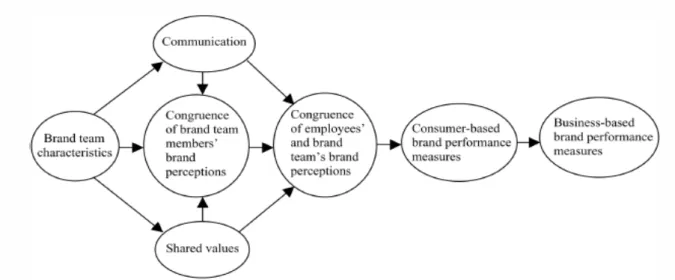
Harris and de Chernatorny (2001) state, along with a numerous of previous studies, that there are three main aspects that influence perceptual congruity: the similarity of brand members, shared values and communication. Figure 2.5 on the next page, illustrates the importance of these integrated internal aspects that can be employed to evaluate performance, as described by Harris and de Chernatorny.
FIGURE 2.5 The relationships between internal brand resources and brand performance Source: Harris and de Chernatorny (2001), p. 447.
Brand Team Members
Harris and de Chernatorny (2001) argue that corporate branding involves a large, diverse team to leverage the brand into action. They highlight that the more similarities in characteristics that these brand team members possess, the greater chance of communication, integration and consensus building can be achieved. Harris and de Chernatorny contend that shared values and outlooks are needed to harmonize the team members in their brand building performance. However, they also describe that dissimilarities between group members can be advantageous, with a greater scope of skills and knowledge, plus the restrictions connected to “groupthink”, stated as key issues to be considered in regard to innovation, as well as change. Harris and de Chernatorny even mention that a team could become more compact and stronger if they were to settle differences and conflicts to begin with, although they specifically note that the turnover rate of team members could also be quite high. Nevertheless, Harris and de Chernatorny confirm that in time team members usually acquire similar values and assumptions, as they continually work and interact with each other, and in turn communication within the team in enhanced.
Shared Values
Successful organizations, in the view of Harris and de Chernatorny (2001) stress that the brand values are to be easily recognized, understood explicit and shared by all employees. They continue to note that effective managers employ their values to form the views and attitudes for the entire company. By having shared values, Harris and de Chernatorny declare that desired employee behaviour can be achieved, which is an important corporate brand factor, as brand and organizational values must be consistent to each other when communicating to stakeholders. Harris and de Chernatorny insist that shared values improve participation, hence creating a better commitment towards the brand and the company, and enhancing organizational performance. However, they do also mention that shared values can impair an organization’s success, as certain core values must be able to adapt to the dynamics of the ever-changing business environment in order to maintain a competitive performance. Harris and de Chernatorny add that managers must therefore decide which core values are to be kept and which are to be changed so as to enhance performance.
Communication
According to Harris and de Chernatorny (2001), communication plays a significant role in the development of the brand, in particular when considering actual and desired brand identity. As mentioned before, Harris and de Chernatorny state that communication is more effective when similar values and attitudes are shared. Communications will affect the brand’s performance, so Harris and de Chernatorny confirm that brand team member relationships, as well as the relationship between brand team members and employees are noted to be of considerably importance. They state that the more the brand team interacts with each other, the stronger the team becomes in terms of solving problems with compromises and/or shared attitudes and values. In addition to these interactions, Harris and de Chernatorny also avow that a more distinct brand identity is created the more managers and employees communicate, as performances are conducted in a more consistent manner to the outside world. This is acknowledged by Harris and de Chernatorny to support and improve the brand images of both the employee and the customer. Moreover, they state that the communication between management and employees should become a two-way communication process so as evaluate if the communication methods are effective. Harris and Chernatorny also allege that employees are more inclined to accept communicated brand values, from both management and advertising if they feel that they are part of the brand’s communicational efforts, so management must be clear to employees in explaining the brand’s identity, as well as how brand communication is to create that identity in order to eliminate uncertainty.
In order to achieve employee commitment to the brand’s identity, Harris and de Chernatorny (2001) acknowledge that it is vital to create personnel communication programmes, as internal organizational communication is considered to be essential for presenting and receiving information, attaining understanding and employee commitment. They further note that employees must understand what role they have in an organization and feel that they are engaged in the brand identity process, in order to fully understand and comply with congruent brand values, in addition to acting as brand ambassador to stakeholders.
2.3
Organizational Brand Commitment
Abbott, White and Charles (2005) affirm that a reliable forecaster of organizational behaviour is organizational commitment (OC), which describes the emotional associations between the employee and the organization and the development of this relationship. They confirm that previous studies have shown that the OC of an employee is connected to fundamental workplace behaviours. Abbott et al. reveal that one investigation in 1993 stated that OC consists of three factors and these are affective, normative and continuance commitment. They define these as: “affective OC denotes the ‘emotional attachment to, identification with and involvement in the organization’; normative OC refers to ‘a perceived obligation to remain in the organization’; and continuance commitment denotes ‘the perceived cost associated with leaving the organization’ ”. Abbott et al. expose that lower turnover intention, in other words, employees find it hard to leave a workplace, is the single likeness found between the three OC elements, and they comment on the fact that OC recognizes the power of emotional ties connected to the employee and the organization. Results in Abbott et al. studies reveal that there is a strong connection between work values and OC in various organizational circumstances. They continue to point out that employees develop affective and normative OC due to the association of their own personal values and the perceived
values of their place of work, and that socially prioritized values, such as vision and humanity, are considered to be attractive values for an organization to be in accordance with. Hoogervorst, Koopman and Flier (2005) further add that organizational culture, management practices and organizational structures and systems must be understood and appreciated, so as to attain collective, consistent employee behaviour. As decision-making is a renowned management process, Hoogervorst et al. argue that this traditional method of organizational process removes employee participation, in terms of knowledge, ideas and significant assistance. They also note that organizational performance is credited to be enhanced the greater personnel comply to formal structures, regulations and assignments, as their behaviour is acknowledged to be of a coherent and harmonized nature. Hoogervorst et al. state that management need to encourage employee motivation and commitment, therefore they highlight that a human-centred view that focuses on employees being the vital link for organizational success. Competitive advantage, as they explain can only be achieved by the attaining of required organizational behaviour. Hoogervorst et al. assert that human resources are the greatest unexploited supply of knowledge in companies today, so they maintain that employee participation in organizational internal activities is crucial to sustain and enhance organizational performance, as well as supporting employee development.
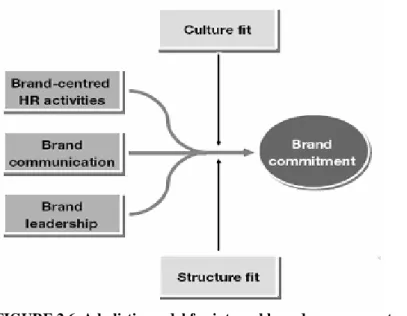
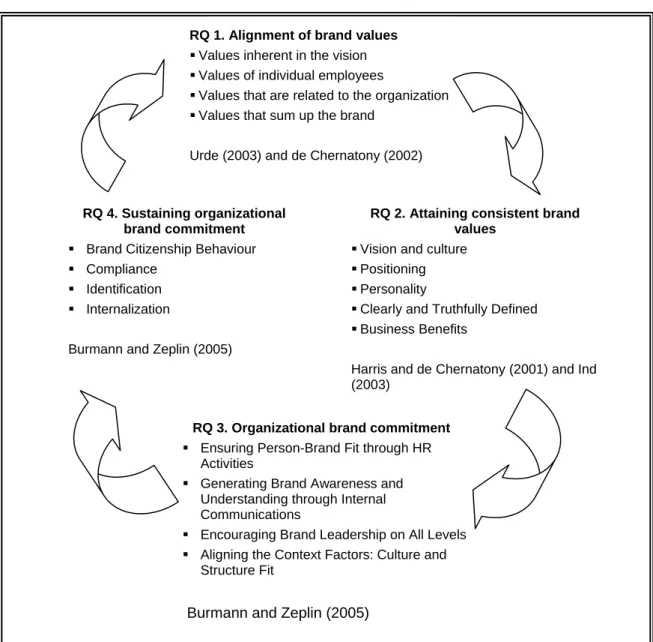
Burmann and Zeplin (2005) present a holistic model for internal branding and declare that brand commitment does not materialize by itself. They have designed a holistic model with three central forces for achieving brand commitment based on the review of previous their studies. Their earlier investigations lead Burmann and Zeplin to believe that there is no ideal or easy answer for how to create brand commitment as numerous processes must be implemented and coordinated together. The fundamental nature of these processes, according to Burmann and Zeplin, are shared in three forces: brand-centred human resources (HR) activities, brand communications and brand leadership. However, they point out that these three core forces will not result in success if they are not aligned with the background features of the organizational culture and organizational structure fit. Figure 2.6 illustrates the elements, according to Burmann and Zeplin, of holistic brand management, which are influential to brand commitment within an organization.
FIGURE 2.6 A holistic model for internal brand management Source: Adapted from Burmann and Zeplin (2005), p. 286.
Ensuring Person-Brand Fit through HR Activities
Burmann and Zeplin (2005) predict that some employees will be stronger related to the brand values through their own personal values than others even prior to working at an organization, which implies that core brand values already typify certain ingredients of their self-concept, so less effort regarding the brand promise activities is required by the organization. A brand-centred approach to HR management, as stated by Burmann and Zeplin, must make certain that candidates with a strong personal identity-brand fit are firstly hired and chosen, and then those employees which posses a strong person-brand fit are promoted. They go on to mention that the foundations of the brand identity concept support employee marketing, employee selection and promotion credentials. Burmann and Zeplin highlight that “Recruitment is a branding exercise, it’s part of the management of the corporate brand”. Although various screening methods do exist, Burmann and Zeplin recommend that potential employees are to spend time with established employees so as to observe their qualities before entering the workplace, in order to assist personal identity-brand identity fit in the course of self-selection. Furthermore, Burmann and Zeplin (2005) also proclaim that the HR management of an organization can assist to the development of brand identity internalization by phasing in new employees. Burmann and Zeplin acknowledge the use of orientation training as a key means to initialize the socialization process, in addition to the communicating of brand identity through an organization’s tradition, vision, values, capacity and character. They even note that executive programmes experienced in later working life can be a way of complementing this preliminary training. As well as training, Burmann and Zeplin emphasize the need for informal approaches so as to enhance the employee’s perception of the brand identity, with social events and mentor programmes given as examples. They reveal that previous investigations have shown that institutionalized socialization has a major encouraging impact on the development of organizational commitment, organizational identification and person-organizational fit, thus Burmann and Zeplin maintain that the same must be said for brand commitment as it is founded on brand identity internalization.
Generating Brand Awareness and Understanding through Internal Communications
In the view of Burmann and Zeplin (2005), if personal identity-brand identity is accomplished by HR practices, personal and brand values are only associated unconsciously. It is here that they allege that every employee must also be consciously responsive to the brand’s identity, so as to appreciate what this entails for the organization by recognizing the importance of branding concerns of the day-to-day aspects of their jobs and the interaction with customers in ensuring the brand’s promise. Burmann and Zeplin continue to add that only when every single employee understands the impact of customer relationships that the brand identity concept can be communicated. Therefore, Burmann and Zeplin assert that a clear and engaging expression of the brand identity concept is to be verbally communicated within the entire organization at every employee and management level.
The verbal communication is explained by Burmann and Zeplin (2005) to involve two contradicting purposes that must be fulfilled. Firstly, they claim that it should truthfully symbolize all the features surrounding the brand identity, and secondly, they add that it must also be memorable. Burmann and Zeplin (2005) continue to mention that an extensive brand book can describe in great detail the conception of an organization’s brand identity, however, they highlight that a brand book is considered to be a very good guide and support to the
brand’s progress, in particular for HR and internal communications. But Burmann and Zeplin reveal that it is very unlikely that the whole book will be memorized by every employee. According to Burmann and Zeplin, small teams, which can include the CEO, as well as any long existing executives and significant employees, are the best method to transmit the verbalization of the brand identity. Burmann and Zeplin affirm that a brand value statement can also be employed as a directive, but even this can be long-winded and hard to recollect. They stress that core values, no matter how simple and common they appear, must be remembered and employed in the daily communications and work activities within an organization. In order for the brand statement to be effective, Burmann and Zeplin disclose that it must first and foremost be memorable, in addition to also being short and concise. Encouraging Brand Leadership on All Levels
According to Burmann and Zeplin (2005) the third element of developing brand commitment is leadership, and they reveal that there are two brand-related levels of leadership to be considered. Firstly they highlight the macro level, which describes the role of the CEO and executive board in the brand management procedure. Burmann and Zeplin explain that the CEO and the executive board are recognized to have a substantial influence on both the internal and external brand observations. Employees, as acknowledged by Burmann and Zeplin, will only take the internal branding practices sincerely if they are backed by and employed by the CEO and executive board. Consequently, Burmann and Zeplin state that the entire organization, from top to bottom, must appreciate and understand the brand identity concept, in order for it to be both employed and effective. However, they also mention that the key role of the CEO can also be considered to be negative, as a few careless expressions or actions can brutally harm the brand’s reputation. Another danger exposed by Burmann and Zeplin, is that the brand identity may become too dependent on the CEO’s charisma and that the brand identity can be left with no direction when a successor takes over.
The second level, as describe by Burmann and Zeplin (2005), concentrates on the micro level of leadership, which entails the personal leadership of executives within an organization. They verify that every executive must behave as a role model for the brand, and that social learning can be deemed to be the informal means of the internal interaction process where employees gain knowledge of brand norms and values. As well as role models, Burmann and Zeplin also reveal that there are specific forms of leadership behaviours which are judged to be more successful in developing brand commitment through identification, and they mention the transformational leadership theory as an effective research model.
Transformational leadership, when considering the brand, is highlighted by Burmann and Zeplin (2005) to define leaders’ behaviour, which manipulates the values, assumptions and ambitions of the employees of an organization and persuade them to surpass personal interests to support the good of the brand. They continue to add that transformational leadership has been proven to have noteworthy influences on organizational commitment and organizational citizenship behaviour, as well as improving organizational identification. Previous investigations have shown that charisma, inspiration, intellectual stimulation and individual consideration are four features that symbolize transformational leaders, and Burmann and Zeplin acknowledge that all four characteristics can be obtained by leaders through the methods of training and coaching. They also mention that many practitioners illustrate the need for empowerment of employees in these circumstances.
Leadership, not management is maintained by Hoogervorst, Koopman and Flier (2005) to be a key factor for an organization to employ a human-centred approach, as they mention that the motivation of employees is a managerial task that is founded from mutual needs, expectations and values. Hoogervorst et al. argue that the moral issues surrounding leadership are important matters that help to cement relationships with personnel, as emotional bonds are generated. Trust therefore, as considered by Hoogervorst et al. to be a necessity in the leader/employee relationship, in order for management to constantly relate to and appreciate their employees. They point out that leadership qualities affect employee control, self-confidence, self-efficiency and self-actualization, in relation to organizational performance. Hoogervorst et al. reinstate that effective leadership requires employees to be involved and committed, and this is obtained through the relationship of creating shared goals, values and ambitions, thus a valuable internal social interaction is imperative to coordinate organizational performance.
Aligning the Context Factors: Culture and Structure Fit
Burmann and Zeplin (2005) confirm that the three brand-centred HR practices of brand communication will only be successful in attaining brand commitment if the organizational culture and structure are in correspondence with the brand identity concept. Due to the extreme influence of organizational culture on personal values and performance, Burmann and Zeplin maintain that there must therefore be a brand identity-culture fit. They go no to clarify that high brand identity is experienced by employees as it is founded on values that are strongly recognized through the organizational culture, and this helps to develop a strong and consistent brand identity by informal interactions within the organization. However, Burmann and Zeplin affirm that if a misalignment between desired brand identity and organizational culture is exposed, there are three alternatives an organization can consider, and these are: adapting the brand identity concept, managing around the organizational culture or adapting the organizational culture.
As noted by Hoogervorst, Koopman and Flier (2005), organizational culture can either enhance or discourage organizational objectives. Moreover, they reveal that many authors state that as well as social communications, management practices have a major impact on the organizational learning process and the instigation of organizational culture change. Thus, Hoogervorst et al. propose that this represents how management can manipulate that values and beliefs of personnel. They describe how certain authors indicate that the development of organizational culture is a managerial problem, as this helps to fashion and sustain appropriate employee behaviour.
Corporate structure, as stated by Burmann and Zeplin (2005), must also be in harmony with the brand identity concept as it entails reward policies, infrastructure and organizational structure. Burmann and Zeplin mention that the first measure to align reward systems is to make certain that incentive structures do not neutralize the desired brand-consistent behaviours, and they highlight that to influence these brand behaviours they must be able to be evaluated and rewarded upon successful performance. As described by Hoogervorst, Koopman and Flier (2005), organizational structures and systems involve communication, evaluations, rewards, operational organization and assignments, as well as information processes and these are considered to be pivotal in organizational behaviour. Structures and systems, according to Hoogervorst et al. are traditionally associated to regulating instruments that shape a controlled state of standards and knowledge throughout the organization, which is