Implementing an Object Model
on Top of Commercial Database Systems
(Extended Abstract)Markus Tresch and Marc H. Scholl
Department of Computer Science, Information Systems { Databases ETH Zurich, CH-8092 Zurich, Switzerland
E-mail: [email protected]
1 Introduction
The aim of the COCOON1 project is to
investi-gate the design of an object-oriented data model with main emphasis on ecient implementation of queries and updates. While the nested rela-tional kernel of DASDBS is the target physical storage system for COCOON, the model is also implemented on top of commercial database sys-tems, as rst prototypes and to analyze feasibility and compare performance.
This report summarizes the experiences of im-plementing the COCOON object model and its object algebra COOL on top of two commercially available database systems: a relational one (Or-acle) and an object-oriented one (ONTOS).
We have chosen a relational one, because the state of the art database systems for productive use are still relational, and an object-oriented one, because a couple of companies started to sell object-oriented database system products. Ini-tially, we expected a semantic gap between our object model and relational databases, and as-sumed that the mapping to object-oriented data-bases is much more straightforward.
First we describe the mapping of COCOON type and class declarations into Oracle tables and ONTOS C++ classes. Then we investigate the transformation of object retrieval and manipula-tion by comparing COOL with Oracle's relamanipula-tional SQL and the SQL-like query interface of ONTOS.
2 The COCOON Model
Essentially, the COCOON model as described in SS90, SLT91] is an object-function-model in the sense of Bee89]. It is a core object model, mean-ing that it is restricted to the essential mean- ingredi-ents: objects, functions, types, and classes.
Func-1Recursive acronym standing for "COcoon ... Complex
tions are the generalized abstraction of attributes (stored or computed) and relationships. They can be single- or set-valued. Types are arranged in a type-lattice, and classes in a subclass-hierarchy.
When the object model has been developed, the following key properties were identied, that appear to be essential for a model and a language for object-oriented databases:
object-preservation is the central concept, meaning that the results of queries are some of the already existing objects from the data-base. Object preservation is crucial for many of the subsequent requirements for exam-ple a straightforward view denition facil-ity.
type/class separation is a consequence of object preservation. If both projection and selection are to preserve objects, and if com-posite select/project queries are permitted, we need type/class separation in order to give a proper description of the result of such a query.
multiple type instantiation and multiple class membership are again immediate conse-quences of object preservation: since pro-jection, for example, changes the type, all objects in the result 'acquire' a new type, in addition to their former one.
dynamic reclassication of objects during updates becomes necessary when we take into account, that objects can dynamically gain and loose types and class membership during their life time. Update operations may change type and classication of ob-jects. (In COCOON, classes may be de-ned by a class predicate, so objects of the superclasses are automatically classied de-pending on their properties { cf. AI classi-cation.)
The set-oriented object algebra COOL2
includes generic query (select, project, extent, union, in-tersect, dierence, extract) and update operators (update, insert, delete, add, remove, set). All query operators (except for extract, which re-turns tuples) result in a set of preexisting ob-jects (! object preservation). Therefore queries
can be used to dene virtual classes (views) and as the input to update operations SLT91, HS91]. The principle idea behind COOL's query opera-tors is to provide a functionality similar to (nested) relational algebra.
As a sample COCOON database, we will use the following type and class denitions (see g-ure below) in the sequel.
typepersonisa object
= name: string, age: integer
typeemployeeisa person = salary: integer,
empl: companyinverse sta
typecompanyisa object = name, city: string,
sta : set of employeeinverse empl
classPersons : personsome Objects
classYoungs : personallPersonswhere age<30
classEmployees : employee somePersons
classCompanies : companysome Objects
Objects Companies Persons Employees Youngs staff empl name age name city age<30 salary inv
Furthermore, based on the above schema, we ap-ply the following example queries and updates:
Q
1:selectcity(empl(e)) = 'Zuerich'] (e:Employees) Q2:selectage>65]
(selectname(empl(e)) = 'IBM'](e: Employees))
Q
3:projectname, salary, city(empl)] (Employees) Q
4:extractname, salary, city(empl)]
(selectage>65](Employees))
U1: john:=insertname:= 'JS', age:= 29] (Persons)
Acronym for "Complex Object-Oriented Language".
U2:setsalary:= 1.1*salary]
(selectcity(empl(e)) = 'Bern'](e:Employees))
U
3:setage:= 30] (john) U
4:addjohn] (Employees)
3 The Two Implementations
The target system for the implementation of CO-COON is the nested relational DASDBS system, for it provides very exible (hierarchical) cluster-ing options SPSW90]. Therefore, many of the numerous joins that are necessary in a relational implementation of an object model can be ma-terialized in DASDBS storage clusters SPS87]. One reason for a relational competitor implemen-tation is to evaluate quantitatively these possible performance gains and trade them o against the discrepancy between a commercial, highly tuned system and a university prototype.The second reason, and the one for choosing theOraclerelational DBMS (Version 6.0, Oracle
Corp.) Ora88], is that this system provides (i) clusters, that can mimic 2-level nested relations, and (ii) ROWIDs, that is, tuple addresses are available in the query language. This allows an implementation of join-indexes or link-elds on top of the system. For example, an employee re-lation may, in addition to the foreign key, have an attribute compID, that holds, for each employee, the address of his/her company tuple. Thus, a join via the ROWID eld requires no searching at all, rather a direct access from employee to company tuples is possible.
As a second competitive prototype we chose
ONTOS (Release 2.0 Beta, Ontologic Inc.): an
early object-oriented DBMS AH87, ONT90]. The programmatic interface to ONTOS is AT&T's C++ 2.0 compiler. Thus C++ serves for schema denition, object manipulation, and retrieval. An additional query interface is ONTOS SQL, an ex-tension of SQL. SELECT{FROM{WHEREclauses are applied to classes, and C++ expressions can be used in the formulation of queries.
Now, why implement another object model on top of an object-oriented DBMS? The answer is, that the query language of that ONTOS is not suciently powerful. Because ONTOS SQL returns data tuples, not objects3, composition of 3Consequently, there was no need to separate types and
classes in ONTOS { another deciency for the mapping of COCOON to ONTOS.
queries, views, and queries as the input to set-oriented updates are not possible. Hence, our objectives are twofold: (i) to investigate whether a more powerful query language can be imple-mented on top of ONTOS SQL or whether one has to redo the whole language processor in plain C++, and (ii) what the necessary extensions to ONTOS SQL would be to make it better suited to our requirements.
3.1 Mapping the Schema Denition
... to Oracle
Our current Oracle implementation does not yet provide necessary exibility to run experiments with dierent relational designs for a given CO-COON schema. The only option currently in-cluded is whether or not to include ROWIDs to-gether with foreign keys. Extensions are under-way, here we sketch the current default realiza-tion.
Essentially, every COCOON type maps into an Oracle table (relation), and every class is rep-resented as a view, derived from some of these tables. Thus every instance of a type is a row in at least one table, and the rows of a table consti-tute the 'active domain' of a type.
Transformation of functions depends on whe-ther the they have a primitive, abstract, single-, or set-valued range. Functions with primitive range are stored attributes, and can therefore be realized as columns, using Oracle standard types (number, oat, char). Set-valued functions and functions with abstract range are implemented as (connection-) tables.
CREATE TABLE person ( OID NUMBER(10),
name CHAR(30), age NUMBER(10) ) CREATE INDEX Iperson ON person (OID)
CREATE TABLE employee ( OID NUMBER(10), salary NUMBER(10) )
CREATE INDEX Iemployee ON employee (OID) CREATE TABLE employee_empl ( employee
NUMBER(10), company NUMBER(10) ) CREATE UNIQUE INDEX Iemployee_empl
ON employee_empl (employee,company) CREATE TABLE company ( OID NUMBER(10),
name CHAR(30), city CHAR(30) ) CREATE INDEX Icompany ON company (OID)
CREATE SYNONYM company_staff FOR employee_empl
The data-denition statements above show the transformation of the COCOON example into SQL tables. Every relation holds an additional
attribute to store the object-identier. Connec-tion-tables are generated for set-valued functions and / or functions with abstract domain. Inverse functions can be implemented by creating a syn-onym for the connection table. In the schema denitions shown, no ROWIDs are utilized. The gure below illustrates, how class-extents are cal-culated as select-project-joins views.
CREATE VIEW Persons AS SELECT name, age FROM person CREATE VIEW Employees AS SELECT t0.OID, t0.name, t0.age,
t1.salary, t2.company empl FROM person t0, employee t1,
employee_empl t2
WHERE t0.OID = t1.OID AND t1.OID = t2.OID CREATE VIEW Youngs AS
SELECT * FROM person WHERE age < 30 CREATE VIEW Companies AS
SELECT t0.OID, t0.name, t0.city, t1.employee staff
FROM company t0, company_staff t1 WHERE t0.OID = t1.OID
Subtype-hierarchy, that is the relationship be-tween supertype A and subtype B, where B
in-herits all functions fromA, and additional
func-tions can be dened atB, can be mapped to
ta-bles RARB in several ways:
horizontal partitioning between tables for super- and subtype: relations RAand RB
are created such that
ARA
attr (A)
RB and B RB
vertical partitioning between tables for super-and subtype: relationsRAandRBare
cre-ated such that
ARA and BRB 1RA
no partitioning between tables for super-and subtype: one relationRis created such
that A attr (A) R and B attr (B)6=NULL R
redundant, direct materialization of tables for super- and subtype: relations RA and RB are created such that
ARA and BRB
The problem of physical database design is nd-ing the best representation. Currently, we have implemented only vertical partitioning: there are
no null-value problems, and it is a reasonably good compromise between fast access to objects and easy updating tables.
Furthermore, the design can already be im-proved by dening clusters (e.g., for set-valued functions), or additional indexes (e.g., for the se-lection predicate of a view).
... to ONTOS
The schema of an ONTOS database is a collec-tion of C++ class denicollec-tions. Internally, ONTOS uses a meta-schema to store the schema data. While C++ does not allow for dynamic class de-nitions at runtime, the ONTOS meta-database is fully transparent to the user and can be di-rectly updated and queried. So, there are two ways to dene an ONTOS database schema:
indirect, by generating code les with C++ class denitions. They must be compiled to the database using the classify utility, which extends the ONTOS kernel by the denitions of the application classes.
direct, by updating the ONTOS meta classes. This is mainly done by instantiating the ONTOS class type, the runtime-usable form of C++ class-denitions.
Of course, direct meta-schema manipulation is much more exible. As long as there are no new C++ procedures to be added to the schema den-ition, no reclassication, recompilation, and link-ing is necessary. The direct method also oers additional possibilities of dening semantic con-straints in a schema. The advantage of the indi-rect method is of practical nature, because this way is much more stable and secure4, the
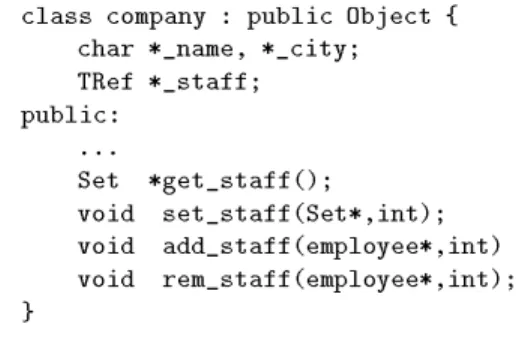
gen-erated C++ code is understandable, and debug-ging is easier. The example below shows indirect mapping of the COCOON type company:
class company : public Object { char *_name, *_city TRef *_staff public: ... Set *get_staff() void set_staff(Set*,int) void add_staff(employee*,int) void rem_staff(employee*,int) }
4The direct method did not work with ONTOS 1.5.
Furthermore, the additional constraints are not checked and can even be conicting.
Parts of the generated C++ class are given, as it is to be classied afterwards. COCOON func-tions with primitive domain are always mapped into private properties. They can only be ac-cessed by the automatically generated get...
and set... methods. Functions with abstract
domain (person, employee, ...) realize relation-ships between objects and are implemented as pointers.5 For each set-valued function, the
ad-ditional procedures add..., rem... are
pro-duced. The generated procedures maintain con-sistency, such as minimum and maximum cardi-nalities, or inverse relationship of functions.
The next gure shows the transformation by direct manipulation of the meta-schema. New ONTOS types and properties (attributes) are con-structed. Afterwards a constructor is generated for every new type, and the type is compiled to create associated structures required by the sys-tem. ct = new type("company",OC_Object) c0 = new PropertyType(0,"_staff","company", staffPtr,0,private) c0->Inverse(e0) ... ct->generateConstructor(...) ct->compile()
Distinction between types and classes prevents from a very simple one-to-one mapping of CO-COON into ONTOS. COCO-COON types are mapped into C++ classes as shown above. There is an additional construct needed to implement CO-COON classes. This is dierent from Oracle, be-cause ONTOS lacks a view mechanism. Thus, the meta-class Class is introduced, which is mainly a persistent homogeneous set of objects. It stores references to the member-objects of the class. Table 1 gives a summary of mapping COCOON schema denitions into Oracle and ONTOS.
3.2 Mapping Queries and Updates
... to Oracle
Mapping COOL queries to relational SQL is quite intuitive. So simple selection of objects, as for ex-ample in query Q
1, is translated into Oracle as: 5Instead of direct virtual memory pointers,
TRefs(= transparent references) are used. There is an ONTOS library class, implementing these persistent references to database objects.
COCOON ONTOS Oracle
indirect direct
types C++ classes instances of Type Oracle tables (relations) functions C++ properties instances of column of table or
with access-functions PropertyType separate connection-tables
classes instances of Class views on tables
objects persistent C++ objects rows of Oracle tables
Table 1: Summary of schema denition mappings
Q1:SELECT c0.OID
FROM Employees c0, Companies c1 WHERE c0.empl = c1.OID
AND c1.city = 'Zuerich'
However, to guarantee object-preservation and to enable nesting of operations, the identity of an object (its surrogateOID) must never be lost.
Omitting the OID attribute from the projection
list would perform extraction of the values from objects, such that tuples of data are produced and duplicates are eliminated. This would ex-actly implement COOL'sextract-operator, as in
query Q 4. Q
4:SELECT DISTINCT c0.name,c0.salary,c1.city
FROM Employees c0, Companies c1 WHERE c0.empl = c1.OID
Access to non-primitive functions (object- or set-valued) requires joins with the corresponding con-nection-tables. There we can benet, if ROWIDs are included in these relations' schema.
According to COCOON's type/class separa-tion, objects may be instances of multiple types and/or member of several classes at the same time. Thus updates may
locally change the value of a function (e.g., raise the salary of an employee, cf. U
2)
change class membership (e.g., change the age of a person, may remove it from the class Youngs, cf. U
3)
change class-membership and type (e.g., add a person to the class Employees, cf. U
4).
COCOON update operations are always mapped into a sequence of SQL data manipulation state-ments. They directly manipulate the tables, rep-resenting types. Extensive code has to be imple-mented for consistency checks, since Oracle can-not express them directly.
... to ONTOS
Queries of the COCOON algebra can be trans-formed into ONTOS retrievals in two dierent ways:
ONTOS SQL: An extension of SQL, where queries of the from SELECT <expr> FROM <class|set|...> WHERE <logic expr>can
be formulated. A query-iterator is used to iterate the SQL-query over a given data-base in a programmatic way. The output over every iteration step is either a charac-ter string, or a list of the values.
COOL Interpreter: An interpreter can be implemented in C++, traversing a syntax tree produced by a COOL parser, and thus evaluating queries on the database.
Although mapping to ONTOS SQL would be a quite elegant way, it is only feasible for very sim-ple queries. In fact, ONTOS SQL is not object-preserving, but value-generating. This disables the mapping of nested COOL queries like for ex-ample query Q
2 to ONTOS SQL.
However, an ONTOS SQL statement is ap-propriate as for the COOL data extraction oper-ator. The ONTOS SQL example below is equiv-alent to query Q
4:
Q4 :select name, salary, empl.city
from employee where age > 65
Thus, for the object-preserving COOL operators, we have to write our own query processor. The COOL interpreter traverses the syntax tree, such that for every COOL operator, there is a cor-responding C++ procedure, evaluating this op-erator. For example, the select-operator is im-plemented as a method select, with two
argu-ments: a set of objects, and pointer to the node in the syntax tree, representing the selection-predicate.
Set *Interpreter::select (Set*, node*) { ... }
Such an interpreter is in the most part a reim-plementation of the ONTOS SQL query facility. This is a pity, because ONTOS SQL could be eas-ily improved to fulll most of our requirements: if the inputs and outputs were sets of TRefs (ob-jects) then closure, view denition, and compo-sition would be possible. So an 'extended' ON-TOS SQL statement, realizing query Q
2, could
look like this:
Q2:select f.name, f.salary, f.empl.city
from f in ( select e
from e in employee
where e.empl.name == 'IBM' ) where f.age > 65 )
In the inner select{from{where block, the 'tuple' variable e itself is listed in the selection clause.
This could indicate an object-preserving query. Data-manipulation statements are completely missing in ONTOS SQL. So, even if some simple queries could be transformed to ONTOS SQL, at least all update operations must be implemented in C++. For this purpose, the generated C++-methodsget ,set ,add ,andrem are used. So,
the descriptive and generic object-manipulation operators are implemented as calls of procedural methods. In order to provide set-oriented update capabilities, ONTOS SQL has to be extended with a descriptive iterator over sets (of TRefs, see above) that takes methods, or generic update operations, if any, as argument (cf. update U
2): U2:update e in employee
set e.salary = 1.1*e.salary where e.empl.city == 'Bern'
In more generality, we would like to have the pos-sibility to use arbitrary (object-preserving) queries in the update statement (update o in <query>...).
4 Conclusion
We showed that implementing a state-of-the-art object model on top of commercial database sys-tems results in a semantic gap between the con-cepts needed and those oered by relational as well as early object-oriented database manage-ment systems. Particularly, we experienced that the implementation is not much more straightfor-ward, if we take the object-oriented DBMS prod-uct instead of a standard relational one. Even though the mapping of the structured part is
more direct, the operations still require much coding, since its query language and object ma-nipulation facilities are not yet satisfactory.
In the future, we will complete these two im-plementations and the DASDBS realization of COCOON and then run extensive performance comparisons.
Thanks to our students Matthias Boos, Marcel Fritsch,
Felix Meschberger, and Paul Wickli for doing the imple-mentation work BFMW91].
References
AH87] T. Andrews and C. Harris. Combining lan-guage and database advances in an object-oriented development environment. In Proc. Int'l Conf. OOPSLA. ACM Press, October 1987.
Bee89] C. Beeri. Formal models for object-oriented databases. In W. Kim, J.-M. Nicolas, and S. Nishio, editors, Proc. 1st Int'l Conf. on Deductive and Object-Oriented Databases (DOOD), Kyoto, Japan, December 1989. North-Holland.
BFMW91] M. Boos, M. Fritsch, F. Meschberger, and P. Wickli. COOL projects. Master's the-sis, Dept. of Computer Science, ETH Zurich, March 1991.
HS91] A. Heuer and M.H. Scholl. Principles of object-oriented query languages. In Proc. GI-Fachtagung Datenbanksysteme in Buro, Technik und Wissenschaft (BTW), Kaiser-slautern, Germany, March 1991. Springer, IFB 270.
ONT90] ONTOS Inc., Burlington, MA. ONTOS 2.0 { Reference Manual, 1990.
Ora88] Oracle Corp.ORACLE - Relational Database Management System, Version 6.0, November 1988.
SLT91] M.H. Scholl, C. Laasch, and M. Tresch. Up-datable views in object-oriented databases. In C. Delobel, M. Kifer, and Y. Masunaga, editors, Proc. 2nd Int'l Conf. on Deduc-tive and Object-Oriented Databases (DOOD), Munich, Germany, December 1991. Springer, LNCS 566.
SPS87] M.H. Scholl, H.-B. Paul, and H.-J. Schek. Supporting at relations by nested relational kernel. In Proc. 13th Int'l Conf. on Very Large Data Bases (VLDB), Brighton, Great Britan, September 1987. Morgan Kaufmann. SPSW90] H.-J. Schek, H.-B. Paul, M.H. Scholl, and G. Weikum. The DASDBS project: Ob-jectives, experiences, and future prospects.
IEEE Trans. on Knowledge and Data Engi-neering, 2(1), 1990.
SS90] M.H. Scholl and H.-J. Schek. A relational ob-ject model. InProc. 3rd Int'l Conf. on Data-base Theory (ICDT), Paris, France, Decem-ber 1990. Springer, LNCS 470.