Application
of
Copulas
to
Estimation
of
Joint
Crop
Yield
Distributions
Dmitry Vedenov
Department of Agricultural Economics Texas A&M University 2124 TAMU College Station, TX 77843‐2124 E‐mail: [email protected] Tel: 979‐845‐8491Selected Paper prepared for presentation at the American Agricultural Economics Association Annual Meeting, Orlando, FL, July 2729, 2008.
This paper reports results of research in progress. Updated versions of the paper may be available in the future. Contact the author before quoting.
© Copyright 2008 by Dmitry Vedenov. All rights reserved. Readers may make verbatim copies of this document for noncommercial purposes by any means, provided that this copyright notice appears on all such copies.
Introduction Correct estimation of crop yield distribution is commonly acknowledged to be of paramount importance in analysis of issues in crop insurance and risk management (Ker and Coble, 2003). Estimation of single yield distributions has received considerable attention in recent years. Sherrick, et al. (2004) compare performance of alternative parametric distributions in modeling farm level yields for Illinois farms. Ramirez, Misra and Field (2003) suggest a family of parametric distributions that allows for nonnormality of yields. Goodwin and Ker (1998) and Ker and Goodwin (2000) discuss (nonparametric) kernel density approach to yield modeling, which allows for more flexibility than parametric distributions. Ker and Coble (2003) introduce a semi‐parametric estimator that combines benefits of both parametric and non‐parametric estimators. All authors, however, acknowledge a common problem of short data series, especially for the farm‐level yields. While a single yield distribution suffices in many applications (e.g. determining premiums and optimal coverage levels for yield insurance), many applied problems call for joint distributions of various yields. For example, if a producer grows corn and soybeans on the same farm, the full‐farm risk management problem requires knowledge of a joint yield distribution of the two crops. Similarly, a joint distribution of farm‐level and county‐level yields is necessary in order to find an optimal coverage level for an area‐yield contract (e.g. Group Risk Plan) under general assumptions on producer’s risk preferences. Unfortunately, modeling of joint yield distributions based on historical data is affected by shortness of data series even more severely than in a univariate case. Indeed, the same limited number of observations has to provide information both on the distributions of individual yields and the dependence structure between them. To a large
procedures involve transform extent, the existing literature tries to circumvent the problem rather than tackling it directly. Commonly used approaches include using mean‐variance criterion or assuming regressibility of the random variables modeled. The mean‐variance criterion does not require the knowledge of the full distribution and only depends on its first two moments easily estimated from historical data. However, the ranking of random alternatives based on this criterion is known to be consistent with the expected utility maximization only when the underlying distributions satisfy location and scale condition (Meyer, 1987), which is rarely the case with yield distributions. Regressibility assumption essentially states that, in case of two1 random variables, one variable can be completely described as a linear function of the other plus an uncorrelated random shock (see, for example, Hau, 1999). The linear coefficient is typically known as beta (e.g. Miranda, 1991) and is proportional to the correlation between the variables. Thus the regressibility assumption essentially states that the dependence between the random variables of interest is completely captured by the linear correlation. However, the latter is known to be a poor measure of dependence, as is commonly illustrated by the example of a standard normal variable and its square. Furthermore, if the uncorrelated random shocks are assumed normal, regressibility amounts to joint multivariate normality — an assumption crop yields typically violate (Ramirez, Misra and Field, 2003; Sherrick, et al., 2004). Many papers recognize the limitations of the above approaches and employ various ad hoc procedures to model the dependence between the yields. Most of the time, these ations of multivariate normal distribution with the 1 The following arguments can be extended to a multivariate case as well.
parameters estimated from data (Ramirez, 1997; Coble, Heifner and Zuniga, 2000). While this approach allows greater flexibility in modeling joint distributions, it still implicitly relies on the assumption that the correlation matrix contains all necessary information about the dependence structure. A multivariate empirical distribution is probably the closest to preserving the information contained in the data without imposing distributional assumptions (Deng, Barnett and Vedenov, 2007). However, the empirical distributions are limited to the observed realizations and results in discontinuous density functions, which is particularly problematic in evaluating expected losses and payoffs of insurance contracts. Copulas provide an alternative way to model joint distributions of random variables with greater flexibility both in terms of marginal distributions and the dependence structure. Copulas have been used in financial literature for quite sometime (see, for example, Cherubini, Luciano and Vecchiato, 2004; Chen and Huang, 2007; Fernandez, 2008), but have not made their way yet to the agricultural economics literature. The purpose of the present paper is to demonstrate the application of copulas to modeling of joint yield distributions, analyze relative performance of different modeling assumptions, and illustrate the effect of different modeling methodology on a typical risk management problem of selecting optimal coverage for an area‐yield insurance contract. The rest of the paper is organized as follows. The next section presents a brief theory behind the copulas and outlines the procedure of modeling joint distributions using copulas. The following section illustrates the methodology by estimating the joint distribution of farm‐ and county‐yield for Iowa corn and evaluates its performance relative to alternative modeling approaches. The last section presents concluding remarks.
Copulas and Joint Distributions Overvie ) 0 , ( w of Copulas
A two‐dimensional copula C(u,v) is defined as a function2C:[0,1]2→[0,1] with the following properties: 0 ) , 0 ( = = v u C C for all u,v∈[0,1] nd a u u C( ,1)= C(1,v)=vfor al lu,v∈[0,1] 0 ) , ( ) , ( ) , ( ) , (u2 v2 −C u2 v1 −C u1 v2 +C u1 v1 ≥ C for all u1≤u2,v1≤v2. Copulas are related to joint bivariate distributions by virtu of Sklar’s Theorem (Nelsen, 2006, p. 15), which states that any distribution function e ) , (x y H with margins F(x) and ) (y G can be represented as )) ( ), ( ( ) , (x y C F x G y H = , (1)
where C(⋅,⋅)is a uniquely d termined copula function. The theorem also states that any two distribution functions F(x) and ( ) e y G combined with an arbitrary copula C according to (1) result in a joint distribution function HC(x,y) with the margins F and G. If the distribution functions and the copula in (1) are continuous, Sklar’s theorem can be restated in terms of the probability densities as ) ( ) ( )) ( ), ( ( ) , (x y c F x G y f x g y h = ⋅ ⋅ , (1’) where y x h ∂ ∂ , , y x H y x, )=∂ ( , ) ( 2 f(x)=F'(x) g(y)=G'(y), and v u c ∂ ∂ is the copula d to as the canonical representation essentially decomposes v u C v u, )= ( , ) ( 2 density. Eq. (1’) often referre ∂ 2 The following is a brief summary of theory behind the copulas limited to two‐dimensional copulas for brevity sake. A more formal and thorough presentation on the topic can be found in Nelsen, 2006.
the joint distribution of two variables into a product of marginal densities and the dependence structure captured by the copula density (Cherubini, Luciano and Vecchiato, 2004). From the practical standpoint, (1’) allows both derivation of copulas from a known distribution and construction of a joint distribution given marginal distributions and the copula. For example, if h is a bivariate standard normal distribution with the correlation ρ and the standard normal margins, then (1’) implies the Gaussian copula density ⎟⎟ ⎠ ⎝ − − 2 2(1 ) 1 ρ2 ρ where Φ(·) is the cumulative density function of the standard normal distribution. The Gaussian copula is parameterized by a single parameter, which can be estimated from the historic ⎞ ⎜⎜ ⎛ Φ Φ + Φ Φ − Φ Φ = 1 exp ( − ( )) ( − ( )) 2 − ( ) − ( ) ( − ( )) ( ( )) ) , (uv 1 u 2 1 v 2 1 u 1 v 12u 2 1 v 2 c + ρ − − , (2) al data in a straightforward fashion. The real advantage of copulas, however, comes from the fact that once the copula is derived or estimated, it can be applied to any pair of marginal distributions, not necessarily those implied by the original joint distribution. For instance, the Gaussian density (2) can be combined in (1’) with a beta distribution f and a Student distribution g to result in a joint density function h, which is neither bivariate normal, nor beta, nor Student. This property is particularly useful in modeling yield distributions, as it allows one to estimate marginal yield densities either parametrically or nonparametrically (e.g. by one of the methods mentioned in the Introduction) and then combine them into a joint distribution using a selected copula function. For all its flexibility, the copula approach has one serious shortcoming. Generally speaking, there are an infinite number of copula functions and any one can be used in (1’)
to combine margins into a joint distribution. In a sense, this means substituting one arbitrary choice (that of a parametric distributional form) by another (that of a copula function). Several parametric copulas have been frequently used in financial literature including the Gaussian copula in (2) as well as Student, Frank, and Gumbel copulas (Cherubini, Luciano and Vecchiato, 2004). Relative performance of different copulas can be measured against each other, but there is no constructive way to determine the “optimal” copula function (Kole, Koedijk and Verbeek, 2007). An alternative approach is to use a nonparametric copula estimated from the available data. This is similar to using nonparametric techniques such as empirical distribution and kernel density estimation in a univariate case. In particular, a kernel copula can be estimated based on a multivariate analog of kernel density estimator as outlined below. n Kernel Copula A kernel copula can be constructed from (1’) by setting h equal to the kernel density estimate of the joint distribution, and f and g to the kernel density estimates of the corresponding marginals. A general form kernel density estimator of a univariate probability density function f can be writte as
∑
⎟ = ⎞ ⎜ ⎛ − = n K x Xi x fˆ( ,τ) ⎠ ⎝ i nτ 1 τ where n i i X } 1 { = are observations (i.i.d. draws from the distribution being estimated), K(∙) is a kernel function, and τ is a smoothing parameter called bandwidth. 1 , (3) 3 3 The theory behind the kernel density estimator and the choice of the kernel function and bandwidth is beyond the scope of the present paper. A more detailed exposition can be found in (Wand and Jones, 1995).A bivariate analog of (3) can be written as
∑
⎟⎟ = ⎞ ⎜⎜ ⎛ − − = n K x Xi y Yi y x hˆ( , ,τ1,τ2) , o ⎠ ⎝ i nτ1τ2 1 τ1 τ2 where all the notation corresponds to (3), except that the kernel function now has two arguments and different smoothing parameters can be used along each dimension. There are several options for choosing the bivariate kernel function, but the most straightforward way is to use the product of two univariate (although not necessarily the same) kernels (Wand 1 , (4) and Jones, 1995). Based on (1’), (3), and (4), the verall procedure for estimating the kernel copula from a series of historical data 4 i i i Y X , } 1 { = can be outlined as follows. Step 1. Construct the kernel density estimates of marginal distributions f and g accordin n g to (3) using appropriate kernels Kj and bandwidths τj. Step 2. Calculate the cumulative density functions corresponding to f and g (e.g. by numerical integration)∫∑
∞ ⎟⎟ ⎞ ⎜⎜ ⎛ − = n K Xi d x Fˆ( ) 1 ξ ξ − i= ⎝ ⎠ nτ1 1 τ1 x 1 and∫∑
∞ = ⎟⎟ ⎞ ⎜⎜ ⎛ − = y n K Yi d y) 1 2 ( ˆ η η − i ⎝ ⎠ nτ2 1 τ2 Step 3. Construct kernel density estimate of the joint density h according to (4) using the product kernel and the same bandwidths as in Step 1. G (5) Step 4. Estimate the copula density at any given point (u,v) based on (1’), namely )) ( ˆ ( ˆ )) ( ˆ ( ˆ )) ( ˆ ), ( ˆ ( ˆ ) , ( ˆ 1 1 1 1 v G g u F f v G u F h v u c − − − − ⋅ = , (6) 4 Note that in the rest of the section the dependence of the estimated kernel density functions on the bandwidth is suppressed for brevity sake.where Fˆ−1(u)and Gˆ−1(v) are inverse functions to the cumulative densities estimated in (5), which can be obtained by solving numerically the root‐finding problems F(x)=u and G(y)=v for given u and v, respectively.
Just as in the case of Gaussian copula mentioned above, once estimated, the kernel copula can be combined with any estimates of the marginal distributions of f and g, either parametric or nonparametric. ˆ ˆ MonteCarlo Simulations Many problems in crop insurance and risk management require calculating a criterion defined as a function of random variables. For example, the expected utility framework calls for maximization of the expected utility of a revenue or profit function, which is expressed in terms of realizations of one or more random variables. While the expectation can be computed using the joint density function estimated according to (1’), the process involves numerical integration and thus requires calculation of the estimated copula draw from a copula C, then and margins at a large number of integration nodes.5 Monte‐Carlo method is often more computationally efficient in solving these problems, in particular when the number of random variables is large (Miranda and Fackler, 2002). Sklar’s Theorem (1) provides a constructive way to generate Monte‐Carlo draws from the joint distribution implied by a copula C and margins F and G. The method is based on the fact that any copula function by itself is a joint distribution of random variables with uniform margins on [0,1] (Nelsen, 2006). In particular, if {u,v}is a random is a random draw from the joint )} ( ), ( { } , {x y = F−1 u G−1 v 5 The direct integration approach suffers from so‐called curse of dimensionality in the sense that the number of integration nodes increases exponentially in the number of random variables.
distribution H(x,y)=C(F(x),G(y)). In turn, random draws from a given copulas can be generated by using the conditional sampling method (see, for example, Cherubini, Luciano and Vecchiato, 2004, p. 182). In the two‐dimensional case, the overall algorithm of generating Monte‐Carlo draws from the joint distribution of variables of interest can be outlined as follows. Step 1. Select or estimate a copula function C and marginal densities F and G.
Step 2. Generate a necessary number of draws from two independent uniform N j 1 } , {ξ η = distributions on [0,1].
Step 3. Use the first series as is, i.e. set uj =ζj for all j = 1,...,N, and calculate the distributions of v conditional on realization of uj as j u u u = ∂ Step 4. Transform each draw j j j C u v C ( | )=∂ . η using the corresponding inverse conditional distribution function (conditional copula) to obtain the second series of draws, i.e. set j ( j| j) for all j = 1,..., N.
Step 5. Transform the generated pairs using the inverse margins, i.e. set
)} ), { − = 1 j C u v = − η N j j j v u , } 1 { = ( ( } , {xj yj F uj G vj For parametric copulas, the conditional copulas can be usually calculated analytically either from the copula function itself or from the copula density. In case of the kernel copula, a numerical integration of copula density in (6) can be used. 1 1 − for all j = 1,...,N.
Application Data The application of copula methodology is illustrated by modeling a joint distribution of county‐ and farm‐level yields. Such distributions are of interest, for example, when evaluating risk‐reducing effectiveness of area‐yield contracts such as GRP. A common problem with estimating farm‐level yield distributions is that the available data series are typically very short (6‐10 years). Therefore, any estimation of a joint distribution or a dependence structure between county‐level yields and individual farm yields are extremely unreliable. A representative farmer approach is typically used instead, where all available farm‐level data within a given county are pooled together and treated as draws from a distribution of farm yields within the county (Schnitkey, Sherrick and Irwin, 2003; Deng, Barnett and Vedenov, 2007). For the purposes of this analysis, a farm‐level data for corn yields in Kossuth County, IA, are used. 6 The data set includes observations for 90 farms over the period between 1980 and 1994, with at least 12 years worth of yields available for each farm. County‐level yield series are typically much longer and are available from the National Agricultural Statistical Service (USDA/NASS, 2008). County yield series from 1967 to 2007 were detrended using a simple log‐linear trend and adjusted to their 2007 equivalents (Vedenov and Barnett, 2004). Given shortness of farm‐level yield series, the estimated county trend was used to detrend those as well. The detrended farm‐level yields for each year were also adjusted to ensure that their average is equal to the detrended 6 Results for other crops and/or regions may be available in the future.
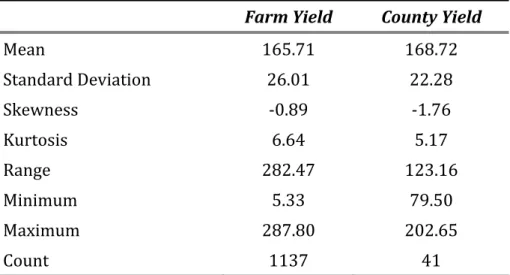
county yield for that year.7 The sample statistics of detrended farm‐ and county‐level yields are presented in Table 1. Both farm and county yields are skewed to the left and leptokurtic, suggesting nonnormality. As expected, farm‐level yields exhibit greater variability and range than the county‐level yields. [Table 1 about here] The scatter‐plot of detrended farm‐level yields versus the corresponding county yields is shown in Figure 1. One conclusion that can be made from the figure is that the farm‐level yields exhibit different variability for different realizations of county yields, suggesting that assuming joint normality, or regressing farm yields on county yields may produce misleading results. Therefore, modeling the full joint distribution is of particular importance in this situation. [Figure 1 about here] Gaussian copula (2) and kernel copula (6) were used to model the dependence structure between the county and farm yields. The dataset included 1,137 pairs of county/farm yield observation, which were used to estimate the parameters of Gaussian copula and the density of kernel copula. In order to illustrate the flexibility of copula approach, four distributions frequently used in the literature — normal, gamma, Weibul, and nonparametric kernel density — were fitted to the data to model marginal distributions of county and farm level yields. 7 This adjustment is necessary to reflect the fact that the farms included in the sample may not necessarily represent all possible yields in the county.
In particular, county yield margins were estimated using the entire series from 1967 to 2007, while all available 1,137 farm yield observations were used to fit the farm‐level yield densities. The fitted marginal distributions are shown in Figures 2 and 3.
[Figure 2 about here] [Figure 3 about here] The joint distributions of county and farm‐level yields were then estimated using the Sklar theorem. The combination of four marginal distributions and two copulas resulted in eight joint distributions.8 The contours of the estimated distributions superimposed on the scatter‐plots of original data are shown in Figure 4 for Gaussian copula and in Figure 5 for kernel copula. [Figure 4 about here] [Figure 5 about here] Note that the normal margins combined with Gaussian copula result in a bivariate normal distribution, while kernel copula combined with kernel density margins result in a bivariate kernel density estimate of the joint distribution. However, one of the advantages of copula approach is that the copula and the margins do not have to be estimated from the same samples. This property is particularly useful in the example presented here, since the farm‐level yields only match to a small portion of county‐yield series. While matching observations are used to estimate the copula, longer county yield series are used to estimate their marginal distribution. 8 The same types of marginal distributions were used for both farm and county yields in each case. However copula approach can easily accommodate margins of different type.
In order to evaluate how well the estimated joint distributions reflect the historical data, the log‐likelihood criterion was calculated in each case. The results are summarized in Table 2. [Table 2 about here] The results in figures 4 and 5 illustrate the importance of selecting both the correct copula and the marginal distributions. Gaussian copula tends to generate elliptic distributions regardless of the margins, which may lead to underestimating the dependence away from the mean. Given that analysis of risk management and insurance typically concerns with tail events, Gaussian copula may not be the best choice. In terms of goodness‐of‐fit as measured by the log‐likelihood of the estimated joint distributions, a combination of Gaussian copula and kernel density margins provides the best fit of the data followed by Weibul and normal margins. All parametric margins seem to have problems with fitting the outlying series of observations corresponding to the Midwest flood of 1993. Distributions based on kernel copula seem to do much better job reflecting the shape of the original data than those based on Gaussian copula. However, the failure of parametric margins to capture the very same set of outlying observation resulted in log‐ likelihood criterion equal to negative infinity for joint distributions based on these margins. On the other hand, kernel copula combined with kernel density margins outperformed all four joint distributions based on Gaussian copula in terms of log‐likelihood criterion. Conclusion This paper presents a copula‐based methodology for modeling joint yield distributions. Copulas have been used extensively in financial literature, but have not been widely used in agricultural economics and particularly risk management. The copula
approach provides a powerful and flexible method to model multivariate distributions and thus go beyond joint normality, regressibility, and mean‐variance criterion. Accurate estimation of joint distributions may help to improve the results in the area of risk management and insurance obtained under more limiting assumptions. An Achilles’ heel of copula approach is the arbitrariness of the copula selection. However, this shortcoming can be mitigated by using nonparametric (e.g. kernel) copulas. Nonparametric copulas do not require any assumptions and are primarily data driven thus minimizing the subjectivity introduced by the researcher. Further research in this area needs to look at relative importance copulas and margins, as well as evaluate copula approach in practical risk management problems such as crop insurance rating and optimal coverage selection.
Table 1. Descriptive Statistics of Detrended Farm and County Yield Data, Kossuth
County, Iowa.
Farm Yield County Yield
Mean 165.71 168.72 Standard D s eviation 26.01 ‐ 22.28 ‐ Skewnes is 0.89 1.76 Kurtos 6.64 2 5.17 1 Range 82.47 23.16 Minimum um 5.33 2 79.50 20 5 Maxim 87.80 2.6 Count 1137 41 Notes: All yields are in bu/ac. Farm‐level yields are observations from 90 farms over a eriod from 1980 to 1994. County level yields are from 1967 to 2007. p
Table 2: LogLikelihood of Yield Observations under Estimated Joint Distributions
Margins
Copula Normal Gamma Weibull Kernel Density
Gaussian –11,069 –11,433 –10,978 –10,696
Kernel –Inf –Inf –Inf –10,589
References Chen, S.X., and Huang, T.‐M. "Nonparametric Estimation of Copula Functions for n Journal of Statistics, 35, 2(2007): 265‐282. Dependence Modelling." The Canadia Cherubini, U., Luciano, E., and Vecchiato, W. Copula Methods in Finance. Wiley Finance Series. Hoboken, NJ: John Wiley & Sons, 2004. Coble, K.H., Heifner, R.G., and Zuniga, M. "Implications of Crop Yield and Revenue Insurance for Producer Hedging." Journal of Agricultural and Resource Economics, 25, 2(2000): 432‐52. Deng, X., Barnett, B.J., and Vedenov, D.V. "Is There a Viable Market for Area‐Based Crop Insurance?" American Journal of Agricultural Economics, 89, 2(2007): 508‐19. Fernandez, V. "Multi‐Period Hedge Ratios for a Multi‐Asset Portfolio When Accounting for Returns Co‐Movement." Journal of Futures Markets, 28, 2(2008): 182‐207. Goodwin, B.K., and Ker, A.P. "Nonparametric Estimation of Crop Yield Distributions: Implications for Rating Group‐Risk Crop Insurance Contracts." American Journal of Agricultural Economics, 80, 1(1998): 139‐53. Hau, A. "A Note on Insurance Coverage in Incomplete Markets." Southern Economic Journal, 66, 2(1999): 433‐441. Ker, A.P., and Coble, K. "Modeling Conditional Yield Densities." American Journal of Agricultural Economics, 85, 2(2003): 291‐304. Ker, A.P., and Goodwin, B.K. "Nonparametric Estimation of Crop Insurance Rates Revisited." American Journal of Agricultural Economics, 82, 2(2000): 463‐78. Kole, E., Koedijk, K., and Verbeek, M. "Selecting Copulas for Risk Management." Journal of Banking and Finance, 31, 8(2007): 2405‐23.
Meyer, J. "Two‐Moment Decision Models and Expected Utility Maximization." American Economic Review, 77, 3(1987): 421‐430. Miranda, M.J. "Area‐Yield Crop Insurance Reconsidered." American Journal of Agricultural 233‐42. Economics, 73, 2(1991): Miranda, M.J., and Fackler, P.L. Applied Computational Economics and Finance. Cambridge, : MIT Press, 2002. Mass. Nelsen, R.B. An Introduction to Copulas. 2nd Edition. Springer Series in Statistics. New York: Springer, 2006. Ramirez, O.A. "Estimation and Use of a Multivariate Parametric Model for Simulating Heteroskedastic, Correlated, Nonnormal Random Variables: The Case of Corn Belt Corn, Soybean, and Wheat Yields." American Journal of Agricultural Economics, 79, 1(1997): 191‐205. Ramirez, O.A., Misra, S., and Field, J. "Crop‐Yield Distributions Revisited." American Journal of Agricultural Economics, 85, 1(2003): 108‐20. Schnitkey, G.D., Sherrick, B.J., and Irwin, S.H. "Evaluation of Risk Reductions Associated with Multi‐Peril Crop Insurance Products." Agricultural Finance Review, 63, 1(2003): 1‐21. Sherrick, B.J., et al. "Crop Insurance Valuation under Alternative Yield Distributions." n Journal of Agricultural Econ America omics, 86, 2(2004): 406‐19. USDA/NASS. "Quickstats, U.S. & States, Prices." National Agricultural Statistical Service, (2008). Available online at http://www.nass.usda.gov/Data_and_Statistics/Quick_Stats/index.asp. Accessed 03/15/2008.
Vedenov, D.V., and Barnett, B.J. "Efficiency of Weather Derivatives as Primary Crop Insurance Instruments." Journal of Agricultural and Resource Economics, 29, 3(2004): 387‐403. Wand, M.P., and Jones, M.C. Kernel Smoothing. Monographs on Statistics and Applied Probability 60. London, New York: Chapman & Hall, 1995.