NBER WORKING PAPER SERIES
STRATEGIC JUDGMENT PROOFING Yeon-Koo Che
Kathryn E. Spier Working Paper 14183
http://www.nber.org/papers/w14183
NATIONAL BUREAU OF ECONOMIC RESEARCH 1050 Massachusetts Avenue
Cambridge, MA 02138 July 2008
The authors thank Barry Adler, Ian Ayres, Lucian Bebchuk, Patrick Bolton, Albert Choi, Jim Dana, Allen Ferrell, Fernando Gomez, Oliver Hart, Kazumi Hori, Daniel Klerman, Reinier Kraakman, Yair Listokin, Paul Mahoney, Mark Ramseyer, Chris Sanchirico, Alan Schwartz, James Spindler, Eric Talley, Abe Wickelgren, Justin Wolfers, many seminar participants, and the editor and the referees for helpful comments. They acknowledge Shoemaker Fellowship and Searle Fund for their respective financial support. The views expressed herein are those of the author(s) and do not necessarily reflect the views of the National Bureau of Economic Research.
NBER working papers are circulated for discussion and comment purposes. They have not been peer-reviewed or been subject to the review by the NBER Board of Directors that accompanies official NBER publications.
© 2008 by Yeon-Koo Che and Kathryn E. Spier. All rights reserved. Short sections of text, not to exceed two paragraphs, may be quoted without explicit permission provided that full credit, including © notice, is given to the source.
Strategic Judgment Proofing
Yeon-Koo Che and Kathryn E. Spier NBER Working Paper No. 14183 July 2008
JEL No. D21,D62,G32,G38,K13,K22
ABSTRACT
A liquidity-constrained entrepreneur needs to raise capital to finance a business activity that may cause injuries to third parties — the tort victims. Taking the level of borrowing as fixed, the entrepreneur finances the activity with senior (secured) debt in order to shield assets from the tort victims in bankruptcy. Interestingly, senior debt serves the interests of society more broadly: it creates better incentives for the entrepreneur to take precautions than either junior debt or outside equity. Unfortunately, the entrepreneur will raise a socially excessive amount of senior debt. Giving tort victims priority over senior debtholders in bankruptcy prevents over-leveraging but leads to suboptimal incentives. Lender liability exacerbates the incentive problem even further. A Limited Seniority Rule, where the firm may issue senior debt up to an exogenous limit after which any further borrowing is treated as junior to the tort claim, dominates these alternatives. Shareholder liability, mandatory liability insurance and punitive damages are also discussed. Yeon-Koo Che Columbia University 420 W. 118th Street New York, NY 10027 [email protected] Kathryn E. Spier Hauser Hall 302 Harvard Law School
1575 Massachusetts Avenue Cambridge, MA 02138 and NBER
1
Introduction
There was a striking 41% rise in the number of taxi and livery accidents in New York City in the 1990’s. As described in the New York Times, many of the victims — often bystanders on the sidewalk — found themselves unable to collect their awards after receiving favorable judgments at trial. There were several reasons for this. First, most of New York City’s 12,000 taxi cabs were minimally insured. Second, the taxi industry is organized in such a way as to make taxi medallions — worth about $275,000 each — unreachable by the victims. The owners of the medallions often use them as collateral for loans, so that “even when the rare victim tries to seize a medallion in court, it is common to find that the owner has attached so much debt to it that there is little money left to recover.”1 Furthermore, owners of large fleets often organize their operations into collections of much smaller taxi companies owning just two or three medallions, thereby protecting their assets from liability. In the words of Pam Liapakis, former president of the New York State Trial Lawyers Association, “When one owner can own 100 cars in different corporations, and then mortgage them to protect his assets from accident victims, that’s wrong ... The purpose of the corporate law is being subverted.”
These concerns are hardly unique to the taxi industry. In light of increasing malpractice premiums, many physicians are protecting their assets with limited liability partnerships, irrevocable trusts and offshore trusts, sometimes forgoing malpractice insurance altogether. Similar strategies are used by accountants, corporate board members, and even lawyers. In a 2003 survey of individuals with personal assets exceeding $1 million, 35% had adopted an asset protection plan, up from 17% in 2000.2 Asset protection strategies are not restricted to small businesses.3 Following an oil spill in the Gulf of Mexico, French oil company Elf Aquitaine decided to relinquish ownership of its oil prior to shipping it to refineries in the United States (Sullivan, 1990). More generally, large corporations have an incentive to spin off their most hazardous activities into separate units with limited financial assets.4 Indeed, Ringleb and Wiggins (1990) attributed a 20% increase in the number of small corporations
1Drew and Newman (1998). Much of this debt existed before the accidents took place. On some occasions,
however, taxi owners engaged in additional borrowing following the court’s findings of liability. This practice, while illegal, further frustrates the victim’s attempts to collect.
2Silverman (2003). The survey was conducted by Prince & Associates, a Connecticut market research and
consulting firm. See also Mandell (1999).
3See also LoPucki (1996), Gilles (2006), and Hansmann and Kraakman (1991).
4Walkovsky v. Carlton, 276 2d 585 (2d Cir. 1966) is a famous veil-piercing case. A cab company had
shielded themselves from liability by incorporating each cab as its own corporation. The Court refused to pierce the veil on account of undercapitalization alone.
between 1967 and 1980 to the outsourcing of risky activities by large corporations to small firms.5 Large companies can also issue secured debt based on their physical assets, and then use the cash received to buy back equity or pay dividends to existing shareholders (LoPucki, 1996).6 Furthermore, companies can issue so-called “Bowie Bonds” to securitize future cash flows, thus making them unavailable to tort victims.7
This paper is concerned with “strategic judgment proofing,” the deliberate strategies used by firms to shield their assets from future accident victims. While this issue has been discussed in the legal literature and to some extent in the empirical economics literature, very little theoretical work has been done. Specifically, we consider a liquidity-constrained entrepreneur (the injurer) who raises capital to finance a risky activity that may harm others. The entrepreneur can judgment proof himself through both the method of financing (namely through secured senior debt) and the level of financing. These two tactics potentially impose costs on third parties (the tort victims) and affect the entrepreneur’s incentives to improve the safety of his operations. We consider the social desirability of the entrepreneur’s judgment-proofing strategies and the effectiveness of several proposed remedies.
Taking the level of borrowing as fixed, we first show that the entrepreneur would choose to finance the risky activity with secured senior debt. Secured senior debt enjoys the highest priority in bankruptcy, and can therefore be used to shield assets from tort victims. Inter-estingly, this form of strategic judgment-proofing enhances social welfare. Taking the level of outside financing as fixed, senior debt creates the best incentives for the entrepreneur to take precautions to reduce the harm to the victims. The reasoning is as follows. The secured senior debtholders face a lower risk of non-repayment than the holders of junior claims and, as a consequence, require a lower interest rate. This lower interest rate makes bankruptcy less likely, leading the entrepreneur to better internalize the social harm from the risky activity.8 Unfortunately, the level of outside financing by entrepreneurs is not fixed. We show that
5Other empirical work has revealed mixed results. Notably, Brooks (2002) finds evidence that the oil
industry has, overall, become more vertically integrated in response to increased liability.
6Warren and Westbrook (2005) analyze a sample of business bankruptcies and find that 8.8% of these firms
have outstanding lawsuits and an additional 7.5% have judgment liens against them. In their sample, 61.2% of the debt is secured. Ulph and Valentini’s (2004) empirical study shows that an increase in environmental liability leads to an increase in bank debt, an effect that is mitigated when banks are also held liable.
7These are named after rock star David Bowie who issued securities backed by the future revenues from his
previously-released music albums (Clark, 1997). Corporations have securitized assets as diverse as equipment leases, franchise fees, and cash flows from oil and gas reserves (Harrel, Rice, and Shearer, 1997). These securities are separate legal entities and would not be included in a bankruptcy proceeding.
8This intuition is similar to Pitchford’s (1995) observation that lender liability increases the interest rate
the entrepreneur will secure an excessive amount of senior debt in order to further dilute the value of the tort claim. In the extreme, the entrepreneur could essentially reduce his liability to zero by issuing securities whose face value exceeds the upper bound on the future firm value. Although secured senior debt is desirable for fixed levels of outside financing, over-leveraging leads social welfare to fall since the firm takes too little care to avoid accidents.
We then explore how several different public policies affect the firm’s financial structure and the entrepreneur’s incentives for care. First, suppose the victims were given priority over the secured senior debtholders in bankruptcy. Although the mandatory subordination of the debtholders discourages over-borrowing by the firm, the entrepreneur still takes too little care to avoid harm. (Subordinated financial claimants would require a higher interest rate to compensate them for the risk of non-repayment, and so the entrepreneur’s incentives to take precautions are therefore diluted.) Second, suppose the senior debtholders were held liable for the residual harms unpaid by the injurer. Lender liability also prevents over-borrowing but exacerbates the moral hazard problem even further. A rule that we call theLimited Seniority Rule dominates these other policies. Under this rule, the firm may offer a limited amount of senior debt, after which any further borrowing is treated as junior to the tort claim. Limited seniority essentially gives the “best of both worlds.” The junior treatment of the debt beyond the pre-set limit eliminates the incentives for over borrowing, while the senior status of the debt up to the pre-set limit implies that the firm can borrow at a low interest rate, giving better incentives for precaution taking.
The current paper is related to several strands of existing research. First, it is closely related to literature on (exogenous) judgment proofness. Shavell (1986) was the first to rigorously analyze the judgment-proof problem — that injurers with limited assets will engage in risky activities too often and will take too little care while doing so.9 A number of remedies have been explored, including mandatory liability insurance (Shavell, 1986,2004), vicarious liability (Dari Mattiacci and Parisi, 2003), and damage multipliers (Boyd and Ingberman, 1994, 1999).
In the corporate finance context, Bebchuk and Fried (1996, 1997) have argued that rais-ing the priority of tort victims in bankruptcy and subordinatrais-ing debt claims will give the debtholders a strong incentive to monitor the borrower ex post, improving the firm’s pre-cautions.10 Bebchuk and Fried did not anticipate the negative effect of subordination on
9See also Summers (1983). Beard (1990) extended Shavell’s analysis to include a pecuniary effort choice,
and showed that firms may in fact take too much care. Intuitively, corporate investments made out of cash reserves are subsequently not claimable by tort victims, so the tort victims effectively subsidize the firm’s pecuniary investments. See also Dari Mattiacci and De Geest (forthcoming).
incentives identified here, however. In work that is the most closely related to ours, Pitchford (1995) considers the impact of imposing liability on lenders. Lenders, anticipating future liability, would require a higher interest rate in compensation. This leaves less remaining wealth for the borrower to lose in the event of an accident, diluting his incentives for care. He suggested the policy of holding the lender partially liable as achieving the optimal outcome.11 A similar prescription is made by Boyer and Laffont (1997), who observe the agency problem between lender and the firm makes it optimal to hold the lender less than fully liable for the harm. The connection between their remedies and ours will be discussed in more detail later. Our paper differs from the previous research on the judgment-proof problem. We allow the firm to endogenously judgment proof itself through a broad class of “standard” financial contracts that encompasses senior debt, junior debt, equity, and convertible debt (in addition to a continuum of hybrid securities). This plays a central role in our analysis. First, it allows us to explicitly study the impact of tort liability on the firm’s method and level of external financing. Second, it allows us to compare and contrast a comprehensive set of public policy remedies. We provide clear picture of how various bankruptcy reforms influence the firm’s choice of financial structure and subsequent precaution levels, and the relative advantages of these bankruptcy reforms over lender liability (either partial or full).
Our paper also contributes to the finance literature on the role of agency costs in the design of financial securities (Jensen and Meckling, 1976).12 Innes (1990), assuming a fixed capital requirement, showed that debts dominate all other standard financial contracts in terms of the incentives they provide to the borrower to maximize the value of the venture.13 Innes’ model, like many of the existing models, does not distinguish different types of debt contracts, and thus does not explain why senior debt would be chosen over junior debt.14 In our paper, the firm’s preference for senior debt is driven by the presence of the tort victims.15
11Lewis and Sappington (2001) generalize Pitchford’s binary technology and give the lender more
instru-ments with which to control the firm, including non-monotonic contracts. Some of Pitchford’s main results do not survive this extension. See also Balkenborg (2001).
12Modigliani and Miller’s (1958) famous result about the irrelevance of capital structure fails to hold in the
presence of taxes, bankruptcy costs, and (as here) agency costs and strategic effects.
13Innes assumed, as we do, that the lender’s payoff must be non-decreasing in firm profit. This is sensible
when lenders can sabotage the firm’s results and borrowers can misrepresent their cash flows.
14Hart and Moore (1995) argue that the hard claims associated with senior debt can be used to discipline
the “empire building”bias of managers. In practice, most large firms issue multiple securities with varying durations and seniority. This likely due to variations in the timing of corporate investments and cash flows, in addition to the heterogeneous preferences and monitoring abilities of investors (Tirole, 2005, pp. 404-406).
15Perotti and Spier (1993) argue that debt is an effective bargaining tool for extracting concessions from
The paper is arranged as follows. Section 2 illustrates some of the key contributions of our paper in a simple example. Section 3 lays out the basic assumptions of the model and establishes a social welfare benchmark. Section 4 characterizes the financial decisions and effort choice of the firm. Section 5 considers public policy responses, including the elevation of tort victims in bankruptcy and lender liability. Sections 6 and 7 discuss other remedies of judgment proofness and discuss several extensions. Section 8 concludes.
2
Example
Consider an entrepreneur who needs to raise at least $300 to purchase capital — a “taxi medallion.” The capital market is competitive and the risk-free interest rate is normalized to zero. The taxi medallion, which does not depreciate in value, will generate an additional
cash flow of $200 under the control of the entrepreneur. Although the cash flow is riskless, the business activity is risky in the sense that it may cause harm to other people. For the moment, let’s assume that there is an exogenous one-in-ten probability that the activity will cause $1,000 in damages to a tort victim. Notice that this business activity is inherently judgment proof: in the event of an accident, the total assets (the $300 medallion plus the $200 cash flow) are insufficient to compensate the tort victim for his loss.
For any fixed level of borrowing below the total value of the assets — say $300 — it is clear that the entrepreneur would choose to finance the business with secured debt. With senior status, the lender is guaranteed repayment of his loan in the event of an accident and is therefore willing to issue the loan at the risk-free rate of 0%. In the event of an accident, the lender receives the $300 taxi medallion and the tort victims claim the $200 cash flow. Note that the entrepreneur’s equity has an expected value of $180 — the entrepreneur keeps the residual $200 cash flow 90% of the time and keeps nothing in the event of an accident. If the debt were junior to the tort claim, on the other hand, then the lender would not be repaid following an accident. A face value of (approximately) $333 would allow the lender to break even in expectation, corresponding to an interest rate of 11%.16 What happens if the entrepreneur borrows $300 with junior debt? In such a case, if no accident occurs the entrepreneur’s payoff is $300 + $200 − $333 = $167; if an accident occurs the entrepreneur receives $0, assuming that the debt has a junior status relative to the tort claim.17 His
value from tort victims, but do not consider incentive problems. See also Ulph and Valentini (2004).
1690% of $333 is approximately $300.
17In practice, junior debtholders and tort victims receive equal treatment in bankruptcy proceedings. As
expected payoff is therefore 90% of $167, or $150. Therefore the entrepreneur’s expected payoff is $30 higher when the debt is senior to the tort claim.
Senior debt is an effective mechanism for transferring value from the tort victims to the entrepreneur: the entrepreneur is madebetter off by $30 and the tort victims are madeworse off by $30. To see this, consider the expected payments to the tort victims. When the debt is senior, the taxi medallion is essentially taken “off the table” and the tort victims’ recovery is limited to $200. That is, the tort victims collect $20 in expectation. When the debt is junior, on the other hand, the tort victims can seize the taxi medallion worth $300 in addition to the $200 cash flow. So the tort victims’ recovery following an accident is $500, or $50 in expectation.
The method of financing does more than simply reallocate value among the different players, however. It can also affect the entrepreneur’s effort choice and hence the expected accident losses. To see this, suppose that there are two levels of precaution: low and high. The low level of effort is costless for the entrepreneur and leads to a 20% accident probability. The high level of effort requires the entrepreneur to make non-pecuniary investment of $18 and reduces the accident probability to 10%. Notice that the high level of effort is socially optimal here: the entrepreneur’s cost of effort, $18, is outweighed by the $100 reduction in the expected accident losses. It is easy to see that, with senior debt, the entrepreneur will take the high level of precaution. The 10% reduction in probability multiplied by the entrepreneur’s $200 out-of-pocket cost in the event of an accident outweighs his $18 additional cost of effort. With junior debt, on the other hand, the entrepreneur will not take the high level of precautions. Suppose he did. Recall that an 11% rate of interest would reduce the entrepreneur’s personal stake from $200 to $167. The additional cost of effort, $18, is higher than the benefit of this effort, (.1) ($167) = $16.7.18 This simple example illustrates that entrepreneur’s preferredmethod of financing — senior secured debt — is aligned with that of society more broadly. If the entrepreneur controlled the level of financing as well, he would issue securities that are backed by the $200 cash flow in addition to the $300 taxi medallion and can subsequently consume (or hide) the immediate cash infusion of $200. Since the lender expects to be repaid in full, the required rate of interest is 0%. Now the company is totally judgment proof: there are no assets for the victims to claim in the event of an accident. The entrepreneur takes the low level of effort here and, in a richer framework, his precautions would be even lower than that.
adopt this simple notion of junior debt, for analytical and expositional ease.
18If the high effort cannot be supported, then the junior debtholders would demand an interest rate above
What can society do to control this behavior? First, suppose that a law were passed that elevated the status of the tort victims in bankruptcy above that of the debtholders. This effectively forces debt into a junior position. On the positive side, this law would prevent the over-leveraging identified above. The entrepreneur will limit his borrowing to the $300 taxi medallion only. On the negative side, however, the higher interest rate demanded by the lender implies that the entrepreneur will take only the low level of effort. Suppose instead that the lender is held liable for 100% of the accident victim’s losses. Assuming a high level of effort, the interest rate would necessarily rise to 30% — the first $300 of the $389 face value reflects the principal of the loan while the remaining $89 reflects the lender’s expected future liability. From the entrepreneur’s perspective, the 10% reduction in probability multiplied by his $111 loss following an accident is outweighed by the $18 cost of effort.19 Indeed, this example suggests that the entrepreneur’s incentives would be even worse with lender liability. Our proposed Limited Seniority Rule, which allows the entrepreneur to issue senior debt up to a limit of $300 and forces further borrowing into a junior subordinated position, does better than either of these other remedies. The entrepreneur would borrow exactly $300 and no more, and would subsequently take the high level of precautions. The junior treatment of the additional cash flow eliminates the incentives for overborrowing since overborrowing cannot help to shield the entrepreneur from liability. At the same time, the scheme allows for the senior status of debt up to the level required for productive use. This means that the firm can borrow on the terms that will leave it with best incentives to take precautions.
3
Model
Consider a privately owner-managed firm. The firm has a project that requires an initial investment of k and will generate a fixed future cash flow of v > k. The project also potentially causes harm to society. The magnitude of the harm, x, depends on the effort (or precaution) chosen by the firm, e ∈ R+. Specifically, x, is distributed over the interval X := [0, x], according to a cdf F(· | e) which has positive density f(· | e) in its support. We assume that higher effort reduces social harm in the sense off satisfying monotone likelihood ratio property in (−x, e): (M LRP) f(x 0|e0) f(x|e0) < f(x0|e) f(x|e) for any x 0 > x, e0 > e, x0, x∈ X.
Assuming differentiability of F(· |e) with respect to e, (M LRP) implies that Fe(· | e) >0.
We assume further that Fee ≤0. When taking an effort of e, the firm incurs a nonpecuniary 19If there is no accident, the lender receives the $400 face value and the firm keeps $500−$389 = $111.
cost of c(e), where c(0) = 0, c0(e) ≥ 0, c00(e) > 0, c0(0) = 0 and c0(∞) = ∞. Effort is unobservable to all parties other than the firm and cannot be directly contracted upon.
The owner-manager is liquidity constrained and finances the project with money raised on the external capital market.20 The capital market is perfectly competitive and the risk-free interest rate is normalized to zero. In return for their capital investment, the outside investors receive claims on the future cash flow of the firm, v, which is fully contractible. (The specifics of these financial contracts are described in detail below.) The level of funds actually raised by the owner-manager, K, may in fact exceed the amount necessary for the project, k. We assume that any excess borrowing, K−k, can be spent quickly and efficiently by the owner-manager in a way not reachable later by the tort victims or by the outside investors. For instance, K−k could be immediately consumed by the owner-manager in the form of salary or perks, or paid out to inside shareholders in the form of dividends or special distributions.21
Once the cash flow v is generated and the social harm x is realized, the victims sue for damages and the firm is subsequently liquidated. We assume that the tort victims receive compensatory damages equal to their realized harm, x, whenever the firm has sufficient cash flows left after repaying any senior financial claims. Under the assumed bankruptcy rules, senior financial claims are paid first, followed by the tort claims, followed by any junior financial claims.22 Any remaining cash flow that remains is subsequently enjoyed by the owner-manager.
In the analysis that follows, it is sometimes useful to distinguish two different cases. Suppose firstx≤v−k. In this case, we will say that the project isnot inherently judgment-proof in the sense that its cash flow could reimburse both an outside investor for the minimum necessary capital, k, and fully compensate the victims for their harms (even if the harms are at the highest level). Whenx > v−k, we will say that the project isinherently judgment-proof 20The firm may have internal funds ofwat its disposal for the investment, in which case the project requires
total investments of k+w, so that it requires outside investment of k. In this sense, kis interpreted to be the minimal investment to be raised outside.
21The owner-manager might lease a corporate jet or a luxurious office, or purchase a yacht. As long as the
investor believes that the project will generate sufficient cash flows,v, and that he is adequately protected by the terms of his financial contract, the investor would be willing to lend in excess of k. For simplicity, there is no direct efficiency loss associated with the excess borrowing. In practice, this may not be the case. The previous working paper version of this paper generalizes the model in this direction. The main results are qualitatively unchanged.
22In practice, junior debt and tort claims typically share, pro rata, in the value that remains after paying the
secured senior claims. Our framework could be adapted to consider this intermediate case without changing the main conclusions.
because the firm would face insolvency if the harm were sufficiently large.
Financial Contracts. The firm raises capital,K, by issuing financial claims that may vary in their status at the time of bankruptcy. A financial contract is formally represented as the firm’s repayment requirement specified as a function of the cash flow left after the claims with higher status have been paid. Hence, we consider claims that are either “senior” or “junior” relative to the claims of the tort victims.
The “senior claims” in our model are debt contracts characterized by a single repayment amount,rS ≤v.23These claims are repaid out of the cash flow before the victims are
compen-sated. In practice, senior debt may be secured by the physical capital of the firm or its future cash flow, as with the case of asset securitization strategies (i.e., “Bowie Bonds”). Note the terms of repayment for these senior claims do not depend on the social harm,x. Although our focus is on financial contracting, our framework captures the essence of many different types of judgment-proofing strategies. For example, we can interpret the senior debt in our model as actually being equity that is owned by a “parent,” while the firm (a “subsidiary”) rents the assets from the parent and controls the risky activity. As described in the introduction, these asset securitization strategies also have the feature that the assets are owned by the parent are not part of a bankruptcy proceeding when the subsidiary becomes insolvent.
“Junior claims” are paid out only after the senior claims and victims have been compen-sated. Their repayment amount may be a function of any remaining cash flow,z =v−rS−x.
Formally, an arbitrary junior claim specifies the payout to the investor, ρJ(v −rS − x),
given a cash flow v, a senior claim rS, and a tort claim of x, where ρJ(v − rS − x) ∈
[0,max{v −rS −x,0}]. As is standard in security design literature, we restrict the set of
junior claims by requiring both the payment to the claimant, ρJ(z), and the payment to the
firm z−ρ(z) to be nondecreasing in the remaining cash flow z, for z ≥ 0. We call the set, R, of junior claims satisfying these properties standard junior claims. All well known junior claims belong to this set. For instance, a typical junior debt contract with repayment rate
rJ is described by ρJ(z) := min{rJ,max{z,0}}. An outside equity claim is described by ρJ(z) =µmax{z,0}, for some µ∈(0,1], so againρJ(z)∈ R. It is easy to see that
convert-ible debt, levered equity, call options, as well as any mixture of these instruments generates another standard junior claim ρJ ∈ R.24
23That the repayment term takes a single real number is an artifact of the deterministic cash flow. If the
cash flow were stochastic, the repayment would be a function,ρS(˜v)∈[0,v˜], depending on the cash flow ˜v.
With the Innes’ monotonicity assumption,ρ0
s(·)∈[0,1], our results will remain valid. See Section 7.
The firm’s repayment terms can therefore be represented by a pair, r := (rS, ρJ), such
that rs≤v and ρJ ∈ R. In the special case where the junior claim is a simple debt contract,
then we will simply replace the second component by the repayment rate rJ (with slight
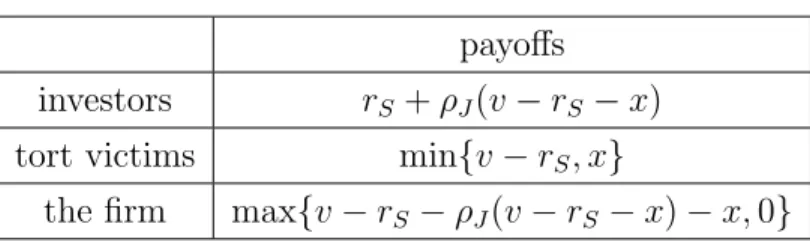
abuse of notation). In general, financial contract r yields the ex post payoffs to the three parties as follows:
Table 1: Payoffs under Contract r payoffs
investors rS+ρJ(v−rS−x)
tort victims min{v−rS, x}
the firm max{v−rS−ρJ(v−rS−x)−x,0}
The time line is as follows. At date T = 0, the firm chooses its financial contract (K,r). At date T = 1, the firm chooses effort e. At date T = 1.5, the harm x is realized. At date
T = 2, the investor is repaid and the tort victim is compensated.
Welfare Benchmark. Before proceeding, we establish a useful social welfare benchmark. Assuming that the project is pursued, social welfare is simply
W(e) := v−k− Z
X
xf(x|e)dx−c(e).
Neither the financial contracts nor the level of borrowing,K, influence social welfare directly. Capital structure will matter later, however, through its indirect effect on firm behavior. Integrationg the social welfare function by parts gives
W(e) :=v−k− Z
X
[1−F(x|e)]dx−c(e).
Suppose that the social planner can decide how much precaution the firm should exert directly. Differentiating W(e) shows that the first-best precaution level, eF B, satisfies
Z
X
Fe(x|e)dx−c0(e) = 0. (1)
Throughout, we assume that W(0) ≥ 0, so the project is socially valuable even with zero effort. This assumption will simplify our analysis and ensure that the project will be carried out in the relevant cases studied below. We later discuss the implication of judgment proofing on the project funding decision.
4
The Firm’s Problem
We now study the firm’s behavior. While our focus in this section is to analyze its behavior without any regulation, it is convenient for a later analysis to begin with a slightly general framework in which the lender may be subject to some liability. Specifically, suppose the firm picks (K,r,e) ∈ [k, v]×[0, v]× R ×R+ =:F to initiate the project. We assume that, after the lender is repaid according to r, he is liable to pay `(x) when the harmx is realized, where `(·) is assumed to be nondecreasing. Then, the lender’s ex post payoff is
π(x,r, `) :=rS+ρJ(v−rS−x)−`(x), (2)
when harm x is realized. If the lender expects the firm to choose e, then his ex ante payoff becomes
Π(r, e;`) := Z
X
π(x;r, `)f(x|e)dx.
Meanwhile, the firm receives an ex post payoff of
u(x;r) := max{v−rS−ρJ(v−rS−x)−x,0}, (3)
so its ex ante payoff given effort e is
U(K,r, e) :=K −k+ Z
X
u(x;r)f(x|e)dx−c(e).
The firm then faces the problem:
[P(`)] max (K,r,e)∈FU(K,r, e) subject to (IR) Π(r, e;`)≥K. and (IC) e∈arg max e0∈ R+ U(K,r, e0).
Condition (IR) ensures that the lender breaks even from the financial contract (K,r), when the firm is expected to choose effort e. Condition (IC) means that the firm must have the incentive to choose e, facing the financial contract (K,r). This is a constraint because the firm cannot commit to a level of precaution ex ante, even though it may wish to do so.25 We say that (K,r, e) ∈ F is feasible if it satisfies both (IR) and (IC) and optimal for the firm if it solves the program [P(`)].
25(IC) may bind since, starting at the solution of the relaxed program ignoring (IC), it may pay the firm
4.1
The unregulated behavior of the firm
We now analyze the unregulated behavior of the firm. Formally, we consider [P(0)]: That is, no restriction is placed on the firm’s financial decision making (i.e., the amount of borrowing and its choice of financing instruments), and the lender bears no liability (i.e., `(·) = 0). Therefore, the firm is free to choose the amount of borrowing,K, the financing instruments, r, and its precaution levele. Before proceeding, we characterize the optimal financial structure for the firm and its incentive to take precautions, given that financial structure.
Lemma 1 (Optimality of senior debt)For any feasible(K,r, e)with a non-debt structure
r, there exists a feasible (K,ˆr,eˆ), with an all-debt structure ˆr, which the firm prefers over
(K,r, e). For any feasible (K,r, e) with an all-debt structure with rJ > 0, there exists a feasible (K,ˆr,eˆ), with a senior-debt-only structure with rˆJ = 0, which the firm prefers over
(K,r, e). In each case, a shift to any such preferred feasible structure leads to a (weakly) higher level of precaution.
Proof: See the Appendix.
Lemma 1 tells us that, holding the level of capital fixed at K, it is both privately and socially optimal for the firm to choose a senior-debt only structure.26 As mentioned above, the private optimality of senior debt stems from its effectiveness as a judgment-proofing device. To illustrate the role of seniority, suppose first that the firm borrows K with (only) junior debt with the payment rate of rJ. Assumev−rJ < xso that insolvency arises with positive
probability, in which case the (junior) creditor does not always receive her payment rJ. This
scenario is depicted in Figure 1.1, which plots the payouts to different parties as functions of
x.
[PLACE FIGURE 1.1 ABOUT HERE.]
For a given level of harm, x,the tort victim is paid min{x, v}, the junior creditor is paid min{rJ,max{v−x,0}}, and the firm receives max{v−x−rJ,0} (gross of effort cost). The
areas, weighted by the densities, represent the expected payments to different parties. Notice that the repayment rate, rJ, must be inflated to reflect the risk of non-repayment: rJ > K.
26There are additional costs associated with high levels of senior or secured debt that are beyond the scope
of this paper. First, large debt obligations may discourage additional attention by the borrower to maintain the value of the firm’s assets, and the lender may lack the expertise to monitor the borrower effectively. Additional costs of secured debt include the transactions costs of enforcement and the loss to the borrower of the private benefits of ownership and control. See Tirole (2005, pp 166-168).
Suppose instead that the firm borrows K with senior debt, assuming for a moment the same payment rate rS = rJ > K. The firm would still receive max{v−x−rJ,0}, but the
rent is redistributed from the tort victim to the lender: the lender now receivesrJ > K with
certainty and the tort victim receives the remainder, min{x, v−rJ}. This redistributed rent
can be easily shifted to the firm. Since the lender would receive a strictly higher payoff with senior rather than junior debt (holding the repayment rate fixed) she can be persuaded to charge a lower rate. In fact, the competitive capital market would drive the repayment rate down to a level that allows the lender to break even: rS =K. This is shown in Figure 1.2.
[PLACE FIGURE 1.2 ABOUT HERE.]
The firm extracts all of the redistributed rents, i.e., the entire gain from diluting the tort claims. Nevetheless, Lemma 1 suggests that this judgment-proofing strategy is socially desirable since the firm chooses a higher level of precautions with senior debt than with junior debt (or other junior claims). A senior claimant is assured repayment of the loan, unlike junior claimants, so the former charges a lower repayment rate than the latter. Hence, the firm is less likely to be insolvent with senior debt. Comparing Figure 1.1 to Figure 1.2 shows that, with senior debt, the firm is a residual claimant in more states of nature and thus has a greater incentive to reduce the harm to the tort victims.
Given Lemma 1, we can restrict attention to the senior-debt only financial structure for the firm. If the firm issues senior debt with anyK ∈[k, v], the break-even repayment rate is simply rS =K since the debt-holder has the seniority over tort victims. From (3) above the
firm’s ex post payoff is
u0(x;K) :=u(x;K,0) = max{v−K−x,0}. (4) Hence, its ex ante payoff given effort e is
U0(K, e) :=K −k+ Z v−K 0 (v −K−x)f(x|e)dx−c(e) = K−k+ Z v−K 0 F(x|e)dx−c(e),
where the equality follows from integration by parts.
The unregulated behavior of the firm, (K0, e0), must then maximize U0(K, e). The be-havior is characterized as follows. Given any efforte, the firm’s marginal benefit from raising its borrowing is:
∂U0(K, e)
∂K = 1−F(v−K|e). (5)
This expression reveals the judgment-proofing benefit of overborrowing. Whenever the firm is insolvent (i.e., x > v−k), the additional repayment to the lender comes out of the fund that
would have been used for the tort award, given the seniority of the debt. Hence essentially, each additional dollar borrowed is paid out of the tort victims’ pockets with probability 1−F(v −K|e). Consequently, the marginal benefit of increasing the senior debt is strictly positive for any K < v, which implies that the firm will borrow K0 =v.
The implication for firm precaution is quite clear. Given any K ∈ [k, v], the firm’s precaution level e0(K) is determined by
∂U0(K, e)
∂e =
Z v−K
0
Fe(x|e)dx−c0(e) = 0. (6)
Since ∂2U0(K, e)/∂e∂K = −Fe(v −K|e) < 0 for any K < v, e0(·) is strictly decreasing in the range. In words, an increased senior debt lowers the firm’s exposure to tort liability, reducing its incentive for precaution. In fact, as is clear from (6), given K =v, the firm has no incentive for any precaution, i.e., e0(v) = 0.
Proposition 1 Without any policy intervention, the firm borrows K0 =v with senior debt
and takes no precautions, e0 = 0.
Note that even when the firm is not inherently judgment proof (x ≤ v −k), it creates “artificial” judgment-proofness by borrowing up to its cash flow.
5
Public Policy Responses
This section considers several remedies to the judgment-proof problem, including extending liability beyond the injurer to the lenders and senioritizing the bankruptcy status of tort claims. These two remedies share a common purpose of expanding the recovery of damages for the victims from a judgment-proof injurer. They may differ, however, in their incentives for precaution-taking and borrowing. In order to meaningfully compare these remedies, we first establish a more realistic welfare benchmark than the one established before.
5.1
Welfare Target with Moral Hazard
Suppose the social planner controls all aspects of the firm’s behavior, except for its precaution decision. Specifically, the planner chooses the amount of borrowing K ≥k, and the terms of the financial contract, r, for the firm. She also imposes liability of`(·) on the lender, where
`(·) is nonnegative and nondecreasing. We denote the set of feasible liability rules by L. These choices are subject only to the constraints that the lender must break even (i.e., (IR))
and the firm must have incentive to choose the precaution the planner wishes to implement (i.e., (IC)). Formally, the social planner would solve
[SW] max
(K,r,e,`)W(K, e) subject to
(K,r, e)∈ F satisfies (IR) and (IC), and `∈ L.
Although the regulators probably do not have either the information or the power to control the amount of borrowing or the terms of financial contracts of firms, the program [SW] yields a more realistic welfare target than the first-best level. The next proposition characterizes the optimal borrowing and precaution behavior, (K∗, e∗), that the planner would wish to implement.
Proposition 2 (Constrained efficiency) The solution of the problem [SW] involves K∗ =k
and e∗ = e0(k). No liability is imposed on the lenders, `(x) = 0, and the financial contract
involves only senior debt, r = (k,0).
This result suggests that the underprovision of effort chosen by the unregulated firm is attributed entirely to its excess borrowing. Had the firm borrowedK =k, then the firm would have chosen the (constrained) efficient level of precaution e0(k). The reason is the following. The unregulated firm dilutes the tort claims by choosing senior debt and by borrowing beyond the necessary level. For a fixed level of borrowing, senior debt improves incentives (Lemma 1). Excessive borrowing, however, worsens the incentives.
We will now show that subordination and lender liability serve to curb excessive borrowing but introduce their own problems.
5.2
Mandatory Subordination
Under mandatory subordination, all financial claims are restricted to be junior to the tort claims in their bankruptcy priority. Given the junior status of the debt, the tort victims have priority, meaning that they will receive up to the level allowed by the cash flow, or min{v, x}. This means that raising the level of borrowing cannot help the firm to avoid tort liability. Mandatory subordination controls the over-leveraging problem, with the firm choosing Ksub =k.
Given Step 2 of Lemma 10 (see the Appendix), the firm prefers junior debt among all standard junior claims. The equilibrium repayment rate, rsub, and the firm’s equilibrium
effort choice, esub, are determined jointly. Given the effort esub, the the repayment rate rsub
must be chosen to satisfy the lender’s break-even condition (IR): Z v
0
min{rsub, v−x}f(x|esub)dx =k. (7)
Given the repayment rate, rsub, the effort choice esub must satisfy the firm (IC), or the
associated first-order condition:
Z v−rsub
0
Fe(x|esub)dx=c0(esub). (8)
The equilibrium outcome depends on whether the project is inherently judgment proof. If it is not inherently judgment-proof, the investor can break even with the repayment of
k, so rsub = k. Then, since v −k ≥ x, (8) coincides with (1), which implies that the firm
will choose the first-best effort eF B. Hence, mandatory subordination implements the social
optimum in this case. If the project is inherently judgment-proof, however, the lender must chargersub > kto break even. This means that the firm is more likely to be insolvent relative
to the senior debt case, thus leading to too little precaution, i.e., esub < e0(k). Hence, the constrained efficient precaution level,e∗ =e0(k), is not attainable by subordination. In either case, since W(0)≥0 and since the firm does not fully compensate the tort victims, the joint payoff for the firm and the lender is nonnegative, so the project will be financed. In particular,
rsub < v. It then follows from (8) that esub>0. Recall that, without subordination, the firm
would overborrow to its cash flow limit, K0 =v and choose no precaution. Hence, the debt subordination would clearly improve welfare. The results are summarized as follows.
Proposition 3 Suppose the firm is allowed to employ only (standard) junior claims. Then,
the firm never borrows more than k, but chooses too little precaution esub < e∗ if the project is inherently judgment-proof. Subordination improves social welfare (relative to unregulated behavior).
In sum, subordination trades off two sources of precaution incentives. On the one hand, it eliminates overleveraging which improves the firm’s precaution incentives. But at the same time, the switch from senior to junior debt worsens the firm’s incentives.
5.3
Lender Liability
Now suppose that the lender bears the entire residual liability for the damages suffered by the tort victims when the firm is unable to compensate them ex post. Since the additional
liability imposed on the lender causes him to raise its repayment rate to a point that will allow him to break even, the liability is in fact shifted to the firm ex ante.
At first glance, lender liability looks similar to debt subordination. As before, the firm thus cannot avoid liability by raising its debt, so the firm would never borrow more than its productive use, i.e., Kll = k. If the social harm never exceeds the cash flow (x ≤ v), then
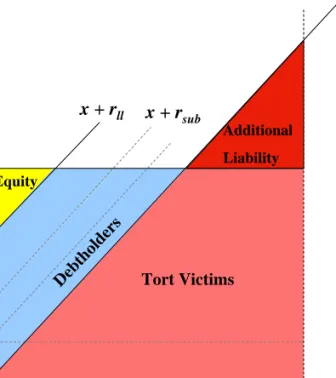
lender liability is precisely the same as debt subordination. When the harm level may exceed the cash flow (x > v), however, then lender liability and debt subordination generate different incentives for care. In such a case, the lenders have far more to lose with unlimited lender liability: in addition to the risk of non-repayment of principal and interest, they also run the risk that the tort victims will sue them and recover damages from the lender’s personal assets. The additional liability of the lender is depicted in Figure 2 as the triangle above the cash flow v.27
[PLACE FIGURE 2 ABOUT HERE.]
Anticipating higher future liability, the lenders would require an interest rate that is even higher than the rate with subordination, rll > rsub. This clearly reduces the firm’s equity
stake, further diluting the incentives for care.
To be more precise, let (rll, ell) be the equilibrium repayment rate and precaution choice
under lender liability, assuming that the project will be financed. As before, we have Z x 0 min{rll, v−x}f(x|ell)dx=k, (9) and Z v−rll 0 Fe(x|ell)dx=c0(ell). (10)
Ifx≤v, then comparing (7) with (9) confirms thatrll=rsub, soell=esub. Ifx > v, however,
the extra liability borne by the lender causes him to charge a higher rate, orrll > rsub, which
means that the firm is more likely to be insolvent, and thus will have a lower incentive for precaution, i.e., ell < esub. In either case, our assumption of W(k,0) ≥ 0 ensures that the
project will be initially launched and that rll≤v and ell≥0.
Proposition 4 If x≤v, then unlimited lender liability yields the same outcome as
subordi-nation. If x > v, then unlimited lender liability induces lower precautions than subordination. In either case, the firm never borrows more than k. Lender liability improves social welfare relative to unregulated behavior.
27If the harm never exceeds the cash flow (i.e., x ≤ v) then the additional liability triangle in Figure 2
While lender liability and debt subordination are equally effective at eliminating over-leveraging, the incentive problem is more pronounced with lender liability. Intuitively, the lender faces liability risks in addition to the risk of non-repayment of principal and interest, and the higher interest rate required by the lender exacerbates the incentive problem. It is worth highlighting that the benefit of lender liability arises only due to the firm’s strategic judgment proofing, in the form of overleveraging. Lender liability is never beneficial if the firm’s borrowing is fixed atk. Further, the benefit of deterring over-leveraging applies only to senior claims. If all claims were junior (for instance because the firm has no securable asset), there would be no benefit from lender liability in our model.
Corollary 1 If the firm can only issue (standard) junior claims, then lender liability can
only worsen the incentive for precaution taking, strictly so if x > v.
Proof: If the firm can only use junior claims, then it would use only junior debt (by
Step 2 of Lemma 10). Hence, the case without lender liability would coincide with mandatory subordination. The result then follows since mandatory subordination (strictly) dominates lender liability (if x > v).
This same logic would apply to placing liability on outside equityholders. An outside equityholder, anticipating future liability for the misconduct of the entrepreneur, would de-mand a greater proportion of the firm’s equity in return. This would leave the entrepreneur with a smaller proportion of the equity, diluting his incentives for care.
We next propose a liability rule that does attain constrained efficiency.
5.4
Optimal Liability Scheme: Limited Seniority Rule
We now introduce a liability rule, called Limited Seniority Rule, that implements the con-strained efficient outcome, (K∗, e∗), as defined in Proposition 2. Under this rule, a financial claim’s “seniority” is honored only up to a certain limit, k. Suppose that a firm borrowed
K > k with senior debt. In the bankruptcy court, only the amount k would be treated as “senior” debt, having a priority over tort claims. The remaining portion, K −k, would be treated as junior debt. Equivalently, this rule requires that the financial claims on the firm’s cash flow be “junior” up tov−k, while the remaining portion of cash flow, k, may be distributed according to the standard absolute priority rule.
The effect of this rule can be analyzed as follows. First, note that our earlier result concerning the private optimality of senior debt (i.e., Lemma 10) extends to this rule, so there
is no loss in restricting attention to senior debt. Hence, suppose the firm obtains senior debt with K ≥k. Given an equilibrium repayment rate ˆr(K) the lender will receive
(
min{ˆr(K), v−x} if x≤v−k,
k otherwise.
Given that the lender anticipates the firm to choose ˆe(K), the lender breaks even if ˆ
r(K)F(v−rˆ(K)|ˆe(K)) + Z v−k
v−rˆ(K)
(v −x)f(x|ˆe(K))dx+k(1−F(v−k|ˆe(K))) =K. (11) Meanwhile, the firm’s incentive compatibility requires
Z v−rˆ(K)
0
Fe(x|ˆe(K))dx−c0(ˆe(K)) = 0. (12)
Observe from (11) that ˆr(k) = k. That is, if the firm borrows the productive requirement,k, it does not bear any additional liability, so the repayment rate ofkwill break even. Substituting ˆ
r(k) = k into (12) shows that the firm’s precaution choice will be constrained efficient, i.e., ˆ
e(k) =e∗.
We now show that the firm would never borrow more than k. Suppose that the firm did in fact borrow K > k. Then, the firm’s ex ante payoff will be (with integration by parts)
ˆ
U(K) =K−k+
Z v−rˆ(K)
0
F(x|ˆe(K))dx−c(ˆe(K)).
Differentiate this with respect to K, using the envelope theorem, to obtain: ˆ
U0(K) = 1−F(v−rˆ(K)|ˆe(K))ˆr0(K). (13) Next, differentiate totally (11) to obtain
F(v−rˆ(K)|ˆe(K))ˆr0(K) + Z v−k v−rˆ(K) Fe(x|ˆe(K))dx ˆ e0(K) = 1. (14) Substituting (14) into (13) gives
ˆ U0(K) = Z v−k v−rˆ(K) Fe(x|ˆe(K))dx ˆ e0(K)<0,
where the last inequality holds since Fe > 0 and e0(K) ≤ 0. Since the inequality yields a
contradiction, we conclude that the firm never borrows more thank. The following conclusion is then immediate.
Proposition 5 The Limited Seniority Rule that treats any borrowing beyond a limit, k, as
junior to the tort claim implements the constrained efficient outcome (K, e) = (k, e∗).
When compared with mandatory subordination and lender liability, the Limited Seniority Rule involves less compensation to the tort victims ex post. Nevertheless, the rule generates the best incentives for precautions by the firm. Also note that our rule respects absolute priority (up to a limit), and therefore implies less interference with the existing bankruptcy priority rules.
In practice, the exact seniority limit k may not be perfectly observable by the policy maker, so the latter may err either by being too generous or too stingy in her treatment of debt seniority. The Limited Seniority Rule is forgiving of such errors, however, in that its relative desirability is robust to even large errors. To see this, observe that mandatory subordination is a special case of the current rule where the seniority limit is set at zero, forcing all borrowing to be junior to the tort claim. The Limited Seniority Rule with a limit set (inaccurately) in (0, k) will clearly dominate mandatory subordination and thus also lender liability. Likewise, the Limited Seniority Rule will dominate unregulated behavior as long as the limit is set in (k, K0). Consequently, for a very broad range of “inaccurate” limits, the rule will produce a better outcome than mandatory subordination, lender liability, or no regulation at all. In particular, in the absence of accurate estimate of k, a conservative approach that would limit “seniority” to the debt associated with initial setup investment will outperform the mandatory subordination and at the same time will prevent the overleveraging problem.
6
Other Remedies
The three remedies to the judgment-proof problem discussed so far — debt subordination, lender liability, and limited seniority — all have focused on debt contracts and the regulation of bankruptcy. We will now discuss additional remedies — partial lender liability, shareholder liability, mandatory liability insurance and punitive damages.
Partial Lender Liability. Pitchford (1995) and Boyer and Laffont (1997) advocated the idea of holding the lender partially liable for the social harm. Our Limited Seniority Rule can be interpreted in this light, since exposing part of the financial claim to tort victims is a way of holding the lender partially liable. Specifically, the constrained optimum can be implemented by holding the lender liable for `(x;K, k) = min{max{x−(v−K),0}, K−k}
(without any debt subordination). Notice that, given our judgment-proofing issue, the extent of the lender’s liability must vary with the extent of borrowing, which differs from the existing proposals. Alternatively, one could set the lender liability equal to min{x, v−k}, as has been proposed by Pitchford. This approach only works when the senior repayment rate depends on the harm x, assumed away in our model.28
Shareholder Liability. Our model has very important implications for shareholder lia-bility.29 First, policies that allow tort victims to seize the entrepreneur’s personal assets — home equity and retirement plans for example — would lead to improved incentives for care. Facing personal liability, the entrepreneur would better internalize the harms that he causes to society. Whether outside shareholders should be held liable depends on their abil-ity to influence the firm’s behavior via monitoring or sophisticated contracting. If they have sufficient control over the firm’s behavior, shareholder liability may be desirable.30 More realistically, though, outside shareholders tend to be passive, lacking such an ability. In that case, outside equityholders liability would worsen the entrepreneur’s incentives rather than improve them. An outside equityholder, anticipating future liability for tort damages beyond his equity stake, would demand a greater proportion of the company’s stock to compensate for that risk. (This greater proportion of stock is analogous to the higher interest rate that would be demanded by debtholders in the case of lender liability.) The entrepreneur is left with a smaller equity stake than otherwise, and hence less of an incentive to take precautions to avoid future liability. In fact, the logic of Lemma 1 implies that the firm’s precaution incentive would be even worse under this regime than under lender liability. This insight provides some support for the rule of limited liability in US corporate law.
28Suppose the lender and the firm can sign a contract onxrequiring the firm to reimburse min{x, v−k}
to the lender. This scheme implements the constrained optimum. The repayment rate decreasing in v−x
will make the contract nonstandard, violating our “monotonicity” assumption. Moreover, if the parties can contract on xthe partial lender liability is no longer optimal. The social planner can achieve an even better outcome by raising the lender liability beyondv−k, possibly up to full liability. For instance, with full lender liability, the lender may induce the firm to chooseeF B by charging less thankwhen there is no accident and
more thank+xwhen there is an accident. This problem does not arise in Pitchford (1995) due to the binary state. See also Lewis and Sappington (2001).
29See Hansmann and Kraakman (1991), who argue that the prevailing rule of limited liability for corporate
offers few, if any, advantages over a rule of unlimited liability.
30As noted in footnote 28, any arrangement holding a third party liable leads to the constrained optimum,
as long as that party can charge the firm reimbursement contingent on the level of social harm. In this vein, Pitchford (1993) established equivalence between outside shareholder responsibility, mandatory insurance and third party superfund scheme, assuming such a contracting ability.
Mandatory Liability Insurance. Mandating that the injurers purchase liability insur-ance is a simple way of ensuring the tort victims’ recovery of their court awards. As Pitchford (1993) and Shavell (2004) observed, if a full-insurance provider can monitor and control the injurer’s precaution level (say by conditioning its payout or insurance premium on this level), the provider will require the firm to choose a socially efficient level of precaution. In practice, however, insurance providers are unlikely to possess fully effective monitoring capabilities. For instance, in the context of the taxi accidents, precautions would take the form of a taxi company’s screening for careful drivers at the hiring stage and monitoring their driving prac-tices. Such intimate involvement with the management of the business is often beyond the expertise of insurance providers. Without monitoring, liability insurance would lead to higher insurance premiums and would reduce the injurer’s precautions. Moreover, if the liability in-surance coverage were partial rather than full, so the firm’s assets were partially exposed to tort victims, then the firm would still borrow excessively to completely judgment proof itself. With complete insurance coverage, there would be no need for further judgment proofing. Either way, the firm has no incentive to invest in precautions, for it is completely shielded from ex post liability. In other words, the standard moral hazard problem associated with insurance compounds the judgment-proof problem, which aggravates the incentives.
Damage Inflation: Punitive Damages. The merits of punitive damages have been widely debated among legal scholars (see Polinsky and Shavell (1998) for a survey). Since judgment proofness typically leaves victims undercompensated, punitive damages may be one possible way to hold the judgment proof defendant accountable. While inflating damages does little to extract payment from a bankrupt injurer, it raises the payment when the injurer is not bankrupt. This is not necessarily a good thing, however (see Boyd and Ingberman (1994, 1999)). First, damage inflation has a dubious effect on incentives in the presence ofexogenous
judgment proofness. Damage inflation increases damage payments when the harms to society are very low — namely when the injurer is solvent whether or not the damages are inflated. Hence, damage inflation imposes a greater punishment in exactly those states of nature that society would like to encourage. Second, inflating damages creates more temptation for the firm to resort to judgment proofing. Inflated damages mean that the injurer has more to lose in the solvent state, thus motivating her to shield her asset by judgment proofing. In sum, inflating damages does not seem useful in the context of judgment proofness and judgment proofing.
7
Extensions
Richer Contracting Possibilities and Lender Monitoring. We have considered a broad set of financing contracts that encompass most of the commonly observed financ-ing arrangements. It is of (at least theoretical) interest to consider even richer contractfinanc-ing possibilities. For example, we can imagine junior claims that do not satisfy the monotonicity properties assumed in R, or senior claims whose payment requirements depend on realized harm x, or the investor may be able to monitor the firm’s effort. While contracts outside R are not common in reality, they are at least theoretically interesting since often such contracts may dominate the ones in R in performance.31
As pointed out by Boyer and Laffont (1997), the improved contracting between the lender and the firm makes it more desirable to regulate the lender. This is true even in the presence of judgment proofing. Without any regulation, the lender’s improved ability to control the firm’s behavior via sophisticated monitoring and contracting will simply enable them to promote their joint interest more effectively. They will engage in a variety of judgment-proofing strategies to simultaneously create more firm value and protect that value from the reach of future tort victims. The policy interventions discussed above — subordination, lender liability, and limited seniority — all force the lender and the firm to jointly internalize the social harm they cause. An improved contract between the two parties enables them to implement the level of precaution in their best joint interest, and these policies can better align their joint interest with social welfare. As with Boyer and Laffont (1997), if the lender can monitor the firm’s precaution accurately, the agency problem between the two parties disappears. In this case, full lender liability will yield the first-best outcome: The firm will borrowK =k with a contract that punishes the firm whenever it does not pick the first-best effort level.
Victim Precautions. Our analysis has assumed that only the firm can take precautions to avoid accidents. In reality, potential victims can also take precautions to avoid accidents and to mitigate their damages in the event that they do occur. In the taxi cab example, pedestrians can be more careful when walking near traffic. Policies that “make the victim whole” following an accident — such as unlimited lender liability — will lead the victim to
31Innes (1990) shows that a financial claim which charges high repayment when the cash flow is low and a
lower repayment when the cash flow is high does better than a debt. See Lewis and Sappington (2001) for a similar point.
take too little care.32 Debt subordination performs better than unlimited lender liability in this regard. Since the victim bears a residual loss with debt subordination, the victim takes a higher level of care. Since the tort victim bears an even higher loss when debt is senior rather than junior, our Limited Seniority Rule performs best of all. With the Limited Seniority Rule, the junior status of the tort victim encourages greater care levels by the victim, and the lower interest rate encourages greater precautions by the firm.
Uncertain Cash Flows and Capital Requirements. Thus far, we have assumed that the cash flow, v, is deterministic and the productive requirement, k, is known. These as-sumptions, made primarily for simplicity, may not hold in reality. Our results are largely robust to relaxing these assumptions, however. Suppose the cash flowv is a random variable. Innes (1990) showed that debt is preferable to all other standard (i.e., “monotonic”) financial claims (which as noted earlier include all plausible financial claims) in a model without tort victims, so there would be little loss in restricting attention to senior debt. More importantly, the firm’s preference for senior debt over junior claims and its tendency for over-leveraging remain unchanged in this case, since the “judgment proofing” benefits of these practices do not depend on the stochastic nature of the cash flow. Hence, the firm will choose senior se-cured debt and borrow in excess of its productive use. Some of the remedies to this problem – namely subordination and lender liability – will lead to the same tradeoffs as discussed before. The optimality of the Limited Seniority Rule extend to this new environment, except that the scope of the “junior treatment,” v−k, would be random instead of deterministic. Activity Levels. We have so far assumed that the firm’s activity is socially justified even when it exerts no precaution. Relaxing this assumption identifies an additional role for reg-ulation. Suppose the firm’s activity is sufficiently harmful that it is socially unjustifiable, without sufficient precaution. Without any regulation, the various judgment-proofing strate-gies could enable the firm to engage in harmful activities even without any precaution. The public policies discussed above may regulate firm’s activity decisions. For instance, in the perfect contracting environment, full lender liability will force the firm and the lender to internalize the social harm caused by their activity, resulting in the optimal decision. As Boyer and Laffont (1997) noted, if there is moral hazard or adverse selection in the invest-ment, however, full lender liability may prevent even a socially justifiable project from being
32The law and economics literature has suggested various solutions to these so-called bilateral accidents,
including contributory negligence. Our framework assumes that the firm’s effort level is unobservable and not contractible, preventing the implementation of these negligence rules.
pursued. Such problems may render partial lender liability or the Limited Seniority Rule optimal.
8
Conclusion
This paper has considered the problem faced by an entrepreneur when raising capital to finance a risky business activity. In order to shield his assets from future tort claimants, and to secure capital at lower cost, the entrepreneur has a strong incentive to issue claims that are senior to any future claims by tort victims. Holding the level of borrowing fixed, the entrepreneur’s private decision to use senior debt is also socially desirable: senior debt leads to higher levels of precautions and hence a higher social surplus than either junior debt or outside equity. The entrepreneur will tend to borrow too much, however, and this leads to lower precautions. Public policies that prevent strategic judgment proofing may or may not in society’s interest ex ante. Debt subordination and lender liability both eliminate overleveraging. By itself, this is a good thing: lower levels of borrowing implies higher levels of precautions. But holding the level of borrowing as fixed, both policies lead to suboptimal precautions and higher levels of social harm (lender liability performing worst). The Limited Seniority Rule allows senior debt only up to a predetermined limit, and thus limits the scope of the elevation of the torts’ bankruptcy status. While least protective of the interest of tort claimants compared with other policies, this rule achieves the constrained social optimum: it prevents overleveraging and also creates the highest achievable incentives for care.
The main lesson of our paper is that firms, when left unregulated, will tend to engage in judgment-proofing strategies. These strategies not only leave the victims undercompensated, they also lead the firms to take too few precautions to avoid causing harm. While our paper focused primarily on financial strategies, namely the firm’s choice of capital structure and securitization, it would be interesting to more formally explore other judgment-proofing strategies such as vertical and horizontal disintegration. While our analysis suggests that regulating such practices may be socially desirable, the precise form and degree of regulation requires careful assessment of the incentives facing the firm and is left for future research.
9
Appendix
We prove a more general version of Lemma 1 for any nondecreasing `(·)≥0, Lemma 10.
Proof of Lemma 10: The proof of the first statement consists of two steps:
Step 1: Consider any all-debt financial structure, (K,r), with r = (rS, rJ). Given such a structure, the firm’s choice of precaution is unique and nonincreasing in the sum rS +rJ, and the surplus the firm collects is strictly decreasing in rS+rJ for rS+rJ ∈(0, v).
Proof. Fix any all-debt financial structure, (K,r), with r= (rS, rJ). Given the structure,
if the firm picks e, it collects the utility of
U(K,r, e) = K−k+ Z x
0
max{v−rS−rJ−x,0}f(x|e)dx−c(e).
Integrating by parts, this can be rewritten as:
U(K,r, e) = K−k+
Z v−rS−rJ
0
F(x|e)dx−c(e).
Given the assumptions made on F(x|·) and c(·), U(K,r,·) is strictly concave and admits an interior maximizer. Further, the function satisfies a single crossing property with respect to (−rS−rJ, e), hence, the maximizer, ¯e(rS+rJ), ofU(K,r,·) must be nonincreasing inrS+rJ.
LetU(rS+rJ) := maxe∈R+{K−k+
Rv−rS−rJ
0 F(x|e)dx−c(e)} be the associated maximized value. By the envelope theorem, for rS+rJ ∈(max{0, v−x}, v),
U0(rS+rJ) =−F(v−rS−rJ|¯e(rS+rJ))<0,
which proves the last statement.
Step 2: For any feasible (K,r, e) with nondebt structure there exists a feasible (K,ˆr,ˆe)
with all-debt structureˆr, which the firm prefers over (K,r, e). A shift to any feasible all-debt structure that the firm prefers results in a (weakly) higher precaution.
Proof. Fix any (K,r, e) with nondebt structure (i.e., ρ 6≡0, ρ ∈ R), satisfying (IR) and (IC). We consider an all-debt structure (K,ˆr, with ˆr:= (rS,ˆrJ), where ˆrJ is chosen so that
Π(ˆr, e, `) = Π(r, e, `), ⇔ Z v−rS−rˆJ 0 min{ˆrJ, v−rS−x}dF(x|e) = Z x 0 ρ(v−rS−x)dF(x|e). (15)
Since ρ ∈ R, ˆrJ exists (recall the properties of R). Further, there exists ˆx ∈[0, v−rS] such
that min{ˆrJ, v−rS−x} ≤ρ(v−rS−x) ifx≤xˆand min{ˆrJ, v−rS−x} ≥ρ(v−rS−x) if x≥xˆ, (which again follows from the fact that ρ∈ R).
For anye0 < e, U(K,ˆr, e0)−U(K,r, e0) = Z v−rS 0 [ρ(v−rS−x)−min{ˆrJ, v−rS −x}]f(x|e0)dx = Z xˆ 0 [ρ(v−rS−x)−min{ˆrJ, v−rS −x}]f(x|e0)dx + Z v−rS ˆ x [ρ(v−rS−x)−min{ˆrJ, v−rS−x}]f(x|e0)dx = Z xˆ 0 [ρ(v−rS−x)−min{ˆrJ, v−rS −x}]f(x|e) f(x|e0) f(x|e) dx + Z v−r ˆ x [ρ(v−rS−x)−min{ˆrJ, v−rS−x}]f(x|e) f(x|e0) f(x|e) dx ≤ Z xˆ 0 [ρ(v−rS−x)−min{ˆrJ, v−rS −x}]f(x|e) f(ˆx|e0) f(ˆx|e) dx + Z v−r ˆ x [ρ(v−rS−x)−min{ˆrJ, v−rS−x}]f(x|e) f(ˆx|e0) f(ˆx|e) dx = f(ˆx|e0) f(ˆx|e) Z v−rS 0 [ρ(v −rS −x)−min{ˆrJ, v−rS−x}]f(x|e)dx = 0. (16)
The lone inequality follows from (M LRP), and the last equality follows from (15). By (15),
U(K,ˆr, e)−U(K,r, e) =
Z v−rS
0
[ρ(v−rS−x)−min{ˆrJ, v−rS−x}]f(x|e)dx= 0. (17)
Hence, for any e0 < e,
U(K,ˆr, e)−U(K,ˆr, e0)≥U(K,r, e)−U(K,r, e0)≥0, (18) where the first inequality follows from (16) and the second follows from the fact that (K,r, e) satisfies (IC). By Step 1, the optimal precaution ˆe ∈arg max˜e∈RU(K,ˆr,e˜) is unique. Hence, if ˆe < e, U(K,ˆr, e)< U(K,ˆr,eˆ), which would contradict (18). We thus conclude that ˆe≥e.
It follows from this last fact that Π(ˆr,ˆe;`) = Z X π(x,ˆr, `)f(x|ˆe)dx≥ Z X π(x,ˆr, `)f(x|e)dx= Π(ˆr, e;`) = Π(r, e;`)≥K,
where the first inequality holds since π is nonincreasing inx and f has (M LRP) in (−x, e), the second equality follows from the construction of ˆr, the third equality follows form (15), and the last inequality holds since (K,r, e) satisfies (IR). We thus conclude that (K,ˆr,ˆe) satisfies (IR).