Online recognition of human activities and adaptation to habit changes
by means of learning automata and fuzzy temporal windows
M. Ros
⇑, M.P. Cuéllar, M. Delgado, A. Vila
Department of Computer Science and Artificial Intelligence, University of Granada, E.T.S. Ingenierías Informática y de Telecomunicación, C/Pdta. Daniel Saucedo Aranda s.n., 18071 Granada, Spain
a r t i c l e
i n f o
Article history:
Available online 18 October 2011 Keywords:
Learning automata Ambient assisted living Online learning Smart homes Human behavior
a b s t r a c t
Smart Homesare intelligent spaces that contain resources to collect information about user’s activities and ease the assisted living. Abnormal behavior detection has been remarked as one of the most challenging application fields in this research area, due to its possibilities for assisting elders or people with special needs. These systems help to maintain people’s independence, enhancing their personal comfort and safety and delaying the process of moving to a nursing home. In this paper, we describe a new approach for the behavior recognition problem based on Learning Automata and fuzzy temporal windows. Our proposal learns the normal behaviors, and uses that knowledge to recognise normal and abnormal human activities in real time. In addition, our proposal is able to adapt online to environmental variations, changes in human habits, and temporal information, defined as an interval of time when the behavior should be performed.
Ó2011 Elsevier Inc. All rights reserved.
1. Introduction
In the past years, life expectancy has got longer, thanks, in most of cases, to advances in medicine and technology. This fact leads to the need for new resources in order to maintain this lifestyle. Technology raises as the most powerful tool to help in this issue. The advances in electronics and sensor technologies allow the development of new intelligent environ-ments, where the combination of independence, continuous supervision, and assistance is taking place. One example of this combination is the project presented by Rantz et al.[34], at the University of Missouri. They develop an interdisciplinary research that involves disciplines, such as nursing, electrical and computer engineering, social work, or health informatics, among others. The project is developed in a real nursing home, where elderly people are able to live independently. Their research is focused on the study of the data acquired from a huge number of motion, pressure, and sound sensors, or IR-cam-eras. This information is used to extract conclusions about the user: heart pulse, breathing, fall detection, etc. Other out-standing study isCARE(Context Awareness in Residence for elders)[21], developed in the University of Amsterdam. CARE lets elders retain their independence by living longer at home. They use sensors such as switches or pressure mats, in order to monitor the inhabitants’ behavior unobtrusively and provide benefits to both families and elders by means of network services. Focusing on the people with special needs, in[31,30], the authors proposed a project to help people suffering from mild dementia to navigate using contextual information and wireless and mobile device technologies, including location-based services. Related to location services, a flexible and dynamic access control model location-based on user-activity, Activity-Oriented Access Control (AOAC) is proposed in[22]. A user is allowed to perform an activity if he/she holds a number of satisfactory attributes (i.e. roles, assignments, etc.) under a certain environment constraint. Other examples in the literature
0020-0255/$ - see front matterÓ2011 Elsevier Inc. All rights reserved. doi:10.1016/j.ins.2011.10.005
⇑ Corresponding author.
E-mail addresses:[email protected](M. Ros),[email protected](M.P. Cuéllar),[email protected](M. Delgado),[email protected](A. Vila).
Contents lists available atSciVerse ScienceDirect
Information Sciences
are MavHome project[7], the iDorm[10], the CASAS project[35], and the Georgia Tech Aware Home[18]. Further projects regarding this research area are summarised in[11].
One of the most challenging issues regarding home assistance is the recognition of normal and abnormal human behav-iors for elderly people, to enhance their personal comfort and safety, and delaying the process of moving to a nursing home. The literature offers a great variety of approaches in this way[4]. One interesting work is the one presented in[32]. It defines a new paradigm for Activities of Daily Living (ADL)[24,32]inference, using radio-frequency-identification (RFID) technology to identify objects used by people, and a probabilistic inference engine for the recognition of complex activities. They have developed the systemProactive Activity Toolkit(PROACT) to represent activities as a probabilistic sequence of used objects. It uses the RFID signals to extract the user context and then, mines probabilistic models of activity use from plain english descriptions of activities.
Recent projects generalise the problem of behavior recognition to usual activities of daily living, such as morning routine, having breakfast, or leaving home. To achieve this, the trend is the use of probabilistic techniques to supervise the current activities. The reason for resorting to stochastic methods is that they are able to model different scenarios and possible ways to finish the human tasks correctly. Naive Bayes classifiers have been used in some projects[17,39]obtaining good accuracy results for abnormal behavior detection, even when the system receives large amounts of data. Other similar works that model human activities with Hidden Markov Models (HMMs) are[5,46,27]. Naeem and Bigham present in[28]an approach based on Multiple Behavioral Hidden Markov Models (MBHMM). They propose the creation of multiple hidden Markov mod-els for each variation of an action, so that the system is able to determine which tasks are currently active even if the user has not yet completed the activity. In[23], Lee et al. propose an algorithm that incorporates a modified fuzzy competitive learn-ing structure with a Bayesian decision rule that is capable of ignorlearn-ing unintended behavior of the user. An extensive study about the benefits and drawbacks of different probabilistic and statistical techniques for human activities recognition is pre-sented in[19].
Lately, some projects that involve different techniques for the problem of recognising normal and abnormal behaviors have arisen. In[2], the authors propose an ambient intelligence approach, and develop a fuzzy computing system to learn and model human behaviors. Their work joins the advantages of a multiagent-based framework with fuzzy control tech-niques to improve the recognition process and continuously enrich the knowledge about the user and his/her environment. On the other hand, Rashidi et al. in[36]introduce an unsupervised method to discover activities in a smart environment, using data mining techniques to find activity patterns and a clustering process to group these patterns into activity defini-tions, and HMMs to represent the activities and their variations for their later detection and recognition. Other authors have included temporal information in order to extract correct patterns for each behavior. For instance, in[16,45], the authors propose a learning machine to identify temporal relations among daily activities in a smart home. These relations are used for prediction, decision making, and anomaly detection of ADL. Further related projects are summarised in[26,12,13,43].
Despite the efforts carried out to recognise human activities in smart home environments, the need for feedback infor-mation is required for the system adaptation to environmental or human habit changes. Stochastic systems are usually used to acquire reasonable behavior in environments characterized by uncertainty. In[20], Kitakoshi et al. propose an on-line reinforcement learning system that adapts to environmental changes using a mixture of Bayesian networks. They try to imi-tate how people adapt to changes: reusing experiences with suitable modifications to solve current problems. Every BN in the mixture represents the experiences in an specific environment. When environmental changes are observed, the system modifies the mixture to adapt to the changed environment.
Specifically, in Ambient Assisted Living, some of the most important projects consider this issue, such as the CASAS pro-ject[35,36]. It includes an adaptive activity mining component to find changes in activity patterns using a hierarchical behavior model with probabilistic methods and a feedback-based learning component in charge of finding relevant changes in the activities. Among the projects based on agent systems, in iDorm[10,15,14], the authors developed AOFIS, a life-long fuzzy learning and adaptation technique for embedded agents in ubiquitous computing environments. This technique is an unsupervised data-driven one-pass approach for extracting fuzzy rules and membership functions from user data modelling for behavior detection and online adaptation. Other examples are[1], where Acampora et al. improve the system proposed in [2]by means of the adaptation of both the framework and the fuzzy services. They use feature mining to detect changes in the human activities. Finally, in[39], the authors propose a system for recognising activities that are capable of adjusting the internal model in real-time as new examples of activities become available.
In previous works, we developed a method to mine frequent human activities using inductive learning, and provided a behavior model as a tree. The branches represent a way in which a behavior could be performed[9]. Lately, we studied the benefits of using a fuzzy temporal window to disclose the most relevant actions of an activity[37], in contrast to the classic crisp temporal sliding window. However, this approach is static and the need of adaptation to environment and habit changes require a new learning after sufficient user activity monitoring. The behavior representation was improved in[8], where we proposed to separate learning methods and behavior models for a better problem statement. This approach is able to learn temporal relationship constraints between actions in a behavior, and has the advantage of being a graphical model to ease the user monitoring. However, it lacks of time processing and detection of several behaviors simultaneously. In this article, we propose a system to recognise human behavior from current user activity. To be more concise, we focus on the learning of relevant actions of the activity, their order relations, and temporal data of behaviors. The proposal overcomes the limitations of HMMs regarding first order assumption[5,46,27], since behavior actions are structured in execution levels. We include temporal information in the developed system as a component of a behavior execution, and our approach is also
capable of online self-adaptation when a behavior or environmental change occurs, therefore adjusting the behavior knowl-edge to a specific user. For each human behavior, we distinguish between two types of constraints: temporal and order rela-tionship constraints. The temporal constraints relate to the period of time when the behavior must be performed, whereas the order relationship constraint controls which actions must be executed before the others, i.e. the temporal order relation-ships between actions in a behavior. The proposed system is able to learn these constraints and it generates a representation of a behavior as a module. Key aspects of our approach are: (a) The separation of the behavior model from the behavior learn-ing procedure, in order to avoid shrinklearn-ing problems produced by the learnlearn-ing algorithms, as happens with HMMs; (b) the modularisation of the approach, which allows the migration of a learnt behavior to other contexts or user environments; (c) the online learning and adaptation capability, by means of learning automata and fuzzy temporal windows, to learn the changes produced either in the user habits or the environment. The proposal has been designed as an abstract software layer, so that it works independently on the underlying sensor network. Several technologies could be used to adjust the system to a specific scenario by means of matching user actions and sensor events that trigger such actions, such as RFID [32,28,25]of processed video streams[6,44].
The paper is organised as follows: In Section2, we introduce basic theoretical aspects of Learning Automata which will be useful for our later developments. Next, Section3summarises thebehavior modelconcept. The description of the model is presented in Section4, where the relevant aspects of the system are remarked: the behavior time and the action order rela-tionship constraints models. After that, in Section5, we address the problems of online behavior recognition and their adap-tation to environmental and human habit changes. Section6presents the outlines of simulating the system with different data sets and includes an in-depth analysis with the obtained results. Finally, the conclusions and future works are discussed in Section7.
2. Learning Automata. Theoretical background
A learning automaton (LA)[33]is a decision-making stochastic machine defined by tupleh
a
,Q,R,Ti, wherea
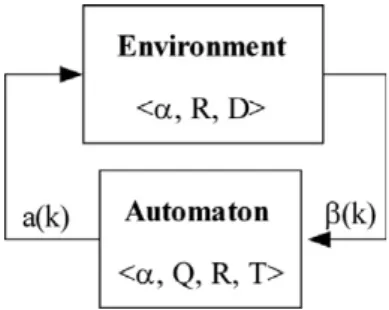
is a set of available actions for the automaton,Qis the internal state,Ris a set of reinforcement values to the automaton, andTis a reinforcement learning scheme. The operation of a learning automaton (Fig. 1) is described as follows: at each time instant k, the automaton selects an actiona(k)2a
according to the automaton internal stateQ(k), and returnsa(k) to an unknown random environment. The environment evaluates the action chosen by the automaton with a fitness functionf:Da
?R and provides a reward or penalty reinforcement valueb(k) =f(D,a(k)), whereDis the expectation to obtain a reward rein-forcement value. Finally, the internal state of the automaton is updated withQ(k+ 1) =T(Q(k),a(k),b(k)). This process is re-peated until a predefined desired condition is fulfilled, as for example the convergence to the learnt optimal action. There is a wide variety of LA depending on the design ofa
,Rand the environment. For the sake of brevity, we suggest reference[41]for a complete description of the classic LA schemes. Next, we describe the models that are useful for this work.A Finite Action-Set Learning Automaton (FALA)[41]is a LA model with a finite action set,
a
= {a
1,a
2,. . .,a
r}, whererstandsfor the number of available actions. The stateQ(k) usually contains a probability distribution over the action-set of autom-atonQ(k) =P(k) = [p1(k)p2(k). . .pr(k)], although other more complex state structures may be designed to improve the learning
capabilities of the automaton, as happens with the estimator learning algorithms[3]. On the other hand, Continuous Action-Set Learning Automata (CALA)[41]can be used to handle continuous action spaces. The action probability distribution in a CALA, at the learning iterationk, is defined by a Normal probability distributionN(
l
(k),r
(k)). The update of its action prob-ability distribution is executed by updatingl
(k) andr
(k)[33,41]. Finally, another LA model of interest to our work is the variable action-set learning automaton(VALA)[40,42,29]. Here, the action-set is finite as FALA, but the availability of actions to the automaton depends on external variables such as time. The state of the VALA may be easily modelled with a matrix, where each column is the action probability distribution corresponding to each time,Q(k) = [P(k, 1)t,P(k, 2)t,. . .,P(k,t)t].In this work, we use a team of FALA to online learn the temporal action relationship constraints of a human behavior, and a CALA team to learn the parameters of a fuzzy temporal window in which the behavior occurs. For the behavior recognition and online adaptation, the FALA team is implemented into a VALA team to achieve the dynamisation of the behavior model.
This helps to model situations where a behavior has several ways to finish correctly and its actions can be executed in any order. The next sections explain these issues in depth.
3. Behavior model
The objective of the article is to present a system that is able to learn human behaviors online and detect when the user is carrying them out, either correctly or incorrectly. Therefore, the first step consists of defining what behaviors are and how the system deals with them.Example 1introduces the problem to solve:
Example 1. Let us suppose that every night, when the user goes to bed at approximately 9.30 p.m., he/she opens the bedroom door, puts his/her pyjamas on, sits on his/her bed, takes his/her slippers off, takes the pills and turns off the light. Then, all these actions could be embraced as a unique routine: to go to bed. Let us suppose that a single day the user does not take his/her pills. This fact is considered as an abnormal behavior for this routine, and it should be controlled. However, if that oversight becomes more usual, the system should stop recognising it as abnormal, and accept it as normal.
Example 1outlines the concepts of behavior and human action: the set of actions performed to get the routineto go to bed is a behavior, and the behavior is associated with a time in which it occurs. The relevant concepts are formally introduced in the next subsections.
3.1. Behavior action sequence
We assume that the tasks carried out by the user may be identified by means of sensor events. Our starting point are ac-tions that have been defined over a set of sensor events to be independent of the sensor network design. The action and behavior concepts are as follows:
Definition 1 (Human action). A human actionhiis a triplehi=hli,si,tii, whereliis a label to identify the action,siis a sensor
event andtiis a time stamp in which the action occurs. In brief, a human action labelledliis an activity (fact) that happens
over a specific object in a time instantti, and it may be uniquely determined by means of a sensor eventsi.
Definition 2 (Behavior action sequence). A human behavior action sequenceBiis a tuple
hH,Ri,Cii, whereH= {h
1h2,. . .,hn} is a
set of available human tasks,Ri
¼ ri
1;ri2;. . .;rijRi j
n o
#His the subset of available human tasks that are required to complete the behavior, andCiis a set of temporal constraints between the tasks inRi, defined over a partial order relationship operator
. The operatordefines the temporal dependency requirements over the actions of a behavior, and its formal definition is
described in Eq.(1). In brief, an actionri
aprecedesribin time in a behaviorB
i, and is writtenri
arib, if the time stamptaofriais
lower than the time stamptbofrib, for all the possible instances of the behavior.
ri ar
i
b$ta<tb ð1Þ
A behavior action sequence is represented by a set of tasks that must fulfil (or not) temporal order relationship con-straints. In addition, the behavior may be associated with a time interval in which it usually occurs. Because of these restric-tions, we use the representation presented in[8]for the behavior action sequence. In this representation, the tasks are organized in execution levels connected in cascade. These cascade levels are implemented with AND gates, and the levels simulate the order relationships between the human tasks. By default, all input lines to AND gates are set to false, and their values change to true if the human actions that they represent have been performed. On the other hand, although all the tasks in setHmay be taken into consideration for a specific behavior, only those actions that are included in setRare really outstanding for it. To handle these situations, the authors introduce an additional discard-level in which those tasks that are not relevant for the behavior are assigned.
A behavior does not have an only one way to be performed, since some tasks may be executed with different order con-straints. Taking the level cascade model representation into consideration, this means that a task might be an input of dif-ferent AND gates in the cascade, depending on the user execution context. For instance, in theExample 1, the tasktake his/her pillscould be performed either in level 1 or in level 2 in the model that represents a normalto go to bedbehavior. To deal with this disparity, in[8], the authors proposed the use of a probability distribution for each action in the setH, so that an actionhi
may be executed in each of therpossible levels of the cascade with probabilityPi¼ pi
1;pi2;. . .;pir
t
. This probability distri-bution represents that each action can be executed within a cascade level with a concrete probability value. Therefore, the representation as a sequence of ANDs in cascade is the most likely representation of a behavior, assigning each action to its most probable level in the cascade. Formally, a human task hi is located at the cascade level l if, and only if,
l¼min j:pi
jðkÞ ¼maxj pijðkÞ
n o
n o
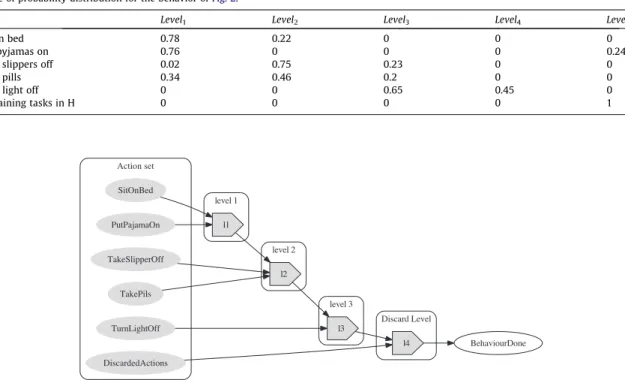
, i.e.lis the first level with a maximum probability value in the action-set of the automaton. If the task is not executed at such level, the model is updated online to the next most probable execution level according to the behavior model probability distribution. This situation is illustrated with theExample 1. A possible probability distribu-tion for the example would be described inTable 1, andFig. 2shows the most likely behavior execution:
Among the advantages of this proposal, the separation of the described behavior model from the probability distribution learning procedure is presented as one of the most significant ones. This separation allows to achieve a better system mod-ularisation and to use a higher number of learning methods for the same behavior model.
The system uses a set of FALA to learn eachbehavior action sequencefrom raw sequences of user actions. Every set is com-posed forjHj+ 1 number of FALAs, wherejHjis the cardinal of the setH. Each learning automaton in the team is uniquely matched with a human task, and its action-set contains the level of the AND cascade in the behavior action sequence in which the task can be located. The goal of each automaton is to learn the optimal level in the sequence of gates in at which its corresponding task should be located. If the automaton action is associated with leveljHj+ 1, then it means that its matched task has been discarded for the behavior, and a selection of a level between 1 andHmeans that the matched task is located at such level. For a wider explanation about offline learning of behavior action sequences, we suggest to read[8]. 3.2. Behavior time
Thebehavior timeis in charge of checking if the time stamp of a human task corresponds to the time interval in which a behavior must occur. In our approach, this module stores aFuzzy Temporal Window(FTW) for each behavior in the system[37]:
Definition 3 (Temporal Window, W). LetIbe an interval from the temporal line
s
, ODB the Observation Data Base of user tasks carried out during the behavior time,t2ODBa tuple from ODB, and ij= (hj,lj,dj) a human task; then, a TemporalWindowWfor a specific behavior that occurs in the intervalIof
s
, is defined as a subset ofIwhere8i
j2WðtÞthenij2tandlj2IDefinition 4 (Fuzzy Temporal Window, FTW). LetIbe an interval from the temporal line
s
, ODB the Observation Data Base andt2ODBa tuple from ODB. Letijbe an actionij= (hj,lj,dj) and a Temporal WindowWfor a specific behavior. Letfsbe afuzzy set over
s
, then it is defined afuzzy temporal window FTWas a Temporal Window where8i
j2WðtÞl
FWðijÞ ¼l
fsðljÞIn this work, an FTW is represented as a Gaussian function whose mean value is the middle point of the interval associ-ated with the behavior, and its standard deviation defines the amplitude of the execution time. The FTW is also used for obtaining areliability degreeof execution of each behavior. A membership degree can be calculated for each human task car-Table 1
Example of probability distribution for the behavior ofFig. 2.
Level1 Level2 Level3 Level4 Leveldiscard
Sit on bed 0.78 0.22 0 0 0
Put pyjamas on 0.76 0 0 0 0.24
Take slippers off 0.02 0.75 0.23 0 0
Take pills 0.34 0.46 0.2 0 0
Turn light off 0 0 0.65 0.45 0
Remaining tasks in H 0 0 0 0 1
ried out in the time interval of an FTW. It provides every task with the reliability of belonging to a specific behavior. To esti-mate that reliability degree of the overall behavior, we aggregate the membership degrees of all their executed tasks as just one value. We use the OWA operator as average of these values for simplicity, although any aggregation operator could be used.Example 2summarises the explained process.
Example 2. The user has performed the sequence of tasks {Keys, 8:27 a.m.}, {Cellular, 8:30 a.m.}, {FrontDoor, 8:37 a.m.} for behaviorLeave home at 8:30 a.m.. The FTW is defined with mean equals to 8:30 a.m. and standard deviation of 20 min. Then, the membership values of the actions to the FTW are 0.956, 1 and 0.783 respectively, and the average aggregation is 0.913, what means that this sequence of actions is considered as a normal behavior with a reliability degree of 0.9129.
It is required to develop a method that is able to learn theFTWassociated to a specific behavior, defined by two real num-bers
l
FTWandr
FTW. In this work, we include two CALA[41]into a team to learn these values for each behavior. The mainadvantage of this selection is the capability of online self-adaptation to changes in the behavior temporal constraints by means of the feedback loop of the LA.
4. System description
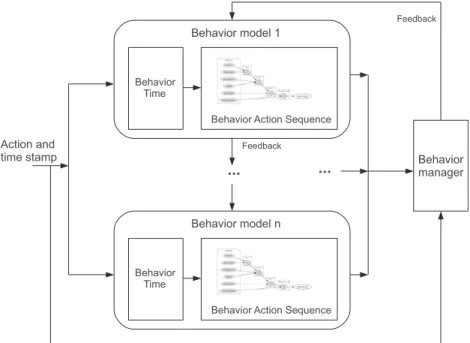
Our proposal distinguishes two parts for each behavior (seeFig. 3): action processing and temporal processing. Each behavior is considered as an autonomous module, which makes the processing of several simultaneous behaviors easier. In addition, the control and interaction of all behaviors is managed by an additional module calledbehavior manager, that unifies the solutions and controls the simultaneousness of the behaviors. Thebehavior action sequenceandbehavior time are adapted as regards user routine and environment changes. These changes could cause modifications in the execution lev-els or in the actions involved in the behavior. The decision about the update of the internal state of each behavior model is taken by thebehavior managerduring the recognising process.
The goals of thebehavior managerinclude to schedule and process the behaviors obtained in the recognition process; to control which actions have been performed, belonging or not to a behavior; to provide the necessary feedback to adapt the system for environmental or behavior changes; and to send warning alarms for the user when required. This module re-trieves the action performed by the user and the results obtained during the recognition process. In short, it returns the iden-tification of the detected behaviors, the reliability degree of the detected behavior, and if the behavior may be considered as normal or abnormal. To be more precise, the system is able to detect three types of behaviors: normal behaviors, uncom-pleted behaviors, and violation order constraints behaviors. These last two types are classified as abnormal behaviors:
Normal behaviorsare those action sequences which fit the temporal window associated with the behavior and whose actions have been executed according to the behavior action sequence model.
Uncompleted behaviorsare action sequences that have not finished when the FTW expires. This means that there are some relevant actions that have been missed by the user during the behavior execution. If a human activity is classified as an uncompleted behavior, it may be due to either deliberately action missing or a human error, and then, an alarm should be sent to the user.
Violation of task relationship constraints: The patterns that are classified in this class fulfill the behavior temporal con-straints, but they contain one or more violations in thebehavior action sequence. If a pattern is matched with this class, then, an abnormal behavior has been detected or a human habit change might be taking place. An alarm must be sent to the user to warn about this abnormal situation.
The behavior manager is in charge of producing the signals to send the alarm by an existing higher level application when an abnormal behavior is detected, and of generating the feedback for behavior model online adaptation if a change in user routine is taking place. Therefore, it saves a record about the executed actions and the level in which the actions have been carried out in the behavior models.
5. Online behavior recognition and adaptation
During the recognition of a behavior, the temporal constraints of executed actions are checked using thebehavior time module (seeFig. 3), which provides a membership degree of every performed action. Since a behavior may be performed in different ways, thebehavior action sequencemust be adapted online regarding the user past activity.Variable Action-Set Learning Automata(VALA) offers the best option to change the action relationship constraint model online. This type of learn-ing automata changes its action probability distribution dependlearn-ing on an external parameters such astime. The internal state of an automata in the VALA team used in our system is represented with a matrix of size n ðjHj þ1Þ;QiVALAðkÞ ¼ ðPiðk;1Þ;Piðk;2Þ;. . .;Piðk;jHj þ1ÞÞt, where Piðk;1Þ ¼QiFALAðkÞ, i.e. the action probability distribution learnt with the FALA
team. The remaining probability distributionsPiðk;lÞ ¼ pi
1ðk;lÞ;pi2ðk;lÞ;. . .;pijHjþ1ðk;lÞ
h it
;1<l6jHj þ1 are calculated using Eq.(2). A valuepi
jðk;lÞstands for thea prioriprobability of human taskhito be executed at thejth level in the behavior model
when a human action assigned with levellhas been executed.
pi jðk;lÞ ¼ 0; j<l Pl m¼1 pi mðk;1Þ; j¼lp i jðk;1Þ; l<j<jHj þ1 8 > < > : ð2Þ
During the recognition process, bothbehavior timeandbehavior action sequenceupdate their internal state depending on the feedback received from thebehavior manager. This adaptation process allows to improve the knowledge about the user, adjusting theBehavior modelto the user features.
Thebehavior action sequenceis updated depending on the levellin which each action was carried out, and considering those actions not executed and discarded. The adaptation process consists on updating the probabilities of the automata fol-lowing a discrete rule, as shown in Eq.(3). The parameterDdetermines the learning rate of the user habits. High values ofD mean a faster adaptation to the user habits, and therefore, a low system–human interaction is obtained.
pi jðkþ1;1Þ ¼ max pi jðk;1Þ
D
;0 ; j–l 1 P Sþ1 z¼1;i–l pi zðkþ1;1Þ; j¼l 8 > > < > > : ð3ÞAs far asbehavior timeis concerned, the adaptation process consists of updating the parameters that define a CALA:
l
CA-LA(k) andr
CALA(k). The traditional CALA update rule may be found in[41]. However, this rule performed too slowly in ourexperiments and a large number of update iterations were required for a good system performance. This problem is well-known as the traditional limitation of the learning automata. To overcome this limitation, we changed the update rule and provided the best approach which we found for this work in Eqs.(4) and (5).
l
ðkþ1Þ ¼l
ðkÞ þkCALAðtmeanl
ðkÞÞ; if 9=j:l
FTWðtjÞ<l
min ð4Þr
ðkþ1Þ ¼r
ðkÞ kCALAr
ðkÞ; if 9=j:l
FTWðtjÞ<l
minr
ðkÞ þkCALAr
ðkÞ; otherwise
ð5Þ
wherebj= (aj,tj) are the relevant human tasks and the time instant in which they have been carried out respectively,
l
ministhe minimum membership value allowed for an action to be considered inside the fuzzy temporal window of the behavior, tmeanis the average time of the executed actions, andkCALAis the learning rate for the automaton.
According to Eqs.(4) and (5), the parameter
l
(k) is updated only in the case in which all the actions are included in the fuzzy temporal window. In this case, the valuer
(k) is also reduced to find the fuzzy temporal window of minimum size thatcontains all the behavior actions. On the other hand, if an action was detected outside the window, then the value
r
(k) in-creases in order to cover the missing actions.5.1. Algorithm for behavior recognition and system adaptation
When an action is received in the system, the time constraints of each behavior are checked in order to discard those behaviors which are out of time for the sake of efficiency. Once we know those behaviors whose instants of time match, the action is placed and compared in thebehavior action sequence. The output of eachBehavior Modelis sent to thebehavior manager, who analyses those outputs, detecting if the behavior has been finished and its type; and decides the next step: keeping on with the recognising process, warning the user, updating the behavior models, or reinforcing the models.
A scheme of the algorithm used for the recognition process is presented next. Notice that the main body of the algorithm (from step 2 to 7) is executed every predefined period of clock time. The algorithm assumes that the learning process has been performed previously and starts from a set of learntbehavior models.
1. Initialisation.In this step, the list of current active behaviors and the behavior action sequence buffer are initialised. A behavior is active if the evaluation of the current task is in itsfuzzy temporal window(the membership degree of the task over a threshold). The list of current active behaviors contains those behaviors that are active at each time instant. A behavior is removed from the list when it is recognised, and a behavior action sequence buffer stores the tasks that have been carried out during the behavior time.
2. Finding the active behaviors.First, the current timetand the actions that have been executed at such time instant are fetched. Then, the membership value of timetto thefuzzy temporal windowof each behavior is computed. Those behav-iors that are active will be added to the list of current active behavbehav-iors within thebehavior manager.
3. Checking if active behaviors are uncompleted.In this step, the algorithm checks if all the behaviors stored in the list of active behaviors remain active. It is possible that those behaviors that were included in the list in previous iterations are not active at the current moment. This fact implies that the fuzzy temporal constraints of the behavior have been violated and then, the behavior is tagged as unfinished. When these behaviors have been identified, the algorithm has to test if the behavior was effectively incomplete or the user did it deliberately by sending an alarm to the user. If this confirms the change in the behavior, the action sequence model of the behavior is updated to remove the missing actions.
4. Current action processing.The next step is the processing of the current action into its possible behavior models. First of all, the algorithm checks which behaviors contain the action executed by the human at the current time in the AND cas-cade model. If we find one or more behaviors that fulfill this condition, the action is then included in theiraction sequence modelbuffer. On the other hand, if the action is not relevant for any behavior, it is included in all the active behaviors, since it may mean a new user habit change that includes the new action.
5. Updating the reliability degree.The actions included in step 4 have a temporal membership value associated with its time of occurrence. These values are used to update the reliability degree of the behaviors.
6. Checking violations of action order relationship constraint behaviors.Once the algorithm has processed the temporal information, the next step is to know if any action order relationship constraints have been violated. If a violation is found, then the user’s opinion is required in order to find out whether the actions have been done on purpose or if it was a human mistake.
7. Checking finished behaviors.Finally, if no violations were found, a normal behavior recognition is detected. The action sequence model and the behavior time are updated to reinforcement the correct human habits.
8. Go to step 2.
6. Experiments
In this section, we present the results obtained after a testing process. Firstly, in Section6.1we show the experimental settings. Then, Sections6.2 and 6.3describe the experiments for testing the system recognition and adaptation capabilities, respectively, and a final Section6.4is included to discuss further results and obtain conclusions about them.
6.1. Experimental settings
As previously indicated, our system input is user activity as sequence of human taskshi=hli,si,tii. To develop a sequence of
correct experiments, we define the experimental contextualization as follows: The environment is a simulated home equipped with 26 sensors able to distinguish between different human tasks. We focus on seven behaviorsTo Get Up(B1), To Have a Shower(B2),To Have Breakfast(B3),To Leave Home(B4),To Cook(B5),To Wash the Dishes(B6), andTo Go To Sleep (B7). These are defined by a set of temporal and task order constraints (seeTable 2) that let us define sequence of actions to represent those behaviors confidently. InTable 2, column 1 describes the behaviors and the number of actions involved, column 2 stands for the action relationship constraints, and column 3 shows the behavior time. We remark that the number of actions in a behavior (column 1) may be higher than those appearing in column 2, since some actions may have no order constraints. We did not included these actions in the text for space limitations, since its inclusion is not key to assess the proposal in the next subsections. On the other hand, the reason for choosing simulation instead of real user monitoring is
that we found no differences between the synthetic user and to give guidelines to a real one about how to perform the behaviors, so that the system could be validated. In addition, the use of simulation helps us to force situations that could be dangerous for users without putting them in risk, to test the constraints violation detection rate.
We generated three databases with user action sequences for the experiments. Each database is a timetable where every row means a day (24 h) and every column is a second. A cell in the timetable contains the actions performed by the user at that time. The content and goals of each database is described as follows:
1. Database for learning process. It contains information about the execution of normal instances of behaviorsB1–B7during 365 days. For its generation, each action of a behavior was assigned to a random cell of the timetable during the behavior time. After that, actions that did not fulfill the relationship constraints were exchanged until the database contained no constraints violations. Finally, we added noise actions during each behavior time to simulate other activities that the user could perform during its execution. Theserubbishtasks were 30% of each behavior.
2. Database to test recognition. This database contains 365 normal, uncomplete and constraint violations behaviors, and it was generated under the same conditions as the previous one. It is used to validate the approach for recognition of normal and abnormal activities in Section6.2. It contains 50% of normal behaviors, and 25% of uncompleted and constraint vio-lation samples, respectively.
3. Database to test adaptation. The adaptation is carried out when the user changes his/her routine. To simulate this situ-ation, we changed deliberately the constraints and time information of the behaviors to those shown inTable 3. This data-base contains 365 normal instances of the modified behaviorsB
1—B
7, and it is used in Section6.3.
Before starting the recognition and adaptation experimentation, a learning process is required to establish a common start point. In this paper, we used the learning algorithm presented in[8]to mine relevant tasks of behaviors and their order relationship constraints. To finalize,Table 4shows the values of the parameters studied for the online recognition and adap-tation. Concretely, we will study three parameters: the minimum membership value for the fuzzy temporal window (
l
min),and the learning rates for the FALA (kFALA) and CALA (kCALA) teams. The value
l
minis the minimum value required for an actionbeing considered into the fuzzy temporal windows, and those actions whose membership degree would be lower than this parameter would be discarded in the recognition/adaptation process. On the other hand, the learning rates are used to check the feasibility of the online adaptation in real time and the adaptation speed.
6.2. Analysis of online recognition
In this section, we analyse the capability of our model to recognise normal and abnormal behaviors. We run the recog-nition process using the test database for this purpose as input, with the parameter values defined in theonline recognition column ofTable 4.Fig. 4summarises the results obtained for a recognition process with parameters
l
min= 0.001 andk FA-LA= 0.001. These parameters provided the best score in our experiments, and an in-depth study of this selection is describedin the next section. In general terms, our method obtains accurate results in the experimentation: All the behavior samples were correctly matched to their corresponding behavior, 96.05% of them were correctly detected and the remaining 3.95% were misclassified. The normal behavior detection rate is 92.50%, and the remaining 7.50% were detected as uncompleted of
Table 2
Action relationship constraints and time interval for the behaviors. Behavior Constraints
Order relationship Temporal
B1(4 actions) TurnBedLightOnTakeCellular [7:25–7:45] TakeCellularSitOnBed
{TurnBedLightOn,TakeCellular,SitOnBed}PutSlipperOn
B2(3 actions) UseBathTapTakeTowel [7:45–7:55] {UseBathTap,TakeTowel}UseBath
B3(6 actions) TakeMilkUseSaucepan [7:55–8:05] UseSaucepanUseGas
B4(5 actions) OpenFrontDoorTakeLift [8:20–8:40] {TakeCellular,TakeKeys,TakeBag}OpenFrontDoor
B5(5 actions) {TakeCereals,UseSaucepan, [13:40–14:20] TakeFryingPan}UseGas
B6(3 actions) TakeSoapCleanDishes [14:50–15:10] {CleanDishes,TakeSoap}OpenKitchenTap
B7(4 actions) PutSlipperOffTakePills [22:20–22:40] TakePillsSitOnBed
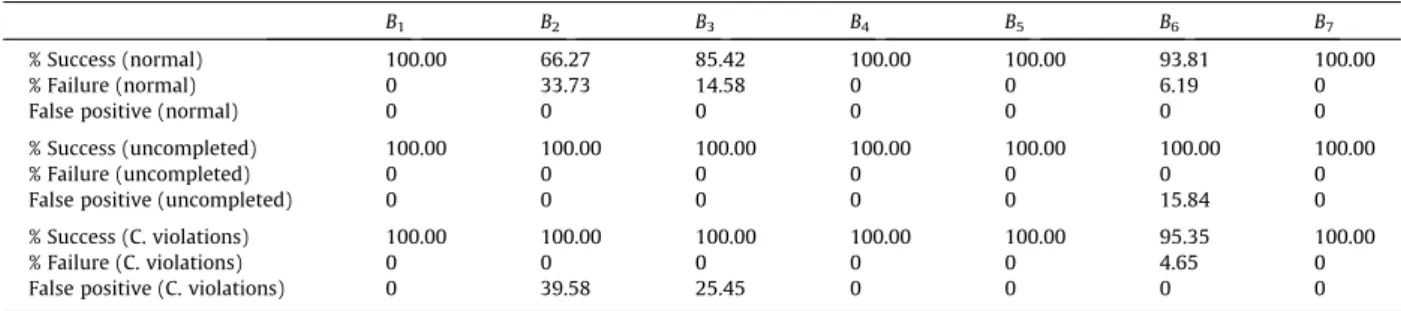
constraint violation samples. We notice that none of uncompleted or constraint violation samples were classified as normal behaviors, so that unusual or dangerous situations for the user are never recognized as true behaviors, which is very impor-tant for the goals of our system. In addition, 100% of uncompleted samples and 99.36% of constraint violations were correctly classified. The false positive detection rate of uncompleted samples is 2.47%, which correspond to normal and constraint vio-lation behaviors that were misclassified. However, the 11.99% of false positives regarding the detection of constraint viola-tions means that some of the normal behavior are erroneously detected, because its constraints are not included in the knowledge learnt by the behavior models. An in-depth analysis of this situation is presented inTable 5. In this table, we may observe that most of learned models were able to recognize the temporal and order relationship constraints of the stud-ied behaviors. However, some normal behavior samples ofB2,B3andB6were not correctly classified. We concluded that these detection errors are due to overtraining of the system: The models learned correctly the relationship constraints of each problem, but they also inferred further non-existent constraints including the remaining actions of the behavior. In the case of behaviorB6, actions that do not belong to the activity were also included in the behavior model because the sim-ulated user performed them in high number of samples. This conclusion is supported by the false positive rate of constraint violations inTable 5, and the false positive rate of uncompleted behaviors inB6. Despite of the overtraining, we solve this situation with the online adaptation process.
To validate the approach, we compare the results obtained with Hidden Markov Models (HMMs) since this technique is a baseline method widely used in AAL recognition. To achieve this, the design and learning of HMMs were done following the guidelines proposed in[38]. An HMM was trained for each behavior using the training data. The HMMs have as many states as available human actions. The prior and transition probabilities were learned from the training data, and the emission probability matrix was set to the identity matrix because our main assumption is that each human task is uniquely deter-mined by a sensor event. The training and test data were the sequences of tasks carried out by the user, ordered in time. A time window was used to shrink the input data to those in the specific time of each behavior.
Once the models learned the training data, the recognition database was used as test so that we can compare results with our proposal. We run two types of experiments: Firstly, we are interested in knowing if, for a given a sequence of tasks of a behavior, it is possible to know which is the best HMM that can generate that sequence. To achieve this, we select the HMM that provides the maximum probability of HMM sequence generation for each test sample. On the other hand, in the second experiment we assume that the HMM for each sequence of tasks in the test data set has been correctly identified, and our goal is to know if the model is able to identify if the behavior sample is normal or abnormal. Since HMMs cannot distinguish between uncompleted and constraint violation samples, both behavior samples are considered as abnormal for the analysis. Table 3
Action relationship and time interval constraints for the adapted behaviors.
Behavior Constraints
Order relationship Time
B
1(4 actions) TakeCellularTurnBedLightOn [7:30–7:50]
SitOnBedTakeCellular
{TurnBedLightOn,TakeCellular,SitOnBed}PutSlippersOn B
2(3 actions) TakeTowelUseBathTap [7:40–7:50]
{UseBathTap,TakeTowel}UseBath B
3(6 actions) UseSaucepanTakeMilk [8:00–8:20]
UseSaucepanUseGas B
4(5 actions) TakeKeysTakeLift [8:30–8:35]
TakeBagTakeKeys OpenFrontDoorTakeLift
{TakeCellular,TakeKeys,TakeBag}OpenFrontDoor B
5(5 actions) TakeCerealsUseSaucepan [14:15–14:30]
{UseSaucepan,UseFridge,TakeFryingPan}UseGas B
6(3 actions) CleanDishesTakeSoap [14:50–15:00]
{CleanDishes,TakeSoap}OpenKitchenTap B
7(4 actions) TakePillsTakeSlippersOff [22:35–22:45]
TakePillsTurnBedLightOff
{TakePills,TurnBedLightOff}SitOnBed
Table 4
Values for the used parameters.
Parameter Online recognition Online adaptation
Temporal fuzzy window minimum membership (lmin) {0.001, 0.01, 0.1, 0.2, 0.3} {0.001, 0.01, 0.1, 0.2, 0.3} FALA learning rate (kFALA) {0.001, 0.01, 0.1, 0.2, 0.9} {0.2, 0.3, 0.5, 0.75, 0.9}
To achieve this, a behavior is considered as normal if its probability of sequence generation using the corresponding HMM is over a threshold, otherwise it is considered abnormal. The threshold was set to the minimum probability of HMM sequence generation for all samples in the training data, because this value provided the best results in our experiments.
Table 6describes the classification rate in both experiments for each behavior. We observe that, for the experiment 1, normal and abnormal behavior samples were identified by its corresponding HMM in 69.51% of instances, and 30.41% of in-stances could not be classified under any model. This last set of inin-stances are samples with constraint violations that do not fulfill the behavior requirements, and valid and uncompleted samples with rubbish tasks that the models did not learn dur-ing the traindur-ing. One positive aspect is that only 0.35% of all samples were misclassified in other behaviors than the reference class. Here, the HMM was not able to distinguish between tasks of the behavior and rubbish tasks associated to other HMM instead ofB6. On the other hand, if we focus on experiment 2 the true positive rate of normal behaviors correctly classified is 90.07%. However, the true positive rate of abnormal behaviors detection decreases to 52.62%. Thus, 47.38% of abnormal behaviors are classified as normal ones, which is a high security breach for user safety. If we compare the results obtained by HMM and our approach, we notice that the proposal in this work overcomes the limitation of HMM regarding first order assumption, and it is able to provide a high detection rate in both normal and abnormal behaviors. In addition, our behavior model is able to distinguish between relevant and non-relevant tasks for a behavior, which eases the recognition of different concurrent behaviors. Further important advantages of our proposal is the possibility to see the order relationship con-straints between tasks graphically to ease the behavior management by experts if it would be necessary, and also the online adaptation capability studied in the next section.
6.3. Online adaptation to behavior changes and parameter influence analysis
The adaptation process is simultaneous to the recognition process. Thus, the behavior model is able control all changes in the behavior, as seasonal changes or fall repercussions in elders. However, the system needs user opinion to find out for sure if the behavior is changing or the user has carried out an abnormal behavior. In order to minimize the system-user interac-tion, the online adaptation process requires a fast online learning that depends on the system parameters, in contrast to the
Fig. 4.Summary of online recognition results.
Table 5
Classification rate (%) for each specific behavior.
B1 B2 B3 B4 B5 B6 B7
% Success (normal) 100.00 66.27 85.42 100.00 100.00 93.81 100.00
% Failure (normal) 0 33.73 14.58 0 0 6.19 0
False positive (normal) 0 0 0 0 0 0 0
% Success (uncompleted) 100.00 100.00 100.00 100.00 100.00 100.00 100.00
% Failure (uncompleted) 0 0 0 0 0 0 0
False positive (uncompleted) 0 0 0 0 0 15.84 0
% Success (C. violations) 100.00 100.00 100.00 100.00 100.00 95.35 100.00
% Failure (C. violations) 0 0 0 0 0 4.65 0
recognition stage once a behavior is stable. In this section, the study is focused on parameters influence over final scores. Fig. 5shows the evolution of percentages of correct classified behaviors in the 365 patterns of the recognition and adaptation databases, regarding
l
min,kFALAandkCALAparameters.Firstly,Fig. 5(a) shows the relevance of parameterskFALAand
l
minregarding the recognition capability of the system. Asthe parameterkFALAincreases, the percentage of correct detections decreases. This fact is due to the high adaptability rate
that makes the behavior model lose its flexibility driving thebehavior modelto a just one available representation, increasing the number of failures. As far as
l
minconcerned, larger ranges are more effective than shorter ones. Asl
minincrements itsvalue, it turns more restrictive, reducing the number of actions that could be part of the behavior, so that small changes in temporal constraints are allowed. On the other hand, as this value decreases, more elements are accepted to be analysed for the recognition process and large habit changes could be collected. However, if the assigned value is excessively small, the temporal constraints may turn less restrictive, provoking that in some cases, an out of time behavior could be recognised as normal instead of uncompleted.
Secondly,Fig. 5(b) and (c) describe the influence of parameters
l
min,kCALAandkFALAfor adaptation to habit changes. Ashappened in the experiments for behavior recognition, larger values of
l
minare more restrictive to allow temporal violationsand therefore, the adaptation rate is slower and the scores decrease as this parameter increases, independently of the learn-ing rate for the FALA and CALA teams in the behavior models. In addition, it is shown that a fixed value ofkCALAprovides
similar results independently of the value of
l
min. Smaller values ofkCALAare more desirable for a better adaptation, whilelarger values may critically change the temporal window to areas in which the behavior cannot be executed. This fact makes the percentage of undetected behaviors to increase. However, large values forkFALAare more desirable when the system
adaptation takes place in contrast to a recognition stage, since it allows the system to have a faster adaptation capability to the new action relationship constraints circumstances. This situation will be analysed in-depth in the discussion.
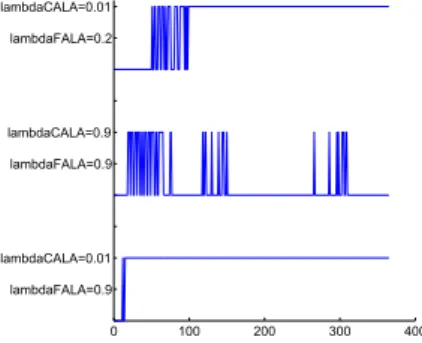
Considering the time required for a full adaptation to behavior changes,Fig. 6shows the evolution through the time for adaptation from behaviorTo leave home(B4) to behaviorB
4, for different values of parameterskFALAandkCALA. Only this
behavior is shown because its evolution is representative of all the remaining ones, and for space limitations. High values stand for a positive detection and low values mean that the sample was misclassified. This picture helps to support the pre-vious assumption about the fact that large values ofkCALAmove the time window too much and then, the behaviors become
even undetected. Thus, a large value ofkCALAresults in the increase of the accumulated undetected behaviors over the time,
while the small values of this parameter make the undetected behaviors to be almost zero. Furthermore, this figure also ex-plains that large values ofkFALAmay help for a quick adaptation, while lower ones decrease the adaptation rate. The time
required for the full adaptation with the optimal values of the parameters is between 25 and 50 behavior detections, con-sidering all the behaviorsB
1—B
7. However, unexpected recognition failures may be found during the online recognition once the behaviors have been adapted, due to the existence of the noisy actions as explained in the previous section.
6.4. Discussion and final remarks
In previous sections, we concluded that parameterkCALAis not relevant for the task of behavior recognition, and also that
small values ofkCALAare more desirable for a better adaptation. On the other hand, we discovered that the recognition and
adaptation capabilities are higher if the temporal constraints are more relaxed and the value of parameter
l
minis small.However, small values of parameterkFALAprovide high detection scores in behavior recognition, while high values ofkFALA
are preferable for a faster adaptation. Thus, we find a conflict about which value should takekFALAto achieve high scores
in both adaptation and recognition tasks.
To solve this situation, we propose to use two different values to update the action relationship model and the FALA teams within,k1FALAandk2FALA, withk1FALA<k2FALA. The first valuek1FALAwould be used to update the models after a normal behav-ior recognition, so that the update would be carried out softly. On the other hand, the second one would be used after critic situations in which the system fails the recognition and detects a false positive abnormal behavior. Since the human–system interaction is required in these situations to find out if the abnormal behavior detected was executed deliberately by the user, we could use a larger value of FALA team adaptationk2FALAto update the action models faster. With this strategy, we
Table 6
Classification rate (%) of Hidden Markov Models.
Experiment 1 Experiment 2
% Classified % Misclassified % Unknown % Classified (normal) % Classified (abnormal)
B1 66.30 0 33.70 90.70 55.96 B2 74.52 0 25.48 92.90 42.35 B3 70.96 0 29.04 83.85 46.24 B4 64.38 0 35.62 88.13 57.98 B5 71.51 0 28.49 90.59 52.76 B6 72.05 2.47 25.48 92.27 52.63 B7 66.85 0 33.15 92.02 60.45 Average 69.51 0.35 30.14 90.07 52.62
take advantage of both recognition and adaptation extreme situations, so that we are able to ensure the maximum score percentage.
As conclusion, the reliability degree obtained with the OWA operator should be studied. To be considered as a good reli-ability degree, it should only depend on the set of actions that the system has recognised as part of the behavior. Therefore, the value assigned to
l
minhas to affect the quality of the final results. To prove this assumption, we calculated the averagevalue of the evolution of thereliability degree, obtained with a constantkFALA= 0.5 and two different values of
l
min= 0.001,0.1. We obtained two data populations containing reliability degree values for each 365 normal behavior samples using these parameters. In our results, the reliability degree provides better (higher) results using the smallest
l
minvalue, for thedeter-mination of action sequences belonging to a behavior. These values are between 0.6 and 0.9, independently of the value of parameter
l
min. In order to test if both data populations are statistically similar, and therefore to know if the response of theOWA operator depends on
l
min, we applied a Student’sT-test with a confidence level of 95% over the two average OWA dataset. The test provided a probability value of 2.7250e079, which concludes that there are significant differences between
both data populations. Therefore, this result supports that the reliability degree depends on the actions performed corre-sponding to the behavior, determined by the
l
minparameter.7. Conclusions
In this work, we have developed a system which is able to recognise human behaviors from current user activity. The system uses a representation of the behaviors, known asbehavior model, which contains all the information about a behav-ior: its temporal and order relationship constraints. To learn everybehavior modeland to recognise the current activity, we developed a method based on Learning Automata, taking advantages of the own feedback process for adapting itself when a behavior or environmental change occurs.
In order to deal with the two types of constraints which are typical of a behavior, we distinguish two modules in each behavior model:behavior timeandbehavior action sequence. The first one is in charge of studying the temporal constraints. To make this processing easier, we introduce the use of aa fuzzy temporal window, which allows to establish a defined inter-val where a behavior is probably performed. The FTW is learnt and analysed using a team of 2 continuous action-set learning automata (CALA). On the other hand, the order relationship constraints are responsibility of thebehavior action sequence. This module is implemented using a team of finite action-set learning automata (FALA) to learn action order relationship con-straints in a behavior model and a team of variable action-set learning automata (VALA) to recognising and adaptation process.
Our proposal has obtained suitable performances regarding both recognition and adaptation tasks. We have developed a complete experiment where we have studied the effect of the parameters over the results, concretely, the minimum value for belonging to a fuzzy temporal window and automata learning rates. Regarding the minimum membership degree, we have detected that using wider values for this parameter, the system is able to detect a bigger number of behaviors, but with the drawback that the reliability degree of the behavior decreases. On the other hand, we have found out that large values of the CALA learning rate may change drastically the area of the time windows, therefore making the adaptation difficult. In these cases, an extreme update of the parameters may locate the temporal window over time which does not correspond to the behaviors to be recognised, and then, the classification finds a larger number of undetected normal activities. Smaller values for the temporal learning rate are preferred, although the adaptation rate decreases. The opposite situation is found when the adaptation of human action order relationship constraints is considered. When the system is stable and just the behavior recognition is required, smaller values for the FALA learning rate are preferred to avoid the adaptation to noisy human ac-tions carried out during the behavior time. However, when the behavior suffers from a change in the human habits, larger values of the learning rate are more suitable in order to learn the new action order relationship constraints in fewer itera-tions. These two situations may be controlled by means of the system–human interaction when a violation of an action rela-tionship constraints is found: in these cases, a large learning rate is used, while a smaller one is applied during the system normal operation.
In this paper, we have studied time constraints between actions in a behavior and developed a complete model that also takes into consideration order relationship constraints. Up to now, the system controls behaviors individually and indepen-dently. However, the relations between behaviors, their integration and organisation to model other more complex ones or environmental situations should be addressed in future work. On the other hand, the development of a semantic represen-tation of the environment, behaviors, and system begins to be essential in fact.
Acknowledgement
This work has been supported by the project TIN2009-14538-C02-01, I + D + I National Program from Spain Government
References
[1] G. Acampora, M. Gaeta, V. Loia, A.V. Vasilakos, Interoperable and adaptive fuzzy services for ambient intelligence applications, ACM Trans. Auton. Adapt. Syst. 5 (2010) 8:1–8:26.
[2] G. Acampora, V. Loia, Fuzzy control interoperability and scalability for adaptive domotic framework, IEEE Trans. Indus. Inform. 1 (2005) 97–111. [3] M. Agache, B.J. Oommen, Generalized pursuit learning schemes: new families of continuous and discretized learning automata, IEEE Trans. Syst. Man
Cybernet., Part B 32 (2002) 738–749.
[4] L. Atallah, G. Yang, The use of pervasive sensing for behaviour profiling – a survey, Perv. Mob. Comput. 5 (2009) 447–464.
[5] J. Boger, J. Hoey, P. Poupart, C. Boutilier, G. Fernie, A. Mihailidis, A planning system based on markov decision processes to guide people with dementia through activities of daily living, IEEE Trans. Inform. Technol. Biomed. 10 (2006) 323–333.
[6] J. Candamo, M. Shreve, D.B. Goldgof, D.B. Sapper, R. Kasturi, Understanding transit scenes: a survey on human behavior-recognition algorithms, IEEE Trans. Intell. Transp. Syst. 1 (2010) 206–224.
[7] D.J. Cook, M. Youngblood, E.O. Heierman III, K. Gopalratnam, S. Rao, A. Litvin, F. Khawaja, Mavhome: an agent-based smart home, in: PERCOM’03: Proceedings of the First IEEE International Conference on Pervasive Computing and Communications, IEEE Computer Society, Washington, DC, USA, 2003, p. 521.
[8] M. Cuéllar, M. Ros, M. Delgado, A. Vila, Detection of abnormal human activities by means of Learning Automata, Technical Report, Department of Computer Science and Artificial Intelligence, University of Granada, Department of Computer, 2010.
[9] M. Delgado, M. Ros, M. Amparo Vila, Correct behavior identification system in a tagged world, Expert Syst. Appl. 36 (2009) 9899–9906.
[10] F. Doctor, H. Hagras, V. Callaghan, A fuzzy embedded agent-based approach for realizing ambient intelligence in intelligent inhabited environments, IEEE Trans. Syst. Man Cybernet., Part A 35 (2005) 55–65.
[11] R.M. Droes, M. Mulvenna, C. Nugent, D. Finlay, M. Donnelly, M. Mikalsen, S. Walderhaug, T.v. Kasteren, B. Krose, S. Puglia, F. Scanu, M.O. Migliori, E. Ucar, C. Atlig, Y. Kilicaslan, O. Ucar, J. Hou, Healthcare systems and other applications, IEEE Perv. Comput. 6 (2007) 59–63.
[12] T. Gu, Z. Wu, X. Tao, H.K. Pung, J. Lu, Epsicar: an emerging patterns based approach to sequential, interleaved and concurrent activity recognition, in: IEEE International Conference on Pervasive Computing and Communications, vol. 0, 2009, pp. 1–9.
[13] V. Guralnik, K.Z. Haigh, Learning models of human behaviour with sequential patterns, in: Proceedings of the AAAI-02 Workshop ‘‘Automation as Caregiver’’, pp. 24–30.
[14] H. Hagras, V. Callaghan, M. Colley, G. Clarke, A. Pounds-Cornish, H. Duman, Creating an ambient-intelligence environment using embedded agents, IEEE Intell. Syst. 19 (2004) 12–20.
[15] H. Hagras, M. Colley, V. Callaghan, G. Clarke, H. Duman, A. Holmes, A fuzzy incremental synchronous learning technique for embedded-agents learning and control in intelligent inhabited environments, in: Proceedings of the 2002 IEEE International Conference on Fuzzy Systems, 2002. FUZZ-IEEE’02, vol. 1, pp. 139–144.
[16] V. Jakkula, D.J. Cook, Anomaly detection using temporal data mining in a smart home environment, Methods Inform. Med. (2008) 70–75.
[17] T. van Kasteren, B. Krose, Bayesian activity recognition in residence for elders, in: 3rd IET International Conference on Intelligent Environments, 2007, IE 07, pp. 209–212.
[18] J.A. Kientz, S.N. Patel, B. Jones, E. Price, E.D. Mynatt, G.D. Abowd, The georgia tech aware home, in: CHI’08: CHI’08 Extended Abstracts on Human Factors in Computing Systems, ACM, New York, NY, USA, 2008, pp. 3675–3680.
[19] E. Kim, S. Helal, D. Cook, Human activity recognition and pattern discovery, IEEE Perv. Comput. 9 (2010) 48–53.
[20] D. Kitakoshi, H. Shioya, R. Nakano, Empirical analysis of an on-line adaptive system using a mixture of bayesian networks, Inform. Sci. 180 (2010) 2856–2874.
[21] B. Krose, van T. Kasteren, C. Gibson, van den T. Dool, Care: context awareness in residences for elderly, in: Proceedings of ISG’08: The 6th International Conference of the International Society for Gerontechnology, pp. 101–105.
[22] X.H. Le, S. Lee, Y.K. Lee, H. Lee, M. Khalid, R. Sankar, Activity-oriented access control to ubiquitous hospital information and services, Inform. Sci. 180 (2010) 2979–2990.
[23] S.W. Lee, Y.S. Kim, K.H. Park, Z. Bien, Iterative bayesian fuzzy clustering toward flexible icon-based assistive software for the disabled, Inform. Sci. 180 (2010) 325–340.
[24] L. Liao, D.J. Patterson, D. Fox, H. Kautz, Learning and inferring transportation routines, Artif. Intell. 171 (2007) 311–331.
[25] H. Liu, H. Darabi, P. Banerjee, J. Liu, Survey of wireless indoor positioning techniques and systems, IEEE Trans. Syst. Man Cybernet., Part C 37 (2007) 1067–1080.
[26] S. Luhr, G. West, S. Venkatesh, Recognition of emergent human behaviour in a smart home: a data mining approach, Perv. Mobile Comput. 3 (2007) 95– 116. Design and Use of Smart Environments.
[27] X. Meng, K.K. Lee, Y. Xu, Human driving behavior recognition based on hidden markov models, in: IEEE International Conference on Robotics and Biomimetics, vol. 0, 2006, pp. 274–279.
[28] U. Naeem, J. Bigham, A comparison of two hidden markov approaches to task identification in the home environment, in: 2nd International Conference on Pervasive Computing and Applications, IEEE, 2007, pp. 383–388.
[29] K. Najim, A. Poznyak, Multimodal searching technique based on learning automata with continuous input and changing number of actions, IEEE Trans. Syst. Man Cybernet., Part B: Cybernet. 26 (1996) 666–673.
[30] C. Nugent, M.D. Mulvenna, F. Moelaert, B. Bergvall-Koreborn, F. Meiland, D. Craig, R. Davies, A. Reinersmann, M. Hettinga, A.L. Andersson, R.M. Droes, J. Bengtsson, Cogknow: Helping people with mild dementia to navigate their day,<http://www.cogknow.eu>, 2005 (accessed 10.05.10).
[31] C. Nugent, M.D. Mulvenna, F. Moelaert, B. Bergvall-Koreborn, F. Meiland, D. Craig, R. Davies, A. Reinersmann, M. Hettinga, A.L. Andersson, R.M. Droes, J. Bengtsson, Home-based assistive technologies for people with mild dementia, in: Pervasive Computing for Quality of Life Enhancement, vol. 4541, pp. 63–69.
[32] M. Philipose, K.P. Fishkin, M. Perkowitz, D.J. Patterson, D. Fox, H. Kautz, D. Hahnel, Inferring activities from interactions with objects, IEEE Perv. Comput. 3 (2004) 50–57.
[33] A.S. Poznyak, K. Najim, Learning Automata and Stochastic Optimization, Springer-Verlag New York, Inc., Secaucus, NJ, USA, 1997.
[34] M. Rantz, M. Aud, G. Alexander, D. Oliver, D. Minner, M. Skubic, J. Keller, Z. He, M. Popescu, G. Demiris,, S. Miller, Tiger place: an innovative educational and research environment, in: AAAI in Eldercare: New Solutions to Old Problems.
[35] P. Rashidi, D. Cook, Keeping the resident in the loop: Adapting the smart home to the user, IEEE Trans. Syst. Man Cybernet., Part A: Syst. Humans 39 (2009) 949–959.
[36] P. Rashidi, D.J. Cook, L.B. Holder, M. Schmitter-Edgecombe, Discovering activities to recognize and track in a smart environment, IEEE Trans. Knowl. Data Eng. 99 (2010).
[37] M. Ros, M. Delgado, A. Vila, Fuzzy method to disclose behaviour patterns in a tagged world, Expert Systems with Applications 38 (2011) 3600–3612. [38] G. Singla, D.J. Cook, M. Schmitter-Edgecombe, Tracking activities in complex settings using smart environment technologies, Int. J. BioSci., Psy. Technol.
1 (2009).
[39] E.M. Tapia, S.S. Intille, K. Larson, Activity recognition in the home using simple and ubiquitous sensors, in: A. Ferscha, F. Mattern (Eds.), Pervasive Computing, Lecture Notes in Computer Science, vol. 3001, Springer, Berlin/ Heidelberg, 2004, pp. 158–175.
[40] M.A.L. Thathachar, B.R. Harita, Learning automata with changing number of actions, IEEE Trans. Syst. Man Cybern. 17 (1987) 1095–1100. [41] M.A.L. Thathachar, P.S. Sastry, Varieties of learning automata: an overview, IEEE Trans. Syst. Man Cybernet., Part B 32 (2002) 711–722.
[42] J. Torkestani, M. Meybodi, Graph coloring problem based on learning automata, in: ICIME’09. International Conference on Information Management and Engineering, 2009, pp. 718–722.
[43] A.C. Tran, S. Marsland, J. Dietrich, H.W. Guesgen, P. Lyons, Use cases for abnormal behaviour detection in smart homes, in: Aging Friendly Technology for Health and Independence. Proceedings of the 8th International Conference on Smart Homes and Health Telematics, ICOST 2010, Seoul, Korea, June 22–24, 2010, pp. 144–151.
[44] P.K. Turaga, R. Chellappa, V. Subrahmanian, O. Udrea, Machine recognition of human activities: a survey, IEEE Trans. Circuits Syst. Video Technol. 18 (2008) 1473–1488.
[45] D.J.C. Vikramaditya Jakkula, A. Crandall, Enhancing Anomaly Detection using Temporal Pattern Discovery, Advanced Intelligent Systems, Springer, 2008. pp. 175–194.
[46] D. Zhang, D. Gatica-Perez, S. Bengio, I. McCowan, G. Lathoud, Modeling individual and group actions in meetings with layered hmms, IEEE Trans. Multimedia 8 (2004) 509–520.