23
·
2002
Harry Leinonen – Veli-Matti Lumiala –
Riku Sarlin
Financial Markets Department
19.9.2002
Settlement in
modern network-based
payment infrastructures
– description and prototype of
the E-Settlement model
23
·
2002
Harry Leinonen – Veli-Matti Lumiala – Riku Sarlin
Financial Markets Department
19.9.2002
Settlement in modern network-based
payment infrastructures
– description and prototype of the E-Settlement model
The views expressed are those of the authors and do not necessarily reflect the views of the
Bank of Finland.
(online)
Suomen Pankin monistuskeskus Helsinki 2002
Bank of Finland Discussion Papers 23/2002
Harry Leinonen – Veli-Matti Lumiala – Riku Sarlin
Financial Markets Department
Abstract
Payment systems are undergoing rapid and fundamental changes stimulated
largely by technological progress especially distributed network technology and
real-time processing. Internet and e-commerce will have a major impact on
payment systems in the future. User demands and competition will speed up
developments. Payment systems will move from conventions that were originally
paper-based to truly network-based solutions.
This paper presents a solution – E-Settlement – for improving interbank
settlement systems. It is based on a decentralised approach to be fully integrated
with the banks’ payment systems. The basic idea is that central bank money, the
settlement cover, is transferred as an encrypted digital stamp as part of the
interbank payment message. The future payment systems would in this model
operate close to the Internet/e-mail concept by sending payment messages directly
from the sending bank’s account/payment server to the system of the receiving
bank with immediate final interbank settlement without intervening centralised
processing. Payment systems would become more efficient and faster and the
overall structure would be come straightforward. The E-Settlement and
network-based system concept could be applied with major benefits for correspondent
banking, ACH and RTGS processing environments.
In order to assess this novel idea the Bank of Finland built a prototype of the
E-Settlement model. It consist of a group of emulated banks sending payments to
each other via a TCP/IP network under the control of a central bank as the
liquidity provider and an administration site monitoring the system security.
E-4
Harry Leinonen – Veli-Matti Lumiala – Riku Sarlin
Rahoitusmarkkinaosasto
Tiivistelmä
Maksujärjestelmät ovat merkittävien ja nopeiden muutoksien edessä, mikä johtuu
tekniikan kehityksestä erityisesti hajautetun verkkotekniikan ja
reaaliaikaproses-soinnin alueilla. Internetillä ja elektronisella kaupankäynnillä tulee olemaan
mer-kittäviä vaikutuksia maksujärjestelmiin. Käyttäjävaatimukset ja kilpailu
nopeut-tavat kehitystä. Maksujärjestelmät siirtyvät alun perin paperipohjaisista
ratkai-suista todellisiin verkkopohjaisiin menettelyihin.
Tämä keskustelualoite esittelee ratkaisun pankkienvälisten katteensiirtojen
tehostamiseksi: E-Settlement. Se perustuu katteensiirtojärjestelmän
hajauttami-seen ja täydellihajauttami-seen integrointiin pankkijärjestelmien kanssa. Perusideana on, että
keskuspankkiraha eli maksujen kate siirtyy salakirjoitettuna digitaalisena leimana
osana pankkienvälisiä maksusanomia. Tulevaisuuden maksujärjestelmät
toimisi-vat tässä mallissa hyvin samanlaisella periaatteella kuin Internetin sähköposti.
Sa-noma välitetään suoraan lähettävän pankin tili- ja maksuserveriltä vastaanottavan
pankin järjestelmiin ilman keskitettyjä käsittelyvaiheita. Maksujärjestelmät
tehos-tuvat ja nopeutehos-tuvat sekä niiden kokonaisstruktuuri yksinkertaistuu. E-Settlementiä
ja verkkopohjaista maksujärjestelmästruktuuria voidaan soveltaa
kirjeenvaihtaja-pohjaisiin, clearingkeskusta käyttäviin ja RTGS-järjestelmiin.
Uuden idean arvioimiseksi Suomen Pankki rakensi prototyypin
E-Settlement-mallista. Se koostuu ryhmästä emuloituja pankkeja, jotka lähettävät toisilleen
maksuja TCP/IP-verkon kautta. Järjestelmää valvovat likviditeettiä toimittava
kes-kuspankki ja erityinen hallintayksikkö turvallisuuden ja tekniikan osalta.
Tämä keskustelualoite sisältää johdannon verkkopohjaiseen
maksuinfrastruk-tuuriin ja E-Settlementratkaisuun määrittelyineen sekä kuvauksen, tulokset ja
kokemukset varsinaisesta E-Settlement-prototyypistä.
Asiasanat: verkkopohjainen maksujärjestelmä, katteensiirtojärjestelmät,
pankkien-väliset katteensiirrot, maksujärjestelmien integrointi
prototype in order to assess the new idea and to be able to concretely present the
system in operation.
The idea was first presented in the Bank of Finland discussion proposal
“Re-engineering payment system for the e-world”
1. A follow-up project seemed
to be needed in order to make the model more concrete and illustrative. A project
was launched with the following objectives
–
specify the model in detail
–
find out the stability and reliability of the model
–
check attainable efficiency and cost levels
–
assess the attainable security level
–
evaluate decentralised administration issues
–
build and test a prototype with the basic core functionalities.
The project started in November 2001 with a tender procedure. The specifications
were ready by end of February 2002 and the prototype was built from March
through to May. During summer 2002 the different parts of the prototype were
integrated and tested. It was ready for complete demonstrations in August 2002.
The prototype includes the basic core elements of a network-based payment
infrastructure eg TCP/IP network, direct addressing and transfers, multilevel PKI
encryption, decentralised account management, liquidity control and continuous
automated reconciliation etc. The prototype shows that the E-Settlement concept
is technically possible and reliable. The cost-benefit analyses show that clear
benefits can be found in all kinds of payment system environments (correspondent
banking, ACH and RTGS) by utilising a network-based approach for payments
and settlements.
This discussion paper contains the main reports from the E-Settlement
prototype project divided into separate sections
6
specifications.
The authors want to thank everybody participating in the project. The
international payment systems experts that have contribute by commenting on the
E-Settlement idea during the project. We want also to thank the Finnish banking
industry for the comments received throughout the project from the payment
systems cooperation bodies. Most of the specification and prototype building
work was out-sourced and therefore we especially want to thank the two
IT-companies, one that has written most of the specifications and built the prototype
e-settlement module and the other that has constructed the hardware secure
module and the public key security solution for the prototype, for forming a very
good and successful team work. We hope that the prototype and this discussion
paper will stimulate further studies in network-based solutions aimed at
implementing efficient new infrastructures.
2
Section 1:
Introduction to E-Settlement...9
Section 2:
E-Settlement system architecture specification...15
Section 3:
E-Settlement system security specification ...67
Section 4:
E-Settlement cost/benefit analysis...115
Section 5:
E-Settlement prototype description and preliminary
experiences ...127
Section 1
1
I
NTRODUCTION TO
E-S
ETTLEMENT
E-Settlement is a settlement method for the next generation of payment systems, which can nonetheless be employed already in current payment systems. The next generation of payment systems will be network- and real-time-based. In order to fulfil customer needs, payment systems will be standardised and globalised, providing access and services to everyone, free of national technical barriers. These systems will have to be open and supportive of interoperability (see figures 1a and 1b). In this environment, the settlement method will need to entail immediate finality between all the different participating service-providing institutions (mainly banks).
The settlement process itself will have to be a well-integrated part of the payment process, with end-to-end control from send-to-ending to receiving bank. In order to support rapid payment transfers, the settlement method must also support real-time processing. An efficient settlement system also supports continuous reconciliation – for immediate error detection. It is also important that most of the security and control features be built into the system, to enable immediate reaction.
In an open global payment system, the sending customer should need to know only the receiver’s account number in order to be able to send a payment. The international account number (IBAN or its equivalent) would be the only information needed for routing the message properly through the system, just as email addresses or international gsm-telephone numbers route messages (emails or sms messages) internationally. Interoperable bridges are needed to route payments between the accounts of different service providers. As regards payments, these bridges must transfer payment messages as well as interbank settlements. This is the main difference as compared to other messaging systems and this is where E-Settlement introduces new electronic possibilities.
Figure 1a: Payments can be made by transferring funds by addressing directly the receiving account in a common account number space
Figure 1b: The common account number space is divided into sub-spaces belonging to service providers which are connected via interoperable system bridges.
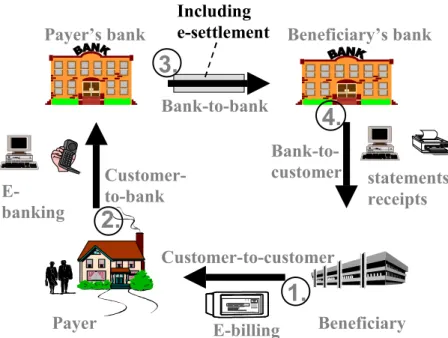
The E-Settlement process is designed to support and accomplish final interbank settlement in central bank money in real-time for end-to-end payments in straight-through-processing (STP) mode. It should be seen as one essential part of the whole payment (credit transfer) circle as described in figure 2.
Beneficiary’s bank
statements
receipts
Bank-to-customer
4.
Payer
E-banking
Customer-to-bank
2.
Payer’s bank
Bank-to-bank
3.
Beneficiary
E-billing
Customer-to-customer
1.
Including
e-settlement
Figure 2: E-settlement is part of the credit transfer circle, which provides efficient electronic communications between participants in a payment.
(1) The payer receives a bill or other instruction from the beneficiary concerning a payment to be made. (2) The payer then sends the instruction to his bank for processing and routing to the beneficiary’s bank. (3) This interbank leg includes E-Settlement, so that the beneficiary’s bank receives both the payment message and the final settlement. (4) The beneficiary’s bank can then inform the beneficiary as to the incoming/final payment. This credit-push/credit-transfer type of payment is the most convenient and efficient in the network real-time world. It has fewer processing and transportation legs than electronic credit/debit card payments, direct debits, or electronic cheques. In credit transfers, the payer’s bank identifies its customer, checks the payment instruction, and debits the payer’s account; the beneficiary’s bank checks the settlement and credits the beneficiary’s account. In the future real-time world, payments will be processed within seconds in the same way as email and sms messages are now processed.
The E-Settlement solution should be seen as part of the future payment infrastructure that will support increased
– e-commerce via Internet
– real-time security and money market deals and transfers – mobile payments (currently GSM-based but soon UMTS-based) – cross-border volumes.
The payment world (for all kind of payments) will be changing as will all other messaging systems, from slower-paced batch processing to immediate real-time service, integrated directly with user systems.
Beneficary’s Bank Address Payment envelope End of payment Payment details ….. Central Bank e-settlement stamp
Figure 3: The digital e-settlement stamp is part of the payment message
The E-Settlement stamp is added to the payment message and serves to transfer central bank money from payer’s bank to beneficiary’s bank. Final settlement is part of the payment message, in the form of an electronic central bank draft or central bank e-cash for interbank settlement purposes.
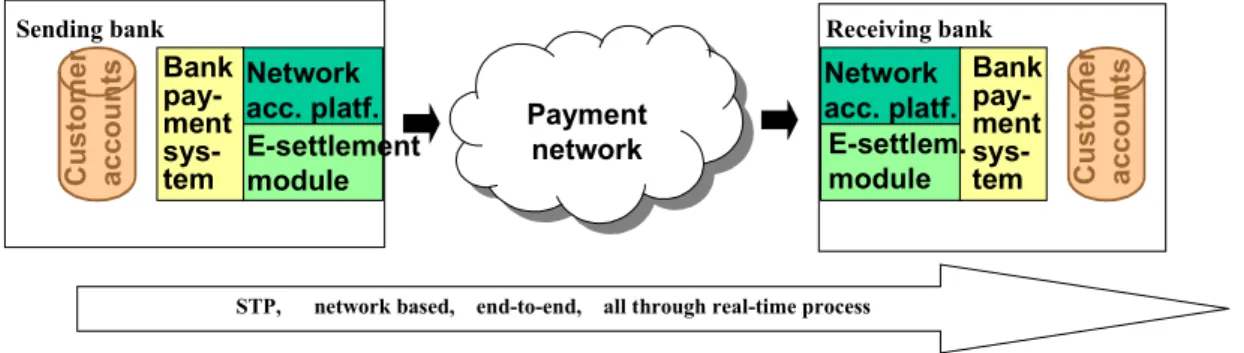
The stamp is protected by very strong and modern cryptographic technology. These stamps are produced and decoded by E-Settlement modules situated close to banks’ payment systems, as shown in figure 4.
STP, network based, end-to-end, all through real-time process
Sending bank Receiving bank
Payment network Payment network Network acc. platf. Network acc. platf. E-settlement module E-settlem. module Bank pay-ment sys-tem Bank pay-ment sys-tem Customer acc oun ts Custom er ac counts
Figure 4: E-settlement stamps are produced by e-settlement modules, which are closely integrated with banks’ payment systems.
The E-Settlement modules are tamper-resistant devices provided by central banks to each bank. These are closely integrated with banks’ payment systems, eg directly integrated with the SWIFT-net access platform (CBT). This makes settlement transfers a highly automated part of payment processing. Integrating the new settlement process will be quite straightforward, given that it will be done on the access platform (eg SWIFT CBT) level. In traditional RTGS systems, banks’ settlement accounts are located in the centralised RTGS system. In the E-Settlement system, each bank’s settlement account is distributed to the bank’s own processing site. Each bank has access to its own account, as before, but is much more closely integrated in a more automated and efficient way. The distribution of central bank money in electronic format to banks’ payment platforms is the essential feature of the E-Settlement approach. The distributing E-Settlement modules need to be highly secure and to meet at least the same security standards as do traditional RTGS systems. The system should also be generally open and independent, to support the various payment networks used by banks.
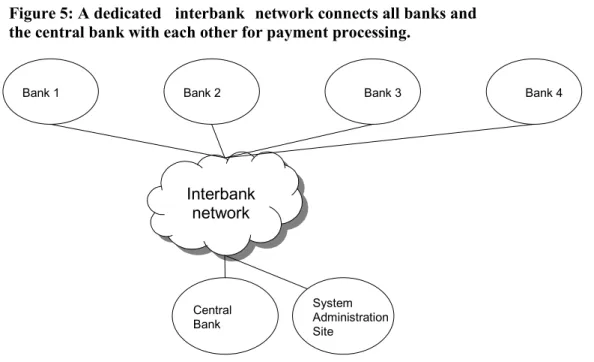
A dedicated interbank network (figure 5) is needed to link together all participating banks and the central bank, for the purpose of processing payments.
Interbank
network
Interbank
network
Bank 2Bank 1 Bank 3 Bank 4
System Administration Site
Central Bank
Figure 5: A dedicated interbank network connects all banks and
the central bank with each other for payment processing.
The interbank payment network is the essential part in a network-based payment system. All banks can address each other directly and send payments to each other without a centralised processing and routing site. This is the essential new paradigm introduced by Internet communications (TCP/IP-networks). All participants can operate independently; they need only enough networking capacity to meet their own needs. System administration is needed only for administration purposes, ie not for payment processing. The new SWIFTnet network, introduced by SWIFT, is one that can support direct communications between all participants. There are also national dedicated payment networks with the same capability, eg the interbank network Pankkiverkko in Finland.
For settlement purposes, banks need liquidity. Liquidity is transferred by the central bank to the system (ie E-Settlement modules) at the start of the day. It can be increased during the day by the central bank via liquidity transfers or payments to the banks. At the end of the day, liquidity is transferred back to the central bank. The liquidity in the settlement modules is thus composed of positive balances of central bank money, originally in the traditional form of reserve deposits, intraday credits etc, but transferred from the centralised system in the morning to distributed E-Settlement modules to be employed during the day in the E-Settlement system. In the evening the liquidity will be transferred back to the centralised accounts for overnight bookings.
In a true real-time environment, there is generally little scope for the various types of advanced liquidity saving features, based on delaying/queuing of payments. Customers are waiting for direct confirmation of their payments. A bank that is often obliged to inform its customers that payments are queued – waiting for liquidity – will lose customers. In the real-time environment, customers expect direct delivery.
number of trustworthy users. The system will include automated reconciliation at end-of-day, from time to time during the day and in connection with each transaction. In a network-based environment, all parts – centralised and distributed – must be well secured. A digital/electronic version of the four-eyes principle has to be implemented.
High availability must also be ensured in the distributed system. In a distributed system, a malfunction will generally affect only one participant at a time and only those payments to and from that particular participant. In order for the participant to re-establish normal operations quickly, there should be back-ups and mirrored devices for all critical components.
The main benefit of E-Settlement is that it enables redesign of the whole payment system process in an efficient way, using new network possibilities. It thereby creates the next generation of payment systems infrastructures and makes the settlement process more efficient. Payment systems will change considerably in the near future due to modern technology and it would be an advantage to modernise the settlement conventions at the same time.
The cost-advantage of the Settlement system is in the low processing costs of adding the E-Settlement stamp that enables instant final settlement in central bank money. The extra processing cost of adding the E-Settlement stamp will be practically nil. It will be an integral part of the payment process itself. Banks need only invest in low cost equipment. The very low transaction costs for of E-Settlement will enable banks also to transfer payment flows from centralised processing centre systems to more efficient decentralised network-based communications. The bottlenecks created by centralised resources will disappear and even the dependence on critical centralised resources will be dramatically reduced. E-Settlement could offer a solution for integrating the euro-area payment systems, and a multi-currency version could serve an even larger area. In order to achieve large-scale benefits via the E-Settlement model, the number of participating banks and the payment flows must be sufficiently large.
Section 2
E-S
ETTLEMENT
T
ABLE OF
C
ONTENTS
TABLE OF CONTENTS ... 16
ABBREVIATIONS... 17
1
INTRODUCTION... 18
1.1 E-S
ETTLEMENT SYSTEM... 18
1.2 E
NSURING INFORMATION CONSISTENCY INE-S
ETTLEMENT SYSTEM... 19
1.3 E
NSURING CONSISTENCY OF AUDIT TRAILS... 20
1.4 T
O BE SPECIFIED LATER... 20
1.5 D
OCUMENT SCOPE... 20
1.6 D
OCUMENT STRUCTURE... 21
2
DESIGN PHILOSOPHY... 22
2.1 D
ESIGN RATIONALE... 22
2.2 L
AYERED DESIGN... 23
3
STRUCTURE OF E-SETTLEMENT SYSTEM ... 26
3.1 B
ANK PAYMENT SYSTEMBAPS... 27
3.2 C
ENTRALB
ANK PAYMENT SYSTEMCBPS ... 28
3.3 B
ANKE-S
ETTLEMENT MODULEBEM... 29
3.4 C
ENTRALB
ANKE-S
ETTLEMENT MODULECEM... 31
3.5 S
YSTEM ADMINISTRATION SITESAS... 32
3.6 E-S
ETTLEMENT SYSTEM INTERFACES... 34
4
CORE PROCESSES... 36
4.1 P
AYMENT PROCESSES... 37
4.2 L
IQUIDITY MANAGEMENT PROCESSES... 46
4.3 R
ECONCILIATION PROCESSES... 48
4.4 C
ONTROL PROCESSES... 55
5
EXCEPTION HANDLING... 58
5.1 E
XCEPTIONAL SITUATIONS... 58
5.2 D
ISASTER RECOVERY... 59
6
MANAGEMENT ARCHITECTURE... 60
7
SECURITY ARCHITECTURE ... 61
7.1 L
AYERED APPROACH TO SECURITY... 61
7.2 F
ACETS OFE-S
ETTLEMENT SECURITY... 62
A
BBREVIATIONS
Abbreviation MeaningBAIF Bank Interface – E-Settlement system external interface to banks BAPS Bank Payment System –bank system linked with E-Settlement system BBIF BEM-BEM interface – E-Settlement system internal interface BCIF BEM-CEM interface – E-Settlement system internal interface BEM Bank E-Settlement Module – E-Settlement system element
BIC Bank Identifier Code - technical code that uniquely identifies a financial institution. BNET Interbank network
BOD Beginning-of-day
BSIF BEM-SAS interface – E-Settlement system internal interface CA Certification authority
CB Central Bank
CBIF Central Bank Interface – E-Settlement system external interface to CBs CBPS Central Bank Payment System – CB system linked with E-Settlement system CEM Central Bank E-Settlement Module – E-Settlement system element
CSIF CEM-SAS interface – E-Settlement system internal interface ECB European Central Bank
EOD End-of-day
ESN E-Settlement Network – E-Settlement system element
FCAPS Faults, Configuration, Accounting, Performance, Security – areas of management HSM Hardware security module
1
I
NTRODUCTION
1.1
E-Settlement system
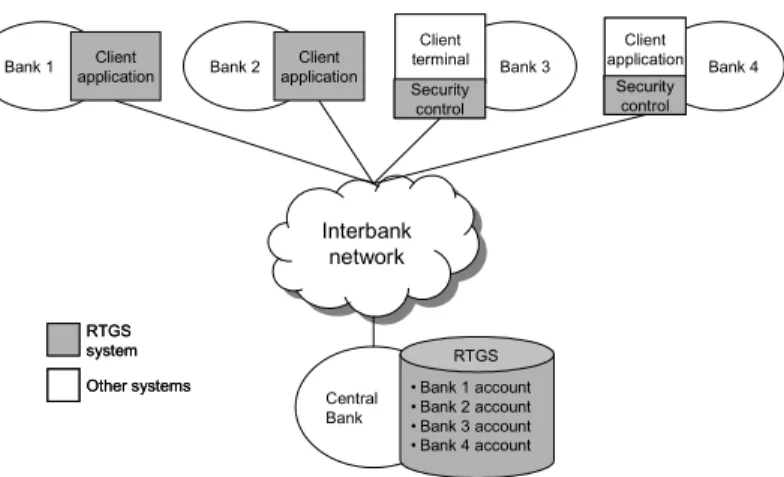
Practically all RTGS systems currently in use are centralized systems, where liquidity management, payment processing and data storage are handled by the hosting central bank. See Figure 1 below for a schematic picture. The client banks interact with the central system using applications that participate in the workload of the RTGS system only partly or not at all. Depending on the RTGS system, the client applications are offered by the RTGS provider, or the banks can access RTGS directly by writing their own client applications. In some systems client access can even be terminal based. Security control (hardware and/or software based) is required to ensure access to authorized clients only using secured communications. In a centralized RTGS settlement is done using the liquidity available in each bank’s centralized RTGS account.
Interbank network
Interbank network Bank 2
Bank 1 Bank 3 Bank 4
Central Bank • Bank 1 account • Bank 2 account • Bank 3 account • Bank 4 account Client application Client application RTGS RTGS system RTGS system Other systems Other systems Client terminal Security control Client terminal Security control Client application Security control Client application Security control
Figure 1. Centralized RTGS system
A distributed RTGS system is still centrally managed and controlled, but intraday liquidity management, payment processing and data storage are more scattered. One way to do this is to
distribute the centralized database so that each bank has a “small RTGS database” available at their site with only bank’s own account. System control and management is still centralized. Once liquidity has been transferred to banks’ accounts, the client applications can perform settlement directly and finally between each other in real time using the account’s liquidity. E-Settlement is a concept for such a distributed RTGS system [PAYMENTSYS]. The basic idea of E-Settlement is to distribute processing into standardized tamper-resistant elements called E-Settlement modules – the “small RTGS database” of the system. These modules use encrypted E-Settlement “stamps” to negotiate settlement directly with each other, without intervention by centralized system elements. Due to the high security requirements, the Settlement modules enforce a set of tight controls. Figure 2 below shows an E-Settlement system in a national context.
Central Bank Client app
Interbank network Interbank network E-Settlement network E-Settlement network Bank 2 Bank 1 Bank 3 System Administration Site E-Settlement system element E-Settlement system element Other systems Other systems
Client app Client app Client app Client app Bank 4
· E-Settlement network connects the E-Settlement system elements. It is used for system control and management traffic. The payment messages are transferred through the existing interbank networks. Physically these networks can be the same.
· Bank E-Settlement module is linked with bank’s liquidity management and payment systems. It is able to process liquidity transfers to/from Central Bank E-Settlement module and perform payment settlement with other banks using encrypted E-Settlement stamps.
· Central Bank E-Settlement module is linked with CB accounting, liquidity issuance and payment systems. It can process liquidity transfers to/from banks and collect statistics from the banks.
· System Administration Site is in charge of all the centralized system features such as system-wide reconciliation, multilateral netting, directory management as well as overall system management and control.
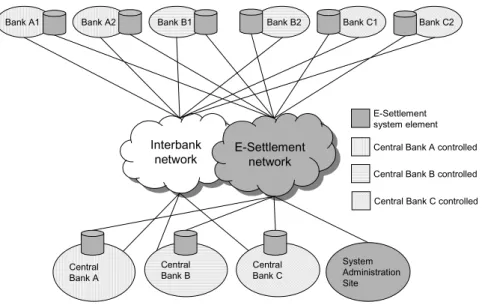
E-Settlement can also be used in currency area context where multiple CBs co-operate to perform settlement in a single currency, such as in Euro area. Figure 3 below shows E-Settlement in currency area context. Banks can send payments directly to each other just as in a national E-Settlement system, also to banks controlled by other CBs. Each CB issues liquidity to banks under its control, performs CB level reconciliation and collects payment statistics of these banks. In this context, SAS has the additional task of collecting system level statistics and performing system-wide reconciliation. In this document we present the E-Settlement system in currency area context.
Central Bank A Central Bank B Central Bank C Interbank network Interbank network E-Settlement network E-Settlement network
Bank B1 Bank B2 Bank C1 Bank C2
Bank A1 Bank A2
Central Bank A controlled
Central Bank B controlled E-Settlement
system element
Central Bank C controlled
System Administration Site
Integrity of E-settlement stamps is accomplished through the use of a strong hash algorithm. 2. Payment sequence level
A settlement stamp from E-Settlement module A to E-Settlement module B contains verification information: the order number of the message (from A to B), the amount of liquidity successfully transferred from A to B during the day and during the reconciliation period. In addition, the stamp contains similar information from the last few settlement transactions between the banks. Upon reception of a payment, E-Settlement module B compares the information sent by module A against the information it has in store. 3. Reconciliation period level
During reconciliation breaks or when requested by CB, consistency of settlement traffic is checked between E-Settlement modules. The transactions and the amounts of liquidity sent between two E-Settlement modules have to match.
4. Overall liquidity control level
At reconciliation breaks, and also otherwise when needed, consistency is checked at system level by requesting liquidity balance from banks’ E-Settlement modules. This information is then compared to the amount of liquidity issued to the system by the CBs.
1.3
Ensuring consistency of audit trails
To ensure complete audit trails, the bank payment system must give its unique payment identifier and authenticated user credentials together with payment information to Bank E-Settlement module. The module stores this information and returns a unique Settlement payment identifier and an E-Settlement stamp. The bank payment system keeps a table of cross references between these.
1.4
To be specified later
At the time of this writing, E-Settlement is at a concept level with a prototype system being under specification. While a lot of effort has been put into ensuring that the concept is consistent and functionally complete, a number of issues can be considered in detail only after experiences from the prototype work have been gathered and analyzed. These issues include:
· Performance: performance of the system and any performance bottlenecks to be solved
· Availability: the detailed mechanisms needed to ensure production level availability
· System management: the practices needed in running and maintaining the system
· Exceptions: while many exceptional situations have been considered already at this stage, the full range of possible exceptions will become evident during the prototype work
1.5
Document scope
This document describes the E-Settlement system on a general level. Main topics covered are system structure and the core processes of the system. Related documents include [BAIF_SPEC] describing banks’ interface to the E-Settlement system in detail, [CBIF_SPEC] describing the central banks’ interface to the Settlement system in detail, and [TECH_ARCH] defining technical aspects of E-Settlement system such as addressing, data stores and internal system interfaces.
1.6
Document structure
First the design rationale behind the architecture specification work is presented. Then the system structure is presented, main processes are charted and exception situations presented. Issues related to system management and security are addressed.
2
D
ESIGN PHILOSOPHY
This chapter describes some of the principles adopted for system design and decisions made regarding the architecture.
2.1
Design rationale
Open technologies will be utilized throughout the system whenever possible. Proprietary (such as a service utilizing a proprietary interface provided by an operating system vendor) and off-the-shelf solutions used will be accessed through an interface hiding the proprietary and vendor-specific features. This will make it easier to replace these later on if the need arises.
External interfaceswill be specified in detail. The responsibilities of the external systems are clearly defined. This will give the banks and the CBs the possibility to integrate with E-Settlement system as they see fit.
Economics will be a consideration in system design. The whole idea of the decentralized E-Settlement system relies on the relatively cheap price of “normal” server hardware as compared to the prices of hardware required in massive centralized processors. In addition, E-Settlement utilizes banks’ existing payment systems and interbank network connections.
Security issues will be paid utmost attention. It is seen that E-Settlement system concept will not be successful without due attention to security issues. Security must be “built in” the system from the very start of the development process. The approach chosen here is “security through openness” – system security controls must be strong enough to resist attempts at compromising the system by a party knowledgeable about the system’s security solution. The security management framework of E-Settlement system has been defined according to an ISO standard. See chapter 7 for more information. The efficiency of the system relies on decentralization and networking. The basic operations are decentralized, and centralized control process should only require a limited part of the total processing. The 20/80 rule should be in force: at most 20 percent of the payment transactions, and at most 80 percent of the total value of payments, will be handled by centralized processing elements.
E-Settlement is neutral towards any interbank payment network. It is up to a bank’s payment system to decide whether to use E-Settlement to perform settlement of the payment, and in case it is used, what interbank payment network to use in transmitting the payment and E-Settlement
information to the recipient’s bank. Naturally, the banks must mutually agree to settle payments using E-Settlement system beforehand, and the system must be aware of the agreement.
An internal representation of payment information will be defined. Settlement of payments is based on this information. Multilateral nettings also uses the internal representation of payments. To ease auditing and accounting, bank and E-Settlement payment representations are interlinked – a bank needs to give its unique payment ID to the E-Settlement module together with the payment
information. Correspondingly, the E-Settlement system provides an unique E-Settlement payment ID to the bank systems.
Liquidity operations are final in nature. That is, liquidity is removed from the bank’s E-Settlement account immediately when an E-Settlement stamp is formed. If a transaction is rejected by the receiving bank, liquidity is then added back to the account. Payment cancellation at a later stage requires a transaction in another direction to transfer the liquidity back.
E-Settlement is designed for real-time operation. If the payment systems of both the sending and the receiving banks operate in real time, E-Settlement can provide final settlement of payments in real time. E-Settlement works without modification in non real-time environment as well.
2.2
Layered design
E-Settlement system is designed in a layered manner. The whole system relies on validity of a basic set of functionality, the E-Settlement core. After the core functionality has been proven to work, add-on services for both banks and central banks will be defined. See Figure 4 below for a schematic presentation of the approach.
Bank Central bank •Payments •Liquidity mgmnt •Reconciliation •Control •Multilateral netting •Gridlock resolution •Transaction authorization •Payment Queues •Bilateral netting •User management •Deposit management •Intraday overdraft management •Standing facilities management
Figure 4. Layered structure of E-Settlement system
2.2.1 Core
Core functionality is needed for the E-Settlement system to work as a reliable settlement provider. Core processes, described in chapter 4, define the functionality. This functionality is provided solely by the E-Settlement system. This document concentrates on the core functionality.
Core functionality includes the following:
· Payment processing: Payments can be securely and reliably settled between the E-Settlement modules.
o
management framework, are applied
o Beginning-of-day and end-of-day activities: E-Settlement modules can be opened and closed in a controlled and secure way
o Payment traffic control: deviations and problems in payment traffic are detected and can be reacted to
o System management: System problems are detected and can be reacted to
2.2.2 Local add-on services for banks
Local add-on services increase the service level and payment processing intelligence of the bank E-Settlement module, but do not directly contribute to payment settlement per se. These are needed by most banks to perform real-life payment settlement and will in the future be distributed as a part of the E-Settlement system.
· Payment queues: Managing payments for which at the moment there is not enough liquidity. Payment queue operates in prioritized “first in, first out” principle. The bank can reorder the queue and remove payments from it.
· Bilateral netting: bank-to-bank netting to save liquidity. The idea is that two banks that have frequent payment traffic with each other can have pending payments to each other at the same time. If this is the case, the payments can possibly be directly netted against each other, with only a small amount of liquidity (by the bank with smaller amount of payments to be netted) needed.
· User management: A service for managing bank’s E-Settlement users and their access rights to the E-Settlement system. Banks handle their user management towards the E-Settlement system using this service.
2.2.3 Centralized add-on services for banks
These services increase the service level of the E-Settlement system. From banks’ perspective, Bank E-Settlement module acts as an “access point” to these services.
· Multilateral netting: based on payments and liquidity sent to a centralized netting component. Netting is performed according to a schedule, i.e. netting is performed at specific times of the day. Banks can be given an opportunity to send more liquidity in case the original liquidity is not sufficient for the netting.
· Gridlock resolution: also based on payments and liquidity sent to a centralized netting component. In theory, every time additional liquidity or a new payment is sent to the service, or bank’s netting queue is modified, a new netting could be attempted. Out of efficiency concerns it is probably good to limit the resolution interval e.g. to every 15 minutes and reserve the service for large value payments only.
· Transaction authorization: centralized authorization service for very large value payments. All payments beyond a certain value, and possibly a small randomly selected portion of all payments, are checked and authorized by the centralized service. In addition, authorization procedures could be invoked when the payment traffic turnover reaches given predefined reporting points.
2.2.4 Central bank add-on services
The basic central bank services needed in the Settlement system are liquidity transfers between E-Settlement modules. In the basic situation all balances in the Bank E-E-Settlement modules are positive and Central Bank E-Settlement modules have the opposite negative balances, reflecting the amount of liquidity issued to the banks. Any payment transaction form the central bank to the bank and any additional liquidity issue during the day will increase the liquidity balance in the Bank E-Settlement modules and at the same time increase the negative balance in the Central Bank E-Settlement modules. However, central banks will need some additional features for liquidity management. These can be provided as add-on services. Generally the liquidity issued to the banks for payment system purposes consists of reserve or other deposits and of intraday overdraft facilities. If a bank at the end of the day has an exceptional and unplanned liquidity situation, the bank may need to revert to standing facilities. Hence the central bank add-on services could consist of
· reserved deposit management systems
· other deposit managements systems
· intraday overdraft management systems
· standing facilities management systems
The add-on services would typically provide an automated interface between these liquidity providing systems and even the accounting and management system for these deposits and credits.
3
S
TRUCTURE OF
E-S
ETTLEMENT SYSTEM
This chapter maps the structure of the E-Settlement system. First, the elements in the system and the external systems are defined. The responsibilities of each of the elements in the E-Settlement core processes (payment, liquidity management, reconciliation and control) are then charted. E-Settlement system must provide the means for the elements to meet these responsibilities. The responsibilities act as high-level functional requirements for the E-Settlement system. Lastly, the interfaces between the system elements are presented shortly.
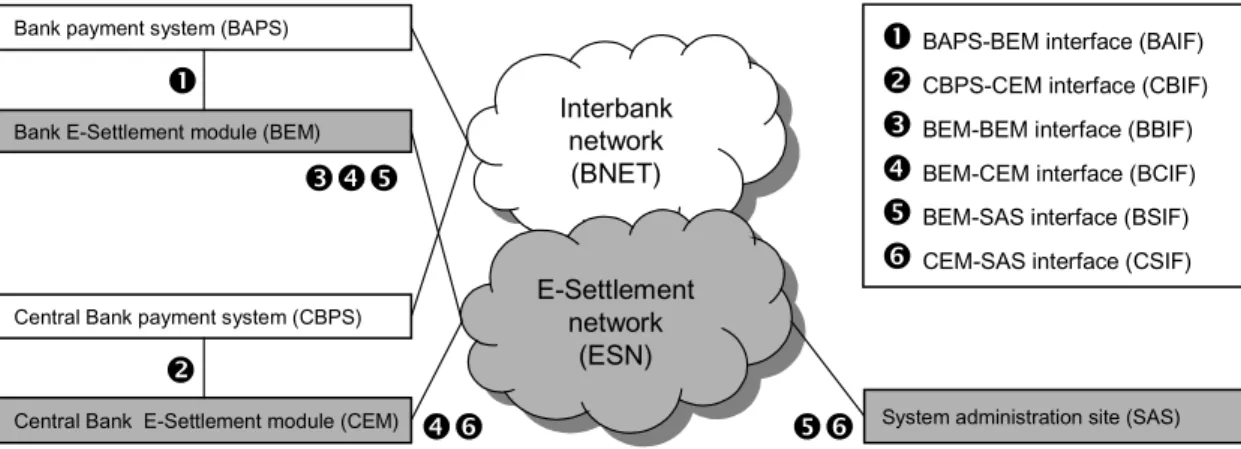
E-Settlement system consists elements interlinked with a network, shown in gray in Figure 5 below. Two kinds of external systems are linked with the E-Settlement system, and the external systems are linked with another network. These are jointly called “external elements” in this specification. The figure also shows the abbreviations for the elements and the active system elements.
Bank payment system (BAPS)
Bank E-Settlement module (BEM) Interbank
network (BNET) Interbank network (BNET) E-Settlement network (ESN) E-Settlement network (ESN)
Central Bank payment system (CBPS)
Central Bank E-Settlement module (CEM) System administration site (SAS)
BAPS-BEM interface (BAIF)
CBPS-CEM interface (CBIF)
BEM-BEM interface (BBIF)
BEM-CEM interface (BCIF)
BEM-SAS interface (BSIF)
CEM-SAS interface (CSIF)
Figure 5. E-Settlement system elements and interfaces
E-Settlement system elements are defined as follows:
· Bank E-Settlement module (BEM): A secure processing element responsible for performing settlement of payments in real time
· Central Bank E-Settlement module (CEM): A secure processing element responsible for controlling a number of BEMs.
· System administration site (SAS): Centralized element responsible for overall system control
· E-Settlement network (ESN): The secure, dedicated network connecting the E-Settlement system elements
The external elements are defined as follows:
· Bank payment system (BAPS): The existing payment system of the bank enhanced with an interface to the E-Settlement system
· Central Bank payment system (CBPS): The existing payment system of the CB enhanced with an interface to the E-Settlement system
· Interbank network (BNET): The existing network(s) connecting the payment systems of banks and CBs, such as SWIFT and SWIFTNet in an international setting, or Pankkiverkko 2 in Finland.
E-Settlement system has two external interfaces, one towards the banks and one towards central banks. Banks and CBs access the services provided by the E-Settlement system through these interfaces. In addition, there are four internal interfaces between the system elements.
3.1
Bank payment system BAPS
From E-Settlement system point of view, a bank is an entity that sends and receives payments, the settlement of which is handled via E-Settlement stamping. In addition to the responsibilities listed here, bank payment system has the security responsibilities set forth in [SECURITY_POLICY].
3.1.1 Payment
In this process the bank payment system has the following responsibilities in the E-Settlement system:
· Payment message transfer via interbank networks
· Maintaining payment queues (basic payment queues will be provided as an add-on service, too)
· Outgoing credit transfer payments:
o Requesting E-Settlement stamps from BEM. This entails giving the core payment information, and the bank’s unique payment identifier to BEM and receiving the E-Settlement payment ID and E-E-Settlement stamp in return.
o Storing a table of cross references between bank’s unique payment identifiers and E-Settlement payment IDs
o Attaching E-Settlement stamps received from BEM to interbank payments and sending the payments to beneficiary’s bank as soon as possible
o Confirming the success or failure of each E-Settlement stamped payment to BEM based on the acknowledgement sent by the beneficiary’s bank as soon as possible when such an acknowledgement has been received
o Listening to and reacting to notifications from BEM regarding payments for which BEM has not yet received a (positive or negative) confirmation
· Incoming credit transfer payments:
o De-loading the E-Settlement stamps from the interbank payments
o Sending all received stamps to BEM for validation even if the payment was rejected by BAPS, and receiving the confirmation stamps from BEM
o Sending an E-Settlement stamped confirmation message to the sending bank for each received E-Settlement stamped interbank payment
3.1.3 Reconciliation
In this process BAPS is responsible of the following:
· Reacting to reconciliation related notifications sent by BEM
· Ensuring that there are no inconsistencies between BEM transaction history and the payment history stored by the bank
· Reading and storing BEM statements of account
3.1.4 Control
· Storing BEM transaction logs for legal and accounting purposes
3.2
Central Bank payment system CBPS
Central Bank payment system issues liquidity to the to banks and controls banks’ payment traffic. In addition to the responsibilities listed here, Central Bank payment system has the security
responsibilities set forth in [SECURITY_POLICY]. Note that from technical E-Settlement system point of view, ECB payment system site is identical with other CB sites.
3.2.1 Payment
Central Bank payment system is responsible for sending liquidity to banks as normal interbank payments, the recipient of which is the E-Settlement module of the bank in question. Thus, its responsibilities in this respect are similar to that of the Bank payment system. The main differences stem from the fact that CB payment has limitless liquidity. In payment processing its responsibilities include:
· Payment message transfer via interbank networks
· Outgoing credit transfer payments:
o Requesting E-Settlement stamps from CEM. This entails giving the core payment information and the CB’s unique payment identifier to CEM and receiving the E-Settlement payment ID and E-E-Settlement stamp in return.
o Storing a table of cross references between bank’s unique payment identifiers and E-Settlement payment IDs
o Attaching E-Settlement stamps to interbank payments
o Attaching E-Settlement stamps received from CEM to interbank payments and sending the payments to beneficiary’s bank as soon as possible when an E-Settlement stamp has been received from CEM
o Confirming the success or failure of each E-Settlement stamped payment to CEM based on the acknowledgement sent by the beneficiary’s bank as soon as possible when such an acknowledgement has been received
o Listening to and reacting to notifications from CEM regarding payments for which CEM has not yet received a (positive or negative) confirmation
· Incoming credit transfer payments:
o
by CBPS, and receiving the confirmation stamps from CEM
o Sending an E-Settlement stamped confirmation message to the sending bank for each received E-Settlement stamped interbank payment
3.2.2 Liquidity management
This functionality has been planned as an add-on service to the central banks.
Central Bank payment system has the following liquidity management responsibilities:
· Keeping up to date on the amount of liquidity issued to each bank
· Issuing more liquidity to banks upon request after validating the request against the funds available to the bank
· Receiving unused liquidity from banks during the day and at the end of the day
· Ordering forced liquidity de-issuing as required
· Replying to liquidity situation requests from the banks
3.2.3 Reconciliation
In this process CBPS is responsible for the following:
· Reacting to reconciliation related notifications sent by CEM
· Ensuring that the transaction log of Central Bank E-Settlement module is consistent with CBPS liquidity accounting information
· Reading and storing CEM statements of account
3.2.4 Control
In this process CBPS is responsible for the following:
· Storing full CEM transaction logs
· Reacting to bank profile violations
· forming and validating E-Settlement stamps
· alerting SAS if E-Settlement stamp is invalid or there are any other stamp problems
· Ensuring that the payment profiles (limits on the number and amount of payments that can be processed per unit of time) of the banks are enforced
3.3.2 Liquidity management
In this process BEM is responsible for the following:
· Reporting liquidity situation to BAPS, CEM and SAS upon request
· Reporting funds available to the BAPS upon request
· Sending a notification to BAPS if available liquidity goes below a pre-configured limit
3.3.3 Reconciliation
In this process BEM is responsible for the following:
· Maintaining bilateral (bank-to-bank) transaction history for audit trail checking and reconciliation purposes
· Performing continuous reconciliation
· Performing bank-to-bank reconciliation upon request and automatically at the end of reconciliation periods
3.3.4 Control
In this process BEM is responsible for the following:
· Allowing start-up of BEM only after strong and secure user authentication
· Storing a local copy of the system directory data as indicated by SAS and the CEM controlling the BEM
· Restoring system state from persistent storage after system failure
· Informing BAPS, CEM and SAS about changes in system state
· Giving periodical activity signals to controlling CEM and to SAS
· Stop (and resume) sending payments to a particular BEM if ordered so by CEM or SAS
· Stop (and resume) sending payments altogether if ordered so by CEM or SAS
· Checking that all payments have been either rejected or confirmed by BAPS. Alert BAPS and SAS on expiration of payment timers.
· Calculating payment, IT resource usage, availability, payment performance and activity statistics of the bank
· Monitoring possible deviations from normal payment flow (too many unconfirmed payments, prolonged unavailability of liquidity) and alerting CEM/SAS
3.4
Central Bank E-Settlement module CEM
CEM is a secure processing element capable of forming and validating E-Settlement stamps, controlling the consistency of payment traffic, and for controlling the liquidity situation in the banks under its control. The Central Bank E-Settlement module also stores the full CB payment logs,
calculates payment statistics for the CB area, and takes some system management responsibility for the banks under its control.
3.4.1 Payment
In payment processing CEM is responsible for the following:
· maintaining CEM liquidity balance information
· forming and validating E-Settlement stamps
· alerting SAS on invalid E-Settlement stamps or any other stamp problems
3.4.2 Liquidity management
In this process CEM is responsible for the following:
· Following up the amount of liquidity issued to each BEM
· Informing SAS on any changes of the liquidity issued to, sent to or received from the BEMs
· Forwarding BEM liquidity requests to CBPS and forwarding CBPS replies to BEM
3.4.3 Reconciliation
In this process CEM is responsible for the following:
· Maintaining bilateral (bank-to-bank) transaction history for audit trail checking and reconciliation purposes
· Performing continuous reconciliation
· Performing bank-to-bank reconciliation upon request and automatically at the end of reconciliation periods
· Giving periodical activity signals to SAS
· Stop (and resume) sending payments to a particular BEM or CEM if ordered so by SAS
· Stop (and resume) sending payments altogether if ordered so by SAS
· Checking that all payments have been either rejected or confirmed by CBPS. Alert CBPS and SAS on expiration of payment timers.
· Calculating payment, IT resource usage, availability, payment performance and activity statistics of CEM
· Collecting BEM payment statistics from BEMs under the CEMs control after reconciliation breaks and at the end of the day.
· Cross-tabulating the payment statistics for the CB after reconciliation periods and at the end of the day
· Providing CB statistics to SAS upon request
· Providing access to CEM transaction log
· Granting E-Settlement smart cards (used for storing critical bank-specific information) to banks, reacting to any alarms sent by BEMs
· Maintaining BEM and BAPS information (identifications, contact information, PKI, bank profiles) for the BEMs and BAPSes under CEM’s control
· Starting and stopping payment processing of BEMs under the CEMs control during beginning-of-day and end-of-day activities, respectively, and also during the day if required
3.5
System administration site SAS
System administration site is the centralized administration and management entity in the E-Settlement system. ECB could be a natural environment for SAS.
3.5.1 Payment
In this process SAS has the following responsibilities:
· Ordering BEMs to stop (and resume) sending payments to specified BEMs if there are problems in payment traffic between BEMs
· Ordering BEMs to stop and start processing payments in case of serious payment problems
3.5.2 Liquidity management
In this process SAS has the following responsibilities:
· Keeping up to date on the amount of liquidity currently being issued in the E-Settlement system
3.5.3 Reconciliation
· Correcting bank-to-bank reconciliation problems
· Performing system level reconciliation, i.e. ensuring that the amount of liquidity in circulation, as reported by CEMs, corresponds to the amount of liquidity reported by the BEMs. This is to be done according to a predefined schedule, and at will during the day.
· Defining the reconciliation schedule for the day and writing this information to BEMs during beginning-of-day activities
3.5.4 Control
System administration site is responsible for general system management tasks, such as:
· Managing system security: keys, certificates and security policy
· Maintaining CEM and CBPS information (identifications, contact information, PKI) for the CEMs and CBPSs
· Maintaining system directory information
o private CEM/BEM information
§ bank profile
§ bank-specific timeouts
§ controlling element (CEM or SAS)
o public CEM/BEM information
§ CB code of the bank
§ Bank name
§ BIC(s)
§ IP address
§ public key
§ the state of the bank (whether payments should be sent to the bank)
o software version information
3.6
E-Settlement system interfaces
What follows is a very brief description of the system interfaces.
3.6.1 Bank interface BAIF
Bank interface offers the E-Settlement functionality to banks. It needs to be flexible enough for many kinds of banks to use, and thus needs to be carefully designed. The interface is specified in
[BAIF_SPEC] and offers the following functionality:
· E-Settlement stamp request and validation
· Liquidity management
· Reconciliation between BAPS and BEM
· User management
· Access to system directory data
· Notifications mechanism
3.6.2 Central Bank interface CBIF
Central bank interface offers the E-Settlement functionality to CBs. The interface is an extension of the Bank interface. It has been augmented with commands related to liquidity issuing/de-issuing and bank control functions. Flexibility is also crucial for CBs. The interface is specified in [CBIF_SPEC].
3.6.3 BEM-BEM interface BBIF
BBIF contains bank-to-bank reconciliation functionality and other functions needed in controlling settlement traffic between two banks. The interface is specified in [TECH_ARCH].
3.6.4 BEM-CEM interface BCIF
BCIF provides functionality for sending alerts between BEM and CEM, transferring transaction log, statistics and BEM account data between BEM and CEM, and for controlling BEM. [TECH_ARCH]
3.6.5 BEM-SAS interface BSIF
BSIF provides functionality for authentication, sending alerts between BEM and SAS, controlling BEM, and transferring following data between BEM and SAS:
· transaction logs on request
· system directory data
· reconciliation data
· liquidity balance information
· activity information
· payment performance information
· IT resource usage information
· software version control information The interface is specified in [TECH_ARCH].
3.6.6 CEM-SAS interface CSIF
CSIF provides functionality for controlling CEM, sending alerts between CEM and SAS, and for transferring data between CEM and SAS similar to that transferred between BEM and SAS. In addition, issued liquidity information is transferred over this interface. The interface is specified [TECH_ARCH].
4
C
ORE
P
ROCESSES
This chapter presents an overview of the E-Settlement core processes. Figure 6 describes how the core processes are interlinked. It presents a typical (unproblematic) “day in life” of a Bank E-Settlement module. The day of BEM starts with BEM start-up process, after which beginning-of-day activities (reception of system data from SAS) are performed. Initial liquidity loading follows. After this, liquidity management in the form for liquidity issuing and de-issuing processes goes on through the day. An E-Settlement day is divided into a number (minimum one) of reconciliation periods, during which BEM processes payments normally and performs continuous reconciliation. After the period has ended, bank-to-bank reconciliation is performed to ensure that payment information is consistent throughout the distributed system. After the last reconciliation period of the day has ended, liquidity is de-loaded to CEM and end-of-day activities are performed. EOD activities include de-issuing
remaining liquidity, and calculation and collection of system statistics.
BEM start-up and BOD EOD activities Continuous reconc. Bank-to-bank reconc. Load liquidity Deload liquidity
... Continuousreconc. Bank-to-bankreconc. Payment and system control
Liquidity management Payment processing BEM initialized, start payment processing First reconciliation period ends Last reconciliation period ends, stop payment processing BEM closed BEM started Control Liquidity mgmnt Payment Recon-ciliation First reconciliation OK Last reconciliation OK Start EOD
Figure 6. "Day in life" of BEM
The processes in this chapter are presented using a sequence diagram notation presented in Figure 7 below. In the notation, each system element is described as a gray box at the top of the picture, with each element having a descriptive name and type separated with a colon, such as “Sending:BEM”. Messages between the elements are represented using numbered and labeled arrows, with conditional messages shown as dotted lines. An arrow starting and ending in the same element is used to represent processing or a decision by the element. The flow of time in the pictures is top-down.
Element1 : Type Element2 : Type
1: Message
2: Conditional message
3: Processing or decision by an element
Figure 7. Process notation
In order to make it easier to see the responsibilities of each system element in the processes, all process descriptions have the same system elements in the same order: sending BEM, sending bank’s payment system, receiving bank’s payment system, receiving BEM, (sending bank’s) CEM, (sending bank’s) Central Bank payment system and finally SAS. This is done even if a system element does not take part in the messaging of a particular process – for example, in liquidity issuing the receiving bank (in the payment process) does not have any role. It is still in process description to emphasize that it does not have any role, or responsibility, in the process. Banks are always referred to as ”Sending” and ”Receiving” even if no message transfer takes place between the banks. ”Sending” bank is the active
Payment, Liquidity management, Reconciliation and Control processes.
4.1
Payment processes
In the payment process two banks exchange payment and settlement information to process an inter-bank payment. This chapter presents the different payment processes, including rejections at various stages and payment time-outs. See also [BAIF_SPEC] for more information.
In sending BEM, a payment can be in one of three states. It is important to note that all changes in payment state are final in nature, i.e. that liquidity is finally increased or decreased at each change of state – expect when a payment is positively acknowledged, in which case no change in liquidity takes place. The three states are:
1. Final unconfirmed credit transfer (upon stamp creation)
2. Final confirmed credit transfer (upon reception of positive confirmation) 3. Final rejected credit transfer (upon reception of negative confirmation)
In receiving BEM, a payment can be in exactly two states. Liquidity is increased if an E-Settlement stamp can be successfully validated.
1. Final confirmed credit transfer (upon validation of E-Settlement stamp)
2. Final rejected credit transfer (if payment was rejected by the receiving BAPS or receiving BEM)
As an implication of this finality of operations, canceling a payment for which an E-Settlement stamp has been created requires processing the payment normally followed by a payment in the other direction at the same amount – see payment cancellation process.
At each stage of payment processing after the E-Settlement stamp has been created, the stamp can be given to next participant in the payment process either as accepted or rejected. In all cases, the stamp goes through the whole payment process – even if the payment was rejected at some earlier stage::
1. Sending BAPS normally sends a payment and the stamp to Receiving BAPS as accepted but can also send it as rejected if the payment has been immediately canceled. Note that even in this case the payment and the stamp are sent to the Receiving BAPS.
2. If Receiving BAPS can validate the payment, it forwards the stamp to Receiving BEM as accepted, and if it cannot validate the payment (e.g. beneficiary not found) in forwards the stamp to the receiving BEM as rejected.
3. If Receiving BEM can validate the stamp and can perform continuous reconciliation successfully, it accepts the payment and performs final settlement of the payment. In the
transaction. If Sending BAPS can complete the transaction, the payment transaction has been completed successfully. If it cannot do so, it has to resort to payment cancellation process, since liquidity has already been finally transferred.
4.1.1 Normal payment flow
Sending : BAPS
Sending : BEM Receiving : BAPS Receiving : BEM CB : CEM CB : CBPS SAS : SAS
1: Payment information 2: E-Settlement stamp
3: Stamped interbank payment
5: E-Settlement stamp 6: E-Settlement stamp 7: Stamped payment confirmation
8: E-Settlement stamp 9: Payment confirmed
4: Validate payment
Figure 8. Normal payment flow
1: Sending BAPS presents payment information to its BEM.
2: Sending BEM validates the payment message, reduces liquidity from the bank’s liquidity balance and generates an E-Settlement stamp, which it returns to BAPS.
3: Sending BAPS attaches the E-Settlement stamp to the payment message, and sends it immediately to the Receiving BAPS via BNET.
4: Receiving BAPS gets the message and validates the payment message content.
5: Receiving BAPS checks that the payment can be completed in its payment system and presents the E-Settlement stamp to its BEM.
6: The Receiving BEM validates the E-Settlement stamp, adds the payment amount to the bank liquidity and returns a positive acknowledgement to Receiving BAPS, together with a new
E-Settlement stamp containing the Receiving BEM confirmation. Receiving BAPS can commit the payment at this stage.
7: Receiving BAPS sends Sending BAPS an E-Settlement stamped positive acknowledgement message to inform the payment transaction has been completed successfully.
8: Sending BAPS receives the message, detaches the E-Settlement stamp in it and presents the stamp to its BEM informing that the payment message was processed successfully.
9: Sending BEM acknowledges that the operation was concluded successfully. Sending BAPS can now consider the payment and settlement complete.
4.1.2 Payment cancellation
Sending : BAPS
Sending : BEM Receiving : BAPS Receiving : BEM CB : CEM CB : CBPS SAS : SAS
2: Payment information (cancel) 3: E-Settlement stamp 4: Stamped interbank payment
6: E-Settlement stamp 7: E-Settlement stamp
8: Stamped payment confirmation
9: E-Settlement stamp 10: Payment confirmed 5: Validate payment
1: Request payment cancellation
Figure 9. Payment cancellation
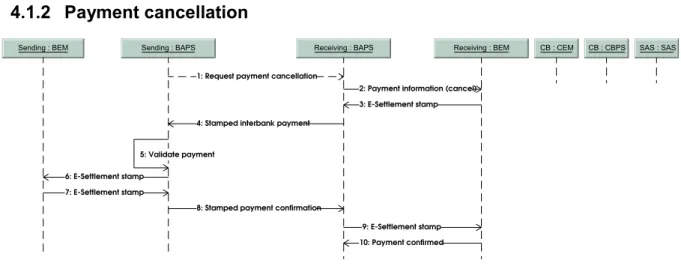
From E-Settlement system point of view, payment cancellation is a process for transferring liquidity from Receiving BEM to Sending BEM. Only a confirmed payment can be canceled.
1: The cancellation process can either be started by the Sending BAPS or the Receiving BAPS, depending on the situation as described in the beginning of chapter 4.1. In both cases, a cross-reference to the cancelled payment is sent in the request.
2: Receiving BAPS presents the cancelled payment information to its BEM.
3: Receiving BEM forms a new Settlement stamp containing a cross-reference to the canceled E-Settlement transaction.
4-10: The payment is processed normally as a payment from Receiving bank to Sending bank. As end result, the liquidity has been transferred back from the Receiving bank to Sending bank.
4.1.3 Payment resending
Sending : BAPS
Sending : BEM Receiving : BAPS Receiving : BEM CB : CEM CB : CBPS SAS : SAS
1: Payment information 2: E-Settlement stamp
3: Stamped interbank payment
9: E-Settlement stamp 10: E-Settlement stamp 11: Stamped payment confirmation
12: E-Settlement stamp 13: Payment confirmed
8: Validate payment 4: Unconfirmed payment
5: Payment information (resend) 6: E-Settlement stamp
7: Stamped interbank payment
Figure 10. Payment resending
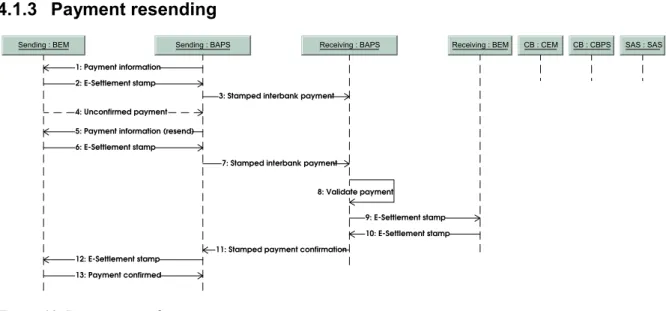
Payment resending is process for trying to receive a confirmation for hitherto unconfirmed payments. 1-3: Payment transaction is begun normally.
4: A notification from Sending BEM can start payment resending. Independently of this, Sending BAPS can also keep timers on payments and try to resend payments in order to receive a confirmation for them.
5: Sending BAPS requests resending of a payment by presenting payment resending information to its BEM. This resets the payment timer in Sending BEM. A new stamp is created but no additional liquidity is used for the stamp.
6-13: Normal payment process with the resent payment information is conducted. All elements must be prepared to receive duplicate payment information and take care that the payment will not be processed twice.
4.1.4 Bank profile violation
SAS : SAS Sending : BEM Sending : BAPS Receiving : BAPS Receiving : BEM CB : CEM CB : CBPS
1: Payment information
10: Corrective actions 9: Payment processing stopped
8: Stop payment processing
12: Resume payment processing 2: Payment rejected
4: alarm: Bank profile violation
6: Inspect severity of violation
13: Payment processing resumed
3: alarm: Bank profile violation
5: Bank profile violated
7: Stop payment processing
11: Resume payment processing
Figure 11. Bank profile violation
1: Sending BAPS gives payment information to Sending BEM.
2: Sending BEM concludes that bank profile would be violated (e.g. too large-value payment) if the payment was processed. The payment is rejected and the cause is returned to Sending BAPS. 3-4: Sending BEM sends an alert to both CEM and SAS about the situation.
5-6: CEM informs the violation to CBPS. The decisions and corrective actions in this respect are taken by CBPS.
7-9: In this case, CEM suspects misconduct by Sending BAPS and orders Sending BEM to stop processing payments. Sending BEM informs its BAPS of this.
10: CBPS performs corrective actions, such as modifies the bank profile. In this case, system directory would be updated on BEM’s part and BEM would be informed of the change.
11-12: Problem was solved. CBPS tells CEM to order Sending BEM to resume payment processing, which BEM informs to BAPS.
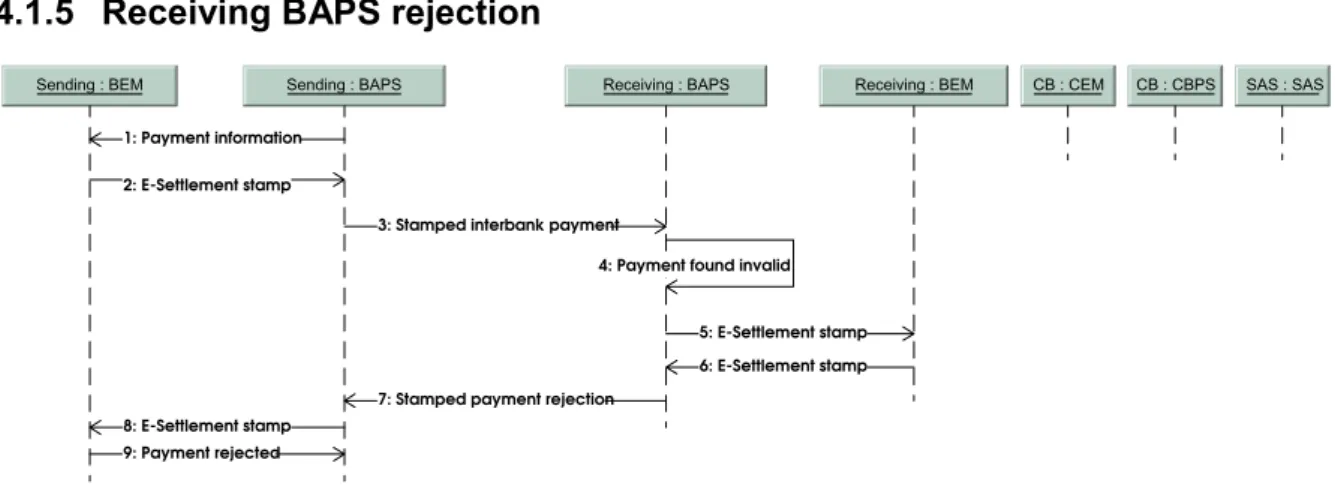
4.1.5 Receiving BAPS rejection
Receiving : BEM
Sending : BEM Sending : BAPS Receiving : BAPS CB : CEM CB : CBPS SAS : SAS
7: Stamped payment rejection 9: Payment rejected
5: E-Settlement stamp 2: E-Settlement stamp
8: E-Settlement stamp
6: E-Settlement stamp 3: Stamped interbank payment
1: Payment information
4: Payment found invalid
Figure 12. Receiving BAPS rejects the payment.
1–3: Normal payment process.
4: Receiving BAPS rejects the payment. There can be many reasons for this, for example unknown beneficiary IBAN number, or the payment has been sent to wrong BAPS or BEM.
5: This is a different call in the interface, telling BEM that the payment corresponding to the stamp was rejected by the bank. In this way Receiving BEM can update its payment info and keep the
E-Settlement audit trail intact.
6: Receiving BEM returns an E-Settlement stamp indicating rejection by Receiving BAPS. 7: Receiving BAPS sends Sending BAPS an E-Settlement stamped negative acknowledgement message to inform the payment was rejected.
8: Sending BAPS receives the message, detaches the E-Settlement stamp in it and presents the stamp to BEM informing that the payment message was rejected.
9: Sending BEM acknowledges that the payment was rejected. Sending BAPS can now proceed with the rejection in its internal statistics.
4.1.6 Receiving BEM rejection
Receiving : BEM Receiving : BAPS
Sending : BEM Sending : BAPS CB : CEM CB : CBPS SAS : SAS
5: E-Settlement stamp 6: E-Settlement stamp 1: Payment information
8: E-Settlement stamp 9: Payment rejected
3: Stamped interbank payment 2: E-Settlement stamp
7: Stamped payment rejection
10: alarm: payment rejected
11: Inspect severity 12: Stop sending 14: Corrective actions 15: Resume sending 13: Stop sending 16: Resume sending 4: Validate payment
Figure 13. Receiving BEM rejects payment.
1–4: Normal payment process.
5–9: For some reason (e.g. invalid payment stamp) BEM rejects the E-Settlement stamp. The payment is handled as a rejected payment back to Sending BEM. After stage 5, the liquidity balance of the Receiving BEM is not changed. Upon