Abstract
This position paper is an attempt to show how real-options theory and portfolio theory—can be applied to mak-ing software investment decisions in practice. We have pre-viously developed a method, called CBAM, for making software investment decisions based upon architectural analysis, and have applied this method to a large-scale sys-tem development—NASA’s ECS project. Building upon this experience, we reflect upon the relationship between the theory of economic models and what can be done in prac-tice.
1. Introduction
Despite the criticality of software architectures to a sys-tem’s success, software architects do not have well devel-oped structures to reason about the costs and benefits of the various design options available to them. The Architecture Tradeoff Analysis Method (ATAM) [6] provides a frame-work for software architects to reason about the technical tradeoffs faced while designing and maintaining a software system. But these technical tradeoffs have largely ignored economic considerations.
We have been developing a method for doing economic analyses of software and systems, centered around their architectures. We call this method the CBAM (Cost Benefit Analysis Method) [7]. The CBAM builds upon the ATAM adding techniques that help the analyst to better understand the benefit and cost implications of the architectural design decisions being made. Given the fact that there are large uncertainties—both technical as well as economic—during the architecture design stage of a software system, the architects will be facing risks with regards to the system’ ability to meet its business goals. One of the advantages of our approach lies in the fact that it forces the stakeholders to quantify these risks, by explicitly quantifying the benefits of architectural decisions, as well their costs, quality attribute responses, and the uncertainty surrounding these estimates.
The financial literature contains several interesting tech-niques such as real-options theory and portfolio theory to help decision makers manage uncertainty and risk in their investments. Given that software projects are also
invest-ments[2], then it seems reasonable that the (relatively mature) techniques outlined in the financial literature could be borrowed and applied to software projects. Sullivan [10], Butler [3] and a few others have already described how these techniques could be used in the context of software projects and how one might think about the design problem in that framework. However, we have not yet seen any example of a substantial software project actually using these techniques to help in their decision making process. We attribute this to the fact that obtaining economic data in software projects is much harder than in financial markets from where these techniques have been borrowed. In this paper we show how we can apply these techniques in prac-tice.
2. Overview of the CBAM
The CBAM begins where an ATAM leaves off and depends upon the artifacts that the ATAM produces as out-put. The problem at hand is to choose from large set of desired changes to the system, each of which we call an Architectural Strategy (AS)
In the ATAM process we simply generate a list of the quality attributes of importance to the project. In the CBAM we go further, by having the stakeholders individually rate each of the attributes such that the sum of their scores is 100. The attribute ratings are denoted by QAScorej, where j is the quality attribute being rated. Hence, by design,
Σ(QAScorej) = 100 and for all j, QAScorej > 0. We then elicit from the stakeholders an estimate of the impact result-ing from the application of each AS, in terms of how it affects each quality attribute of the system. We call these contribution scores ( Contij). Based upon the QAScoreand the Cont score we can calculate a rough benefit score as fol-lows:
A desirability metric is also calculated as follows: Desirability(ASi) = Benefit(ASi)/Cost(ASi)
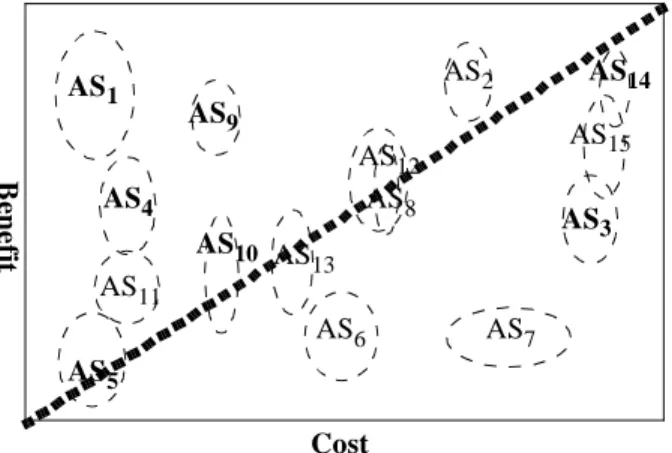
Figure 1 plots the ranges of benefit values against the cost values for the respective ASs. Looking at the plot we realize that ideally we would like to choose those strategies
Benefit ASi( ) (Contij QAscorej× )
j
∑
=
A Foundation for the Economic Analysis of Software Architectures
EDSER-3 Position Paper
Jai Asundi
1,2, Rick Kazman
2,31
Dept. of Engineering and Public Policy
3Dept of Information Technology Management
2Software Engineering Institute
University of Hawaii
Carnegie Mellon University
Honolulu, HI
that lie on the top left corner: strategies with a high benefit and low cost. The ovals denote the uncertainty in the elic-ited values of benefit and cost. We shall revisit this plot later in the paper.
3. Software Projects as Investments Under
Uncertainty
The development of a software product can be viewed as an investment today with an expectation of benefits or rewards in the future. The investment in software projects, just like many other investments, have a characteristic that they are largely irreversible, have considerable uncertainty and there is some amount of leeway as to the timing of the investment.
3.1. Advanced economic methods
The economics and finance literature discusses a num-ber sophisticated techniques [5] that have caught the inter-est of many in the software engineering community. For example, the use of real-options theory (Sullivan [10]) and portfolio theory (Butler [3]) for software design have been suggested. Benaroch [1] in their study of information sys-tems use the real-option formulation to analyze a decision problem
More research needs to be carried out to both operation-alize and validate the use of these economic theories in soft-ware investment decisions. This, however, requires large-scale case studies, which are rare to come by. We were extremely fortunate to have NASA’s ECS project willing to participate in the experimental application of these tech-niques within the framework of the CBAM.
We believe that addressing the software investment problem at the architectural level of abstraction will make the application of these sophisticated techniques easier. The reason for this is obvious: architecture is an appropriately
high level of abstraction at which to think about strategic investment decisions. A level at which one could reason about the impact of decisions to the business goals of the system via the quality attributes.
3.2. The real-options approach
Traditional investment decisions for engineering projects have been based on a simple rule that a project is undertaken only if the Net-Present Value (NPV) is greater than zero.:
This simply means that the benefit derived from the project is greater than the cost incurred. However, the implicit assumption of this formulation is that the invest-ment is reversible and that the decision to be made is now-or-never1. We know that this is not the case: costs in soft-ware development are irreversible (one can’t, in general, go to the market and sell off the implemented module) and project managers usually have some leeway with respect to the timing of project’s implementation. It is possible that the manager could postpone the decision of implementation until he receives additional information about the benefit he could derive from any particular AS. By waiting an addi-tional amount of time he could obtain a higher return on investment at the cost of the lost convenience yield (the amount of benefit gained per year due to implementing the system immediately).
The insight gained from the real-option formulation is that we want to postpone a decision when the NPV is less than the value of the option to delay. We can estimate these values based upon the information that we elicit in the CBAM process because we are already estimating the costs and expected benefits as part of the elicitation process.
3.3. An idealized view of the real-options approach
In real-options literature [5], the benefit or value is assumed to follow a Wiener process which is easiest repre-sented by stochastic equations (also known as brownian motion with drift):
where B is the benefit, C is the cost, α is the drift param-eter (i.e. the amount by which the value steadily increases) and σ is the variance parameter. Similarly if the cost of investment also varies stochastically over time (which we would argue is the case with software projects) then it is Cost Be n e fit AS1 AS2 AS3 AS8 AS5 AS4 AS9 AS14 AS10 AS6 AS13 AS11 AS12 AS7
Figure 1. Plotting the benefits and costs of architectural strategies
AS15
1. In the case of pure uncertainty, then expected values of Benefit and Cost are used to calculate NPV
NPV (Benefitt–Costt) 1+r ( )t --->0 t=0 T
∑
= dB = Bα1dt+Bσ1dz dC = Cα2dt+Cσ2dzshown that the decision rule is defined by:
where δB is the convenience yield on the asset and β1 is a function of variance in benefit, cost, the correlation between the two and also the yields on assets and costs2. This equa-tion suggests that unless the value of the asset (software project in our case) is p* times the cost of investment, the project manager should not go ahead with implementation of the project. The fact that p* >1 shows that there is an addi-tional ‘safety-factor’ involved in making decisions under uncertainty and this is a powerful result. In terms of the example that we have been pursuing here, p* is shown as the dashed line in Figure 1. ASs significantly above that line should be immediately implemented while those below should be postponed.
From our experience with the ECS project in eliciting benefit and cost information we realized that gathering data that directly fits into models described in financial literature is difficult. We have some information, like the Benefit and Cost estimates. However, to calculate β1 and the conve-nience yield, δB, will prove to be challenging. Software experts typically have little idea about the true meaning of “discount rate” for the software project or what, if any, is the “dividend” payable by a software project and what “correla-tion” one can attribute to various ASs.
3.4. Using a portfolio approach
The idea behind the portfolio approach to investment is to reduce the overall risk (uncertainty) in returns by invest-ing in assets that do not have a strong positive correlation [4]. Consider two assets A and B, with returns rA and rB that have standard deviation σA and σB respectively. If we invested some fraction xA of our resources on A and (1-xA) on B, then the overall return, RAB, we would obtain from our ‘portfolio’ would be:
RAB = xA*rA + (1-xA)*rB,
and the variance, and hence risk, would be given by:
σAB2= x
A2σA2 + (1-xA)2σB2 + 2xA (1-xA)ρABσAσB
where ρAB is the correlation in returns between asset A and asset B. Figure 2 shows the curve for all values of xA on a plot of returns versus standard deviation. From the plot, B is a high risk asset, but yields a higher return whereas A is a low risk but lower return asset. Thus we see that we can choose a particular xA for which the resultant portfolio has a lower variance or risk than for either of the assets indepen-dently. The return is a weighted average of the two invest-ments. If one chooses a risk level then the return can be calculated. This is the basic principle behind investing in a portfolio of assets. Portfolio theory is suitable for cases where one has to follow a risk mitigating or minimizing strategy while providing a reasonable return.
It is well understood that in many software projects, managers wish to minimize the risk of choosing a particular technology if it is uncertain. Concerns of inter-operability, vendor survivability, and market acceptance are foremost in their minds. Portfolio theory provides an ideal framework for managers to manage the uncertainty and hence the risk of their decisions.
Now how do we apply this theory to architectural design? Considering that our problem is one of choosing a small set of ASs for implementation, we can restate this problem in the portfolio theory terms as follows: we have a particular architectural strategy, AS1, that uses a new tech-nology. If this technology gains widespread market accep-tance then it has a potentially high benefit but with relatively large uncertainty and moderate cost. Another architectural strategy, AS7, is our customary way of implementing the fea-ture with moderate benefit and cost, but low uncertainty. AS1 is thus a high risk option while AS7 is a low risk option.
So to operationalize portfolio theory in the context of the CBAM we need three types of information: returns, vari-ances, and correlations among ASs. We have already cap-tured information on returns and variances in the CBAM in the form of benefit information and its associated uncer-tainty. Hence to use portfolio theory, we only need to intro-duce the concept of a “dependency structure” between the various ASs under consideration as a proxy for correlation information. Figure 3 depicts how the various ASs
poten-2. For a detailed analysis refer to [5] pp. 207-11 B C ----≥p∗ ββ1 1–1 ( ) ---δB>1 =
Figure 2. A portfolio of two assets
R e tu rn ( RA B ) Standard Deviation (σAB) Asset B Asset A xAof A and (1-xA) of B Portfolio of
x
Figure 3. Dependency/Correlation between ASs IOS DMS MSS DSS PLS DPS INS AS1 AS7 AS5 AS4
tially affect the components of the system architecture. We can see that AS7 and AS1 overlap—they affect some of the same components. But since they are implementing com-peting technologies, then they are considered to be nega-tively correlated (i.e. the success of one virtually guarantees the failure of the other). If we consider AS1and AS5, we see that they also overlap in the sense that they both affect the MSS component. So how do we use this information to determine the correlation between the ASs?
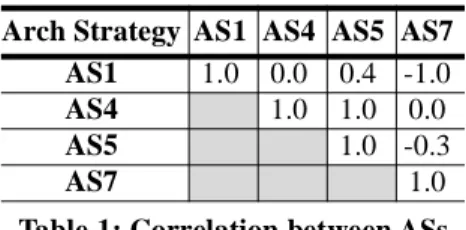
Depending on what each of the ASs are trying to accom-plish and which portions of the components they affect we can elicit a proxy measure for the correlation. For strategies that have no obvious dependency we can assume a zero cor-relation. ASs that are subsets of others can be considered as having a correlation of 1. As part of the CBAM we elicit correlations between ASs. We can use correlation informa-tion to populate a matrix as shown in Table 1.
The optimization problem thus becomes that of mini-mizing risk, given the constraints of total investment (bud-get) and the returns and uncertainties of the various ASs. We can thus choose a portfolio of strategies based upon the benefit scores we elicited in Section 3 and the correlation coefficients that we have elicited here. The resultant set of ASs may not be the best in terms of return/benefit, but it attempts to minimize the project’s overall risk.
When combining the various strategies to form a portfo-lio, one needs to look at their structural overlap, their tech-nical overlap, the techtech-nical feasibility of implementing all of them at the same time, as well as the implied additional schedule and budget considerations.
3.5. A hybrid technique (options+portfolio)
The application of the pure form of options or portfolio theory to making a design decision is possible in some cases. However, in the case of ECS—and, we believe, most systems—we need to apply them in a hybrid form. There are some subsystems where a risk mitigation strategy is required, while in other subsystems, a maximization strat-egy is appropriate.
In the situation where a project is considering many architectural strategies, we can apply the real-options for-mulation based upon the dependency structure of the strate-gies. In our example, AS4 and AS5 are two architectural strategies that overlap completely. In fact, AS4 is a subset of AS5 (hence the correlation of 1 in Table 1). Analysis of AS4 and AS5 shows that to implement AS5, AS4 must first be
implemented (i.e., there is a hierarchical dependency). The problem can thus be framed in the real-option framework by considering that the price of the option to postpone AS5 is the cost of implementing AS4. Since AS4, when imple-mented, will provide more information about AS5 it will either reduce the uncertainty regarding the benefits that can be obtained or provide the waiting period for any exoge-nous factors to take effect while keeping the option to implement AS5 open.
Hence a strategy that the designers could adopt while making a choice of ASs, is to choose a set of ASs that tries to minimize the risk using the portfolio framework and then deciding on which ASs to postpone based on the uncer-tainty and correlation of the ASs. New ASs could be added to the chosen set (depending on resource availability) to provide the real-option of postponing some uncertain AS. These additional ASs that provide the option would neces-sarily have to be either subsets of the original strategy or strongly correlated to it.
3.6. Assumptions of these technique
There are a number of assumptions that are made to make the analysis of real-options and portfolios easier. These assumption may hold in the financial world, but when considering software projects, they may seem tenu-ous.
One of the basic assumptions is that there is no arbitrage in the financial markets. Now within software projects, we cannot think of trading individual software components/ modules! The non-trading of assets makes it difficult for one to claim that the resultant strategy is “optimal”. How-ever, we can argue that economic strategies provide us with guidance and help us build better but not necessarily opti-mal systems.
Another assumption made is that the various parameters like discount rate, drift rates and convenience yields are exogenous to the system. In our case, the context depen-dence of the problem results in varying values of these parameters and hence leads to endogeneity.
4. Conclusions and Future Work
The current form of the CBAM is a structured elicitation process within a probabilistic Cost-Benefit analysis frame-work combined with a decision analysis frameframe-work [8]. This blend of techniques aids us in making software and system architecture decisions. The techniques of decision analysis are used to define the design space and economic techniques are used to maximize the sum total expected utility (Desirability) of all proposed architectural changes.
We have explained how advanced economic tech-niques—real-options theory and portfolio theory—can be practically applied to software engineering projects. An area of future work is in the continued application of these techniques to software projects and obtaining more data for Arch Strategy AS1 AS4 AS5 AS7
AS1 1.0 0.0 0.4 -1.0
AS4 1.0 1.0 0.0
AS5 1.0 -0.3
AS7 1.0
its validation. Solving a problem in theory and in practice are very different. We need more experience in applying these techniques in practice to guide us in optimizing them.
One important area we see is for firms that develop soft-ware products to increase their institutional capability with regards to economic modeling. Understanding the relation-ship between their business goals, quality attributes and the utility they derive from them will be a first step. Over time, if a firm were to develop models (even if they were heuristic) relating a quality attribute response to utility, or benefit, then the elicitation exercise would be much easier and less sub-jective.
Similarly we can imagine cost models to be built from empirical data so that the economic tradeoffs involved are easily identified. Cost models that are “architecturally aware”, i.e. those that consider architectural components as units and consider the architectural design itself as affecting the overall system cost, would be useful in the context of the CBAM.
Have we shown that economic techniques are appropri-ate and advantageous for software decision making? Yes. Have we proven that they are optimal? No. Such a proof is extremely difficult to come by. However, we have shown that such techniques can be practically applied given infor-mation that we can and do currently elicit from real-world software projects. We believe that the application of eco-nomic techniques is inherently better than the ad-hoc approaches that projects (even quite sophisticated projects) employ today. We cannot prove the optimality of our tech-niques—these techniques are optimal in theory, but the application of them introduces some uncertainty. Because we use expert judgements our techniques may not be optimal but they are at least satisficing.
Furthermore our experience with the CBAM (as well as earlier experience with the ATAM) tells us that just giving people the appropriate tools to frame and structure their deci-sion making process is already an enormous benefit.
5. Acknowledgments
We would like to thank Linda Northrop and the staff of
the SEI’s ATA initiative and Mike Moore and the staff of NASA’s ECS project for their support. We also wish to thank Benoit Morel of EPP, CMU for helping us grapple with the finer points of Real-options and Portfolio Theory.
6. References
[1] Benaroch, M. and Kaufman, R.J., “A Case for Using Real Options Pricing Analysis to Evaluate Information Tech-nology Project Investments”, Information Systems Research, Vol. 10, No. 1, March 1999, pp70-86.
[2] Boehm, B. Software Engineering Economics, Prentice Hall, 1981.
[3] Butler, S., Chalasani, S., Jha, S., Raz, O. and Shaw, M. “The Potential of Portfolio Analysis in Guiding Software Decisions”, First Workshop on Economics-Driven Software Engineering Research, http://www.cs.virginia.edu/~sullivan/ EDSER1/.
[4] Brealey, R., Myers, S., Principles of Corporate Finance, McGraw-Hill, New York, 1981.
[5] Dixit, A., Pindyck, R. S., Investment Under Uncertaint , Princeton University Press, New Jersey, 1994.
[6] Kazman, R., Klein, M., Clements, P., “ATAM: A Method for Architecture Evaluation”, CMU/SEI-2000-TR-004, Soft-ware Engineering Institute, Carnegie Mellon University, 2000.
[7] Kazman, R., Asundi, J., Klein, M., “Quantifying the Costs and Benefits of Architectural Decisions”, Proceedings of the 23rd International Conference on Software Engineer-ing, Toronto, Canada, May 2001, to appear.
[8] Mishan E. J., Economics for Social Decisions: Elements of Cost-Benefit Analysis, Praeger, New York, 1973.
[9] Morgan, G., Henrion, M, Uncertainty: A Guide to deal-ing with Uncertainty in Quantitative Risk and Policy Analy-sis, Cambridge University Press, 1990.
[10]Sullivan, K.J., Chalasani, P., S. Jha, S., Sazawal, V., “Software Design as an Investment Activity: A Real Options Perspective,” in Real Options and Business Strategy: Appli-cations to Decision Making, (L. Trigeorgis, ed.), Risk Books, 1999.