AND POLICY NOTE /3/
Designing Stress Tests for the Czech Banking System
Martin
Č
ihák
The Internal Research and Policy Notes of the Czech National Bank (CNB) are intended to disseminate the results of the CNB-coordinated research projects, as well as other research activities of the staff of the CNB, related to strategic issues of monetary policy and financial stability that are discussed within the CNB. All Internal Research and Policy Notes are refereed inside the CNB and the views expressed therein are those of the authors and do not necessarily reflect the official views of the CNB.
Distributed by the Czech National Bank. The Internal Notes are also available at http://www.cnb.cz.
Reviewed by: Jarmila Musilová (Czech National Bank)
Michal Hlaváček (Czech National Bank)
Project Coordinator: Kateřina Šmídková
© Czech National Bank, April 2004
Martin
Č
ihák
Martin Čihák*
Abstract
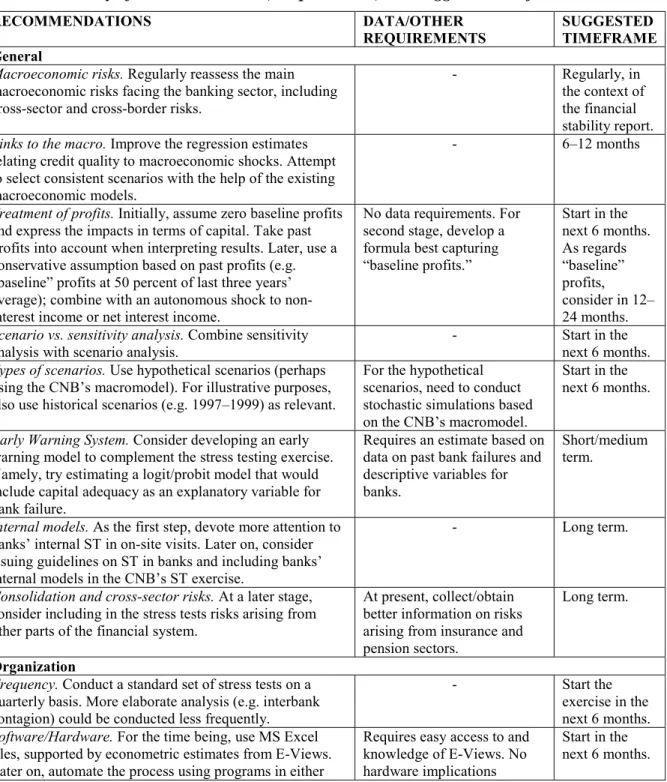
The note discusses key issues involved in designing a suitable set of stress tests for the Czech banking system. The aim of the note is to propose stress tests that could be used by the Czech National Bank on a regular basis to assess the soundness of domestic banks, both for purposes of macroprudential surveillance and for banking supervision. The author suggests that the exercise be broadly based on the stress tests conducted during the 2001 IMF-World Bank Financial Sector Assessment Program (FSAP) mission to the Czech Republic. He summarizes the FSAP stress tests, and proposes a number of extensions and modifications. The key recommendations are presented in a table that covers also data requirements and a suggested timeframe for implementation. The note includes results of a replication of the Czech FSAP stress tests for mid-2003 data.
JEL Codes: G21, G28, E44.
Keywords: Banking system, stress tests.
* Martin Čihák, International Monetary Fund ([email protected]). All views presented herein are those of the
author and not of any institution to which he is affiliated. I would like to thank: Jaroslav Heřmánek and Eva Komárková for their excellent cooperation on the stress testing project; Edward Frydl for providing me with the documentation on the Czech FSAP stress tests; Jarmila Musilová and Michal Hlaváček for detailed suggestions on an earlier draft; and the participants of interim seminars at the CNB in May and December 2003 for their insightful comments. This paper was written within the framework of the Czech National Bank Research Project No. B6/2003.
Introduction
This note discusses selected issues in designing a suitable set of stress tests for the Czech banking system which could be repeated on a regular basis. It builds on a review of the key concepts relevant to stress testing (Čihák, 2004). The note is to be followed by further technical work by the author in cooperation with the CNB’s Stress Testing Group towards implementing stress tests in the CNB during 2004.
There are two main reasons why it would be useful for the CNB to conduct regular stress tests. First, the tests could be used to support!the macroprudential analysis at the CNB, including in the banking sector stability report. Conducting stress tests on a regular basis would help to identify whether the overall pool of risks in the system is increasing or decreasing over time. Second, stress testing could help in strengthening banking supervision. In particular, it could be useful in focusing supervisory processes more on a risk basis. Together with signals derived from the regular off-site analysis, early warning models, and other information (including qualitative), stress tests should help to identify weak banks that need closer follow-up.
The structure of the note is as follows. The first section summarizes the stress tests conducted during the 2001 IMF–World Bank Financial Sector Assessment Program (FSAP) mission to the Czech Republic (“Czech FSAP stress tests”). The second section discusses the design of a stress testing exercise that could be used by the Czech National Bank on a regular basis. The exercise would be broadly based on the Czech FSAP stress tests, with a number of extensions and modifications. The third section is devoted to specific methodological issues relating to the individual risks. The fourth section summarizes the key recommendations and issues involved in developing further the stress testing framework. It includes data requirements and a suggested timeframe for implementation. An appendix presents the results of a replication of the Czech FSAP stress tests on mid-2003 data, compares the results with the FSAP stress tests, and illustrates some additions to the stress tests.
1. Stress Tests in the Czech Republic FSAP
In 2001, the FSAP mission to the Czech Republic carried out what were the first system-wide stress tests for the Czech banking system. A short summary of the main results of the stress tests was presented in the Financial Sector Stability Assessment report!(IMF, 2001). A detailed description of the stress tests was not published and may not be easily available to the reader. Given that the Czech FSAP stress tests could be a useful first step towards developing a regular stress testing exercise for the Czech banking system, the following text summarizes the methodology of the Czech FSAP stress tests.
1.1 Macroeconomic Risk Factors
The discussion of the macroeconomic factors affecting financial sector stability in the Czech FSAP noted that the experience so far had shown the resilience of the Czech economy to certain types of shocks. In the banking sector, the crisis at IPB had been handled without repercussions to
the rest of the sector. As for cross-border contagion risks, the Czech Republic had weathered well the crisis in Russia in 1998, and no significant pressure had been felt on domestic interest rates. The FSAP noted that the Czech economy faced risks that could potentially have a significant impact on real economic activity and the financial system. The risks were seen as emerging primarily from three factors: (i) the unsustainable fiscal situation and the absence of a well-articulated plan to address it; (ii) the dependence of both the budget and the balance of payments on large inflows of foreign direct investment, to a significant extent related to the privatization process; and (iii) the substantial reliance on the EU for export!markets and capital. The FSAP noted that the impact of these factors could be reinforced by inadequate progress with structural reforms, which could undermine confidence in the government’s policies and stem the flow of foreign direct investment.
1.2 Coverage
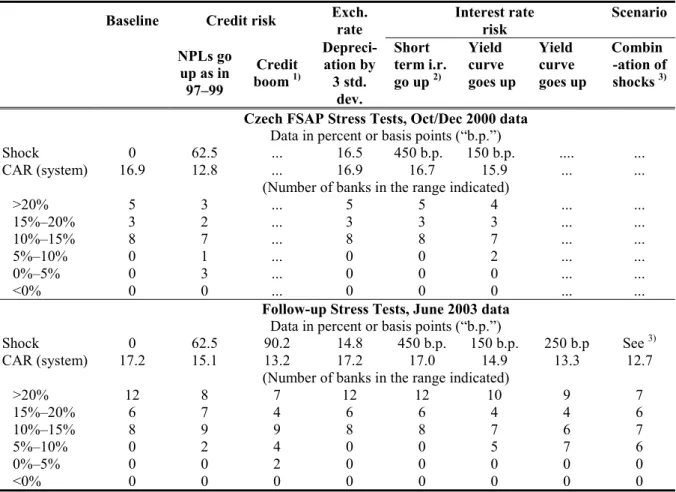
Based on a discussion of the potential vulnerabilities faced by the Czech economy, the Czech FSAP conducted stress tests on a potential increase in interest rates, a depreciation of the currency, and a deterioration in the loan portfolio following a downturn in external demand. The stress tests included simple single-factor tests (sensitivity calculations) for interest rate risk, foreign exchange risk, and credit risk. The impacts on the institutions were expressed as post-shock capital ratios (total capital relative to risk-weighted assets), compared to the pre-post-shock capital ratios.
The results of the FSAP stress tests were reported for 16 individual banks, grouped by type (3 large, 8 foreign, 2 domestic, and 3 building societies). The sample accounted for about 80 percent of assets in the Czech banking system. KOB was excluded from the list. The foreign banks that were included represented separately capitalized foreign bank subsidiaries in the Czech Republic. Foreign bank branches with no separate capital were omitted, since the stress tests were concerned with probing the vulnerability of institutions to insolvency risk.
1.3 Interest Rate Risk
Interest rate risk was assessed in the Czech FSAP using a simple duration analysis. The available data on the maturity breakdown of assets and liabilities were used to construct maturity “buckets.” In theory, the net asset position in each bucket should be multiplied by a duration factor that represents the price sensitivity of assets for that maturity class. Since average maturity or duration data for Czech bank assets were not available, risk weighting factors for maturity classes suggested by the Basel Committee on Banking Supervision were used instead. The change in the portfolio value was then the sum over all the maturity classes of net assets multiplied by the duration factor multiplied by the interest rate shock.
The first shock considered was a 150 basis point upward shift in the yield curve. This was an increase of 3 standard deviations (1 percent confidence level), based on a log-normal distribution of proportional interest rate changes. This shock would produce a modest negative effect on bank capital positions but was generally readily absorbed. Although this shock represented an upward shift in the Czech yield curve, it was applied to all net asset positions, including foreign currency asset positions, since separate data on the maturity distribution of foreign currency assets were not
available. This construction implies that a similar shock effects both foreign and domestic yield curves, leaving exchange rates unchanged. If the maturity distribution of foreign currency assets were similar to the maturity distribution of Czech koruna assets and only Czech interest rates change, the interest rate risk would be somewhat lower than that reported in the stress test.
The second shock studied was a 450 basis point jump in short-term interest rates maintained for three months and then reversing steadily over the next nine months. This models a temporary sharp increase in short-term interest rates. The jump by 450 basis points is roughly equal to the spike in two-month repo rates that occurred during the exchange rate crisis in May 1997. This test projects a sharp monetary tightening that abates relatively quickly. Because in this shock long-term interest rates are unaffected, the result on bank capital ratios is small.
1.4 Exchange Rate Risk
To model direct foreign exchange risk, the Czech FSAP stress test involved shocking banks’ net open positions in foreign exchange by a depreciation of 16.5 percent over three months. This shock corresponded to a 1 percent confidence level, assuming log-normal distribution of exchange rate changes, and was large in historical perspective—the maximum three-month exchange rate depreciation in February 1993–December 2000 was 20.1 percent (10.4 percent for appreciation). Net open foreign exchange positions were so small across banks that this depreciation had negligible effects (less than one percent of capital). Because of the lack of vulnerability to exchange rate shocks, no other stress tests for exchange rates were done.
The indirect foreign exchange risk (through changes in credit risk) was identified as potentially important, but not covered in the stress tests. The report!noted that a potential existed for an indirect impact of a foreign exchange shock through effects on the creditworthiness of Czech business borrowers who had taken out loans denominated in foreign currencies. A depreciation of the Czech currency would raise the burden of foreign currency debt, which would impact on the creditworthiness of borrowers with no offsetting foreign exchange assets or income to be used in servicing the debt.
1.5 Credit Risk
The Czech FSAP stress test for credit risk involved assessing the impact of an increase in the level of nonperforming loans (NPLs). The capital loss from this effect was calculated by provisioning new NPLs at the weighed-average provisioning ratio for NPLs (based on the actual distribution of NPLs as of September 2000 and equal to 0.7). The shock used was intended to project the effect of a recession on NPLs and was measured by the percentage point increase in the NPL ratio over the 1997–1999 recession (7.8 percentage points). This represented a relatively severe stress test, since the borrowing companies that would be affected by a recession were generally better able to continue servicing their debts than borrowers during the earlier recession. An inclusive measure of NPLs was used in this calculation. The receivables of Ceska Financni and Konpo were added to commercial bank and KOB NPLs, on the grounds that these receivables were originally generated by the impairment of bank loans.
The 7.8 percentage point rise in the NPL ratio was applied to the October 2000 level of commercial bank NPLs. The base level of NPLs incorporated reductions from reported levels of NPLs to reflect information and assumptions about shifts of impaired loans from some large banks to KOB. This adjustment reduced the total level of NPLs for the bank group used in the calculations by CZK 109 billion and reduced their NPL ratio from 24.8 percent to 9.9 percent. The level of total loans was left unchanged; it was assumed that the banks financed the transfer of impaired loans themselves by new loans to KOB.
This test produced significant negative effects on capital ratios of a few banks, with three banks falling well below the Basel minimum of 8 percent. The overall capital ratio for the sample fell by 4 percentage points to 12.8 percent. The tests suggested that credit risk may yet remain a significant vulnerability, at least for pockets of the Czech system.
1.6 Summary of the FSAP Mission’s Findings
The FSAP mission concluded that the Czech system did not appear to be very vulnerable to market risk. Foreign exchange positions were close to square for banks across the board, meaning that direct exposures of banks to exchange rate risk were negligible. Depreciation would increase the debt-servicing burden of unhedged borrowers of foreign exchange, but a decline in foreign currency loans relative to exports suggested that this may not have been a growing threat.
Exposure to interest rate risk was found to be limited by the FSAP mission. In the environment of constrained profitability and reluctance to lend, however, it was noted that banks had growing incentives to take on more interest rate risk.
The FSAP mission found that new credit shocks might pose localized problems, although institutions overall were reasonably well buffered by high levels of capital and the pockets of vulnerability could not be characterized as adding up to a systemic problem. It was noted that additional factors also worked to further mute the vulnerability of the system to distress. The large privatized banks had arrangements with KOB that allowed them to off-load existing nonperforming loans or, in some cases, some part of new unexpected NPLs that might emerge. The report!noted that these banks also had strong foreign strategic investors who had made a long-term commitment to the Czech market and were, therefore, likely to defend their banks against unexpected shocks. Given that the Czech system had undergone a protracted period of increased NPLs, the report!argued that potential problem loans had most likely already been squeezed out of the system.
2. Designing the Framework for Regular Stress Testing
Following the multi-step process explained in Čihák (2004), I will now discuss identifying the major risks and exposures in the Czech banking system and formulating questions about those risks and exposures; defining the coverage and identifying the data required and available; calibrating the scenarios or shocks to be applied to the data; selecting and implementing the methodology; and interpreting the results. In all these points, the FSAP stress tests are taken as a starting point and the discussion focuses on possible adjustments to the methodology.
2.1 Major Macroeconomic Risks
The general assessment of macroeconomic risks in the Czech economy and the main vulnerabilities in the Czech banking system remain broadly unchanged from those in the FSAP report. The macroeconomic and macrofinancial developments since the FSAP have indicated the following:
• Since the FSAP, the Czech economy has again shown its resilience to external shocks. The IMF’s 2003 Article IV mission noted that despite slowing demand in export!markets, growth had remained at a respectable 2 percent. Even though an unsustainable fiscal stimulus had played a role, export!market penetration, thanks largely to success in addressing structural weaknesses and the post-crisis pick-up in private investment, had also been important. Sustaining this strength over the short to medium term would require authorities’ efforts during what, according to the Article IV mission, “may prove to be a period of relatively weak external growth and increasing competition in Europe.”
• The financial soundness of the Czech banking system has continued to improve. Banks’ capital adequacy ratio (CAR) remains strong (about 14.5 percent at end-2003), and profitability and liquidity have been increasing. A decline in interest earnings (due to low nominal interest rates) has been more than offset by increases in fee income and declines in costs (mainly in the personnel part). NPLs (8.9 percent at 2002 and 4.8 percent at end-2003) have been declining (to a significant extent due to a transfer of NPLs to the Czech Consolidation Agency), contributing to the increase in profitability. In addition, provision coverage continues to improve, standing at 74 percent in 2002 and 77 percent in 2003.
• At the same time, the risk profile of banks has been changing. The majority of system-wide assets are in government and central bank instruments due to the lack of acceptable risks in other portfolios, in particular lending to SMEs. Banks’ risk appetite has shifted from corporate toward consumer credit, with lending to households rising quickly, while loans to corporations (adjusted for write-offs transferred to the Consolidation Agency) remain flat. In 2002 and 2003, credit to households increased by about 29 and 32 percent y/y respectively, fueled by growth in real wages, aggressive marketing by banks, and lower nominal interest rates. Banks plan to shift even more towards household credit, given its still relatively low share in total credit and negligible reported default ratios. At the same time, reacting to the low nominal interest rates, depositors have been shifting funds from term deposits to demand deposits and to products such as construction savings accounts, pension funds, life insurance, and investment funds.
• In the years leading up to euro-area accession, credit growth to the private sector is likely to increase substantially (Cottarelli et al., 2003). Although this growth should be regarded as a positive development, it will create additional challenges for banks’ risk management practices and banking sector supervision.
2.2 Coverage
The institutional coverage of the Czech FSAP stress tests (16 banks, accounting for about 80 percent of the banking system) would be sufficient from the macroprudential perspective. For supervisory (microprudential) purposes, however, it might be useful to increase the coverage to all domestically incorporated banks. Given that all the calculations would be computerized, this
would not increase the computational difficulty dramatically. The appendix to this note shows the first calculations for this wider sample.
Similarly to the stress tests in the Czech FSAP, it might be useful to exclude branches of foreign banks from the calculations. It is not difficult to replicate most of the calculations done for banks also for the branches. However, given that it is convenient to express the impacts of shocks in terms of changes in capital ratios, and given that the branches are a relatively small part of the banking sector, excluding the branches simplifies the presentation without distorting the results in a major way. (The calculations presented in the appendix were also done for branches, but the results presented only cover banks.)
To the extent possible, stress testing calculations should be based on consolidated data. At the time of the FSAP, consolidated supervision was only applied to bank groups and the CNB had no authority to require consolidated supervision for financial holding companies or mixed holding companies. Given the growth of financial conglomerates in the Czech Republic, this was an important weakness of the input data. Since the FSAP, the CNB has issued rules for consolidated supervision and risk management for credit risk and market risk (in force since January 2003). In March 2003, a revised memorandum of understanding (MOU) was signed between the domestic supervisory agencies, allowing information sharing and consolidated supervision of banking, insurance, pension funds, and the capital market.1 MOUs were also signed with supervisory agencies abroad. In general, the approach in the stress tests should be to use consolidated data to the extent possible. However, data for consolidated entities tend to be more limited in scope than those for solo banks (e.g. there are no data on residual maturity, and no classification of total loans or NPLs by sector for consolidated institutions), which limits the potential use of consolidated data in the stress tests. Also, estimates based on past data will necessarily be based on solo bank data, since most of the information would come from periods before the consolidated data became available.
As regards the coverage of risks, it would be useful to cover, apart from the risk factors already covered in the Czech FSAP stress tests (interest rate risk, exchange rate risk, and credit risk), also sectoral and concentration risks (as a part of credit risk), equity price and real estate price risk, and liquidity risks. An important extension of the stress testing exercise would be to include interbank contagion risk, i.e. the risk that a failure of one bank can carry over to another bank.
2.3 Methodology and Calibration of Shocks
It is proposed that the stress tests contain both sensitivity analysis and scenario analysis. The advantage of scenario analysis is that it can capture the impact of consistent sets of shocks. Sensitivity analysis has also its advantages, since it can help assess the robustness of the system with respect to the individual shocks and show how the impact changes if the assumed shocks change.
1 An earlier version of the MOU had been in place since 1998. In November 2003, a committee consisting of
representatives of the central bank, the Ministry of Finance, and the Securities Commission announced that they see it as efficient for financial sector supervision to be unified in several steps by the time of the Czech Republic’s entry to the European Monetary Union.
As regards the time horizon over which to measure the impact of the shocks, it would be preferable to estimate the impact of the shocks on the net present value of the bank, which would require estimating the impact on all future economic flows and discounting it back in the present. Such a calculation would be too difficult to implement. Instead, most FSAPs measure the impact over a chosen period of time, typically a year. For our calculations, we will also choose the one year horizon.
Macroeconomic scenarios
For the scenario analysis, it is suggested to use hypothetical scenarios. Historical scenarios, such as the 1997 exchange rate turbulence and the 1997–1999 recession, might be used to compare the impact with the shocks that were actually observed. However, the interpretation of these results would be quite difficult given that there have been major changes in the macroeconomic relationships since 1997, among other things because of a change in the exchange rate regime. The hypothetical scenarios can be used to judge the possible impact of shocks going beyond historical experience.
The relative sizes of the shocks in the hypothetical scenarios can be justified using macroeconomic models. Recognizing the limitations of macromodels, especially for large shocks, it would be useful to employ the CNB’s existing macromodels in the scenario design. The model could be used to determine the relative sizes of the shocks to the risk factors and to assess the likelihood of the scenarios (ideally using stochastic simulations based on the model). A practical question is, however, which of the CNB’s models to use. The CNB currently uses different models for medium-term and short-term forecasts. A disadvantage of the model used for the medium-term forecasts is the fact that it is not sufficiently detailed; also, instead of GDP, it contains only the GDP gap. A disadvantage of the model used for short-term forecasts is the short-term nature of the model as well as the low transparency of the forecast. A pragmatic approach would be to cross-check the consistency of a macroeconomic scenario using both models.
For market risks, stress tests could explicitly identify a “worst case scenario,” i.e. a combination of risk factors that, for a given level of plausibility, minimizes the value of a portfolio. A software tool can be programmed (in the Austrian National Bank, such a tool is used under the name “Worst Case Finder”) to identify worst case scenarios on the basis of a mathematically well defined definition of the plausibility. For credit risks, however, given the difficulties in measuring covariance between credit and market risk, the assessment will have to be derived from an informed judgment based on historical data.
Threshold approach
It is suggested to attempt also an alternative presentation of the results by showing the largest shocks that leave the system above a certain threshold. The advantage of this approach is that it does not require calibrating macroeconomic scenarios, while providing intuitive results that are straightforward to interpret. The following thresholds could be used: (i) the largest shock that the banking sector would be able to survive with no bank becoming insolvent; (ii) the largest shock such that no bank’s CAR declines below 8 percent; or (iii) the largest shock such not more than 5 percent of the banking system becomes insolvent.
Measuring the macroeconomic relevance of the impacts
A practical question relating to the presentation and interpretation of the results is how to express and assess the overall magnitude of the impacts. The standard presentation, used in the Czech FSAP stress tests, is to express the impact in terms of a change in the system’s ratio of capital to risk-weighted assets (CAR). This is a reasonable approach; nonetheless, the CAR does not capture the potential macroeconomic repercussions of the banking sector’s losses.
An approach that can be used in addition to the standard presentation is to express the overall loss in capital as a percentage of gross domestic product. Differences in sizes of financial sectors and in stress testing methodologies make it difficult to conduct a cross-country comparison as a basis for an assessment of whether a particular impact in terms of GDP is large or small. Nonetheless, expressing the impact as a percentage of GDP at least makes it possible to assess the macroeconomic relevance of the calculated shocks in the domestic economy. Also, it is important to look at the development of this measure over time. An increase in the potential impacts as a percentage of GDP would (for an unchanged methodology of stress tests) signal that the financial sector poses an increasing risk to overall macroeconomic stability. Indeed, the interpretation of any ratios to GDP needs to take into account the fact that GDP itself is subject to fluctuations. 1.4 Implementation Issues
We will now briefly discuss five questions relating to implementation: (i) what data to use; (ii) how frequently to run the stress tests; (iii) using what software; (iv) by whom; and (v) in what form to disseminate and present the results.
Data. For all the risks, it is necessary to include not only balance sheet exposures, but also those arising from off-balance sheet items. For historical time series, a question is whether to exclude or include data for failed banks. It is suggested to include them, since excluding failed banks could lead to an underestimation of the likely impacts of external variables on the health of the banking system.
Data improvements are particularly needed in the following areas:
• To keep pace with the rapid development of banks’ exposures to households, monitoring of potential vulnerabilities arising from these exposures needs to be strengthened. In particular, more detailed data on household credit are needed (this should be assisted by targeted on-site examinations of banks’ risk management practices in this area and perhaps even the implementing of loan-to-value norms).
• Collect and analyze migration of loan quality and corporate debt indicators, in particular those relating to indirect foreign exchange risk (e.g. NPLs by currency denomination).
• Collect and analyze data on the SME sector.
• Collect data for the interbank contagion matrix, described generally in Čihák (2004) and more practically in part III.E of this paper.
Frequency. It is suggested to conduct a standard set of stress tests on a quarterly basis. The sensitivity analysis can be conducted more frequently. The more elaborate analysis (e.g. contagion analysis) could perhaps be conducted less frequently. Conducting the analysis on a regular basis
will make it possible to assess whether the pool of risk in the system is growing, stagnant, or decreasing.
Software. It is recommended for the time being to use Microsoft Excel workfiles, supported by econometric estimates from EViews. This was the approach taken in the Czech FSAP stress tests. Later on, the process can be automated using programs built either in Microsoft Access or Excel. The stress testing file should have a transparent and well documented structure, which should include the following:2
• A ReadMe worksheet, describing the structure of the file, contacts, and changes;
• Input worksheets, containing the input data; the worksheets should be in a format that is easy to extract from the CNB’s information system, to make feeding new data into the file and regular operation of the stress tests a routine operation;
• An Assumptions worksheet, which would include all the assumptions of the model (and allow the user to change all the quantitative assumptions) and the sizes of all the various shocks; no shocks or quantitative assumptions should be introduced in the calculations elsewhere in the file except in this worksheet;
• Calculation worksheets; one worksheet for each of the risks covered, and one general worksheet (Results) summarizing the impact of the various shocks on capital adequacy; the Calculation sheets would be linked to the Input sheets and the Assumptions sheet; a change in any of the model assumptions or shock sizes in the Assumptions sheet should lead to an automatic recalculation of all the Calculation worksheets; and
• Presentation worksheets, which would include hard numbers (values), copied from the Results sheet, charts, and other information based on the calculations.
Who to run the stress tests? This note assumes that the stress tests would be run by the supervisors on a routine basis. It is, however, expected, that research-oriented staff would provide help with estimating the sensitivity coefficients and other inputs in the stress testing models. The banking supervision department should keep the master Excel file with the calculations; at the same time it is possible that research staff would work with the file to test the model and to assess the impact of new assumptions or techniques.
Dissemination and presentation. The stress tests could be presented in internal reports distributed to the CNB’s senior management. These reports could include bank-by-bank results and also be linked with the results from the supervision department’s early warning system. Summary results could be used as inputs for the financial sector stability report. These would focus on the macroprudential surveillance implications of the stress tests and present the results in aggregate form and by peer group.
3. Specific Methodological Issues
We will start this section by discussing the treatment of profits in stress tests. We will then turn to specific methodological issues relating to the individual risk factors, namely credit risk, exchange rate risk, interest rate risk, equity and real estate price risk, and liquidity risk. Finally, we will discuss practical issues involved in modeling interbank contagion effects and cross-border and cross-market contagion effects.
3.1 Treatment of Profits
One practical issue that deserves some discussion in the design of the stress tests is the treatment of profits. Most FSAP stress tests, including the Czech ones, expressed the impact of the various shocks in terms of capital adequacy ratios. In some FSAP missions, an attempt was made to take into account the profits that banks could use against the losses created by shocks. Both approaches have their advantages and disadvantages.
The main advantage of the first approach is its simplicity. It does not require forecasting of banks’ baseline profits (i.e. profits that they would have if there were no shocks) and is arguably more prudent. The disadvantage of the approach is that it can exaggerate the actual impact of the shocks, since banks would typically use profits as the first line of defense. In banking systems with consistently high profits, assuming zero profits could lead to a significant exaggeration of the actual impact caused by stress. It could be argued that this approach is equivalent to assuming that on top of any other shocks or scenarios, there are always some other shocks that cause profits in each bank to be exactly zero. Such an external shock would not only be arbitrary; it would also discriminate against banks that tend to be more profitable.
Including profits makes stress testing calculations more complicated and dependent on an additional assumption (i.e. on the baseline profit forecast). However, for banks with consistently positive profits, it is reasonable to envisage that profits would be positive in the absence of any shocks and that they could be used by the bank against the losses created by the stress scenarios.3 To address the suggestion that this approach could be “less prudent,” it is possible to assume an autonomous shock to non-interest income or net interest income on top of other shocks. This autonomous shock could be interpreted as a proxy for other general shocks that could affect the soundness of banks and are not captured by any of the explicitly specified shocks.
A pragmatic solution regarding the treatment of profits in the stress tests for the Czech banking system would be, in the initial step, to use the first approach. The fact that profits were omitted needs to be taken into account in the interpretation of the results. The results of this approach can be understood as a normalization of the impacts by risk-weighted assets and comparing them with capital. As an intermediate step, the impacts can be, after the calculation, compared with (a function of) the past profits. In the next step, a prudent assumption based on past profits (e.g. the “baseline” profits could be 50 percent of the average of the last three years) can be introduced and combined with an autonomous shockto non-interest income or net interest income.
3 Indeed, according to the regulations, undistributed profits can become a part of the bank’s capital, subject to
3.2 Credit Risk
Credit risk was identified as the most significant source of risk in the Czech FSAP stress tests. In terms of the categorization introduced in Čihák (2004), the Czech FSAP credit stress test used a mechanical approach based on loan performance. Consequently, we start with a discussion of technical issues in the mechanical approach, followed by regression analysis based on the loan performance data and by approaches based on data on borrowers.
Stress tests assuming an increase in nonperforming loans
As regards the size of the aggregate shock, there was a marked variation across FSAP missions, reflecting country-specific circumstances. The size of the credit shocks ranged generally between a 5 percent and 30 percent increase in NPLs (IMF and World Bank, 2003). The 7.8 percentage point increase in the NPL ratio used in the Czech FSAP stress tests corresponded to a 62.5 percent increase in the volume of NPLs, i.e. it was quite substantial.
The size of the credit shock in the Czech FSAP stress test was derived to replicate the effect of the 1997–1999 recession (in particular, the increase in NPLs was chosen so as to lead to the same percentage point increase in the ratio of NPLs to total loans). For the first iteration, it is possible to use the same relative size of credit shock as in the Czech FSAP stress test (i.e. a 62.5 percent increase in NPLs). In further development of this particular stress test, it might be useful to estimate an econometric model based on the past Czech data which would include NPLs and a number of macroeconomic variables.4 It is encouraging that the CNB has already been conducting econometric work along these lines.
In stress tests that assume an aggregate increase in NPLs, the question arises how to model bank-by-bank increases in NPLs. There are many possible approaches to modeling them. The increases in NPLs in individual banks can be proportional to: (i) the bank’s existing stock of NPLs; (ii) its performing loans; (iii) the sum (or weighted sum) of its NPLs and performing loans; and (iv) past increases in the bank’s NPLs under similar shocks.
Approach (i), which was used in a number of FSAPs, including the Czech one, means assuming that banks more prone to NPLs in the past would also have more new NPLs. This could be because the relative levels of existing NPLs reflect relative qualities of credit risk management and, therefore, at least in part, prospective NPLs. The possible problem with this approach is that it ignores the size of the loan portfolio as a credit risk factor. This is relevant in cases where there have been important changes in credit policies or in the economic environment (both of which apply to the Czech banking sector in the recent period). For example, when bank lending starts to grow quickly, lagging indicators such as NPLs are likely to overestimate the quality of loan portfolios.
For the above reasons, it might be useful to make the new NPLs dependent on the existing stock of performing loans, as in approach (ii).5 However, this approach might be viewed as penalizing banks with lower NPL ratios for their good performance. A compromise approach is therefore
4 For a practical example of a model along these lines, see Shu (2002).
5 This could be viewed as a simplified version of the credit quality transition matrices popular in the literature,
often used which is a combination of (i) and (ii). The last approach, (iv), is arguably the most “elaborate” in this group, as it would require basing the postulated bank-by-bank increases in NPLs on actual bank-by-bank increases observed in the past rather than on the aggregate shock. Rapid growth in total loans
The Czech FSAP credit risk stress test only tested for an inflow of NPLs from the existing stock of performing loans. In other words, it assumed that the overall stock of loans is fixed. However, one of the important concerns in the Czech Republic, as well as in a number of other CEC countries, is the risk associated with rapid growth in credit (see, e.g., Cottarelli et al., 2003). Indeed, in the Czech Republic, certain segments of the credit market have already been growing quite substantially, especially lending to households. It might be therefore useful to include in the stress tests for credit risk also tests for the likely impact of increased growth rates of credit.
The implementation of this stress test can be, at least in the first step, similarly simple to the test for a shift of loans from the performing to the nonperforming category. Similarly to the approach taken by some FSAP missions, we can assume that a certain part of the newly granted loans shifts into NPLs and calculate the impacts in the same way as in the basic credit risk stress test. A mild (and perhaps more realistic) variation of this approach is to assume that the new NPLs are not proportional to the new loans, but rather that their incidence is much higher above a certain threshold, e.g. for banks that have more than 20 percent growth. Ideally, the threshold should be estimated econometrically, based on past experience with loan performance in banks with rapidly growing portfolios.
Sectoral stress tests based on loan performance
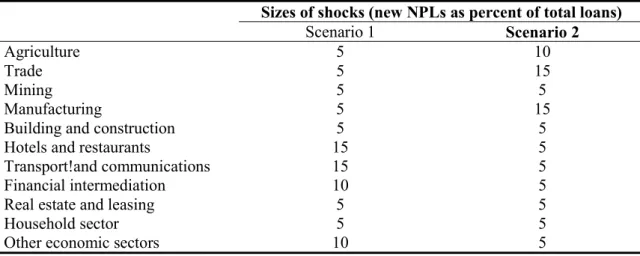
Another important subgroup of approaches is those that try to capture sectoral risks. An illustrative example of a very simple framework for stress testing sectoral risks is presented in Table 1. The two scenarios presented here are defined by the increases in NPLs arising from total loans in the individual sectors. In the particular example shown here, the inflow of new NPLs varies from 5 percent of total loans in the sector (for sectors that are influenced by the shock only very indirectly, through general changes in economic conditions) to 15 percent (for sectors directly impacted by the modeled shock). In this particular example, Scenario 1 could be thought of as a shock to the tourism industry, while Scenario 2 could model the impact of an exchange rate appreciation. It should be reiterated that this is a purely illustrative example and that selecting appropriate sectoral assumptions for the Czech case would need to be the subject of a thorough discussion.
Table 1 refers to industries defined by types of products. Similar calculations can also be conducted on economic sectors defined by the type of borrower. Indeed, for the first stress testing calculations, we were able to obtain data separately for the government sector, publicly owned companies, foreign/domestic private companies, and households.
Table 1: Implementation of Sectoral Shocks (by Industry)
Sizes of shocks (new NPLs as percent of total loans)
Scenario 1 Scenario 2
Agriculture 5 10
Trade 5 15
Mining 5 5
Manufacturing 5 15
Building and construction 5 5
Hotels and restaurants 15 5
Transport!and communications 15 5
Financial intermediation 10 5
Real estate and leasing 5 5
Household sector 5 5
Other economic sectors 10 5
Source: Author.
Concentration risk
Given the importance of large industrial groups in the Czech economy, it would be advisable to include in the stress tests for credit risk also concentration risk in lending, i.e. the risk of failure of a major borrower or group of borrowers. In the first step, simple sensitivity analysis for large exposures could be conducted. This can be based on available data about the largest borrowers of a bank. In the second step, it will be important to identify borrowers that have lending exposures to several different banks.
Approaches based on data on borrowers
The main disadvantage of the approaches based on loan performance is that NPLs are lagging indicators of credit quality. A more direct and potentially more beneficial approach would be to use corporate sector and household sector data. The key problem of that approach in the Czech context is the lack of adequate and timely information.
A possible approach based on data on borrowers involves a mapping from corporate sector fundamentals (such as the interest coverage ratio) to the soundness indicators of the financial system (in particular the NPL ratio).6 Another important element of this approach is to establish a baseline relationship between NPLs and economic activity. Finally, using cross-sectional regression techniques or another method,7 one can estimate the relationship between output growth (approximated by GDP or industrial production growth in a particular sector) and the interest coverage ratio. This can provide a way to link an explicit macroeconomic scenario involving GDP growth rates to the situation of the corporate sector. Then, using the mapping between the interest coverage ratio and NPLs for the different corporate sectors, the links between
6 Goldman Sachs (2000) and Heytens and Karacadag (2001) are examples of this approach. The interest
coverage ratio is the ratio of earnings before interest, taxes, and depreciation to interest expenses.
7 An alternative method to using cross-sectional regression techniques is to estimate Markov transition matrices
for both NPLs and interest coverage ratios for different economic conditions (e.g. one for booms and one for recessions). Applying the transition matrices to the NPLs and interest coverage ratios in a chosen macroeconomic scenario (e.g. a sequence of recessions) provides an estimate of what those respective ratios would be. This should enable the estimation of NPLs and interest coverage ratios for a variety of different sequences of economic activity.
a general macroeconomic scenario and NPLs, by way of corporate sector balance sheets, could be established. Once these relationships are established, this scheme of sectoral linkages could then be used to simulate various changes in parameters and growth rates to examine the sensitivity of NPL ratios to different economic circumstances.
An alternative model using individual company data is a logit/probit model forecasting the probability of corporate bankruptcy as a function of company size, sectoral characteristics, financial indicators (e.g. leverage, earnings, liquidity, financial strength, foreign exchange earnings to foreign exchange credit).8 The regression should also include variables characterizing the ownership structure of the company. The stress testing scenario would provide changes in these characteristics, which would then be translated using the logit model into changes in the default probabilities. This could then be linked to individual banks through their exposures to individual industries (or groups of companies). This would allow for the calculation of the potential loss of a bank (after taking into account guarantees). Including sectoral characteristics in the logit regression would make it possible to conduct the sectoral credit risk stress tests on an arguably sounder footing than the sectoral stress test illustrated in Table 1.
Given the rapid and still ongoing structural changes in the Czech economy, there is a case for basing the analysis on individual company data rather than aggregate or sectoral data. In particular, there is significant heterogeneity in economic performance within individual sectors depending on other parameters such as the ownership structure. In this situation, aggregate data may disguise important differences among groups of companies.
The disadvantage of the approaches based on data on borrowers is that it is difficult to obtain this information on a timely basis, especially for smaller borrowers. In the Czech context, we do not have financial ratios on the household sector which would allow for such a detailed analysis. Given the rapid growth in household lending in the Czech Republic in recent periods, this is an important data gap. It would therefore be advisable, while continuing for the time being with loan classification data as the basis for the credit risk stress test, to improve the statistical database so as to obtain better data on the financial situation in the real sector, both in the corporate sector and, in particular, in the household sector.
At present, there is no comprehensive database covering financial data for individual companies. The Czech Statistical Office has a database which should cover financial data on all companies with more than 100 employees; however, this database does not have sufficiently detailed reporting of liabilities operations (e.g. borrowed funds and reserves). Companies with 20–100 employees provide even less data and are covered only through a survey. For the CNB’s purposes, it might be preferable to use the Central Credit Registry database, which has more detailed data on loans and also covers all credits. However, the linking of the two databases is hampered by some legal and communication problems.
8 Such a model was recently estimated in another former transition country. However, preliminary calculations
for the Czech economy, using data on medium-size (20–100 employees) and large (100+ employees) companies, by M. Hlaváček from the Czech Statistical Office were unsuccessful, perhaps because the bankruptcy variable was distorted by the weak legal and judicial framework for bankruptcy. In this context, it might be more useful to estimate the relationships between the financial ratios of companies and subsequent changes in their loan classification.
The situation is even more complicated for household credit, given the lack of consistent historical data. Moreover, a practical obstacle from the viewpoint of accessing the data by the CNB is that the credit registry for physical persons is organized by a private company. On the other hand, it is possible to expect a higher degree of homogeneity of data in a relatively small number of groups.
3.3 Exchange Rate Risk
Similarly to the credit shock, there was a marked variation across the FSAP missions in the calibration of the exchange rate shock, reflecting country-specific circumstances. The range of assumed depreciations and appreciations of the exchange rate varied between 10 and 50 percent (IMF and World Bank, 2003).
Some minimum criteria for the exchange rate shock can be derived from the standards promulgated by regulators, although in most currencies, stress tests should include much more dramatic exchange rate changes:
• the Basel Committee’s capital charges for foreign currency risk are based upon exchange rate changes of ± 8 percent; the Basel Committee also recommends the use of volatility fluctuation of at least 25 percent to determine capital charges for options;
• the Derivatives Policy Group (1995) has recommended at least 6 percent for major world currencies and 20 percent for other currencies; and
• the financial instruments disclosure of the Commission of European Communities (2000) mentions an adverse change of at least 10 percent.
Direct exchange rate risk
Direct exchange rate risk is likely to be negligible, similarly to the Czech FSAP stress tests. At end-2002, the banking system’s net open position in foreign exchange relative to capital was 0.5 percent. At the same time, it should be noted that this figure excludes foreign exchange guarantees, inclusion of which would bring the number down to -49.8 percent. Referring to EU guidelines, the CNB does not routinely include foreign exchange guarantees in the computation for net open position. The IMF’s Financial Soundness Indicators Compilation Guide (IMF, 2003) includes in the definition of the open position “guarantees (and similar instruments) that are certain to be called and likely to be irrecoverable.” At the same time, the guide admits that even though ideally one would need data on the likelihood of the contingency occurring, “calculating the likelihood of the losses can be difficult, and international standards are evolving.” The CNB considers the probability of guarantees being called to be very low, even though no estimates of such probabilities are maintained. A large part of the foreign exchange is concentrated in the Czech Export!Bank, whose results seem good so far: it has been profitable, with an NPL ratio of only 0.6 percent, despite the past appreciation of the Czech koruna, and with an A1 long-term foreign exchange rating from Moody’s. A fair approach at this stage would be to use the 0.5 percent figure, while closely monitoring the likelihood of default on the foreign exchange guarantees.
Another potential issue is the method of inclusion of foreign exchange options in the calculation. Currently, option contracts are reportedly included by banks at face value. This potentially introduces a bias into the reported net open positions. The Financial Soundness Indicators Compilation Guide (IMF, 2003) suggests the delta method as a preferred one. This is not a major issue at present, since the volume of option contracts is very low compared to foreign exchange swaps/forwards.
Indirect exchange rate risk
Indirect exchange rate risk was not covered in the Czech FSAP stress tests and could potentially be an important source of risk. For simplicity, we will now focus on the case of a depreciation (the discussion would be very similar for an appreciation). A depreciation is likely to:
1. increase the domestic currency value of foreign exchange loans, hurting borrowers without corresponding foreign exchange earnings (or assets);
2. increase the competitiveness of Czech-produced products in international markets, increasing foreign exchange revenues, possibly even for borrowers who did not have such revenues in the first place, and serving as a potential offset; it should be noted in this regard that the corporate sector’s export!earnings have in recent years provided higher coverage of foreign exchange loans than was the case in the past; and
3. decrease the competitiveness of importers or import-dependent firms.
The overall impact on the banking sector depends both on the relative size of these effects and on the exposures of banks to the different groups of borrowers (denoted here for simplicity as “exporters” and “importers”).
The methods for quantifying this source of risk are the same as the methods used to analyze credit risk: the exchange rate is one of the factors that should be used as an explanatory variable for corporate sector defaults in the credit risk model proposed earlier. A simplified solution based on loan performance data is to assume that a certain percentage of foreign exchange loans become nonperforming as a result of the exchange rate depreciation. The percentage could be estimated using regression analysis.
3.4 Interest Rate Risk
The size of the interest rate shock can be based on historical experience, it can be a multiple of the standard deviation, or it can be a part of a hypothetical scenario. The following are some examples that could be used as very broad guidance:
• The Derivatives Policy Group (1995) recommended a parallel shift in the yield curve of 100 basis points up and down; a steepening and flattening of the yield curve by 25 basis points; and an increase and decrease in the 3-month yield volatilities by 20 percent of the prevailing levels.
• The Basel Committee for Banking Supervision suggests a standardized interest shock of 200 basis points. The U.S. Federal Reserve Bank examination manual also notes that a 200 basis
point parallel shift in the yield curve represents a plausible scenario, based on 1974–1994 data.
• In FSAP missions, the size of interest rate shocks ranged between a 50 and 300 basis point increase in interest rates (IMF and World Bank, 2003).
• The 150 basis point shock to the yield curve would then appear broadly in line with these general guidelines, but there would appear to be space for a larger shock.
• The calculation of the impact of the interest rate shock requires good data on the asset and liability maturity structure. Therefore, the key questions to be asked are: (i) do banks report!residual maturity properly; (ii) does the indicator capture the whole balance sheet; and (iii) are off-balance sheet contracts included? The stress test measuring the price revaluation effect of changes in interest rates should include all instruments, except equities, that are marked to market or fair valued on the balance sheet. The stress test measuring the effect on net interest income should include all interest-bearing instruments regardless of whether fair valued or not. Relevant positions in financial derivatives and off-balance sheet instruments need to be included in the stress tests.
• Consideration could be given to differentiating the interest rate stress test by currency. That would require residual maturity data for each currency and specifying separate shocks to each of the currencies. The signs and relative sizes of the shocks could be based on the correlation patterns observed in the past.
• Given the absence of sufficient data at this stage, it is recommended that in the first step, the simplified method used in the Czech FSAP stress tests is followed, namely to use residual maturity data plus the weights proposed by the Basel Committee. At the same time, it would be useful to work on improving the interest rate reporting formats to better capture the potential interest rate risk resulting from banks’ interest rate positions.9
The above discussion relates only to the direct risk to banks resulting from changes in the (nominal) interest rate, through changes in asset prices and net interest income. A comprehensive stress test would also need to include the impact of (real) interest rate changes on borrowers’ creditworthiness. This effect and its modeling are discussed in relation to credit risk.
3.5 Interbank Contagion
The key to implementing the interbank contagion stress test is to put together the matrix of interbank exposures as characterized in Čihák (2004). This means that, for each bank, we would need to know its total uncollateralized credit exposures to each of the other banks operating in the interbank market.
The problem in the Czech case is that data are available only on the total exposure of a bank with respect to the rest of the banking system, not bank by bank. To cover this data gap, it would be worthwhile to consider collecting such data, at least with a low frequency (having in mind the
9 The approximate weights proposed by the Basel Committee generally tend to be a fair approximation of the
actual results obtained with more detailed data. There will be, however, no proof that this is indeed the case in the Czech Republic until more detailed data on the duration of assets and liabilities are obtained.
reporting burden) and conducting the test on such a basis. In the meantime, as a first step, we can use the existing data on each bank’s aggregate exposure to the interbank market and distribute the number according a proxy variable. Possible candidates for the proxy variable include banks’ total assets, total loans, or the relative sizes of their own exposures to the interbank market.
The following is a practical example of how the interbank contagion stress test could be implemented in the Czech case. In general, the initial impulse can be a liquidity or default shock. To begin with, it is suggested to simplify the analysis by treating failure of payments in any type of exposure as a default, i.e. assuming that losses occur simultaneously to all other types of exposures. (Alternatively, to capture the short-term liquidity impact of a counterparty failure, we would need to collect data on interbank gross claims with maturity breakdown).
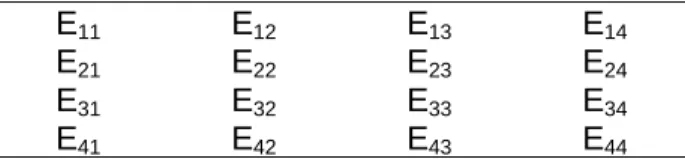
We will present the suggested implementation of the interbank contagion stress test on a banking system with only four components. These components should ideally be individual banks (the calculations would be the same for, say, 26 banks, but a 26x26 matrix would be more difficult to present than a 4x4 matrix), but we can also think of them as bank groups (if it were substantially easier to obtain such data for groups of banks rather than banks themselves). For simplicity, we will refer to the four components as “banks.” Eij is the sum of all types of gross exposures of bank
i to bank j, including both on- and off-balance sheet exposures.
Table 2: A Matrix of Interbank Exposures (Example with Four Banks)
E11 E12 E13 E14
E21 E22 E23 E24
E31 E32 E33 E34
E41 E42 E43 E44
The interbank contagion analysis starts with a shock to bank group 1, resulting instantaneously in the loss of claims at groups 2, 3, and 4. For the purpose of these stress tests, it can be assumed that there is no recovery at all, which is a realistic assumption for the short term, but conservative for the long term. (Alternatively, one could assume a percentage recovery in the long term, based on past experience or on other countries’ experience, and multiply the impacts by one minus the recovery ratio.) Let Ci, Ai, and Si be the Basel capital, risk-weighted assets, and capital adequacy ratio for bank i. The first iteration means recalculating the capital adequacy ratio in the following way:
Si’ = (Ci-E1i)/(Ai-Ei1), where i=2, 3, and 4.
The second step of the analysis consists in constructing a mapping from the capital adequacy ratio to the probability of bank i defaulting, Pdi. Table 3 shows an example of the mapping used by some other central banks. Multiple mappings may be constructed under different scenarios (e.g. baseline and worst-case). This is purely an example; the numbers in Table 3 could be replaced by assumptions that are viewed as more appropriate for the Czech banking system based on past experience or analysis of the Czech banking system. Ideally, an estimate of the probabilities in the “baseline” mapping could be derived from an early warning system model (see the discussion in section III.H). As regards the capital ratios used in Table 3, it would probably be advisable to focus on tier 1 capital ratios.
Table 3: Assumed Default Probability and Capital Adequacy (in percent) Capital adequacy ratio Pi CAR>=10 0.02 9=<CAR<10 0.05 8=<CAR<9 2 6=<CAR<8 25 4=<CAR<6 50 CAR<4 100
Based on the mapping in Table 3, another set of capital adequacy ratios can be calculated to reflect the cascading effects on bank i of the increased likelihood of other banks, also exposed to bank 1, having liquidity problems. Again, zero recovery is assumed for simplicity (a non-zero recovery rate R would mean multiplying the impacts by (1-R)).
S2’’=(C2-E12-P3*E32-P4*E42)/(A2-E21-P3*E23-P4*E24) S3’’=(C3-E13-P2*E23-P4*E43)/(A3-E31-P2*E32-P4*E34) S4’’=(C4-E14-P2*E24-P3*E34)/(A4-E41-P2*E42-P3*E43)
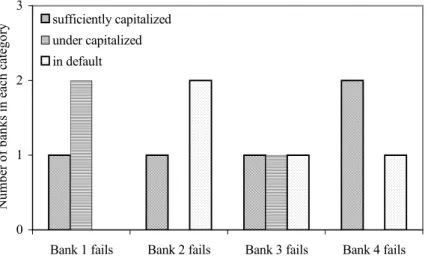
The third step of the analysis consists in repeating this exercise with banks 2, 3, and 4 canceling payment one at a time. For each bank, an after-shock capital adequacy ratio is thus calculated for each of the other three failing banks. The findings can then be summarized using a categorization consistent with the above mapping. Bank i can be classified as “sufficiently capitalized” if Si”is 8 percent or more; “under-capitalized” if Si” is from 4 to 8 percent; and “in default” if Si” is less than 4 percent.
For each impulse of the counterparty failure of bank i, the number of the other three banks (i.e. for
j not equal to i) in each category can be charted to profile the contagion effects, as indicated in Figure 1.
Figure 1: Contagion Effects of a Counterparty Failure (Example)
0 1 2 3
Bank 1 fails Bank 2 fails Bank 3 fails Bank 4 fails
Nu mb er o f b an ks in each cat eg or y sufficiently capitalized under capitalized in default
A potentially interesting version of the interbank contagion risk is contagion through liquidity stress. An example of such contagion would be a liquidity run on a bank perceived as “weak,” triggered by liquidity problems (either genuine ones, or also caused by a liquidity run) in another bank. The modeling of contagion through reputational effects would be conceptually the same as modeling contagion through lending exposures, as described above. However, it would be practically more difficult, since there are no good data on bank-by-bank exposures in terms of reputational effects. A possible approach to modeling such effects is to approximate the “reputational exposure” of a bank by its perceived weakness. A proxy for the weakness of a bank could be the supervisory rating of the bank, or an indicator based on an early warning model, which could include variables such as banks’ interest rates on deposits or the interbank rates faced by a bank (see the discussion of early warning systems in section III.H).
3.6 Cross-Market and Cross-Border Contagion
To ensure consistency of the stress testing exercise with the consolidated approach to supervision, it would be necessary to include in the stress tests also the linkages of the banking sector with other parts of the financial system. More elaborate stress tests would thus cover not only interbank contagion, but also contagion across segments of the financial system, for instance, between banks and insurance companies. The channels of contagion include credit derivatives, which are used by banks to off-load credit risk from their balance sheets. The risk inherent in these derivatives can be taken on by various investors, including insurance companies. Given the data constraints and the dominance of banks in the Czech financial sector, it is suggested that such consolidated approach to the stress testing exercise is adopted only at a later stage.
Cross-border contagion is a potentially very important channel, having in mind the large foreign ownership of banks in the Czech Republic, as well as the overall openness of the Czech economy. A shock in a foreign country could entail a “double whammy”: it would impact both on the Czech real sector and on the parent companies of the Czech banks. The Czech FSAP commented on another aspect of cross-border contagion risks by noting that the Czech Republic weathered reasonably well the crisis in Russia in 1998, and no significant pressure was felt on domestic interest rates.
Cross-border contagion can take place through economic links in the real sector. The links through the real economy should generally be captured in the analysis that precedes the modeling of the individual risk factors discussed earlier. For example, the impact of an economic slowdown in the Czech Republic’s main trading partners should be included in the econometric model used to assess credit risk. If economic slowdowns lead to exchange rate adjustments, these should be reflected in the direct and indirect exchange rate risk.
Cross-border contagion can also take place through financial sector links. In the Czech case, the most obvious ones are the links between banks and their foreign owners. The Czech FSAP took the stance that foreign ownership helps to increase financial sector stability. That is indeed the case; nonetheless, there is no guarantee that the foreign owners will stand ready to provide capital injections if a Czech bank were to fail.
Another example of cross-border financial contagion links are securities markets. The impact of this contagion channel on banks is limited at present by the size of banks’ exposures to the stock market. Nonetheless, it is an important area to monitor for the future. The analysis of cross-border stock market linkages is illustrated in Figure 2, which depicts the degree of co-movement of stock market indices in a “biplot” chart. For this chart, all stock market indices were transformed in one-day returns by taking the first difference of the logs of their values. A GARCH(1,1) model was estimated for each series with a constant and a number of autoregressive terms in the mean equation determined by sequential model reduction, from which the values of the conditional variances of the one-day stock returns were calculated. The realizations of the conditional variances were standardized by subtracting the mean from the original values and dividing by the standard deviation of the individual series. Biplot analysis was then used to map the correlation matrix and the daily realizations of the standardized conditional variances of the one-day stock returns in the two-dimensional space defined by their first two principal components. The rays originating from the center of the graph are linear projections of all variables in the space defined by the first two principal components. The individual points in the chart approximate daily realizations of the standardized conditional variances in the respective countries.10
The interesting conclusion from Figure 2 is that the Czech stock market seems more affected by shocks emanating from developed markets than by those from emerging markets. The smaller the inner angle between any two rays, the higher the correlation between the values of the variables (rays representing uncorrelated variables are orthogonal). The ray corresponding to the Czech market has a smaller angle relative to the rays corresponding to developed markets, suggesting a relatively high susceptibility to shocks originating from those markets.
To implement the calculations presented in Figure 2 into a stress test, one would first need to assume certain shocks in foreign stock markets and calculate their impact using the correlation pattern estimated in the picture. The impact on individual financial institutions would then be calculated using their net open positions in equities, and aggregated across the institutions.
10 I would like to express my thanks for the biplot chart to Plamen Yossifov. For more information on the biplot
Figure 2: Volatility Spillovers across Selected Stock Markets, 1995–2002 Australia (t) Hong_Kong (t) India (t) Indonesia (t) Japan (t) Korea (t) Malaysia (t) Philippines (t) Singapore (t) Thailand (t) Argentina (t-1) Brazil (t-1) Canada (t-1) Czech_Rep (t-1) France (t-1) Germany (t-1) Hungary (t-1) Mexico (t-1) Poland (t-1) Russia (t-1) Switzerland (t-1) UK (t-1) USA (t-1) -0.4 -0.3 -0.2 -0.1 0 0.1 0.2 0.3 -0.1 -0.05 0 0.05 0.1 0.15 0.2 0.25 0.3 0.35 0.4 1997 1998 2002 2001 1995-1996 1999-2000
3.7 Banks’ Internal Stress Testing Models
In the future, it might be useful to “outsource” some parts of the stress testing calculations to commercial banks. The advantage of this approach is that the banks can conduct the stress tests at a much greater level of detail and more exactly. The results of banks’ stress tests could be cross-checked with the results of supervisors’ stress tests and supervisors could then follow up in cases of major differences between their and the banks’ results (to check the integrity of the bank’s models or to adjust their own models).
As a first step in this direction, a survey of stress testing practices in Czech banks has been conducted as part of this project (see Heřmánek and Komárková, 2004). The survey found that the commercial banks do conduct stress tests, although they are typically very limited in their scope and coverage, mostly focusing on market risks and only on a small part of their overall exposures. Stress testing for credit risk is typically not conducted, even though banks indeed have credit models, in some cases relatively elaborate.11
In the next step, it might be useful to devote more attention to banks’ internal stress tests in on-site visits. The CNB may also consider issuing guidelines on stress testing in commercial banks. An example of such guidelines can be found on the Austrian National Bank’s website (see Austrian National Bank, 1999) or on the Hong Kong Monetary Authority’s website (see HKMA, 2002).
11 Derviz and Kadlčáková (2001) discuss some practical issues relating to banks’ internal credit risk models in