Florida International University
FIU Digital Commons
FIU Electronic Theses and Dissertations University Graduate School
6-16-2015
On the Impacts of Telecommuting over Daily
Activity/Travel Behavior: A Comprehensive
Investigation through Different Telecommuting
Patterns
Hamidreza Asgari
Florida International University, [email protected]
Follow this and additional works at:http://digitalcommons.fiu.edu/etd Part of theTransportation Engineering Commons
This work is brought to you for free and open access by the University Graduate School at FIU Digital Commons. It has been accepted for inclusion in FIU Electronic Theses and Dissertations by an authorized administrator of FIU Digital Commons. For more information, please [email protected]. Recommended Citation
Asgari, Hamidreza, "On the Impacts of Telecommuting over Daily Activity/Travel Behavior: A Comprehensive Investigation through Different Telecommuting Patterns" (2015).FIU Electronic Theses and Dissertations.Paper 2182.
FLORIDA INTERNATIONAL UNIVERSITY Miami, Florida
ON THE IMPACTS OF TELECOMMUTING OVER DAILY ACTIVITY/TRAVEL BEHAVIOR: A COMPREHENSIVE INVESTIGATION THROUGH DIFFERENT
TELECOMMUTING PATTERNS
A dissertation submitted in partial fulfillment of the requirements for the degree of
DOCTOR OF PHILOSOPHY in CIVIL ENGINEERING by Hamidreza Asgari 2015
ii To: Dean Amir Mirmiran
College of Engineering and Computing
This dissertation, written by Hamidreza Asgari, and entitled On the Impacts of Telecommuting over Daily Activity/Travel Behavior: A Comprehensive Analysis through Different Telecommuting Patterns, having been approved in respect to style and intellectual content, is referred to you for judgment.
We have read this dissertation and recommend that it be approved.
_______________________________________ Zhenmin Chen _______________________________________ Albert Gan _______________________________________ Mohammed Hadi _______________________________________ L. David Shen _______________________________________ Xia Jin, Major Professor
Date of Defense: June 16, 2015
The dissertation of Hamidreza Asgari is approved.
_______________________________________ Dean Amir Mirmiran College of Engineering and Computing _______________________________________ Dean Lakshmi N. Reddi University Graduate School
iii
© Copyright 2015 by Hamidreza Asgari All rights reserved.
iv DEDICATION
This dissertation is dedicated to my parents, Zahra Golzarkashi and Hossein Asgari, for their endless love, encouragement, and support.
v
ACKNOWLEDGMENTS
I would like to take this opportunity to acknowledge everyone who helped me realize my dream of achieving a doctoral degree in Transportation Engineering. First and foremost, I would like to express my deepest gratitude toward my major advisor, Dr. Xia Jin, for her support, guidance, and encouragement at every stage of this dissertation, which provided me with a tremendous atmosphere for research work. Along my journey to accomplish this dissertation, I have always been impressed by her thoughtful insights and comments, which make me feel fortunate to be her first Ph.D. student in her academic career.
I would like to thank my dissertation committee members, Dr. Albert Gan, Dr. Mohammed Hadi, Dr. L. David Shen, and Dr. Zhenmin Chen, for serving on my committee and for their invaluable comments, suggestions, and interest in my research.
A special note of appreciation is due to my co-researchers, Mr. Sakoat Hossan, Mr. Kollol Shams, Mr. Fengjiang Hu, and Mrs. Nishat Zaman. Their hard work, collaboration, and companionship has made me proud of being part of this research group during all these years.
Finally, I am especially indebted to the University Graduate School at the Florida International University for providing the financial support for this dissertation research through a Dissertation Year Fellowship.
vi
ABSTRACT OF THE DISSERTATION
ON THE IMPACTS OF TELECOMMUTING OVER DAILY ACTIVITY/TRAVEL BEHAVIOR: A COMPREHENSIVE INVESTIGATION THROUGH DIFFERENT
TELECOMMUTING PATTERNS by
Hamidreza Asgari
Florida International University, 2015 Miami, Florida
Professor Xia Jin, Major Professor
The interest in telecommuting stems from the potential benefits in alleviating traffic congestion, decreasing vehicle miles traveled (VMT), and improving air quality by reducing the necessity for travel between home and the workplace. Despite the potential economic, environmental, and social benefits, telecommuting has not been widely adopted, and there is little consensus on the actual impacts of telecommuting. One of the major hurdles is lack of a sound instrument to quantify the impacts of telecommuting on individuals’ travel behavior. As a result, the telecommuting phenomenon has not received proper attention in most transportation planning and investment decisions, if not completely ignored.
This dissertation addresses the knowledge gap in telecommuting studies by examining several factors. First, it proposes a comprehensive outline to reveal and represent the complexity in telecommuting patterns. There are various types of telecommuting engagement, with different impacts on travel outcomes. It is necessary to identify and distinguish between those people for whom telecommuting involves a
vii
substitution of work travel and those for whom telecommuting is an ancillary activity. Secondly, it enhances the current modeling framework by supplementing the choice/frequency approach with daily telework dimensions, since the traditional approach fails to recognize the randomness of telecommuting engagement in a daily context.
A multi-stage modeling structure is developed, which incorporates choice, frequency, engagement, and commute, as the fundamental dimensions of telecommuting activity. One pioneering perspective of this methodology is that it identifies non-regular telecommuters, who represent a significant share of daily telecommuters. Lastly, advanced statistical modeling techniques are employed to measure the actual impacts of each telecommuting arrangement on travelers’ daily activity-travel behavior, focusing on time-use analysis and work trip departure times. This research provides a systematic and sound instrument that advances the understanding of the benefits and potentials of telecommuting and impacts on travel outcomes. It is expected to facilitate policy and decision makers with higher accuracy and contribute to the better design and analysis of transportation investment decisions.
viii CONTENTS
CHAPTER PAGE
1 INTRODUCTION ... 1
1.1 Background ... 1
1.2 Research Needs and Problem Statement ... 5
1.3 Goals and Objectives ... 7
1.4 Dissertation Organization ... 10
2 LITERATURE REVIEW ... 12
2.1 Introduction ... 12
2.2 General Telecommuting Trends and Statistics ... 15
2.3 Telecommuting Forecasts and Modeling Frameworks ... 21
2.4 Telecommuting Impacts ... 51
2.4.1 Aggregate Studies ... 53
2.4.2 Disaggregate Studies ... 61
2.5 Summary ... 68
3 METHODOLOGY AND DATA DESCRIPTION ... 70
3.1 Introduction ... 70
3.2 Major Dimensions of Telecommuting Activity ... 72
3.3 Phase I: Telecommuting Estimation ... 75
3.3.1 Discrete Choice Models and Random Utility Theory ... 78
3.3.2 Proposed Modeling Structure ... 81
3.3.3 Choice/Frequency ... 83
3.3.4 Daily Engagement/Additional Commute ... 86
3.4 Phase II: Analysis of Telecommuting Impacts ... 89
3.4.1 Time-Use Analysis: SEM Theory and Principles ... 91
3.4.2 Commute Displacement Analysis: Hazard Function ... 100
3.5 Data ... 104
3.6 Summary ... 110
4 PHASE I: TELECOMMUTING ESTIMATION RESULTS ... 112
4.1 General Overview of the Data ... 112
4.2 Telecommuting Estimation Model Steps ... 115
4.3 Telecommuting Choice/Frequency Model Results ... 115
4.3.1 Choice Model ... 115
4.3.2 Frequency Model results ... 118
4.3.3 Joint Choice/Frequency Model Results ... 125
4.4 Engagement/Commute Model ... 126
4.4.1 Results for Regular Telecommuters ... 130
4.4.2 Results for Non-regular Telecommuters ... 135
ix
5 PHASE II: ANALYSIS OF TELECOMMUTING IMPACTS ... 142
5.1 Directions of Impact Analysis ... 142
5.2 Data Preparation and Descriptive Statistics ... 143
5.3 Time Use and Trip Generation ... 149
5.3.1 Workers' Sample ... 149
5.3.2 Non-workers' sample ... 159
5.4 Analysis of Telecommuting Impacts on Commute Displacement ... 165
5.4.1 Hazard Model Results ... 168
5.4.2 Overall Comparisons ... 174
5.5 Summary ... 178
6 CONCLUSIONS AND RECOMMENDATIONS ... 183
6.1 Summary and Conclusions ... 183
6.2 Research Contributions ... 188
6.3 Study Limitations ... 189
6.4 Recommendations for Future Research ... 191
REFERENCES ... 193
VITA ... 203
x
LIST OF TABLES
TABLE PAGE
2-1 Summary of Forecasting Methodologies ... 22
2-2 Major Studies in Telecommuting Forecast ... 24
2-3 Telecommuting Impact Studies ... 54
3-1 Definition of Different Telecommuting Patterns ... 78
4-1 Descriptive Statistics of the Sample Dataset ... 113
4-2 Regular versus Non-regular Telecommuters ... 116
4-3 Choice/Frequency Model ... 123
4-4 Classification of Telecommuting Behavior ... 127
4-5 Engagement Rate by Personal/Household Attribute ... 129
4-6 Engagement/Commute Model for Regular Telecommuters ... 131
4-7 Engagement/Commute Model for Non-regular Telecommuters ... 136
5-1 ANOVA Test for Non-mandatory Activity Durations ... 146
5-2 ANOVA Test for Daily Trips ... 148
5-3 SEM for Workers' Sample, Non-standardized Coefficients ... 150
5-4 SEM for Non-workers' sample, Standard Coefficients ... 152
5-5 Work Arrangements' Impacts on Non-mandatory Activities ... 157
5-6 Telecommuting Impacts on Non-mandatory Activities ... 158
5-7 SEM for Non-workers' sample, Non-standard Coefficients ... 160
5-8 SEM for Non-workers' Sample, Standard Coefficients ... 162
5-9 Hazard Model for Commute Departure Times ... 169
xi
LIST OF FIGURES
FIGURE PAGE
1-1 Modification of the General Planning Framework ... 10
3-1 Telecommuting Estimation Framework ... 76
1-2 Phase I: Telecommuting Estimation Modeling ... 82
3-3 Direct and Indirect Effects ... 96
3-4 Direct Feedback Loop ... 96
3-5 SEM Path Diagram for Daily Activity Schedule ... 97
3-6 RHTS Study Area for NYBPM Model... 107
4-1 Telecommuting Hours per Week for Regular Telecommuters ... 119
4-2 Cluster Analysis Outcomes ... 121
4-3 Telecommuting Engagement Rates ... 127
5-1 Average Daily Durations for Non-mandatory Activities ... 145
5-2 Average Daily Work Durations ... 147
5-3 Total Daily Trip Rates for Different Telecommuting Patterns ... 148
5-4 Distribution of Daily Commuters ... 166
5-5 Distribution of Commute Departure Times in a 24-hour Period ... 167
5-6 Commuters' Mode Choice ... 167
5-7 Estimated Cumulative Hazard Diagram ... 175
5-8 Estimated Survival Diagram ... 176
1
CHAPTER 1 INTRODUCTION 1.1. Background
The concept of telecommuting gained attention in the late 20th century, following the advent of personal computers and sophisticated communication technologies. In 1974, the term “telecommute” or “telework” was applied for the very first time in a report from the University of Southern California that focused on a rush-hour traffic elimination project funded by the National Science Foundation (Nilles et al., 1974). Later in the 1980s, pilot telework programs were initiated across the United States and by the 1990s, many states, local governments, and private sector corporations had implemented telework arrangements. Enabled by the development of information technologies and encouraged by the global business competition, more and more organizations tend to incorporate telework into their layout. A 2001 study by the International Telework Association and Council (ITAC) reported 28.8 million teleworkers in the United States. This showed a 17% increase compared to the prior year, and almost equates to one out of every five U.S. workers. The United States Bureau of Transportation Statistics in 2006 showed that 30% of the U.S. labor force work at home for at least part of the week (Mello, 2007). According to the “Global workplace analytics & telework research network,” regular telecommuting grew by 79.7% between 2005 and 2012, and with no growth acceleration, it is estimated that regular telecommuters will reach a total of 3.9 million by 2016, reflecting a 21% increase from the 2012 level of 3.22 million in 2012.
The definition of telecommuting has been subject to fundamental evolution since its first introduction 40 years ago. A quick review of what a telecommuting background
2
entails reveals a plethora of definitions for the concept, which depend on the inclusion or exclusion of any of the following attributes: 1) alternative workplace, which leads to savings in time/physical distance (“tele”), 2) partial or total substitution of daily commute (“commute”), 3) intensity of the telecommuting activity, and 4) availability of information and intercommunication technologies. Nilles, also known as the father of telecommuting, defined telecommuting as “the phenomenon that employees can access information in the workplace through technologies without physically being there” (Nilles, 1994). Some researchers made the definition more detailed by emphasizing the use of electronic devices such as computers, cellular phones, emails and online database services (Crimando and Godley, 1985; De Marco, 1995; Handy and Mokhtarian 1995). Teo et al. (1998) described telecommuting as “performing a job task away from the regular work site at least one to two days per week.” It is also important to recognize that telecommuting does not necessarily involve working at home, but it can also include the use of a telework center, located at some point between an individual’s home and workplace. In a survey in 2001, The International Telework Association and Council ITAC-2, found that telecommuting may be performed at home, on the road, at a customer location, or at a satellite office. In addition, many studies have agreed that telecommuting leads to a total or partial substitution of daily commutes (Nilles, 1988; Mokhtarian, 1991; Sampath et al., 1991; Handy & Mokhtarian, 1995; Walls & Safirova, 2004). Despite the general consensus about the basic components of telecommuting in academia, the definition of telecommuting on a professional level may be slightly different from place to place or from one survey to another. Surveys reflect the needs and biases of data collection bureaus; hence, the bureaus
3
follow their own pattern when it comes to the definition of telecommuting. This is the main reason why reported telecommuting statistics from different agencies are inconsistent.
In order to come up with a concise, consistent definition of telecommuting, the following general description is applied in this research: “Telecommuting is defined as working at home or at a location close to home instead of commuting to a conventional work location. It may or may not lead to commute removal or displacement.” It should be noted that this study only focuses on home-based telecommuting.
Like any other type of development, implementation of telecommuting is followed by a number of benefits and costs. Literature reveals that there are a host of advantages for participants of a telecommuting program, including employers, employees and community (Fitzgerald and Halliday, Inc., 2001; Turnbull et al., 1996; Shafizadeh et al., 2000; Grippaldi, 2002; PVPC, 2011). Employer benefits include increased productivity, morale and commitment improvement, cost savings through office and parking spaces, etc. Employees also benefit from the reduction of stress, the general cost of daily commuting, an increase in job satisfaction and productivity, and the expansion of job flexibility, which results in a balance of job and family responsibilities. General public advantages include reduced emissions and improved air quality, reduction of vehicle miles traveled (VMT), an increased rate of employment, global competitiveness, etc. Above all, policy makers believe that telecommuting is an easy-to-implement strategy that does not require long-term planning and could be applied at any time at a low cost, compared to other management strategies (Sampath et al., 1991). However, telecommuters might be discouraged by a number of drawbacks (Gil Gordon Associates, 1995; Piskurich, 1996; Teo et al., 1998). Such disadvantages mainly include the emotional or mental effects of
4
telecommuting on individuals. Employees may feel lonely or isolated for fear of being left out of office culture. In addition, some jobs are not classified as being intrinsically suitable for telecommuting.
While there is a lot to discuss about the background of telecommuting, including its pros and cons, certain attention is drawn to exploring the concept from a forecasting perspective. In terms of travel demand analysis and behavioral models, there is an overall emphasis on the importance of work schedule and labor force participation, mainly in activity-based models (ABM), which are increasingly being deployed in practice. In this respect, work, as the primary activity of the majority, implies time-space constraints on individuals' activity patterns, restricting the degree of freedom to pursue other maintenance or discretionary activities. Hence, work activities and commute-related trips are scheduled first, and non-work activities and non-mandatory travel are scheduled around work activities. Therefore, any changes in work arrangements are expected to significantly affect the general daily activity pattern of individuals. Developing a framework that provides an accurate and reliable estimate of telecommuting rates will therefore improve the general transportation planning framework.
Several attempts have been made in the past two decades that focus on prediction of telecommuting behavior. The main idea is to develop forecasting frameworks using statistical tools at a disaggregate level, which will predict employees’ behaviors about telecommuting. Models usually rely on various types of personal, household and job-related attributes, and follow specific statistical distributions. As the models have gradually evolved, a variety of telecommuting facets are recognized, and dimensions such as “Adoption” of telecommuting, Telecommuting “Option,” telecommuting “Choice” and
5
“Frequency” of Telecommuting have been introduced. Inferences have been made about significant variables and their respective effects on telecommuting estimation. Regardless of the applied methodology, there is a general agreement that the decision to telecommute is complex and is governed by a host of demographic, occupational, and attitudinal factors (Yen & Mahmassani, 1994; Popuri & Bhat, 2003).
1.2. Research Needs and Problem Statement
Researchers’ interest in telecommuting has been continuous and growing since its first implementation as a part of public policy to address transportation congestion in 1988 in California. In view of practical studies, two major topics are of the essence: 1) telecommuting estimation, and 2) telecommuting impacts. There is a close relationship between these two topics as impact studies rely on the number of telecommuters (telecommuting rate), which in turn is derived from the outcomes of estimation studies. This section focuses on the existing deficiencies and research needs, with an emphasis on any of the two aforementioned topics.
While there is an extensive body of literature on estimating telecommuting decisions, some aspects are yet unexplored. The approach centered on “Option, Choice, and Frequency” provides insight on who, among those that have the option, may choose to telecommute and at what frequency level. This approach considers telecommuting as part of the lifestyle arrangement, or in other words, a long-term choice (i.e., the decision of whether to own a car or use a transit pass). However, owning a car or a transit pass does not mean the traveler is driving or using transit for every trip by default, instead, car/transit pass ownership is seen as critical determinant factors in mode choice models. Similarly,
6
the knowledge surrounding the long-term telecommuting decision needs to be translated into daily decisions.
There are two important reasons to extend modeling efforts into the daily framework. First, the abovementioned approach can only capture “regular telecommuters” that have added telecommuting to their lifestyles and have more or less settled into their daily activity arrangements. Yet, there are other workers that have not chosen to telecommute regularly but may telecommute on a random day, which is referred to as “non-regular telecommuters.” Based on a New York regional household travel survey, 22% of workers that telecommuted on a random day were non-regular telecommuters (Jin and Wu, 2012). This percentage is too significant to ignore, but it cannot be addressed unless a daily level decision is introduced where any worker could be a potential telecommuter regardless of his/her long-term “choice.”
Secondly, telecommuting can be implemented in a variety of ways. It could involve a full-day engagement, where the daily commute is completely removed and telecommuting serves as a substitution effect, or it could be a part-day assignment where the commute may or may not be displaced temporally and telecommuting serves as a supplementary effect It is clear that full-day and part-day telecommuting have different impacts on workers’ travel activity schedules, which is well recognized in existing literature (Mokhtarian, 1998; Shafizadeh et al., 2001; Lyons et al., 2006; Lyons and Haddad, 2008; Haddad et al., 2009; Nilles, 1988; Mokhtarian, 1991; Sampath et al., 1991; U.S. DOT report, 1993; Handy and Mokhtarian, 1995; Walls and Safirova, 2004). However, the current choice/frequency approach remains at the long-term level, which does not reflect an employee’s daily decision whether or not to telecommute on a specific
7
day, and which type of telecommuting to engage in. Therefore, the actual impacts of different types of telecommuting on travel outcomes cannot be fully addressed. On a technical note, a majority of previous household travel surveys, including the National Household Travel Survey (NHTS), did not provide details about in-home activities, which made it impossible to differentiate telecommuting from other in-home activities. Hence, it was not feasible to extend the telecommuting estimation framework to a daily basis.
Consequently, there appears to be no comprehensive planning structure that appropriately encompasses all of the following issues. First, the planning structure should include the ability to identify all possible forms of telecommuting engagements (e.g., full-time, part-full-time, regular, non-regular, full-day, and part-day) based on simple and comprehensible definitions. Second, the structure should include appropriate modeling structures in order to predict respective shares of each type of telecommuting in the market. Third, it should incorporate the types of telecommuting into a daily activity pattern or tour generation model in order to explore the final impacts of telecommuting at a disaggregate level.
1.3. Goals and Objectives
Considering the prevailing deficiencies, this study contributes to the literature by developing a comprehensive planning module that focuses mainly on estimation of telecommuting forms, along with their respective influences over individuals’ daily activity/travel scheduling. The current planning framework relatively tracks the following well-known pattern: The procedure usually starts with a population synthesis, which categorizes the individuals based on a variety of their attributes, including socio-economic, demographic, land-use, professional and job-related characteristics, etc. Such information
8
is usually obtained from several sources at the national or regional level, such as the National Household Travel Survey (NHTS) or Regional Household Travel Survey (RHTS), which inclusively record the travel behavior of individuals, along with their personal and household data. The American Time Use Survey (ATUS), is another informative source that examines how American individuals allocate their daily time budget into different types of activities.
The next step is to plug each individual into daily activity scheduling models. This step helps the analyst forecast how individuals plan their respective daily activity schedule and subsequently, predicts their trip (tour) generation behavior. Several structures were proposed in terms of daily activity schedule and tour generation (Bowman, 1995 & 1998; Bhat & Misra, 1999; Doherty, 2000; Kulkarny & McNally, 2000; Mohammadian & Doherty, 2005; Cynthia & Mokhtarian, 2006; Erica et al., 2009; Auld & Mohammadian, 2009). The outcome of this stage usually includes major daily activities, number of generated tours and tour type (simple or complex). This may further be examined by taking into account the different temporal and spatial characteristics of a single tour, including time of day, mode choice, and destination. Finally, any of the various existing algorithms might be applied to assign the predicted traffic volumes into the transportation network.
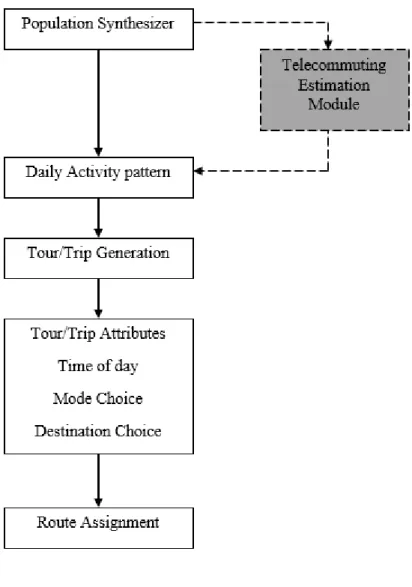
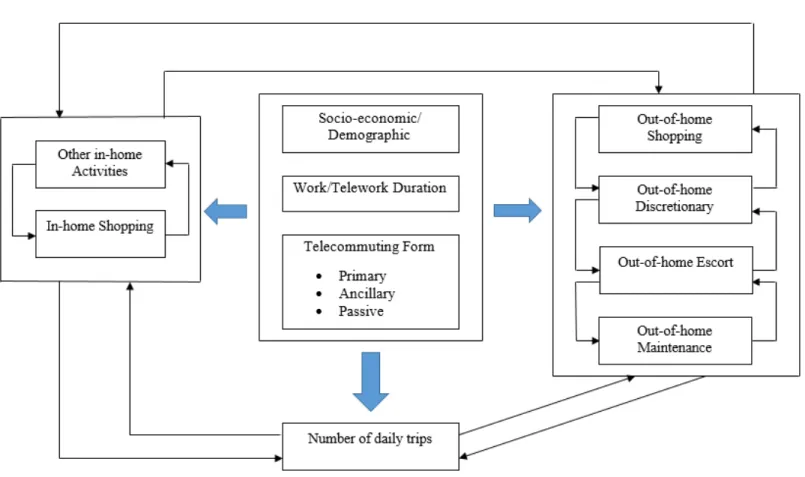
This research work attempts to enhance the current planning framework by adding a sub-procedure (module) to the context. The major objective of this additional module is to estimate and classify telecommuting engagement behavior based on individuals’ attributes (Figure 1-1). This aspect of telecommuting indicates whether or not a certain worker telecommutes, and if so, indicates the type of “telecommuter.” This attribute will then be used as an independent variable in the next step to account for the influence of
9
telecommuting on daily activity patterns. The major assumption in this study is that “Telecommuting is anticipated to reflect significant impacts on individuals’ activity scheduling and trip/tour characteristics. Moreover, it is important to distinguish various forms of telecommuting as the impacts of telecommuting engagement forms will probably be different from one another.”
Herein, the study will encompass the following phases and steps: Phase I
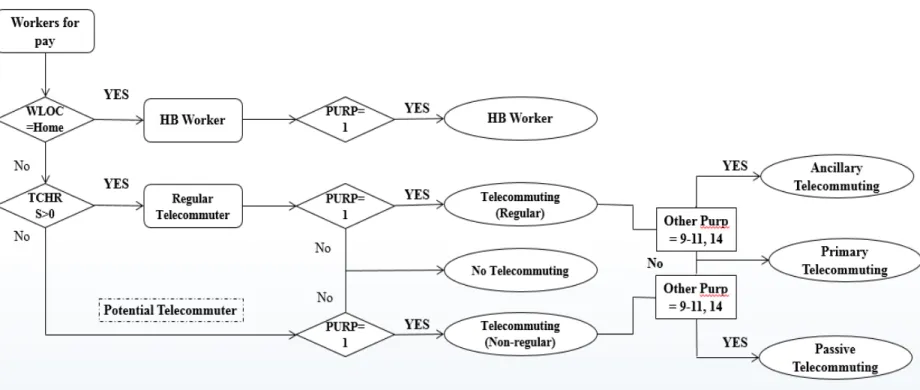
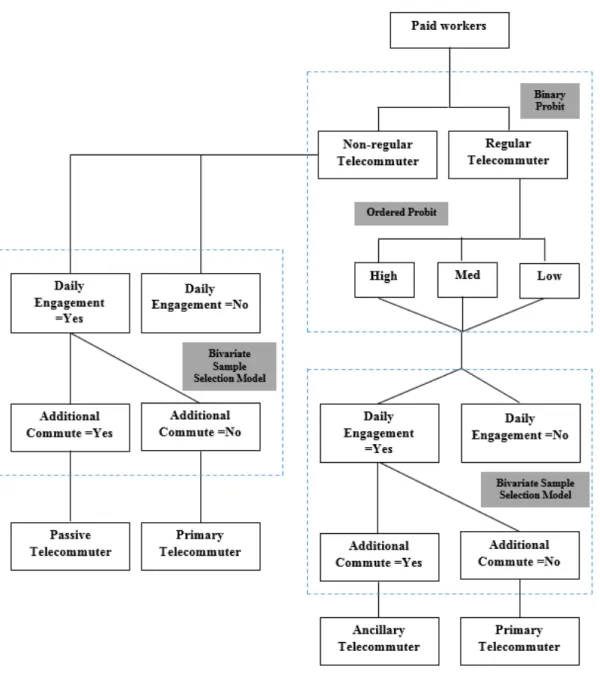
1. Identify the main types of telecommuting engagement by exploring the dataset and analyze various aspects of telecommuting adoption. This step also provides simple and straightforward definitions and algorithms in order to categorize employees based on different types of telecommuting behavior.
2. Develop appropriate statistical models in order to predict market shares of different types of telecommuting behavior. This step requires a comprehensive literature review in order to capture a fundamental grasp of statistical methodologies applied in telecommuting literature, respective pros and cons, and to find the best possible structure.
3. Investigate the results and compare how different socio-economic, demographic, job-related, or land-use variables play significant roles in telecommuting behavior. Phase II
1. Incorporate the outcomes of the first phase into the activity/tour generation model. More precisely, this step includes adding the “telecommuting form” as an exogenous variable into the modeling structure.
10
2. Explore the model outcomes, which will further enable the researcher to make reasonable inferences. This sheds light on how telecommuting, as a new work arrangement, will impact daily activity or tour generation patterns.
Figure 1-1 Modification of the General Planning Framework
1.4. Dissertation Organization
The rest of this dissertation is organized as follows: Chapter 2 will provide a nearly comprehensive review of the conducted research efforts in the field of telecommuting, with
11
an emphasis on telecommuting forecast, along with impact analysis. Chapter 3 focuses on research methodology, which presents a general telecommuting estimation framework, in addition to statistical tools and modeling structures. Moreover, appropriate modeling tools are investigated for estimating telecommuting impacts. Chapter 4 presents the results of Phase 1, which explores different dimensions of telecommuting activity. Chapter 5 uses the outcomes of Phase 1 in order to estimate the impacts of telecommuting in terms of time-use analysis and commute departure times. Finally, Chapter 6 provides general conclusions and further research opportunities.
12
CHAPTER 2 LITERATURE REVIEW 2.1. Introduction
This section focuses on reviewing the empirical literature on telecommuting concepts. Considering that the literature on telecommuting is extensive and has been growing rapidly in recent years, such review may not be considered exhaustive by any means. However, it attempts to cover the major studies and publications in the telecommuting field for the past twenty to thirty years.
According to Walls and Safirova (2004), telecommuting literature could well be classified based on emphasis on one of the following categories:
1. General telecommuting trends and statistics
2. Studies over telecommuting forecasts and modeling frameworks 3. Estimation of telecommuting impacts
These three separate categories are explicitly investigated in this chapter. Before stepping into details, it seems useful to provide a general overview of the evolution of telecommuting literature, including the drawbacks, improvements, and overall trends since the early 1990s. The general movement in the development of telecommuting literature can be viewed from various angles, including the following:
1. Data: Early telecommuting studies were usually based on stated preference (SP)
data (Bernardino et al., 1993; Mahmassani et al., 1993; Mokhtarian and Salomon, 1995). However, since the mid-1990s, one may observe an overall shift toward revealed preference (RP) data (Mannering and Mokhtarian, 1995; Mokhtarian and Salomon, 1997; Drucker and Khattak, 2000; Popuri and Bhat, 2003). Such change
13
stems from the observed inconsistencies between the findings from SP-based and RP-based analyses. Those inconsistencies originated from the existing gap between telecommuting preference and actual telecommuting behavior. As Mokhtarian and Salomon (1995) discussed in their California case study, although 88 percent of 628 respondents preferred to telecommute, only 13 percent actually did.
Another common disadvantage among early empirical studies is data limitation, which could be viewed in terms of sample size or technical definition. Initially, studies were usually based on small samples from a limited number of specific organizations (Sullivan et al., 1993; Bernardino et al., 1993; Mokhtarian & Salomon, 1994, 1996a, 1996b, 1997; Mannering & Mokhtarian, 1995; Mokhtarian et al., 1998; Wells et al., 2001). Although such organization-specific datasets are capable of providing detailed job-related information and attitudinal behaviors of both employers and employees, they hinder the generalization of the study’s outcomes and question model transferability.
Furthermore, initial studies seldom offered standard and coherent
definitions of telecommuters or telecommuting intensity. The intensity (frequency) of telecommuting, for instance, was initially based on defining discrete categories (Mannering & Mokhtarian, 1995; Mokhtarian et al., 1997; and Walls et al., 2006). Thresholds, however, used to be study-specific, i.e., they were different from one study to another, which led to confusion when it came to a comparison of the results. In order to resolve this issue, some researchers suggested using the number of telecommuting days (either per week or per month) as a frequency index rather than ad hoc discrete categories (Popuri & Bhat, 2003; Sener & Bhat, 2011; Singh
14
et al., 2012). Also, researchers did not distinguish between home-based workers (those who do not have or need a conventional office rather than home) and real telecommuters (those who have a fixed office but telecommute regularly). Hence, application of large sample sizes, usually at the national or statewide level (Drucker & Khattak, 2000; Yen, 2000; Popuri & Bhat, 2003; Wernick, 2004; Walls et al., 2006; Zhou, 2008; Sener & Bhat, 2011; Singh et al., 2012), along with providing clear definitions of telecommuters and their subcategories, could be named as major enhancements of models in the research background.
2. Telecommuting dimensions: One fundamental improvement in the modeling methodology refers to obtaining the knowledge that telecommuting is a multidimensional concept and should be analyzed from several perspectives. Early studies mainly focused on either “preference” or actual “choice” (Sullivan et al., 1993; Bernardino et al., 1993; Mokhtarian & Salomon, 1994, 1996a, 1996b, 1997; Mokhtarian et al., 1998; Belanger, 1999; Wells et al., 2001; Grippaldi, 2002), while aspects such as “frequency” or “option” were gradually added to the literature (Mannering & Mokhtarian, 1995; Yen, 2000; Drucker & Khattak, 2000; Peters et al., 2001; Popuri & Bhat, 2003; Wernick, 2004; Walls et al., 2006; Mamdoohi et al., 2006; Zhou, 2008; Vana et al., 2008; Haddad et al., 2009; Tang et al., 2011; Sener & Bhat, 2011; Singh et al., 2012).
3. Statistical modeling and technical issues: Unquestionably, there has been a remarkable tendency toward using more sophisticated and intricate statistical models in order to improve prediction accuracy. Having initially focused on descriptive statistics and basic models such as the Multinomial or binary logit,
15
telecommuting research history is enhanced through application of different econometric tools and methodologies, including nested logit structures, generalized ordered response models, multivariate distributions, Structural Equation Modeling (SEM), and instrumental variables. A detailed review is provided in Section 2.3. 4. Enhancement of variables: A quick review of the literature reveals that like any
other behavioral models, the likelihood of telecommuting in any aspect may be explained based on individual and household characteristics, along with job-related attributes. In addition, when detailed information is available regarding telecommuting opportunities at work, organizational variables and managerial attitudes may well be added to the models in order to provide a better fit. However, this requires identification of different types of companies with respect to their reactions toward telecommuting implementation. Moreover, detailed surveys should be prepared and sent out separately to each company. As it is not plausible to do this at a national level and includes high expenses in terms of both time and money, such surveys usually lead to relatively small sample sizes, which counteract the models’ reliability and transferability. Hence, research work that deals with large sample sizes are restricted to using general job-related variables, which are easily accessible from national or statewide surveys. In some cases, the impact of land-use and built environmental variables are also explored using geo-coded data. Likewise, detailed information will be discussed in Section 2.3.
2.2. General Telecommuting Trends and Statistics
References falling into this category could be summarized either as statistical reports and technical memorandums funded by the government (USDOT report, 1993;
16
ITAC-1, 2001; ITAC-2, 2001; USOPM report to the Congress, 2013), or discussion papers that provide theoretical analysis on the definition and measurement of telecommuting (Mokhtarian, 1991; Sampath et al., 1991; Nilles, 1994; Handy & Mokhtarian, 1995, 1996; Pratt, 2002; Balaker, 2005; Mello, 2007).
In terms of statistics, there is a general agreement that telecommuting popularity is increasing both among employers (option) and employees (adoption). According to the United States Office of Personnel Management’s report (2013), there has been a significant increase toward telecommuting implementation in view of employees, employers, and using sophisticated approaches in telecommuting development.
Discussion papers mainly focused on how the concept of telecommuting has evolved and on the major theoretical deficiencies or noticeable issues at the time of the study. In a pioneering study in 1991, Mokhtarian explored the concept of telecommuting from a variety of aspects, including the definition, subforms, transportation impacts, and application of information technologies. Based on the definition, it was insisted that both concepts of “tele” and “commute” should be involved in order to consider a telecommuting option as an alternative work arrangement. In other words, the worker should be far from the conventional workplace (or from the supervisor), and the daily commute should be either removed or displaced. Secondly, telecommuting can be exercised in a variety of ways. If a worker telecommutes all five days per week and does not travel to the workplace on any of the workdays, he/she will be labeled as a full-time telecommuter; otherwise, he/she is a part-time telecommuter. This means that a part-time telecommuter may telecommute on some days and work at the regular workplace on other days. Mokhtarian showed that part-time telecommuters only telecommute an average of one or two days per
17
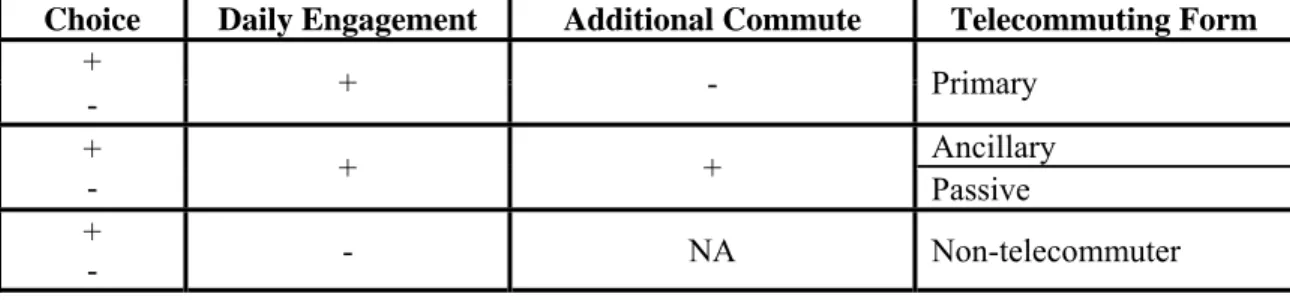
week. Even on a single day, telecommuting could be practiced differently, depending on whether or not the daily commute is removed. It could involve a full-day engagement, where the daily commute is completely removed and telecommuting serves as a substitution effect, or it could be a part-day assignment where the commute may or may not be displaced temporally and telecommuting plays a supplementary effect.
Handy and Mokhtarian (1995) discussed different approaches by which telecommuting is measured and also explained the problems involved in comparing estimates from different surveys. From a transportation-based perspective, the critical component of telecommuting definition is the elimination, or partial elimination, of daily commute trips. Therefore, telecommuting is commonly described as working at home or at a telework center (also known as a tele-center) as a substitute for travel to an employer’s conventional workplace. Available data sources on telecommuting, however, have a variety of difficulties. First, many surveys do not address tele-centers at all, thereby leaving out workers who telecommute in this manner. Second, some workers may telecommute only for part of a day (i.e., they work in the office part-day as well), thus shifting the commute time but not removing the trip entirely. These workers may be captured as telecommuters in a survey but should probably not be grouped with full-day telecommuters. Third, many surveys ask about working at home, thus possibly capturing a group of workers based in their homes. These categories, such as home-based businesses, should not be considered telecommuters.
Aside from the issues associated with the definition of telecommuter, there are multiple ways to analyze the survey data in order to provide information about the magnitude of telecommuting. The authors here distinguish between the percentage of
18
workers that telecommute, labeled as telecommuting penetration, and the number of telecommuting occasions, or the number of days an employee works entirely at home. While both statistics can be useful, it is the latter that is crucial for evaluating the effects of telecommuting, including VMT, congestion, emissions, etc.
Handy and Mokhtarian (1995) also explored the findings from four studies that provide information on telecommuting penetration. The national survey done by the Census Bureau discovered that approximately 1% of California workers in occupations that are conducive to telecommuting report that they “usually” work at home. In an annual national survey, a private firm, Link Resources, reported that between 1.88% and 3.34% of U.S. workers telecommute. Two California surveys, one in Los Angeles and one in the San Francisco Bay area focused only on full-time workers that worked outside home. Accordingly, around 9% of Los Angeles workers “sometimes” telecommute compared to 9.8% in San Francisco. These percentages are higher because of the option for occasional telecommuting (as opposed to “usually” in the Census survey), and also because only full-time workers are examined. These pilot studies also suggest that there is a high variation observed in telecommuting frequency. The range varies from 0.8 days a week to 3 days a week. Finally, looking at the proportion of workers that telecommute on any given day, telecommuting penetration ranges from less than 1% up to 2.1%; that is, on any given day of the week, between 1% and 2% of workers actually telecommute. Handy and Mokhtarian applied a Caltrans survey to summarize the final estimate of the percentage of telecommuting workers. It found that on any given day, 1.47% of people in the workforce telecommute, 1.98% of people working on that particular day telecommute, and 2.01% of commute trips are replaced by telecommuting.
19
Pratt (2002) placed an effort on summarizing statistics from questions added to several national surveys, including the Federal Highway Administration’s Nationwide Personal Transportation Survey (NPTS) and the Census Bureau’s American Housing Survey and Current Population Survey. Some of the results are unanimous with the issues identified by Handy and Mokhtarian. More specifically, the magnitude of telecommuting varies across studies because the sample of workers is often different. Whether or not the sample includes self-employed, independent contractors, part-time workers, or workers with multiple jobs, the percentage of the telecommuting workforce tends to differ. Samples including self-employed workers or workers with multiple jobs often show higher telecommuting rates. However, it should be noted that these people are not necessarily making fewer vehicle trips or traveling fewer miles. According to the Nationwide Personal TransportationSurvey (NPTS) data, 15% of individuals that reported working from home within the past two months were holding two or more jobs. Furthermore, 22% of workers with multiple jobs telework, which is a much higher percentage than what most studies report for total workers or workers with one job. Pratt also reported that the work-at-home group contained 68% employees, 19% home-based business owners, and 11% non-home-based self-employed people.
Comparing numbers and trends, Pratt found that as expected, including self-employed workers in the sample leads to overestimation of telecommuters. The actual number of telecommuters as a fraction of commuting employees is far lower. Overall, Pratt reported that different surveys agree that telecommuting has been holding steady, with about 16% to 17% of total employees working at home some of the time.
20
In 2005, Mokhtarian et al. criticized what they called “lack of consensus” among different telecommuting statistics in the existing literature. Five major data sources were taken into account: U.S. Census Bureau, American Housing Survey (AHS), Current Population Survey (CPS) of the Bureau of Labor Statistics (BLS), market research firms and the trade association-sponsored Telework America surveys. Evaluating these data sources regarding their usefulness and reliability toward telecommuting estimates, authors came up with three major dimensions that can cause further uncertainty in data: definition, quality, and quantity. In terms of definition, several aspects should be carefully considered, including types of workers being counted or the frequency threshold applied as the telecommuting criteria. In addition, issues such as overtime work, misinterpretation of paid work, and confusion of home-based workers with telecommuters might lead to further statistical inconsistencies. Clearly, more workers fall into the category of telecommuters if the criterion is shifted from “at least three days a week” to “at least once a month.” On the other hand, when it comes to the quality and quantity of telecommuting data, technical aspects should be carefully considered and applied. These include sample size, and whether the data is drawn properly (unbiased) and weighted in order to correctly represent the whole population. The analysis in this paper indicates that a great deal of uncertainty surrounds estimates of the number of telecommuters and frequency of telecommuting. Obviously, the answers greatly depend on the questions asked, and also that framing the phenomenon of interest is central to framing the questions. Though data quality may well be maintained through appropriate statistical techniques, it is yet unlikely to achieve consensus on the “best” definition of telecommuting. This can be justified considering its multifaceted nature and the variety of perspectives from which people approach the subject.
21
2.3. Telecommuting Forecasts and Modeling Frameworks
From a planning perspective, it is crucial to figure out reliable estimates of how telecommuting impacts the transportation system performance or urban area characteristics. Such impacts will not be assessed unless there is a sound framework that captures and quantifies the popularity (intensity) of telecommuting adoption among workers. In other words, it is inevitable to come up with a systematic procedure that provides reliable answers to the following key questions: Among the workers’ sample, who telecommutes? To what extent? What are the underlying factors that contribute to workers' decisions toward telecommuting adoption?
Based on such understanding, it is essential to forecast how much telecommuting will occur and how sensitive this demand is to structural changes or policies. At a disaggregate level, this calls for a behavioral modeling approach for telecommuting adoption. This section sheds light on some of the major publications that focus on telecommuting forecast and modeling frameworks.
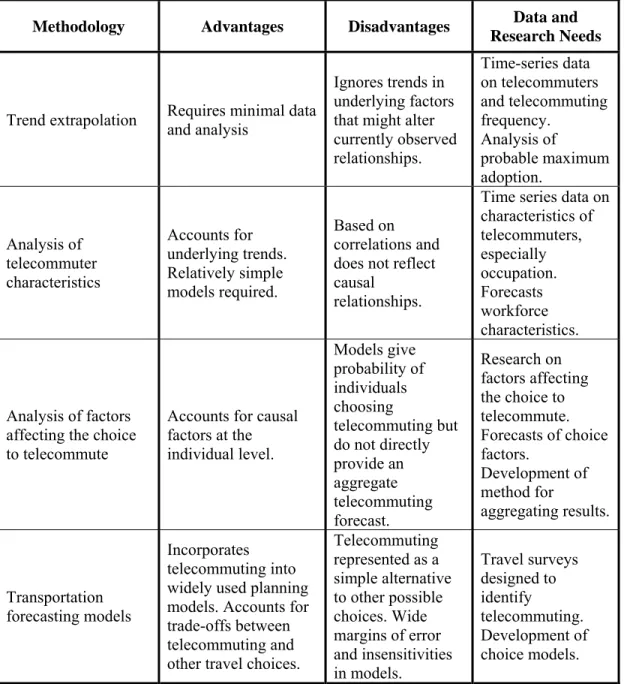
Handy and Mokhtarian (1996) provided an exploration of methodologies and research needs in order to forecast telecommuting. Four alternative methodologies were introduced, along with their respective advantages and disadvantages. Moreover, researchers discussed the type of data that is required for each methodology. These methodologies include: 1) Trend extrapolation, which relies on growth factors and curves of technological substitution; 2) Analysis of telecommuter characteristics versus non-telecommuters, which is based on descriptive statistics and the correlation between the choice to telecommute and several individual, household or job-related characteristics; 3) Analysis of telecommuting choice, which estimates the probability that an individual with
22
certain characteristics and in a specific situation will telecommute; and 4) Incorporating telecommuting into traditional transportation forecast models, which may be done in any of the generation, distribution or mode choice steps. Table 2-1 summarizes the pros and cons of any of the aforementioned methodologies.
Table 2-1 Summary of Forecasting Methodologies
Methodology Advantages Disadvantages Data and Research Needs
Trend extrapolation Requires minimal data and analysis
Ignores trends in underlying factors that might alter currently observed relationships. Time-series data on telecommuters and telecommuting frequency. Analysis of probable maximum adoption. Analysis of telecommuter characteristics Accounts for underlying trends. Relatively simple models required. Based on correlations and does not reflect causal
relationships.
Time series data on characteristics of telecommuters, especially occupation. Forecasts workforce characteristics. Analysis of factors affecting the choice to telecommute
Accounts for causal factors at the individual level. Models give probability of individuals choosing telecommuting but do not directly provide an aggregate telecommuting forecast. Research on factors affecting the choice to telecommute. Forecasts of choice factors. Development of method for aggregating results. Transportation forecasting models Incorporates telecommuting into widely used planning models. Accounts for trade-offs between telecommuting and other travel choices.
Telecommuting represented as a simple alternative to other possible choices. Wide margins of error and insensitivities in models. Travel surveys designed to identify telecommuting. Development of choice models.
23
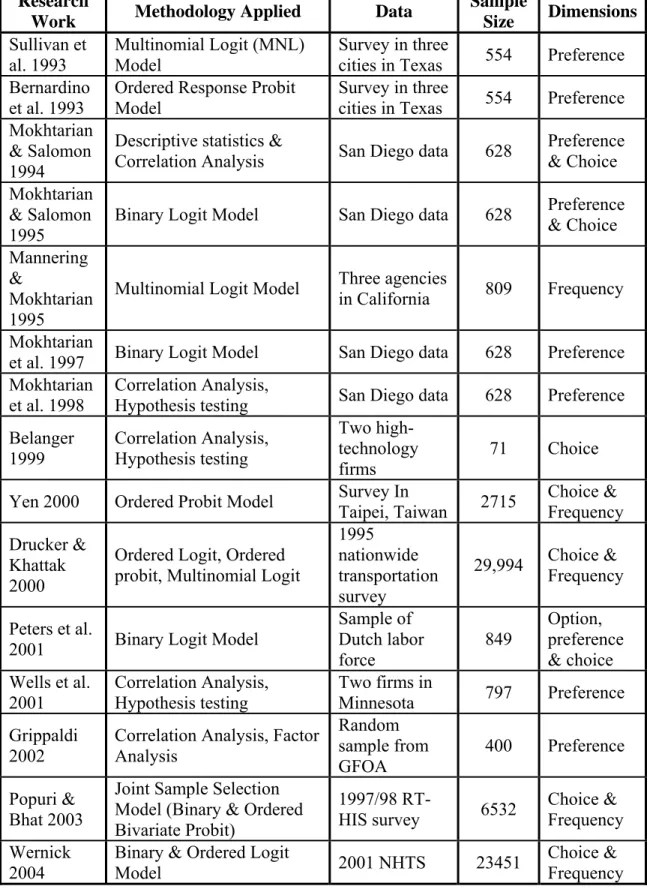
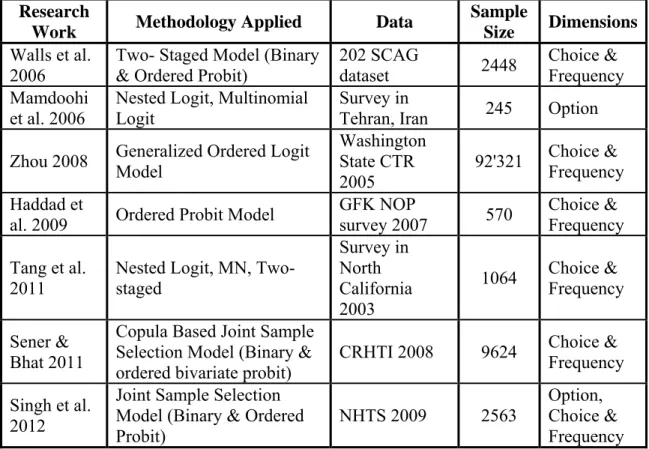
This section mainly focuses on methodology types two and three, which explores the factors that contribute to telecommuting adoption either in terms of descriptive statistical analysis or developing modeling structures. A summary of the research background is highlighted in Table 2-2.
Using a cost neutral scenario, Sullivan et al. (1993) developed a multinomial logit model of employees’ stated preference toward telecommuting. The scenario was basically defined as if all of the telecommuting costs were incurred by the employer, and the employees’ salary would remain unchanged. The major idea was to investigate the impacts of individual and household characteristics, work-related attributes and individuals’ travel behavior. Consequently, researchers concluded that as the round-trip commute time increases, workers show a higher tendency to prefer full-time telecommuting, especially when the total commute time is greater than or equal to 20 minutes. In addition, the number of commute stops employees make has a positive impact over their telecommuting preference. This might be due to their need for a flexible schedule in order to combine their daily activities. As far as job characteristics are concerned, employees with higher experience (five years or more) are less likely to prefer telecommuting. Likewise, tasks that include several daily face-to-face contacts with customers or supervisors decrease the telecommuting preference. On the contrary, technology improvements, such as computer-related tasks increase employees’ propensity toward full-time telecommuting. In terms of individual and household variables, results indicate that females with young children, along with males from low-income households, are more likely to prefer telecommuting.
24
Table 2-2 Major Studies in Telecommuting Forecast Research
Work Methodology Applied Data
Sample Size Dimensions Sullivan et al. 1993 Multinomial Logit (MNL) Model Survey in three
cities in Texas 554 Preference Bernardino
et al. 1993
Ordered Response Probit Model
Survey in three
cities in Texas 554 Preference Mokhtarian
& Salomon 1994
Descriptive statistics &
Correlation Analysis San Diego data 628
Preference & Choice Mokhtarian
& Salomon 1995
Binary Logit Model San Diego data 628 Preference & Choice Mannering
&
Mokhtarian 1995
Multinomial Logit Model Three agencies in California 809 Frequency
Mokhtarian
et al. 1997 Binary Logit Model San Diego data 628 Preference Mokhtarian
et al. 1998
Correlation Analysis,
Hypothesis testing San Diego data 628 Preference Belanger
1999 Correlation Analysis, Hypothesis testing
Two high-technology firms
71 Choice
Yen 2000 Ordered Probit Model Survey In Taipei, Taiwan 2715 Choice & Frequency Drucker &
Khattak 2000
Ordered Logit, Ordered probit, Multinomial Logit
1995 nationwide transportation survey
29,994 Choice & Frequency
Peters et al.
2001 Binary Logit Model
Sample of Dutch labor force 849 Option, preference & choice Wells et al.
2001 Correlation Analysis, Hypothesis testing Two firms in Minnesota 797 Preference Grippaldi
2002 Correlation Analysis, Factor Analysis
Random sample from GFOA 400 Preference Popuri & Bhat 2003
Joint Sample Selection Model (Binary & Ordered Bivariate Probit) 1997/98 RT-HIS survey 6532 Choice & Frequency Wernick
25
Table 2-2 Major Studies in Telecommuting Forecast (continued) Research
Work Methodology Applied Data
Sample
Size Dimensions
Walls et al. 2006
Two- Staged Model (Binary & Ordered Probit)
202 SCAG dataset 2448 Choice & Frequency Mamdoohi et al. 2006
Nested Logit, Multinomial Logit
Survey in
Tehran, Iran 245 Option
Zhou 2008 Generalized Ordered Logit Model
Washington State CTR 2005 92'321 Choice & Frequency Haddad et
al. 2009 Ordered Probit Model GFK NOP survey 2007 570 Choice & Frequency Tang et al.
2011
Nested Logit, MN, Two-staged Survey in North California 2003 1064 Choice & Frequency Sener & Bhat 2011
Copula Based Joint Sample Selection Model (Binary & ordered bivariate probit)
CRHTI 2008 9624 Choice & Frequency Singh et al.
2012
Joint Sample Selection Model (Binary & Ordered Probit)
NHTS 2009 2563
Option, Choice & Frequency
Bernardino et al. (1993) improved the model structure by developing different scenarios. Each scenario is represented by a combination of salary, costs, schedule flexibility, telecommuting frequency, and available equipment. Respondents stated that their preferences were measured on an arbitrary scale from one (definitely would not telecommute) to five (would definitely telecommute). Considering the ordered nature of the dependent variable, an ordered-response probit model was developed to describe individuals’ stated preference to telecommute. According to their results, researchers found that parents with children under 18 are more likely to prefer telecommuting. Moreover, employees who were not offered a telecommuting opportunity showed a higher tendency to participate in telecommuting, which may well indicate a policy bias. Surprisingly,
26
variables such as gender, commute time, and years of employment had no significant impact on the model. As expected, the telecommuting preference will decrease if employees are forced to provide a computer or accept their extra work-related payments, such as telephone bills.
Yen and Mahmassani (1994) proposed a conceptual framework with the objective to explore the interactions between telecommuting adoption and travel behavior, as well as to develop statistical models for telecommuting adoption. The framework divides telecommuting into two major dimensions: the employer and the employee. Data used in this study come from a survey of employees and employers in selected organizations from three cities in Texas: Austin, Houston, and Dallas. The final sample includes 694 employees and 83 employers. An explanatory analysis of stated preference data indicated that employee attitudes and preferences toward telecommuting were significantly affected by personal and household characteristics such as gender, job attributes, computer proficiency, number of children under 16, and personal computers at home, as well as commuting attributes. Factors that influence employer attitudes and preferences include management concerns such as productivity, morale, absenteeism, and data security. A comparison of the two categories reveals that employers are more reluctant to adopt telecommuting than employees.
Two separate generalized ordinal probit models were developed, one for employees and one for employers. In terms of employees, results confirm most of the previous exploratory findings, namely that employee participation in telecommuting is primarily influenced by five groups of attributes: 1) economic implications of program design, 2) personal and household characteristics, 3) job characteristics, 4) commuting attributes, and
27
5) attitudes toward telecommuting. Moreover, estimated coefficients of variables point out that both changes in employee salary and the costs incurred by telecommuters significantly influence employee telecommuting adoption, with the salary changes having a stronger effect. Furthermore, the effect of salary decrease is stronger than salary increase. In terms of employers, as expected, estimation results indicate that employers are not likely to support any program that increases telecommuter salary. On the other hand, they do not consider that telecommuters should incur a decrease in salary, which is one of the main concerns of employee adoption. Results also confirm that management issues are the major obstacle to employer support, as widely speculated in the literature.
Mokhtarian and Salomon (1994) presented a conceptual framework for individuals’ decision-making toward telecommuting. The key elements of the model include constraints, facilitators, and drives. A constraint is defined as a factor that prevents or hinders any change (in this case, the choice to telecommute) if it is present. Facilitator or enabler is a factor that allows change (telecommuting), or makes the change easier or more effective, if it is present. The same basic factor may be either a facilitator or a constraint, depending on whether it is present in a positive sense or a negative one. Drive or motivator is a factor that actually motivates a person to consider a change (begin to telecommute). Authors explain that these concepts may be applied to any type of change, which is telecommuting in this case. Thus, one may consider the following scenario where a person is not telecommuting. He/she is driven toward telecommuting by one or more factors. Given the initial drive, the presence of facilitators increases the probability that telecommuting will be adopted (or the amount that he/she chooses to telecommute). Without that drive, facilitators are assumed to have no effect on the adoption of
28
telecommuting. On the other hand, the presence of constraints decreases the likelihood of adoption (or the amount of telecommuting) and, if sufficient, will preclude adoption.
Two major types of constraints are categorized and introduced: External factors that are subject to change (for example by company or public policy) and internal factors that are less amenable to external change due to their internal nature. External factors are related to awareness, the organization, and the job, while internal constraints usually include psychological factors. Furthermore, it is important to notice that constraints or facilitators do not tell the whole story. A person does not telecommute simply because the technology is available or because the supervisor agrees to that. Those factors facilitate telecommuting but do not drive it. Five major types of drives are introduced in this context including: Work-related, family-related, leisure-related, ideology-related and travel-related. Given the presence of one or more drives, the probability of the choice to telecommute will increase with the number and strength of drives and facilitators, and decrease with the number and strength of constraints.
While a conceptual framework was developed in their earlier studies, researchers presented the descriptive statistical results from the empirical data of 628 employees in San Diego, California. Three different aspects of telecommuting including possibility, preference and choice were explored and their relationships were examined. The data for this study come from a 14-page self-administered questionnaire that includes questions about: respondents’ awareness and experience with telecommuting, job characteristics, ability to telecommute, advantages and disadvantages of telecommuting, socio-demographics, attitudes and lifestyle drives. A total of 1428 surveys were sent out, of which 628 were returned, yielding an effective response rate of 44%.
29
Regarding the dependent variable, authors discussed various possible dimensions that may be considered. Whether the individuals’ preference or actual behavior is considered remains an important issue. In addition, one might consider the application of binary or nominal variables. While the binary variable focuses on “whether or not to telecommute,” a nominal variable simultaneously considers the “frequency” aspect. For the purpose of their research work, a binary variable is adopted.
Constraints are categorized into “dichotomous” or “continuous”. Three major dichotomous constraints are identified: “Lack of awareness” is active for 4%, “job unsuitability” is active for 44%, and “manager disapproval” for 51% of the sample. It is assumed that if any of the constraints is active for a person, he/she will not have the possibility of telecommuting. This occurs for 68% of the sample. However, even in the
absence of dichotomous constraints, most people do not choose telecommuting, which is probably due to continuous constraints. According to the questionnaires, five major reasons were reported as significant including: lack of resources, being content with the present situation, etc. Only a small portion of the whole sample (11%) find telecommuting as being possible, preferred, and chosen. One key finding is the existence of a large share of the people (57%) for whom telecommuting is a preferred, impossible alternative, i.e., they prefer to telecommute but are prevented by at least one of the constraints.
In 1995, Mokhtarian and Salomon operationalized their previously published conceptual model. Using survey data from the City of San Diego, hypothesized drives to telecommute and constraints on facilitators of telecommuting are measured. A binary logit model of the preference to telecommute from home is estimated, which shows a value of 0.68. The explanatory variables include attitudinal and factual information. Factor
30
analysis is performed on two groups of attitudinal questions, identifying a total of 17 (oblique) factors that can be classified as drives and constraints. Additional measures are created from other data in the survey, usually objective socio-demographic characteristics. Variables representing at least four of the five hypothesized drives (work, family, independence/leisure, and travel) are found to be significant in the final model. Variables from four of the ten groups of constraints (job suitability, social/professional and household interaction concerns, and a perceived benefit of commuting) are significant, primarily representing internal rather than external constraints. The results clearly demonstrate the importance of attitudinal measures over socio-demographic ones, as the same demographic characteristics (such as the presence of children and commute time) will have different effects on preference for different people.
The results for the preference model seemed statistically sound and reasonably justified. However, it should be noted that there is a wide gap between preference and actual choice. Eighty eight percent of the entire sample prefers telecommuting, while only 13% actually telecommute. Researchers therefore enhanced their modeling structure by shifting the dependent variable from “preference” to “actual choice.” Preference is then added to the model as a binary independent variable. In addition, constraints are treated and evaluated in two intrinsically different approaches: In the first approach, constraints are directly incorporated into the model. In the second approach, constraints are applied to define and limit the choice set. Results indicate that models developed through the first approach are statistically superior in this analysis. Significant variables include work and travel drives, awareness, manager support, technology, job suitability, and discipline constraints.
31
One advantage of the first approach is that it enables the analyst to explore how any of the existing constraints will impact the telecommuting rate in the population. Based on the results, when unawareness, lack of manager support and job unsuitability constraints are relaxed, 28% of the PIA (preferred impossible alternative) categories adopt telecommuting.
Considering its richness in terms of variables and its compatibility to the telecommuting framework, the San Diego survey data was popularly used for some further studies. Mannering and Mokhtarian (1995) explored individuals' telecommuting frequency as a function of demographic, travel, work and attitudinal factors. Three different datasets were used to develop three separate multinomial logit models. These include data collected from the Franchise Tax Board in Sacramento (90 individuals), data from the Public Utilities Commission in San Francisco (90 individuals) and data from the City of San Diego survey (629), all of which form a total sample of 809 workers.
Three alternatives were considered for telecommuting frequency: Never telecommute, infrequently telecommute (less than once a week) and frequently telecommute (at least once a week). Moreover, it was discussed whether ordered or un-ordered response models should be considered for frequency. The most critical disadvantage discussed by the authors was that ordered response models assumed monotonic increase of desirability for each explanatory variable. It means this modeling approach cannot accommodate variables that favor mid-range alternatives over high- or low-range alternatives. Therefore, multinomial logit models were preferred and applied to the data.
32
One important conclusion is the apparent lack of transferability of the models, which raises the need to identify organization-specific attributes, i.e., attitudes which differentiate one organization from another. This includes size, geographic location, managerial structure, age and industry. Moreover, degree of empirical experience with telecommuting seems to play an important role in telecommuting frequency. Among the significant variables, one can mention the presence of small children, number of household members, respondent's gender, number of household vehicles, supervisory status of respondent, and family orientation.
Mokhtarian et al. (1997) examined three models of individual preference for home-based or center-home-based telecommuting. Different aspects of dependent variable were discussed including: 1) binary (choice/preference) versus multinomial (frequency), 2) telecommuting type (home, center or both), and 3) whether preference or actual choice should be considered.
As there were not enough data available for center-based telecommuting adoption, preference was addressed as the main dependent variable. One major problem was that the three alternatives of home, center and regular workplace were not mutually exclusive. It means a person may be attracted to all three options over a course of a week. In order to resolve this issue, six different choices were offered for each of home- or center-based telecommuting: not at all, less than once a month, about 1 to 3 days a month, one to two days a week, three to four days a week and five days a week. A matrix was then formed with the rows indicating home-based preference and he columns indicating center-based preference. Therefore, 581 individuals were divided into four categories: 61 people who do not prefer any type of telecommuting, 245 individuals falling on the matrix diagonal
33
(which prefer either of the telecommuting options), 31 workers falling above the diagonal (who prefer center-based over home-based), and 244 individuals who prefer home-based telecommuting over center-based.
Two binary logit models were presented, one on the preference of center-based telecommuting versus other options ( = 0.24), and the other on the preference of center-based telecommuting over home-center-based telecommuting ( = 0.64). A nested logit model was also developed, including two tiers: the first tier includes three alternatives of no preference, strict preference and indifference. The strict preference is further divided into home- or center-based telecommuting.
The results of the models confirmed the importance of attitudinal measures in measuring an individual’s preference to telecommute. Oblique factor scores representing workplace interaction, stress, workaholism, internal control, and commute stress were statistically significant in some or all of the models. Other explanatory variables that were found to be consistently significant were education, job suitability, and age. Most respondents preferred either to telecommute from home or were indifferent between either form of telecommuting, which raises the question as to whether there really is a sizeable market position to be filled by telecommuting centers, and whether they may make a significant contribution to transportation demand reduction.
In another relevant study, Mokhtarian et al. (1998) used the San Diego data to explicitly target how gender, occupation, and presence of children (as the most important demographics) influence individuals' perception of motivations or constraints. Exploratory statistical analyses were carried out on the data. Eleven disadvantages of telecommuting, also known as “internal constraints” were identified, which were later classified into four
34
different classes: Workplace interaction, management visibility, office discipline and commute benefit. Seventeen recognized advantages were also further stratified into five new groups: Personal benefits, stress, family, disability/parental leave and relocation. External constraints consist of a variety of issues such as lack of awareness, job unsuitability, supervisor unwillingness, etc. In order to compare these variables among different categories of gender, occupation, and presence of children, several statistical tests were applied. These include ANOVA, the “t” test, and Pearson chi square. Several detailed results were obtained that may further be used to inform policies intended to support telecommuting. For instance, women were more likely than men to consider family, personal benefits and stress reduction as potential incentives toward telecommuting. They were also more prone to take supervisor unwillingness, risk aversion and lack of visibility to the manager as the major constraints. Among different occupation categories, while managers were mostly concerned about reduced professional interactions or household distractions, clerical workers were mostly affected by misunderstanding, supervisor unwillingness and job unsuitability. One interesting outcome was that lack of awareness, cost and lack of technology did not differ significantly by gender or occupation. In addition, respondents with children considered stress reduction and family benefits as their main motivations towards telecommuting.
Belanger (1999) carried out an empirical study over workers’ propensity to telecommute. The data applied in this study came from a survey in two large work groups working for a high technology organization during the spring and summer of 1997. The final sample consists of 76 workers out of 168, reflecting an acceptable return rate of 46%. The major motivation was to answer the following two questions about the concept of