Department of Computer Science
George Mason University
Technical Reports
4400 University Drive MS#4A5 Fairfax, VA 22030-4444 USA http://cs.gmu.edu/ 703-993-1530
GPU-Euler: Sequence Assembly using GPGPU
Syed F. Mahmood
[email protected]
Huzefa Rangwala
[email protected]
Technical Report GMU-CS-TR-2011-1
Abstract
Advances in sequencing technologies have revolution-ized the field of genomics by providing cost effective and high throughput solutions. In this paper, we de-velop a parallel sequence assembler implemented on general purpose graphic processor units (GPUs). Our work was largely motivated by a growing need in the ge-nomic community for sequence assemblers and increas-ing use of GPUs for general purpose computincreas-ing appli-cations. We investigated the implementation challenges, and possible solutions for a data parallel approach for sequence assembly. We implemented an Eulerian-based sequence assembler (GPU-Euler) on the nVidia GPUs using the CUDA programming interface. GPU-Euler was benchmarked on three bacterial genomes using in-put reads representing the new generation of sequenc-ing approaches. Our empirical evaluation showed that GPU-Euler produced lower run times, and showed com-parable performance in terms of contig length statistics to other serial assemblers. We were able to demonstrate the promise of using GPUs for genome assembly, a com-putationally intensive task.
1
Introduction
Knowing the entire DNA sequence of an organism is an essential step towards developing systematic ap-proaches for altering its function. It also provide better insights into the evolutionary relations among different species. In the last few years, we have seen several new, high-throughput and cost-effective sequencing technolo-gies that produce reads of length varying from 36 base pairs (bp) to 500 base pairs (bp). Sequence assembly algorithms stitch together short fragment reads and put them in order to get long contiguous stretches of the genome with few gaps.
Several assembly methods have been developed for the traditional shotgun sequencing and new sequencing technologies. Examples include, greedy approaches like
VCAKE [20], graph oriented approach that find Eulerian tours [27], and use bi-directed string graph represen-tation [24]. ABySS [35] is one of the first distributed memory assembler. It has a unique representation for the de-Bruijn graph that allows for ease of distribution across multiple compute processors as well as concur-rency in operations. Jackson et. al. [17, 19] proposed a parallel implementation for bi-directed string graph assembly on large number of processors available on supercomputers like the IBM Blue Gene /L.
In this work, we develop a GPU-based sequence as-sembler, referred to as GPU-Euler. Specifically, we follow the Eulerian path based approach that was developed for Euler [28]. Our method was motivated by the current ad-vances in multi-core technologies and the use of graphic processor units (GPUs) in several computing applica-tions. In this paper, we investigated the effectiveness and feasibility of graph-based sequence assembly mod-els on GPUs using the CUDA programming interface. nVidia GPUs along with CUDA provides massive data parallelism, that is easy to use and can be considered cost-effective in comparison to loosely coupled Beowulf clusters.
GPU-Euler was benchmarked on three previously as-sembled genomes: (i) Campylobacter Jejuni, (ii) Neis-seria Meningitidis and (iii) Lactococcus Lactis. We sim-ulated three sets of reads for each genome with read lengths equal to 36, 50 and 250 base pairs (bps). The scope of this work was to develop an assembler that would exploit the GPU computing resources effectively. As such, we were focused in improving the run times of different phases of the algorithm. We compare the per-formance (run-time, contig accuracy and length statis-tics) of GPU-Euler to a previously developed assem-bler, EulerSR [7]. Our experimental evaluation showed the promise of using GPUs for genome assembly tasks. In terms of run-time performance, GPU-Euler outper-formed EulerSR. In our current implementation, we do not perform any graph simplification as well as error correction that are integral for producing accurate con-tigs.
The rest of the paper is organized as follows. Section 2 provides a thorough review of different sequence assem-blers. Sections 3 and 4 provide the background on the parallel computing models and the implementation de-tails of GPU-Euler. Section 5 provides the experimental results. Section 6 describes several directions for future work and provides concluding remarks.
2
Literature Review
The past few years have seen rapid development in new, high-throughput and cost effective sequencing technolo-gies; Roche 454, Illumina Genome Analyzer 2 (GA2) and the ABI SoLID platform in addition to the well estab-lished Sanger sequencing protocol. These approaches vary in their output, cost, throughput and errors pro-duced. All approaches rely on shotgun sequencing [36], where the genome is randomly sheared into many small subsequences or pieces referred to as reads. The prob-lem of combining these sequence reads to reconstruct the source genome is called the “sequence assembly” prob-lem. Sanger, produces longer sequence reads, of size 750 to 1000 base pairs (bps) whereas the next generation sequencing (NGS) technologies produce reads that are shorter from 36 to 500 bps. The volume of data produced by NGS technologies demands a robust solution to the data management, assembly, and the development of derived information. Pop [29] and Myers et. al. [23] pro-vide a detailed review of the computational challenges involved with sequence assembly, along with a study
of the widely used approaches. De novoassembly
al-gorithms stitch together short fragment reads and put them in order to get long contiguous DNA fragments called contigs, which are further extended to get super-contigs and finally placed in order, to get the assembled genome. The approaches for de novo sequence assem-bly can be grouped into three categories: (i) greedy, (ii) overlap-layout-consensus (OLC) and (iii) eulerian-based approaches.
Greedy assemblers, follow an iterative approach where at each step, the reads (or contigs) that have the longest possible overlap with other reads are ex-tended. An effective indexing mechanism is used to accelerate the discovery of the reads to be used for fur-ther extension to produce longer contigs. For assembling NGS data, greedy assembly algorithms, like SSAKE [37], SHARCGS [10], QSRA [5] and VCAKE [20] have been developed. Due to their greedy nature, these algorithms produce several mis-assemblies due to repeat regions within the genomes.
The OLC approach finds potentially overlapping reads between fragments by computing pairwise align-ments between the reads (overlap). The overlap between the reads can be modeled using edges of a graph with the reads as vertices (layout). Determining a Hamiltonian path, i.e., a valid path that visits every vertex exactly
once will lead to a sequence assembly. However, find-ing the paths in presence of repeats leads to NP class of problems, and as such the DNA sequence (consen-sus) is derived using several heuristics as illustrated in methods like Celera [25], Arachne [4] and EDENA [13].
The Eulerian based de novo methods have always been widely used, and were inspired by the sequencing-by-hybridization approach [16, 28]. These algorithms
represent each read by its set ofk-mers (smaller
subse-quences) and construct a de-Bruijn graph. Ade-Bruijn
graph is a directed graph where vertices arek-mers, and
there exists an edge between two vertices if there is
an overlapping subsequence of length(k−1)between
them. Finding the Eulerian path or tour, where each edge in the de-Bruijn graph will be visited exactly once will lead to the sequence assembly solution. Before per-forming the Eulerian tour, these approaches use differ-ent heuristics to remove from the de-Bruijn graph, nodes and edges that are created due to sequencing errors and repeat regions within the genome. Myers presented an-other graph oriented approach based on the notion of
bi-directed string graph [24]. Abi-directed string graph
has direction associated with both end points of an edge produced by modeling the forward and reverse orienta-tion of sequence reads. The Eulerian-tour of such a graph enforces additional constraints that leads to improved accuracy and length of produced sequence contigs.
Euler-SR [7], Velvet [38], SHORTY [14], ALLPATHS [6] and ABYSS [35] are examples of the different Eulerian-based approaches, developed for NGS read data. These algorithms differ on the heuristics that they employ to perform the graph simplification, and on the data struc-tures used to construct the de Bruijn graph for modeling the reads.
ABySS [35] is one of the first distributed memory de novo assembler. It has a unique representation for the de Bruijn graph that allows for ease of distribution across multiple compute processors as well as concurrency in operations. The location of a specific k-mer within the reads can be computed from the sequence of the reads, and the adjacency information for a k-mer is stored in a compact fashion that is independent of the location. Jack-son et. al. [17, 19] proposed a parallel implementation for bi-directed string graph assembly on large number of processors available on supercomputers like the IBM Blue Gene /L.
In this work we propose an implementation of the Eulerian-based sequence assembler, that will utilize graphic processor units (GPUs) to produce sequence assemblies from short read NGS data.
Debruijn Graph Construction
FASTA file (input)
Euler Tour
Construction Identify Contigs Graph Reads Annotated Graph FASTA file (output) Contigs EulerGPU
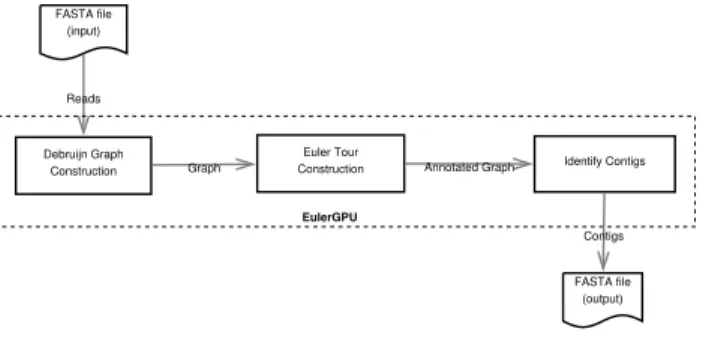
Figure 1: GPU-Euler Work Flow.
3
Background
3.1
Compute Unified Device Architecture.
Graphic processing units (GPUs) have long been serving the need of parallel computation, due to the very na-ture of the graphics applications. For the past few years, there have been several efforts, to tap the potential of GPU’s parallel computation capability so that they can be utilized for general purpose computing. Compute Unified Device Architecture (CUDA) is an initiative from nVidia that provides programming interface to utilize the compute capabilities of GPUs. CUDA SDK provides a compiler front end implemented as an extension of C language, augmented with several device-specific con-structs. It contains a set of runtime libraries that provide an API for device management. CUDA-enabled GPU devices provide parallel thread execution environment known as PTX, and can be viewed as multiple threads concurrently executing the same piece of code called kernel. This form of architecture, can be mapped to the single program multiple data (SPMD) style for par-allel computation. The logical view of CUDA device groups a set of thread into blocks and set of blocks into grids. Physical view of CUDA consists of a number of streaming multiprocessors (SMs), having a set of scalar processors (SP). CUDA threads are scheduled to run on these SPs. The actual number of threads scheduled to run concurrently depends on the resources available to SMs. There are different types of memory available to the CUDA threads, which vary in terms of their presence on and off the chip, latency and accessibility to threads or to blocks.
3.2
Parallel Graph Algorithms
Designing efficient graph algorithms for parallel architec-ture has always been challenging. Computational prob-lems dealing with graphs are inherently difficult to de-compose into balanced sub-problems, and the speedup achieved is usually not linear [8, 9, 11, 15].
3.2.1 Euler Tour Construction
The “Euler tour” construction problem for a connected graph is defined as the traversal of a graph by visiting every edge exactly once. Linear time algorithm with respect to the number of edges, exist for the
sequen-tial architecture. Makki [22] proposed a O(|E|+|V|)
algorithm for distributed memory model using a modifi-cation of the original, Fleury’s sequential algorithm. It works by simulating the Fleury’s algorithm on the ver-tices distributed among the nodes, and each node tries to identify the successive edge.
Awerbuch et. al. [3] proposed aO(logn)parallel time
algorithm for a concurrent-read and concurrent-write,
CRCW model which requiresO(|E|)processors. In this
approach, the concurrent writes do not require any spe-cific ordering of the write operations, which makes it sim-ilar and applicable on CUDA-enabled GPU platforms. Concurrent writes can be achieved by using atomic op-erations.
In our work, we opted for Awerbuch’s approach for implementing the Eulerian tour construction. This ap-proach for determining the Euler Tour, first constructs a successor graph by defining a successor relationship between edges. In the successor graph, the vertices cor-responds to the edges of original de-Bruijn graph and an edge represents the end points that are related to each other by successor function. Further, the connected components of the successor graph identifies the circuits in the graph. Two circuits will be related to each other if they have edges incident on the same vertex. This relation is represented in the form of circuit graph. A spanning tree of this circuit graph will yield a path con-necting each circuit, which in turn represents edges with their successors. Swapping the successors of the edges of two circuits at the same vertex (identified by edge of the spanning tree), will result in a Euler tour. To lower the number of edges in the circuit graph, the algorithm extracts connected sub-graphs from the circuit graphs. We implement a GPU-based parallel Eulerian tour algo-rithm by following the above approach. We specifically use a parallel connected component algorithm as a step during parallel Eulerian tour algorithm execution.
As part of the Euler tour construction, a spanning for-est is computed from the circuit graph. The edges in the spanning forest will identify the edges of the de-Bruijn graph that can exchange their successors, yielding to the final euler tour. The different methods used for identify-ing connected components (see below) can also be used for identification of spanning forests. There are several efficient parallel spanning forest algorithms available for different computing models [2]. In our implementa-tion, we opted for Kruskal’s Spanning tree algorithm as implemented in BOOST graph library [34].
Finding Connected Components For a given graph,
graph such that the vertices in the partitioned subgraph (subset) are connected to each other through some path and there does not exist any path between vertices of different subgraphs.
Shiloach-Vishkin [33] proposed a O(logn) parallel
time algorithm to find the connected component of
graph using n+2m processors where n = |V| and
m=|E|for CRCW PRAM model.
This algorithm finds the connected component by it-erating over four steps. For every vertex, a root pointer is maintained which points to the lowered numbered vertex within the connected component. The algorithm starts with each vertex as a component, with its root pointer pointing to itself. During the execution, the root pointer is repeatedly updated. Update steps cor-responds to the merging of components to form larger components. Within the iteration, the first step updates all the root pointers, in case the root vertex itself has been updated with a new root during previous itera-tion. The next step requires all vertices to examine their neighbours and update their root pointers, if the neigh-bour has root pointer with smaller vertex number. Root vertices of the component that remained unchanged in the first step, now try updating their root pointers with neighbouring lowered number root vertices. All ver-tices then perform a short-cutting step to update their root pointer with their root’s root pointer (grand-parent). These steps are performed iteratively till there are no more updates to the root pointers.
4
Methods
The current implementation of our algorithm works in
three steps as outlined in Figure 1. In the first step,k
-mers are extracted from the input sequence reads (in a fasta file) and the de-Bruijn graph is constructed. In the second step, the de-Bruijn graph is processed on the GPU to find the euler tour across the graph. In the final step, the contigs are identified and sent to the output. At this moment no error correction is performed during the assembly.
4.1
de-Bruijn Graph Data Structure
An important aspect of our implementation is the data structure that was used to represent the de-Bruijn graph. We had two considerations while implementing this data structure. Firstly, the data structure should be able to express better locality, which is a driving force for de-veloping GPU specific application. This would yield to a layout where those attributes that are going to be accessed by the same CUDA kernel will be contiguous, resulting in an efficient memory access pattern. Sec-ondly, the representation should be efficient in terms of the memory used, due to the the capacity of memory available on GPUs. This would also reduce the time
spent transferring data from the host memory to the GPU memory.
Our de-Bruijn graph is represented as a list verticesV,
a list of edges E, and two lists of pointers,EPandLP,
which store information about the leaving and entering edges for each of the vertices, respectively. The entries
within EP and LPpoint to locations within the edge
list E. Also, since the number of entering (incoming)
and leaving (outgoing) edges per vertex is unknown,
bothEPandLPare maintained as dynamic lists, with
allocation information per vertex computed during run time.
4.2
de-Bruijn Graph Construction
The input sequence reads are represented as a string over
four nucleotides or alphabets (A,C,G,T). As such, each
base can be represented using two bits and similarly a
k-mer can be represented as a sequence of 2∗kbits. (A
k-mer is a subsequence of a longer DNA sequence of
lengthk). With the 2-bit encoding per character, each
k-mer is mapped onto a unique integer value. This
en-coding allows easy computation ofk-mer neighbors by
simple bitwise operations (Shift, OR). A neighbor for a
k-merx, is one that shares either the prefix or suffix of
lengthk−1 withx.
For the de-Bruijn graph construction, we used a scheme where a hash table [1] is constructed with a
(key,value) pair defined using thek-mer’s encoded
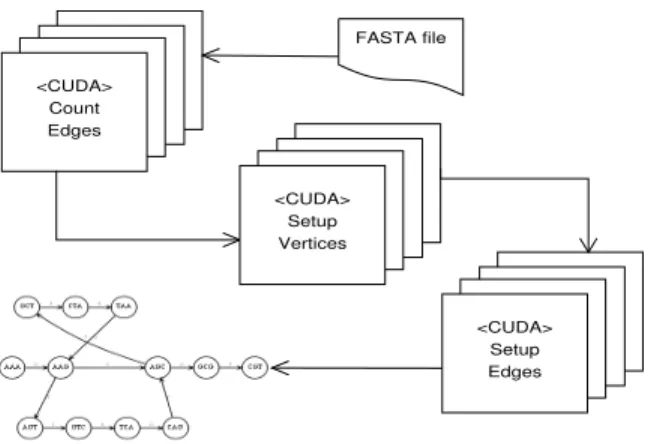
rep-resentation as key, and its index within an array as value. The steps for the GPU-based de-Bruijn graph construc-tion are shown in Figure 2) Initially, the input file
con-taining the reads is processed to extract (k+1)-mers
andk-mers. Eachk-mer is then assigned an index value
based on the hashing function, which can serve as the
location to store various attributes for the givenk-mer in
associative array representation.
Eachk-mer represents a vertex in the de-Bruijn graph,
while eachl-mer, where (l = k+1), defines an edge
between twok-mers representing an overlap ofk−1
nu-cleotides (or characters). Algorithm 1 uses three CUDA kernel launches. After the initial processing, a CUDA
kernel is invoked to process each of thel-mers (i.e., count
the edges), and update the in-degree and out-degrees
for the differentk-mer vertices. As seen in Algorithm
1, we maintain two count listsECount andLCountto
calculate the number of entering and leaving edges per vertex. Using the CUDPP Library [12, 31, 32], we per-form a parallel prefix scan on the GPUs to compute the memory required per vertex to store the information regarding the entering and leaving edges. As such, we record the offset locations for both types of edges, per
vertex. This allows us to maintain the dynamicLPand
EPdata structures.
After allocating the required memory, a second CUDA kernel is invoked to set the vertices with the edge list offset and count information. During the final step, a
<CUDA> Count Edges <CUDA> Setup Edges FASTA file <CUDA> Setup Vertices
Figure 2: de-Bruijn Graph Construction.
third CUDA kernel is invoked with each thread working on an edge to compute information regarding the source, sink and multiplicity of the edges. Within the CUDA framework, implicit synchronization is performed at the end of each kernel call i.e., all threads are automatically synchronized.
4.3
Euler Tour Construction
The Euler tour construction step is a modified implemen-tation of the algorithm proposed by Vishkin et. al. [3] for the CRCW PRAM model. These modifications were nec-essary, since CUDA follows the SPMD (Single Program Multiple Data) paradigm without inherent instruction level synchronization. On the other hand, the CRCW PRAM model expects that all processors synchronize af-ter executing each instruction. CRCW PRAM also allows for concurrent read/write to the same memory location. CUDA does not support concurrent writes. CUDA offers two kinds of synchronizations [26]; (i) Across a thread block, all threads in a single block can be synchronized using an API command. However, threads across the blocks aren’t affected by this method. (ii) Across all threads, there is automatic synchronization at the launch and completion of CUDA kernels.
These two synchronization mechanism can be used while working on CUDA platform, to accomplish a closer simulation of PRAM model. To handle concur-rent writes, we can use atomic APIs which serialize all the concurrent accesses to a memory location. Our im-plemented algorithm defines concurrent writes as one where arbitrary threads (processors) can win and CUDA atomic APIs can be used to mimic this behavior. The net effect of such an implementation is that only the last write will be visible. Synchronization and atomic operations are costly operations, and as such can lead to performance overhead. Atomic instruction sets are available on CUDA devices with compute capability 1.1 and later. An alternate option is to use shared memory and break ties using duels.
The input to the euler tour construction consists of a graph (de-Bruijn graph in our case) represented as a
list of verticesV, list of edges,Eand two
supplemen-Find Spanning Tree <CUDA> Assign Successor <CUDA> Execute Swipe <CUDA> Find Component <CUDA> Create Circuit Graph Circuit Graph Annotated Graph Spanning Tree Comp. Label DeBruijn Graph Euler Tour
Figure 3: Parallel Euler Tour.
tary listsLPandEP, that store the leaving and entering
edges for each vertex, respectively. The intuition behind this algorithm is to identify circuits in the given graph, and then change the successor of those edges of a cir-cuit, which are adjacent to an edge belonging to another circuit. To lower the complexity of the circuit graph, a sub-graph is extracted by finding the connected compo-nents, a spanning tree of this sub-graph would yield the edges that are required to be switched with their neigh-bors. Figure 3 shows major components of the Euler tour construction and are discussed below.
4.3.1 Successor Assignment
In the successor assignment step, each edge in the input de-Bruijn graph is assigned a successor. The cuda kernel works on each vertex, assigning one of the leaving edges as the successor for one of the entering edges. This assignment follows a sequential pattern i.e., the first entering edge is paired with first leaving edge, second entering edge to the second leaving edge and so on.
4.3.2 Successor Graph Creation
In this step, a successor graph is generated to represent the successor information we computed in the previous step. This step is required, so that we can identify the circuit to which each edge belongs. The successor graph contains all the edges as vertices and an edge exists be-tween two vertices, if one of them is a successor to the other. This step can be performed in constant time, pro-vided the number of processors are equal to the number of edges. For the successor graph, the number of edges in our algorithm is linear in terms of vertices. The CUDA kernel is launched for each de-Bruijn graph edge, which then sets the information in the graph being constructed.
4.3.3 Connected Components
Our implementation is based on the algorithm proposed by Uzi Viskin et. al. [33] for CRCW PRAM model that
requiresO(logn)parallel time to completion. We
modi-fied the CRCW model such that based on the iteration step, each thread would be in-charge of either a vertex or edge from the successor graph, with the four steps
Table 1: Genome size and number of simulated reads for different read lengths.
Genome Length 36 bp 50 bp 250 bp
CJ 1,641,481 911,934 656,593 128,241
NM 2,184,406 1,213,559 873,763 170,657
LL 2,635,589 1,314,216 946,236 184,812
Table 2: Profiling of GPU-Euler.
Phase Computation
I/O and k-mer Extraction CPU
Hash Table Construction GPU
de-Bruijn Graph Construction GPU
Euler Tour Construction GPU+ CPU
Sub-steps for Euler Tour Construction
Finding Connected Component GPU
Circuit Graph Creation GPU
Spanning Tree CPU
Swipe Execution GPU
Traversal (Other) GPU
Contig Generation (O/P) CPU
involving updating of root vertices performed iteratively. (See Section 3.2.1).
4.3.4 Circuit Graph Creation
The circuit graph creation works by calculating the edges between two circuits. At any vertex, instead of consider-ing all possible combination of the edges, the algorithm picks edges which are adjacent to each other in the edge
list, i.e. ei andei+1. In order to maintain a consistent
behavior across different runs, we have stored the edge list of the circuit graph in canonical order.
4.3.5 Spanning Tree
This step is implemented serially on the CPU using the boost graph library [34], which implements the Kruskal
spanning tree algorithm and requires O(|E|log|V|)
time. In our situation|E|is of the order ofO(|V|)and
the actual time will be dependent on the number of cir-cuits identified in the successor graph.
4.3.6 Swipe Execution
The final step requires a traversal of the edges in span-ning tree identified in the previous step. Each edge of the spanning tree corresponds to a pair of edges in de-Bruijn graph incident on same vertex, swapping their succes-sors will connect path containing one edge with the path containing the other edge, resulting in a connected Eu-lerian tour. Contigs are generated by identifying the source vertices and following the successor edge infor-mation pertaining to each edge.
4.4
Time Complexity Analysis
The de-Bruijn Graph construction is a constant time
op-erationO(1)givenO(n)processors, which can be
ar-ranged by assigning eachk-mer to a single CUDA-based
GPU thread. The CRCW Euler tour construction
algo-rithm [3] has a run time complexity ofO(logn)forn
ver-tices. Our modifications, introduce a constant step that does not affect the complexity of Eulerian tour
construc-tion phase, which is bounded byO(logn). Specifically,
identifying the component requires O(logn) parallel
steps, and the circuit graph creation and successor graph creation is a constant time operation in terms of num-ber of vertices. Prefix scan for calculating the required
memory also takesO(logn)parallel time. The Kruskal
spanning tree algorithm is bounded byO(|E|log|V|)
where|V| is number of vertices and|E|is number of
edges in the successor graph. The number of vertices in the successor graph tend to be far lesser than the number of vertices in the de-Bruijn graph, and the dominating factor in the time complexity analysis is not affected by the spanning tree algorithm. Hence, the overall run time
complexity of our GPU-Euler is bounded byO(logn),
as shown by analyzing different phases of the algorithm.
5
Experimental Results
5.1
Datasets
To evaluate the performance of our GPU-based assem-bler we used three previously assembled genomes: (i) Campylobacter Jejuni (CJ), (ii) Neisseria Meningitidis (NM) and (iii) Lactococcus Lactis (LL). These genomes have been used for benchmarking various other assem-bly algorithms including Euler [28]. The genome sizes (lengths) of CJ, NM and LL are 1.6Mbps, 2.1 Mbps and 2.3 Mbps, respectively. For each of the assembled genomes we simulated error free reads using MetaSim [30]. The read lengths were varied to be 36 bp, 50 bp and 250 bp for three independent set of experiments, repre-senting the NGS technologies. For each experiment, the number of reads simulated achieved a 20x coverage for the genomes and are summarized in Table 1. Since, we were focused on illustrating the performance of GPU-Euler in terms of run times we simulated only error free reads.
5.2
Experimental Protocol
We performed a comprehensive set of experiments that assessed the run time performance of GPU-Euler across the three different genome benchmarks, and with vary-ing read lengths. We performed run time profilvary-ing of our method, evaluating and optimizing the speed of different phases of the GPU-Euler algorithm. We also compared the performance of our approach to well es-tablished sequence assemblers like EulerSR [7]. We ran
Table 3: Run Time Performance for CJ Genome using GPU-Euler (250 bp reads).
k I/O Hash Table de-Bruijn Euler Tour Output GPU CPU Total
Component Spanning Tree Swipe Other
16 61.646 0.129 0.487 4.364 0.123 0.004 0.240 1.501 5.224 65.497 70.722 18 57.705 0.137 0.513 4.371 0.050 0.004 0.156 1.521 5.181 61.476 66.657 22 60.541 0.136 0.513 4.412 0.035 0.004 0.272 1.594 5.339 64.45 69.790 24 62.273 0.136 0.504 4.412 0.033 0.004 0.301 1.643 5.358 66.221 71.579 26 63.682 0.137 0.503 4.423 0.030 0.004 0.321 1.687 5.388 67.740 73.128 28 65.494 0.137 0.514 4.431 0.026 0.004 0.327 1.734 5.413 69.588 75.002 30 67.595 0.136 0.513 4.484 0.025 0.004 0.324 1.768 5.462 71.651 77.114 32 68.965 0.138 0.504 4.387 0.027 0.004 0.312 1.820 5.344 73.072 78.417
The run-times are reported in seconds. The phases indicated in bold i.e., Hash Table, Component, Swipe and Other are performed on the GPUs.
Table 4: Run Time Performance for NM Genome using GPU-Euler (250 bp reads).
k I/O Hash Table de-Bruijn Euler Tour Output GPU CPU Total
Component Spanning Tree Swipe Other
16 75.948 0.173 0.723 5.798 0.264 0.030 0.593 2.003 7.319 80.858 88.178 18 76.615 0.179 0.759 5.839 0.209 0.028 0.518 2.057 7.326 81.658 88.985 20 79.029 0.181 0.758 5.732 0.181 0.026 0.499 2.108 7.199 84.139 91.339 22 82.235 0.182 0.748 5.753 0.176 0.024 0.473 2.161 7.183 87.428 94.612 24 84.787 0.181 0.763 5.739 0.164 0.023 0.456 2.263 7.163 90.046 97.210 26 87.398 0.183 0.773 5.734 0.158 0.021 0.439 2.281 7.152 92.767 99.920 28 89.956 0.182 0.781 5.755 0.138 0.021 0.430 2.310 7.171 95.323 102.495 30 92.503 0.184 0.793 5.779 0.135 0.019 0.419 2.380 7.195 97.958 105.154 32 95.303 0.184 0.778 5.735 0.124 0.019 0.361 2.479 7.079 100.835 107.915
The run-times are reported in seconds. The phases indicated in bold i.e., Hash Table, Component, Swipe and Other are performed on the GPUs.
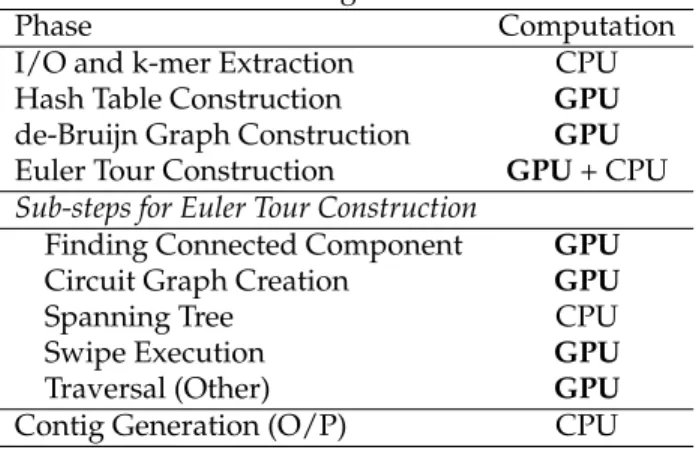
each experiment multiple times to ensure that the run-times remained consistent due to load factors on the workstation. We did not notice any significant variabil-ity across multiple runs with the same parameters, and as such do not report them in this study. The GPU-Euler algorithm has different phases of the algorithm run on the GPUs using CUDA kernel launches, whereas some of the phases are run on the CPU and some of the steps are run on the CPU as well as GPUs. We show in Table 2 the different steps of the GPU-Euler algorithm and their execution pattern.
For contigs greater than 100 bp we report the total bases within the contigs, mean and maximum length of contigs obtained. We also compute the N50 score, which is defined as the length of smallest contig such that 50% of the genome length is contained in contigs of size N50 or greater. To compute the accuracy and coverage statistics, we used the NUCMER pipeline of MUMMER [21] that allowed for quick and fast alignment of assembled contigs to the input genomes. NUCMER uses a suffix-tree based string matching algorithm to search for exact matches, and extends these matches using a dynamic programming based alignment that is considerably faster than BLAST. Using the alignment we calculate the length weighted accuracy.
5.2.1 System Configuration
The benchmarking of GPU-Euler was performed on a Dell workstation which has a quad core Intel Xeon 2.00 GHz processor with 8 GB primary memory. This system has a nVidia Quadro FX 5800 GPU, which has a clock rate of 1.30 GHz, 240 cores, 4 GB GPU RAM and CUDA compute capiblity 1.3. We used the CUDA SDK version 2.3 to build GPU-Euler. The GPU-Euler uses both CPU and GPU, whereas the EulerSR (used for comparison) was run on a single core of the Intel processor.
5.3
Run-Time Performance
Tables 3, 4 and 5 show the run times (in seconds) across the different phases of GPU-Euler performed by varying
the overlap parameter,k-mer size from 16 to 32 across
the CJ, NM and LL genomes, respectively. We performed experiments across reads of length, 36, 50 and 250 bps but show results in these tables for 250 bps. We report the run-times for the different phases of the algorithm across the GPU and CPU as shown in Table 2. We also report the total run-time along with the total GPU and CPU run-times.
As we increase the value ofk, the CPU run-time
grad-ually increases for all the three genomes. A large percent-age of time (approximately 90%) is spent in extracting
k-mers from the several input read sequences (denoted
as I/O). During this phase, a file containing the sequence reads (in fasta format) is processed sequentially and a list
ofk-mers along with their occurrence frequency is
gen-erated. We use an unordered set data structure from the
Boost library [34] to maintain the list of occurringk-mers
and their frequency. This is a dynamic structure and needs to expand, if the number of entries in the set (i.e.,
k-mers) increase. In the I/O phase we also compress and
encode thek-mers using thebase4representation. Thus,
the execution time during the I/O phase performed on the CPU dominates the overall performance of our cur-rent algorithm. In the future, we intend to extend our GPU-implementation to off-load more work from the CPU.
The different phases of GPU-Euler that are run on the GPUs do not vary significantly, in terms of run-times as
thekparameters is increases. The GPU run-time is
dom-inated by the connected component phase algorithm which uses 8 CUDA kernel launches in an iterative fash-ion. These kernels use CUDA synchronization API to serialize writes for given memory execution, which ex-plains the relatively higher execution time for this phase. When comparing the performance across the three
Table 5: Run Time Performance for LL Genome using GPU-Euler (250 bp reads).
k I/O Hash Table de-Bruijn Euler Tour Output GPU CPU Total
Component Spanning Tree Swipe Other
16 84.858 0.200 0.900 6.241 0.186 0.008 0.352 2.224 7.702 90.225 97.928 18 84.397 0.208 0.985 6.278 0.124 0.007 0.302 2.225 7.782 89.877 97.660 20 85.231 0.209 1.001 6.278 0.111 0.006 0.348 2.262 7.845 90.765 98.611 22 88.208 0.208 1.000 6.447 0.096 0.006 0.358 2.384 8.022 93.853 101.876 24 90.868 0.209 0.995 6.315 0.090 0.006 0.366 2.407 7.892 96.547 104.440 26 93.315 0.208 1.016 6.307 0.089 0.006 0.361 2.482 7.900 99.144 107.045 28 95.276 0.210 1.003 6.316 0.083 0.006 0.369 2.530 7.905 101.153 109.059 30 98.125 0.209 0.980 6.341 0.081 0.006 0.352 2.610 7.891 104.079 111.971 32 100.088 0.210 1.008 6.297 0.079 0.006 0.356 2.662 7.879 106.123 114.003
The run-times are reported in seconds. The phases indicated in bold i.e., Hash Table, Component, Swipe and Other are performed on the GPUs.
Table 6: Comparative Performance for GPU-Euler on the CJ genome(Contigs >= 100 bp).
Assembler k Time (s) N50 N Mean Max TB WA
Read Length = 36 bp EulerSR* 16 122.391 5345 21 503.810 5345 10580 99.35 22 100.676 136 17 144.882 244 2463 100 EulerSR 20 176.858 17827 227 7408.696 57201 1681774 97.37 22 162.582 7386 387 4192.140 36866 1622358 98.62 GPU-Euler 22 42.456 8480 720 4491.206 40255 3233668 83.23 Read Length = 50 bp EulerSR* 22 101.220 6085 25 441.840 6085 11046 99.88 26 96.496 1686 9 849.667 3637 7647 99.09 EulerSR 21 151.444 79838 114 14404.965 155588 1642166 95.33 26 141.378 46497 124 13042.726 97486 1617298 97.22 GPU-Euler 26 49.166 47766 307 10527.147 158836 3231834 91.01 Read Length = 250 bp EulerSR* 18 114.383 511 1529 394.891 3476 603788 78.01 32 - - - -EulerSR 27 103.104 112428 69 24544.275 191547 1693555 95.38 32 - - - -GPU-Euler 32 78.417 13806 597 5521.774 59742 3296499 98.25
EulerSR* represents a run of EulerSR with-minMult=20. We report for each assembler the results withk-mer size which produces the best N50 score. For EulerSR we also report the results for thek-mer chosen for GPU-Euler. For
k>30, EulerSR produces a memory error. N50, N, Mean, Max are the N50 scores, total number of contigs, mean contig lengths and maximum contig lengths, respectively. TB and WA denote the total number of aligned bases
within the contigs and the weighted accuracy, respectively.
genomes, we notice that as size of genome increases from CJ to NM to LL, the number of input reads increase to maintain the 20x coverage (Table 1). As such, the I/O
andk-mer extraction increases with increasing genome
sizes. The average GPU run times for the CJ, NM and LL genomes are 5.339, 7.199 and 7.869 seconds, respectively. This change in the GPU-time is primarily because of larger de-Bruijn graph size with increasing number of input reads. In Figure 4 we show a plot of the GPU run times across these three genome benchmarks for the different read lengths.
5.4
CUDA Configuration
Within the CUDA specification, we can specify different groupings of threads for the problem instances. CUDA threads are grouped into blocks and blocks are grouped as grids. This arrangement provides different portion of on-chip memory to be shared among a block of threads, which can lead to overall improvement in the execution time depending upon the problem. We also performed experiments using different kernel launch configuration i.e., assigning 4 threads per block to 512 threads per block for our datasets. We observed that the overall GPU run
time exhibited very slight variation across the different configurations. This was primarily because of the nature of the problem ported on the GPUs. In this work, we report results with the kernels having 512 threads per block.
5.5
Comparative Performance
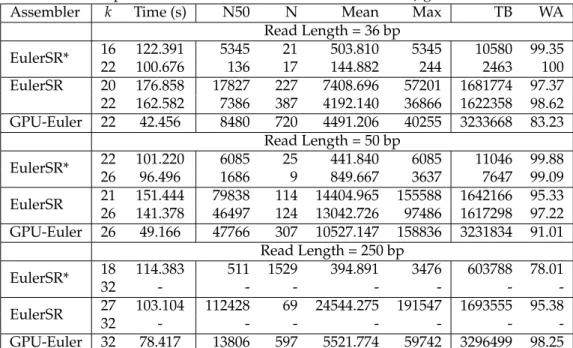
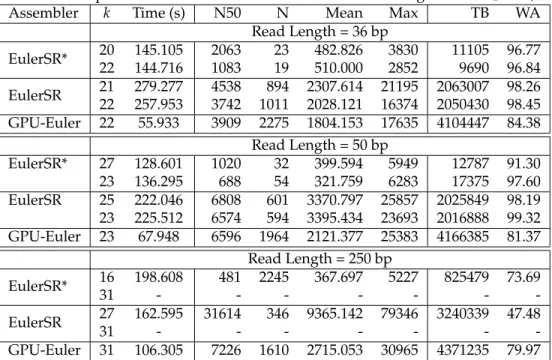
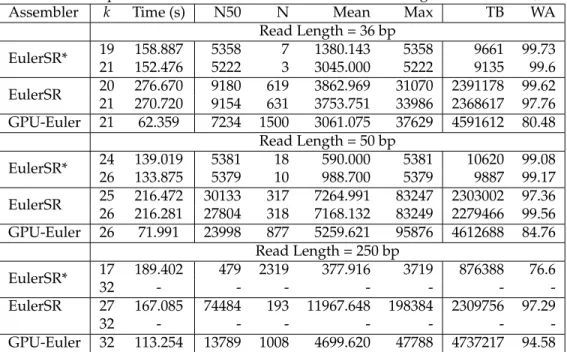
We compared our assembler with EulerSR [7], a widely used Eulerian-based assembler developed for short reads. Experiments for EulerSR were performed on a sin-gle CPU core of our workstation. Tables 6, 7 and 8 show the contig length statistic, contig accuracy results and the run-time for 36, 50 and 250 bps across the CJ, NM and LL genome benchmarks, respectively. We report these performance results for GPU-Euler and compare it to EulerSR. We report those results for the different assemblers that achieved the best N50 score. For Eu-lerSR we also invoked a parameter (minMult = 20) that
will filterk-mers that do not occur at least twenty times.
These results are reported in the Tables as “EulerSR*”. We highlight in bold those entries that show the best performance across the two assemblers.
Table 7: Comparative Performance for GPU-Euler on the NM genome(Contigs >= 100 bp).
Assembler k Time (s) N50 N Mean Max TB WA
Read Length = 36 bp EulerSR* 20 145.105 2063 23 482.826 3830 11105 96.77 22 144.716 1083 19 510.000 2852 9690 96.84 EulerSR 21 279.277 4538 894 2307.614 21195 2063007 98.26 22 257.953 3742 1011 2028.121 16374 2050430 98.45 GPU-Euler 22 55.933 3909 2275 1804.153 17635 4104447 84.38 Read Length = 50 bp EulerSR* 27 128.601 1020 32 399.594 5949 12787 91.30 23 136.295 688 54 321.759 6283 17375 97.60 EulerSR 25 222.046 6808 601 3370.797 25857 2025849 98.19 23 225.512 6574 594 3395.434 23693 2016888 99.32 GPU-Euler 23 67.948 6596 1964 2121.377 25383 4166385 81.37 Read Length = 250 bp EulerSR* 16 198.608 481 2245 367.697 5227 825479 73.69 31 - - - -EulerSR 27 162.595 31614 346 9365.142 79346 3240339 47.48 31 - - - -GPU-Euler 31 106.305 7226 1610 2715.053 30965 4371235 79.97
EulerSR* represents a run of EulerSR with-minMult=20. We report for each assembler the results withk-mer size which produces the best N50 score. For EulerSR we also report the results for thek-mer chosen for GPU-Euler. For
k>30, EulerSR produces a memory error. N50, N, Mean, Max are the N50 scores, total number of contigs, mean contig lengths and maximum contig lengths, respectively. TB and WA denote the total number of aligned bases
within the contigs and the weighted accuracy, respectively.
0 2 4 6 8 10 CJ NM LL
GPU Time (seconds)
Genome
36bp 50bp 256bp
Figure 4: GPU Time comparison across different
genomes.
GPU-Euler consistently outperforms EulerSR in terms of run times. However, note GPU-Euler is utilizing the computing capacity of the GPUs whereas EulerSR is benchmarked on single processor. As the read length increases from 36 to 250 base pairs, we notice that the run time for GPU-Euler increases. This is primarily because of processing longer reads during the I/O phase.
With respect to contig length statistics and accuracy, we notice that EulerSR shows better performance. GPU-Euler shows better or comparable N50 scores and mean contig lengths for few of the cases. The implemented GPU-Euler works on the full de-Bruijn graph without any compaction and translation. EulerSR implements several heuristics that analyze the de-Bruijn graph struc-ture and help resolve repeat regions within a genome.
6
Conclusion and Future Work
In this work, we investigated the potential of using GPUs for performing genome sequence assembly task. We de-veloped an Eulerian-based sequence assembler that used the GPU in conjunction with the CPU. Our empirical re-sults showed that this GPU-based assembler had better run time performance in comparison to EulerSR on three bacterial genome benchmarks, across reads representing NGS data. We also showed competitive contig length statistics but in terms of accuracy there is room for im-provement.
The hash table implementation can be improved for more efficient creation and access time. We can also in-vestigate the possible use of shared memory and texture
memory especially for hash lookup. At this moment ,k
-mer extraction and read encoding is done on CPU, which can be moved to GPU for additional improvements. Be-sides the run-time performance, we intend to improve the contig lengths and accuracy by incorporating graph simplification strategies as well as error correction capa-bilities. From a benchmarking perspective, we would like to compare GPU-Euler to EulerSR using multi-cores, as well as other distributed-memory parallel assemblers developed, ABySS [35] and YGA [18].
A limitation of our approach is scalability in terms of the genome sizes. One of the limitations of using GPUs, is the amount of available memory and the high mem-ory requirement for genome assembly and analysis tasks. This can potentially be avoided by a pipelining solution that would break the computation into different parts and inter-leave the operations that would be performed
Table 8: Comparative Performance for GPU-Euler on the LL genome(Contigs >= 100 bp).
Assembler k Time (s) N50 N Mean Max TB WA
Read Length = 36 bp EulerSR* 19 158.887 5358 7 1380.143 5358 9661 99.73 21 152.476 5222 3 3045.000 5222 9135 99.6 EulerSR 20 276.670 9180 619 3862.969 31070 2391178 99.62 21 270.720 9154 631 3753.751 33986 2368617 97.76 GPU-Euler 21 62.359 7234 1500 3061.075 37629 4591612 80.48 Read Length = 50 bp EulerSR* 24 139.019 5381 18 590.000 5381 10620 99.08 26 133.875 5379 10 988.700 5379 9887 99.17 EulerSR 25 216.472 30133 317 7264.991 83247 2303002 97.36 26 216.281 27804 318 7168.132 83249 2279466 99.56 GPU-Euler 26 71.991 23998 877 5259.621 95876 4612688 84.76 Read Length = 250 bp EulerSR* 17 189.402 479 2319 377.916 3719 876388 76.6 32 - - - -EulerSR 27 167.085 74484 193 11967.648 198384 2309756 97.29 32 - - - -GPU-Euler 32 113.254 13789 1008 4699.620 47788 4737217 94.58
EulerSR* represents a run of EulerSR with-minMult=20. We report for each assembler the results withk-mer size which produces the best N50 score. For EulerSR we also report the results for thek-mer chosen for GPU-Euler. For
k>30, EulerSR produces a memory error. N50, N, Mean, Max are the N50 scores, total number of contigs, mean contig lengths and maximum contig lengths, respectively. TB and WA denote the total number of aligned bases
within the contigs and the weighted accuracy, respectively.
on the GPU and CPU. Such a strategy will slow the over-all process but would over-allow assembly for large human genomes.
References
[1] Dan A. Alcantara, Andrei Sharf, Fatemeh Abbasine-jad, Shubhabrata Sengupta, Michael Mitzenmacher, John D. Owens, and Nina Amenta. Real-time
par-allel hashing on the GPU. ACM Transactions on
Graphics, 28(5):1, 2009.
[2] Awerbuch and Shiloach. New connectivity and MSF algorithms for Shuffle-Exchange network
and PRAM. IEEE Transactions on Computers,
C-36(10):1258–1263, 1987.
[3] B. Awerbuch, A. Israeli, and Y. Shiloach. Finding
euler circuits in logarithmic parallel time. In
Pro-ceedings of the sixteenth annual ACM symposium on Theory of computing - STOC ’84, pages 249–257, Not Known, 1984.
[4] S. Batzoglou. ARACHNE: a Whole-Genome
shot-gun assembler. Genome Research, 12(1):177–189,
2002.
[5] D. W Bryant, W. K Wong, and T. C Mockler. QSRA – a quality-value guided de novo short read
assem-bler. BMC bioinformatics, 10(1):69, 2009.
[6] J. Butler, I. MacCallum, M. Kleber, I. A Shlyakhter, M. K Belmonte, E. S Lander, C. Nusbaum, and D. B
Jaffe. ALLPATHS: de novo assembly of
whole-genome shotgun microreads. Genome Research,
18(5):810, 2008.
[7] M. J. Chaisson and P. A. Pevzner. Short read
frag-ment assembly of bacterial genomes. Genome
Re-search, 18(2):324–330, 2008.
[8] F. Y Chin, J. Lam, I. Chen, et al. Efficient parallel
al-gorithms for some graph problems.Communications
of the ACM, 25(9):665, 1982.
[9] G. Cong and D. A Bader. Techniques for designing efficient parallel graph algorithms for SMPs and
multicore processors. Lecture Notes in Computer
Sci-ence, 4742:137, 2007.
[10] J. C. Dohm, C. Lottaz, T. Borodina, and H. Himmel-bauer. SHARCGS, a fast and highly accurate short-read assembly algorithm for de novo genomic
se-quencing. Genome Research, 17(11):1697–1706, 2007.
[11] John Greiner. A comparison of parallel algorithms
for connected components. InProceedings of the
sixth annual ACM symposium on Parallel algorithms and architectures - SPAA ’94, pages 16–25, Cape May, New Jersey, United States, 1994.
[12] Mark Harris, Shubhabrata Sengupta, and John D. Owens. Parallel prefix sum (scan) with cuda. In
Hu-bert Nguyen, editor,GPU Gems 3. Addison Wesley,
August 2007.
[13] D. Hernandez, P. Francois, L. Farinelli, M. Osteras, and J. Schrenzel. De novo bacterial genome se-quencing: Millions of very short reads assembled
on a desktop computer.Genome Research, 18(5):802– 809, 2008.
[14] Mohammad Hossain, Navid Azimi, and Steven Skiena. Crystallizing short-read assemblies around
seeds. BMC Bioinformatics, 10(Suppl 1):S16, 2009.
[15] T. Hsu, V. Ramachandran, and N. Dean.
Implementa-tion of parallel graph algorithms on a massively parallel SIMD computer with virtual processing. University of Texas at Austin, Dept. of Computer Sciences, 1993. [16] Ramana M. Idury and Michael S. Waterman. A new
algorithm for dna sequence assembly. Journal of
Computational Biology, 2:291–306, 1995.
[17] B. Jackson, P. Schnable, and S. Aluru. Parallel short
sequence assembly of transcriptomes. BMC
bioin-formatics, 10(Suppl 1):S14, 2009.
[18] B. G. Jackson, M. Regennitter, X. Yang, P. S. Schn-able, and S. Aluru. Parallel de novo assembly of large genomes from high-throughput short reads. In Parallel & Distributed Processing (IPDPS), 2010 IEEE International Symposium on, pages 1–10, 2010. [19] Benjamin G. Jackson and Srinivas Aluru. Parallel
construction of bidirected string graphs for genome
assembly. In2008 37th International Conference on
Parallel Processing, pages 346–353, Portland, Oregon, USA, 2008.
[20] W. R Jeck, J. A Reinhardt, D. A Baltrus, M. T Hick-enbotham, V. Magrini, E. R Mardis, J. L Dangl, and C. D Jones. Extending assembly of short DNA
se-quences to handle error. Bioinformatics, 23(21):2942,
2007.
[21] S. Kurtz, A. Phillippy, A. Delcher, M. Smoot, M. Shumway, C. Antonescu, and S. Salzberg. Ver-satile and open software for comparing large
genomes.Genome biology, 5(2):R12, 2004.
[22] SAM Makki. A distributed algorithm for
construct-ing an Eulerian tour. InPerformance, Computing, and
Communications Conference, 1997. IPCCC 1997., IEEE International, pages 94–100. IEEE, 1997.
[23] P. Medvedev, K. Georgiou, G. Myers, and M. Brudno. Computability of models for sequence
assembly. Algorithms in Bioinformatics, pages 289–
301, 2007.
[24] E. W. Myers. The fragment assembly string graph.
Bioinformatics, 21(suppl_2):ii79–ii85, 2005.
[25] E. W Myers, G. G Sutton, A. L Delcher, I. M Dew, D. P Fasulo, M. J Flanigan, S. A Kravitz, C. M Mo-barry, K. H.J Reinert, K. A Remington, et al. A
whole-genome assembly of drosophila. Science,
287(5461):2196, 2000.
[26] Nvidia. Cuda toolkit reference manual.
[27] P. A Pevzner, H. Tang, and M. S Waterman. An eulerian path approach to DNA fragment assembly.
Proceedings of the National Academy of Sciences of the United States of America, 98(17):9748, 2001.
[28] P. A Pevzner, H. Tang, and M. S Waterman. A new approach to fragment assembly in DNA
sequenc-ing. InProceedings of the fifth annual international
conference on Computational biology, pages 256 –267, 2001.
[29] M. Pop. Genome assembly reborn: recent
com-putational challenges. Briefings in Bioinformatics,
10(4):354–366, 2009.
[30] D. C Richter, F. Ott, A. F Auch, R. Schmid, and D. H Huson. MetaSim- a sequencing simulator for
genomics and metagenomics.PLoS One, 3(10):3373,
2008.
[31] S. Sengupta, M. Harris, and M. Garland. Efficient parallel scan algorithms for GPUs. Technical report, Citeseer, 2008.
[32] Shubhabrata Sengupta, Mark Harris, Yao Zhang, and John D. Owens. Scan primitives for gpu
com-puting. InGraphics Hardware 2007, pages 97–106.
ACM, August 2007.
[33] Y Shiloach and U Vishkin. An (log) parallel
connec-tivity algorithm. Journal of Algorithms, 3(1):57–67,
1982.
[34] J. Siek, L.Q. Lee, A. Lumsdaine, L.Q. Lee, L.S. Black-ford, J. Demmel, J. Dongarra, I. Duff, S. Hammar-ling, M. Heroux, et al. The boost graph library: User
guide and reference manual. InProceedings of the,
volume 243, pages 112–121, 2002.
[35] J. T. Simpson, K. Wong, S. D. Jackman, J. E. Schein, S. J.M. Jones, and I. Birol. ABySS: a parallel
assem-bler for short read sequence data. Genome Research,
19(6):1117–1123, 2009.
[36] J. Craig Venter, Hamilton O. Smith, and Leroy Hood.
A new strategy for genome sequencing. Nature,
381(6581):364–366, May 1996.
[37] R. L Warren, G. G Sutton, S. J.M Jones, and R. A Holt. Assembling millions of short DNA sequences
using SSAKE. Bioinformatics, 23(4):500, 2007.
[38] D. R. Zerbino and E. Birney. Velvet: Algorithms for de novo short read assembly using de bruijn
Algorithm 1de-Bruijn Graph Construction on CUDA-based GPUs.
Input: L:l-mer list, T ():k-mer hash function
Output: V : Vertex List, E : Edge List , LP : Leaving Edge Pointers List, EP : Entering Edge Pointers List
/* Temporary Lists */
LCount : Leaving Edge Count List LOffset : Leaving Edge Offset List ECount : Entering Edge Count List EOffset : Entering Edge Offset List
/* Kernel 1 for Counting Edges */
1: for allthreadi:LiinL do
2: p←PREFIX(Li)
3: s←SUFFIX(Li)
4: pindex←T(p)/* T is a lookup hash function */
5: sindex←T(s)
6: ECount[sindex] + +
7: LCount[pindex] + +
8: Synchronize
/* CUDPP Library Prefix-Scan */
9: EO f f set←PREFIX−SCAN(ECount)
10: LO f f set←PREFIX−SCAN(LCount)
/* Kernel 2 for Vertices Setup */
11: for allthreadi:(key,index)←(Ti)∈Tdo
12: V [index].vid←key
13: V [index].EOffset←EOffset[index]
14: V [index].LOffset←LOffset[index]
15: Synchronize
/* Kernel 3 for Edge Setup */
16: for allthreadi:LiinLdo
17: p←PREFIX(Li)
18: s←SUFFIX(Li)
19: pindex←T(p)/* T is a lookup hash function */
20: sindex←T(s)
21: E [i].source←pindex
22: E [i].sink←sindex
23: Update LP [V[pindex].LOffset] withi