Consistent, global state transfer
for message-passing parallel algorithms in
Grid environments
PhD thesis
Written by
József Kovács
research fellow MTA SZTAKIAdvisors:
Dr. Péter Kacsuk (MTA SZTAKI)
Dr. László Kovács (ME)
Leader of Doctoral School:
Dr. Tibor Tóth
Computer and Automation Research Institute,
Hungarian Academy of Sciences
(MTA SZTAKI)
„Hatvany József” Doctoral School of Information Science,
University of Miskolc
(ME)
Abstract
This dissertation introduces a new way to combine and complement existing parallel checkpointing techniques to be applied for software heterogeneous ClusterGrid infrastructure in order to provide transfer (migration) of parallel algorithms (applications) among clusters and nodes. While existing solutions are aiming at providing application transparency by building special middleware, the solution presented in this dissertation provides both application and middleware transparency for the algorithms at the same time.
This dissertation addresses the problem of migrating parallel applications among clusters where source and target clusters may not be operated by identical middleware components. In this case, application may not lay on any special service provided by the middleware running on the cluster. Therefore the solution must somehow be designed in a way that middleware of the cluster is not taking part in the checkpointing procedure and the application programmer must not be forced to touch his/her application source code to reach this functionality.
The solution presented in this dissertation introduces a new checkpointing method by which transparent migration of parallel applications can be solved. The overall checkpointing design space is introduced, requirements are defined and the method is introduced. Two different checkpointing frameworks – targeting different application development methods - have been designed and introduced: Grapnel and TotalCheckpoint. Based on these results process and application migration is introduced providing middleware and application transparency.
Contents
ABSTRACT...2 CONTENTS ...3 LIST OF FIGURES...6 ABBREVIATIONS ...7 1 INTRODUCTION...91.1 CLUSTER,GRID,CLUSTERGRID...10
1.2 OVERVIEW OF ROLLBACK-RECOVERY TECHNIQUES...12
1.2.1 LOG-BASED ROLLBACK/RECOVERY...13
1.2.2 CHECKPOINT-BASED ROLLBACK/RECOVERY...14
1.2.3 CHECKPOINT BASED MIGRATION...16
1.3 OVERVIEW OF CHECKPOINTING AND MIGRATION FRAMEWORKS...17
1.3.1 COCHECK...17 1.3.2 CONDOR...18 1.3.3 FAIL-SAFE PVM ...18 1.3.4 DYNAMITE...19 1.3.5 MPVM(MIST)...20 1.3.6 TMPVM...21 1.3.7 DAMPVM ...21 1.3.8 CHARM...22 1.3.9 CLIP ...22 1.3.10 ZAPC ...23 1.3.11 LAM/MPI ...23 1.3.12 CHARM4MPI ...24 1.3.13 FT-MPI ...24 1.3.14 STARFISH MPI ...25
2 NEW CHECKPOINTING METHOD ON CLUSTERGRID ...26
2.1 TRANSPARENCY CONDITIONS IN CLUSTERGRID ENVIRONMENTS...27
2.1.1 OVERVIEW...27
2.1.2 IDENTIFICATION OF THE COMPONENTS...27
2.1.3 USE CASES...29
2.1.4 REQUIREMENTS IN CLUSTERGRID...32
2.1.5 FORMAL DEFINITION OF THE REQUIREMENTS...33
2.1.5.1 Abstract State Machines ...33
2.1.5.2 Basic universes, functions and relations ...34
2.1.5.3 Formal definition of the requirements ...35
2.1.6 ANALYSIS OF THE REQUIREMENTS...36
2.1.6.1 Existing checkpointing techniques ...36
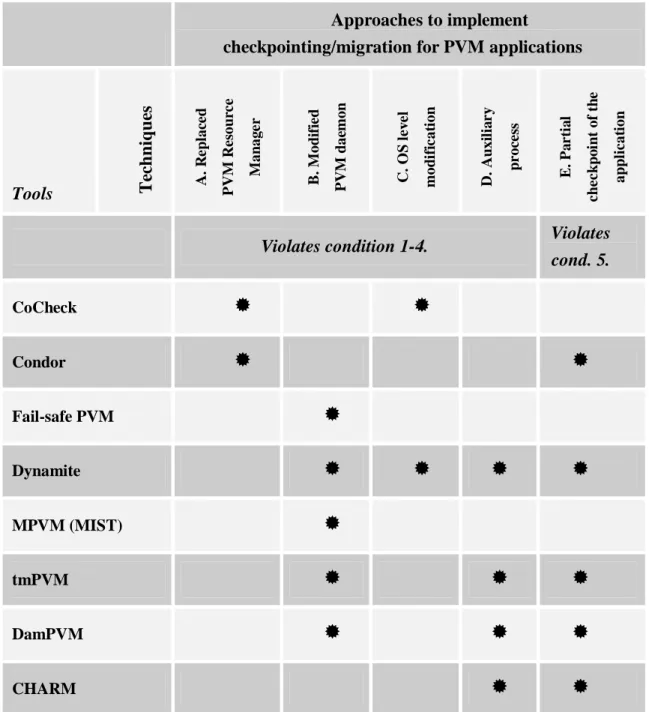
2.1.6.2 Classification of related works ...37
2.2 THE CLUSTERGRID CHECKPOINTING METHOD...41
2.2.2 INTRODUCTION OF THE CLUSTERGRID METHOD...41
2.2.3 FORMAL DEFINITION OF THE CLUSTERGRID CHECKPOINTING METHOD...44
2.2.4 DEFINITION OF THE CPGROUNDASM MODEL...48
2.2.4.1 Universes and signatures...48
2.2.4.2 Initial state...49
2.2.4.3 Rules ...49
2.2.5 VALIDATION OF THE CPGROUND MODEL...56
3 CHECKPOINTING PVM APPLICATIONS...62
3.1 THE GRAPNEL CHECKPOINTING FRAMEWORK...63
3.1.1 OVERVIEW...63
3.1.2 P-GRADE ENVIRONMENT AND GRAPNEL LANGUAGE...63
3.1.3 THE GRAPNEL CHECKPOINTING SOLUTION...66
3.1.3.1 Overview of the solution...66
3.1.3.2 Structure of the GRAPNEL checkpointing framework ...68
3.1.3.3 The GRAPNEL checkpointing protocol ...69
3.1.3.4 Checkpoint aware communication primitives ...71
3.1.3.5 Interruption and consistent cut ...73
3.1.3.6 Redesigned communication algorithms ...75
3.1.4 DEFINITION OF THE CPGRAPNELASM MODEL...77
3.1.4.1 Universes and signatures...77
3.1.4.2 Initial state...78
3.1.4.3 Rules ...78
3.1.5 CORRESPONDENCE OF CPGROUND AND CPGRAPNELASM MODELS...86
3.1.5.1 Notion of equivalence...86
3.1.5.2 Proof of equivalence ...87
3.2 THE TOTALCHECKPOINT FRAMEWORK...93
3.2.1 OVERVIEW...93
3.2.2 STRUCTURE AND PRINCIPLES...93
3.2.3 DESIGN ISSUES AND SOLUTIONS...95
3.2.3.1 Identification of processes ...95
3.2.3.2 Dynamic process creation ...95
3.2.3.3 Starting the execution ...96
3.2.3.4 Recovering the execution...98
3.2.3.5 Checkpointing the application...101
3.2.3.6 Restoring message buffers with dynamic message format ...103
3.2.4 COMPARISON OF GRAPNEL AND TCKPT CHECKPOINTING...104
3.2.5 OVERVIEW OF THE ENHANCED TCKPT...105
3.2.6 DEFINITION OF CPTCKPTASM MODEL...107
3.2.6.1 Universes, Signatures and Initial state ...107
3.2.6.2 Rules ...108
3.2.7 RELATION OF CPGRAPNEL AND CPTCKPTASM MODELS...110
3.2.7.1 Correctness of refinement ...110
4 MIGRATION OF PVM APPLICATIONS ...112
4.1 PROCESS MIGRATION ON CLUSTERS...114
4.1.1 OVERVIEW...114
4.1.2 CONDOR...114
4.1.3 SELF-COORDINATED MIGRATION IN THE GRAPNEL APPLICATION...115
4.1.3.1 Assumptions...115
4.1.3.3 Preparation of the migration procedure ...116
4.1.3.4 The migration procedure...116
4.1.3.5 Migration among nodes under the Condor job scheduler ...117
4.1.4 MODELLING...120
4.1.5 SUMMARY...121
4.2 APPLICATION MIGRATION ON CLUSTERGRID...122
4.2.1 OVERVIEW...122
4.2.2 MOTIVATION...122
4.2.3 DESIGN ISSUES...122
4.2.3.1 Initiation of application migration ...123
4.2.3.2 Self-checkpoint capable server process ...124
4.2.3.3 Migration of working files of the application ...125
4.2.4 FLOW OF MIGRATION...125
4.2.5 MODELLING...127
4.2.6 SUMMARY...128
5 DISCUSSION AND CONCLUSION...130
6 ACKNOWLEDGEMENT...132
List of Figures
Figure 1 Classification of rollback-recovery algorithms ...12
Figure 2 Classification of checkpoint levels ...15
Figure 3 The CoCheck checkpointing protocol...17
Figure 4 View of the Condor MW paradigm ...18
Figure 5 Architecture of Fail-safe PVM ...19
Figure 6 Architecture of the Dynamite PVM system ...20
Figure 7 The tmPVM virtual machine ...21
Figure 8 Structure of CLIP ...23
Figure 9 Structure of the FT-MPI implementation...24
Figure 10 Architecture of the Starfish MPI...25
Figure 11 Components of a checkpointing environment ...28
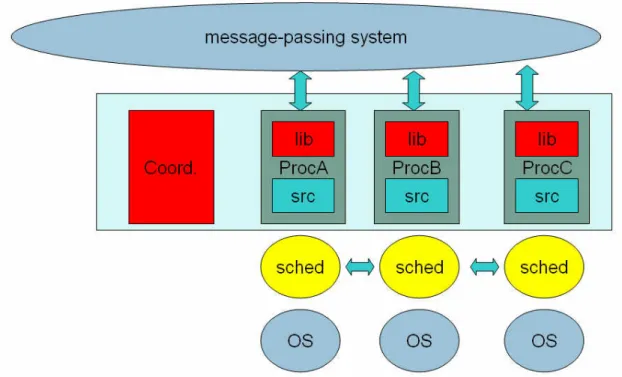
Figure 12 Structure of the proposed checkpointing technique ...44
Figure 13 Phase transition diagram of the CPground model ...60
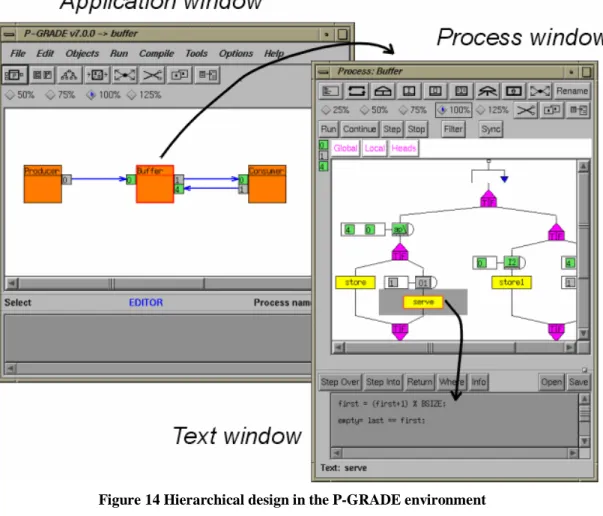
Figure 14 Hierarchical design in the P-GRADE environment ...64
Figure 15 Relation of P-GRADE and GRAPNEL application ...65
Figure 16 Structure of a GRAPNEL application generated by P-GRADE ...67
Figure 17 Structure of the Grapnel application in checkpoint mode...68
Figure 18 Guarded communication primitives to prevent interruption ...72
Figure 19 Modification of receive communication primitives to multi-receive ...73
Figure 20 Consistent and inconsistent cuts in a system state ...74
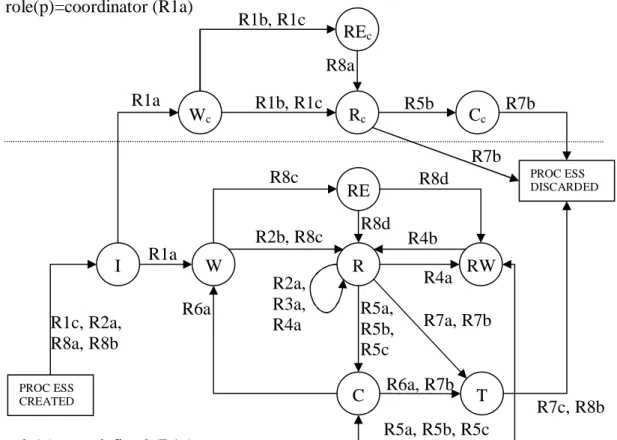
Figure 21 Phase-transition diagram of processes in CPgrapnel ASM model ...87
Figure 22 Computational segments in CPground and CPgrapnel models ...88
Figure 23 Startup phase of SGMINITIALISATION in CPground and CPgrapnel models ...89
Figure 24 Resumption phase of SGMINITIALISATION in CPground and CPgrapnel models....90
Figure 25 Communication phase of SGMEXECUTION in CPground and CPgrapnel models ..91
Figure 26 Checkpoint/Restart phase of SGMEXECUTION in CPground and CPgrapnel models ...91
Figure 27 Termination phase of SGMTERMINATION in CPground and CPgrapnel models ...92
Figure 28 Shutdown phase of SGMTERMINATION in CPground and CPgrapnel models ...92
Figure 29 Architecture of the Totalcheckpoint framework...94
Figure 30 Protocol of normal startup for a single process ...97
Figure 31 Protocol of normal startup for the child process...98
Figure 32 Protocol of resumption at startup for a single process ...99
Figure 33 Protocol of resumption at startup for the entire application ...100
Figure 34 Protocol of checkpoint saving in TCKPT ...102
Figure 35 Software layers in GRAPNEL and TCKPT checkpointing ...105
Figure 36 Comparison of structures of GRAPNEL and TCKPT checkpointing ...105
Figure 37 Evolution of the Enhanced Totalcheckpoint framework...106
Figure 38 Coordinator initialisation in the Enhanced TCKPT framework ...106
Figure 39 Structure of the Enhanced TCKPT framework ...107
Figure 40 Startup phase of SGMINITIALISATION in CPgrapnel and CPtckpt models ...111
Figure 41 Resume phase of SGMINITIALISATION in CPgrapnel and CPtckpt models...111
Figure 42 Migration protocol in the GRAPNEL application ...117
Figure 43 Migration of GRAPNEL application among Condor nodes ...119
Figure 44 Process checkpointing and termination in CPgrapnel...120
Figure 45 Initialisation and resumption segment in CPgrapnel...121
Figure 46 Phases of application migration in ClusterGrid ...126
Figure 47 Application checkpointing and termination in CPgrapnel...127
Abbreviations
APP APPlication
ASM Abstract State Machine
CKPT CheKPointT
CP CheckPoint
CR Checkpoint-Restart
CRR Checkpointing and Rollback-Recovery DIWIDE DIstributed WIndows DEbugger
FT Fault-Tolerant
GCA Grid Checkpointing Architecture GRAPNEL GRAPhical NEtwork Language
GRED GRaphical EDitor
GRP GRaPh (graph representation of GRAPNEL) GUI Graphical User Interface
HPC High Performance Computing HTC High Throughput Computing
ID IDentifier
IO or I/O Input-Output
LIB LIBrary
MPE Message Passing Environment MPI Message Passing Interface
MW Master-Worker
NFS Network File System
OS Operating System
P-GRADE Parallel Grid Run-Time and Application Development Environment
PVM Parallel Virtual Machine
PVMD PVM Daemon PVMLIB PVM LIBrary PWD PieceWise Deterministic RM Resource Manager SCHED SCHEDuler SGM Computational SeGMent
SI,SR,SF Initial State, Running State, Finishing State
SRC SouRCe (code)
STID System Task IDentifier
TCKPT TotalChecKPoinT
TID Task IDentifier
TM Turing Machine
1 Introduction
Parallel applications are developed to utilise the computational power of numerous computers to increase performance. These applications consist of processes for calculation and a message-passing framework to exchange sub results among the processes running on different node of a supercomputer, a cluster or a Grid. The executing infrastructure is a collection of machines accumulating mainly processing and storage capacity. Due to the inherently dynamic and error prone behaviour, parallel applications must survive the loss of any resource they are using during execution.
In order to avoid the failure of a parallel application running on multi nodes, special checkpointing techniques are required to save the overall state of the application. Later, the application can be resumed on a different set of nodes based on the saved state. Process migration in distributed systems is an event when a process running on a resource is redeployed to another one in a way that the migration does not influence the result of calculation. To enable this mechanism a very strict and coordinated cooperation of the operating system, scheduler, checkpointer, message-passing framework and the application is required.
The goal of the research is to design and provide a parallel checkpointing technique for parallel applications and execution environments, where the impact generated by the checkpointing facility is minimized for the entities mentioned above. In this work, a highly automated new checkpointing framework is presented. The main design goals are to perform programmer transparency, adaptability, automation and independence from the execution environment.
The dissertation is organised in the following way. Section 1 is to define the scope of the dissertation by introducing Clusters, Grid and ClusterGrid in section 1.1, by over viewing the rollback/recovery and checkpointing techniques in section 1.2, and by summarising existing solutions in section 1.3.
In section 2 the focus is on to develop a general method. First, transparency conditions are identified in section 2.1 and then the method is defined in section 2.2. In both cases a formal description is given based on the model framework introduced in section 2.1.5.2. For the method, the ground model is elaborated in section 2.2.4 by defining the initial states and finally the model is validated in section 2.2.5.
Section 3 aims at giving a concrete checkpointing solution applying the ground model. The P-GRADE checkpointing and migration framework is developed in section 3.1, the corresponding model is introduced in section 3.1.4 and its relation to the ground model is detailed in section 3.1.5. To overcome the limitations of the P-GRADE checkpointer, the TotalCheckpoint framework is designed and introduced in section 3.2. Finally, the corresponding model is developed in section 3.2.6, and the relation to the grapnel model is detailed in section 3.2.7.
Section 4 is detailing the method of migration based on the P-GRADE checkpointer tool. Process migration is defined and introduced in section 4.1, while application migration is elaborated in section 4.2.
Finally, section 5 discusses and summarises the work described in this dissertation and section 6 contains references.
1.1 Cluster, Grid, ClusterGrid
In order to deliver more performance, increasing the number of processors to execute a job is trivial. With the increasing speed of network components and with the decreasing cost of single processor computers building computer clusters in the early 90s became an efficient alternative to the different supercomputers containing hundreds/thousands of processors but with an extremely high-cost.
A computer cluster [26] is a group of tightly coupled computers that work together closely to provide the view of a single computer. The components of a cluster are usually, but not always, connected to each other through fast local area networks. High-performance computing (HPC) clusters are implemented primarily to provide increased performance by splitting a computational task across many different nodes in the cluster, and are most commonly used in scientific computing.
The HPC computer cluster can be defined as follows:
1. Consists of many of the same or similar type of machines (Heterogeneous clusters are a subtype, still mostly experimental)
2. Machines use dedicated network connections
3. All machines share resources such as a common home directory (NFS can be a problem in very large clusters.)
4. They must trust each other so that rsh or ssh does not require a password, otherwise you would need to do a manual start on each machine.
5. Must have communication software such as an MPI or PVM implementation installed to allow programs to be run across nodes
Such clusters commonly run custom programs which have been designed to exploit the parallelism available on HPC clusters. HPCs are optimized for workloads which require jobs or processes running on the separate cluster computer nodes to communicate actively during the computation. These include computations where intermediate results from one node's calculations will affect future calculations on other nodes.
The concept of Grid [28] emerged as a natural extension and generalization of distributed supercomputing or meta-computing [27]. Still one of the important goals of the Grid is to provide a dynamic collection of resources from which applications requiring very large computational power can select and use actually available resources. In that sense Grid is a natural extension of the concepts of supercomputers and clusters towards an even more distributed and dynamic parallel program execution platform and infrastructure. Components of such a Grid infrastructure include supercomputers and clusters and hence parallel application programs and programming tools of supercomputers and clusters are expected to be used in the Grid, too.
These days there are many projects with the idea of extending and generalizing the existing parallel program development and execution environments towards the Grid. The current idea is that a parallel program that was developed for supercomputers and clusters should be used in the Grid, too. Indeed, execution of a parallel program in the Grid does not defer semantically from the execution in a parallel computing system. The main difference comes from the speed, reliability, homogeneity and availability of the exploited resources. In the traditional parallel
systems like supercomputers, the speed of the processors, communication networks, memory access, I/O access are steadily high, the components of the supercomputers are homogeneous and highly reliable and statically available (after allocating them by a resource scheduler). Clusters have more or less the same parameters as the supercomputers though their components might be heterogeneous, they are usually less reliable, a bit slower and the availability of their components is less static than in the supercomputers.
The Grid represents a significant modification in these parameters. The Grid is very heterogeneous, the components (resources) dynamically change both in the respect of their speed and availability and there is no guarantee for their reliability. It means that a parallel program that was developed for a homogeneous, high-speed, static and reliable execution environment should perform satisfactorily well even in a heterogeneous, changing-speed, dynamic and un-reliable execution environment.
In a computational Grid various resources are collected where one or more broker component performs the mapping of applications to resources based on the application requirements and resource capabilities. In this dissertation ClusterGrid is defined as a Grid that can contain clusters represented as one compound and indivisible resource for the broker. Clusters can be maintained by different organizations, so scheduling and execution policy as well as software environment of the clusters can be different. On clusters various schedulers can handle jobs and at the same time the cluster might run different versions of operating systems or message-passing environments. Above all any kind of service can be installed additionally to support the requirements of the organization owning and operating the cluster. These services may differ in every cluster in the ClusterGrid.
Technology of Grid is closely related to cluster computing. The key differences between grids and traditional clusters are that grids connect collections of computers which do not fully trust each other, and hence operate more like a computing utility than like a single computer. In addition, grids typically support more heterogeneous collections than are commonly supported in clusters.
A ClusterGrid in the context of this dissertation is defined as a Grid of clusters, where each cluster is handled as an individual and indivisible resource by the Grid. Each cluster can be owned by different authorisation therefore clusters have their own local policies regarding the handling of jobs to execute.
Since clusters have different policies, their middleware is also defined by the local authority operating the cluster which results in a software-heterogeneous Grid of clusters. Any job to be executed on a cluster might face with different middleware components on the different clusters.
After a short introduction of Clusters, Grids and ClusterGrids, the focus is on the latter one. A more precise definition of ClusterGrid will follow in Section 2.1.
1.2 Overview of rollback-recovery techniques
In the recent decade numerous surveys, classifications and taxonomies have appeared aiming at summarizing existing approaches of the different rollback-recovery [49][50][51] techniques. The main purpose of this section is to give a short overview of the rollback/recovery techniques based on the available literature.
Checkpoint is defined as a designated place in a program at which normal processing is interrupted specifically to preserve the status information necessary to allow resumption of processing at a later time [52]. Checkpointing is the process of saving the status information. By periodically invoking the checkpointing process, one can save the status of a program at regular intervals. If there is a failure one may restart computation from the last checkpoint thereby avoiding repeating computation from the beginning. The process of resuming computation by rolling back to a saved state is called rollback recovery.
A checkpoint can be saved on either stable storage or the volatile storage of another process, depending on the failure scenarios to be tolerated. For long-running scientific applications, checkpointing and rollback-recovery can be used to minimize the total execution times in the presence of failures. For mission-critical service-providing applications, checkpointing and rollback-recovery can be used to improve service availability by providing faster recovery to reduce service down time.
Rollback-recovery in message-passing systems is complicated by the issue of rollback propagation (rolling back to previous state of the application enforced by the inconsistency of message states) due to inter process communications. When the sender of a message m rolls back to a state before sending m, the receiver process must also roll back to a state before m’s receipt; otherwise, the states of the two processes would be inconsistent because they would show that message m was not sent but has been received, which is impossible in any correct failure-free execution.
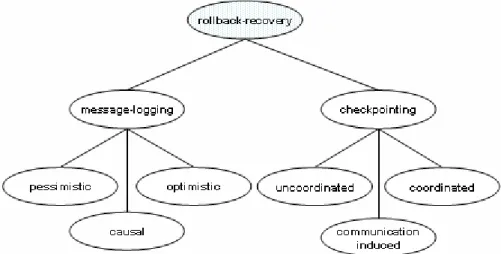
Figure 1 Classification of rollback-recovery algorithms
In some cases, cascading rollback propagation may force the system to restart from the initial state, losing all the work performed before a failure. This unbounded rollback is called the domino effect. The possibility of the domino effect is highly undesirable because all checkpoints taken may turn out to be useless for protecting an application against losing all useful work upon a failure.
In a message-passing system, if each participating process takes its checkpoints independently then the system is susceptible to the domino effect. This approach is called uncoordinated checkpointing. One way to avoid the domino effect is to perform coordinated checkpointing: the processes in a system coordinate their checkpoints to form a system-wide consistent state. A state is consistent if for every process state it is true that 1) every message that has been received has also been sent in the state of the sender and 2) each message that has been sent has also been received in the state of the receiver.
Such a consistent set of checkpoints can then be used to bound the rollback propagation. Alternatively, communication-induced checkpointing forces each process to take checkpoints based on some application messages it receives from other processes. This approach does not require system-wide coordination and therefore may scale better. The checkpoints are taken such that a consistent state always exists, and the domino effect cannot occur.
Systems with more than one processor are known as multiprocessor systems. As the number of processors increase the probability of any one processor failing is high. It has been found in practice that over 80% of the failures in such systems are transient and intermittent [53]. Checkpointing and rollback recovery are particularly useful in such situations. Checkpointing, however, is more difficult in multiprocessors as compared to uniprocessors. This is due to the fact that in multiprocessors there are multiple streams of execution and there is no global clock. The absence of a global clock makes it difficult to initiate checkpoints in all the streams of execution at the same time instance.
The aforementioned solutions rely solely on checkpoints, thus the name checkpoint-based rollback-recovery. In contrast, log-based rollback-recovery uses checkpointing and message logging (see Figure 1). In log-based rollback-recovery a process can deterministically recreate its pre-failure state even if it has not been checkpointed by logging and replaying the nondeterministic events in their exact original order. It is mostly used for applications that frequently interact with the outside world.
1.2.1 Log-based rollback/recovery
Log-based rollback recovery protocols, or message logging protocols, supplement normal checkpointing with a record of messages sent by and received by each process. If the process fails, the log can be used to replay the progress of the process after the most recent checkpoint in order to reconstruct its previous state. This has the advantage that process recovery results in a more recent snapshot of the process state than checkpointing alone can provide. Additionally, log-based approaches avoid the domino effect, since the failed process can be brought forward to the global application state rather than individual processes being forced to roll back for consistency with the failed process.
Log-based recovery protocols rely on the piecewise deterministic assumption (PWD). This assumption dictates that the system has the ability to detect the nondeterministic events that transition to the next state interval. Furthermore, the system must be able to record information about the events such that the important aspects of the event can be recreated in a reconstruction of the process state [57].
An orphan process p is a process that does not fail, but whose state depends on a nondeterministic event that was not recorded to stable storage and the determinant of
which was not recorded on p. Such a process therefore cannot be restored to a consistent state because the information required to replay an event has been lost [49].
There are three main techniques (see Figure 1) used by log-based recovery protocols to guarantee that all processes can be recovered to a consistent state in the event of a failure: Pessimistic, optimistic, and causal. Each of the three approaches has its own tradeoffs for performance, ease of process recovery, and ability to roll back processes that did not fail.
Pessimistic logging techniques, sometimes called synchronous logging, record the determinant of each event to stable storage before the event is allowed to affect the computation. This ensures that the system will easily be able to recover from the failure of any process occurring at any time, because no process can be affected by an event that has not been logged. Pessimistic logging has two key advantages. First, in the event of a failure, processes that did not fail can never become orphans and need not take any special actions. This greatly simplifies the recovery algorithm. Second, garbage collection of message logs and checkpoints is simple - only one checkpoint must be maintained for each process, and message logs older than that checkpoint can be discarded [49].
Optimistic or asynchronous, logging techniques record logs to volatile storage, which is then periodically written to stable storage. This substantially reduces the performance overhead on the application because it does not need to block while waiting for each message to be written to disk. Unfortunately, recovery of the system in the event of a failure is much more complex. Since messages recorded in volatile memory will be lost in the event of a process failure, processes can become orphans. In addition to the recovery of the failed processes, the surviving processes must be rolled back to a state that does not depend on any lost messages [57].
Causal logging protocols maintain the advantages of both optimistic and pessimistic logging, but at the expense have requiring much more complex recovery techniques. The low overhead of optimistic logging is attained by saving logs to volatile storage, similar to optimistic logging [58][59].
1.2.2 Checkpoint-based rollback/recovery
Checkpoint-based rollback/recovery techniques can be classified into three groups based on the abstraction level: kernel-level, library-level and application-level, where the library- and kernel- level checkpointing is also called jointly as system-level checkpointing (see Figure 2).
The kernel-level [54] checkpoint support is implemented by a kernel module part of the operating system. Any executed process can be checkpointed in this way, since no changes in the executable are required. The internals of a process are text, data, dynamically allocated data, shared libraries, stack, processor registers, signal handlers and the signal masks, open files and shared resources. A kernel module can easily access the state of theses internals to create a checkpoint. Later the reconstruction of the process is also done by the operating system. This technique produces checkpoint file with binary data (e.g. copy of the memory), so it can be used on computational nodes of a cluster with the same platform.
The library-level checkpointing usually requires the application to be relinked with a special library performing the state saving and resumption procedure. In this case special techniques are used to access the process internals. Similarly to
kernel-level the checkpoint information contains bits that constitute the state of the process. Sometimes it is problematic to patch the operating system to support checkpointing, so the main advantage of this approach is to avoid the modification of the OS. Tools implementing this approach are for example Condor [32], Libckpt[31] and Ckpt[29].
The third alternative is application-level [55] checkpointing, where applications provide their own checkpointing code. The application is written so that it correctly restarts from various positions in the code by storing certain information to a restart file. The programmer needs to save data to recover the program state. The advantage is that the checkpoint information can be produced in a way that the application is able to checkpoint and restart among nodes with different platforms. The disadvantage of this approach is that it complicates the coding of the application program. Sometimes adding this type of checkpoint support to a parallel application is a comparable task with developing the whole application.
Figure 2 Classification of checkpoint levels
Beyond the previous three directions, two additional aspects (independent from the abstraction levels) are distinguished in parallel checkpointing on how parallel processes are instructed when checkpointing is performed. The three aspects are: coordinated, uncoordinated, communication-induced (see Figure 1).
In uncoordinated checkpointing each process of the application can save its state at any time independently from the neighbouring processes. Checkpointing action is not taking the consistency of messages into account, so it can be implemented and executed easily. The problem may occur at restart phase. First, each process reloads its state from the latest checkpoint and then they check whether the application has consistent state [56] regarding messages. Consistency exists if neither duplicated nor lost messages is detected. If the latest checkpoints do not form a consistent state of the application, based on the dependencies of messages rollback propagation is executed. Due to the domino effect it can easily happen that rollback is repeated until the application reaches its initial point i.e. the application is started from the beginning.
Contrary to the previous one, coordinated checkpointing creates a consistent state of the application at the time of checkpoint saving instead of trying to create it at resumption phase. Whenever an application must be checkpointed, a global coordination protocol, implemented by exchanging special marker messages, is used to coordinate the state saving of the individual processes by creating a consistent state for the application. A global snapshot is taken from which the computation can be restarted. In this case a distinguished process is responsible to initiate and execute the checkpoint saving protocol. The Chandy-Lamport [56] algorithm is the most well-known protocol for this purpose.
Communication-induced (or quasi-asynchronous) checkpointing provides
resilience to the domino effect without requiring global coordination across all checkpoints. Each process takes checkpoints locally, as in uncoordinated checkpointing. However, such protocols allow for processes to be forced to take a checkpoint in order generate a global checkpointed state that will not cause domino effect. Each message passed between processes contains extra protocol information that allows the recipient to determine for it whether or not it should take a forced checkpoint [49].
1.2.3 Checkpoint based migration
Process migration in distributed systems is a special event when a process running on a particular resource is moved to another one in such a way that the migration does not cause any change in the process execution. It means that the process is not restarted instead; its execution is temporarily suspended and then resumed on the new resource. In order to provide this capability migration usually relies on some checkpointing techniques to save the state of the target process and to reconstruct it on the target machine.
Such migration mechanism can be used in several scenarios. First, in supercomputing applications load-balancing is a crucial issue. Migration can solve the problem of unbalanced parallel sites of the Grid. Processes on overloaded machines can migrate to underloaded machines without terminating the entire application. Similarly, load-balancing can be ensured among different sites of the Grid, i.e., when a site becomes overloaded complete applications can migrate to other sites. Third, the migration module can be used for providing fault-tolerance capability for long-running applications if machines are corrupted or need system maintenance during the execution. Fourth, migration can be driven by resource needs, i.e., processes can be moved to a remote site in order to access special unmovable resources. For example, processes may need to use special equipments or huge databases existing on dedicated machines in the Grid.
During migration a tool suspends the execution of the process, collects all the internal status information necessary for resumption and terminates the process. Later it creates a new process and all the collected information is restored for the process to continue its execution from where it was suspended.
1.3 Overview of checkpointing and migration frameworks
In this section an overview is given on various systems in the field of parallel (mostly PVM and MPI) checkpointing. There are numerous systems, but without giving an endless list, the most significant tools on this field are introduced.
1.3.1 CoCheck
CoCheck is a research project which aims at providing Consistent Checkpointing for various parallel programming environments both PVM and MPI. CoCheck implements a coordinated, consistent checkpointing of parallel applications.
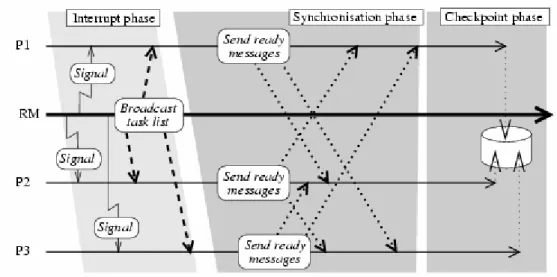
In PVM version of CoCheck [64][72] a special process, called Resource Manager (RM) is dedicated to perform decision on task allocation whenever a new task is spawned. When checkpointing, it notifies the tasks by sending signal-message pairs to all the processes to interrupt them as a first step. After successful interruption it synchronizes the messages in order to avoid having in-transit messages in the messaging layer at the time of checkpointing.
Figure 3 The CoCheck checkpointing protocol
When all the messages have been flushed, the processes detach and finally the process memory is saved (see Figure 3). The restart of a parallel job is steered by a modified startup routine (crt0.o) that belongs to the operating system. This tool was developed in the mid of 90’s and it has no more code maintenance, but it became a basic reference work for all parallel checkpointing systems.
To create the MPI version of CoCheck [71] a new MPI implementation has been developed, called tuMPI. To add checkpointing support for tuMPI, the central instance of CoCheck (RM in the PVM version) was integrated as an additional component in the daemon processes of tuMPI. Consistent state of the application processes was ensured by the same algorithm as used in the PVM version. Finally, the tool was optimised for migration of tasks, by transferring checkpoint information to a skeleton process of the migrating one.
One of the main well-known features of CoCheck is its checkpoint protocol, which makes sure in-transit messages are flushed from the message-passing layer. This protocol is derived from Chandy-Lamport algorithm.
1.3.2 Condor
The goal of the Condor Project [33] is to develop, implement, deploy, and evaluate mechanisms and policies that support High Throughput Computing (HTC) on large collections of distributively owned computing resources. Condor is a specialized workload management system for compute-intensive jobs. Like other full-featured batch systems, Condor provides a job queuing mechanism, scheduling policy, priority scheme, resource monitoring, and resource management. Users submit their serial or parallel jobs to Condor, Condor places them into a queue, chooses when and where to run the jobs based upon a policy, carefully monitors their progress, and ultimately informs the user upon completion.
Condor is able to execute and schedule different types of applications (e.g. sequential, PVM, MPI, Java, etc.) and for PVM they introduced the CoCheck protocol in 1996. Later it became unsupported, so the Condor versions in the last few years changed direction regarding PVM checkpointing.
Figure 4 View of the Condor MW paradigm
The new model they introduced is a fault-tolerant execution for Master-Worker (MW) type applications [73]. For Condor, there is a tool for making a master-worker style application that works in the distributed, opportunistic environment of Condor. MW applications use Condor as a resource management tool, and can use either Condor-PVM or MW-File a file-based, remote I/O scheme for message passing. The user must define the code for the Master process, the Worker processes and the system will distribute the works automatically among the workers in a way defined by the programmer. When a worker process aborts or fails, Condor automatically spawns a new worker with the same workpackage, the failed worker owned.
In the Condor job-scheduler tool there is no real checkpointing of parallel application, but fault-tolerant execution of PVM applications are supported in a limited way. However, Condor is able to checkpoint sequential jobs; therefore it is sometimes reused by parallel checkpointing tools, like CoCheck.
1.3.3 Fail-safe PVM
Fail-safe PVM [65] has been designed and implemented by the Carnegie Mellon University. The main purpose of the framework is to provide a fault-tolerant PVM environment regarding single-node failures.
Fail-safe PVM uses checkpoint and rollback to recover from such failures. Both checkpoints and rollbacks are transparent to the application. The system does not rely on shared stable storage and does not require modifications to the operating system. The main goals and advantages of this system are application independence, application transparency, compatibility and minimal overhead.
Figure 5 Architecture of Fail-safe PVM
Fail-safe PVM is an enhanced version of PVM, i.e. the design and implementation has been done in a way that PVM internals are modified in order to fulfil the goals.
The main strengths of the system is the capability to detect failed-nodes and to migrate application processes from the failed nodes to the failure-free ones. The PVM daemons are modified in order to synchronize among each other to prepare the application for checkpointing. At recovery the daemons are able to rollback themselves to create a consistent state of the parallel virtual machine. After the daemons are rolled back, they initiate the application to start recovering itself. To do this the application processes are reordered among the error-free PVM daemons to take the work from the failed one. The checkpoint information is distributed among the daemons. After the application has successfully restarted from the last consistent state, it is instructed to continue the execution.
As a summary, FPVM is strongly focusing on migration support of the PVM processes, where the migration is driven in a way to provide fault-recovery of the application.
1.3.4 Dynamite
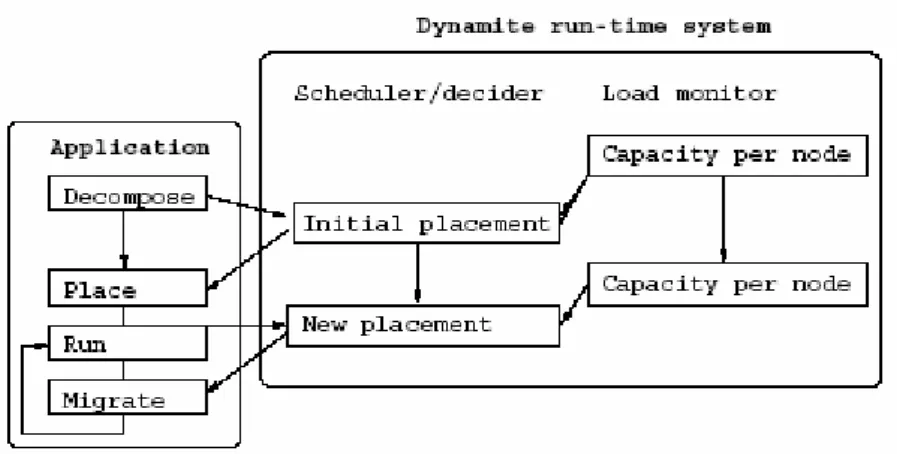
Dynamite [66] aims to provide a complete integrated solution for dynamic load balancing of parallel jobs on networks of workstations. It contains an integrated load-balancing and checkpointing support for PVM applications.
Dynamite provides dynamic load-balancing for PVM applications running under Linux and Solaris. It supports migration of individual tasks between nodes in a manner transparent both to the application programmer and to the user, implemented entirely in user space. Dynamically linked executables are supported, as are tasks with open files and with direct PVM connections. In Dynamite, a monitor process is started on every node of the PVM virtual machine. This monitor communicates with the local PVM daemon and collects information on the resource usage and availability of the nodes.
The architecture of Dynamite is modular. It is possible to use just the dynamic loader of Dynamite and get checkpoint/restart facilities for sequential jobs that do not use PVM. Even when using PVM, it is not required to use the Dynamite monitor/scheduler: the user can migrate tasks manually from the PVM console (using the new move command) or from custom programs (using the new pvm_move function call). This gives Dynamite extra flexibility, and makes its components reusable for different projects.
Figure 6 Architecture of the Dynamite PVM system
The system focuses on migrating individual PVM processes. To provide this capability, Dynamite replaces the dynamic loader and the whole PVM implementation for the daemons.
1.3.5 MPVM (MIST)
In MPVM [67], the interface between the PVM daemons (pvmd) and the Resource Manager has been extended to accommodate task migration, allowing the MPVM Resource Manager to use dynamic scheduling policies.
In order to support task migration, both the pvmd and PVM library (pvmlib) is modified. The modifications made were also driven by the goals of source code compatibility, portability, and migration transparency. To ensure source code compatibility, the modifications maintain the same function calls, parameters and semantics, as provided by PVM. To maximize portability, the migration mechanism is implemented at user-level, using facilities available through standard Unix library routines and system calls. Migration transparency is addressed by modifying the pvmd and pvmlib such that the migration could occur without notifying the application code and by providing ”wrapper” functions to certain system calls.
To avoid explicit modification of the source code of the PVM application for installing the signal handler, the (m)pvmlib defines its own main() function which executes the necessary initialization and then calls a function called Main(). A Migration Transparent Version of PVM linked with the pvmlib, the resulting executable will have the pvmlib's main() as the entry point, allowing execution of the migration initialization code prior to the execution of the application's code.
An important component of the migration protocol is what is collectively called Control Messages. These control messages or CMs are special system messages added to the pvmds and the pvmlib for the primary purpose of managing task
migration. Just like other system messages, these control messages are invisible to the application code.
The medium for the state transfer is TCP connection between the source pvm task and the destination migrated task. MPVM uses the approach of transferring the entire virtual address space of a process at migration time. That is mainly the reason why MPVM does not support fault-tolerance.
The protocol implemented in MPVM is designed in way that after the migration the task has the same task identifier, so translation tables are not needed. However, there is a need for routing tables in the PVM daemons.
1.3.6 tmPVM
The tmPVM [68] system aims to provide efficient migration of PVM tasks. It does not create application wide checkpointing, i.e. it does not support fault-tolerant, the application does not have a stored consistent global state.
Figure 7 The tmPVM virtual machine
A task to be migrated creates a checkpoint file by spawning an external extractor to scan the /proc file system. This task waits until the task is restarted on the destination node, and in the mean time forwards any messages that it receives to the destination (new) instance. The destination instance has a new PVM task identifier after the migration, so a special TID alias directory (mapping table) is maintained in the PVM daemons to translate between the original and current task identifier.
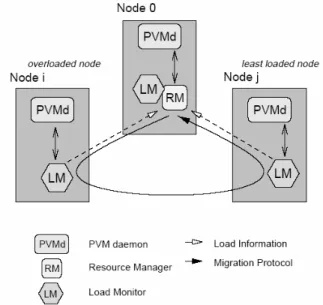
A load monitor module is spawned on each node to collect local load information. In tmpPVM, a centralized resource manager gathers and maintains local information for each participating node. All load monitor modules are assumed to be active till the shutdown of the tmPVM virtual machine. Users are required to include an initialisation call (named TCP_TM_init()) before any statement. The routine will install the necessary mechanism, data structures and notification to the load monitor modules.
1.3.7 DAMPVM
DAMPVM [69] (Dynamic Allocation and Migration Parallel Virtual Machine) is an extension to the PVM environment. DAMPVM traces the changes of some
parameters on the machines in the virtual machine like nodes loads, other users activities, measures the speeds of the nodes to get to know how much processing power is available on the nodes.
The programs can be written analogously to PVM ones but the programmer must use the library supported by DAMPVM instead of PVM. This library offers communication and creation functions analogous to the PVM ones plus some extra connected with process instrumentation. DAMPVM kernels (one on each machine) start processes on the appropriate machines. DAMPVM is a regular PVM application so there are processes - kernels (one on each machine) and additionally the DAMPVM library.
The goal of DAMPVM is to minimize the total execution time of the whole application (all the processes started by the user of DAMPVM) - DAMPVM performs dynamic allocation of processes. Heterogeneous migration is possible because it is performed on the code level. A programmer must support two functions for packing and unpacking the state of a process to enable DAMPVM kernels to migrate a process. Dynamic allocation and migration is performed automatically by DAMPVM.
1.3.8 Charm
Charm [70] is a checkpoint/restart system, where PVM calls are wrapped in order to modify the behaviour of the calls and to support checkpointing. To preserve communication it uses a similar version independent protocol to the one defined in CoCheck, but it is optimised for faster migration, since message flushing is only performed for migrating tasks. The messages sent to the migrating processes are stored in a delaying buffer and when the migration has finished the content of the delaying buffer is forwarded to the new destination. The key advantage of this system is that no modification of PVM is performed. The system has a C-manager that is responsible for performing the proper protocol among the processes of the application.
C-manager is implemented as a PVM task. Users start the charm system (cmanager), then cmanager spawns the user’s PVM task. It also reads in the checkpointing-related .rc files. By this technique the application will know, the Task ID of the C-manager and will be able to cooperate with it in order to perform checkpointing.
With the slight modification of the start-up mechanism of the PVM application, Charm is able to migrate PVM processes. At the same time this system does not provide application wide checkpoint, i.e. it is not possible to checkpoint the whole application, shutdown all the running component and to restart the checkpointed application on a different cluster.
1.3.9 CLIP
CLIP [74] (Checkpoint Libraries for Intel Paragon) is a semi-transparent checkpointer for the Intel Paragon. CLIP can checkpoint programs written in either NX or MPI. The conceptual structure of CLIP is depicted in Figure 8. In checkpointing mode, CLIP code acts as middleware between the user's application and the Paragon libraries.
To use CLIP, a user must link the CLIP library with the application program. Additionally, the user must place one or more subroutine calls in the code specifying when checkpoints can occur. When the code is executed, CLIP takes periodic checkpoints of the program's state to disk. If for some reason (hardware or software
failure) the program is terminated prematurely, it may be restarted from the checkpoint file.
Figure 8 Structure of CLIP 1.3.10 ZapC
ZapC [75] is a novel system for transparent coordinated checkpoint-restart of distributed network applications on commodity clusters. ZapC provides a thin virtualization layer on top of the operating system that decouples a distributed application from dependencies on the cluster nodes on which it is executing.
This decoupling is done by introducing a PrOcess Domain (POD) abstraction. POD enables ZapC to checkpoint an entire distributed application across all nodes in a coordinated manner such that it can be restarted from the checkpoint on a different set of cluster nodes at a later time.
ZapC is designed to support migration of unmodified legacy applications while minimizing changes to existing operating systems. This is done by leveraging loadable kernel module functionality in commodity operating systems that allows ZapC to intercept system calls as needed for virtualization.
1.3.11 LAM/MPI
LAM/MPI [76] is a high performance implementation of the Message Passing Interface (MPI) standard. LAM/MPI provides a System Services Interface (SSI), a modular component system that allows easy extensibility to new environments. One of these services is designed to provide a transparent checkpointing and rollback recovery (CRR) with high portability.
The CRR framework implements most management of coordinated checkpointing and rollback recovery for MPI parallel applications. MPI applications running under LAM/MPI can be checkpointed to disk and restarted at a later time. LAM requires a 3rd party single-process checkpoint/restart toolkit for actually checkpointing and restarting a single MPI process - LAM takes care of the parallel coordination.
Currently, the Berkeley Labs Checkpoint/Restart package (BLCR) [77] is supported which is a kernel-level single-process-CRR tool for Linux. It works as a dynamically loadable kernel module, so it is not a universal tool for different Linux versions and platforms.
LAM/MPI allows new back-end checkpointing systems to be "plugged-in" simply by providing a new CR SSI module. An example to replace kernel-level
checkpointing of LAM/MPI with user-level checkpoint and recovery is introduced by [78] where BLCR is replaced with libcsm. New CR modules are designed and the tool is modified to provide the needed APls. Because LAM/MPI supposes checkpointing is thread-based and implements the framework on this assumption, its workflow had to be modified to integrate the library.
1.3.12 Charm4MPI
ChaRM4MPI [84] is a Checkpoint-based Rollback Recovery (CRR) and Migration System for Message Passing Interface, specially designed and implemented for Linux Clusters. It is based on coordinated checkpointing protocol, synchronized rollback recovery to provide process migration.
In ChaRM4MPI users can migrate MPI processes manually from one node to another for load balance or system maintenance. This tool is implemented in a user-transparent way and uses the techniques employed by libckpt [31] and CoCheck [72]. The whole implementation is based on MPICHP4 [79], which is an MPI implementation developed at Mississippi State University and Argonne National Laboratories that employs P4 [79] library as the device layer.
Regarding the architecture, one management process, called manager, is implemented as the coordinator of parallel CRR and process migration. It can operate users’ checkpoint or migration commands received through a GUI. The source code of P4 listener is altered to perform signal interruption of computing processes in case commands received from the coordinator. The start-up procedure of MPICHP4 is modified, so all MPI processes will register themselves to the coordinator. In this way, the latter can maintain a global process-info-table to manage the whole system.
1.3.13 FT-MPI
The aim of FT-MPI [80] is to build a fault tolerant MPI implementation that can survive failures. The system offers a wide range of recovery options for the application developer other than just returning to some previous checkpoints. FT-MPI is built on the HARNESS [81] meta-computing system.
Figure 9 Structure of the FT-MPI implementation
FT-MPI extends the MPI communicator states with additional states (e.g. ok, detected, recover, recovered, failed). A communicator changes its state when either an MPI process changes its state, or a communication within that communicator fails for some reason. By allowing the communicator to be in an intermediate state the application has the ability to decide how to alter the communicator and its behaviour.
The current implementation is built as a number of layers and integrates a wide variety of underlying services to provide fault-tolerance (see Figure 9). Different services provide FT-MPI with notification of failures from communications libraries as well as the OS support layer.
Since FT-MPI provides fault-tolerance by reporting failures through e.g. modification of communicator states, the responsibility to handle the undesirable situations is still remains a duty of the application programmer. The typical usage of FT-MPI would be in the form of an error check and then some corrective action such as rebuilding a communicator and so on.
1.3.14 Starfish MPI
Starfish [82] MPI is a daemon based implementation approach for MPI. Each host of a cluster must have a Starfish daemon (see Figure 10) forming a parallel computer over the cluster. Application processes can only be migrated within the so-called parallel computer i.e. where a starfish daemon is running.
Figure 10 Architecture of the Starfish MPI
Starfish uses its own distributed system to provide built in checkpointing. Starfish MPI handles communication and state changes which are built upon the Ensemble system [83] and managed by strict atomic group communication protocols among the daemons.
2.1 Transparency conditions in ClusterGrid environments
2.1.1 Overview
Checkpointing of message-passing based parallel algorithms or applications can be realised using various techniques and methods. A concrete solution must always face the requirements imposed by the Grid middleware. The goal of the first group of thesis is to identify the requirements and conditions towards the checkpoint and migration techniques imposed by the ClusterGrid environment and to elaborate a new (abstract) technique which fulfils the already identified requirements.
As a preparation of thesis 1.1, I have defined the main characteristics of the ClusterGrid environments and several desirable use cases for state migration mechanism. As a next step, I have identified the cluster components which may influence the internal operation of a checkpointing system and then I determined the requirements in 4+1 points. By using the ASM formal framework for modelling I have developed the model of the cluster components and their most relevant characteristics, and then based on this model I have elaborated a formal description of the requirements and conditions for checkpointing techniques. Finally, based on these criteria I have analysed, evaluated and classified the existing solutions and stated thesis 1.1.
Thesis 1.1: In a cluster environment a formal framework of requirements can
be defined for message-passing parallel algorithms, which enables transparent checkpointing of the algorithms for the scenarios defined in the dissertation. In addition, currently there are no checkpointing and migration facilities fulfilling the defined requirements in a cluster environment for the defined scenarios.
Related publications are [3][4][19]. 2.1.2 Identification of the components
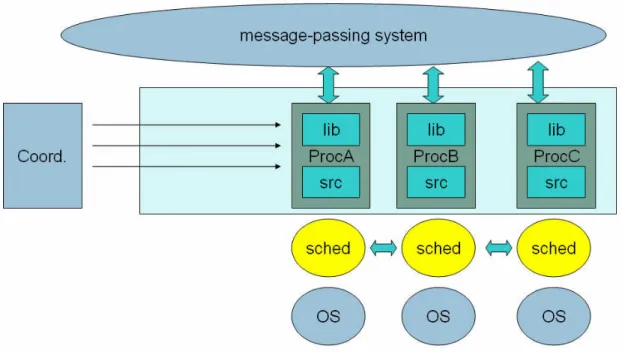
Based on the abstraction levels and coordination types (both defined in Section 1.2), checkpointing of a parallel application can be implemented in several ways. In this section the most relevant components are identified which contribute to the whole checkpoint and restart procedure. The following (logical) components are identified as possible contributors to the checkpoint or restart procedure (see Figure 11) in a cluster environment:
1. Operating system (“OS”) 2. Scheduler (“sched”)
3. Source code of the application (“src”) 4. Linked libraries of the application (“lib”)
5. Message-passing layer (“message-passing system”) 6. External coordination process (“Coord.”)
An application is shown (see Figure 11) with three processes ("ProcA", "ProcB", "ProcC") running on three nodes of a cluster. Processes - from logical point of view - contain user written code ("src") and libraries linked ("lib") to the code of the processes. The distinction is introduced to distinguish between library or application level checkpointing.
In case of application level checkpointing the source code (depicted as "src" in Figure 11) must be prepared by the programmer as it has been detailed in section 1.2.
If automatic library (system) level checkpointing is supported, a special library (depicted as "lib" in Figure 11) is linked to the process. The library is usually activated during execution; it scans through all the memory space of the process and saves the information into a temporary storage for later usage. Saving results into a binary file includes all memory segments, registers, signals and so on.
Figure 11 Components of a checkpointing environment
The message-passing system (MP) (see Figure 11) is running in the background to transport messages among the processes. In certain solutions (e.g. Fail-safe PVM [65], Dynamite [66], MPVM [67], etc.) this layer is modified to support checkpointing of the messages and of the links among processes. This support usually means cooperation with the application to be prepared for checkpointing in a way that consistency of in-transit messages and connections are preserved.
In order to facilitate the coordination of checkpoint among the processes of the application an external checkpoint coordination process (depicted as "Coord." in Figure 11) can be connected to each process of the application. This auxiliary process usually performs coordination of checkpoint saving, exchange of checkpoint related information or identifiers among the application processes. Furthermore, it can manage open files and play a central role in the resumption procedure, too.
Checkpoint support in schedulers can be an integrated part. Most of the
schedulers for clusters (depicted as "sched" in Figure 11) perform checkpointing up to some extent (e.g. Dynamite [66]). Checkpointing of an individual process is usually fully supported by these schedulers, which means checkpoint/restart mechanism is integrated. The Scheduler decides (usually based on load of the nodes) when checkpoint must be carried out and shutdown a process.
Last, but not least another component where checkpoint support might be implemented is the operating system (depicted as "OS" in Figure 11) in case of kernel-level checkpointing as it has been described in section 1.2.
To summarize, the list of components/modules/parts defined above represents potential/possible modification points that existing checkpoint frameworks usually exploit. Based on the type of checkpointing, different combination of the components are added, replaced or modified. As a consequence, depending on the components modified by the checkpointing system, different levels of compatibility can be reached among the clusters in case of a ClusterGrid.
2.1.3 Use cases
This section is aimed at defining some of the use cases that are typical in a ClusterGrid system concerning a job life-cycle including submission, fault-related events, checkpointing and migration. Before defining use cases it is necessary to determine some basic key features of the Grid system and the critical characteristics of the jobs to be submitted in order to understand the potential behaviour of the entire system.
In the current context the execution of the submitted application is realised in a Clustergrid containing numerous clusters independent of each other. The main expectations towards these clusters are defined as follows:
Assumptions for the proposed ClusterGrid (AsmpCls):
AsmpCls 1. Each node of every cluster in the Grid is compatible at OS level to each other. It is necessary that the binary of the submitted application can be executed on any node of any cluster. In a real environment it is not always true. In that case we consider the biggest subset of the Grid consisting OS compatible nodes as the ClusterGrid environment.
AsmpCls 2. Each node of every cluster must have the same type of message-passing system installed, i.e. each must have MPI or PVM or both.
AsmpCls 3. The scheduler is able to allocate a process of the application to any node of the supervised cluster.
AsmpCls 4. Every node (except the front-end node) in a cluster are identical regarding software environment.
Assumptions for the application (AsmpApp):
AsmpApp 1. The application uses PVM or MPI as message-passing layer. AsmpApp 2. The physical requirements (memory size, disk capacity, etc.) of
the application fit to the capabilities of the clusters and nodes.
AsmpApp 3. The application is authorised to be executed on any of the clusters in the Grid. In a real environment it is not always true. In that case we consider the biggest subset of the ClusterGrid the application is authorised nodes as the ClusterGrid environment.
Points (degree) of freedom for the proposed ClusterGrid (FreeClu):
FreeClu 1. Clusters of the Grid are not expected to have a specific checkpointing service installed on their nodes. Decision on installed services is made by the local policy of the cluster.
FreeClu 2. Clusters of the Grid are not expected to have installed the same version of the message-passing software, but still must accomplish the assumptions defined in AsmpCls2 and AsmpCls3.
FreeClu 3. Clusters of the Grid are not expected to operate a predefined scheduler. Decision on scheduler to be used on a cluster is made by the local policy.
FreeClu 4. Clusters of the Grid are not expected to apply a predefined OS version installed on their nodes, but still must accomplish the assumptions defined in AsmpCls1.
FreeClu 5. Clusters of the Grid are not expected to perform OS or kernel related updates to support checkpointing.
FreeClu 6. Clusters of the Grid are not expected to assign all of their nodes to one application. A cluster might serve for execution of multiple (parallel) applications at the same time. Decision on scheduler rules to be applied on a cluster is made by the local policy.
The proposed assumptions (AsmpClu, AsmpApp) and the points of freedom (FreeClu) in the middleware of the clusters determine the potential behaviour and interaction among the clusters in the entire ClusterGrid.
Several scenarios are now defined to be supported during the execution of application performed by the middleware of cluster.
Scenarios for process and application migration: Scenario 1. Immediate process migration to free resources
This scenario defines a simple case when one of the processes of the application (job) migrates from its source node to another (target) one. The reason is that the source node is about to be pre-empted by the local scheduler.
1.1. User submits job containing k processes
1.2. Job is scheduled to Cluster A having n nodes where n>k
1.3. Job is executed on Cluster A on nodes 1..k and nodes k+1..n are free 1.4. Scheduler initiates termination of process running on node i, where 1≤i≤k 1.5. Scheduler assigns new node j for the job, where k<j≤n
1.6. Process from node i is migrated to node j 1.7. Job continues execution
1.8. Job finishes 1.9. User gets results
Scenario 2. Delayed process migration to free resources
This scenario defines a simple case when one of the processes of the application is removed from its node, but the migration cannot be realised due to unavailable free resource.
2.1. User submits job containing k processes
2.2. Job is scheduled to Cluster A having n nodes where n>k
2.3. Job is executed on Cluster A at nodes 1..k and nodes k+1..n are reserved 2.4. Scheduler initiates termination of process running on node i, where 1≤i≤k 2.5. No resource is available, process is waiting for free node
2.6. Node j becomes free, where k<j≤n 2.7. Scheduler assigns node j for the job 2.8. Process from node i is recovered on node j 2.9. Job continues execution