Flow boiling heat transfer on a heating element restricted by an
interference sleeve
S. Madhusudana Rao, A.R. Balakrishnan
*Department of Chemical Engineering, Indian Institute of Technology Madras, Chennai 600 036, India
Received 1 May 1997; accepted 7 April 1998
Abstract
The ¯ow boiling phenomenon over a heated tube restricted by an interference sleeve, which is a passive enhancement technique, has been analysed using a semi-empirical approach. The liquid boiled was water ¯owing through an annular cross-section. A model developed earlier for the case of pool boiling over porous surfaces has been adapted after modi®cation to pool boiling with in-terference surfaces using equivalent geometrical parameters and a modi®ed permeability factor. This was further extended to sat-urated ¯ow boiling situation using an additive mechanism. The single phase heat transfer coecient required for the additive mechanism is obtained from an experimental correlation developed in the present study. The suppression factors evaluated for the eight sleeve geometries used in the present investigation are expressed in terms of the single phase Reynolds number and the Martinelli parameter. Very good agreement was observed between the model predictions and experimental data validating the mechanisms postulated. Further, a purely empirical correlation based on the present experimental data has been proposed to es-timate the two-phase heat transfer coecient. While the empirical correlation shows a better ®t with the experimental data, the additive model has a physical basis. Ó1998 Elsevier Science Inc. All rights reserved.
Notation
Bo boiling number, ()) Co convective number, ()) Cp speci®c heat, J/(kg K)
d pore diameter of the porous surface; hole diameter in the interference surface, m
db departure diameter of the bubble, m
dp particle diameter of porous surface; equivalent diameter in the interference surface, m
Dequ equivalent diameter of annular section (Do)Di), m Di diameter of inner tube of annulus, m
Do diameter of outer tube of annulus, m Frl Froude number, ())
G mass velocity of the liquid, kg/(m2 s) g acceleration due to gravity, m/s2 h heat transfer coecient, W/(m2K) Ja Jakob number (qlCplDTs)/(qvk) k thermal conductivity, W/(m K)
_
m vapour mass ¯ow rate, kg/s
N/A active pore site density in porous surfaces; hole site density in interference surfaces, mÿ2
p hole pitch, m Pr Prandtl number (Cpl/k), ()) q heat ¯ux, W/m2 Re Reynolds number, ()) S suppression factor, ()) T temperature, K
DTe eective wall superheat, K
DTs wall superheat (Tw )Ts), K t thickness of the interference surface, m uD Darcy velocity, m/s
Wf wetting factor, ()) x vapour quality, ()) Xtt Martinelli parameter, ()) Greek
d clearance between the interference surface/sleeve and the heating element;dp: thickness of the porous matrix, m
porosity of the porous matrix; fractional free area of the interference sleeve, ())
j permeability of the porous matrix;jm: modi®ed per-meability for interference sleeves, ())
k latent heat of vaporisation, J/kg
l viscosity, kg/(m s) X sleeve factor, ()) Subscripts l large; liquid p porous s small; saturated tp two-phase v vapour w wall *Corresponding author.
0142-727X/98/$ ± see front matterÓ1998 Elsevier Science Inc. All rights reserved. PII: S 0 1 4 2 - 7 2 7 X ( 9 8 ) 1 0 0 3 3 - 4
1. Introduction
The use of porous surfaces is an important enhancement technique in ¯ow boiling, though the mechanisms by which this phase change heat transfer takes place are not completely understood. Experimental results reported by Czikk et al. (1981) explain to some extent the eect of mass velocity on the boiling heat transfer coecients. Their results showed that the mass velocity greatly aects the boiling heat transfer coecient for oxygen boiling inside a horizontal tube that contained a porous coated surface.
An experimental study on pool boiling of water by Shimada et al. (1991) showed that an interference plate (a plate with small holes located on a speci®ed pitch) placed with a small clearance over a ¯at copper heating surface traps the vapour bubbles stably and acts as a heat transfer enhancement tech-nique. A salient feature of this arrangement is that its perfor-mance is comparable or better than the commercially available high performance boiling heat transfer surfaces evaluated by Gottzmann et al. (1973), and Ito et al. (1982, 1983). The in-terference plate used in this study was made of 6 mm thick polycarbonate sheet with varying hole geometries (size and pitch) and clearances above the heated surface. The primary advantage of using an interference plate over a boiling surface as a heat transfer enhancement technique over other en-hancement techniques is the easy cleaning of fouling deposits. Secondly, preparation of the enhanced surface does not need sophisticated mechanical processing methods. The boiling mechanism on the heating surface with such interference sur-face over it is believed to be similar to that on a porous sursur-face. In order to con®rm this, an earlier model of pool boiling over porous surfaces by Rao and Balakrishnan (1997a) is extended to pool boiling over interference sleeves and then extended to ¯ow boiling. The model is validated with experimental results obtained in the present study for ¯ow boiling over a horizontal heated stainless steel tube which is restricted by an interference sleeve with holes.
2. Pool boiling over porous surfaces
O'Neill et al. (1972) developed a model to predict the heat ¯ux in pool boiling over porous surfaces. The model consists of a term for the liquid ®lm thickness expressed in terms of a geometrical parameter. This geometrical parameter depends on the particle packing geometry. The geometric parameters required for this model are evaluated for regular packings and are indeterminate for actual packings. Nakayama et al. (1980a, b) developed a semi-empirical additive model for the
Thermoexcel E type surface ± a commercial high performance surface consisting of pores with interconnecting tunnels below in a regular pattern. Their experimental results showed that the contribution of the heat ¯ux due to single phase external convection was negligible compared to the latent heat ¯ux contribution. Their model consisted of seven empirical con-stants which have to be evaluated for each surface±liquid combination. Kovalev et al. (1987, 1990) mathematically modelled the boiling behaviour by using the momentum and energy equations separately for both the liquid and vapour phases. These equations were solved numerically. This model is not easy to use (Webb, 1994). Rao and Balakrishnan (1997a, b) developed a model for pool boiling over porous surfaces by considering the pressure drop across the porous matrix. A brief description of this model is given in Appen-dix A. The total heat ¯ux `q' was expressed in terms of the wall superheat, physical properties of the boiling ¯uid and the ge-ometry of the porous matrix. The ®nal expression for the heat ¯ux was given by
q2:410ÿ4qlq2vkk2DTs dp=d0:8Ja0:22
lvdpTs qlÿqv1:23 : 1
3. Extension to pool boiling over interference sleeves
The model developed for pool boiling over porous surfaces can be extended to pool boiling over surfaces restricted by an interference plate with holes by appropriately de®ning the dierent geometrical parameters. The following considerations are involved in the development of this extension:
1. The vapour liquid exchange mechanism is the same for both porous surfaces and interference surfaces.
2. Extension of the model for porous surfaces to interfer-ence plates or sleeves requires modi®cation of the permeability factor. The fraction of the free area of the interference plate or sleeve is considered equivalent to the porosity of the porous matrix.
3. Since the vapour is generated from the base surface with interference plates, the assumption of constant matrix tem-perature of the porous surfaces is valid here also.
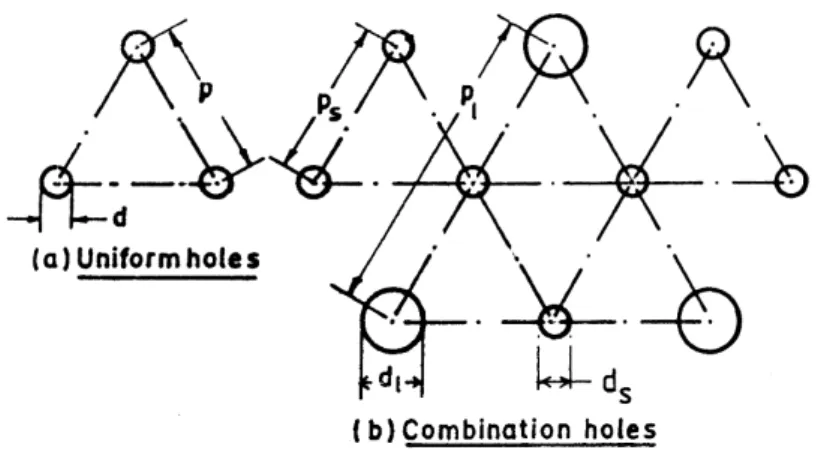
Shimada et al. (1991) studied two types of hole geometries on a triangular pitch, namely, holes with a uniform diameter and holes with a combination of two diameters as shown in Fig. 1. From Fig. 1(a) it may be seen that the fractional free area, which is equivalent to the porosity in a porous matrix, can be expressed as
0:91 d2=p2: 2
For combination holes,can be written as (see Fig. 1(b)) 0:52 dl22ds2
plps
: 3
Shimada et al. (1991) reported heat transfer data for pool boiling of water for a large number of interference plate ge-ometries. The pitch of the holes were varied from 4´10ÿ3 to 14´10ÿ3m, the hole diameter from 1´10ÿ3m to 8´10ÿ3m and the gap clearance between the interference plate and the heating surface from 5´10ÿ5m to 3´10ÿ3m. The model for pool boiling on porous surfaces is compared with the data of Shimada et al. (1991). In order to do this, the porosity of the matrix,, has to be substituted with the fractional free area as de®ned by Eqs. (2) and (3) above. The permeability `j' is ad-justed to match the data and the model. A correction factor is then applied to the permeability obtained by the straight tube model (see Appendix A) to match the adjusted or modi®ed permeability, so that jmC1 d 2 32 : 4
The correction factor is correlated with the geometry of the sleeve as
C16:9210ÿ3 dd b
ÿ0:52
: 5
In the above expression `db' is the bubble departure diameter from a plain surface and `d' is the gap clearance between the heating element and the interference plate. The bubble de-parture diameterdbcan be estimated using the expression due to Cole and Rohsenow (1969) and is
dbC2 g q r lÿqv 1=2
Ja
5=4; 6
whereC21.5´10ÿ4for water and Jais the modi®ed Jakob number de®ned as
JaqlCplTs
qvk : 7
An expression for the pool boiling heat transfer coecient with interference plates can be obtained by rearranging Eq. (1) (using the modi®ed permeability jm as de®ned by Eq. (4) above) and is
hpool2:410ÿ4
q1l:22Cpl0:22q1v:78jmk1:78 DTs0:22 t=d0:8
lvtTs qlÿqv1:23 : 8
4. Extension to ¯ow boiling over interference surfaces
When a ¯ow situation exists on a heating surface which is restricted by an interference plate/sleeve, the moving liquid sweeps or takes away the vapour bubbles emerging out of the holes. Hence, the expected bubble departure diameters would be smaller with ¯ow boiling. Chen (1966) explained that the existence of high two-phase Reynolds numbers associated with signi®cant vapour qualities results in nucleation suppression.
As may be seen from the illustration in Fig. 2, whether in pool boiling or ¯ow boiling, the degree of superheat is not constant across the boundary layer. The convective eects associated with pool boiling are small, so the dierence be-tween the eective superheat DTe andDTs can be neglected. However, this dierence is not negligible in the case of ¯ow boiling. The liquid temperature gradient for ¯ow boiling de-pends on the ¯ow rate and vapour quality and in general will be much steeper than in the corresponding pool boiling case
for the same wall superheat. Eq. (8) for pool boiling was de-veloped by assuming that the external convective eects were negligible and therefore the wall superheat and the eective superheat were the same. Eq. (8) is hence modi®ed to take into account the convective eects using the eective superheat to represent the nucleate heat transfer coecient and is given by hnuc2:410ÿ4
q1l:22C0p:l22q 1:78
v jmk1:78 DTe0:22 t=d0:8
lvtTs qlÿqv1:23 : 9
Furthermore, in the present study a suppression factor,S, is de®ned as the ratio of the eective to true wall superheat at the wall
S DDTTe
s 0:22
: 10
Combining Eqs. (9) and (10), the nucleate boiling heat transfer coecient in terms of this suppression factor is given by hnuc2:410ÿ4 q 1:22 l C0p:l22q 1:78 v jmk1:78 DTs0:22 t=d0:8 lvtTs qlÿqv1:23 S: 11
Unlike in pool boiling the additive mechanism has a signi®cant role in convective boiling. The single phase heat transfer co-ecient cannot be neglected when the convective Reynolds numbers are high. Therefore, the total heat transfer coecient for convective boiling is
hhnuchcon: 12
However, the single phase heat transfer coecient cannot be estimated using conventional correlations when the ¯ow is over the interference surface/sleeve. In the present study, single phase heat transfer data was obtained on a heated cylinder restricted by interference sleeves. The test liquid was water ¯owing over the interference sleeves in an annular section. 5. Experimental
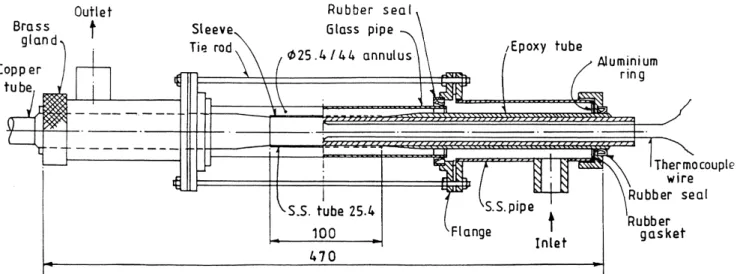
A schematic of the experimental set-up is shown in Fig. 3. The test loop consists of a horizontal test section, a separator or water storage tank, a preheater, an ori®cemeter connected to an inclined tube manometer and a water cooled glass denser. Fig. 4 shows the details of the test section which con-sists essentially of a horizontal heated stainless steel tube. The Fig. 2. Temperature pro®les in pool boiling and in ¯ow boiling at a given wall superheat.
stainless tube in concentrically placed in a glass pipe so that boiling which takes place on the outside of the heated stainless tube can be visually observed when water ¯ows axially in the annular space between the heated stainless tube and the outer glass pipe. The stainless steel tube is heated with a DC power supply using a 16 kVA recti®er with copper terminals and a bus-bar arrangement. Power input is varied using a step-up/ step-down arrangement in the recti®er and the corresponding wall temperatures are recorded using thermocouples imbedded in the tube walls. Power input is estimated from the product of the voltmeter and ammeter readings of the recti®er. Chromel± alumel thermocouple wires (24 gauge) were used for
temper-ature measurements. Three thermocouple wires are ®xed at 90° intervals around the circumference of the heated tube wall to which they are silver soldered with metal studs. The average of these three thermocouple readings gives the mean wall tem-perature of the heating surface `Tw'. The digital millivoltmeter used to measure the emf generated by the thermocouple wires has a resolution of 0.01 mV. Mass velocity of the water en-tering the test section is measured by the calibrated ori®ce-meter with an inclined tube mercury manoori®ce-meter. Inlet temperature of water is maintained at saturation temperature using a pre-heater with dimmerstat control. The water outlet of the test section is exposed to the atmosphere. The quality of
Fig. 4. Test section details.
the vapour is estimated by performing an energy balance. Necessary precautions are taken to ensure degassing and ageing of the heated surface.
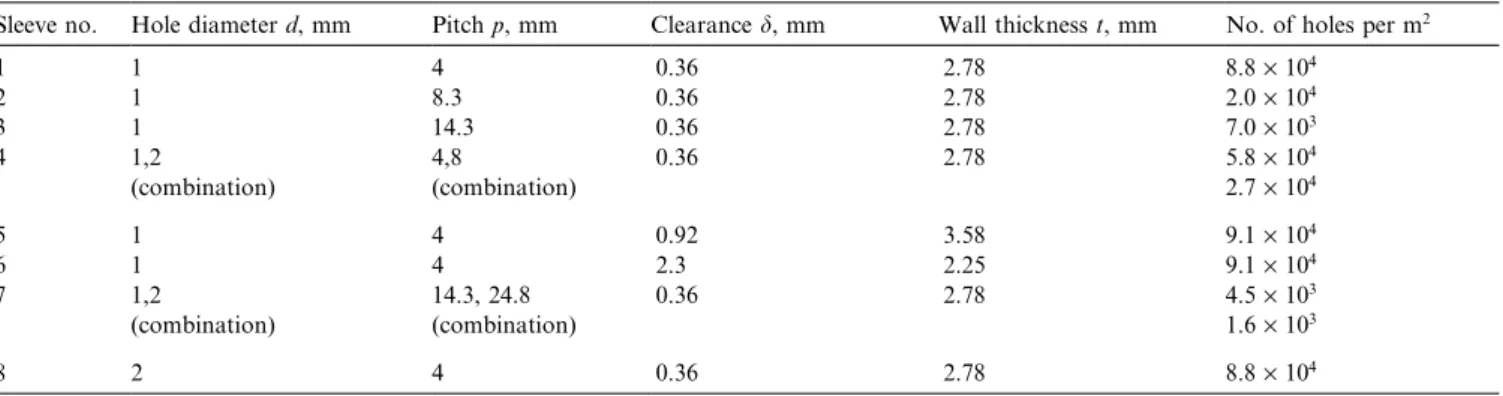
The arrangement of the interference sleeves over the stainless steel tube is shown in Fig. 5. Uniform clearance be-tween the heating tube and the sleeve is ensured by using Te¯on rings. The performance of a much large tube with sleeve is simulated by sealing the ends, so that liquid/vapour can reach/leave the tube only through the holes and not through the gap clearance. A total of eight sleeves were used with dif-ferent hole geometries and gap clearances. These details are summarized in Table 1. Mass velocities were varied from 577 to 1347 kg/(m2s). The ¯ow in the annulus was in the turbulent regime.
6. Results and discussion
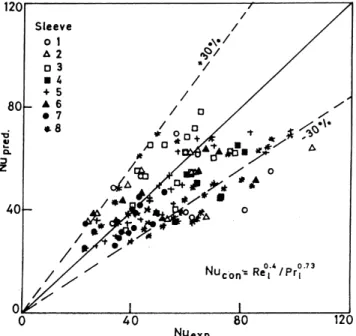
The single phase heat transfer data over the sleeves has been correlated as
NuconRe0l:4 Pr0:73 l
; 13
where Nucon(hconDeq)/kl Rel(GDeq)/ll, Prl Cplll=kl. The performance of the correlation is shown in Fig. 6.
Boiling data obtained with these eight sleeves were used to evaluate the suppression factors from Eqs. (11)±(13). These suppression factors are expressed in terms of the liquid phase
Reynolds number and the well known Martinelli parameter which is representative of vapour quality. Unfortunately, it was not possible to obtain a unique expression for the sup-pression factor for all eight sleeves. The individual exsup-pressions are given in Table 2. Although the number of data points for each expression is limited, the ®t was extremely good with a variation of less than 3%. It is for this reason that attempts to obtain a unique expression for all eight sleeves were not pur-sued. The Martinelli parameter,Xtt, used in the expressions in Table 2 is de®ned by Xtt qqv l 0:5 l l lv 0:1 1ÿx x 0:9 : 14
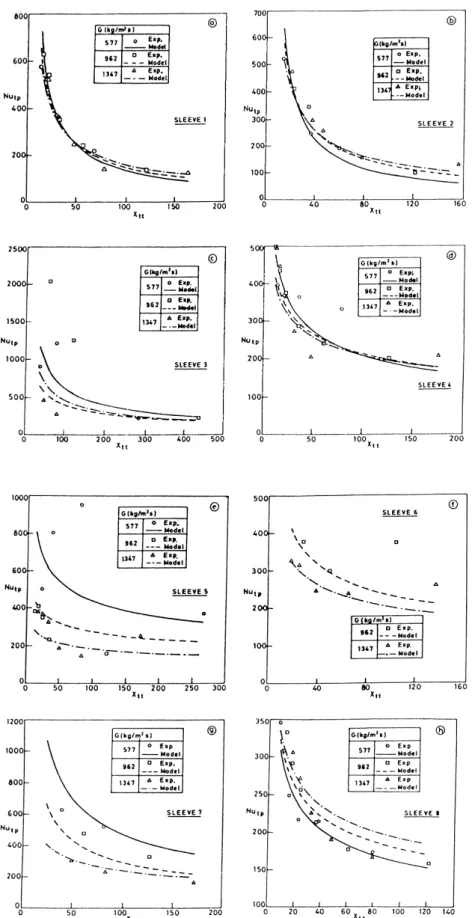
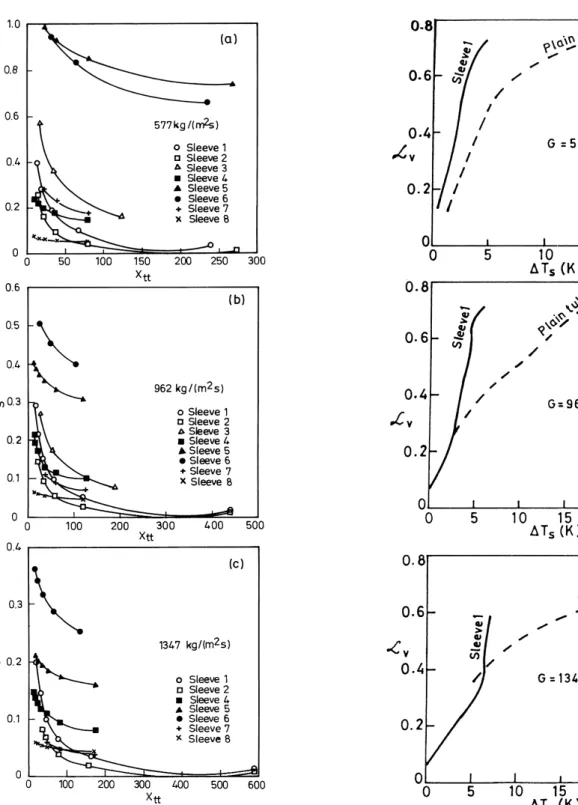
The range of Reynolds numbers used in developing the above expressions given in Table 2 is 3.7´104 to 8.62´104. Fig. 7(a)±(h) show the comparison of the model with the ex-perimental data obtained in the present study for all the eight sleeve geometries considered at dierent inlet liquid mass ve-locities. Good agreement may be seen between the model predictions and the experimental data. Suppression factors obtained with the eight sleeves at three mass velocities is shown in Fig. 8(a)±(c).
Chen (1966) proposed the nucleation suppression concept by considering the two-phase Reynolds numbers when the vapour qualities are signi®cant. But, in the present study, de-spite low vapour qualities, the nucleation suppression factors are high. The present data is obtained for water boiling at atmospheric pressure. The vapour void fractions correspond-Table 1
Sleeve geometries used in the present study
Sleeve no. Hole diameterd, mm Pitchp, mm Clearanced, mm Wall thicknesst, mm No. of holes per m2
1 1 4 0.36 2.78 8.8´104 2 1 8.3 0.36 2.78 2.0´104 3 1 14.3 0.36 2.78 7.0´103 4 1,2 4,8 0.36 2.78 5.8´104 (combination) (combination) 2.7´104 5 1 4 0.92 3.58 9.1´104 6 1 4 2.3 2.25 9.1´104 7 1,2 14.3, 24.8 0.36 2.78 4.5´103 (combination) (combination) 1.6´103 8 2 4 0.36 2.78 8.8´104
ing to the vapour qualities can be estimated using the corre-lation proposed by Rouhani (1969)
rvqx v 10:12 1ÿx x qv 1ÿx ql " 1:18 1ÿxgr qlÿqv0:25 Gq0:5 l #ÿ1 : 15
The estimated void fractions for sleeve 1 and the plain tube without sleeve are shown in Fig. 9(a)±(c) for three dif-ferent inlet liquid mass velocities, namely, 577, 962 and 1347 kg/(m2 s), respectively. It may be noted that the void fraction values are signi®cant. At any given wall superheat sleeves show higher heat ¯ux values than plain tubes. This results in the generation of more vapour and therefore larger void fractions result. Visual observations indicate that the test section is either in bubbling mode or in the slug mode when heat ¯uxes are low and the mass velocities are high. On the other hand, at high heat ¯ux conditions the upper portion of the test section
could get ®lled with vapour and this could result in ¯ow sep-aration, thereby eecting a shift from the bubbling or slugging regime to the strati®ed regime. Similarly, low mass velocities and moderate heat ¯uxes also could result in ¯ow separation. This could be the reason for signi®cant suppression factors even at low vapour qualities. Furthermore, it may also be noted that the wall superheats are low with sleeve 1 when compared to a plain tube without sleeves at the same void fractions. In developing the present model, the coalescence of the bubbles in the clearance gap between the sleeve and the heating cylinder was not considered. This could be a reason for some deviation between the model and the experimental data with sleeves with higher pitch as may be seen in Fig. 7(c). When sleeves with large values of pitch are used, the vapour in the gap clearance (the clearance between the heating cylinder and the sleeve) has to travel a large distance along the heating surface before discharging from a nearby hole. This causes coalescence of the bubbles which give rise to higher heat transfer coecients. This phenomena was also observed ex-perimentally in a parallel study on sub-cooled ¯ow boiling over interference sleeves by Rao and Balakrishnan (1997b). They further reported that the use of interference sleeves gave en-hancement factors (de®ned as the ratio of the wall superheats without and with sleeves at the same heat ¯ux) of up to 2, at a mass velocity of 478 kg/(m2s) and an inlet sub-cooling of 5 K. Rao (1997) has shown that under saturated boiling conditions even higher enhancements can be achieved. For example, at a mass velocity of 962 kg/(m2s), enhancement factors as high as 8 were observed using sleeve 3. Unfortunately, high enhance-ment factors were reported to be accompanied by an early transition to ®lm boiling. This appears to point towards bub-ble coalescence, alluded to earlier.
6.1. Empirical correlation
The saturated boiling data obtained in the present study has been analysed following the approach of Shah (1982) and an empirical correlation proposed to estimate the two-phase heat transfer coecient in the nucleate boiling regime. The corre-lation is
w46:54 W1
f 0:21
X: 16
Xis the sleeve factor that depends on the geometry of the holes in the sleeve and is given by
X01:23 dd
0:1
17
Fig. 6. Performance of the correlation for convective heat transfer with interference sleeves.
Table 2
Suppression factors for various sleeves used in the present study
Sleeve no. Expression for suppression factor Martinelli parameter range (Xtt) No. of data points Standard deviation
1 S136/X0:87 tt Re0l:34 13.66Xtt6163.8 13 13.14 2 S11.6/X1:1 tt Re0l:1 21.56Xtt6156.4 11 20.5 3 S6.18´104/X0:64 tt Re0l:88 38.66Xtt6122.6 9 40.5 4 S71.36/X0:24 tt Re0l:49 10.36Xtt6175 16 19.5 5 S5´108/X0:12 tt Re1l:87 12.86Xtt6171.1 12 33.1 6 S9´105/X0:8 tt Re1l:25 18.26Xtt6135.7 9 19.0 7 S6.26´106/X0:37 tt Re1l:5 236Xtt6171.1 9 21.1 8 S0.36/X0:15 tt Re0l:11 8.26Xtt6168.1 18 18.2
Fig. 7. Comparison of model predictions with experimental data: (a) Sleeve 1 with 4 mm hole pitch, 1 mm hole diameter and 0.36 mm clearance; (b) Sleeve 2 with 8.3 mm hole pitch, 1 mm hole diameter and 0.36 mm clearance; (c) Sleeve 3 with 14.3 mm hole pitch, 1 mm hole diameter and 0.36 mm clearance; (d) Sleeve 4 with combination holes of 1 and 2 mm diameter on 4 and 8 mm hole pitch, respectively and 0.36 mm clearance; (e) Sleeve 5 with 4 mm hole pitch, 1 mm hole diameter and 0.92 mm clearance; (f) Sleeve 6 with 4 mm hole pitch, 1 mm hole diameter and 2.3 mm clearance; (g) Sleeve 7 with combination holes of 1 and 2 mm on 14.3 and 24.8 mm hole pitch, respectively and 0.36 mm clearance; (h) Sleeve 8 with 4 mm hole pitch, 2 mm hole diameter and 0.36 mm clearance.
andw is the ratio of the two-phase or boiling heat transfer coecient to the forced convection or single phase heat transfer coecient over sleeves
whtp
hl ; 18
wherehl can be determined from Eq. (13).
Wf is a wetting factor de®ned as the ratio of the Froude number and the boiling number
Wf Frl=Bo; where
FrlG2= q2 lgDeq; Boq= Gk:
The range of variables covered in the present study are Fig. 8. Suppression factors of the eight sleeves used in the present
in-vestigation using the additive model: (a)G577 kg/(m2s); (b)G962
kg/(m2s); (c)G1347 kg/(m2s).
Fig. 9. Comparison of the estimated void fractions for sleeve 4 and plain tube: (a) G577 kg/(m2 s); (b) G962 kg/(m2 s) and (c) G1347 kg/(m2s).
210ÿ6<Bo<1:510ÿ4; 2<Co<70; 2<Frl<11:
Co is the convective number and is de®ned by Co 1ÿx x 0:8 q v ql 0:5 : 19
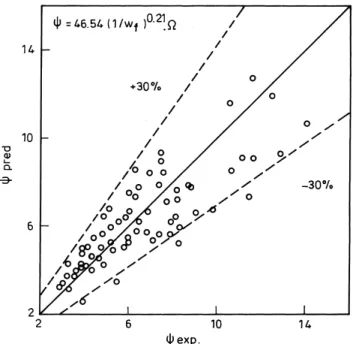
In the present study, the Convection number is always greater than one. According to Shah (1982), Co > 1 implies the nu-cleate boiling regime where wis independent of Co and de-pends only on the Boiling number. Furthermore, according to Shah (1982), the two-phase convective eects in this regime are negligible and heat transfer enhancement is determined solely by the intensity of bubble nucleation. However, the data ob-tained in the present study shows thatwis dependent on the Froude number in addition to the boiling number indicating that the convective eects are indeed important. Furthermore, in spite of low vapour qualities encountered, the large local void fractions encountered in the narrow con®nes of the an-nular geometry cause suppression of nucleation.Wf, the wet-ting factor, accounts for such local nucleation suppression eects. At low liquid mass velocities the Froude numbers are low and the channel is likely to be in the strati®ed ¯ow regime. This gives low Wf values and hence high two-phase heat transfer coecients. Moreover, at the same liquid mass ve-locity but with higher heat ¯ux, the boiling number is high giving rise to a lowWf value again leading to high two-phase heat transfer coecients. So it is seen thatWfre¯ects the eect of both liquid inlet mass velocity and the applied heat ¯ux. The performance of the correlation is shown in Fig. 10. The stan-dard deviation of the data is 19.67%. The total number of data points in the ®gure is 73 and the agreement between the cor-relation and the data is within 30%.
Fig. 11 shows a comparison of the experimental data with both the additive model described earlier and the empirical correlation. It can be seen that both the approaches are sat-isfactory, in that both match the data. However, the additive model has a physical basis using as it does Chen's (Chen, 1966) suppression concept, while the latter uses the boiling number
empirically. The model requires separate expressions for the suppression factor for each sleeve while an appropriately de-®ned common sleeve factor is satisfactory for all the sleeves in the correlation.
The data obtained in the present study are either in the bubbling mode or in the slugging mode. The annular strati®ed conditions are observed only at high heat ¯ux conditions and at low mass velocities. The wall superheats reported in this investigation are the mean of the local values taken circumferentially. Wf, de®ned as the wetting factor, incorpo-rates the boiling suppression eects. The correlations for ¯ow boiling through tubes based on the boiling number (e.g. Shah, 1982) are generally given in terms of the ratio of the two-phase heat transfer coecient and the single phase heat transfer co-ecient as a function of either the boiling number or the Froude number. Dierent correlations are available in the literature, depending on the boiling number and the Froude number. The term Wf is a uni®ed parameter which accounts for both the ¯ow and the applied heat ¯ux. In the additive model these eects are treated separately.
Uncertainty in measurements: The resolution of the tem-perature measurement is 0.2°C. The power input is estimated from the product of the voltmeter and ammeter readings. The resolution of the voltmeter is 0.04 V and that of the ammeter is 10 A. The accuracy in measuring the liquid mass velocity is 10 kg/(m2s).
7. Conclusions
Flow boiling over a heated cylinder with an interference sleeve has been examined both analytically as well as experi-mentally. An additive model based on pool boiling over po-rous surfaces and incorporating nucleate boiling suppression in the ¯ow boiling mode has been proposed and compared with experimental data. The experimental data has also been correlated empirically. The study shows that there is signi®cant nucleate boiling suppression in spite of low qualities encoun-tered, due primarily to the high void fractions in the narrow annular cross-section available for ¯ow. The study further shows that both inlet liquid mass velocity and the applied heat Fig. 10. Performance of the empirical correlation for ¯ow boiling over
interference sleeves.
Fig. 11. Comparison of the experimental data with predicted values from the model and the empirical correlation.
¯ux are important in the geometry used. Bubble coalescence is important in those sleeves that have large hole pitch and gap clearance.
Acknowledgements
This work is part of a study funded by the Department of Atomic Energy, Government of India through the Board of Research in Nuclear Sciences, Bhabha Atomic Research Centre, Mumbai, India.
Appendix A
Rao and Balakrishnan (1997a) analysed the pool boiling phenomena over porous surfaces. A small superheat initiates nucleation over the porous surface. The vapour formed in the pores starts moving up as more and more vapour accumulates inside the porous surface. The pressure drop across the porous layer that causes the upward movement of vapour can be es-timated from Darcy's law
dP dy
lv
j uD: A:1
Assuming the vapour in the porous medium is moving up-wards through capillary tubes of diameter `d' formed between spherical particles of uniform diameter `dp', the Darcy velocity `uD' can be written as
uDq m_
v pd2=4; A:2
wherem_is the mass ¯ow rate of the vapour through the porous layer and is given by
_
mk Nql=A: A:3
In the above equation `ql' is the latent heat contribution of the total heat ¯ux `q' and (N/A) is the number of active pores per unit area. Substituting Eqs. (A.2) and (A.3) into Eq. (A.1) gives the pressure drop across the porous layer of thickness `dp'
DP 1:27qldplv
qvkd2 N=Aj: A:4
The permeability `j' can be estimated from the straight tube model reported by Kaviany (1991) and is given by
jd322: A:5
Using the pressure drop from Eq. (A.4) in the well-known Clapeyron equation and rearranging, the latent heat ¯ux can be expressed as
qlqlq 2
vjk2d2DTs N=A
1:27lvdpTs qlÿqv: A:6 The total heat ¯ux `q' is
qqlqex; A:7
where `qex' is the contribution of the heat ¯ux due to single phase convection over the porous surface and is evaluated using an expression due to Nakayama et al. (1980b)
qex DCTs q 5=3 N A 1=3 : A:8
`Cq' is an empirical constant which depends on the liquid being boiled. This model compared very well with the experimental results of Nakayama et al. (1980a) for the two surfaces re-ported by them. Their data was obtained on surfaces whose porosities were 0.013 and 0.02. Working on these surfaces Nakayama et al. (1980a) showed experimentally that the heat ¯ux due to single phase convection is about 10% of the total heat ¯ux. However porous coatings generally give rise to very high active pore density and hence it is believed that for highly porous surfaces the total heat ¯ux consists mostly of latent heat ¯ux and the convective contribution can be ignored. Using the data of Tehver et al. (1992) for boiling on porous surfaces under burnout conditions when all the pores are ac-tive, the nucleation site density was obtained as
N
A310ÿ4
dp=d0:8Ja0:22
1:23d2 : A:9 Substituting the above into Eq. (A.6), the total heat ¯ux `q' is given by
q2:410ÿ4qlq2vjk2DTs dp=d0:8Ja0:22
lvdpTs qlÿqv1:23 : A:10
References
Chen, J.C., 1966. Correlation for boiling heat transfer to saturated ¯uids in convective ¯ow. Ind. Eng. Chem. Process Des. Dev. 5, 322±329.
Cole, R., Rohsenow, W.M., 1969. Correlation of bubble departure diameters for boiling of saturated liquids. Chem. Eng. Prog. Symp. Ser. 65, 211±213.
Czikk, A.M., O'Neill, P.S., Gottzmann, C.F., 1981. Nucleate boiling from porous metal ®lms: Eect of primary variables. In: Webb, R.L., Carnavos, T.C., Hostetler, K.M. (Eds.), Advances in Enhanced Heat Transfer, vol. 18. HTD ASME, New York, pp. 109±122.
Gottzmann, C.F., O'Neill, P.S., Minton, P.E., 1973. High eciency heat exchangers. Chem. Eng. Prog. 69, 69±75.
Ito, T., Nishikawa, K., Tanaka, K., 1982. Evaluation of potential high performance porous boiling surfaces. Trans. Jpn Assoc. Refriger-ation 57, 25±29.
Ito, T., Nishikawa, K., Tanaka, K., 1983. Evaluation of potential high performance porous boiling surfaces. In: Proceedings of 20th National Heat Transfer Symposium, vol. B211, pp. 232±234. Kaviany, M., 1991. Principles of Heat Transfer in Porous Media.
Springer, New York.
Kovalev, S.A., Solovyev, S.L., Ovodkov, O.A., 1987. Liquid boiling on porous surfaces. Heat Transfer ± Soviet Research 19, 109±120. Kovalev, S.A., Solovyev, S.L., Ovodkov, O.A., 1990. Theory of boiling
heat transfer on a capillary porous surface. In: Proceedings of Nineth International Heat Transfer Conference, vol. 2, pp. 105± 110.
Nakayama, W., Daikoku, T., Kuwahara, H., Nakajima, Y., 1980a. Dynamic model of enhanced boiling heat transfer on porous surfaces ± Part I. ASME Journal of Heat Transfer 102, 445±450. Nakayama, W., Daikoku, T., Kuwahara, H., Nakajima, Y., 1980b.
Dynamic model of enhanced boiling heat transfer on porous surfaces ± Part II. ASME Journal of Heat Transfer 102, 451±456. O'Neill, P.S., Gottzmann, C.F., Terbot, J.W., 1972. Novel heat exchanger increases cascade cycle eciency for natural gas lique-faction. In: Timmerhaus, K.D. (Ed.), Advances in Cryogenic Engineering, vol. 17. Plenum Press, New York, pp. 420±437.
Rao, S.M., 1997. Enhancement of ¯ow boiling heat transfer on cylinders using interference sleeves. Ph.D. Thesis, Indian Institute of Technology Madras, Chennai, India.
Rao, S.M., Balakrishnan, A.R., 1997a. Analysis of pool boiling heat transfer over porous surfaces. Warme und Stoubertragung 32, 463±469.
Rao, S.M., Balakrishnan, A.R., 1997b. Enhancement of subcooled ¯ow boiling heat transfer on cylinders using interference sleeves. Journal of Enhanced Heat Transfer 4, 203±215.
Rouhani, Z., 1969. Modi®ed correlations for void fraction and two-phase pressure drop. AB Atomenergi Sweden, AE-RTV-841, 1/10.
Shah, M.M., 1982. Chart correlations for saturated boiling heat transfer: Equations and further study. ASHRAE Trans. 88, 185±196. Shimada, R., Komai, J., Hirono, Y., Kumagai, S., Takeyama, T., 1991. Enhancement of boiling heat transfer in a narrow space restricted by an interference plate with holes. Experimental Thermal and Fluid Science 4, 587±593.
Tehver, J., Sui, H., Temkina, V., 1992. Heat transfer and hysteresis phenomena in boiling on porous plasma sprayed surfaces. Exper-imental Thermal and Fluid Science 5, 714±727.
Webb, R.L., 1994. Principles of Enhanced Heat Transfer. Wiley, New York.