Mayur Bapodra, Reiko Heckel
Department of Computer Science, University of Leicester, UK
[email protected], [email protected]
1
Introduction
This report details a case study based on a very simple overview of peer-to-peer
(P2P) connections over a voice over IP (VoIP) network such as that used for
Skype. We present the concrete version of the model (with aggregating attributes
already added) followed by the resulting abstract model.
Rule name abbreviations that have been used in accompanying research are
given after each rule name.
2
Concrete Model
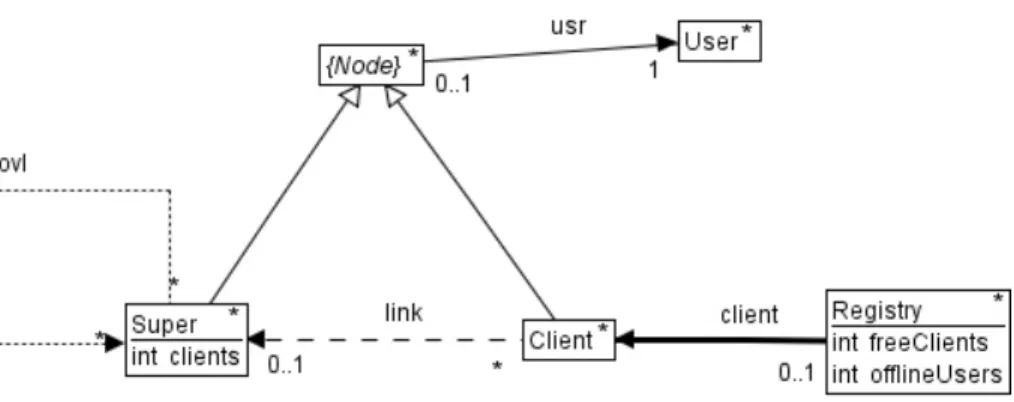
The VoIP network is constructed from Client and Super nodes, each servicing
a single user, administrated by a central registry. Figure 1 shows the concrete
type graph.
User
represents a physical user.
Client
represents a node that users
attach to in order to make a call. Users can also attach to a
Super
node, but since
Supers form the overall communication network via
ovl
edges, linking Clients to
each other through this network, the user in question must meet a bandwidth
threshold. In our model, we simplify this threshold by not explicitly measuring
bandwidth, but instead controlling the likelihood that a user has the minimum
bandwidth through stochastic parameters.
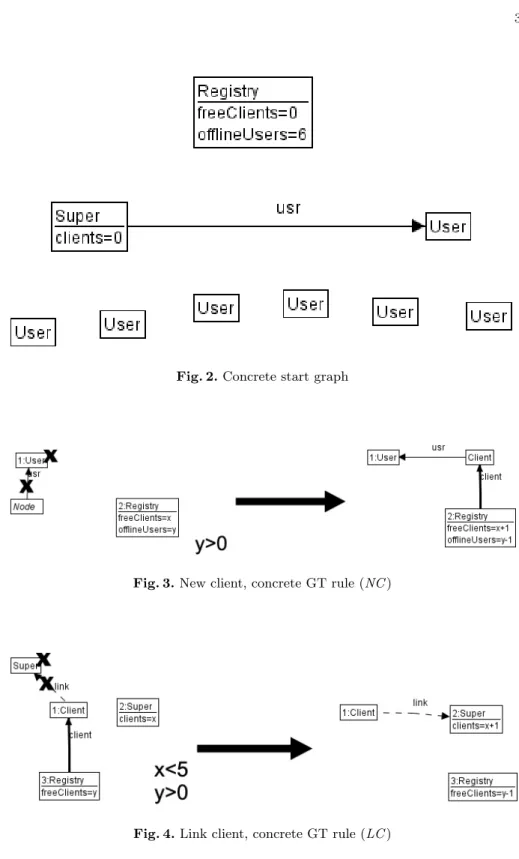
Our smallest start graph is shown in Figure 2. It consists of the registry
node, one super node (with associated user) and six disconnected users. In the
abstract model we aim to simplify the type graph by hiding User and Client
types. There are therefore three aggregating attributes in this model to retain
information. The Registry stores the number of clients not yet connected to the
overlay network via a link edge to a Super (as
freeClients). It also stores the
number of users that have not yet turned on their VoIP program and therefore
do not have an associated Client or Super node (as
offlineUsers
). Additionally,
Supers store the number of clients linked to them. The OCL constraints giving
their values in the concrete model are as follows:
context: Registry
inv: self.offlineUsers = User.allInstances -> count (u:User |
Node.allInstances -> forall(n:Node | n.usr
6
=
u))
Fig. 1.
Concrete type graph
context: Registry
inv: self.freeClients = Client.allInstances -> count (c:Client |
c.link -> isEmpty())
context: Super
inv: self.clients = Client.allInstances ->
count (c : Client | c.link = self)
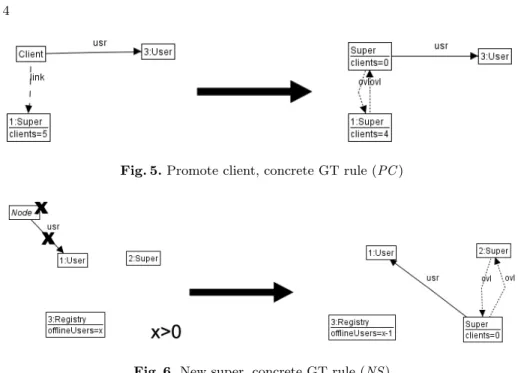
The behavioural semantics of the model are explained through the GT rules.
Figure 3 shows the creation of a new client when a user connects to the VoIP
program. The NAC shows that the user must not already be connected. The new
client is connected at the registry. The condition on the
offlineUsers
aggregating
attribute is naturally redundant since we have the user node and the NAC at
the concrete level.
Figure 4 illustrates a user wishing to communicate with another via the
overlay network set up between Super nodes. The client must not have an existing
link to a super node, and the super it connects to must have fewer than five
clients. This is considered the maximum shareable bandwidth before a super
node is overloaded. Note that ideally, although redundant, a NAC should also
be present to represent this condition, but we omit it and leave the condition on
the aggregating attribute only for simplicity.
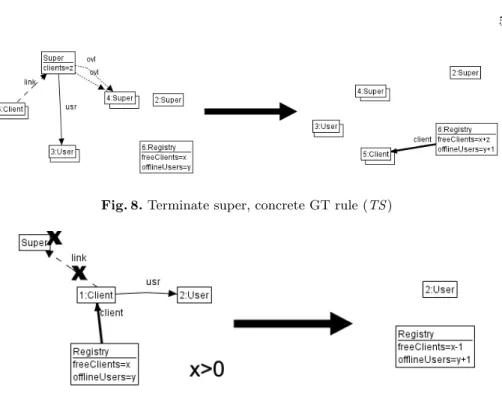
Figure 5 shows the promotion of a client to a super when it is connected to
an overloaded super node. This reduces some of the pressure on the overused
super node.
Figure 6 depicts the rule that is analogous to the creation of a new client,
except that the user has sufficient bandwidth to support a super node. The super
node is immediately connected to the overlay network via an existing super node.
Fig. 2.
Concrete start graph
Fig. 3.
New client, concrete GT rule (
NC
)
Fig. 5.
Promote client, concrete GT rule (
PC
)
Fig. 6.
New super, concrete GT rule (
NS
)
Figure 7 shows the termination of a client while it is connected to the overlay
network (i.e., during a call). The rule represents the shutting down of the VoIP
program by a user.
Fig. 7.
Terminate linked client, concrete GT rule (
TL
)
The rule in Figure 8 represents the shutting down of the VoIP program by a
user that is connected directly through a super node. This is only allowed if there
is at least one other super node present. To prevent violation of the dangling
condition, we must explicitly represent all other graph vertices the deleted node
is connected to. Furthermore, all clients that were connected to the deleted super
node are returned to the registry. Through the deletion of a super node by this
rule, the overlay network may become disconnected so that some clients may
become unreachable from others.
Figure 9 depicts the loss of an unlinked client, i.e., a user switching off the
VoIP program without being in a call.
Fig. 8.
Terminate super, concrete GT rule (
TS
)
Fig. 9.
Terminate unlinked client, concrete GT rule (
TU
)
Finally, Figure 10 describes the creation of redundant links between supers in
order to make the overlay network more robust. Client pairs are less susceptible
to becoming disconnected when a super is terminated if there is more than one
path between the supers to which they are connected. Note that the rule has two
NACs: one stating that there should be no existing overlay connection between
the supers that are to be newly linked, and secondly, that there is no alternate
pathway between these supers via a fourth super node.
Fig. 10.
Create shortcut, concrete GT rule (
CS
)
The global behaviour of interest in this model is the proportion of total clients
at any time that are connected to the overlay network, and the proportion of
total super node pairs that are unreachable from each other (i.e., there is no
transitive closure of the
ovl
edge between them).
For the former, we create a probe rule that searches matches for Client nodes,
and another that searches matches for Client nodes linked to Super nodes,
di-viding the second by the first to find the measure we require. This measurement
is taken after every step in the simulation and we use the average value over
each of these steps as our result.
Transitive closure measurements require modifications to the standard
VIA-TRA2 installation [1]. A description of the necessary steps are outlined by the
authors in an online addendum to [1] at http://viatra.inf.mit.bme.hu/grats. We
specify the pattern between just two super nodes with a pair of oppositely
di-rected
ovl
edges between them. The transitive closure version of the probe then
looks for all pairs of super nodes between which there is a chain of
ovl
edges. A
negation of this pattern then finds all such pairs between which there is no such
transitive connection. We divide this number of pairs by the total number of
super node pairs to find our measure. Just as with the connected client measure,
we take the average of this value over all simulation steps.
Code Fragment 1.1 shows the VTCL specification implementing the entire
behaviour of the concrete model, complete with probes and auxiliary patterns.
Code Fragment 1.1.
VTCL Specification of Concrete Model
1 2 namespace p2p ; 3 4 i m p o r t DSM. metamodels . p2p TG ; 5 i m p o r t d a t a t y p e s ; 6 7 @ i n c r e m e n t a l 8 machine r u l e s a n d c o n s t r a i n t s { 9 10 // ///////////////////////////////////////// 11 // PATTERNS 12 // //////////////////////////////////////// 13 14 p a t t e r n U s e r C o n n e c t e d (U) = { 15 U s e r (U) ; 16 P2PNode (N) ; 17 P2PNode . u s r ( U1 , N, U) ; 18 } 19 20 p a t t e r n C l i e n t L i n k e d (C) = { 21 C l i e n t (C) ; 22 S u p e r ( S ) ; 23 C l i e n t . l i n k ( L , C , S ) ; 24 } 25 26 p a t t e r n C l i e n t s (C) = { 27 C l i e n t (C) ; 28 } 29 30 p a t t e r n S u p e r P a i r s ( S1 , S2 ) = { 31 S u p e r ( S1 ) ; 32 S u p e r ( S2 ) ; 33 } 34 35 s h a r e a b l e p a t t e r n S u p e r L i n k e d ( S1 , S2 ) = { 36 S u p e r ( S1 ) ; 37 S u p e r ( S2 ) ; 38 S u p e r . o v l ( Ov1 , S1 , S2 ) ; 39 S u p e r . o v l ( Ov2 , S2 , S1 ) ; 40 }41 42 43 @ I n c r e m e n t a l ( r e i n t e r p r e t=t r a n s i t i v e C l o s u r e , o f P a t t e r n=S u p e r L i n k e d ) 44 p a t t e r n t r a n s i t i v e C l o s u r e O f S u p e r L i n k e d ( S1 , S2 ) = {} 45 46 47 48 // ///////////////////////////////////////// 49 // CONCRETE RULES 50 // //////////////////////////////////////// 51 52 g t r u l e N e w C l i e n t ( ) = { 53 54 p r e c o n d i t i o n p a t t e r n l h s (U, OU, FC, R) = { 55 R e g i s t r y (R) ; 56 R e g i s t r y . O f f l i n e U s e r s (OU) i n R ; 57 R e g i s t r y . o f f l i n e U s e r s (Ou , R, OU) ; 58 R e g i s t r y . F r e e C l i e n t s (FC) i n R ; 59 R e g i s t r y . f r e e C l i e n t s ( Fc , R, FC) ; 60 U s e r (U) ; 61 neg f i n d U s e r C o n n e c t e d (U) ; 62 } 63 64 a c t i o n { 65 l e t C=u n d e f , 66 C1=u n d e f , 67 U1=u n d e f , 68 Model=DSM. m o d e l s . model 69 i n s e q { 70 new ( C l i e n t (C) i n Model ) ; 71 rename (C , ” c l ”+s t r . r e p l a c e A l l ( s t r . r e p l a c e A l l ( s t r . t o L o w e r C a s e ( name (C) ) , ” ” , ” ” ) , ” un ” , ” ” ) ) ; 72 new ( P2PNode . u s r ( U1 , C , U) ) ; 73 rename ( U1 , ” u s r ” ) ; 74 new ( R e g i s t r y . c l i e n t ( C1 , R, C) ) ; 75 rename ( C1 , ” c l i e n t ”+s t r . r e p l a c e A l l ( s t r . r e p l a c e A l l ( s t r . t o L o w e r C a s e ( name ( C1 ) ) , ” ” , ” ” ) , ” un ” , ” ” ) ) ; 76 s e t V a l u e (OU, t o S t r i n g ( t o I n t e g e r ( v a l u e (OU) ) − 1 ) ) ; 77 s e t V a l u e (FC, t o S t r i n g ( t o I n t e g e r ( v a l u e (FC) ) + 1 ) ) ; 78 p r i n t l n ( ”GT RULE . . . N e w C l i e n t a p p l i e d t o c r e a t e C l i e n t ” + name (C) ) ; 79 } 80 } 81 } 82 83 84 g t r u l e L i n k C l i e n t ( ) = { 85 86 p r e c o n d i t i o n p a t t e r n l h s (FC, Cl1 , C , S , S C ) = { 87 S u p e r ( S ) ; 88 S u p e r . C l i e n t s ( S C ) i n S ; 89 S u p e r . c l i e n t s ( S Cx , S , S C ) ; 90 c h e c k ( t o I n t e g e r ( v a l u e ( S C ) ) < 5 ) ; 91 R e g i s t r y (R) ; 92 R e g i s t r y . F r e e C l i e n t s (FC) i n R ; 93 R e g i s t r y . f r e e C l i e n t s ( Fc , R, FC) ; 94 C l i e n t (C) ; 95 R e g i s t r y . c l i e n t ( Cl1 , R, C) ; 96 neg f i n d C l i e n t L i n k e d (C) ; 97 } 98 99 a c t i o n { 100 l e t L=u n d e f 101 i n s e q { 102 d e l e t e ( Cl1 ) ; 103 new ( C l i e n t . l i n k ( L , C , S ) ) ; 104 rename ( L , ” l i n k ” ) ; 105 s e t V a l u e ( S C , t o S t r i n g ( t o I n t e g e r ( v a l u e ( S C ) ) + 1 ) ) ;
106 s e t V a l u e (FC, t o S t r i n g ( t o I n t e g e r ( v a l u e (FC) ) − 1 ) ) ; 107 p r i n t l n ( ”GT RULE . . . L i n k C l i e n t a p p l i e d t o l i n k C l i e n t ” + name (C) ) ; 108 } 109 } 110 } 111 112 113 g t r u l e P r o m o t e C l i e n t ( ) = { 114 115 p r e c o n d i t i o n p a t t e r n l h s ( S , C , U, L , U1 , S C ) = { 116 S u p e r ( S ) ; 117 S u p e r . C l i e n t s ( S C ) i n S ; 118 c h e c k ( t o I n t e g e r ( v a l u e ( S C ) ) >= 5 ) ; 119 S u p e r . c l i e n t s ( S Cx , S , S C ) ; 120 121 C l i e n t (C) ; 122 C l i e n t . l i n k ( L , C , S ) ; 123 124 U s e r (U) ; 125 P2PNode . u s r ( U1 , C , U) ; 126 } 127 128 a c t i o n { 129 l e t S2=u n d e f , 130 S CNew=u n d e f , 131 S CNew X=u n d e f , 132 Ovl1=u n d e f , 133 Ovl2=u n d e f , 134 U2=u n d e f , 135 Model=DSM. m o d e l s . model 136 i n s e q { 137 p r i n t ( ”GT RULE . . . P r o m o t e C l i e n t a p p l i e d t o promote C l i e n t ” + name (C) ) ; 138 d e l e t e ( L ) ; 139 d e l e t e ( U1 ) ; 140 d e l e t e (C) ; 141 142 new ( S u p e r ( S2 ) i n Model ) ; 143 rename ( S2 , ” s u p e r ”+s t r . r e p l a c e A l l ( s t r . r e p l a c e A l l ( s t r . t o L o w e r C a s e ( name ( S2 ) ) , ” ” , ” ” ) , ” un ” , ” ” ) ) ; 144 145 new ( e n t i t y ( S CNew ) i n S2 ) ; 146 rename ( S CNew , ” C l i e n t s ” ) ; 147 s e t V a l u e ( S CNew , 0 ) ;
148 new ( i n s t a n c e O f ( S CNew , r e f ( ”DSM. metamodels . p2p TG . S u p e r . C l i e n t s ” ) ) ) ;
149 new ( S u p e r . c l i e n t s ( S CNew X , S2 , S CNew ) ) ; 150 rename ( S CNew X , ” c l i e n t s ” ) ; 151 152 new ( S u p e r . o v l ( Ovl1 , S2 , S ) ) ; 153 rename ( Ovl1 , ” o v l ”+s t r . r e p l a c e A l l ( s t r . r e p l a c e A l l ( s t r . t o L o w e r C a s e ( name ( Ovl1 ) ) , ” ” , ” ” ) , ” un ” , ” ” ) ) ; 154 new ( S u p e r . o v l ( Ovl2 , S , S2 ) ) ; 155 rename ( Ovl2 , ” o v l ”+s t r . r e p l a c e A l l ( s t r . r e p l a c e A l l ( s t r . t o L o w e r C a s e ( name ( Ovl2 ) ) , ” ” , ” ” ) , ” un ” , ” ” ) ) ; 156 s e t V a l u e ( S C , t o S t r i n g ( t o I n t e g e r ( v a l u e ( S C ) ) − 1 ) ) ; 157 158 new ( P2PNode . u s r ( U2 , S2 , U) ) ; 159 rename ( U2 , ” u s r ” ) ; 160 161 p r i n t l n ( ” t o S u p e r ” + name ( S2 ) ) ; 162 } 163 } 164 } 165 166 167 g t r u l e NewSuper ( ) = {
168 169 p r e c o n d i t i o n p a t t e r n l h s (U, S , OU) = { 170 R e g i s t r y (R) ; 171 R e g i s t r y . O f f l i n e U s e r s (OU) i n R ; 172 R e g i s t r y . o f f l i n e U s e r s (Ou , R, OU) ; 173 U s e r (U) ; 174 S u p e r ( S ) ; 175 neg f i n d U s e r C o n n e c t e d (U) ; 176 } 177 178 a c t i o n { 179 l e t S2=u n d e f , 180 S CNew=u n d e f , 181 S CNew X=u n d e f , 182 Ovl1=u n d e f , 183 Ovl2=u n d e f , 184 Us1=u n d e f , 185 Model=DSM. m o d e l s . model 186 i n s e q { 187 188 new ( S u p e r ( S2 ) i n Model ) ; 189 rename ( S2 , ” s u p e r ”+s t r . r e p l a c e A l l ( s t r . r e p l a c e A l l ( s t r . t o L o w e r C a s e ( name ( S2 ) ) , ” ” , ” ” ) , ” un ” , ” ” ) ) ; 190 191 new ( e n t i t y ( S CNew ) i n S2 ) ; 192 rename ( S CNew , ” C l i e n t s ” ) ; 193 s e t V a l u e ( S CNew , 0 ) ;
194 new ( i n s t a n c e O f ( S CNew , r e f ( ”DSM. metamodels . p2p TG . S u p e r . C l i e n t s ” ) ) ) ;
195 new ( S u p e r . c l i e n t s ( S CNew X , S2 , S CNew ) ) ; 196 rename ( S CNew X , ” c l i e n t s ” ) ;
197
198 new ( P2PNode . u s r ( Us1 , S2 , U) ) ;
199 rename ( Us1 , ” u s r ” ) ; 200 new ( S u p e r . o v l ( Ovl1 , S2 , S ) ) ; 201 rename ( Ovl1 , ” o v l ”+s t r . r e p l a c e A l l ( s t r . r e p l a c e A l l ( s t r . t o L o w e r C a s e ( name ( Ovl1 ) ) , ” ” , ” ” ) , ” un ” , ” ” ) ) ; 202 new ( S u p e r . o v l ( Ovl2 , S , S2 ) ) ; 203 rename ( Ovl2 , ” o v l ”+s t r . r e p l a c e A l l ( s t r . r e p l a c e A l l ( s t r . t o L o w e r C a s e ( name ( Ovl2 ) ) , ” ” , ” ” ) , ” un ” , ” ” ) ) ; 204 s e t V a l u e (OU, t o S t r i n g ( t o I n t e g e r ( v a l u e (OU) ) − 1 ) ) ; 205 p r i n t l n ( ”GT RULE . . . NewSuper a p p l i e d t o c r e a t e S u p e r ” + name ( S2 ) +” w i t h C l i e n t s a t t r i b u t e v a l u e ” + v a l u e ( S CNew ) ) ; 206 } 207 } 208 } 209 210 211 g t r u l e T e r m i n a t e L i n k e d C l i e n t ( ) = { 212 213 p r e c o n d i t i o n p a t t e r n l h s (C , S , S C , OU, U1 , L ) = { 214 R e g i s t r y (R) ; 215 R e g i s t r y . O f f l i n e U s e r s (OU) i n R ; 216 R e g i s t r y . o f f l i n e U s e r s (Ou , R, OU) ; 217 S u p e r ( S ) ; 218 S u p e r . C l i e n t s ( S C ) i n S ; 219 S u p e r . c l i e n t s ( S Cx , S , S C ) ; 220 U s e r (U) ; 221 C l i e n t (C) ; 222 P2PNode . u s r ( U1 , C , U) ; 223 C l i e n t . l i n k ( L , C , S ) ; 224 } 225 226 a c t i o n { 227 d e l e t e ( L ) ; 228 d e l e t e ( U1 ) ; 229 s e t V a l u e ( S C , t o S t r i n g ( t o I n t e g e r ( v a l u e ( S C ) ) − 1 ) ) ;
230 s e t V a l u e (OU, t o S t r i n g ( t o I n t e g e r ( v a l u e (OU) ) + 1 ) ) ; 231 p r i n t l n ( ”GT RULE . . . T e r m i n a t e L i n k e d C l i e n t a p p l i e d t o t e r m i n a t e C l i e n t ” + name (C) ) ; 232 d e l e t e (C) ; 233 } 234 } 235 236 237 g t r u l e T e r m i n a t e U n l i n k e d C l i e n t ( ) = { 238 239 p r e c o n d i t i o n p a t t e r n l h s (C , OU, FC, U1 , C1 ) = { 240 R e g i s t r y (R) ; 241 R e g i s t r y . O f f l i n e U s e r s (OU) i n R ; 242 R e g i s t r y . o f f l i n e U s e r s (Ou , R, OU) ; 243 R e g i s t r y . F r e e C l i e n t s (FC) i n R ; 244 R e g i s t r y . f r e e C l i e n t s ( Fc , R, FC) ; 245 246 U s e r (U) ; 247 C l i e n t (C) ; 248 P2PNode . u s r ( U1 , C , U) ; 249 R e g i s t r y . c l i e n t ( C1 , R, C) ; 250 } 251 252 a c t i o n { 253 d e l e t e ( C1 ) ; 254 d e l e t e ( U1 ) ; 255 s e t V a l u e (FC, t o S t r i n g ( t o I n t e g e r ( v a l u e (FC) ) − 1 ) ) ; 256 s e t V a l u e (OU, t o S t r i n g ( t o I n t e g e r ( v a l u e (OU) ) + 1 ) ) ; 257 p r i n t l n ( ”GT RULE . . . T e r m i n a t e U n l i n k e d C l i e n t a p p l i e d t o t e r m i n a t e C l i e n t ” + name (C) ) ; 258 d e l e t e (C) ; 259 } 260 } 261 262 263 g t r u l e T e r m i n a t e S u p e r ( ) = { 264 265 p r e c o n d i t i o n p a t t e r n l h s (OU, FC, S2 , R, S C ) = { 266 R e g i s t r y (R) ; 267 R e g i s t r y . O f f l i n e U s e r s (OU) i n R ; 268 R e g i s t r y . o f f l i n e U s e r s (Ou , R, OU) ; 269 R e g i s t r y . F r e e C l i e n t s (FC) i n R ; 270 R e g i s t r y . f r e e C l i e n t s ( Fc , R, FC) ; 271 272 S u p e r ( S1 ) ; 273 S u p e r ( S2 ) ; 274 S u p e r . C l i e n t s ( S C ) ; 275 S u p e r . c l i e n t s ( S CX , S2 , S C ) ; 276 } 277 278 a c t i o n { 279 s e t V a l u e (FC, t o S t r i n g ( t o I n t e g e r ( v a l u e (FC) ) + t o I n t e g e r ( v a l u e ( S C ) ) ) ) ; 280 i t e r a t e c h o o s e w i t h a p p l y r e l i n k C l i e n t s ( S2 , R) ; 281 s e t V a l u e (OU, t o S t r i n g ( t o I n t e g e r ( v a l u e (OU) ) + 1 ) ) ; 282 p r i n t l n ( ”GT RULE . . . T e r m i n a t e S u p e r a p p l i e d t o t e r m i n a t e S u p e r ” + name ( S2 ) ) ; 283 d e l e t e ( S2 ) ; 284 } 285 } 286 287 288 g t r u l e C r e a t e S h o r t c u t ( ) = { 289 290 p r e c o n d i t i o n p a t t e r n l h s ( S1 , S2 ) = { 291 S u p e r ( S1 ) ; 292 S u p e r ( S2 ) ; 293 S u p e r ( S3 ) ;
294 S u p e r . o v l ( O1 , S3 , S1 ) ; 295 S u p e r . o v l ( O2 , S3 , S2 ) ; 296 neg f i n d S u p e r s C o n n e c t e d ( S1 , S2 ) ; 297 neg f i n d S u p e r s B y p a s s ( S1 , S2 , S3 ) ; 298 } 299 300 a c t i o n { 301 l e t Ovl1=u n d e f , 302 Ovl2=u n d e f 303 i n s e q { 304 new ( S u p e r . o v l ( Ovl1 , S1 , S2 ) ) ; 305 rename ( Ovl1 , ” o v l ”+s t r . r e p l a c e A l l ( s t r . r e p l a c e A l l ( s t r . t o L o w e r C a s e ( name ( Ovl1 ) ) , ” ” , ” ” ) , ” un ” , ” ” ) ) ; 306 new ( S u p e r . o v l ( Ovl2 , S2 , S1 ) ) ; 307 rename ( Ovl2 , ” o v l ”+s t r . r e p l a c e A l l ( s t r . r e p l a c e A l l ( s t r . t o L o w e r C a s e ( name ( Ovl2 ) ) , ” ” , ” ” ) , ” un ” , ” ” ) ) ; 308 } 309 } 310 } 311 312 313 g t r u l e c o u n t C l i e n t s ( i n S , i n R, i n Count ) = { 314 315 p r e c o n d i t i o n p a t t e r n l h s ( S , L , C) = { 316 317 S u p e r ( S ) ; 318 C l i e n t (C) ; 319 C l i e n t . l i n k ( L , C , S ) ; 320 R e g i s t r y (R) ; 321 } 322 a c t i o n { 323 l e t C1=u n d e f 324 i n s e q{ 325 s e t V a l u e ( Count , t o S t r i n g ( t o I n t e g e r ( v a l u e ( Count ) ) + 1 ) ) ; 326 d e l e t e ( L ) ; 327 new ( R e g i s t r y . c l i e n t ( C1 , R, C) ) ; 328 rename ( C1 , ” c l i e n t ”+s t r . r e p l a c e A l l ( s t r . r e p l a c e A l l ( s t r . t o L o w e r C a s e ( name ( C1 ) ) , ” ” , ” ” ) , ” un ” , ” ” ) ) ; 329 } 330 } 331 } 332 333 334 g t r u l e r e l i n k C l i e n t s ( i n S , i n R) = { 335 336 p r e c o n d i t i o n p a t t e r n l h s ( S , L , C , R) = { 337 338 S u p e r ( S ) ; 339 C l i e n t (C) ; 340 C l i e n t . l i n k ( L , C , S ) ; 341 R e g i s t r y (R) ; 342 } 343 a c t i o n { 344 l e t C1=u n d e f 345 i n s e q{ 346 d e l e t e ( L ) ; 347 new ( R e g i s t r y . c l i e n t ( C1 , R, C) ) ; 348 rename ( C1 , ” c l i e n t ”+s t r . r e p l a c e A l l ( s t r . r e p l a c e A l l ( s t r . t o L o w e r C a s e ( name ( C1 ) ) , ” ” , ” ” ) , ” un ” , ” ” ) ) ; 349 } 350 } 351 } 352 353 354 355 // ///////////////////////////////////////// 356 // PROBE RULES 357 // ////////////////////////////
358 359 g t r u l e P r o b e C o n n e c t e d C l i e n t s ( i n o u t C) = { 360 p r e c o n d i t i o n f i n d C l i e n t L i n k e d (C) 361 } 362 363 g t r u l e P r o b e A l l C l i e n t s ( i n o u t C) = { 364 p r e c o n d i t i o n f i n d C l i e n t s (C) 365 } 366 367 g t r u l e P r o b e D i s c o n n e c t e d ( i n o u t S1 , i n o u t S2 ) = { 368 p r e c o n d i t i o n p a t t e r n l h s ( S1 , S2 ) = { 369 S u p e r ( S1 ) ; 370 S u p e r ( S2 ) ; 371 neg f i n d t r a n s i t i v e C l o s u r e O f S u p e r L i n k e d ( S1 , S2 ) ; 372 } 373 } 374 375 g t r u l e P r o b e A l l S u p e r P a i r s ( i n o u t S1 , i n o u t S2 ) = { 376 p r e c o n d i t i o n f i n d S u p e r P a i r s ( S1 , S2 ) 377 } 378 379 g t r u l e P r o b e S u p e r s ( i n o u t S1 ) = { 380 p r e c o n d i t i o n p a t t e r n l h s ( S1 ) = { 381 S u p e r ( S1 ) ; 382 } 383 } 384 385 }
3
Abstract Model
In the abstract model, we retain only the
Super
and
Registry
types, with the
inheritance of
Super
from
Node
as an inconsequential artefact. The abstract type
graph is shown in Figure 11. The abstraction in this case does not reduce the
number of rules, but with fewer graph elements in each rule and in each instance
graph, there are fewer and smaller matches for each rule. Therefore, an increase
in performance during stochastic simulation is still expected. The start graph is
reduced to just two elements: the registry and the first super node, as shown in
Figure 12.
Fig. 12.
Abstract start graph
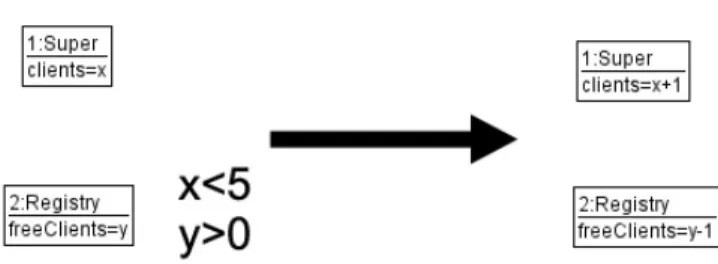
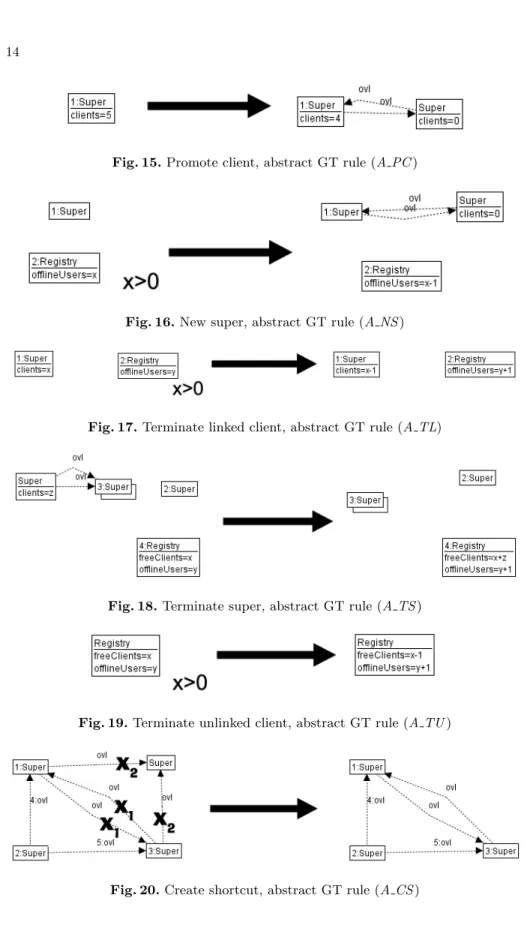
Figures 13 to 19 show the projection of the concrete rules to the abstract
type graph. Note that except for those of create shortcut, all NACs are lost but
conditions on aggregating attributes still remain.
Fig. 13.
New client, abstract GT rule (
A NC
)
Fig. 14.
Link client, abstract GT rule (
A LC
)
The probes responsible for finding disconnected pairs of super nodes can still
be used in the abstract model since the
Super
type is still present. However, to
calculate the proportion of clients that are connected to the overlay network, the
clients
attribute of
Super
must be accessible along with the
freeClients
attribute
of
Registry. The sum of the
clients
attribute for all super nodes divided by this
value plus the
freeClients
value gives us the measure we require.
Since the reading of attribute values is not currently supported by
VIA-TRA2, a hard coded, model specific solution was implemented as a temporary
measure. Probe rules were created to pass required attribute entities in the
mod-elspace to the simulation engine. The hard coded solution recognized the probe
by name and returns/sums the required attribute value for all matches of the
probe rather than simply counting matches themselves. The solution will be
in-corporated into the stochastic simulation package of VIATRA2 once a naming
convention/methodology for attribute value probes is decided upon.
Fig. 15.
Promote client, abstract GT rule (
A PC
)
Fig. 16.
New super, abstract GT rule (
A NS
)
Fig. 17.
Terminate linked client, abstract GT rule (
A TL
)
Fig. 18.
Terminate super, abstract GT rule (
A TS
)
Fig. 19.
Terminate unlinked client, abstract GT rule (
A TU
)
The portion of the
rules.vtcl
file that defines these abstract rules is given in
Code Fragment 1.2.
Code Fragment 1.2.
VTCL Specification of Abstract Model
1 2 // ///////////////////////////////////////// 3 // ABSTRACT RULES 4 // //////////////////////////////////////// 5 6 g t r u l e A b s t r a c t N e w C l i e n t ( ) = { 7 8 p r e c o n d i t i o n p a t t e r n l h s (OU, FC) = { 9 R e g i s t r y (R) ; 10 R e g i s t r y . O f f l i n e U s e r s (OU) i n R ; 11 R e g i s t r y . o f f l i n e U s e r s (Ou , R, OU) ; 12 R e g i s t r y . F r e e C l i e n t s (FC) i n R ; 13 R e g i s t r y . f r e e C l i e n t s ( Fc , R, FC) ; 14 c h e c k ( t o I n t e g e r ( v a l u e (OU) ) > 0 ) ; 15 } 16 17 a c t i o n { 18 s e t V a l u e (OU, t o S t r i n g ( t o I n t e g e r ( v a l u e (OU) ) − 1 ) ) ; 19 s e t V a l u e (FC, t o S t r i n g ( t o I n t e g e r ( v a l u e (FC) ) + 1 ) ) ; 20 p r i n t l n ( ”GT RULE . . . N e w C l i e n t a p p l i e d t o c r e a t e C l i e n t ” ) ; 21 } 22 } 23 24 25 g t r u l e A b s t r a c t L i n k C l i e n t ( ) = { 26 27 p r e c o n d i t i o n p a t t e r n l h s (FC, S , S C ) = { 28 R e g i s t r y (R) ; 29 R e g i s t r y . F r e e C l i e n t s (FC) i n R ; 30 R e g i s t r y . f r e e C l i e n t s ( Fc , R, FC) ; 31 c h e c k ( t o I n t e g e r ( v a l u e (FC) ) > 0 ) ; 32 S u p e r ( S ) ; 33 S u p e r . C l i e n t s ( S C ) i n S ; 34 S u p e r . c l i e n t s ( S Cx , S , S C ) ; 35 c h e c k ( t o I n t e g e r ( v a l u e ( S C ) ) < 5 ) ; 36 } 37 38 a c t i o n { 39 s e t V a l u e ( S C , t o S t r i n g ( t o I n t e g e r ( v a l u e ( S C ) ) + 1 ) ) ; 40 s e t V a l u e (FC, t o S t r i n g ( t o I n t e g e r ( v a l u e (FC) ) − 1 ) ) ; 41 p r i n t l n ( ”GT RULE . . . L i n k C l i e n t a p p l i e d t o l i n k S u p e r ” + name ( S ) ) ; 42 } 43 } 44 45 46 g t r u l e A b s t r a c t P r o m o t e C l i e n t ( ) = { 47 48 p r e c o n d i t i o n p a t t e r n l h s ( S , S C ) = { 49 S u p e r ( S ) ; 50 S u p e r . C l i e n t s ( S C ) i n S ; 51 S u p e r . c l i e n t s ( S Cx , S , S C ) ; 52 c h e c k ( t o I n t e g e r ( v a l u e ( S C ) ) >= 5 ) ; 53 } 54 55 a c t i o n { 56 l e t S2=u n d e f , 57 S CNew=u n d e f , 58 S CNew X=u n d e f , 59 Ovl1=u n d e f , 60 Ovl2=u n d e f , 61 Model=DSM. m o d e l s . model 62 i n s e q {63 new ( S u p e r ( S2 ) i n Model ) ; 64 rename ( S2 , ” s u p e r ”+s t r . r e p l a c e A l l ( s t r . r e p l a c e A l l ( s t r . t o L o w e r C a s e ( name ( S2 ) ) , ” ” , ” ” ) , ” un ” , ” ” ) ) ; 65 66 new ( e n t i t y ( S CNew ) i n S2 ) ; 67 rename ( S CNew , ” C l i e n t s ” ) ; 68 s e t V a l u e ( S CNew , 0 ) ;
69 new ( i n s t a n c e O f ( S CNew , r e f ( ”DSM. metamodels . p2p TG . S u p e r . C l i e n t s ” ) ) ) ;
70 new ( S u p e r . c l i e n t s ( S CNew X , S2 , S CNew ) ) ; 71 rename ( S CNew X , ” c l i e n t s ” ) ; 72 73 new ( S u p e r . o v l ( Ovl1 , S2 , S ) ) ; 74 rename ( Ovl1 , ” o v l ”+s t r . r e p l a c e A l l ( s t r . r e p l a c e A l l ( s t r . t o L o w e r C a s e ( name ( Ovl1 ) ) , ” ” , ” ” ) , ” un ” , ” ” ) ) ; 75 new ( S u p e r . o v l ( Ovl2 , S , S2 ) ) ; 76 rename ( Ovl2 , ” o v l ”+s t r . r e p l a c e A l l ( s t r . r e p l a c e A l l ( s t r . t o L o w e r C a s e ( name ( Ovl2 ) ) , ” ” , ” ” ) , ” un ” , ” ” ) ) ; 77 78 s e t V a l u e ( S C , t o S t r i n g ( t o I n t e g e r ( v a l u e ( S C ) ) − 1 ) ) ; 79 80 p r i n t l n ( ”GT RULE . . . P r o m o t e C l i e n t a p p l i e d t o new S u p e r ” + name ( S2 ) ) ; 81 } 82 } 83 } 84 85 86 g t r u l e A b s t r a c t N e w S u p e r ( ) = { 87 88 p r e c o n d i t i o n p a t t e r n l h s ( S , OU) = { 89 R e g i s t r y (R) ; 90 R e g i s t r y . O f f l i n e U s e r s (OU) i n R ; 91 R e g i s t r y . o f f l i n e U s e r s (Ou , R, OU) ; 92 c h e c k ( t o I n t e g e r ( v a l u e (OU) ) >0) ; 93 S u p e r ( S ) ; 94 } 95 96 a c t i o n { 97 l e t S2=u n d e f , 98 S CNew=u n d e f , 99 S CNew X=u n d e f , 100 Ovl1=u n d e f , 101 Ovl2=u n d e f , 102 Model=DSM. m o d e l s . model 103 i n s e q { 104 new ( S u p e r ( S2 ) i n Model ) ; 105 rename ( S2 , ” s u p e r ”+s t r . r e p l a c e A l l ( s t r . r e p l a c e A l l ( s t r . t o L o w e r C a s e ( name ( S2 ) ) , ” ” , ” ” ) , ” un ” , ” ” ) ) ; 106 107 new ( e n t i t y ( S CNew ) i n S2 ) ; 108 rename ( S CNew , ” C l i e n t s ” ) ; 109 s e t V a l u e ( S CNew , 0 ) ;
110 new ( i n s t a n c e O f ( S CNew , r e f ( ”DSM. metamodels . p2p TG . S u p e r . C l i e n t s ” ) ) ) ;
111 new ( S u p e r . c l i e n t s ( S CNew X , S2 , S CNew ) ) ; 112 rename ( S CNew X , ” c l i e n t s ” ) ; 113 114 new ( S u p e r . o v l ( Ovl1 , S2 , S ) ) ; 115 rename ( Ovl1 , ” o v l ”+s t r . r e p l a c e A l l ( s t r . r e p l a c e A l l ( s t r . t o L o w e r C a s e ( name ( Ovl1 ) ) , ” ” , ” ” ) , ” un ” , ” ” ) ) ; 116 new ( S u p e r . o v l ( Ovl2 , S , S2 ) ) ; 117 rename ( Ovl2 , ” o v l ”+s t r . r e p l a c e A l l ( s t r . r e p l a c e A l l ( s t r . t o L o w e r C a s e ( name ( Ovl2 ) ) , ” ” , ” ” ) , ” un ” , ” ” ) ) ; 118 s e t V a l u e (OU, t o S t r i n g ( t o I n t e g e r ( v a l u e (OU) ) − 1 ) ) ; 119 p r i n t l n ( ”GT RULE . . . NewSuper a p p l i e d t o c r e a t e S u p e r ” + name ( S2 ) ) ; 120
121 } 122 } 123 } 124 125 126 g t r u l e A b s t r a c t T e r m i n a t e L i n k e d C l i e n t ( ) = { 127 128 p r e c o n d i t i o n p a t t e r n l h s ( S , S C , OU) = { 129 R e g i s t r y (R) ; 130 R e g i s t r y . O f f l i n e U s e r s (OU) i n R ; 131 R e g i s t r y . o f f l i n e U s e r s (Ou , R, OU) ; 132 S u p e r ( S ) ; 133 S u p e r . C l i e n t s ( S C ) i n S ; 134 S u p e r . c l i e n t s ( S Cx , S , S C ) ; 135 c h e c k ( t o I n t e g e r ( v a l u e ( S C ) ) > 0 ) ; 136 } 137 138 a c t i o n { 139 s e t V a l u e ( S C , t o S t r i n g ( t o I n t e g e r ( v a l u e ( S C ) ) − 1 ) ) ; 140 s e t V a l u e (OU, t o S t r i n g ( t o I n t e g e r ( v a l u e (OU) ) + 1 ) ) ; 141 p r i n t l n ( ”GT RULE . . . T e r m i n a t e L i n k e d C l i e n t a p p l i e d t o t e r m i n a t e C l i e n t on S u p e r ” + name ( S ) ) ; 142 } 143 } 144 145 146 g t r u l e A b s t r a c t T e r m i n a t e U n l i n k e d C l i e n t ( ) = { 147 148 p r e c o n d i t i o n p a t t e r n l h s (OU, FC) = { 149 R e g i s t r y (R) ; 150 R e g i s t r y . O f f l i n e U s e r s (OU) i n R ; 151 R e g i s t r y . o f f l i n e U s e r s (Ou , R, OU) ; 152 R e g i s t r y . F r e e C l i e n t s (FC) i n R ; 153 R e g i s t r y . f r e e C l i e n t s ( Fc , R, FC) ; 154 c h e c k ( t o I n t e g e r ( v a l u e (FC) ) >0) ; 155 } 156 157 a c t i o n { 158 s e t V a l u e (FC, t o S t r i n g ( t o I n t e g e r ( v a l u e (FC) ) − 1 ) ) ; 159 s e t V a l u e (OU, t o S t r i n g ( t o I n t e g e r ( v a l u e (OU) ) + 1 ) ) ; 160 p r i n t l n ( ”GT RULE . . . T e r m i n a t e U n l i n k e d C l i e n t a p p l i e d ” ) ; 161 } 162 } 163 164 165 g t r u l e A b s t r a c t T e r m i n a t e S u p e r ( ) = { 166 167 p r e c o n d i t i o n p a t t e r n l h s (OU, FC, S2 , R, S C ) = { 168 R e g i s t r y (R) ; 169 R e g i s t r y . O f f l i n e U s e r s (OU) i n R ; 170 R e g i s t r y . o f f l i n e U s e r s (Ou , R, OU) ; 171 R e g i s t r y . F r e e C l i e n t s (FC) i n R ; 172 R e g i s t r y . f r e e C l i e n t s ( Fc , R, FC) ; 173 174 S u p e r ( S1 ) ; 175 S u p e r ( S2 ) ; // t o d e l e t e 176 S u p e r . C l i e n t s ( S C ) ; 177 S u p e r . c l i e n t s ( S CX , S2 , S C ) ; 178 179 } 180 181 a c t i o n { 182 s e t V a l u e (FC, t o S t r i n g ( t o I n t e g e r ( v a l u e (FC) ) + t o I n t e g e r ( v a l u e ( S C ) ) ) ) ; 183 s e t V a l u e (OU, t o S t r i n g ( t o I n t e g e r ( v a l u e (OU) ) + 1 ) ) ; 184 p r i n t l n ( ”GT RULE . . . T e r m i n a t e S u p e r a p p l i e d t o t e r m i n a t e S u p e r ” + name ( S2 ) ) ; 185 d e l e t e ( S2 ) ;
186 } 187 } 188 189 190 g t r u l e A b s t r a c t C r e a t e S h o r t c u t ( ) = { 191 192 p r e c o n d i t i o n p a t t e r n l h s ( S1 , S2 ) = { 193 S u p e r ( S1 ) ; 194 S u p e r ( S2 ) ; 195 S u p e r ( S3 ) ; 196 S u p e r . o v l ( O1 , S3 , S1 ) ; 197 S u p e r . o v l ( O2 , S3 , S2 ) ; 198 neg f i n d S u p e r s C o n n e c t e d ( S1 , S2 ) ; 199 neg f i n d S u p e r s B y p a s s ( S1 , S2 , S3 ) ; 200 } 201 202 a c t i o n { 203 l e t Ovl1=u n d e f , 204 Ovl2=u n d e f 205 i n s e q { 206 new ( S u p e r . o v l ( Ovl1 , S1 , S2 ) ) ; 207 rename ( Ovl1 , ” o v l ”+s t r . r e p l a c e A l l ( s t r . r e p l a c e A l l ( s t r . t o L o w e r C a s e ( name ( Ovl1 ) ) , ” ” , ” ” ) , ” un ” , ” ” ) ) ; 208 new ( S u p e r . o v l ( Ovl2 , S2 , S1 ) ) ; 209 rename ( Ovl2 , ” o v l ”+s t r . r e p l a c e A l l ( s t r . r e p l a c e A l l ( s t r . t o L o w e r C a s e ( name ( Ovl2 ) ) , ” ” , ” ” ) , ” un ” , ” ” ) ) ; 210 } 211 } 212 } 213 214 // ///////////////////////////////////////// 215 // PROBE RULES 216 // //////////////////////////// 217 218 g t r u l e P r o b e D i s c o n n e c t e d ( i n o u t S1 , i n o u t S2 ) = { 219 p r e c o n d i t i o n p a t t e r n l h s ( S1 , S2 ) = { 220 S u p e r ( S1 ) ; 221 S u p e r ( S2 ) ; 222 neg f i n d t r a n s i t i v e C l o s u r e O f S u p e r L i n k e d ( S1 , S2 ) ; 223 } 224 } 225 226 g t r u l e P r o b e A l l S u p e r P a i r s ( i n o u t S1 , i n o u t S2 ) = { 227 p r e c o n d i t i o n f i n d S u p e r P a i r s ( S1 , S2 ) 228 } 229 230 g t r u l e P r o b e S u p e r s ( i n o u t S1 ) = { 231 p r e c o n d i t i o n p a t t e r n l h s ( S1 ) = { 232 S u p e r ( S1 ) ; 233 } 234 } 235 236 g t r u l e P r o b e A t t r i b u t e F r e e C l i e n t s ( i n o u t FC) = { 237 p r e c o n d i t i o n p a t t e r n l h s (FC) = { 238 R e g i s t r y (R) ; 239 R e g i s t r y . F r e e C l i e n t s (FC) i n R ; 240 R e g i s t r y . f r e e C l i e n t s ( Fc , R, FC) ; 241 } 242 } 243 244 g t r u l e P r o b e A t t r i b u t e C o n n e c t e d C l i e n t s ( i n o u t S C ) = { 245 p r e c o n d i t i o n p a t t e r n l h s ( S C ) = { 246 S u p e r ( S ) ; 247 S u p e r . C l i e n t s ( S C ) ; 248 S u p e r . c l i e n t s ( S CX , S , S C ) ; 249 } 250 }