
ownCloud Administrators Manual
Release 7.0
The ownCloud developers
CONTENTS
1 Introduction 1
1.1 Target Audience . . . 1
1.2 ownCloud Videos and Blogs . . . 1
1.3 Document Structure . . . 1
2 ownCloud Videos 5 2.1 Server to Server Sharing on ownCloud 7 . . . 5
2.2 Introducing ownCloud 7 Enterprise Edition . . . 5
2.3 ownCloud for Enterprise File Sync and Share . . . 5
3 What’s New for Admins in ownCloud 7 7 3.1 New User Management . . . 7
3.2 External Storage . . . 7
3.3 Object Stores as Primary Storage . . . 7
3.4 Server to Server Sharing . . . 7
3.5 SharePoint Integration (Enterprise Edition only) . . . 7
3.6 Windows Network Drive Integration (Enterprise Edition only) . . . 8
3.7 Sharing . . . 8
3.8 Email Configuration Wizard . . . 8
3.9 Editable Email Templates . . . 8
3.10 Active Directory and LDAP Enhancements . . . 8
4 ownCloud 7.0 Release Notes 9 4.1 Recommended Setup for Running ownCloud . . . 9
4.2 Supported Platforms . . . 9
4.3 Enterprise 7 Only. . . 11
5 Installation 13 5.1 Preferred Linux Installation Method . . . 13
5.2 ownCloud Appliances . . . 13
5.3 Installing and Managing Apps . . . 14
5.4 Hiawatha Configuration . . . 17
5.5 Installation Wizard . . . 17
5.6 Lighttpd Configuration . . . 21
5.7 Mac OS X . . . 22
5.8 Nginx Configuration . . . 22
5.9 Other Installation Methods . . . 24
5.10 Manual Installation on Linux . . . 24
5.11 Univention Corporate Server. . . 31
5.12 Windows 7 and Windows Server 2008. . . 38
5.13 Yaws Configuration . . . 44
6 Configuration 47
6.1 Configuring the Activity App . . . 47
6.2 Configuring the ClamAV Antivirus Scanner . . . 47
6.3 Automatic Configuration Setup . . . 51
6.4 Defining Background Jobs . . . 53
6.5 Uploading big files > 512MB (as set by default) . . . 54
6.6 Configuring the Collaborative Documents App . . . 56
6.7 Config.php Parameters . . . 58
6.8 Custom Client Configuration. . . 72
6.9 Database Configuration . . . 73
6.10 Email Configuration . . . 80
6.11 Encryption Configuration . . . 87
6.12 Configuring External Storage (GUI) . . . 93
6.13 Configuring External Storage (Configuration File) . . . 107
6.14 Linking External Sites . . . 114
6.15 File Sharing . . . 116
6.16 Files Locking App Configuration . . . 121
6.17 Hardening and Security Guidance . . . 121
6.18 JavaScript and CSS Asset Management . . . 124
6.19 Knowledge Base Configuration . . . 124
6.20 Language Configuration . . . 125
6.21 Logging Configuration . . . 125
6.22 Using the occ Command . . . 126
6.23 Performance Tips. . . 130
6.24 Previews Configuration . . . 136
6.25 Reverse Proxy Configuration. . . 138
6.26 Enabling Full-Text Search . . . 138
6.27 Configuring Server-to-Server Sharing . . . 139
6.28 Serving Static Files for Better Performance . . . 141
6.29 Using Third Party PHP Components. . . 144
6.30 User Authentication with IMAP, SMB, and FTP . . . 144
6.31 User Authentication with LDAP . . . 146
6.32 LDAP User Cleanup . . . 158
6.33 User Management . . . 159
6.34 Resetting a Lost Admin Password . . . 162
7 Maintenance 163 7.1 Maintenance Mode Configuration . . . 163
7.2 Backing up ownCloud . . . 163
7.3 Updating ownCloud with the Updater App . . . 164
7.4 Upgrading Your ownCloud Server . . . 169
7.5 Restoring ownCloud . . . 175
7.6 Migrating ownCloud Installations . . . 176
7.7 Converting From SQLite to MySQL, MariaDB, or PostgreSQL . . . 176
8 Issues and Troubleshooting 179 8.1 Bugs . . . 179
8.2 General Troubleshooting . . . 179
8.3 Troubleshooting Webserver and PHP problems . . . 181
8.4 Troubleshooting WebDAV . . . 182
CHAPTER
ONE
INTRODUCTION
Welcome to the ownCloud Administrator Guide. This guide describes administrator tasks for ownCloud; a flexible, open source, file synchronization and sharing solution. ownCloud is comprised of a server running on either a Linux or Microsoft Windows platform as well as client applications for Microsoft Windows, Mac OS X and Linux (Desktop Client) and mobile clients for both the Android and Apple iOS operating system.
1.1 Target Audience
This guide is targeted towards people who want to install, administer, and optimize the ownCloud server. If you want to learn more about the ownCloud Web user interface or how to install clients on the server, refer to the following:
• User Manual
• Desktop Client Manual
1.2 ownCloud Videos and Blogs
See theofficial ownCloud channelandownClouders community channelon YouTube for tutorials, overviews, and conference videos.
VisitownCloud Planetfor news and developer blogs.
1.3 Document Structure
This document is broken out into three major sections – Installation, Configuration, and Maintenance. The Issues sections has instructions for reporting bugs. The following sections provide detailed information about various tasks associated with each of these sections.
1.3.1 Installation
This section provides detailed instructions on how to install ownCloud in different scenarios. It contains the following topics:
• ownCloud Appliances
• Installing and Managing Apps
• Hiawatha Configuration
• Installation Wizard
• Lighttpd Configuration
• Preferred Linux Installation Method(recommended)
• Mac OS X(not supported)
• Nginx Configuration • Other Installation Methods • Manual Installation on Linux
• Univention Corporate Server
• Windows 7 and Windows Server 2008
• Yaws Configuration
• SELinux Configuration
Note: If you just want to try out ownCloud in a virtual machine, without any configuration, refer to ownCloud Appliances. For your convenience, this topic contains ready-to-use images.
1.3.2 Configuration
This section describes how to configure ownCloud and your Web server. It contains the following topics:
• Configuring the ClamAV Antivirus Scanner
• Automatic Configuration Setup
• Defining Background Jobs
• Uploading big files > 512MB (as set by default)
• Configuring the Collaborative Documents App
• Config.php Parameters
• Custom Client Configuration
• Database Configuration
• Email Configuration
• Configuring External Storage (GUI)
• Configuring External Storage (Configuration File) • File Sharing
• Files Locking App Configuration
• JavaScript and CSS Asset Management
• Knowledge Base Configuration
• Language Configuration
• Logging Configuration
• Previews Configuration
• Reverse Proxy Configuration
ownCloud Administrators Manual, Release 7.0
• Encryption Configuration
• Configuring Server-to-Server Sharing • Serving Static Files for Better Performance
• Using Third Party PHP Components
• User Authentication with IMAP, SMB, and FTP
• User Authentication with LDAP
• LDAP User Cleanup
• User Management
• Resetting a Lost Admin Password
1.3.3 Maintenance
This sections describes the maintenance tasks associated with the ownCloud server (for example, updating or migrating to a new version of ownCloud). It contains the following topics:
• Backing up ownCloud
• Converting From SQLite to MySQL, MariaDB, or PostgreSQL
• Maintenance Mode Configuration
• Migrating ownCloud Installations
• Restoring ownCloud
• Updating ownCloud with the Updater App
• Upgrading Your ownCloud Server
1.3.4 Issues
What to do when you have problems, and where to report bugs. • Issues and Troubleshooting
CHAPTER
TWO
OWNCLOUD VIDEOS
Please visit ourYouTube channelfor howtos, demos, news, and Webinars for both the Community and Enterprise versions of ownCloud.
2.1 Server to Server Sharing on ownCloud 7
Build a Cloud of ownCloud Servers with Server to Server Sharing
Create your own cloud of ownCloud servers with server-to-server sharing. Link specific shares to other ownCloud servers and have two-way synchronization.
2.2 Introducing ownCloud 7 Enterprise Edition
ownCloud 7 Enterprise Edition Enterprise File Sync and Share Software
ownCloud 7 Enterprise Edition introduces Universal File Access, which provides a single interface to all of your disparate systems and data silos. Integrate Sharepoint libraries, Windows network drives, link ownCloud servers with server-to-server sharing, and lots more.
2.3 ownCloud for Enterprise File Sync and Share
ownCloud for Enterprise File Sync and Share
ownCloud is an enterprise-grade file sync and share solution that is hosted in your data center, on your servers, using your storage. ownCloud integrates seamlessly into your IT infrastructure; you can leave data where it lives and still deliver file sharing services that meet your data security and compliance policies.
CHAPTER
THREE
WHAT’S NEW FOR ADMINS IN OWNCLOUD 7
3.1 New User Management
Admins can now view all ownCloud users in a single scrolling window, filter user lists by group, and search by user display name using the new text filter. User attributes have also been added, included the file storage location for each user and the last time they logged in. New groups can be added with a click of a button.
3.2 External Storage
Major improvements to the external storage app include support for FTP, Dropbox, Google Drive, SFTP, Swift, S3, WebDAV, SMB/CIFS and more storage locations to the ownCloud instance. You can control which storage types your users can set up in their Personal tabs. Further performance improvements have made externally mounted storage faster and more responsive.
3.3 Object Stores as Primary Storage
Primary storage in ownCloud is where all files and folders are stored by default. In contrast to secondary storage, primary storage is completely managed by the ownCloud application. With ownCloud 7, ownCloud can now leverage SWIFT and S3 (S3 is enterprise only) object stores as primary storage for ownCloud files. Now admins can choose the best option for their specific need, including local storage, network file system mounts, and object stores.
3.4 Server to Server Sharing
ownCloud 7 servers can now connect shares with each other. With just a few clicks you can easily and securely create public shares that are available to other ownCloud 7 users on remote servers, and optionally allow your users to also create their own public shares.
3.5 SharePoint Integration (Enterprise Edition only)
Native SharePoint support has been added to ownCloud 7 Enterprise Edition as a secondary storage location for SharePoint 2007, 2010 and 2013. When this is enabled, users can access and sync all of their SharePoint content via ownCloud, whether in the desktop sync, mobile or Web interfaces. Updated files are bi-directionally synced automatically. SharePoint shares are created by the ownCloud admin, and optionally by any users who have SharePoint credentials. ownCloud preserves SharePoint ACLs to ensure content is restricted per SharePoint rules.
3.6 Windows Network Drive Integration (Enterprise Edition only)
ownCloud has always supported mounting Windows network drives, and in OC7 EE it is easier than ever for the administrator to mount Windows Network Drives for a user, a group or the entire ownCloud instance, and allow each user to access the network drives and preserve their ACLs. The network drives appear as normal folders and files, and changes are bi-directionally synced between user devices and the Windows network drives.
3.7 Sharing
Sharing has been dramatically enhanced and streamlined, making it more flexible, faster and accessible. Improvements include:
• Force Password: Admins can now force users to set a password when they create shared links. This ensures that files shared outside of ownCloud via a link are properly secured by users.
• Share Link Default and Max Expiration: When sharing a file with a link, admins can now require users to set a specific expiration duration for the link.
• Antivirus Action Updates: The Antivirus app has been enhanced to allow – with some minor customization – the use of external virus scanners (rather than the default ClamAV) in scanning files as they arrive on the server.
• The Shared folder has been removed from new installations of ownCloud 7: Shared files now appear in the top level of your file tree on your Files page, and you can change the default shared folder to any folder with
the’share_folder’directive inconfig.php. If you are upgrading from older ownCloud versions
you will still have your old Shared folder.
• Local shares do not expire with public shares: In older versions of ownCloud, you could set an expiration date on both local and public shares. Now you can set an expiration date only on public shares, and local shares do not expire when public shares expire.
3.8 Email Configuration Wizard
The new graphical Email configuration wizard connects to your mail server in just a few clicks, so that ownCloud can send automated messages to users. ownCloud connects via PHP, Sendmail, or standard SMTP.
3.9 Editable Email Templates
ownCloud admins can now edit the email templates that ownCloud uses for automatic notifications on the Admin page.
3.10 Active Directory and LDAP Enhancements
Several improvements have been made to the LDAP and Active Directory plug-in application, improving both the performance of the application as well as the compatibility with OpenLDAP and Active Directory.
CHAPTER
FOUR
OWNCLOUD 7.0 RELEASE NOTES
4.1 Recommended Setup for Running ownCloud
ownCloud runs on multiple operating systems and HTTP servers. For best performance, stability, support, and full functionality we recommend:
• Red Hat Enterprise Linux 7 • MySQL/MariaDB
• PHP 5.4 + • Apache 2.4
4.2 Supported Platforms
• Hypervisors: Hyper-V, VMware ESX, Xen, KVM
• Server: Windows 2008R2; 2012, Linux (Debian 6, RHEL / Centos 6 and 7, Ubuntu 12 and 14, SLES 11, Univention Corporate Server 3.x)
• Databases: MySQL 5.x; Microsoft SQL Server 2008R2; SQL Server 2012 R2; Oracle 11g
• Desktop: Windows XP, Windows 7, Mac OS X 10.7+ (64-bit only), Linux (CentOS 6, Ubuntu 10.04 and 11.04+, Fedora 16+, openSUSE 11.4+)
• Mobile apps: iOS 7+, Android 4+
• Webserver: IIS (Windows) and Apache2 (Windows and Linux)
• Web browser: IE8+ (but not Compatibility Mode), Firefox v14+, Chrome v18+, Safari v5+
4.2.1 Manual LDAP Port Configuration
When you are configuring the LDAP user and group backend application, ownCloud may not auto-detect the LDAP server’s port number, so you will need to enter it manually.
4.2.2 LDAP Search Performance Improved
Prior to 7.0.4, LDAP searches were substring-based and would match search attributes if the substring occurred any-where in the attribute value. Rather, searches are performed on beginning attributes. With 7.0.4, searches will match at the beginning of the attribute value only. This provides better performance and a better user experience.
Substring searches can still be performed by prepending the search term with “*”.For example, a search fortewill find Terri, but not Nate:
occ ldap:search "te"
If you want to broaden the search to include Nate, then search for*te: occ ldap:search "*te"
Refine searches by adjusting your search attributes in theUser Search Attributesform in your LDAP config-uration on the Admin page. For example, if your search attributes aregivenNameandsnyou can find users by first name + last name very quickly. For example, you’ll find Terri Hanson by searching forte ha. Trailing whitespaces are ignored.
4.2.3 Protecting ownCloud on IIS from Data Loss
Under certain circumstances, running your ownCloud server on IIS could be at risk of data loss. To prevent this, follow these steps.
In your ownCloud server configuration file,owncloud\config\config.php, setconfig_is_read_only to true.
Set theconfig.phpfile to read-only.
When you make server updatesconfig.phpmust be made writeable. When your updates are completed re-set it to read-only.
4.2.4 Antivirus App Modes
The Antivirus App offers three modes for running the ClamAV anti-virus scanner: as a daemon on the ownCloud server, a daemon on a remote server, or an executable mode that callsclamscanon the local server. We recommend using one of the daemon modes, as they are the most reliable.
4.2.5 “Enable Only for Specific Groups” Fails
Some ownCloud applications have the option to be enabled only for certain groups. However, when you select specific groups they do not get access to the app.
4.2.6 Changes to File Previews
For security and performance reasons, file previews are available only for image files, covers of MP3 files, and text files, and have been disabled for all other filetypes. Files without previews are represented by generic icons according to their file types.
4.2.7 4GB Limit on SFTP Transfers
ownCloud Administrators Manual, Release 7.0
4.2.8 “Not Enough Space Available” on File Upload
Setting user quotas to unlimitedon an ownCloud installation that has unreliable free disk space reporting– for example, on a shared hosting provider– may cause file uploads to fail with a “Not Enough Space Available” error. A workaround is to set file quotas for all users instead ofunlimited.
4.2.9 No More Expiration Date On Local Shares
In older versions of ownCloud, you could set an expiration date on both local and public shares. Now you can set an expiration date only on public shares, and local shares do not expire when public shares expire.
4.2.10 Zero Quota Not Read-Only
Setting a user’s storage quota should be the equivalent of read-only, however, users can still create empty files.
4.3 Enterprise 7 Only
4.3.1 No Federated Cloud Sharing with Shibboleth
Federated Cloud Sharing (formerly Server-to-Server file sharing) does not work with Shibboleth .
4.3.2 Windows Network Drive
Windows Network Drive runs only on Linux servers because it requires the Samba client, which is included in all Linux distributions.
php5-libsmbclientis also required, and there may be issues with older versions oflibsmbclient; see Using
External Storage > Installing and Configuring the Windows Network Drive App in the Enterprise Admin manual for more information.
By default CentOS has activated SELinux, and the httpdprocess can not make outgoing network connections. This will cause problems with curl, ldap and samba libraries. Again, see Using External Storage > Installing and Configuring the Windows Network Drive App in the Enterprise Admin manual for instructions.
4.3.3 Sharepoint Drive SSL
The SharePoint Drive app does not verify the SSL certificate of the SharePoint server or the ownCloud server, as it is expected that both devices are in the same trusted environment.
4.3.4 Shibboleth and WebDAV Incompatible
Shibboleth and standard WebDAV are incompatible, and cannot be used together in ownCloud. If Shibboleth is enabled, the ownCloud client uses an extended WebDAV protocol
4.3.5 No SQLite
SQLite is no longer an installation option for ownCloud Enterprise Edition, as it not suitable for multiple-user instal-lations or managing large numbers of files.
4.3.6 No App Store
The App Store is disabled for the Enterprise Edition.
4.3.7 LDAP Home Connector Linux Only
CHAPTER
FIVE
INSTALLATION
5.1 Preferred Linux Installation Method
5.1.1 Supported Distribution Packages
Installing ownCloud on Linux from theopenSUSE Build Servicepackages is the preferred method. These are main-tained by ownCloud engineers, and you can use your package manager to keep your ownCloud server up-to-date. Ready-to-use packages are available at the ownCloud repository for a variety of Linux distributions. Follow the instructions for your distro to add the oBS repository, download and install the repository signing key, and install ownCloud. Then run the Installation Wizard to complete your installation. (seeInstallation Wizard).
You canstill get 7.0.5, which is the latest 7.0 version. It is recommended to use the latest stable 8.x version, but if you wish to roll back an upgrade to 8.x, or delay upgrading, use this direct link to 7.0.5.
Note: Please don’t move the folders provided by this packages after the installation. This will break further updates. If your distribution is not listed, your Linux distribution may maintain its own ownCloud packages, or you may prefer to install from source code (seeManual Installation on Linux).
5.1.2 Additional Installation Guides and Notes
SeeSELinux Configurationfor a suggested configuration for SELinux-enabled distributions such as Fedora and Cen-tOS.
Archlinux:The are two packages for ownCloud:stable versionin the official community repository anddevelopment versionin AUR.
PCLinuxOS:Follow the TutorialownCloud, installation and setupon the PCLinuxOS web site.
Debian/Ubuntu: The package is installing an additional Apache config file to/etc/apache2/conf.d/owncloud.conf which contains anAliasto the owncloud installation directory as well as some more needed configuration options.
5.2 ownCloud Appliances
If you are looking for virtual machine images, check the Software Appliances section. The Hardware Appliances section is of interest for people seeking to run ownCloud on appliance hardware (i.e. NAS filers, routers, etc.).
5.2.1 Software Appliances
There are number of pre-made virtual machine-based appliances:
• SUSE Studio, ownCloud on openSuSE, runnable directly from an USB stick. • Ubuntu charm, ownCloud
• Amahi home server
5.2.2 ownCloud on Hardware Appliances
These are tutorials provided by the user communities of the respective appliances:
• ownCloud 7 on Raspberry Pi (Arch Linux) using Lighttpdfor the popular credit-card sized computer • QNAP Guidefor QNAP NAS appliances
• OpenWrt Guidefor the popular embedded distribution for routers and NAS devices. • Synology Packagefor Synology NAS products
Todo
Tutorials for running ownCloud on Dreamplug.
5.3 Installing and Managing Apps
After installing ownCloud, you may provide added functionality by installing applications.
5.3.1 Viewing Enabled Apps
During the ownCloud installation, some apps are enabled by default. To see which apps are enabled: 1. ClickAppsin the Apps Selection Menu.
The apps available for use with ownCloud appear in the Apps Information Field. 2. Scroll down the Apps Information Field to view the enabled apps.
Apps that are enabled appear at he top of the list of apps.
5.3.2 Managing Apps
In the Apps page, you can enable or disable applications. If an app is already enabled, it appears highlighted in the list. In addition, enabled apps appear at the top of the app list in the Apps Information Field. In contrast, disabled apps appear below any enabled apps in the list and are not highlighted. Some apps have some configurable options on the Apps page, but mainly they are enabled or disabled here, and they are configured on your ownCloud Admin page.
ownCloud Administrators Manual, Release 7.0
Figure 5.1:Administrator application page
5.3.3 Adding Third Party Apps
Some apps are developed and supported by ownCloud directly, while other apps are created by third parties and either included in or available for your ownCloud server installation. Any apps that are not developed by ownCloud show a 3rd partydesignation. Install unsupported apps at your own risk.
Sometimes the installation of a third-party app fails silently, possibly because’appcodechecker’ => true,is enabled inconfig.php. Whenappcodecheckeris enabled it checks if third-party apps are using the private API, rather than the public API. If they are then they will not be installed.
To understand what an application does, you can click the app name to view a description of the app and any of the app settings in the Application View field. Clicking theEnablebutton will enable the app. If the app is a third party app, it will be downloaded from the app store, installed and enabled.
Though ownCloud provides many apps in the server installation, you can view more in theownCloud apps store. To view or install apps from the ownCloud apps store:
1. Scroll to the bottom of the Apps Information Field. 2. ClickMore apps.
The ownCloud apps store launches.
3. Read about any of the apps in the ownCloud app store and download any that you like.
4. Extract a downloaded compressed file and place the contents (which should themselves be contained in a folder with the app name) in the apps folder in your ownCloud installation, typicallyowncloud/apps.
5. Ensure the permissions and ownership are similar to the other ownCloud apps. Typically, access rights are rwxr-x—, or0750in octal notation, and the owner and group are your HTTP user. On CentOS this isapache, Ubuntu is
www-data, and on openSUSE is itwwwrun:www.
Note: If you would like to create or add your own ownCloud app, please use theAdd your App...button on the same
page. This button redirects you to ourDeveloper Centerwhere you can find information about creating and adding your own apps.
5.3.4 Setting App Parameters
Most app parameters are configured on your Admin page, and some are set inconfig/config.php. Always try your Admin page first.
5.3.5 Using Custom App Directories
Use theapps_pathsarray inconfig.phpto set any custom apps directory locations. The keypathdefines the absolute file system path to the app folder. The keyurldefines the HTTP web path to that folder, starting at the ownCloud web root. The keywritableindicates if a user can install apps in that folder.
Note: To ensure that the default/apps/ folder only contains apps shipped with ownCloud, follow this example to setup an/apps2/folder which will be used to store all other apps.
<?php
"apps_paths" => array ( 0 => array (
"path" => OC::$SERVERROOT."/apps", "url" => "/apps",
"writable" => false, ),
1 => array (
"path" => OC::$SERVERROOT."/apps2", "url" => "/apps2",
"writable" => true, ),
),
5.3.6 Using Your Own Appstore
You can enable the installation of apps from your own apps store. This requires that you can write to at least one of the configured apps directories.
To enable installation from your own apps store: 1. Set theappstoreenabledparameter to “true”.
This parameter is used to enable your apps store in ownCloud. 2. Set theappstoreurlto the URL of your ownCloud apps store.
This parameter is used to set the http path to the ownCloud apps store. The appstore server must use OCS (Open Collaboration Services).
<?php
"appstoreenabled" => true,
ownCloud Administrators Manual, Release 7.0
5.4 Hiawatha Configuration
AddWebDAVapp = yes to the ownCloud virtual host. Users accessing WebDAV from MacOS will also need to
addAllowDotFiles = yes.
Disable access to data folder: UrlToolkit {
ToolkitID = denyData Match ^/data DenyAccess }
5.5 Installation Wizard
When ownCloud prerequisites are fulfilled and all ownCloud files are installed on the server, the last step to complete the installation is running the Installation Wizard. Open your Web browser to your new ownCloud installation.
• If you are installing ownCloud on the same machine as you are accessing the install wizard from, the URL will
behttp://localhost/owncloud, orhttps://localhost/owncloudif you have enabled SSL.
• If you are installing ownCloud on a different machine, you’ll have to access it by its hostname or IP address,
e.g.http://example.com/owncloud.
• If you are using a self-signed certificate, you will be presented with a security warning about the issuer of the certificate not being trusted which you can ignore.
• You will be presented with the setup screen:
5.5.1 Required Settings
Undercreate an admin accountyou must enter a username and password for the administrative user account. You may choose any username and password that you want.
5.5.2 Storage & Database
• ClickStorage & Databaseto see all of your database options, and to optionally change the default data storage directory.
• The database you want to use must already be installed, and you must have a database admin user and password. • Enter any arbitrary name for the Database name. This must be a database that does not already exist.
• If you are not using Apache as the web server, it is highly recommended to configure the data directory to a location outside of the document root. Otherwise all user data is potentially publicly visible!
ownCloud Administrators Manual, Release 7.0
5.5.3 Database Choice
• For a guideline on which database system to choose, and on pointers how to set them up for being available for PHP/ownCloud, seeDatabase Configuration
• Note that you will only be able to choose among the PHP database connectors which are actually installed on the system.
• It is not easily possible to migrate to another database system once you have set up your ownCloud to use a specific one. So make sure to carefully consider which database system to use.
• When using MySQL/MariaDB or PostgreSQL you have two options regarding the database name and user account you specify:
– You can specify either an admin or the root user, and the name of a database which does not yet exist. This lets ownCloud create its own database; it will also create a database user account with restricted rights (with the same username as you specified for the administrative user, plus anoc_prefix) and will use that for all subsequent database access.
– There are restrictions as to what characters a database name may or may not contain; see the MySQL Schema Object Names documentationfor details);
5.5.4 Finish Installation
• Once you’ve entered all settings, click “Finish Setup”
• ownCloud will set up your cloud according to the given settings
• When it’s finished, it will log you in as administrative user and present the “Welcome to ownCloud” screen.
5.5.5 Setting Strong Directory Permissions
For hardened security we recommend setting the permissions on your ownCloud directory as strictly as possible. This should be done immediately after the initial installation. Your HTTP user must own theconfig/,data/and
apps/directories in your ownCloud directory so that you can configure ownCloud, create, modify and delete your
data files, and install apps via the ownCloud Web interface.
You can find your HTTP user in your HTTP server configuration files. Or you can create a PHP page to find it for you. To do this, create a plain text file with the following lines in it:
<?php
echo "User: " . exec('whoami');
echo "Group: " . exec('groups'); ?>
If the exec php function is disabled (getting a white page with the script above) you can also try to use a script like: <?php
$processUser = posix_getpwuid(posix_geteuid());
echo "User: " . $processUser['name'];
$processGroup = posix_getgrgid($processUser['gid']);
echo " Group: " . $processGroup['name']; ?>
Name it whoami.phpand place it in your/var/www/htmldirectory, and then open it in a Web browser, for examplehttp://localhost/whoami.php. You should see a single line in your browser page with the HTTP user name.
• The HTTP user and group in Debian/Ubuntu iswww-data. • The HTTP user and group in Fedora/CentOS isapache. • The HTTP user and group in Arch Linux ishttp.
• The HTTP user in openSUSE iswwwrun, and the HTTP group iswww.
Note: When using an NFS mount for the data directory, do not change its ownership from the default. The simple act of mounting the drive will set proper permissions for ownCloud to write to the directory. Changing ownership as above could result in some issues if the NFS mount is lost.
The easy way to set the correct permissions is to copy and run this script. Replace theocpathvariable with the path to your ownCloud directory, and replace thehtuserandhtgroupvariables with your HTTP user and group:
#!/bin/bash
ocpath='/var/www/owncloud' htuser='www-data'
htgroup='www-data'
find ${ocpath}/ -type f -print0 | xargs -0 chmod 0640 find ${ocpath}/ -type d -print0 | xargs -0 chmod 0750 chown -R root:${htuser} ${ocpath}/
chown -R ${htuser}:${htgroup} ${ocpath}/apps/ chown -R ${htuser}:${htgroup} ${ocpath}/config/ chown -R ${htuser}:${htgroup} ${ocpath}/data/ chown -R ${htuser}:${htgroup} ${ocpath}/themes/
chown root:${htuser} ${ocpath}/.htaccess chown root:${htuser} ${ocpath}/data/.htaccess
chmod 0644 ${ocpath}/.htaccess chmod 0644 ${ocpath}/data/.htaccess
If you have customized your ownCloud installation and your filepaths are different than the standard installation, then modify this script accordingly.
This lists the recommended modes and ownership for your ownCloud directories and files:
• All files should be read-write for the file owner, read-only for the group owner, and zero for the world
• All directories should be executable (because directories always need the executable bit set), read-write for the directory owner, and read-only for the group owner
• The/directory should be owned byroot:[HTTP group]
• Theapps/directory should be owned by[HTTP user]:[HTTP group] • Theconfig/directory should be owned by[HTTP user]:[HTTP group] • Thethemes/directory should be owned by[HTTP user]:[HTTP group] • Thedata/directory should be owned by[HTTP user]:[HTTP group] • The[ocpath]/.htaccessfile should be owned byroot:[HTTP group] • Thedata/.htaccessfile should be owned byroot:[HTTP group]
ownCloud Administrators Manual, Release 7.0
• Both.htaccessfiles are read-write file owner, read-only group and world
5.5.6 Trusted Domains
ownCloud will take the URL used to access the Installation Wizard and insert that into theconfig.phpfile for the
trusted_domainssetting. All needed domain names of the ownCloud server go into thetrusted_domains
setting. Users will only be able to log into ownCloud when they point their browsers to a domain name listed in the
trusted_domainssetting. An IPv4 address can be specified instead of a domain name. A typical configuration
looks like this:
'trusted_domains' => array ( 0 => 'localhost', 1 => 'server1', 2 => '192.168.1.50', ),
In the event that a load balancer is in place there will be no issues as long as it sends the correct X-Forwarded-Host header.
The loopback address,127.0.0.1, is whitelisted and therefore users on the ownCloud server who access ownCloud with the loopback interface will be able to successfully login. In the event that an improper URL is used, the following error will appear:
For configuration examples, refer to theconfig/config.sample.phpdocument.
5.6 Lighttpd Configuration
This assumes that you are familiar with installing PHP applications on Lighttpd.
It is important to note that the.htaccessused by ownCloud to protect thedatafolder is ignored by lighttpd, so you have to secure it by yourself, otherwise yourowncloud.dbdatabase and user data are publicly readable even if directory listing is off. You need to add these two snippets to your Lighttpd configuration file:
Disable access to data folder:
$HTTP["url"] =~ "^/owncloud/data/" { url.access-deny = ("") }
Disable directory listing:
$HTTP["url"] =~ "^/owncloud($|/)" { dir-listing.activate = "disable" }
Note for Lighttpd users on Debian stable (wheezy):
Recent versions of ownCloud make use of theHTTP PATCHfeature, which was added to Lighttpd at version 1.4.32 while Debian stable only ships 1.4.31. The patch is simple, however, and easy to integrate if you’re willing to build your own package.
Download the patch fromhttp://redmine.lighttpd.net/attachments/download/1370/patch.patch Make sure you have the build tools you need:
apt-get build-dep lighttpd
apt-get install quilt patch devscripts
Patch the package source: apt-get source lighttpd cd lighttpd-1.4.31
export QUILT_PATCHES=debian/patches # This tells quilt to put the patch in the right spot
quilt new http-patch.patch
quilt add src/connections.c src/keyvalue.c src/keyvalue.h # Make quilt watch the files we'll be changing
patch -p1 -i /patch/to/downloaded/patch.patch quilt refresh
Increment the package version withdch -i. This will open the changelog with a new entry. You can save as-is or add info to it. The important bit is that the version is bumped so apt will not try to “upgrade” back to Debian’s version. Then build withdebuildand install the .debs for any Lighttpd packages you already have installed.
5.7 Mac OS X
Note: Due to anissuewith Mac OS Unicode support, installing ownCloud Server 7.0 on Mac OS is currently not supported.
5.8 Nginx Configuration
• You need to insert the following code intoyour nginx config file.
• The config assumes that ownCloud is installed in /var/www/owncloud and that it is accessed via http(s)://cloud.example.com.
• Adjustserver_name,root,ssl_certificateandssl_certificate_keyto suit your needs.
• Make sure your SSL certificates are readable by the server (seeNginx HTTP SSL Module documentation). Note: The following example assumes that your ownCloud is installed in your webroot. If you’re using a subfolder you need to adjust the configuration accordingly.
ownCloud Administrators Manual, Release 7.0 upstream php-handler { server 127.0.0.1:9000; #server unix:/var/run/php5-fpm.sock; } server { listen 80; server_name cloud.example.com; # enforce https return 301 https://$server_name$request_uri; } server { listen 443 ssl; server_name cloud.example.com; ssl_certificate /etc/ssl/nginx/cloud.example.com.crt; ssl_certificate_key /etc/ssl/nginx/cloud.example.com.key;
# Path to the root of your installation root /var/www/owncloud/;
# set max upload size client_max_body_size 10G; fastcgi_buffers 64 4K;
# Disable gzip to avoid the removal of the ETag header gzip off;
# Uncomment if your server is build with the ngx_pagespeed module # This module is currently not supported.
#pagespeed off;
rewrite ^/caldav(.*)$ /remote.php/caldav$1 redirect; rewrite ^/carddav(.*)$ /remote.php/carddav$1 redirect; rewrite ^/webdav(.*)$ /remote.php/webdav$1 redirect; index index.php; error_page 403 /core/templates/403.php; error_page 404 /core/templates/404.php; location = /robots.txt { allow all; log_not_found off; access_log off; } location ~ ^/(?:\.htaccess|data|config|db_structure\.xml|README){ deny all; } location / {
# The following 2 rules are only needed with webfinger
rewrite ^/.well-known/host-meta /public.php?service=host-meta last;
rewrite ^/.well-known/host-meta.json /public.php?service=host-meta-json last;
rewrite ^/.well-known/carddav /remote.php/carddav/ redirect; rewrite ^/.well-known/caldav /remote.php/caldav/ redirect;
rewrite ^(/core/doc/[^\/]+/)$ $1/index.html;
try_files $uri $uri/ /index.php; }
location ~ \.php(?:$|/) {
fastcgi_split_path_info ^(.+\.php)(/.+)$; include fastcgi_params;
fastcgi_param SCRIPT_FILENAME $document_root$fastcgi_script_name; fastcgi_param PATH_INFO $fastcgi_path_info;
fastcgi_param HTTPS on; fastcgi_pass php-handler; }
# Optional: set long EXPIRES header on static assets location ~* \.(?:jpg|jpeg|gif|bmp|ico|png|css|js|swf)$ {
expires 30d;
# Optional: Don't log access to assets access_log off;
}
}
Note: You can use ownCloud over plain http, but we strongly encourage you to use SSL/TLS to encrypt all of your server traffic, and to protect user’s logins and data in transit.
• Remove the server block containing the redirect • Changelisten 443 ssltolisten 80;
• Removessl_certificateandssl_certificate_key. • Removefastcgi_params HTTPS on;
Note: If you want to effectively increase maximum upload size you will also have to modify yourphp-fpm con-figuration(usually at /etc/php5/fpm/php.ini) and increaseupload_max_filesizeandpost_max_sizevalues. You’ll need to restart php5-fpm and nginx services in order these changes to be applied.
5.9 Other Installation Methods
5.9.1 PageKite Configuration
You can use thisPageKite how toto make your local ownCloud accessible from the internet using PageKite.
5.10 Manual Installation on Linux
Installing ownCloud on Linux from the openSUSE Build Service packages is the preferred method (seePreferred Linux Installation Method). These are maintained by ownCloud engineers, and you can use your package manager to keep your ownCloud server up-to-date.
ownCloud Administrators Manual, Release 7.0
from scratch using a classic LAMP stack (Linux, Apache, MySQL/MariaDB, PHP). This document provides a com-plete walk-through for installing ownCloud on Ubuntu 14.04 LTS Server with Apache and MySQL.
5.10.1 Prerequisites
Note: This tutorial assumes you have terminal access to the machine you want to install ownCloud on. Although this is not an absolute requirement, installation without it is likely to require contacting your hoster (e.g. for installing re-quired modules). Consult thePHP manualfor information on modules. Your Linux distribution should have packages for all required modules.
To run ownCloud, your web server must have the following installed: • php5 (>= 5.3.8, minimum recommended 5.4) • PHP module ctype • PHP module dom • PHP module GD • PHP module iconv • PHP module JSON • PHP module libxml • PHP module mb multibyte • PHP module SimpleXML • PHP module XMLWriter • PHP module zip • PHP module zlib
Database connectors (pick at least one):
• PHP module sqlite (>= 3, usually not recommended for performance reasons) • PHP module mysql
• PHP module pgsql (requires PostgreSQL >= 9.0) Recommendedpackages:
• PHP module curl (highly recommended, some functionality, e.g. http user authentication, depends on this) • PHP module fileinfo (highly recommended, enhances file analysis performance)
• PHP module bz2 (recommended, required for extraction of apps)
• PHP module intl (increases language translation performance and fixes sorting of non-ASCII characters) • PHP module mcrypt (increases file encryption performance)
• PHP module openssl (required for accessing HTTPS resources) Required for specific apps:
• PHP module ldap (for LDAP integration)
• smbclient (for SMB storage / external user authentication) • PHP module ftp (for FTP storage / external user authentication)
• PHP module imap (for external user authentication) Recommended for specific apps (optional):
• PHP module exif (for image rotation in pictures app) • PHP module gmp (for SFTP storage)
For enhanced server performance (optional/ select only one of the following): • PHP module apc
• PHP module apcu • PHP module xcache For preview generation (optional):
• PHP module imagick • avconv or ffmpeg
• OpenOffice or LibreOffice Remarks:
• Please check your distribution, operating system or hosting partner documentation on how to install and enable these modules.
• Make sure your distribution’s PHP version fulfills the version requirements specified above. If it doesn’t, there might be custom repositories you can use. If you are e.g. running Ubuntu 10.04 LTS, you can update your PHP using a customPHP PPA:
sudo add-apt-repository ppa:ondrej/php5 sudo apt-get update
sudo apt-get install php5
• You don’t need the WebDAV module for your web server (i.e. Apache’smod_webdav) to access your own-Cloud data via WebDAV. ownown-Cloud has a built-in WebDAV server of its own, SabreDAV.
5.10.2 Example installation on Ubuntu 14.04 LTS Server
On a machine running a pristine Ubuntu 14.04 LTS server, install the required and recommended modules for a typical ownCloud installation, using Apache and MariaDB, by issuing the following commands in a terminal:
apt-get install apache2 mariadb-server libapache2-mod-php5 apt-get install php5-gd php5-json php5-mysql php5-curl apt-get install php5-intl php5-mcrypt php5-imagick
• This installs the packages for the ownCloud core system. If you are planning on running additional apps, keep in mind that they might require additional packages. See the Prerequisites section (above) for details.
• At the execution of each of the above commands you might be prompted whether you want to continue; press “Y” for Yes (that is if your system language is English. You might have to press a different key if you have a different system language).
• At the installation of the MySQL server, you will be prompted to create a root password. Be sure to remember the password you enter there for later use as you will need it during ownCloud database setup.
Now download the archive of the latest ownCloud version: • Go to theownCloud Installation Page.
ownCloud Administrators Manual, Release 7.0
• Click theArchive file for server ownersbutton. • ClickDownload Unix.
• This downloads a file named owncloud-x.y.z.tar.bz2 (where x.y.z is the version number of the current latest version).
• Save this file on the machine you want to install ownCloud on. • Verify the MD5 or SHA256 sum:
md5sum owncloud-x.y.z.tar.bz2 sha256sum owncloud-x.y.z.tar.bz2
• You may also verify the PGP signature:
wget https://download.owncloud.org/community/owncloud-x.y.z.tar.bz2.asc wget https://www.owncloud.org/owncloud.asc
gpg --import owncloud.asc
gpg --verify owncloud-x.y.z.tar.bz2.asc owncloud-x.y.z.tar.bz2
• Now you can extract the archive contents. Open a terminal, navigate to your download directory, and run: tar -xjf owncloud-x.y.z.tar.bz2
• Copy the ownCloud files to their final destination in the document root of your web server: cp -r owncloud /path/to/webserver/document-root
where/path/to/webserver/document-rootis replaced by the document root of your Web server. On Ubuntu systems this/var/www/owncloud, so your copying command is:
cp -r owncloud /var/www/
5.10.3 Installation Wizard
Finish setting up your ownCloud server by following theInstallation Wizard.
After running the Installation Wizard your ownCloud installation is complete. However, you should perform the following steps to improve your server’s security.
5.10.4 Setting Strong Directory Permissions
We recommend setting the directory permissions in your ownCloud installation as strictly as possible for stronger security. Please refer to theSetting Strong Directory Permissionssection ofInstallation Wizard.
5.10.5 SELinux
SeeSELinux Configurationfor a suggested configuration for SELinux-enabled distributions such as Fedora and Cen-tOS.
Apache is the recommended Web server.
5.10.6 Configuration notes to php.ini files
Keep in mind that changes to php.ini may have to be done on more than one ini file. This can be the case, as example, for thedate.timezonesetting.
php.ini - used by the webserver: /etc/php5/apache2/php.ini or
/etc/php5/fpm/php.ini or ...
php.ini - used by the php-cli and so by ownCloud CRON jobs: /etc/php5/cli/php.ini
5.10.7 Apache Web Server Configuration
Note: You can use ownCloud over plain http, but we strongly encourage you to use SSL/TLS to encrypt all of your server traffic, and to protect user’s logins and data in transit.
5.10.8 Enabling SSL
An Apache installed under Ubuntu comes already set-up with a simple self-signed certificate. All you have to do is to enable the ssl module and the according site. Open a terminal and run:
a2enmod ssl
a2ensite default-ssl service apache2 reload
If you are using a different distribution, check your documentation on how to enable SSL.
Note: Self-signed certificates have their drawbacks - especially when you plan to make your ownCloud server publicly accessible. You might want to consider getting a certificate signed by commercial signing authority. Check with your domain name registrar or hosting service, if you’re using one, for good deals on commercial certificates.
5.10.9 Configuring ownCloud
Since there was a change in the way versions 2.2 and 2.4 are configured, you’ll have to find out which Apache version you are using.
Usually you can do this by running one of the following commands: apachectl -v
apache2 -v
ownCloud Administrators Manual, Release 7.0
Server version: Apache/2.4.7 (Ubuntu) Server built: Jul 22 2014 14:36:38
Example config for Apache 2.2: <Directory /path/to/owncloud>
Options Indexes FollowSymLinks AllowOverride All
Order allow,deny allow from all </Directory>
Example config for Apache 2.4: <Directory /path/to/owncloud>
Options Indexes FollowSymLinks AllowOverride All
Require all granted </Directory>
• This configuration entry needs to go into the configuration file of the “site” you want to use.
• On a Ubuntu system, this typically is the “default-ssl” site (to be found in the /etc/apache2/sites-available/default-ssl.conf).
• Add the entry shown above immediately before the line containing: </VirtualHost>
(this should be one of the last lines in the file).
• A minimal site configuration file on Ubuntu 14.04 might look like this: <IfModule mod_ssl.c> <VirtualHost _default_:443> ServerName YourServerName ServerAdmin webmaster@localhost DocumentRoot /var/www <Directory /> Options FollowSymLinks AllowOverride None </Directory> <Directory /var/www/>
Options Indexes FollowSymLinks AllowOverride None
Order allow,deny allow from all </Directory>
ErrorLog ${APACHE_LOG_DIR}/error.log LogLevel warn
CustomLog ${APACHE_LOG_DIR}/ssl_access.log combined SSLEngine on
SSLCertificateFile /etc/ssl/certs/ssl-cert-snakeoil.pem SSLCertificateKeyFile /etc/ssl/private/ssl-cert-snakeoil.key <FilesMatch "\.(cgi|shtml|phtml|php)$">
SSLOptions +StdEnvVars
</FilesMatch> <Directory /usr/lib/cgi-bin> SSLOptions +StdEnvVars </Directory> BrowserMatch "MSIE [2-6]" \ nokeepalive ssl-unclean-shutdown \ downgrade-1.0 force-response-1.0
BrowserMatch "MSIE [17-9]" ssl-unclean-shutdown <Directory /var/www/owncloud>
Options Indexes FollowSymLinks AllowOverride All
Allow from all Require all granted Dav Off
Satisfy Any </Directory>
</VirtualHost> </IfModule>
• For ownCloud to work correctly, we need the modulemod_rewrite. Enable it by running: a2enmod rewrite
• In distributions that do not come witha2enmod, the module needs to be enabled manually by editing the Apache config files, usually/etc/httpd/httpd.conf. Consult the Apache documentation or your Linux distribution’s documentation.
• In order for the maximum upload size to be configurable, the .htaccess in the ownCloud folder needs to be made writable by the server (this should already be done, see section Set the Directory Permissions).
• You should make sure that any built-in WebDAV module of your web server is disabled (at least for the own-Cloud directory), as it will interfere with ownown-Cloud’s built-in WebDAV support.
If you need the WebDAV support in the rest of your configuration, you can turn it off specifically for the ownCloud entry by adding the following line in the<Directorysection for your ownCloud server. Add the following line directly after theallow from all/Require all grantedline:
Dav Off
• You must disable any server-configured authentication for ownCloud, as it uses Basic authentication internally for DAV services. If you have turned on authentication on a parent folder (via e.g. anAuthType Basic directive), you can turn off the authentication specifically for the ownCloud entry. Following the above example configuration file, add the following line directly after theallow from all/Require all granted line in the<Directorysection:
Satisfy Any
• When using ssl, take special note on the ServerName. You should specify one in the server configuration, as well as in the CommonName field of the certificate. If you want your ownCloud to be reachable via the internet, then set both of these to the domain you want to reach your ownCloud server.
Note: By default, the certificates’ CommonName will be set to the host name at the time the ssl-cert package was installed.
ownCloud Administrators Manual, Release 7.0
• Finally, restart Apache. – On Ubuntu systems run:
service apache2 restart
– On systemd systems (Fedora, Arch Linux, OpenSUSE), run: systemctl restart httpd.service
5.10.10 Other Web Servers
Microsoft Internet Information Server (IIS)SeeWindows 7 and Windows Server 2008for further instructions. Nginx Configuration
SeeNginx Configuration
Lighttpd Configuration SeeLighttpd Configuration Yaws Configuration
SeeYaws Configuration
Hiawatha Configuration
SeeHiawatha Configuration
5.11 Univention Corporate Server
Subscribers to the ownCloud Enterprise edition can also integrate with UCS (Univention Corporate Server).
5.11.1 Pre configuration
ownCloud makes use of the UCR, the Univention Configuration Registry. The values are being read during installation, most of them can be changed later, too. Changes done directly via ownCloud are not taken over to UCR. We think we found sane defaults, nevertheless you might have your own requirements. The installation script will listen to the UCR keys listed below. In case you want to override any default setting, simply add the key in question to the UCR and assign your required value.
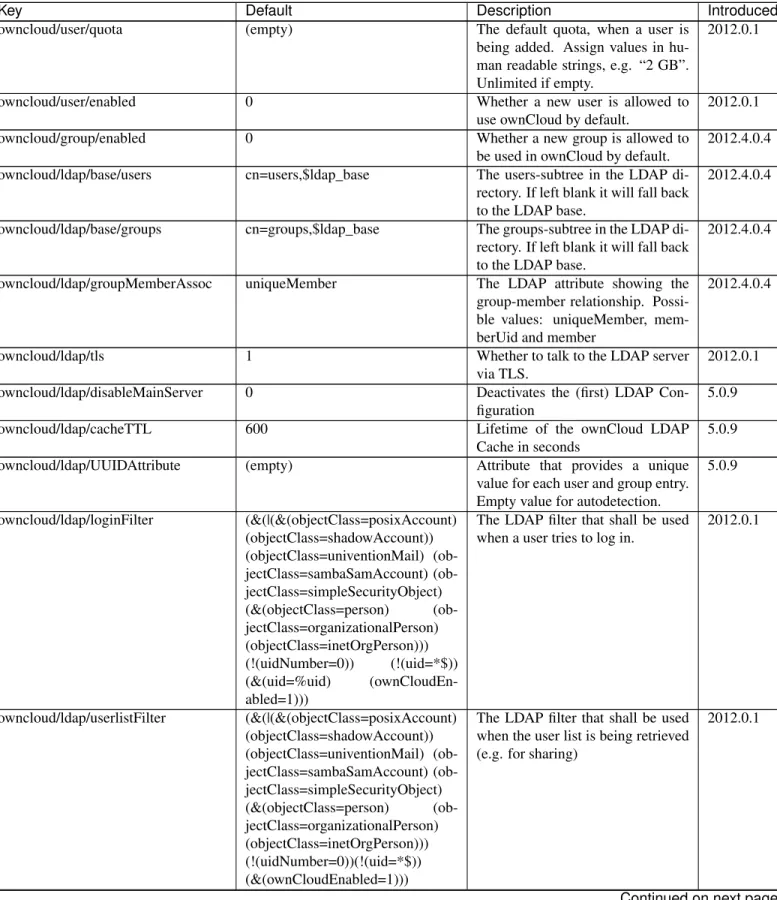
Key Default Description Introduced
owncloud/directory/data /var/lib/owncloud Specifies where the file storage will
be placed
2012.0.1
owncloud/db/name owncloud Name of the MySQL database.
ownCloud will create an own user for it.
2012.0.1
Continued on next page
Table 5.1 – continued from previous page
Key Default Description Introduced
owncloud/user/quota (empty) The default quota, when a user is
being added. Assign values in hu-man readable strings, e.g. “2 GB”. Unlimited if empty.
2012.0.1
owncloud/user/enabled 0 Whether a new user is allowed to
use ownCloud by default.
2012.0.1
owncloud/group/enabled 0 Whether a new group is allowed to
be used in ownCloud by default.
2012.4.0.4
owncloud/ldap/base/users cn=users,$ldap_base The users-subtree in the LDAP
di-rectory. If left blank it will fall back to the LDAP base.
2012.4.0.4
owncloud/ldap/base/groups cn=groups,$ldap_base The groups-subtree in the LDAP
di-rectory. If left blank it will fall back to the LDAP base.
2012.4.0.4
owncloud/ldap/groupMemberAssoc uniqueMember The LDAP attribute showing the
group-member relationship. Possi-ble values: uniqueMember, mem-berUid and member
2012.4.0.4
owncloud/ldap/tls 1 Whether to talk to the LDAP server
via TLS.
2012.0.1
owncloud/ldap/disableMainServer 0 Deactivates the (first) LDAP
Con-figuration
5.0.9
owncloud/ldap/cacheTTL 600 Lifetime of the ownCloud LDAP
Cache in seconds
5.0.9
owncloud/ldap/UUIDAttribute (empty) Attribute that provides a unique
value for each user and group entry. Empty value for autodetection.
5.0.9 owncloud/ldap/loginFilter (&(|(&(objectClass=posixAccount) (objectClass=shadowAccount)) (objectClass=univentionMail) jectClass=sambaSamAccount) (ob-jectClass=simpleSecurityObject) (&(objectClass=person) (ob-jectClass=organizationalPerson) (objectClass=inetOrgPerson))) (!(uidNumber=0)) (!(uid=*$)) (&(uid=%uid) (ownCloudEn-abled=1)))
The LDAP filter that shall be used when a user tries to log in.
2012.0.1 owncloud/ldap/userlistFilter (&(|(&(objectClass=posixAccount) (objectClass=shadowAccount)) (objectClass=univentionMail) jectClass=sambaSamAccount) (ob-jectClass=simpleSecurityObject) (&(objectClass=person) (ob-jectClass=organizationalPerson) (objectClass=inetOrgPerson))) (!(uidNumber=0))(!(uid=*$)) (&(ownCloudEnabled=1)))
The LDAP filter that shall be used when the user list is being retrieved (e.g. for sharing)
2012.0.1
ownCloud Administrators Manual, Release 7.0
Table 5.1 – continued from previous page
Key Default Description Introduced
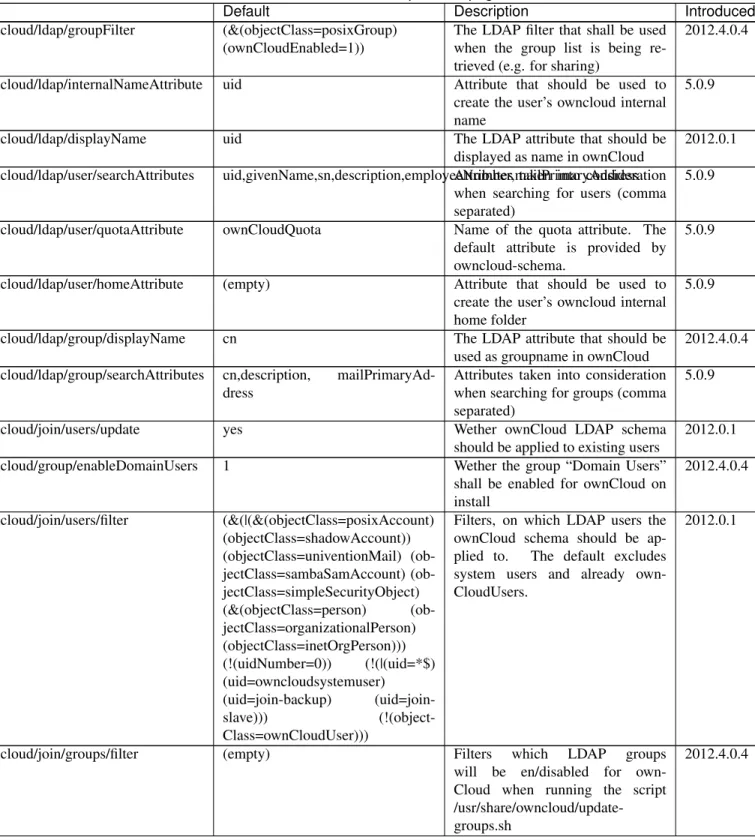
owncloud/ldap/groupFilter (&(objectClass=posixGroup) (ownCloudEnabled=1))
The LDAP filter that shall be used when the group list is being re-trieved (e.g. for sharing)
2012.4.0.4
owncloud/ldap/internalNameAttribute uid Attribute that should be used to
create the user’s owncloud internal name
5.0.9
owncloud/ldap/displayName uid The LDAP attribute that should be
displayed as name in ownCloud
2012.0.1 owncloud/ldap/user/searchAttributes uid,givenName,sn,description,employeeNumber,mailPrimaryAddressAttributes taken into consideration
when searching for users (comma separated)
5.0.9
owncloud/ldap/user/quotaAttribute ownCloudQuota Name of the quota attribute. The
default attribute is provided by owncloud-schema.
5.0.9
owncloud/ldap/user/homeAttribute (empty) Attribute that should be used to
create the user’s owncloud internal home folder
5.0.9
owncloud/ldap/group/displayName cn The LDAP attribute that should be
used as groupname in ownCloud
2012.4.0.4 owncloud/ldap/group/searchAttributes cn,description,
mailPrimaryAd-dress
Attributes taken into consideration when searching for groups (comma separated)
5.0.9
owncloud/join/users/update yes Wether ownCloud LDAP schema
should be applied to existing users
2012.0.1
owncloud/group/enableDomainUsers 1 Wether the group “Domain Users”
shall be enabled for ownCloud on install 2012.4.0.4 owncloud/join/users/filter (&(|(&(objectClass=posixAccount) (objectClass=shadowAccount)) (objectClass=univentionMail) jectClass=sambaSamAccount) (ob-jectClass=simpleSecurityObject) (&(objectClass=person) (ob-jectClass=organizationalPerson) (objectClass=inetOrgPerson))) (!(uidNumber=0)) (!(|(uid=*$) (uid=owncloudsystemuser) (uid=join-backup) (uid=join-slave))) (!(object-Class=ownCloudUser)))
Filters, on which LDAP users the ownCloud schema should be ap-plied to. The default excludes system users and already own-CloudUsers.
2012.0.1
owncloud/join/groups/filter (empty) Filters which LDAP groups
will be en/disabled for own-Cloud when running the script /usr/share/owncloud/update-groups.sh
2012.4.0.4
If you want to override the default settings, simply create the key in question in the UCR and assign your required value, for example:
ucr set owncloud/user/enabled=1
or via UMC:
5.11.2 Installation
Now, we are ready to install ownCloud. This can be either done through the UCS App Center (recommended) or by downloading the packages.
UCS App Center
Open the Univention Management Console and choose the App Center module. You will see a variety of available applications, including ownCloud.
ownCloud Administrators Manual, Release 7.0
Click on ownCloud 5 and follow the instructions.
In the UCS App Center, you can also upgrade from ownCloud 4.5 by installing ownCloud 5.0. They are provided as separate apps. It is only possible to have one version of ownCloud installed.
Manually by download
Download the integration packagesfrom our websiteand install them from within your download folder (note: the package owncloud-unsupported is optional) via command line:
dpkg -i owncloud*.deb
ownCloud will be configured to fully work with LDAP.
Reinstallation
When ownCloud was installed before and uninstalled via AppCenter or via command line using apt-get remove, ownCloud can be simply installed again. The old configuration will be used again.
When an older ownCloud was installed and has been purged (only possible via command line using apt-get purge) the old configuration is gone, but data is left. This blocks an installation. You can either install the old version and upgrade to ownCloud 5 or (re)move the old data. This is done by removing the MySQL database “ownCloud” using the command line:
ownCloud Administrators Manual, Release 7.0
mysql -u root -e "DROP DATABASE owncloud" -p`tail /etc/mysql.secret
In this case you probably also want to remove the data directory/var/lib/owncloudalthough this is not mandatory.
5.11.3 Postconfiguration (optional)
There is only one local admin user “owncloudadmin”, you can find his password in/etc/owncloudadmin.secret. Use this account, if you want to change basic ownCloud settings.
In the installation process a virtual host is set up (Apache is required therefore). If you want to modify the settings, edit
/etc/apache2/sites-available/owncloudand restart the web server. You might want to do it to enable
HTTPS connections. Besides that, you can edit the.htaccess-File in /var/www/owncloud/. In the latter file there are also the PHP limits for file transfer specified.
5.11.4 Using ownCloud
If you decided to enable every user by default to use ownCloud, simply open uphttp://myserver.com/owncloud/and log in with your LDAP credentials and enjoy.
If you did not, go to the UMC and enable the users who shall have access (see picture below). Then, login at http://myserver.com/owncloud/with your LDAP credentials.
Updating users can also be done by the script/usr/share/owncloud/update-users.sh. It takes the fol-lowing UCR variables as parameters:owncloud/user/enabledfor enabling or disabling,owncloud/user/quotaas the Quota value andowncloud/join/users/filteras LDAP filter to select the users to update.
Groups 2012.4.0.4
Since ownCloud Enterprise 2012.4.0.4 group support is enabled. Groups, that are activated for ownCloud usage, can be used to share files to instead of single users, for example. It is also important to note, that users can only share within groups where they belong to. Groups can be enabled and disabled via UCM as shown in the screen shot below.
Another way to enable or disable groups is to use the script/usr/share/owncloud/update-groups.sh. Currently, it takes an argument which can be 1=enable groups or 0=disable groups. The filter applied is being taken from the UCR variableowncloud/join/groups/filter. In case it is empty, a message will be displayed.
5.12 Windows 7 and Windows Server 2008
Note: While ownCloud will run in any standard PHP environment, including IIS or Apache on Windows, there are known issues. For the basic sync and share capabilities of ownCloud, Windows web servers (Apache and IIS) will function properly. However, as apps like external storage are added, particularly SMB mounts, and non-English characters are used in filenames, some of the known Windows and IIS/Apache challenges start to appear as bugs. ownCloud is not supported on the Internet Server Application Programming Interface (ISAPI).
Microsoft SQL Server is not supported.
For these reasons, while ownCloud server will run on Windows, it is not recommended at this time.
Note: You must move the data directory outside of your public root (See advanced installation settings) This section describes how to install ownCloud on Windows with IIS (Internet Information Services).
These instructions assume that you have a standard, non-IIS enabled Windows machine using Windows 7 or Server 2008. After enabling IIS, the procedures are essentially identical for both Windows 7 and Windows Server 2008. For installation, ownCloud physical access or a remote desktop connection is required. We recommend that you leverage MySQL as the backend database for ownCloud. If you do not want to use MySQL, you can use Postgres or SQLite instead. However, Microsoft SQL Server is not yet supported.
Enabling SSL is not yet covered by this section.
Note: If you make your desktop machine or server available outside of your LAN, you must maintain it. Make sure to monitor the logs, manage the access, and apply patches to avoid compromising the system as a whole.
There are four primary steps to the installation, and then an added fifth step required for configuring everything to allow files larger than the default 2 MB size.
1. Install IIS with CGI support – enable IIS on your Windows machine. 2. Install PHP – Grab, download and install PHP.
3. Install MySQL – Setup the MySQL server manager and enable ownCloud to create an instance. 4. Install ownCloud – The whole reason we are here!
5. Configure upload sizes and timeouts to enable large file uploads – So that you can upload larger files.
5.12.1 Activate IIS with CGI Support
Windows 7To activate IIS on Microsoft Windows 7:
1. Navigate toStart –> Control Panel –> Programs.
2. Under Programs and Features, click on the link entitledTurn Windows Features on and Off. 3. Expand the box labeledInternet Information Services.
ownCloud Administrators Manual, Release 7.0
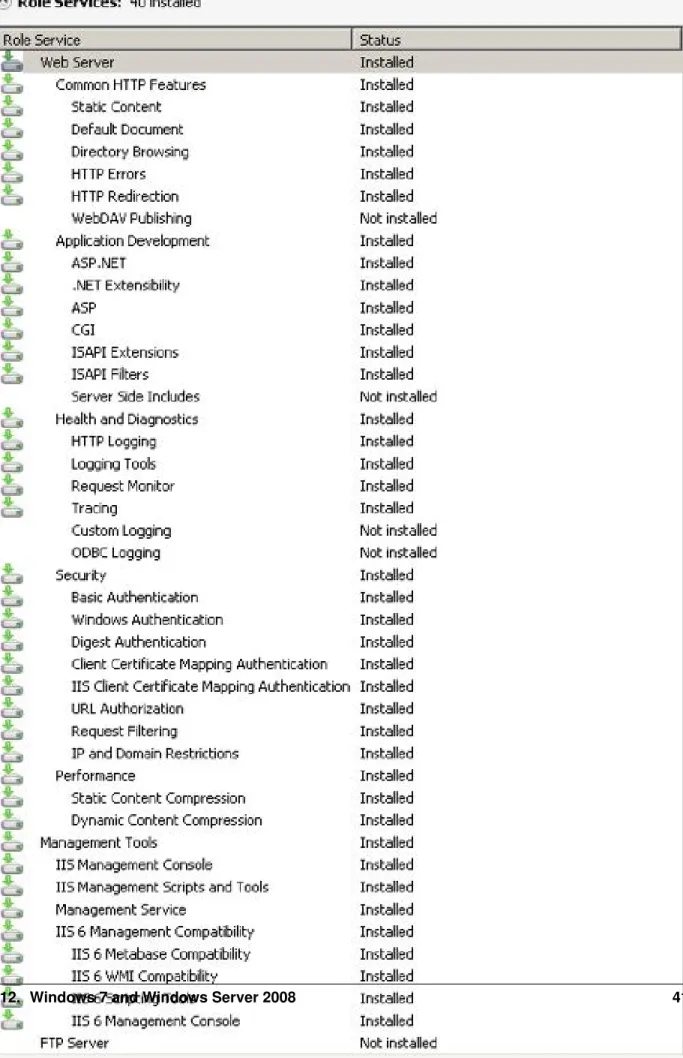
4. ExpandWorld Wide Web Servicesand all of the folders beneath it. 5. Select the folders as shown in the image below to launch the IIS server.
6. Because a running FTP server is not required, turn off that feature for your server.
7. Ensure that you have the IIS Management Console. An IIS management console is the easiest way to start, stop, and restart your server. This console also enables you to change certificate options and manage items like file upload size.
8. Check the CGI checkbox underApplication Development Featuresin order to enable PHP on IIS. 9. Turn off WebDAV publishing to avoid conflicts between the Windows WebDAV and the ownCloud WebDAV
interface.
Note: This feature might already be turned off for you. However, we recommend that you ensure that it remains off. The common HTTP features are the features you would expect from a web server. After implementing the selections on this page, IIS serves up a web page.
10. Restart IIS by going to the IIS manager (Start –> IIS Manager). 11. Select your website.
On the far right side of the opening page you will see a section titledManage Server. 12. Make sure that the service is started, or clickStartto start the services selected. 13. Go to a web browser and navigate tohttp://localhost.
The standard IIS 7 splash page opens. This page displays a static image that indicates that your web server is running. Assuming you were able to reach splash page, your web server is now up and running.
Continue byinstalling PHP.
Windows Server 2008
1. Navigate toStart –> Control Panel –> Programs.
2. Under Programs and Features, click the link titledTurn Windows Features on and Off. The Server Manager starts.
3. In the Server Manager, clickRoles 4. ClickAdd Roles.
5. Use theAdd Roles Wizardto add the web server role.
6. Make sure that, at a minimum, the same boxes are checked in this wizard that are checked in the Windows 7 Section. For example, make sure that the CGI box is checked under Application Development Features, and that WebDAV Publishing is turned off. With Remote Desktop Sharing turned on, the detailed role service list looks like the figure “Role Services”.
7. Go to the IIS manager (Start –> IIS Manager) and restart IIS. 8. Select your website
9. Once this is complete, you should be able to go to a web browser and typelocalhost. This should open the standard IIS 7 splash page, which is just a static image that says your web server is running. Assuming you were able to get the splash page, it is safe to say your web server is now up and running.
Continue byinstalling PHP.
ownCloud Administrators Manual, Release 7.0
Figure 5.3:Server roles required for ownCloud



![{1,1′ Bis[(pyridin 2 yl)methyl] 2,2′ bipiperidyl}(perchlorato)copper(II) perchlorate](data:image/gif;base64,R0lGODlhAQABAIAAAP///wAAACH5BAEAAAAALAAAAAABAAEAAAICRAEAOw==)