Relationship Management
As the world becomes more
competitive, firms are increasingly
seeking more innovative ways to create
value and improve their levels of
efficiency and effectiveness
CIPS members can record one CPD hour for reading a CIPS Knowledge download that displays a CIPS CPD icon.
The Chartered Institute of Purchasing and Supply (CIPS) commissioned Professor Paul Cousins at Manchester Business School to produce a white paper to discuss theories, concepts and applications of inter firm relationship management.
1. Introduction
As the world becomes more competitive, firms are increasingly seeking more innovative ways to create value and improve their levels of efficiency and effectiveness1. Traditionally firms
have focused on improving their internal processes, in recent years this focus has changed and increased attention has been centred on the management of the firm’s supply activities. Figure 1 demonstrates, by taking a simple systems view of the firm as an input, transformation, output model how competition has changed over the last twenty years.
These paradigmatic changes have changed the way that firms think about managing their internal and external organisational processes (both manufacturing and service industries) consequently this has increased the visibility and importance of ‘relationship’ management.
Figure 1: the Development of Manufacturing Paradigms
2. The evolution of manufacturing paradigms and their effect on SCM
The 1980s (see Figure 1) witnessed a drive towards becoming what was known then as ‘world class’. Enshrined within the world concept is the idea of benchmarking; measuring a firm’s performance against what is termed the ‘best in class’. This method uses a range of performance indicators to assess process capability. During this time period manufacturing organisations in particular were under increasing pressure from Japanese manufacturers who were producing better quality, lower priced products, with improved technology cycle times1 Please note efficiency is how quickly a firm does something; effectiveness is how well a firm performs.
and delivery schedules2. In short, Western manufacturing with its inefficient production
systems, poor supply management, lack of a quality focus and ignorance of customer demands, was simply unable to compete. The ‘wake up’ call came from the automobile manufacturing industries who were one of the first sectors to feel the pressure of a more ‘globally’ based competitive environment. This was short lived as competition spread into aerospace, construction, computer/technology industries and it is now prevalent in the service sector. In short, Western business was under ever increasing pressure to improve its levels of productivity, quality and performance.
In the 1980s academics and managers adopted what might be termed ‘if you can’t beat them, join them’ approach to management restructuring. Studies of Japanese and Far East
manufacturing firms were conducted by a host of academics and consultancies in an attempt to reverse engineer their success3. The Toyota Production System (TPS) was hailed as the way
forward for UK auto manufacturing, along with a tidal wave of other techniques including the adoption of “new” inventory management techniques such as Just-In-Time(JIT)4, Total Quality
Management (TQM), cellular manufacturing and so on. The key focus here was improving the ‘transformation’ system i.e. the way goods and services are made and delivered. Whilst this approach of the focused factory had some success, Western firms were still unable to adequately compete with their Far East adversaries.
This lack of success is often attributed to several issues; firstly whilst Western firms successfully copied Japanese manufacturing techniques, they focused more on the hard systems issues i.e. procedures and less (if at all) on the softer cultural management issues. It was these implicit management systems that were seen as the glue holding together the successful Japanese manufacturing systems. In fact, Toyota and Nissan would offer tours to their competitors of their plants, safe in the knowledge that their competitive advantage was ‘ambiguous’ i.e. difficult or even impossible to replicate5. Secondly, and also associated to this
point, is the fact that all of these manufacturing transformation techniques require a supply chain input e.g. JIT requires demand signal management, TQM requires working closely with the supplier so that quality is built in as opposed to inspected into the system. Therefore, in order to make the system work effectively and efficiently, it requires a combination of ‘hard’ techniques as well as ‘soft’ management systems, these should incorporate a focus on both the transformation as well as the input systems.
The 1990s saw the resolution of this situation with the development of the lean
’manufacturing paradigm. Lean manufacturing grew out of the ideas of the Toyota Production System (TPS) which was first introduced in the late 1940s; it translated the basic concepts and techniques of TPS into a Western focus – the key issue with Lean was that it focused on both the transformation process and also the input or supply side processes.
The Lean paradigm’s central philosophy can be summarised as ‘making more for less’. In essence the concept is concerned with reducing waste, or muda as it is known in Japanese. Five principles are espoused within the philosophy; value creation, the value stream, flow, pull
2 See Womack, Jones and Roos (1990)The Machine That Changed The World. Also see Lamming (1993)
Beyond Partnership for a detailed discussion on these competitive issues and their effect on the auto-motive industry.
3 See Hines (1994) CreatingWorld Class Suppliers.
4 Just-In-Time was actually part of the Toyota Production System (TPS) design and was originally
devel-oped in 1947
5 This phenomenon is known as ‘causal ambiguity’ in the Resource Based View literature.
©CIPS 2013 2
and perfection. Within the concept of lean’s original development in the book “The Machine That Changed The World” came the development of a second concept known as ‘Lean Supply’ which was developed and popularised by Richard Lamming in his book ‘Beyond Partnership: Strategies for innovation and lean supply’. Here Professor Lamming discusses in detail the concept and theory of ‘Lean Supply’ and how it applies to the automotive industry.
Lean Manufacturing and Lean Supply set the foundations in place for today’s businesses that in the mid 1990s followed strategies of outsourcing, modularisation and supply chain
disintermediation as ways of focusing their businesses, improving value and reducing waste, thereby increasing their customer base and making larger profits through increased sales as well as cost reduction programmes. The story however does not end here. Whilst the ideas espoused by the proponents of Lean and their more recent text ‘Lean Thinking’ have been very well received by industrial practitioners and academics, globalisation and competition would appear to be pushing firms to adopt and adapt to different organisational structures and approaches.
The final paradigm (see Figure 1) occurred at the beginning of the 2000s and is currently seen as a logical development of Lean. The word that probably best summarises the approach of today’s leading firms is ‘responsiveness’. Firms in the 2000s in order to be able to compete on the world stage have to be agile and responsive to market changes and dynamics. In the late 1990s new business models began to emerge that not only took account of an efficient transformation and supply side process, but that also realised that they were supplying to an end customer; something hitherto which was largely ignored. In the mass production systems customers were seen as people who consumed what they were given, rather than having an influence over the production process.
This type of close customer interaction would be more akin to ‘craft’ manufacturing e.g. specifically tailoring the part for customer needs and wants; and this is expensive! These customers were complicated, they had needs and demands. The old system of mass
production was not going to satisfy these customers. Increasingly customers were demanding specific (or tailor made goods) at mass production prices; add to this the rise of the super economies of China and India, with low labour rates and highly motivated workers, Western firms were beginning to find themselves in a highly precarious position. This situation has brought about strategies referred to as outsourcing and more specifically ‘offshoring’. In order to combat these competitive pressures, to retain and grow their customer bases, Western firms needed to find a new basis of competition. The business model that firms appear to be adapting for the 2000s is known as Mass Customisation (MC).
The term MC is a tautology; it argues that firms need to produce on a mass production platform, but tailoring their products for specific customer groups. Naturally, Henry Ford (the father of today’s modern production line) would not have thought that this was possible – as he famously once said, eloquently illustrating the flexibility of the mass process “…you can have any colour you like, as long as it is black.” Unfortunately this inflexible approach is no longer possible in today’s highly competitive world, firms now have to offer any colour, variety or specification you want – the customer is king.
Companies such as Dell, Levi Straus, Nike, to name but a few, have embraced the mass customisation (MC) business model with much success. Its secret lies in the ability of the firm to break their product down into component modules, which can then be assembled in a variety of ways to create new product configurations. There are a variety of degrees of MC from partial modularisation to a fully modularised product. Naturally the extent of MC will
depend on customer demands and the ability of the firm to be able to implement this approach.
The implementation ability is not only concerned with the development of modules but also the management of supply companies to deliver these modules. Furthermore, when firms move from Mass production to Mass Customisation they will have to transition through a supply base restructuring programme. This involves identifying key or ‘first tier’ suppliers who have the capability to provide and coordinate the development of essential modules. As one large auto manufacturer surprisingly commented when asked about supplier tiers and the movement towards modularity“…if I knew then, what I know now, I would never have gone through the process.” This attitude appears to be very at odds with the current thinking. The literature would argue that the move to modularity and tier structures is a sensible strategy to follow. However, on further investigation it was apparent that the move from a mass system to an MC system is not at all easy from both a technical as well as strategic perspective. Technically, the modules must be built in such a way that they are fully interchangeable. The evolution of the manufacturing paradigms from a unitary focus on transformation to a much more holistic business focus has dramatically increased the complexity of the
management process. Furthermore, it has increased the role that supply chain management must play in organising and co-ordinating these complex business networks. Supply Chain Management (SCM) has had to move away from a purely process role towards a much more strategic network co-ordination process approach. In order for MC to operate effectively, firms need to strategically manage their supply chain process. The change in manufacturing
paradigms has also focused firms on their ability to manage and co-ordinate supply. The trend has been a movement towards supply base rationalisation resulting in fewer, but more strategically powerful suppliers.
These suppliers (or indeed portfolio of suppliers) need to be managed strategically. This means developing a clear understanding of how to manage inter (between) and intra (within) firm relationships.
3.
The move towards strategic supply chain management
Inter organisational networks have spread rapidly reflecting a shift towards a global business environment, characterised by escalating R & D costs, increasing product complexity, reduced product life cycles, difficulties in managing technological change and a greater amount of resources and knowledge required to innovate. Firms have been forced to rethink the scope of their organisational boundaries, with many using collaborative relationships with external entities as a cornerstone of strategy.
This blurring of the organisational boundaries can be seen across many industries, for example, in pharmaceuticals where close alliances are forged with major supplier partners to share the costs of development and trials, the automotive industry and in the personal computing industry. Since sources of innovation are not found exclusively within firms, but also at “the interstices between firms, universities, research laboratories, suppliers and customers” (Powell, Koput, & Smith-Doerr, 1996:118), relationships within a firm’s network, particularly with suppliers, can become a valuable source of innovation and profits.
Supplier integration in new product development is one area of inter-organisational networks that is receiving increasing attention in the literature. Effective supplier integration can lead to vast improvements in quality, cost and new product development cycle times. Early
participation of suppliers in the design process also helps firms select the best components and technologies, and choose between different solutions and cost-performance trade-offs. Although the internal processes associated with effective product development performance have been investigated and empirically supported, there is comparatively little research investigating the processes required to integrate external entities, such as suppliers, into the new product development process. Further research is required to investigate these issues. Indeed, despite being a relatively under-researched area empirically, supplier integration is ranked as an increasingly important strategic issue for companies. The difficulties of involving suppliers are particularly important in the context of knowledge based activities. The simple involvement of suppliers in product development does not automatically guarantee that the transfer of new knowledge and subsequent capability development will occur. New knowledge is often fragmented, vague and widely dispersed throughout the organisation. Successful integration requires processes which facilitate the utilisation, and transfer of supplier knowledge, into the new product or service. High levels of supplier integration improves coordination, increases interactions among various groups involved in the innovation process, encourages joint problem solving, cross-learning and leads to successful technology
commercialisation.
4.
The development of supply chain and relationship management
SCM is now well established within the literature and is becoming more recognised by firms as a strategic business function. Whilst there are a variety of definitions used to describe what supply chain management actually is, perhaps the most succinct definition is provided by Lambert et al who refer to SCM as “…the integration of business processes from end user through original suppliers that provides products, services, and information that add value for customers” (p504). Lambert et al develop the argument that whilst there is a range of
definitions with varying detail, the common factors are supply chain actors or institutions, such as suppliers and customers.
Further elaboration in the literature has led to the development of the definition of ‘strategic supply’ management. Ellram and Carr (1994) point out that the literature takes three distinct themes: First, specific strategies employed by the purchasing function; second, purchasing’s role within those strategies; and lastly, purchasing as a strategic function within the firm. This research found that whilst there was a reasonable amount of literature on the subject most of it was of a conceptual nature and lacked empirical rigour. In a recent paper Tan (2001)
explores the development of the supply chain literature and argues that there is a convergence of two areas: logistics and purchasing. The conclusion is that there is a variety of ‘buzzwords’ but with little empirical substance. It is clear that the development of supply chain
management requires more rigorous, empirical work.
Other authors (Farmer,1972;Reck & Long,1988) have put forward four and five stage models to show how organisations can attain ‘strategic status’, whilst others (Carr et al,1997) have taken a more pragmatic view analysing the constituent ingredients required to make supply strategic. Carr and Smeltzer (1997) argue that its status, knowledge and skills, risk and
available resources directly influence the level of strategic supply within the organisation. The overall consensus is that supply should be seen as ‘strategic’, as integral to the decision making mechanisms of the firm although more rigorous empirical work is required.
The research on supply management tends to either base itself in the transaction cost (Richardson, 1994; Williamson, 1975), resource based views or in the marketing literature.
Some authors have put forward the view that the firms should be seen as a ‘nexus of contracts and that the firm should manage its resources to maximise advantage for the business;
relationships are seen as a key resource of the business. Others see the management of supply as part of the wider production system.
The implications of managing supply strategically are debated in the literature. It is widely agreed that the involvement of purchasing in a strategic context can enhance a company’s financial performance and improve the firm’s overall competitive position. Others argue that the integrations of strategic purchasing practices can directly affect manufacturing
performance and therefore added value to the customer. This integration manifests itself in the selection of sourcing strategies for technological innovation as well as in the design of the appropriate business network within which to manage the supply strategy.
Regulating the relationship is an integral component of managing sourcing strategies. Authors argue this point from a variety of perspectives, some from the view point of the relationship in a general behavioural sense e.g. Moss-Kanter refers to successful partnerships being needed to manage the relationship and not just a focus on the business deal; she calls it becoming best PALs (pooling, allying and linking).
Other scholars argue that the move towards relationship management will change the very role and strategies of how firms behave, moving them away from their traditional structures and towards ‘hub and spoke’ focussed organisations. Other writers see relationship
management from a much more economic viewpoint, utilising game theory to demonstrate how various strategies and relationships can be aligned. This discourse clearly shows that there are a variety of ways of viewing relationship management, however the key question appears to remain the same: how should a firm organise to manage its complex relationships?
5.
Relationship definitions and misconceptions: towards a management
model
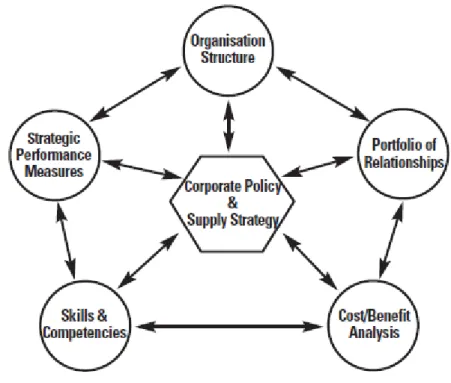
Whilst this question sounds very simple the answer is very complex. This complexity is in part caused by the fact that relationship strategies are only one dimension of a much more sophisticated management system. Figure 2 is known as the supply wheel, it was developed from a large research project which examined the strategic supply issues of 750 firms. The outcome was an overarching model which shows the main supply foci and their inter-relationships.
Figure 2: the Strategic Supply Wheel
The model outlines six key factors6 that need to be considered simultaneously by the supply
strategist. The Supply Wheel begins by suggesting that it is imperative to maintain an alignment of corporate and supply policies. Whilst this might sound intuitively obvious it is rather surprising when interviewing Purchasing Directors how many are unaware or not connected in any way to the policy and goal setting priorities for the firm. This lack of
connectivity makes it extremely difficult, if not impossible, for purchasing professionals to set their own polices, goals and strategies that reflect the needs, wants and direction of the firm itself. For example, one Purchasing Director of a large multi-national manufacturing firm who was interviewed was totally unaware of his firm’s strategic priorities and goals. When he attempted to discover what these goals and policies might be, he was told that this was a secret and the Corporate Planning Director refused to divulge the information. Whilst some of the goals and objectives are reasonably obvious these are mainly those that are transmitted to the market.
However, there could be a range of issues e.g. environmental policy, technology policy, competitive policy etc. that are of great importance to the firm, and which supply
management could play a pivotal role if only it was consulted and involved in the process. Firms that are cost focused will require the supply activity to deliver a range of business and marketing benefits that will put the firm into a stronger cost management position (i.e. savings). The firm is not interested in supply forming closer working relationships, or
implementing complex sourcing strategies, rather, it is interested in short/medium term direct business benefits. The key focus for the firm has to be on competing based on cost reduction. Supply in these organisations will undoubtedly be seen as an important function, with the key focus on purchasing as a tactical weapon as opposed to a strategic process. For supply to be seen as important within this type of firm it must deliver savings.
6 For a detailed discussion of this model, see Cousins,P.D. (2002) ‘Conceptual Models of
Inter-Organisational Relationships. See also Cousins,P.D., Lamming,R.,C., Lawson,B., Squire,B. (2006) Strategic Supply Management: Theories,Concepts andApplications. Prentice-Hall.
©CIPS 2013 7
Differentiation focused firms on the other hand have a more enlightened and long-term view of the business. They will tend to view supply as strategic to their business organisation. Their competitive advantage is gained from manipulating their competencies and capabilities and supply will be seen as a core capability. Differentiated firms will compete by using a
differentiated approach .This could focus on improving time-to-market, increased innovations within the firm and co-makership. Differentiated firms will see supply as a strategic activity to achieve these aims. Supply may achieve these business aims through supply tiers (delegated and/or parallel sourcing), outsourcing and co-design agreements.
These approaches will require more complex collaborative approaches utilising strategic collaborations. Firms following this approach can expect to achieve higher visibility of the partner’s business through cost transparency and information sharing. The development of risk and reward sharing agreements, which divide the level of risk and return between the strategic partners, will generally focus on major collaborations such as technology
development programmes and customer and/or market development activities. Relationship development outcomes will also deliver improved integration of business processes, with a view to improving efficiency and overall levels of effectiveness of these processes. Finally, relationship development outcomes will also allow the partner firms to develop joint shared capital investment projects such as development of new factories, warehousing etc. In short, the differentiated approach requires a much broader and more strategic view of supply’s role within the firm.
The model shown in figure 3, the Strategic Focussed Outcomes Model (SFOM) indicates which strategies should be followed dependent upon the strategic approach taken by the firm. The emphasis here is appropriateness and allocation of resources. If the firm sees its competitive advantage in a cost focused approach then supply has the opportunity to follow two strategic approaches, (these are illustrated in quadrants A and B) which are Operational Collaboration or Market Collaboration.
Figure 3: The Strategic Focussed Outcomes Model (SFOM)
This SFOM model was developed from a two year research project examining a range of medium to large sized firms. The research indicates that a short-term strategy would only allow for what is termed ‘Operational Collaboration’ to be achieved. This strategy consists of actions such as sharing operations planning information, developing and sharing demand forecasts, linking order management systems, usually via an intranet and joint capacity planning management systems to align operational flows. Should supply want to develop longer term relationships with the suppliers under the cost focused approach, they have the ability to develop what is termed ‘Market Collaborations’ (see quadrant B). Market
Collaborations are concerned with tactics such as shared merchandising, co-branding, joint selling and management of distribution channels. These types of collaboration tend to be more long term; however their main focus is firmly embedded in the activity of cost reduction. The SFOM illustrates the available strategic alternatives to match the strategic focus on the firm. If supply is aligned in cost focused organisations it should peruse both operational and market collaborations.
Firms that have a ‘differentiation’ focus will firstly tend not to have any short-term strategic foci. Their main concern will be to develop long-term sustainable business outcomes, based around Strategic Collaborations (see quadrant c). Strategic Collaborations are concerned with aligning the customer requirements with the supplier, the sharing of technological processes and products to enhance offerings to existing and new customers which may lead to new product development activities.
Furthermore, this type of collaboration will also focus on sharing production engineering resources, developing joint capital investment and expenditure plans; these are typically in the shape of risk and reward sharing agreements between the buyer and supplier. Firms that have a differentiation focus will require supply to align its approach to achieve the various goals and objectives outlined above. Failure to do so will result in a misalignment of the strategic focus of the organisation and supply management and will undoubtedly lead to tensions and non- achievement of the firm’s organisational focus.
6.
Development of a relationship management approach
The concept of a “relationship” is much discussed and generally misunderstood. A vast array of this confusion comes from not understanding the unit of analysis and indeed not really
considering what a ‘relationship’ is in a practical sense. Most purchasing professionals tend to think of a relationship as an entity (a thing), they will often refer to“…the relationship that exists between us and Supplier X.” Often in discussions with purchasing professionals they tell of away days to discuss “the relationship” between buyers and suppliers. Whilst there are some socialization benefits to be gained from this, there is no clear evidence that these events enhance the relationship between the two firms. This is because it is unclear to both parties what the relationship actually is.
To put it another way, think of the relationship that exists between Buyer A and Supplier B as a business process (or course of action). This process will lead to some type of output. For example, communication is a process or course of action, which leads to the communicator delivering (via a medium) a range of information. It is deemed to be successful if, when tested the recipient has clearly understood the message. If managers think about relationships as a process or course of action, then their role is to deliver some sort of business outcome. This could be in the form of price reduction, cost information exchange, technology or innovation exchanges and so on. In other words, relationships need to focus on business deliverables; they need to deliver something if they are deemed to be successful.
This is an important point and worth recapping, relationships can be thought of as a process or course of action, which should be designed to deliver business outcomes. Now building on this point, in order to deliver business outcomes, relationship processes need to focus at the level of the product or service (and not the firm). For example, some products and services that are bought from suppliers will require a relatively simple relationship process to achieve a
relatively simple business outcome i.e. negotiation to achieve price reduction.
Other business outcomes may be much more complex, for example, innovation exchange, long term joint cost reduction targets, these will require much more complex relationship processes in order to deliver them. Therefore, the type of business outcome will dictate the level of relationship process or detail of course of action required to achieve it. Again this is another important point. Taking this to its logical conclusion, this will mean that there will probably be a portfolio of relationships with any particular supplier depending on what business outcomes are required from the various products and services procured from that supplier. Furthermore, both buyers and suppliers need to be aware that when they develop a relationship strategy they focus the relationship process on the delivery of business performance outcomes.
7.
The complexities of relationship management
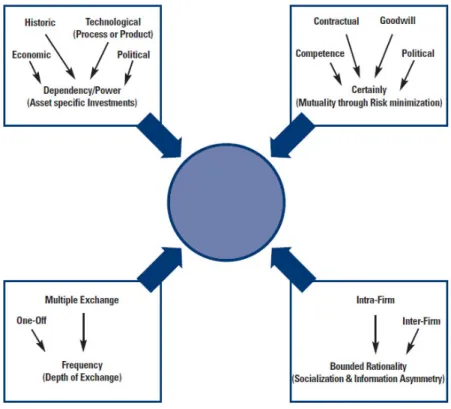
Managing inter firm (buyer/supplier) relationships is a complex task. Figure 4 shows the key issues when dealing with relationship management. These include the management of dependencies between the buyer and supplier, the management of risk or certainties, the frequency of exchange and bounded rationality. The focus here is on internal (intra-firm) relationships as well as external (inter-firm) relationships and the wide range of issues that need to be considered.
Each of the elements contained within Figure 4 will now be discussed in detail, thus building an overview and understanding of relationship management processes.
Figure 4: the Complexities of Relationship Management
8.
The management of dependencies and certainties
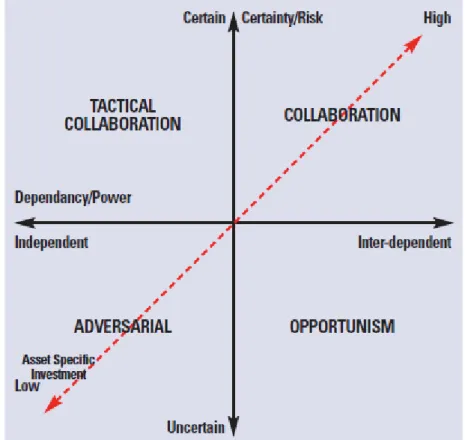
Managing inter-firm relationships is a difficult task, which as previously discussed is made much more difficult when practitioners have to consider the range of issues involved in using the relationship to achieve significant business success. Figure 5 builds on the previous discussion and presents a model for thinking about the management of inter-firm
relationships. The model considers two key variables for the management of relationships: Dependency and Certainty.
Dependencies are defined as mechanisms that create a reliance on either the buyer/supplier or both. There are four key dependencies (see Cousins, 2002) Economic, Historic,
Technological (product and process) and Political, these dependencies are not mutually exclusive i.e. all, some or only one of these may be in effect at a particular point in time. These are defined as follows:
Dependency Description
Historic The parties have had previous interactions with each other; this has built up a level of knowledge and shared experiences. These could be positive as well as negative and will act to inform the parties on what they can expect in the future from the relationship.
Economic Economic dependencies refer to what is traditionally termed ‘switching costs’. These are the costs incurred of moving the supply relationship from one supplier to another. These costs are generally easy to quantify
e.g. tooling costs, investment in labour, training, patents, investment in plant, machinery and so on. By investing in these types of costs the buyer and supplier become dependent on each other for the delivery of the product or service. Naturally, the higher the level of investment the more difficult it becomes to switch from one supply source to another.
Technological (product and/or process)
Technological dependencies refer to dependencies centred on technological competencies and capabilities. These could either be product based i.e. a physical technology of some description (or software) or process based. Process technologies would refer to knowledge based competencies such as a consultancy firm. These dependencies are very powerful and also demonstrate that dependencies can be created on other aspects of business and are not confined to purely economic size. For example, large multi-nationals can be highly dependent on small software houses for development and maintenance. This can represent a significant supply chain risk if it is not managed carefully.
Political Political dependencies are interesting and often highly influential often ignored by practitioners; these can be in the form of a large ‘P’ or small ‘p’. They can have a large influence over which suppliers are selected and deselected and how the relationship is managed. Government policy in some industries (particularly military and aerospace applications) can have a
significant impact on which suppliers are chosen for particular contracts (large ‘P’). Internal politics can also drive supplier selection and management. Suppliers can become quite adept at playing the ‘political’ game (small ‘p’). This is another very good reason to manage the internal organisational relationships.
These dependencies can be identified by both the buyer and supplier firms as drivers for the development and manipulation of the relationship. In order to use these to gain business
success the firm must take a strategic stance. The aim of either side would be at worst to create ‘inter-dependence’ (or mutual dependency) this occurs when the buyer and supplier are equally dependent upon each other. This would be an equilibrium situation, neither party will try to gain advantage over the other as they each have as much to lose as the other. This situation is often referred to as ‘win/win’, however, as is obvious from this illustration it is effectively ‘lose/lose’ as neither party can gain substantial advantage over the other, they in effect suboptimise.
Another strategy, which might be referred to as the ‘best’ or optimal approach for creating or maximising value, occurs when either the buyer or supplier creates a one-sided dependency on the other i.e. the supplier is dependent upon the buyer or the buyer is dependent upon the supplier. This situation will allow the dominant party to exploit their relationship position. This naturally has a time limitation, if one party over dominates then the other will tend to search for either a new source of supply or customer. However, there are a variety of strategies that can be executed around this approach. For example, the dominant party might only use its dominant position in situations when maximum advantage can be gained, this would leave the other party tolerating the relationship without being prepared to divest it.
The level of dependencies within the relationship is, however, only one aspect of the
management of these complex processes. The other aspect that needs to be considered is the level of ‘risk’ that is involved with the management of this interaction. The term ‘risk’ is used here instead of the usual term ‘trust’. In the interests of brevity this report will not go into a long discussion on this issue, however a brief explanation is required. The concept of ‘trust’ is extremely difficult to understand. Durkhiem who was a famous philosopher in the 1950s referred to trust as “…blind faith” furthermore, trust is often used as a construct to explain behaviours between individuals. Firms, and more importantly relationships as a unit of analysis, tend to involve a variety of people pursuing a mix of aims and objectives.
The best that can be hoped for in this business situation is to minimise risk. Economists often refer to the concept of risk as levels of certainty. This definition has been used to construct the second variable that should be considered when managing inter-firm relationships; these are certainties or risks.
Building on the work of Mari Sako (1992) who explored differing contractual mechanisms such as Arms-Length (adversarial) and Obligation Exchanges (collaborative) four levels of certainty have been defined: contractual, competence, goodwill and political. These are described as follows:
Certainties Description
Contractual How certain are the parties that one or other will perform to the specifications and standards of the contract.
Competence How certain are the parties that one or other has the capabilities to perform to the contract e.g. the required levels of skills, competencies and capabilities.
Goodwill How certain are the parties that the one or other will be willing (or not)
to go beyond their contractual duties and go beyond the straight contractual terms and conditions should they need it.
Political What is the political risk or gain of dealing with the party either from an internal or external perspective.
The balancing out of dependencies and risks will yield a variety of possible relationship
management strategies. These are illustrated in Figure 5, the Strategic Relationship Positioning
Model (SRPM). The available strategies are: Adversarial, Opportunism, Tactical Collaboration or Strategic Collaboration.
Figure 5: Strategic Relationship Positioning Model
The SRPM uses the previously discussed concepts of dependency and certainty as a
mechanism for developing relationship management strategies at the product/service level. It offers a range of available relationship strategies. The key point to remember here is that either the buyer or the supplier should choose the most appropriate strategy for them to follow i.e. the strategy that will achieve the most value. This will naturally depend on the time horizon (i.e. whether it is seen as a short, medium or long term game) and also on the amount of value (or expected value) that is to be gained from the relationship.
The four key generic strategies that have been identified will now be briefly discussed. Adversarial strategies refer to Arms Length contractual relationships. These are where there are low levels of dependency (independent) and low levels of risk (generally due to multiple sources and the product or service has low technology).
Opportunism occurs where either the buyer or the supplier is dependent (one-sided) on the other party. This will allow the dominant partner to take advantage of this situation (if that party desires to use the situation in this way). Opportunism will only generally take place if the dominant partner believes that they are in a position to sustain this additional value over time and if the interaction is relatively short term and discrete i.e. project type environments. The management process here is around dependencies. Opportunism occurs where dependency is one-sided and levels of certainty are low i.e. contractual terms may be short (this will allow the other party to see this as short term and therefore take advantage of the situation),
competencies are undefined, goodwill is unproven and the level of political ‘fall out’ is also low.
The two remaining strategies deal with varying degrees of collaboration activity; these are split into tactical and strategic collaboration. Tactical collaboration occurs when the levels of mutual dependency have increased; this may be, for example, because a modularity strategy or supply base reduction strategy has been followed. In addition, certainties have also increased; this may be through offering long term contracts, development of some risk and reward sharing arrangements etc. Whilst these relationships do not represent what has become known as ‘partnership’ arrangements, they do represent a significant level of collaborative activity.
The final strategy available is ‘strategic collaboration’. This occurs where there are high levels of mutual dependency (or inter-dependency) and high levels of certainty. These collaborations focus both parties on working the relationship for mutual gain; these would consist of risk and reward sharing arrangements, co-makership, and joint product and technology development teams and so on. They require a large amount of investment, with large returns for both parties involved.
Having outlined the key relationship strategies, it is now important to see where they fit into the overall sourcing process. Figure 6 offers an ‘alignment’ model to help consider this
approach. As previously discussed relationship strategies should be focussed at the level of the product or service being purchased. The Alignment model in Figure 6 shows in the interaction between the relationship focus, the type of product and service being purchased and the strategic nature of the supply function.
Figure 6: Alignment of Strategies, Relationships and Skills (click to enlarge)
The model also shows the link between skill and competence development. The argument being that firms need to align all of these issues if they want to maximise value from their
inter-firm relationships and more importantly that these relationships are built up from interactions at the product/service level. In other words, a buyer may have any number of different relationships with a supplier depending on the importance of the product, the amount of risk that is being taken and the balance of power/dependency within the relationship.
The point that should be emphasised here for the firm is that the choice of the relationship approach or strategy should be based on focusing the appropriate relationship type to the outcomes required from the business transaction. These are indicated from the various linkages within this model. Furthermore, in order to operate these relationships the model indicates that the firm will need to have the requisite skills and competency mix and performance measurement systems. Practitioners should refer back to the Supply Wheel at this stage to remind themselves of the broad and inter-related issues that need to be considered.
9.
Frequency of exchange
The frequency of exchange refers to the type and amount of interactions within the
relationship. The previous discussion introduced the problem of Opportunistic Behaviour. This is linked to exchange frequency, for example, if the frequency is low and dependency is high, the dominant party will be likely to resort to opportunism. If, however, dependency is high and frequency transactions are high, the dominant party may be less likely to resort to this action because of the fear of missing out on future business.
Frequency exchange is an important mechanism for managing inter-firm transactions. The greater the exchange, the more information and learning is passed between the parties, the less likely it is for opportunism to take place.
10.
Bounded rationality, socialisation and information asymmetry
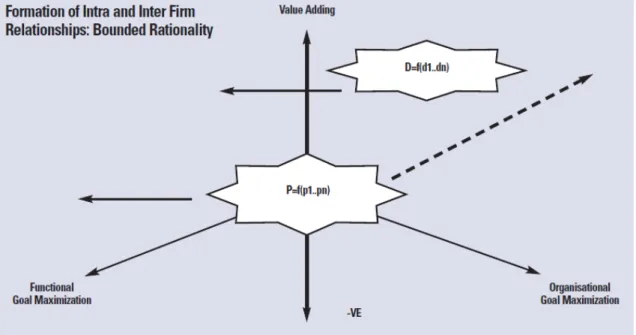
The concept of Bounded Rationality was first established by Herbert Simon in 1958. Simon’s idea, put simply, was that humans viewed problems within their own individual context which was established by their systems of values and beliefs. So for example, an engineer would view a problem differently than say a commercial person.As well as their own belief systems there is also the effect of organisational performance measurement systems. Generally in firms, different functions are measured on different performance targets. An example would be that design are measured on how well (and quickly) they design a certain item; this might be by comparing it to the conformance to the customer specification. The tendency here would be for design to exceed the customer specification if possible i.e. to exceed their measure. However, purchasing may be measured on a ‘target cost basis, i.e. achieving cost targets based on predetermined cost models. If Design have ‘over designed’ the part (and generally specified the supplier) it will be extremely difficult for Purchasing to achieve their targets. Thus measurement systems can be (and often are) diametrically opposed to each other.
These measures also cause individual functions to behave in a specific manner – causing functional rationality i.e. making decisions based on the functions measures and outputs and not considering the wider implications of these actions. Figure 7 below illustrates this problem between the pull of functional and organisational goal maximisation. In academic terms we call
this ‘goal incongruence ’which is a mismatch of goals and objectives between elements or functions of the organisation, in this example between Design and Purchasing.
Figure 7 Inter and Intra Firm Bounded Rationality
This is a very important concept for managers to consider. Earlier in this paper I referred to the term ‘intra-organisational’ relationships. These are relationships that exist within the firm; these are internal relationship management issues. I would contend that these intra organisational relationships are, to some extent, more important that external (inter)
relationships. Without these relationships working effectively and efficiently, the firm cannot hope to encourage and engender deep inter-firm relationships.
Therefore, when re-engineering external relationships, the first place to start is with the internal dynamics of both the buyer and supplier organisations. Figure 6 suggests a way of thinking about the management of these relationships within various sourcing groups. There are a variety of processes that can be used to pull together disparate groups within the firm. They may take the form of cross-functional teams and one method of assessment and
selection. This has the effect of involving the group in the decision making process and forming one bound of rationality7. These relationships should also be output focused. They should be
concerned with business improvements i.e. focused on tangible business outcomes. A further document will focus on these implementation techniques.
11.
Implications for managers
There are several management implications that should be drawn from this report:
1. The management of inter-firm relationships is complex, it is not sufficient to simply set up an agreement, action plans need to be followed to instigate change. The Supply Wheel demonstrates the complexity of areas that need to be considered simultaneously. 2. It is important to consider what a ‘relationship’ is, i.e. defining the term. In this report,
relationships are referred to as processes that drive or facilitate changes in behaviour. Naturally these can be positive or negative depending on how they are used.
7 There are a range of tools available for this, generally employing AHP (Analytical Hierarchy Processing)
which is a weighting and scoring system.
©CIPS 2013 16
3. It is important to consider relationships at the level of the product or service and not at the level of the firm e.g. it is impossible to say that the relationship with firm x is good, bad or indifferent, there will be as many views on this as there are people involved. The point is that firms need to consider strategically what they buy and then apply the appropriate relationship which will deliver the maximum value for their business. Milton Friedman’s famous quote, “the business of business is business” applies here.
4. Inter and Intra firm relations. Relationship management should not begin with changing the way a firm manages its suppliers. It should start with how the buyer firm interacts with itself (intra firm relationships). It is vitally important that relationships are aligned internally first before any attempts are made at changing, enhancing or refocusing existing inter-firm relationships.
5. Building a business case. There must be a business benefit from refocusing relationship approaches. Firms (both buyers and suppliers) need to think clearly through what these benefits are, and also if the costs of getting them outweigh the actual benefits. Whilst this may sound obvious, it has certainly become apparent during this research with major firms, how few consider these important decision drivers. Firms tend to reduce supply bases with little cost knowledge, move towards higher dependency relationships without performance measurement or skill changes and so on. The point here is that if a firm is going to adopt a different way of working then it must consider all of these aspects and build a business case for doing so.
6. Relationship strategies are dynamic, they need to be thought through and managed over time. At different stages they may require different people/skills to manage them. It is important that firms choose appropriate relationships to deliver the maximum value for their transaction. This can be achieved through manipulating and managing the
dependency/certainty mix.
12.
Summary and conclusions
The objective of this report was to review changes in manufacturing and examine how inter-firm relationships might play a role in influencing and adding value to the inter-firm. This study presents theories, models, tools and techniques to allow practicing managers to consider the strategic complexities of managing inter and intra firm relationships.
13.
References
Ahuja,G. (2000). "Collaboration networks, structural holes, and innovation: a longitudinal study." Administrative Science Quarterly 45:425-455.
Angel,D.P. (2002). "Inter-firm collaboration and technology development partnerships within US manufacturing industries." Regional Studies 36(4):333-344.
Croom, S.R. (2001). "The dyadic capabilities concept: examining the processes of key supplier involvement in collaborative product development." European Journal of Purchasing & Supply Management 7(1):29-37.
Handfield,R.B.,G. L.Ragatz, et al. (1999). "Involving suppliers in new product development." California Management Review 41(1):59-82.
Hoegl,M. and K.Weinkauf (2004). "Interteam coordination,project commitment, and teamwork in multiteam R&D projects:A longitudinal study." Organization Science 15(1):38-55.
Kaufman,A.,C.H.Wood, et al. (2000). "Collaboration and technology linkages: a strategic supplier typology." Strategic Management Journal 21:649-663.
Klassen,R.D. and S.Vachon (2003). "Collaboration and evaluation in the supply chain: the impact on plant-level environmental investment." Production and Operations Management 12(3):336.
Lamming,R.C. (1993).Beyond Partnership: Strategies for Innovation and Lean Supply. London,Prentice-Hall.
Lamming,R.C.,P.D.Cousins, et al. (1996). "Beyond vendor assessment: relationship assessment programmes." European Journal of Purchasing & Supply Management.2(4):173-181.
Madhok,A. (1998).Transaction costs, firm resources and interfirm collaboration.DRUID Summer Conference, Copenhagen,Denmark.,DRUID.
Matthyssens,P. and C. van den Bulte (1994). "Getting Closer and Nicer:Partnerships in the Supply Chain." Long Range Planning 27(1):72-83.
Powell,W.W.,K.W.Koput, et al. (1996). "Interorganizational collaboration and the locus of innovation:networks of learning in biotechnology." Administrative Science Quarterly 41(1):116-145.
Ring,P. S. andA.H.Van DeVen (1994). "Developmental, Processes of Cooperative Interorganisational Relationships."Academy of Management Review(January):90-118. Womack, J. and D. Jones (1994). "From Lean Production to the Lean Enterprise." Harvard Business Review(March -April).
Womack, J.,D. Jones, et al. (1990).The MachineThat Changed The World. New York, Rawlinson Associates.