Reducing error and influencing
behaviour
This is a free-to-download, web-friendly version of HSG48
(Second edition, published 1999). This version has been adapted for online use from HSE’s current printed version.
You can buy the book at www.hsebooks.co.uk and most good bookshops. ISBN 978 0 7176 2452 2
Price £11.50
This publication is aimed at managers in all industries. It explains why human factors are important in health and safety and how they need to be assessed and managed in the same way as other risk factors. It gives practical advice on how to develop systems designed to take account of human capabilities and fallibilities.
© Crown copyright 2009 First published 1989 Second edition 1999
Reprinted 2000, 2003, 2005, 2007 ISBN 978 0 7176 2452 2
All rights reserved. No part of this publication may be reproduced, stored in a retrieval system, or transmitted in any form or by any means (electronic, mechanical, photocopying, recording or otherwise) without the prior written permission of the copyright owner.
Applications for reproduction should be made in writing to: The Office of Public Sector Information, Information Policy Team, Kew, Richmond, Surrey TW9 4DU or e-mail: [email protected]
This guidance is issued by the Health and Safety Executive. Following the guidance is not compulsory and you are free to take other action. But if you do follow the guidance you will normally be doing enough to comply with the law. Health and safety inspectors seek to secure compliance with the law and may refer to this guidance as illustrating good practice.
Contents
Introduction 4
Chapter 1 What are ‘human factors’? 5
Why should I be interested in human factors issues at work? 6 How do I know if these problems exist in my organisation? 6 Isn’t it just about people ‘taking more care’? 7
This seems to be a very broad topic area, where should I start? 7 Isn’t this going to be costly? 7
Should I seek the views of the workforce and their representatives? 8 What kind of control measures are possible? 8
Chapter 2 Understanding human failure 9
Human failure and accidents 9
The human contribution to accidents 11 Causes of human failure 12
Breaking the rules 16
Chapter 3 Designing for people 19
Ergonomic design 19
Designing jobs for mental well-being 21 Writing procedures 24
Designing warnings for maximum effect 27 Human Reliability Assessment 28
Chapter 4 Managing the influences on human performance 31
Fatigue and shift work 31 Effective shift communication 33 Focusing on behaviour 34 Health and safety culture 39
Chapter 5 Getting started 42
Where do I start? 42
Human factors in risk assessments 42
Human factors when analysing incidents, accidents and near misses 44 Human factors in design and procurement 44
Human factors in other aspects of health and safety management 45 How can I do all of this? 45
Checklist for human factors in the workplace 46
Chapter 6 Case studies: Solutions to human factors problems 47 Acknowledgements 69
Glossary 69 References 70
Introduction
This guidance is aimed at managers with health and safety responsibilities, health and safety professionals and employee safety representatives.
The message is that proper consideration of ‘human factors’ is a key ingredient of effective health and safety management. Human factors is a broad field and organisations may have viewed it in the past as being too complex or difficult to do anything about. This guidance aims to overcome such fears by providing practical help on how to tackle some of the important issues.
The guidance:
explains how human error and behaviour can impact on health and safety; n
shows how human behaviour and other factors in the workplace can affect the n
physical and mental health of workers;
provides practical ideas on what you can do to identify, assess and control n
risks arising from the human factor; and
includes illustrative case studies to show how other organisations have tackled n
different human problems at work. The format of the publication is as follows:
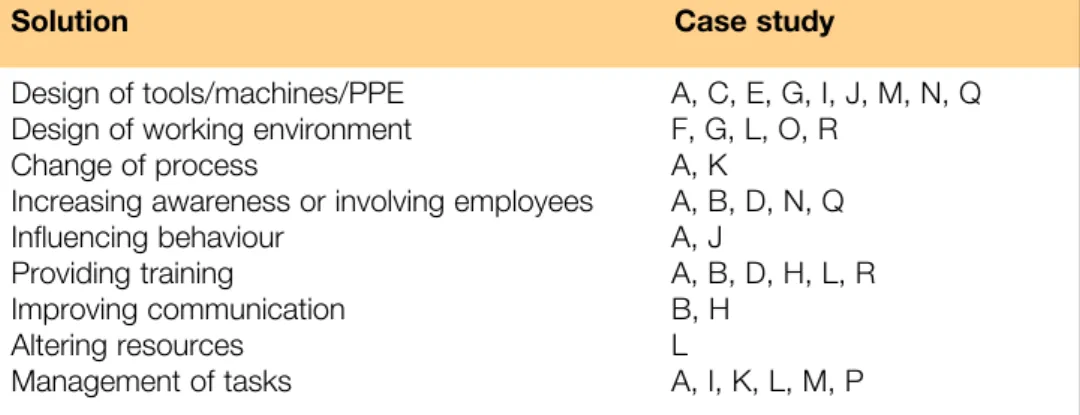
Chapter 1 provides an introduction to human factors. Chapter 2 looks at types of human failures, their causes and ways of reducing them. Chapter 3 considers how to improve health and safety at work through better design of tasks, equipment, procedures and warnings. Chapter 4 looks at some key operational issues: shiftwork and fatigue, shift communication, risk perception and behaviour, and health and safety culture. Chapter 5 provides some hints on how to get started. Chapter 6 presents a series of case studies which illustrate practical cost-effective solutions to real human factors problems. Tables enable you to read only those cases which are most relevant to your organisation and problem area. Some of the approaches shown in this guidance represent ‘good practice’ rather than what is strictly required by legislation.
The guidance cannot cover every aspect of human factors. It introduces some key influences on peoples’ behaviour and work performance which need to be included in a health and safety management system. References are given including references to general books on human factors. A list of relevant professional societies and a glossary of terms is also provided.
This publication is a revision of guidance originally published in 1989 Human factors in industrial safety. This major revision reflects improvements in our understanding of human error and human behaviour at work and the need to carry out risk assessments which take account of these issues.
Chapter 1 What are ‘human
factors’?
The HSE definition is: ‘Human factors refer to environmental, organisational and job factors, and human and individual characteristics which influence behaviour at work in a way which can affect health and safety’. A simple way to view human factors is to think about three aspects: the job, the individual and the organisation and how they impact on people’s health and safety-related behaviour.
The job - Tasks should be designed in accordance with ergonomic principles to take into account limitations and strengths in human performance. Matching the job to the person will ensure that they are not overloaded and that the most effective contribution to the business results. Physical match includes the design of the whole workplace and working environment. Mental match involves the individual’s information and decision-making requirements, as well as their perception of the tasks and risks. Mismatches between job requirements and people’s capabilities provide the potential for human error.
The individual - People bring to their job personal attitudes, skills, habits and
personalities which can be strengths or weaknesses depending on the task demands. Individual characteristics influence behaviour in complex and significant ways. Their effects on task performance may be negative and may not always be mitigated by job design. Some characteristics such as personality are fixed and cannot be changed. Others, such as skills and attitudes, may be changed or enhanced.
Figure 1 Human factors in occupational health and safety
The organisation - Organisational factors have the greatest influence on individual and group behaviour, yet they are often overlooked during the design of work and during investigation of accidents and incidents. Organisations need to establish their own positive health and safety culture. The culture needs to promote employee involvement and commitment at all levels, emphasising that deviation from established health and safety standards is not acceptable.
Figure 1 lists some of the key issues for each area. By thinking about these aspects you are asking questions about:
What are people being asked to do and where (the task and its n
characteristics)?
Who is doing it (the individual and their competence)? n
Where are they working (the organisation and its attributes)? n
Why should I be interested in human factors issues at work?
Careful consideration of human factors at work can reduce the number of accidents and cases of occupational ill-health. It can also pay dividends in terms of a more efficient and effective workforce.
Accidents can occur through people’s involvement with their work. As technical systems have become more reliable, the focus has turned to human causes of accidents. It is estimated that up to 80% of accidents may be attributed, at least in part, to the actions or omissions of people. This is not surprising since people are involved throughout the life cycle of an organisation, from design through to operation, maintenance, management and demolition. Many accidents are blamed on the actions or omissions of an individual who was directly involved in operational or maintenance work. This typical but short-sighted response ignores the fundamental failures which led to the accident. These are usually rooted deeper in the organisation’s design, management and decision-making functions.
Work has an impact on people’s health as well as on their safety. A positive work experience leads to job satisfaction and contributes to physical and mental well-being. Well-designed tasks and working environments that suit people’s individual skills and capabilities can help here. Physical health problems can result from lost-time injuries such as slips and falls, and from manual handling problems. Mental well-being can be affected if someone witnesses a traumatic event, suffers bullying or violence at work, or experiences stress at work.
How do I know if these problems exist in my organisation?
You will know you need to think about human factors issues at work by looking out for some relevant indicators like those given in Box A.
Accidents involving staff, contractors or visitors where ‘human error’ is given as a cause
Occupational health reports of mental or physical ill-health High absenteeism or sickness rates
High staff turnover levels
Low level of, or changes in, compliance with health and safety rules Behaviour or performance issues identified in risk assessments Complaints from staff about working conditions or job design
Isn’t it just about people ‘taking more care’?
No. It is quite wrong to believe that telling people to take more care is the answer to these problems. While it is reasonable to expect people to pay attention and take care at work, relying on this is not enough to control risks. Box B shows what can happen if complacency about risks is combined with a belief that ‘taking care’ is a suitable control measure.
A farm worker was crushed under the wheel of a manure spreader which was being reversed between a building and a retaining wall for a distance of about ten metres. The driver was asked by the farm worker to move the tractor and spreader to allow access for cattle into a yard. He agreed to move it and intended to reverse it into another yard. When he got into the tractor, the farm worker was standing by the nearside of the tractor. He started the engine and looked over his right shoulder and reversed. After four or five metres he heard a scream and found the worker lying under the nearside of the spreader in front of the wheel. A witness had apparently seen the farm worker fall under the wheel.
The ground was very muddy and the soles of the farm worker’s boots had become smooth. The tractor was large and not fitted with rear view mirrors as it was not used on the highway.
Everyone (farm managers and employees) were complacent about the risks in reversing equipment and believed that if everyone ‘took care’ no accidents would happen. In this case there were a number of steps which could have been taken to reduce the risks, such as the provision of mirrors on the tractor, and checking and replacing of boots. However, these steps would not be implemented unless farm managers and employees took a more positive attitude to risk reduction. Box B Employee crushed by reversing manure spreader
This seems a very broad topic area, where should I start?
Don’t be discouraged by the breadth of issues that are covered by human factors. This guidance will provide you with practical information to help you start to
manage human factors in your organisation. In particular it should help you to make progress in addressing human factors in four main areas:
during risk assessments; n
when analysing incidents, accidents and near misses; n
in design and procurement; and n
in certain aspects of day-to-day health and safety management. n
It is a continual challenge to manage the risks to and from people at work so that they remain safe and healthy. Improving health and safety cannot rely just on improvements in technical and system factors. You need to tackle some of the important ‘people’ issues too.
Isn’t this going to be costly?
Many improvements will be at minimal cost and the ideas may already exist in your organisation. The set of case studies in Chapter 6 show you how straightforward many human factors changes can be. Even relatively small changes to tasks and the working environment can improve health and safety as well as productivity and quality.
Should I seek the views of the workforce and their representatives? Yes, this is vital. Both safety representatives and other staff know about their job and working conditions. They will have insights into how this impacts on their health and safety. They will be able to help you to identify key issues and may already have suggestions for improvements. You will need to prioritise these issues and allocate appropriate resources to carry through the actions. Proper planning before implementing changes includes consulting the workforce and their representatives. This will usually lead to any changes being introduced more easily and accepted more readily. Afterwards you will also need to check and review that the changes have been effective.
What kind of control measures are possible?
A range of control measures are available including: workplace precautions, risk control systems, and management arrangements.
Adequate workplace precautions have to be provided and maintained to prevent harm to the people at risk. These precautions include: procedures and warnings, safe systems of work, controls on equipment, alarms, safety instructions,
communications arrangements, and machine guards. All of these need to be designed with the human in mind to make sure that they are used correctly and reliably. Ergonomic changes to the task and the working environment also help to reduce risks and can improve the physical and mental well-being of the workforce. Risk control systems are the basis for ensuring that adequate workplace
precautions are provided and maintained. Most of the activities where risk control systems are needed will involve people, eg maintenance, routine and non-routine operations, recruitment and selection, demolition, dealing with emergencies. Looking at ways of improving the human factors aspects of these activities, eg through training, selection, and job design, will enhance risk control.
A set of management processes is necessary to organise, plan, control and monitor the design and implementation of the risk control systems. HSE’s publication Successful health and safety management1 provides advice in this area.
KEY MESSAGES
Consideration of ‘human factors’ is a key ingredient of effective health and safety management. It involves:
thinking about relevant job, individual and organisational aspects; n
addressing human factors in risk assessment, during accident investigation, n
in design and procurement and in day-to-day operations; involving the workforce and their representatives; and n
selecting from a range of effective control measures. n
Chapter 2 Understanding human
failure
Human failure and accidents
Over the last 20 years we have learnt much more about the origins of human failure. We can now challenge the commonly held belief that incidents and
accidents are the result of a ‘human error’ by a worker in the ‘front line’. Attributing incidents to ‘human error’ has often been seen as a sufficient explanation in itself and something which is beyond the control of managers. This view is no longer acceptable to society as a whole. Organisations must recognise that they need to consider human factors as a distinct element which must be recognised, assessed and managed effectively in order to control risks.
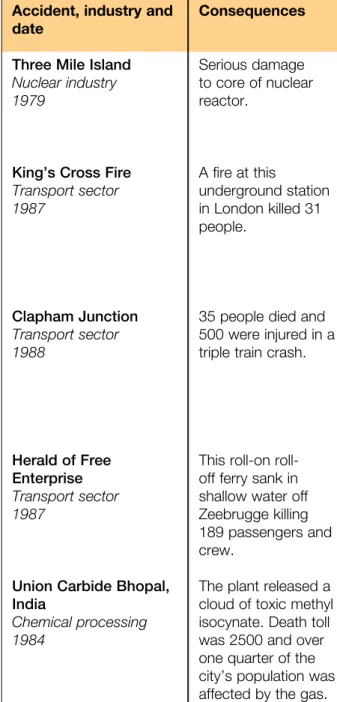
Accident, industry and date
Three Mile Island
Nuclear industry 1979
King’s Cross Fire
Transport sector 1987 Clapham Junction Transport sector 1988 Herald of Free Enterprise Transport sector 1987
Union Carbide Bhopal, India Chemical processing 1984 Consequences Serious damage to core of nuclear reactor. A fire at this underground station in London killed 31 people.
35 people died and 500 were injured in a triple train crash.
This on roll-off ferry sank in shallow water off Zeebrugge killing 189 passengers and crew.
The plant released a cloud of toxic methyl isocynate. Death toll was 2500 and over one quarter of the city’s population was affected by the gas.
Human contribution and other causes
Operators failed to diagnose a stuck open valve due to poor design of control panel, distraction of 100 alarms activating, inadequate operator training. Maintenance failures had occurred before but no steps had been taken to prevent them recurring.
A discarded cigarette probably set fire to grease and rubbish underneath one of the escalators. Organisational changes had resulted in poor escalator cleaning. The fire took hold because of the wooden escalator, the failure of water fog equipment and inadequate fire and emergency training of staff. There was a culture which viewed fires as inevitable.
Immediate cause was a signal failure caused by a technician failing to isolate and remove a wire. Contributory causes included degradation of working practices, problems with training, testing quality and communications standards, poor supervision. Lessons not learnt from past incidents. No effective system for monitoring or limiting excessive working hours. Immediate cause was the failure to close the bow doors before leaving port. No effective reporting system to check the bow doors. Formal inquiry reported that the company was ‘infected with the disease of sloppiness’. Commercial pressures and friction between ship and shore management had led to safety lessons not being learnt. The leak was caused by a discharge of water into a storage tank. This was the result of a combination of operator error, poor maintenance, failed safety systems and poor safety management.
Table 1 Some illustrative major accidents
It is all too easy to provide examples of accidents where ‘human error’ has given rise to a major accident with loss of life and injuries. Table 1 illustrates how the failure of people at many levels within an organisation can contribute to a major disaster. For many of these major accidents the human failure was not the sole cause but one of a number of causes, including technical and organisational failures, that led to the final outcome. Remember that many ‘everyday’ minor accidents and near misses also involve human failures.
We all make errors irrespective of how much training and experience we possess or how motivated we are to do it right. Failures are more serious for jobs where the consequences of errors are not protected. However, errors can occur in all tasks, not just those which are called safety-critical.
Accident, industry and date Space Shuttle Challenger Aerospace 1986 Piper Alpha Offshore 1988 Chernobyl Nuclear industry 1986 Texaco Refinery, Milford Haven Chemical processing 1994 Consequences An explosion shortly after lift-off killed all seven astronauts on board.
167 workers died in the North Sea after a major explosion and fire on an offshore platform. 1000 MW Reactor exploded releasing radioactivity over much of Europe. Environmental and human cost. An explosion on the site was followed by a major hydrocarbon fire and a number of secondary fires. There was severe damage to process plant, buildings and storage tanks. 26 people sustained injuries, none serious.
Human contribution and other causes
An O-ring seal on one of the solid rocket boosters split after take-off releasing a jet of ignited fuel. Inadequate response to internal warnings about the faulty seal design. Decision taken to go for launch in very cold temperature despite faulty seal. Decision-making result of conflicting scheduling/safety goals, mindset, and effects of fatigue.
Formal inquiry found a number of technical and organisational failures. Maintenance error that
eventually led to the leak was the result of inexperience, poor maintenance procedures and poor learning by the organisation. There was a breakdown in
communications and the permit-to-work system at shift changeover and safety procedures were not practised sufficiently.
Causes are much debated but Soviet investigative team admitted ‘deliberate, systematic and numerous violations’ of safety procedures by operators.
The incident was caused by flammable hydrocarbon liquid being continuously pumped into a process vessel that had its outlet closed. This was the result of a combination of: an erroneous control system reading of a valve state, modifications which had not been fully assessed, failure to provide operators with the necessary process overviews and attempts to keep the unit running when it should have been shut down. Table 1 Some illustrative major accidents (continued)
The human contribution to accidents
People can cause or contribute to accidents (or mitigate the consequences) in a number of ways:
Through a failure a person can directly cause an accident. However, people n
tend not to make errors deliberately. We are often ‘set up to fail’ by the way our brain processes information, by our training, through the design of equipment and procedures and even through the culture of the organisation we work for. People can make disastrous decisions even when they are aware of the risks. n
We can also misinterpret a situation and act inappropriately as a result. Both of these can lead to the escalation of an incident.
On the other hand we can intervene to stop potential accidents. Many n
companies have their own anecdotes about recovery from a potential incident through the timely actions of individuals. Mitigation of the possible effects of an incident can result from human resourcefulness and ingenuity.
The degree of loss of life can be reduced by the emergency response of n
operators and crew. Emergency planning and response including appropriate training can significantly improve rescue situations.
The consequences of human failures can be immediate or delayed.
Active failures have an immediate consequence and are usually made by front-line people such as drivers, control room staff or machine operators. In a situation where there is no room for error these active failures have an immediate impact on health and safety.
Latent failures are made by people whose tasks are removed in time and space from operational activities, eg designers, decision makers and managers. Latent failures are typically failures in health and safety management systems (design, implementation or monitoring). Examples of latent failures are:
poor design of plant and equipment; n
ineffective training; n
inadequate supervision; n
ineffective communications; and n
uncertainties in roles and responsibilities. n
Latent failures provide as great, if not a greater, potential danger to health and safety as active failures. Latent failures are usually hidden within an organisation until they are triggered by an event likely to have serious consequences.
Investigating the causes of accidents
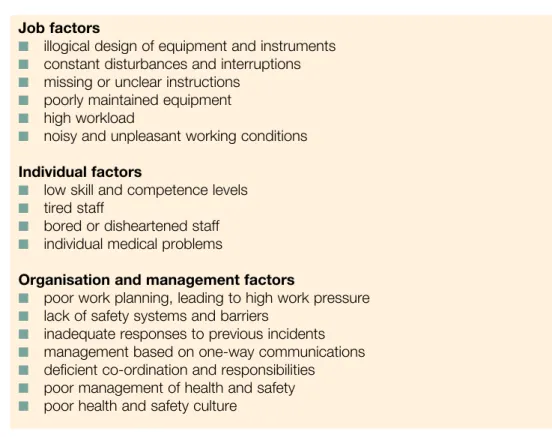
After an accident involving human failure there may be an investigation into the causes and contributing factors. Very often, little attempt is made to understand why the human failures occurred. However, finding out both the immediate and the underlying causes of an accident is the key to preventing similar accidents through the design of effective control measures. Typical examples of immediate causes and contributing factors for human failures are given in Box C. This is not a complete list and you will be able to add other causes. The HSE publication Successful health and safety management1 gives more information on investigating
accidents. Formal methods for causal analysis exist and are described in CCPS (1994).2
Job factors
illogical design of equipment and instruments n
constant disturbances and interruptions n
missing or unclear instructions n
poorly maintained equipment n
high workload n
noisy and unpleasant working conditions n
Individual factors
low skill and competence levels n
tired staff n
bored or disheartened staff n
individual medical problems n
Organisation and management factors
poor work planning, leading to high work pressure n
lack of safety systems and barriers n
inadequate responses to previous incidents n
management based on one-way communications n
deficient co-ordination and responsibilities n
poor management of health and safety n
poor health and safety culture n
Box C Examples of often cited causes of human failures in accidents Causes of human failure
There are different types of human failures: errors and violations (see Figure 2)
Slips of action Lapses of memory Knowledge-based mistakes Routine Situational Exceptional Rule-based mistakes Mistakes Skill-based errors Errors Violations Human failures
a
n human error is an action or decision which was not intended, which involved a deviation from an accepted standard, and which led to an undesirable
outcome. a
n violation is a deliberate deviation from a rule or procedure. Violations are discussed in detail in the section on ‘Breaking the rules’, page 16.
Errors fall into three categories: slips, lapses and mistakes.
Slips and lapses occur in very familiar tasks which we can carry out without much need for conscious attention. These tasks are called ‘skill-based’ and are very vulnerable to errors if our attention is diverted, even momentarily. Driving a car is a typical skill-based task for many of us. Slips and lapses are the errors which are made by even the most experienced, well-trained and highly-motivated people. They often result in omitted steps in repair, maintenance, calibration or testing tasks. We need to be aware of these types of errors and try to design equipment and tasks to avoid or reduce their occurrence. We can also try to increase the opportunities to detect and correct such errors. It can be useful to make everyone aware that slips and lapses exist and to consider them during accident investigation.
Slips are failures in carrying out the actions of a task. They are described as ‘actions-not-as-planned’. Examples would be: picking up the wrong component from a mixed box, operating the wrong switch, transposing digits when copying out numbers and misordering steps in a procedure. Typical slips might include:
performing an action too soon in a procedure or leaving it too late; n
omitting a step or series of steps from a task; n
carrying out an action with too much or too little strength (eg over-torquing a n
bolt);
performing the action in the wrong direction (eg turning a control knob to the n
right rather than the left, or moving a switch up rather than down);
doing the right thing but on the wrong object (eg switching the wrong switch); n
and
carrying out the wrong check but on the right item (eg checking a dial but for n
the wrong value).
The following is an example of a slip causing an accident:
Two similarly named chemicals were manufactured at a chemical works in batch reactions. Each required the presence of an inorganic base to maintain alkalinity to prevent exothermic side reactions. Development work was in progress which involved altering the various ratios of chemicals in each reaction. A chemist, in calculating the quantities of inorganic base required, inadvertently transposed the figures (a typical slip). As a result one reaction was carried out with only 70% of the required base present and an exothermic side reaction resulted. The subsequent explosion destroyed the plant. The system was not designed to cope with a runaway exothermic reaction. There was no system for checking the calculations. Box D An example of a slip causing an accident
Lapses cause us to forget to carry out an action, to lose our place in a task or even to forget what we had intended to do. They can be reduced by minimising distractions and interruptions to tasks and by providing effective reminders especially for tasks which take some time to complete or involve periods of waiting. A useful reminder could be as simple as a partially completed checklist placed in a clearly visible location for the person doing the task. We may be able to eliminate some of these lapses through better design of equipment or tasks, as in Box E.
An experienced road tanker driver had virtually completed the filling of his vehicle from a bulk tank of flammable liquid when a nearby telephone rang. After ignoring it for some five minutes he closed the various valves on the installation and went to answer it. On returning to the vehicle he drove away having forgotten that he had not disconnected the tanker hose from the installation. Fixed pipework from the installation fractured and approximately one tonne of material was lost. The installation was not fitted with a drive-away protection device.
Box E An example of a worker being distracted
Mistakes are a more complex type of human error where we do the wrong thing believing it to be right. The failure involves our mental processes which control how we plan, assess information, make intentions and judge consequences. Two types of mistakes exist, rule-based and knowledge-based.
Rule-based mistakes occur when our behaviour is based on remembered rules or familiar procedures. We have a strong tendency to use familiar rules or solutions even when these are not the most convenient or efficient.
An operator was very familiar with the task of filling a tank. He expected the filling procedure to take about 30 minutes. However, on this occasion the diameter of the pipe entering the tank had been enlarged and the tank was filling much more rapidly than he anticipated. He ignored the high level alarms on the grounds that the tank could not be full so quickly. The tank overflowed. Improved communications would have alerted the operator to the changes that had been made to the pipe.
Box F An example of a rule-based mistake
In unfamiliar circumstances we have to revert to consciously making goals, developing plans and procedures. Planning or problem solving needs us to reason from first principles or use analogies. Misdiagnoses and miscalculations can result when we use this knowledge-based reasoning, as in Box G.
The investigation following a major collapse of a tunnel found that the
organisation had relied on the experience of one person as a control measure. However, the nature of the method of working meant that this person had no reliable instrumentation for detecting when the tunnel was becoming unstable. Relying on ‘experience’ was actually relying on knowledge-based reasoning of the ‘expert’ and was not an effective control method to prevent a serious collapse given the unpredictable nature of the event. The expert needed more reliable instruments to carry out this work.
Box G An example of relying on ‘experience’ Inexperience and lack of information
The kinds of error described above typically occur with people who are experienced and trained. It is important to remember that human errors often occur if a person is not experienced or does not receive the correct information such as knowledge of potential hazards. The following example shows this.
A man was killed while removing the lid of a 45 gallon drum using a burning torch. He had not been told that the drum contained flammable residues. The drum exploded when heat was applied.
Box H An example of incomplete information
Lack of understanding often arises through a failure to communicate effectively. Shift handovers are a particularly vulnerable time for communication failures as is shown by this next example (see Chapter 4 for more information).
Contamination of a beach near a nuclear reprocessing plant occurred partly from a failure in communications between two shifts. One shift presumed that a particular tank only contained aqueous layers, when in fact it also contained floating radioactive solids which they presumed had been removed earlier. The result was that these solids were inadvertently pumped to the sea tanks along with the aqueous layer.
Box I An example of a failure to communicate Reducing errors
Errors are more likely to occur under certain circumstances including:
work environment stressors, eg extremes of heat, humidity, noise, vibration, n
poor lighting, restricted workspace;
extreme task demands, eg high workload, tasks demanding high levels of n
alertness, jobs which are very monotonous and repetitive, situations with many distractions and interruptions;
social and organisational stressors, eg insufficient staffing levels, inflexible or n
overdemanding work schedules, conflicts with work colleagues, peer pressure and conflicting attitudes to health and safety;
individual stressors, eg inadequate training and experience, high levels of n
fatigue, reduced alertness, family problems, ill-health, misuse of alcohol and drugs; and
equipment stressors, eg poorly designed displays and controls, inaccurate and n
confusing instructions and procedures.
Error control and reduction needs to consider these influences on peoples’ behaviour and performance. Steps to reduce human errors include:
addressing the conditions and reducing the stressors which increase the n
frequency of errors;
designing plant and equipment to prevent slips and lapses occurring or to n
increase the chance of detecting and correcting them; making certain that arrangements for training are effective; n
designing jobs to avoid the need for tasks which involve very complex n
decisions, diagnoses or calculations, eg by writing procedures for rare events requiring decisions and actions;
ensuring proper supervision particularly for inexperienced staff, or for tasks n
where there is a need for independent checking;
checking that job aids such as procedures and instructions are clear, concise, n
available, up-to-date and accepted by users;
considering the possibility of human error when undertaking risk assessments; n
thinking about the different causes of human errors during incident n
investigations in order to introduce measures to reduce the risk of a repeat incident; and
monitoring that measures taken to reduce error are effective. n
Breaking the rules
Violations are any deliberate deviations from rules, procedures, instructions and regulations. The breaching or violating of health and safety rules or procedures is a significant cause of many accidents and injuries at work. Removing the guard on dangerous machinery or driving too fast will clearly increase the risk of an accident. Health risks are also increased by rule breaking. For example a worker in a noisy workplace who breaks the site rules about wearing ear defenders increases their risk of occupational deafness. Our knowledge of why people break rules can help us to assess the potential risks from violations and to develop control strategies to manage these risks effectively.
In the workplace rules are broken for many different reasons. Most violations are motivated by a desire to carry out the job despite the prevailing constraints, goals and expectations. Very rarely are they wilful acts of sabotage or vandalism. Violations are divided into three categories: routine, situational and exceptional. With a routine violation, breaking the rule or procedure has become a normal way of working within the work group. This can be due to:
the desire to cut corners to save time and energy; n
the perception that the rules are too restrictive; n
the belief that the rules no longer apply; n
lack of enforcement of the rule; and n
new workers starting a job where routine violations are the norm and not n
realising that this is not the correct way of working.
Here are some examples of routine violations (taken from HFRG 1995).3
The inquiry into the Clapham Rail Crash found that maintenance working practices had degraded to the point where it had become routine not to use the prescribed method for certain tasks. Poor supervision and problems with training and testing meant that this situation was allowed to persist.
In a study of Dutch railways, 80% of the workforce considered that the rules were mainly concerned with pinning blame, while 95% thought that work could not be finished on time if all the rules were followed.
Box J Examples of routine violations of rules To reduce routine violations managers could:
take steps to increase the chances of violations being detected, eg by routine n
monitoring;
think about whether there are any unnecessary rules; n
make rules and procedures relevant and practical; n
explain the reasons behind certain rules or procedures and their relevance; n
improve design factors that affect the likelihood of corner cutting (see Box K); n
and
involve the workforce in drawing up rules to try to increase acceptance. n
Awkward, uncomfortable or painful working posture n
Excessively awkward, tiring or slow controls or equipment n
Difficulty in getting in or out of operating or maintenance position n
Equipment or software which seems unduly slow to respond n
High noise levels which prevent clear communication n
Frequent false alarms from instrumentation n
Instrumentation perceived to be unreliable n
Procedures which are hard to read or out of date n
Difficult-to-use or uncomfortable personal protective equipment n
Unpleasant environments, eg dust, fumes, extreme heat or cold n
Box K Design features which increase violations
In the case of situational violations breaking the rule is due to pressures from the job such as being under time pressure, insufficient staff for the workload, the right equipment not being available, or even extreme weather conditions. It may be very difficult to comply with the rule in a particular situation or staff may think that the rule is unsafe under the circumstances. Risk assessments may help to identify the potential for such violations. Encouraging reporting of job pressures through open communication will also be helpful.
A steel erector was killed when he fell 20 m from a structure under erection. Although harnesses were provided there was no provision for fixing them and there were no other safeguards available.
Box L An example of a situational violation
To reduce these situational violations managers need to consider: improving the working environment;
n
providing appropriate supervision; n
improving job design and planning; and n
establishing a positive health and safety culture. n
Exceptional violations rarely happen and only then when something has gone wrong. To solve a new problem you feel you need to break a rule even though you are aware that you will be ‘taking a risk’. You believe, falsely, that the benefits outweigh the risks. For example:
Before the accident at the Chernobyl nuclear power plant a series of tests were being undertaken. When an operator failure led to dangerously low power levels the test should have been abandoned. Operators and engineers continued to improvise in an unfamiliar and increasingly unstable regime to protect the test plan.
Box L An example of an exceptional violation To minimise exceptional violations:
provide more training for abnormal and emergency situations; n
during risk assessments think about the possibility of violations; and n
try to reduce the time pressure on staff to act quickly in novel situations. n
Organisational and managerial role in violations
Organisational culture and managerial goals and priorities can influence whether health and safety rules are broken. If the wrong messages about health and safety are received rule breaking can be encouraged. A lack of visible communication from management can be seen as somehow condoning violations of health and safety rules. Managers and supervisors need to send positive messages about health and safety. Further information on these issues is given in HSG651 and in
other parts of this guidance.
RELATED CASE STuDIES
Relevant case studies on violations in Chapter 6 include F Lighting underground locomotive cabs safely which gives an example of how a problem with drivers violating speed rules was investigated and resolved. Case study N Introduction of a mini-crane in a chemical plant may also provide useful tips.
KEY MESSAGES
Everyone can make errors no matter how well trained and motivated they are. Sometimes we are ‘set up’ by the system to fail. The challenge is to develop error-tolerant systems and to prevent errors from occurring.
Failures arising from people other than those directly involved in operational or maintenance activities are important. Managers’ and designers’ failures may lie hidden until they are triggered at some time in the future.
There are two main types of human failure: errors and violations. Controls will be more effective if the types are identified and addressed separately.
Reducing human error involves far more than taking disciplinary action against an individual. There are a range of measures which are more effective controls including design of the job and equipment, procedures, and training.
Paying attention to individual attitudes and motivations, design features of the job and the organisation will help to reduce violations.
Chapter 3 Designing for people
Many of the human factors problems highlighted so far in this guidance can be prevented or reduced during design. This chapter introduces the following topics:some basic principles of ergonomic design; n
job design to improve levels of job satisfaction and mental well-being; n
writing procedures which are more likely to be used efficiently; n
designing warnings that are more effective; and n
assessing human reliability. n
Ergonomic design
Ergonomics is about ensuring a good ‘fit’ between people and the things they use. People vary enormously in height and weight, in physical strength, in ability to handle information and in many other ways. Ergonomics uses information about human abilities, attributes and limitations to ensure that our equipment, work and workplaces allow for such variations. For example, a car built for only ‘average’ sized drivers might require larger people to crouch, while smaller people may be unable to reach the pedals. This is clearly unacceptable, so designers use information about variations in size, reach and so on to produce cars that most people can operate comfortably, conveniently and safely.
Designing tasks, equipment and workstations to suit the user can reduce human error, accidents and ill health. Failure to observe ergonomic principles can have serious consequences for individuals and for the whole organisation. Effective use of ergonomics will make work safer, healthier and more productive.
Knowing that you have an ergonomic problem
If you look at the circumstances surrounding incidents and near misses in your workplace you may find problems such as people being:
unable to see important displays; n
unable to reach controls; n
unable to work in a comfortable position; n
overloaded with too much information at one time; and n
inattentive because there is too little to do. n
The people who do a particular job are in a good position to identify especially awkward or difficult tasks. Remember that they may also have become used to a poor design. Some jobs may be extremely tiring or liable to cause aches and pains. Observation of how people actually use equipment can highlight ergonomic problems. Makeshift adaptations to machines such as lengthened levers, extra labels on switches, blocks of wood or cushions used to alter working positions, can be a sign that the design of the equipment or the job needs attention.
Medical and sickness absence records may reveal patterns of injury or complaint that could be associated with particular jobs.
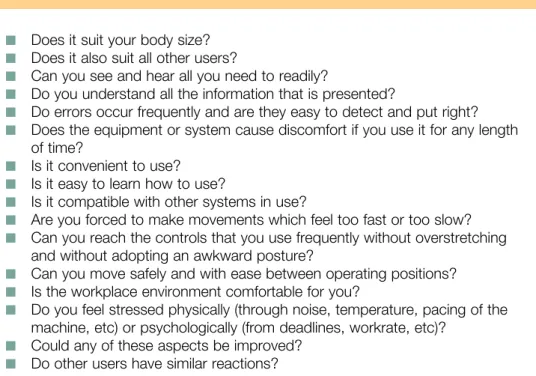
Table 2 lists some questions that you can use to identify possible mismatches between the abilities and physical attributes of people and the demands of the equipment they work with.
Table 2 Is the task and equipment ergonomically satisfactory?
Consider all the ways and circumstances in which the equipment or system may be used.
Does it suit your body size? n
Does it also suit all other users? n
Can you see and hear all you need to readily? n
Do you understand all the information that is presented? n
Do errors occur frequently and are they easy to detect and put right? n
Does the equipment or system cause discomfort if you use it for any length n
of time?
Is it convenient to use? n
Is it easy to learn how to use? n
Is it compatible with other systems in use? n
Are you forced to make movements which feel too fast or too slow? n
Can you reach the controls that you use frequently without overstretching n
and without adopting an awkward posture?
Can you move safely and with ease between operating positions? n
Is the workplace environment comfortable for you? n
Do you feel stressed physically (through noise, temperature, pacing of the n
machine, etc) or psychologically (from deadlines, workrate, etc)? Could any of these aspects be improved?
n
Do other users have similar reactions? n
Problems which ergonomics can address
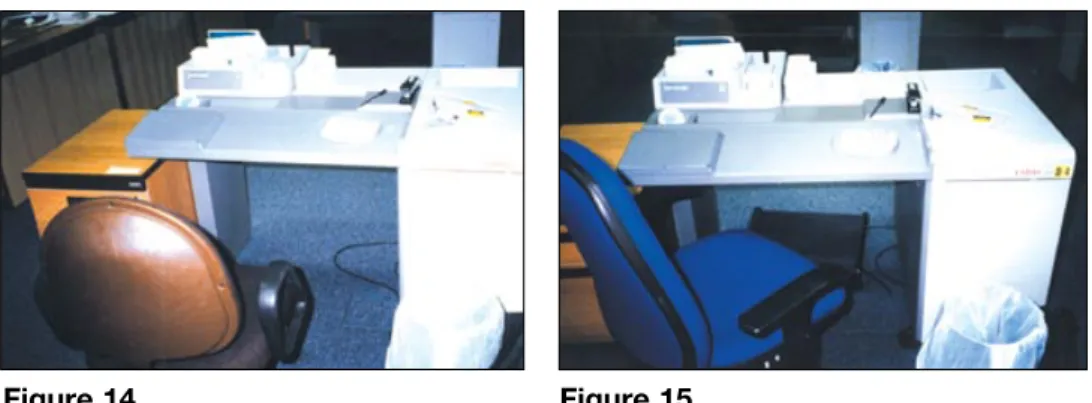
Good ergonomic design can help with a range of problems. Some of the most obvious are to do with body size; eg work surfaces that are uncomfortable to sit at because they don’t allow sufficient clearance for users’ legs.
The layout of controls and displays can influence the safety of a system. Typical problems include:
switches which can be inadvertently knocked on or off; n
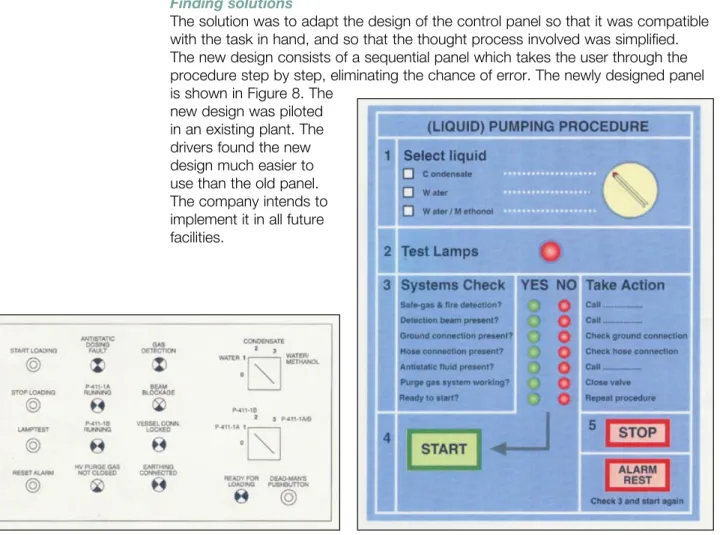
control panel layouts which are difficult to understand; n
displays which force the user to bend or stretch to read them properly; n
critical displays which are not in the operator’s normal field of view; n
poorly identified controls which the operator could select by mistake; and n
emergency stop buttons which are difficult to reach. n
Table 3 Ergonomic design of controls
Consider these aspects of the design of controls: Size (relative to force required)
n
Weight (relative to user’s position) n
Resistance (to prevent accidental use) n
Feedback (to user’s senses) n
Texture (slip, grip, glare issues) n
Coding by colour (differences need to be visible to user) n
Coding by shape (simple forms are easier to identify between) n Coding by texture n Coding by size n Location n
Compatibility (between displays and controls) n
Stereotypes (usual way of operating, eg switching a control on by pressing n
down) Taking action
If you find an ergonomic problem, a minor alteration may be all that is necessary to make a task easier and safer to perform. For instance, height-adjustable chairs allow individual users to work at their preferred work height, platforms may help operators to reach badly located controls (but beware of allowing access to danger points). If shadows or overall lighting levels are a problem, local lighting for particular tasks may be an easily adopted solution.
Always make sure that any alterations are evaluated by the people who do the job and take care that a change introduced to solve one problem does not cause difficulties somewhere else (eg for maintenance staff).
Where a straightforward solution does not seem possible and more complex redesign is indicated you need to consult a trained ergonomist. A list of professional societies is given at the end of this guidance.
RELATED CASE STuDIES
A number of case studies illustrating ergonomic problems and their solutions are given in Chapter 6. Look in particular at cases A, C, E, G, I, J, M, N and Q. Cases A, N and Q show how involving users can improve the acceptance of, and commitment to, any changes.
Designing jobs for mental well-being
Problems with mental well-being are one of the major causes of time off work. Depression and anxiety stem from causes both outside and inside work. They affect not only the mental well-being of staff but also organisational performance through increased staff turnover, poor work performance and accidents at work. When jobs are designed it tends to be the technology or the equipment which determines the content of the job. However, it is also desirable to design jobs in ways which improve levels of job satisfaction for the workforce. Feeling satisfied with your job has been shown to improve your performance at work, reduce your feelings of being under stress, and generally lead to a sense of mental well-being.
Sources of stress
HSE4 defines stress as ‘the reaction that people have to excessive pressure or
other types of demands placed upon them. It arises when they worry that they can’t cope’. A number of sources of stress have been identified and are shown in Figure 3. They include:
Factors intrinsic to the job, eg poor physical working conditions (such as high n
levels of noise, poor ventilation), working inconvenient and excessive hours, working on a repetitive and fast-paced task, or having a job which involves risk or danger. The introduction of new technology can be another source of stress. Both work overload (having too much to do or the work being too difficult) and work underload (routine, boring and under-stimulating tasks) can be sources of stress.
If a person’s role in an organisation is ambiguous, ie they do not have a clear n
idea of their role and responsibilities or their work objectives, this can be a source of stress. Role conflict and conflict situations are possible sources of stress, eg being torn between competing or conflicting job demands or having to perform tasks that you do not like or which are outside your job specification. Having responsibility at work for other people can be particularly stressful. Other people at work and our interactions with them can be sources of both n
support and stress. Relationships with our bosses, our subordinates and our co-workers are all important. Mistrust of co-workers and poor communications with them can lead to low job satisfaction. Close supervision and a
management style characterised by constant negative performance feedback is related to high levels of stress and poor worker health. (Organisational culture is discussed in Chapter 4.)
A lack of job security, fear of redundancy, or forced early retirement are n
potential stressors relating to career development. Another source of job dissatisfaction would be under or over-promotion arising from a failure to advance or promotion to a position beyond one’s capabilities. A particular stressor in some jobs is the threat of violence in the workplace and the experience of trauma following a violent incident.
People can sometimes feel they do not belong to an organisation or lack n
opportunities to participate. If the workforce is allowed more participation in decision making this can lead to higher levels of job satisfaction and lower absenteeism and staff turnover. Participation in the decision-making process may create a sense of belonging and can improve communication channels within the company. It can generate a sense of ‘being in control’ which is important for mental well-being.
Imbalance between demands and ability to cope
Experience of stress/troubled employees
Diminished availability for work
and work performance employee healthPoor/impaired
Impaired quality of employee life Organisational ill-health Problems external to work Exposure to organisational
and psychosocial factors Figure 3 Patterns of
causes and effects of stress. Adapted from Loss Prevention Council (1998)5
Individual differences
Different people will react in different ways to the same situation. Individual
characteristics (such as attitudes, abilities, and personality) will interact with features of the job and organisation (eg job characteristics, work environment and health and safety culture) to affect a person’s sense of well-being and job satisfaction. The degree of fit between the person and the job can significantly influence their sense of mental well-being. There will be variations between people in which jobs will promote job satisfaction or job dissatisfaction. This needs to be taken into account in the design of tasks. For example, the effects of a repetitive, monotonous task are worse if the work is also machine rather than self-paced. However, a proportion of workers do prefer machine to self-paced work. In general though machine-paced work is often combined with repetitiveness, physical constraint and under-utilisation of skills and associated with a higher level of stress.
Improving job design
When thinking about improving job satisfaction and reducing stress levels organisations often focus on the individual worker through the provision of stress management courses and employee assistance programmes. Although helpful, attempts to deal with difficulties on an individual basis are ultimately only ‘sticking plasters’ and the problems will tend to recur. Another complementary approach is to consider organisational and job design. Solutions here will in the long run be more cost effective as the underlying work-related causes will be identified and resolved.
Throughout this century jobs have tended to become increasingly monotonous and controlled. Many jobs are designed to minimise skill requirements, maximise management control and minimise the time required to perform a task. Jobs designed like this have a human cost in terms of negative attitudes to the job and poor mental and physical health and attempts have been made to redesign such work to improve the quality of working life. Such redesign is based on increasing one or more of the following job characteristics:
variety of tasks or skills (increased use of capabilities); n
autonomy (higher control over when and how tasks are done); n
completeness (whether a job produces an identifiable end result which makes n
the task more significant and meaningful for the worker); and
feedback from the job (improved knowledge of the results of the work activities). n
Other characteristics of work which are also thought to be important for job satisfaction are the amount and quality of social interaction with co-workers, responsibility for technology and output, and the mental demands of a job including the need to pay close, constant attention to a task and the need to diagnose and solve problems.
Typical ways of work redesign are:
Job rotation. Here people rotate through a small number of different but typically similar jobs. The rotation is often frequent, eg weekly. This can increase task variety but as it does not improve other job factors it is of limited value in improving job satisfaction. The company benefits by having more people who can carry out a particular job. Effective task training is needed especially if a job requires a high degree of skill or if there is the potential for an error with serious consequences. Horizontal job enlargement. A person’s job is altered to include additional tasks which are similar to those which are already being carried out. Many companies now encourage staff to become multi-skilled. Job enlargement does increase the variety of work but it may not necessarily improve job satisfaction. At worse it can result in the aggregation of several equally boring and stressful tasks.
Vertical job enlargement. The redesign of a job to include additional decision-making responsibilities and/or higher-level challenging tasks. This increases autonomy and variety.
Job enrichment. This is similar to vertical job enlargement but builds into jobs greater scope for personal achievement and recognition, more challenging and responsible work and more opportunity for advancement and growth. Elements can include feedback about performance, more control over resources and increased participation in decision making.
Autonomous work groups. The aim here is to provide a job which is complete; the group sees it through from start to finish and has the responsibility for planning, co-ordinating and evaluating its own work activities. This can lead to improvements in product quality and quantity. There can be problems if wage levels are dependent on the speed with which items are produced. If so, pressure may be put on slower members of a group. There can be strong motivation within a work group to attain goals. This may lead to very high levels of effort and a negative impact on the mental and physical health of group members.
Employee involvement and participation. Involvement and participation of staff in job, task and equipment design and redesign is an important tool in the reduction of both stress levels and safety risks. Individuals are often able to identify and propose solutions to some of the ergonomic problems in their workplace as is shown in many of the case studies in this guidance. However, such initiatives need to have the support of management to make them work. Extended use of participation can create raised expectations for employees which may be difficult to meet. Employee involvement can appear threatening to managers who are used to making their own decisions.
Job redesign usually has a positive impact on job satisfaction, motivation, employee mental health and performance as long as it is not restricted to just increasing job variety. Such redesign usually occurs in combination with other changes such as staffing levels, pay rates, or management style which are likely to also affect these outcomes.
RELATED CASE STuDIES
Case studies K, O and P look at instances where stress and/or job satisfaction were problems for the organisation. Case studies which show how involving employees was helpful are A, B, D, N and Q.
Writing procedures
Procedures, especially operating and maintenance procedures, are important for the prevention of accidents and ill health. Written procedures are vital in maintaining consistency and in ensuring that everyone has the same basic level of information. They are a key element of a safety management system and an important
training tool. However, poor procedures can be a reason for people not following recommended actions.
As well as being technically accurate, procedures need to be well-written, usable and up to date. Remember that even if your procedures are not formally written down they exist through the working practices of staff. Ask yourself:
Are your procedures accessible? n
Are they actually followed by staff? n
Are they written so that they can be understood and followed easily? n
Do they reflect the tasks as they are actually carried out? n
Do the procedures include key safety information? n
Are they kept up to date and reviewed occasionally? n
Procedures ideally need to: be accurate and complete; n
be clear and concise with an appropriate level of detail; n
be current and up to date; n
be supported by training; n
identify any hazards; n
state necessary precautions for hazards; n
use familiar language; n
use consistent terminology; n
reflect how tasks are actually carried out; n
promote ownership by users; n
be in a suitable format; and n
be accessible. n
Writing better procedures
Start by collecting information about the task and the users. To do this you could carry out an activity analysis (see Chapter 5 for details). You will also need to have the results of any relevant risk assessments to hand so that the procedure can reflect arrangements to maintain adequate control of identified risks. Here are some issues to think about:
consider both the difficulty and importance of the task(s) to be documented; n
find out how often the task is carried out and the potential hazards; n
think about who will use the procedure and the level of information they need n
(providing too much information may lead to less use of the procedure if users find it too detailed and hard to follow, too little information may mean that an inexperienced person will not be able to carry out the task);
establish the skills, experience level, past training and needs of the users of the n
procedure; and
look at whether the procedure needs to be supported by training in order to n
promote understanding and effective use.
Try to promote ownership by encouraging users to participate in the preparation and maintenance of the procedure. For example experienced staff could write the procedure and users could review it. Ask users about the ease of use of a procedure and whether it is easy to understand. Encourage users to suggest improvements to existing procedures.
Procedures can appear in many different forms, eg as printed text documents, electronically, as quick reference cards, or as posted notices. It is important that users know where the procedures can be found and that this is convenient for them. If it takes too long to find a procedure users will be more reluctant to use it. Procedures which are duplicated, eg as posted notices as well as printed text documents, should not contain conflicting instructions.
Think about the issue of style. As general guidance keep sentences short and avoid use of complex sentence structure. This will make the procedure easier to read and understand. Try to write the required actions that users need to do in positive active sentences eg ‘Open valve A then valve B’. This is easier to follow than the more complicated - ‘After opening valve B open valve A’ or ‘Do not open valve B until valve A has been opened’.
Put items in the order in which they need to be carried out. It is easier to follow a procedure which states ‘Do A then do B’ rather than ‘Before doing B do A’. For procedures which are complex, rarely carried out, or performed in adverse conditions it is helpful to document the steps of the procedure one at a time. Effective use can be made of:
flow charts; n
decision tables (often in the form of ‘if condition X, then go to step Y’); n
questions (eg ‘is the temperature greater than 100o C? Yes, go to step 1; No, n
go to step 2’); and diagrams.
n
Divide longer procedures into shorter chunks. This helps users to go back to a particular step if they are interrupted or if the task takes some time to carry out. AVOID USING ALL CAPITAL LETTERS FOR THE TEXT. Research shows that this is slower and more difficult for us to read than the lower case text we are more used to. Decide how features such as capitals, bold, italics, and underlining will be used. Overuse of these features is very distracting for users.
Avoid using very small fonts (eg 8 point or smaller) as this is very difficult for users to read.
Make good use of open space in the printed text. If the page appears too cluttered, users will be discouraged from reading it. Although the procedure may have more pages, providing spaces between steps on the page will make it more usable. Try to use the same format for all procedures. This will help users find their way around the text. An inconsistent format could confuse the user. A typical format would include:
purpose of the procedure; n
precautions which must be observed to avoid potential hazards; n
special tools or equipment needed; n
initial conditions which must be satisfied before starting; n
references to other relevant documents, eg data sheets or manuals; and n
procedural steps to perform the task safely and efficiently. n
Users may be very familiar with some frequently carried out procedures. Here it may be more effective if the procedure is in the form of a quick reference card containing the key precautions and action steps.
Warning information about potential hazards is usually given in a precautions section at the start of the procedure and in the form of ‘cautions’ embedded in the procedural steps.
The precautions section needs to give the user information on what can happen, why, and the consequences of ignoring the precaution. It is best to restrict the precautions section to important health and safety issues. Too much information about self-evident issues will reduce the impact of the key messages.
Cautions in the procedural steps reiterate the precautions. Make sure that a caution appears immediately before the relevant step in the procedure and on the same page as the step. Ensure that the caution is clear, concise and contains only the relevant information for the user. Usually a caution or warning contains only information to alert or explain something to the user. Information about actions to carry out are contained in the procedural steps.
Designing warnings for maximum effect
In our working lives we are used to seeing written warnings, hearing alarms, and noticing warning signs or labels on products. All of these are intended to communicate risk to us. Yet, as accidents show, all too often we ignore these warnings. We need to ensure that warnings are effective, or consider alternative ways of reducing the risks.
Responding to warnings is important in all work situations but particularly so where the risks have not been completely eliminated through design. Here human actions may be needed to minimise risks. For example, control room staff need to respond to alarms to safeguard the plant and its process, medical staff need to respond to intensive care equipment alarms.
Risk assessments should indicate where it is important or essential for someone to respond appropriately to a warning or alarm.
Why have warnings?
Warnings serve three purposes:
alerting someone that a product or situation is hazardous; n
specifying the potential seriousness of the hazard and the consequences of n
wrong action; and
specifying the preventive actions to be taken. n
Do we comply with warnings?
As can be seen in Figure 4, while most people will notice a written warning, only half will actually read it and only a third will comply with the instructions. This shows that we cannot rely on a warning to produce the response we want.
People who comply most with warnings tend to: perceive the risks of not complying to be
n serious or highly likely to occur;
believe they will be personally affected by the consequences; n
are unfamiliar with the product or situation; n
see other people around them are complying with the warnings; n
find it is easy to comply, eg any necessary personal protection is close at hand; and n
believe that if they comply there will be a real personal benefit. n
0 20 40 60 80 100
People who: Notice the warning Read the warning Comply with it Figure 4 Complying with
What about the design of warnings?
Warnings should be conspicuous! Good design can help to make written warnings attention-grabbing. Use size, colour and pictures to make written warnings more visible. Take care if using pictorial symbols as these can be misunderstood or may deter further reading of the warning. The content of the warning should be brief, include only the relevant information and be easy to understand. It must be reasonable to carry out the instructions in a reliable and timely manner.
The instructions should specify what actions to take as well as which to avoid. It makes sense to place a warning where it is needed. A warning can be effective if placed at the beginning of instructions or embedded within them.
If the warning is spoken think about the pitch and stress of the voice delivering the message. Female voices tend to attract attention more readily than male voices. Consider not only the volume of a spoken message but also its audibility and whether it can be understood.
For other audible warnings the perceived urgency of the warning can be altered using changes in volume, pitch and repetition. Loud sounds of high pitch, sounds with rising tones and frequent repetitive sounds are usually seen as needing urgent action. In abnormal situations and emergencies (eg in control rooms or intensive care wards) staff often need to discriminate rapidly between many simultaneous audible alarms in order to identify the most urgent, so take care not to use such alerting features for low priority alarms.
Can warning response be improved?
Yes. Think about the people and the warning. People need to: be alert and sober;
n
be seeking information (either because they suspect a hazard is present or n
because their past experience indicates that such information may be needed); accept the warning as being important (they should not be overloaded with n
information or other warnings and not have experienced many false alarms); believe the warning, receive information that is consistent with their past n
experience, accept the source of the warning as credible and see that other people are acting consistently with the warning;
judge the risk to be significant (see the health and safety consequences as n
highly likely or severe, believe that they do not have control over the hazard, appreciate that the risks outweigh any adverse peer pressure and accept that the risks outweigh the cost/effort of avoidance);
be capable of carrying out the required action; and n
remember how and when to carry out the action. n
The warning needs to:
be present when and where needed; n
give only the information needed; and n
be in a suitable format (brief, understandable and attention-grabbing). n
Human Reliability Assessment
Human reliability is the opposite of human error. It is the probability of successfully performing a task. The reliability of a system depends on hardware, software and human reliability. It is important to be able to assess human reliability, particularly in a complex high-hazard system. Human Reliability Assessment (HRA) is a structured and systematic way of estimating the probability of human errors in specific tasks.