The Small Business Peer-to-Peer Energy Efficiency Program
Cyane B. Dandridge, Strategic Energy InnovationsLeslie Mendez, Strategic Energy Innovations
ABSTRACT
Energy efficiency programs targeting the small business sector have been few despite the numerous potential benefits. Cost reduction through implementing energy efficiency measures directly benefits the profit of a business and can improve its aesthetics and performance capability. Besides providing the business with additional cash to perform its core business, funds from energy savings could be reinvested to improve business operation, decrease cost of services, or hire needed staff. On a community level this translates to improved building stock, higher employment rates, increased tax revenue for cities, increased jobs and reduced local energy expenditures that usually leaves the community to non-locally-based utility companies.
The Small Business Peer-to-Peer Energy Efficiency Program in East Palo Alto, California, was designed as an innovative outreach approach by a non-utility entity to attract small businesses to participate in an energy efficiency program. The Program aimed to educate small businesses about how to invest in energy efficiency products and services and implement low-cost improvements and no-cost behavior changes. These businesses met with other businesses that have already implemented successful programs and shared lessons learned and success stories. This approach, combined with direct technical assistance from energy efficiency experts, helped to achieve a high success rate in outreach efforts in this hard to reach small commercial sector.
This paper presents an outline of the year-long energy efficiency program conducted in East Palo Alto. It describes accomplishments, challenges, and lessons learned plus a strategic model that other communities can replicate.
Introduction
Strategic Energy Innovations (SEI) conducted a year-long Peer-to-Peer Small Business Energy Efficiency Program (“the Program”) in the City of East Palo Alto, California. The Program was designed as an innovative outreach approach from a non-utility entity to entice small businesses to participate in an energy efficiency program. There have been several programs targeting the small business sector, primarily providing technical assistance and incentives for retrofitting buildings. (Boman 1996; City of Berkeley 2002; City of San Francisco 2001; Dandridge & Green 1998). Based on the barriers found in these programs, this program was designed to explore outreach and education; how to motivate small businesses to take advantage of existing resources for upgrading sites to energy efficiency.
The Program’s primary goal was to educate small businesses about the benefits of energy efficiency products and services (for example, that a reduction in energy consumption corresponds to reductions in operational costs to the businesses) and how to invest in such offerings.
SEI’s specific goals were to:
x Directly contact at least thirty small businesses with an educational visit and perform
preliminary energy efficiency walk-through audits on their facilities;
x Of these thirty small businesses, have at least seven participate in an educational Peer Forum and perform a detailed energy audit of their facility.
x Test an innovative model for small business outreach and education plus report lessons learned for application of this model in future programs.
Through direct outreach and Peer Forums, we encouraged business owners to consider implementing energy efficiency measures, including retrofits and no-cost behavior modifications; however, the actual implementation of measures was not a specific deliverable of the Program. The specific deliverables focussed on outreach success and education, and creating a replicable model for future outreach programs.
When educating business owners, SEI focused on how cost reduction through energy efficiency directly benefits the profit of the business, especially if there is a short-term payback associated with the measure. Other benefits communicated to the business included improving the aesthetics and performance of a business, which will attract more customers and provide higher comfort to workers, leading to higher satisfaction for both and the potential for enhanced profitability. Besides providing the business with additional cash to perform its core business, funds from energy savings could also be reinvested to improve business operation, decrease cost of services, or hire needed staff. On a community level, this translates to improved building stock, higher employment rates, increased tax revenue for cities, increased jobs, and reduced local “energy expenditures” that usually leave the community and go to utility companies. (Dandridge & Green 1998). As East Palo Alto is a very economically depressed community, this concept was an attractive selling point.
Despite substantial potential energy savings, several barriers exist when working with small businesses. Small business owners have limited capital, knowledge and time to plan and implement energy-efficiency projects. Even with a favorable return on investment, small businesses often lack access to the initial capital resources required to implement many energy saving measures. Lack of investment capital was particularly prevalent in the businesses contacted in economically depressed East Palo Alto. Additionally, the majority of the small business owners rent their space instead of own. Renters often feel hesitant to invest finances in improvements for their landlords’ buildings, especially those with short-term leases or who are otherwise unsure of their longevity. This proved to be a particularly strong barrier in East Palo Alto, where the City’s redevelopment work made even long-term leases and ownership unreliable. Finally, the private sector (e.g., auditors, contractors and lenders) has largely ignored the small commercial market due to the relatively high cost of marketing and providing services (Boman 1996; Dandridge & Green 1998; EMR 1997).
Additional challenges exist for outreach to small businesses. Small businesses have a small staff which limits their ability to send someone offsite to a workshop. Often the store
manager, who likely has the most influence to implement energy efficiency measures or enforce no-cost behavioral changes, ran the daily operations of the store and was unable to attend a meeting (EMR 1997). When we visited some small businesses we were asked to return when the manager was available to perform a preliminary audit and discuss the Peer Forum. This significantly contributed to the time-intensive nature of our outreach approach as some businesses required multiple visits. Finally, English was often a second language for store owners and employees; however, the local project lead spoke Spanish, which eliminated this as a potential barrier.
Program Description
The Program ran from June 2000 through the end of July 2001. Over the course of the Program, we saw significant successes above and beyond the scope of our intended goals. We also were able to gather substantial information in regards to operating an energy efficiency program involving small businesses. The results and the process of gathering this information are outlined below.
To identify potential participants we began by compiling a list of businesses within the City. Since East Palo Alto does not have a Chamber of Commerce, we relied on an initial list created by the City’s Community Development Department (“City Partner”), and supplemented the list with information researched on the internet and by businesses identified by sight while touring the City. The list was then reviewed by our City Partner who crossed off those buildings slated for development (i.e. demolition or a complete rebuild) within the upcoming year.
With our final list in hand, we began an intensive outreach process to contact local businesses and assess their willingness to participate in the Program, their energy needs, and their response to the services offered through the Program. We went from business to business introducing ourselves, explaining the Program, and handing out pamphlets on energy efficiency and available rebates (EPA 2001). We engaged them in a discussion of their questions and concerns and conducted a preliminary site audit of lighting and refrigeration within their business. We briefly explained what types of energy efficient alternatives were available. We also invited the businesses to participate in the upcoming workshops, and followed up with written invitations and phone calls.
In conducting the outreach, we faced challenges specific to working with small businesses located in the City of East Palo Alto. The City lacks both a Chamber of Commerce and other business associations. There is no general means of disseminating information, nor is there a sense of camaraderie amongst businesses. There are no strong business leaders with which we could focus effort and potentially use to help with outreach to other businesses. We were not aware of this lack of a business network before the Program began. The City Partner believed their strong relationship with the businesses would be sufficient; however, our experience showed that several businesses were skeptical of the City’s role with the business community.
Many small businesses in East Palo Alto have particularly limited capital available to invest due to the current decline of their businesses in this economically disadvantaged area. Additionally, the City has slated several existing commercial areas as Redevelopment Zones. Some of the businesses we visited lie in these zones. The owners are, on the one hand,
resentful and, on the other hand, pragmatic—they do not want to invest in a building that likely will be demolished in the “near or not-too-distant” future. The reality is that many of the buildings in the Redevelopment Zones will not undergo any demolition or construction for quite a few years, thereby making retrofit investments financially worthwhile for the business owners. However, lack of communication by the City to relate the redevelopment schedule has left a lot of uncertainty on the part of the business owners.
We held two energy efficiency workshops in May and July 2001. The workshops provided a forum for businesses to meet, discuss the challenges they face and hear “success stories” from businesses who had successfully implemented energy efficiency measures. A panel of resource partners explained the various aspects of energy efficiency measures (for example, lighting, controls, and HVAC options), brought in demonstration products and explained their use and cost, and how to deploy them. Other organizations explained what financial assistance (including rebates) was available to help implement the projects.
At the workshops, and through subsequent follow-up, businesses had the opportunity to sign up for an energy audit provided free of charge through the Program. Our sub-contractors met with participants to do a thorough audit of their businesses. Based on the analysis, the sub-contractors generated and presented a final report—specifically oriented for promoting energy efficiency to the small commercial market. The report projected cost savings, energy savings, utility rebates, and implementation costs for each business on a measure-by-measure basis. The development and presentation of the report was instrumental in articulating to business owners the magnitude of savings potential that could be realized. By presenting the business owners with a choice of measures to consider as opposed to a lump sum, they were able to prioritize measures selectively.
Program Results
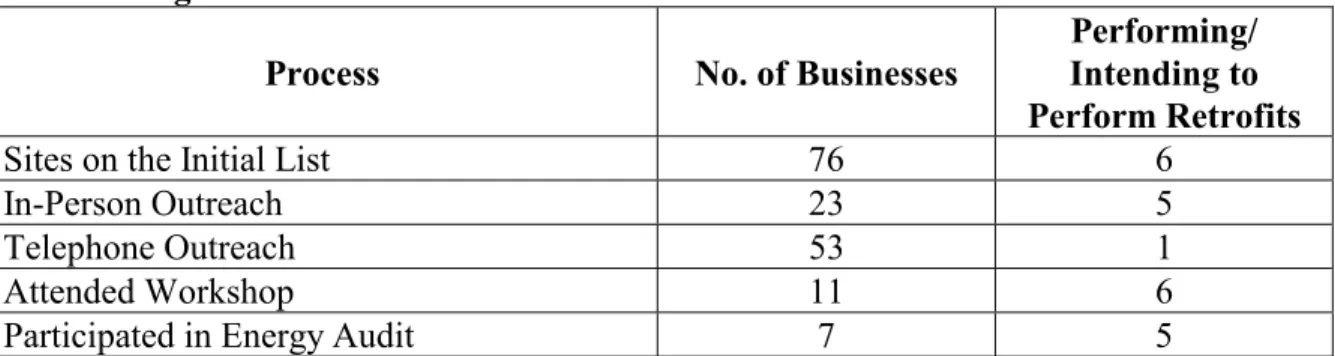
As part of the outreach program, SEI contacted twenty-three businesses in person as shown in see Table 1. (Due to time intensive nature of this type of outreach, we were limited in the number of establishments we were able to visit in person. We contacted an additional 53 businesses by phone.) The walk-by site visits revealed incredible opportunities to implement energy efficiency measures. Most businesses have older inefficient lamps, many (15-20% of the lamps onsite) of which are either non-functional or in disrepair. While replacing a non-functional lamp with a functional one will increase energy use, it also increases aesthetics of the building, a result which has high value to the building owner. In some cases an over-abundance of lighting provides a good opportunity for de-lamping. With the exception of one, the delis and markets we visited had older refrigeration units with open display cases and/or doors with worn-out seals. Also, many of the establishments are over-air-conditioned, and discussion with storeowners revealed that heating was a problem in the winter months.
In addition to identifying energy efficiency opportunities, we identified additional benefits for the businesses, such as improved aesthetics and performance capability. For example, many sites had dirty fixtures or exposed tubes, and replacing those would improve aesthetics for store workers and customers. New fixtures would also provide a better light quality which could improve both employee performance and customer interest and satisfaction.
Table 1. Program Process and Results
Process No. of Businesses
Performing/ Intending to Perform Retrofits
Sites on the Initial List 76 6
In-Person Outreach 23 5
Telephone Outreach 53 1
Attended Workshop 11 6
Participated in Energy Audit 7 5
Of the total number of businesses involved in this Program, six are performing or intending to perform retrofits.
SEI’s goal was to reach thirty businesses for preliminary outreach and initial energy audits. We were able to reach twenty-three businesses in person, due to the time intensive nature of visiting so many businesses. However, we were able to reach a total of seventy-six businesses when factoring in the phone conversations, which we viewed as successfully expanding our educational outreach effort beyond our initial target of thirty businesses.
Our second goal aimed for seven businesses to attend the Peer Forum and participate in a full energy audit. We exceeded this goal. Eleven businesses participated in the workshops and seven participated in the energy audit. The workshops were well received, and provided the type of information most businesses needed to understand how to move forward with a retrofit. Mr. Arias, from Elvia’s Boutique, commented that, “It was great to attend the workshop and hear what other businesses have done. Now I can really see how to save energy at my store.” (Arias 2001). Mr. Wilson, from Free At Last, had a similar comment, “The workshop was informative and inspirational! We’re moving forward to realize our own energy savings.” (Wilson 2001). Each of these businesses have already implemented, or have said they will implement, all of the recommended energy retrofits.
In addition to positive feedback on both the information provided, and the interactive nature of the Forum, businesses were excited about the free energy audits. George Tadlock was initially very skeptical about the possible savings he could realize as he had just recently retrofit his store with new “energy efficient” lamps. In fact, he had only replaced his inefficient T12 lamps with slightly more efficient T12 energy saving lamps. After he saw the audit results, he said, “The free energy audit showed us how much we could save; a retrofit will be very cost effective” (Tadlock & Tadlock 2001).
Table 2 shows that the seven final participants were a representative cross-section of the community as a whole: one restaurant, two retail, one church, and three non-profits. Although in general most small businesses lease their space, four of the seven final participants owned their space.
Table 2. Participant Profile
Business Type Own Lease
Retail 1* 1
Restaurant 0 1*
Non-Profit 2* 1*
Church 1* 0
*Implementing, or highly likely to implement energy upgrades
The results from the energy analyses were favorable. The seven business participating in the program had a potential for combined annual energy savings of 134,089 kWh. The breakdown of these savings are outlined in the Table 3.
Table 3. Potential Energy Savings Summary
kWh Savings/yr
Free At Last, non-profit 71,694
Girls Club, non-profit 11,287
Drew Foundation, non-profit 19,292
Elvia’s Boutique, retail 1,690
Tadlock’s Auto Supply, retail 10,976
JZ Cool, restaurant 12,818
Community Church, church 6,332
Total: 134,089
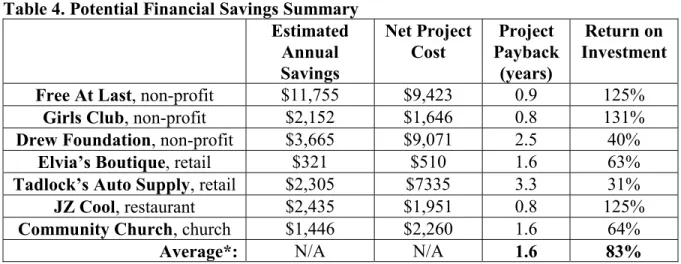
The average project payback for the seven businesses is 1.6 years, ranging from 3.3 years (31% return on investment) to an incredible 0.8 years (131% return on investment). Table 3 is a summary of potential energy savings of the seven participants.
Table 4. Potential Financial Savings Summary
Estimated Annual Savings Net Project Cost Project Payback (years) Return on Investment
Free At Last, non-profit $11,755 $9,423 0.9 125%
Girls Club, non-profit $2,152 $1,646 0.8 131%
Drew Foundation, non-profit $3,665 $9,071 2.5 40%
Elvia’s Boutique, retail $321 $510 1.6 63%
Tadlock’s Auto Supply, retail $2,305 $7335 3.3 31%
JZ Cool, restaurant $2,435 $1,951 0.8 125%
Community Church, church $1,446 $2,260 1.6 64%
Average*: N/A N/A 1.6 83%
Although it was not a stated goal of the Program, we are excited that, as a result of participating in the Peer Forum and energy audits, several participants intended to implement energy efficiency retrofits. At the end of the Program, one (a non-profit) was implementing the energy efficient retrofits, and another five were highly likely to follow suit (a second non-profit, the restaurant, the two retail, and the church). Unfortunately, since that time a number of other factors have detrimentally affected the businesses willingness to participate. A primary factor is the City itself; the Redevelopment Agency has undergone a number of changes that have decreased small business confidence in the future of their own business even further. One of the seven businesses that was very enthusiastic about implementing retrofits went out of business before the retrofits could be implemented. A second is in severe financial difficulty and will probably not implement measures.
On a more positive note, we found one business owner had implemented low cost measures by simply turning off lights in over-lit areas and was no longer using an inefficient baking oven. Although he didn’t have money to invest in retrofits, his savings from these measures were significant because he did not see peaks in his demand usage, and thus avoided extra demand costs, and he had energy cost reduction as well. He remains interested in pursuing retrofits in the future if capital becomes available (Tadlock 2002). Other businesses we contacted were still confident they would eventually be able to implement recommendations. In all, two had either performed a retrofit or had implemented no cost measures, while two are still likely to implement measures. While these numbers alone do not indicate the success of the program, we still believe the model indicates success. Fifty-seven percent of the businesses which received an energy audit and eight percent of businesses contacted were interested in moving forward with energy saving measures. The initial goal of this program was purely educational, to find a new model for providing outreach to small businesses in a very low income area, and to increase their interest and understanding of energy efficiency measures. Judging by the percentages of businesses that participated, we believe the model used was successful.
Lessons Learned
The following are lessons learned from the Program:
x Although in-person outreach is time intensive, it is time well spent. As mentioned
above, small business owners work long hours in their store and generally lack the knowledge of available energy efficiency alternatives, where to obtain them, what they will cost, what the cost savings will be, and what financial assistance (including rebates) is available. Due to these circumstances, a general sense of apathy on the part of the business owners was prevalent when first introduced to the Program. For the most part, it was only through repeated communication and personal contact with SEI staff and others at the Peer Forum that owners became interested and enthused in the Program. The rate of participation of those businesses contacted in person was 22% as compared to only a 3% participation rate of those businesses contacted by phone.
x Future programs should incorporate a post-workshop/audit follow-up component. The follow-up would provide implementation support to ensure the needs of participants are met and installation of the energy retrofits proceeds. This would include providing
the names of pre-identified installation contractors willing to participate in the program, helping fill out rebate forms and low-interest loan applications, coordinating with the installation contractor and addressing any final questions and concerns of the participants. The follow-up component would provide the extra support needed to motivate participants and encourage successful installation of the energy retrofits.
x Time should be budgeted to researching the small business network of a community
to understand its role and ability to assist with implementing a program. In this Program, the City Partner was unaware that there were tensions from some small businesses towards the City which became a barrier to work through in the outreach efforts. Time spent understanding the specific roles, influence, and marketing channels of a Chamber of Commerce, business organizations, and/or City organizations and building relationships with these entities will be advantageous to reaching small businesses.
Conclusion
The Peer-to-Peer Energy Efficiency Program conducted in East Palo Alto, California provides a good model for outreach and education of small businesses in a very low income area. First and foremost, it educated a traditionally under-served sector of the community on energy efficiency alternatives. These businesses were able to participate in resource workshops, had access to on-going technical assistance and received a detailed energy analysis that outlined potential savings for their business. As previously mentioned, East Palo Alto has no business peer network, and the majority of businesses have low revenue, are in a very low income community and are unsure of their status due to slated redevelopment zones. The accomplishments of the Program, are thereby heightened due to the specific challenges faced in working with small businesses in East Palo Alto. It is rewarding to know that participants are motivated and are proceeding to implement energy efficiency measures beyond the official determination of the Program.
References
Arias, O. (Elvia’s Boutique). 2001. Personal communication with author. July 17.
Boman, J.M. 1996. “Seattle Nets Sustainable Urban Growth Management and Multiple Resource Conservation Through the Neighborhood Power Project.” In Proceedings of the ACEEE 1996 Summer Study on Energy Efficiency in Buildings, 9:21-29. Washington, DC: American Council for an Energy-Efficient Economy.
City and County of San Francisco Department of the Environment. 2001. “SF Environment to Launch ‘Power Boosters’ Program, Targeting Small Business Energy Needs.” Available online: http://www.ci.sf.ca.us/sfenvironment/suppages/pressreleases/ pr071101city8 million.htm. San Francisco, CA: SF Environment.
City of Berkeley Office of City Manager. 2002. “Energy Relief for Small Business: Cities of Berkeley and Oakland in Partnership with CPUC; Unveil New Program to Tap
Savings Opportunities.” Available online: http://www.ci.berkeley.ca.us/news/2002/ 02feb/022002 energy.html. Berkeley, CA: City of Berkeley.
Dandridge, Cyane B. and Green, Andrew S. 1998. “Access and Delivery Strategies for Small Businesses: Buyers Club for Energy Efficiency.” In Commercial Buildings: Program Design, Implementation, and Evaluation. Washington, D.C.: American Council for an Energy-Efficient Economy.
EMR. 1997. Energy Star Small Business Barriers and Constraints Assessment Report. Washington, DC: US Environmental Protection Agency.
Environmental Protection Agency. 2001. Putting Energy Into Profits: Energy Start Guide for Small Business. DOE/EE-0254. Washington, DC: Energy Star for Small Business. Tadlock, G. and Tadlock, D. (Tadlock’s Auto Supply). 2001. Personal communication with
author. July 17.
Tadlock, G. (Tadlock’s Auto Supply). 2002. Personal communication with author. February 27.
Wilson, B. (Free At Last). 2001. Personal communication with author. July 24. Wilson, B. (Free At Last). 2002. Personal communication with author. March 8.