i
Information Management Plan
December 15, 2004
Draft
Developed by:
Sara M. Stevens
&
Gary Entsminger
Mission Statement
This information management plan has been developed to support NPS Inventory and Monitoring Program goals and objectives to ensure that Northeast Coastal and Barrier Network (NCBN) Inventory and Monitoring Program data and information are accessible and useful long beyond the initial field data collection phase.
Executive Summary
As the basic and most important products of scientific research, data and information represent a valuable and an often irreplaceable resource (Michener and Brunt, 2000). Because field
experiments and associated data collection are often time consuming and expensive, management of data and information products plays an important role in any scientific program. For long-term ecological monitoring programs, such as the NCBN Inventory and Monitoring Program, retention and documentation of high quality data are the foundation upon which the success of the overall program rests.
To develop and retain high quality data, the Network has developed the following draft information management plan that describes the Network’s information management infrastructure (e.g., staffing, hardware, software) and architecture (databases, procedures,
archives). This includes procedures to ensure that relevant natural resource data collected by NPS staff, cooperators, researchers, and others are entered, quality-checked, analyzed, reported,
archived, documented, cataloged, and made available to others for management decision-making, research, and education.
In addition to the Network’s Information Management Plan, NCBN staff are developing specification and guidance documents to share with park, Network, regional and national staff (http://www1.nature.nps.gov/im/units/ncbn/d_guidelines.htm). These guidelines describe methods that will be used by NCBN for managing natural resource information from hard copy reports to digital photos. Standard Operating Procedures (SOP) that describe in detail how to create FGDC compliant metadata or conduct quality control procedures on data collected by the Network are also being developed and included each of the Network monitoring protocols. In order for the NCBN Information Management Plan to be successful, the Network must:
provide up-to-date technical guidance for the preparation and management of data (guidance, specification and Standard operating procedure documents)
maintain efficient standards for data processing, from acquisition to distribution Success will be based on the resulting:
iii
production and maintenance of high quality information products that fulfill a wide variety of user needs
The NCBN Information Management plan outlines the approach that the Northeast Coastal and Barrier Network will take to implement and maintain a system that will serve the data and information management needs of the NCBN Inventory and Monitoring Program. The plan reflects the commitment to the establishment, maintenance, description, accessibility, and long-term availability of high-quality data and information.
Roles and Responsibilities
For the NCBN Inventory and Monitoring program to work effectively, everyone within the Network will have stewardship responsibilities in the production, analysis, management, and/or end use of data produced by the program. To meet the new data management goals and standards developed by the National Park Service and its constituents, Network staff must understand how data and information flow, and what their roles and responsibilities are in this process.
There are four main categories of data stewardship roles to be handled by Network personnel. These are:
1. production 2. analysis 3. management 4. end use
Each of these broad categories has principal, or ‘must-do’ responsibilities as well as many potential ancillary tasks. As coordinator of these tasks, the fundamental role of the Network data manager is to understand and determine program and project requirements, to create and maintain data management infrastructure and standards, and to communicate and work with all responsible individuals.
Project Workflow
To better understand the information management needs of the NCBN program, it is useful to understand the general work flow of project development and the information management tasks associated with each stage. There are two main types of projects handled by the Network:
short-term projects, which may include individual park research projects, inventories, or pilot work done in preparation for long-term monitoring
long-term projects, mainly the Network vital-signs monitoring projects central to the I&M program, but which may also include multi-year research projects and
monitoring performed by other agencies and cooperators. Long-term projects will often require a higher level of documentation, peer review, and program support
For information management the primary difference between short- and long-term projects is an increased need to adhere to and maintain standards for long-term projects. Maintaining
standardization from year-to-year will be necessary when comparing data over an extended period of time (years for vital signs monitoring).
Within this information management plan, both short and long-term projects are divided into four primary stages:
1. initiation and approval 2. planning-design and testing 3. implementation
4. finalization-product integration and evaluation
Each of these four stages are associated with multiple information management tasks. During the initiation and approval stage, preliminary decisions are made regarding the scope of the project and its objectives. A scope of work may or may not be written for each project, but a proposal is developed and funding sources, permits, and compliance are addressed. A cooperative agreement or contract is developed and finalized. Although many of these responsibilities rest with the project leader and/or program administrators, data management staff must be involved in
identifying project deliverables and assuring that each contract or agreement includes a clear list of these deliverables, with reference to either national, regional or Network information and data standards.
At the planning-design and testing stage of a project either an inventory study plan or monitoring protocol is developed that details how data will be acquired, processed, analyzed, and reported. Information management tasks associated with this stage include data design, development and maintenance of guidelines and specifications, and dissemination of this information. This stage is one of the most important as it initiates the development of sound, quality data products.
Once the design and testing and the administrative tasks associated with project information management have been completed, the project is implemented. At this stage the technical information management staff is critical to the success of the project. Tasks include acquiring, processing, and documenting data. During this phase, products such as reports, maps, and GIS themes are developed. All raw data undergo QA/QC measures and final manipulated products are reviewed. Although many of these tasks may be completed by Network cooperators, the
information management staff must be closely involved in the training, development, and review of all draft and final project products.
Once all products have been developed and gone through extensive review, product integration and evaluation occurs. Records are either finalized permanently for short-term projects or finalized for the project year for long-term projects. Records are finalized or closed out for the year in the Network project tracking database to reflect status and deliverables. Information management tasks include the review, dissemination, and archiving of all products.
v
on the category and type of data being collected or compiled. This dictates how data are acquired and processed within each project stage.
Data Acquisition and Processing
There are two categories of data acquired and managed by the Network:
1. Network-based data-those data collected by Network staff and/or cooperators working with the Network
2. Network-integrated data-those data collected by other entities (parks, universities, other agencies, other NPS programs), but identified as important natural resource data,
necessary for the Network to manage
Network-based data are those data originating within the Network or are currently being collected by NCBN staff. These include three of the twelve basic I&M Program biological inventory
datasets:
vegetation maps
species occurrence inventories species distribution inventories
Along with vegetation maps and species inventories, the Network manages long-term monitoring data as part of its Vital Signs program. NCBN is currently developing protocols to monitor:
salt marsh vegetation estuarine nekton
geomorphologic change estuarine nutrient enrichment landscape change
visitor impacts
Network-Integrated data can be divided into two more data type categories:
1. Current or ongoing datasets–These datasets are pre-determined for acquisition by the Network and follow very specific acquisition and processing steps. These can either be park-based or from external NPS sources. They are protocol dependent datasets that the Network acquires on a regular basis. These datasets are either used for data analyses and comparison purposes with Network-based monitoring data, or they are baseline datasets essential for the completion of a vital sign monitoring protocol.
2. Legacy datasets–are those data found and compiled through the data mining process. These include vertebrate and vascular plant species data, other important natural resource inventory data, specimen or voucher data, bibliographic data, and existing monitoring datasets.
Network-based data and Network-integrated data follow slightly different acquisition and processing steps. These are described in detail in the NCBN Information Management Plan (Chapter 5). Field data (Network-based data), data acquired from external sources and legacy data (Network-integrated data), are handled through a variety of steps to reach their final archiving stage. Although some of the steps differ from one data type to another such as the acquisition and dissemination steps, there are four main steps that all NCBN data undergo once acquired:
1. quality assurance/quality control 2. documentation
3. transcription to master databases 4. archiving
Data and information are stored, maintained and disseminated through Network and nationally based database management systems. Details are available in the Network plan (Chapter 5). NCBN vital signs data are stored in the NCBN monitoring database template. Network water quality data are housed in the national water quality database STORET. Species data are managed in the NPS NPSpecies database, and bibliographic data are compiled by the Network in the NPS NatureBib database.
Quality Assurance, Quality Control
When developing a long term ecological monitoring program, it is imperative that information and data developed as part of the program be of high quality and adequate for its intended use (US EPA, 2001). In order to develop quality products, a plan for quality assurance as well as methods for quality control must be developed at all levels of the program. Network staff and cooperators conducting ecological monitoring must be aware of both the need for and the mechanisms to achieve excellence at all levels of product development. To accomplish this, NCBN is developing a quality management system. The Network’s quality management system will include the organizational structure, responsibilities, procedures, processes, and resources for implementing QA/QC for its ecological monitoring program.
NCBN will establish guidelines for the identification and reduction of error at all stages in the data lifecycle, including project planning, data collection, data entry, verification and validation, processing, and archiving. This approach requires that the Network:
develop a plan for quality assurance that will include the identification of roles and responsibilities of Network, park, and cooperative staff for maintaining quality standards at all levels of the program–from field and laboratory data collection to overall data management procedures
ensure that the process of achieving quality is not only documented, but maintained through routine review by Network staff
develop protocols and SOPs to ensure data quality
vii
perform periodic data audits and quality control checks to monitor and improve the Network’s data quality program.
Much QA/QC work involves defining and enforcing standards for electronic formats, locally defined codes, measurement units, and metadata. This process begins with data design and continues through acquisition, entry, metadata development, and archiving. The progression from raw data to verified data to validated data implies increasing confidence in the quality of the data through time. Documentation of the dataset’s quality review process will be added to the project metadata.
Data Documentation
Another critical step following quality assurance and control is data documentation. Data documentation is another step towards ensuring that datasets are useable for their intended purposes well into the future. Data documentation involves the creation of metadata. Metadata describe how, when, and by whom a particular set of data was collected, and how the data are formatted. Metadata include information about the quality, condition, and characteristics of a dataset. Metadata help us create and maintain a framework for cataloging datasets, which in turn helps make datasets more readily available to a broad range of users.
A significant amount of guidance has become available on proper data documentation (see NCBN Information Plan Appendices). As mandated by the National Park Service, all NCBN metadata associated with geospatial data will conform to Federal Geographic Data Committee (FGDC) standards. There are a variety of software tools available for creating and maintaining FGDC compliant metadata.
For biological datasets, NCBN has adopted the Biological Data Profile Metadata standards developed by the National Biological Information Infrastructure (NBII). All Network-based datasets will be accompanied by the Biological Data Profile when distributed. Northeast Region cooperators have developed helpful guidelines on tools used for creating Biological Data Profile metadata (see Plan Appendices).
NCBN data management staff will provide training and support to project leaders to facilitate metadata development. Upon completion, metadata will be posted and made available and searchable in conjunction with related data and reports via the NCBN website, as well as the national NR-GIS Data Store.
Data Distribution
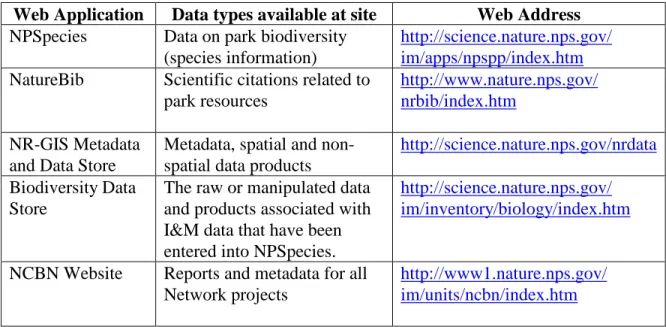
Access to NCBN data products will be facilitated via a variety of information systems that allow users to browse, search, and acquire Network data and supporting documents. These systems include the NCBN website, and national applications with internet interfaces (NatureBib,
NPSpecies, NR-GIS Data Store, etc.). The following table provides a list of repositories and types of data that will or can be housed there (Table A).
Table A. Information management systems that facilitate dissemination of NCBN information
Web Application Data types available at site Web Address NPSpecies Data on park biodiversity
(species information)
http://science.nature.nps.gov/ im/apps/npspp/index.htm NatureBib Scientific citations related to
park resources
http://www.nature.nps.gov/ nrbib/index.htm
NR-GIS Metadata and Data Store
Metadata, spatial and non-spatial data products
http://science.nature.nps.gov/nrdata Biodiversity Data
Store
The raw or manipulated data and products associated with I&M data that have been entered into NPSpecies.
http://science.nature.nps.gov/ im/inventory/biology/index.htm
NCBN Website Reports and metadata for all Network projects
http://www1.nature.nps.gov/ im/units/ncbn/index.htm
Because Network data will reside in the repositories listed above, these data will automatically be searchable via the integrated metadata and image management system and search gateway called “NPS Focus.” This system is being built with Blue Angel Enterprise software for metadata management and the LizardTech Express Server for image management. Currently, ten NPS and two non-NPS databases have been integrated into the NPS Focus prototype in either full or test bed form for one stop searching. NPS Focus has been released as an Intranet version only (http://focus.nps.gov/) – release of a public version is projected in the near future.
Archiving
The final information management step, and one of the most vital to the Network’s Inventory and Monitoring Program, is the long-term maintenance and management of digital and analog
information. Technological obsolescence is a significant cause of information loss, and data can quickly become inaccessible to users if they are stored in out-of-date software programs or on outmoded media. Effective maintenance of digital files depends on the proper management of a continuously changing infrastructure of hardware, software, file formats, and storage media. Major changes in hardware can be expected to occur every 1-2 years and in software every 1-5 years (Vogt-O'Connor 2000).
As software and hardware evolve, datasets must be consistently migrated to new platforms, or they must be saved in formats that are independent of specific platforms or software (e.g., ASCII delimited files). Thus, NCBN archiving procedures include saving datasets in both their native format (typically MS-Access or Excel spreadsheet format) and as sets of ASCII text files. As a platform- and software-independent format, ASCII text files ensure future usability of the data in a wide range of applications and platforms. In addition, datasets will periodically be converted to
ix
Chapter 10 of the NCBN Information Management Plan describes procedures for maintaining and managing digital data, documents, and objects that result from Network projects and activities. These procedures will help ensure the continued availability of crucial project information and permit a broad range of users to obtain, share, and properly interpret that information.
Table of Contents
Chapter 1 Purpose and Scope of the Northeast Coastal and Barrier Network (NCBN) Information Management Plan
1.1 Data Management Overview
1.2 The NCBN Inventory and Monitoring Program’s Long-Term Goals 1.3 Overview of the NCBN Information Plan
1.4 Sources of Natural Resource Data
1.5 NCBN Information Management Plan Principles and Scope 1.6 Revisions
1.7 Intended Audience and Layout for the NCBN Data Management Plan
Chapter 2 Information Management Staff Coordination of Roles and Responsibilities
2.1 Information Management Staff
2.1.1 National Level Staff and Coordination 2.1.2 Northeast Region Data Management Staff 2.1.3 NCBN Information Management Staff 2.1.4 Park Level Data Management Staff
2.2 Coordination of Roles and Responsibilities 2.2.1 NCBN Data Management Coordination
2.2.2 Data Management Staff-Roles and Responsibilities 2.2.3 Project Leaders
2.2.4 Project Leaders-Roles and Responsibilities 2.2.5 Sharing Responsibilities
2.2.6 Communication 2.3 Acknowledgements
Chapter 3 Information Management Resources: Infrastructure and Systems Architecture
3.1 Computer Resources Infrastructure
3.1.1 NCBN Digital File Maintenance and Storage 3.2 NCBN Systems Architecture
3.2.1 Project Database Standards
3.2.2 Core tables and fields based on network and national standards 3.2.3 Protocol-specific Field Data Tables
3.2.4 Common Lookup Tables
3.2.5 NCBN NRDT Template User Interface 3.3 Project Tracking Application
3.4 National Information Management Systems Architecture 3.5 Acknowledgements
xi
Chapter 4 Data Management Integration and Project Work Flow
4.1 Project Work Flow
4.2 Project Initiation and Approval 4.3 Planning: Design and Testing 4.4 Implementation
4.5 Project Finalization 4.6 Acknowledgements
Chapter 5 Data Acquisition and Processing
5.1 Categories of Network Data 5.1.1 Network-based Data
5.2 Acquiring and Processing Field Data (Biological Inventories and Monitoring) 5.2.1 Data Acquisition and Processing, Steps
5.3 Network Water Quality Data Integration 5.4 Network-Integrated Data
5.4.1 Acquiring and Processing Current or Ongoing Datasets 5.4.2 Acquiring and Processing Legacy Datasets
5.4.2.1 Species Data 5.4.2.2 Bibliographic Data
5.4.2.3 Specimen Collection Data 5.4.2.4 Long-term Monitoring Datasets
Chapter 6 Quality Assurance, Quality Control
6.1 National Park Service Mandate for Quality
6.2 Quality Assurance (QA) and Quality Control (QC) 6.2.1 Data Verification and Validation
6.3 NCBN QA/QC Plan
6.4 NCBN QA/QC Plan for Data Collection 6.4.1 QA Measures for Data Collection
6.4.2 NCBN Data Collection Quality Control Measures 6.5 NCBN QA/QC Plan for Data Entry
6.5.1 QA Measures for Data Entry 6.5.2 QC Techniques for Data Entry 6.5.3 NCBN Data Verification Methods 6.5.4 NCBN Data Validation Methods
6.6 Monitoring Conformance to Plans and Standards 6.7 Data Quality Review and Communication
6.7.1 Feedback from QA/QC Measures to Improve Data Quality 6.7.2 NCBN Quality Review of Completed I&M Products 6.8 Roles and Responsibilities
6.10 Acknowledgements
Chapter 7 Data Documentation
7.1 Metadata
7.2 Sources for Data Documentation Guidance 7.3 NPS Integrated Metadata System Plan and Tools 7.4 Network Data Documentation Strategy
Chapter 8 Summaries, Analyses, and Reports
8.1 Data Users 8.2 Data Delivery
8.3 Preparation of Data for Exchange and Distribution 8.4 Monitoring Data Summaries and Analyses
8.5 NCBN Monitoring Project Reports
8.6 Species Inventory Summaries, Analyses and Reports 8.7 Other Network-generated Reports
Chapter 9 Data Ownership
9.1.1 National Park Service Policy on Data Ownership 9.1.2 Establishing Data Ownership Guidelines
9.2 Data Distribution
9.2.1 Data Distribution Mechanisms
9.2.2 Data Classification: Protected vs. Public 9.2.3 Access Restrictions on Sensitive Data
9.2.4 Public Access to Network Inventory and Monitoring Data 9.2.5 Data Availability
9.2.6 Data Acquisition Policy 9.3 Data Feedback Mechanisms 9.3.1 Data Error Feedback Procedures 9.4 Acknowledgements
Chapter 10 Data Maintenance, Storage, and Archiving
10.1 Digital Data Maintenance 10.1.1 Short-term Datasets
10.1.2 Long-term Monitoring of Datasets 10.1.3 Spatial Data
10.2 Storage and Archiving Procedures–Digital Data 10.2.1 Storage Facilities for Electronic Archives 10.2.2 Directory Structure for Electronic Archives 10.2.3 Backup Procedures for Digital Data
xiii
10.3 NCBN Storage and Archiving of Official and Non-official Records 10.3.1 Hard Copy and Digital Reports Produced by the Network
10.4 Specimens 10.5 Photographs 10.5.1 Aerial Photographs
10.6 Role of Curators in Storage and Archiving Procedures 10.7 Acknowledgements
NCBN Data Management Guidance Documents and Appendices
Associated with the NCBN Information Plan
Appendix: Document Title:
1. Northeast Region GPS Field Collection Standards for Cooperators (to be developed) 2. Northeast Coastal and Barrier Network Standard Operating Procedure (SOP) for the
Garmin V GPS Unit
3. Northeast Coastal and Barrier Network File Management Plan (to be developed)
4. Northeast Region I&M Program Guidelines for developing FGDC compliant metadata for both spatial and biological data (to be developed)
5. Northeast Region Metadata tools used in the creation of the FGDC biological data profile 6. NCBN I&M Program Standards for File Revision Control (to be developed)
7. NCBN I&M Program Data Management Standards for Voucher Collection and Cataloging (to be developed)
8. Northeast Region I&M Program Database Specifications (to be developed 9. Northeast Region I&M Program NPSpecies Certifier’s Guide
10.Northeast Region Inventory and Monitoring Program NPSpecies Data Management Plan 11. Northeast Region Inventory and Monitoring Program NPSpecies Data Entry and Data
Management Standards
12.Northeast Region I&M Program NatureBib Data Management Plan
13.Northeast Region I&M Program NatureBib Data Management and Data Entry Standards Manual
14. Northeast Region I&M Program Product Specifications
15. NCBN Standard Operating Procedure Converting the NCBN Database Template 16. NCBN Saltmarsh Monitoring Database User’s Guide
17. Northeast Region I&M Program Data Mining Specifications (to be developed)
18. NCBN I&M Program Project Management Guidelines (based on use of Project KickStart Software) (to be developed)
xv
20. Northeast Region I&M Program Web-Page Development and Management Guidelines (to be developed)
21. NCBN GIS Specifications and Guidelines
22. Cape Cod National Seashore Digital Image Management Guidelines (Draft) 23. NCBN Quality Assurance Plan (to be developed)
24. Northeast Coastal and Barrier Network FOIA and Sensitive Data Information 25. NCBN Data Stewardship-Staff Roles and Responsibilities
26. Northeast Region I&M Program QA/QC Procedures and Metadata Development for Final Biological Inventory Products
27.NCBN Data Dictionary Example
28. NCBN Example Language Describing Deliverables for use in Cooperative Agreements and Contracts
29. Northeast Region Natural and Social Science Study Proposal and Deliverable Guidelines (download this document at: www.nps.gov/nero/science/)
30.Northeast Region GPS Metadata Form
31.Northeast Region Vegetation Mapping Aerial Photo Specification Example for scale 1:6000
32.Northeast Region Vegetation Mapping Aerial Photo Specification Example for scale 1:12000
33.NCBN Lidar Data Acquisition and Processing Example (to be developed)
34. Northeast Region Inventory and Monitoring Program Vegetation Map Development Example
35. Northeast Region Example of Spatial Data Review for Vegetation Mapping Products 36. Northeast Region Inventory and Monitoring Program Example Vegetation Mapping
Deliverables and Mapping Report Guidelines 37. NCBN Metadata Questionnaire (to be developed)
Chapter 1
Purpose and Scope of the Northeast Coastal and Barrier Network (NCBN)
Information Management Plan
1.1 Data Management Overview
The Inventory and Monitoring (I&M) Program represents a long-term commitment by the National Park Service (NPS) to assess and document the status and trends of park ecological resources. In 1998, the National Parks Omnibus Management Act established the framework for the I&M Program to fully integrate natural resource monitoring and other scientific activities into the management processes of the National Park System.
The Act charges the Secretary of the Interior to “continually improve the ability of the National Park Service to provide state-of-the-art management, protection, and interpretation of and research on the resources of the National Park System”, and to “… assure the full and proper utilization of the results of scientific studies for park management decisions.” Section 5934 of the Act requires the Secretary of the Interior to develop a program of “inventory and monitoring of National Park System resources to establish baseline information and to provide information on the long-term trends in the condition of National Park System resources.”
To carry out this mission, the National Park Service initiated a service-wide, natural resource Inventory and Monitoring Program encompassing 270 parks with significant natural resources. Ecologically similar parks among the 270 chosen were grouped into 32 Networks. Each I&M Network has been tasked with documenting existing park vertebrates and vascular plants, developing a management-based, ecological monitoring program with a written plan and protocols, as well as an Information Management Plan that encompasses all aspects of the Network program.
With the primary goal to “improve park management through greater reliance on scientific knowledge” the Northeast Coastal and Barrier Network (NCBN) Inventory and Monitoring Program will identify, catalog, organize, structure, archive, and provide high-quality natural resource data, which institutions and individuals alike can share. Researchers, managers, and administrators will rely on the Network to secure and maintain the quality of these data over a long period of time.
As the basic and most important products of scientific research, data and information represent a valuable and often irreplaceable resource (Michener and Brunt, 2000). Because field
experiments and associated data collection are often time and budget consuming, management of data and information products plays an important role in any scientific program. For long-term ecological monitoring programs, such as the NCBN Inventory and Monitoring Program, retention and documentation of high quality data are the foundation upon which the success of the overall I&M Program rests.
NCBN Information Management Plan
1.2 The NCBN Inventory and Monitoring Program’s Long-Term Goals
The I&M Program’s success at identifying, cataloging, organizing, structuring, archiving, and providing relevant natural resource information will largely determine the Program’s efficacy and image among critics, peers, and advocates.
The I&M Program’s long-term goals are to:
establish natural resource inventory and monitoring standards throughout the
National Park system that transcend traditional program, activity, and funding boundaries
inventory the natural resources and park ecosystems under National Park Service stewardship
monitor park ecosystems to provide reference points for comparisons with other, altered environments
integrate natural resource inventory and monitoring information into National Park
Service planning, management, and decision making
share National Park Service accomplishments and information with other natural
resource organizations and form partnerships for attaining common goals and objectives
To achieve the last two of these goals, a modern information management infrastructure must be developed (e.g., staffing, hardware, software). This infrastructure will include procedures to ensure that relevant natural resource data collected by NPS staff, cooperators, researchers, and others will be entered, quality-checked, analyzed, reported, archived, documented, cataloged, and made available to others for management decision-making, research, and education. The National Park Service is a highly decentralized agency with complex data requirements. The primary audience for many of the products from the I&M Program is at the Park level–to provide park managers with the information they need to make better-informed decisions and to work more effectively with other agencies and individuals for the benefit of Park resources. However, certain data are also needed at the regional or national level for a variety of purposes. The National Park Advisory Board (2001) has stated that the findings “must be communicated to the public, for it is the broader public that will decide the fate of these resources.” Therefore, the NCBN Information Management Program cannot simply attend to database tables, and fields, it must also provide a process for developing, preserving, and integrating the context that makes data interpretable and valuable.
1.3 Overview of the NCBN Information Plan
All data–whether collected last week or 20 years ago–must be accompanied by enough information to reliably preserve and use it in the future. Future users of this data will need to know as much as possible about how and why these data were collected. Thus, datasets will be accompanied by sufficient documentation and products to answer questions about the data. Throughout the NCBN Information Management Plan the term “data” is used to encompass all products generated alongside primary tabular and spatial data as part of the I&M Program. These data fall into five general categories: raw data, derived data, documentation, reports, and administrative records (Table 1.1).
Table 1.1 Categories of data products and project deliverables Category Examples
Raw data GPS rover files, raw field forms and notebooks, photographs and sound/video recordings, telemetry or remote-sensed data files, biological voucher specimens
Compiled/derived
data Relational databases, tabular data files, GIS layers, maps, species checklists Documentation Data collection protocols, data processing/analysis protocols,
record of protocol changes, data dictionary, FGDC/NBII metadata, data design documentation, quality assurance report, catalog of specimens/photographs
Reports Annual progress report, final report (technical or general audience), periodic trend analysis report, publication Administrative
records
Contracts and agreements, study plan, research
permit/application, other critical administrative correspondence To meet I&M Program goals, and to ensure adequate context for primary data products, all of these categories require some level of management to ensure their quality and availability. Thus, the Network will use a more “holistic view” about how natural resource data are generated, processed, finalized, and provided. All phases of data processing will be integrated, and information about each phase and its processes shared through high-quality documentation. 1.4 Sources of Natural Resource Data
There are many potential sources of important data and information about the condition of natural resources in our parks. The types of work that may generate these natural resource data include:
inventories
monitoring
pilot studies associated with protocol development
NCBN Information Management Plan
monitoring or research studies done by other agencies on park or adjacent lands resource impact evaluations related to park planning and compliance with regulations resource management and restoration work
Because the I&M Program focuses on long-term monitoring and natural resource inventories, the Network’s first priority is toward data and information derived from these primary efforts. However, the same standards, procedures, infrastructure, and attitudes can easily apply to data management to other natural resource data sources. High-profile data that provide crucial information to park management will be prioritized for data management by the Network regardless of funding source.
This plan covers four major categories of data sources and types that are coordinated or managed by the Network:
1. Data managed in service-wide databases. NCBN uses three data systems developed by the I&M WASO office. NatureBib is used as a bibliographic tool for cataloging reports, publications, or other documents that relate to natural resources in park units. Dataset Catalog is used to document primarily non-spatial databases or other data assemblages. NPSpecies is used by the Network to develop and maintain lists of vertebrates and vascular plants in Network parks, along with associated supporting evidence.
2. Data developed or acquired directly by the Network as a result of inventory, monitoring, or other projects. This category includes project-related protocols, protocols, vegetation maps, reports, spatial data, and associated materials such as field notes and photographs provided to NCBN by contractors or developed by NCBN staff. Projects can be short-term (one to two years duration) or long-short-term (ongoing monitoring).
3. Data that, while not developed or maintained by NCBN, are used as data sources or provide context to other datasets. Examples of this category include: GIS data developed by Parks, other agencies or organizations; national or international taxonomic or other classification systems; climate or hydrologic data collected by regional or national entities.
4. Data acquired and maintained by Network Parks that NCBN assists in managing. Because of the lack of data management expertise in many Network parks, NCBN provides data management assistance for high-priority datasets or those that may benefit from standardized procedures. Examples include: a multi-park database for rare plant data; datasets of legacy natural resource monitoring data; and data on exotic invasive plant species.
These above categories can contain one or more of the following data formats:
hard-copy documents (e.g., reports, field notes, survey forms, maps, references, administrative documents)
objects (e.g., specimens, samples, photographs, slides)
electronic files (e.g., Word files, email, websites, digital images)
electronic tabular data (e.g., databases, spreadsheets, tables, delimited files) spatial data (e.g., shapefiles, coverages, remote-sensing data)
Each of these data formats has specific requirements for ongoing management and maintenance, which are address in this plan.
1.5 NCBN Information Management Plan Principles and Scope
The NCBN approach to data management is to develop an Information Management Plan that is “user friendly” to a varied audience, from park natural resource managers to data managers. This means providing guidance on data management practices at a number of different levels. To facilitate this guidance, the NCBN plan has been developed along three basic principles:
1. keep the plan simple, flexible, and evolving
2. make it useful to all–to park GIS and data management staff, regional technical staff, resource management staff, and cooperating scientists
3. include the data users in the decision making process whenever possible
The NCBN Information Management Plan outlines how the Network intends to implement and maintain a system that will serve the data and information management needs of its Inventory and Monitoring Program. This plan reflects commitment to the establishment, maintenance, description, accessibility, and long-term availability of high-quality data and information. The NCBN Data Management Plan describes how the Network will:
support I&M Program objectives
acquire and process data
assure data quality
document, analyze, summarize and disseminate data and information maintain nationally developed data management systems
maintain, store and archive data
1.6 Revisions
The NCBN data management plan covers I&M Program needs based on the most current information systems technology relevant through 2004. Revisions to this plan and associated data management documents (guidelines and SOPs) will be made as needed.
1.7 Intended Audience and Layout for the NCBN Data Management Plan
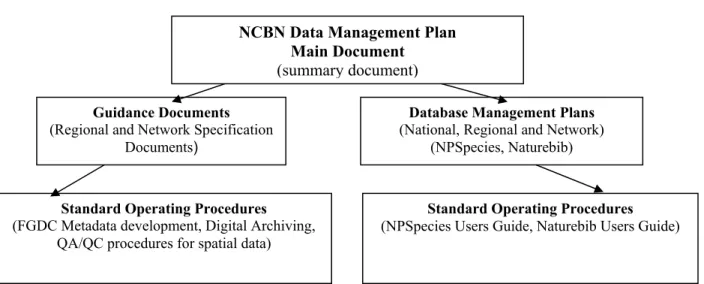
The conceptual model in Figure 1.1 shows the layout of the NCBN Information Management Plan. There will be three tiers of document types with multiple modules within tiers.
NCBN Information Management Plan
6
Figure 1.1 Layout of the NCBN Information Management Plan
Guidance Documents (Regional and Network Specification
Documents)
Database Management Plans (National, Regional and Network)
(NPSpecies, Naturebib)
Standard Operating Procedures (FGDC Metadata development, Digital Archiving,
QA/QC procedures for spatial data)
Standard Operating Procedures (NPSpecies Users Guide, Naturebib Users Guide) NCBN Data Management Plan
Main Document
(summary document)
Four document types are being developed as part of this plan:
1. The NCBN Information Management Plan (Summary Document)
2. Subject Specific Guidance Documents (GIS specs) (Some drafts available) 3. Specific Database Management Plans (NPSpecies, NatureBib)
4. Standard Operating Procedures (SOP) (Some drafts available)
NCBN developed this information management plan in modular format with the hope of increasing both its readability and usability among a wider audience. This format allows information plan users to easily locate and access subdocuments pertaining to a particular
element of information management guidance or process. Individual procedural documents from within the plan can be provided as standalone documents to park and regional data management staff, cooperators and project leaders. This format also allows for a more complete and technical review. Technical experts can be provided with applicable portions of the plan based on their expertise (GIS, Database, Metadata, GPS, etc.).
Standard Operating Procedures (SOP) developed as part of this plan detail work processes that are to be conducted or followed by Network staff and cooperators. SOPs are useful in that they document the way activities are to be performed to facilitate consistent conformance to technical and quality system requirements and to support data quality. The development and use of SOPs promotes quality through consistent implementation of a process or procedure within the organization, even if there are temporary or permanent personnel changes.
Chapter 2
Information Management Staff
Coordination of Roles and Responsibilities
An increasing demand for more detailed, high quality data and information about natural resources and ecosystem functions requires a group of people working together to steward data and information assets. Knowledgeable individuals from many disciplines must come together to ensure that data are collected using appropriate methods, and that resulting datasets, reports, maps, models, and other derived products are well managed. Datasets and the presentations of these data must be credible, representative, and available for current and future needs.
For the NCBN Inventory and Monitoring program to work effectively, everyone within the Network must have stewardship responsibilities in the production, analysis, management, and/or end use of data produced by the program. In order to meet the new data management goals and standards developed by the National Park Service and its constituents, Network staff must understand how data and information flow and what their roles and responsibilities are in this process.
Table 2.1 summarizes the data stewardship roles of various Network personnel. Each of these broad categories has primary, or ‘must-do’, responsibilities as well as many potential ancillary tasks. As coordinator of these tasks, the fundamental role of the Network data manager will be to understand and determine program and project requirements, to create and maintain data
management infrastructure and standards, and to communicate and work with all responsible individuals. This new and crucial emphasis on data management, analysis, and the reporting of results will require a large investment of personnel, time, and money. The NCBN Inventory and Monitoring Program expects to invest at least thirty percent of available resources in developing a high-quality data management system.
Table 2.1 Categories of data stewardship involving all Network personnel
Stewardship
Category Related Activities Principal jobs or positions Note: Each position is listed in only one category according to overriding responsibilities. However, most positions contribute in each category.
Production
Creating data or information from any original or derived source. This includes recording locations, images, measurements, and observations in the field, digitizing source maps, keying in data from a hardcopy source, converting existing data sources, image processing, and preparing and delivering informative products, such as summary tables, maps, charts, and reports.
Project Crew Member Project Crew Leader
NCBN Information Management Plan
Analysis
Using data to predict, qualify, and quantify ecosystem elements, structure, and function as part of the effort to understand these components, address monitoring objectives, and inform park and ecosystem
management.
Network Ecologist Resource Specialist
Management
Preparing and executing policies,
procedures, and activities that keep data and information resources organized, available, useful, compliant, and safe.
Network Data Manager Project Leader
GIS Manager
Information Technology Specialist Database Manager
National Level I&M Data Manager End Use
Obtaining and applying available information to develop knowledge that contributes to understanding and managing park resources.
Network Coordinator
Park managers and superintendents Others
This chapter describes the Network’s current Information management staff, as well as regional and Network park staff. As the Network’s Long-term Monitoring Program becomes fully implemented, the staffing configuration will change. These changes will include a need to better define the data management positions within the Network in relation to the implementation of the monitoring protocols. At this time, a number of Network long-term staffing plan scenarios are being reviewed by the Network’s Board of Directors and Technical Steering Committee. These scenarios include information management staff similar to the current configuration described below, with data management assistance contracted through one of the Regional Field Technical Support Centers (FTSC).
2.1 Information Management Staff
Management of information will be coordinated at national and regional levels.
2.1.1 National Level Staff and Coordination
At the national level, 32 Network data managers have been hired as part of the Inventory and Monitoring Program. I&M Program data managers regularly coordinate with each other and national program staff via annual meetings, conference calls, workgroups, a listserv, web sites, and informal communication. Data managers from these Networks share the workload by working closely with each other while developing their respective Network Data Management Plans. This model of cooperation and communication has been very effective, and should be applied to resource information management issues and implemented by administrators. The Northeast Coastal and Barrier Network maintains an active role in promoting practical consistency among protocols and datasets involving other Networks and organizations. GIS and data managers from all Network parks are encouraged to participate in program development and activities. Park data managers are encouraged to use Inventory and Monitoring Program
resources, and to communicate with Network and program staff to share knowledge, expertise and information.
2.1.2 Northeast Region Data Management Staff
The Northeast Region Inventory and Monitoring Program falls under the Natural Resource and Stewardship division of the Northeast Region Support Office (NESO), and directly under one of two Northeast Region Chief Scientists. Natural Resource and Stewardship staff at the regional level will assist regional Inventory and Monitoring staff in:
identifying and prioritizing regional and individual park needs
identifying qualified researchers and potential cooperators administering research contracts and cooperative agreements
providing scientific consultation as Network board of directors and science committee members
At the regional office level no over-arching natural resource data management positions existed prior to the development of the four regional I&M Networks. By 2005, the region will be staffed with four I&M Network data managers. Although some coordination has begun among the region’s information managers, it is expected that more coordination will occur with the inception of the NCBN data management plan, which will be the first I&M data management plan available in the region. With the use of this plan as a starting point, regional IT staff, GIS Coordinators, curators and Network data managers can better coordinate on future data
management initiatives and ideas within the region to improve on current data management practices.
NCBN data management staff have worked closely with park GMP planners in providing initial vertebrate inventory data collected as part of the Network’s I&M Program. Product
specifications developed by the Network have been adopted by regional science staff for use with cooperative agreements and contracts funded outside I&M. The NCBN data manager has acted as a reviewer of contract deliverables at the regional level, assuring that data management standards are clearly and completely written. Close coordination has begun between I&M data management staff and regional science staff to develop region-wide standard operating
procedures addressing various data management practices.
2.1.3 NCBN Information Management Staff
NCBN information management is coordinated by one permanent NPS data manager. The Network Data Manager supervises and coordinates one term NPS database manager/programmer and two part-time research associates at the University of Rhode Island through cooperative agreement.
Currently, most of the Network’s data management is conducted through cooperative agreements with two Regional NPS Field Technical Support Centers (FTSC):
Environmental Data Center at the University of Rhode Island
NCBN Information Management Plan
These FTSCs provide technical assistance to all of the parks in the Northeast as well as the four I&M Networks in the region.
North Carolina State University FTSC (NCSU FTSC)
The Center for Earth Observation at North Carolina State University has worked with the Northeast Region of the National Park Service (NPS) for over 10 years in the development of geographic information systems (GIS) for resource management. This activity has led to major advances in the planning and application of GIS technology in the NPS and has placed the Northeast Region among the leaders within the NPS in this regard.
In 1996, the Philadelphia Support Office of the Northeast Region designated NCSU as a Field Technical Support Center for GIS support. In this capacity NC State University has been involved in a variety of activities including: developing and reviewing park GIS plans;
developing hardware, software, and data acquisition strategies; providing telephone and on-site technical support; programming for GIS enhancement projects; teaching short courses in GIS operations; performing executive reviews; delivering national presentations; providing in-park assistance with GIS implementation and applications; and assisting with region-wide GIS strategic planning.
NCSU’s experience in GIS spans 20 years and includes a long association with public resource management agencies. The Center for Earth Observation is part of the College of Natural Resources and our GIS research program has focused on the development of appropriate sized GIS programs for non-centralized resource management (e.g. smaller NPS units, US Forest Service ranger districts, state park regions, etc.) The NCSU facilities include a full complement of GIS and related software packages, a separate remote sensing research program, a large array of computer hardware configurations within two laboratories, and over 10 professional staff.
University of Rhode Island FTSC (URI FTSC)
Similar to the NCSU FTSC, the URI FTSC provides the NPS with access to a broad spectrum of expertise that is brought to bear on critical cluster- and service-wide issues. The URI FTSC was developed to support all aspects of GIS research and practices as they relate to park management, including natural and cultural research and resource management, planning and development, interpretation, visitor services and facilities management. The URI FTSC serves as the focus site for GIS support for the National Parks in the New England Cluster. The NCSU FTSC supports those parks in the Chesapeake-Alleghany Cluster. NCBN parks are divided between the two clusters and therefore the Network relies on both centers for park GIS support.
Because the NCBN Network Coordinator and Data Manager are stationed at the University of Rhode Island the Network Data Manager assists in the supervision of research associates hired through the URI FTSC. At this time one research associate works as the Network’s NPSpecies Data Manager and the other assists the Network in database development and GIS. Network working data files are also housed on the FTSC server and backed-up on a regular basis as part of the center’s program. Technical and hardware support are provided to Network staff as needed.
2.1.4 Park Level Data Management Staff
Within the Network, two park data management positions exist, one at Cape Cod National Seashore (CACO) a prototype park and one at Assateague Island National Seashore (ASIS). CACO, ASIS, Gateway National Recreation Area (GATE) and Colonial National Historical Park (COLO) all have permanent park GIS Coordinators as well.
CACO Prototype Park
In 1996, CACO was identified as a prototype park for long-term ecological monitoring within the Atlantic and Gulf Coast biogeographic region. As a prototype park and in partnership with the U.S. Geological Survey (USGS), CACO was charged with developing and refining long-term monitoring protocols that could be of utility to other Atlantic and Gulf Coast parks, in addition to supporting management of Cape Cod's natural resources. With the advent of the Network
approach to inventory and monitoring, CACO’s prototype mission expanded to include focused technical support to the Northeast and Coastal Barrier Network.
Along with the development of long-term monitoring protocols, data management initiatives related to shared protocols are being coordinated between Network and CACO’s data
management staff. Databases for all shared protocols are being developed jointly by both Network and park staff. NCBN and CACO staff share ideas and procedures for all aspects of data management. The CACO prototypepark data manager has the same basic duties and responsibilities as the Network data manager, but also has the responsibility for mentoring and training others and developing and testing new approaches to data analysis, synthesis, and reporting of monitoring results.
The NCBN and CACO data management staff plan to update the Network data management plan as well as develop and update a plan for the prototype program at the park. Some data
management SOPs and guidelines will be developed jointly and shared by both programs.
2.2 Coordination of Roles and Responsibilities
A Role is a function or position (e.g., Data Manager).
A Responsibility is a duty or obligation (e.g., to review data records).
The Natural Resource Challenge states that collaboration among the National Park Service, other public agencies, universities, and non-governmental organizations is necessary to effectively acquire, apply, and promulgate the scientific knowledge gained in National Parks. The Inventory and Monitoring Program encourages coordination among participants at all levels to help ensure that data collected by NPS staff, cooperators, researchers, and others are entered,
quality-checked, documented, analyzed, reported, archived, cataloged, and made available for management decision-making, research, and education.
The following sections provide a general conceptual framework for all aspects of information management at the Network level. Related to the framework are the hypothetical roles and
NCBN Information Management Plan
responsibilities associated with each task. At this stage of development this framework is
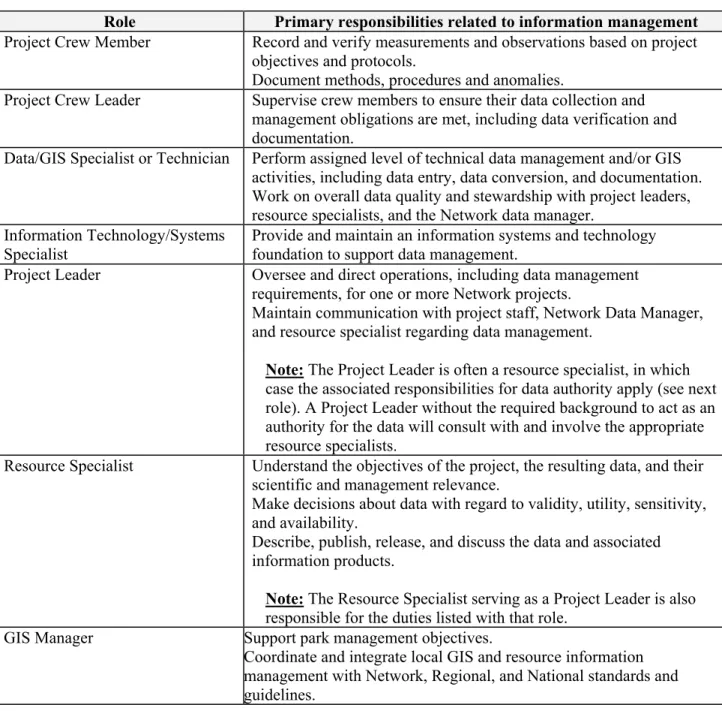
hypothetical because the Network has not completed its staffing plan. A number of scenarios are currently under review. Once a permanent staffing plan is in place, the framework presented below may change. However, this framework is useful in not only laying out potential staffing responsibilities, but also providing an example of the necessary coordination needed to maintain a quality data management program. Table 2.2 summarizes potential roles and responsibilities of Network and park personnel (See Appendix 25–Data Stewardship Responsibilities).
Table 2.2 Summary of Roles and Responsibilities
Role Primary responsibilities related to information management Project Crew Member Record and verify measurements and observations based on project
objectives and protocols.
Document methods, procedures and anomalies.
Project Crew Leader Supervise crew members to ensure their data collection and management obligations are met, including data verification and documentation.
Data/GIS Specialist or Technician Perform assigned level of technical data management and/or GIS activities, including data entry, data conversion, and documentation. Work on overall data quality and stewardship with project leaders, resource specialists, and the Network data manager.
Information Technology/Systems Specialist
Provide and maintain an information systems and technology foundation to support data management.
Project Leader Oversee and direct operations, including data management requirements, for one or more Network projects.
Maintain communication with project staff, Network Data Manager, and resource specialist regarding data management.
Note: The Project Leader is often a resource specialist, in which case the associated responsibilities for data authority apply (see next role). A Project Leader without the required background to act as an authority for the data will consult with and involve the appropriate resource specialists.
Resource Specialist Understand the objectives of the project, the resulting data, and their scientific and management relevance.
Make decisions about data with regard to validity, utility, sensitivity, and availability.
Describe, publish, release, and discuss the data and associated information products.
Note: The Resource Specialist serving as a Project Leader is also responsible for the duties listed with that role.
GIS Manager Support park management objectives.
Coordinate and integrate local GIS and resource information management with Network, Regional, and National standards and guidelines.
Role Primary responsibilities related to information management Network Data Manager Provide overall Network planning, training, and operational support
for the awareness, coordination, and integration of data and information management activities, including people, information needs, data, software, and hardware.
Serve as Point of Contact for National Park Service database applications (NPSpecies)
Coordinate internal and external data management activities.
Database Manager Apply particular knowledge and abilities related to database software and associated application(s)
Network Ecologist Ensure useful data are collected and managed by integrating natural resource science in Network activities and products, including objective setting, sample design, data analysis, synthesis, and reporting
Network Coordinator Ensure programmatic data and information management requirements are met as part of overall Network business
I&M Data Manager (National Level)
Provide service-wide database design, support, and services, including receiving and processing to convert, store, and archive data in service-wide databases
Other End Users These 'information consumers' include park managers and
superintendents, researchers, staff from other agencies, and the public. End users are responsible for the appropriate use and application of data and derived products and for providing feedback for
improvements.
2.2.1 NCBN Data Management Coordination
The Network data manager works with Inventory and Monitoring Program data management staff and regional resource information management personnel to maintain a high-level of involvement in service-wide and regional databases and data management policy. The Network data manager works locally with Network personnel, Park staff, and cooperators to promote and develop workable standards and procedures that result in the integration and availability of datasets.
Key contacts for the Network Data Manager include park GIS and data managers and the project leaders for each monitoring or inventory project. Consistent and productive communication among these personnel leads to common understanding and better synchronization of Network and park data management activities. Park and Network staff work together to manage resource information using a variety of methods. These include personal visits, phone calls, email, joint meetings and training sessions, as well as the meetings and work of the Network’s Technical Steering Committee and Board of Directors. Involvement and input from Park scientists and resource information management staff is essential.
NCBN Information Management Plan
2.2.2 Data Management Staff-Roles and Responsibilities
The data management staff is responsible for ensuring the compatibility of project data with program standards, for designing the infrastructure for the project data, and for ensuring long-term data integrity, security, and availability.
Data managers will:
develop and maintain the infrastructure for metadata creation, project
documentation, and project data management
create and maintain project databases in accordance with best practices and current program standards
provide training in the theory and practice of data management tailored to the needs of project personnel
develop ways to improve the accessibility and transparency of digital data establish and implement procedures to protect sensitive data according to project
needs
collaborate with GIS specialists to integrate tabular data with geospatial data in a
GIS system in a manner that meets project objectives Data managers will also work closely with the project leader to:
define the scope of the project data and create a data structure that meets project needs
become familiar with how the data are collected, handled, and used
review quality control and quality assurance aspects of project protocols and standard procedure documentation
identify elements that can be built into the database structure to facilitate quality
control, such as required fields, range limits, pick-lists and conditional validation rules
create a user interface that streamlines the process of data entry, review,
validation, and summarization that is consistent with the capabilities of the project staff
develop automated database procedures to improve the efficiency of the data summarization and reporting process
make sure that project documentation is complete, complies with metadata requirements, and enhances the interpretability and longevity of the project data
ensure regular archival of project materials
inform project staff of changes and advances in data management practices The GIS specialists manage spatial data themes associated with Network inventory and
monitoring projects, as well as other spatial data related to the full range of park resources. They incorporate spatial data into the GIS. They also maintain standards for geographic data and are responsible for sharing and disseminating GIS data throughout the Network.
The GIS specialists will:
determine the GIS data and analysis needs for the project
develop procedures for field collection of spatial data including the use of GPS and other spatial data collection techniques
display, analyze, and create maps from spatial data to meet project objectives
properly document data in compliance with spatial metadata standards GIS specialists will also work directly with data managers to:
design databases and other applications for the Network
create relationships between GIS and non-spatial data
create database and GIS applications to facilitate the integration and analysis of both spatial and non-spatial data
establish and implement procedures to protect sensitive spatial data according to
project needs
develop and maintain an infrastructure for metadata creation and maintenance
ensure that project metadata are created and comply with national and agency
standards
2.2.3 Project Leaders
Since the data management aspects of every inventory or monitoring project normally require the expertise and involvement of several people over a period of months or years, it makes sense that one person is charged with keeping track of the objectives, requirements, and progress for each project. This project leader (or steward) is usually a resource management specialist with training and experience in the field of science related to the inventory or monitoring project. The project leader may have worked in the geographic area where the study occurs. This can be helpful as it gives the project leader a background of information to use when overseeing field work, coordinating with GIS and data managers on information management needs, evaluating data resources, and understanding the project’s objectives. A project leader who cannot act as an authority for the data should work with the appropriate resource specialists to account for those aspects of data stewardship.
To ensure the quality of each project, including data requirements, project leaders should be assigned only those projects they can effectively oversee based on workload and other relevant factors. Unless the project is short term (three months or less) the project will have at least one alternate or backup project leader to provide continuity in case the principal project leader becomes temporarily or completely unavailable.
2.2.4 Project Leaders-Roles and Responsibilities
The project leader is responsible for data quality during all phases of the project, including collecting, entering, handling, reviewing, summarizing, and reporting data. Developing project
NCBN Information Management Plan
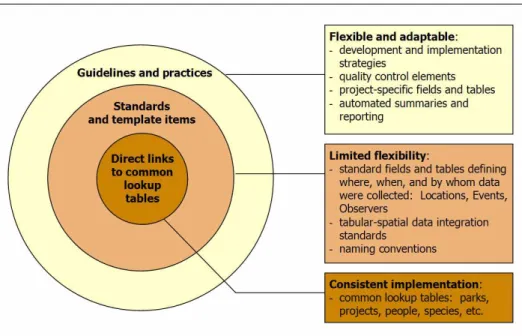
documentation and metadata are crucial elements of the project leader’s role. Figure 2.1 illustrates some of the overlap between project and data management responsibilities. Specifically, a project leader is responsible for:
project documentation that describes the ‘who,’ ‘what,’ ‘where,’ ‘when,’ ‘why,’ and ‘how’ of a project
documentation and implementation of standard procedures for field data
collection and data handling
quality assurance and quality control measures, which include the supervision and certification of all field operations, staff training, equipment calibration, species identification, data collection, data entry, verification, and validation
maintenance of concise explanatory documentation of all deviations from standard procedures
detailed documentation for each field data collection period
maintenance of hard copies of data forms and archiving of original data forms
scheduling of regular project milestones such as data collection periods, data processing target dates, and reporting deadlines
regular summary reports, periodic trend analysis of data, resulting reports, and
their public availability
acting as the main point of contact concerning data content The project leader will also work closely with the data manager to:
develop quality assurance and quality control procedures specific to project
operations
identify training needs for staff related to data management philosophy, database software use, and quality control procedures
coordinate changes to the field data forms and the user interface for the project database
document and maintain master data
identify sensitive information that requires special consideration prior to
distribution
manage the archival process to ensure regular archival of project documentation, original field data, databases, reports and summaries, and other products from the project
define the process of how project data will be transformed from raw data into meaningful information
create data summary procedures to automate and standardize this transformation process
identify and prioritize legacy data for conversion and convert priority data sets to
a modern format
increase the interpretability and accessibility of existing natural resource information