Scientific Workflow Design for Mere Mortals
Timothy McPhillips, Shawn Bowers, Daniel Zinn, Bertram Lud¨ascher
University of California at DavisOne Shields Avenue Davis, CA 95616, U.S.A.
Abstract
Recent years have seen a dramatic increase in research and development of scientific workflow systems. These systems promise to make scientists more productive by automating data-driven and compute-intensive analyses. Despite many early achievements, the long-term success of scientific workflow technology critically depends on making these systems useable by “mere mortals”, i.e., scientists who have a very good idea of the analysis methods they wish to assemble, but who are neither software developers nor scripting-language experts. With these users in mind, we identify a set of desiderata for scientific workflow systems crucial for enabling scientists to model and design the workflows they wish to automate themselves. As a first step towards meeting these requirements, we also show how the collection-oriented modeling and design (COMAD) approach for scientific workflows, implemented within the Kepler system, can help provide these critical, design-oriented capabilities to scientists.
1. Introduction
Scientific workflow technology has emerged over the last few years as a challenger to long-established approaches to au-tomating computational tasks. Due to the wide range of analyses performed by scientists, however, and the diverse requirements associated with their automation, scientific workflow systems are forced to address an enormous variety of complex issues. This situation has led to specialized approaches and systems that focus on particular aspects of workflow automation, such as workflow deployment within high-performance computing and Grid environments [TBF+06,DSS+05,PA06,FPD+05],
fault-tolerance and recovery [TTK+07,ABJF06,HK03], workflow
composition languages [GRD+07,SdSGS06,BL05], workflow
specification management [DRGS07,WGG+07], and workflow and data provenance [GLM04,BCS+05,ZWF06,SPG05]. A far smaller number of systems have been developed explicitly to provide generic and comprehensive support for the various chal-lenges associated with scientific workflow automation (e.g., [LAB+06,MSTW04,OGA+06]).
The intended users of many of these systems (particularly the latter, more comprehensive ones) are scientists who are ex-pected to interact directly with the systems to design, configure, and execute scientific workflows. Consequently, the long-term success of such scientific workflow systems critically depends on making these systems not only useful to scientists, but also directly useable by them. As such, these systems must provide scientists with explicit and effective support for workflow mod-eling and design. Regardless of how a workflow is ultimately deployed—within a local desktop computer, web server, or dis-tributed computing environment—scientists must have models and tools for designing scientific workflows that correctly and efficiently capture their desired analyses. In this paper we iden-tify important requirements for scientific workflow systems and
Email addresses:[email protected](Timothy McPhillips),
[email protected](Shawn Bowers),[email protected]
(Daniel Zinn),[email protected](Bertram Lud¨ascher).
presentCOMAD, a workflow modeling and design framework that aims to address these needs.
Scripting Languages for Tool Integration. Many scientists today make extensive use of batch files, shell scripts, and programs written in general-purpose scripting languages (e.g., Perl, Python) to automate their tool-integration tasks. Such programs typically combine and chain together sequences of heterogeneous applications for processing, manipulating, man-aging, and visualizing data. These generic scripting languages are often distinguished from more specialized languages, com-puting platforms, and data analysis environments (e.g., R, SAS, Matlab), which target scientific users with more sophis-ticated needs (e.g. data analysts, algorithm developers, and researchers developing new computational methods for partic-ular domains). Many of these more specialized scientific com-puting platforms now provide support for interacting with and automating external applications, and domain-specific libraries are increasingly being developed for use via scripting lan-guages (e.g., BioPerl1). Thus, for scientific workflow systems to become broadly adopted as a technology for assembling and automating analyses, these systems must provide scientists con-crete and demonstrable advantages, both over general-purpose scripting languages and more focused scientific computing environments currently occupying the tool-integration niche. Scientific Workflow Systems. Existing scientific workflow systems generally share a number of common goals and charac-teristics [GDE+07] that differentiate them from tool-integration
approaches based on scripting languages and other platforms with tool-automation features. One of the most significant dif-ferences is that whereas scripting approaches are largely based on imperative languages, scientific workflow systems are typi-cally based ondataflow languages[JHM04,GDE+07] in which
workflows are represented as directed graphs, with nodes de-noting computational steps (oractors), and connections repre-senting data dependencies (and data flow) between steps. Many
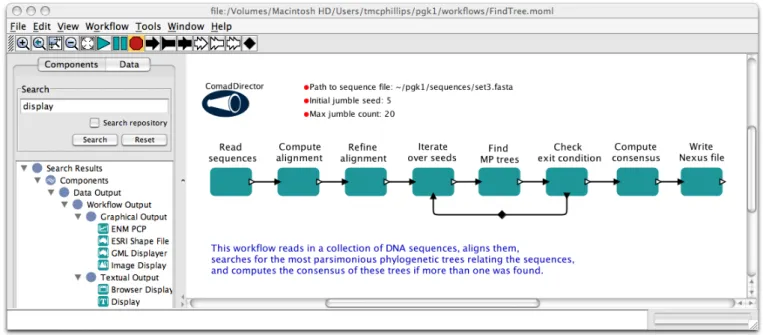
Fig. 1. A phylogenetics workflow implemented in the Kepler system. Kepler workflows are built fromactors(boxes) that perform computational tasks. Users can select actors from component libraries (panel on the left) and connect them on the canvas to form a workflow graph (center/right). Connections specify
dataflow between actors. Configuration parameters can also be provided (top center), e.g., the location of input data and the initial jumble seedvalues are
given. Adirector(top left corner on the canvas) is a special component, specifying a model of computation and controlling its execution.
systems (e.g., [BCS+05,LAB+06,MSTW04,OGA+06]) allow workflows to be created and edited using graphical interfaces (see Fig. 1 for an example in Kepler). The dataflow paradigm is well-suited for supporting modular workflow design and fa-cilitating reuse of components [JHM04,LP95,LAB+06,BL05].
Many workflow systems (e.g., [OGA+06,LAB+06]) further
allow workflows to be used as actors in other workflows, thus providing workflow authors an abstraction mechanism for hiding implementation details and facilitating even more reuse. One advantage of workflow systems that derives from this dataflow-orientation is the ease with which data produced by one actor can be routed to multiple downstream actors. While the flow of data to multiple receivers is often difficult to de-scribe clearly in plain text, the dataflow approach makes ex-plicit this detailed routing of data. For instance, in Fig. 1 it is clear that data can flow directly fromRefine alignmentonly toIterate over seeds. The result is that scientific workflows can be more declarative about the interactions between actors than scripts, where the flow of data between components is typ-ically hidden within (often complex) code. The downside of this approach is that if taken too far, specifications of complex scientific workflows can become a confusing tangle of actors and wires unless the workflow specification language provides additional, more sophisticated means for declaring how data is to be routed (asCOMADdoes—see below as well as [MBL06] and [BLNC06]).
Other notable advantages of scientific workflow systems over traditional approaches are their potential for transparently opti-mizing workflow performance and automatically recording data and process provenance. Unlike most scripting language im-plementations, scientific workflow systems often provide capa-bilities for executing workflow tasks concurrently where data
dependencies between tasks allow, either in an “assembly-line” fashion with actors connected in a linear pipeline performing their tasks simultaneously, or in parallel with multiple such pipelines operating at the same time (e.g., over multiple input data sets or via explicit branches in the workflow specification) [YB05,PA06,MBL06]. Many scientific workflow systems also can record, store, and query data and process dependencies that result during one or more workflow runs, enabling scientists to later investigate the data and processes used to derive results and to examine intermediate data products [SPG05,ML08].
While these and other advantages of systems designed specif-ically to automate scientific workflows help to position these technologies as viable alternatives to traditional approaches based on scripting languages and the like, much is yet required to achieve the vision of putting workflow automation fully into the hands of “mere mortals” [GDE+07]. Much remains to be done to realize the vision of scientists untrained in program-ming and relatively ignorant of the details of information tech-nology rapidly composing, deploying, executing, monitoring, and reviewing the results of scientific workflows without assis-tance from information-technology experts.
Contributions and Paper Outline.In this paper we describe key aspects of scientific workflow systems that can help en-able broader-scale adoption of workflow technology by scien-tists, and demonstrate how these properties can be realized by a novel and generic workflow modeling paradigm that extends existing dataflow computation models. In Section 2, we present what we see as important desiderata for scientific workflow systems from a workflow modeling and design perspective. In Section 3, we describe our main contribution, thecollection
deliver-ing on the expectations described in Section 2. Our framework is especially suited for cases where data is nested in structure and computational steps can be pipelined (which is often true, e.g., in bioinformatics). The COMAD framework provides an assembly-line style computation approach that closely follows the spirit of flow-based programming [Mor94]. The COMAD
framework has been implemented as part of the Kepler sys-tem [LAB+06] and has been successfully used to implement a range of scientific workflows. Finally, we discuss related work in Section 4 and conclusions in Section 5.
The goal of this paper is not to show that our approach is the best way to implement all scientific workflows, but rather to demonstrate that the ambitious-sounding requirements com-monly attached to scientific workflows and spelled out explic-itly in Section 2 can largely be satisfied by an approach appli-cable to a range of scientific domains. We hope in this way to inspire others to further identify and tackle head-on the chal-lenges to wide-scale adoption of scientific workflow systems by the scientific community.
2. Desiderata for Scientific Workflow Systems
The following desirable characteristics of scientific work-flow systems are targeted at a specific set of users, namely, re-searchers in the natural sciences developing their own scientific
workflows to automate and share their analyses. For these users
to benefit from scientific workflows, we believe workflow sys-tems should distinguish themselves from scripting languages and other general purpose tools in three principal ways: (1) they should help scientists design and implement workflows; (2) they should provide first-class support for modeling and man-aging scientific data, not just analytical processes; and (3) they should take responsibility for optimizing performance. Within these three categories we argue for eight specific desiderata for scientific workflow systems.
The desiderata presented below are based on our own expe-riences working with scientists through various projects aimed at implementing scientific workflows and developing support-ing workflow technology. These desiderata largely arrise from issues concerning workflow modeling and design, and in the following section we describe how these requirements can be satisfied using theCOMAD approach (see Fig. 2). While exist-ing scientific workflow systems support some or all of these desiderata in a variety of ways (see [YB05] and Section 4), we focus below on the capabilities and limitations of the Kepler scientific workflow system, which provides the framework and context for most of our work.
2.1. Assist in the Design and Implementation of Workflows
Scientific workflow systems such as Kepler expect the user to compose workflows incrementally, selecting modules from a library of installed components and wiring the components to-gether. Kepler currently helps the user during the workflow de-sign process in a number of ways. For example, Kepler enables powerful keyword searches over actor metadata and ontology
annotations to quickly find relevant actors in local or distributed libraries [BL05]. Similarly, subworkflows can be encapsulated as composite actors within Kepler workflows, and output data types of one actor can be checked against the expected input types of another actor. However, workflow systems are ideally placed to do much more to make it easy to design workflows. Well-Formedness:Workflow systems should make it easy to
design well-formed and valid workflows. (WFV)
Workflow systems should be able to detect when workflows do not make sense overall, or when parts of the workflow will not contribute to the result of a run. Similarly, workflow sys-tems should enable users to declare the types of the expected inputs and outputs of a workflow, and ensure well-formedness by verifying that all workflow actors and input data items will indeed contribute to the production of the expected workflow products.
The reason for this is that scientific workflows are much more like recipes used in the kitchen, or protocols carried out in a lab, than is the average computer program. Workflows are meant to produce well-defined results from well-defined inputs, using well-defined procedures. Few scientists would commit to carrying out an experimental protocol that does not make clear what the overall process will entail, what products (and how much of each) the protocol is meant to yield, and how precisely that product will be obtained (see clarity below). Scientists would be justified in being equally dubious about a “scientific” workflow that is not as clear and predictable as the protocols they carry out in the lab. They should be particularly worried when the workflows they design are so obscure as to be not predictable in this way (seepredictabilitybelow).
Clarity:Workflow systems should make it easy to create
self-explanatory workflows. (CLR)
Any scientist composing a new workflow will have a fairly good idea of what the workflow should do when it executes. Ideally the system would confirm or contradict this expectation and thus provide immediate feedback to the scientist. In current systems, however, expectations about what will happen during a run often can only be checked by running a workflow on real data and checking if the results look reasonable. Because an actual run may be impractical to execute while developing a workflow, either because the run would take too long or be-cause the required computational resources cannot be spared, understanding the behavior of a workflow without running it would facilitate workflow design immensely.
One solution to this problem would be to make the language for specifying workflows so clear and declarative that a scien-tist could tell at a glance what a workflow will do when exe-cuted. This in turn requires that systems provide scientists with workflow abstractions relevant to their domain. Instead of en-meshing users in low-level details that obscure the scientific meaning of the workflow, systems should provide abstractions that hide these technical details, especially those details that have more to do with information technology than the particu-lar scientific domain.
Predictability: Workflow systems should make it easy to
un-derstand what a workflow will do before running it. (PRE)
Unfortunately, the complexities of data management and the need for iteration and conditional control-flow often make it difficult to foresee the complete behavior of a workflow even when the workflow is defined in terms familiar to the user. In these cases where the function of a workflow cannot be read directly from the workflow graph, systems need to be able to predict, in some way that is meaningful to a scientist, what will happen when a workflow is run.
Workflow systems should also make it easy for collaborators to understand the purpose and expected products of a work-flow. Many scientific projects involve multiple collaborators that rely on each other’s data products. Understanding data in such projects often requires understanding the analyses in-volved in producing the data. Thus, scientific workflow designs should also make it possible to quickly and easily understand the steps involved in an analysis by someone other than the creator of the workflow.
Recordability: Workflow systems should make it easy to see
what a workflow did do when it ran. (REC)
Understanding workflow behavior after it occurs is often more important to scientists than predicting workflow behavior in advance. There is no point in carrying out a “scientific” anal-ysis if one cannot later determine how results were obtained. Unfortunately, for various reasons, recording what happened within a workflow run is not as easy as it sounds. For instance, due to parallel and concurrent optimizations, the “raw” record of workflow execution will likely be as difficult to interpret as, e.g., a single log-file written to by multiple Java threads. There also are numerous types of events that can be recorded by a system, ranging from where and when a workflow was run, to the amount of time taken and memory used by each invocation (execution) of an actor, all the way down to the low-level de-tails of what hardware and software configurations were used during workflow execution. The latter details are useful primar-ily to engineers deploying workflow systems and troubleshoot-ing performance problems. For scientists what is most needed are approaches for accurately recording actor invocation events and associating these with the data objects consumed and pro-duced during each such that the scientific aspects of workflow runs can be reviewed later.
Reportability:Workflow systems should make it easy to see if
a workflow result makes sense scientifically. (REP)
Scientisits not only need to understand what data processing events occurred in a workflow run, but also how the products of the workflow were derived, from a scientific point of view, from workflow inputs. It is critical that this kind of data “lineage” information not distract the scientist with technical details hav-ing to do with how the workflow was executed. For example, it is not helpful to see that a particular sub-analysis was car-ried out at 11:39 PM on a particular node in the departmental Linux cluster when one is curious what DNA sequences were used to infer a particular phylogenetic tree. Instead, one would
hope that a scientist reviewing the results of a run of the work-flow in Fig. 1, e.g., could immediately see that the final phy-logenetic tree was computed directly from five other trees via an invocation of theCompute consensusactor; that each of these trees were in turn computed from a sequence alignment via invocations of theFind MP treesactor; and so on. Such depictions of data dependencies often are referred to as data
lineage graphs[ML08] and can be more effective as means for
communicating the scientific justification for a computed result than the workflow specification itself.
Reusability:Workflow systems should make it easy to design
new workflows from existing workflows. (REU)
Workflow development often means starting from an exist-ing workflow. Workflow systems should minimize the work needed to reuse and repurpose existing workflows as well as help prevent and reveal the errors that can arise when doing so. Note that with many programming tools it is often easier and less error-prone to start afresh, rather than to refactor existing code. We can do better than this if we provide scientists with the design assistance features described here.
In a similar way, it is important to make it easy for scientists to develop workflows in a manner compatible with and support-ive of their actual research processes. In particular, scientific projects are often exploratory in nature and the specific analy-ses of a project hard to predicta priori. Workflows must be easy to modify (e.g., by allowing new parameterizations, new input data, and new methods to be incorporated), chain together and compose, and track (i.e., to see in what context they were used, with what data, etc). Furthermore, support should be provided for designing workflows spanning a broad range of complex-ity, from those that are small and comprising only a few atomic tasks, to large workflows with many tasks and subworkflows.
2.2. Provide First-Class Support for Modeling Data
Scientists tend to have a data-centric view of their analy-ses. While the computational steps in an analysis certainly are important to scientists, they are not nearly as important as the data scientists gather, analyze, and create via their analyses. In contrast, current scientific workflow systems, including Kepler, tend to emphasize theprocessof carrying out an analysis. Al-though workflow systems enable scientists to perform powerful operations on data, they often provide only crude and low-level constructs for explicitly modeling data.
One consequence of this emphasis on process specifications (frequently at the expense of data modeling constructs) is that many useful opportunities for abstraction are missed. For ex-ample, if workflow systems require users to model their DNA sequences, alignments, and phylogenetic trees as strings, ar-rays, and other basic data types, then many opportunities for helping users design, understand, and repurpose workflows are lost.
Scientific Data Modeling: Workflow systems should provide data modeling and management schemes that let users
One solution is to enable actor developers to declare entirely new data types specific to their domains, thus making it easier to represent complex data types, to hide their internal struc-ture, and to provide intuitive abstractions of these types to the scientist composing workflows.
Another approach often used in workflow systems is to model data according to the corresponding file formats used for rep-resentation and storage (thus, file formats serve as data types). An actor in this case might take as input a reference to a file containing DNA sequences in FASTA format2, align these se-quences, and then output the alignment in the ClustalW format [THG94]. The biggest problem with this approach is that many file formats do not map cleanly onto individual data entities or simple collections of such entities. For example, a single file in Nexus format [MSM97] can contain phylogenetic charac-ter descriptions, data matrices, phylogenetic trees, and a wide variety of specialized information. It is very difficult to guess the function of a workflow module that takes one Nexus file as input and produces another Nexus file as output, or to ver-ify automatically the meaningfulness of a workflow employ-ing such an actor. It would be far better if workflow systems enabled modules to operate on scientifically meaningful types (as described above), and transparently provided application-specific files to the programs and services they wrap. Doing so would both help preserve the clarity of workflows and greatly enhance the interoperability of modules wrapping applications that employ different data formats.
Many application-specific file formats in science are meant primarily to maintain associations across collections of related data. A FASTA file can define a set of biological sequences. A Nexus file can store and declare the relationships between phy-logenetic data matrices and trees inferred from them. Workflow systems also must provide ways of declaring and maintaining such associations without requiring module authors to design new, complex data types each time they run into a new com-bination of data items that must be operated on or produced together during a workflow. For example, a domain-specific data type representing a DNA sequence is useful to have, but it would be onerous to require that there be another custom data type representing a setof DNA sequences. Thus, work-flow systems should provide generic constructs for managing collections of data.
Workflow systems that lack explicit constructs for managing collections of data often lead to “messy” workflows containing either many connections between actors to communicate the size of lists produced by one actor to actors consuming these lists; or many data assembly and disassembly actors; or both. The consequence of such ad hoc approaches for maintaining data associations during workflow runs is that the modeling of workflows and the modeling of data become inextricably intertwined. This leads to situations in which the structure of the dataprocessed by a workflow is itself encoded implicitly in the workflow specification—and nowhere else.
Workflow systems should clearly separate the modeling and design of data flowing through workflows from the modeling 2 http://www.ncbi.nlm.nih.gov/blast/fasta.shtml
and design of the workflow itself. Ideally, the workflow def-inition would specify the scientifically meaningful steps one wants to carry out; the data model would specify how the data is structured and organized, as well as how different parts of data structures are related to each other; and the workflow system would figure out how to carry out the workflow on data struc-tured according to the given data model. While this may sound difficult to achieve, the closer we can get to achieving this sep-aration the better it will be for scientists employing workflow systems.
2.3. Take Responsibility for Optimizing Performance
Much of the impetus for developing scientific workflow sys-tems derives from the need to carry out expensive computa-tional tasks efficiently using available and often distributed re-sources. Workflow systems are used to distribute jobs, move data, manage multiple processes, and recover from failures. Existing workflow systems provide support for carrying out some or all of these tasks either explicitly, as part of work-flow deployment, or implicitly, by including these tasks within the workflow itself. The latter approach is often used today in Kepler, resulting in specifications that are cluttered with job-distribution constructs that hide the scientific intent of the work-flow. Workflows that confuse systems management with scien-tific computation are difficult to design in the first place and extremely difficult to re-deploy on a different set of resources. Even worse, requiring users to describe such technical details in their workflows excludes many scientists who have neither the experience nor interest in playing the role of a distributed operating system.
Automatic Optimization: Workflow systems should take
re-sponsibility for optimizing workflow performance. (OPT)
Even when workflows are to be carried out on the scien-tist’s desktop computer, performance optimizations frequently are possible. However, systems should not require scientists to understand and avoid concurrency pitfalls—deadlock, data cor-ruption due to concurrent access, race conditions, etc.—to take full advantage of such opportunities. Rather, workflow systems should safely exploit as many concurrent computing opportu-nities as possible, without requiring users to understand them. Ideally, workflow specifications would be abstract and employ metaphors appropriate to the domain rather than including ex-plicit descriptions of data routings, flow control, and pipeline and task parallelism.
3. Addressing the Desiderata with COMAD
In this section, we describe how thecollection-oriented
mod-eling and design (COMAD) framework promises to make it
easier for scientists to design workflows, to clearly show how workflow products were derived, to automatically optimize the performance of workflow execution, and otherwise make sci-entific workflow automation both accessible and practical for scientists. We also detail specific technical features ofCOMAD
Workflow System Desiderata Workflow & System Features Enabled by COMAD
Clarity (CLR).Make it easy to create self-explanatory work-flows.
Explicit actor read- and write-scope configurations require fewer ‘shims’ or ‘adapters’ that often clutter conventional workflow models. Workflows consist of actors that correspond to scientifically meaningful tasks.
Well-Formedness (WFV).Make it easier to design well-formed and valid workflows.
Workflow system can statically determineactor relevanceviaCOMADtype propagation.
Predictability (PRE).Make it easy to see what a workflow will do without running it.
Workflow system can statically infer output schema, actor dependencies, and schema
lineage graphshowing data transformations before runtime;minimal input schemacan also be inferred.
Recordability (REC). Make it easy to see what a workflow actually did do when it ran.
Workflow system can record “detailed”provenanceof all relevant events inCOMAD, e.g.,
actor invocations and associated inputs and outputs.
Reportability (REP).Make it easy to see if a workflow result makes sense scientifically.
Workflow system can provideprovenanceof data products by deriving an intuitive
data-dependency graph from the detailed provenance records.
Reusability (REU).Make it easy to design new workflows from existing ones.
Read- and write-scopeconfigurationandpart-of subtypingmake workflows more
change-resilientwith respect to input schema changes and actor insertions and deletions.
Scientific Data Modeling (SDM). Provide first-class support for modeling scientific data.
Nested collections(XML-like tree structures) are the basic data-modeling abstraction in
COMAD, with explicit support for user-defined data types.
Automatic Optimization (OPT).Systems should take respon-sibility for optimizing performance.
Workflow system can providetask-and pipeline-parallelism(streaming data, concurrent
actors). Additional support for data shipping optimization by exploiting schema (type)
information.
Fig. 2. Desiderata for scientific workflow systems (from the perspective of a scientist wishing to automate and share their scientific analyses) and theCOMAD
features addressing these desiderata.
to show how it realizes the desiderata explicated above. Fig. 2 summarizes theCOMAD features described here and how they relate to the desiderata of Section 2.
3.1. An Introduction toCOMAD
As mentioned in Section 1, the majority of scientific work-flow systems represent workwork-flows using datawork-flow languages. The specific dataflow semantics used, however, varies from sys-tem to syssys-tem [YB05]. Not only do the meaning of nodes, and of connections between nodes, differ, but the assumptions about how an overall workflow is to be executed given a specification can vary dramatically. Kepler makes explicit this distinction between the workflow graph, on the one hand, and the model of computation used to interpret and enact the workflow on the other, by requiring workflow authors to specify adirector
for each workflow (see Fig. 1). It is the director that specifies whether the workflow is to be interpreted and executed accord-ing to a process network (PN), synchronous dataflow (SDF), or other model of computation [LSV98].
Most Kepler actors in PN or SDF workflows aredata
trans-formers. Such actors consume data tokens and produce new
data tokens on each invocation; these actors operate like func-tions in traditional programming languages. Other actors in a PN workflow can operate as filters, distributors, multiplexors, or otherwise control the flow of tokens between other actors; however, the bulk of the computing is performed by data trans-formers.
Virtual assembly-lines.InCOMAD, the meanings of actors and connections between actors are different from those in PN or SDF. Instead of assuming that actors consume one set of to-kens and produce another set on each invocation, COMAD is
based on an assembly-line metaphor:COMADactors (coactors
or simplyactorsbelow) can be thought of as workers on a vir-tual assembly-line, each contributing to the construction of the workflow product(s). In a physical assembly line, workers per-form specialized tasks on products that pass by on a conveyor belt. Workers only “pick” relevant products, objects, or parts thereof, and let all irrelevant parts pass by. Coactors work anal-ogously, recognizing and operating on data relevant to them, adding new data products to the data stream, and allowing irrel-evant data to pass through undisturbed (see Fig. 3). Thus, unlike actors in PN and SDF workflows, actors aredata preservingin
COMAD. Dataflows throughserially connected coactors rather
than being consumed and produced at each stage.
Streaming nested data collections.A number of advantages can be gained by adopting an assembly-line approach to sci-entific workflows. Possibly the biggest advantage is that one can put information into the data stream that could be repre-sented only with great difficulty in plain PN or SDF workflows. For example, COMAD embeds special tokens within the data stream to delimit collections of related data tokens. Because thesedelimiter tokensare paired, much like the opening and closing tags of XML elements (as shown in Fig. 3), collections can be nested to arbitrary depths, and this generic collection-management scheme allows actors to operate on collections of elements as easily as on single data tokens. Combined with an extensible type system, this feature satisfies many of the data modeling needs described in Section 2. Similarly, annotation
tokenscan be used to represent metadata for collections or
in-dividual data tokens, or for storing within the data stream the provenance of items inserted by coactors (see Fig. 3). The re-sult is that coactors effectively operate not on isolated sets of input tokens, but on well-defined, information-rich collections
of data organized in a manner similar to the tree-like structure of XML documents.
3.2. A Closer Look at COMAD
Here we take a technical look at some features ofCOMAD, illustrating how this approach makes significant progress to-wards satisfying the desiderata described above.
Actor configurations and scopes. Assume we want to place an actor A in a workflow where the step before A produces instances of type τ and the subsequent step requires data of typeτ0:
τ
−→ A: α→ω τ
0
−→
In the notation above, A : α → ω is the signature of actor
A such that A consumes instances of type α and produces instances of typeω. Conventional approaches require that the typeτ be a subtype ofαand thatω be a subtype of the type
τ0, denotedτ ≺ αandω ≺ τ0. Often these type constraints will not be satisfied when designing a workflow, and adapters or shims must be added to the workflow as explained below.
InCOMAD, we would instead modelAas acoactor:
τ
−→ ∆A: τα→τω τ0 −→
where an actorconfiguration∆A:τα→τωdescribes thescope
of workofA. More specificially,∆Ais used (i) to identify the
read-scopeταofA, i.e., the type fragments relevant forA, and
(ii) to indicate thewrite-scopeτωofA, i.e., the type of the new output fragments (if any). In addition, the configuration ∆A needs to prescribe (iii) whether the type fragments matching
ταare consumed (removed from the input stream) or kept, and (iv) where theτωresults are located withinτ0.
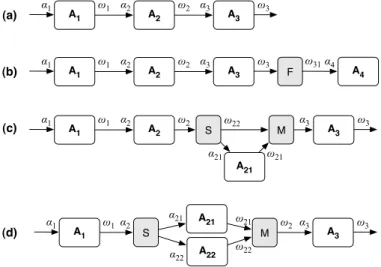
These ideas are depicted in Fig. 4, where the relevant frag-ments matchingταare shown as black subtrees. These are con-sumed by actorAand replaced byA’s outputs (of typeτω). Clarity(CLR)and Reusability(REU).In Fig. 5 we illustrate a number of issues associated with designing declarative (clear) and reusable workflows, two of the desiderata discussed in Sec-tion 2. ConvenSec-tional workflows tend to clutter a scientist’s con-ceptual design (Fig. 5a) with lower-level glue actors, thus mak-ing it hard tocomprehend andpredict a workflow’s behavior (Fig. 5b–d). Similarly, workflowreuseis made more difficult: when viewed in the context of workflow evolution, conventional workflows tend to be more “brittle”, i.e., break easily as new actors are added or exisiting ones are replaced. As mentioned above, a conventional actorAcan be seen as a data transformer, i.e., a functionA: α→ω. In Fig. 5a, each actor maps an input typeαito an output typeωi. The connection fromAi toAi+1
must satisfy the subtyping constraint ωi ≺ αi+1. This rigid
typing approach leads to the introduction ofadapters[BL05],
shims[HSL+04,RLSR+06], and to complex data- and
control-flow constructs to send the exact data fragments to the correct actor ports, while ensuring type safety.
For example, suppose we want to add to the end of the conceptual pipeline in Fig. 5a, the new actor A4 : α4 → ω4.
!21 !22 "22 "21 !31 !22 !21 "21 "4 A #" !A : #"" #!
#
#
' context paths "matched"fragments "replaced"fragments
!3 "1 !1 "2 !2 "3 A1 A2 A3 !3 "1 !1 "2 !2 "3 A1 A2 A3 F A4 !3 "1 !1 "2 !2 "3 A1 A2 A3 A21 S M !3 "1 !1 "2 !2 "3 A1 A22 A3 A21 S M (a) (b) (c) (d) #" #! #!
Fig. 4. The scope of actor (stream processor)Ais given by aconfiguration
∆A with read-scope τα (selecting relevant input fragments for A) and
write-scopeτω(forA’s outputs). Outputs replace inputs “in context”.
!21 !22 "22 "21 !31 !22 !21 "21 "4 A !" !# $" $# %&'()*+!'*,*$'- &*()*+!*)*./0*1112*111- &'*()*+!'*)*./0*1112*111- &3*()*+$*)*.40*1112*111-context "cut" fragments "replaced" fragments !3 "1 !1 "2 !2 "3 A1 A2 A3 !3 "1 !1 "2 !2 "3 A1 A2 A3 F A4 !3 "1 !1 "2 !2 "3 A1 A2 A3 A21 S M !3 "1 !1 "2 !2 "3 A1 A22 A3 A21 S M (a) (b) (c) (d)
Fig. 5. Conventional workflows are rarely the simple analysis pipelines that
scientists desire (a), but often require “glue” steps (adapters,shims), cluttering
and obfuscating the scientists’ conceptual design, leading to workflows that
are difficult to predict (PRE) and reuse (REU): filter adapterF(b); split-merge
adaptersS,M(c,d).
Ifω3 is a complex type, andA4 only works on apart of the
output ω3, then an additional actor F must be added to the
workflow (Fig. 5b) to filter the output ofA3 and so obtain the
parts needed byA4. Similarly, in Fig. 5c, suppose we wish to
add actorA21between two existing actors.A21works only on
specific parts of the output ofA2, and only produces a portion
of the desired subsequent input type α3. Here, we must add
two new shim actors to satisfy the type constraints: (i) the split actorSseparates the output of A2 into the parts required by A21 and the remaining, “to-be-bypassed” parts; and (ii) the
merge actorMcombines the output ofA21with the remaining
output ofA2, before passing on the aggregate toA3. Finally, in
Fig. 5d, a scientist might have discovered that she can optimize the workflow manually by replacing the actor A2 with two
specialized actors A21 and A22, each working in parallel on
distinct portions of the output ofA1. Similar to the previous
case, this replacement requires the addition of two new shim actors to appropriately split and merge the stream. We note that it is often the case that a single workflow will require many of these “workarounds”, not only making the workflow specification hard to comprehend, but also making it extremely difficult to construct in the first place.
In contrast, no shims are necessary to handle Fig. 5b–d in
COMAD. In cases (b) and (c), actor configurations select relevant
data items, passing everything else downstream. Similarly, (d) is implicitly and automatically achieved inCOMAD simply by
M3:2 M3:1 S1 Proj Trial Trees Seqs Almts S10 A1 A2 T1 T2 T3 Trees T6 M2:1 M5:1 M5:2 M7:1 M7:1 Trial Seqs S11 S20 Almts A3 A4 T7 T8 Trees Trees T9 M2:2 M5:3 M5:4 ... T4 T5 ... (b) (a) < Proj > < T rial > < Seqs > </ Seqs > </ Almts > < Almts > < T rial > < Seqs > </ Seqs > </ T rial > </ Proj >
M5: Find MP trees M7: Compute consensus
S1 S10 A1 A2 < T rees > </ T rees > T1 T2 T3 < T rees > </ T rees > T4 T5 T6 </ T rial > </ Almts > < Almts > A3 A4 < T rees > </ T rees > < T rees > </ T rees > T7 T8 T9 > > < > < > < > < < > > < > < > < > < < < ... ... > Data token
< Collection closing-delimiter token
> Collection opening-delimiter token
Insertion-event metadata token New data token produced by step
M:I Dependency & module invocation
M6: Check exit condition S11 S20
S DNA Sequence
A Sequence Alignment
T Phylogenetic Tree
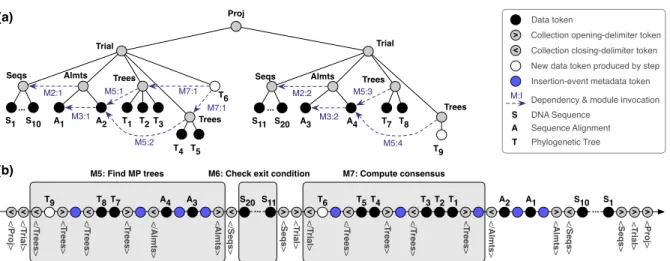
Fig. 3. An intermediate snapshot of a run of theCOMADphylogenetics workflow of Fig. 1: (a) the logical organization of data at an instant of time during the
run; and (b) the tokenized version of the tree structure showing three modules (i.e., actors) being invoked concurrently on different parts of the data stream.
InCOMAD, nested collections are used to organize and relate data objects that instantiate domain-specific types (e.g., denoting DNA sequencesS, alignments
A, and phylogenetic treesT). AProjcollection containing twoTrialsub-collections is used here to pipeline multiple sets of input sequences, and data
products derived from them, through the workflow. In COMAD, provenance events for data and collection insertions, insertion dependencies, and deletions
(from the stream) are added directly as metadata tokens to the stream (b), and can be used to induce provenance data-dependency graphs (a).
connectingA21andA22in series. Additionally inCOMAD, the
system can still optimize this to runA21andA22as task-parallel
steps (described further below). In short, the use of this part-of subtyping inCOMAD, based on configurations and scopes, enables more modular and change-resilient workflow designs than those developed using approaches based on strict (i.e., is-a) subtyping, since changes in irrelevant parts (e.g., outside the read-scopeτα) will not affect the validity of the workflow design.
Due to the linear topology of assembly lines,COMAD work-flows are also relatively easy to compose and understand. They resemble procedures such as recipes and lab protocols where the most important design criterion is that the specified sub-tasks be ordered to satisfy the dependencies of later tasks. For this reason, the meaning of a COMADworkflow often can be read directly from the workflow specification as in Fig. 1. Moreover, because most of the data manipulation and control flow con-structs that typically clutter other workflows are not required in
COMAD(the collection-management framework handles most
of these tasks transparently), what is read off the workflow graph is thescientificmeaning of the workflow.
Well-Formedness(WFV)via Type Propagation.A further ben-efit of requiring actors to declare read and write scopes is that we can employtype inferenceto determine various properties
ofCOMADworkflows. The type inference problem forCOMAD,
denoted as
τ∆;A
τ0,
is to infer the modified schemaτ0 = ∆A(τ)given an input type
τ and an actor configuration ∆A. We can restate the problem of findingτ0 as
τ0 = ((τ τα)⊕τω
| {z }
=∆A ),
which indicates that an actor configuration∆A:τα→τωcan recognize parts τα of the inputτ andadd additional partsτω
(denoted by⊕). It is also possible for the actor toremovethe original τα parts from the stream (denoted in the formula by ). Ifταis not removed, we say that the actor is in “add-only” mode.
Using type inference, we canpropagateinferred types down-stream along any path
τ ∆;A1 τ1 ∆;A2 τ2 ∆;A3 · · ·
once the initial input schema τ is known. Type propagation makes it possible to statically type-check (and thusvalidate)
a COMAD workflow design. For example, if an actor’s input
constraint is violated, we say the actorAwillstarve(or is
ex-traneous) for inputs of typeτ. There can be different reasons
whyA can starve. In particular, either A’s read-scope never matches anything inτ; or else, potential matches are not ac-ceptable subtypes ofτα. In both cases, the workflow can still be executed since theCOMADframework ensures that unmatched data simply flows through A unchanged. COMAD workflows are thus robust with respect to superfluous actors in a way that systems based on strict subtyping are not.
Predictability(PRE)via Type Propagation.Using static type inference, COMAD can help predict what a workflow will do when executed. Given an input schema and a workflow, we can compute the output schema of the workflow by propagating the schema information through the actors. Intermediate data products also can be inferred, together with information about which actors are used to create each product. Given an input schema (or collection structure), we can statically compute a
schema lineage graph, which explains which actors (or analysis
steps) refine and transform the input to finally produce the output.
The read and write scopes of actors inCOMAD workflows also can be used to reveal inter-actor dependencies. In an assembly-line environment it is not a given that each worker uses the products introduced by the worker immediately
up-stream and no others. Similarly, an actor in aCOMADworkflow might not work on the output of the immediately preceding coactor. Displaying to a workflow designer the actual de-pendencies would reveal accidently misconfigured actors that should be dependent on each other but are not due to scope mis-configurations, for example. Furthermore, we can stati-cally infer the minimal data structure that must be supplied to a workflow such that all actors will find some data within their scope and so be invoked at least once during a run. COMAD
thus allows us to provide scientists composing or examining workflows with a variety of predictions about the expected behavior of a workflow.
Optimization (OPT) via Pipeline Parallelism. In a manner similar to other dataflow process networks [LP95], actors in a
COMADworkflow operateconcurrentlyover items in the data
stream. In COMAD, rather than supplying the entire tree-like structure of the data stream to each actor in turn, a sequence of tokens representing this tree is streamed through actors. For ex-ample, Fig. 3 illustrates the state of aCOMADrun for the exam-ple workflow of Fig. 1 at a particular point in time, and contrasts the logical organization of the data flowing through the work-flow in Fig. 3a with its tokenized realization at the same point in time in Fig. 3b. This figure further illustrates the pipelining capabilities of COMAD by including two independent sets of sequences in a single run. This degree of pipeline parallelism is achieved in part by representing nested data collections at runtime as “flat” token streams that contain paired opening and closing delimiters to denote collection membership.
Optimization (OPT) via Dataflow Analysis. Type propaga-tion can also be used in COMAD workflows to minimize data shippings and maximize task parallelism. Consider the process pipeline
x→τ A −→ B −→ C τ
0
→y
denoted as(A→B→C)for short, with input typeτand output typeτ0. Type propagation starts with typeτ and then applies
actor configurations ∆A,∆B, and∆C to determine, e.g., the parts of A’s output (if any) that are needed as input toB and
C. If, e.g., one or more data or collection items ofA’s output are not relevant forB andC(based on propagated type infor-mation), these items are automaticallybypassedaround actors
BandCtoy(or beyond, depending on the actors downstream of C). Thus, what looks like an otherwise linear workflow
(A→B→C) can be optimized using static type propagation and analysis. In this example, by “compiling” the linear work-flow we might obtain one of the following process networks, based on the actual data dependencies of the workflow:
(AqBqC), (A→(BqC)), ((AqB)→C)
where (X q Y) denotes a task-parallel network with two
branches, one forX and one forY, respectively.
A simple example from physical assembly lines can further illustrate these optimizations. Consider a workerAwho is op-erating on the front bumper (τA) of a car (τ). Other parts of the car (included in τ τα) which are “behind” the bumper
(in the stream) cannot move pastA, despite the fact that they are irrelevant toA. InCOMAD it is possible to optimize such a situation by “cutting up” the input stream and immediately bypassing irrelevant parts downstream (e.g., to B orC). This minimizes data shipping costs and increases concurrency. In this case, we introduce into the network downstreammerge ac-torsthat receive various parts from upstreamdistribution ac-tors. Pairing of the correct data and collection items is done by creating so-called “holes”—empty nodes with specially as-signed identifiers—and corresponding “filler” nodes [Zin08]. Recordability(REC) and Reportability(REP).We also illus-trate in Fig. 3 how provenance information is captured and rep-resented during a COMAD workflow run. As COMAD actors add new data and collections to the data stream, they also add special metadata tokens for representing provenance records. For example, the fact thatAlignment2(denoted A2in Fig. 3) was computed fromAlignment1(denotedA1) is stored in the
insertion-event metadata token immediately preceding theA2
data token in Fig. 3b, and displayed as the dashed arrow from A2toA1 in Fig. 3a. When items are not forwarded by an
ac-tor,deletion-event metadata tokens are inserted into the data
stream, marking nodes as deleted so that they are ignored by downstream actors. From these events, it is possible to recon-struct and query data, collection, and process dependencies as well as determine the input and output data used for each actor invocation [BML08].
3.3. Implementation ofCOMAD
We have implemented many of the features of theCOMAD
framework described here and have included a subset of them in the standard Kepler distribution.3 We also have employed
COMADas the primary model of computation in a customized
distribution of Kepler developed for the systematics commu-nity.4 The COMADimplementation in Kepler extends the PN
(process network) director [LP95,MBL06,BL05], and pro-vides a rich set of Java classes and interfaces for developing
COMAD actors, managing and defining data types and
collec-tions, recording and managing runtime provenance events, and specifying coactor scopes and configurations.
We have developed numerous coactors as part of theCOMAD
framework and have used them to implement a variety of work-flows. We have implemented actors for wrapping specific ex-ternal applications, for executing web-based services, and for supporting generic operations on collections. We include tools in this framework for recording and managing provenance in-formation associated with runs ofCOMADworkflows, including a generic provenance browser. To facilitate the reuse of con-ventional actors developed for use with Kepler, we provide as part of the framework support for conveniently wrapping SDF sub-workflows in a manner that allows them to be employed as Kepler coactors [MBL06].
3 Seehttp://www.kepler-project.org 4 Seehttp://daks.ucdavis.edu/kepler-ppod
To demonstrate the potential optimization benefits of
COMAD, we also have recently developed a prototype
imple-mentation of a stand-aloneCOMAD workflow engine. The im-plementation is based on the Parallel Virtual Machine (PVM) library for message passing and job invocation, where each actor is executed as its own process and can run on a differ-ent compute node. Opening and closing delimeters (including holes and fillers) are sent using PVM messages; large data sets are managed as files on local filesystems and sent between nodes using secure copy (scp). Our experimental results have shown that the optimizations based on pipeline parallelism and dataflow analysis can lead to significant reductions in workflow execution time due to increased concurrency and fewer overall data shipments [Zin08]. As future work, we are interested in further developing this approach as part of the KeplerCOMAD
framework, allowing COMAD workflows designed within Kepler to be efficiently and transparently executed within distributed and high-performance computing environments.
3.4. Limitations ofCOMAD
Our applications ofCOMADhave shown that the advantages of this approach do come at a cost. First, COMAD workflows are easy to assemble only after the data associated with a par-ticular domain has been modeled well. Until this is done, it can be unclear how best to organize collections of data passing through workflows, and challenging to configure coactor scope expressions (just as designing an assembly line for constructing an automobile would be difficult in the absence of blueprints and assembly instructions). On the other hand, once the data in a domain of research has been modeled well, this step need not be repeated again by others.COMADmakes it easy to take advantage of the data modeling work done by others, but it does not allow the data modeling step in workflow design to be skipped altogether.
Second,COMADworkflows cannot always be composed sim-ply by stringing together a set of actors in an intuitive order. Often at least some of the coactors must be configured specif-ically for use in the context of the workflow being developed, and this requires an understanding of the assumed organization of data in the data sets to be provided as input to the workflow. We believe, however, that the design support tools described above will help make this step easier. Eventually, one can imag-ine workflow systems suggesting coactor configurations based on sample input data sets.
Third, many actors already have been developed for Kepler and other workflow systems, and these actors are not imme-diately useable as actors in COMAD workflows. As described above, however, we have developed an easy way to encapsulate conventional Kepler actors and sub-workflows within generic actors such that they can be employed seamlessly as coactors along with coactors originally developed as such.
Finally, while the assembly-line approach can make it easier for scientists to design and understand their workflows, a na¨ıve implementation of a COMAD workflow enactment engine can
result in a greater number of data transfers than would be
ex-pected for a more conventional workflow system. As discussed above, however, and described more fully in [ZBL07], static analysis of the scope expressions can be used to compile user-friendly, linear workflows into performance-optimized, non-linear workflows in which data is directly routed to just those actors that need it. Note that this optimization would be done at deployment or run time, leaving the workflow modeled by the scientist unchanged.
4. Related Work
The diversity of scientific data analyses requires that work-flow systems address a broad range of complex issues. Nu-merous, equally diverse approaches have been proposed and developed to address each of these needs. The result is that there is no single, standard conceptual framework for under-standing and comparing all of the contributions to this field, nor is there a common model for scientific workflow specifi-cations shared across even a majority of the major tools. This situation is similar to that faced by the business workflow com-munity [RtHEvdA05], where comparing the modeling support provided by systems based on Petri Nets, Event-Driven Process Chains, UML Activity Diagrams, and BPEL has proved chal-lenging, and defining conceptual frameworks that are meaning-ful across all these approaches equally difficult.
In this paper, we have primarily focused on issues related to modeling and design of scientific workflows, a key area in which we believe much progress still remains to be made before scientists broadly adopt scientific workflow systems. In this section we relate this aspect of our work to modeling and design approaches reported by other groups. For a broad comparison of systems, we refer the reader to one of the many surveys on scientific workflow systems, e.g., [YB05].
COMAD is, indeed, one of many modeling and design
frameworks for scientific workflows. Unlike other approaches,
COMAD extends the process network (PN) dataflow model
[LP95] by providing explicit support for nested collections of data, adding high-level actor scoping and configuration lan-guages, and enabling implicit iteration of actors over (nested) collections of data. This paper extends our previous work [MBL06] on COMAD by (1) describing a set of general re-quirements that, if satisfied, would lead to wider adoption of workflow systems by scientists; (2) presenting the abstract modeling framework offered byCOMADin terms of virtual as-sembly lines and their advantages for workflow design; and (3) illustrating how COMAD satisfies the various design-oriented desiderata described above.
COMAD shares a number of characteristics with
ap-proaches for query processing over XML streams, e.g., [CCD+03,CDTW00,BBMS05,KSSS04,GGM+04,CDZ06]. Most of these approaches consider optimizations of specific XML query languages or language fragments, sometimes tak-ing into account additional aspects of streamtak-ing data (e.g., sliding windows). COMAD differs by specifically targeting scientific workflow applications, by providing explicit support for modeling the flow of data through graphs of black-box
functions (actors), and by enabling pipeline and task-parallel concurrency without requiring the use of advanced techniques for preventing deadlocks and race conditions.
In common with [FPD+05,LAB+06,MSTW04], COMAD
does not restrict workflow specifications to directed acyclic graphs (e.g., [OGA+06,DSS+05,BV04,CJSN03,BCS+05] do have this limitation). We have found that supporting advanced workflow modeling constructs such as loops; conditional branches; sub-workflows; nested, heterogeneous models of computation (e.g., composite coactors built from SDF sub-worklows); and so on, leads to specifications of complex scien-tific analyses that more clearly capture the scienscien-tific intent of the individual computational steps and of the overall workflow.
TheCOMADapproach also can reduce the need for adapters and
shims [HSL+04,OGA+06] through its virtual assembly-line
metaphor, while still providing static typing support for work-flows (e.g., as in [OGA+06,LAB+06]) via type progagation
through read and write scopes. Taverna [OGA+06] provides a
simple form of implicit iteration over intermediate collections, but without scope expressions and collection nesting; and the ASKALON system [FPD+05], provides management support for large collections of intermediate workflow data.
Finally, considerable work within the Grid community has focused on approaches for optimizing scientific workflows, with the aim of making it easy for users to specify, deploy, and mon-itor workflows, e.g., [FPD+05,TBF+06,BGK+07,BGH+03]. Our hope is thatCOMADcan leverage the automatic optimiza-tion techniques employed by these approaches, while providing scientists intuitive and powerful workflow modeling and design languages and support tools.
5. Conclusion
As a first step towards meeting the needs of scientists with little programming experience, we have identified and de-scribed eight broad areas in which we believe scientific work-flow systems should provide modeling and design support:
well-formedness,clarity,predictability,recordability,
reporta-bility,reusability,scientific data modeling, andautomatic
op-timization, and have implemented a novel scientific workflow
and data management framework that largely addresses these desiderata. While the goal of making it easy to develop arbi-trary software applications might remain elusive forever, we believe that for scientific workflow automation there are good reasons for hope. We invite and encourage the community to join the quest for more scientist-friendly workflow modeling and design tools.
Acknowledgements. This work supported in part through NSF grants IIS-0630033, OCI-0722079, IIS-0612326, DBI-0533368, and DOE grant DE-FC02-07-ER25811.
6. References
[ABJF06] I. Altintas, O. Barney, and E. Jaeger-Frank. Provenance
Collection Support in the Kepler Scientific Workflow System. InIntl. Provenance and Annotation Workshop (IPAW), volume
4145 ofLNCS. Springer, 2006.
[BBMS05] M. Balazinska, H. Balakrishnan, S. Madden, and
M. Stonebraker. Fault-Tolerance in the Borealis Distributed
Stream Processing System. InACM SIGMOD, 2005.
[BCS+05] L. Bavoil, S. P. Callahan, C. E. Scheidegger, H. T.
Vo, P. Crossno, C. T. Silva, and J. Freire. VisTrails:
Enabling Interactive Multiple-View Visualizations. In IEEE
Visualization, page 18. IEEE Computer Society, 2005.
[BGH+03] A. Belloum, D. L. Groep, Z. W. Hendrikse, L. O. Hertzberger,
V. Korkhov, C. T. A. M. de Laat, and D. Vasunin.
VLAM-G: a grid-based virtual laboratory. Future Generation Comp.
Syst., 19(2):209–217, 2003.
[BGK+07] M. Bubak, T. Gubala, M. Kasztelnik, M. Malawski,
P. Nowakowski, and P. Sloot. Collaborative virtual laboratory for e-Health. In P. Cunningham and M. Cunningham, editors,
Expanding the Knowledge Economy: Issues, Applications, Case Studies. IOS Press, 2007.
[BL05] S. Bowers and B. Lud¨ascher. Actor-Oriented Design of
Scientific Workflows. In Intl. Conference on Conceptual
Modeling (ER), LNCS. Springer, 2005.
[BLNC06] S. Bowers, B. Lud¨ascher, A. H. Ngu, and T. Critchlow.
Enabling Scientific Workflow Reuse through Structured
Composition of Dataflow and Control-Flow. In
Post-ICDE Workshop on Workflow and Data Flow for Scientific Applications (SciFlow), 2006.
[BML08] S. Bowers, T. M. McPhillips, and B. Ludscher. Provenance
in Collection-Oriented Scientific Workflows.Concurrency and
Computation: Practice and Experience, 20(5):519–529, 2008.
[BV04] R. Buyya and S. Venugopal. The Gridbus toolkit for service
oriented grid and utility computing: an overview and status
report. In Intl. Workshop on Grid Economics and Business
Models (GECON), 2004.
[CCD+03] S. Chandrasekaran, O. Cooper, A. Deshpande, M. J. Franklin,
J. M. Hellerstein, W. Hong, S. Krishnamurthy, S. Madden, V. Raman, F. Reiss, and M. Shah. TelegraphCQ: Continuous
Dataflow Processing for an Uncertain World. InProceedings
of the 1st Biennial Conference on Innovative Data Systems Research (CIDR’03), 2003.
[CDTW00] J. Chen, D. DeWitt, F. Tian, and Y. Wang. NiagraCQ: A
scalable continuous query system for internet databases. In
ACM SIGMOD, pp. 379–390, 2000.
[CDZ06] Y. Chen, S. B. Davidson, and Y. Zheng. An Efficient XPath
Query Processor for XML Streams. In Intl. Conf. on Data
Engineering (ICDE), 2006.
[CJSN03] J. Cao, S. Jarvis, S. Saini, and G. Nudd. GridFlow: Workflow
Management for Grid Computing. InIntl. Symp. on Cluster
Computing and the Grid (CCGrid), 2003.
[DRGS07] D. De Roure, C. Goble, and R. Stevens. Designing the
myExperiment Virtual Research Environment for the Social
Sharing of Workflows. InIEEE Intl. Conf. on e-Science and
Grid Computing, pp. 603–610, 2007.
[DSS+05] E. Deelman, G. Singh, M.-H. Su, J. Blythe, Y. Gil,
C. Kesselman, G. Mehta, K. Vahi, G. Berriman, J. Good, A. Laity, J. C. Jacob, and D. S. Katz. Pegasus: a Framework for Mapping Complex Scientific Workflows onto Distributed
Systems. Scientific Programming Journal, 13(3):219–237,
2005.
[FPD+05] T. Fahringer, R. Prodan, R. Duan, F. Nerieri, S. Podlipnig,
J. Qin, M. Siddiqui, H. Truong, A. Villazon, and M. Wieczorek. ASKALON: A grid application development and computing
environment. InIEEE Grid Computing Workshop, 2005.
[GDE+07] Y. Gil, E. Deelman, M. Ellisman, T. Fahringer, G. Fox,
Examining the Challenges of Scientific Workflows. IEEE Computer, 40(2):24–32, 2007.
[GGM+04] T. J. Green, A. Gupta, G. Miklau, M. Onizuka, and D. Suciu.
Processing XML Streams with Deterministic Automata and
Stream Indexes. ACM Transactions on Database Systems
(TODS), 29(4):752–788, 2004.
[GLM04] P. Groth, M. Luck, and L. Moreau. A protocol for recording
provenance in service-oriented grids. In Intl. Conf. on
Principles of Distributed Systems, 2004.
[GRD+07] Y. Gil, V. Ratnakar, E. Deelman, G. Mehta, and J. Kim. Wings
for Pegasus: Creating Large-Scale Scientific Applications Using Semantic Representations of Computational Workflows. InProc. of the AAAI Conference on Artificial Intelligence, pp. 1767–1774, 2007.
[HK03] S. Hwang and C. Kesselman. GridWorkflow: A Flexible Failure
Handling Framework for the Grid. In IEEE Intl. Symp on
High-Performance Distributed Computing (HPDC), pp. 126– 137, 2003.
[HSL+04] D. Hull, R. Stevens, P. Lord, C. Wroe, and C. Goble. Treating
shimantic web syndrome with ontologies. InFirst Advanced
Knowledge Technologies Workshop on Semantic Web Services (AKT-SWS04), 2004.
[JHM04] W. M. Johnston, J. P. Hanna, and R. J. Millar. Advances in
dataflow programming languages. ACM Computing Surveys,
36(1):1–34, 204.
[KSSS04] C. Koch, S. Scherzinger, N. Schweikardt, and B. Stegmaier.
Schema-based Scheduling of Event Processors and Buffer
Minimization for Queries on Structured Data Streams. In
VLDB Conf., 2004.
[LAB+06] B. Lud¨ascher, I. Altintas, C. Berkley, D. Higgins, E. Jaeger,
M. Jones, E. A. Lee, J. Tao, and Y. Zhao. Scientific
Workflow Management and the Kepler System. Concurrency
and Computation: Practice & Experience, pp. 1039–1065, 2006.
[LP95] E. A. Lee and T. Parks. Dataflow Process Networks.
Proceedings of the IEEE, 83(5):773–799, May 1995.
[LSV98] E. A. Lee and A. L. Sangiovanni-Vincentelli. A framework
for comparing models of computation. IEEE Transactions on
Computer-Aided Design of Integrated Circuits and Systems, 17(12):1217–1229, 1998.
[MBL06] T. McPhillips, S. Bowers, and B. Ludscher. Collection-Oriented
Scientific Workflows for Integrating and Analyzing Biological
Data. 3rd International Workshop on Data Integration in the
Life Sciences (DILS’06), 2006.
[ML08] L. Moreau and B. Lud¨ascher, editors. Concurrency and
Comptuation: Practice and Experience, Special Issue on The First Provenance Challenge, volume 20(5). Wiley, 2008.
[Mor94] J. P. Morrison. Flow-Based Programming – A New Approach
to Application Development. Van Nostrand Reinhold, 1994.
[MSM97] D. Maddison, D. Swofford, and W. Maddison. NEXUS: An
extensible file format for systematic information. Systematic
Biology, 46(4):590–621, 1997.
[MSTW04] S. Majithia, M. S. Shields, I. J. Taylor, and I. Wang. Triana:
A Graphical Web Service Composition and Execution Toolkit.
InICWS, pp. 514–. IEEE Computer Society, 2004.
[OGA+06] T. Oinn, M. Greenwood, M. Addis, M. N. Alpdemir, J. Ferris,
K. Glover, C. Goble, A. Goderis, D. Hull, D. Marvin, P. Li, P. Lord, M. R. Pocock, M. Senger, R. Stevens,
A. Wipat, and C. Wroe. Taverna: Lessons in Creating a
Workflow Environment for the Life Sciences.Concurrency and
Computation: Practice & Experience, pp. 1067–1100, 2006.
[PA06] C. Pautasso and G. Alonso. Parallel computing patterns for
grid workflows. In Workshop on Workflows in Support of
Large-Scale Science (WORKS), 2006.
[RLSR+06] U. Radetzki, U. Leser, S. C. Schulze-Rauschenbach,
J. Zimmermann, J. L¨ussem, T. Bode, and A. B. Cremers. Adapters, shims, and glue—service interoperability for in silico
experiments. Bioinformatics, 22(9):1137–1143, 2006.
[RtHEvdA05] N. Russell, A. ter Hofstede, D. Edmond, and W. van der Aalst. Workflow data patterns: identification, representation and tool
support. InConf. on Conceptual Modeling (ER), volume 3716
ofLNCS, pp. 353–368, 2005.
[SdSGS06] L. Salayandia, P. P. da Silva, A. Q. Gates, and F. Salcedo.
Workflow-Driven Ontologies: An Earth Sciences Case Study. InIntl. Conf. on e-Science and Grid Technologies (e-Science), page 17, 2006.
[SPG05] Y. Simmhan, B. Plale, and D. Gannon. A survey of data
provenance in e-science.SIGMOD Record, 34(3):31–36, 2005.
[TBF+06] H. Truong, P. Brunner, T. Fahringer, F. Nerieri, and
R. Samborski. K-WfGrid distributed monitoring and
performance analysis services for workflows in the grid. In
IEEE Conf. on e-Science and Grid Computing (e-Science), 2006.
[THG94] J. Thompson, D. Higgins, and T. Gibson. CLUSTAL W:
improving the sensitivity of progressive multiple sequence alignments through sequence weighting, position specific gap
penalties and weight matrix choice.Nucl. Acids Res., 22:4673–
2680, 1994.
[TTK+07] T. Tavares, G. Teodoro, T. Kurc, R. Ferreira, D. Guedes,
W. Meira Jr., U. Catalyurek, S. Hastings, S. Oster, S. Langella,
and J. Saltz. An efficient and reliable scientific workflow
system. In Intl. Symp. on Cluster Computing and the Grid
(CCGrid), 2007.
[WGG+07] C. Wroe, C. A. Goble, A. Goderis, P. W. Lord, S. Miles,
J. Papay, P. Alper, and L. Moreau. Recycling workflows
and services through discovery and reuse. Concurrency and
Computation: Practice and Experience, 19(2):181–194, 2007.
[YB05] J. Yu and R. Buyya. A taxonomy of scientific workflow systems
for grid computing. SIGMOD Record, 34(3):44–49, 2005.
[ZBL07] D. Zinn, S. Bowers, and B. Ludscher. Change-Resilient Design
and Dataflow Optimization for Distributed XML Stream Processors. Technical Report CSE-2007-37, UC Davis, 2007.
[Zin08] D. Zinn. Modeling and optimization of scientific workflows.
InProc. of the EDBT Ph.D. Workshop, 2008.
[ZWF06] Y. Zhao, M. Wilde, and I. Foster. Applying the Virtual
Data Provenance Model. InIntl. Provenance and Annotation