17 July 2015 ■ UNCLASSIFIED
Enhanced Solutions for the Information Technology
Enterprise (E-SITE)
Ordering Guide
July 17, 2015
Notice: The official version of the E-SITE Ordering Guide is posted at WWW.DIA.MIL. Any printed copy is considered superseded. Please submit proposed changes and
comments on NIPRNet to: [email protected]
UNCLASSIFIED
Primary Points of Contact
Procuring Contracting Officer
E-SITE Program Manager
Esther L. Woods
Phyllis J. Wright
CFO4
CIO BPM
1
Table of Contents
1 EXECUTIVE SUMMARY ... 3
1.1 INTRODUCTION ... 3
1.2 STRATEGIC ALIGNMENT ... 3
1.3 WHAT IS THE E-SITECONTRACT ... 4
1.4 ADVANTAGES OF E-SITE ... 5
1.5 PURPOSE OF THE GUIDE ... 5
2 E-SITE STRUCTURE/LAYOUT ... 6
2.1 ROLES AND RESPONSIBILITIES ... 6
2.1.1 Procuring Contracting Officer (PCO) ... 6
2.1.2 E-SITE Program Manager and the CIO Business Planning and Management Branch (CIO BPM) ... 7
2.1.3 Intelligence Support Panel (ISP) ... 8
2.1.4 Intelligence Systems Panel Representative (ISPR) ... 8
2.1.5 Portfolio Manager ... 8
2.1.6 Requiring Activity (End-User) Responsibilities ... 9
2.1.7 Decentralized Contracting Officer (DCO) Responsibilities ... 10
2.1.8 COR Responsibilities ... 11
2.1.9 Security Responsibilities ... 11
2.2 TASK AREAS ... 11
2.3 CONTRACT TERMS ... 13
2.4 ORDER DURATION ... 13
2.5 OTHER E-SITEACQUISITION PLAN CONSIDERATIONS ... 14
2.5.1 Contractor versus Government Performance ... 14
2.5.2 Inherently Governmental Functions ... 14
2.5.3 Acquisition Plan ... 14
2.5.4 Market Research ... 14
3 HOW TO CONDUCT BUSINESS ... 17
3.1 ACQUISITION REQUIREMENTS PLANNING ... 17
3.2 TASK ORDER ACQUISITION PLANNING AND AWARD PROCESS ... 18
3.2.1 Establishing the TORP ... 18
3.2.2 Small Business Set Aside Determination ... 19
3.2.3 Conduct Technical Exchange Meeting with the E-SITE Vendors ... 20
3.2.4 Conduct An Advisory Multi-Step Process ... 20
3.2.5 Request for Proposal ... 20
3.2.6 Evaluation ... 21
3.2.7 Award ... 22
3.2.8 Executing Task Order ... 23
3.3 CONTRACT EXECUTION ... 24
3.3.2 Quality Assurance Surveillance Plan ... 24
3.3.3 Task Order Modifications ... 25
3.3.4 Material Purchases ... 25
3.4 CONTRACT CLOSEOUT ... 25
4 DECENTRALIZED ORDERING ... 26
5 REFERENCES ... 27
5.1 POINTS OF CONTACT ... 27
2
List of Appendices
APPENDIX A ... A-1 REQUEST E-SITE DECENTRALIZED ORDERING AUTHORITY LETTER (DOAL) ... A-1 A-2 SAMPLE APPROVING DECENTRALIZED ORDERING AUTHORITY LETTER (DOAL) ... A-2 APPENDIX B ... PERFORMANCE-BASED SERVICE ACQUISITION (PBSA) ... B-1 APPENDIX C ... E-SITE CHECKLIST ... C-1 APPENDIX D ... E-SITE PWS TASK ORDER TEMPLATE AND INSTRUCTIONS ... D-1 APPENDIX E ... QUALITY ASSURANCE SURVEILLANCE PLAN (QASP) AND PERFORMANCE REQUIREMENTS SUMMARY (PRS) MATRIX TEMPLATES AND SAMPLES ... E-1 APPENDIX F ... PREPARING INDEPENDENT GOVERNMENT COST ESTIMATES (IGCE) ... F-1 ASSUMPTIONS WHEN PREPARING YOUR IGCE (PROVIDE WITH THE IGCE) ... F-5 APPENDIX G ... INSTRUCTIONS FOR THE SUBMISSION OF OFFERS AND OTHER INFORMATION ... G-1 APPENDIX H ... COR NOMINATION LETTER ... H-1 APPENDIX I ... COR CONTRACT COMPLETION STATEMENT ... I-1 APPENDIX J ... DOCUMENTATION ACCOMPLISHED ... J-1 APPENDIX K ... ACRONYMS ... K-1
3
1 Executive Summary
1.1
Introduction
The E-SITE focus is directed towards improving integration, sharing information, gaining efficiencies and safeguarding information through a common IT approach. It is expected that a common architecture and consolidated operations, as well as increasing
migrations to the virtual and cloud environments, will improve mission outcomes. The goal is to move towards managed services versus traditional staff augmentation to align with the Intelligence Community’s Information Technology Enterprise (IC ITE) as
directed by the Director of National Intelligence (DNI).
E-SITE supports the transition to IC ITE, Joint Information Environment (JIE) and other IC efforts. E-SITE Contractors recommend strategies and courses of action that
specifically address improved mission capabilities, data migration, capacity planning, systems/infrastructure engineering, and support activities for IC ITE and enterprise operations. They actively engage, understand, and de-conflict the relationships between technologies and other capabilities that will be operating in infrastructure as a service; platform as a service; and potentially application as a service, as well as all identified government specific data types and operation support activities. E-SITE services include:
Standardizing and optimizing system and infrastructure designs and architectures.
Identifying and coordinating emerging IT solutions and technology integration opportunities.
Implementing innovative industry best practices and technologies that maximize efficiencies and cost savings.
Developing new systems while migrating infrastructure capabilities to meet mission requirements and improve operational efficiency of customers.
Delivering system and infrastructure capabilities that scale to meet enterprise demand with the least re-engineering effort possible.
Facilitating and monitoring the integration, interoperability, and synchronization of enterprise-wide systems and infrastructure solutions and services.
1.2
Strategic Alignment
E-SITE harnesses private sector capabilities to drive strategic IT advantage and value to its participating organizations, thus delivering mission and business capabilities versus simply delivering IT expertise. E-SITE industry partners have demonstrated and documented experience and expertise achieving strategic outcomes that include:
4
Effecting positive change on customer operating models and systems by understanding their needs, forecasting industry and the customer’s future, and then transitioning them into a better state.
Building and fostering effective working relationships between stakeholders, service providers, and industry partners.
Driving innovation, ingenuity, industry best practices, adoption of new technology (e.g., cloud computing, virtualization, mobile computing), and service/process transformation while sharing risk and reward.
Promoting flexibility and agility to meet new mission requirements, scaling services to demand, adapting to operating model and organizational changes, and dealing with challenging fiscal environments.
Provisioning services using a managed service delivery model, quantitative and qualitative key performance indicators, established service levels, quality
assurance reviews, and performance management corrections.
1.3
What Is the E-SITE Contract
E-SITE is a multiple award, Indefinite Delivery/Indefinite Quantity (IDIQ) contract vehicle with a program ceiling of $6.0 billion with a 5 year ordering period (basic period and four annual option periods).
The E-SITE contract provides worldwide coverage of IT requirements and technical support services supporting the Government through system design, development, fielding, and sustainment of global intelligence and Command and Control (C2) assets vital to the security of the United States (US).
The E-SITE contract vehicle supports both classified and unclassified programs on multiple networks and security domains. The services and capabilities supported by the E-SITE contract will provide responsive, flexible, adaptive, and timely solutions for participating organizations to satisfy current and future IT requirements. Technical requirements are included in the scope of the E-SITE contract and are delineated in Section 2.2. The Contractor shall provide services on site at government-designated facilities or at the Contractor’s site as specified in the individual Task Orders.
Participating organizations may use E-SITE Task Orders to provide IT services to customers across various Departments and Agencies include, but are not limited to: DIA, CCMDs, Air Force, Army, Marine Corps, Navy, Coast Guard, Joint Reserve Intelligence Program, National Command Authorities, other Department of Defense (DoD) Agencies, multi-national partners (e.g., coalition and alliance), and both DoD and non-DoD members of the Intelligence Community (IC) or other departments or agencies that consume services from the IC members.
While the vast majority of E-SITE contract work is on Top Secret networks, individual Task Orders will specifically identify which networks and domains (and their security
5
level) that are to be included in the scope of work. This may vary from by DoD agency/ component and location.
The E-SITE contract features decentralized ordering and is designed as a flexible and responsive end-user solution with acquisition streamlining advantages. E-SITE also provides a variety of pricing arrangements of the following major types: Fixed Price (FP), Cost Plus (CP), Labor Hour (LH), and Time and Material (T&M). These pricing arrangements can be combined on the individual Task Order.
E-SITE replaces DIA’s SITE multiple award IDIQ contract vehicle. As a multiple award IDIQ contract vehicle, the actual tasks will be awarded and completed via Task Orders. The E-SITE contract is limited by a 10% ceiling on T&M or FFP/LOE type Task Orders. Before soliciting for these two types of Task Orders, a written authorization must be obtained from the E-SITE PCO and the DIA Senior Procurement Executive.
1.4
Advantages of E-SITE
DIA’ Chief Information Office Business Planning and Management Branch (CIO-BPM) and IDIQ contract vehicle are structured to offer the following advantages:
CIO-BPM Office to support development of acquisition packages and facilitation through acquisition lifecycle.
Competitive, market-aligned rates.
Ability to hold vendors accountable for performance. Broad array of contract types and expertise.
Capacity and ability to achieve IC-wide initiatives. Flexible and responsive to quickly meet mission needs.
Ready access to qualified small businesses to help meet small business goals.
1.5
Purpose of the Guide
This guide provides the requiring activities (end users) with pertinent information for using the E-SITE IDIQ contract vehicle. It also provides guidance for obtaining decentralized ordering authority and outlines procedures for identifying E-SITE requirements through Task Order award. Section 2, outlines the roles and
responsibilities along with the E-SITE contract terms to facilitate the ordering process. Section 3 outlines the process of awarding and modifying an E-SITE Task Order. Section 4 outlines the decentralized order process. Section 5 provides references to E-SITE materials.
Please thoroughly review the information provided. If additional assistance is needed, please contact the applicable Points of Contact (POCs) identified in Section 5.
6
Notice: This guide is not intended to take precedence over any aspects of the contracts. In the event of any conflict between the information in this guide and the terms and conditions of the contract, the contract is the binding document.
2 E-SITE Structure/Layout
2.1
Roles and Responsibilities
This section describes the roles and responsibilities of primary E-SITE Stakeholders.
2.1.1
Procuring Contracting Officer (PCO)
DIA CFO-4 serves as the E-SITE PCO. The E-SITE PCO has overall contractual responsibility for the E-SITE contracts and all resultant DIA Task Orders. The E-SITE PCO’s responsibilities include:
Perform all contract administrative functions, including issuance of modifications, final decisions, explanations of terms and conditions and contract interpretation, and appointing CORs for DIA Task Orders.
Manage all protests, claims and contract litigation associated with the base IDIQ contracts (not individual Task Orders).
Ensure program and procedural compliance with the Federal Acquisition Regulation (FAR), DoD FAR Supplement (DFARS), and other governing regulations, policies, laws and statutes.
Provide guidance, upon request, to the Decentralized Contracting Office (DCO) executing Task Orders under the E-SITE contracts.
Chair the Vendor Performance Award Board and final Performance Award Decision Authority on individual Task Orders (except for decentralized orders). The final authority for determining scope of Task Orders and if that work is
permissible under the E-SITE contract.
Provide the CIO BPM a copy of all Task Order internal award documents and modifications and any other related attachments/documents.
Be the determining authority on all internal contract and Task Order disputes and claims and will be advised by the assigned representatives from the Office of the General Counsel. DCOs will be responsible for all claims, disputes. and protests received for their respective Task Orders.
Grants decentralized ordering authority via a Decentralized Ordering Authority Letter (DOAL) (Appendix A).
7
2.1.2
E-SITE Program Manager and the CIO Business Planning and Management
Branch (CIO BPM)
The DIA Chief Information Office (CIO) is the technical organization responsible for program management and technical oversight of the IDIQ contracts. The CIO
appointed the CIO BPM Branch Chief as the E-SITE Program Manager (PM). The CIO BPM is the designated office of responsibility for managing and administering the functional and technical oversight of the E-SITE contract vehicle. The CIO BPM provides guidance and acquisition lifecycle support to the Intelligence Support Panel (ISP). The CIO BPM also assist requiring activity and program managers with
developing the Task Order Requirements Package (TORP) including Performance Work Statements (PWS), Statements of Objectives (SOO), Statements of Work (SOW), Independent Government Cost Estimates (IGCE), Quality Assurance Surveillance Plans (QASP), DD-254, and Proposal Evaluation Criteria.
The E-SITE PM and CIO-BPM responsibilities include:
Manage the allocation of the contract ceiling on behalf of the CFO-4.
Track expenditure rates and overall IDIQ contract and Task Order performance of the E-SITE Task Orders, They will report monthly the statuses to DIA ClO management.
Process and track requests for the use of T&M Contract Line Item Number (CLIN) with Task Orders.
Maintain records of all decentralized ordering authority associated Task Orders, periodically reviewing for changes or adjustments of duration of authorities. Conduct regular and recurring Quarterly Business Reviews (QBRs) on all
E-SITE Task Orders with the E-E-SITE primes. Attendees will include the COR, the ISPRs, the PCO and all Decentralized Ordering Officers.
Attend DIA Vendor Performance Award Boards (except for decentralized orders).
Serve as Chairman of the ISP and convene the ISP at least annually, examining new or pending requirements and coordinating any potential changes to ceiling allocations.
Request a determination and approval of scope by the PCO when needed. Administer the Quality Assurance Surveillance Program and the Award Fee
Program.
Manage the E-SITE COR Training and Administration Program.
Work with external requiring activities that have decentralized ordering authority for the E-SITE contract to ensure consistency across all Task Orders.
8
2.1.3
Intelligence Support Panel (ISP)
The ISP is an appointed group of individuals who provide user representation and E-SITE program support to their respective Service/Agency users. Each Service/Agency that uses the E-SITE contract vehicle must designate a representative to serve on the ISP.
The ISP is chaired by the E-SITE PM. The roles and responsibilities of ISP Chair and representatives are contained within the ISP Charter which is available on the E-SITE websites.
2.1.4
Intelligence Systems Panel Representative (ISPR)
ISP Representatives are designated in writing by the CIO or other Senior Executive of that Agency/Service and are authorized to represent that organization in defining E-SITE program requirements to the E-E-SITE PM. The ISP Representative (ISPR) serves as the focal point for coordination with the E-SITE PM and servicing DCO. The ISP Representative will be responsible, as a minimum, for the following:
Being the primary point of contact for coordinating with the E-SITE PM and CIO BPM.
Validating the TO prior to submitting to the CIO BPM. Coordinate and provide oversight of the IA to include:
o Ensure the authorized ordering ceiling value is not exceeded o Process IA requests for additional ceiling as necessary
Provide recommendations for in-scope determinations by the PCO on potential E-SITE requirements.
Review TORPs to ensure packages are complete prior to submittal to the issuing DCO.
Assist in contractors’ proposal evaluations, if requested by the DCO. Support the E-SITE COR administration program.
Assist DCOs when necessary to resolve protests, claims, and disputes related to DCO issued Task Orders.
2.1.5
Portfolio Manager
The E-SITE PM appoints a Portfolio Manager who will provide cradle to grave
acquisition support for each E-SITE Task Order. The Portfolio Managers provide timely and accurate support to financial offices, contracting officers, ISPR, awardees and CORs in the coordination, preparation, and execution of all E-SITE requirements, to include:
Requirements Management:
o Determine if new IT requirements fit into a new or existing Task Order using CIO BPM requirement management processes
9
Task Order Scheduling and Status Reporting:
o Create and Manage Project and Acquisition Timelines
o Provide logistics support to facilitate Request for Information (RFI) and Vendor Technical Exchanges
o Coordinate with Decentralized Contracting Officer and Customers to facilitate RFI/Request for Proposal (RFP) Questions & Answers
Contract Management:
o Coordinate with contracting, finance, CIO BPM and Customers for Task Order Modifications and Funding
o Track programmatic aspects of E-SITE Task Orders o Coordinate Quarterly Business Reviews
Customer Liaison for Agency and Intelligence Support Panel Representatives: o Coordinate Decentralized Ordering Authority Letters
o Coordinate and Attend ISP Representative (ISPR) Meetings
Support to E-SITE Contracting Officer Representative (COR) and Task Orders Administrative CORs (ACOR):
o Support COR in his/her responsibilities as set forth in COR Appointment Letter
o Provide Status of Forces Agreement (SOFA) and Technical Expert Status Accreditation (TESA) Expertise
o Administer COR oversight program
o Review and assist COR/ACOR with issues from the contract activity report or monthly expense reports
2.1.6
Requiring Activity (End-User) Responsibilities
The requiring activity is engaged with defining the requirement and ensuring the contents of the TORP represent their needs. The requiring activity has the following roles and responsibilities:
Identify and document requirements.
Ensure funds are available by date of award.
Prepare PWS, SOO or SOW (guidance available from ISP Representative or DIA E-SITE Portfolio Manager).
Develop Proposal Evaluation Criteria. Develop IGCE.
Ensure the TORP is complete.
Participate in the Source Selection Board. Nominate a COR and QASP Monitor.
Perform technical and quality surveillance evaluations.
Monitor the QASP - documenting positive/negative contractor performance. Complete performance reports.
10
Ensure all deliverables have been submitted and meet Task Order requirements. Report any suspected fraudulent activities by E-SITE contractors to the
DCO/PCO for possible referral to the cognizant Inspector General (IG) office. Report the outcomes of any investigations conducted to the PCO, DCO, and the
E-SITE PM.
2.1.7
Decentralized Contracting Officer (DCO) Responsibilities
The contracting organization which issues and manages the decentralized ordering is responsible for the following:
Receive TORP from requesting organization or ISP Representative after it has been through CIO BPM review.
Request E-SITE PCO approval if Fair Opportunity exemption is contemplated. Request authority to issue a TO with T&M, LH or FFP LOE lines.
Review PWS, SOO or SOW and Proposal Evaluation Criteria.
Develop the Source Selection Plan (if required by Agency procedures). Ensure funding documentation is accurate.
Request proposal from contractors (all, some or one as appropriate). Receive/evaluate proposals.
Conduct discussions (unless awarded without discussions). Prepare the Best Value determination for the SSA.
Award the Task Order (provide copy to DIA PCO and CIO BPM). Administer the Task Order and resolve disputes, claims, and protests. Ensure contractor performance assessments report (CPAR) is completed in
accordance with agency procedures for each Task Order.
Conduct close-out procedures and notify the PCO and CIO BPM Portfolio Manager.
In addition to the normal processing of Task Orders, the issuing contracting office also has the responsibility to:
Ensure that the E-SITE PCO is provided copies of all Task Orders issued against E-SITE contracts and all modifications within 15 days of issuance
Appoint CORs and specify their duties/responsibilities under E-SITE orders. Provide a copy of the COR appointment letter to the E-SITE PCO and PMO. Ensure that the E-SITE PCO and PMO receive timely information on any issues
or problems with the Task Order.
Provide information copies of reports to the E-SITE PCO in accordance with the contract, this ordering guide, and E-SITE.
11
Report fraudulent activities or investigations regarding E-SITE contractors to the respective Inspector General (IG) office via the E-SITE PCO and PMO.
2.1.8
COR Responsibilities
Contracting Officer’s Representatives (CORs) will be designated by letter of appointment from Task Order CO’s. The CORs has the following roles and responsibilities:
Obtain Service/Agency required training for CORs. Attend E-SITE COR training.
Serve as focal point for all task activities and acts as primary POC for contractors.
Provide technical oversight of the Task Order and ensures adherence to the terms and conditions of the Task Order and E-SITE contract.
Conduct final inspection and acceptance of Task Order services and deliverables.
Accept Task Order services, receives any materials purchased, receives and reviews deliverables, and performs contractor surveillance in accordance with the QASP.
Maintain a complete record of required COR folders as required by agency requirement.
Ensure accuracy of invoices through comparison with the E-SITE Labor and ODC expense data prior to invoice approval.
Provide recommendations to the Vendor Performance Award Fee Board, if applicable.
Complete annual Contractor Performance Assessment.
Note: Although not required, it is highly recommended that the COR is involved in the requirements definition and the source selection process.
2.1.9
Security Responsibilities
Each Service/Agency is separately responsible for contractor personnel security management to include the processing and maintenance of security clearance approvals for contractors according to their Service/Agency guidelines.
2.2
Task Areas
This section describes the 7 Functional Areas that make up the Enterprise services and support activities offered by E-SITE. At the Task Order level, these Functional Areas may be combined to maximize efficiencies, drive process improvements, eliminate service overlaps, and realize cost efficiencies to the Government. The latest SOW can be found at http://www.dia.mil/Business.aspx. The 7 Functional Areas are:
12
Services include: IT Service Management; Enterprise Architecture Definition, Documentation, and Planning; Technology Assessment and Evaluation; Systems/Infrastructure Engineering; Independent Testing and Verification; Project Management and Planning; Logistical Support and Inventory
Management; Asset and Configuration Management; and Technical Writing and Documentation Support.
Functional Area 2 - Customer, Work Center, and Field Support Services
Services include: Customer Outreach and Relationship Management; Customer Mission Engagement and Operations Planning; Customer Education and
Training; Customer IT Infrastructure Installation, Fit Outs, and Decommissioning; Service Desk; and Desk Side Support.
Functional Area 3 - Mission & Business Applications, Tools, Portals, and Web Services Services include: Software Engineering, Development and Integration; Mission and Business Application and Tool Development, Integration, Maintenance and Management; Web and Portal Systems Development, Integration, Maintenance, and Management; Knowledge and Content Management; Development and Test Environment; and Life Cycle Software License Management and Control.
Functional Area 4 - Enterprise Computing, Storage, Shared and Field Services Services include: Server and Workstation Baseline Creation; Standardization, Deployment, and Patch Management; Enterprise Hardware Maintenance and Repair; Field Service Support; Server Administration and Management; Storage Administration and Management; Data Services, Data Administration, and Database Management; Mission and Business Systems Services,
Administration, and Management; Enterprise Shared Application and
Infrastructure Services, Administration, and Management; Enterprise Operations; Event Monitoring and Management; Performance Monitoring, and Analysis; Enterprise Infrastructure Maintenance and Repair; Service Delivery Center, Data Center, and Equipment Room IT Management; Enterprise Data Backup, Disaster Recovery (DR), and Continuity of Operations (COOP) Operations and Support. Functional Area 5 - Network and Communications Services
Services include: Unified Communications Support; Cable/Fiber Installing, Testing, Troubleshooting and Management; Network Administration and Management; Network Operations; Event Monitoring and Management; Performance Monitoring and Analysis; Wireless and Mobile Device Support; Voice and Secure Voice Installation, Operations, and Maintenance; Video and Video Teleconferencing Installation, Operations, and Maintenance; Knowledge Wall and Video Display Integration, Operations, and Maintenance;
Communications Security Support; Tactical Satellite Communications Initialization, Operations, and Management.
Functional Area 6 - Cyber security and Information Assurance Services
Services include: Policy Development; Security Technical Assessment; Security Architecture Development; Security Engineering; Certification and Accreditation;
13
Security Compliance, IA Training Management, Audit, Assessment, and
Reporting Services; Computer Network Defense Service Provider (CNDSP) and Inspection Services; Vulnerability Assessment and Management; Metrics
Consolidation and Reporting (to include the Federal Information Security Management Act (FISMA) requirements); Computer Network Defense (CND) Operations, Monitoring, and Analysis; Cyber security and IT Systems and Tools Administration and Maintenance; Incident Response, Tracking, and Resolution; Cross-Domain Solutions Support; Inter-Agency Coordination; and PKI
Procedures and Guidance.
Functional Area 7 - Other Special Services
Services include: Outside Technical Support Services; Callout/Per Call Support Services; Surge Support Services and Deployment Support Services; and Pricing Arrangements.
2.3
Contract Terms
This section describes following terms and provisions of the E-SITE Multiple IDIQ awards.
Contract Terms
E-SITE
Contract Ceiling The total amount of all orders placed against the E-SITE contract shall not exceed $6.0B over the life of the contract
Task Order Performance Period Task Orders may be up to Five (5) Years 12-month base period
Four 12 month options
Pricing Structure* Fixed Price: including FFP, FPAF, FPIF, FPFF & FFP-LOE
Cost Type: including CPAF, CPFF & CPIF Labor Hour
T&M Hybrid
Performance-Based Contracting Preferred method for acquiring services Fair Opportunity to be
Considered
Subject to FAR 16.505 and DFARS 216.505-70 Ordering Guidance and Process Guidance provided herein and E-SITE Contract Clause G-10 and FAR 16.505, Awarding Orders under Multiple Award Contracts
2.4
Order Duration
Task Orders may be awarded at anytime during the life of the E-SITE contract (also referred to as the contract ordering period). The Task Order ordering period is for a base period of one year, with four 1 year options:
14 E-SITE ORDERING PERIODS:
Base Period 17 July 2015 – 16 July 2016 Option Period 1 17 July 2016 – 16 July 2017 Option Period 2 17 July 2017 – 16 July 2018 Option Period 3 17 July 2018 – 16 July 2019 Option Period 4 17 July 2019 – 16 July 2020
Task Order issuance beyond the base period is dependent upon the E-SITE PCO exercising the associated ordering period option of the E-SITE contracts.
Task Order duration is not dependent upon exercising the E-SITE contract option periods—provided that the order term is consistent with the ordering activity’s policy, regulatory/statutory restrictions, and appropriation limitations on Task Order duration and funding. Ordering activities may consider the use of options in Task Orders, that when exercised, extend the Task Order’s base period of performance. All E-SITE Task Orders may contain option periods.
2.5
Other E-SITE Acquisition Plan Considerations
2.5.1
Contractor versus Government Performance
OMB Circular A-76 has been considered and E-SITE is compliant. E-SITE shall not be used to replace Government employees.
2.5.2
Inherently Governmental Functions
Consideration was given to the subpart FAR 7.503(c) conditions, and contractors will not be performing inherently governmental duties. Requirement owners and Task Order COs will examine each Task Order to ensure that no Inherently Governmental Functions will be performed.
2.5.3
Acquisition Plan
An Acquisition Plan may be required by servicing in accordance with agency procedures. The E-SITE PCO does not require an acquisition plan since one was completed as part of the basic E-SITE IDIQ acquisition. The format and completion of this plan will be defined and accomplished in accordance with Service/Agency DCO guidelines.
2.5.4
Market Research
A Market Research report is not required by the PCO for DIA Task Orders, but may be required by the servicing DCO. The format for this report is defined and accomplished in accordance with Service/Agency guidelines.
15
Market Research should consider the IT marketplace and other existing contracts in addition to E-SITE. When the use of the E-SITE contract is determined to be the best solution, a thoroughly documented Market Research Report will afford a basis for determining (1) whether to restrict competition in accordance with FAR 16.505(b)(2), Exceptions to the Fair Opportunity Process, (2) whether there are a sufficient number of qualified small business concerns among the E-SITE contract holders to justify limiting competition exclusively to small business concerns or (3) small business set-aside criteria imposed by FAR 19.502-2(b) cannot be met.
2.5.4.1 Service Contract Act
The Service Contract Act of 1965 was included in the solicitation. Contractors must identify when responding to a Task Order which labor categories are subject to the Service Contract Act and subject to an applicable Wage Determination.
2.5.4.2 Contractors Authorized to Accompany US Forces Outside the US
The requisite clauses have been incorporated into the Base IDIQs. Services deemed to be essential during a crisis will be identified in the individual Task Order.
2.5.4.3 Information Assurance Review
The Requiring Activity will screen each potential Task Order for compliance with agency applicable Information Assurance (IA) statutes, policies, and procedures prior to
submittal to the Contracting Officer. The requiring activity is responsible for providing: a. SOW/PWS/SOO that meet information assurance requirements as
specified in DFARS Subpart 239.7102-1a; Inspection and acceptance methods and criteria; and A determination as to whether the information technology requires protection against compromising emanations;
b. A determination as to whether the information technology being acquired constitutes a "mission critical" or "mission essential" capability as defined in DoDI 5000.2 Operation of the Defense Acquisition System.
All IA or IA-enabled IT hardware, firmware and software components or products incorporated into DoD information systems must comply with the evaluation and validation requirements of National Security Telecommunications and Information Systems Security Policy Number 11. Such products must be satisfactorily evaluated and validated either prior to purchase or as a condition of purchase; i.e., vendors will warrant, in their responses to a solicitation and as a condition of the contract, that the vendor's products will be satisfactorily validated within a period of time specified in the solicitation and the contract. Purchase contracts shall specify that product validation will be maintained for updated versions or modifications by subsequent evaluation or
through participation in the National IA Partnership (NIAP) Assurance Maintenance Program.
16
2.5.4.4 Time and Material (T&M), Labor Hour (LH) and Firm Fixed Price-Level of Effort (FFP-LOE) Task Orders
The aggregate value of all awarded task and delivery orders utilizing Time and Material (T&M), Labor Hour (LH) and Firm Fixed Price-Level of Effort (FFP-LOE)line items may not exceed 10% of the total aggregate value of all Task Orders awarded annually (as measured one year after award of the basic contract and each subsequent year
thereafter). The DCO must receive approval from the E-SITE PCO and the DIA Senior Procurement Executive before issuing a Task Order with either T&M, LH, or FFP-LOE CLINs.
Prior to issuance of a T&M Task Order under E-SITE, determinations and findings (D&F) required by FAR 16.601(c) and DFARS 216.601(d) must be executed by DCOs. Intelligence Support Panel Representatives will assist DCOs, when necessary, to verify that (1) the work is of a T&M nature and (2) the facts and rationale justify that no other contract-type is suitable. This D&F must be approved by the E-SITE PCO and the DIA Senior Procurement Executive prior to the solicitation of the Task Order.
2.5.4.5 Logistics Considerations
1. Contractor and Agency Support. Government furnished supplies and services will be established on a Task Order basis. This includes all Task Orders,
OCONUS and CONUS. The CIO BPM and the requiring activity will ensure that unique Task Order support requirements are fully addressed for each
requirement. This includes agency support provided OCONUS or in austere locations.
2. Quality Assurance for Logistical Requirements. Quality Assurance for Logistical requirements will be identified and tracked on a Task Order basis by the
requiring activity.
3. Warranties. When applicable, the use of warranties will be applied to the maximum extent possible on a Task Order basis.
4. Contractor Data. Applicable technical data requirements will be defined and specified at the Task Order level by the requiring activity.
5. Standardization Concept. The requiring activity must ensure that no proprietary applications, hardware, software, etc., is used in the performance of any E-SITE effort, unless authorized in writing by the COR and DCO. To the maximum extent possible, Commercial-Off-The-Shelf (COTS) products will be used in the performance of all efforts. This standardization will ensure that the Government can achieve adequate competition in the future.
2.5.4.6 Government Furnished Property (GFP)
Control of GFP will be accomplished consistent with FAR Part 45 and through the incorporation of the Supply Information in the individual Task Order.
17
2.5.4.7 Government Furnished Information (GFI)
All required tasks will be accomplished in accordance with the technical documentation made available to the contractor on a Task Order basis. The information to be provided will be specified in each TO.
2.5.4.8 Environmental and Energy Conservation Objectives
1. Any equipment delivered must be Energy Star Compliant. Appropriate provisions will be placed in the TO.
2. E-SITE requiring activities are notified prior to order issuance that if HAZMAT is used or HAZMAT waste is generated in performance of requirements, the basic PWS/SOO/SOW will contain the following statement: "Contractor is not required to dispose of HAZMAT except to installation/site collection points." (Collection points will be specified in the TO).
3. The Industrial Safety Requirements attached to the Task Orders will contain applicable HAZMAT regulations for the type of work being accomplished. The contractors will comply with Ozone Depleting Substances (ODS) requirements per FAR 23.803.
2.5.4.9 Security Considerations
The contractor will meet the security requirements as set forth on the DD Form 254, Contract Security Classification Specification, on a Task Order basis. Security requirements for contractor employees will be spelled out in the Task Order PWS/SOO/SOW.
3 How to Conduct Business
3.1
Acquisition Requirements Planning
The CIO BPM assists the requiring activity with Acquisition Requirements Planning. The purpose of E-SITE Acquisition Requirements Planning is to ensure that new requirements are appropriately defined and validated and have appropriate leadership buy-in and approval before moving forward with the formal Task Order Acquisition Planning and Award process. Once the CIO BPM has received a validated acquisition requirement from the ISPR, the CIO BPM will work with the requiring activity to
determine the most efficient and effective acquisition path for the requiring activity based on their need. The CIO BPM will recommend whether the requirement will be placed on a new or existing E-SITE Task Order based on the requirement. A CIO BPM Portfolio Manager will be assigned to assist the requiring activity with Task Order Acquisition Planning and Award.
18
3.2
Task Order Acquisition Planning and Award Process
The purpose of E-SITE Task Order Acquisition Planning and Award Process is to
ensure that the requirements defined during Acquisition Requirements Development are properly established so that a new Task Order or modification to an existing Task Order can be executed in a timely manner. The first step is to establish the draft Task Order Requirements Package (TORP).
3.2.1
Establishing the TORP
The CIO BPM Portfolio Manager will provide the requiring activity assistance with Performance-based Service Acquisition (PBSA) (Appendix B) or SOW, if applicable, and provide E-SITE templates to prepare and process the TORP. The CIO BPM
Portfolio Manager will also develop an Acquisition Plan Schedule. The TORP is used to initiate a new E-SITE Task Order or to modify an existing one. An E-SITE Checklist (Appendix C) will assist the requiring activity understand TORP components.
A representative Task Order Schedule is shown below. A range is shown to reflect complexity of the individual Task Order. Actual timelines will be established for each TO.
CIO Acquisition Requirements Development (CARD) and Procurement Acquisition Timeline Template (PALT)-calendar
days From To
Task Order Planning and TORP development 30 days 120 days
Release Draft TORP to Vendors for Technical Exchange 5 days 10 days
Adjust Draft TORP and Final TORP Package 5 days 10 days
Request For Proposal (RFP) Development and Contract Review 5 days 15 days
Vendors Draft Proposals 15 days 30 days
Source Selection Board Evaluates Proposals (Including Possible Down-Select based on Multi-Step Process)
* 30 days
* 60 days Source Selection Authority (SSA) Decision, Internal Reviews
and Award 5 days 15 days
Transition Period 30 days 60 days
Total Days 115 315
* . If the contract will be cost-type, add an additional 60 days.
The TORP contains a number of documents prepared by the requiring activity (end-user or COR) that are required by the DCO for developing a new or modifying an existing Task Order and executing the acquisition. Each of these documents is discussed in more detail in Appendices below. The TORP includes the following key documents:
19
SOO/PWS/SOW and any supporting data clarifying the requirements to be satisfied by the contractor (Appendix D).
Quality Assurance Surveillance Plan (QASP). (Appendix E) Independent Government Cost Estimate (IGCE). (Appendix F)
Proposal Instructions for the Submission of Offers and Other Information. (Appendix G)
COR Nomination Letter. (Appendix H)
List of Source Selection Evaluation Board members.
DoD Contract Security Classification Specifications (DD Form 254) and any supplements or attachments as required by a specific Service/Agency (obtain from the security organization).
Assistance from E-SITE contractors (Prime or Sub-contractors) in developing a TORP is strictly prohibited.
Once the requiring activity completes the TORP, the CIO BPM Portfolio Manager will review it for completeness with the requiring activity and will make final changes. The draft TORP will then be used as the information source for a Technical Exchange Meeting with E-SITE vendors.
3.2.2
Small Business Set Aside Determination
Prior to issuing Task Orders under the E-SITE contract, the DCO determines whether to:
Compete the Task Order among all of the contract holders.
Set-aside* for only the small business contract holders pursuant to FAR 19.502-2(b).
Restrict competition in accordance with FAR 16.505(b)(2), Exceptions to the Fair Opportunity Process. Use of any of the exemptions afforded by FAR 16.505(b), Orders under Multiple Award Contracts, must be documented by the requiring activity and approved as required by DFARS 216.505-70 and DFARS PGI 216.5.
NOTE: DCOs should contact the E-SITE PCO for guidance and
endorsement prior to formalizing acquisition plans for sole source or limited competition Task Orders. Such sole source or limited competition Task Orders are not authorized on E-SITE without prior written authorization by the E-SITE PCO.
The E-SITE contract (IAW FAR 52.219-14) requires that, for total small business set-asides, “at least 50% of the cost of contract performance incurred for personnel shall be expended for employees of the [Offeror]”. The 50% rule applies at the Task Order level for each and every TO.
20
E-SITE is governed by FAR 16.505(b)(1), Orders under Multiple Award Contracts. This means that the DCO will provide each contractor a fair opportunity to be considered for each Task Order exceeding $3,000.
Contract Awardee business size may be a determining factor in the fair opportunity to be considered process. Accordingly, the ordering activity may offer any requirement to the small business contract holders only. Unless an exception to the fair opportunity process is approved by the E-SITE PCO, or a small business set-aside is selected, all E-SITE contractors will be provided a fair opportunity to be considered for each order.
3.2.3
Conduct Technical Exchange Meeting with the E-SITE Vendors
The CIO BPM Portfolio Manager will forward the draft TORP to all applicable E-SITE vendors via email and set up a Technical Exchange Meeting (TEM)/pre-proposal conference. During the TEM, E-SITE vendors will ask questions about the draft TORP and Request for Proposal (RFP) process. The requiring activity will brief the TORP and the CO will address contractual requirements tied to RFP process.
3.2.4
Conduct An Advisory Multi-Step Process
The DCO may, if deemed necessary, publish a pre-solicitation notice or an RFI to all IDIQ awardees that provides a general description of the scope or purpose of the acquisition and invites potential Offerors to submit information that allows the
Government to advise the Offerors about their potential to be viable competitors. The pre-solicitation notice or RFI will identify the information that must be submitted and the criteria that will be used in making the initial evaluation. Information sought may be limited to a statement of qualifications and other appropriate information (e.g., proposed technical concept and limited pricing information). At a minimum, the notice shall
contain sufficient information to permit a potential Offeror to make an informed decision about whether to participate in the acquisition.
The agency shall evaluate all responses in accordance with the criteria stated in the notice, and shall advise each respondent in writing either that it will be invited to
participate in the resultant TO competition or, based on the information submitted, that it is unlikely to be a viable competitor. The agency shall advise respondents considered not to be viable competitors of the general basis for that opinion.
3.2.5
Request for Proposal
The E-SITE PCO or DCO shall provide the Request for Proposal (RFP) to every E-SITE contract awardee or to small business contract awardees when set-aside procedures are used. The RFP will include: the suggested contract type, estimated Task Order start date, period of performance, work specification, evaluation criteria (e.g. experience and past performance), the order of importance of the criteria, instructions for
submission of a technical and cost/price proposal, special requirements (i.e. security clearances, travel, special knowledge), other information deemed appropriate for the respective order, and deadline for receipt of proposals. The RFP may be provided via regular mail, electronic mail, facsimile, or by other means as determined by the ordering
21
officer. Appendix G contains a sample proposal preparation and evaluation guide. After proposals are received from the Vendor, the evaluation of the proposals will commence.
3.2.6
Evaluation
Award of competitive Task Orders will be made to the contractor whose proposal is the most advantageous to the Government based on an integrated assessment of
evaluation criteria. Each solicitation will explain the selection criteria that the proposals will be evaluated against and the order of importance of the criteria. Technical
approach, a small business participation plan and price or cost will be among the selection criteria for all orders. Past Performance may be considered, but is not mandatory. Only Past Performance information on previous Task Orders will be considered. Past Performance information for other efforts have already been
evaluated during the IDIQ source selection process across all 7 functional areas and must not be repeated at the TO level.
The E-SITE PCO or DCO shall lead a Source Selection Evaluation Board that will evaluate all proposals received using the evaluation criteria stated in the RFP. The E-SITE PCO or DCO is responsible for considering the level of effort and the mix of labor proposed to perform a specific task being ordered, and for determining that the total price is reasonable. Contractors may propose rates that are lower, but no higher, than those in the Ceiling Rate Tables attached to the basic contract and these lower rates will be incorporated in the Task Order. The reduced labor rates will apply only to the respective Task Order and will not change the rates in the E-SITE contract rate tables or the rates on other Task Orders.
Note: Requiring activity requirements/ contracting personnel are responsible for
providing the appropriate evaluation criteria with the competitive procurement package. Additional evaluation factors relevant to the particular Task Order may be considered in the awards under this contract. The following factors are examples:
Specific Technical Expertise Optimum Technical Solution
Manning levels by labor categories (labor mix)
Delivery Schedule or Turnaround Time may be considered; however, this is normally dictated by the Government requirements
Other factors the requiring activity believes relevant to the award of an order IAW FAR 16.505(b)(1), the contracting officer must provide each awardee a fair
opportunity to be considered for each order exceeding $2,500 issued under multiple delivery-order contracts or multiple task-order contracts, unless rare conditions listed in FAR 16.505(b)(2) exist.
22
A multi-phase approach may be used when conditions warrant doing so. The contracting officer may exercise broad discretion in developing appropriate order
placement procedures. The contracting officer should keep submission requirements to a minimum. Contracting officers may use streamlined procedures, including oral
presentations. If the order does not exceed the simplified acquisition threshold, the contracting officer need not contact each of the multiple awardees under the contract before selecting an order awardee if the contracting officer has information available to ensure that each awardee is provided a fair opportunity to be considered for each order. The competition requirements in Part 6 and the policies in Subpart 15.3 do not apply to this process. However, the contracting officer must 1) develop placement procedures that will provide each awardee a fair opportunity to be considered for each order and that reflect the requirement and other aspects of the contracting environment; 2) not use any method (such as allocation or designation of any preferred awardee) that would not result in fair consideration being given to all awardees prior to placing each order; 3) tailor the procedures to each acquisition; 4) include the procedures in the solicitation and the contract; and 5) consider price or cost under each order as one of the factors in the selection decision.
To promote efficiency in providing products and services under E-SITE, the following guidelines from FAR 1.102-4(e) are encouraged:
If a policy or procedure, or a particular strategy or practice, is in the best interest of the Government and is not specifically addressed in the FAR, nor prohibited by law (statute or case law), Executive order or other regulation, Government members of the Team should not assume it is prohibited. Rather, absence of direction should be interpreted as permitting the Team to innovate and use sound business judgment that is otherwise consistent with law and within the limits of their authority. Contracting Officers should take the lead in encouraging business process innovations and ensuring that business decisions are sound.
3.2.7
Award
IAW FAR 16.505(b)(7), once evaluations are complete, the E-SITE PCO or DCO will make an award decision and document the rationale for the decision. Prior to making a decision, copies of all evaluations will be prepared/provided to document the selection process and serve as evidence that the fair opportunity to be considered rule was applied, unless an exception was taken under FAR Part 16.505(b)(2). At a minimum, it will include:
(1) A statement indicating whether announcement of the Task Order
requirement was made to all contractors eligible for receiving an award for the task requirement, or if an exception to fair opportunity was cited IAW FAR 16.505(b)(2);
(2) The selection criteria /methodology used to evaluate the competing contractors;
23 (3) The results of the evaluation; and
(4) The rationale for the award decision, including a summary of any negotiations conducted, cost/price analysis and best value analysis.
In accordance with 10 U.S. Code 2304c(d) and FAR 16.505(a)(9), the ordering agency’s award decision on each order is generally not subject to protest under FAR Subpart 33.1 except when an order increases the scope, period, or maximum value of the IDIQ contract, or an order valued in excess of $10M. The DIA Ombudsman will review complaints from the contractors and ensure that all contractors are afforded a fair opportunity to be considered for each order, consistent with the procedures in the contract.
The ordering activity will then place the order with the contractor that represents the best value and will adhere to published ordering procedures (reference FAR 16.505 and terms of the E-SITE contract). After award of orders exceeding $5M, the ordering
activity will provide timely notification to unsuccessful Offerors IAW 16.505(b)(6).
3.2.8
Executing Task Order
Task Orders will be issued in writing on a DD Form 1155,Order for Supplies and
Services, or the appropriate agency form for non-DOD activities. Decentralized orders will adhere to the numbering sequences specified in DFARS 204.7004(d) (2)(i),
exclusive of Task Order numbers 0001 thru 9999 which are reserved for DIA use. Non-DoD agencies may use any numbering system provided it does not conflict with either of these numbering systems.
Each Task Order will contain: Date of order
Contract number and order number
Contract line item number and description, quantity and price Delivery/Performance schedule
Place of delivery or performance
Any packing, packaging or shipping instructions Identification of contract option periods
Accounting and appropriation data Method of payment and payment office Work Specification (PWS /SOO/SOW)
Quality Assurance Surveillance Plan (QASP)
Service Deliverable Summaries, as applicable (CDRL)
DD Form 254 (Contract Security Classification Specifications) as applicable Any Government furnished property, Government furnished information,
material, equipment, or base support to be made available for performance under the Task Order as applicable
24 Contractor Proposal as applicable
Additional contract clauses as applicable
Award fee plan and all applicable award fee documents such Award Fee Determination Official designation
Agency Specific Clauses and Additional FAR Clauses: Provisions and clauses that supplement the FAR, which are prescribed and included in authorized agency
acquisition regulations and issued within an agency to satisfy the specific needs of the agency as a whole, may be added at the Task Order level so long as they are not inconsistent with the terms of the E-SITE contract. See IDIQ paragraph H-23 Contract Clause Applicability.
3.3
Contract Execution
3.3.1.1 Management Information Requirements
The Contractor is required to furnish monthly Contract Activity Reports, Expense Reports, and Quarterly Business Reviews to the Government using the E-SITE format which is available at http://www.dia.mil/Business.aspx.. These reports should be emailed to [email protected].
3.3.2
Quality Assurance Surveillance Plan
The Quality Assurance Surveillance Plan (QASP) describes the systematic methods used to monitor performance and to identify the required documentation and the resources to be employed. The QASP provides a means for evaluating whether the contractor is meeting the performance standards/quality levels identified in the PWS or SOW and the contractor’s Quality Control Plan (QCP), and to ensure that the
government pays only for the level of services received.
The QASP also defines the roles and responsibilities of all members of the integrated project team (IPT), identifies the performance objectives, defines the methodologies used to monitor and evaluate the contractor’s performance, describes quality assurance documentation requirements, and describes the analysis of quality assurance
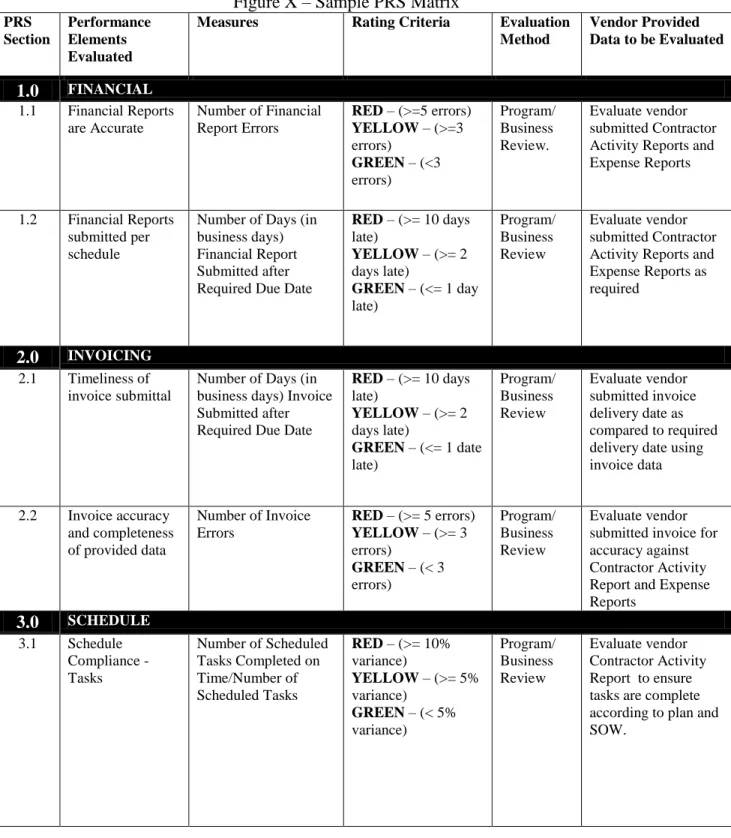
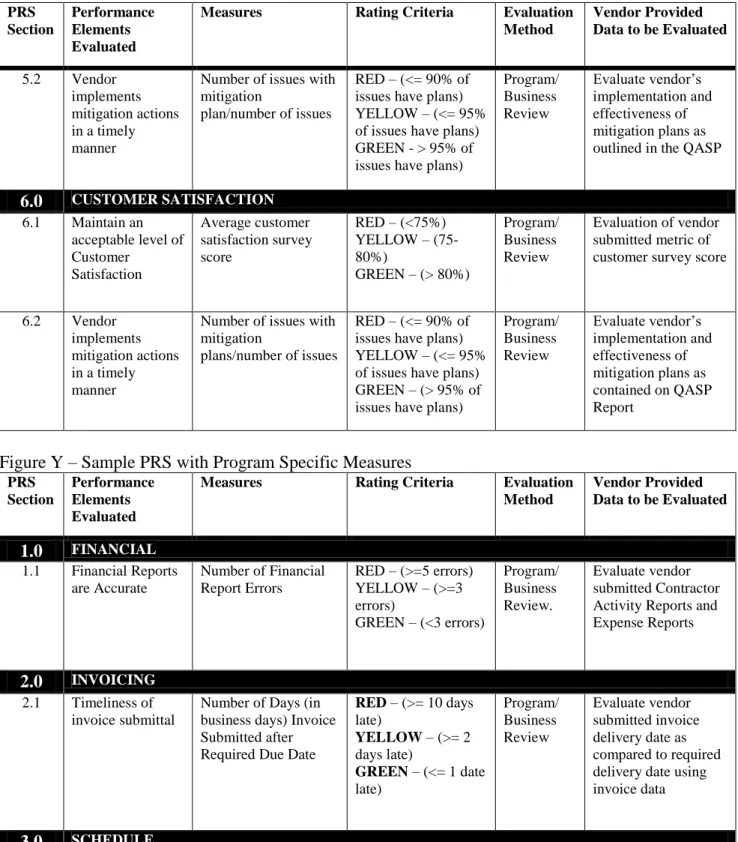
monitoring results. The QASP is typically an attachment to the PWS, along with the Performance Requirements Summary (PRS) Matrix. The DIA has a QASP Template, but external Task Order organizations may follow their agency’s established practices. For internal TO’s, the CIO BPM has developed a mandatory PRS Matrix system, and the application of this system must be discussed at the Contract Planning Conference. Details about that system are not addressed in this document as portions of the system are still under development. More information on the QASPs (to include sample
content) is provided in Appendix E.
3.3.2.1 QASP Management for Award Fee Task Orders
For Award Fee Task Orders, the QASP is used to determine eligibility for Award Fee. Each performance-based contract that utilizes an Award Fee will also have an Award
25
Fee Plan. The Award Fee Plan is used to outline the Award Fee Funding and Structure, define the Award Fee evaluation process, detail the Award Fee process roles and
responsibilities, and layout the Award Fee evaluation periods used for determining E-SITE contract Task Order Award Fee amounts. The Award Fee Plan also documents the Award Fee process and provides a mechanism for evaluating and recommending earned Award Fee based on QASP performance results. When an incentive fee TO is deemed appropriate, the QASP will allow for the establishment of objective criteria, i.e. performance incentives tied to specific elements of the contractor’s performance. 3.3.2.2 QASP Management for Other Task Order Types
For other Task Order types that are not Award Fee, the QASP is used to ensure Government expected outcomes are achieved. It is also used to support past performance requirements during the RFP process and for exercising options.
3.3.3
Task Order Modifications
In the event that an existing TO needs to be modified, follow your Agency/Service procedures and contact the assigned Contract Specialist or Contracting Officer for the Task Order. It is highly recommended to discuss the proposed change early to
determine the best procurement method for the change. It is entirely possible that a new TO may be initiated in lieu of a modification.
DIA internal requiring activities must submit their proposed changes through the CIO BPM prior to contacting the Contracting Office.
3.3.4
Material Purchases
The COR shall authorize all purchases under the Task Orders in accordance with purchases previously authorized by the CO as part of the Task Order award. COR has ODC approval authority up to and including $25,000.00. For expenses above the $25,000.00 threshold, approval must be obtained from the Task Order Contracting Officer before any expenses are incurred. See IDIQ Contract H-5, Material Purchases.
3.4
Contract Closeout
At the completion of a contract or Task Order, the COR will supply the E-SITE PCO or DCO with the COR file/documentation for retirement with the official contract file. The COR will use the COR Contract Completion Statement (or agency-specific forms), (Appendix I) as a guide for proper documentation. In addition to using the checklist, the COR will ensure the following items are included in the documentation:
Final Contractor Performance Assessment Report. Final DD Form 254.
Evidence of property disposal/disposition. The complete COR file.
26
Detailed contract closeout instructions can be found in the DIA Contract Closeout Guide for DIA Task Orders. For decentralized TO’s, the COR will follow their agency’s
closeout procedures.
4 Decentralized Ordering
DIA administers the E-SITE IDIQ contract vehicle centrally, but authorizes decentralized ordering and decentralized TO administration to meet the needs of the DoD Services, including Army, Navy, Air Force, United States Marine Corps, and other Federal Agencies/Departments. E-SITE is available for use by DoD and Federal
Agencies/Departments with Intelligence missions whose Information Technology (IT) requirements are within the scope of the E-SITE Statement of Work (SOW).
To use E-SITE, the Service/Agency must be authorized via a Decentralized Ordering Authority Letter (DOAL) from the E-SITE PCO. A sample which is used for requesting the establishment of the DOAL, is provided in Appendix A. When executed, the DOAL will specify the conditions, roles and responsibilities, and approved ceiling allocation for ordering. Upon receipt of the DOAL requesting letter, DIA will review and normally make a decision within 15 calendar days.
Upon execution of the DOAL, the designated Decentralized Contracting Offices defined in the DOAL are empowered to place orders in accordance with the terms and
conditions of the E-SITE contracts, E-SITE ordering guidelines, the FAR, DFARS, or applicable Service/Agency procedures.
If there are questions concerning a requirement and whether or not it can be supported under E-SITE, contact the appropriate ISPR or the DIA CIO BPM. The Requiring Activity is responsible for recommending the “in scope” determination, assisted by their DCO, the E-SITE PM and E-SITE PCO as necessary.
The E-SITE PCO will not make any judgments or determinations regarding orders awarded under the E-SITE contracts by a DCO, except in cases where sole source or limited competition Task Orders are intended or when T&M, LH or FFP-LOE type orders are being contemplated. All issues, including protests and disputes must be resolved in accordance with individual agency procedures and/or oversight. Upon request, the E-SITE PCO is available to provide guidance to Ordering Contracting Officers executing orders under the E-SITE contracts.
The DCO is responsible for acquisition planning. Once the DOAL is finalized, the requiring activity will follow their internal processes for planning the requirement, requesting approval, and documenting the acquisition process for each Task Order. The total estimated value of a Task Order, including options, should be considered in developing an acquisition strategy.
27
Note: DCOs must request approval from the E-SITE PCO prior to issuing Task Orders contemplating a sole source or any other exception to fair opportunity, as well as any orders containing T&M, LH or FFP LOE CLINS.
5 References
5.1
Points of Contact
Office Name Phone Email
PCO Esther Woods 703-735-6411 [email protected] E-SITE PM Phyllis J. Wright 703-735-5504 [email protected] ISPR/DIA Phyllis J. Wright 703-735-5504 [email protected]
ISPR/OTHER TBD TBD TBD
5.2
List of Prime Contractors
Large Businesses:
Contract Number Contractor
HHM402-15-D-0010 American Systems HHM402-15-D-0011 BAE Systems HHM402-15-D-0012 Blue Canopy
HHM402-15-D-0013 Boeing Company, The HHM402-15-D-0014 Booz Allen Hamilton HHM402-15-D-0015 CACI
HHM402-15-D-0016 CGI Federal
HHM402-15-D-0017 Computer Sciences Corporation HHM402-15-D-0018 D&S Consultants Inc.
HHM402-15-D-0019 EIS
HHM402-15-D-0020 General Dynamics Information Technology HHM402-15-D-0021 HP Enterprise Services
HHM402-15-D-0022 IBM
HHM402-15-D-0023 Intelligent Decisions
HHM402-15-D-0024 K Force Government Solutions HHM402-15-D-0025 L3 National Security Solutions HHM402-15-D-0026 Leidos
HHM402-15-D-0027 Lockheed Martin Corporation HHM402-15-D-0028 ManTech/WINS
28 Contract Number Contractor
HHM402-15-D-0029 Northrop Grumman HHM402-15-D-0030 Pragmatics
HHM402-15-D-0031 Raytheon IIS Group
HHM402-15-D-0032 Scientific Research Corporation HHM402-15-D-0033 Sotera
HHM402-15-D-0034 SRA International Small Businesses:
Contract Number Contractor
HHM402-15-D-0035 22nd Century Technologies HHM402-15-D-0036 AEEC LLC
HHM402-15-D-0037 American Technology Solutions International HHM402-15-D-0038 Berico Technologies
HHM402-15-D-0039 Buffalo Group, The
HHM402-15-D-0040 Convergent Solutions Inc. HHM402-15-D-0041 Criterion Systems Inc. HHM402-15-D-0042 Cyberspace Solutions HHM402-15-D-0043 DAn Solutions Inc. HHM402-15-D-0044 DKW Communications
HHM402-15-D-0045 E-Volve Technology Systems HHM402-15-D-0046 Federated IT
HHM402-15-D-0047 Intrepid Solutions & Services Inc. HHM402-15-D-0048 Kenjya Group, The
HHM402-15-D-0049 New River Systems HHM402-15-D-0050 OCCAM Solutions HHM402-15-D-0051 QVine Corporation HHM402-15-D-0052 Red Arch Solutions HHM402-15-D-0053 Riite
HHM402-15-D-0054 Soft Tech Consulting HHM402-15-D-0055 Trusted Mission Solutions HHM402-15-D-0056 Varen Technologies HHM402-15-D-0057 Vykin Corporation HHM402-15-D-0058 Xcelerate Solutions HHM402-15-D-0059 Zolon Tech Inc.
A-1
APPENDIX A-1
Sample Letter
Request E-SITE Decentralized Ordering Authority Letter (DOAL)
FROM: [Service/Agency Office]
TO: E-SITE Procuring Contracting Officer
Subject: Request to Initiate an E-SITE Decentralized Order
1. Reference: EnhancedSolutions for the Information Technology Enterprise (E-SITE) Ordering Guide, Defense Intelligence Agency (DIA)
2. Pursuant to the purpose and scope of the E-SITE contract and the procedures defined in the reference above, request that a DOAL be initiated by DIA to authorize this organization to perform acquisition using the E-SITE Indefinite
Delivery/Indefinite Quantity contract.
3. Propose that the DOAL authorize the use of the E-SITE programs as follows: a. Duration: The period of the agreement will be effective through [date].
b. Ordering Limit: The agreement authorizes an ordering amount (ceiling) of:
[$ordering limit].
c. Decentralized ordering authority is requested.
For Decentralized Ordering Authority: The Contracting Officer(s) nominated to be an authorized E-SITE Decentralized Contracting Officer(s) (DCO) is/are: Contracting Office Contacting Officer Name Phone/Email
__________________
[Signature block of Sponsoring Agency/Department]
A-2
APPENDIX A-2
Sample Approving Decentralized Ordering Authority Letter (DOAL)
FROM: E-SITE Procuring Contracting Officer TO: [Service/Agency Office]
SUBJECT: Appointment of Decentralized Contracting Officers (DCO)
Reference: EnhancedSolutions for the Information Technology Enterprise (E-SITE) Ordering Guide, Defense Intelligence Agency (DIA)
1. In accordance with ref (a), I authorize the following additional DCOs to place orders on the E-SITE PMO contract:
Contracting Office Contacting Name
2. If you have any additional questions or concerns, please contact Esther Woods at Esther. [email protected], or at 703-735-6411.
ESTHER L. WOODS E-SITE PCO
B-1
APPENDIX B
Performance-based Service Acquisition (PBSA)
Performance Work Statement (PWS)
and
Statement of Objectives (SOO)
Performance-Based Service Acquisition
PBSA is the preferred method of contracting for E-SITE services and supplies. PBSA means an acquisition structured around the results to be achieved as opposed to the manner by which the work is to be performed. Essential elements of PBSA include:
(1) Performance requirements, expressed in either a Performance Work Statement (PWS) or Statement of Objective (SOO). Performance requirements should be described in terms of what the required output is and should not specify how the work is to be accomplished
(2) Performance standards or measurements which are criteria for determining whether the performance requirements are met
(3) Appropriate performance incentives, either positive or negative
(4) A surveillance plan that documents the government’s approach to monitoring the contractor’s performance. These elements are discussed further below.
Federal Acquisition Regulation (FAR) 37.102 has established the policy to use a PBSA approach, to the maximum extent practicable, for all services. Services exempted from this policy are: architect-engineer, construction, utility, and services that are incidental to supply purchases. Use of any other approach has to be justified to the ISPR and DCO.
For Defense agencies, Defense Federal Acquisition Regulations Supplement 237.170-2 requires higher-level approval for any acquisition of services that is not performance-based. Guidance and additional information is incorporated in FAR 37.6 (Performance-based
Acquisition). Also, Acquisition Central website provides a comprehensive training tool to understanding PBSA called “Seven Steps to Performance-Based Service Acquisition Guide available”, at: https://www.acquisition.gov/sevensteps/home.html.
What Contract Type?
Under law and regulation [FAR 37.102(a)(2)], there is an order of preference in contract types used for performance-based contracting, as follows:
A firm fixed price, performance-based contract or Task Order.
B-2
A contract or Task Order that is not performance-based.
Requiring activities should use the contract type most likely to motivate contractors to perform at optimal levels. Firm fixed price is the preferred contracting type, but it’s not always the best solution for PBSA. Work statements should be developed in sufficient detail to permit
performance on every requirement. E-SITE offers a host of pricing arrangements and incentive types for consideration. Hybrid types (those with both fixed-price and cost-type or T&M tasks) are common and should also be considered.
What is a PWS?
A PWS identifies the technical, functional and performance characteristics of the
government’s requirements. The PWS describes the work in terms of purpose of the work to be performed and required results rather than how the work is to be accomplished or the number of hours to be provided. The format for the PWS is similar to the legacy Statement of Work (SOW). However, the difference between an SOW and a PWS is that the tasks are described in terms of the required outcomes or results, not with just the details of "how" the contractor will perform the tasks. A PWS makes the contractor responsible for the outcomes and accountable for achieving or failing to achieve the desired outcomes. A PWS enhances a traditional SOW by including the performance standards and most importantly a Quality
Assurance Surveillance Plan (QASP). Performance Standards/