Risk Management for Enterprise Resource Planning
Post Implementation Using COBIT 5 for Risk
Dwi Rosa Indah
1, Harlili
2, Mgs. Afriyan Firdaus
3 1,3Information System Department, Sriwijaya UniversityJl. Palembang-Prabumulih Km.32 Indralaya, Indonesia
2Informatics Department, Bandung Institute of Technology
Jalan Ganesha No.10 Bandung, Indonesia
1[email protected] 2[email protected] 3[email protected]
Abstract— Risk management for ERP post-implementation is required to achieve ERP success. In
this paper, risk management for ERP
post-implementation is designed using COBIT 5 for Risk on APO12 processes. The design of a risk management framework begins with assessment of ERP post-implementation success adopting two approaches, namely the framework of ERP post-implementation success and Critical Success Factor of ERP post-implementation as an input to the risk identification adopted from COBIT 5 for Risk. The study was conducted at the company that has been entered the ERP post-implementation stage. The results of research on the case study company are ERP post-implementation success assessment by only 55.6% and there is a fairly high percentage of unsuccessful at 44.4% which indicates a risk that must be managed. Risks that need to be managed as many as 26 ERP post- implementation risks that are grouped into nine categories of risk. With the option of risk response is one risk are transfered, 21 are mitigated and four are accepted.
Keywords— risk management, ERP post-implementation,
COBIT 5 for Risk, critical success factors, case study. I. INTRODUCTION
ERP is a system software which integrates all information flow in the company including finance, accounting, human resources, supply chain and customer information by using a single database that can be accessed by all divisions within the company [2].
Facts suggest that long-term survival and success of ERP depends on continuous operation, use, maintenance and improvement of the ERP post-implementation or exploitation stage of the system [11]. It shows that the ERP post-implementation stage is the stage that will determine the success of ERP in a company.
In the ERP post-implementation, failure can be determined by assessing the success of the ERP post-implementation [7] so that risks that occur in ERP post-implementation can be identified. Subsequently, the identified risks can be managed further by designing risk management for ERP post-implementation. This is relevant to Dey, Clegg, & Cheffi [1] that researchers can expand the practice of risk management in the post-implementation period to help ensure the sustainability of the enterprise information systems. One
framework approach that can be used in risk management is COBIT 5 for Risk.
Research methodology that is used based on the development of the research methodology proposed by Ellis et al [8]. The first phase begins with the identification of problems and determination of research objectives. The next stage is to do a literature review on risk management for ERP post-implementation. Analysis and design stage is conducted to design risk management for ERP post-implementation. Implementation and evaluation stage is performed by implementing the design made before and evaluate it through implementation on a case study company. The last stage is to report the research results. The stages can be repeated according to the needs of research.
II. RISK MANAGEMENT OF ERPPOST-IMPLEMENTATION
Risk management of ERP post-implementation is part of the IT risk management. COBIT 5 for Risk defines IT risk as a business risk, in particular, the business risks associated with the use, ownership, operation, involvement, influence and adoption of IT within the company.
III. DESIGN OF RISK MANAGEMENT FOR ERPPOST -IMPLEMENTATION
In this section, the success factors of ERP post-implementation assessment is arranged which then used in the design of risk management for ERP post-implementation.
A. Formulation of Success Component Assessment for ERP Post-Implementation
The intent of this analysis was to determine the factors that will be assessed for ERP post-implementation success by adopting the ERP post-implementation framework and Critical Success Factor (CSF) of ERP post-implementation. The results of the ERP post-implementation success assessment will be the basis for risk identification adopted from COBIT 5 for Risk framework as shown in Figure 1.
The ERP post-implementation success assessment is used to determine the success and failure factors of ERP post-implementation [7]. According to Dijk [3], the concept of identifying risk factors closely related to the concept of identifying success factors, since both aim to identify the obstacles on the way to ERP post-implementation success of system. This is reinforced by Gemi statement [4] that failure factors associated with risk.
Fig.1 Linkages between ERP assessment of post-implementation success and COBIT 5 for Risk
Referring to Kiriwandeniya, et.al [7] and Nejib [10], it can be organized a success factors list of ERP post-implementation that were identified as shown in Table 1.
Based on table I, it is obtained ERP post-implementation success components include nine factors: (1) Customization of the ERP software, (2) the ERP post-implementation training, (3) care or support from managers in the use of ERP software, (4) the standards of the usage success of ERP application, (5) Change management to achieve the benefits of the ERP system, (6) maintenance level of the ERP system, (7) efforts to disseminate additional features following an ERP upgrade (8) prior to ERP implementation success rate, and (9) Support from the vendor.
TABLEI
COMPONENT OF THE ERP POST-IMPLEMENTATION SUCCESS ASSESSMENT. ERP Post Implementation Success Factors Post-Implementation ERP framework [7] CSF of Post-Implementation ERP [10] Customization of ERP software √ √ Training of post-implementation ERP √ Manager's support in
the use of ERP software √ √ Standards successful of ERP applications usage √ Change management to achieve the benefits
of the ERP system
√ Tingkat pemeliharaan sistem ERP √ Efforts to disseminate additional features after such ERP
upgrade
√
Success rate before ERP implementation
√
Support vendors √
For ERP success assessment scale measurement in this research will be made into four ratings shown in Table II.
TABLEII
SCALE MEASUREMENT COMPONENT OF ERPPOST-IMPLEMENTATION
SUCCESS
Scale Assessment Description
1 Very Low ERP failure
2 Low ERP failure
3 High ERP success
4 Very High ERP success
B. Design of Risk Management for ERP Post Implementation
Guidelines of COBIT 5 enabling process explained that each company defines the process, and each management practices that is selected or adopted is adapted by considering the situation or circumstances in the enterprise [5]. The design of the risk management for ERP post-implementation based on COBIT 5 for Risk namely APO12 process. In the APO12 process there are six practices [6], namely:
(1) Collect data (APO12.1), is the practice of identifying and collecting relevant data for the identification of risks that occur at this time and the history of IT-related risks.
(2) Risk analysis (APO12.2), is the practice of developing information to support risk decisions by estimating the frequency and impacts associated with IT risk scenarios. (3) Maintain Risk profile (APO12.3), is the practice of maintaining an inventory of known risk and risk attributes and control activities at this time.
(4) Articulation of risk (APO12.4), is the practice of providing information related to IT risk conditions and risk response options that can be utilized by all stakeholders.
(5) Establish portfolio risk management measures (APO12.5), is the practice of managing risk response actions to reduce risk to an acceptable level as a portfolio.
(6) Response to risk (APO12.6), is the practice of responding to risks in a timely manner with effective measures.
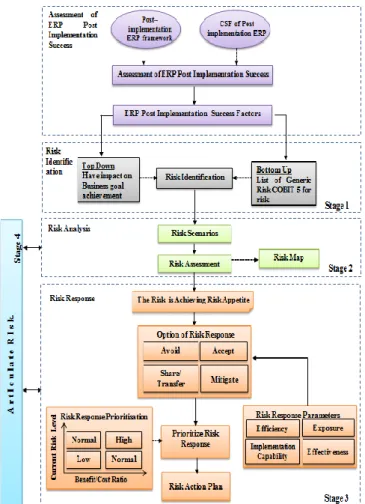
Based on APO12 process then the risk management for ERP post-implementation is designed refering APO12 practices and making some adjustments required by the case study company. The design of the risk management for ERP post-implementation is shown in Figure 2.
The explanation of the stages of the design as follows:
A. Risk Identification
In the early stages of risk identification is to perform data collection and assessment of data history document in accordance with the APO12.1 processes in COBIT 5 for Risk. The input of this phase is obtained from the results of the success assessment of ERP post-implementation by adopting two approaches, namely the framework of ERP post-implementation and CSF for ERP post-implementation. The results is unsuccessful factors for ERP post-implementation as the basis for identifying risks, which in turn studied with two approaches, top down and bottom up. The top down approach is an approach to identify risks based on the unreachability of business objectives while the
bottom-up approach is an approach to identify risks through list of generic risks from COBIT 5 for Risk.
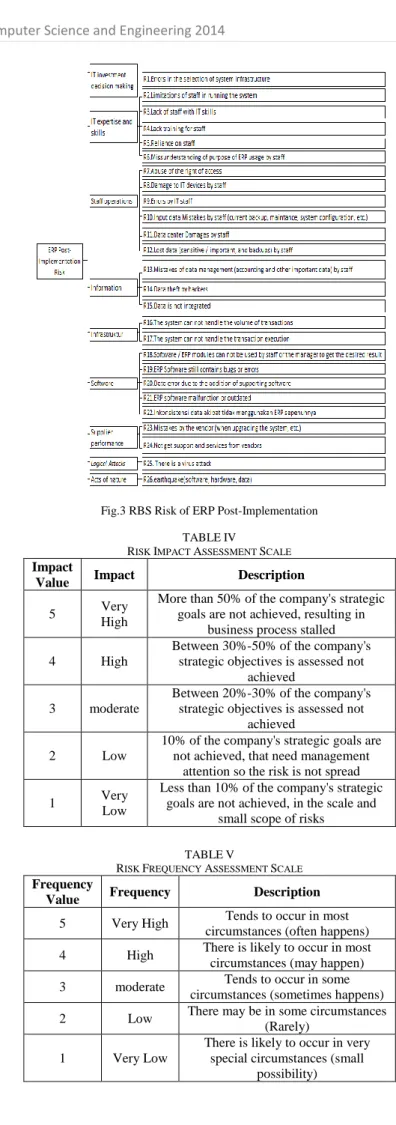
Details of the risks and risk categorization are determined by Risk Breakdown Structure (RBS) approaches. RBS is used primarily in an attempt to make the categorization of each risk to see risks in more detail [9].
Fig.2 The design of risk management for ERP post implementation.
B. Risk Analysis
This stage corresponds to APO12.2 process in COBIT 5 for Risk. The risk analysis stage is performed by conducting a risk assessment of the risks identified by calculating the probability of the risk (likelihood) and how large the impact of risk for the company that could affect the company's strategic objectives and business goals, resulting in business process stalled. The result is a list of risk, which then became the basis for preparing risk maps.
C. Risk Response
In this stage, risk response is determinated, in accordance with the APO12.6 process. Risk response tailored to the risk appetite set by the company. Risk appetite is a statement that shows a company's attitude towards risk management.
The choice of risk response action consists of four options, namely:
(1) Avoid the risk, is an action to avoid doing activities that let the risk.
(2) Reduce or mitigate risk, is an action to detect risks, then do activities to reduce the impact or frequency of occurrence of such risks.
(3) Transfer the risk, is an action of dividing the whole or part of the risk to third parties.
(4) Accept the risk, an action to accept the consequences if the risk actually occurs. Accept the risk having a meaning that risks are identified and then the management decided to accept the risk.
To determine the risk response that will be applied to follow up of risk, it needs measurement considering the risk response parameters, which include:
(1) Efficiency, related to how far follow-up of risk in line with the business objectives of the organization. (2) Exposure, the impact and frequency of occurrence of
the risk indicated by its position on the risk map. (3) Ability to implement, related to the company's ability to
implement action risk selected.
(4) The effectiveness, related to how far the response action options will reduce the impact and magnitude of risks. Prioritizing selection of risk responses is necessary to align the risks of ERP post-implementation of the company's risk tolerance limits. Priorities include high, normal and low. The priority is used as a reference in the measurement to determine the risk actions of ERP post- implementation.
D. Risk Articulation
This stage is the articulation of risk in accordance with APO12.4. Articulation of risk is determined by doing analysis the stakeholders and the existing practices in APO12.4. Risk articulation process is giving information to the stakeholder using a RACI Matrix.
IV. RESULTS
The implementation is done at the headquarters of PT. Pusri. The selection of case studies by considering that PT. Pusri has entered the ERP post-implementation and use ERP for 14 years. So the longer the age of ERP utilization may pose risks. Questionnaire of ERP post-implementation success assessment, risk identification, risk assessment is distributed to 40 respondents of ERP users.
A. Success Assessment of ERP Post-Implementation
The success assessment of ERP post-implementation conducted by distributing questionnaires to obtain the results in Table III.
Table III shows the assessment analysis results of ERP post-implementation success factors. Success factors of ERP post-implementation with low-value consists of four factors: the customization of ERP applications in accordance with the company's business processes, ERP post-implementation training, efforts to disseminate additional features following an ERP upgrade and vendor engagement. These four factors indicate unsuccessful ERP post-implementation. 44.4% failure rate of ERP post-implementation is obtained from the calculation (4/9x100%). While the ERP post-implementation success factors are 5 factors so ERP post-implementation success rate is only 55.6% were obtained from the calculation (5/9x100%).
TABLEIII
SUCCESS ASSESSMENT RESULTS OF ERPPOST-IMPLEMENTATION.
No ERP Post Implementation Success Factors Assessment Description 1. Customization of ERP software 2 Low 2. Training of post-implementation
ERP 2 Low
3. Manager's support in the use of
ERP software 3 High
4. Standards successful of ERP
applications usage 3 High 5. Change management to achieve
the benefits of the ERP system 3 High 6. Tingkat pemeliharaan sistem ERP 3 High 7. Efforts to disseminate additional
features after such ERP upgrade 2 Low 8. Success rate before ERP
implementation 3 High
9. Support vendors 2 Low
Furthermore, these results are validated by using triangulation techniques. Triangulation can be done using different techniques namely interviews, observation and documents [12]. The final result of data validation is four unsuccessful ERP post-implementation factors namely customizations in ERP applications in accordance with the company's business processes, ERP post-implementation training, efforts to disseminate additional features following an ERP upgrade and vendor engagement.
B. Identification of Risk
Risk identification is determined using two approaches, top down and bottom up. The results of risk identification are mutually supportive results from both approaches. It is found 28 details of risk that re-confirmed to ERP users through questionnaires. From the risk identification questionnaire found 26 risks grouped into nine risk categories of ERP post-implementation. A detailed list of risk categories shown in Figure 3.
C. Risk Analysis
Based on figure 3, the risk analysis carried out by conducting a risk assessment to the impact and frequency of risk occurrence. Assessment of the impact and frequency measures using a scale of 1 to 5 shown in table IV and V.
D. Risk Response
Choice of risk response actions first adapted to the company's risk appetite among ≥ 4 risk assessment ≤ 15 which is medium and high risk categories. Based on company policy, 4 low risks is accepted by the company with the risk of ID are: R9, R11, R15, R22. As for the 22 categories of risk namely moderate and high categories conducted risk response actions choices.
The results of the risk action choice of the 22 risk are 21 risks are mitigated and 1 risk is transferred. Table VI shows the recapitulation of risk response actions against 26 ERP post-implementation risks.
Fig.3 RBS Risk of ERP Post-Implementation
TABLEIV
RISK IMPACT ASSESSMENT SCALE Impact
Value Impact Description
5 Very High
More than 50% of the company's strategic goals are not achieved, resulting in
business process stalled 4 High
Between 30%-50% of the company's strategic objectives is assessed not
achieved 3 moderate
Between 20%-30% of the company's strategic objectives is assessed not
achieved 2 Low
10% of the company's strategic goals are not achieved, that need management
attention so the risk is not spread 1 Very
Low
Less than 10% of the company's strategic goals are not achieved, in the scale and
small scope of risks TABLEV
RISK FREQUENCY ASSESSMENT SCALE Frequency
Value Frequency Description
5 Very High Tends to occur in most circumstances (often happens) 4 High There is likely to occur in most circumstances (may happen) 3 moderate Tends to occur in some
circumstances (sometimes happens) 2 Low There may be in some circumstances
(Rarely) 1 Very Low
There is likely to occur in very special circumstances (small
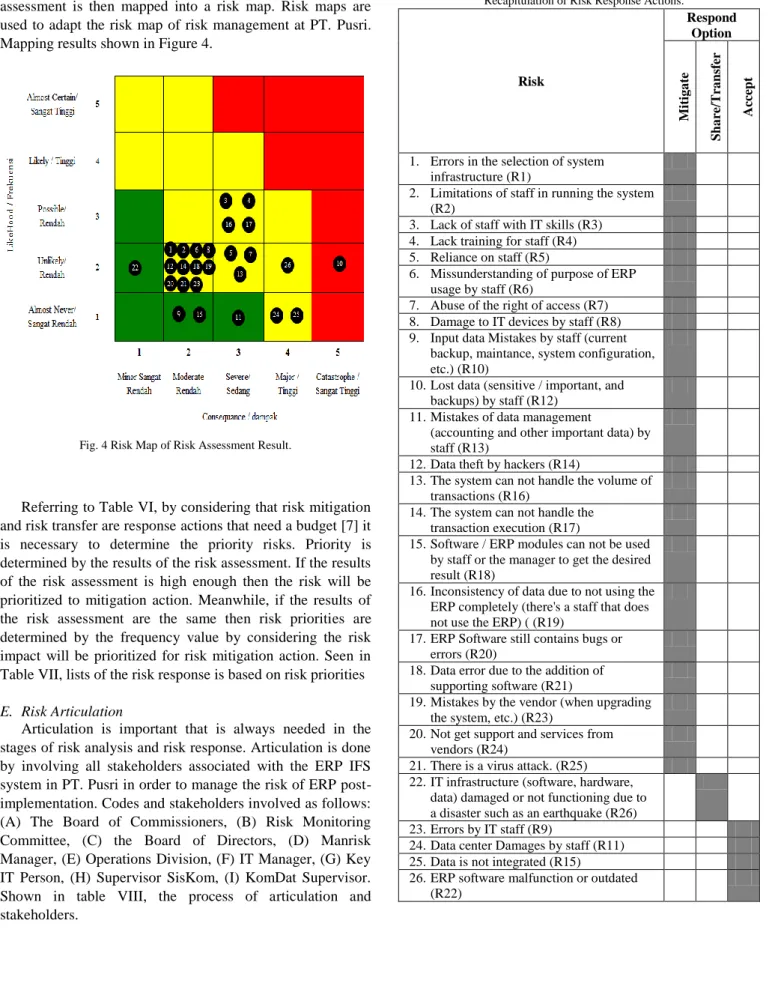
Referring to the above assessment, the results of the risk assessment is then mapped into a risk map. Risk maps are used to adapt the risk map of risk management at PT. Pusri. Mapping results shown in Figure 4.
Fig. 4 Risk Map of Risk Assessment Result.
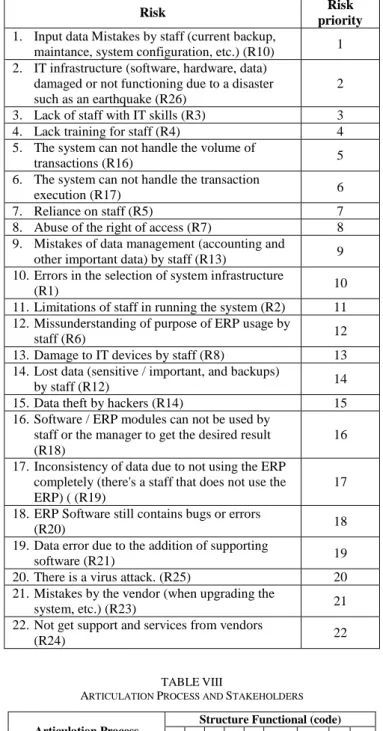
Referring to Table VI, by considering that risk mitigation and risk transfer are response actions that need a budget [7] it is necessary to determine the priority risks. Priority is determined by the results of the risk assessment. If the results of the risk assessment is high enough then the risk will be prioritized to mitigation action. Meanwhile, if the results of the risk assessment are the same then risk priorities are determined by the frequency value by considering the risk impact will be prioritized for risk mitigation action. Seen in Table VII, lists of the risk response is based on risk priorities
E. Risk Articulation
Articulation is important that is always needed in the stages of risk analysis and risk response. Articulation is done by involving all stakeholders associated with the ERP IFS system in PT. Pusri in order to manage the risk of ERP post-implementation. Codes and stakeholders involved as follows: (A) The Board of Commissioners, (B) Risk Monitoring Committee, (C) the Board of Directors, (D) Manrisk Manager, (E) Operations Division, (F) IT Manager, (G) Key IT Person, (H) Supervisor SisKom, (I) KomDat Supervisor. Shown in table VIII, the process of articulation and stakeholders.
TABLE VI
Recapitulation of Risk Response Actions.
Risk Respond Option Mi tig a te S h a re /Tra n sfe r Ac ce p t
1. Errors in the selection of system infrastructure (R1)
2. Limitations of staff in running the system (R2)
3. Lack of staff with IT skills (R3) 4. Lack training for staff (R4) 5. Reliance on staff (R5)
6. Missunderstanding of purpose of ERP usage by staff (R6)
7. Abuse of the right of access (R7) 8. Damage to IT devices by staff (R8) 9. Input data Mistakes by staff (current
backup, maintance, system configuration, etc.) (R10)
10.Lost data (sensitive / important, and backups) by staff (R12)
11.Mistakes of data management
(accounting and other important data) by staff (R13)
12.Data theft by hackers (R14)
13.The system can not handle the volume of transactions (R16)
14.The system can not handle the transaction execution (R17)
15.Software / ERP modules can not be used by staff or the manager to get the desired result (R18)
16.Inconsistency of data due to not using the ERP completely (there's a staff that does not use the ERP) ( (R19)
17.ERP Software still contains bugs or errors (R20)
18.Data error due to the addition of supporting software (R21)
19.Mistakes by the vendor (when upgrading the system, etc.) (R23)
20.Not get support and services from vendors (R24)
21.There is a virus attack. (R25) 22.IT infrastructure (software, hardware,
data) damaged or not functioning due to a disaster such as an earthquake (R26) 23.Errors by IT staff (R9)
24.Data center Damages by staff (R11) 25.Data is not integrated (R15)
26.ERP software malfunction or outdated (R22)
TABLEVII
RISK RESPONSE LIST BASED ON RISK PRIORITIES
Risk Risk
priority 1. Input data Mistakes by staff (current backup,
maintance, system configuration, etc.) (R10) 1 2. IT infrastructure (software, hardware, data)
damaged or not functioning due to a disaster such as an earthquake (R26)
2 3. Lack of staff with IT skills (R3) 3 4. Lack training for staff (R4) 4 5. The system can not handle the volume of
transactions (R16) 5
6. The system can not handle the transaction
execution (R17) 6
7. Reliance on staff (R5) 7 8. Abuse of the right of access (R7) 8 9. Mistakes of data management (accounting and
other important data) by staff (R13) 9 10.Errors in the selection of system infrastructure
(R1) 10
11.Limitations of staff in running the system (R2) 11 12.Missunderstanding of purpose of ERP usage by
staff (R6) 12
13.Damage to IT devices by staff (R8) 13 14.Lost data (sensitive / important, and backups)
by staff (R12) 14
15.Data theft by hackers (R14) 15 16.Software / ERP modules can not be used by
staff or the manager to get the desired result (R18)
16 17.Inconsistency of data due to not using the ERP
completely (there's a staff that does not use the ERP) ( (R19)
17 18.ERP Software still contains bugs or errors
(R20) 18
19.Data error due to the addition of supporting
software (R21) 19
20.There is a virus attack. (R25) 20 21.Mistakes by the vendor (when upgrading the
system, etc.) (R23) 21
22.Not get support and services from vendors
(R24) 22
TABLEVIII
ARTICULATION PROCESS AND STAKEHOLDERS
Articulation Process
Structure Functional (code)
A B C D E F G H I
Reported the results of a risk analysis related to the assessment of risk impact
C C R I A/ A/ C C
Describe the risk scenarios to support decision making in response to the risk
C C R I A/ A/ C C
Report the current risk
profile I C C R I A/ A/ C C Review the the results of the
risk assessment I R A R C C R/ Identify the increased use of
ERP opportunities to respond the existing risk
I C A C C A/ C
V. CONCLUSIONS
Research conducted is successfully implemented in the case study company. It is known that, the results of the ERP post-implementation success assessment only 55.6%, and
there is a fairly high percentage of unsuccessful at 44.4% which indicates risks that must be managed. Risks need to be managed that successfully identified by 9 categories risks include: IT investment decision-making, expertise and IT related skills, operations staff, information, infrastructure, software, supplier performance, logical attacks, and natural events. Those nine risk categories comprised 26 risk details that are one high risk, 21 medium risks and four low risks. While the results of the risk response options consisting of one risk transferred, 21 risk mitigated and four risk accepted. Further, risk mitigation actions adjusted using COBIT 5 for Risk. The results of the study have been validated by the case study company.
ACKNOWLEDGMENT
Author thanks goes to Dra. Harlili, M.Sc., for the guidance given to research which is a series of thesis research currently being done by the author.
REFERENCES
[1]. Dey, P., Clegg, B., & Cheffi, W. Risk management in enterprise resource planning implementation: a new risk assessment framework. Production Planning & Control, 24(1), 1-14. 2013.
[2]. Dhewanto, W., & Falahah. ERP Menyelaraskan Teknologi Informasi dengan Strategi Bisnis. Informatika Bandung. 2007..
[3]. Dijk, N. Risks in the post-implementation phase of enterprise system implementations Qualitative, inductive, multiple case study research. BSc Industrial Engineering & Management Science. 2013.
[4]. Gemi, S. G. Perancangan Panduan Risk Mangement Plan (RMP) untuk IT Outsourcing Project di Instansi Pemerintah. ITB. 2010. [5]. ISACA. COBIT (R) 5 Framework. USA: ISACA. 2012. [6]. ISACA. COBIT® 5 for Risk. USA: ISACA. 2013.
[7]. Kiriwandeniya, I., Ruwan , V., Samarasinghe, S., Kahandawarachchi, C., & Thelijjagoda, S. Post Implementation Framework for ERP Systems with Special Reference to Sri Lanka. Computer Science & Education (ICCSE), International Conference , 508 - 513. 2013. [8]. T.J. Ellis dan Y. Levy, A Guide for Novice Researchers: Design and
Development Research Methods, Proceedings of Informing Science & IT Education Conference (InSITE), 2010
[9]. Susilo, Leo J. dan Kaho, Victor Riwu. Manajemen Risiko berbasis ISO 31000 untuk industri non perbankan. Jakarta: Penerbit PPM. 2010.
[10]. Nejib, B. M. Determinants of Post Implementation Success of ERP In Tunisian Companies: An Empirical Study of The Moderating Role of The Technical Fit. International Review of Management and Business Research. 2013.
[11]. Pan, K., Nunes, M., & Peng, G. Risks affecting ERP post-implementation Insights from a large Chinese manufacturing group. Journal of Manufacturing Technology Management Vol. 22 No. 1, 107-130. 2011.
[12]. Nasution, Prof. Dr. S. Metode Penelitian Naturalistik Kualitatif, Tarsito, Bandung. 2003.