Convergence of Position Auctions under
Myopic Best-Response Dynamics
∗
Matthew Cary
Aparna Das
Benjamin Edelman
Ioannis Giotis
Kurtis Heimerl
Anna R. Karlin
Scott Duke Kominers
Claire Mathieu
Michael Schwarz
January 10, 2013
Abstract
We study the dynamics of multi-round position auctions, considering both the case of exogenous through rates and the case in which click-through rates are determined by an endogenous consumer search process. In both contexts, we demonstrate that the dynamic auctions converge to their associated static, envy-free equilibria. Furthermore, convergence is efficient, and the entry of low-quality advertisers does not slow conver-gence. Because our approach predominantly relies on assumptions com-mon in the sponsored search literature, our results suggest that dynamic position auctions converge more generally.
Keywords. Position auctions, dynamic auctions, consumer search, best-response bidding.
1
Introduction
The position auctions used to allocate sponsored search links are often mod-eled as games in which advertisers submit bids and are assigned positions in descending bid order. The utility of each advertiser then depends upon its per-click valuation, the per-click-through rate of the position it receives, and the profile of bids.
∗This work combines and extends previous papers of Caryet al.[6] and Kominers [13],
which respectively appeared in theProceedings of the 8th ACM Conference on Electronic Commerceand theProceedings of the 5th International Conference on Algorithmic Aspects in Information and Management.
This research was supported in part by NSF grant CCF-0635147, a Yahoo! Research Alliance gift to Karlin, and Harvard College Program for Research in Science and Engineering and AMS–Simons grants to Kominers. Kominers also appreciates the hospitality of the Harvard Program for Evolutionary Dynamics, which hosted him during part of this research. The authors thank Zachary Abel, Susan Athey, Yiling Chen, Peter Coles, Noam D. Elkies, Drew Fudenberg, Andrea J. Hawksley, Kathleen L. McGinn, David Parkes, Michael Ostrovsky, Alvin E. Roth, Sergei Severinov, Dmitry Taubinsky, several referees, the associate editor, and participants in the Harvard EconCS Research Workshop for helpful comments and suggestions.
Early position auction models, such as [2], [9], and [17] assumed positions’ click-through rates to be entirely exogenous. New approaches have introduced the effects of consumer behavior, as in [8] and [3]. However, both approaches typ-ically rely on static modeling frameworks—leaving open the question of whether and how outcomes converge to the static equilibrium.1
In this paper, we study dynamic position auctions, considering both the case of exogenous click-through rates (using the static model of [9]) and the case in which click-through rates are determined by an endogenous consumer search process (using the static model of [3]). In each case, we demonstrate that the dynamic auctions converge to their associated static, envy-free equilibria. This convergence is efficient. Moreover, the entry of low-quality advertisers does not slow convergence.
Our contributions are threefold: First, we illustrate that the popular static position auction equilibrium of [9] arises under a natural best-response bidding dynamic. We also show that the addition of consumer behavior does not prevent the eventual stability of the dynamic position auction. Finally, we demonstrate the robustness of our approach: similar analysis yields the convergence of posi-tion aucposi-tions in significantly different settings.
We proceed as follows: In Section 2, we present a basic dynamic position auction framework. In Section 3, we present convergence results for both syn-chronous and asynsyn-chronous bidding in position auctions with fixed click-through rates. In Section 4, we obtain convergence results for the case of endogenous click-through rates arising from consumer search behavior. Finally, in Section 5, we conclude with comments on the generality of our approach.
2
Framework
We consider an auction in whichN advertisers bid onM < N sponsored link positions. Each advertiserπhas a per-click valuationqπ; we assume that these
valuations are drawn independently from a public, atomless distribution with support on [0,1]. For convenience, we label the advertisersπby{1, . . . , N} so that the valuationsqπ satisfyq1>· · ·> qN.
An assignment of advertisers to positions is an injection P :{1, . . . , M},→ {1, . . . , N} such that advertiserP(j) is assigned positionj.
We assume a dynamic setting with sequential rounds of playt= 1,2, . . .. In each round t >0, the search engine allocates positions through a generalized second-price auction:2 the advertiser submitting thej-th highest bid in roundt
1There are a few notable exceptions. For example, [10] uses a dynamic position auction
model to derive equilibrium refinements for the static framework of [9].
2The exact details of the implementation of such an auction without and with consumer
search are specified by [9] and [3], respectively. The mechanism is analogous to a second-price ascending bid auction for theM positions.
is assigned positionj and is charged a per-click priceptj equal to the (j+ 1)-st highest bid submitted in roundt.3
3
Bidding Dynamics in the Presence of Fixed
Click-Through Rates
For now, we assume that each positionj has an exogenous click-through rate
θj, interpreted as the probability that a consumer clicks on the advertisement
in position j. (In Section 4.1, we instead derive positions’ click-through rates endogenously as a result of a consumer search process.) We assume that higher positions have higher click-through rates, i.e.θ1>· · ·> θM
When modeled as a static game of complete information, the generalized second-price auction has a continuum of Nash equilibria (see [9, 17, 14]). One of these equilibria results in advertiser payments identical to those which would arise under the VCG mechanism; this equilibrium is also attractive to advertisers because it is the “cheapest” equilibrium that is(locally) envy-free in the sense that an advertiser assigned positionjdoes not want to exchange positions with the advertiser assigned position (j−1) at the price the advertiser occupying position (j−1) is paying. In that equilibrium, bids follow a recursive formula:
bπj = ( qπj − θj θj−1(qπj −bπj+1) 1≤j≤k, qπj k < j ≤N, (1)
where thej-th highest bidbπj is submitted by advertiserπj. There are multiple
Nash equilibria in the static game. However, [17] and [9] suggest that the equilibrium given by (1) is the most plausible because its bids are the highest advertisers can choose while ensuring that no advertiser will lose money if she accidentally exceeds the bid of the advertiser directly above her and thus moves up in the allocation of positions.4 Here and throughout subsequent analysis, we defineθ0:= 2θ1, so that the bidding strategy is well-defined in the first position.
3.1
Balanced Bidding
We assume that advertisersπplay myopic best-response strategies, submitting bids under the assumption that all other advertisers will repeat their previous bids. So that advertisers’ strategies are well-defined in the first round, we assume a random assignment of advertisers to initial positions, with all initial bids equal to 0. Under this assumption, we define therestricted balanced bidding strategy.
3This is arank-by-bid mechanism: payment is proportional to the number of clicks that
occur, but advertisers are ranked in strict bid order. In contrast,rank-by-revenue mecha-nisms sort advertisers after their bids are weighted by their ads’ expected click-through rates. We focus on rank-by-bid mechanisms in part because modeling a dynamic rank-by-revenue mechanism requires modeling fluctuations in advertisers’ expected click-through rates [16]. Furthermore, as shown in [3], rank-by-revenue mechanisms render equilibrium bidding behav-ior unclear in the presence of consumer search, even in the static context.
4[9] proposes a model where this equilibrium is a unique outcome.
Definition 1. Therestricted balanced bidding (RBB) strategy is the strategy for advertiserπwhich, given the bids of the other advertisers in roundt,
• targets the positions∗πwhich maximizes the utility of advertiserπamong
the positions with no higher expected click-through rate than her current positionsπ,
• chooses the bidb∗π for roundt+ 1 so as to satisfy the equation
θs∗ π(qπ−p t s∗ π) =θs ∗ π−1(qπ−b 0). (2)
The static bid profile (1) is the unique fixed point of the RBB strategy. Thus, we see that the condition (2) is not ad-hoc—it arises as the local bidding condition in round t+ 1 of our model when all advertisers play according to an envy-free symmetric strictly monotone equilibrium strategy. Indeed, if ad-vertiserπexpects other advertisers to repeat their bids from round t, then she must bid as in (2) if she is to be indifferent between receiving positions∗π−1 at priceb∗π and receiving positions∗π at pricepts∗
π.
5
The requirement that advertisers only target positions with click-through rates no higher than those of their current positions is less natural. This is a technical condition which is necessary in order to obtain convergence in the synchronous bidding model. As we show in Section 3.3, convergence results for synchronous bidding under RBB imply that convergence obtains in an asyn-chronous bidding model even when this technical condition is lifted. Thus, this condition does not appear overly confining.
Would an advertiser be well advised to choose the RBB strategy? We sim-ulated a set of advertisers playing a variety of other strategies, and a focus advertiser choosing between playing RBB and matching the other advertisers’ strategy. Table 1 presents the percent increases in payoff to the focus advertiser by switching to RBB in an environment with geometric click-through rates and exponential valuations. For every alternative strategy that we examined, the focus advertiser increased his payoff by choosing RBB. We found qualitatively similar results for other distributions of click-through rates (geometric, pareto, uniform) and valuations (exponential, normal, uniform); on the whole the RBB strategy yielded more favorable individual payoffs than alternatives.
5Recall thatpt s∗
π is the price of positions
∗
π in roundt+ 1 if all advertisers other thanπ repeat their bids from roundt.
All other bidders use % payoff increase to focus bidder by switching
this bidding strategy x from x to RBB from x to BB
Jammer (bids at top of largest gap) 234% 234%
Bids at middle of biggest gap 204% 204%
ROI maximizer 38% 39%
(seeks maximum return on advertising spend)
Mean bidder 1.0% 0.97%
(bids midway between BB point and next-highest bid)
Kind bidder 2.6% 1.6%
(bids midway between BB point and next-lowest bid)
Bid at midpoint of best response interval 2.3% 2.6%
Reinforcement learner
Reinforcing over positions 5.0% 5.4%
Reinforcing over kind/balanced/mean
within best response interval 0.92% 0.60%
Table 1: Payoff Improvements from Switching to the BB Strategy
Simulation details: Number of bidders and number of posi-tions were held constant at 10. Valuaposi-tions were drawn from an exponential distribution with mean 1. Bidders updated bids asynchronously in random order. Click-through rates were ge-ometric with rate of decline 0.8. Each point reflects the av-eraged results of 1000 simulations. Comparison strategies in-cluded strategies used by practitioners (e.g., strategies offered by commercial bidding tools, as in [1]) as well as strategies sug-gested by the academic literature (e.g., reinforcement learning, as in [11] and the references therein).
Strategy details: The jammer finds the largest price gap (by subtracting each bid from the bid above it, and finding the gap of maximum of these differences), then bids at the top of this gap. In light of the GSP payment rule, this strategy pro-vides the jammer with the largest possible discount (in cents per click). Themiddle of biggest gapstrategy targets the same
position, but sets its bid as the arithmetic mean of the top and bottom of the gap. TheROI maximizer seeks to maximize its percentage return on advertising spending, maximizing the ra-tio of its value to its advertising expenditure. Themean,kind, andmidpoint of best response interval bidders all find the best response interval and bid, respectively, halfway between the BB point and the next-highest bid, halfway between BB and next-lowest, and at the midpoint of the best response interval. Reinforcement learning (RL) bidders consider previous payoffs when selecting parameters for further bidding. Our first RL bidder-type reinforces over ranked positions, optimizing over the prospect of seeking each ordinal position. Our second RL bidder-type always places a bid in the best response interval and uses reinforcement learning to select one of nine positions within that interval (mean, three equally-spaced positions tween mean and BB, BB, three equally-spaced positions be-tween BB and kind, and kind).
3.2
Synchronous Bidding Dynamics
We now consider the behavior of dynamic position auctions undersynchronous bidding, in which all advertisers see all round-(t−1) bids and—simultaneously— submit bids for roundt. This problem corresponds to an instance of the syn-chronous, distributed assignment problemconsidered by Bertsekas [4]. Applying an analog of Bertsekas’s approach yields the following convergence result. Theorem 2. In the synchronous model of dynamic bidding in which each ad-vertiser bids every round, the RBB strategy always converges to its fixed point. Proof. We denoteγj :=
θj
θj−1 and letγ
∗∗:= max
jγj.
Lemma 3. Advertiserπprefers to target positionj over positionj−1in round
t+ 1 if and only if (1−γj)qπ+γjptj< ptj−1.
Proof. This follows from the fact that advertiser π prefers to target positionj
over positionj−1 if and only if
θj(qπ−ptj)> θj−1(qπ−ptj−1).
Lemma 4. At every round tsuch that
t > t1:= 2 + logγ∗∗((1−γ∗∗)(qM−qM+1)/qM+1),
we have
(
bπ> qM+1 π < M + 1, bπ=qπ π≥M + 1,
wherebπ is the bid of advertiser1≤π≤N.
Proof. If bis the (M+ 1)-st highest bid, thenb ≤qM+1. Ifb < qM+1 in some
roundt, then in the next round any advertiserπ∈ {1,2, . . . , M+ 1}will either bidb0π=qπ or target some positionj ∈ {1, . . . , M}with bid
b0π:= (1−γj)qπ+γjptj
≥(1−γ∗∗)qM+1+γ∗∗b
≥b+ (1−γ∗∗)(qM+1−b).
In both of these cases,qM+1−b0π ≤γ∗∗(qM+1−b).
It follows that
qM+1−b <(1−γ∗∗)(qM−qM+1)
within at most t ≤ logγ∗∗((1−γ∗∗)(qM −qM+1)/qM+1) rounds. Then, the
biddersπ∈ {1, . . . , M}will bid at least
(1−γj)qπ+γjpjt≥(1−γj)qπ+γjb
≥b+ (1−γj)(qπ−b)
> b+ (1−γ∗∗)(qM−qM+1)> qM+1
in roundt+ 1. In roundt+ 2, advertiserM+ 1 will bidqM+1 while advertisers π∈ {1, . . . , M} bid aboveqM+1.
Lemma 4 proves that, within finitely many rounds, the set of advertisers competing for theM positions will stabilize and that this set will be the collec-tion of advertisers of maximal quality,{1, . . . , M}. Furthermore, at this time, theN−M advertisers{M+ 1, . . . , N}will bid their values in every subsequent round. Thus, we may assume that these rounds have already elapsed; all that remains is to show that the bids for theM actual positions eventually converge to the desired fixed point. Since the fixed point is unique, it suffices to prove convergence.
For anyj∈[0, M], we say that the advertisers assigned positions [j+ 1, M] are stable if their allocation is in order of decreasing quality and their prices satisfy equation (2). If all M positions are stable, then we have reached the fixed point of the RBB strategy.
Suppose that, at some roundt > t1, the setS= [s+ 1, M] of stable positions
is not the full set [1, M]. LetP denote the set of advertisers in positions [1, s], and letbdenote the minimum bid of these advertisers. Define a partial orderA on stable sets: S0 AS if either S (S0 or if the advertiser of minimum quality
in (S∪S0)\(S0∩S) belongs toS0.
In roundt+ 1, all advertisers inS repeat their bids. We let the new lowest bid of advertisers inPbeb0π, bid by advertiserπ. We must consider three cases:
Case 1: b0π < pt
s. We letj be the position targeted byπ. By Lemma 3 and
the definition of RBB, we havept
j <(1−γj)qπ+γjptj =b0π< ptj−1.
We denote byπj ∈S the advertiser who assigned positionj in roundt. By
the stability ofS, we havept
j−1= (1−γj)qπj +γjp t j. Then, we have ptj−1= (1−γjt(qπj))qπj +γ t j(qπj)p t j>(1−γj)qπ+γjptj > p t j,
as advertiserπj is assigned position j in round t (whenceqπj ≥p
t
j).
Further-more, asS is stable, we have
ptj−1= (1−γj)qπj +γjp
t
j (3)
by the definition of the RBB strategy. As (3) is larger than the bid of π, we findqπj > qπ. Likewise, we find thatqπj−1 < qπ. Thus, S
0 :={π0 ∈S :q
π0 <
qπ} ∪ {π}is stable and S0AS.
Case 2: πtargets positions. Thenπis allocated positionsandS∪{π}AS
is stable.
Case 3: π targets some position j ≤s−1. Then, S remains stable and the minimum bid of advertisers inP has increased. We will show that this case may occur only finitely many times between occurrences of Cases 1 and 2.
As in Section 4.1, we respectively denote the qualities of the advertisers in positions 1, . . . , M byqπ1, . . . , qπM. We then let
:=θM
θ1
(1−γ∗∗) min
π6=π0|qπ−qπ0|
and let x:= log1/γ∗∗((q1−qM+1)/). We will see that at mostxinstances of
Case 3 may occur between instances of Cases 1 and 2.
Lemma 5. Ifpts−1> qπ−, then advertiserπprefers positionsto any position
j < s. Proof. We have qπ−pts= (1−γs+1)(qπ−qπs+1) +γs+1p t s+1 ≥(1−γ∗∗) min π6=π0|qπ−qπ0|. (4)
The ratio of the expected utility of position k < sto that of position s is less than θk(qπ−pts−1) θs(qπ−pts) ≤ θk θs(qπ−pts) ≤ θ1 θs(qπ−pts) ≤1.
Now suppose that Case 3 occurs forxconsecutive rounds. We let πbe the advertiser in P of minimal quality qπ and denote by b(t
0)
the minimal bid of advertisers in P after t0 consecutive rounds of Case 3. If π0 ∈ P submits the minimal bidb(t0+1) in the next round, then
b(t0+1)≥(1−γ∗∗)qπ0+γ∗∗b(t 0) ≥(1−γ∗∗)qπ+γ∗∗b(t 0) ≥qπ−γ∗∗(qπ−b(t 0) ).
Afterxconsecutive rounds of Case 3, we have
b(x)≥qπ−(γ∗∗)x(qπ−b(0)).
Hence,b(x)≥q
π−. It follows from Lemma 5 thatπwill target positions in
the next round, so the next round is an instance of Case 2. Thus, we have shown that Case 3 may occur only finitely many times between instances of Cases 1 and 2.
Theorem 2 shows that under the RBB strategy, advertisers’ bids converge to the static bid profile (1). In general, the proof of Theorem 2 yields a rather weak bound on the convergence time: tracing the argument shows convergence within O 2M log(1−γ∗) logγ∗ + log(1/γ∗) q1 min1≤π≤M(qπ−qπ+1) + log(1/γ∗) θ1 θM
rounds, where γ∗ := maxj θθj
j−1 determines an advertiser’s maximum marginal loss from being lowered one position.
A tighter bound can be obtained in the case when the click-through rates are geometrically decreasing, i.e. whenθj=δj−1, for 0< δ <1.6
Theorem 6. In the synchronous model of dynamic bidding with geometrically decreasing click-through rates, θj =δj−1 (with 0 < δ < 1), the RBB strategy
converges to bid profile (1) within
O M3+ logδ (1−δ)qM−qM+1 qM+1 rounds.
In the proof of Theorems 2 and 6, the number of rounds until convergence is constant inN, holding max1≤π≤Nqπfixed. That implies the following result:
Corollary 7. The entry of low-quality advertisers does not slow the auction’s convergence.
3.3
Asynchronous Bidding Dynamics
We now examine convergence of position auctions underasynchronous bidding dynamics, in which an advertiser chosen (uniformly) at random updates its bid in each round, according to the following envy-free bidding strategy.
Definition 8. Thebalanced bidding(BB) strategy is the strategy for advertiser
πwhich, given the bids of the other advertisers in roundt,
• targets the positions∗π which maximizes the utility of advertiserπ, • chooses the bidb∗π for roundt+ 1 so as to satisfy (2).
BB performs well against a variety of other strategies. The final column of Table 1 presents payoff increases for BB in an environment with geometric click-through rates and exponential valuations. Similar to our results for RBB, an advertiser switching to BB obtained increased payoffs. Results were qualita-tively similar for other distributions of click-through rates (geometric, pareto, uniform) and valuations (exponential, normal, uniform).
Unlike RBB, the BB strategy does not restrict the positions that advertis-ers may target. However, like RBB, BB has a unique fixed point—the static bid profile (1). Our next result shows that asynchronous bidding under BB converges, and that this convergence is again mediated by the constantγ∗. Theorem 9. In the asynchronous model of dynamic bidding in which advertis-ers bid in a (uniformly) random order and follow the balanced bidding strategy, bids converge to the bid profile (1) with probability 1 and expected convergence time
Ot1(NlogM) +NlogN+M2
M(1+x) ,
where (as in the proof of Theorem 2)
t1= 2 + logγ∗ (1−γ∗)(qM −qM+1) qM+1 , x= log1/γ∗ q1−qM+1 θM 2θ1(1−γ ∗) min π6=π0|qπ−qπ0| ! . 9
This result follows from the asynchronous-case extension of the arguments of [4]. For the full proof, see Appendix B.
In general, the bound in Theorem 9 is doubly exponential in the number of positions, M. However if M is constant (as is the case in practice), then the bound is nearly linear in the number of bidders,N.
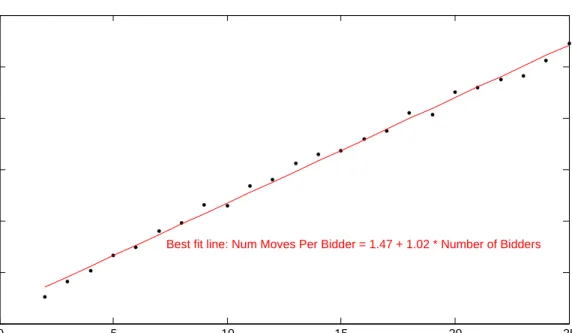
We ran simulations to better evaluate convergence speed in practice. Figure 1 presents convergence time as the number of bidders and number of positions increase identically. For bidders drawn from exponential distributions, conver-gence speed is roughly linear in the number of bidders and positions. Results were similar for bidders drawn from other distributions. A best-fit line (com-puted using OLS regression) shows the number of bids required per bidder; the fit is tight, and the slope of the line is not statistically significantly different from 1. We also simulated other distributions of click-through rates (geometric, pareto, uniform) and valuations (exponential, normal, uniform) in all combi-nations. Results were qualitatively similar, and a linear best-fit line remained a good fit of the number of bids required per bidder, although best-fit slope ranged from 1.02 to 2.81 (with standard error in every case below 0.1).
4
Bidding Dynamics in the Presence of
Con-sumer Search
4.1
Consumer Search Process
We now consider an auction in which click-through ratesθk arise endogenously
as the result of a consumer search process.
We interpret advertisers’ per-click valuations in terms of advertiser quality:
qπ is the probability of meeting an individual consumer’s need; an advertiser
receives a payoff of 1 every time it meets a consumer’s need. With this structure, advertisers’ per-click valuations are again given by the valuesqπ, as the expected
per-click revenue of advertiserπisqπ·1 =qπ.
At all times, a continuum of consumers seek to meet their needs by searching through the sponsored link list. Consumers are assumed to be ignorant of the positions’ dynamics, so their beliefs are independent of the dynamics of advertisers’ bid updating. (A typical consumer will only use a search engine to seek a given product once, hence no consumer has an opportunity to learn about the positions’ dynamics.) Additionally, consumers are assumed to believe that the advertisers’ bidding strategies are strictly monotone in their qualities. This is a reasonable assumption for our purposes. Indeed, Proposition 5 of [3] shows that the static position auction game in this framework has a symmetric pure strategy monotone equilibrium; this equilibrium is the unique equilibrium of both the static game and the dynamic game in our model.
Each consumeri must pay a search cost ofci for each click on a sponsored
search link. Search costsciare assumed to be distributed according to a public,
atomless distribution with support on [0,1] and CDFG. Since search is costly and consumers believe the links to be sorted in order of descending quality, they
0 5 10 15 20 25 0 5 10 15 20 25 30
Num Moves Per Bidder
Number of Bidders and Number of Positions
Best fit line: Num Moves Per Bidder = 1.47 + 1.02 * Number of Bidders
Figure 1: Convergence speed as number of bidders changes.
Simulation details: Number of bidders and number of positions were increased identically as indicated. Bidders updated bids asynchronously in random order. Valuations were drawn from an exponential distribution with mean of 1. All bidders used the BB bidding strategy. Click-through rates were geometric with rate of decline 0.8. Convergence was declared when all bids were within 10−6of
the [9] equilibrium bids indicated in (1). Each plotted point reflects the averaged results of 100 simulations.
examine links from top to bottom. Consumers update their predictions about advertisers’ qualities in a Bayesian manner: when a website does not meet consumeri’s need, she reduces her estimate of the lower websites’ qualities and continues searching if and only if the expected value of clicking on the next link exceedsci. Since consumers are unable to learn about the positions’ dynamics,
we assume that consumers are slightly myopic: an individual consumer will maintain her belief that the advertisers below position j have lower qualities than do the advertisers in positions 1, . . . , j, even if she discovers while searching that the advertisers are not sorted in order of quality.
Suppose that the advertisers with quality scores qπP 1, . . . , q
P
πM are
respec-tively assigned positions 1, . . . , M in some assignment P mapping advertisers to positions. Let zπP1, . . . , zπPM be Bernoulli variables taking the value 1 with probabilitiesqPπ1, . . . , qπPM. Then a consumer whose need has not been met by the advertisers in the firstj ≥1 positions expects that the quality of the firm in positionj+ 1 is ¯ qPj+1:=E(qπj+1|z P π1 =· · ·=z P πj = 0).
The expected probability of the advertiser in the first position meeting a con-sumer’s need is always ¯qP1 :=E(qπ). All consumers can compute this value, as
the distribution of advertiser quality is assumed to be public. From these defi-nitions, it is apparent that ¯qPj >q¯jP+1 for any 1≤j ≤M. Then the advertiser assigned to position j will receive (1−qPπ1)· · ·(1−qPπj−1)·G(¯qjP) clicks. (See Proposition 2 of [3].)
For convenience, we denote ¯
qjt:= ¯qjPt, q¯j := ¯qP
∗
j ,
wherePt is the assignment of positions in roundtandP∗ is the assignment of advertisers to positions in order of descending valuation. With our assumption that q1 ≥ · · · ≥ qN, it follows that qP
∗
πj =qj. Then, by construction, ¯qj ≥q¯
P
j
for any assignmentP and 1≤j≤M.
4.2
Balanced Bidding
We again assume that each advertiserπplays a myopic best-response strategy in each round, submitting bids under the assumption that other advertisers repeat their bids. As before, we assume a random assignment of advertisers to positions at the beginning of the game (round 0), with all initial bids set to 0. Under this assumption, we define arestricted balanced bidding strategy, which is analogous to that of Definition 1.
Definition 10. Therestricted balanced bidding (RBB) strategy is the strategy for advertiserπwhich, given the bids of the other advertisers in roundt,
• targets the positions∗πwhich maximizes the utility of advertiserπamong the positions with no higher expected click-through rate than the adver-tiser’s current positionsπ,
• chooses the bidb∗π for roundt+ 1 so as to satisfy the equation (1−qπ)G(¯qts∗ π)(qπ−p t s∗ π) =G(¯q t s∗ π−1)(qπ−b ∗ π). (5)
(As above, we defineG(¯q0t) := 2G(¯qt1) so that the strategy is well-defined in the
first position.)
Instead, we could require that each advertiserπupdate its bid with attention to long-run equilibrium click-through rates, choosingb∗π to satisfy
(1−qπ)G(¯qs∗ π)(qπ−p t s∗ π) =G(¯qs ∗ π−1)(qπ−b ∗ π). (6)
With this bidding assumption, the proof of Theorem 11 applies directly. In this case, the assumption that consumers always search from the top down is unnecessary, as this search behavior arises endogenously.
As in the model without consumer search, condition (5) arises as the local bidding condition in roundt+ 1 when all advertisers play according to an envy-free, symmetric, strictly monotone equilibrium strategy. Furthermore, just as in the model without consumer search, convergence results for synchronous bid-ding under RBB imply convergence in an asynchronous bidbid-ding model in which advertisers are not required to target positions with expected click-through rates (weakly) lower than those of their current positions.
The key difference between Definition 10 and Definition 1 is (5), providing for round-dependent click-through rates as well as adding a factor of 1−qπ
which arises from the consumer search process.7
4.3
Synchronous Bidding Dynamics
At the unique fixed point of the RBB strategy, the advertisers choose their bids according to the recursive strategy presented in Proposition 5 of [3]. (This is a direct consequence of the proof of Proposition 5 of [3], which shows that these bids satisfy the condition (5).) That is, the bids at the fixed point are given by
bπj = ( qπj − G(¯qj) G(¯qj−1)(1−qπj)(qπj −bπj+1) 1< j≤M, qπj M < j≤N, (7)
where the j-th highest bid bπj is submitted by advertiserπj. Our main result
is the convergence of the dynamic position auction to this fixed point.
Theorem 11. In the synchronous model of dynamic bidding in which click-through rates are determined by consumer search and each advertiser bids every round, the RBB strategy always converges to its fixed point within finitely many rounds.
7Since consumers search from the top down, advertiserπexpects to lose a fraction of clicks
equal to 1−qπwhen switching from positions∗π−1 to positions∗π, as 1−qπis the expected fraction of consumers meeting their needs at positions∗π−1. Including consumer search also changes the computation of the positions∗
π, but this does not materially affect our arguments.
The proof of Theorem 11, which we present in Appendix C, is analogous to the proof of Theorem 2. However, the addition of consumer search to the model produces variation in click-through rates across rounds. This increases the technical difficulty of the argument; in particular, it renders the results of [4] inapplicable.
The additional complexity introduced by consumer search weakens the bound on convergence time. However, even in the presence of consumer search, the en-try of low-quality advertisers does not affect the speed of convergence.
4.4
Asynchronous Bidding Dynamics
As in the case without consumer search, it is possible to extend Theorem 11 to obtain a convergence result for an asynchronous auction in a less restricted strategy space.
Definition 12. Thebalanced bidding(BB) strategy is the strategy for advertiser
πwhich, given the bids of the other advertisers in roundt,
• targets the positions∗π which maximizes the utility of advertiserπ, • chooses the bidb∗π for roundt+ 1 so as to satisfy the equation
(1−qπ)G(¯qts∗ π)(qπ−p t s∗ π) =G(¯q t s∗ π−1)(qπ−b ∗ π). (8) (As in RBB, we defineG(¯qt
0) := 2G(¯q1t), so that this strategy is well-defined in
the first position.)
The BB strategy is a natural envy-free bidding strategy, analogous to Def-inition 8. Unlike RBB, each advertiserπ playing BB may target any position. However, as in RBB, the bid condition (8) arises as the advertisers’ envy-free condition in a symmetric, strictly monotone equilibrium. The bid profile (7) is the unique fixed point of the BB strategy. (This follows directly from Proposi-tion 5 of [3].)
Our next result, which follows from the proof of Theorem 11, shows that the dynamic position auction converges under BB in anasynchronous bidding model in which advertisers update their bids asynchronously, bidding in a uniformly random order.
Theorem 13. Consider the asynchronous model of dynamic bidding in which click-through rates are determined by consumer search, and in which advertisers
• bid in a (uniformly) random order and • follow the balanced bidding strategy.
Then bids converge to the bid profile (7)with probability1 and expected conver-gence time
Ot1(NlogM) +NlogN+M2
M(1+x) .
The proof follows directly from the analysis in the proof of Theorem 9. As before, this result continues to hold if each advertiserπupdates with attention to long-run equilibrium click-through rates, choosing bidsb∗π to satisfy (6) instead
of (8).
5
Discussion and Conclusion
Standard models of position auctions largely ignore the question of how bids converge to equilibrium. Some models assume that advertisers already know each others’ values. (For example, players could learn others’ values through previous interactions that are outside the model.) Other models offer an ap-proach to information revelation that is intended to capture the essence of actual practice despite important differences from reality. (For example, the general-ized English Auction of [9] is a metaphor for GSP but not a realistic desription of the true sponsored search bidding game.) In contrast, the preceding results establish that if players follow a simple bidding rule in the spirit of myopic best response, bids eventually converge to the equilibrium proposed in [9] and [17]. Notably, the convergence process we present arises in strikingly different envi-ronments, including the fixed click-through rate framework of Edelmanet al.[9] and the consumer search model of Athey and Ellison [3].
To identify the conditions supporting our convergence results, we review the key steps of our proofs of convergence:
1. We restrict the strategy space to a class of plausible bidding behaviors (as in Definition 10),
2. We establish that the advertisers with the lowest valuations must eventu-ally bid their values (as in Lemma 17), and
3. We demonstrate that the advertisers who win positions in equilibrium eventually sort monotonically (as in Cases 1–3 within the proof of Theo-rem 11).
These steps are consistent with standard assumptions in the sponsored search literature. For example, some restriction of the strategy space is required to ensure that the bidding equilibrium is unique. Such a restriction is usually included even in static models (e.g., envy-freeness in [9] and [3]). Step 1 com-bines this selection restriction with the requirement that bidders adjust their bids to maximize individual short-term profits. Since it is always weakly dom-inant for advertisers to bid their values, the advertisers who actually receive positions in any position auction should be those with the highest valuations. Hence, Step 2 seems particularly natural. Finally, Step 3 uses monotonicity of the equilibrium strategy and best-response dynamics to establish conver-gence of the auction among the advertisers with the largest valuations.8 Despite
these modest assumptions about bidder behavior, we are able to demonstrate
8Without monotonicity, “bid cycling” may occur. See [7] and [5].
convergence—suggesting that the “well-behaved” properties of sponsored search include convergence under reasonable assumptions.
There are clearly limitations to our study: First, the assumption that the advertisers are able to implement myopic best-responses may not always be re-alistic, as it requires knowledge of both current prices and click-through rates. However, both of these data can be learned as long as they are not changing too rapidly. Second, it is not a priori clear whether advertisers should up-date myopically. However, a recent paper of Nisanet al.[15] partially assuages this concern, by showing that for GSP auctions, an individual advertiser’s best course of action is to best respond whenever all other advertisers best-respond repeatedly.9 Finally, our work is not immune to the standard criticisms about
the practical relevance of position auction models, such as the fact that they do not incorporate budgets.
References
[1] Atlas search - campaign tools. Available at http://advertising. microsoft.com/atlas-search-bid-management. Historic version, listing specific bidding strategies, is preserved by Archive.org at http://web.archive.org/web/20070312022600/http://www. atlasonepoint.com/products/bidmanager/rulesbased?.
[2] Aggarwal, G., Goel, A., and Motwani, R. Truthful auctions for pricing search keywords. In Proceedings of the 7th ACM Conference on Electronic Commerce (2006), pp. 1–7.
[3] Athey, S., and Ellison, G. Position auctions with consumer search. Quarterly Journal of Economics 126 (2011), 1213–1270.
[4] Bertsekas, D. P. The auction algorithm: A distributed relaxation method for the assignment problem. Annals of Operations Research 14 (1988), 105–123.
[5] Bu, T.-M., Deng, X., and Qi, Q. Dynamics of strategic manipula-tion in ad-words aucmanipula-tion. In 3rd Workshop on Sponsored Search Auctions (SSA2007), in conjunction with WWW2007 (2007).
[6] Cary, M., Das, A., Edelman, B., Giotis, I., Heimerl, K., Karlin,
A. R., Mathieu, C., and Schwarz, M. Greedy bidding strategies for keyword auctions. InProceedings of the 8th ACM Conference on Electronic Commerce (2007), pp. 262–271.
[7] Cary, M., Das, A., Edelman, B., Giotis, I., Heimerl, K., Karlin, A. R., Mathieu, C., and Schwarz, M. On best-response bidding in
GSP auctions. NBER Working Paper W13788, 2008.
9This provides a game-theoretic justification to our model in the case that click-through
[8] Chen, Y., and He, C. Paid placement: Advertising and search on the internet. Economic Journal 121 (2011), F309–F328.
[9] Edelman, B., Ostrovsky, M., and Schwarz, M. Internet advertising and the generalized second-price auction: Selling billions of dollars worth of keywords. American Economic Review 97 (2007), 242–259.
[10] Edelman, B., and Schwarz, M.Optimal auction design and equilibrium selection in sponsored search auctions. American Economic Review 100 (2010), 597–602.
[11] Erev, I., and Roth, A. E. Predicting how people play games: Re-inforcement learning in experimental games with unique, mixed strategy equilibria. American Economic Review 88 (1998), 848–881.
[12] Feng, J., Bhargava, H. K., and Pennock, D. M.Implementing spon-sored search in web search engines: Computational evaluation of alternative mechanisms. INFORMS Journal on Computing 19 (2007), 137–148. [13] Kominers, S. D. Dynamic position auctions with consumer search. In
Proceedings of the 5th International Conference on Algorithmic Aspects in Information and Management (2009), vol. 5564 ofLecture Notes in Com-puter Science, Springer, pp. 240–250.
[14] Lahaie, S. An analysis of alternative slot auction designs for sponsored search. InProceedings of the 7th ACM Conference on Electronic Commerce (2006), pp. 218–227.
[15] Nisan, N., Schapira, M., Valiant, G., and Zohar, A. Best-response auctions. In Proceedings of the 12th ACM Conference on Electronic com-merce (2011), pp. 351–360.
[16] Pin, F., and Key, P. Stochastic variability in sponsored search auctions: Observations and models. In Proceedings of the 12th ACM Conference on Electronic commerce (2011), pp. 61–70.
[17] Varian, H. R. Position auctions. International Journal of Industrial Organization 25 (2006), 1163–1178.
A
Proof of Theorem 6
We begin the analysis after theM highest-value advertisers are all bidding above
qM+1and the otherN−M advertisers are all bidding their values. By Lemma 4,
it will take at most logδ((1−δ)(qM−qM+1)/qM+1) rounds to reach this point.
Then we bound the number of rounds it takes for theM advertisers with values
q1, . . . , qM to obtain positions 1, . . . , M respectively, with bids as in (1).
For a pair of advertisersπandπ0, we say that aninversion occurs in round
t+ 1 ifπis ranked aboveπ0in roundt, and then ranked belowπ0in some future
round. This is abad inversionifqπ> qπ0; otherwise, it is agood inversion. First
we prove that bad inversions do not occur under RBB when the click-through rates are geometrically decreasing; hence, the correct ordering is reached after at mostO(M2) inversions. Second we prove there can be at mostM−1 rounds between each good inversion. These two facts together imply that convergence of the topM positions inO(M3) rounds.
Lemma 14. Let πandπ0 be advertisers such thatπhas a higher value thanπ0
and supposeπ holds a position above π0 in round t. Then in all future rounds
t0> t,π holds a position above π0.
Proof. Letjbe the position occuped byπ0in roundtand letj0 be the position thatπ0 targets in roundt+ 1. Letkandk0 denote the corresponding positions for advertiserπ.
First, we observe that k0 ≤j0: Since π0 targets j0, π0 has higher utility at positionj0 than at any positionssuch thatj≤s≤j0. Thus, we have
θj0(qπ0−ptj0)≥θs(qπ0−pts). (9)
Rearranging (9), we find
qπ0 ≥(θj0ptj0−θspts)/(θj0−θs). (10)
Sinceqπ ≥qπ0, (10) implies that
qπ >(θj0ptj0−θspts)/(θj0−θs). (11)
Hence in roundt+ 1,πtargets either positionj0or a position abovej. In either casek0≤j0.
Given that k0 ≤j0, πwill bid bπ = (1−δ)qπ+δptk0 in round t+ 1, andπ0
will bidbπ0 = (1−δ)qπ0+δptj0.10 This implies the desired result.
Lemma 14 implies that bad inversions do not occur under RBB when click-through rates are geometrically decreasing; hence, every inversion is a good inversion. We show next that there can be at mostM−1 rounds between good inversions.
Now, we let S = [s+ 1, M] denote the maximum stable set in round t (as defined in the proof of Theorem 2), and recall that any advertiser assigned a position inS repeats his bid in roundt+ 1.
Letπ1, . . . , πM represent the current assignment of advertisers to positions
1, . . . , M. Our next lemma shows that in every round where there are no inver-sions, an additional position is added to the stable set. As we have reached the RBB fixed point once allM positions are stable, this implies that there can be at mostM−1 rounds between two good inversions.
Lemma 15. If there is no inversion in round t+ 1, then πs targets position s
and bidsbπs=δbπs+1+ (1−δ)qπs (as in (2)) in roundt+ 1.
10Recall that as click-through rates are geometrically decreasing, we haveγ
s = δfor all positionss.
Proof. Under RBB advertiser πs can only target positionsor a lower position
j > s. Ifπs targets and wins positions in roundt+ 1, then by RBB he must
bid as in (2), as desired.
Now, suppose πs targets a position j > s. Then its bid bπs must be less
than the current bidb of advertiser πj. Sincej ∈S, πj sumbits bidbj =b in
roundt+ 1; hence, bπs < bπj =b, and an inversion (between πsandπj) occurs
in roundt+ 1.
Finall, suppose πs targets but does not win positions. Sinceπsis assigned
position s in round t, this implies there is an inversion (between πs and the
advertiser who wins positions) in round t+ 1.
By Lemma 15, we see that if there is no inversion in roundt, then [s, M] is stable in roundt+ 1. Combining this fact with our prior observations completes the proof.
B
Proof of Theorem 9
At roundt, a playerπisactivatedifπis the advertiser who updates his bid (while others repeat their previous bids). To prove convergence in the asynchronous case, we revisit each step of the proof of Theorem 2 (showing convergence in the synchronous case). We analyze the expected number of asynchronous acti-vations required to achieve each round of the synchronous proof, given that the active advertiser is selected with uniform probability in each round.
Step 1. We must first assure thatbπ > qM+1 for π ≤M, andbπ =qπ for
π ≥ M+ 1. Lemma 3 showed this round could be obtained in t1 rounds in
the synchronous setting. To use Lemma 3 in the asynchronous case, we must activate each of the top k+ 1 advertisers once per t1 rounds. Because the
active advertiser is picked uniformly from the N advertisers, in expectation
O(Nlog(M)) activations are required per round to ensure that allM highest-value advertisers update their bids. Thus, after an average of O(t1Nlog(M))
activations, the topM+ 1 advertisers will all be bidding as required. Then each losing advertiser must be activated once so that each losing advertiser bids its value. To ensure that all theN −(M + 1) losing advertisers are activated at least once requires an additionalO(Nlog(N−M)) activations in expectation. Thus in total the expected number of activations to complete Step 1 in the asynchronous setting isO(t1N(log(M) + log(N))).
Step 2. Continuing the argument of Theorem 2, we must assure that the
M highest-value advertisers are sorted correctly. Progress entails increasingly better stable sets (where “better” is defined by the lexicographic orderingAof Theorem 2).
After Step 1, no losing advertiser can afford a slot. Thus, if a losing advertiser is activated, he bids his value, which must be less thanbM. Thus the bids from
losing advertisers will not interfere with the convergence of theM highest-value
advertisers’ bids. However, losing advertisers can still consume activations. We therefore later add a budget of rounds to cover the expected number of losing advertisers’ activations.
We now define a sequence T of activations of the top M bidders. The sequenceT will be partitioned into phases, corresponding to stable sets (defined in the proof of Theorem 2). LetS be the current stable set, let [j+ 1, M] be the slots occupied by the advertisers of S, and letP be the set of advertisers occupying slots [1, j]. Letπmin be the advertiser inP whose value is minimal.
Consider the three cases enumerated in the proof of Theorem 2. The occurrence of Case 1 or Case 2 always results in a new stable set. For each stable set, Case 3 can occur at most x rounds, after which a bid from πmin is guaranteed to
result in a new stable set.
To achieve these results in the asynchronous case, we repeatedly activate the advertiser in slot j until either Case 1 or Case 2 occurs. If neither case occurs afterxactivations, then we activate advertiserπmin. At this point a new
stable set is formed, the current phase ends, and we move on to the sequence of activations required by the next stable set. This completes the definition of sequenceT. As there are 2M stable sets and each stable set requires at most
x+ 1 activations, the lengthT is bounded byt2:= 2M(x+ 1).
How long will it take to activate advertisers in the order given by sequence T, if losers are excluded? With M advertisers, the probability of activating the correct advertiser is at least 1/M per round. Thus the correct sequence of activations will occur afterMt2 rounds, in expectation.
Finally, we add back rounds to account for losing advertisers. We expect (1−
M N)M
t2 losing advertiser activations to occur during Step 2. The second stage therefore requiresMt2+ (1−M
N)M
t2 =O(Mt2) total activations in expectation. Summation. Adding the expected rounds required in Step 1 to those from Step 2, we see that convergence is reached inO(t1(NlogM) +NlogN+Mt2)
rounds, in expectation. It follows that convergence occurs within finitely many rounds with probability 1.
C
Proof of Theorem 11
We denoteγjt(q) := (1−q) G(¯q t j) G(¯qt j−1) and let γ∗(q) := (1−q) max P " max j>0 G(¯qPj ) G(¯qjP−1) !# , γ∗∗:= max 1≤π≤Nγ ∗(q π).We observe that, by construction,
γtj(qπ)≤γ∗(qπ)≤γ∗∗<1
for anyt >0, 1≤j≤M, and 1≤π≤N. The last of these inequalities follows from the fact that ¯qP
j >q¯Pj+1 for anyP and 1≤j≤M, since then
G(¯qjP)
G(¯qP
j−1) <1.
We begin with two lemmata.
Lemma 16. Advertiser π prefers to target position j over position j −1 in roundt+ 1 if and only if(1−γt
j(qπ))qπ+γjt(qπ)ptj< ptj−1.
Proof. Upon algebraic manipulation, this follows from the fact that advertiser
πprefers to target positionj over positionj−1 if and only if (1−qπ)G(¯qtj)(qπ−ptj)> G(¯q
t
j−1)(qπ−ptj−1).
Lemma 17. At every roundt such that
t > t1:= 2 + logγ∗∗((1−γ∗∗)(qM−qM+1)/qM+1),
we have
(
bπ> qM+1 π < M + 1, bπ=qπ π≥M + 1,
wherebπ is the bid of advertiser1≤π≤N.
Proof. If bis the (M+ 1)-st highest bid, thenb ≤qM+1. Ifb < qM+1 in some
roundt, then in the next round any advertiserπ∈ {1,2, . . . , M+ 1}will either bidb0π=qπ or target some positionj ∈ {1, . . . , M}with bid
b0π:= (1−γtj(qπ))qπ+γjt(qπ)ptj
≥(1−γjt(qπ))qM+1+γjt(qπ)b
=b+ (1−γjt(qπ))(qM+1−b)
≥b+ (1−γ∗∗)(qM+1−b).
In both of these cases,qM+1−b0π ≤γ∗∗(qM+1−b).
It follows that
qM+1−b <(1−γ∗∗)(qM−qM+1)
within at most t ≤ logγ∗∗((1−γ∗∗)(qM −qM+1)/qM+1) rounds. Then, the
biddersπ∈ {1, . . . , M}will bid at least (1−γjt(qπ))qπ+γjt(qπ)ptj≥(1−γ
t
j(qπ))qπ+γjt(qπ)b
≥b+ (1−γjt(qπ))(qπ−b)
> b+ (1−γ∗∗)(qM −qM+1)> qM+1
in roundt+ 1. In roundt+ 2, advertiserM+ 1 will bidqM+1 while advertisers π∈ {1, . . . , M} bid aboveqM+1.
Lemma 17 proves that, within finitely many rounds, the set of advertisers competing for theM positions will stabilize and that this set will be the collec-tion of advertisers of maximal quality,{1, . . . , M}. Furthermore, at this time, theN−M advertisers{M+ 1, . . . , N}will bid their values in every subsequent
round. Thus, we may assume that these rounds have already elapsed; all that remains is to show that the bids for theM actual positions eventually converge to the desired fixed point. Since the fixed point is unique, it suffices to prove convergence.
For anyj∈[0, M], we say that the advertisers assigned positions [j+ 1, M] are stable if their allocation is in order of decreasing quality and their prices satisfy equation (5). If all M positions are stable, then we have reached the fixed point of the RBB strategy.
Suppose that, at some roundt > t1, the setS= [s+ 1, M] of stable positions
is not the full set [1, M]. LetP denote the set of advertisers in positions [1, s], and letbdenote the minimum bid of these advertisers. Define a partial orderA on stable sets: S0 AS if either S (S0 or if the advertiser of minimum quality
in (S∪S0)\(S0∩S) belongs toS0.
In roundt+ 1, all advertisers inS repeat their bids. We let the new lowest bid of advertisers inPbeb0π, bid by advertiserπ. We must consider three cases: Case 1: b0π< pts. We letj be the position targeted by π. By Lemma 16 and
the definition of RBB, we haveptj <(1−γjt(qπ))qπ+γjt(qπ)ptj =b0π< ptj−1.
We denote byπj ∈S the advertiser who assigned positionj in roundt. By
the stability ofS, we havept
j−1= (1−γtj(qπj))qπj +γ t j(qπj)p t j. Then, we have ptj−1= (1−γjt(qπj))qπj+γ t j(qπj)p t j >(1−γ t j(qπ))qπ+γjt(qπ)ptj,
from which it follows that
(qπj −qπ) 1 + G(¯qt j) G(¯qt j−1) (qπj −p t j) +qπ−1 ! >0. (12)
Since advertiser πj is assigned position j in round t, we know that qπj ≥p
t j. Furthermore, 0< G(¯q t j) G(¯qt j−1)≤ 1, so G(¯qt j) G(¯qt j−1) (qπj −p t j) +qπ−1 >−1.
It follows that (12) holds if and only ifqπj > qπ. Likewise, we find thatqπj−1 < qπ. Thus,S0 :={π0∈S:qπ0 < qπ} ∪ {π} is stable andS0AS.
Case 2: πtargets positions. Thenπis allocated positionsandS∪{π}AS
is stable.
Case 3: π targets some position j ≤s−1. Then, S remains stable and the minimum bid of advertisers inP has increased. We will show that this case may occur only finitely many times between occurrences of Cases 1 and 2.
As in Section 4.1, we respectively denote the qualities of the advertisers in positions 1, . . . , M byqπ1, . . . , qπM. We then let
:= G(¯qM) 2G(¯q1) (1−γ∗∗) min π6=π0|qπ−qπ0| M Y j=1 (1−qj)
and let x:= log1/γ∗∗((q1−qM+1)/). We will see that at mostxinstances of
Case 3 may occur between instances of Cases 1 and 2.
Lemma 18. Ifpts−1> qπ−, then advertiserπprefers positionsto any position
j < s. Proof. We have qπ−pts= (1−γ t s+1(qπs+1))(qπ−qπs+1) +γ t s+1(qπs+1)p t s+1 ≥(1−γ∗∗) min π6=π0|qπ−qπ0|. (13)
The ratio of the expected utility of position k < sto that of position s is less than G(¯qtk)(qπ−pts−1) Qs j=k(1−qπj) G(¯qt s)(qπ−pts) ≤ G(¯q t k) Qs j=k(1−qπj) G(¯qt s)(qπ−pts) ≤ G(¯q1) Qs j=k(1−qπj) G(¯qt M)(qπ−pts) ≤1,
where the last inequality follows from (13), the fact thatG(¯qst)≥G(¯qM) (since
t > t1) and from the definition of.
Now suppose that Case 3 occurs forxconsecutive rounds. We let πbe the advertiser in P of minimal quality qπ and denote by b(t
0)
the minimal bid of advertisers in P after t0 consecutive rounds of Case 3. If π0 ∈ P submits the minimal bidb(t0+1) in the next round, then
b(t0+1)≥(1−γ∗(qπ0))qπ0+γ∗(qπ0)b(t 0) ≥(1−γ∗(qπ0))qπ+γ∗(qπ0)b(t 0) =qπ−γ∗(qπ0)(qπ−b(t 0) ) ≥qπ−γ∗∗(qπ−b(t 0) ).
Afterxconsecutive rounds of Case 3, we have
b(x)≥qπ−(γ∗∗)x(qπ−b(0)).
Hence,b(x)≥q
π−. It follows from Lemma 18 thatπwill target positionsin
the next round, so the next round is an instance of Case 2. Thus, we have shown that Case 3 may occur only finitely many times between instances of Cases 1 and 2.